Red Sistémica · Violence
Persecutory violence in the Basque Country
A patient tells you he is being followed, watched, that people want to kill him; every day he changes his schedule and his route, and inspects the underside of his car before starting it. Elsewhere in the world, one would think about the dose of haloperidol to prescribe. In the Basque Country of 2004, this is one of the some 40,000 people whose lives are threatened by ethno-nationalist terrorism. Roberto Pereira describes this “terrorism with a lowercase t,” persecutory violence, and its insidious effects on victims and their families: guilt, a shrinking network, the loss of the routines that make up one’s identity, anxiety, depression, exile.
“Terrorism is irrational only from the point of view of those of us who defend the human rights of individuals as coming before anything else.”
Roberto Pereira
The thin line between the “normal” and the “pathological”
When I want to explain to my students the importance of context, or the thin line that often separates the “normal” from the “pathological,” I usually give them the following example:
Vignette
“A patient comes to your office saying that he is doing very badly because he is being followed and watched with the intention of killing him. Every day he leaves home at a different time; if he passes a neighbor, he notices that the neighbor walks past him quickly, looking at him sideways and muttering an unintelligible greeting. Before leaving the building, he looks carefully in both directions, then heads quickly to his car. He walks around it twice, checking whether he notices anything strange, first outside and then inside, and finally bends down to inspect the underside. He always hesitates when inserting and turning the key to open the door, and he always drives off in great anguish. He does not calm down until he has gone three or four streets. He goes to work by a different route and at a different time every day, thinking about how long it has been since he stopped taking his son to school, stopped buying the newspaper at the corner kiosk, stopped having a coffee at the bar near the entrance to his workplace. He has changed all his routines so as not to make things easier for those who want to kill him; he notices that he has lost weight, he looks unwell, he finds himself without friends and perceives the growing worry in the eyes of his family.”
If this account is given to us in one of the few quiet places left in the world, we will immediately think about the dose of haloperidol we are going to prescribe to this client. If it is given in my office, in the Basque Country, I will know that I have before me one of the some 40,000 people whose lives are threatened by Basque ethno-nationalist terrorism.
In reality, it is around 50% of the non-nationalist Basque population whose lives are threatened: those 40,000 people are the ones who have designated themselves by their profession or by expressing their ideas: judges, police officers, politicians at whatever level of commitment, media journalists, participants in citizens’ movements, artists, etc., all unaffiliated with Basque ethno-nationalism.
40,000
people whose lives are threatened in the Basque Country, designated by their profession or their ideas
50%
of the non-nationalist Basque population, whose lives are in reality threatened
100 to 200,000
people who are thought to have left the Basque Country since ETA began its activity, according to the most credible estimates
25 years
long years of ETA activity at the time the author is writing
Terrorism and terror with a lowercase t
All are victims of terrorism, of terror with a lowercase t. I write it this way not because there are differences between some and others, or because it is less harmful or less cruel. I do so to distinguish it from the kind that produces a greater impact on many more people at once: bombs in public places, without prior warning, which affect a large number of people whose only common link is that they were there at that moment, as happened on March 11 in Madrid. Terrorism, whether one or the other, has the same objectives: to impose one’s will on the other, using all necessary means, without concern for the violence of those means.
This terrorism with a lowercase t, less well known but very harmful to a society, has come to be called, in the Basque Country, persecutory violence. It needs the first kind, extreme and repeated violence, for without it it would have neither meaning nor the slightest chance of success. It consists in using violent actions (murders, kidnappings, explosions, etc.) for publicity purposes, to create a climate of threat and harassment that produces a continuous, suffocating feeling of fear, driving the victims to silence, submission or flight.
Terrorism, with a capital T
Bombs, shootings, arson: a massive impact on a large number of people at once, whose only link is having been there. Its effects are well studied under the category of post-traumatic stress disorder.
Persecutory violence, with a lowercase t
Threats, pressure on the person’s circle, insults, burned cars: a climate of continuous, suffocating harassment that sets in insidiously, with even less social recognition and access to support systems.
To create this context, direct and indirect means are used. Among the direct ones are verbal or written threats, pressure exerted on the circle of the threatened person so that he is isolated, insults, setting fire to the car, etc. Among the indirect ones is the multiplier effect of the media coverage of terrorist acts, used more or less skillfully by the terrorists: attacks often occur in the days preceding particularly significant dates or elections, as happened in March in Madrid. Another indirect factor, which has been enormously damaging in the Basque Country, has been the attitude of the “non-violent” nationalist parties: an understanding attitude toward the “misguided patriots,” “the petrol kids,” which has come to create a feeling of impunity and abandonment (the feeling that the person who should defend you is looking the other way, something similar to what happens with the spouses of the incestuous parent), and which leaves the victims of this persecutory violence in a situation of enormous distress.
And what are the effects on these victims?
Studies on the victims of terrorism have focused on the effects of Terrorism with a capital T, that of bombs, shootings or arson, on the victims and their relatives, whose symptoms are grouped under the category of what is called post-traumatic stress disorder.
The effects of this terrorism with a lowercase t are somewhat different. They set in gradually and insidiously, they receive even less social recognition and, consequently, have even less access to support and treatment systems. In fact, one of the aims of this persecutory violence is to make that access more difficult, to limit the possibilities of communication and therefore of asking for help.
In the victims of persecutory violence:
A feeling of guilt
A feeling of guilt frequently appears, linked to the social stigmatization of those whom the terrorists designate as “anti-patriots,” a designation that for many years was taken up uncritically by the Basque nationalist community.
For quite a few years, indeed, a terrorist attack against a citizen whose affiliation was unknown was met with a stock phrase that became remarkably widespread: “he must have done something” (1). The designation of “anti-patriot,” that is to say “enemy of the Basque (nationalist) cause,” thus became the (dis)qualification needed for those who supported or tolerated terrorism to be able to ease their conscience and sleep in peace. This stigmatization of the anti-patriotic enemies (read: any independent journalist, a university professor who speaks freely, or a substitute town councilor in a small village who peacefully defends his ideas) transcends even their murder, and it is not unusual that, a few hours after it, the wife, husband, children or parents of the victims receive telephone calls in which they are mocked, the death of their loved one is loudly celebrated, or they are insulted and told to leave the Basque Country. All this even though it has never been clearly defined who is Basque or a Basque patriot, beyond a few ethnic roots from another age. But in general, all terrorisms converge on this definition: patriots are those who support and help the terrorists, anti-patriots, everyone else.
When the situation drags on, the feeling of guilt extends to the suffering of the harassed person’s family, which sees its life considerably complicated and plunged into vital risk because of its relationship and cohabitation with that person. Doubts as to whether his attitude was the right one, whether he acted correctly in trying to defend his ideas, human rights, his dignity, despite the cost this implies for those around him, increase his anxiety and pain.
A shrinking network
His support networks diminish, through both direct and indirect pressure, that is to say through the fear that something might happen while in the company of the threatened person. After the first reaction of solidarity (if there is one) when the threat becomes known, comes that of progressive distancing and reduced contact from a good part of the social network. This is why many threatened people strive to keep their condition from becoming known. It is not uncommon for the family itself to fail to understand the conduct of the threatened person and to interpret it as though he had put himself voluntarily in such a situation, since he knew about it in advance.
The loss of routines
An inevitable change of routines takes place, as our patient described. Many habits have to be modified, for one’s own safety or for that of those around one. These routine behaviors constitute our identity and it costs a great deal to give them up, because doing so produces an intense feeling of disorientation and unease. One can no longer pick the children up from school, or have a coffee in one’s favorite café while leafing through the newspaper, or take the pleasant evening walk. One goes out less and less, and the circle of relationships shrinks even further.
This is one of the things that arouses the most resistance, and failure to comply with it has led to the carrying out of many murders. The terrorists, who in the Basque Country show a great interest in preserving their own lives, need these routine behaviors in order to draw up a plan of attack that will allow them, in addition to success, to ensure their escape. They know that sooner or later they will be imprisoned (“They all fall” is another stock phrase that has been widespread for many years within nationalism itself), but they count on the prisoner support networks to make it more bearable, and on pressure from the nationalist parties to obtain a new amnesty at some point (there were two during what was called the “democratic transition” in Spain, in the course of which hundreds of ETA prisoners were released, most of them rejoining the organization). It matters little that political developments now make this very unlikely: that is why ever younger terrorists are recruited, who take even less account of these considerations.
A world view turned upside down
The modification of routines and habitual behaviors, the reduction of communicational interactions, the perception of a certain ring of preventive isolation around oneself, the necessary increase in attitudes of mistrust as an indispensable activity for safeguarding one’s own life and that of one’s family, the difficulties in doing one’s job properly, all of this, often established brutally, produces an intense modification of the persecuted person’s view of the world, who must make an intense effort to adapt to this new reality, so different and so threatening. This necessary adaptation is sometimes made with little outside support, since for the institutions he becomes one more burden, and the immediate family is busy with its own adaptation. We have already said that the social network shrinks; all this, together with the loss and the terror produced by the continuous and diffuse threat to life, leads to the appearance of numerous symptoms.
Anxiety, silence, depression, departure
Threatened people suffer from intense anxiety, which varies in intensity and duration over the course of the day and according to the activities carried out. Anxious symptomatology frequently appears, often persecutory, accompanied by fear, isolation and sometimes an increase in the consumption of toxic substances or sedatives. These are frequently self-administered, given the fear the threatened person feels about asking for help if he is not sure who is going to listen to his words.
The Basque Country is divided almost 50/50 between a nationalist and a non-nationalist population, which, in most cases and for various reasons, does not make its political affiliation explicit. Thus, almost no one knows “who they are talking to,” and everyone is careful not to express their opinions. Politics is rarely discussed, except in circumstances of great intimacy, for fear that divisions and confrontations might arise between friends or within the family itself, or, in the worst case, that it might reach the ears of someone who could make perverse use of that information. Frequently, the information ETA needs to murder someone comes from the neighbors of the murdered person. Conversely, the media are highly “politicized,” and political activity concentrates on this same theme in a very high proportion.
Sadness, fatigue and discouragement gradually make their appearance, often constituting depressive syndromes. Finally, if social and family support is not perceived, or if the tension is unbearable or goes on too long, and if there is an opportunity to do so, the victim chooses to leave the Basque Country.
As one might suppose, it is difficult to obtain reliable figures on the number of people who have left the Basque Country because of nationalist pressure. The most credible estimates speak of 100 to 200,000 people since ETA began its activity, twenty-five long years ago now. Beyond these figures, it is a fact that the Basque Country is losing population, and that it is one of the regions with the lowest birth rates in the world.
The terrorists thus achieve their objective: an ethnic cleansing that reduces the non-nationalist vote and culture in the Basque Country, so that, through a muted but effective process, they gradually achieve homogenization. Let us not forget that terrorists are heartless and amoral, but that they are not stupid. Terrorism is irrational only from the point of view of those of us who defend the human rights of individuals as something that comes before anything else; for those who place the supposed rights of the “Basque people” above those of the individuals who make up that supposed people, their action is not irrational, and may even be justified.
Key takeaway
Persecutory violence targets precisely what would make it possible to cope with it: it limits communication, makes access to help more difficult and shrinks the network. The therapist must therefore read the symptoms (persecutory anxiety, mistrust, isolation, self-medication, depression) in the light of the context, or risk mistaking a vital adaptation for a delusion.
A mayor’s testimony
Finally, to illustrate some of the things said above, I reproduce a few paragraphs from the statement of Ana Urchueguía, socialist mayor of a town of around 18,000 inhabitants near San Sebastián, before the Committee of the Regions of the European Union (April 2003):
Ana Urchueguía, Committee of the Regions of the European Union, April 2003
“My life has been in danger on multiple occasions; they very much want to murder me. I am assured that I am a priority target, and there is nothing I can do to avoid it. … I have needed protection since the 1980s. When I was giving birth to my youngest son, the Civil Guard was guarding my door. My newborn nephew, I see him in my office to avoid the risks. Every time I want to do something, I must first weigh the risks that I and those around me are running.
We non-nationalist town councilors are the object of all kinds of aggression. … We are abused, threatened, our cars and our houses are burned; our neighbors pass information to the commandos who are going to make attempts on our lives. To survive, we must be escorted, accept the sequestration of our freedom. It is very difficult, even for the people closest to us, to understand the drama in which we live, the personal cost that being a town councilor and defending legality entails in Euskadi… (Accepting to be a non-nationalist town councilor) is accepting the end of personal freedom, the beginning of a life full of dangers and problems for us and for all those we love. It is the end of family peace, it is the anguish of knowing that, when you say goodbye to your son with a kiss, it may be the last kiss he will receive from you. That when you close the door of your house, you may never again see everything you are leaving inside. Many families have already been broken by the terrorists’ bullets.
Our families are our great anguish. They are the most innocent victims of this whole situation. They must accept our commitment, from the smallest children to the oldest, from your spouse to your parents. And the suffering is great, the silences are painful. We chose; they did not. How do you overcome the cruelty of receiving a death threat in the pocket of your son of barely a few months, when his grandfather took him out for a walk?”
Bilbao, May 2004
Notes from the original
(1) Editor’s note from Perspectivas Sistémicas: the pathetic expression “he must have done something” reminds us of the years of lead of the military dictatorship in Argentina, during which, in the face of State terrorism, many people, terrorized, victims of the learned helplessness syndrome, repeated the phrase in question like a litany. It seems to be one of the symptoms of any society that lives under a climate of persecution, denunciation and arbitrary repression and which, in its despair, seeks a pseudo-explanation for what has none and which is, quite simply, the expression of the effect produced by being subjected to situations and contexts such as those Dr Pereira describes. On this subject, we recommend reading Carlos Sluzki’s article “Palabras recuperadas, mundos recuperados” (Perspectivas Sistémicas no. 34, December 1994 – February 1995).
(*) This article was published in no. 81 of Perspectivas Sistémicas, May-June 2004.
Who is Roberto Pereira
Dr Pereira is president of the Spanish Federation of Family Therapy Associations, director of the Basque School of Family Therapy and foreign scientific advisor (Bilbao) to Perspectivas Sistémicas.
This article is an English translation of “Violencia de persecución en el País Vasco”, published by Red Sistémica (first published in Perspectivas Sistémicas, n° 81, mai-juin 2004). Translated and republished with the journal’s permission.
Read the original articleHow to cite this article
Pereira, R. (2022). Persecutory violence in the Basque Country (Complexe Systémique, Trans.). Complexe Systémique. https://app.complexe-systemique.com/en_GB/articles/persecutory-violence-in-the-basque-country (Original work published in 2004 in Perspectivas Sistémicas, n° 81, mai-juin 2004; republished in 2022 by Red Sistémica, https://redsistemica.ar/2022/07/19/violencia-de-persecucion-en-el-pais-vasco/)
To go further
- The manifestations of psychological trauma: how to recognize the signsThe effects of “Terrorism with a capital T,” which Pereira distinguishes from persecutory violence.
- Facing violence and indifference in non-therapeutic settings (part 1). Interview with Eduardo CárdenasThe indifference of those around you as a second trauma: an Argentine echo of “he must have done something.”
- Violence explained for therapyUnderstanding violence as imposing one’s will on the other, the very definition Pereira gives of terrorism.
Related training courses
 Symposium
Digital technology, AI and mental health
Conference in Lyon, 11 December 2026: digital technology, artificial intelligence and mental health. Six talks, replay for participants. In French.
 Short course
The suicidal crisis in adolescents and young adults
Training: assessing and supporting the suicidal crisis in adolescents and young adults. Clinical landmarks and systemic tools. In French.
Related articles
 Article
 Toxic, narcissistic, borderline: what therapy speak does to your relationships
Narcissistic, borderline, toxic: therapy speak has left the consulting room. Julien Besse shows how these labels close the debate and relieve us of our own part.
 Article
 Relearning couplehood after exile and violence
At the Maison d’Ella, Ivy Daure receives exiled women who have survived violence. Her work: relearning relationship so as not to form a couple by the same grammar again.
 Article
 First Psychological Aid for Families During War: Integrating the Narrative Approach With Emotionally Focused Therapy (EFT)
Three or four meetings for families living under the threat of war: telling their story before a witness, then repairing the attachment cycle disrupted by fear.
 Article
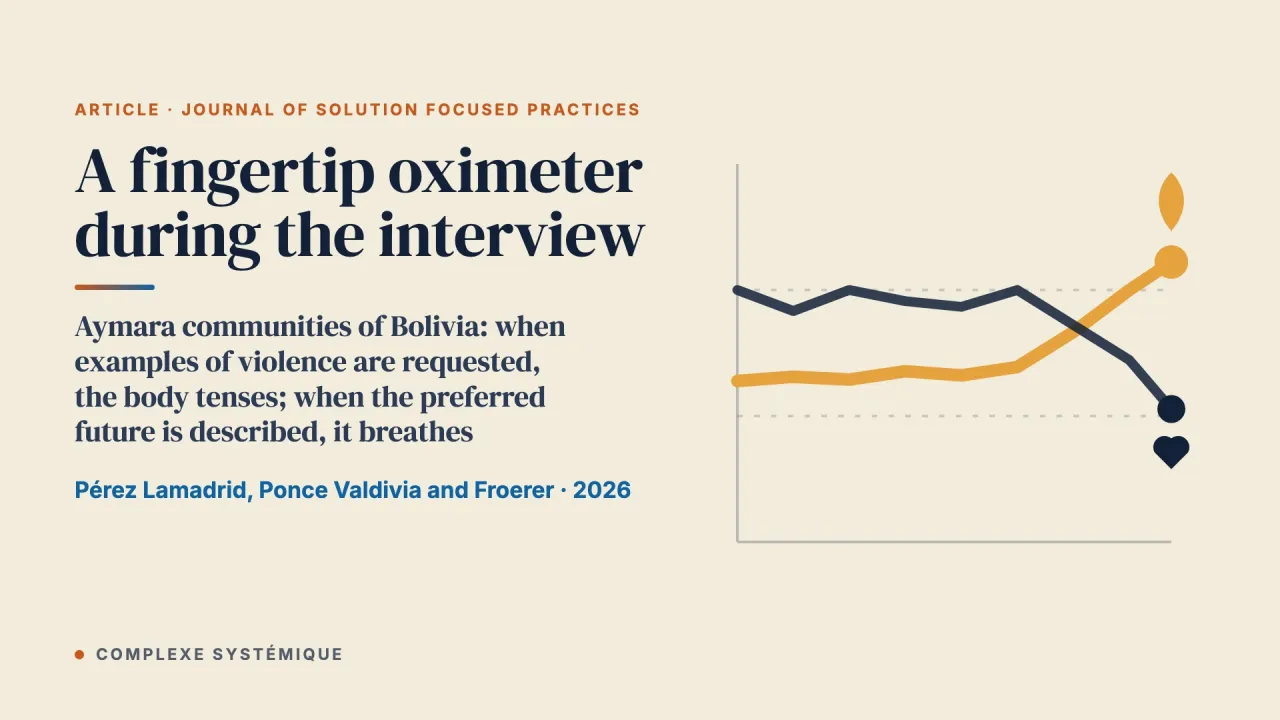
 Oxygenation and Heart Rate in Solution-Focused and Problem-Focused Interviews With Rural and Indigenous Aymara Communities (Viacha and Laja) Regarding Intersectional Violence
A fingertip oximeter on 19 Aymara people of the Altiplano: the problem-focused interview tenses when examples of violence are requested; the solution-focused one oxygenates and slows the heart.
Comments 0
Log in to join the discussion. Log in