Red Sistémica · Violence
Polemical reflections on abuse. Some feedback from a seminar “Narratives of love, stories of abuse”
Invited by the Revista de Psicoterapia to write an article on abuse shortly after the publication of his book on family abuse between therapy and control, Juan Luis Linares refuses to serve up “leftovers” and chooses another path: making public the critical correspondence exchanged with a participant in one of his seminars, to illustrate the importance of ideological confrontation on questions relating to abuse.
“It is the author’s privilege to sow doubt, just as it falls to the reader to assert their own interpretation.”
Juan Luis Linares
Preamble
When I received from the Revista de Psicoterapia the invitation to write an article on abuse, besides rushing to accept, I began to reflect on the possible approaches and contents. As the publication of my book Del abuso y otros desmanes. El maltrato familiar entre la terapia y el control (“Of abuse and other excesses. Family abuse between therapy and control”) was very recent, the first temptation was to indulge in the practice of cut-and-paste and cobble together a rehash of myself, clipping paragraphs here and there. I must say, in honour of my own honesty and, above all, of the respect this journal inspires in me, that the idea was quickly discarded. But the demon of intellectual laziness does not easily give up its enterprises, so that I was soon assailed by a second temptation: to put together a new text which, in the form of an article, would inevitably reproduce the fundamental contents of the book. I also rejected this idea, which seemed to me unstimulating and just as ambiguous from the point of view of editorial ethics: the book would always be better and more complete and, moreover, an article of this kind would supplant what good reviews ought to be.
That was where things stood when, following one of the seminars on abuse that I gave at that time, I received a letter from one of the participants, training as a family mediator and a professional in the vast territory of socio-therapeutic services. The letter was critical, but grateful and respectful; so, although it caused me a certain irritation (the kind I feel almost every time that, despite my efforts, I do not feel understood), it also made me want to reply, since the image I had of its author remained no less kind and friendly.
I let a few weeks go by and, indeed, I replied to her, while beginning to form the idea of giving publicity to both letters, to illustrate the importance of ideological confrontation on questions relating to abuse. I first thought of asking my correspondent’s permission and even offering her co-authorship of the resulting text, but this generosity, which would no doubt have honoured me, would have enormously complicated the process of elaboration, to the point, who knows, of perhaps making any concrete result impossible.
I therefore chose to assume full responsibility for the writing, making the identity of my polemicist student unrecognizable, to the point of legitimizing speculation as to whether this article is, as it apparently claims, strictly documentary or, on the contrary, a work of fiction. It is the author’s privilege to sow doubt, just as it falls to the reader to assert their own interpretation. What I hope and wish is that this play of intersubjectivities, intended to make the contents more pleasant, does not distract the reader from what is essential in them, and that the maxim uniting the documentary and fictional genres prevails: “se non è vero, è ben trovato”.
Key takeaway
Rather than summarizing his book, Linares chooses to stage a disagreement: the critical letter of a future family mediator and his own reply. The device – the correspondent’s identity made unrecognizable, doubt maintained between document and fiction – serves a substantive point: on abuse, the ideological confrontation between therapy and control is fruitful and deserves to be made public.
Theoretical contextualization
Editor’s note
The excerpt published by Red Sistémica breaks off here, at the threshold of the section “Theoretical contextualization”. The full text appeared in Perspectivas Sistémicas no. 84.
Who is Juan Luis Linares
Juan Luis Linares is a psychiatrist and full professor of psychiatry at the Autonomous University of Barcelona. He directs the Psychotherapy Unit and the School of Family Therapy of the Hospital de la Santa Creu i Sant Pau.
This article is an English translation of “Reflexiones polémicas sobre el maltrato. Algunos feed-backs de un seminario titulado Narrativas de amor, narraciones de maltrato”, published by Red Sistémica (first published in Perspectivas Sistémicas, n° 84). Translated and republished with the journal’s permission.
Read the original articleHow to cite this article
Linares, J. L. (2022). Polemical reflections on abuse. Some feedback from a seminar “Narratives of love, stories of abuse” (Complexe Systémique, Trans.). Complexe Systémique. https://app.complexe-systemique.com/en_GB/articles/polemical-reflections-on-abuse-some-feedback-from-a-seminar-narratives-of-love-stories-of-abuse (Original work published in 2022 in Perspectivas Sistémicas, n° 84; republished in 2022 by Red Sistémica, https://redsistemica.ar/2022/07/19/reflexiones-polemicas-sobre-el-maltrato-algunos-feed-backs-de-un-seminario-titulado-narrativas-de-amor-narraciones-de-maltrato/)
To go further
- The silent cries of child abuse. Interview with Marco VannottiAnother systemic clinician on abuse: what the child cannot say.
- When 'helping' becomes a subtle violence: what Guy Hardy's journey unsettles in usTherapy or control? The tension Linares places at the heart of his book, seen from mandated help.
- Violence: understanding and interveningA systemic framework for reading intrafamily violence and choosing the level of intervention.
Related training courses
 Online course
Master the art of narrative therapy: a unique journey with Charlie Crettenand
Immersive online course: discover the narrative approach with Charlie Crettenand. A unique audiovisual journey, lifetime access, exercises. In French.
Related articles
 Article
 Relearning couplehood after exile and violence
At the Maison d’Ella, Ivy Daure receives exiled women who have survived violence. Her work: relearning relationship so as not to form a couple by the same grammar again.
 Article
 First Psychological Aid for Families During War: Integrating the Narrative Approach With Emotionally Focused Therapy (EFT)
Three or four meetings for families living under the threat of war: telling their story before a witness, then repairing the attachment cycle disrupted by fear.
 Article
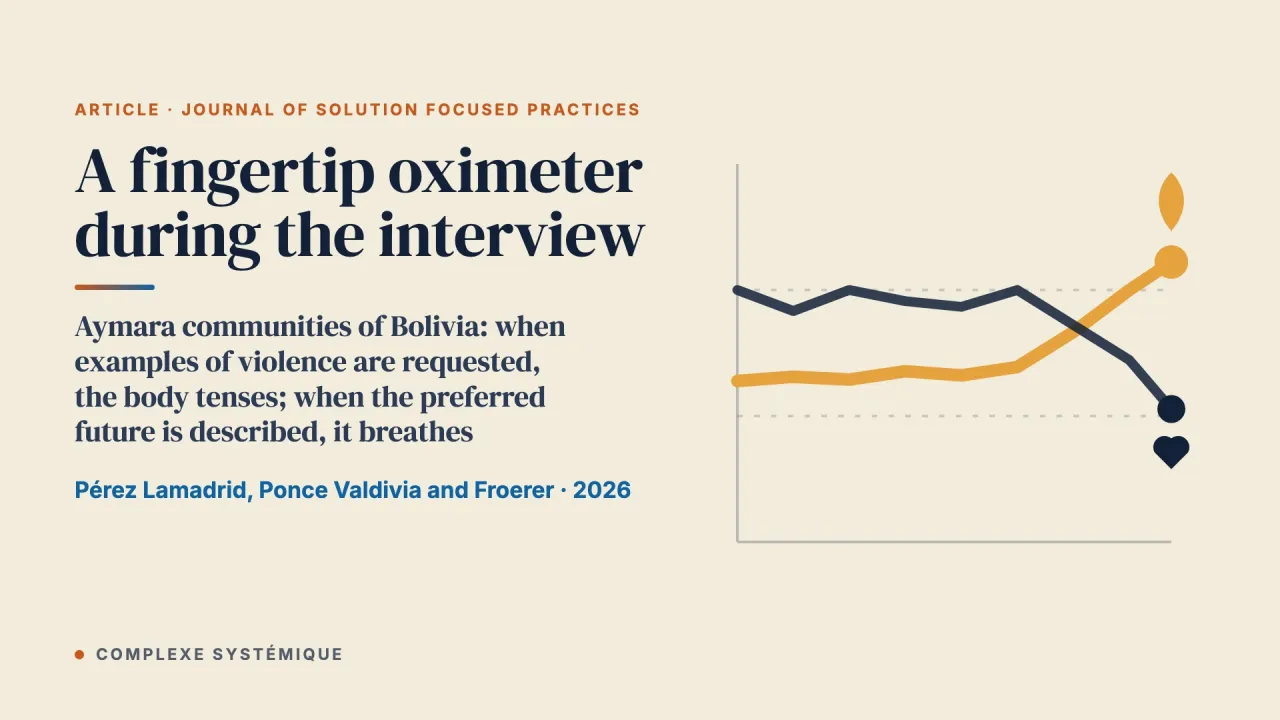
 Oxygenation and Heart Rate in Solution-Focused and Problem-Focused Interviews With Rural and Indigenous Aymara Communities (Viacha and Laja) Regarding Intersectional Violence
A fingertip oximeter on 19 Aymara people of the Altiplano: the problem-focused interview tenses when examples of violence are requested; the solution-focused one oxygenates and slows the heart.
 Article
 Ways of Supporting Coparenting in Child and Family Services: Discourses of Involvement, Capacity Building and Reconciliation
Involving the father, building capacity, reconciling after divorce: three ways of supporting coparenting in Finnish family centers, and one blind spot, the child.
Comments 0
Log in to join the discussion. Log in