Red Sistémica · Psychotherapy
The real as the possible: psychotherapy as screenplay
What is at stake in the very first sessions? Claudio Des Champs sees them as the moment when the screenplay of the therapy is decided: depending on the questions asked, the words picked up and the attention given to resources rather than to what is missing, the consulting system starts telling one version of its story rather than another. The author brings together narrative practice, psychotherapy research — the therapeutic alliance and the client’s theory of change —, the contribution of positive psychology and resilience, emotional contagion and mirror neurons, and Boscolo and Bertrando’s “Self-Reflecting Ring of Time”, which moves the session from past to future in order to make change credible.
Abstract
This article will describe the importance of the first psychotherapeutic sessions/encounters. It will take into account systemic epistemology and practice, particularly the Narrative, the notion of emotional contagion — mirror neurons, psychotherapy research — the therapeutic alliance and the client’s theory of change —, and the contribution of positive psychology and resilience, thereby creating the possibility of lasting change on the basis of a new screenplay that will also use the Self-Reflecting Ring of Time to stabilise confidence and the perception of progress despite the vagaries of circumstance in the unfolding lives of human beings, of consulting systems.
“The problem is not to try to fit therapy to a particular (diagnostic) classification, but to know what potentialities the patient reveals to you as to his capacity to do this or that.”
Milton Erickson
“An essential notion of crisis is the intermediation of the actual and the virtual, the possible; what is at stake is invention, creative imagination.”
The scene of the session: the importance of the welcome
The first therapeutic sessions are fundamental in building an optimistic working team that aims to create a context open to change, non-psychopathological, centred on change, on resources, competences, solutions and resilient processes. One must take into account the characteristics of the client’s world — work, family, leisure — and also, if there are any, the other professionals directly or indirectly involved. That is to say the wider, more complex environment which will react to my interventions, independently of the effectiveness of the therapy or of the client’s satisfaction or dissatisfaction with it.
Clients realise very quickly, from the first questions, the first reactions, the first exchanges, what the therapist is proposing and what he is most interested in: in what is missing, in what went wrong, or on the contrary in competences and in the way of taking up what happened before. From that moment on, the client system follows the movement.
Patients or clients?
Doctor Knock, in Jules Romains’s play, holds that people in good health are merely sick people who do not yet know that they are sick.
Jules Romains, Knock
How do they present themselves, these psychotherapy clients/consultants? Generally, as patients, a word of medical origin. So they come to be cured. If they are going to be cured, are they ill? Psychology belongs to mental health, and therefore to the world of illness and cure. These clients present themselves in a passive attitude, and complaint accompanies this beginning. Their position, according to one of Watzlawick’s axioms of communication, is complementary inferior in relation to that of the therapist. With a more or less elaborate screenplay, presented as a fait accompli: “here we are, with these symptoms, in this situation because of this or that, because of me, of them, of him or of her, in these circumstances: what can you do about it from there, doctor, can you cure me, can you explain it to me, can you help me?” It sounds like the beginning of a film, a novel or a play: from this fact, from this communication, the story will unfold. Or not. Or not, because if I listen to this account as a version, as a text, instead of listening to it as a fait accompli, that means that many other versions are possible. So rather than a new screenplay, by way of a stage of improvisation, of creation that will not look like creation, we may arrive at an adaptation, in the sense of a film or a play that is almost the same and yet different. When the source of inspiration of a screenplay is an original work already published, we speak of an “adaptation”. It may be a novel, a short story, or something created in the form of a play or a musical. Or of a therapeutic session. During the session we shall take into account the original elements, the facts and the characters of the version presented by the consulting system, and even other colleagues who might know these clients and speak to us about them, or any report or file concerning them. But once the session has begun, the patients/clients will have — fortunately — no other possibility than to tell, or rather to tell themselves and to tell me, their story, their conflict or their misfortunes, within a conversation in the course of which certain questions I might ask, certain inflections of my voice, facial expressions, starts, glances, indifference or interest will release and create new meanings. These new adaptations and/or reconstructions of the same facts, which did not exist before and are henceforth equipped with new words and new possible interpretations, will be part of the beginning of a possible new life story/screenplay.
Psychotherapy research and the praxis of the encounter
Since 40% of positive outcomes in psychotherapy depend on extratherapeutic variables (the client’s), factors that belong to the client and his environment and that contribute to change, according to the data of psychotherapy research (Lambert, 1992), this new screenplay, or new adaptation or reconstruction, will have to be co-constructed with the client system within the praxis of the encounter. That is to say within that unprecedented, singular conversation which can take root and become part not only of the clients’ lives but also, consequently, enrich their narrative identity, since our identity is inevitably constituted, constructed, by stories. It is bound up with the possible, with what reality allows in this unique case. It can adapt itself to the bio-psycho-social capital of each individual, to his degree of maturity or immaturity, to his mode of functioning, to the words he uses to define, present and explain his vision.
Moreover, it is inscribed in a given time and space, within a process of change: what can be thought today may no longer be thinkable tomorrow, and it is quite likely that only yesterday one was not yet ready to imagine it.
“The praxis of the encounter is a co-creation between the therapist/mediator and the client system: the succession of interventions, the form these take, is built out of the exchanges; they are the consequence and the origin at one and the same time.”
This has to happen in a situation of respect and cordiality and, from the very beginning, by working to establish a solid therapeutic alliance, which accounts for 30% of the prediction of possible success or failure (Alexander, Luborsky, 1986) in the field of psychotherapies.
And let us not forget the 15% produced by the placebo factor, that is to say expectations, the improvement produced by the fact that the client knows he is undergoing psychotherapeutic treatment and supposes that it will do him good.
The client’s theory of change (Duncan, Hubble and Miller, 2003), the consultant’s/client’s way of envisaging his own change, of looking for solutions to his problem, and his active collaboration, are essential factors of therapeutic success.
Once the bond between the therapist and the consulting system has been consolidated, the construction of a new story becomes possible, the creation of a story/chimera in Boris Cyrulnik’s terms (2008), which will allow the client to recover his dignity; and as a consequence the process of resilience gets under way.
Temporality in psychotherapy: temporal circularity, or the “Self-Reflecting Ring of Time”
An essential aspect of this approach is the concept discovered by Milton Erickson in his 1954 article “Pseudo-orientation in time as a hypnotic procedure”, taken up by Steve de Shazer in 1980 with his “miracle question” (1985, 1991) and developed throughout Boscolo and Bertrando’s book The Times of Time. A New Perspective in Systemic Therapy and Consultation (1993).
Erickson describes hypnosis not only as a technique of regression to the past but also as an orientation towards the future, in which it suggests to the client that he has already achieved the goals he now wishes for. De Shazer would take up this technique without hypnosis, in search of solutions and considering problems as essentially situational and as anchored in language. It is the client who will be the sole judge of what constitutes a solution, and it is also he who will decide that things are going well enough for therapy to stop (1995). This dovetails with the client’s theory of change (Duncan, Hubble and Miller, 1997), described above.
Boscolo and Bertrando’s concept of the “Self-Reflecting Ring of Time” is particularly interesting here.
Imagine the movement of a swing in slow motion, going in search of the past of the present, looking for images and memories that will reinforce, for instance, positive aspects, and then coming back, inevitably, and moving into the present of the present. This will allow me to observe what is happening within me, in my mental image, what the result is, the effect of that strategic narrative return. And, seamlessly, the movement of that swing, still in slow motion, will go forward, towards the present of the future. Everything takes place, as in a film, during the hour of the session, and in those prospective scenes, set in a possible future, we shall co-construct an entirely plausible future, stimulating, a catalyst of proactive actions that will lead to the fulfilment of those goals, those projects, those dreams. Or, at the very least — which would already be no small thing —, those scenes will transform the clients’ present vision of their past and allow them to face the challenge of the present of the present and of the immediate future with a more confident attitude and better self-esteem.
Anchoring, positive emotional contagion and mirror neurons
To conclude, the anchoring aspect of these stories lies in the technique of questions, of positive connotations among others, of my verbal and non-verbal responses, unprecedented until that moment. This will widen the field of the possible, since stories belong to narrative thinking, always open to new meanings.
Account will be taken both of the meticulous observation of verbal and above all non-verbal or analogical responses — signs of assent, for instance — and of the expression of positive emotions or feelings of acceptance of the new story.
The techniques of oral narration, the action that moves forward, the detailed descriptions, are important: screenwriting, let us remember, differs from literary writing in its presentation of visual and auditory facts, always in the present tense, and comes close in that respect to writing for the theatre. A screenplay is meant to describe or suggest what we shall see and hear in a film.
Besides the dialogue, a screenplay also contains descriptive passages (the visual and auditory directions). During sessions, descriptions of the deeds that are going to be accomplished have a very important suggestive effect.
In the same way, the therapist’s enthusiasm and state of mind will be an essential factor: we must take into account emotional contagion, the brain Wi-Fi described by Daniel Goleman in Social Intelligence (2007), and the empathy felt through the mirror neural network system described by Giacomo Rizzolatti, Gallese, Iacoboni and others, on the basis of the discovery of mirror neurons, thanks to which the effect of our interventions can be observed in that brain which acts at the moment when we observe the actions of others.
“The research group of the Institute of Neurophysiology of the University of Parma, led by Rizzolatti, made, at the beginning of the 1990s, a discovery of great importance for the understanding of mental processes: that of mirror neurons. These neurons are activated when goal-directed actions are performed, but also when we observe the same actions performed by others… The same chains of neurons are involved not only in the recognition of the other’s action, but also in its why, that is to say in the intention that motivated it. These processes… are structured on the basis of circuits that work as if: it is not possible to understand the meaning and the intentions of the other in what he does except by imitating and reproducing his action in our own body (Rizzolatti & Sinigaglia, 2006). It is this process that Gallese calls an embodied simulation (Gallese, 2005 et al., 2006). It underlies psychological and relational phenomena of great importance such as empathy, emotional identification with the other, and affective attunement.” (Onnis, 2010)
These neuroscientific aspects constitute further pillars of this therapeutic approach, which aims at the emergence of evolution, at the flourishing of the possibilities of lasting change and of positive emotions in the individuals, couples, families or wider systems with which we interact.
Taking up Doctor Knock’s formula again, one might say that:
“Most of the time, our patients/clients are people in good health who do not know it.”
Claudio Des Champs, 2010
Buenos Aires, 28 August 2011.
Author’s note
This article is a revised and expanded version of the author’s paper given at the 7th EFTA Congress, 29, 30 and 31 October 2010, in Paris.
Who is Claudio Des Champs
Claudio Des Champs is a psychologist and an individual, couple and family psychotherapist. A university professor in Buenos Aires, he is a teacher, founder and supervisor of the ESA (Escuela Sistémica Argentina). Founding editor and director of the journal Perspectivas Sistémicas (1988-2007), he runs the website redsistemica.ar.
References
Onnis Luigi (2010). « Les voix intérieures de la famille. Mythes et fantasmes familiaux », chapitre I de Thérapie familiale en Europe : inventions à cinq voix, Goldbeter-Merinfeld E., Linares J. L., Onnis L., Romano E., Vanotti M., Éditions De Boeck Université, Bruxelles, Belgique.
Des Champs Claudio. « La Cour des Miracles de Rosario. Un travail communautaire systémique axé sur la crise », dans Auto-référence et thérapie familiale, Cahiers critiques de thérapie familiale et de pratiques de réseaux, n° 9, novembre 1998.
Des Champs Claudio. « Pathologie de la famille et interventions thérapeutiques dans un environnement démocratique : quels effets ? », mai 2006. Exposé de la 53e Conférence internationale du CIRCF (Commission internationale des relations du couple et de la famille), « Famille et démocratie, compatibilité, incompatibilité, chance ou défi », 7-10 juin 2006. Ce travail a été publié sur le site et dans le cahier de l'Exposition 2006 du CIRCF, en anglais et en français.
This article is an English translation of “Le Réel comme le Possible : la Psychothérapie comme Scénario”, published by Red Sistémica (first published in 7e Congrès de l’EFTA, Paris, 2010). Translated and republished with the journal’s permission.
Read the original articleHow to cite this article
Des Champs, C. (2023). The real as the possible: psychotherapy as screenplay (Complexe Systémique, Trans.). Complexe Systémique. https://app.complexe-systemique.com/en_GB/articles/the-real-as-the-possible-psychotherapy-as-screenplay (Original work published in 2010 in 7e Congrès de l’EFTA, Paris, 2010; republished in 2023 by Red Sistémica, https://redsistemica.ar/2023/01/30/le-reel-comme-le-possible-la-psychotherapie-comme-scenario-articulo-en-frances/)
To go further
- The clinic of change, or positive psychology avant la lettreThe same intuition, seen from the history of ideas: systemic therapists were already working with resources before positive psychology gave them a name.
- On resilience. The thought of Boris CyrulnikWhat the “story-chimera” invoked here really covers: resilience according to Cyrulnik, and the narrative that gives dignity back.
- Scientific research in outcome evaluation in psychotherapyThe figures quoted in this text, put back in context: what research actually measures of the effectiveness of psychotherapies.
Related training courses
 Short course
Training in the Strategic Resolutive Method
Training in the Strategic Resolutive Method: analysing how problems persist and building strategies for change. Online, delivered in French.
 Online course
Master the art of narrative therapy: a unique journey with Charlie Crettenand
Immersive online course: discover the narrative approach with Charlie Crettenand. A unique audiovisual journey, lifetime access, exercises. In French.
Related articles
 Article
 The AFFIRM Model for Navigating Challenges in Continuously-Interfaith and Divergent-Interfaith Marriages
Thirty happy interfaith couples describe how they navigate their religious differences: five processes, from respecting each other’s choices to religious intimacy, gathered in the AFFIRM model.
 Article
 First Psychological Aid for Families During War: Integrating the Narrative Approach With Emotionally Focused Therapy (EFT)
Three or four meetings for families living under the threat of war: telling their story before a witness, then repairing the attachment cycle disrupted by fear.
 Article
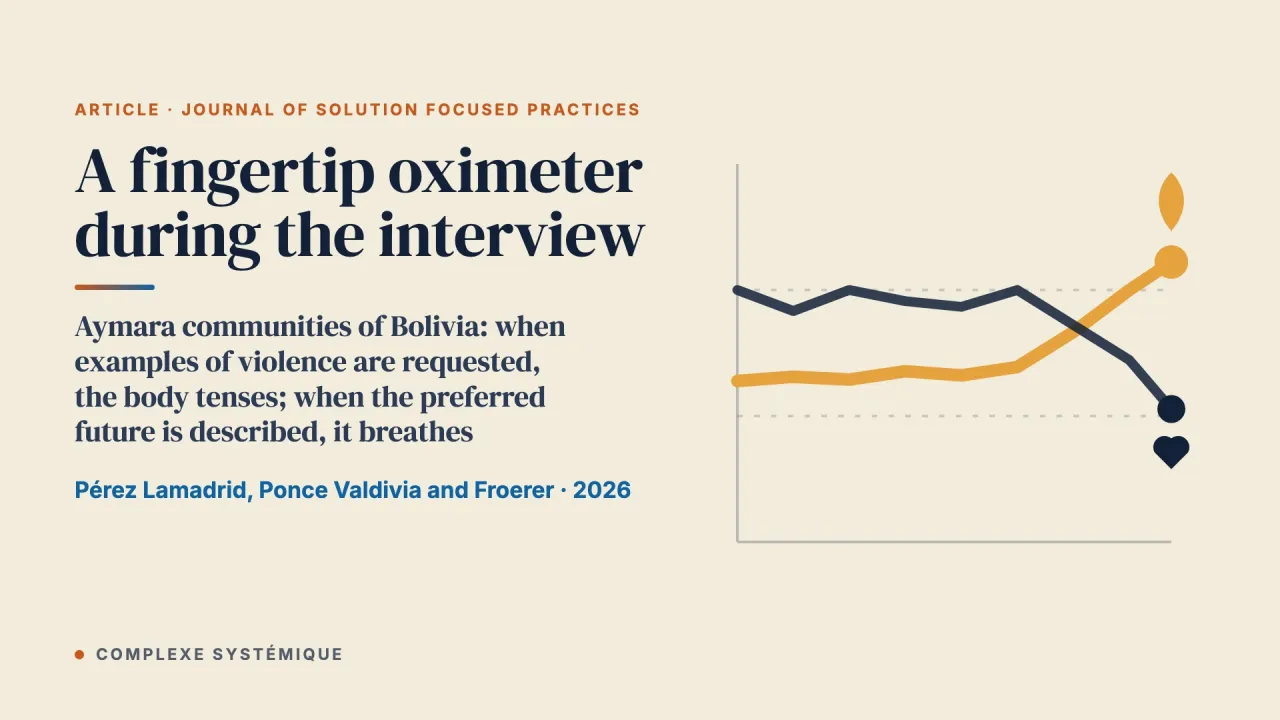
 Oxygenation and Heart Rate in Solution-Focused and Problem-Focused Interviews With Rural and Indigenous Aymara Communities (Viacha and Laja) Regarding Intersectional Violence
A fingertip oximeter on 19 Aymara people of the Altiplano: the problem-focused interview tenses when examples of violence are requested; the solution-focused one oxygenates and slows the heart.
 Article
 The trap of non-judgement: when staying silent is no longer neutral
Absolute non-judgement is a myth: not reducing a person to their acts does not require silence about what humiliates or dominates. A systemic, ethical reading of silence.
Comments 0
Log in to join the discussion. Log in