Journal of Solution Focused Practices · Article
“Write What You Know” (Twain): How to Write a Practical Journal Article
The Journal of Solution Focused Practices wants articles written for practitioners, and almost nothing explains how such writing is done. Amber Bloom and Frank Thomas, of Texas Christian University, gather what the manuals of other disciplines say and draw a guide from it: clarify one’s values as an author before writing, choose one’s journal and genre (research, conceptual, reflective, opinion, case study, each with an example from the journal), a template running from the title to the “pronouncement paragraph”, then the usual advice: answer the reader’s “so what?”, avoid jargon, think of the reader whose English is a third language, and survive the reviewers. A craft text, useful well beyond the journal that commissioned it.
This is a reformatted republication of “Write What You Know” (Twain): How to Write a Practical Journal Article, by Amber D. Bloom and Frank N. Thomas, published in the Journal of Solution Focused Practices (2020), doi: 10.59874/001c.75063, under a CC BY 4.0 licence. Prepared by Complexe Systémique in September 2026: the text has been re-laid out, which constitutes a modification of the work under the terms of the licence. Box 1 is presented as a text box; Box 2, an image in the original, is not reproduced; the footnotes are gathered at the end. This edition was made neither by the authors nor by the publisher, who are not responsible for its content or for any errors. The original version prevails.
Abstract. The Journal of Solution Focused Practices (JSFP) seeks manuscript submissions written with the practitioner in mind. Unfortunately, there are few resources informing authors on how to go about this kind of writing. The authors of this article have brought together resources from various disciplines to create guidelines that are easy to follow and adhere to the submission guidelines for JSFP. We also explore ways one can make a manuscript more relevant to an international audience and include tips for writing well.
Introduction
You are likely aware that the Journal of Solution-Focused Brief Therapy recently underwent a name change and is now the Journal of Solution Focus Practices (JSFP). According to Australasian Association for Solution-Focused Brief Therapy (AASFBT) President David Hains (2019), the goal of this change is to “highlight that we are not just about ‘therapy’” (para. 1). Here is the official JSFP invitation to submit manuscripts1 (AASFBT, n.d., para. 2):
The journal seeks scholarly papers that report the process and results of quantitative and/or qualitative research that seeks to explore the effectiveness of Solution Focused Brief Therapy or seeks to explore the aspects of the Solution Focused process. We are also committed to research reports being ‘user-friendly’ and so invite authors submitting research-based papers to address specifically the implications of relevance of their research findings to Solution Focused practitioners.
The Editorial Policy goes on to describe other types of manuscripts appropriate to the Journal, including ‘theoretical’ and ‘case study/practice-related’ papers, and discussions among the Editorial Board have overwhelmingly endorsed the desire to publish and disseminate high-quality articles that embrace SF practitioners across contexts and cultures. In an effort to communicate this desire to prospective authors, we (AB and FT) accepted the challenge to articulate guiding ideas for those interested in writing pieces directly related to solution-focused (SF) practices outside the typical research-based articles so common in academic journals (Ribeiro-Soriano & Berbegal-Mirabent, 2017).
Writing for practitioners offers many advantages to potential authors including reaching a wider international audience, immediate applicability of the subject matter, and a clear connection between your work and why it is important to solution-focused practice (Emerald, n.d.; Wiley, n.d.). Many publications focus on how to write scholarly or academic articles; little is written about how to write for the practitioner (Jalongo, 2013). In this article, we bring together literature on writing for the practitioner (scarce, but applicable to our Journal) and distill it to inform those writing for a practical journal and the global SF audience. It is not meant to be a definitive work on how to write for the practitioner but rather to give you a place to begin.
Practical Writing 101
Before You Begin
Our intention in writing this article is not to constrict expression; instead, we drew from international publications and diverse fields (business management, literacy, early childhood education, and higher education) in an attempt to erect signposts on your journey toward publication of practical material. We firmly agree with Helen Sword (2012, p. vii) when she said, “intellectual creativity thrives best in an atmosphere of experimentation rather than conformity.” Both rigor and imagination are necessary; rigor alone stifles, and imagination without precision is often bedlam (Weakland & Wilder, 1981). We believe your ideas deserve to be elegantly expressed, and such expression is the product of craft, conversation, practice, and editing without mercy.
Successful practical articles require careful consideration before any serious writing can happen. You will need to identify three things before beginning: Who is the intended journal or audience? What values am I trying to communicate with this article? Which article style is most appropriate to facilitating these goals? Addressing these three questions will focus your work and save you time in the review and editing process (Healey, Matthews, & Cook-Sather, 2019).
Considering Values
Healey, Matthews, and Cook-Sather (2019) state “every author, whether consciously aware of it or not, considers particular approaches, styles, and standards of writing to be important” (p. 34). Your writing choices speak to your readers, with or without intention. Therefore, it is vital that you think through your own values to ensure you are communicating intentionally. For example, we have chosen to write this article in the first person to decrease the distances between ourselves, the text, and our audience. Conversely, third person is often used in scientific writing because they often “value distance between the writer and the written work” (Healey, Matthews, & Cook-Sather, 2019, p. 34).
Most writers in JSFP are themselves practitioners. Therefore, the journal can be seen as an ongoing conversation about solution-focused practices. Tammar Zilber (quoted in Cloutier,2016) states, “By writing a paper you are engaging in a conversation with other scholars, they offer their ideas in their papers. I offer mine in my papers. This is a dialogue” (p. 72). It is important to consider what you are trying to say as part of this conversation. Questions you might ask yourself include: How am I joining the conversation? Am I respecting differences across time and cultures? Is my value to further an existing idea? To challenge an unexamined assumptions? To contribute case study or practice examples to flesh out the research and theoretical literature? SF was not invented in a vacuum; it has flourished, in part, because of its appeal, which includes honoring others’ experiences, valuing differences, promoting curiosity, learning collaboratively, and resisting normative (and often judgmental) ideas and practices (see Cade, 2007). Box 1 provides questions to help you consider your personal values and potential contributions to JSFP.
Box 1 – Sorting out your values (adapted from Healey, Matthews, & Cook-Sather, 2019)
1. “How can you use writing about” solution focused practice to… “shape your identity in the” solution focused world? “be present in your writing and express yourself with a clear voice”? “engage both emotionally and intellectually”?
2. “What opportunities does writing in” JSFP “afford you to”… “inquire into the complexities” of solution focused practices? “participate in ongoing conversations or created new ones within the solution focused practitioner community”? “push the boundaries of discourse in the community by drawing on your own expertise” and experiences?
3. “How might you embrace the potential of writing about” solution focused practice to… “acknowledge, affirm, and constructively critique rather than attack or undermine”? “illuminate and expand, rather than obscure or diminish”? “represent context-specific complexity well, rather than reduce to generalizable simplicity”?
Choose a Journal
We are assuming you are reading this article because you would like to write for JSFP. However, we would still like to discuss the art of choosing a journal, and therefore an audience, as it is a very important step in the writing process. Choosing for whom you write allows you to tailor your article to a particular audience and a journal that is most likely to reach them. Be sure to read about the journal, its mission statement, and the kinds of articles already published. You will be able to follow the guidelines for the journal from the beginning, which can save you time and possibly rejection (Healey, Matthews, & Cook-Sather, 2019).
As you write, focus on your anticipated readership, if known. Audiences will be interested in why your work is important to them. For SF practitioners, this is especially important. Be sure to ask, “What is new about my work? What is generalizable? What is good about it, and how can the benefit be translated into something tangible from which others can learn?” (Emerald Group, n.d., section 3, para 4.).
Choose an Article Style
The final task before you begin to write is to choose an article style. Healey, Matthews, and Cook-Sather (2019) created a heuristic framework for four types of articles: empirical research, conceptual, reflective, and opinion. We have added case studies to this list. This framework includes questions for you to use after you have identified the type of article you intend to write. You will find the questions for all article types in Box 2
Box 2 – Formulating your article (adapted from Healey, Matthews, & Cook-Sather, 2019). Box not reproduced.
Empirical Research Articles. When writing about a study you have conducted, it is helpful to have an idea of how and where you will get your study published before you begin your research (Wiley, n.d.). A strong research article will include justification for both the study and your methods, a solid grounding of your study in the literature, clearly communicated results, a thorough discussion session, and any implications for your field (Wiley, n.d.).
Make your research and findings accessible to a wide audience by avoiding overly technical language. Be concise and direct, link research to real world examples, and speak directly to your reader (Wiley, n.d.). To be the most useful to your audience, your article needs to connect directly to solution-focused practice, while at the same time adding something new to it (Barley, 2006; Healey, Matthews, & Cook-Sather, 2019). Practitioners will be more interested in the implications for themselves and their work than in minute details about the hows and whys of your research method. You may lose readers if you spend too much time on the methods section of your paper (Emerald, n.d.; Wiley, n.d.).
Within the JSFP tradition a few empirical articles stand out. Worsley and Hjemdal’s (2016) scale development of the Resilience Doughnut tool is certainly worth reading as it is organized in a traditional research article fashion familiar to most readers. One of the most current research articles in circulation related to SF is Wallace, Hai, and Franklin (2020). These authors also adopt a conventional writing organization utilized by most researchers when writing up research results.
Conceptual Articles. These articles do not include new research but pull from published works. Conceptual articles seek to “offer a new perspective or reframe existing theorizations” (Healey, Matthews, & Cook-Sather, 2019, p. 37). They offer fresh perspective, disagreement, or reimagining of those conversations (Wiley, n.d.). Conceptual articles must have a solid grounding in relevant literature and a creative understanding of other possibilities. Gale Miller’s (2014) essay on culture and SF is an exceptional example, if one is looking for guidance. He introduces his article as an “approach (that) represents an anthropological-sociological interpretation…An explanation of how my intercultural perspective extends cultural themes in the Solution-Focused literature is discussed” (p. 25). Another example by Miller, one I (FT) find thoroughly provocative, is “Readers Matter: Reading Practices and the Future of Solution-Focused Thought and Practice” (2013).
Reflective Essays. The most personal of articles, reflective essays, are focused on “lived experiences, and the sense you made from them” (Healey, Matthews, & Cook-Sather, 2019, p. 38). These authors report that, rather than focusing on current or past research, the goal is to take the reader through an event or time in your life and share “what you attempted, struggled with, learned from, or realized” (p. 37). There is more freedom in writing reflective articles as they are based on personal experience and can be written much less formally. They also provide more guidance, as reflective articles “show, as opposed to tell through offering vivid, detailed examples instead of simply stating that something happened” (Healey, Matthews, & Cook-Sather, 2019, p. 37). Therefore, reflective articles usually have a limited number of citations. An example of a reflective article is Thomas and Durrant (2014). Here Thomas responds to Durrant’s questions, many of which invite Thomas’s reflections and speculations on the past, present, and current affairs in the SF world.
Opinion Pieces. Opinion pieces are generally the shortest article type and need to be connected to a body of literature to allow you to “state a clear and direct position and then support it with a persuasive argument” (Healey, Matthews, & Cook-Sather, 2019, p. 39). As with the other types of articles we have discussed, it is vital you include how your opinion is important to your reader’s practice by drawing parallels between your topic and solution-focused practices. One of the finest opinion pieces I (FT) have ever encountered in the field of psychotherapy is Salvador Minuchin’s “Where is the Family in Narrative Family Therapy?” (1998). Minuchin’s challenges are clear, supporting his positions with relevant scholarly and personal source materials. Others respond to his arguments, writing reflective rejoinders in the same issue.
Case Studies. The SF tradition has traditionally centered on learning-by-doing. The inductive clinical approach Insoo Kim Berg, Steve de Shazer, Eve Lipchik, and the other prominent members of the Milwaukee team, relied on current therapy cases to inform their group thinking, model development, and writing projects (Cade, 2007). This is still our SF tradition, and the Editorial Board welcomes manuscripts from practitioners applying the SF approach in counseling, family therapy, coaching, training, education, and other contexts.2 The culturally informed case study article by Moir-Bussy (2014) in the first issue of the Journal of Solution-Focused Brief Therapy is an excellent example of connecting practices across history and cultures. She addresses multiple cultural bridges connecting SF to educational and mental health practices in Hong Kong, challenging Western ideas and adapting SF tenets and techniques to Chinese and indigenous Australian peoples.
A Writing Template
Our writing must start somewhere, and we suggest you begin by forming ideas around how your manuscript will be organized. Below we create a template that may be of use – it is a template, not an outline, but it may provide the structure you need as you put thoughts to paper.
Title
The title is quite literally the gateway to your article. Jalongo (2013) and Emerald (n.d.) agree that many people will decide whether to read the abstract based on the title alone. Search engines also largely rely on titles to sort articles. Therefore, a title needs to be both descriptive and, when appropriate, catchy. Sword (2012, p. 188) says this about book titles: “I classify as ‘engaging’ any title whose author appeared to have consciously made even the most modest attempt to amuse, entertain, or capture the attention of the intended audience.” Jalongo (2013) suggests an article title “should not sound like a book title!” (p. 18) but needs to be much more specific. Other possible assists include “using alliteration, descriptive phrases, repetition” (Emerald, n.d., para 3) and terms related to solution-focused practice. Two examples of titles that illustrate these points from past volumes of the Journal of Solution Focused Brief Therapy (JSFBT) are Durrant’s (2016) article “Confessions of an unashamed Solution-Focused purist: What is (and isn’t) Solution-Focused?” and McKergow’s (2016) article “SFBT 2.0: The next generation of Solution-Focused Brief Therapy has already arrived.”
Abstract (and Outline)
Generally required only for empirical research and conceptual articles, the abstract is nearly as important as the title. Those who are drawn in by the title will turn to the abstract for more information to decide if they will read the entire article. Given the prominence of the abstract, it is surprising that “many people treat the abstract almost as an afterthought to dash off just before submitting” (Healey, Matthews, & Cook-Sather, 2019, p. 42). An abstract, when written first, can be used to outline your article. Cloutier (2016) found that many authors find an outline a useful way to organize their thoughts. Referring to such a tool throughout your writing can keep you on track and provide structure for your manuscript.
Introduction
Jalongo (2013) has created a formula for writing an introduction that may be useful to you as you create your manuscript. The goal for an introduction is to begin generally and move towards the specific. You want to bring the reader along on your journey from the context of your article and evidence supporting such a context to your specific thesis, your point of view, and how it relates to the more general context (Jalongo, 2013; Wiley, n.d.). Emerald (n.d.) states that a well-written introduction should “draw the reader into the subject, making clear its practical relevance” (section 4 para. 4). Greenblatt (2007, p. 5) addresses introductions in this way: “You do not have to write the dreary sentences that say ‘In this essay I intended to explore the theme of… My goal will be…blah, blah blah.’ Instead you plunge the reader into a story that has already begun, and you create – or at least try to create – the desire to know more.”
Pronouncement Paragraph
Included as a part of the introduction, the pronouncement paragraph sets the stage for your article. This section “previews what is to come in the entire piece. Each item mentioned is perfectly matched to a main heading” (Jalongo, 2013, p. 19). Like a roadmap for your readers, this section will lead the way into your topic no matter what type of article you chose to write. Like the abstract, the pronouncement paragraph can be used as instructions for you as you are “rewriting, revising, and refining” (Healey, Matthews, & Cook-Sather, 2019, p. 44). Here is an example of a pronouncement paragraph:
In this article, the authors first review literature related to outpatient therapy with persons struggling with disordered eating, including necessary monitoring by medical personnel. Then they outline some of the basic assumptions of solution-focused (SF) practice that seem particularly relevant to working with this population. Following the case example, the authors explore how they stayed true to the SF tenets while cooperating with physicians to create partnerships based on the goals and experiences of this young client. Finally, the authors dialogue about the effects of this particular person and case on their own perspectives regarding disordered eating and collaborating when potential life-threatening circumstances must inform everyone involved – the client, therapists, family, and collaborating medical experts.
Main Headings
The main headings of your article should match those put forth in the pronouncement paragraph, guiding the reader through your outline (Emerald, n.d.; Jalongo, 2013; Wiley, n.d.). Jalongo adds main headings are best when you “make them specific to the focus of the manuscript; no ‘generic’ headings!” (p. 20). APA style, according to the seventh edition of the Publication Manual of the American Psychological Association, follows a specific format for headings that includes five levels. Additionally, “Do not begin a paper with an ‘Introduction’ heading; the paper title at the top of the first page of the text acts as a de facto Level 1 heading” (2020, p. 44). Subheadings are not required by JSFP; see the JSFP policy link for other guidance.
Illustrative Material
Many journals targeting practitioners require visuals to increase article accessibility to the reader. However, according to Jalongo (2013), illustrations need to “save words” (p. 20) and have some specific value for the reader. To be useful, a visual must be the most effective way to depict a topic within your article (Emerald, n.d.). An illustration created for its own sake will add little to nothing to your article. Some authors, according to Cloutier (2016), found “drawing, doodling, or sketching ideas in visual form” (p. 75) a useful tool for developing and organizing ideas, even if these visuals did not end up in the final published article. Hopefully you find Boxes 1 and 2 in this article useful as visuals and summaries.
Examples
A goal of writing for professional journals, according to Emerald (n.d.), is to “link the article to the real world whenever possible” (section 4, para. 6). Examples can be pulled from other articles, real-world clinical experiences, and/or personal experiences (Emerald, n.d.; Jalongo, 2013; Wiley, n.d.). Jalongo (2013, p. 20) suggests examples be “very short…based on your experiences; try to pack more than one example into a sentence” (emphasis their own). Instances are helpful in identifying the why (as in “why should I care?”) and can be used to make your article more relevant to an international audience.
Conclusion
Jalongo (2013) suggests beginning with a reintroduction to the thesis statement. Then, work through your introduction backwards, ending with the broadest applications of your argument. Avoid introducing new ideas in the conclusion while keeping it from repeating the introduction.
General tips
Easy to Follow
Make your article easily accessible to the practitioner by writing in a lively, clear, simple and direct way. Visuals, along with bullet points, will help you meet this goal (Wiley, n.d.; Emerald, n.d.). Pinker (2014) states that “the reader can recognize the truth when she sees it, as long as she is given an unobstructed view” (para. 12) One of the more difficult things to do when writing is to remember that your readers may not have the knowledge that you take for granted. JSFP draws readers from many different fields and cultures worldwide, with English often being the reader’s second, third, or fourth language. Include a wide variety of possible connections to your work.
Technical Jargon and Purposeful Complexity
One way to avoid alienating or boring your reader is to avoid technical jargon when possible (Emerald, n.d.; Wiley, n.d.). This is especially true of frequently used abbreviations in your field, which those outside your area or culture may struggle to make sense of. When completely avoiding technical terms is not possible, “explain them or give explanations in a glossary or box” (Wiley, n.d., p. 8).
We would also suggest, when possible, you use common language. Obfuscation confounds.3 You can always utilize a thesaurus to clarify your intended meaning but trust your own words and edit later. Your words are good enough; start with what you know and seek out informed colleagues you believe will be honest yet kind in their reading and criticism so future drafts become clearer and more accessible.
Be Relevant to Your Reader
Place yourself and your reader into the context of your article by using person-first and active language (Emerald, n.d.; Wiley, n.d.). Be sure you are answering the following questions for your reader:
So What?
Keep in mind while writing your article that your readers will be asking this question and wondering why they should care about your article. As a writer it is your job to convince them your topic matters to them (Thomson, 2017). Take the time to explain the importance of your work to as many different contexts as possible.
What Now?
Answering the “what now?” question can be done when discussing the limitations of your article, or in stating next steps in research, thought, discussion, and theory development (Thomson, 2017). Solution-focused practice is an evolving philosophy and by publishing in JSFP you are part of an ongoing, decades-long dialogue. Identifying where you fit into that discussion will give your reader an opportunity to respond (Thomson, 2017; Healey, Matthews, & Cook-Sather, 2019).
Writing for international audiences
JSFP is an international journal whose authors, editors, and readers live all over the world (Editorial Policy, n.d.). Your article may be more valuable to an international audience if you attend to the guidelines from the above sections. Keep in mind that readers may not be familiar with abbreviations, jargon, idioms, clichés, or laws that are considered well-known in your country or culture (Healey, Matthews, & Cook-Sather, 2019; Thomson, 2017). One should not assume the reader will understand your intent or illustrations if they contain culturally specific colloquialisms. Often humor and sarcasm are lost in translation. The following are suggestions for creating a manuscript with an international audience in mind.
Broaden Context
Whenever possible, use your local context “to explore/say something about the wider, international concern, debate, issue, question, or interest” (Thomson, 2017, para. 4). Do this by including a variety of references from international settings so your “so what?” and “what now?” questions are tied to an international context. Be sure your “conclusion connects back to the international context” (Thomson, 2017, para. 11). Thomas’s (2016) article on complimenting draws from literature across multiple approaches to applying SF ideas. In addition, he situates the practice across time and cultures, noting different emphases on complimenting through SF history and the necessity for cultural competence.
Collaboration
Healey, Matthews, and Cook-Sather (2019, p. 40) write, “we have generally found that work with others enables us to cover more ground, is more enjoyable, and has benefitted the quality of writing” (p. 40). Writing collaboratively is the foundation of academic writing, according to Cloutier (2016) who states, “we tend to forget that the origins of academic journals were personal letters that scientists wrote to their peers and to which their peers responded” (p. 80). Luckily, today we have the advantage of technology which allows us to collaborate in real time. In order to avoid potential conflicts and frustrations during a collaboration, take into account your own temperament and time commitments. The amount of work for each participant should be carefully negotiated up-front, and potential conflicts, such as author order, need to be discussed on the front end of the project (Healey, Matthews, & Cook-Sather, 2019).
Submitting and Responding to Reviewers
Submitting your work can be an emotional and vulnerable process, particularly for novice writers (Cameron, Nairn, & Higgins, 2009). Authors can err on the side of overworking their article or aiming for perfection. Healey, Matthews, and Cook-Sather (2019, p. 45) ask you to keep in mind that “unconditional acceptances are extremely rare … Minor and major revisions are much more common”. Reviewers at JSFP aim to provide helpful comments and suggestions that encourage the development of the author(s) being reviewed.
Finalize Before Submission
Cameron, Nairn, and Higgins (2009) remind readers writing “entails initial messiness and failure”. Your first draft is just that, a first attempt. The goal of a first draft should be to put words on paper. Many revisions between the first draft and submission is the norm for most who write for journals. The process of rewriting brings clarity; each draft is a step towards a cohesion (Cloutier, 2016; Cameron, Nairn & Higgins, 2009).
Conduct Self-Assessment
Jalongo (2013) suggests conducting a self-assessment by reviewing key characteristics of your article, such as “audience appropriateness, originality, persuasiveness, organization, focus, voice, (and) synthesis” (p. 21). Important questions to ask yourself during the editing process are: Have I used Turnitin to check originality and avoid plagiarism? Have I been honest in my findings? Is the paper coherent? And, does it hold together from the title to the final paragraph? Healey, Matthews, and Cook-Sather (2019) suggest rechecking your article with the content and formatting requirements of the journal you are planning to submit to. The submission requirements for JSFP can be found on the first page of this article. This article can be used as a guide to self-assessment by providing a loose framework to structure a practical article.
Ask for Help and How to Respond to Reviewers
Once you have conducted your self-assessment, seriously consider asking for help. Cloutier (2016) suggests that an initial review conducted by a friend can be used as a way to gauge how your article might be received by the community of solution focused practitioners. Having your work reviewed can be “both challenging and frustrating” (Cloutier, 2016, p. 73), and your mental framework of the review and revision of your work will be a key factor in the emotional impact of the feedback process. Embracing the review process as not only necessary but as a beneficial tool for learning and improvement of yourself as a practical writer is helpful in increasing your willingness to revise your work. Improvement is unlikely without such feedback (Cameron, Nairn, & Higgins, 2009; Cloutier, 2016).
Conclusion
Here we have attempted to provide a framework for writing a practical journal article. However, there is no one right way to write such an article. We intend these guidelines to a jumping off point. And while our focus has been on helping you to prepare for submission to JSFP, we believe that these ideas will be helpful when writing for any practical journal. Steven Greenblatt (2007, p. 6) summarizes the process appropriately: “You should try to write well – and that means bringing to the table all of your alertness, your fears, and your desires. And every once in a while…tell yourself that you will take a risk.”
Authors’ notes
1. The Editorial Policy for JSFP’s can be found at https://www.solutionfocused.org.au/journal/editorial-policy
2. NOTE the important guidelines when writing about clinical work in the JSFP’s Editorial Policy: https://www.solutionfocused.org.au/journal/editorial-policy
3. An example of obfuscating, or confusion (a little humor!). We have all read papers that might be useful to read, based on the title and abstract, if only the writing style did not get in the way. For an example of an essay that is “completely meaningless and..randomly generated,” see McElwaine (n.d.)
Complexe Systémique: key points
A workshop text rather than an article, but a well-run workshop: sorting out one’s values before writing, choosing the genre with an example from the journal for each, and the template of title, abstract, introduction, pronouncement paragraph, are tools any practitioner who wants to write can borrow, whatever their school. The most useful part for a French-speaking readership is, paradoxically, the one on writing for an international audience: English as the reader’s third language, humour that does not survive translation, the local context to be tied to a wider debate. For our atlas one might add that the same demand holds the other way round: explaining what goes without saying in Milwaukee or London. Cloutier’s reminder, that a journal was born of letters between peers, is a good definition of what a site like this one tries to remain. Read alongside Gerwing’s case for videorecording practice and complimenting according to Frank Thomas.
References
American Psychological Association (2020). Publication manual of the American Psychological Association (7e éd.). https://doi.org/10.1037/0000165-000
Australasian Association for Solution-Focused Brief Therapy (n.d.). Editorial policy. Retrieved January 18, 2020.
Barley, S. R. (2006). When I write my masterpiece: Thoughts on what makes a paper interesting. The Academy of Management Journal, 49(1), 16-20.
Cade, B. (2007). Springs, streams and tributaries: A history of the brief, solution-focused approach. In T. S. Nelson & F. N. Thomas (Eds.), Handbook of solution-focused brief therapy: Clinical applications (p. 25-63). Haworth.
Cameron, J., Nairn, K., & Higgins, J. (2009). Demystifying academic writing: Reflections on emotions, know-how and academic identity. Journal of Geography in Higher Education, 33(2), 269-284. https://doi.org/10.1080/03098260902734943
Cloutier, C. (2016). How I write: An inquiry into the writing practices of academics. Journal of Management Inquiry, 25(1), 69-84. https://doi.org/10.1177/1056492615585875
Durrant, M. (2016). Confessions of an unashamed Solution-Focused purist: What is (and isn’t) Solution-Focused? Journal of Solution-Focused Brief Therapy, 2(1), 40-49.
Emerald Publishing (n.d.). How to… write for a practitioner audience. Retrieved December 19, 2019.
Greenblatt, S. (2007, September-October). Writing as performance: Revealing “the calculation that underlies the appearance of effortlessness.” Harvard Magazine.
Healey, M., Matthews, K. D., & Cook-Sather, A. (2019). Writing scholarship of teaching and learning articles for peer-reviewed journals. Teaching & Learning Inquiry, 7(2), 28-50. http://dx.doi.org/10.20343/teachlearningu.7.2.3
Hains, D. (2019, December). News update – JSFBT → JSFP. https://www.solutionfocused.org.au/journal
Jalongo, M. R. (2013). Getting on the conference program and writing a practical article: Templates for success. Early Childhood Education Journal, 41, 13-23. https://doi.org/10.1007/s10643-012-0533-x
McElwaine, B. V. D. (n.d.). The subcapitalist paradigm of consensus, patriarchal dematerialism and nihilism. Retrieved February 3, 2020.
McKergow, M. (2016). SFBT 2.0: The next generation of Solution-Focused Brief Therapy has already arrived. Journal of Solution-Focused Brief Therapy, 2(2), 1-17.
Miller, G. (2013). Readers matter: Reading practices and the future of solution-focused thought and practice. International Journal of Solution-Focused Practices, 1(1), 3-9.
Miller, G. (2014). Culture in Solution-Focused consultation: An intercultural approach. Journal of Solution-Focused Brief Therapy, 1(2), 25-40.
Minuchin, S. (1998). Where is the family in narrative family therapy? Journal of Marital and Family Therapy, 24(4), 397-403.
Moir-Bussy, A. (2014). Using SFBT in Hong Kong: Initiatives from Hong Kong Master of Counselling psychology students and implications for cultural contexts in Australia. Journal of Solution-Focused Brief Therapy, 1(1), 30-45.
Pinker, S. (2014, September 26). Why academics stink at writing. The Chronicle of Higher Education.
Ribeiro-Soriano, D. E., & Berbegal-Mirabent, J. (2017). Disseminating scientific research: A double-edged sword? Knowledge Management Research & Practice, 15, 380-390.
Sword, H. (2012). Stylish academic writing. Harvard University Press.
Thomas, F. N., & Durrant, M. (2014). Not all who wander are lost: Wandering and wondering in the solution-focused world. Journal of Solution-Focused Brief Therapy, 1(2), 1-16.
Thomas, F. N. (2016). Complimenting in solution-focused brief therapy. Journal of Solution-Focused Brief Therapy, 2(1), 19-39.
Thomson, P. (2017, October 9). ‘Internationalizing’ a journal article. https://patthomson.net/2017/10/09/internationalising-a-journal-article/
Wallace, L. B., Hai, A. H., & Franklin, C. (2020). An evaluation of Working On What Works (WOWW): A solution-focused intervention for schools. Journal of Marital and Family Therapy. https://doi.org/10.1111/jmft.12424
Weakland, J. H., & Wilder, C. (Eds.). (1982). Rigor and imagination: Essays from the legacy of Gregory Bateson. Praeger.
Wiley (n.d.). Writing for publication: An easy to follow guide for nurses. Retrieved December 19, 2019.
Worsley, L., & Hjemdal, O. (2016). Scale development and psychometric qualities of the Resilience Doughnut tool: A valid, Solution-Focused and ecological measure of resilience with Australian adolescents. Journal of Solution-Focused Brief Therapy, 2(2), 18-36.
Reformatted republication of “Write What You Know” (Twain): How to Write a Practical Journal Article, by Amber D. Bloom and Frank N. Thomas, published in the Journal of Solution Focused Practices, Journal of Solution Focused Practices, vol. 4, no. 1 (2020), pp. 6-14, doi: 10.59874/001c.75063, under a CC BY 4.0 licence. Edition and layout: Complexe Systémique, September 2026 — the work has been modified under the terms of the licence (Box 1 as a text box, Box 2 not reproduced, notes gathered). Neither the authors nor the publisher are responsible for this edition; the original version prevails.
This is the original article ““Write What You Know” (Twain): How to Write a Practical Journal Article”, published in Journal of Solution Focused Practices (2020) under a CC BY 4.0 licence. Republished by Complexe Systémique: the author’s text is unchanged; only the presentation has been adapted for reading online, as set out at the head of this page.
Read the original articleHow to cite this article
Bloom, A. D., & Thomas, F. N. (2020). “Write What You Know” (Twain): How to Write a Practical Journal Article. Complexe Systémique. https://app.complexe-systemique.com/en_GB/articles/write-what-you-know-twain-how-to-write-a-practical-journal-article (Original work published in 2020 in Journal of Solution Focused Practices, vol. 4, n° 1 (2020), p. 6-14; republished in 2020 by Journal of Solution Focused Practices, https://journalsfp.org/article/75063)
To go further
- A Case for Videorecording PracticeAnother craft text from the journal.
- Complimenting in Solution-Focused Brief TherapyThomas’s article cited as an example of international writing.
- A Personal View — Solution-Focused Therapy: The Research and the Literature. Where Do We Go From Here?The language problem, seen from the reader’s side.
Related training courses
 Certifying course
Training in Systemic Therapy and Interventions – Cycle 1
Certifying training cycle in systemic therapy and interventions – year 1. Courses, supervision and practice, aligned with EFTA/SFTF. In French.
 Certifying course
Training in Systemic Therapy and Interventions – Cycle 2
Certifying training cycle in systemic therapy and interventions – year 2. Clinical complexity, supervision and practice. EFTA/SFTF aligned. In French.
 Certifying course
Training in Systemic Therapy and Interventions – Cycle 3
Certifying training cycle in systemic therapy and interventions – year 3. In-depth intervention, supervision and practice. EFTA/SFTF aligned. In French.
 Certifying course
Training in Systemic Therapy and Interventions – Cycle 4
Certifying training cycle in systemic therapy and interventions – year 4. Clinical integration, supervision and certification. EFTA/SFTF. In French.
Related articles
 Article
 The AFFIRM Model for Navigating Challenges in Continuously-Interfaith and Divergent-Interfaith Marriages
Thirty happy interfaith couples describe how they navigate their religious differences: five processes, from respecting each other’s choices to religious intimacy, gathered in the AFFIRM model.
 Article
 What if the shortest path to change ran through a joyful detour?
Humour in therapy is not a gimmick but a clinical skill: it loosens the loops, reframes without wounding and reopens the field of possibilities. With its ethical safeguards and a concrete toolbox.
 Article
 The therapy wars: who really has the right to treat?
Protected titles versus practitioners trained outside the university: a systemic reading of the “therapy wars”, and the real question of what minimum guarantees to demand.
 Article
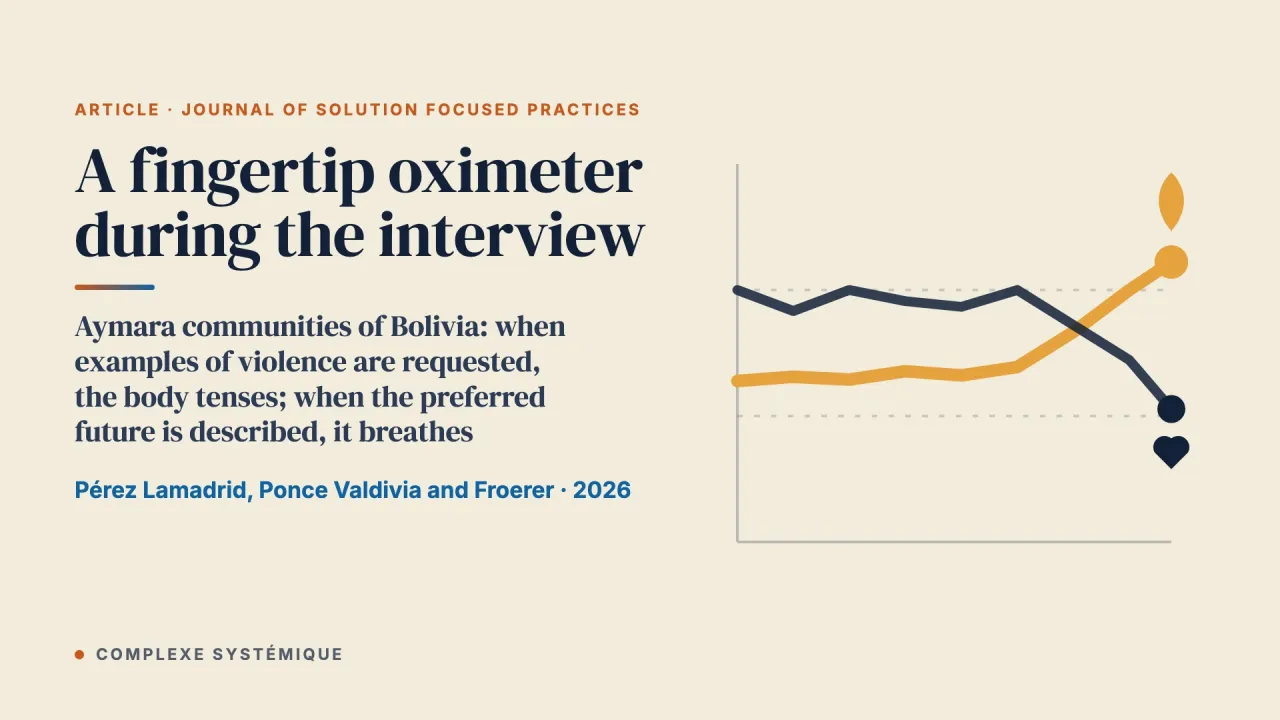
 Oxygenation and Heart Rate in Solution-Focused and Problem-Focused Interviews With Rural and Indigenous Aymara Communities (Viacha and Laja) Regarding Intersectional Violence
A fingertip oximeter on 19 Aymara people of the Altiplano: the problem-focused interview tenses when examples of violence are requested; the solution-focused one oxygenates and slows the heart.