AI-assisted translation
This version was translated from Spanish by Complexe Systémique with the help of artificial intelligence. In case of doubt, the original version prevails.
Red Sistémica · Interview
Conversations on systemic biology. Interview with Humberto Maturana
At a time when biology is being assimilated to the astonishing advances of technology — think of the media dazzle of genetics or the irresistible advance of psychopharmacology in our field —, Humberto Maturana, the renowned Chilean biologist and thinker, offers a decidedly different vision. In this interview, with the flow that characterises him, he ranges over themes such as his personal conception of biology, the dynamics of social relationships and the impact of technology on them.
“Genetic predeterminism is not a phenomenon of genetics: it is an opinion of genetics.”
Humberto Maturana
Therapy and the biology of love
What is, from your point of view, the evolution of the problems of epistemology, psychology and psychotherapy?
I don’t know what course therapy will take in the future. I think therapy works, essentially, in a way I call the biology of love.
In other words, there are different ways of approaching the same thing.
These ways will keep transforming according to changes in ways of living, which therefore implies the need to evolve the spaces of reflection, the way problems appear; likewise, in psychiatry, psychiatric illnesses change with history.
What do you think of the growing tendency to use medication, for example psychotropic drugs?
Psychotropic drugs can help solve certain problems; they change the person’s situation a little, but they do not solve the problems, because the problems are relational. So there will be oscillations in many directions, but the central thing is the biology of love.
Against genetic determinism: the organism arises in a history
On the biology of love: current biology tends, more and more, towards ahistorical models, with a great emphasis on genetics, the idea that there are many pre-set behaviours. You, for your part, have the idea of an interactional, historicising biology, in the sense that interactions build new constructions in real time. Could you expand on these differences in the way biology is understood?
The difference is fundamental because, in many aspects of the interpretation or attempted explanation of biological phenomena, great emphasis is placed, as you point out, on the notion of genetic determinism, which is in turn accompanied by the notion of predeterminism. But the situations are different, because predeterminism implies that the initial condition determines the subsequent development or the future, and that never happens. Even in the biological development and transformations of the living being, what there is, is a phenomenon of epigenesis. Always. That is to say, the organism arises little by little in a history.
Now, if the initial conditions are repeated, if the historical flow of interactions is repeated, the transformations will be similar or the same. But the phenomenon is always an epigenesis. So this whole approach that emphasises genetic determinism seems inadequate to me. Therapy would not work under the conditions of genetic determinism. If therapy works, it is precisely because there is neither genetic determinism nor predeterminism. Genetic conditions constitute the initial structure of the organism, the foundation of development, of epigenesis, but they do not determine the course of epigenesis, because that arises as a historical phenomenon. I think this deterministic and predeterministic approach is a mistake and that it will, in time, be abandoned. That does not mean I deny the phenomena of genetics. I am saying that genetic predeterminism is not a phenomenon of genetics, but an opinion of genetics.
Key takeaway
For Maturana, genes provide the initial structure of the organism, not the course of its development: every living being arises in a history of interactions (epigenesis). It is precisely because there is no predeterminism that therapy can work.
In what you call the biology of love, what ahistorical or fixed characteristics would there be, that is, ones that repeat themselves in interactions, and what, in the biology of love, changes with history?
When I speak of the biology of love, I am referring to the structural, and therefore genetic, characteristics of human beings in particular, which specify the nature of their history as a possibility, which specify the kind of history they can live.
This entails that, in the dynamic present, human identity is not fixed, because it is neither determined nor predetermined genetically; there is a systemic dynamic of configuration of the human being that has to do with a conservation of this loving condition.
Of course, this can change with history. If the systemic dynamic that conserves the loving being is not maintained, it will drift in another direction, biology will change and the destiny of Homo sapiens will follow a different course from the one it has shown so far. But when I speak of the biology of love, I am referring, on the one hand, to the basic constitution that makes it possible for us to be a particular class of animals and, on the other, to the systemic dynamic of human coexistence that conserves this as a central condition for living. Because for us, human beings, this relationship of fulfilment within a welcoming human space is a central condition. Then something else arises: for example, when one speaks of psychopathic behaviour, at bottom, it is a different human being. It is a Homo sapiens of another class.
Deviations, normality and community: a disagreement with Cecchin
Gianfranco Cecchin maintained that societies need these deviations in order to self-regulate and that, in reality, what we consider pathologies are deviations from the norm by means of which culture itself self-regulates, and that therapy would be a way of sending back to that central, normative culture the messages of these deviations. They would be the edges of a normal curve. These messages are what make it possible to change the whole and the concept of normality.
I think it is a nice idea, but I don’t see things that way. I think there is a certain variability, which corresponds to the diversity possible on the basis of the fundamental condition, and that what is conserved as the central mode of living of a community is a systemic phenomenon. So these extremes are variations, and they can serve us, of course, to realise the direction in which we may deviate; but the conservation of the central mode of life is a systemic, dynamic phenomenon, in which what is conserved is constituted and conserved in living.
In this process, we can take these deviations as occasions for reflection or as situations to be denied. In the history of humanity, both have happened.
For the deviations Cecchin speaks of to be messages, this conservation of normality must be that systemic dynamic I am talking about. Because for something to be a message, I have to read it as such. Nothing is a message in itself. So that if I see these deviations as messages, it means they invite me to reflection; but if I see them as deviations, then they do not invite me to reflection, they invite me to denial.
Cecchin said precisely that, in one type of therapy, reflexive therapy, and in certain cases, the function of therapy would be this interpretation of these meaningless messages; the ethical, reflexive process of therapy would be to obtain this insight, so that these deviations could be retranslated into messages of new possibilities rather than into deviations to be reduced.
Since I don’t do therapy, I cannot reflect in that direction.
I think therapy is a task that has to do with people insofar as they resolve their conflicts (they consult because they have conflicts and, in turn, they have conflicts because they have contradictory emotions in their living); this will reincorporate them, to a greater or lesser degree, into the fundamental community to which they belong. Whether that fundamental community takes on the deviations as an invitation to reflection, or does not, is another matter. In that sense, I don’t agree with G. Cecchin.
At the same time, therapists can say: “Listen! See that there are such and such types of deviations; please, let us realise what is going on.”
So it is a call to therapists’ attention so that they in turn call the community’s attention.
That is interesting, because for this message to have any effectiveness, it has to be received by a community capable of interpreting it.
It cannot simply be the intimacy of a therapeutic relationship…
In that sense, the change and learning that take place in the therapeutic bond need to be contextualised within a wider social framework.
Learning takes place in coexistence. I am not talking about bond. The notion of bond establishes an idea of dependence. I am talking about coexistence. I can live with others in many ways: I can be in pleasure, in enchantment, in the desire for closeness, in the desire for distance, but this happens to me according to the mobility I have.
I put a child in school, and things are going to happen to that child, whether their teachers and classmates want it or not; and different things will happen to them in each case.
What children need, on the other hand, is a loving relationship in order to grow up with self-respect. Can a child grow up without self-respect? Of course they can grow up without self-respect, but they will be a different adult from the one who grows up with self-respect. The one who grows up with self-respect will also see their social awareness grow and will become an adequately integrated being.
The other will be different. The course of humanity can go one way or the other; it is not pre-set.
Bond
The notion of bond, which Maturana rejects, installs an idea of dependence.
Coexistence
It is in coexistence that learning takes place: pleasure, enchantment, desire for closeness or distance, according to each person’s mobility.
Media and the dynamics of social relationships
Today, the media have developed in a way that was unimaginable only a few years ago. How are the dynamics of social relationships changing in relation to the new technologies?
It depends. Not all human relationships are social relationships.
If these new dimensions of interaction open a space for encounter in mutual respect, they widen the dimensions of configuration of social dynamics.
But if they constitute the opening of a space that does not open to encounter in mutual respect, but where the possibility of manipulation appears, the attempt at control — for example with propaganda —, that is something else. Propaganda is not a vehicle of social communication, it is an instrument of manipulation.
At the same time, showing that there is something is an opening for looking and for reflection. So it depends on the emotion with which it is done. If I show in order to seduce, so that the other person consumes a product of mine, I am doing something completely different from showing so that the other knows what there is and acts on the basis of their understanding and of themselves.
These communication systems, such as the Internet, are going to modify the spaces of relationship, but it will depend on how they are used. For example, when amateur radio operators appeared, a few years ago, with the development of radio, people communicated, friendships were formed, a whole series of things happened through which people communicated via the radio. People appeared there.
On the Internet, do people appear? If people appear, it will be like the amateur radio system. If people do not appear, if things you don’t want are put on the Internet for you, if people intrude into your life, that is something else. Manipulation and pornography will appear. Pornography does not only have to do with sex; it is any human activity used according to a manipulative and commercial criterion.
If you take art and distort it for purposes of manipulation and commerce, you turn it into pornography. The problem is that at that stage, one has no control, one cannot say no, because things get in there.
From the birth of the media — television in its early days, as something more naive, radio — to today’s megacorporations, there is a moment of opening, then a reification…
Well, it depends on the technologies. For example, radio. It begins as a system of broadcasting to the world, like a tree scattering its seeds: whoever hears, hears, and whoever does not hear, does not hear. Then amateur radio operators appear, who converse with one another. That is something else.
What television throws out to the world is not a system of encounter with the other through it; it is a system of throwing out, like the plant that scatters its seeds into the world.
I do not interact with television, I have no way of interacting with it. If there is encounter between people, the new technology will have a different character from the one it will have if there is not.
When people meet, the dynamic of the biology of love appears. They meet, converse, respect or reject one another.
I think technologies, by themselves, do nothing. It is we, human beings, who use technologies. The emphasis on technologies is a mistake, or almost a deception. Because promises are made, through technology, that do not depend on it, but on what people do with technology.
Key takeaway
A technology does nothing by itself: everything depends on the emotion with which it is used. If people appear in it and meet there in mutual respect, the social space widens; if it serves to seduce, to manipulate, to sell, it becomes propaganda — or, in the broad sense Maturana gives it, pornography.
Editor’s notes from Perspectivas Sistémicas
Other articles by the author in Perspectivas Sistémicas, nos 2, 3, 31 and 38.
Reference is made to the interview with Gianfranco Cecchin published in no. 43 of Perspectivas Sistémicas (“Systemic prejudices”).
The article was published in Perspectivas Sistémicas, no. 47, July-August 1997.
Who is Humberto Maturana
Humberto Maturana (1928-2021), Chilean biologist and epistemologist, is the author, with Francisco Varela, of the theory of autopoiesis. His “biology of cognition” and his “biology of love” profoundly marked constructivism and second-order cybernetics, and, through them, systemic family therapy.
This interview is an English translation of “Conversaciones sobre biología sistémica. Entrevista a Humberto Maturana”, published by Red Sistémica (first published in Perspectivas Sistémicas, n° 47, juillet-août 1997). Translated and republished with the journal’s permission.
Read the original articleHow to cite this article
Torrente, F., & Des Champs, C. (2022). Conversations on systemic biology. Interview with Humberto Maturana (Complexe Systémique, Trans.). Complexe Systémique. https://app.complexe-systemique.com/en_GB/articles/conversations-on-systemic-biology-interview-with-humberto-maturana (Original work published in 1997 in Perspectivas Sistémicas, n° 47, juillet-août 1997; republished in 2022 by Red Sistémica, https://redsistemica.ar/2022/06/28/conversaciones-sobre-biologia-sistemica-entrevista-a-humberto-maturana/)
To go further
- What is constructivism?The epistemological current that Maturana's biology of cognition nourished.
- What mathematics brought to psychotherapy: cybernetics and the systemic approachFrom cybernetics to therapy: the framework within which Maturana's thought is situated.
- The Milan school of systemic family therapyGianfranco Cecchin, whose idea of deviations as messages addressed to culture Maturana discusses here.
Related training courses
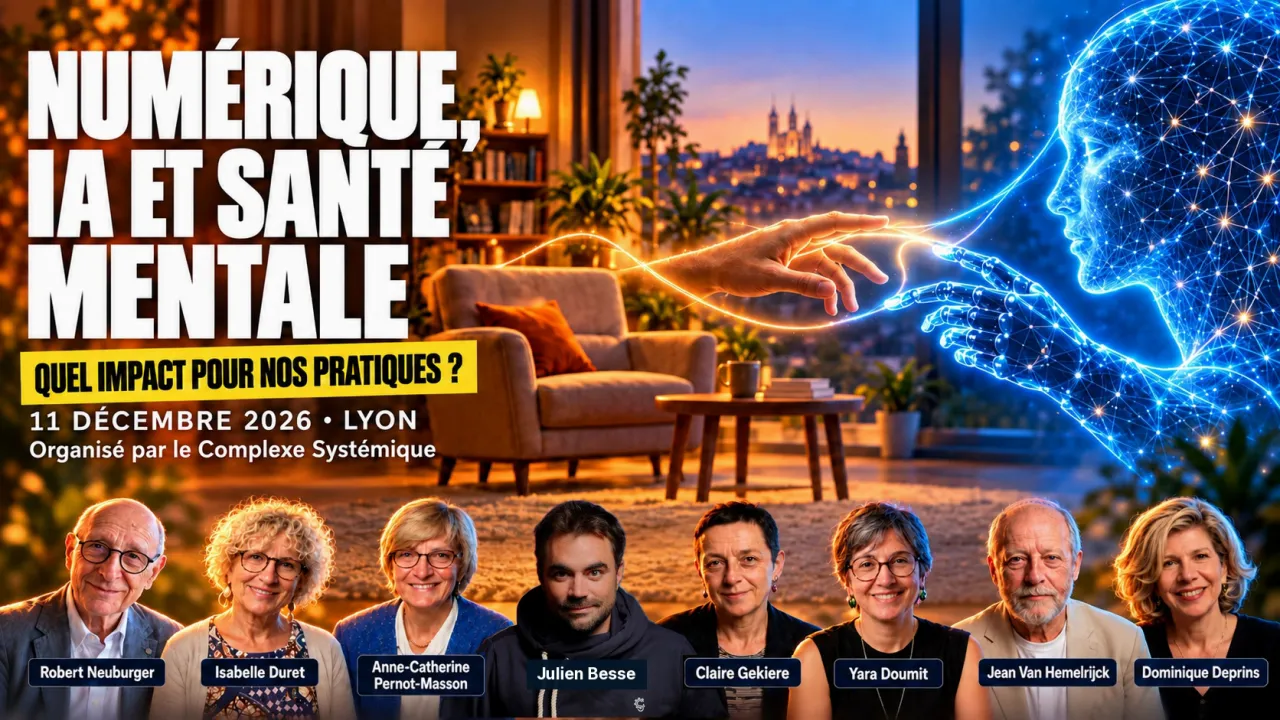 Symposium
Digital technology, AI and mental health
Conference in Lyon, 11 December 2026: digital technology, artificial intelligence and mental health. Six talks, replay for participants. In French.
 Short course
The suicidal crisis in adolescents and young adults
Training: assessing and supporting the suicidal crisis in adolescents and young adults. Clinical landmarks and systemic tools. In French.
Related articles
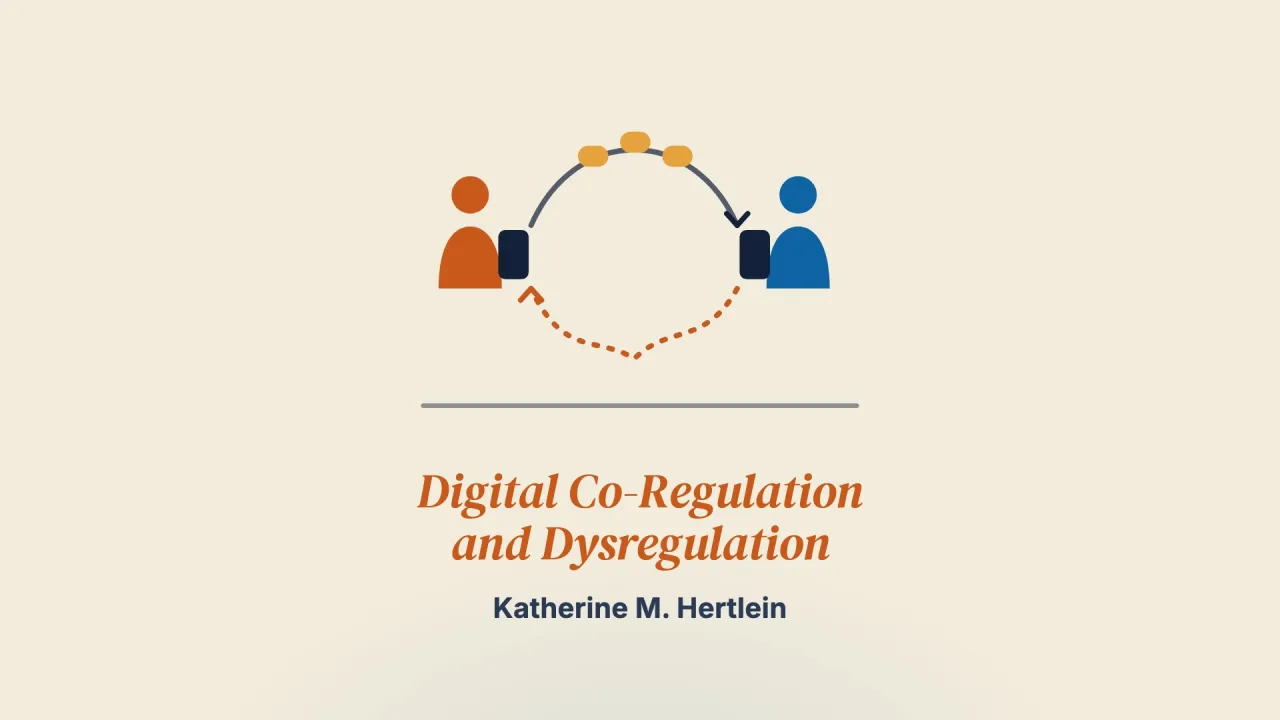 Scientific
 Digital Co-Regulation and Dysregulation in Romantic Relationships: A Systemic Model of Technology-Mediated Emotional Processes
Checking, chasing, blocking: 31 interviews show how the phone regulates or dysregulates a couple’s anxiety, with a systemic model of the loop.
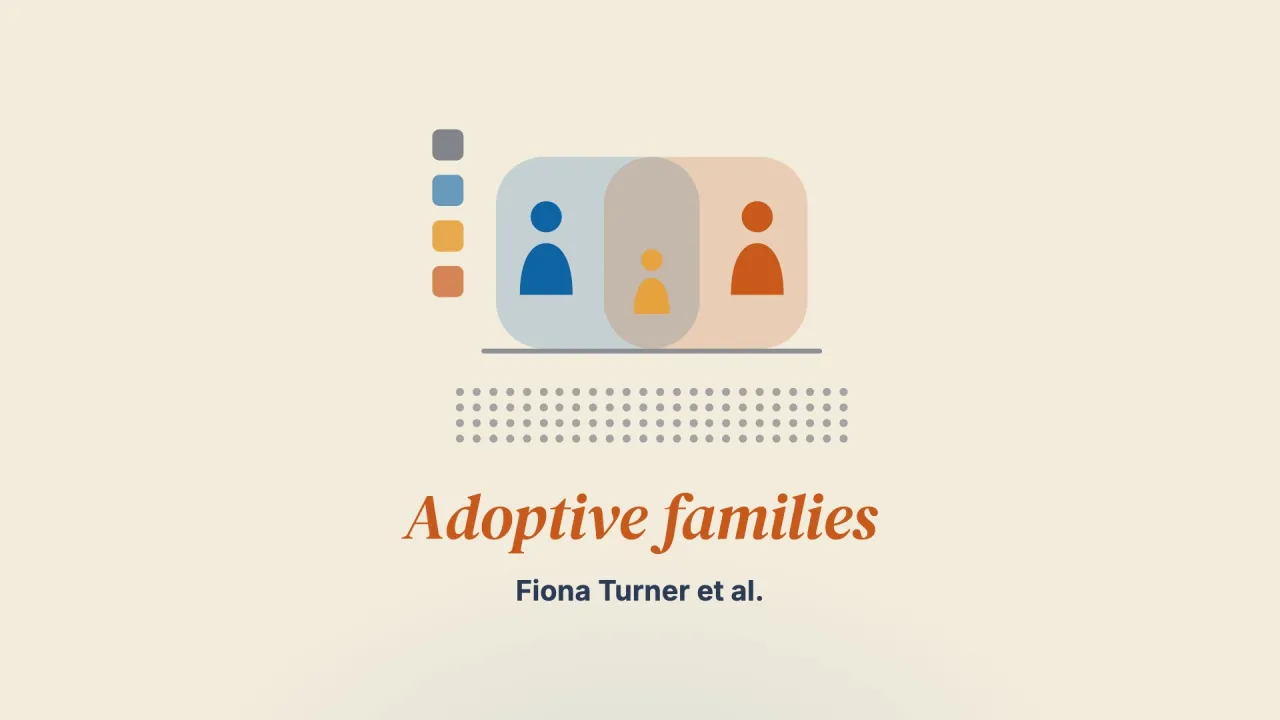 Scientific
 How can we BeST? meet the needs of adoptive families? Relevant findings from a major Randomised Controlled Trial of infants in foster care in the UK
The BeST? trial (488 infants in care in the UK) reread for adoption: holistic, ongoing assessment of children and a move to dual registration.
 Scientific
 The Role of Parental Expressed Emotion and Loss-Specific Parental Responses in Children’s Loss-Related Outcomes Following Traumatic Loss: A Mixed-Methods Observational Study
After a road-traffic bereavement, parental criticism goes with the child's depression, positive appraisals of the loss with better well-being.
 Blog
Blog Toxic, narcissistic, borderline: what therapy speak does to your relationships
Narcissistic, borderline, toxic: therapy speak has left the consulting room. Julien Besse shows how these labels close the debate and relieve us of our own part.
Comments 0
Log in to join the discussion. Log in