Journal of Solution Focused Practices · Research
Creating a common language: how SFBT reflects current principles of change and common factors
Since Rosenzweig in 1936, we have known that psychotherapies resemble each other more than they admit. Beverley Kort, Adam Froerer and Cecil Walker take four reference texts on common factors (Miller, Hubble and Chow; Goldfried; Gassmann and Grawe; Wampold), draw seven themes from them, then set them against BRIEF’s practice manual Briefer. The result: hope, alliance, tasks, client factors, therapist effect, monitoring of progress; solution-focused brief therapy ticks every box, but through language rather than assessment, diagnosis or homework. It all ends with a self-assessment grid for talking about what we do with colleagues from other schools.
This is a re-edition of Creating a Common Language: How Solution Focused Brief Therapy Reflects Current Principles of Change and Common Factors, by Beverley Kort, Adam Froerer and Cecil Walker, published in the Journal of Solution Focused Practices (2021), doi: 10.59874/001c.74980, under a CC BY 4.0 licence. Re-edited by Complexe Systémique in September 2026: the original text has been lightly edited and re-laid out, the three tables (factor matrix, implementation according to Briefer, self-assessment grid) being presented as cards, which constitutes a modification of the work under the licence. Neither the authors nor the publisher took part in this edition and they are not responsible for its content or for any errors. The original version prevails.
Introduction
The debate between advocates for a common factors and principles of change perspective versus proponents of a model-specific approach has been going on for quite some time (Sprenkle et al., 2009). In this paper we will provide a brief overview of the common factors/mechanisms of change literature, a brief review of the solution-focused brief therapy (SFBT) approach, and we will articulate why valuing both perspectives may contribute an expanded evidence base for SFBT. In addition, we will consider the benefits for SFBT clinicians of being able to converse with other clinicians and stakeholders in a common language about the effectiveness of SFBT and how SFBT utilises similar mechanisms of change to other approaches. Finally, we will consider research and clinical implications of this broadened perspective.
Literature review
Common factors and mechanisms of change
The importance of identifying the factors that produce change in psychotherapy regardless of specific modalities, and of understanding how psychotherapy produces benefits, has been a point of interest for many over an extended period of time. The subject of common factors in various methods of psychotherapy was first addressed by Rosenzweig (1936). He is quoted by McAleavey and Castonguay (2015): ‘psychotherapies that are different do indeed have many similar features, and these similar features may be responsible in some way for the fact that proponents of many treatments report success’ (p. 2). McAleavey and Castonguay also state that ‘it is not uncontroversial to say that psychotherapies of many origins share several features of process and content, and it follows that better understanding the patterns of these commonalities may be an important part of better understanding the effects of psychotherapy’ (p. 2).
The idea of common factors and core principles of change has not been met with universal support. Some feel that this approach may dilute the importance of ‘specific or unique’ factors for each school of psychotherapy (Mulder et al., 2017). For many reasons (both personal and political), there is pressure to demonstrate how one treatment modality is more effective than others. Although this may benefit ‘the school’ or ‘the theory’, it does not help create a core consensus or understanding in our field. Nor does it help individuals within the field evaluate different approaches in a uniform way. This lack of consensus often leads to arguments and efforts to prove each other wrong, instead of attempts to understand and collaborate with one another for the benefit of all clients. Goldfried (2018) purports there is a disconnect between our past and our present in the field of psychotherapy. He states that psychotherapy ‘lacks a common core and always seems to be at the cutting edge, not building upon past contribution and instead emphasizing what is new’ (p. 3). This pressure to be on the cutting edge pushes clinicians to emphasise where they stand apart and where they are making a unique contribution to the field, rather than acknowledging what shoulders they stand on, or how they are building on the philosophies and understanding of those who have come before. This approach is in stark contrast to much of science, which attempts to build on the past while adopting new modalities, which facilitates a mutual understanding and agreement.
Currently, psychotherapy advocates that being on the cutting edge is valuable and important, but equally important is the need to understand what factors contribute to change for clients, some of which are consistent across treatment modalities. Identifying common change factors allows clinicians to work effectively with clients without needing to recreate the wheel each time. In addition, identifying unique or specific factors that work for each clinician or each approach may enhance the work for each individual clinician. Without studying the interaction of common factors/mechanisms of change, unique therapist factors and unique approach factors, we are at risk of not being useful to our clients. As Goldfried (2018) said, ‘having different theory-based language systems prevents us from ever learning of any similarities and points of complementarity across orientations’ (p. 2). The absence of a common language keeps psychotherapy from coming to a consensus about what works and what does not within psychotherapy (Norcross & Thomas, 1988).
Although we come from a solution-focused brief therapy (SFBT) background, we are working toward two goals with this article. The first goal, by presenting this research analysis, is that SFBT therapists will be able to express, in a shared language, what we do well. Hopefully, the shared description and language provided will make agreements more accessible between SFBT therapists and their colleagues who work from different approaches. Hopefully, SFBT practitioners will be more easily able to describe shared avenues of change versus differentiating strategies and theories, thus making it more feasible to meet the goals of organisations to do the ‘best’ therapy.
Our second goal is to demonstrate how SFBT reflects these common factors and principles and how these principles broaden the evidence base for SFBT as a therapeutic approach. We hope this broadened evidence base will help make an impact both within individual sessions and generally within the profession.
Solution-focused brief therapy
Solution-focused brief therapy was originally developed by Steve de Shazer, Insoo Kim Berg and their colleagues (de Shazer et al., 2007). SFBT is founded on the simple practices of (a) looking for resources rather than deficits, (b) exploring possible and preferred futures through detailed conversations, and (c) investigating what is already happening that contributes to these preferred futures (George et al., 2017). Typically, SFBT sessions begin by assessing the client’s best hopes or desired outcome from the session and transition to eliciting a detailed description associated with the presence of this desired outcome. Time may be spent investigating with the client, through questions, resources the client has that would help bring this desired outcome to pass, instances where pieces of the preferred future are already occurring, or highlighting progress that has already taken place (George et al.). SFBT sessions are language-based and co-construct with the client new realities through the use of changes in language (de Shazer et al.). We were interested in identifying how this language-focused approach works to create lasting change in ways that were similar to, and perhaps different from, other therapeutic approaches.
Methods
As a first step to identifying SFBT’s fit within the common factors/mechanisms of change literature, we reviewed the current common factors literature in order to determine which perspectives to include in this modified content analysis. Content analyses are used to identify common patterns of themes in written documents and to make inferences based on these patterns (Hsiu-Fang & Shannon, 2005). The articles included in this study were each: (1) published or produced in the last 15 years (since 2005), to ensure relevance regarding the most recent literature; (2) published or produced by an author or authors who have written or contributed significantly to the common factors literature base; (3) consistent with mainstream literature regarding common factors.
These criteria, although not significantly rigorous, served the purpose of having a well-founded literature base. Although many other articles may have met these criteria, it was determined that since the focus of this study was on applying the common factors literature to the solution-focused approach, and not on evaluating the common factors’ validity, the face validity and content validity of the included studies were the most important factors. In addition, because the focus of this paper was on applying the themes to SFBT and not providing a comprehensive representation of all common factors literature, an exhaustive inclusion of all potential articles was not needed; a representative sample would be sufficient.
Included articles
For the purposes of this paper, to work towards the potential of creating a common language and to demonstrate how SFBT reflects these factors and principles, we have presented the research of the following papers: The Question of Expertise in Psychotherapy (2008) by Scott Miller, Mark Hubble and Daryl Chow; Obtaining Consensus in Psychotherapy: What Holds Us Back (2018) by Marvin Goldfried; General Change Mechanisms: The Relation Between Problem Activation and Resource Activation in Successful and Unsuccessful Therapeutic Interactions (2006) by Daniel Gassmann and Klaus Grawe; How Important Are the Common Factors in Psychotherapy? An Update (2015) by Bruce Wampold. Below we provide a brief summary of each.
Miller, Hubble and Chow. This article asserts that all treatment that applies current common factors will lead to good therapy. In their Common Factors Model there are four areas: (a) therapeutic technique, (b) expectancy and placebo, (c) therapeutic relationships, and (d) client factors. The authors posited that therapeutic techniques account for 15% of change, expectancy and placebo 15%, the therapeutic relationship 30-50%, and use of client factors 40%. Their model is the only one (of the included articles) that gives specific percentages, but the research on all models generally seems to substantiate these numbers. Thus, emphasis should be on all factors that support a strong alliance with the client and the many ways of utilising client factors.
Goldfried. Goldfried presents his research on principles and mechanisms of change. He promotes moving the field of psychotherapy from theoretical considerations to agreed-upon principles of change. Specific interventions and techniques may then be thought of as methods of implementing these principles. They can be summed up as ‘…clients change when they are motivated and have positive expectations of change, work with a therapist with whom they have a good alliance, become better aware of what is causing the problem, take steps to make changes, … and engage in ongoing reality testing …’ (p. 6). His core principle of change can be described as working towards ‘the client doing something not done before’. It does not matter how or under what circumstances the change takes place, or whether it is phenomenological or observable.
Gassmann and Grawe. Gassmann and Grawe focused on the processes underlying change. They emphasised the role and balance of problem activation versus resource activation across therapies to support therapeutic change. They concluded that therapists who viewed the client as capable and more than the ‘sum of their parts’, and engaged the client very early on in the session with the healthy parts of the client’s life and personality, created an environment that promoted more productive work with the client. They found that these clients left the session with ‘higher activated resources’ than when they entered.
Wampold. The final model included was Wampold’s Contextual Model. His overall observation was that all therapies with a structure provided by an empathetic and caring therapist, which facilitates client engagement in healthy behaviours, will have equal effects. He presents three interacting but ‘reasonably independent’ pathways, which echo all the current research on common factors and principles of change: Pathway 1, real relationship; Pathway 2, expectations; Pathway 3, specific ingredients. Wampold, as well as the other researchers reviewed here, emphasises two further points: (1) the importance of ‘robust therapists’, that is, therapists having the ability to form strong alliances, possessing strong interpersonal skills and engaging in practice outside the therapy sessions; and (2) the importance of inviting ongoing feedback from the client, with regular monitoring of progress and process either formally or informally.
Inter-rater reliability
After the included articles were identified, Beverley Kort (BK) and Cecil Walker (CW) each did an initial qualitative content analysis review of the articles to identify specific common factors and principles of change within each. The reviewers began with open coding, then moved to axial coding while maintaining field notes regarding their decision making (Strauss & Corbin, 1998). Qualitative inter-rater reliability was evaluated, and Adam Froerer (AF) served as arbitrator. Seven themes were identified across the included studies (see Table 1): (a) ideology/rationale, (b) expectation/hope and resource activation, (c) therapeutic alliance, (d) tasks of therapy, (e) use of client factors, (f) therapist effects and self-regulation, and (g) monitoring and process outcome.
Once the themes were identified, the researchers did a second modified qualitative content analysis, applying the seven themes to the Briefer practice manual (George et al., 2017) to evaluate how SFBT fits within the common factors and principles of change identified in phase one. Again, BK and CW served as independent reviewers, inter-rater reliability was checked, and AF arbitrated when needed (see Table 2).
Results
Step one of the content analysis resulted in seven themes. Table 1 gives a breakdown of the themes and how each article fits within them. The second analysis looked at how SFBT fits within these themes; its results are in Table 2. Note that ideology and rationale is excluded from Table 2 because it is an overall principle and is not specifically noted within practice or treatment manuals.
Table 1. Common factor and mechanisms of change themes, article by article
Ideology/rationale. Miller, Hubble and Chow: all treatment that reflects current common factors (therapeutic technique, expectancy and placebo, therapeutic relationship, client factors) will lead to good therapy. Goldfried: move from theoretical considerations to principles of change; clients change when they are motivated and have positive expectations, work with a therapist with whom they have a good alliance, become aware of what is causing problems, take steps to make changes in thinking, feeling and behaviour, and engage in ongoing reality testing. Gassmann and Grawe: ‘resource activation is an empirically strongly supported change mechanism… realised in interventions that focus not on the patient’s problems, but rather on the sound and healthy parts of the patient’s personality’. Wampold: all therapies with a structure, given by an empathetic and caring therapist who facilitates client engagement in healthy behaviours, will have equal effects; all treatments achieve their effects through three interacting but reasonably independent pathways, the real relationship, expectations, specific ingredients.
Expectations/hope. Miller et al.: expectancy and placebo; creating hope is greatly influenced by the therapist’s attitude toward the patient in the early moments of therapy. Goldfried: promote client expectations and motivation that therapy can help; recognise and experience what positive change would be like. Gassmann and Grawe: successful therapists focused, right at the beginning of the session, markedly on what worked well for the patient (resource activation). Wampold, Pathway 2: the client is provided with an adaptive context that allows for solutions, believes participating will be helpful; agreement on goals and tasks increases the alliance.
Therapeutic alliance. Miller et al.: experiencing change early on increases the alliance; positive client experience of the alliance; the therapist creates an environment that matches the client’s definition of empathy, genuineness, respectfulness and worldview. Goldfried: defined as a good bond plus agreement on the goals and methods; the most important transtheoretical principle of change. Gassmann and Grawe: engaging in early resource activation creates an environment where the patient is perceived as a well-functioning person; early symptom relief leads to alliance and successful outcomes; goal collaboration leads to the most successful outcomes. Wampold, Pathway 1: the real relationship, through social support, interpersonal connection and belongingness or attachment between client and therapist.
Tasks of therapy. Miller et al.: emphasis on the client’s goals versus history and psychopathology; across all models therapists expect their clients to do something different, develop new understandings, feel emotions, face fears, take risks, alter old patterns. Goldfried: agreement about goals and methods; facilitating client awareness of factors associated with their difficulties; core principle, the client does something not done before; reality testing. Gassmann and Grawe: clients leave a session with even higher activated resources than when they entered. Wampold, Pathway 3: treatment that a client finds acceptable and that leads to healthy actions that decrease their distress; induce the client to enact healthy actions regardless of treatment specifics.
Use of client factors. Miller et al.: more client involvement leads to more possibility of change; take into account strengths, resources, current situation, fortuitous events, worldview. Goldfried: recognise and make use of previous life experiences that may be helpful with current difficulties. Gassmann and Grawe: view of the client as capable and more than the sum of their problems. Wampold: the explanation/rationale must be acceptable to the client, congruent with cultural and personal beliefs.
Therapist effect and self-regulation. Miller et al.: engage in ‘deliberate practice’ to improve skills and maintain best practices (quality of the relationship, creation of hope, plausible rationale and healing rituals, understanding and use of client strengths, therapist self-regulation). Goldfried: learn skills that reflect commonalities across orientations; get supervision from therapists still actively in practice. Gassmann and Grawe: respond quickly to an activated resource, with no lag time. Wampold: robust therapists form a strong alliance across a range of clients, have greater facilitative interpersonal skills, express more personal self-doubt, engage in practice outside therapy sessions.
Monitoring and process outcome. Miller et al.: use feedback-informed therapy tools. Wampold: monitor process and outcome on a session-by-session basis, and utilise the feedback to inform therapy.
Table 2. SFBT ideas for implementation, based on Briefer: A Solution Focused Practice Manual (George et al., 2017)
Expectation and hope: best hopes; ‘what do you want instead?’; future focus; direction established by the client; the client takes credit for change; nurturing a sense of possibility (‘so far’, ‘as yet’, ‘in spite of’); noticing; instances and exceptions; noticing small signs of progress; starting each subsequent session with ‘what’s better?’.
Therapeutic alliance: resource talk and best hopes; use of the client’s language, description, worldview; collaboration on the client’s desired outcome; one foot in the present and one foot in possibilities; checking in regularly to make sure of going in the right direction; safety scaling questions; coping questions; constructive history questions; identity questions.
Tasks of therapy: questions as a provocation for the client to think about, notice and name differences; the desired outcome drives the session; preferred future; the client is given credit through questions; questions that remove contingencies; instances and exceptions; noticing changes; lists; ‘what else?’ questions to expand present and past successes; scaling questions to discover what the client has already accomplished.
Use of client factors: instances and exceptions; pre-meeting change; ‘what’s better’; coping questions; building on already existing skills; identity.
Therapist effect and self-regulation: asking ‘what does the client want from therapy?’ and letting that influence the next questions; making room for the client’s identity, background, beliefs and views; letting go of assumptions; staying neutral and marginal in the client’s life.
Monitoring progress and outcome: first small signs of progress; scaling; checking in with the client on the direction of the session during each session; magnifying change; exceptions and instances of change.
Discussion and conclusion
The seven factors identified in the qualitative content analysis fit nicely with SFBT and help SFBT to fit into the larger frame of psychotherapy. We will first discuss each of the seven themes and why they have been deemed necessary for effective psychotherapy. Then, after each theme, an applications section discusses it from a non-SFBT and an SFBT perspective, to facilitate mutual understanding of how different practitioners can attend to the same important factors but do so in different ways.
Ideology/rationale
Brown (2015) states that it is an ethical imperative for clinicians to base their services on ‘evidence-supported’ practices (p. 307). He goes on to say that since most therapies appear to be effective according to reviews of psychotherapy regardless of technique, it is becoming more apparent that ‘highlighting treatment principles rather than treatment strategies as a way of discussing active ingredients of change’ (p. 307) would yield better results. In his implications for therapists he emphasises the importance of focusing on common factors that highlight both process and content (for example, the client-therapist relationship and the client’s experience of change), and of focusing on principles rather than strategies of change. This allows the therapist to be ‘drawn directly to a range of therapies that are evidence supported and provide principles that evoke thinking across therapies in dealing effectively with clients’ (pp. 311-312). In their review of current psychotherapy research and reports by therapists of diverse allegiance, Castonguay et al. (2015) discovered that ‘many behaved in ways that were more similar than dissimilar’ (p. 4). Many of the ‘unique’ interventions of particular orientations are idiosyncratic manifestations of more general strategies or principles of change, such as increase of positive expectations, provision of a new view of self or testing of change with day-to-day reality (Goldfried, 1980; Goldfried & Padawer, 1982).
Applications. Non-SFBT: from other therapeutic approaches, it is important to spend at least two or three sessions doing psychosocial assessment and information gathering about history and problem in order to properly evaluate client concerns and arrive at a diagnosis. The treatment process follows the diagnosis, and the goal is to alleviate symptoms. SFBT: through conversations with the client, SF practitioners co-construct the client’s vision of their desired outcome to determine where they want to go, rather than a description of where they have been or what problems they are experiencing. First sessions are often treated as ‘working sessions’, as the assumption is that each session may be the last. Solution-focused practitioners hold the belief that clients are the experts of their lives and should contribute their content expertise to the process expertise of the clinician. Both perspectives hold values about how to help clients, but enact these beliefs in different ways.
Expectation/hope
Hope and expectancy are commonly cited as responsible for a substantial percentage of the variance in the outcomes of therapy (Lambert, 1992). Hope is best described as ‘the sum of the mental willpower and waypower that you have towards your goals’ (Snyder, 1994, p. 5). It is well established that a model that can activate hope and positive expectations in clients tends to have more positive therapeutic outcomes. Potential reasoning for that positive relationship includes the tendency of hope to be accompanied by positive affect (Ciarrochi et al., 2015), which can have extensive influence on an individual’s cognitive flexibility and access to mental resources (Estrada et al., 1994). The client’s expectations play a direct role in stimulating positive change (Constantino & Westra, 2012).
Applications. Non-SFBT: a common way therapeutic models build and make use of hope is in the construction of goals, since defined objectives and forward thinking are central to developing hope (Cheavens et al., 2006). Non-SFBT models might also emphasise how the execution of their interventions will help clients progress towards goal attainment, such as completing homework or finding insight in genograms. These insight- and task-oriented explanations offer clients a consistent approach that meets their expectations about the process of overcoming problems, whether through faulty cognitions, relational triangulation or other problem-focused conceptualisations. SFBT: solution-focused brief therapy emphasises the significance of increasing positive expectancy and hope (Reiter, 2010). SFBT begins work with clients by inquiring about each client’s best hopes (George et al., 2017). Through detail-oriented questions, SFBT therapists build realities that are founded on the best hopes established right at the beginning of each session. They continue building hope by asking clients to detail times when the problem was not so significant (exceptions) or, even better, times when pieces of the best hopes were previously present in the client’s life (instances). SFBT therapists infuse hope into questions throughout sessions by using presuppositions that highlight the client’s strengths, resources or abilities (Bavelas et al., 2013). SFBT is effective at building hope because of the way it manifests to clients the ways their present reality might connect to a preferred future, an understanding of which is a key facet of hopefulness (Rand & Cheavens, 2009).
Therapeutic alliance
The therapeutic or working alliance is the common factor that has received the most attention. Horvath et al. (2011) identified over 200 research reports on the working alliance (for individual therapy for adults) that support its robustness in correlation with positive outcomes. The quality of the therapeutic relationship in general, and the alliance in particular, are obvious ‘common factors’ shared by most if not all psychotherapies (Horvath et al., 2011). Other relationship variables that cut across theoretical orientations and have received empirical support include empathy and positive regard. Several of the other therapeutic factors are enhanced by or inversely contribute to the alliance, giving it exponential influence on the outcomes of therapy.
Applications. Non-SFBT: most therapy models seem to agree on the importance of the alliance. From non-SFBT perspectives, it is established through intentionally fostering an empathetic bond, joining and expressing empathy for problems encountered by clients. More specifically, some approaches even seek to construct an attachment bond between client and therapist, or to join the family system and learn the rules that govern it. These bonds are built through respect towards the client, validating their experiences and agreement on goals and therapy tasks. SFBT: although SFBT does not overtly include ‘alliance-building’ as a part of the theoretical approach, a focus on developing a working relationship with clients is absolutely at the forefront of what SFBT clinicians do. This working relationship is built on language and happens through the co-constructive process. Building conversations on the clients’ perspective and understanding fosters significance and relevance for the client, which in turn translates to trust and a more positive view of therapy.
Tasks of therapy
Within the therapeutic process, the tasks of therapy involve the ‘behaviors and processes within the therapy session that constitute the actual work of therapy. Both the therapist and client must view these tasks as important and appropriate for a strong therapeutic alliance to exist’ (Asay & Lambert, 1999, p. 35). The tasks included in any model are strongly tied to the expectancy it can build in clients, the construction of goals, as well as the alliance. Positive outcomes depend on fostering the client’s trust that the ‘means’ of therapy are guiding them in a productive and hopeful direction. The tasks of therapy are observable mechanisms within therapeutic interactions to which clients might attribute the action of progress.
Applications. Non-SFBT: non-SFBT approaches can have a variety of tasks, all sharing the understanding that these tasks will move the therapy forward: family sculpting (experiential), cognitive reframing (CBT) or heightening emotions (emotionally focused therapy). All provide the client with action that might explain or induce their potential progress. Therapeutic tasks are the tools clinicians from any approach use to assist clients in the change process, and the theoretical assumptions underlying the approach have direct influence over the tasks selected. SFBT: the tasks within SFBT are exclusively based on language: inquiring about best hopes, focusing on the preferred future, discussing resources, noticing exceptions and instances, and asking questions about coping and resilience, among others. While the interaction is very conversational and dependent on the clients’ words and perspective, these conversations lead to observable actions and positive change.
Client factors
Client factors are the most robust predictors of successful therapy. Bohart and Tallman (2010) assert that although specific techniques and approaches can influence outcomes, it is the client’s ability to operate upon their therapist’s input that ultimately brings about a positive result. Clients use and tailor what each approach provides to address their specific problems. ‘Instead of technical know-how, the therapist helps primarily by supporting, nurturing, or guiding and structures the client’s self-change efforts’ (p. 95). Their suggestions include promoting client strengths, resources and personal agency, believing all clients are motivated, and privileging clients’ experiences and ideas.
Applications. Non-SFBT: a therapist might examine what the client has done to perpetuate their problem, or what maladaptive beliefs perpetuate problems; assess the client’s motivation, personality and symptomatology; many approaches may buy into the belief that ‘things might get worse before they get better’. SFBT: the goal is also to increase positive outcomes by engaging client factors, but the way they are utilised looks a little different. SFBT draws on client factors through language rather than behavioural interventions or homework tasks. It utilises the client’s strengths and resources, as well as evidence of past successes, to be applied to the current situation. The assumption is that all clients who present for therapy want to change, so their level of motivation is not questioned, their personality is not assessed, nor are the symptoms of the problem seen as valuable as their desired outcome.
Therapist effect
While effective therapy requires an organised ideology and relies heavily on the relationship, there is still room for the influence of the clinician’s skill. The clients of effective psychotherapists improve at a rate 50% higher and drop out 50% less than those of less effective therapists (Skovholt & Jennings, 2004). Similar to how general therapeutic principles are more influential than the specific approach, the clinician and their clinical skills are also more important than the specific treatment in contributing to outcomes (Sperry & Carlson, 2013). Likely because of its relation to the alliance, who the clinician is as a person can make a difference (Horvath et al., 2011).
Applications. Non-SFBT: there is a focus on the clinical ability to execute the particular approach, and on developing interventions or psychoeducation suggestions following diagnostic principles. The therapist must be skilled in understanding clinical diagnoses and the appropriate responses; in many approaches there are predetermined directions that clinicians must follow accurately, and the therapist is seen as the expert who holds a significant responsibility for creating change. SFBT: there is more of a focus on how well the therapist listens and sticks to the client’s language to develop a rich description of their preferred future. It is important to make room for the client’s background and views, and to let go of any assumptions about the direction or outcome the client wants. A skilled SFBT therapist is able to stay neutral about the client’s life or choices, and very skilled at asking detailed questions and helping the client co-construct a detailed description of their preferred future, while leaving their own options and expectations outside the description.
Monitoring process and outcome
It is easy for the therapist to develop an inaccurate view of the client’s treatment process (Walfish et al., 2012). The client’s own subjective experience of change early in treatment, however, is a good predictor of success (Norcross, 2002). The client’s evaluation of the quality of the relationship is a better predictor of the alliance and of outcome than the therapist’s (Horvath et al., 2011). Several of the factors identified here, and positive outcomes in general, seem to rely heavily on the client’s regard of the process. This supports why means of monitoring the process and measuring outcomes are beneficial, providing client and therapist with shared tools for observing change.
Applications. Non-SFBT: many clinics use the ORS and SRS and other outcome measures to determine whether therapy is successful; less formal ways may involve occasionally asking clients how therapy is going, or monitoring homework or symptom severity. SFBT: SFBT does not suggest any formal scales to monitor process and progress, but there are many practices that involve checking in with the client at every appointment: starting every session with a variation on ‘what’s better, what’s changed, what have you noticed since our last appointment that you are pleased with, how are you coping (if things are worse)’, etc. SF therapists also listen for small signs of progress and magnify them, through questions, to increase the chance that the client will be able to take credit for the changes.
Implications
Research implications
In an era where understanding what we do and why it is effective within therapeutic settings is emphasised, it is essential to be able to articulate in a meaningful way how SFBT is evidence-based. There is significant research providing empirical support for SFBT (Kim, 2008; Kim et al., 2019), and significant process research that increases our understanding of what happens in sessions that might contribute to the abundance of positive outcome data (Franklin et al., 2017). However, understanding the research that supports the common factors, and where the common factors align with SFBT, will further broaden the evidence base of SFBT.
First, the utilisation of a treatment manual strengthens the foundation of the evidence base for an approach, because it increases the likelihood that various clinicians are doing the same thing and that one clinician practises consistently with various clients (Trepper et al., 2012). Ensuring that the manual is consistent with best practices and empirically supported practices is another essential step. The findings of this study demonstrate that solution-focused brief therapy has factors (as identified in Briefer; George et al., 2017) that directly link to each of the identified common factors supported by empirical research (Table 2).
Second, by linking the factors from the SFBT manual to the factors that contribute to effective outcomes across modalities, we link our evidence to the broader network of evidence of effective modalities (Table 1). This allows SFBT practitioners and researchers to assert with added certainty that SFBT is evidence-based, and to communicate with confidence about how SFBT utilises the common factors to bring about lasting change; a task that is imperative when advocating for the effectiveness of SFBT with third-party payers, funding agencies and clients.
Third, by making this evidence-based link with the common factors, an avenue is created for communicating commonalities across therapeutic domains that can lead to greater understanding and acceptance of SFBT as a worthwhile approach (face validity) with various stakeholders. This common language allows SFBT clinicians and researchers to co-construct a new reality with other practitioners and researchers who may not initially see or appreciate the effective work of SFBT. By identifying common ground with other modalities (not advocating that we are doing exactly the same things, but identifying that different approaches can lead to similar outcomes), we may avoid unnecessary debates and arguments, thereby building relationships of collaboration and mutual respect.
Clinical implications
One of the goals of this study was to help SFBT clinicians communicate better, in a common language, with clinicians working from different modalities about what they are doing that is useful in creating change. We hope that with the information in Table 2, SFBT clinicians will be able not only to understand how SFBT fits within a larger framework but to articulate this fit to non-SFBT clinicians. In addition, Table 3 below is provided to help SFBT clinicians conduct self-assessments and engage in dialogue with non-SFBT peers about how various modalities may differ but can still achieve similar outcomes. Beyond talking with other clinicians, it is anticipated that clinicians can use the self-assessment to evaluate their own work and make purposeful decisions about how to work best and most effectively with clients. It is hoped that SFBT practitioners will integrate their clients’ language in meaningful ways to build hope and expectation, to activate resources, to utilise external client factors and to strengthen the alliance. By purposefully attending to the common factors and useful mechanisms of change, we believe clients will be better served and positive outcomes will be more likely.
Table 3. Self-assessment and cross-modality discussion questions
Expectation and hope. How do you inspire hope in your client? How do you make use of expectancy factors from the outset? How do clients experience what positive change looks like? How do you deal with unrealistic hopes? How do you draw on client strengths and resources to help them achieve their goals? How early in the session do you recognise those strengths and resources? In what ways do you draw clients’ attention to their evidence of competence and past success? In what ways do you check for any change that has occurred between the initial phone call and the appointment, and incorporate it into the first session?
Therapeutic alliance. How do you collaborate with clients to find their own goals? How do you establish a strong working alliance? What do you do to engage clients in therapy? How do you engage those that seem unmotivated? What do you do to provide empathy, genuineness and respect, and how do you tailor these to each client? In what ways do you express thoughtful appreciation for the clients’ problems? In what ways do you follow and use the client’s language, worldview and culture rather than the treatment approach? In what ways do you identify clients that are not progressing, and subsequently re-evaluate your work together? How do you deal with issues of safety?
Tasks of therapy. What strategies do you use to work collaboratively with your clients to develop their own strategies and tasks that may help them reach their desired outcome? How often do you notice that the ideas, tasks or strategies the client develops are the ones that you can’t possibly have thought of, and come from their own personal experience? What do you do that might encourage your client to make use of past experiences that help them change? How do you help your client see themselves from multiple perspectives? How do you help your client remove contingencies that interfere with their goals?
Use of client factors. In what ways do you take into account and use the client’s environment and existing supports? In what ways do you expand on the spontaneous changes that clients experience outside therapy? How do you draw attention to the importance of the fortuitous events in the life of the client that have led to change and self-efficacy? In what ways do you utilise your client’s input, participation and involvement to determine directions for therapy? How do you make sure your client takes credit for change?
Therapist effect and self-regulation. What are your strategies to practise careful listening combined with questions aimed at defining and refining the client’s goals for therapy? How do you maintain emotional neutrality and self-regulation? What have you put in place to ensure you have the kind of ongoing supervision and professional development that is right for you? How does the feedback you receive influence your practice?
Monitoring process and outcome. In what ways have you incorporated the following in your practice: how are you? how are we? how is this? How often do you check in with your client regarding the quality of your therapeutic relationship and their progress? Do you use a formal assessment tool or more informal feedback? How do you describe your process? How do you follow up to determine if the change your client has experienced is stable and long-lasting?
Limitations
Although this study provides valuable information about the integration of the common factors and mechanisms of change with SFBT, some limitations should be noted. First, the authors did not include a comprehensive consideration of all the mechanisms of change and common factors literature. Because the purpose was to apply the principles to SFBT rather than provide a comprehensive overview, there may be other factors not included that could provide added insight, and that would likely further strengthen the results. Second, this study provides a first connection, through qualitative means, between the common factors literature and SFBT, but does not consider the quantitative correlation or causation of these factors in producing particular outcomes. Additional research is needed to draw such conclusions.
Conclusion
This paper sought to demonstrate that SFBT can be strengthened as an evidence-based practice by correlating what is done in SFBT sessions with the larger factors that are known to create effective outcomes. We hope that by illustrating how SFBT utilises these factors, through correlations to the Briefer practice manual and by providing a self-assessment tool, SFBT practitioners will be clearer about what they are doing in sessions and why, will be able to communicate these efforts to other practitioners (both SFBT and non-SFBT), and will be more purposeful in helping their clients achieve lasting change.
Complexe Systémique: key points
A diplomatic article: it does not claim that SFBT does better, it claims that it does the same as the others, differently. Hope, alliance, tasks, client factors, therapist, monitoring: each common factor finds its solution-focused version, carried by language alone. The practical value is twofold, a vocabulary for talking with colleagues from other schools, and the self-assessment grid of Table 3, which holds for any therapist. Read alongside Bavelas on co-constructing meaning, McKergow, who answers Wampold with efficiency, and Żak, whose clients cite the common factors first.
References
Asay, T. P., & Lambert, M. J. (1999). The empirical case for the common factors in therapy: Quantitative findings. In M. A. Hubble, B. L. Duncan, & S. D. Miller (Eds.), The heart and soul of change: What works in therapy (pp. 23–55). American Psychological Association.
Bavelas, J. B., De Jong, P., Franklin, C., Froerer, A., Gingerich, W., Kim, J., Korman, H., Langer, S., Lee, M. Y., McCollum, E. E., Smock Jordan, S., & Trepper, T. S. (2013). Solution focused therapy treatment manual for working with individuals (2nd ed.). SFBTA.
Bohart, A. C., & Tallman, K. (2010). Clients: The neglected common factor in psychotherapy. In B. L. Duncan, S. D. Miller, B. E. Wampold, & M. A. Hubble (Eds.), The heart and soul of change: Delivering what works in therapy (2nd ed., pp. 83–111). American Psychological Association.
Brown, J. (2015). Specific techniques vs common factors? Psychotherapy integration and its role in ethical practice. American Journal of Psychotherapy, 69, 301–316.
Castonguay, L. G., Eubanks, C. F., Goldfried, M. R., Muran, J. C., & Lutz, W. (2015). Research on psychotherapy integration: Building on the past looking to the future. Psychotherapy Research.
Cheavens, J. S., Feldman, D. B., Woodward, J. T., & Snyder, C. R. (2006). Hope in cognitive psychotherapies: On working with client strengths. Journal of Cognitive Psychotherapy, 20(2), 135–145.
Ciarrochi, J., Parker, P., Kashdan, T. B., Heaven, P. C., & Barkus, E. (2015). Hope and emotional well-being: A six-year study to distinguish antecedents, correlates, and consequences. The Journal of Positive Psychology, 10(6), 520–532.
Constantino, M. J., & Westra, H. A. (2012). An expectancy-based approach to facilitating corrective experiences in psychotherapy. In L. G. Castonguay & C. E. Hill (Eds.), Transformation in psychotherapy (pp. 121–139). American Psychological Association.
de Shazer, S., Dolan, Y., Korman, H., Trepper, T., McCollum, E., & Berg, I. K. (2007). More than miracles: The state of the art of solution-focused brief therapy. Routledge.
Estrada, C. A., Isen, A. M., & Young, M. J. (1994). Positive affect improves creative problem solving and influences reported source of practice satisfaction in physicians. Motivation and Emotion, 18(4), 285–299.
Franklin, C., Zhang, A., Froerer, A. S., & Johnson, S. (2017). Solution focused brief therapy: A systematic review and meta-summary of process research. Journal of Marital and Family Therapy, 43(1), 16–30.
Gassmann, D., & Grawe, K. (2006). General change mechanisms: The relation between problem activation and resource activation in successful and unsuccessful therapeutic interactions. Clinical Psychology & Psychotherapy, 13(1), 1–11.
George, E., Iveson, C., & Ratner, H. (2017). Briefer: A solution focused practice manual. BRIEF.
Goldfried, M. R. (1980). Toward the delineation of therapeutic change principles. American Psychologist, 35(11), 991–999.
Goldfried, M. R. (2018). Obtaining consensus in psychotherapy: What holds us back? American Psychologist, 74(4), 484–496.
Goldfried, M. R., & Padawer, W. (1982). Current status and future directions in psychotherapy. In M. R. Goldfried (Ed.), Converging themes in psychotherapy (pp. 3–49). Springer.
Horvath, A. O., Del Re, A. C., Flückiger, C., & Symonds, D. (2011). Alliance in individual psychotherapy. Psychotherapy, 48(1), 9–16.
Hsiu-Fang, H., & Shannon, S. E. (2005). Three approaches to qualitative content analysis. Qualitative Health Research, 15(9), 1277–1288.
Kim, J. S. (2008). Examining the effectiveness of solution-focused brief therapy: A meta-analysis. Research on Social Work Practice, 18, 107–116.
Kim, J. S., Jordan, S. S., Franklin, C., & Froerer, A. S. (2019). Is solution-focused brief therapy evidence-based? An update 10 years later. Families in Society, 100(2), 127–138.
Lambert, M. J. (1992). Psychotherapy outcome research: Implications for integrative and eclectic therapists. In J. C. Norcross & M. R. Goldfried (Eds.), Handbook of psychotherapy integration. Basic Books.
McAleavey, A. A., & Castonguay, L. G. (2015). The process of change in psychotherapy: Common and unique factors. In O. C. G. Gelo, A. Pritz, & B. Rieken (Eds.), Psychotherapy Research. Springer.
Miller, S. D., Hubble, M. A., & Chow, D. (2008). The question of expertise in psychotherapy.
Mulder, R., Murray, G., & Rucklidge, J. J. (2017). Common versus specific factors in psychotherapy: Opening the black box. The Lancet Psychiatry, 4(12).
Norcross, J. (Ed.). (2002). Psychotherapy relationships that work: Therapist contributions and responsiveness to patients. Oxford University Press.
Norcross, J. C., & Thomas, B. L. (1988). What’s stopping us now? Obstacles to psychotherapy integration. International Journal of Integrative and Eclectic Psychotherapy, 7, 74–80.
Rand, K. L., & Cheavens, J. S. (2009). Hope theory. In Oxford handbook of positive psychology (2nd ed., pp. 323–333).
Reiter, M. D. (2010). Hope and expectancy in solution-focused brief therapy. Journal of Family Psychotherapy, 21(2), 132–148.
Rosenzweig, S. (1936). Some implicit common factors in diverse methods of psychotherapy. American Journal of Orthopsychiatry, 6(3), 412–415.
Skovholt, T. M., & Jennings, L. (2004). Master therapists: Exploring expertise in therapy and counseling. Allyn and Bacon.
Snyder, C. R. (1994). The psychology of hope: You can get there from here. Simon and Schuster.
Sperry, L., & Carlson, J. (2013). How master therapists work: Effecting change from the first through the last session and beyond. Routledge.
Sprenkle, D. H., Davis, S. D., & Lebow, J. L. (2009). Common factors in couple and family therapy: The overlooked foundation for effective practice. Guilford Press.
Strauss, A., & Corbin, J. (1998). Basics of qualitative research: Techniques and procedures for developing grounded theory. Sage.
Trepper, T. S., McCollum, E. E., De Jong, P., Korman, H., Gingerich, W. J., & Franklin, C. (2012). Solution-focused brief therapy manual. In C. Franklin, T. S. Trepper, W. J. Gingerich, & E. E. McCollum (Eds.), Solution-focused brief therapy: A handbook of evidence-based practice (pp. 20–36). Oxford University Press.
Walfish, S., McAlister, B., O’Donnell, P., & Lambert, M. J. (2012). An investigation of self-assessment bias in mental health providers. Psychological Reports, 110(2), 639–644.
Wampold, B. E. (2015). How important are the common factors in psychotherapy? An update. World Psychiatry, 14(3), 270–277.
Unofficial re-edition of Creating a Common Language: How Solution Focused Brief Therapy Reflects Current Principles of Change and Common Factors, by Beverley Kort, Adam Froerer and Cecil Walker, published in the Journal of Solution Focused Practices, vol. 5, no. 1 (2021), article 5, pp. 30-44, doi: 10.59874/001c.74980, under a CC BY 4.0 licence. Edition and layout: Complexe Systémique, September 2026 — the work has been modified under the licence, the tables being presented as cards. Neither the authors nor the publisher is responsible for this edition; the original version prevails.
This is the original article “Creating a Common Language: How Solution Focused Brief Therapy Reflects Current Principles of Change and Common Factors”, published in Journal of Solution Focused Practices (2021) under a CC BY 4.0 licence. Republished by Complexe Systémique: the author’s text is unchanged; only the presentation has been adapted for reading online, as set out at the head of this page.
Read the original articleHow to cite this article
Kort, B., Froerer, A., & Walker, C. (2021). Creating a common language: how SFBT reflects current principles of change and common factors. Complexe Systémique. https://app.complexe-systemique.com/en_GB/articles/creating-a-common-language-how-sfbt-reflects-current-principles-of-change-and-common-factors (Original work published in 2021 in Journal of Solution Focused Practices, vol. 5, n° 1 (2021), article 5, p. 30-44; republished in 2021 by Journal of Solution Focused Practices, https://journalsfp.org/article/74980)
To go further
- The Theoretical and Research Basis of Co-Constructing Meaning in DialogueBavelas: what language does, measured.
- Solution-focused work as an aestheticMcKergow answers Wampold with efficiency.
- What is helpful: the client’s perception of the SFBT process by level of engagementClients cite the common factors first.
Related articles
 Article
 The AFFIRM Model for Navigating Challenges in Continuously-Interfaith and Divergent-Interfaith Marriages
Thirty happy interfaith couples describe how they navigate their religious differences: five processes, from respecting each other’s choices to religious intimacy, gathered in the AFFIRM model.
 Article
 What if the shortest path to change ran through a joyful detour?
Humour in therapy is not a gimmick but a clinical skill: it loosens the loops, reframes without wounding and reopens the field of possibilities. With its ethical safeguards and a concrete toolbox.
 Article
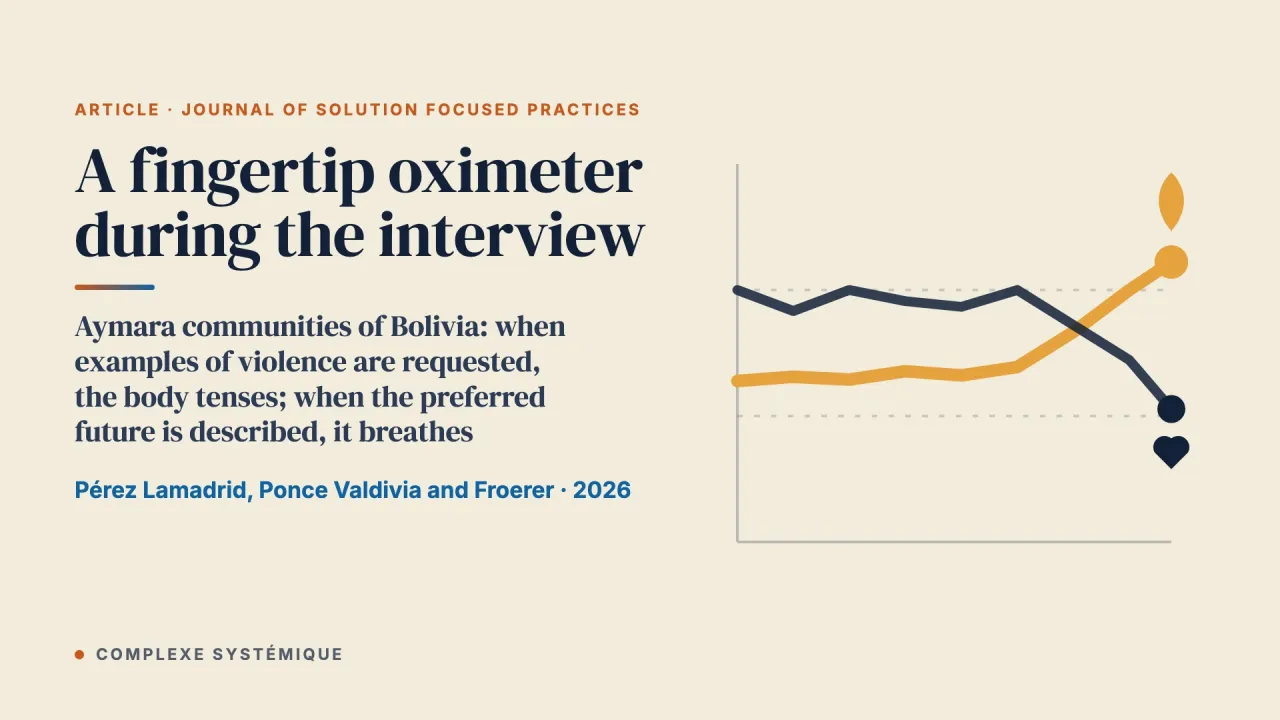
 Oxygenation and Heart Rate in Solution-Focused and Problem-Focused Interviews With Rural and Indigenous Aymara Communities (Viacha and Laja) Regarding Intersectional Violence
A fingertip oximeter on 19 Aymara people of the Altiplano: the problem-focused interview tenses when examples of violence are requested; the solution-focused one oxygenates and slows the heart.
 Article
 Anatomy of the Relational Reframe in Attachment‐Based Family Therapy
The first session of attachment-based family therapy, filmed in 47 families: what leads them to agree to work on relationships rather than on the adolescent.