AI-assisted translation
This version was translated from Spanish by Complexe Systémique with the help of artificial intelligence. In case of doubt, the original version prevails.
Red Sistémica · Cinema
Escaping escapism: a commentary on The Family by Ettore Scola
In this column, the cinema serves as a lens for the systemic gaze. Pedro Herscovici comments on The Family (La famiglia, 1987), in which Ettore Scola follows eighty years of a man’s life without ever leaving the corridor of a single Roman apartment. A film which, in a culture that has enthroned the decontextualised individual, sets out to make visible that invisible unit which is the family: in movement, changing from one form to another, and yet a prisoner of its own structure.
The cinema as a lens
In this column, the cinema — that tide of giving and receiving, as the brilliant Swedish director I. Bergman calls it — will be our lens for various commentaries. This time we shall talk about The Family (La famiglia, 1987), by the director Ettore Scola. It has been said that this film sums up a great part of the Italian filmmaker’s work: from The Terrace it retains the historical description of a character’s life; from We All Loved Each Other So Much, the tragicomedy; from Le Bal, the continuity, within a single setting, of multiple destinies (structural drifts) that intersect; and from That Night in Varennes, what our compatriot Ricardo Aronovich said about light and the camera: that the mechanism alone is not what produces the effect on the viewer.
Scola, who began as a journalist and caricaturist, has always dazzled us as a historian of the social. He is a painter of solitude, of nostalgia, of the decadent and the sordid in context (Ugly, Dirty and Bad).
Making an invisible unit visible
The Family encompasses eighty years of the life of Carlo (Vittorio Gassman), who is shown to us and described to us in his lived situation. In our culture, which has enthroned the decontextualised individual, where this social organism is not perceived as such even by the supposed experts, the film we are concerned with makes the effort of rescuing this changing being, connected to others, in relation with others. Scola shows us the family routines so that we may appreciate that invisible unit, the family, in the only way it can be perceived: in movement, changing from one form to another. He also shows it as it is, kaleidoscopic, made up of different images, and as a sounding board for what happens to each of its members.
Individuals appear there as crystals, large or small, as figure or as ground, luminous or opaque, taking up various positions and taking part in the different forms (structures) assumed by this unit in movement.
The family appears as a ballet, in which everyone depends on the others and in which, without perceiving it, they trace out a choreography. The corridor of the vast dwelling in which several generations of a single family live together is what connects the different rooms; it is the space held in common between the different members. It is also, in time, what connects the different developmental moments of the family life cycle.
Structure as a skeleton
The cinema, like the theatre, the ballet or mime, represents the knowledge of a body. In the structure of this family, as in that of others, the relations between the parts of the system are constitutive. Structure refers to the way in which the parts are connected to one another and give rise to meanings that overflow situations. It is a line that unites, a movement that repeats itself, that delimits and articulates spaces, that defines relationships; it is a body within the body, it is the skeleton. It is a form that makes itself present at different moments of lived experience: it is neither the outline nor the frame, it is the internal design in dynamic relation.
In this story of an Italian family there is a logical progression, as in Greek tragedy, in which the members appear as prisoners of their history and of their structure.
The various subsystems of the family system — the three sisters who remained unmarried and quarrel among themselves, or the love triangle formed by Carlo and the two sisters Beatrice (Stefania Sandrelli) and Adriana (Fanny Ardant) — have defined boundaries and maintain themselves over time. The complementarities between the brothers Carlo (the strong one) and Giulio (the weak one) are recursive.
As the years go by, the organisation remains, the system endures: Carlo and Adriana come to quarrel for fifty years, and even when the third term of the subunit has just died, the distances are maintained. In a beautiful final dialogue, they acknowledge that Beatrice was the continuity of the family (morphostasis) and that they themselves were its leaps (morphogenesis).
The repetition, from generation to generation, of roles and of interpersonal interlockings, as well as of the many historical overdeterminations within a narrow setting, comes to an end when Carlo celebrates his eightieth birthday.
The family photograph of the opening is repeated: the family is the same. They have not been able to stop being constrained in their movements and their possibilities; therein lies the drama.
Who is Pedro Herscovici
A pioneer of family therapy in Argentina, trained in the United States, he is the director of TESIS.
This article is an English translation of “Un escape al escapismo: Un comentario sobre «LA FAMILIA» de Ettore Scola”, published by Red Sistémica (first published in Perspectivas Sistémicas, n° 2, août-septembre 1988). Translated and republished with the journal’s permission.
Read the original articleHow to cite this article
Herscovici, P. (2022). Escaping escapism: a commentary on The Family by Ettore Scola (Complexe Systémique, Trans.). Complexe Systémique. https://app.complexe-systemique.com/en_GB/articles/escaping-escapism-a-commentary-on-the-family-by-ettore-scola (Original work published in 1988 in Perspectivas Sistémicas, n° 2, août-septembre 1988; republished in 2022 by Red Sistémica, https://redsistemica.ar/2022/06/20/un-escape-al-escapismoun-comentario-sobre-la-familia-de-ettore-scola/)
To go further
- The family at the opera. Lyrical metaphors for relational problemsThe same gesture, another art: reading family configurations in a work of fiction.
- Changes in sexual behaviour and the cinemaThe cinema as a document on the transformations of private life.
- Luna de Avellaneda, or how to enthrone the given. Subjectivity, death and political cultureAnother systemic reading of a film, this time on the side of the social and political context.
Related training courses
 Symposium
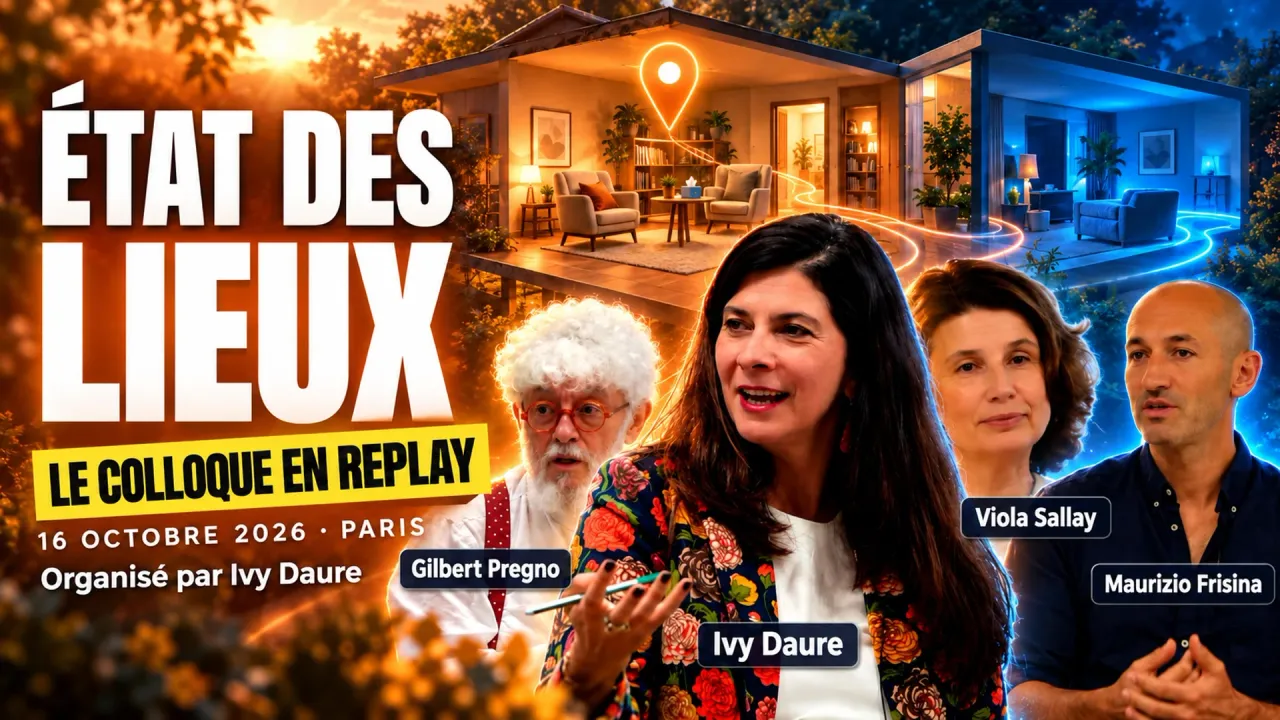
État des Lieux: a psychological approach to spaces
Replay of the “État des Lieux” conference (Paris, 16 October 2026): Ivy Daure, Maurizio Frisina, Viola Sallay and Gilbert Pregno on places as a clinical resource. In French.
Related articles
 Scientific
Family group conference provision across the lifespan of child welfare intervention: A mixed-method realist-informed evaluation comparing three stages of welfare concern
Early help, child protection or children in care: among 155 UK families, experiences and outcomes of family group conferences vary very little by stage.
 Scientific
Parenting after critical illness: a biopsychosocial review of post-intensive care syndrome, family systems, and child outcomes
After post-intensive care syndrome, parenting falters, the co-parent is worn down and children help in silence. A biopsychosocial review proposes how to spot them.
 Scientific
“Tired of Being Tired”: Intergenerational Trauma and Relational Bridging Among 1.5‐Generation East African Refugees
Sixteen Somali, Oromo and Ethiopian refugees who arrived as children describe their role as bridges between generations, between inherited silences and burdened resilience.
 Scientific
Parenting concerns among patients with cancer: a qualitative meta-synthesis
Thirty-seven qualitative studies show how cancer shakes parental identity, mobilises family resources and reveals support needs that are still overlooked.
Comments 0
Log in to join the discussion. Log in