AI-assisted translation
This version was translated from Italian by Complexe Systémique with the help of artificial intelligence. In case of doubt, the original version prevails.
Connessioni · Research
iFamilies: a survey of digital families with adolescent children
Smartphones, messaging, family chat groups: how do families with adolescents live between online and offline? Alessandro Mantovani and Silvia Ylenia L’Abbate surveyed 79 parent–child dyads from a secondary school in Padua, using among other tools Olson’s FACES III. Over 80% of families also communicate through social media, and the more cohesive children perceive their family to be, the less they use the Internet as an escape.
Unofficial English translation. This article is a translation of iFamilies: una indagine sulle famiglie digitali con figli adolescenti, by Alessandro Mantovani and Silvia Ylenia L’Abbate, published in Connessioni (Centro Milanese di Terapia della Famiglia), new series, no. 3 (2018), under a CC BY 4.0 licence. Translated by Complexe Systémique in November 2026 with the help of artificial intelligence: the original Italian text has been translated into English and reformatted, which constitutes a modification of the work under the terms of the licence. Paragraphs and subheadings are those of the journal; the figures and the table are reproduced as published by the journal, in Italian, with translated captions; Watzlawick’s axioms are given in the wording of the original English edition, except the fourth, translated from the Italian paraphrase; the questionnaire items are translated from the Italian; a few typographical errors on the web page have been silently corrected. This translation was made neither by the authors nor by the journal, who are not responsible for its content or for any errors. The original version prevails.
From a perspective of circularity, relationships influence the use of social media and the use of social media influences relationships, in a continuous exchange, in a process of readjustment.
Alessandro Mantovani, Silvia Ylenia L’Abbate
Introduction
In recent years the use of New Media1 has grown considerably in our country too: Italians are going online more and more, above all with their smartphones; at the same time, the use of various social networks is ever more widespread, especially among adolescents. These changes linked to the spread of new technologies are affecting our society and, at the same time, our identity, space, time, our brain, and the way we communicate and relate to one another.
In the light of these reflections, we wanted to focus on digital families with adolescent children, who communicate and relate both online and offline, seeking to identify their technological profile and their family functioning. The study was carried out on a sample of 79 child–parent dyads and is presented in the following sections.
Digital families between online and offline
The use of new media helps to break down the barrier between virtual (online) and real (offline, or face to face) in everyday practices; at the perceptual level, it becomes difficult to distinguish between events produced through technological mediation and communicative events of face-to-face activity (Marinelli, 2013). According to Castells (2007), the boundaries between online and offline appear permeable, at least in everyday practices. People move easily in and out of the different contexts (online and offline); indeed, there are more and more forms of integration between the different modes, following a logic of “continuity” of communicative experience rather than of “separation” (of identities, relationships, forms of communication). Riva (2014) speaks of interreality, a new hybrid social space in which online and offline, digital and real, public and private merge. Aroldi (2016) introduces the concept of “relational overlapping” as a “form of superimposition of structures of relationship and social interaction, offline and online, which occurs on several levels or in several layers and whose result is not the perfect point-by-point coincidence of each layer, but rather an ever-changing configuration, an overlap that is now partial, now redundant, of relational dynamics, at the inter- and intragenerational level, inside and outside the family.”
It is in this context, then, that digital families take their place: the so-called iFamilies (a name borrowed from a 2011 work by Williams and Merten), that is, families who communicate and relate both online and offline. These are families in which, among other things, we can find digital natives, an expression which, according to Riva (2014), refers to those who can use new technologies effortlessly; being a digital native is not a generational matter but a matter of ability. According to Aroldi (2015), a plurality of forms and models contributes to shaping the notion of connected families, which is why it cannot be treated as a unitary and homogeneous phenomenon. This plurality has to do with variables that are structural (degree of diffusion of technologies, speed of their innovation, rate of social mobility, heterogeneity of family models), socio-demographic (position in the developmental course of the family unit, age and gender of its members, place of residence), socio-cultural (dominant communication patterns in families, degree of digital literacy, affordances of the platforms) and relational (quality of inter- and intragenerational ties). From this perspective, Aroldi (2015) identifies several types of family connection, based on the way the structures of online relationships interact with family structures:
- Autonomous model: families whose individual members act individually online within social networks that mutually exclude the other members of the family, either because these are absent from the platform used or because no connection has been activated between their respective profiles. In this regime of autonomy, any partial margins of overlap fall outside the family boundaries, or are highly peripheral, and in any case such as not to activate intra-family connections or communication flows.
- Integrated model: families whose individual members individually replicate the plane of family relationships on the plane of online connection, on some or all of the platforms they use. These are families whose members who are, for instance, on Facebook include one another in their contact lists; another possibility is that a closed family group has been set up, for example on Facebook or WhatsApp. In these cases too, the connection can be more or less inclusive, extended to all members and all generations or only to some, and activated through more or less frequent communicative performances: the density and relevance of this connection depend on practices, skills, affordances (people change only if forced to or if the change represents a significant opportunity), and on the previous quality of offline relationships, which online relationships can enable and sustain more or less effectively.
- Unitary model: the family group is present online as such, a supra-individual subjectivity, a plural we that acquires public visibility and acts communicatively in connection with others (individuals, families or institutions). This is the fairly common example of couples who share the same Facebook profile. Thus, what comes into play in this plurality is: social media, which are not all the same, change fairly quickly and allow certain ways of relating rather than others; and relational variables, the texture and quality of offline family ties, which can push towards one relational configuration or another (Aroldi, 2015).
At the same time, the author makes further observations about social media, which seem to:
– reproduce pre-existing relational dynamics, both as regards the quality of offline relationships and as regards the use and maintenance of social capital;
– favour the horizontal dimension of relationships over the vertical one, and foster peer bonding and bridging rather than family bonding2;
– enhance coordination and the feeling of closeness, although this does not always and necessarily lead to an improvement in the quality of family relationships.
Marinelli (2013) calls today’s families networked families: family units have become smaller and less stable in their composition; family roles and the distribution of domestic time show a different balance between genders; the time and intensity of professional commitments contribute to a more fluid boundary between domestic activity and work. The time available for parenting tasks and domestic activities has decreased, with a consequent acceleration of rhythms and recourse to multitasking. Children are increasingly taken up with commitments outside the family environment, and greater autonomy is required of them in managing their daily activities, as a result of a marked reduction in the time spent with their parents. Within networked families, Marinelli (2013) identifies practices of netting together: the underlying hypothesis is that the use of new media serves to support and strengthen face-to-face interaction with family members (Raine, Wellman, 2012). Netting together thus allows digital material to be shared and opens up spaces for joint evaluation of experiences, people and ways of behaving that would otherwise remain confined to the individual sphere; netting together can also give rise to new family routines (e.g. deciding together via chat what to make for lunch). On the other hand, the online activities of (underage) children could be problematic; in this respect some families put in place netiquette, that is, established safety rules and parental guidelines. Netiquette includes: friending one’s children on social networks, rules about which sites to visit, rules about the kind of information that can be shared on social networks, limits on time spent online, family filters that block certain websites, and monitoring software to check online activities. Giaccardi (2013) sees the family as a “counter-environment” with respect to online relationships, in the sense that it helps to contain their drifts and makes it possible to rethink and enhance certain qualities of family communication.
Systemic connections with Net-related phenomena
In the systemic field, to date, we are aware of few authors who have dealt with phenomena related to the Net, to online and offline (Bedini 2012, 2013, 2017; De Checchi et al., 2012; Di Grado, 2017; Gamba, 2006; Iacone, 2005; Mastropaolo, 2011; Nascimbene, 2003).
In this work we will draw connections between systemic thinking and some concepts used in particular by the Psychology of New Media, such as: identity, Self, hypertext, narrative, relationships, positioning theory, communication, time, space.
Being present in a medium affects our experience of use, but also our identity (Riva 2012; 2014). Bateson (1972), in “Form, Substance, and Difference”, also states that the identity of the subject derives from a process that takes place through social exchanges and connects the various arcs of circuit that constitute it. In general, the authors who speak of a fragmented Self on the Net manage to discuss it not in terms of pathology but in neutral terms, likening it to Bateson’s (1972) Self, understood as a process in the making and bound up with exchange with others (Bedini, 2012). Galzigna (2008) and Giuliani (2012) emphasize the fragmentation of virtual Selves as multiple identity configurations, which come about in continuous exchange and encounter with others and with the tasks and expectations of social life. Turkle (1996) speaks of a fragmented, non-unitary Self that is drawn according to the needs and desires of the protagonist and according to the virtual, and therefore relational, environment in which the protagonist finds themselves. According to Nascimbene (2003), in the digital age the Self would be co-constructed in relation to what digital language calls “hypertext”, taking as an image or metaphor the relationship between people mediated by the rules of the Internet context. Hypertext is a virtual text made up of sets of words and/or visual/auditory images electronically organized by rules, in an open-closed and never definitive textuality. In hypertext the connected networks are numerous and interact with one another (Landow, 1992). Hypertext has neither beginning nor end, but is a circular, reversible and interactive structure; it tends towards dynamism, it is a new construction of time and space, and therefore a new construction of reality (ibid.). Giuliani (Giuliani, Nascimbene, 2009) thus uses the metaphor of the web page with its countless links to other pages, in which each person can move according to their own needs and preferences, co-constructing their own narrative. In this way the hypertext perspective constitutes a new paradigm of a plural, changing and complex Self, because it is the product of a narrative constructed and reassembled each time by several people who are at the same time readers and authors of this narrative. The Internet and social networks make it possible to create new narratives and new ways of expressing them (Bedini, 2012).
To analyse the new media, Riva (2012; 2014) refers to positioning theory (Davies and Harré, 1990): the new media make it possible to play an active role in defining the characteristics of one’s own “position” within one’s social reference groups. At the same time, the search and analysis possibilities offered by the Internet make it easier to check the “position” of others and compare it with one’s own. As positioning theory suggests, it is through narrative that the subject defines their own identity, narrative here meaning the subject interpreting events, describing them and linking them through a plot that reflects a specific meaning (Bruner, 1986). Positioning theory is also taken up in the work of Ugazio (1998; 2012), according to whom people position themselves, and consequently others, on the basis of what they say and do. In every family, conversation is organized within antagonistic meanings, the so-called family semantic polarities, which constitute a shared web of meanings within which each family member must necessarily take a position in the conversation.
As regards communication, a point of reference for the systemic-relational approach is the work by Watzlawick et al. (1971), Pragmatics of Human Communication, which sets out the axioms of communication, that is, the typical properties of communication that have relational implications. De Checchi et al. (2012) used these axioms to analyse online communication:
- One cannot not communicate.
When online, the subject is in a situation in which activity or inactivity, words or silence, a photo, an image, all have message value and influence the other, and it is therefore impossible not to communicate.
- Every communication has a content and a relationship aspect such that the latter classifies the former and is therefore a metacommunication.
In online communication, one chooses whom to communicate with (relationship) and what to communicate (content); the content aspect, however, seems to predominate among those who interact online, while the relationship aspect between the parties involved turns out to be particularly hard to define. In online communication, for example, it is difficult to tell a rejection from a disconfirmation. If A is chatting with B, and B answers A after a particularly long interval, what is B communicating? Rejection, and therefore “I don’t agree with you”, or disconfirmation, and therefore “You don’t exist”?
- The nature of a relationship is contingent upon the punctuation of the communicational sequences between the communicants.
It is difficult to identify the punctuation of online communication sequences, all the more so if, as we have said, online and offline experiences intersect. One parameter that usually remains unspecified by those communicating, but that is important in online communication, is temporality. Silence on the part of the receiver, or a simple delay in replying, may sometimes lead the sender to feel rejected, giving rise to conflicts over what is considered the cause and what is considered the effect of each other’s behaviour. In online interaction, the ability to recognize the diversity of individual perceptions of time thus becomes essential.
De Checchi et al. (2012) ask: what role can this new spatio-temporal dimension play in online interpersonal relationships? It could be that the rules of communication in cyberspace help to create a new relational matrix.
In systemic-relational psychotherapy, too, for example, it is important to recover temporal differences, history, the individual (Boscolo, Bertrando, 1996). Harmonious development requires coordination between inner times and outer times, between the times of the individual and the times of the significant people with whom the individual is in relationship, and with social times. For the systemic therapist, synchronic time and diachronic time are both important, that is, the exploration of a given moment in a history (synchrony) in relation to its overall unfolding, for example in relation to the history of the family or to the evolution of the therapeutic relationship (diachronic time), and vice versa.
- Human beings communicate both verbally (digital mode) and non-verbally (analogic mode).
Gamba (2006) takes up the fourth axiom, stressing that the difference between offline and online communication lies in the fact that in the latter kinetic and paralinguistic indicators are completely missing, and one relies almost entirely on written digital language. The only exception would be the so-called “little faces” or “smileys”, which act as an expressive and appellative reinforcement and serve to compress and condense the elements of discourse as much as possible. For Bedini (2012), the use of the webcam could be seen as an attempt to integrate virtual communication with analogic communication, but it does not seem to be the preferred means of sharing within relationships on the Internet.
- All communicational interchanges are either symmetrical or complementary, depending on whether they are based on equality or difference.
According to De Checchi et al. (ibid.), the possibility of experimenting with different positions in online interactions (moving from a symmetrical to a complementary relationship and vice versa) could be partly due to the lack of a previous history, which allows subjects to present themselves, hic et nunc, with different relational modes. In everyday life, by contrast, subjects are invested with roles and positions built up over time, connected to their personal history and to the system they belong to. The authors give the example of the cyberbully, who seems to relate to the victim mainly in a complementary way, but online it is also possible to experiment rapidly with reversing the one-up/one-down position.
The study on iFamilies
Most studies focusing on the use of New Media in family relationships have been carried out in the United States (Aroldi, 2015). As regards the Italian situation, we would point to an issue of the journal Studi Interdisciplinari sulla Famiglia (edited by Scabini and Rossi, 2013), entitled “Famiglia e Nuovi media” (Family and New Media), which presents several essays and studies on the use of new media and, in particular, on their influence on adolescents and on family organization.
In this article we present our study, whose general aim was to investigate online and offline family relationships in a sample of families with adolescent children. Among other things, ours appears to be the first study to administer an instrument of systemic orientation such as FACES III.
The hypothesis is that new media help family members to stay connected with one another, in a relational continuum between online and offline.
Another hypothesis is that problematic Internet use by the child is correlated with family functioning that is less cohesive from a relational point of view.
The specific aims of the study were:
– to identify which technological devices are owned for connecting to the Internet;
– to measure the time spent online;
– to identify which activities the subjects engage in online and offline;
– to identify whether, and for what purpose, family members use social media with one another;
– to analyse the type of family functioning in iFamilies and their degree of satisfaction (discrepancy between ideal and perceived family);
– to investigate whether the children have a problem with Internet use;
– to investigate whether there is a correlation between the children’s Internet use and the type of functioning of family relationships.
Sample
For the sample we involved the I.I.S. (upper secondary school) “Leonardo da Vinci” in Padua, and in particular 79 child–parent dyads; the children belong to 6 classes of the school, from different courses of study: 4 classes from the social and health services course, 1 class from the commercial services course, 1 class from the tourism course.
Looking at the distribution of the sample, the children have a mean age of 14 (as they belong to first-year upper secondary classes), while the parents have a mean age of 45 with an SD of about 5 years.
The distribution by gender is as follows: among the children there are 67 girls and 12 boys, of whom 48 are first-born, 20 second-born and 10 third-born (or later); among the parents, 65 mothers and 14 fathers. Overall, therefore, the female gender predominates.
The sample is made up of subjects of Italian and foreign nationality, specifically: among the children, 66 are Italian and 13 are foreign nationals; among the parents, 59 are Italian and 20 are foreign nationals.
As regards education, most parents hold an upper secondary school diploma (n = 34), followed by those with a lower secondary school certificate (n = 24), a master’s degree (n = 13) and a bachelor’s degree (n = 6), while few have only a primary school certificate (n = 2).
In terms of employment, the parents are mostly employed (n = 56); there are also 23 subjects who are unemployed or in any case at home.
As for the number of children in each family unit, we have: 12 units with an only child, as many as 41 units with two children, 17 units with three children, 5 with four children, 3 with five children and 1 unit with six children.
Instruments and procedure
For the purposes of the study we chose to administer three instruments.
The first is the INFORMATION SHEET: we created this questionnaire ad hoc, with a first part collecting the personal data of each subject and a second part aimed at reconstructing the subjects’ technological profile by investigating the devices they own for connecting and how long they stay connected; the activities they engage in online and offline; the main reasons why children and parents relate to each other online; and finally the subjects’ perception of the number of their online and offline contacts.
The second instrument is the UADI (Uso, Abuso e Dipendenza da Internet, Internet Use, Abuse and Dependence) proposed by Del Miglio, Gamba and Cantelmi (2001). We chose this instrument, although many have been created on the subject of the Internet, because it considered both the use and the abuse of the Internet.
The UADI consists of 80 items, answered on a five-point Likert scale (1 = absolutely false; 2 = rather false; 3 = neither true nor false; 4 = fairly true; 5 = absolutely true). The test investigates five dimensions:
- Dependence (DIP): the appearance of symptoms of dependence, such as a progressive increase in connection time, compulsiveness and excessive involvement. Examples of items on the scale: no. 16 “I happen to stay online longer than I initially intended”; no. 34 “Sometimes I feel the need to connect to the Internet even just for a moment”; no. 56 “I don’t lose hours of sleep because of the Internet”.
- Compensatory escape (EVA): the tendency to escape from everyday difficulties through the Internet. Examples of items on the scale: no. 53 “Sometimes I think real life is more depressing than online life”; no. 57 “Sometimes, after a bad day, I feel the need to go online”; no. 58 “Sometimes I use the Internet as an outlet for my worries”.
- Dissociation (DIS): the appearance of bizarre sensory experiences, a tendency towards alienation and flight from reality. Items on the scale: no. 62 “After a few hours online I feel slightly dazed or have strange sensations”; no. 74 “The Internet influences my thoughts or my dreams”.
- Impact on real life (IVR): the appearance of consequences on real life, changes in habits, moods and social relationships. Items on the scale: no. 43 “The Internet does not interfere negatively with work, study or social relationships”; no. 49 “I never find myself preferring the Internet to an evening with friends or family”; no. 59 “I don’t try to hide from others the amount of time I spend on the Internet”.
- Experimentation (SPE): the propensity to use the Internet to experiment with parts of the self and/or to seek new emotions. Items on the scale: no. 65 “I often go online to have a private space of my own”; no. 36 “I often go online to chase away boredom”; no. 31 “When I use chat, e-mail or role-playing games, I tend to describe myself differently from how I am”.
The third instrument is FACES III (Family Adaptability and Cohesion Evaluation Scale III) by Olson, Portner and Lavee (1985). It is a self-report questionnaire useful for studying family interaction and relationships with reference to individual, couple and family variables, and for summarizing the perceptions and aspirations of the different members of a family (Scabini, 1994). The instrument is based on the Circumplex Model of Olson et al. (1983), which provides a classification of “family types” built from levels of cohesion and adaptability.
The concept of cohesion refers both to emotional bonds, that is, to the mutual ties between family members, and to the degree of personal autonomy of each member of the family unit. Adaptability, on the other hand, indicates the ability of a family or couple system to change its power structures, roles and relational rules in response to developmental and stressful situations.
Through the articulation and gradation of cohesion and adaptability, considered central to the system’s process of morphostasis and morphogenesis, Olson et al. (1983) developed a typology of family functioning with sixteen categories, in which none of the types of functioning is pathological in itself: dysfunction arises when a family unit rigidly repeats a certain mode, without the possibility of moving along the dimensions. The sixteen family types could be summarized in three categories of families: balanced (central area of the map), mid-range (intermediate area of the map) and extreme (extreme areas of the map). Balanced families thus comprise the family units that obtain average scores on both the cohesion and the adaptability dimensions; the mid-range type corresponds to families that reach the maximum or minimum level on one dimension and intermediate values on the other; finally, the extreme type is made up of families located at maximum or minimum values on both dimensions. FACES III makes it possible to place each member within the Circumplex Model and to visualize the members’ perceptions of the family’s current situation (perceived family) and of their aspirations for its future change (ideal family). The discrepancy between perceived family and ideal family provides a measure of family dissatisfaction.
FACES is divided into two scales: one measures the perception of the family situation (perceived family), the other is an analogous scale (made up of the same items, with a slight variation in wording) that aims to measure the cohesion and adaptability the subject would ideally like in their own family (ideal family).
The items are unidirectional, all in the direction of the maximum expression of the two dimensions of cohesion and adaptability, and consist of statements about various aspects of family life and functioning.
Response format: five-point Likert scale (from 1 = almost never, 2 = once in a while, 3 = sometimes, 4 = frequently, 5 = almost always).
As regards scoring, two scores can be calculated, corresponding to the sum of the partial scores obtained on the cohesion and adaptability items, for both the perceived and the ideal family. By comparing the answers relating to the perceived family with those relating to the ideal family, a discrepancy score can also be calculated: a high discrepancy corresponds to a high degree of dissatisfaction; conversely, a low discrepancy corresponds to a low or zero degree of family dissatisfaction (Barni, 2006).
Participants were given a brief introduction to the aims of the study and an explanation of the tests they would complete. Specifically, we then administered the following instruments to the children: information sheet, UADI and FACES III; and to the parents, the information sheet and FACES III. Families could choose freely which parent, one or both, would complete the tests. In our sample one parent per child took part, mostly mothers; among the children, girls predominated.
Results
We begin by setting out the results concerning the participants’ technological profile. The most commonly owned technological device is the smartphone, for both children (96%) and parents (95%). Next comes the computer, owned by 82% of the children and 74% of the parents. Then there is the tablet, owned by 49% of the children and 40% of the parents. Finally, 41% of the children and 27% of the parents own gaming devices. In general, it is the children who own more technological devices. As regards the “Amount of time spent connected to the Internet”: most parents spend less time (in hours) online (82%), while the children are online for decidedly more hours, “3–5 hours” (53%) and “more than 6 hours” a day (12%). Most frequent online activities: the children mainly use chat and social networks. The percentage of children who use streaming and/or download content is also high. The parents’ answers are more spread out, with social networks, search engines and chat coming first. Offline activities: seeing friends is the activity most engaged in by both children and parents; this seems to be a good indicator of cultivating relationships outside the family as well, in the social network, and therefore in other contexts and systems; social networks thus feed social capital.
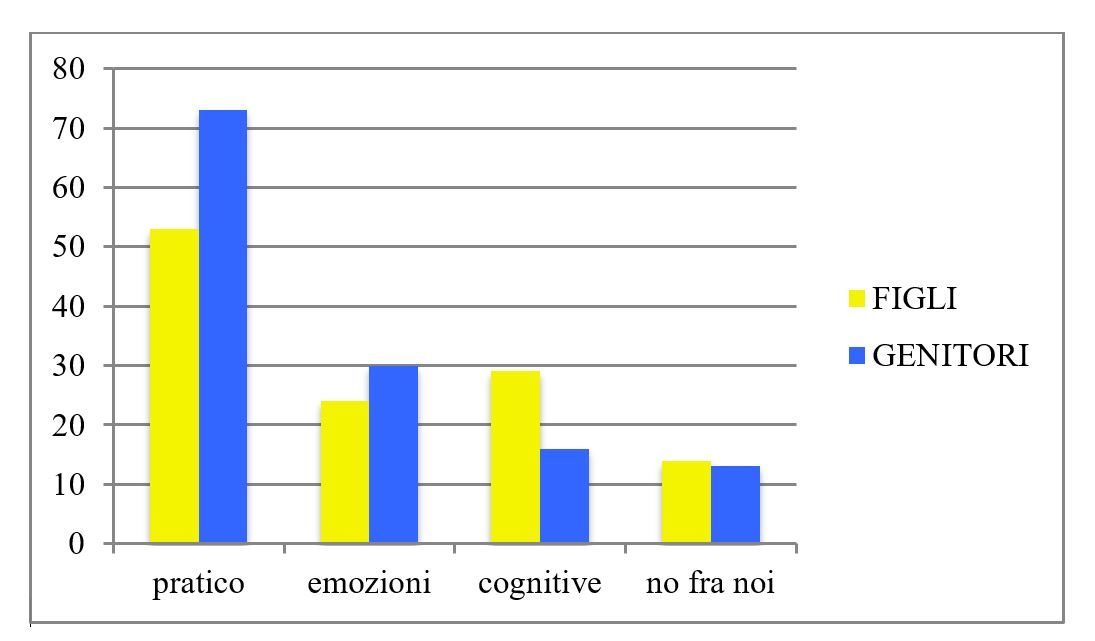
Fig. 1 refers to the item asking: “In our family we use social media or instant messaging tools with one another mainly for”. Both children (53%) and parents (73%) use them for “practical matters”; 29% of the children use them to make decisions or solve problems (cognitive), compared with 16% of the parents. The children (24%) use these tools to share emotions about events and experiences, compared with 30% of the parents. A fair percentage of children (14%) and parents (13%) say they do not use these tools to communicate among family members.
As regards the answers to the item “If you had to quantify your ONLINE CONTACTS (that is, all those you have in your online profiles), how many are there?”, in general it is more often the parents who report having a narrower circle of online contacts: 58% of them fall in the band “from 1 to 100” online contacts; the largest group of children (43%) report having “from 1 to 100” online contacts.
To the item “Among your online contacts, how many are mere ACQUAINTANCES (that is, people you do not usually interact with, either online or in daily life)?”, the majority of both children (58%) and parents (50%) answer “from 1 to 50”, thus stating that they have few acquaintances among their online contacts.
The majority of the sample report having “from 1 to 50” friends: 46% of the children and, above all, 65% of the parents.
We now present the results of the FACES III and UADI instruments.
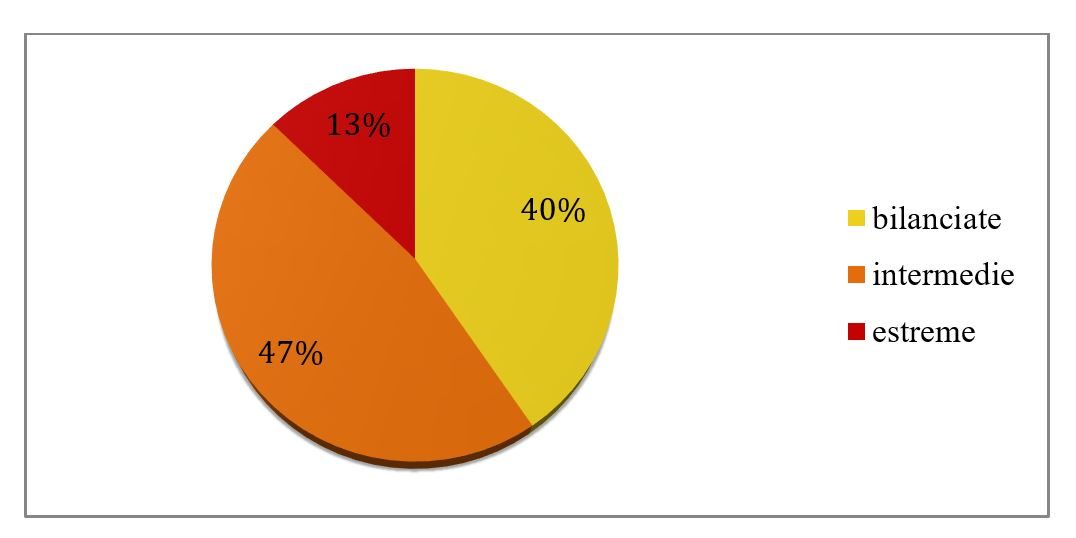
The pie chart in Fig. 2 shows the results of FACES III (in percentages). We divided the families according to their functioning, and it emerged that 32 families (40%) are balanced, 37 (47%) mid-range and 10 (13%) extreme.
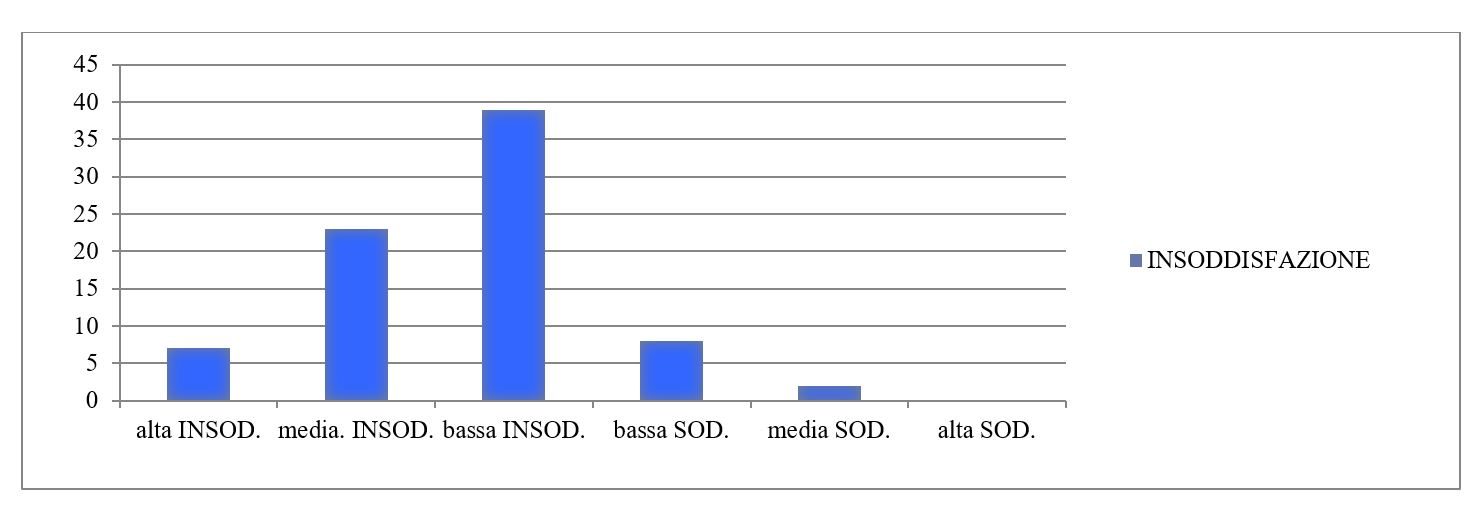
The graph (see Fig. 3) shows where the families in our sample stand in terms of level of dissatisfaction, which is the result of the discrepancy between perceived family and ideal family. We then grouped the families’ levels of dissatisfaction as follows:
– from 21 to 45: high dissatisfaction
– from 11 to 20: medium dissatisfaction
– from 1 to 10: low dissatisfaction
– from −10 to 0: low satisfaction
– from −20 to −11: medium satisfaction
– from −45 to −21: high satisfaction
It thus emerged that 7 families have high dissatisfaction, 23 families medium dissatisfaction and 39 families low dissatisfaction; then 8 families have low satisfaction and 2 medium satisfaction. In short, low dissatisfaction seems to prevail.
If we look at each child’s T-scores on each UADI scale individually, we find that some subjects have low or high T-scores. Particularly noteworthy are the 3 subjects who fall in “high escape” and the 5 subjects with a high “impact on real life”. Nevertheless, these 8 subjects belong to families with balanced or mid-range functioning.
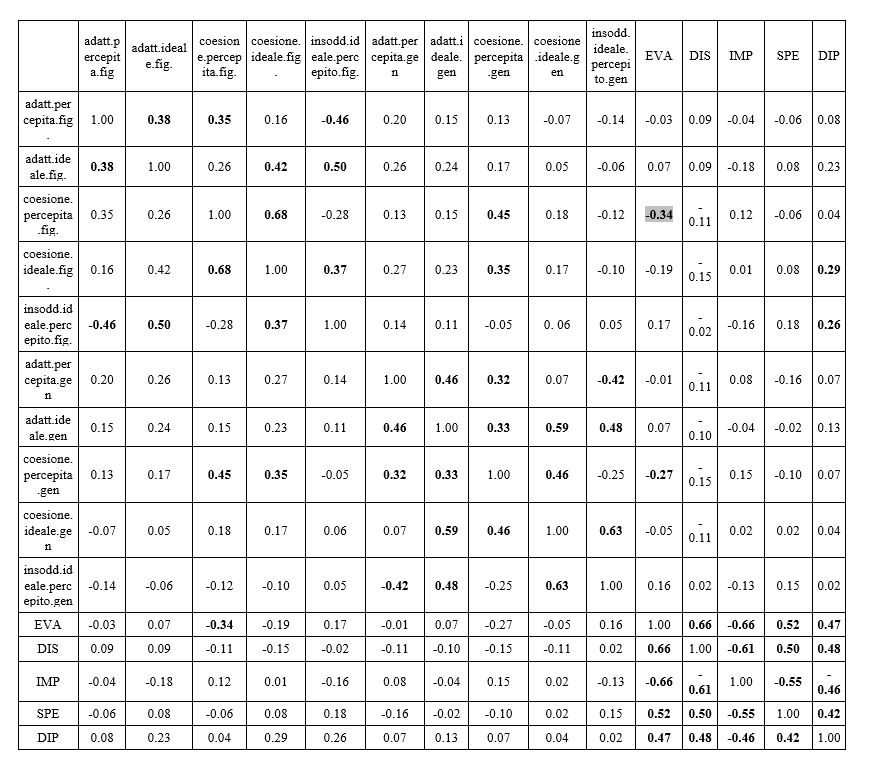
We then decided to compute Pearson correlations between the dimensions of FACES (perceived and ideal adaptability, perceived and ideal cohesion, dissatisfaction) and those of the UADI, on the basis of the answers of children and parents (see Tab. 1). Among all the correlations, we found one that concerns two different dimensions of the two instruments used: as the cohesion perceived by the children increases (FACES III), escape from real problems decreases (UADI), with a value of −0.34.
Discussion
The results confirm how digital today’s families are: the technological devices owned for connecting to the Internet are numerous (subjects often have more than one), as are the different activities the subjects engage in online. Among the devices, the most commonly owned is the smartphone (children 96%; parents 95%); this finding seems to confirm national statistics according to which Italians increasingly go online using their smartphones rather than other devices. It is worth noting that gaming devices are also very widespread: almost half the children in our sample own one (41%).
As regards the amount of time spent online in hours, most parents (82%) spend 1–2 hours a day on the Internet. The children turn out to be more connected than their parents: 53% spend from 3 to 5 hours on the Internet, and 12% of the children are online for more than 6 hours a day. According to some authors (Cantelmi et al. 2000), 5–6 hours a day would be the critical threshold beyond which one risks entering the circuit of Internet dependence, or rather risks problematic Internet use. For this part of the sample (12% of the children) who are online for more than 6 hours a day, it would be interesting to explore whether and how these hours of connection affect the young people’s other daily offline activities (afternoon and/or evening), given that, for example, smartphone use is not allowed at school, at least in the morning.
If we then look at the most frequent online activities carried out at least 4 times a week, the children mainly use chat (81%) and social networks (75%); this confirms that social media are very widespread among the young. The percentage of children who use streaming and/or download content is also high (63%), while the use of online video games is lower but still significant (16%). The parents’ answers are more widely spread, with fairly frequent use of social networks (54%), search engines (54%) and chat (42%). The difference in percentages of use between children and parents is immediately striking for two answer options: e-mail is used more by the parents (57%), compared with 10% of the children; streaming/download is used more by the children (63%), compared with 14% of the parents. One might hypothesize that parents use e-mail more for more formal matters too, for example for work communications.
As regards the activities that people prefer to do offline at least twice a week, seeing friends is the one most engaged in by the children (78%), but the percentage of parents is also significant (59%); this seems to be a good indicator, for our sample, of cultivating relationships outside the family too, in the social network, and therefore in other contexts, in other systems. As also found in the literature (Kaare et al. 2007; Brandtzaeg et al. 2010), social networks feed social capital: they are effective in sustaining the dynamics of peer bonding (ties between peers), and this may hold for both children and parents. Again in the literature (ibid.), we found that the first reason for using social networks is communication with friends, followed by looking for new friends and acquaintances, and by contact with old friends; one might therefore think that social networks are the tool that makes it possible to communicate (online and offline) and to see friends (offline). In this sense the concept of the Net as a social space, and in particular as a space for online and offline relationships, would be confirmed.
Again with regard to offline activities, the children listen to music (85%) twice as much as their parents (39%); this finding seems connected with the online streaming/download activity of 63% of the children, in that the children download music online and listen to it offline. Among the activities done at least twice a week, both children (37%) and parents (35%) include cultural ones: cinema, theatre, reading. It is easy to think that the Net itself may help to spread information and advertise films, shows, events and books (think, for example, of the “events” advertised on Facebook: if we mark ourselves as attending, the event will then appear to our other friends) and to cultivate cultural interests; cinema and theatre could also create opportunities for seeing friends, and thus feed the peer bonding we spoke of earlier.
The results on the use of social media and instant messaging tools among family members show that only a small part of the sample, 14% of the children and 13% of the parents, say they do not use these tools to communicate within the family. Thus over 80% of the whole sample use them. This result seems to confirm the presence of netting together practices (Marinelli, 2013; Raine, Wellman, 2012), that is, the sharing among family members of information, emotions and experiences, with the possibility of giving rise to new family routines. It also seems to confirm what is described by the Pew Research Center studies, namely that networked families are in connected motion: integrating online connections into daily routines allows greater operational coordination at a distance between the different members (in the item, the answers “practical matters” and “making decisions or solving problems”) and helps to maintain a sense of proximity and closeness, including of an expressive kind (in the item, the answer “sharing emotions about events and experiences”). In this sense the Net is the “pattern which connects”. According to the literature (Rivoltella, 2013), interaction between parents and children through social media would be positive, since it provides an opportunity for dialogue with children about their online experiences, and the relationship itself would be enriched by communication between generations.
We would like to make a general observation on the answers to the items asking respondents to quantify their online contacts, acquaintances, and online and offline friends. The results seem to confirm what has been found in the literature, namely that the Internet is a space for identity performances, which may be extensive, for those who display their network of friends as part of their “reputational capital”, or intensive, for those who use a smaller number of expressive resources, but in a targeted way, often documenting moments of offline conviviality with friends.
The FACES III and UADI results point to a sample with predominantly mid-range and balanced family functioning; there are also 10 families with extreme functioning, which means that they are located at maximum or minimum values on both the cohesion and the adaptability dimensions. It should be remembered that cohesion concerns the emotional bond that unites family members and includes the representation of family ties that each of us carries within; cohesion focuses on the balance between a sense of belonging and a sense of separateness in family relationships; adaptability, on the other hand, indicates the ability of a family system to change its power structures, roles and relational rules in response to developmental and stressful situations.
Furthermore, calculating the level of dissatisfaction of the families in the sample, it would seem that there are more dissatisfied families than satisfied ones.
The UADI results show that almost all of the children in the sample have no problems with Internet use; the exceptions are 3 children with high escape (using the Net to escape from real problems, difficulty in establishing social relationships), who nonetheless fall within the percentage of families with balanced functioning. There are also 5 children with a high impact on real life (social distress, psychophysiological fatigue, disruption of usual habits), who belong to families with balanced or mid-range functioning.
We also found that as the child’s perceived cohesion increases, escape decreases (−0.34); it would therefore seem that the more the child feels the emotional bond that unites the family members, the less the child will tend to escape from everyday difficulties through the use of the Internet.
More generally, with respect to the data that emerged, it would be interesting to know what role is played by parental mediation and the domestication of technology identified in other studies on the subject, that is, to what extent parents put in place parental mediation strategies for the use of new technologies, and how the latter are incorporated into the domestic space, which includes the values, practices and lifestyles of the family and its members.
Conclusions
The aim of the study was to analyse relationships in families with adolescent children. With respect to the initial hypothesis, we found that most of the families in the sample are in connected motion: new media help family members to stay connected with one another, online and offline; online and offline activities therefore compensate for each other and intersect. Furthermore, social media are social spaces that allow subjects to manage their social network, to have friends online and to see them offline. Through the use of new media the Self is co-constructed, thanks to narrative, in a continuous social exchange; in this way the individual takes up a position. From a perspective of circularity, relationships influence the use of social media and the use of social media influences relationships, in a continuous exchange, in a process of readjustment.
As some authors argue (Di Grado et al., 2017), conceptualizing social media as a resource makes it possible to state that it is we, with our meanings and our values, who give them meaning, and that no media frontier is dangerous in itself, but only according to how critically and consciously it is used.
We can say that the Net gives people the possibility of “being seen”; as Cecchin indeed emphasized, “the fundamental need of the human being is to be seen in relationship with others”. The problem, in these terms, arises when the only visibility is obtained in the online world rather than in the offline one. The role of psychotherapy will then be to gather the story of this “disconnection” from the real world, connecting the different family narratives in a pattern that can restore that “relational signal” capable of providing the gratification that only flight into the online world was able to give… but that is another story.
Complexe Systémique: key points
This survey has the merit of applying a systemic instrument, Olson’s FACES III, to families’ digital practices, and of looking at parents and children together rather than at individual screen use alone. Its limits are clear: a single school in Padua, a convenience sample made up mostly of girls and mothers, self-report questionnaires, and a single correlation reported (−0.34) with no indication of significance. It therefore does not allow any causal link to be drawn between family cohesion and Internet use. For clinical work, however, it invites a useful shift: treating screens as part of family organization, made of chat groups, parental rules and everyday coordination, rather than as an individual symptom. Asking a family what its online exchanges are for, who takes part in them and who is left out opens a circular reading in which media use and relationships shape each other. Read alongside the study of family involvement in treating adolescent Internet addiction, and the article on digital technology in support of parent–child relationships.
Notes from the original
1 New Media: all the means of communication that use digital language.
2 – bridging: weak ties;
– bonding: strong ties;
– peer bonding: ties between peers;
– family bonding: family ties.
References
Aroldi, P. (2015), “Famiglie connesse: Social network e relazioni familiari online”, Media Education, vol. 6, n. 1, pp. 1-17.
Aroldi, P. (2016), Connessioni quotidiane. Spazi di esperienza tra online offline, Milano, Educatt (e-book).
Barni, D. (2006), Strumenti self-report per conoscere le famiglie, Milano, Vita e Pensiero.
Bateson, G. (1972), Steps to an ecology of mind, New York, Chandler Publishing Company (trad. it. Verso un’ecologia della mente, Milano,Adelphi, 1976).
Bedini, E. (2012), “Le identità virtuali: Quello che la sistemica dice e quello che non dice”, Identità sistemiche, Mosconi, A.; Pezzolo, M.; Racerro, G. (2012), (a cura di) Atti del Convegno Nazionale del Centro Milanese di Terapia della Famiglia.
Bedini, E. (2013), Ci vediamo in chat: Come costruiamo le nostre relazioni all’interno di internet, Atti del Convegno nazionale del Centro Milanese di Terapia della Famiglia, Mondello (PA), ottobre 2013.
Bedini, E. (2017), Rete e connessioni,(e-book).
Boscolo, L.; Bertrando, P. (1996), Terapia sistemica individuale, Milano, Raffaello Cortina Editore.
Boscolo, L.; Cecchin, G. (1988), “Il problema della diagnosi da un punto di vista sistemico”, Psicobiettivo, n.3.
Brandtzæg, P. B.; Heim, J.; Kaare, B. H. (2010), “Bridging and bonding in social network sites. Investigating family-based capital”, International Journal of Web Based Communities, 6, n.3, pp. 231-253.
Bruner, J. S. (1986), Actual minds, possible worlds, Cambridge, Mass. Harvard University Press; trad. it. La mente a più dimensioni, Roma-Bari Laterza, 1993.
Castells, M. (2007), Mobile Communication and Society: A Global Perspective, Cambridge, The MIT Press.
Davies, B.; Harré, R. (1990), “Positioning: The discursive production of selves”, Journal for the Theory of Social Behaviour, 20, pp. 43-63.
De Checchi, F.; Mattiazzi, V.; Neri, A. (2012), “Siamo malati di comunicazione? Web, social network e nuove forme di comunicazione rilette in ottica sistemica”,in Mosconi, A.; Pezzolo, M.; Racerro, G. (a cura di) (2012),Identità sistemiche, Atti del Convegno Nazionale del Centro Milanese di Terapia della Famiglia, pp. 330-340.
Del Miglio, C.; Gamba, A.; Cantelmi T. (2001),“Costruzione e validazione preliminare di uno strumento (U.A.D.I.) per la rilevazione delle variabili psicologiche e psicopatologiche correlate all’uso di Internet”, Giornale Italiano di Psicopatologia, 3, pp. 293-306.
Di Grado, M.; Beconi, A.; Tata, M.; Tamborini, V. (2017), “Social media e legami familiari: verso un superamento della dicotomia tra mondo reale e digitale”, Riv. di Psicoterapia Relazionale, 45/2017, Franco Angeli.
Galzigna, M. (2008), Comunità virtuali e pratiche del sé, in Mapelli, M.; Lo Iacono, R. (a cura di), Pratiche collaborative in rete, Milano, Mimesis.
Gamba, A. (2006), La pragmatica della comunicazione in internet, Opsonline (acc. settembre 2017)
Giaccardi, C. (2013), Ripensare i legami: La famiglia nell’era dei social media, in Scabini, E.; Rossi, G. (a cura di), Famiglia e nuovi media, Milano, Vita e Pensiero.
Giuliani, M. (2012), Ipotesi sul Sé: Dalla psicoanalisi al virtuale, in Barbetta, P.; Casadio, L.; Giuliani, M. (a cura di), Margini: Tra sistemica e psicoanalisi, Torino, Antigone.
Giuliani, M.; Nascimbene, F. (2009),La terapia come ipertesto, Torino, Antigone.
Iacone, S. (2005), “La molteplicità e la consistenza: Psicoterapia sistemico- relazionale in un caso di internet addiction”,Ecologia della mente, n. 28, pp. 270- 283.
Kaare, B. H.; Brandtzaeg, P. B.; Heim, J.; Endestad, T. (2007), “In the borderland between family orientation and peer culture: the use of communication technologies among Norwegian teens”, New Media & Society, vol. 9, n. 4, pp. 603-624.
Landow, G. (1992), The definition of Hypertext and its history as a concept, Baltimore, John Hopkins U. Press.
Marinelli, A. (2013), Networked Families, in Scabini, E. Rossi, G. (2013) (a cura di), Famiglia e nuovi media, Milano, Vita e Pensiero.
Mastropaolo, L. (2011), “Nuove patologie adolescenziali o nuove emergenze sociali? L’Hikikomori è solo giapponese?”, Terapia Familiare, n. 97, pp. 31-58.
Mosconi, A.; Gonzo, M.; Sorgato, R.; Tirelli, M.; Tomas, M. (1999), “Ipotesi diagnostiche e relazione terapeutica: ricorsività e coerenza nel ‘Milan Model’”,Connessioni, 5, pp. 67-96.
Mosconi, A.; Pezzolo, M.; Racerro, G. (a cura di) (2012), Identità sistemiche, Atti del Convegno Nazionale del Centro Milanese di Terapia della Famiglia.
Mosconi, A.; Tirelli, M.; Neglia, V. (2013), “Il quadrilatero sistemico: una storia per narrare altre storie”, Terapia Familiare, n. 101.
Nascimbene, F. (2003), “La matrice ipertestuale del sé. Riflessioni sul modello sistemico-relazionale in un contesto internet”, Connessioni, n. 13.
Olson, D.H.; Portner, J.; Lavee, Y. (1985), FACES III, Family Social Science, Saint Paul, University of Minnesota. Trad it. Galimberti, C.; Farina, M. (1990), FACES III. Uno strumento per la ricerca e l’osservazione clinica della famiglia, Milano, Vita e Pensiero (Quaderno del Centro Famiglia, 10).
Raine, L.; Wellman, B. (2012), Networked. The New Social Operating System, Boston, MIT Press, trad.it. (2012),Networked. Il nuovo sistema operativo sociale, Milano, Guerini.
Riva, G. (2012), Psicologia dei nuovi media, Bologna, Il Mulino.
Riva, G. (2014), Nativi digitali. Crescere e apprendere nel mondo dei nuovi media, Bologna, Il Mulino.
Rivoltella, P. (2013), Educare ai nuovi media in famiglia: metafore e prospettive, intervento al Convegno Family TAG, Technology Across Generations, Milano, 18 ottobre.
Scabini, E.; Rossi, G. (a cura di) (2013), Famiglia e nuovi media, Milano, Vita e Pensiero.
Turkle, S. (1996), Life in the screen. Identity in the Age of the Internet, New York,Simon & Schuster, tr. it. Parrella, B. (1997), La vita sullo schermo: Nuove identità e relazioni sociali nell’epoca di internet, Apogeo, Milano.
Ugazio, V. (1998, 2012), Storie permesse Storie proibite, Torino,Bollati Boringhieri.
Watzlavick, P.; Beavin, J. H.; Jackson, D. D. (1971), Pragmatica della comunicazione umana, Roma, Astrolabio.
Williams, L.; Merten, J. (2011), “iFamily: Internet and Social Media Technology in the Family Context”, Family & Consumer Sciences Research Journal, vol. 40, n. 2, pp. 150-170.
Unofficial English translation of iFamilies: una indagine sulle famiglie digitali con figli adolescenti, by Alessandro Mantovani and Silvia Ylenia L’Abbate, Connessioni, new series, no. 3 (2018), under a CC BY 4.0 licence. Translation (with the help of artificial intelligence) and layout: Complexe Systémique, November 2026 — the work has been modified under the terms of the licence (figure and table captions translated). Neither the authors nor the journal are responsible for this translation; the original version prevails.
Unofficial English translation of “iFamilies: una indagine sulle famiglie digitali con figli adolescenti”, published in Connessioni (2018) under a CC BY 4.0 licence. Made by Complexe Systémique with the help of artificial intelligence, it does not come from the authors or the journal, who are not responsible for its content; the original version prevails.
Read the original articleHow to cite this article
Mantovani, A., et L'Abbate, S. Y. (2018). iFamilies: a survey of digital families with adolescent children (Complexe Systémique, Trans.). Complexe Systémique. https://app.complexe-systemique.com/en_GB/articles/ifamilies-a-survey-of-digital-families-with-adolescent-children (Original work published in 2018 in Connessioni, nuova serie, n. 3 (2018); republished in 2018 by Connessioni, https://connessioni.cmtf.it/ifamilies-una-indagine-sulle-famiglie-digitali-con-figli-adolescenti/)
To go further
- A Qualitative Study of Practitioners’ Views on Family Involvement in Treatment Process of Adolescent Internet AddictionThe family in treating Internet addiction.
- Strengthening and supporting parent–child relationships through digital technology: Benefits and challengesDigital tools for the parent–child bond.
- Emotion Regulation Focused Family Therapy With Contemporary Families Affected by Information and Communication TechnologiesScreens as family emotion regulators.
Related training courses
 Symposium
État des Lieux: a psychological approach to spaces
Replay of the “État des Lieux” conference (Paris, 16 October 2026): Ivy Daure, Maurizio Frisina, Viola Sallay and Gilbert Pregno on places as a clinical resource. In French.
 Short course
The suicidal crisis in adolescents and young adults
Training: assessing and supporting the suicidal crisis in adolescents and young adults. Clinical landmarks and systemic tools. In French.
 Symposium
The Abnormal Normals and the Normal Abnormals
Conference replay: six clinicians explore normality — diagnoses, norms, adolescents, therapists. Immediate, lifetime access. Talks in French.
Related articles
 Blog
Why do we feel we are behind in our lives?
Checking how old Yalom was when he published his first book reassured me. But in which race? A systemic look at the feeling of being behind, and at what we can change together.
 Scientific
Family group conference provision across the lifespan of child welfare intervention: A mixed-method realist-informed evaluation comparing three stages of welfare concern
Early help, child protection or children in care: among 155 UK families, experiences and outcomes of family group conferences vary very little by stage.
 Scientific
Digital Co-Regulation and Dysregulation in Romantic Relationships: A Systemic Model of Technology-Mediated Emotional Processes
Checking, chasing, blocking: 31 interviews show how the phone regulates or dysregulates a couple’s anxiety, with a systemic model of the loop.
 Scientific
The Role of Parental Expressed Emotion and Loss-Specific Parental Responses in Children’s Loss-Related Outcomes Following Traumatic Loss: A Mixed-Methods Observational Study
After a road-traffic bereavement, parental criticism goes with the child's depression, positive appraisals of the loss with better well-being.
Comments 0
Log in to join the discussion. Log in