Journal of Solution Focused Practices · Trauma
A Broad Overview of Solution Focused Severe Trauma & Stress Recovery Work, with the Introduction of Two Additional SF Instruments to Promote Thriverhood
Twenty-five years of working with adult survivors of childhood abuse and neglect, and of severe trauma, have convinced John Henden of one thing: to move towards thriving, clients need to understand what thriving is. He revisits Yvonne Dolan’s Victim–Survivor–Thriver continuum, briefly describes the work of four contemporary practitioners, draws on neuroplasticity to account for what solution focused questions bring about, and introduces two instruments of his own: the handout ‘What Thriving is Like’ and the thirty-three-item questionnaire that measures progress towards that third stage.
This is the original article A Broad Overview of Solution Focused Severe Trauma & Stress Recovery Work, with the Introduction of Two Additional SF Instruments to Promote Thriverhood, by John Henden, published in Journal of Solution Focused Practices (2020), doi: 10.59874/001c.75027, under a CC BY 4.0 licence. Republished by Complexe Systémique: the author’s text is unchanged; only the presentation has been adapted for reading online, and the response scale of the questionnaire, printed under each of its thirty-three items in the original, is stated once. Boxes labelled “Complexe Systémique” are ours, not the author’s.
On its own, being a ‘survivor’ is not enough. You owe it to yourself to move into the third stage: thriving.
John Henden
Abstract
The purpose of this paper is to show how the author’s solution focused (SF) work with both adult survivors of child abuse and neglect; and, adult trauma survivors, has developed from Yvonne Dolan’s severe trauma recovery work (Dolan, 1998). Dolan’s major contribution to this way of working is acknowledged; and, her three-stage Victim–Survivor–Thriver continuum detailed, with an emphasis on the Thriver stage. Other contemporary practitioners’ work is described, in brief, also. From the author’s clinical work with survivors of trauma, over some 25 years, it has become clear that clients need to understand more fully what thriverhood is about, in order to move towards it more effectively. Psychoeducation in the form of in-session verbal information and typed sheets to take away, has proved to be helpful in most cases. Some recent neuroscientific research, with specific reference to neuroplasticity is referred to, to demonstrate how clients improve through this specialist SF application. The handouts ‘What Thriving is Like’ (Figure 1) and ‘The Thriver Progress Questionnaire’ (Figure 2) are more advanced materials to help clients have a better understanding of both what is possible and how to be thriving more fully. It is the author’s intention also, to encourage more practitioners, equipped with the additional tools referred to, to take up the challenge of those important and rewarding work.
Keywords: Thriving; Solution focused; Trauma; Survivor; Victim; Thriver; Neuroscience; Neuroplasticity.
Introduction
Almost year on year, the number of specialist applications of the SF approach, expands. Since becoming an SF therapist in the early 1990s, I have sought to apply the principles, assumptions, tools and techniques of our wonderfully liberating approach to therapy, coaching and consultancy. Within the last 10 years, especially, I have concentrated on my two specialist mental health applications: Suicide Prevention and Severe Trauma Recovery. The second of these, developed out of my extensive training of military welfare workers, across the British armed forces, saw the publication of my first work: Beating Combat Stress: 101 techniques for recovery (Henden, 2011). This was both a reference book for welfare workers and a self-help book for military veterans and serving personnel, who may have experienced combat operational stress injury (COSI) or operational stress injury (OSI). (I avoid using the problem-focused term, PTSD, deliberately.)
Immediately after the book was published, there were requests from various quarters for a civilian version. This was published in Dec 2017 and is entitled, What it takes to Thrive: techniques for severe trauma recovery (Henden, 2017). Within this article, I will consider some aspects of my SF approach to severe trauma recovery, with a later focus on the recently designed above mentioned instruments.
In my psychotherapeutic work over some twenty plus years, with both adult survivors of childhood abuse and neglect; and, adult severe trauma experiences, I have found it helpful to provide clients with a degree of psychoeducation, to help them understand how what happened to them has caused their current symptoms and experiences; but more importantly, what they can do about them, to live full and satisfying lives. It is important for clients to be allowed to tell their story at the beginning of the therapy. “Being able to say to another human being…is a sign that healing can begin” (Van der Kolk, 2014).
Background
I owe a deep debt of gratitude to Yvonne Dolan (1998), who developed her notion of Victim-Survivor-living the authentic life (Thriver). By way of providing some background, after many years of working with victims of trauma, Dolan noticed that although such clients could acknowledge they were survivors, being able to function better than hitherto, they were still prone to spells of very low mood. Her belief was that there must be a third stage that clients could both aspire to – and reach. This she described as ‘The authentic self-identity’ or ‘Living the life you truly want and deserve’. (The term Thriver was suggested to me some fifteen years ago by Roger Meeson (2006), an SF colleague and private psychotherapist practicing in the South West of England.) In her book, Beyond Survival: Living well is the best revenge, Dolan outlined many novel and powerful tools and techniques for clients to try out, as and when appropriate.
Before looking at Dolan’s 3-stages of recovery, it may be helpful to say a little about the approaches of other SF practitioners in the severe trauma recovery field.
Contemporary SF Trauma Recovery Specialists
Jackie von Cziffra-Bergs
Being based and practicing mainly in Johannesburg, South Africa, von Cziffra-Bergs (Froerer et al., 2018) finds that much of her trauma recovery work comprises of car jackings and home invasions, often involving firearms. She makes the point, strongly, that she has made the shift from a ‘victimologist’ to a ‘resilientologist’, in that she asks survivors, questions of resilience: “How did you cope?” and “How did you respond at the time?” It is well known that people do incredible things in a traumatic situation, so it is most helpful to ask questions about it. In keeping with this SF emphasis on resilience, instead of debriefing such clients, she focuses on a re-briefing of client strengths. Presuppositional questions about client resilience and those leading to recovery are a cornerstone to von Cziffra-Bergs’ work.
Steve Flatt
Being one of the more experienced SF severe trauma recovery therapists I have met, Flatt (personal communication, 2020), having seen over 2,000 clients within the past twenty years, including survivors of the cruise ship Costa Concordia, which capsized in shallow waters off Italy, in 2012, uses a strength-based approach comprised, typically, of a 4 – 6 session episode over some 10 weeks. Being fully aware of the work of neuroscientist Joseph LeDoux (2011), he is a firm believer in the idea that therapists do not change clients’ brains for the better: clients change their brain for themselves. Flatt (personal communication 2020) believes that clients know within the first milliseconds of the first meeting whether or not they are going to get on with their potential therapist. Within this first meeting, he talks in a strengths-based way about what happened to them and about how they managed to cope at the time. Like so many of us, resilience is a key part of Flatt’s work. He has an elegant way of introducing the notion of clients’ best hopes for the work, at the beginning of the first session: “Supposing that you could work with me; and, supposing we did some work together that was useful to you, standing at the end of the line of this work, what would you notice about yourself that would tell you that this has been helpful?”
Frederike Bannink
A clinical psychologist based in Amsterdam, the Netherlands, Bannink (2014) wrote her first book on trauma, in which the theory and practice of positive psychology and solution-focused brief therapy are combined with traditional approaches. Her concept veers away from a focus on clients’ pathology and how to repair the worst to a focus on what is right with them and how to create the best. In her book, Posttraumatic Success (Bannink, 2014) she lists the 3 R’s of posttraumatic success as:
- Recovery
- Resilience
- Enrichment (posttraumatic growth)
Bannink (2014) labors the point that it is time to turn the tide on treating trauma by shifting the focus from reducing distress and merely surviving, to building success and positively thriving.
Ben Furman
Being one of a growing number of psychiatrists who question the consequences of the biomedical approach, Furman (2020) both pioneered and promoted SF practice, in a variety of settings.
Regarding trauma recovery work, he invites the client to choose their own preferred term to refer to the adverse event, thus avoiding the medical term, ‘trauma’ (Furman, 2020). Also, he assumes a not-knowing position with clients, asking whether past traumatic events have a bearing on current problems. Other key aspects of Furman’s approach are to ensure the client defines the goal of therapy; to facilitate the client’s natural recovery process; to invite clients to appreciate possible positive consequences of the adverse life events; and, to regard these adverse life events as memories that can change. A light-hearted part of Furman’s work is to allow the client to share one or more amusing details related to the adverse event.
The 3 Stages of Recovery
Victim Stage
“Trauma make people feel either like somebody else or like nobody” (Van der Kolk, 2014. p247).
Acknowledgement of the Victim stage is the most important first step of healing: it is important for the person/ client/ survivor, to face the reality of the bad or unfortunate thing/s that happened to them; or that they experienced. Accurate naming is important, without minimizing or putting any sort of gloss on it. An example of a past client of my own, was their marked shift from, “My childhood was not particularly rosy” to “I was a victim of severe and enduring childhood emotional and physical abuse from care givers.”
Finding the courage to disclose to someone else what happened, breaks down the isolation and is crucial. Over the past twenty-five years, I have had numerous cases where, usually, the incident disclosed was between ten to fifty-one years previously. One memorable case, often which I cite on 2-day workshops, is of a 70-year old woman who had been imprisoned within a compound by soldiers in a war zone, when she was age 19. A young mother there, was worried about the distressed cries of her hungry baby. That night, under the cover of darkness, my client crept out, across the compound to a cattle shed where she milked one of the cows. The baby’s mother was very grateful for her act of kindness in supplying the urgently required milk. Unfortunately, in the morning, the guards found out what she had done and killed the baby, as punishment. She had told no-one about this incident after the war and carried the false guilt about the baby’s death throughout the intervening fifty-one years. Knowing what we know now about ‘depression’ resulting from either unexpressed negative emotion; and/or undisclosed or unresolved secrets from the past (Griffin & Terrell, 2000), this client fitted both of these categories; and consequently, had many occasions when, to the mystification and distress of her family, she was extremely low in mood.
A typical question at this stage, is as referred to above: “What happened to you?” (Langdon, 2013)
This is a vitally important question as it allows the client to name, in their own words, what they experienced. It replaces the medical model’s “What is wrong with you?” of yesteryear.
Naming the event/ abuse/ experience accurately, is an especially important part of the Victim stage; and, it is not necessary, unless the client wishes, for them to go into detail. Other useful questions to ask at this stage are:
Victim stage questions
- “What remaining negative feelings about the event/ abuse/ experience, do you need to discharge safely?”; and,
- “What have you done so far, that has been helpful?”
For clients, feeling listened to and understood, changes their physiology. “Being able to articulate a complex feeling; and, having our feelings recognized, lights up our limbic brain and creates an ‘Aha’ moment.” (Van der Kolk, 2014) The simple SF techniques of acknowledgement and validation, facilitate this process.
Once full acknowledgement of victimhood has taken place, any negative emotions that might be around, can be expressed safely in several ways. These negative emotions most commonly are: grief, frustration, anger, guilt, shame, disappointment, hopelessness and helplessness. Expressing them safely, is a vital part of healing within the Victim stage.
Often, a challenge for the therapist is their helping the client to appreciate that what happened was not their fault. Survivors of child abuse often feel, that in some way, they were to blame for what happened to them. Many perpetrators are particularly skilled at imputing this belief into their victims. Any harm which comes to children is the responsibility of the responsible adults (parents or other care givers, teachers, etc.) around at the time, who were supposed to be ensuring they came to no harm. A helpful psychoeducational statement here, is: “From what we know from doing this work, it is never the child’s fault.”
Many survivors of traumatic events in adulthood feel, too, that they are either wholly or partly responsible for what happened, or, what they witnessed. For over twenty years, personally, I carried the guilt of a road traffic crash I witnessed at the age of 18, where a helmet-less motorcyclist crashed into the front of a lorry. The impact speed was approximately 50mph, the motorcyclist landing on the road head-first, after being propelled through the air for some distance, like a rocket. He bled out from a serious head wound within three minutes, creating a pool of blood two feet in diameter. I had been awarded a top-level first aid certificate only two weeks previously and did nothing to help, simply looking on, in shock. My therapist explained that, most probably, he was dead on impact with the oncoming lorry and was certainly dead on impact with the road. There was nothing I could have done; and, what I was experiencing was some sort of ‘survivor guilt’: quite a normal response. After that, I was able to let the guilt go.
There are some cases with adult traumatic experiences where some of the guilt may be owned, justifiably, by the survivor. However, it is rarely “100%”, as often expressed by survivors. Such clients, through a process of apportioning percentages to other factors, and individuals, can enable the correct proportion of blame to be carried. Appropriate SF techniques can then be used to deal with this remaining guilt, in constructive ways. Deep sorrow and repentance and forgiveness from either the victim in person, or via the healing letters exercise (Dolan, 1998), can lead to a freeing up.
Other valuable SF questions and statements for helping clients through this stage are:
Questions and statements
- “How would you like to use these sessions?”;
- “How much of the detail, if any, do you need to tell me, in order for me to be most helpful to you?”; and,
- “I am getting some level of understanding of how awful this was for you at the time and your reactions to it which are unsurprising.”
Once the Victim stage has been understood and acknowledged, the client can then move on to the next stage – Survivor.
Survivor Stage
This begins when the traumatized person understands they have lived beyond the traumatic or highly stressful experience that occurred. The Survivor stage reinforces the fact that this/these experiences happened in the past. There is then a wonderful opportunity for the therapist to ask the following SF questions:
Survivor stage questions
- “How did you survive it?”
- “How did you do that?”
- “How did you know how to do that?”
- “What strengths, abilities and personal resources did you bring into play, at the time?”
- “What got you through it?”
Acknowledgement of survivorhood also involves developing an inventory of internal strengths and positive personality characteristics. The list may include some of the following: creativity; curiosity; determination; honesty; having clear values; and, resourceful. This is important, because victims of whichever type of trauma can experience both low self-esteem and low self-confidence, as a result of what happened to them. Often, I have found severe trauma clients to be hard-pressed to list any positive characteristics. Using third parties, (e.g. best friend, mother, head teacher) can often build this much-needed list through the well-known Gestalt technique of the empty chair: “Just suppose, in that chair over there, is sitting your best friend. What would they say are your positive characteristics?”
Furthermore, clients can be asked to elaborate on other internal strengths and qualities such as hidden knowledge, courage, spirituality, personal beliefs and other positive aspects of self that have got them this far on their journey. There is a powerful process at work here, as through this line of SF questioning, clients realize that things are not all bad; and, that through answering, positive emotions can be elicited. This is an important aspect of solution-building. (Kim & Franklin, 2015).
It is worth enquiring about external resources that were available to the client, too, around the time or shortly after the abuse or trauma was experienced. These might comprise of a grandparent or neighbor (in the case of child abuse or neglect); mates; a minister or welfare worker.
Questions then may be asked such as:
Questions about external resources
- “Who was most helpful?”
- “What was it they said or did that was most helpful?”
- “How did you know how to access their help at the time?”
- “Looking back, how could you have enlisted their help even more than you did at the time?”
At this stage, Survivors begin to regain better functioning in their everyday lives: both in terms of family and social life; and at work. Increased assertiveness and a determination not to be pushed around, bullied or abused, is often evident as clients embrace survivorhood, more fully. One client once remarked; “I’ve decided I’m not going to be taken advantage anymore, by some of my so-called friends!” There is a greater willingness to engage in household tasks, meet up with friends and be involved in community activities. Once survivorhood is fully acknowledged, with all skills, resources, strengths and qualities appreciated, they are ready then, to move on to Thriving. Psychoeducation in the form of a simple explanation about how what happened, has had an effect both on how the person feels about themselves now; and about how they have been living, can be both informative, liberating and empowering. Backing it up with written information can be helpful, too.
In addition to feeling better informed about the results of what happened to them, clients can learn some practical steps they can take to promote recovery in the form of useful tools and techniques, thus feeling more empowered and in control of their own recovery process. Victims of trauma have 6 fields of concern: Triggers; Flashbacks; Intrusive thoughts, ‘The Lows’; Sleep disturbance; and, Living life to the full (Henden, 2017). A simple, yet highly effective technique for dealing with triggers is: “Let it go…Let it go…Let it go…”
Clients are taught to repeat it in the session to ensure they are saying it slowly and deliberately for future occasions when they experience the trigger. It seems that no survivor is too old to change their brain’s response to take the sting out of a trigger, by this technique, so long as they are motivated to do so. There has been a great deal of research into this area of neuroscience, over the past two decades or so. “Investigators of neuroplasticity, demonstrated that the adult brain can continue to form novel neural connections in response to training…” (Garland & Howard, 2009)
During the early years, SF practitioners knew that something amazing was happening to clients’ brains, from what seemed on the face of it, carefully crafted SF questions and some simple techniques. The newer neuroscientific research can be declared the theory behind what is happening here with and explains how the SF approach sees clients recover from trauma over time. Another neuroscientist, Joseph LeDoux (2011), talks in terms of “traumatic learning” and “memory reconsolidation”, suggesting that the synapses in the brain get stuck around the traumatic memory, thus explaining the amygdala response to triggers (LeDoux, 2011).
By using an SF technique “Let it go…Let it go…Let it go…” what seems to happen here, is that these synapses are made fluid again through re-imaging the trauma as the trigger occurs and then via the application of the technique, reset in a healthier way, such that the client responds differently for future triggers. Clinical experience suggests that practicing it for some 30 – 40 occasions, achieves the desired result.
Now, to consider the all-important Thriver stage, within Dolan’s Victim-Survivor-Thriver continuum.
Thriver Stage
In my early years of working with both adult survivors of child abuse and neglect; and, with clients experiencing trauma in their adult lives, I produced a single-sided handout, summarizing Dolan’s key points at each stage, entitled ‘The three stages of survival’.
Helpful questions at this stage are:
Thriver stage questions
- “When this incident/ traumatic time is but a fading memory, what will you be doing differently?”
- “How will you be spending your time?”
- “As you continue healing even more, what will your (significant other) be noticing?”
Whilst being helpful to many, as far as it went, to explain the process, I observed some clients still struggled to grasp the importance of understanding and appreciating each step. Hence the need for something more detailed in the form of the three-pager: ‘What Thriving is Like’ (Figure 1), which was developed in the light of practical experience, with my clients over many years.
Within it, there is mention of acknowledgement of survival skills; rejecting the ‘damaged goods’ label; improved interpersonal relationships; personal skills, attributes, strengths and abilities; the many and varied techniques available for recovery; and, experience of real joy and fulfilment once the third stage, Thriving, is reached. Victimhood and survivorhood, it seems, are easier for clients to grasp, but it is this most important Thriver stage which needs that fuller appreciation and understanding. Interestingly, I have found for many clients, in the early stages of the work, neither do they believe it is possible, nor do they feel they deserve to thrive! Once clients have had explained this three-pager, re-read it as a between-session task, and inwardly digested it, the ‘Questionnaire for Measuring Thriver Progress (Figure 2) follows on naturally. This, also, was developed in the light of practical experience, with a wide range of clients. Within the ten-point Likert scale (below) for each of the questionnaire’s thirty-three questions, even the smallest steps of progress are measurable, as the client’s scoring range is between 33 – 330 points. To assist with understanding and appreciating the power of this measuring tool, I will examine a few of the questions.
Firstly, Question 2 deals with the issue of assertiveness which, invariably, is an issue for adult survivors of childhood abuse and neglect, who may have been blamed and shamed; and, also experienced assaults on their self-esteem. Passivity, (non-assertiveness), can result in their being taken for granted, bullied and/or abused by others. Once clients have a full understanding of the three main interpersonal communication styles (passivity – aggression – assertiveness) they can be encouraged to develop and practice their assertiveness skills with family, friends and in their interactions generally, with others. (Clients can choose to be self-rating and/or the therapist can complete the questionnaire, collaboratively, with the client in the session.) At an early stage in therapy, a score of 1 or 2 on this 1 – 10 scale, would be unsurprising; this increasing, typically, to 7 or 8, at the conclusion of the work. Question 13 measures willingness to take risks, to promote personal growth and life satisfaction. Clients in the Victim stage, generally, move within an exceedingly small world, often shunning change and valuing the security of the familiar. As these clients move into the Survivor stage, they are more likely to push the boundaries of their comfort zone, by taking risks. Thrivers want more fulfilment and therefore are more willing to challenge themselves. It is not uncommon for Thrivers to score 8 or 9 on this question by the end.
Improving sleep quantity and quality, is an important barometer of progress towards thriverhood. Question 17 addresses this. Once establishing client’s usual sleep patterns at the first session, I will ask again how it is, in the third or fourth session. Evidence of improved sleep is understandable in the sense that, through the SF severe trauma recovery process, the client starts to process and sorts things out in their conscious mind, obviating the need for dreamwork, during REM sleep, to attempt to resolve waking life conflicts. Some typical client responses during the third or fourth sessions are: “Since I saw you last; I have had three nights when I have slept for four and a half hours straight. That’s not happened for months!”; and, “I am waking up less often in a cold sweat, in the middle of the night, than before I started this work.”
The last question (No 33) is about one of the key aspects of thriverhood: that of moments of great joy and exhilaration. Victimhood is characterized by chronic low mood; survivorhood has great fluctuations in highs and lows; and thriverhood provides these benefits of a life lived to the full. These great joy and/or exhilaration moments may be fleeting and periodic, but they are very noticeable by clients in thriverhood and are indications that they are beginning to live life well.
Clients may be encouraged to complete the questionnaire between sessions and bring it to the next session. If photocopying facilities are unavailable, the scores for the 33 questions can be recorded within the worker’s case notes. A new blank copy can be provided to the client, as appropriate, at future sessions. Increasing total scores over time can be both affirming and a great encouragement to clients as they continue their journey towards thriverhood. Naturally, this questionnaire would be given to clients only as and when appropriate. Another important point to mention, from a research point of view, is that this questionnaire has not yet been standardized, in terms of reliability and validity. Each one simply tracks the progress of each client over time, during their episode of therapy. It may be that in future studies, this questionnaire could be subjected to statistical validation.
Returning to the concept of resilience, which is a strong feature of other specialists in the field, and mentioned in an earlier part of this paper, the Thriver Questionnaire highlights client strengths, qualities and abilities; and shows how even more resilient they are now despite their awful past experience/s.
By the very action of completing this instrument, clients are further transforming their feelings, thoughts, attitude and behaviors, thus accelerating and encouraging them along their Thriver journey. Just a few more points added to their total score, since the last time they completed one, is very reinforcing. Again, this can be corroborated by the research evidence referred to above.
Conclusions
In conclusion, this valuable severe trauma recovery work is both challenging and rewarding. Traumatized people who receive no help or ineffective help from some practitioners, are destined for a lowly existence which often involves poor physical and mental health and limiting life choices. Being in receipt of prescribed medication and/or self-medication to reduce their pain, they will live significantly shorter lives. Achieving thriverhood, despite whatever awful thing/s have happened, Thrivers are likelier to access healthcare systems less frequently; be in employment and consequently be net providers to the national exchequer through income taxes. Furthermore, they will enjoy better quality personal relationships; and, live more meaningful and purposeful lives. In the light of the practice-based evidence of more than twenty years of this particular specialist application of SF, the majority of the most severely harmed clients achieve thriverhood within approximately 7 to 9 sessions over 8 to 10 months.
Complexe Systémique: key points
Three stages, three sets of questions. At the Victim stage, what happened is named (“What happened to you?”), discharged safely, and guilt is defused. At the Survivor stage, strengths and resources are inventoried (“How did you survive it?”) and the six fields of concern are equipped with tools. At the Thriver stage, the third stage is made conceivable and deserved, with a handout and a questionnaire. The author places the whole within Yvonne Dolan’s lineage, relates it to research on neuroplasticity, and notes that his questionnaire has not been statistically validated.
References
Bannink, F. (2014). Post traumatic success: Positive psychology & solution-focused strategies to help clients survive & thrive. W.W. Norton & Co.
Dolan, Y. (1998). Beyond survival: Living well is the best revenge. Brief Therapy Press.
Froerer, A., Cziffra von Bergs, J., Kim, J. & Connie, E.E. (2018). Solution-focused brief therapy with clients managing trauma. Oxford Scholarship Online.
Furman, B. (2020). Solution-focused Trauma Therapy Bot. Ben Furman. https://courses.benfurman.com/courses/solution-focused-trauma-therapy
Garland, E.L. & Howard, O.H. (2009). Neuroplasticity, psychosocial genomics and the biopsychosocial paradigm in the 21st century. Health and Social Work, 34(3), 191-199.
Henden, J. (2017). What it takes to thrive: Techniques for severe trauma recovery. World Scientific Publishing.
Henden, J. (2011). Beating combat stress: 101 techniques for recovery. Wiley-Blackwell.
Kim, J.S. & Franklin, C. (2015). Understanding emotional change in solution-focused brief therapy: Facilitating positive emotion. Best Practices in Mental Health, 11(1), 25-41.
LeDoux, J. (2013, May 2). The emotional brain. Joseph LeDoux [Video]. YouTube. https://www.youtube.com/watch?v=8yxgPFXWLJA
Van der Kolk, B. (2014). The body keeps the score: Mind, brain and body in the transformation of trauma. Penguin Books.
Figure 1 — What Thriving is Like
The author’s client handout — Severe Trauma & Stress Recovery
You have acknowledged and accepted now that you have been a victim of whatever it was that happened to you; or, what one or others did to you. More importantly, you have acknowledged now that you survived it, using whatever strengths, abilities, and personal resources you tapped into at the time. Also, you acknowledged many external resources that you used at that time. However, on its own, being a ‘survivor’ is not enough. You owe it to yourself to move into the third stage: THRIVING.
What is it like to be a ‘Thriver’?
Millions of others who have experienced the same, or similar dreadful things that happened to you, have powerful personal testimonies/stories about their journey; and what their life is like now. They will never forget what happened to them (although memory fades with time) but no longer, are they pulling around the ‘ball and chain’ of the incident or their traumatic past.
A good illustration of what the Thriver’s life is like, is the Japanese art of Kintsugi: This is where the hand-built and hand-painted ceramic bowl broken during the firing process was repaired by Kintsugi. Kintsugi (“golden joinery”), also known as Kintsukuroi (“golden repair”), is the Japanese art of repairing broken pottery with lacquer dusted or mixed with powdered gold, silver, or platinum. As a philosophy, it treats breakage and repair as part of the history of an object, rather than something to disguise it.
Many survivors view themselves as ‘damaged goods’ but this does not need to be so. The trauma part is only one part of your life. As you move into the Thriver stage, you can now regard yourself as a Kintsugi bowl!
“Our wounds are often the opening into the best and most beautiful part of us” – David Richo
When further along into Thriver, you will notice that your mood generally is better for much of the time. There will be blips along the way, but you will feel now you have the resources to deal with them, as they occur. Also, you are more able to visualise a future which is both realistic and achievable.
Your relationships with others will have improved/are improving. You are wanting to spend more time with friends and family members who are more nurturing and encouraging; who value and respect you. You feel more comfortable being assertive now, in a variety of personal/family/social/professional situations.
As a Thriver, (or being well established on your Thriver journey), you feel your life has more meaning and purpose than at the earlier stages. You feel more fulfilled, more often and feel a greater sense of freedom now. There are times when you reflect on your beliefs and values, acknowledging and giving expression to the spiritual (small s or big S) side of your life.
You notice, too, there are times when you feel more relaxed, calmer and more centred. You are more inspired and have a wish to strive for meaning, rooted in your values and principles. If you find it helpful to consider the Thriver stage as being comprised of ‘chapters’, you have an optimistic outlook as to how these future chapters will be written. (Some Thrivers find it helpful to think in terms of 5-year or 10-year chapters, taking them up to age 80, 90 or even 100!).
Hopes and dreams for the future, help you to hold some ideas in your mind for these future chapters. Many have found it helpful to jot down these ideas in a personal diary or journal.
“Once you have chosen hope, anything is possible” – Christopher Reeve
Personal skills, abilities, strengths and attributes
In the Thriver stage, it is important to remind yourself about your journey from Victim, through Survivor, to Thriver. This has brought into play your many personal abilities, strengths, skills, attributes and resources. Also, along the way, you have found helpful, the resources and strengths of others. There is a good number/range of these abilities, strengths, skills, attributes and resources that are of great value in Thriving. Ensure you value, cherish and honour these.
Tools and Techniques
During the Survivor stage, particularly, you will have learned many useful tools and techniques to master or get control over triggers, flashbacks and intrusive thoughts, connected to the trauma/neglect/abuse/tragedy/incident that you experienced. You will have learned even more useful tools and techniques for strengthening you for the Thriver stage, to enable you to thrive more fully, still. Many of these tools and techniques you will use, as and when appropriate, for the rest of your life. You will be able to encourage others, too, to learn and practise these tools and techniques, to help them along their own Thriver journeys.
You will have noticed your sleep is now much improved than during earlier stages, in that you sleep for longer periods; are more rested by the morning; and, your dream content is better. You use effective psychological and practical techniques which promote sleep.
Your Journey
Now that you are Thriving, or moving further along your Thriver journey, you feel that earlier restrictions on your life are now a thing of the past. You feel you can take more risks now with new interests, pursuits or hobbies that will expand your horizons. You experience now a greater sense of freedom to make choices; to do the things you want; and, to fulfil your hopes and dreams for the future.
As part of moving out of your comfort zone, you may be thinking of doing things, which previously, you would have considered outrageous. You are more creative now in both your thinking and actions.
Your life nowadays is a life being lived and enjoyed; one that you feel you richly deserve. You will be doing more things, taking up new hobbies, interests and other pursuits.
Generally, life now involves a sense of wonder, personal creativity, wider interests and immediacy. Life in the present is more vivid and compelling than your past; and, you can now look the world in the face.
Regarding how you are with others, not only will you now be more nurturing and loving towards yourself; but also, you will be more loving and nurturing towards others close to you. You will feel more comfortable about initiating contact with friends and loved ones; valuing mutually supportive and intimate relationships.
Other key parts of Thriving are that you will have moments of intense joy about your life as it is now. You may notice that your sense of humour is more present than it was. A whole range of emotions, both pleasant and unpleasant, can be experienced fully now; and, you will appreciate that these are vital parts of being human. The challenges, hardships and disappointments of life come your way as usual, but you feel more equipped both to face and deal with them.
Now, you are more likely to enjoy the simple things of everyday life; and, are able to be grateful for all the good things happening in your life as a whole.
Above all else, after all that has happened, YOU DESERVE TO THRIVE!
Author note
This paper is the result of both personal and professional experience in the field of severe trauma and stress recovery over the past 25 years. I am forever indebted to Yvonne Dolan and all that she has taught me over the years, especially through the tools and techniques she has developed for use with Survivors and Thrivers.
Figure 2 — Questionnaire for Measuring ‘Thriver’ Progress
The author’s instrument — Severe Trauma & Stress Recovery
In the questions below, please tick the box which, currently, applies to you. Each item is rated on a scale from 1 (“Strongly disagree”) to 10 (“Strongly agree”); the total ranges from 33 to 330 points.
- I have genuine relationships in which I can share deep thoughts and feelings.
- Generally, I am pleased about my assertiveness skills, in my interactions with others.
- I feel my life is now as fulfilled as I want it to be; and, I am living my life well.
- My life is both meaningful and purposeful.
- I apply my personal strengths, skills and abilities to my life.
- I have at least one good friend or relative, who would help me out psychologically, in most situations.
- Although I remember what happened to me, the incident/s is/are no longer a ‘ball and chain’ I drag around.
- I use tools and techniques that I have learned, to deal successfully with any triggers, flashbacks, intrusive thoughts or sleep problems I may have.
- Within the last month, I can identify at least one instance of emotional calm.
- I am realising, fully, my hopes and dreams for the future.
- My low moods are largely a thing of the past.
- I am having ideas and thoughts about new things I could put into this present chapter of my life.
- Nowadays I am able to challenge myself to do things out of my comfort zone.
- Despite all that has happened, I am now living the life I richly deserve.
- Over this past year, I have taken on new interests, hobbies or pursuits.
- I have a greater sense of freedom now that I can make choices; do things I want; fulfil my dreams; etc, than ever before.
- My sleep is now more restful, for longer periods; and, my dream content is better.
- Generally, I am now experiencing most of the qualities of thriving (freedom, joy, personal creativity, meaning & purpose in life, immediacy, wonder, etc), for most of the time.
- Nowadays, I look at the world fully in the face.
- I am now more hopeful for the future.
- I am now living my life well; and to the full, despite any physical limitations I may have.
- Nowadays I am more relaxed, calm and centred.
- Now, I am living my life according to what I believe and value.
- I find I am better now at problem-solving and finding solutions.
- My sense of humour is better than it was.
- I am pleased with my achievements over the past few months.
- I experience a wide range of emotions, both pleasant and unpleasant; and, I accept this is a normal part of life.
- I seem more able to accept praise well, thanking the person giving the praise.
- I am now more able to love and nurture others, as well as myself.
- Nowadays, I manage better the challenges, disappointments and hardships of life, that come my way.
- I initiate contact with friends and loved ones.
- I am relating in more positive and constructive ways now with my family, friends, work colleagues and to others within my social networks.
- I have moments of great joy or exhilaration, at least once a month.
Other comments you would like to add: …
(This questionnaire is with acknowledgement to Yvonne Dolan for her massive contribution to SF severe trauma recovery work; and, was inspired both by her publications and workshops.)
Original article by John Henden, A Broad Overview of Solution Focused Severe Trauma & Stress Recovery Work, with the Introduction of Two Additional SF Instruments to Promote Thriverhood, published in Journal of Solution Focused Practices, vol. 4, no. 2 (2020), doi: 10.59874/001c.75027, under a CC BY 4.0 licence. Republished by Complexe Systémique, September 2026: the author’s text is unchanged; only the presentation has been adapted for reading online, as set out at the head of this page.
This is the original article “A Broad Overview of Solution Focused Severe Trauma & Stress Recovery Work, with the Introduction of Two Additional SF Instruments to Promote Thriverhood”, published in Journal of Solution Focused Practices (2020) under a CC BY 4.0 licence. Republished by Complexe Systémique: the author’s text is unchanged; only the presentation has been adapted for reading online, as set out at the head of this page.
Read the original articleHow to cite this article
Henden, J. (2020). A Broad Overview of Solution Focused Severe Trauma & Stress Recovery Work, with the Introduction of Two Additional SF Instruments to Promote Thriverhood. Complexe Systémique. https://app.complexe-systemique.com/en_GB/articles/solution-focused-severe-trauma-recovery-from-victim-to-thriver (Original work published in 2020 in Journal of Solution Focused Practices, vol. 4, n° 2 (2020); republished in 2020 by Journal of Solution Focused Practices, https://journalsfp.org/article/75027)
To go further
- The manifestations of psychological trauma: how to recognize the signsBefore naming what happened, recognising what trauma does to the body, to thinking and to behaviour.
- What you need to know about resilience — Boris CyrulnikThe resilience Henden asks his clients about, thought by Cyrulnik as a process between the person and their environment.
- The solution-focused approach explained simplyThe origins and principles of the approach Henden applies here to severe trauma.
Related articles
 Article
 What if the shortest path to change ran through a joyful detour?
Humour in therapy is not a gimmick but a clinical skill: it loosens the loops, reframes without wounding and reopens the field of possibilities. With its ethical safeguards and a concrete toolbox.
 Article
 First Psychological Aid for Families During War: Integrating the Narrative Approach With Emotionally Focused Therapy (EFT)
Three or four meetings for families living under the threat of war: telling their story before a witness, then repairing the attachment cycle disrupted by fear.
 Article
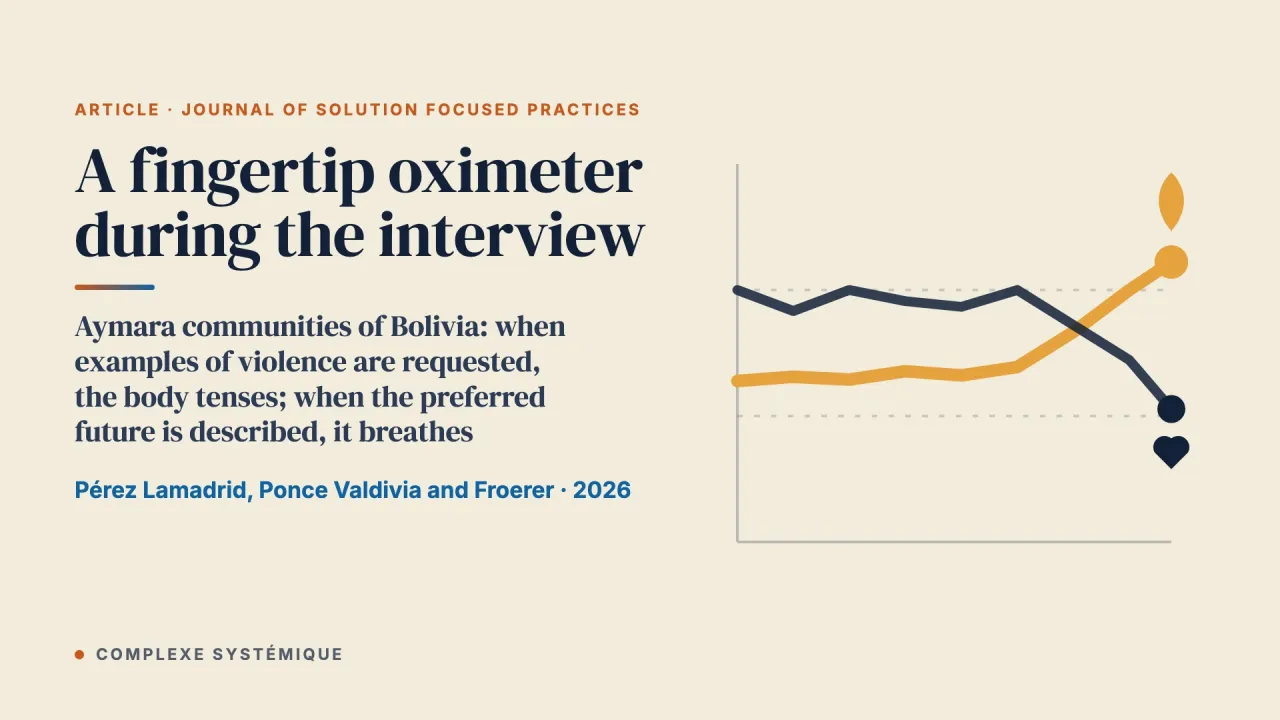
 Oxygenation and Heart Rate in Solution-Focused and Problem-Focused Interviews With Rural and Indigenous Aymara Communities (Viacha and Laja) Regarding Intersectional Violence
A fingertip oximeter on 19 Aymara people of the Altiplano: the problem-focused interview tenses when examples of violence are requested; the solution-focused one oxygenates and slows the heart.
 Article
 The trap of non-judgement: when staying silent is no longer neutral
Absolute non-judgement is a myth: not reducing a person to their acts does not require silence about what humiliates or dominates. A systemic, ethical reading of silence.