Child & Family Social Work · Social work
Supervision as a Dispersed Practice: Exploring the Creation of Supervisory Spaces in Day-to-Day Social Work Practice
In England, supervision of child protection social workers often boils down to a monthly hour and a half, laptop open, ticking boxes. Mark Gregory observed four teams for six months: much of the reflection and emotional support happens in the office, over a cup of tea, among colleagues or in group discussion. A dispersed supervision, valuable, but no excuse for impoverished formal supervision.
This is a reformatted republication of Supervision as a Dispersed Practice: Exploring the Creation of Supervisory Spaces in Day-to-Day Social Work Practice, by Mark Gregory, published in Child & Family Social Work (Wiley) (2024), doi: 10.1111/cfs.13191, under a CC BY 4.0 licence. Prepared by Complexe Systémique in September 2026: the authors’ text is unchanged; the layout has been adapted for reading online, which constitutes a modification of the work under the terms of the licence. This edition was made neither by the authors nor by the publisher, who are not responsible for its content or for any errors. The original version prevails.
Supervision in everyday practice is something of a patchwork, a dispersed activity.
Mark Gregory
Abstract
Supervision is integral to social work practice; however, how it operates in day-to-day practice remains poorly understood. Existing research mainly comprises quantitative and qualitative accounts of social workers' and supervisors' experiences of supervision. More recently, a small number of studies examining the content of supervision have added to our understanding of what happens in supervision. However, supervisory interactions outside formal supervision have received scant empirical attention. This paper draws on an ethnographic study of four social work teams in England, exploring how formal and informal case discussion supports social workers' sensemaking. Data comprised observations of case talk in the office space (n = 21) and group case discussions (n = 2), recordings of one-to-one supervision (n = 17) and semi-structured interviews (n = 22). Findings highlighted the importance of space in how social workers perceived and engaged with supervision. Supervisory spaces involve the interaction of physical, thinking and emotional spaces to create spaces that are supportive, task-focused and reflective. Moreover, these supervisory spaces are not confined to formal one-to-one supervision or to the dyadic supervisor–supervisee relationship. This raises questions for how child protection social workers can be best supported, across diverse supervisory spaces and relationships, to ensure their practice is effective.
1 Introduction
Supervision is viewed as an integral part of social work practice internationally (Akesson and Canavera 2018; Beddoe et al. 2016), to the extent that its value to the profession is taken for granted (Carpenter, Webb, and Bostock 2013). In England, supervision is primarily delivered by a line manager through monthly one-to-one meetings. The dominance of line management supervision in England stands in contrast to forms of supervision provided in other national contexts; for example, other northern European countries offer supervision that is primarily clinical and delivered by someone external to the organisation (Bradley and Höjer 2009). In some other English-speaking countries, it is also common for social workers to have an external supervisor, so line management and other supervisory functions are delivered separately (O'Donoghue and Tsui 2012).
More recently, supervision practice in England has diversified, with several organisations employing systemic group supervision as their primary form of supervision (Bostock et al. 2019), although other forms of group case discussion have increasingly been used to supplement one-to-one supervision (Lees and Cooper 2019; O'Sullivan 2018). It is, however, still the norm for line management and supervisory roles to be combined, and this may explain why supervision in England is viewed as being primarily used for managerial oversight (Wilkins and Antonopoulou 2019). Although oversight of practice is an important aspect of supervision—it plays a function in quality assurance of practice (Kadushin and Harkness 2014) and accountability to the organisation, inspectors and other stakeholders (Saltiel 2017)—supervision should also promote professional growth through reflective case discussions and exploration of support and development needs (Morrison 2005).
Despite the assumed value of supervision, the empirical basis for its effectiveness is limited (Carpenter, Webb, and Bostock 2013). Although there has been an increase in supervision scholarship since the turn of the 21st century (O'Donoghue and Tsui 2015; Sewell 2018), the evidence base for supervision remains provisional (Beddoe et al. 2016; Carpenter, Webb, and Bostock 2013). A particular gap in our understanding is how supervision practice is enacted in everyday practice; research on what happens in formal supervision sessions is scant (Beddoe et al. 2021), comparatively few studies have used the content of supervision as data (see Beddoe et al. 2021; Bostock et al. 2019; Bourn and Hafford-Letchfield 2011; Warwick et al. 2023; Webb, Wilkins, and Martin 2022; Wilkins 2017a; Wilkins, Forrester, and Grant 2017; Wilkins, Lynch, and Antonopoulou 2018), and although it is acknowledged that much of what we think of as supervision takes place outside formal monthly meetings (Wilkins, Forrester, and Grant 2017), little attention has been paid to this aspect of supervisory practice. The aim of this article is to address this gap by exploring how supervision is enacted in the day-to-day practice of social work teams.
1.1 The Child Protection System in England
Child protection social work in England is underpinned by legislation—primarily the Children Act 1989—and statutory guidance such as Working Together to Safeguard Children (Department for Education 2018a). Local authorities and children's trusts are responsible for discharging legal duties in relation to the protection of children, and social workers working within these settings are responsible for carrying out investigations and completing assessments—working with other professionals, such as police officers, teachers and health professionals—where there are concerns that children are at risk of suffering significant harm.
Child protection social work operates in a complex socio-political context, managing tensions between respecting the right to private family life and the need to intervene to keep vulnerable children safe (Dingwall, Eekelaar, and Murray 1983). The dominance of neo-liberal political ideas in England has influenced the development of child protection practice, with increasing moves towards managerialist approaches to social work (Parton 2014). Managerialism has led to increasing use of key performance indicators, adherence to bureaucratic processes and procedures and an emphasis on management oversight (Munro 2011). This places a greater onus on supervisors to oversee the work of child protection social workers (Patterson and Whincup 2018). The importance of good quality supervision for keeping children safe is frequently emphasised by reviews of child deaths (Dickens et al. 2022), which often highlight an absence of adequate supervision (Child Safeguarding Practice Review Panel 2022; Laming 2003, 2009).
Quality assurance of child protection social work in England is carried out by Ofsted, who undertake inspections of children's services departments at least every 3 years (Ofsted 2023). The inspection framework includes consideration of the quality and frequency of supervision, and reviewing supervision policies and records forms an important part of the inspection process (Ofsted 2023). Supervision should last for at least an hour and a half and should take place monthly for experienced social workers and more frequently for newly qualified social workers (Local Government Association 2020). Supervisors are, in essence, responsible for ensuring that child protection social workers complete and review assessments, plans and visits within prescribed timescales and that work with children and families is effective.
1.2 Supervision Practice in England
Despite the importance of supervision to child protection social work, the quality of supervision in England is perceived as being variable. Social workers report a lack of opportunities for reflection in one-to-one supervision (Turner-Daly and Jack 2017; Wilkins and Antonopoulou 2019), which resonates with findings from studies based on recordings of supervision (Wilkins 2017a; Wilkins, Forrester, and Grant 2017). Although concerns about the impact of managerialism on supervision exist internationally (Beddoe et al. 2016), comparisons of supervision practice in England with other nations (Bradley and Höjer 2009; O'Donoghue and Tsui 2012) suggest that supervision in England is dominated by managerial oversight of casework.
The tension between the ideal of supervision as a reflective space (Beddoe et al. 2021) that provides scope for development and emotional support (Morrison 2005) and supervision as a narrower mechanism for managerial oversight has led to moves towards alternative forms of supervision to supplant or supplement the traditional one-to-one line management model. Wilkins (2017b) makes the case for moving away from a fixation on reflective dyadic supervision, instead suggesting that a broader focus on support opens the prospect of using alternative means to promote effective child protection social work. Systemic group supervision has increasingly been adopted by local authorities as either a primary or supplementary form of supervision (Bostock et al. 2019; Wilkins, Lynch, and Antonopoulou 2018), whereas reflective case discussion groups (Lees and Cooper 2019; O'Sullivan 2018) and Schwartz Rounds (Wilkins et al. 2021) offer further means to fulfil the reflective and emotionally supportive functions of supervision. In practice, the functions of supervision may be fulfilled across a range of spaces outside formal supervision, and some forms of supervisory support may be delivered by individuals other than line managers (Wilkins 2017b).
1.3 Space and Supervision
As Beddoe et al. (2021) highlight, the notions of place and space are useful in furthering understanding of how social work practice is enacted. Jeyasingham (2014) argues that individuals construct spaces through their interactions with each other and through their positioning and gestures within these spaces. Carder (2023) draws on Goffman's (1959) work to explore how social workers interact with each other within teams. Social workers engage in settings that are frontstage (in meetings and home visits) and backstage (in the office). In frontstage settings, child protection social workers perform in a certain way to meet the expectations of their audience (the family or other professionals), whereas in backstage settings, the requirement to perform is diminished. Carder (2023) argues that the culture of social work teams and organisations can create pressure to perform in a certain way, meaning that the office space and virtual interactions with colleagues can also act as a frontstage setting. Space is therefore more than a physical construct; spaces take on a particular character through the behaviour and interaction of those who inhabit them (Carder 2023; Jeyasingham 2014).
Different spaces interact with each other; for example, Beddoe et al. (2021) found that the character and quality of team interactions in the office space influences the use of the formal supervisory space. Teams who are co-located in small office spaces can create ad hoc opportunities for reflection and containment in ways that are not possible in large open-plan hot-desking offices (Beddoe et al. 2021). The use of space in the team mirrored how supervision was experienced; in the open-plan office, supervision became an exhausting organisational process, with no space to reflect and explore emotional experiences, whereas supervision within the co-located teams offered some scope for reflection (Beddoe et al. 2021).
It is not only supervisors who help to create a reflective culture; the opportunity for regular, ongoing discussion of cases amongst colleagues provides valuable informal support (Ferguson et al. 2020). Such discussions provide opportunities for sensemaking (Cook and Gregory 2020; Helm 2022) and containment (Beddoe et al. 2021). Furthermore, Webb, Wilkins, and Martin (2022) argue that, contrary to expectations, formal supervision is often not a key site for decision-making; by contrast, collegial case discussion plays a significant role in informing social workers' decision-making (Gregory 2023; Helm 2022). This would suggest that some functions of supervision may be formally delegated within or dispersed across social work teams.
2 Methods
The research took place across four teams in two local authority sites in England across 2018 and 2019. All four teams undertook first assessments of children and families following the receipt of a new referral; two teams also undertook long-term intervention child protection work. Ethical approval for the study was granted by the University of East Anglia's ethics committee and research governance approval was given by the participating local authorities. The primary research question for the study was ‘How do different forms of supervisory and collegial case-talk support social workers' sensemaking?’
Data comprised recordings of formal one-to-one supervision (n = 17), semi-structured interviews with supervisors and supervisees whose supervision had been recorded (n = 22), observations of group supervision (n = 2) and observations of informal supervisory and collegial case discussion in the office space (n = 21), collected over a period of 6 months. Both sites employed hot desking and some flexible working, though teams had their own designated desks within the office that usually enabled team members to be situated together. This is not always the case where hot-desking practices are used (see, e.g. Ferguson et al. 2020).
Supervision sessions were audio-recorded and transcribed for analysis. Observation visits lasted between 3 and 6 h; handwritten fieldnotes were taken contemporaneously and typed up immediately after the observation visit. Fieldnotes were written descriptively with a focus on preserving dialogue; analytical asides were made alongside fieldnotes (Hammersley and Atkinson 2014), and a research journal was used to document key analytical ideas and decisions (Braun and Clarke 2019). Interviews used open-ended questions that prompted participants to explore their casework and their use of supervision and took place at the end of the data collection. This enabled a period of relationship-building to promote openness in the research relationship (Ruch and Julkunen 2016).
Data were analysed thematically and narratively to explore how social workers used supervision and collegial case discussion to engage in sensemaking; a model of sensemaking was derived from this analysis and has been presented elsewhere (Gregory 2023). Social workers engage in a form of story-building in order to make sense of the lives of children and families, but how they do so varies across different forms of case talk, such as formal supervision and informal collegial case discussion (Gregory 2023). Braun and Clarke's (2019) reflexive thematic analysis was used for the first phase of data analysis, utilising their six-stage process to move from familiarisation with the data to writing up findings (Braun and Clarke 2006). This article presents findings from the thematic analysis of the data.
3 Findings
These findings draw on the notion of space and how supervisory spaces are described, created and used by social workers and their supervisors. Although providing an appropriate physical space is a pre-requisite for creating a safe supervisory space, space in supervision is more than just physical (Beddoe et al. 2021); it is also relational and interactional (Jeyasingham 2014). Through these interactions and relationships, supervisory spaces develop qualities that can either promote or inhibit thinking and feeling.
The findings begin by exploring the relationship between physical and emotional spaces, looking at how the intersection of physical and emotional space creates a relational, supportive or ‘therapeutic’ space. Next, the interaction between physical and thinking spaces will be discussed, particularly in relation to formal one-to-one supervision, which tends to be process driven and used for ‘checking out’ thinking. Finally, the intersection of thinking, feeling and physical spaces will be discussed. This provides conditions for the ‘ideal’ of reflective supervision (Beddoe et al. 2021), though the findings will suggest that these spaces are not confined to the dyadic supervisory relationship but are instead dispersed across teams through the enaction of supervision in everyday practice.
3.1 Relational, Supportive and ‘Therapeutic’ Spaces in Supervision
Participants acknowledged the value of having a protected physical space away from the hustle and bustle of the office:
I guess the space is that real kind of dedicated, I've got an hour and a half. I will take my laptop but it goes on to don't disturb. My emails get turned off so they're not pinging up. So, it's that real kind of very physical I'm blocking out people who want to talk to me in the next hour and a half to sit and go through this. (Jesse, SW)
Other participants similarly referred to place and time as being central to the creation of a protected physical space for supervision. One supervisor described how people are ‘naturally gonna talk about things in more depth’ in a private room as opposed to out in the office, whereas another participant said that their supervisions are ‘blocked out for three hours’ regardless of whether that much time is required. Having sufficient time and a sense of privacy were essential for creating a protected physical space for one-to-one supervision.
As well as providing time and a private place for formal supervision, some supervisors identified other means through which they could create a protected space:
I don't take a laptop into my supervision and I don't take a phone into my supervision … I try to make space to have nothing there that is distracting. (Jan, Supervisor)
Although a dedicated physical space for supervision was important, in itself, it did not create the conditions for social workers to explore their thoughts and feelings. By focusing attention on the supervisee within the protected physical space of supervision, supervisors were able to create a safe emotional space. This is an example of how the positioning of individuals within a space contributes to how it is constructed and experienced (Jeyasingham 2014); the physical space of the private room becomes a relational space when the individuals within the room display openness towards each other. For some participants, using formal supervision as a relational space for emotional support was its primary function:
I think it's my time to maybe release anything I've got going on. And, I think maybe that's more, perhaps, on a personal level, if I've got anything going on personally, that's my time to pass that on … I think, for me, it feels like a weight has been lifted sometimes. (Suzie, SW)
However, for some participants, the opposite was true, and they felt unable to use formal supervision to explore their emotions:
I do wonder if [male supervisors are] very good at that emotional well-being stuff … there's certain things that I guess, depending on what's going on in my life, that I wouldn't wanna share. (Shelley, SW)
This limited the extent to which the space in formal supervision was viewed as being relational and supportive for some participants. Echoing findings from other studies (Ingram 2015), personal relationships with supervisors and a more general worry about how safe it was to share emotions—one participant worried that expressing feelings would ‘be used against you’—inhibited the capacity for one-to-one supervision to offer a relational, supportive space. For many participants, the physical space of the office could provide opportunities for emotional sharing:
So, we use a lot of that informal space possibly actually for reassurance and maybe a bit of validation. (Lesley, SW)
Participants described ways in which they creatively constructed and used informal spaces with others, away from their desks; this offered ad hoc opportunities to talk through and process difficult emotional experiences:
Jackie went and got me a cup of tea and we went and had a chat. And I just like let her know what happened and she said, okay, what's going to help you now … And then Erin's like, come, let's go out for a milkshake. You know, in winter. It was more the walking I think … And that's what, you know, it just makes you feel like you're not on your own. (Leigh, SW)
These relational spaces were constructed through action and interaction (Jeyasingham 2014), and for social workers, the capacity to create informal spaces with colleagues provided crucial emotional support. Supervisors, too, were seen as being available to their social workers outside scheduled one-to-one supervisions:
After the visit she'll ask you, ‘How was your visit today? How was the dad? Was there any problem?’ And then you have ongoing supervision there and then. (Brooke, SW)
This notion of supervision as something ongoing that took place within the office space was a common thread in interviews; in practice, the supportive functions of supervision were often undertaken away from formal supervisory meetings. There were examples of this supportive checking in within the observation data:
Stacey says that there ‘isn't anything more I can do’. Sam (Supervisor) says ‘No, and you can rest easy’. Sam says, you've tried, you've done everything you can. (Fieldnotes)
Robin (Supervisor) calls Taylor, who has been out on visits, to check she is okay. Taylor says she is on her way back so Robin says he will speak to her when she gets back … Robin thanks Taylor for her work on the case today and apologises that it wasn't very nice. (Fieldnotes)
Inhabiting an emotional space that was relational and supportive happened in different contexts. Some participants favoured the private space of supervision for emotional sharing, whereas others preferred to use colleagues or their supervisor for in-the-moment emotional support in or adjacent to the office space. Small rituals of care, such as making a cup of tea or checking in after a visit, helped to create informal spaces that promoted sharing of emotional experiences.
3.2 Formal Supervision as a Task-Focused, Process-Driven or ‘Checking-Out’ Space
One barrier to providing a relational space was the use of laptops in formal supervision sessions to record case discussions, which created a physical barrier between supervisor and supervisee and a distraction for supervisors:
I've had it before, it's difficult if, when they're typing away on the computer. Like looking down and typing away. And it feels as though they're not always listening … you feel like there's not the interest in having that discussion. (Jo, SW)
[M]y supervisor … would be getting emails coming through all the time. And he'll be like, oh I've just got to respond to that, or if something else crops up … if your supervisor is getting emails pinged up, people coming in, you know, it loses its value. (Shelley, SW)
In these instances, the physical space of one-to-one supervision lost its capacity to act as a relational space through the distracted or closed-off behaviour exhibited by the individuals inhabiting the space (Jeyasingham 2014). There were other factors that meant that the capacity for formal supervision to provide a relational space could be disrupted; supervisors noted that their own emotional capacity could inhibit their ability to be fully present:
Sometimes, I'm full up in myself, and that's very difficult to then come in and give supervision … and sit down and just be fully there with that person. (Courtney, Supervisor)
Everyone just wants a piece of you and there's only so much you can give out, and you're left a little bit exhausted with little to give in supervision, and sometimes I just dread it because I think, ‘Oh God, I have to sit there and focus for a whole hour and a half and I'm exhausted and I can't think’. (Ashley, Supervisor)
Although supervisors were usually able to ensure a protected physical space for formal supervision, the capacity for this space to be relational was dependent on the supervisor being present in other ways. Where relational engagement was diminished, supervision was used primarily as a space for oversight of casework:
[She's] got pressures on her to get through all my cases, so I guess it always comes back down to the pressure of the tick-box. (Katie, SW)
This ‘tick-box’ approach to supervision was evident in case discussions within recorded supervision sessions; though some cases were discussed in greater depth, often formal supervision was used primarily for social workers to update their supervisor on the work they were doing and to agree actions. Conversations such as the below were frequently observed in supervision recordings:
Robin: D and P? That must be coming up to time for evidence mustn't it?
Jo: November, I think.
Robin: Parenting assessment, 5th of October?
Jo: Yeah.
Robin: That's what I meant by evidence, written evidence.
Jo: Oh yeah, sorry. Yeah. Yeah, 12th I wanna say? For my final evidence. (Supervision)
In this sense, formal supervision offered a task-focused, process-driven space. This gave formal supervision something of a frontstage feel (Carder 2023), with supervisors performing the role of overseer of social work practice and supervisees performing the role of competent practitioner, with both demonstrating their ability to complete the tasks associated with their role. Some participants reflected that this dynamic in supervision did not provide them with the space needed to reflect on how their work with children and families might be impacting on them:
She always asks me how I'm feeling and how things are going but the way that cases affect me is probably discussed more in the office. (Katie, SW)
Supervisors also used case discussions in supervision to check out what the information shared by social workers meant in relation to the statutory child protection threshold or in respect of impact on the child (Gregory 2023). This approach to checking out participants' thinking was frequently evident in recorded supervisions:
Ashley: So what about the drug and alcohol concerns that have been raised?
Kai: Erm, he says that he did used to smoke weed. So the only thing I haven't done is asked him if he would be, he says he's not doing it now…
Ashley: Even if he was, as long as he's not doing it around his child …
Kai: No.
Ashley: … and it's not impacting on his parenting. (Supervision)
The use of formal supervision to narrowly focus on impact on the child and threshold was, at times, mirrored in the use of informal supervisory spaces:
Ashley asks about the impact on C. Toni says, I think It's too early for there to be an impact now as he's only just returned. Ashley says, I'm not sure it's child protection. Toni responds, I'm not even sure what we would do with it under child in need … Ashley says, if we can't evidence impact on C then I'm not sure what we can really do. (Fieldnotes)
Contemporary practice contexts tend towards an overt focus on risk and risk management, which limits the availability of opportunities to reflect on emotional and relational aspects of the work (O'Sullivan 2018). Although the capacity to explore emotion information alongside other forms of information allows for deeper understandings of the lives of families (Turney and Ruch 2018), the reflective space this requires was often absent in formal supervision and was, at times, sidelined in informal supervisory interactions too. The upshot of this was the dominance of tasks, processes and simplistic checking out of information in supervision case discussions.
3.3 The Creation of Reflective, Developmental Spaces
When formal supervision successfully provided physical, emotional and thinking spaces, it offered participants opportunities to meaningfully reflect on their work:
I think she just creates quite an open space to reflect on that … you start to spin alternative stuff in your head. So you're starting to think more about, okay, well what other possibilities are there? How am I impacting on this case? (Chris, SW)
The ability to explore and challenge relied on formal supervision offering a safe emotional space, where relational engagement between supervisor and supervisee prompted mutual curiosity. The supervision discussions that followed had a different character from task-focused, checking-out conversations:
Courtney: … I just wonder if they experienced [physical chastisement] as a child…
Taylor: Mmm, all those years they both did.
Courtney: … and they've taken it on, and I wonder how they experienced it? How they felt, you know? Was it something that was just normal, part of childhood and they didn't really have feelings either way? Probably not, it's probably something that they were frightened of and…
Taylor: It's a method of control isn't it? (Supervision)
Chris: So D very much from N's perspective holds the position that had he remained there that night his dad wouldn't have committed suicide.
Jan: And then that makes the relationship between D and mum fractious, doesn't it? Because he might think, ‘Oh why did you tell me to come home?’ (Supervision)
This kind of supervisory space encouraged greater consideration of the emotional and relational richness of families' lives, moving beyond more professionalised conceptualisations that relied on notions of impact on the child and threshold. Instances of this type of dialogue were infrequent within the recorded supervisions; however, participants highlighted the capacity for informal supervision—case discussions between supervisors and supervisees outside formal supervision—to provide a reflective space:
Informal tends to be just a, whether I go up to him or he'll be coming up to me to tell me about something and that is more of a, I would say more of a discussion, maybe even a bit more reflective. (Jo, SW)
Such opportunities were not limited to conversations with supervisors; collegial dialogue also offered a space for social workers to reflect on their work and explore their thinking. Participants framed this as part of an ongoing informal supervisory process that was not confined to the supervisory dyad:
We're constantly having discussions about things, and then other people in the office get involved. Yes, I mean, I'd say our team is really good at that, you don't have to wait for supervision to talk about things, it's just an ongoing process. (Taylor, SW)
Supervision should provide space for shared sensemaking (Patterson 2019), but in practice, such shared sensemaking often took place informally within the office-space. The nature of these collegial conversations was often different from case discussions in formal supervision, with less of an overt focus on decision-making and less reliance on professional frames for understanding:
Kai asks, how are the boys? Do they have a diagnosis? Toni says, there's something there. Kai says, mum projecting her anxieties? Toni says, it came in as mum felt she wasn't being listened to about the boys' needs and because they weren't getting a diagnosis she was escalating things. She was pushing to get their needs met. Kai says, I'd probably do the same to be fair. Toni says, professionals are now saying he definitely doesn't have what mum thought he had. Kai asks, does she accept that? Toni says, this is where we're at with it, we need to see. (Fieldnotes)
This kind of case talk helped participants to test information, to begin developing hypotheses and to hold on to uncertainty. There was evidence that structured group case discussions similarly provided a space for reflection on the experiences of children and families:
Toni says, he's been labelled heavily. Jackie says, yes and there's real power behind those labels, what's on pen and paper. He could have come to identify with them. There's been too much focus on the risk that he might pose rather than on his own vulnerability … Lesley says, he could go back to being labelled again. Toni says, it's being recreated all the way through for him. Toni adds, the behaviours make sense in a way. (Fieldnotes, Group Supervision)
The capacity for peers as well as supervisors to provide spaces where social workers felt safe to reflect and explore their thoughts and feelings was of significant value to participants. The immediacy of such informal supervisory spaces enabled new information to be reflected on in the moment:
When something comes in, we have a discussion in the office about it and have a reflection what do we need to do here, or can we look at this … So I really promote that open dialogue in the office and reflection really, what do we need here or what ideas have you got etc.? (Jan, Supervisor)
Supervisors played a key role in helping to promote a culture of reflection and support within their teams, meaning that the functions of supervision were often dispersed across different physical spaces and across team members:
I think in terms of supervision for this one I think I've probably accessed more informal supervision from Toni, who's my senior, than I have from [my supervisor]. (Jesse, SW)
If I wanted to be having much more reflective practice supervision then I need to ask for it, but I'm lucky because I get that with my colleagues. (Shelley, SW)
It was notable that participants talked about supervision in this broader sense: Although much supervision research has focused on formal supervision between a supervisor and supervisee, in practice, social workers utilise interactions with supervisors and colleagues to create informal supervisory spaces that offer emotional support and opportunities for reflection. These supervisory spaces are a product of the interaction and behaviour of the individuals inhabiting a physical space (Jeyasingham 2014); the nature of these different spaces is illustrated in Figure 1.
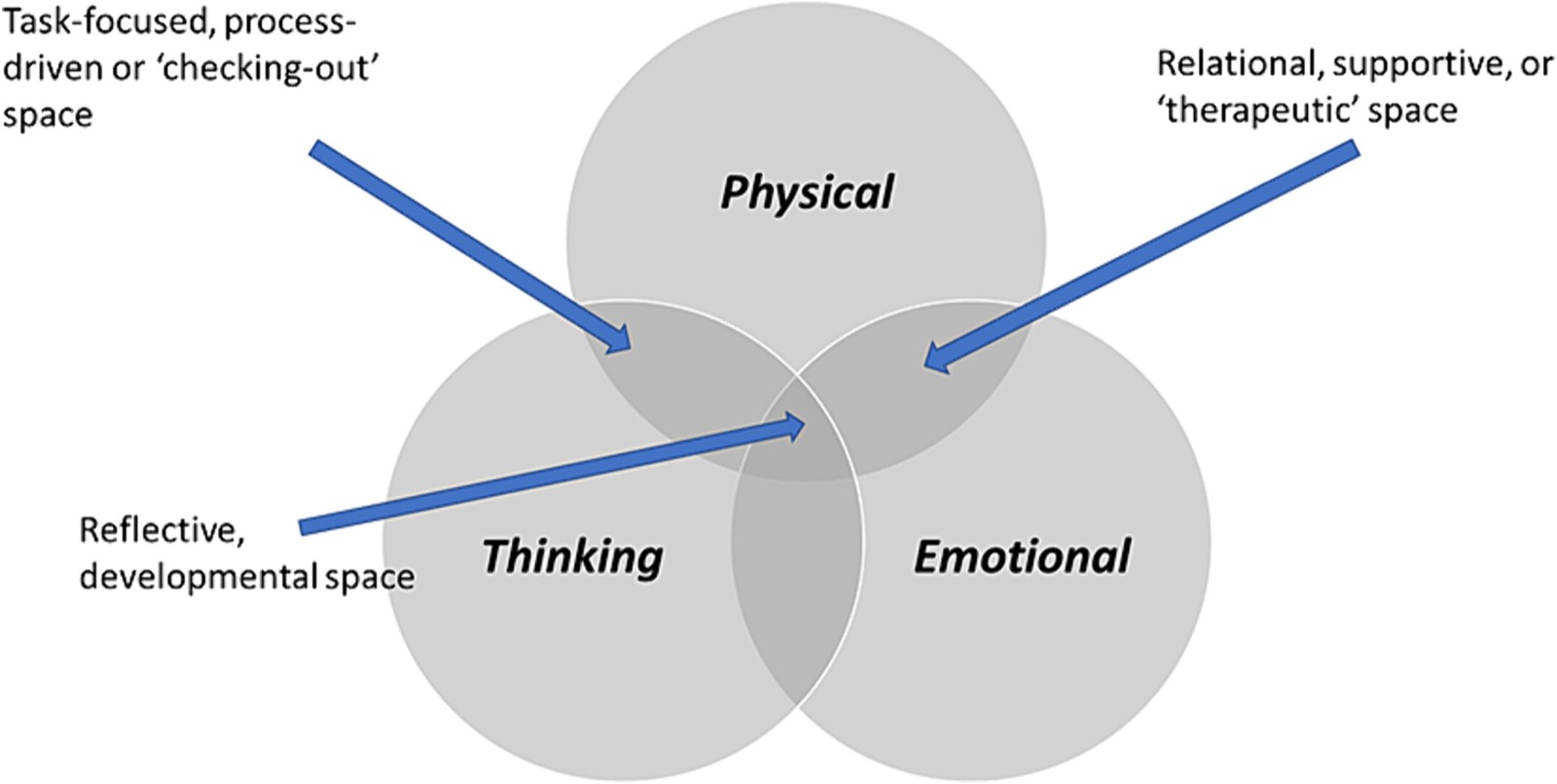
The creative ways in which participants constructed and used these spaces helped to meet their needs for reflection and containment, two key functions of supervision. In practice, the dispersal of these functions across different physical spaces and across different individuals was largely seen as beneficial, with one participant suggesting that ‘informal supervision is so much more valuable’ than formal supervision. In relation to this, one supervisor sounded a word of caution:
Pretty much everybody's talking to me all the time about all of their cases, so I think the danger is to keep supervision as some kind of like different space. (Robin, Supervisor)
The challenge is to ensure that the dispersal of supervisory functions across a range of spaces and individuals complements formal supervision rather than diminishes its value. Supervision should provide opportunities for reflection and support alongside management oversight (Beddoe et al. 2021; Morrison 2005); where reflection and support are provided elsewhere, this should serve to enhance rather than replace their provision in formal supervision.
4 Discussion
Supervision in everyday practice is something of a patchwork, a dispersed activity that takes place across different spaces—private rooms for formal supervision, the office-space for informal and peer supervision and private team spaces for group case discussions—and involves a range of individuals. It is much more complex than the dyadic relationship and formal one-to-one meetings that have traditionally been the subject of supervision research (Wilkins, Forrester, and Grant 2017). This article suggests that, in everyday practice, the fulfilment of the functions of supervision involves multiple relationships and a range of contexts where reflective case discussion and emotional support take place.
As a practice, supervision involves the interaction of physical, emotional and thinking spaces. Providing a physical space for case discussion underpins the creation of supervisory spaces but does not necessarily ensure that those discussions will be reflective or emotionally supportive (Beddoe et al. 2021). As other studies have found, there is a tendency for case management to dominate within one-to-one supervision (Turner-Daly and Jack 2017; Wilkins 2017a; Wilkins, Forrester, and Grant 2017), and this was often evident in recorded supervisions. Though participants noted opportunities for reflection in formal supervision, in practice, such opportunities were sporadic. There is tacit pressure on formal supervision to demonstrate oversight and accountability, and this limits space for meaningful exploration of emotional responses to, and deeper thinking about, the work. Saltiel (2017) argues that supervision often involves participants jointly agreeing an account that can be ‘sold’ to the organisation; in this sense, formal supervision becomes a frontstage setting in which supervisors and supervisees perform the professional roles expected of them to the organisation as audience.
The limitations of the formal supervisory space as a locus for reflection (Wilkins, Forrester, and Grant 2017) are compensated for by the creation of spaces for reflection within and amongst social work teams (Beddoe et al. 2021; Ferguson et al. 2020). As Biggart et al. (2017) found, teams can provide social workers with conditions in which they can emotionally share and reflect on their work. Supervisors are key to creating an environment that is conducive to emotional safety and sensemaking, with the availability of the supervisor—which involves them being present both physically and emotionally (Biggart et al. 2017)—being central to creating the emotional and thinking spaces discussed here. These spaces can, however, be something of a double-edged sword; on the one hand, they offer valuable opportunities for sensemaking (Gregory 2023; Helm 2022) and emotional support (Ferguson et al. 2020), but they can mean that formal supervision is not seen or used as a distinct reflective space.
Positive experiences of supervision have been highlighted as having an impact on social workers' emotional resilience and capacity to stay in their roles (McFadden 2020; Warwick et al. 2023). Social workers who feel overwhelmed emotionally are not only at greater risk of burnout (McFadden 2020) but are also more like to over- or under-estimate levels of risk in their professional judgement (Regehr et al. 2022). Furthermore, Horwath (2016) argues that, where social workers' emotional and developmental needs are neglected, this leads to poorer practice and outcomes for children and families. Good quality supervision, which prioritises emotional support and development in addition to management oversight, is therefore important for ensuring sound risk assessment (Regehr et al. 2022), retention of experienced staff (McFadden 2020) and better practice with and outcomes for children and families (Horwath 2016).
Currently, processes for overseeing child protection practice in England use a somewhat narrow lens to examine line management supervision (Department for Education 2018b), manifested through a focus on case and supervision records during inspections of children's services departments (Ofsted 2023). If inspections aimed at ensuring the effectiveness of child protection practice explicitly focus on management oversight and the supervision record, these become the focus of supervision (Munro 2011; Smith 2019). Process-focused approaches to inspection create process-driven supervision, which in turn leads to more bureaucratic and less humane approaches to child protection practice (Smith 2019); such child protection systems create rather than mitigate the conditions for errors to take place (Munro 2011). It is therefore important for the wider system—including the current arrangements for inspection—to consider supervision as a distinctly reflective, supportive and developmental practice that goes beyond line management. Line management can provide quality assurance of child protection practice; however, supervision also needs to provide supportive thinking and feeling spaces; without the provision of such spaces, scope for developing practice and improving outcomes is limited (Horwath 2016; Munro 2011).
This research has highlighted some of these issues in the formal supervisory space; laptops being used during supervision ensured that supervisors had up-to-date supervision records but often inhibited the capacity for supervisors to be fully emotionally present. This limited supervisors' ability to provide a relational space where feelings could be explored, and reflection could take place. Informal supervisory spaces can and do provide a supplementary function, but how their effectiveness and impact on practice is measured is currently outside the scope of formal inspection and quality assurance frameworks. For supervision to provide formal and informal reflective and developmental spaces that contribute to effective child protection practice, there needs to be a move away from giving primacy to managerial oversight and adherence to procedure (Munro 2011).
4.1 Limitations and Recommendations for Future Research
The research was conducted in two similar local authority sites in England. International studies highlight that, although there are similarities in how supervision is viewed and valued across national contexts (Akesson and Canavera 2018; Beddoe et al. 2016), there are significant national differences in supervision practice (Beddoe 2015; Bradley and Höjer 2009) and ‘supervision’ is likely to be a highly localised concept (Akesson and Canavera 2018). Further empirical work comparing how supervision is enacted in different national contexts would be a fruitful area for future research.
One issue with ethnographic research is the possibility for researcher bias and the impact of the researcher's own positionality. As a registered social worker who has been both supervisor and supervisee, it was important to be mindful of how this may have influenced analysis of the data. A reflexive journal was used to draw out and unpick these issues, which is good practice in ethnographic research (Hammersley and Atkinson 2014). Using three kinds of data also enabled triangulation, which supports analytical rigour in ethnographic research (Fetterman 2010; Hammersley and Atkinson 2014).
Data collection for this study took place shortly before the COVID-19 pandemic, which necessitated a sudden shift to increased remoted working. Research undertaken during the pandemic suggests that teams and supervisors were able to continue to offer mutual support, recreating formal and informal spaces virtually using platforms such as Microsoft Teams and WhatsApp (Cook et al. 2020). However, the move to virtual working also created challenges for how effectively colleagues were able to support each other, and new starters struggled to embed themselves in teams (Cook et al. 2020). With some degree of hybrid working likely to be here to stay, further research on how this impacts the creation of supervisory spaces would be beneficial.
4.2 Conclusion and Implications for Practice
The notion of space in examining social work and supervision practice has been an area of increasing interest (Beddoe et al. 2021; Jeyasingham 2014); this article contributes to our growing understanding of how supervision takes place by focusing on the construction of supervisory spaces in everyday practice. This article has demonstrated that social workers and supervisors create and use supervision spaces creatively, with the functions of supervision taking place in the office space and in group case discussions as well as within formal supervision. Moreover, social workers see valuable forms of informal supervision as being dispersed across their teams rather than being the sole preserve of the designated supervisor.
Child protection social work is a complex activity; the forms of supervisory support that social workers require to be effective in their role are similarly complex (Wilkins 2017b). In recognising this, teams and organisations can ensure they provide spaces that social workers need to meaningfully reflect on their work. How office spaces are constructed influences how accessible supervisors and colleagues are to support thinking and feeling (Beddoe et al. 2021; Ferguson et al. 2020), although Horwath (2016) argues that physical spaces play a key role in meeting social workers' needs. Organisations need to ensure that physical and virtual workspaces promote thinking and feeling, for example, through ensuring co-location of social workers and their supervisors (Ferguson et al. 2020). Social work organisations should also consider whether models of supervision from other countries—where supervision is primarily clinical and distinct from line management (Bradley and Höjer 2009; O'Donoghue and Tsui 2012)—may be more effective in fulfilling the core functions of supervision. This would reduce the risk of reflection, support and development becoming subservient to management oversight (Wilkins and Antonopoulou 2019). This should enable those supervisory functions that are currently often fulfilled outside the formal supervisory space to provide a supportive and complementary role rather than compensating for an absence of quality formal supervision.
There are established models for providing spaces to promote thinking and feeling, such as reflective case discussion groups (Lees and Cooper 2019; O'Sullivan 2018) and Schwartz rounds (Wilkins et al. 2021), and frameworks, such as the team as secure base model (Biggart et al. 2017), that promote support in teams. It is important that social workers also recognise the importance of such spaces; buy-in is a major barrier to the success of structured reflective case discussions (Lees and Cooper 2019). These models can support the structured provision of thinking and feeling spaces to supplement formal supervision. Promoting thinking and feeling spaces within teams can mitigate the risk of emotional overwhelm and burnout that contributes to poorer decision-making and outcomes for children and families (Horwath 2016; Regehr et al. 2022). Moreover, viewing supervision as a holistic team-based practice that provides spaces for thinking and feeling can encourage a shift away from task-focused and bureaucratic line management supervision that inhibits rather than promotes the conditions for effective work with children and families (Munro 2011).
Complexe Systémique: key points
The article usefully shifts the question of supervision: no longer “what happens in the room?”, but “where do thinking and support circulate in the team?”. Reading supervision through spaces (physical, thinking, emotional) and through Goffman’s frontstage and backstage echoes a systemic intuition: supervision is a property of the working system rather than a two-person relationship. The contrast between tick-box exchanges about thresholds and the rare moments when someone wonders what parents went through as children shows the cost of supervision reduced to oversight: the relational complexity of families disappears. The avenues are concrete: close the laptop, protect the time, co-locate teams, set up reflective discussion groups, even separate clinical supervision from line management, as other northern European countries do. The limits: two English local authorities, data collected before the pandemic by a researcher from the profession, and systemic group supervision, cited in the introduction but not studied as such. Read alongside the article on supervision in systemic therapy, and the article on group supervision in child protection.
Notes from the original
Ethics statement. The study on which this article is based was approved by the University of East Anglia School of Social Work ethics committee and was approved via the research governance framework of the participating local authorities.
Conflicts of interest. The author declares no conflicts of interest.
References
Akesson, B., and M. Canavera. 2018. “Expert Understandings of Supervision as a Means to Strengthen the Social Service Workforce: Results From a Global Delphi Study.” European Journal of Social Work 21, no. 3: 333–347.
Beddoe, L. 2015. “Supervision and Developing the Profession: One Supervision or Many?” China Journal of Social Work 8, no. 2: 150–163.
Beddoe, L., H. Ferguson, L. Warwick, T. Disney, J. Leigh, and T. S. Cooner. 2021. “Supervision in Child Protection: A Space and Place for Reflection or an Excruciating Marathon of Compliance?” European Journal of Social Work 25: 525–537.
Beddoe, L., S. Karvinen-Niinikoski, G. Ruch, and M. Tsui. 2016. “Towards an International Consensus on a Research Agenda for Social Work Supervision: Report on the First Survey of a Delphi Study.” British Journal of Social Work 46: 1568–1586.
Biggart, L., E. Ward, L. Cook, and G. Schofield. 2017. “The Team as a Secure Base: Promoting Resilience and Competence in Child and Family Social Work.” Children and Youth Services Review 83: 119–130.
Bostock, L., L. Patrizo, T. Godfrey, and D. Forrester. 2019. “What Is the Impact of Supervision on Direct Practice With Families?” Children and Youth Services Review 105: 1–9.
Bourn, D., and T. Hafford-Letchfield. 2011. “The Role of Social Work Professional Supervision in Conditions of Uncertainty.” The International Journal of Knowledge, Culture and Change Management 10, no. 9: 41–56.
Bradley, G., and S. Höjer. 2009. “Supervision Reviewed: Reflections on Two Different Social Work Models in England and Sweden.” European Journal of Social Work 12, no. 1: 71–85.
Braun, V., and V. Clarke. 2006. “Using Thematic Analysis in Psychology.” Qualitative Research in Psychology 3: 77–101.
Braun, V., and V. Clarke. 2019. “Reflecting on Reflexive Thematic Analysis.” Qualitative Research in Sport, Exercise and Health 11, no. 4: 589–597.
Carder, S. 2023. “Emotional Labour in Child and Family Social Work Teams: A Hybrid Ethnography.” PhD thesis. https://ueaeprints.uea.ac.uk/id/eprint/93530/.
Carpenter, J., C. M. Webb, and L. Bostock. 2013. “The Surprisingly Weak Evidence Base for Supervision: Findings From a Systematic Review of Research in Child Welfare Practice (2000-2012).” Children and Youth Services Review 35: 1843–1853.
Child Safeguarding Practice Review Panel. 2022. “Child Protection in England: National Review Into the Murders of Arthur Labinjo-Hughes and Star Hobson.” https://assets.publishing.service.gov.uk/government/uploads/system/uploads/attachment_data/file/1078488/ALH_SH_National_Review_26-5-22.pdf.
Cook, L., and M. Gregory. 2020. “Making Sense of Sensemaking: Conceptualising How Child and Family Social Workers Process Assessment Information.” Child Care in Practice 26, no. 2: 182–195. https://doi.org/10.1080/13575279.2019.1685458.
Cook, L., D. Zscholmer, L. Biggart, and S. Carder. 2020. “The Team as a Secure Base Revisited: Remote Working and Resilience among Child and Family Social Workers During COVID-19.” Journal of Children's Services 15, no. 4: 259–266.
Department for Education. 2018a. “Working Together to Safeguard Children.” Department for Education.
Department for Education. 2018b. “Post-qualifying Standard: Knowledge and Skills Statement for Child and Family Practice Supervisors.” Department for Education.
Dickens, J., J. Taylor, L. Cook, J. Cossar, N. Rennolds, J. Rimmer, P. Sorensen, R. Wate, N. Hallett, E. Molloy, and J. Garstang. 2022. “Learning for the Future: Final Analysis of Serious Case Reviews, 2017 to 2019.” Department for Education.
Dingwall, R., J. Eekelaar, and T. Murray. 1983. The Protection of Children: State Intervention and Family Life. Oxford: Blackwell.
Ferguson, H., L. Warwick, T. S. Cooner, et al. 2020. “The Nature and Culture of Social Work With Children and Families in Long-Term Casework: Findings From a Qualitative Longitudinal Study.” Child & Family Social Work 25: 694–703.
Fetterman, D. F. 2010. Ethnography: Step-by-Step ( 3rd Edition). London: Sage.
Goffman, E. 1959. The Presentation of Self in Everyday Life. New York: Anchor Books.
Gregory, M. 2023. “Story-Building and Narrative in Children and Families Social Workers' Case-Talk: A Model of Social Work Sensemaking.” Child & Family Social Work 28, no. 4: 949–959.
Hammersley, M., and P. Atkinson. 2014. Ethnography: Principles in Practice. Fourth ed. London: Routledge.
Helm, D. 2022. “Theorising Social Work Sense-Making: Developing a Model of Peer-Aided Judgement and Decision Making.” British Journal of Social Work 52, no. 4: 2329–2347.
Horwath, J. 2016. “The Toxic Duo: The Neglected Practitioner and a Parent Who Fails to Meet the Needs of Their Child.” British Journal of Social Work 46: 1602–1616.
Ingram, R. 2015. “Exploring Emotions Within Formal and Informal Forums: Messages from Social Work Practitioners.” British Journal of Social Work 45: 896–913.
Jeyasingham, D. 2014. “The Production of Space in Children's Social Work: Insights From Henri Lefebvre's Spatial Dialectics.” British Journal of Social Work 44: 1879–1894.
Kadushin, A., and D. Harkness. 2014. Supervision in Social Work (Fifth Edition). New York: Columbia University Press.
Laming, H. 2003. The Victoria Climbié Inquiry Report. London: The Stationery Office.
Laming, H. 2009. The Protection of Children in England: A Progress Report. London: The Stationery Office.
Lees, A., and A. Cooper. 2019. “Reflective Practice Groups in a Children's Social Work Setting – What Are the Outcomes, How Do they Work and Under What Circumstances? A New Theoretical Model Based on Empirical Findings.” Journal of Social Work Practice 35, no. 1: 93–109.
Local Government Association. 2020. “The Standards for Employers of Social Workers in England 2020.” Local Government Association.
McFadden, P. 2020. “Two Sides of One Coin? Relationships Build Resilience or Contribute to Burnout in Child Protection Social Work: Shared Perspectives From Leavers and Stayers in Northern Ireland.” International Social Work 63, no. 2: 164–176.
Morrison, T. 2005. Staff Supervision in Social Care: Making a Real Difference to Staff and Service Users. 3rd ed. Brighton: Pavilion.
Munro, E. 2011. “The Munro Review of Child Protection: Final Report.” Department for Education.
O'Donoghue, K., and M. Tsui. 2012. “In Search of an Informed Supervisory Practice: An Exploratory Study.” Practice 24, no. 1: 3–20.
O'Donoghue, K., and M. Tsui. 2015. “Social Work Supervision Research (1970-2010): The Way We Were and the Way Ahead.” British Journal of Social Work 45: 616–633.
Ofsted. 2023. “Inspecting Local Authority Children's Services.” Department for Education.
O'Sullivan, N. 2018. “Creating Space to Think and Feel in Child Protection Social Work; a Psychodynamic Intervention.” Journal of Social Work Practice 33, no. 1: 15–25.
Parton, N. 2014. “Social Work, Chid Protection and Politics: Some Critical and Constructive Reflections.” British Journal of Social Work 44: 2042–2056.
Patterson, F. 2019. “Supervising the Supervisors: What Support Do First-Line Supervisors Need to Be More Effective in their Supervisory Role?” Aotearoa New Zealand Social Work 31, no. 3: 46–57.
Patterson, F., and H. Whincup. 2018. “Making the Transition From Practitioner to Supervisor: Reflections on the Contribution Made by a Post-Qualifying Supervisory Course.” European Journal of Social Work 21, no. 3: 415–427.
Regehr, C., J. Paterson, K. Sewell, et al. 2022. “Improving Professional Decision Making in Situations of Risk and Uncertainty: A Pilot Intervention.” British Journal of Social Work 52, no. 3: 1341–1361.
Ruch, G., and I. Julkunen. 2016. Relationship-Based Research in Social Work. London: Jessica Kingsley.
Saltiel, D. 2017. “Supervision: A Contested Space for Learning and Decision-Making.” Qualitative Social Work 16, no. 4: 533–549.
Sewell, K. M. 2018. “Social Work Supervision of Staff: A Primer and Scoping Review (2013-2017).” Clinical Social Work Journal 46: 252–265.
Smith, H. 2019. “Omniscience at the Edge of Chaos: Complexity, Defences and Change in a Children and Families Social Work Department.” Journal of Social Work Practice 33, no. 4: 471–480.
Turner-Daly, B., and G. Jack. 2017. “Rhetoric Vs. Reality in Social Work Supervision: The Experiences of a Group of Child Care Social Workers in England.” Child & Family Social Work 22: 36–46.
Turney, D., and G. Ruch. 2018. “What Makes It So Hard to Look and Listen? Exploring the Use of the Cognitive and Affective Supervisory Approach With Children's Social Work Managers.” Journal of Social Work Practice 32, no. 2: 125–138.
Warwick, L., L. Beddoe, J. Leigh, T. Disney, H. Ferguson, and T. S. Cooner. 2023. “The Power of Relationship-Based Supervision in Supporting Social Work Retention: A Case Study From Long-Term Ethnographic Research in Child Protection.” Qualitative Social Work 22, no. 5: 879–898.
Webb, J., D. Wilkins, and R. Martin. 2022. “(How) Are Decisions Made in Child and Family Social Work Supervisions?” Qualitative Social Work 21, no. 6: 1252–1273.
Wilkins, D. 2017a. “How Is Supervision Recorded in Child and Family Social Work? An Analysis of 244 Written Records of Formal Supervision.” Child & Family Social Work 22: 1130–1140.
Wilkins, D. 2017b. “Does Reflective Supervision Have a Future in English Local Authority Child and Family Social Work?” Journal of Children's Services 12, no. 2–3: 164–173.
Wilkins, D., and V. Antonopoulou. 2019. “What Does Supervision Help With? A Survey of 315 Social Workers in the UK.” Practice 31, no. 1: 21–40.
Wilkins, D., D. Forrester, and L. Grant. 2017. “What Happens in Child and Family Social Work Supervision?” Child & Family Social Work 22: 942–951.
Wilkins, D., A. Lynch, and V. Antonopoulou. 2018. “A Golden Thread? The Relationship Between Supervision, Practice, and Family Engagement in Child and Family Social Work.” Child & Family Social Work 23: 494–503.
Wilkins, D., S. Thompson, Z. Bezeczky, S. Daher, V. Bennett, R. Jones, and R. V. Clayton. 2021. “A Randomised Controlled Trial of Schwartz Rounds: An Intervention to Reduce Psychological Distress for Staff in Children's Services.” What Work's for Children's Social Care.
Reformatted republication of Supervision as a Dispersed Practice: Exploring the Creation of Supervisory Spaces in Day-to-Day Social Work Practice, by Mark Gregory, Child & Family Social Work, advance online publication (2024), doi: 10.1111/cfs.13191, under a CC BY 4.0 licence. Edition and layout: Complexe Systémique, September 2026 — the work has been modified under the terms of the licence. Neither the authors nor the publisher are responsible for this edition; the original version prevails.
This is the original article “Supervision as a Dispersed Practice: Exploring the Creation of Supervisory Spaces in Day-to-Day Social Work Practice”, published in Child & Family Social Work (2024) under a CC BY 4.0 licence. Republished by Complexe Systémique: the author’s text is unchanged; only the presentation has been adapted for reading online, as set out at the head of this page.
Read the original articleHow to cite this article
Gregory, M. (2024). Supervision as a Dispersed Practice: Exploring the Creation of Supervisory Spaces in Day-to-Day Social Work Practice. Complexe Systémique. https://app.complexe-systemique.com/en_GB/articles/supervision-as-a-dispersed-practice-exploring-the-creation-of-supervisory-spaces (Original work published in 2024 in Child & Family Social Work, publication en ligne anticipée (2024); republished in 2024 by Child & Family Social Work, https://onlinelibrary.wiley.com/doi/full/10.1111/cfs.13191)
To go further
- Supervision in systemic therapySystemic supervision.
- Group Supervision in Child Protective Service: Utilising the Miracle QuestionGroup supervision.
- Professional exhaustion (burnout), self-care and care of teams working on violenceCaring for teams.
Related articles
 Scientific
Family group conference provision across the lifespan of child welfare intervention: A mixed-method realist-informed evaluation comparing three stages of welfare concern
Early help, child protection or children in care: among 155 UK families, experiences and outcomes of family group conferences vary very little by stage.
 Scientific
How can we BeST? meet the needs of adoptive families? Relevant findings from a major Randomised Controlled Trial of infants in foster care in the UK
The BeST? trial (488 infants in care in the UK) reread for adoption: holistic, ongoing assessment of children and a move to dual registration.
 Scientific
Implementing Family Group Decision-Making within statutory child protection social work in Scotland: Challenges and opportunities
Family group decision-making offered automatically in Scottish child protection: families find a voice, social workers doubt the plans, and everyone wants it offered earlier.
 Scientific
Understanding the Impact of Family-Focused Youth Care: Examining Outcomes, Effective Elements and Tipping Points as Experienced by Parents and Youth
After family-focused youth care, the child and the family are doing better, the parents much less so. Alliance, content, organization and tipping points as families see them.