AI-assisted translation
This version was translated from Portuguese by Complexe Systémique with the help of artificial intelligence. In case of doubt, the original version prevails.
Revista Brasileira de Terapia Familiar · Family therapy
The changes in power relations in families
Dominance, equality, authority: three premises, three ways of organizing power in the family. Combining Minuchin’s structural reading with Brazilian sociology of the family, Alda Cristina Duarte traces the shift from the patriarchal family to the egalitarian-individualistic family, and then to a “citizen family” based on distributed power. She carefully distinguishes authority from authoritarianism, and draws on family resilience to argue that the family has not fallen apart.
Unofficial English translation. This article is a translation of As Transformações nas Relações de Poder das Famílias, by Alda Cristina Duarte, published in the Revista Brasileira de Terapia Familiar (ABRATEF), vol. 3, no. 1 (2011), doi: 10.60114/rbtf.v3i1.74, under a CC BY 4.0 licence. Translated by Complexe Systémique in November 2026 with the help of artificial intelligence: the original Brazilian Portuguese text has been translated into English and reformatted, which constitutes a modification of the work under the terms of the licence. Paragraphs and headings are those of the journal; the author’s biographical note, printed as a footnote on the first page, is included in the presentation; the four lines of the popular song quoted by the author are not reproduced, out of respect for copyright, but summarized in an editor’s note; the epigraph by Letty Cottin Pogrebin and the quotations from Umbarger, Walsh, Romanelli, Sarti, Ferrater and Cicero are translated from the article’s Portuguese, not taken from the original texts; Foucault’s phrase is given in its standard English translation; the name of Letty Cottin Pogrebin, printed as “Setty Cottin Progrebin”, and a few typographical errors have been corrected. The abstract is the authors’ own English version. This translation was made neither by the authors nor by the journal, who are not responsible for its content or for any errors. The original version prevails.
The new family that is envisaged – the citizen family – as a subject of rights and duties is a group run through with conflict, capable of reinventing new alternatives.
Alda Cristina Duarte
Abstract
This paper aims at knowing and understanding the transformations of power relations within the private domain of the family system. We share with Giddens (1993) the idea that much has been thought about the exercise of democracy in the public sphere and only today, in contemporary times, has the gaze of society focused upon issues related to the exercise of power within the intimacy of the family system. In this paper we work from a systemic stance, which leads us to think of the family as a live changing organism with its own local dynamics, whereby one experiences sometimes relations of dominance, and at other times egalitarian-individualistic relations or even relations of citizenship. It is worth remembering, however, that the family unit sets the tone of its power relations, which are closely connected to the social, economic, and cultural context, as the social tissue is permeated with myths, values, and beliefs that very often support inequalities in the relations of gender, social class, race, and ethnic background.
Keywords: family; power relations; citizen family; egalitarian-individualistic family.
Today’s family is a hydra, the seven-headed serpent whose heads grew back as soon as they were cut off, killed by Hercules: it goes on being a “family”, whatever functions or persons are amputated, and because, without the permission of Western culture, it has changed and can thus go on living in new and different forms, it has ultimately proved more useful, more sensitive and more humane than anyone ever deemed possible.
Letty Cottin Pogrebin
Introduction
This paper is an opportunity to reflect on the assumptions that run through the family system, namely: (a) that of dominance; (b) that of the egalitarian-individualistic; and (c) that of authority, and on their relationship with the capacity to transform power relations within the family. It is also a way of reflecting on the path the family has travelled in order, here and there, at different times and in different places, to move from the condition of a subjected being to that of a subject, questioning the system and inventing new, supportive ways of relating.
This reflection will proceed in three distinct stages: in the first, we will describe the family seen as a system; in the second, we will present the premises that shape the different views of families. First, the premise of dominance, which tells us about the hierarchical family (1950s); next, the egalitarian-individualistic premise, relating to the families of the 1960s; and finally, the premise of authority, relating to the citizen family (1990s). The premises set out here are regarded as a theoretical conceptual tool and not as a reflection of the realities of families.
In the third stage, we will turn to the citizen family and to the family’s capacity to withstand adverse situations. What is fundamental in the present study is to know the premise that forms the axis around which families interact, and what their pattern of relating is. From there, we will be able to sharpen our view so as to understand their strength, their power games, their boundaries, their coalitions, their network of dependence and their capacity to organize themselves and overcome adverse situations.
The family seen as a social system
The approach we use in this study follows the systemic-structural conception, since we consider the family as an autonomous system, not reducible to its parts, which builds, nourishes and transforms itself in its relationship with its context, which includes the social, the political, the cultural, the religious and the ecological. Along these lines, we add concepts from a socio-anthropological point of view, because the family system is multifaceted and an integrative, multidisciplinary view can complement and broaden our views on it.
General systems theory associated with systemic practice was born in the middle of the twentieth century (the 1950s) with an interdisciplinary perspective, since its constitution drew on the participation of pioneering figures from different fields of knowledge: from anthropology, Gregory Bateson; from chemistry, John Weakland; from communication, Jay Haley; and from the field of psychotherapy came contributions such as those of the psychiatrist Don Jackson and the social worker Virginia Satir, among others.
Systemic theory associated with systemic practice brings with it two great conceptual leaps. The first concerns the field of psychotherapies, through the shift in the focus of clinical theories from the individual to human systems, that is, from the intrapsychic to the interrelational, and from linear causality to recursive causality, with an emphasis on systems, contexts and relationships (Grandesso, 2002).
The second conceptual leap concerns the model of family therapy itself, given the realization that the process of observation constitutes an autonomous system, which includes the therapeutic system as an integral and active part of the system. In this sense, the professional stance in clinical practice changes qualitatively: the practitioner is not outside the family system, but forms the therapeutic system together with the family.
For Umbarger (1983), a disciple of Minuchin, “the family system has a structure that organizes it. Structures are the alliances and coalitions present among family members that regulate their daily flow of information and energy. In this sense, the structure is not a static container of a personal exchange, but a metaphor for exchanges of behaviour that occur with regularity” (p. 31).
Thus, we could say that the family system has a structure made up of the alliances and coalitions present among family members, which are governed by a unifying element: power relations, which may be constituted at times by the exercise of dominance, at times by the egalitarian-individualistic premise, and at times by that of authority.
Fig. 1 shows the presence of a coalition: the mother and the children join forces against a third party, the father.
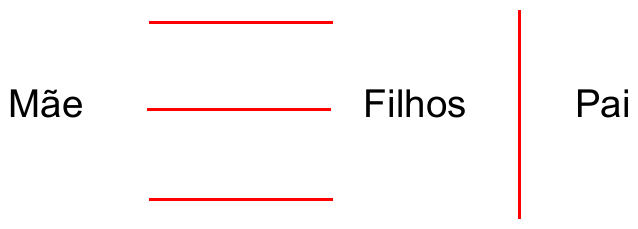
According to Minuchin’s thinking (1982), alliances and coalitions constitute power relations that structure the family system. In the figure above, the mother is over-involved with the children. They take on a parental role, inverting the family hierarchy. The father, for his part, distances himself, justifying and encouraging the coalitions. In this form of relationship, the notion of limits and authority is lost. The principle of dominance and submission is maintained, the members of the family system swap places and the children take on the parental role.
Different assumptions about the family
The assumptions set out here are regarded as a theoretical conceptual tool and not as a reflection of the reality of families. First, we have the premise of dominance, which tells us about the hierarchical family (1950s); next, the premise relating to the egalitarian-individualistic family (1960s); and finally, the premise of authority, relating to the citizen family (1990s).
These premises and patterns that shape the outline of the family system predominate in the contexts mentioned above, but they are by no means the only ones, since families are not seen as substantive, fixed and unchanging entities but rather as systems that create and re-create themselves in infinite forms.
The assumption of dominance
We could say that the premise of dominance informs the ideal of the patriarchal family, and that this ideal, in turn, refers to a hierarchy of values such as the inequality of the sexes, with men seen as superior to women. In this sense, the one who holds power is the father, the supreme authority whom everyone must obey.
According to Coria (1986), the predominant ideas in this ideology rest on the basic assumption of female inferiority and male superiority.
This view of the family reached its peak in the 1950s and is grounded in the paradigms of modernity. The logic of power, based on the principle of inequality, is woven by philosophical, religious and naturalistic currents which, within a fragmented conception of the human being, divide the indivisible, attributing rationality to the masculine and sensitivity to the feminine. These conceptions go on to order the process of primary socialization in the private sphere. It is worth remembering that the premise of inequality is present in this view. The dominator/dominated pair merely changes position; it does not change in itself and remains complementary (Duarte, 2005).
We can perceive not only the power of the father as provider but also the power of the mother, queen of the home, exercised through affection. To illustrate this, we quote a popular song here:
[The author quotes here four lines of a Brazilian popular song, which are not reproduced out of respect for copyright. In them, the mother is celebrated as the mistress of everything and the queen of the home, and the singing voice says she means more to it than the sky, the earth and the sea. — Editor’s note.]
Thus, the hierarchical family constitutes a network of dependence based on the pre-established principle that the woman places her role as mother above all others (wife, professional), while the man, seen as the provider, finds himself restricted in the exercise of fatherhood, as if a relationship were established in which money is the father’s property and the children are the mother’s property. He too is prevented from letting his affection flow (“Real men don’t cry”), and the children, for their part, have a mediating mother and an authoritarian, distant father.
It is worth remembering that, although other premises influenced the formation of the family in the 1950s, we are highlighting the premise of dominance because its hegemony can easily be observed. We would also recall that the family is dynamic and changes, and that when we refer to it, it is only for didactic purposes, since in reality we work with families, each with its own particular and unique stories.
By the 1960s, the patriarchal family was in crisis, as its basic foundation – built under the rule of a relationship of inequality between the genders, of pre-established roles, of the split between rights and duties, of power struggles and of the will of the strongest at the expense of the majority – was showing deep cracks. This can be explained by new social ideals, which project the individual in relation to the social and family context through a new economic configuration of society, characterized by a process of growing industrialization and by the entry of women into the labour market. As a result, the organization of the family is questioned in its basic principle, namely the assumption of the superiority of men over women, based on their role as providers.
Here it is important to stress that we use the words hierarchy and hierarchical families with different conceptions and opposite meanings that do not complement each other. That is, when we refer to the hierarchy of the family, we draw on the systemic framework and on the thinking of Minuchin (1995), who links hierarchy with structure, authority and process. In this sense, hierarchy is seen as an organizing principle of the family system, which analyses the different positions of family members according to the family hierarchy.
When we refer to the term hierarchical family, we draw on a socio-anthropological framework described by Figueira (1987), Salém (1979) and Sarti (1999), according to whom the notion of the hierarchical family is linked to the values of inequality, in which some are better than others.
Next, we will see the form in which the new process of modernization of the Brazilian family appears – the egalitarian-individualistic family – emerging to question the premise of the patriarchal family.
The egalitarian-individualistic assumption
Since the 1960s, the premise of inequality, which organizes the patriarchal family, has been severely questioned, while a new premise, the egalitarian-individualistic one, has emerged from this social context, thus becoming a new axis around which families organize themselves.
We will take as our reference the thinking of Salém (1979), who describes the assumptions of the egalitarian-individualistic family, and of Bateson (1991), who refers to the assumption of symmetry. Salém (1979) describes two structuring ethical principles of the egalitarian family: psychologization and equality.
The principle of psychologization is present in a turning towards oneself, with one’s own self as the reference point, observed through feelings and sensitivity. This principle involves a liberation of the individual, but social norms are seen as oppressive and, above all, there is a radicalization of the individual–society representation.
The second structuring principle of this moral universe is that of equality, which basically expresses an opposition to shared decisions and to hierarchical orderings. This principle is represented positively, and everything happens as if, once hierarchy and its perverse effects had been banished, people entered a domain immune to constraints in which only the laws of freedom and pleasure would reign.
In their invisible dimension, the principles of psychologization and equality, which serve as references for the egalitarian family, carry a fundamental contradiction: both place the individual above an agreement between equals. Salém (1979) also says that, in the private sphere, the egalitarian couple lives by principles that govern the individualistic social order and expresses the dilemmas inherent in it. The individual wants to have their individuality and will not accept interference from the partner. They are left with a dilemma: how to meet the demands of a shared existence?
Thus, in reaction to an unequal principle, another is proposed, cloaked in an ideal of equality, but the basic core and the earlier logic are maintained; only the positions are swapped. In the new order, supremacy is granted to the individual at the expense of the group. A boundless individualism takes hold as a reaction to authoritarianism and patriarchal familism.
We could say that the family reproduces, in the private space, the same process of modernization as Brazilian society. It takes on egalitarian ideals, frees customs that had until then been repressed and changes the actors in power. Yet it maintains the same earlier logic – dominator/dominated – under the guise of a supposed modernization. In these circumstances, which are increasingly present in middle-class families, the reduction of the authority of the husband and father contributes decisively to children assimilating the position of “subjects of rights” inside and outside the domestic unit, while the condition of “subject of duties” recedes into the background (Romanelli, 2000, p. 86).
The logic of the egalitarian family, by constituting subjectivities with an exacerbated individualism, ends up ratifying, in society as a whole, the perverse process of social inequality and of silent, circular violence underlying the social fabric.
Bateson (1991), for his part, in analysing the assumption of symmetry, refers to an escalating competition in which the individual does not accept authority and does not consider themselves a part either, since they can do anything. For Bateson, the premise of symmetry underpins the pride of the person with alcoholism.
We could say that the thinking of Salém (1979), Romanelli (2000) and Bateson (1991) converge on a common perspective, namely: (a) the absence of limits; (b) of affective reference; (c) of commitment to collective norms; (d) of authority; and (e) permissiveness, which places individual interests above collective agreements.
From this perspective, it is worth recalling the request of a mother of two young people, referred to the social worker by the Guardianship Council (Conselho Tutelar): “I came here for you to solve my problem. My children (10 and 12 years old) hit me” (Centro de Convivência Carlos Prates/SUS, 1995). It can be seen that both the users of private practice and those of the public health system (SUS), parents and professionals alike, appear intimidated and paralysed in the face of this reality, characterized by an inversion of power and by the absence of parental authority and of limits.
It should be stressed that in the 1980s and 1990s, in the process of transformation of the Brazilian family, another premise or axis emerged, that of authority, through which families organize themselves. From this axis, the family is seen as an autonomous and transformative system, capable not only of absorbing external changes but also of transforming the systems with which it interacts. This implies a paradigm shift in power relations within the family, since the content of relationships is transformed and structured according to new ideals of family, namely an egalitarian way of living, under the primacy of authority.
The assumption of authority
Here it is necessary to distinguish between the concept of authority and that of authoritarianism, since these concepts, present in the organization of family relationships, constitute two distinct and non-complementary forms of family interaction:
- The exercise of unilateral power, whose organizing principle is the dominance/submission pair – authoritarianism.
- The exercise of distributed power, which implies the presence of authority, of limits, and of rights and duties.
The conceptual categories of authority and authoritarianism are the structuring principles of the power relations that organize family relationships. They are distinct theoretical categories: they do not have the same meaning and they do not complement each other.
In our professional work, we come up daily against the confusion between the concepts of authority and authoritarianism, which has led parents, teachers and school principals to abdicate their role as a reference point and as setters of limits, for fear that taking on a role of authority would amount to exercising authoritarianism.
Mucchielli (1979) and Sarti (2000) agree with Romanelli (1986) on the confusion between the categories of authoritarianism and authority: “It can be seen that, in the exercise of power, these categories have been confused as if they were the same reality” (p. 79).
Sarti (2000) refers to a confusion surrounding the concept of authority: “In this process of contesting the family pattern, of parents over children and of man over woman, there was a confusion between the excesses of traditional authority and the legitimate and necessary exercise of authority in the family, leading to a permissiveness that has been particularly harmful to children, who were left without established limits” (p. 45).
Thus, we can say that the conceptual categories of analysis, authority and authoritarianism, refer to philosophical currents and ideological choices that differ from each other, which may give rise to conceptual confusion and to ideological a prioris attached to these categories. Hence the importance of defining them.
This study adopts the concept of authority in Ferrater’s sense (1974): it is a relationship of mutuality, in which the principle of equality among human beings is present. Authority does not consist in the possession of a force, but in the right to exercise it; and this right derives from the consent of those over whom it is exercised. This doctrine, born of the work of the Stoics, found its great exponent in Cicero and has as its fundamental assumption the denial of inequality among human beings. According to it, “all men have received reason from nature, that is, the true law that rightly commands and forbids: therefore all are free and equal by nature” (Cicero, De legibus, I, 10, 28; 12, 33). Accordingly, “only from human beings themselves and from their concordant will can the foundation and principle of authority arise” (Ferrater, 1974, p. 94).
As for the concept of authoritarianism, it is understood here as the unilateral stance of a member of the system, or even of a system, that seeks to impose itself on others by force, without legitimate, consensual authority. These categories, authority and authoritarianism, are conceptual references for analysis through which we identify the power relations of the family in transformation, and they thus make it easier to identify how the lived family is organized today.
We share the thinking of Foucault (1979), for whom power is fluid and present in all interactions; it has no fixed place; it is paradoxical, interactional and systemic. What interests us here, therefore, is not power in itself but power relations within families in their various manifestations.
In this text, we regard the exercise of authority as the other side of power, since “where there is power, there is resistance”; accordingly, the exercise of authority constitutes the primacy of the citizen family (Foucault, 1979). For Giddens (1993), the task today is to live out in the private space the democratic relations, already emphasized in the public space, that are necessary for building subjects oriented towards the exercise of rights and duties.
In this sense, we conceive of the citizen family as one guided by an ethical dimension and by a relationship of distributed power. The new family that is envisaged – the citizen family – as a subject of rights and duties is a group run through with conflict, capable of reinventing new alternatives, and oriented towards welcoming, accepting and including difference. It should be remembered that we work with the idea that there is no abstract family, no substantive entity, but family systems that self-organize and transform themselves far from equilibrium and in different ways.
The premises of the citizen family, such as the exercise of authority, of duties and of rights, are possible ways of understanding the interactions and patterns of the real family, as a conceptual tool capable of widening our lenses and, therefore, our understanding of the lived family. To this end, we work with the family at two different but complementary levels: the family that is thought and the family that is lived, or the ideal family and the real family. For Szymanski (1992), the family that is thought refers to the model invoked when people criticized their own way of living. The family that is lived refers to the everyday way of living.
We could say that the assumptions we adopt constitute tools for practitioners to recognize, in the everyday life of citizen families, the alternatives they create in order to withstand adverse situations, free themselves from codependence, include differences, and protect and care for their members. It is therefore necessary for the practitioner, engaged with their subject/object of work, the citizen family, to connect with the family’s everyday life in order to identify the different voices, the presence of difference, of the instituting, of authority and, above all, to give meaning to families’ capacity to withstand adverse situations.
A look at the family’s capacity for resistance
The transformations of power relations in postmodern society touch the heart of the family system, disorganizing it and demanding a new construction of roles; it is no longer clear what the role of the man, the woman, the daughter, the grandmother, the daughter-in-law and the son-in-law is, among others. It therefore becomes necessary to construct them.
As a consequence, these transformations of power within the family structure give rise to constant questions coming from different places, such as everyday conversations, articles and lectures, namely: has the family fallen apart? This question is linked above all to the fact that, for many people, the family is in crisis and in chaos, since its identity is being called into question.
We could say that the family has not fallen apart; on the contrary, to recall Walsh (1996), the family system has within it a capacity to withstand adverse situations and, through the exercise of dialogue, families can transform themselves and emerge from crises and from their losses even stronger than before. When we refer to the capacity to withstand present in the family system, we draw on the concept of resilience:
Family resilience tends to foster certain key processes that enable families to cope more effectively with crises or persistent states of stress, whether internal or external to the family, and to emerge strengthened from them. By building family resilience, we strengthen the family as a functional unit and make this capacity possible in all its members (Walsh, 1996, p. 13).
We understand that the concept of resilience arises in a relational situation, applies to the family system and speaks of a strength or resistance for facing adverse situations. This concept adds to our conceptual framework one more way of identifying the interactive processes present in the family system that enable families to cope with persistent states of stress.
The interactive and resilient processes of the family system are identified here as connections and possibilities, tolerance of differences and acceptance of limitations, complementarity and the building of partnership, competences, and the personal and family history that can be given new meaning. Minuchin (1995) draws attention to the song that needs to be sung in our culture: the song of rhythm, of relationships, of people enriching and expanding one another. For him, fights and arguments are noisy and prevent us from sensing the silent connections that make the family a unit.
Conclusion
Working with the categories of the exercise of power, whether of dominance, of symmetry or of authority, gives us distinct lenses that lead us to identify, in the course of our work, the categories of gender, colour, religion and social class that organize and structure family relationships.
When dealing with issues of power, dominance and the inversion of authority, studies among the poor generally refer to economic power as a result of the position occupied in society. We do not deny this reality, which indeed stems from a Marxist perspective on the struggles between social classes. On the contrary, we include it as a working tool in order to understand the connections between the dynamics of families and their socio-economic context.
This study, however, turns to the power relations present within the family sphere and considers that family intimacy is traversed by power relations of dominance, sustained by economic, gender, religious and racial inequality, which reproduce and generate illness.
As a counterpoint to the power of dominance, families question these crosscutting forces, withstand painful situations and open up different paths which, connected with instituting forces present in the socio-political context, sustain connections of interaction open to the protection, welcoming and inclusion of their members.
To illustrate this stance, we quote fragments of dialogues between a mother and her son that took place during interviews with the social worker at the Adolescent Integration Centre (CIA-BH).
1st interview
The mother turns to the practitioner:
“He’s a drug addict. I’ve already given up on him”…
The young man raises his head, enters the dialogue, looks at his mother and says:
“Don’t give up.”
2nd interview
Mother: “It was good to hear my son speak, I didn’t know he thought like that…”
3rd interview
The son turns to his mother:
“… and you were the one who wouldn’t let my father register me…”
We could say that, present in family intimacy, the interactions of hatred and love, despair and hope form the ground on which alternative paths are forged that can broaden the autonomy of the family system.
Complexe Systémique: key points
The distinction between authority and authoritarianism is the most useful contribution of this text: many parents give up setting limits for fear of being authoritarian, and the article offers words to separate power imposed by force from distributed power grounded in agreement. The difference between hierarchy in the structural sense (which protects) and the hierarchical family in the socio-anthropological sense (which creates inequality) also helps to escape a false dilemma. Some caution is needed, however, with the decade-by-decade succession of models, which the author herself presents as didactic, and with a severe portrait of the egalitarian family that could feed nostalgia for a lost order. The coalition diagram and the vignettes place the mother at the centre of the problem, while the text elsewhere denounces the confinement of women to the home: a systemic view would also question the place left to the father. In sessions, one question remains valuable: who decides what here, and on the basis of what agreement? Read alongside the article on child-to-parent violence, and the interview on more democratic relations in families.
References
Bateson, G. (1991). Pasos hacia una ecología de la mente. La cibernética del “si – mismo” (self): una teoría del alcoholismo. III Parte; pp. 339-366. Buenos Aires: Editorial Planeta Argentina S. A.I.C.
Coria, C. (1986). El sexo oculto del dinero: formas de la dependencia femenina. Buenos Aires: Paidós.
Duarte, A. (2005). O poder de recuperação de uma família codependente do álcool. Dissertação publicada na biblioteca da Pontifícia Universidade Católica de São Paulo.
Ferrater, J. (1974). Dicionário de Filosofia. Madrid: Alianza Editorial.
Figueira, S. A. (1987). Uma nova família? O moderno e o arcaico na família de classe média brasileira. Rio de Janeiro: Zahar.
Foucault, M. (1979). Microfísica do poder. Rio de Janeiro: Graal.
Giddens, A. (1993). A transformação da intimidade. São Paulo: Editora da UNESP.
Grandesso, M. (2000). Sobre a reconstrução do significado: uma análise epistemológica e hermenêutica da prática clínica. São Paulo: Casa do Psicólogo.
Minuchin, S. (1995): A cura da família – histórias de esperança e renovação contadas pela terapia familiar. Porto Alegre: Artes Médicas.
Mucchielli, R. (1979). Psicologia da relação de autoridade. São Paulo: Martins Fontes.
Romanelli, G. (2000). Autoridade e poder na família. In Maria do Carmo Brant de Carvalho (Org.). A família contemporânea em debate. (3ª ed., pp. 73-88). São Paulo: EDUC/Cortez.
Salém, T. (1989). O casal igualitário. Revista Brasileira de Ciências Sociais, 9(3), 24-37. São Paulo: Vértice.
Sarti, A. C. Família e individualidade: um problema moderno, (2000). In Maria do Carmo Brant de Carvalho (Org.). A família contemporânea em debate. (3ª ed., pp. 39-49). São Paulo: EDUC/Cortez.
Szymanski, H. (1992). Trabalhando com famílias. Caderno de Ação nº 1. São Paulo: IEE Instituto de Estudos Especiais da Pontifícia Universidade Católica.
Umbarger, C. C. (1983). Terapia familiar estructural. Buenos Aires: Amorrortu.
Walsh, F. (1996). El concepto de resiliencia familiar: crisis y desafío. Family Process, 35, 261-281. Tradução de Leandro Wollson.
Unofficial English translation of As Transformações nas Relações de Poder das Famílias, by Alda Cristina Duarte, Revista Brasileira de Terapia Familiar, vol. 3, no. 1 (2011), doi: 10.60114/rbtf.v3i1.74, under a CC BY 4.0 licence. Translation (with the help of artificial intelligence) and layout: Complexe Systémique, November 2026 — the work has been modified under the terms of the licence. Neither the authors nor the journal are responsible for this translation; the original version prevails.
Unofficial English translation of “As Transformações nas Relações de Poder das Famílias”, published in Revista Brasileira de Terapia Familiar (2011) under a CC BY 4.0 licence. Made by Complexe Systémique with the help of artificial intelligence, it does not come from the authors or the journal, who are not responsible for its content; the original version prevails.
Read the original articleHow to cite this article
Duarte, A. C. (2011). The changes in power relations in families (Complexe Systémique, Trans.). Complexe Systémique. https://app.complexe-systemique.com/en_GB/articles/the-changes-in-power-relations-in-families (Original work published in 2011 in Revista Brasileira de Terapia Familiar, v. 3, n. 1 (2011); republished in 2011 by Revista Brasileira de Terapia Familiar, https://revbrasterapiafamiliar.abratef.org.br/revista/article/view/74)
To go further
- Child-to-parent violence: an emerging phenomenonWhen children hit their parents.
- From expert intervention to collaborative conversation: more democratic relations in families and institutionsTowards more democratic relationships.
- The structural approach in systemic therapy explained simplyHierarchy, boundaries and coalitions.
Related training courses
 Symposium
État des Lieux: a psychological approach to spaces
Replay of the “État des Lieux” conference (Paris, 16 October 2026): Ivy Daure, Maurizio Frisina, Viola Sallay and Gilbert Pregno on places as a clinical resource. In French.
Related articles
 Blog
Capp® groups give parents a place to think together
How does a reflective parenting group work? Jalila Kormachi and Yara Doumit describe how parents revisit a difficult moment and choose what to try next.
 Scientific
Sickle Cell Disease and Young Couples: Understanding the Influence of Shared and Individual Meaning on Couples’ Experience of Illness
Nine young adult couples facing sickle cell disease: how each partner makes sense of the illness, and how the couple moves from caregiving to equality from one crisis to the next.
 Scientific
Family group conference provision across the lifespan of child welfare intervention: A mixed-method realist-informed evaluation comparing three stages of welfare concern
Early help, child protection or children in care: among 155 UK families, experiences and outcomes of family group conferences vary very little by stage.
 Scientific
“One Can Have All Sorts of Good Intentions but Sometimes in Everyday Life, It Turns Out Differently”: Change Agreements in Couples' Everyday Lives
Six Danish couples followed after an online couple program: their change agreements become guilt-inducing contracts, shared understanding or revealers of inequality.
Comments 0
Log in to join the discussion. Log in