AI-assisted translation
This version was translated from Portuguese by Complexe Systémique with the help of artificial intelligence. In case of doubt, the original version prevails.
Revista Brasileira de Terapia Familiar · Mental health
The experience of a group of families who have a member with a severe mental disorder: the Entrelaços Program
How do families living with a severe mental disorder come to welcome and support other families in turn? At the Institute of Psychiatry of the Federal University of Rio de Janeiro, the Entrelaços Program takes families from psychoeducation seminars to problem-solving groups and then to self-run peer groups in the community. Five people who coordinate these groups describe what the experience has changed for them: hope regained, stigma put into words, expertise built together.
Unofficial English translation. This article is a translation of A Experiência de Grupo de Famílias que Possuem um Membro com Transtorno Mental Severo: Programa Entrelaços, by Olga Maria de Araujo Leão, Silvana dos Santos Barreto, Elias Carim Neto, Leonardo Figueiredo Palmeira and Alexandre Lins Keusen, published in the Revista Brasileira de Terapia Familiar (ABRATEF), vol. 10, no. 1 (2021), doi: 10.60114/rbtf.v10i1.22, under a CC BY 4.0 licence. Translated by Complexe Systémique in November 2026 with the help of artificial intelligence: the original Brazilian Portuguese text has been translated into English and reformatted, which constitutes a modification of the work under the terms of the licence. Paragraphs and headings are those of the journal; the authors’ biographical notes, printed as footnotes on the first page, are included in the presentation; the SAMHSA definition is given in its original English wording; the coordinators’ statements and the quotations from Kuipers et al., Gaebel and Baumann, Palmeira et al., Deegan and Anthony are translated from the article’s Portuguese, not taken from the original texts; the coinage “aprendamento” is rendered as “learnment”; a few typographical errors in the printed text (“From-Reichmann”, “Programa Entrelaço”, “Enterlaços” in the English title) have been corrected silently. The abstract is the authors’ own English version. This translation was made neither by the authors nor by the journal, who are not responsible for its content or for any errors. The original version prevails.
More than a space or a place, the group is movement!
C1, in the article by Olga Maria de Araujo Leão et al.
Abstract
The Entrelaços Program is developed at the Institute of Psychiatry of the Federal University of Rio de Janeiro with families who have members with severe mental disorders. The Program consists of seminars, followed by multifamily groups in the model of Problem Solving Therapy and generating peer groups in the community (mutual help groups). This is a qualitative study, aiming to understand the experience of the coordinators of these various groups, as well as to analyze the meaning of that experience. The results showed that the exchange of experiences between families fosters deeper discussions of issues arising from living together as well as the construction of possible solutions to face everyday conflicts. Participation in the groups allowed access to information; contributed to the process of acceptance, hope in recovery, relief from tensions in family life and expansion of the social support network. Psychoeducation helps reduce recurrences / hospitalizations, conflicts and “expressed emotion”; improves the quality of life and the ability to solve problems, developing expertise to deal with difficulties. Peer-led groups contribute to benefit a higher number of people, making them more resilient, empowered, and protagonists in the process of recovery, through which people are able to live, work, learn and fully participate in their communities.
Keywords: Peer-groups, Family Intervention, Recovery, Severe Mental Illness, Empowerment
Introduction
Since 2011, the Institute of Psychiatry of the Federal University of Rio de Janeiro (IPUB/UFRJ) has been running the Entrelaços Program, an intervention program for families who have a member with a severe mental disorder. Families first take part in a series of seminars for producing knowledge and reflecting on it, followed by fortnightly meetings in groups of up to eight families, in which they discuss their problems and look for solutions, with the family regarded as expert, over nine months.
At the end of each cycle of the program, the families are invited to keep the meetings going independently in the community, under their own coordination, so as to ensure their continuity, while remaining open to welcoming new families.
The aim of this article is to identify the meaning of the experience of coordinating a support group in the community, and how this participation has helped the coordinators in their personal recovery process and in developing expertise to deal with the demands that families bring to the meetings.
Now ten years old, the Entrelaços Program keeps feeding back to us the experiences of the relatives and service users who take part in it, through their accounts of what it has contributed to their own personal recovery and that of their families. This is what led us to analyze the discourse of these coordinators.
We stress that, in this work, the term family refers to all of its members; we make no distinction between relative and service user. In the program, everyone takes part voluntarily, whatever their condition. Among the coordinators are mothers, fathers, siblings and service users.
The Entrelaços Program
The program consists of four cycles: (1) welcome and assessment; (2) knowledge production and reflection; (3) sharing of experiences and solutions; and (4) peer action.
In the first stage, the families are welcomed: they receive information about the aims of the program and its structure, take part in individual interviews and complete assessments of quality of life, knowledge about the illness and caregiver burden, and of the level of expressed emotion (EE).
The second stage consists of eight weekly seminars addressing topics related to severe mental disorders, such as causes, treatment, course, etc.
We adopt the view that severe mental disorder corresponds to a state of vulnerability to stress (Zubin et al., 1992), and we place ourselves within the Personal Recovery Movement (recovery), embracing values such as hope, optimism, resilience and empowerment. We believe that everyone is capable of learning and of achieving autonomy and well-being.
Following this orientation, we adopt the multidimensional definition of personal recovery proposed, on the basis of an expert consensus, by the US Substance Abuse and Mental Health Services Administration (SAMHSA) (2005): “Mental health recovery is a journey of healing and transformation enabling a person with a mental health problem to live a meaningful life in a community of his or her choice while striving to achieve his or her full potential.”
Relatives who have attended at least 75% of the seminars are divided into smaller groups for the nine-month stage of sharing experiences and proposing possible solutions to problems. Each group in this third stage is made up of six to eight families, divided according to how close they live to one another.
First, each family is invited to present its genogram (McGoldrick et al., 2012), which aims to give an overview of its family relationships, thus creating greater intimacy as the families share their stories.
The meetings then adopt the problem-solving model (Haley, 1976): problems brought by each family are selected so that the group can jointly look for solutions (Walsh, 2010) that can be used in daily life. At the next meeting, that family gives the group feedback.
We would point out that we use a meeting routine with set times, which we hope can serve as a basis for how the groups will run their future meetings in the community.
This approach was chosen to help families come to terms with their reality, as they realize that they are not alone and experience other ways of dealing with their difficulties, seeing other families’ experiences as alternatives. In addition, the group encourages the growth of their social network and helps improve communication, contributing to their empowerment.
Taking the concepts of second-order cybernetics as our principles, we think of reality as something permanently under construction. Maturana (2001) points to the importance of language in the constitution of reality, showing that it is impossible to speak of a reality independent of the observer’s gaze.
According to Walsh (2010), it improves people’s resilience to stress, leading them to develop strategies to return to their emotional baseline and to respond to the demands of their environment in a more conscious and planned way.
In the fourth stage, the families are invited to keep the meetings going on their own, using the same dynamic, in a venue of their own. For the first six months, the program’s staff attend the meetings in person to provide initial support as the group becomes established in the community. After this period, support is provided through quarterly supervision sessions for the coordinators of the existing groups and, whenever needed, an extra supervision session is offered according to each group’s demand.
At the end of each year, a closing seminar is held with all the community groups and invited guests. During the year, the Trilhando Caminhos group (2017), created by members of all the other groups, organizes events such as outings, barbecues, weekends at a guesthouse and celebrations of the month’s birthdays, among others.
There are currently six community groups that originated in the Entrelaços Program: Abra a Sua Mente (2013); Mentes em Ação (2015); É Possível (2015); Construindo Horizontes (2017); Equilibrarte (2019); MoviMente (2019).
Each group has two coordinators, who are responsible for welcoming new families who come to the groups spontaneously, on the recommendation of other relatives, through publicity on the internet or through the events the groups themselves organize. Two of these groups are coordinated by peer specialists, that is, people who face these difficulties and are in the process of overcoming them. These groups offer support, encouragement, hope and guidance to others facing similar situations, and draw on one another in the conflicts of their daily lives (Davidson et al., 2006).
Methodology
This is a descriptive study with a qualitative approach. The study subjects were the coordinators of five community peer groups that originated in the Entrelaços Program. The coordinators took part in the Entrelaços Program’s 2017 closing seminar, whose theme was Peer support: experiences of community family groups. To protect their identity, they were designated C1, C2, C3, C4 and C5.
The study participants were informed and consented to the seminar being video-recorded and posted on the internet. The presentations were later transcribed to allow analysis.
The data were analyzed using the content analysis method proposed by Bardin (1977), since it makes it possible to describe and interpret the content of all the accounts, with a view to reinterpreting the messages and reaching an understanding of their meanings that goes beyond an ordinary reading.
The content analysis process consists of four stages:
- pre-exploration of the material (floating reading);
- selection of the units of analysis (or units of meaning);
- categorization and subcategorization;
- discussion of the data.
In accordance with Resolution CNS/MS No. 466/12, this study was submitted to the Research Ethics Committee of the Institute of Psychiatry of the Federal University of Rio de Janeiro (IPUB/UFRJ) and approved under Opinion No. 2.869.446.
Results and discussion
Once the accounts had been transcribed and classified into units of analysis, the results were grouped into three categories, which are described and discussed below.
1. The experience of coordination and of peers as an opportunity for transformation and personal growth
For the participants, access to information about severe mental disorders, combined with the opportunity to exchange experiences with other families going through the same problem, has made it possible to discuss the issues that arise in living with their relatives and to build possible solutions together for coping with the illness:
One important thing is that the group doesn’t tell the family what to do! We share the experiences we live through and, in a way, we serve as inspiration for one another. So it’s very rewarding when someone arrives inspired by something they heard, makes a decision, takes a step, and we see the situation shift from conflict, from emotional difficulty, to a ‘learnment’, to a harmonization, to the path of recovery. (C1)
For the coordinators, taking part in the group meetings leads families to report changes in attitude and experiences of overcoming and recovery, and to realize that they can be happy despite the difficulties. The meetings are also an opportunity to spread information about the illness, which helps reduce stigma:
I think the support groups are excellent… We can spread this information further, so that everyone knows about these groups and we can build a different picture of mental disorder. Because we know that lack of knowledge breeds stigma. (C2)
As Kuipers et al. (2002) state,
[…] it is important to explore the family’s feelings of stigmatization and isolation. Families often may not say that they feel stigmatized, but they behave as if they had cut themselves off from the social networks from which they should be receiving support and companionship. The educational program helps to demystify the illness and to feel freed from the feelings of guilt it produces. (p. 120).
These results corroborate what Chien et al. (2013) say about the contributions of participating in peer groups: an injection of hope, with peers serving as models of overcoming for other relatives, as can be seen in the following statements:
“So I think being a group coordinator means sharing hope, in a positive way, among all the people who are there, so that we can move forward and overcome life’s difficulties in relation to the illness.” (C2).
“So it’s a blessing to be in a situation like this and share learning, and you see clearly that we become more human.” (C3).
For the coordinators, taking part in the group fosters the exchange of experiences, makes it possible to obtain information about the illness and to explore certain topics in depth; it helps in the process of acceptance and in hope of recovery; and it brings opportunities for socializing.
“More than a space or a place, the group is movement! Because people, ideas, emotions, attitudes and behaviors are moving. The group works as this learning space.” (C1).
“Together with the seminars, the group also works as a space for becoming aware. And becoming aware is work.” (C1).
“So there was a sense of these observed emotions calming down, and a hope of finding a welcoming space where we could share all these doubts.” (C3).
“We’ve already had several meetings, and that’s the idea. And at our meetings we really get to see the happiness of the participants, of the vulnerable ones, their behavior; it’s all really great, and the interaction between people is so lovely.” (C4).
“O… is a case of recovery; what a pity he isn’t here. Because he’s someone you listen to, you talk with him, and you come away full of hope. You see that it can be overcome!” (C5).
In the group, they experience a feeling of being welcomed and even of relief on discovering that they are not alone, that their problems are similar and that they can share them. In this space, hope, solidarity, mutual help and respect are also shared.
Here in this sharing we don’t give advice, but everyone talks, shows their problems, what’s happening to you, and then you see you’re not alone, you see there are people just like you, so that gives you enormous comfort! (C4).
“The biggest gain, in my opinion, in this first year of the group is this structure of trust, building an architecture of trust so that we can take bolder flights and start to explore the topics in depth.” (C3).
They all express and value the opportunity to talk, given that they previously found it very hard to do so. They experience a feeling of belonging, welcome, friendship and comfort in the group. They feel accepted and understood by the other group members (Durão et al., 2005).
2. Demands that families bring to the groups during the meetings
Among the main issues that families bring to the group meetings, the following stood out: discussion of stigma and self-stigma; the need to discuss limits; conflicts in family life; behaviors of the vulnerable person that cause discomfort in the family; feelings of powerlessness and hopelessness; the difficulty of getting the vulnerable person into the labor market; doubts about the illness and legal aspects; and the search for support in spirituality.
Stigma and self-stigma are among the topics most frequently raised by participants in the groups.
Family stigma and self-stigma… it cuts across all the other issues, because we’re talking about a difficulty in understanding what vulnerability is, about the belief that it’s not going to change, and about the judgment and criticism that the family, without meaning to and yet meaning to, directs at the behaviors of the vulnerable ones, especially regarding refusing medication, lack of hygiene, not keeping up with therapy, which are tests for us relatives, who get exasperated. (C1).
According to Gaebel and Baumann (2003),
The stigmatization of mental illness in general and the stigma associated with schizophrenia in particular represent obstacles to early and successful treatment. Ignorance, prejudice and negative public attitudes towards people with schizophrenia affect both patients and their families, leading to a cycle of alienation and disadvantage that culminates in social distancing, exclusion and disadvantage with regard to housing and employment opportunities.
During the Entrelaços Program, we seek to reduce stigma through information about the illness; to increase group and social activities; to broaden the network of relationships; and to adopt a warmer and more natural attitude, whatever the setting, highlighting qualities, praising, motivating and encouraging potential, while always respecting limits.
The group had several extra social activities, which are very important, birthdays, outings, lunches; there are people interested in painting, there’s one person who does theater, there are people who make music, people offered to go and see plays, concerts. So these extra activities in more informal settings really foster greater intimacy and relaxation, and so, in the relationship, greater intimacy and friendship between the groups. That strengthens things a lot. (C3).
The need to discuss limits is also a very recurrent topic at the meetings: “So the discussion about limits comes up very strongly in the group! And we arrived, at least in this provisional discussion, at the idea that there’s no point in having rigid limits, and no point either in having no limits at all!” (C1).
Families are helped to understand that flexibility and tolerance are necessary to reduce the stress and emotional overload in which everyone is caught up, and that they are crucial for better social life and for keeping stress levels within tolerable bounds (Anderson et al., 1980).
Difficulties in family life are also frequent, as can be seen in the words of one of the coordinators: “… then we deny, we judge, we create unrealistic expectations, we have difficulty dealing with emotions; we communicate aggressively, there’s a dynamic of pulling away.” (C1).
There is a consensus in the scientific community that social, psychological and family factors influence susceptibility to, adaptation to and recovery from illness, with repercussions on the use of health services and on service users’ functioning, autonomy and quality of life. A particularly fruitful field has been research into the relationships between service users and their relatives and their influence on the course of illness, from which the concept of expressed emotion (EE) emerged. “EE is a theoretical construct that brings together crucial aspects of interpersonal relationships, such as measures of criticism, hostility, warmth, positive remarks and emotional overinvolvement, and that makes it possible to predict the course of the case.” (Keusen, 1989).
EE has been extensively researched in the context of schizophrenia; what spurred its study was the realization that patients’ relapses in the year following hospitalization were significantly related to the life situations they found when they were discharged. The early studies by Leff and Vaughn (1985) stimulated research over the following thirty years and confirmed the relationship between family EE and the course of schizophrenia, promoting the development of interventions aimed at changing EE. This working model was later extended to other psychiatric and medical illnesses.
According to Palmeira et al. (2013),
an environment loaded with criticism gradually transforms the way people relate to one another at home. There are highly critical families who become used to living with these stressors, with people accustomed to criticizing and being criticized… In schizophrenia, living in a hypercritical environment can make the difference between stability and relapse (p. 176).
Seeking support in spirituality was also mentioned as a demand that families bring to the groups.
Another issue that comes up there is spirituality, and it comes up in two ways: one is the association between psychotic disorder, the matter of voices, and mediumistic phenomena; so there are families saying they go to the Spiritist center to work on this issue, and people who are afraid to go, worried that it might make the pathology worse. (C1).
Silva and Santos (2009) conducted a study with mothers of people with schizophrenia, many of whom reported seeking support in religion, mysticism, community organizations and alternative medicine as a way of understanding what they were going through with their children and finding some form of relief.
Patricia Deegan (2001, as cited in Palmeira et al., 2013) describes how important spiritual practices were in her recovery process: “My spiritual practices set me on a path where it was possible to find a reason for all that suffering, and helped me with feelings of self-pity and with the inevitable question: why me?” (p. 08).
Even when the diagnosis is certain, it needs to be communicated with great sensitivity because of the impact it will have on everyone involved. Physicians emphasize that the only reliable ways of dealing with these fears are to work in collaboration with the team to keep the underlying process under control and to plan to manage it over a long period in the future (McFarlane et al., 1995).
Doubts about the illness, about the clarity of the diagnosis and about legal aspects were also cited as recurring topics at the group meetings:
Diagnosis and hospitalization are a huge problem that comes up! Families want more precise diagnoses, …, the doctors present another type of diagnosis, which isn’t categorical, as we learn here, but dimensional… (C1).
Interdiction, guardianship and autonomy are another paradox or ambiguity. Many of us resist discussing the question of guardianship because it’s painful to see your son, or whoever it may be, labeled as incapable, because that’s how the law treats them. (C3).
The coordinators recognize the importance of having access to information about the diagnosis and of taking part in the activities of other groups and in events on the subject, since this contributes to the exchange of experiences and solutions with other families, to easing tensions in living with the ill relative, and to broadening the support network.
3. Taking part in the groups provides the opportunity to discuss, share and exchange experiences that make it possible to build solutions to problems
“First we do that warm-up, then the introductions, and then each person talks about their problem. We discuss it and in the end we look for a solution.” (C5).
“This sharing of experiences, of difficulties, of achievements, and how to find solutions together, with suggestions as possibilities, and then each person makes their own choices.” (C3).
“Lots of people say lots of things, but these are meetings I find very rich. Exchanging experiences makes us much stronger, and we learn how to act with others.” (C5).
Families who take part in reflecting on the information available in the literature become better able to exercise some control over interventions, rather than merely feeling guilty for having ill relatives and placing themselves in a passive position as if they were pathogenic units – the schizophrenogenic mother (Fromm-Reichmann, 1948).
The work we carry out in the Entrelaços Program provides help and support to everyone involved, which means creating opportunities for all to belong to a group, thereby reducing family isolation and increasing the exchange of experiences and learning, bringing greater comfort and welcome and a broader social network.
“Spread all this information, spread it in the media so it can reach the people who need it, because there are lots of people who need help and don’t yet know about these groups.” (C2).
So we value what the person is putting forward. There’s this valuing! And in this valuing, besides the courage, we empower the person who needs to be welcomed, whether it’s the patient or the relative. And from there, we keep transforming ourselves! (C2)
They also recognize that seeking social inclusion through work and leisure is fundamental to the recovery process.
I had this idea of putting into practice what we talked about there in the groups, and that’s how the Trilhando Caminhos group came about. The group’s purpose is to offer leisure to patients with severe mental disorders, accompanied by their relatives or carers, through outings, psychoeducational meetings, sharing, group dynamics, relaxation and games. (C4).
As for the difficulty of entering the labor market, we can say that this is a very important topic in the personal recovery process, because work increases self-esteem and the sense of belonging to the social environment, expands the social network, establishes a routine and provides some financial autonomy.
However, the coordinators report that public policies for labor market inclusion have proved insufficient to guarantee access to work: “Job opportunities, we know there’s no inclusion policy, apart from a few exceptions.” (C1).
Because of the difficulties of finding work, some relatives have brought to the meetings their experiences of supporting their vulnerable family members in their own projects for entering the labor market: “And what we’ve been finding in the group are ways out found by the relatives themselves, trying to find occupations for their vulnerable family members, or even by the vulnerable ones themselves, who, at a time of greater autonomy, look for work and get involved.” (C1).
The group meetings make it possible to discuss and reflect on topics related to the illness, treatment and legal aspects concerning the vulnerable family members, fostering the exchange of experiences among participants:
Many of us resist discussing the question of guardianship because it’s painful to see your son, or whoever it may be, labeled as incapable, because that’s how the law treats them. I found myself in this ambiguity, but the need to protect, in the sense of securing a pension for my son, made me look at the question of guardianship, and we went ahead with it. (C1).
The coordinators show an understanding of the personal recovery process. This concept is worked on a great deal during the Entrelaços Program seminars as hope in the recovery process and in its uniqueness. Anthony (1993) describes personal recovery as
[…] a personal and unique process of changing values, feelings, goals, skills and roles. It is considered an ability to give new meaning to life despite the limitations of psychological illness, involving overcoming stigma in order to be able to exercise citizenship (p. 11).
According to Palmeira et al. (2013),
[…] recovery is not going back to being who you were before the illness, but a process of transformation to become someone new; it is the discovery of one’s own limits and of how these limits open up to new possibilities in the individual’s life. The recovery process starts from the inside out. Medical treatment, psychotherapy, family support, work, in short, the external environment, has the role of helping the patient to build their skills and to acquire a sense of agency and power over their own life (p. 12).
So we accept the vulnerability, we reduce judgment and criticism; we lower expectations; we’re more at ease dealing with emotions; we communicate lovingly; we improve the interactions and bring them closer, we reduce stress; we reduce the frequency of hospitalizations; there’s emotional maturing [in both the relative and the vulnerable person]… you give your life new meaning, you believe in recovery, because it doesn’t come from something imposed from outside, it comes from lived experience, that’s what gives you solid ground! (C1).
“Today I’m someone who listens to other people much more… Today I listen, I put myself in that person’s place, and we keep applying what we learn in the seminar, so as to make a better group.” (C2).
According to the coordinators, many families begin the program without hope, and recovering hope plays a fundamental role in the recovery process, achieved through becoming aware of the problems (Glynn et al., 2006). This begins with the information received in the seminars and deepens through the reflection stimulated by sharing and exchanging experiences during the group meetings, which help reduce stigma and revise expectations.
Readjusting expectations about the vulnerable person’s functioning, shifting from hostile communication to more positive and affectionate communication, and being able to work on everyday problems by looking for concrete and plausible solutions and alternatives reduce stress in the family environment and create an optimistic atmosphere of greater trust.
Psychoeducation programs have shown benefits for families and for patients with severe mental disorders, contributing to fewer relapses and hospitalizations; less conflict and lower expressed emotion; better quality of life and problem-solving ability; and developing expertise to deal with the difficulties of the illness, enhancing their resilience and gaining greater empowerment to get on with their lives.
Several studies show a direct relationship between family support, clinical stability and fewer relapses, through family intervention programs (Keusen, 1989). That is why it is important to expand projects such as the one proposed by the Entrelaços Program, which aims to give families greater empowerment and a more active role in this process.
Final considerations
The results of this study showed that the coordinators’ participation led to a greater understanding of their reality. They developed complementary expertise that now enables them to lead peer groups in the community and to deal with the demands that these families bring to them at each meeting. They report that participating in the groups has helped them in their own recovery process and that of their relatives, as well as that of the other participants, in building strategies to manage crisis situations better, in expanding their social support networks and in creating spaces for socializing.
Taking part in the groups makes possible an exchange of experiences and a more optimistic outlook, contributing to changes in attitude and to strategies for facing everyday challenges, enabling participants to take a more active role in this process, empowering them through greater awareness of their rights, and involving them in the fight against social exclusion.
This account of a more active role and greater empowerment is in line with the ideas of Anderson and White (1990), who stress the need to build by valuing new narratives, so that people can see themselves as powerful and free in this new world.
We conclude that, given the scarcity of initiatives like this one in our country, in both the public and the private health network, peer-led groups can help more people benefit, since exchange and sharing among families and vulnerable members foster an appropriation of the process of personal recovery, through which people are able to live, work, learn and participate fully in their communities.
Complexe Systémique: key points
The value of this text lies above all in the setup it describes: a four-stage pathway that takes families from psychoeducation to self-run peer groups, with supervision that becomes less frequent without disappearing. The “expert family” stands alongside the legacy of expressed emotion; the statements gathered show how information, sharing and hope turn guilt into a capacity to act, and how coordinating a group becomes a path to recovery in its own right. The scope of the findings remains limited: the data come from public presentations at a filmed seminar, given by coordinators trained within the program itself, which favors a success story; neither the number of families nor dropouts are reported. The word “vulnerable”, adopted by the groups to designate the ill person, also deserves attention: it avoids a psychiatric label but may fix a place in the family. In practice, one question remains useful: what can a group of families carry on its own, and what still requires a team? Read alongside Julian Leff’s program for the families of schizophrenic patients, and the reflection on the peer contribution to Open Dialogue.
References
Anderson, H. (2012). Possibilities of the collaborative approach. In Tapio Malinen, Scot J.C., Frank N.T. (Eds.). Master of narrative and collaborative therapies: The voices of Andersen, Anderson, and White (pp. 61-120). Routledge.
Anderson, C. M., Hogarty, G. E., & Reiss D. J. (1980). Family treatment of adult schizophrenic patients: A psychoeducational approach. Schizophrenia Bulletin, 6(3): 490-505.
Anthony, W. A. (1977). Recovery from mental illness: The guiding vision of the mental health service system in the 1990s. Psychosocial Rehabilitation Journal; 1993. 16(4): 11- 23.
Bardin L. (1977). Análise de conteúdo. Edições 70.
Chien, W. T., Lui, S., & Clifton, A. V. (2013). Peer support for schizophrenia. Cochrane Database of Systematic Reviews; Issue 12. Art. No.: CD010880. 10.1002/14651858.CD010880.
Davidson, L., Chinman, M., Sells, D., & Rowe, M. (2006). Peer support among adults with serious mental illness: A report from the field. Schizophrenia Bulletin, 32(3): 443-450.
Department of Health and Human Services (US). Substance Abuse and Mental Health Services Administration (SAMHSA) (2005). National Consensus Conference on Mental Health Recovery and Systems Transformation. Department of Health and Human Services.
Durão, A. M. S., Souza, M. C. B. M., & Miasso A. I. (2005). Grupo de acompanhamento de portadores de esquizofrenia em uso de clozapina e de seus familiares: Percepção dos participantes. Rev Bras Enferm., 58(5): 524-8.
Fromm-Reichmann, F. (1948). Notes on the development of treatment of schizophrenics by psychoanalytic psychotherapy. Psychiatry, 11: 263-274.
Gaebel, W., & Baumann, A. E. (2003). Interventions to reduce the stigma associated with severe mental illness: Experiences from the open the doors program in Germany. Can J Psychiatry, 48(10): 657-62.
Glynn, S. M., Cohen, A. N., Dixon, L. B., & Niv, N. (2006). The potential impact of the recovery movement on family interventions for schizophrenia: Opportunities and obstacles. Schizophr Bull, 32(3): 451-63.
Haley, J. (1976). Problem-solving therapy. Jossey-Bass.
Keusen, A. (1989). A Influência da “Emoção Expressada” pelos familiares na evolução da Esquizofrenia. Revisão do Conceito. [Dissertação de mestrado não publicada – Universidade Federal do Rio de Janeiro].
Kuipers, E., Leff, J., & Lam, D. (2002). Family work for schizophrenia (2ª ed.). Royal College of Psychiatrists.
Leff, J. P., & Vaughn, C. E. (1985). Expressed emotion in families: Its significance for mental illness. The Guilford Press.
Maturana, H. R., & Varela, F. J. (2001). A árvore do conhecimento: As bases biológicas da compreensão humana (8ª ed.). Palas Athena.
McFarlane, W. R., Link, B., Dushay, R., Marchal, J., & Crilly, J. (1995). Psychoeducational multiple family groups: Four-year relapse outcome in schizophrenia. Family process, 34(2): 127-44.
McGoldrick, M., Gerson, R., & Petry, S. (2012). Genogramas – Avaliação e intervenção familiar (3ª ed.). Artmed.
Palmeira, L. F., Geraldes, M. T. M., & Bezerra, A. B. C. (2013). Entendendo a esquizofrenia: Como a família pode ajudar no tratamento (2ª ed.). Editora Interciência.
Silva, G., & Santos, M. A. (2009). Esquizofrenia: Dando voz à mãe cuidadora. Estudos de Psicologia, 26(1): 85-92.
Walsh, J. (2010). Psychoeducation in Mental Health. Lyceum Books Inc.
White, M. (2012). Scaffolding a therapeutic Conversation. In Tapio Malinen, Scot J. C., Frank N. T. (Eds.). Master of narrative and collaborative therapies: The voices of Andersen, Anderson, and White (pp. 121-170). Routledge.
Zubin, J., Steinhauer, S. R., & Condray, R. (1992). Vulnerability to Relapse in Schizophrenia. British Journal of Psychiatry, 161(18): 13-18.
Unofficial English translation of A Experiência de Grupo de Famílias que Possuem um Membro com Transtorno Mental Severo: Programa Entrelaços, by Olga Maria de Araujo Leão, Silvana dos Santos Barreto, Elias Carim Neto, Leonardo Figueiredo Palmeira and Alexandre Lins Keusen, Revista Brasileira de Terapia Familiar, vol. 10, no. 1 (2021), doi: 10.60114/rbtf.v10i1.22, under a CC BY 4.0 licence. Translation (with the help of artificial intelligence) and layout: Complexe Systémique, November 2026 — the work has been modified under the terms of the licence. Neither the authors nor the journal are responsible for this translation; the original version prevails.
Unofficial English translation of “A Experiência de Grupo de Famílias que Possuem um Membro com Transtorno Mental Severo: Programa Entrelaços”, published in Revista Brasileira de Terapia Familiar (2021) under a CC BY 4.0 licence. Made by Complexe Systémique with the help of artificial intelligence, it does not come from the authors or the journal, who are not responsible for its content; the original version prevails.
Read the original articleHow to cite this article
Leão, O. M. de A., Barreto, S. dos S., Carim Neto, E., Palmeira, L. F., et Keusen, A. L. (2021). The experience of a group of families who have a member with a severe mental disorder: the Entrelaços Program (Complexe Systémique, Trans.). Complexe Systémique. https://app.complexe-systemique.com/en_GB/articles/the-experience-of-a-group-of-families-who-have-a-member-with-a-severe-mental-disorder (Original work published in 2021 in Revista Brasileira de Terapia Familiar, v. 10, n. 1 (2021); republished in 2021 by Revista Brasileira de Terapia Familiar, https://revbrasterapiafamiliar.abratef.org.br/revista/article/view/22)
To go further
- Working with the families of schizophrenic patientsJulian Leff on working with families.
- The TIPS family psychoeducational group work approach in first episode psychosis and related disorders: 25 years of experiencesTwenty-five years of family psychoeducation.
- Conceptualizing the peer contribution in Open Dialogue practiceWhat peers bring.
Related training courses
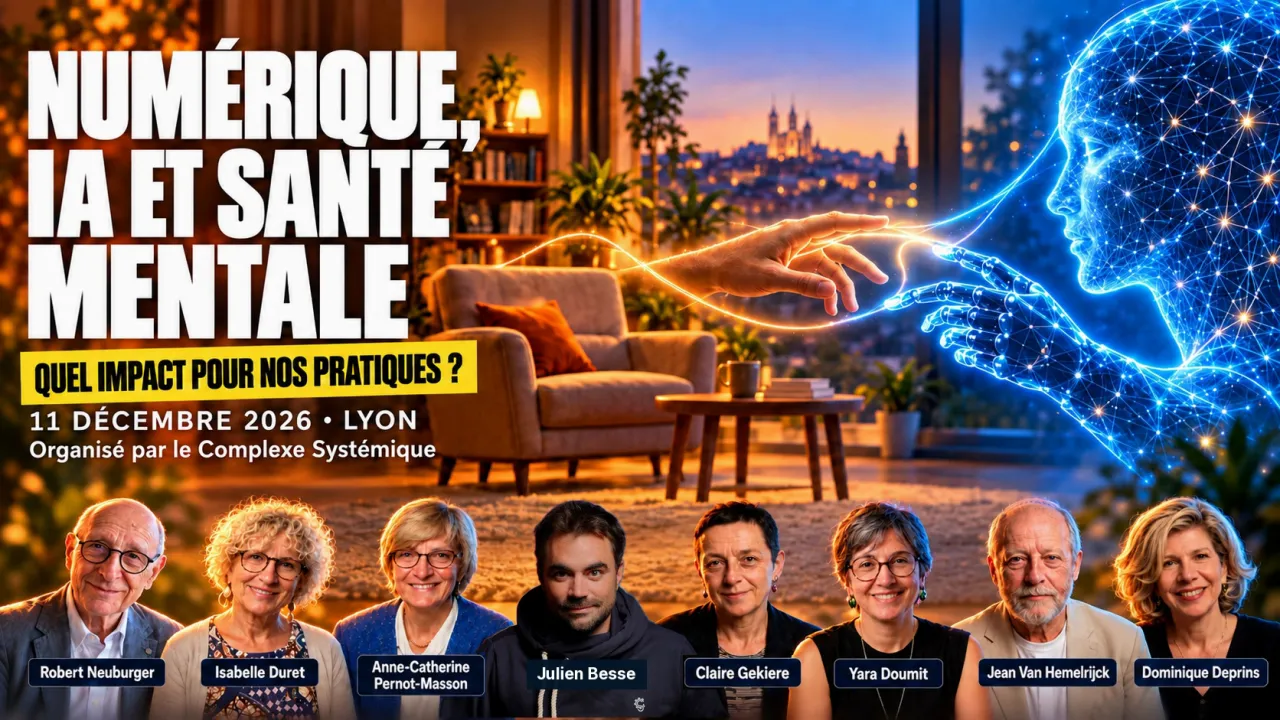 Symposium
Digital technology, AI and mental health
Conference in Lyon, 11 December 2026: digital technology, artificial intelligence and mental health. Six talks, replay for participants. In French.
 Short course
The suicidal crisis in adolescents and young adults
Training: assessing and supporting the suicidal crisis in adolescents and young adults. Clinical landmarks and systemic tools. In French.
Related articles
 Blog
Capp® groups give parents a place to think together
How does a reflective parenting group work? Jalila Kormachi and Yara Doumit describe how parents revisit a difficult moment and choose what to try next.
 Scientific
Sickle Cell Disease and Young Couples: Understanding the Influence of Shared and Individual Meaning on Couples’ Experience of Illness
Nine young adult couples facing sickle cell disease: how each partner makes sense of the illness, and how the couple moves from caregiving to equality from one crisis to the next.
 Scientific
Family group conference provision across the lifespan of child welfare intervention: A mixed-method realist-informed evaluation comparing three stages of welfare concern
Early help, child protection or children in care: among 155 UK families, experiences and outcomes of family group conferences vary very little by stage.
 Scientific
How can we BeST? meet the needs of adoptive families? Relevant findings from a major Randomised Controlled Trial of infants in foster care in the UK
The BeST? trial (488 infants in care in the UK) reread for adoption: holistic, ongoing assessment of children and a move to dual registration.
Comments 0
Log in to join the discussion. Log in