AI-assisted translation
This version was translated from Portuguese by Complexe Systémique with the help of artificial intelligence. In case of doubt, the original version prevails.
Revista Brasileira de Terapia Familiar · Aging
The fear of death in the aging process from the systemic family therapy perspective
Three people aged 79 to 92, living in a long-term care facility near Curitiba, talk about growing old, their families, death, God and their hurts. The research team reads these interviews through Minuchin, Bowen and Boszormenyi-Nagy: the fear of dying disorganizes the family system and pushes it to reorganize, but it never acts alone.
Unofficial English translation. This article is a translation of O medo de morrer no processo de envelhecimento na perspectiva sistêmica familiar, by Alice Parzianello Schirr, Camili Vitoria Antosczyzyn Valandro, Giovana de Souza Boscoli and Iris Sielski de Souza, published in the Revista Brasileira de Terapia Familiar (ABRATEF), vol. 14, no. e0126 (2026), doi: 10.60114/rbtf.v14i1.154, under a CC BY 4.0 licence. Translated by Complexe Systémique in November 2026 with the help of artificial intelligence: the original Brazilian Portuguese text has been translated into English and reformatted, which constitutes a modification of the work under the terms of the licence. The paragraphs and headings are those of the journal, as are the interview excerpts set as block quotations; Table 1 is presented as a list; the Brazilian expression melhor idade and the Portuguese title of a cited work are followed by a translation in brackets; the text has been checked against the facsimile, as the automatic extraction was faulty. The abstract is the authors’ own English version. This translation was made neither by the authors nor by the journal, who are not responsible for its content or for any errors. The original version prevails.
Aging is an invitation to give new meaning to bonds, to practice empathy and to build ways of loving and caring.
Alice Parzianello Schirr, Camili Vitoria Antosczyzyn Valandro, Giovana de Souza Boscoli, Iris Sielski de Souza
Abstract
This research sought to understand the fear of death in the aging process and the disorganization and reorganization of the family system from a systemic perspective, a topic little studied in the literature. This is a qualitative field study that used semistructured interviews with elderly individuals aged 79 to 92 who had been living in long-term care facilities for at least six months without a guardian. This study involved interviews with three individuals, discussing family relationships, perceptions of aging, future prospects, religiosity, and encounters with finitude. In the interviews, the variation in responses can be perceived through the relationship with the social, cultural, and especially family context in which each elderly individual was inserted, allowing the researchers to dynamically correlate the data. This work concluded with the conviction that aging is an invitation to redefine bonds, to practice empathy, and to build ways of loving and caring.
Keywords: Aging, Grief, Family, Family therapy.
Introduction
The concept of aging and the grieving process
According to the World Health Organization (WHO, 2005), in its 2005 definition of the concept of aging, this process, when healthy, is defined by the idea of developing and maintaining the functional capacity that enables well-being in older age. In 2023, the concept of aging was adapted into something considered heterogeneous, strongly influenced by social and physical variables (WHO, 2023).
In this sense, Tavares et al. (2017) state that older people themselves perceive healthy aging as the adoption of habits and behaviors that are necessary and consistent with one’s lifestyle, with emphasis on healthy eating, physical exercise and, above all, refraining from habits that harm health, such as smoking.
Besides the physical aspect, there are social, spiritual and psychological dimensions, which play a fundamental role in the way older people conceive of age and of the aging process, with the understanding that healthy aging is associated with practices that foster feelings of optimism and a positive view of life (Tavares et al., 2017).
Given that older people, even when aging healthily, go through a period of loneliness, losses and illness, they may be seen as a burden in the context of social and family dynamics (Couto et al., 2008). On this basis, it is understood that the unfolding of this stage of life is marked by bereavements, which become constant.
The grieving process, in turn, is a factor present in the daily lives of these people and their families. Kübler-Ross (1998) holds that death is repeatedly imagined as an event laden with fear and dread, a fear shared by most people and an object of strong denial.
As a result, the denial of death and suffering can produce reactions such as neglect of the older person, compromising their process in the face of losses. It is therefore important that, in grief, older people and their families recognize all the stages of this phase of life, so that its conditions can be internalized in a healthy way (Giacomin et al., 2013).
The fear of death
Thanatophobia, according to Kübler-Ross (1969), or the fear of death, is widely suppressed in modern society and treated as a taboo. This denial results in avoidance behaviors and significant emotional difficulties for those facing old age and for their families.
From a systemic point of view, Minuchin (1982) suggests that this fear profoundly affects family dynamics and interactions, leading to changes in roles and internal relationships, and particularly affecting family balance when the family is confronted with the reality of death.
Bowen (1978), in introducing the concept of family homeostasis, argues that families tend to maintain a state of dynamic equilibrium, but that crisis events, such as aging and the imminence of death, can disrupt this equilibrium, producing disorganization in the relationships between family members. Such disorganization can manifest itself as stress, conflict and emotional distance.
Aging is accompanied by the approach of finitude, which intensifies the fear of death. Giacomin et al. (2013) explore the phenomenon of anticipatory grief, which, according to this team, can prepare the family for the loss but also provokes feelings of loneliness and abandonment, especially when family ties are not strong enough to provide adequate emotional support (Giacomin et al., 2013).
The family relationships of older people
The family is marked by constant change, and what happens to one member affects all the others. When a family member enters old age, transitional processes of adaptation and accommodation to new situations become more present and visible in family relationships (Minuchin, 1982).
Family relationships do not lose their importance in the late stage of life, and the family as a whole faces new challenges at this stage, which calls for readaptation. Most research indicates that the triad of social contact, support and longevity is essential, since more contact with friends, visits or time spent with other family members contributes to a better quality of life compared with those who have less or no contact (Carter & McGoldrick, 1995).
It is thus understood that the resources and potentialities present in this late stage of life are many. It is not exclusively a period of losses, limitations and withdrawal, but also one of new experiences and social investments. Older people have autonomy, with a range of relationships to invest in (Couto et al., 2008).
Alongside the new possibilities and experiences that old age can bring, past experiences of good family functioning contribute to greater role flexibility and to successfully facing the challenges of old age (Walsh & McGoldrick, 1998).
Disorganization and reorganization from the perspective of systemic therapy
According to Minuchin and Nichols (1995), death is a process in which the family must reorganize, since the strength and the functions of its members change. When circumstances change, the family structure must be able to adapt, and the family as an integrated system depends on the existence of patterns, on access to the level of these patterns and on the possibility of making them more flexible — when necessary.
Although the importance of family support is often discussed, there is little research addressing the relationship between family dynamics and aging in the grieving process, which may show that the subject remains little explored. Moreover, studies emphasize the importance of expanding, in the academic field, searches, investigations and the creation and harmonization of methods and instruments to assess contexts and variables in the family system (Delalibera et al., 2015).
In light of the above, the general aim of the research was to analyze the fear of death associated with aging from the perspective of systemic family therapy. The specific aims were to identify how older people deal with death and to verify the presence of possible disorganization and reorganization in the family system in the face of the fear that older people express regarding their own death.
On this basis, the hypothesis put forward here was that the fear of death intensifies with aging, causing systemic disorganization in family structures but also driving adaptive reorganization among members. Thus, this research sought to analyze the fear of death associated with aging from the perspective of systemic family therapy.
Materials and methods
Study design
The study was carried out as qualitative field research, aiming to explore the participants’ experiences in depth, taking their context and environment into account. This type of research was chosen because no other Brazilian studies addressing the topic had been found (Denzin & Lincoln, 2018).
In this sense, the research is also defined as non-experimental, since it relies on observations to reach conclusions. In it, the researcher observes the context directly and cannot control or alter the research subjects, and no variables are used (Yin, 2016).
Characteristics of the participants or other sources of information
The research studied the family relationships of older people and their families, with the possible disorganization and reorganization of systems in the face of the fear of death as the main point of discussion. First, an age range was set: from 75 to 100 years.
It was also decided to interview three individuals who had been living in the facility for at least six months without the need for guardianship. The interviews were conducted in person at a long-term care facility for older people in the Curitiba metropolitan region (Paraná).
To choose these individuals, the facility arranged a conversation with the residents so that closer prior contact could be made with potential interviewees. The selection was made at this first contact, and the interview was then conducted with the three people chosen.
Equipment and instruments for data collection
Data collection instruments (voice recording) were used, such as iPhone 13 phones (version 18.5, model MLQ73QBZ/A), and, for transcribing the interviews, the TurboScribe website. After transcription, the recordings were deleted to ensure the confidentiality of the information provided by the participants. A semi-structured interview guide was also used.
Data collection procedures
Data were collected through semi-structured interviews, exploring the interviewee’s reality through a specific theme and allowing subsequent analysis and comparison of the answers given. The purpose of the semi-structured interview is to map out the interviewee’s positions and thoughts on the topic addressed, and it also requires a relationship with the interviewer (Rosa & Arnoldi, 2014).
The semi-structured interview was chosen because a data collection method was needed that would allow a relationship and a closer bond between interviewee and interviewer. In addition, the semi-structured interview proves important because it obtains greater subjective participation from the interviewee, who seeks to include their ideas, emotions and opinions. The questioning is deep and subjective, which opens up the possibility of a reciprocal relationship of trust (Rosa & Arnoldi, 2014).
Data analysis procedures
Data analysis was based on the theories and practices of modeling put forward by Morin and Le Moigne (2000) and presupposes that the researcher is familiar with Jean Le Moigne’s (1977) principles of complexity.
The data analysis technique was adapted from the model used by Freitas (2021), which is divided into six main steps: reorganizing the excerpts; analyzing the excerpts; defining keywords; drawing up an associative table; constructing the graphic representation; and writing a reflective description of the graphic representation.
Thus, the first step regroups the excerpts. The second consists of analyzing the selected excerpts on the basis of the theory used. The third step consists of drawing up keywords from the themes obtained in the previous step. The keywords then allow an associative table to be composed. The associative table, made up of the keywords, aims to organize systematically which of them are related, on the basis of the analysis of the excerpts, so that these associations can be visualized (Freitas, 2021). After this step, a figure representing this associative table is created, which gives the authors greater flexibility in associating and relating the keywords previously highlighted. Finally, the last step of the modeling consists of writing the reflective description of the graphic representation.
To carry out the research, the project was submitted directly for approval by the Research Ethics Committee, which required the signature of the psychologist in charge of the long-term care facility and the free and informed consent form signed by the researchers and the participants.
Results and discussion
Characterization of the participants
This section presents the results obtained in the semi-structured interviews conducted over two days with three older people living in the long-term care facility, aged between 75 and 100. They were lucid and had been living in the facility for at least six months. The structure of the data obtained was built according to the interpretation of the research results and their correlation with systemic family theory.
Analysis of the interviews and their meanings
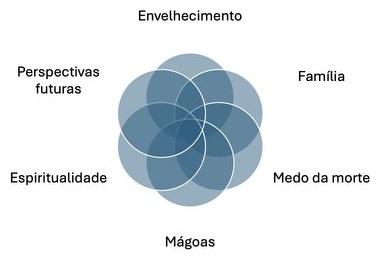
In the analysis and discussion of the data obtained, six keywords were selected on the basis of the themes that emerged from the interviewees’ answers: aging, family, fear of death, spirituality, future prospects and hurt.
Table 1 and Fig. 1 show the relationship between the main themes that emerged from the interviewees, all of which intersect, proving to belong to one another.
Table 1 — Intersections
- Aging: intersects with family, fear of death, spirituality, future prospects, hurt.
- Family: intersects with aging, fear of death, spirituality, future prospects, hurt.
- Fear of death: intersects with aging, family, spirituality, future prospects, hurt.
- Spirituality: intersects with aging, family, fear of death, future prospects, hurt.
- Future prospects: intersects with aging, family, fear of death, spirituality, hurt.
- Hurt: intersects with aging, family, fear of death, spirituality, future prospects.
In the original, a two-way grid marks each intersection of two keywords with a cross. Source: prepared by the authors.
Aging
Participant 1: M
M, male, aged 79, said he was not happy about aging, while at the same time joking that he does not recognize himself in this stage of life.
How do you see the aging process in your life?
M: Aging is a lousy thing, right, nobody can say it’s good. And you have to take it the best way you can. That’s what I think, what I told you yesterday. Try not to let your head get old. That’s it.
M: Age is rubbish, isn’t it? Was I going to say the best age? The best age is yours. This here is the worst age.
Participant 2: E
E, aged 92, takes aging as something normal in life, as a natural stage of the life cycle, and spoke about how her view of the world has not changed because of her age.
How do you see the aging process in your life?
E: For me it’s normal, something that happens, I’m 92 now, and my birthday is March 2, 1933. Do you feel, when you think about everything you’ve lived through up to now, that there’s something in life you see differently today or that you’ve come to value more?
E: I don’t see anything differently, back then I was young, now I’m a little old lady. I came to value work more, time used to go by very fast, now I spend the whole day shut up in this house, I feel bad, but we keep on living, don’t we?
Participant 3: I
I, aged 79, refers to aging as the approach of death and makes it clear that this is not a daily concern for her, but that she thinks about it from time to time: “Actually, I see it as a bad thing, right? It’s a process that’s a step, every day one more step towards the grave, right?”.
According to Minuchin (1982), the family provides its members with individuality. For the creation of the individual’s identity, it is extremely important that factors such as the sense of belonging and separation be acquired in the family system. The sense of separation comes from participation in different family subsystems and extrafamilial groups in various contexts throughout the many phases of life. In this sense, new models of family are perceived in today’s society, such as older people living in long-term care facilities.
Furthermore, according to Castro and Camargo (2017), the increasingly popular term melhor idade (“the best age”) seems to try to dismantle the negative images associated with aging, such as death, illness and inactivity, while turning the older person into a figure of wisdom and experience; yet it ends up minimizing the losses that come with aging and its organic and psychological transformations. This generalization ends up disregarding the plurality of experiences of aging, which reflects a balance between gains and losses in this period of the life cycle.
Family
Participant 1: M
M, aged 79, male, showed in what he said a strong closeness to his sister and described a stable emotional bond with other family members: “And my sister nowadays has a wonderful relationship with her. Which isn’t common here… This is a home that isn’t for nice little old people. The nice little old person stays at home”.
He reported frequent exchanges by phone and visits, especially to his sister’s house. While acknowledging exceptions, he said he feels affection and respect for most of his family members.
Participant 2: E
E, aged 92, female, reported that she keeps in regular contact above all with her son and grandson, who visit her weekly at the facility.
Do you feel there are people you can count on and share moments with at this stage of your life?
E: I can, my son and my grandson, they come here every weekend to chat, to see if I’m all right, but they don’t do any activity, they just bring some biscuits and chocolate.
Participant 3: I
I, aged 79, female, reported a decrease in the number of family visits after moving to a different facility.
Tell me what your relationship with your family is like today. Do they visit you these days?
I: Well, they do, only I got more visits when I was in Curitiba, the first home I stayed in, the care home.
I: But it’s fine, a good place. My daughter used to come often with my grandson, and all that, but now here it’s very far. Sometimes she doesn’t come in the same week, it takes a bit longer, 10 days or so. So she only comes when her husband can come. Or else when my son is off work or takes a day off. Then she comes. She doesn’t come on her own.
The family, according to Minuchin (1982), is the child’s first social contact, reflecting the society and culture in which the individual exists. In this sense, for older people, the family once again becomes a place of physical, mental and financial care and protection. According to Souza et al. (2007), the older person’s family is a very important pillar of their physical and psychological structure; it offers emotional and instrumental support, information and positive social interaction.
It was noted that the participants have different bonds with their families, and that each of these families was shaped by its relations with society and culture in different ways. The direct contact with family on the part of all three participants shows a probable need to maintain the previous structure, that is, the one before the long-term care facility, when the older person still lived with their family, a structure that has changed through the change of environment and stimuli.
The fear of death
Participant 1: M
M, aged 79, male, said he has no fear of death, clearly expressing the wish that it should happen peacefully, with as little physical suffering as possible.
About what? Finitude is tchuf, right? Under the ground. Look, I’ll tell you this. I’m not afraid of death at all. Not at all. It’s going to be something natural. Of course, if it’s something like that, without suffering, that comes all of a sudden. Ah, he went to sleep and died. Wow, how wonderful. That’s the best thing that can happen to an old man.
Furthermore, M stressed that he avoids talking about finitude and death with his family, since he perceives the subject as a source of worry and discomfort among his relatives, especially regarding his state of health: “Look, they got very upset when I was that ill, when the doctor thought I was going to die. I had osteomyelitis. Which you have, after you’ve had osteomyelitis, you never get completely well. You have it latent, but you have it”.
He also spoke about the natural order of the family with regard to death: death in old age is natural, while death in childhood shakes the whole family system.
These are things that have to be natural. My niece, who became a mother and a grandmother late. […] And she had a son. And… that boy died at 11. He died from one moment to the next, with nothing wrong, nobody knowing. […] And that’s something you feel very deeply. Because it isn’t natural. If it were, for example, an older person, a person my age, then you take it in a natural way.
Participant 2: E
E, aged 92, female, spoke during the interview about how death is a subject that makes her sad and somewhat anxious. She acknowledges the inevitability of finitude, but expresses sorrow when she thinks about losing everything that has been built over a lifetime.
What is it like for you to hear or talk with someone who wants to talk about finitude? What does it stir up in you?
E: I get sad, because we know that one day we’re going to die, everything we learned, everything we once said.
The interviewee treats the loss of loved ones with apparent equanimity since, according to her, most of her relatives have already died.
Do you often think about the finitude of life?
E: Yes, sometimes I think about my death. God knows the hour I’m going to leave this world. We never talk about it. What is it like for you to think about the possibility of losing someone you love? How do you deal with these feelings?
E: To tell the truth, I feel fine, normal. My family are all dead, my sisters, my parents, all dead. I wasn’t the youngest, but now there’s only me left and a sister of mine, who is a nun.
Participant 3: I
I, aged 79, female, expressed a more resigned attitude towards the subject of death.
And us talking about this, or sometimes, if you hear someone talking about this question of finitude, does it stir up something different in you? Something like discomfort or comfort?
I: No, not comfort, no. It stirs up something uncertain. It makes you nervous. Because it’s something to keep thinking about, isn’t it? We aren’t just a body, we have the spirit and it goes to a good place, a bad one, and so on and so forth.
Talking about death, especially in the context of aging, means opening up space for a subject that is often silenced, both in everyday family life and in institutions. The accounts gathered show different ways of dealing with finitude: there are those who face the situation with serenity, those who avoid it out of fear or discomfort, and those who see it as part of an inevitable spiritual process. What they have in common, however, is the symbolic weight that death carries, not only as a biological end but as a rupture of bonds, an interruption of stories and, often, an absence of listening.
According to Walsh and McGoldrick (1998), finitude must be understood within the family life cycle, requiring symbolic and practical reorganization. The way each member deals with the subject of death, by talking about it, keeping silent or spiritualizing it, also has to do with family culture and the relational patterns built up over a lifetime.
As Boszormenyi-Nagy and Spark (1986) point out, family bonds carry invisible loyalties, which often show in the way members express (or repress) their feelings in the face of loss. Death, in this sense, is a critical moment that can reactivate old relationship patterns, expose latent tensions or, on the contrary, foster an emotional reconfiguration among family members.
Moreover, the silence surrounding death can be understood as an attempt to maintain the system’s homeostasis, avoiding confrontation with difficult emotions such as fear, sadness or powerlessness. Minuchin (1982) observes that family systems tend to avoid subjects that might threaten their cohesion, and death, being an uncontrollable reality, often occupies this place of taboo; yet avoiding the subject can lead to emotional isolation, especially for older people, who find themselves unable to share their feelings and fears.
On the other hand, spirituality appears as an important resource in working through the fear of death. As Walsh (2009) points out, spiritual practices and religious beliefs offer a symbolic language that allows finitude to be given new meaning, not as an absolute end but as a transition. This view can ease existential anxiety and bring comfort both to the individual and to their family, acting as a link of continuity between generations.
Spirituality
Participant 1: M
For M, religion is not something present in his life at the moment. He calls himself an atheist: “It’s monstrous here. But they’re simple folk who… I’ll tell you this, I’m an atheist. A complete atheist. I don’t believe any more”.
Participant 2: E
Spirituality was very present during the interview with E. In her room, as interviewer I observed, there were several pictures with religious images, such as Jesus Christ and the Virgin Mary.
Do you often think about the finitude of life?
E: Yes, sometimes I think about my death. God knows the hour I’m going to leave this world.
Participant 3: I
In the interview with I, a view different from that of the other participants was perceived, though religious all the same.
May God keep a blissful dwelling for me, which means good, you know? A good dwelling, right? It depends on the evolution of the spirit, and then it’s a question of what the body did. So I think may God help me and may I have a good place, right? Not a bad place, so I can rest, so I can live and be well in that place.
Religion, according to Valle (2005), is guided by goals, values and norms that people understand in light of what they are, feel, think and seek. The family, in this sense, has a great influence on the construction of religiosity, acting as a mediator, since it is in the family that individuals become human, become able to relate to transcendence, or are enabled to select freely from the teachings of the system (De Paiva, 2013).
According to Goldstein and Neri (1999), religion is, for many people, a major point of reference that still carries weight in middle age, since at this point in the life cycle individuals tend to pay more attention to inner aspects, which leads to more religious feelings and behaviors.
In addition, religiosity plays an important role during aging in coping with moral, social and family disruption, as it serves as a resource for dealing with the stressful events experienced at this time, such as losses and physiological changes. It also helps ensure that this phase of life is not characterized by abandonment or loneliness, vulnerability to depressive disorders or loss of social roles (Dendena et al., 2011).
Future prospects
Participant 1: M
In the interview, M spoke of the possibility of a future, which indicates a view of the life cycle as continuing. However, still according to the interviewee, this future does not necessarily mean a healthy life.
But you see the way she takes things, at 90. Because for me there are still ten years to go. I don’t know what those ten years would be. Because it’s all decline, isn’t it? You’re going downhill. If you want to let yourself get down, I think more illness comes, everything comes. You can’t allow your head to age as much as your body ages.
Participant 2: E
Faced with the questions about future prospects, the only moment when E comments on the subject is when the interviewer asks her about the possibility of losing a loved one and how that would make her feel: “You’re studying, aren’t you? I’m stuck here, answering your questions, but thank you”.
Participant 3: I
When asked to describe what family conversations about the time of the end of life are like, I links this to the prospects of a near future in her life, also revealing the family boundaries: “Ah, about the end of life, we don’t talk about that. I prefer not to talk about it, right?”; “They could say they’re going to cremate me and lie to me, because what am I going to know afterwards?”.
Jerusalinsky (2013) describes old age as different from the other phases of life. At this point, the older person is caught in a contradictory race against their own time, in which the future shrinks, and it is from this shrinking that the main meanings of the life that remains are drawn.
According to Veríssimo (2002), the stage of maturity is marked by the age range beyond 60 and is called the “age of retirement”. In this phase, the older individual who feels the end of life approaching is compelled to look back on the past in the face of two possible reactions: integrity and satisfaction, or bitterness and non-acceptance. The author discusses what the older person’s feelings may be, given these different reactions to old age. For example, failure to resolve earlier crises is reflected in bitterness, in the “feeling that time is short, far too short to attempt to start a new life and alternative paths to integrity” (Veríssimo, 2002, p. 23).
It can thus be seen that reactions to this phase of life vary and that the prospects of a near future are extremely influenced by finitude, related mainly to spirituality, to the past lived and to the older person’s families.
Hurt
Participant 1: M
M’s account showed how older people may feel about long-term care facilities, which he pointed to as one of the hurts of this group of people: “A lot, a lot of abandonment. People who turn this place into a dumping ground for old people. They dump old people here. Of course the old people here aren’t the nice little old people. The nice little old person stays at home with the family, with everything, right”.
Participant 2: E
In her interview, E expressed great longing for the work she used to do as a first communion teacher and catechist, making clear the importance she attached to her profession.
Do you feel, when you think about everything you’ve lived through up to now, that there’s something in life you see differently today or that you’ve come to value more?
E: I don’t see anything differently, back then I was young, now I’m a little old lady. I came to value work more, time used to go by very fast, now I spend the whole day shut up in this house, I feel bad, but we keep on living, don’t we?
Participant 3: I
The hurts found in I’s words point to her relationships with her family. The interviewers perceived a strong bond with her past, and accounts of conflict kept surfacing during the conversation.
Look, I, actually, of course, I lost my mother, right? I lost my mother, the person I adored most, right? What I had to suffer, I suffered. You do miss her. I only have one sister. If she’s to be taken first, that’s her problem. If she isn’t taken, she isn’t. I’m not going to leave here to go to her wake. I’m not going. […] They said she [my sister] is going to call you on your birthday and you mustn’t fail to answer. I’m not going to answer. And I can’t go saying the bad things I keep inside and that I know. It’s something I have to keep just to myself.
Although visits and interactions do take place, I said she feels she cannot share all her concerns with her family, and she mentioned old hurts that are still with her.
As for your family, do you feel you can count on them and share moments with them?
I: Well, I can’t share everything with them, can I? Because there’s a lot I keep inside that I can’t talk to them about, which are my hurts from the past. I can’t share that with them, because I’ll. I can’t badmouth them to their faces, you see?
Listening to accounts marked by family hurts brings one into contact with memories that, more than past events, remain alive in the present as unresolved affects. These feelings, often silenced, show how psychological pain can become a constant element in a person’s emotional life, especially when there is no space for listening or support in the closest bonds.
Jerusalinsky (2013), in his text Lembranças e outros esquecimentos (“Memories and other forgettings”), helps us understand that memory is not a simple repetition of what happened but a reconstruction laden with unconscious meanings. He suggests that forgetting does not mean an absence of memory but processes of repression, in which certain painful contents find no place to be symbolized and therefore return indirectly, often as symptoms, hurts or resentments.
In some accounts, one notices the feeling that only certain older people, considered “nice”, are kept with the family, while others are “dumped” in institutions, which reveals a perception of moral judgment linked to the condition of institutionalization. This kind of narrative reinforces an experience of abandonment that is not only physical but symbolic, as if the older person ceased to belong to their family system and came to occupy a place on the margins of the emotional structure. This impossibility of sharing feelings with the family suggests how certain bonds can become spaces of silence rather than of sharing. Hurt, in this context, becomes a form of protection, but also of emotional imprisonment.
According to Minuchin (1982), individuals’ emotions and behaviors are always embedded in broader relational patterns, and hurt can be seen as a symptom of the dynamics of the family system. It often fulfils specific functions, such as maintaining the cohesion of certain roles or marking boundaries between members. In I’s account, there are signs of bonds marked by rigid boundaries and communication difficulties. She said that she “can’t badmouth them to their faces” and that she prefers not to answer calls on significant dates. These behaviors can be interpreted as attempts to preserve her own emotional integrity in the face of relationships that have already caused suffering. Boszormenyi-Nagy and Spark (1986) speak of the “invisible loyalties” that structure family bonds, silent obligations passed down through the generations, which often prevent individuals from freeing themselves from guilt and resentment.
Final considerations
Reflecting on aging and the fear of death in the light of the systemic perspective means entering a territory of profound transformations and human intersections. Throughout this work, we sought to understand how the nearness of finitude resonates in various individual aspects of older people, but also in the complexity of the family systems to which they belong.
Aging, with its inevitable losses and changes, reveals both the fragility and the strength of human relationships. It was observed that the fear of death and aging are different experiences for each person, which shows the individuality built by family culture and by the relational patterns established over a lifetime.
The family, as a living and dynamic system, is constantly challenged to adjust its patterns, redistribute its roles and give new meaning to its functions in the face of the aging of one of its members. The aging of a member of the family system can become a source of emotional and relational disorganization, but it can also act as a catalyst for new forms of connection and emotional reorganization among family members, in order to preserve the functionality of the system. Understanding these dynamics made it possible to see that the aging process is not only a biological phenomenon, but also a relational, emotional and multidimensional one.
The aging process in relation to systemic disorganization and reorganization is still a little-researched area, which shows the need to build a scientific path with regard to society.
This research found that death remains a taboo in society; it is not a subject discussed in families, and people avoid thinking about it. Aging is still seen mostly as a negative stage in the life cycle, rather than as a plural stage of gains and losses.
Regarding the taboo surrounding death, although the importance of family support is discussed, there is little research addressing the relationship between family dynamics and aging in the grieving process, which may show that this is a little-explored area of study that deserves more attention in the field of psychological research. Studies emphasize the importance of expanding, in the academic field, searches, investigations and the creation and harmonization of methods and instruments to assess contexts and variables in the family system (Delalibera et al., 2015).
This work concludes with the conviction that aging is an invitation to give new meaning to bonds, to practice empathy and to build ways of loving and caring. It is therefore hoped that this research will help broaden the outlook of health professionals, families and society in general on the importance of caring for relationships as we age.
The research found that the fear of death during the aging process is a factor that causes disorganization among members of the family system, since they need to change their roles so that new demands can be met. In this way, the system reorganizes its functions in order to fulfil its responsibilities and maintain homeostasis among its members. Nevertheless, the fear of death, even though it has a major impact on the family system, should not be considered the only factor, let alone the main one. Factors other than the fear of dying were perceived in this process that influenced the restructuring of the older people’s families, such as past hurts, religiosity and future prospects. On this basis, it is understood that perceptions of these themes depend on the culture, society and family in which the older people were raised.
Complexe Systémique: key points
This exploratory study, based on just three interviews, is valuable less for its conclusions than for the words it gathers. We hear what families leave unsaid: M avoids talking about death so as not to worry his relatives, I refuses to go to her sister’s funeral and keeps “the bad things” to herself, E notes that visits go by without “any activity”. Three points stand out for clinical work. Silence about death protects family homeostasis at the cost of isolating the older person: opening it up means working with the family, not only with the individual. Moving into a care facility reorganizes the system and awakens a moral sorting (“the nice little old person stays at home”) that is worth naming. Finally, old hurts and invisible loyalties weigh as much as the fear of dying. The limitations are clear: a tiny sample, and theoretical references that are sometimes loose (the concept of family homeostasis, attributed here to Bowen, comes from Don Jackson). Read alongside the study of family talk about end-of-life issues in older adults, and the systematic review of family dynamics in grief.
Notes from the original
CONFLICT OF INTEREST. Nothing to declare.
AUTHORS’ CONTRIBUTIONS. Substantial scientific and intellectual contributions to the study: Schirr, A. P.; Valandro, C. V. A.; Boscoli, G. S.; Souza, I. S. Conception and design: Schirr, A. P.; Valandro, C. V. A.; Boscoli, G. S.; Souza, I. S. Data analysis and interpretation: Schirr, A. P.; Valandro, C. V. A.; Boscoli, G. S.; Souza, I. S. Final approval: Schirr, A. P.
DATA AVAILABILITY STATEMENT. The research data are available in the body of the article.
FUNDING. Not applicable.
STATEMENT ON THE USE OF ARTIFICIAL INTELLIGENCE TOOLS. No artificial intelligence tools were used.
ACKNOWLEDGMENTS. We would like to thank all the teaching staff involved in producing this work, as well as our supervisors, Samarah Perszel de Freitas and Ulisses Domingos Natal, for their indispensable guidance throughout. We also wish to thank the long-term care facility for older people Nosso Lar Comunidade do Idoso, where the work was carried out, together with its psychologist in charge, Cláudia Furlan, and its residents who took part in the research. Our thanks also go to the researchers’ families, who showed support and affection during this year of producing the project and writing it up, and to friends from the course and beyond, who supported the authors from start to finish. This note is equally important for the researchers’ pets, who, without being aware of it, were a pillar of support and affection at this time.
References
Boszormenyi-Nagy, I., & Spark, G. M. (1986). Lealdade invisível: Reciprocidade no relacionamento familiar. Martins Fontes.
Bowen, M. (1978). Family therapy in clinical practice. Rowman & Littlefield.
Carter, B., & McGoldrick, M. (1995). As mudanças no ciclo de vida familiar (M. A. V. Veronese, Trad.). Artes Médicas.
Castro, A., & Camargo, B. V. (2017). Representações sociais da velhice e do envelhecimento na era digital: Revisão da literatura. Psicologia em Revista, 23(3), 882-900. https://doi.org/10.5752/P.1678-9563.2017v23n3p882-900
Couto, M., Prati, L., Falcão, D., & Koller, S. (2008). Terapia familiar sistêmica e idosos: Contribuições e desafios. Psicologia Clínica, 20(1), 135-152. https://doi.org/10.1590/S0103-56652008000100009
De Paiva, G. J. (2013). Família e religião: Um olhar da psicologia. Saberes em Ação 1(1), 37.
Delalibera, M., Presa, J., Coelho, A., Barbosa, J. R., & Franco, M. H. P. (2015). Family dynamics during the grieving process: A systematic literature review. Ciência & Saúde Coletiva, 20(4), 1119-1134. https://doi.org/10.1590/1413-81232015204.09562014
Dendena, A., Dallazen, C. C., Lyra, L. R., & Tosi, P. S. (2011). Religiosidade e envelhecimento bem-sucedido. Unoesc Ciência, 2(2), 184-197.
Denzin, N. K., & Lincoln, Y. S. (Eds.). (2018). The SAGE handbook of qualitative research (5. ed.). SAGE.
Freitas, S. P. (2021). A complexidade das relações no sistema familiar de crianças em dificuldade de aprendizagem [Tese]. Universidade Federal do Paraná. https://hdl.handle.net/1884/74363
Giacomin, K., Santos, W., & Firmo, J. (2013). O luto antecipado diante da consciência da finitude: A vida entre os medos de não dar conta, de dar trabalho e de morrer. Ciência & Saúde Coletiva, 18(9), 2487-2496. https://doi.org/10.1590/S1413-81232013000900002
Goldstein, L. L., & Neri, A. L. (1999). Tudo bem, graças a Deus. Religiosidade e satisfação na maturidade e na velhice. In A. L. Neri (Ed.), Qualidade de vida e idade madura (2. ed.). Papirus.
Jerusalinsky, A. (2013). Lembranças e outros esquecimentos. Escuta.
Kübler-Ross, E. (1969). On death and dying. MacMillan.
Kübler-Ross, E. (1998). Sobre a morte e o morrer: O que os doentes terminais têm para ensinar a médicos, enfermeiras, religiosos e a seus próprios parentes. Martins Fontes.
Le Moigne, J. L. (1977). A teoria do sistema geral: teoria da modelização. Instituto Piaget.
Minuchin, S. (1982). Famílias: Funcionamento & tratamento (J. A. Cunha, Trad.). Artes Médicas.
Minuchin, S., & Nichols, M. P. (1995). A cura da família (M. A. V. Veronese, Trad.). Artes Médicas.
Morin, E., & Le Moigne, J. (2000). A inteligência da complexidade. Peirópolis.
Organização Mundial da Saúde (OMS) (2005). Envelhecimento ativo: Uma política de saúde. Organização Pan-Americana da Saúde. Recuperado de http://bvsms.saude.gov.br/bvs/publicacoes/envelhecimento_ativo.pdf
Organização Mundial da Saúde (OMS) (2023). Envelhecimento e saúde. Organização Pan-Americana da Saúde. Recuperado de https://www.who.int/news-room/fact-sheets/detail/ageing-and-health
Rosa, M. V. F. P. C., & Arnoldi, M. A. G. C. (2014). A entrevista na pesquisa qualitativa: Mecanismo para validação dos resultados. Autêntica.
Souza, R. F., Skubs, T., & Brêtas, A. C. P. (2007). Envelhecimento e família: Uma nova perspectiva para o cuidado de enfermagem. Revista Brasileira de Enfermagem, 60(3), 263-267. https://doi.org/10.1590/S0034-71672007000300003
Tavares, R. E., Jesus, M. C. P., Machado, D. R., Braga, V. A. S., Tocantins, F. R., & Merighi, M. A. B. (2017). Envelhecimento saudável na perspectiva de idosos: Uma revisão integrativa. Revista Brasileira de Geriatria e Gerontologia, 20(6), 889-900. https://doi.org/10.1590/1981-22562017020.170091
Valle, J. (2005). Religião e espiritualidade: um olhar psicológico. In M. M. Amatuzzi (Ed.), Psicologia e espiritualidade. Paulus.
Veríssimo, R. (2002). Desenvolvimento psicossocial: Erik Erikson. Faculdade de Medicina do Porto.
Walsh, F. (2009). Espiritualidade e família: Recursos para a resiliência. Loyola.
Walsh, F., & McGoldrick, M. (Eds.) (1998). Morte na família: Sobrevivência, apoio e resiliência (2. ed.). Artmed.
Yin, R. K. (2016). Pesquisa qualitativa do início ao fim. Penso.
Unofficial English translation of O medo de morrer no processo de envelhecimento na perspectiva sistêmica familiar, by Alice Parzianello Schirr, Camili Vitoria Antosczyzyn Valandro, Giovana de Souza Boscoli and Iris Sielski de Souza, Revista Brasileira de Terapia Familiar, vol. 14, no. e0126 (2026), doi: 10.60114/rbtf.v14i1.154, under a CC BY 4.0 licence. Translation (with the help of artificial intelligence) and layout: Complexe Systémique, November 2026 — the work has been modified under the terms of the licence (table presented as a list). Neither the authors nor the journal are responsible for this translation; the original version prevails.
Unofficial English translation of “O medo de morrer no processo de envelhecimento na perspectiva sistêmica familiar”, published in Revista Brasileira de Terapia Familiar (2026) under a CC BY 4.0 licence. Made by Complexe Systémique with the help of artificial intelligence, it does not come from the authors or the journal, who are not responsible for its content; the original version prevails.
Read the original articleHow to cite this article
Schirr, A. P., Valandro, C. V. A., Boscoli, G. S., et Souza, I. S. (2026). The fear of death in the aging process from the systemic family therapy perspective (Complexe Systémique, Trans.). Complexe Systémique. https://app.complexe-systemique.com/en_GB/articles/the-fear-of-death-in-the-aging-process-from-the-systemic-family-therapy-perspective (Original work published in 2026 in Revista Brasileira de Terapia Familiar, v. 14, n. e0126 (2026); republished in 2026 by Revista Brasileira de Terapia Familiar, https://revbrasterapiafamiliar.abratef.org.br/revista/article/view/154)
To go further
- How Older Adults and Their Families Perceive Family Talk about Aging-Related EOL Issues: A Dialectical AnalysisTalking about the end of life as a family.
- Family dynamics and the grieving process: A systematic review and narrative synthesisWhat grief does to the family.
- The presence of absence. Therapy with families and ghostsWorking with what is no longer there.
Related training courses
 Symposium
État des Lieux: a psychological approach to spaces
Replay of the “État des Lieux” conference (Paris, 16 October 2026): Ivy Daure, Maurizio Frisina, Viola Sallay and Gilbert Pregno on places as a clinical resource. In French.
Related articles
 Scientific
Family group conference provision across the lifespan of child welfare intervention: A mixed-method realist-informed evaluation comparing three stages of welfare concern
Early help, child protection or children in care: among 155 UK families, experiences and outcomes of family group conferences vary very little by stage.
 Scientific
The Role of Parental Expressed Emotion and Loss-Specific Parental Responses in Children’s Loss-Related Outcomes Following Traumatic Loss: A Mixed-Methods Observational Study
After a road-traffic bereavement, parental criticism goes with the child's depression, positive appraisals of the loss with better well-being.
 Scientific
Beyond Self-Blame: A Qualitative Study of the Changing Experience of Parental Guilt Following the Death of a Child
Twenty-seven bereaved parents describe five forms of guilt after a child’s death, shaped by the cause of death, and a guilt that becomes integrated into grief without disappearing.
 Scientific
Implementing Family Group Decision-Making within statutory child protection social work in Scotland: Challenges and opportunities
Family group decision-making offered automatically in Scottish child protection: families find a voice, social workers doubt the plans, and everyone wants it offered earlier.
Comments 0
Log in to join the discussion. Log in