AI-assisted translation
This version was translated from Italian by Complexe Systémique with the help of artificial intelligence. In case of doubt, the original version prevails.
Connessioni · Mental health
The Geel experience: diversity, difference, integration and inclusion
For almost seven centuries, families in Geel, Belgium, have taken people with mental illness into their homes. José Nesis goes back to the founding myth of Saint Dymphna, traces the history of this foster family system from the Church to the public psychiatric hospital, and reads in it a model of inclusion handed down from generation to generation, in which it is the community itself that changes.
Unofficial English translation. This article is a translation of L’esperienza di Geel: diversità, differenza, integrazione e inclusione, by José Nesis, published in Connessioni (Centro Milanese di Terapia della Famiglia), new series, no. 8 (2020), under a CC BY 4.0 licence. Translated by Complexe Systémique in November 2026 with the help of artificial intelligence: the original Italian text has been translated into English and reformatted, which constitutes a modification of the work under the terms of the licence. The paragraphs and subheadings are those of the journal; the Freud epigraph is translated from the Italian; the epigraph is set as a quotation; the two tables are reproduced as published by the journal, in Italian; Perrault’s tale is given under its English title, with the French original; a few typographical errors and spellings of proper names (Aarne-Thompson-Uther, Moreau de Tours, Bénédict Augustin Morel, La Crete) have been silently corrected. This translation was made neither by the authors nor by the journal, who are not responsible for its content or for any errors. The original version prevails.
It is not a matter of erasing differences, but of reconceptualising them as something that often seems to be more a property of the observer than of the observed.
José Nesis
If one were to found, something that today seems fanciful, a university faculty of psychoanalysis, much would have to be taught in it that is also taught in the faculty of medicine: alongside depth psychology, which would always remain the basic element, an introduction to biology, sexology to the widest possible extent, and knowledge of the clinical pictures of psychiatry. On the other hand, analytic teaching should also include subjects that are foreign to medicine and that the doctor has no occasion to encounter in the course of medical practice: the history of civilisation, mythology, the psychology of religion, literature. Without a good grounding in these fields, the psychoanalyst is at a loss when faced with a large part of the material.
Sigmund Freud (1926, p. 411)
In the seventh century, in a remote part of Ireland, a king who was in love with his wife was widowed. The unbearable grief at the loss of the queen turned into an irresistible attraction to his only daughter, an adolescent, whom he found identical to his lost love. Horrified, she tries to flee from her deranged father, who catches her in a village in present-day Belgium called Geel and beheads her. Among the witnesses to the filicide, there are people who begin to show therapeutic physical and mental changes of a supernatural nature. A few centuries later, people began to speak of extraordinary cures for the mentally ill. On account of her martyrdom and the miracles attributed to her, the daughter of the mad king was made a saint and became the protector of the insane. People with psychological problems began to be brought by their families to the altar where her remains were kept. Over time, the families of Geel begin to host these patients in exchange for some form of payment from their relatives, or for productive work, generally on the land. The tradition continues to this day. Over the centuries, the people of Geel have become used to hosting the mentally ill, developing, over several generations, effective skills for the care of these patients. For this reason, Geel is considered the first therapeutic community for the mentally ill.
In the list of disciplines and commitments that Freud considers necessary for the training of an analyst, he includes four elements that we must consider with particular attention, and which he himself describes as usually foreign to the practice of psychotherapy. These are: the history of civilisation, mythology, the psychology of religion and the science of literature.
In order to understand the phenomenon of the first known therapeutic community, an experience many centuries old that is still active, we will need these tools, without which understanding this story would be practically impossible.
Legends and myth
We could begin by describing the historical context, setting out what we know of the history of mental illness, or simply by reporting the testimonies. Instead, we will begin this article with the myth that gives it life, since the myth shapes a story and is still present in it in various ways.
The story begins in what is now Ireland, specifically in what is now County Monaghan. There lived, in the seventh century, a pagan king, Damon of Oriel, his wife Odila and their daughter Dymphna, both devout Christians. The premature death of his wife leaves Damon in a state of desolation that seems to find relief only when he falls intensely in love with his own daughter, whom he asks to marry him. Gripped by terror, Dymphna decides to flee with her confessor, Father Gerebernus. They cross the sea and travel to what is now Belgium. After a relentless pursuit, the king catches them and, faced with his daughter’s final refusal, beheads them both. The murder takes place in what is today a small town in Belgium called Geel. They had settled there before being discovered and, according to the legend, Dymphna had spent her time performing acts of charity, especially towards people who showed some kind of mental disorder. Some time later, the inhabitants of Geel happen upon her buried remains and, in the wake of this, extraordinary events occur, including miraculous cures. The story is then passed down orally from one generation to the next until, around the thirteenth century, written accounts of the legend begin to appear. Dymphna is also canonised by the Church.
There are several versions of the myth, as well as a myriad of details that have been added to it, and perhaps lost, over time. However interesting they may be, reproducing all these details in this article would be excessive and distracting. The main structure of the story must nevertheless be outlined: a father expresses and tries to act on an incestuous desire for his daughter, and the daughter resists and is then punished with death. This structure is neither new nor unique for anyone who has studied the structures underlying children’s stories, folk myths, fables and legends. One of the current classifications of folktales is the Aarne-Thompson-Uther classification, which has evolved since 1910 over more than a century. In this classification, the myth of Dymphna can belong to category 510B, which refers to so-called unnatural love. The most famous example in this category is Charles Perrault’s tale Donkeyskin (Peau d’âne). Observing the similarities between the different aspects of different stories, which sometimes turn out to be almost identical, never ceases to amaze. Incidentally, this is what underpins the Freudian idea that the persistence of these stories, in various guises, constitutes a possible entry point into the way our psyche is structured. In other words, these stories survive thanks to their representational power.
This myth is also a way of constructing mental illness as an entity: incest appears as an expression of melancholia, as melancholic grief. And so the patronage of Dymphna will cover the mentally ill in general (including neurological patients and people with epilepsy) and victims of incest in particular. From this, it should be stressed that madness is shifted from the aggressor to the victim. This means that Dymphna, as a saint, protects the mentally ill, like her father, and victims of incest, like herself. From a cultural and religious point of view, the idea conveyed is that it is more “socially organising” to be dead than to accept an incestuous relationship. The price of the prohibition of endogamy is paid with death, and this prohibition is remembered through myths and their respective rituals.
From myth to reality: foster homes and mental illness
How does an event steeped in myth become a concrete practice, later endorsed and supported by the scientific community? As mentioned, the central mythical event surrounds the moment when Dymphna’s remains are discovered and the phenomenon of the “healing” of the sick, as well as, and perhaps even more importantly, the saint becoming the recipient of prayers invoking the improvement and healing of the mentally ill. For this reason a chapel was built to receive pilgrims, which later became a small sanatorium to house them. The oral tradition turned into practice, and mentally ill people began to travel from various parts of Europe and, for lack of space, began to be housed in the homes of local people. In exchange, those who could did farm work, or their relatives financially compensated the families who took them in. Since then this process has never stopped. Despite many transformations, the system through which patients are hosted by families living in Geel still works. And Dymphna, canonised in 1247, is considered the protector of the mentally ill.
The Geel foster family system has existed for centuries and its organisation has changed over time. What has remained is the practice of including in local households the presence of at least one member with the characteristics of what we would today call a mentally ill person, or a person with some mental disorder.
The data go back to the time when documentation of the activity began to be collected, which takes us back to the middle of the nineteenth century. The following table shows that in 1855 there were about 800 patients hosted in Geel homes, a number that increased considerably until it reached its peak in 1938. Since then, the number has fallen to 460 in 2006, lower than the figure originally recorded. This decline is all the more significant considering the growth of the population, which rose from 12,000 inhabitants in 1900 to 39,000 today. The table counts 21,111 patients since 1855, to whom about 3,000 must be added from 2006 to the present (there are currently about 250 boarders). This gives us almost 25,000 patients since records began, over the last century and a half.
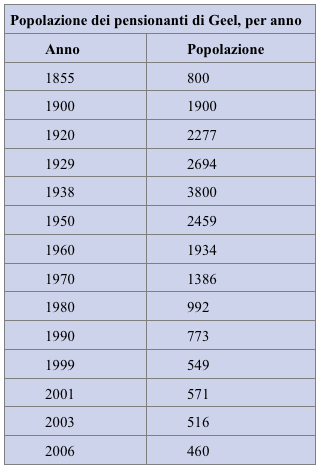
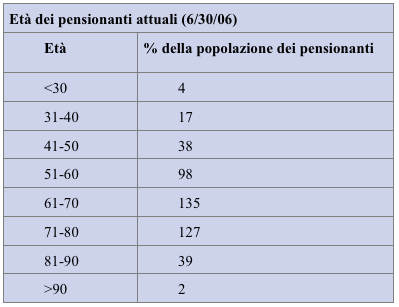
Today, most patients are 60 or older, which shows the decline in the population of patients included in this kind of practice. This decline has several possible causes, which are far from reflecting a failure in therapeutic and, above all, rehabilitative terms. The foster family system moved from the religious to the civil sphere, thereby losing institutional control, but later regaining it, albeit under the current rules governing the contemporary mental health system. With the French Revolution and, shortly afterwards, the annexation of Belgium to France in 1795, the system ceased to be in the hands of the clergy. In 1811 the French Minister of Justice decided to put an end to the foster family system in Geel. However, neither decision really interrupted the tradition, and patients continued to arrive in Geel to be taken in by families. It is worth noting that, at this point, when the system was put to the test, it managed to prevail thanks to its own structure, thus surviving until 1838, when control passed into the hands of the municipality of Geel, and so outlasting the measures aimed at eradicating it. In the mid-nineteenth century, Geel became the centre of a region declared a colony for the mentally ill, which made possible the construction of a hospital that Jozef Guislain helped to design in 1862, and which represented the pioneering projection of the psychiatry of the time. It would then take until 1948 for everything to pass from the hands of the Ministry of Justice to those of the recently created Ministry of Health (Roosens; Van De Walle; Sacks, 2007).
At this time, when the modern state takes care of public health, and with the progress of human rights and their effects in the legal field, we are seeing a return to the regulation of care practices, which now include the activity of host homes. Government control replaces private agreements between patients’ relatives and foster families, thereby also changing the remuneration received. The exchange of housing for farm work also disappears. In other words, financial remuneration decreases and state supervision increases, gradually introducing greater professional attention and care, entrusted to professionals with university degrees and state-registered professions. Since 1991, all families hosting patients have been directly supervised by the OPZ, Openbaar Psychiatrisch Zorgcentrum (Public Psychiatric Hospital). There are currently 4 family teams for about 100 to 250 families. Each team is made up of a psychiatrist, a general practitioner, a psychologist, a social worker and three nurses. In turn, each nurse visits each family every two weeks (or sooner, if difficulties arise).
Interest in the Geel experience, from a psychiatric point of view, received a spectacular boost from the end of the nineteenth century to the middle of the twentieth century. Today it is no longer included in the training of psychiatrists, even though it is a valid methodology that is still in use, updated to the standards of current psychiatry, and even though it remains a challenge, a subject to which we will return at the end of this article. As we were explaining, in the second half of the nineteenth century, articles on the subject began to be published in the most important newspapers in the world. They are generally enthusiastic, and emphasise the fact that the patients live alongside the rest of the population without any incidents being recorded. The writers are amazed at how difficult it is to distinguish the sick from the rest of the population. Today such a distinction is possible, not because of clinical manifestations, but because of the consequences of pharmacological treatments, especially long-term ones, which leave traces in the form of abnormal movements of the limbs and facial muscles. In a way, and paradoxically, the patients are recognised as such not because of the illness itself, but because of the negative effects of the treatments they undergo. The interest was not only journalistic but also medical: the French alienist movement took notice after Esquirol’s visit in 1821. It could be said that, compared with Esquirol, Geel was ahead of its time: whereas he advocated the isolation of psychiatric patients, at the moment when such patients were moving from being considered little more than chained delinquents to the new category of alienated patients, in Geel he found an environment in which isolation was not necessary. It was his contemporary, Jacques Joseph Moreau (Moreau de Tours), who, drawing on the Geel experience, redefined the concept of alienation in a revolutionary way: alienation means removing patients from the context in which the pathology emerged. Finally, it was Bénédict Augustin Morel (who coined the term Dementia Praecox, later popularised by Kraepelin) who, belonging to the same alienist movement, grasped Geel as an undeniable phenomenon that called into question the cornerstones of that movement (Huertas García Alejo, 1988; Bellomo, 2011).
Until the middle of the last century, many doctors and researchers felt drawn to the Geel experience. Accounts from decades of articles and references to Geel refer to the patients with the term “lunatics”. Although it may seem a mere anecdote, this exemplifies the persistence of the point of view of Paracelsus, who created the term in his classification of mental illness. It was not until May 2012 that the United States Senate, with the support of the American Psychiatric Association, removed the term from official documents through a law.
First with a religious character, since religion was an inextricable part of everyday life, and then as a social and even working practice, the presence of psychiatric patients, brought by their families from different parts of Europe, became part of life in Geel. Here the most important aspect of this experience comes into play, which consists in the intergenerational repetition of a practice that becomes therapeutic. For almost 700 years, being born into a family in Geel could give the possibility – an opportunity that has changed over time – of living from birth alongside a person who meets the following characteristics: 1. suffers from some form of mental disorder, 2. is not, strictly speaking, a member of the family, and 3. represents an economic contribution to the family, through work or through the remuneration paid by the patient’s family (in the past, and adequate) or by the State (in the present, and not as well paid). In addition to this, and this is perhaps one of the most significant elements, the possibility of being born into a family that hosts a patient goes hand in hand with the fact that at least one of the parents of the person born in the house was in turn born and raised in a family that hosted another patient. In a way, this family configuration, which includes the presence of a patient, has been replicated over dozens of generations, going back to remote times beyond any possibility of tracing.
There are other similar cases of living with situations and conditions that, in most places in the world, would attract attention and would undoubtedly be considered pathological. Oliver Sacks mentions at least two in his famous autobiography: the case of “Tourettesville” in La Crete, Canada, and the case of Martha’s Vineyard and its deaf community, where he explains how communication through sign language was used naturally (Sacks, 2015).
Diversity, difference, integration and inclusion
Nowadays, the Geel experience is relevant to redefining the place of mental illness within the field of medicine. Indeed, alongside the growth of knowledge about mental functioning (anatomy and neurophysiopathology, neuroimaging and genetics, among other areas), concepts such as “mental illness” remain confused. Take the case of homosexuality as an example, which precisely in recent decades has gone from being a pathology to being considered normal, passing through the intermediate condition of an ego-dystonic state as a criterion for a diagnostic decision. Not only medical documents but also minority associations have played a part in this journey. The shift from a pathological condition to something considered normal perhaps represents the embodiment of the journey from the same to the different, from the universe to the diverse. Not only the so-called “different” is affected by this change, but also the presumed same. It is not a matter of erasing differences, but of reconceptualising them as something that often seems to be more a property of the observer than of the observed.
As mentioned, the Geel foster family system has attracted attention since the beginning of the nineteenth century, because the patients walked around the town and were indistinguishable from the general population. It should be stressed once again that, nowadays, it would be possible to distinguish them, not by their conditions, but by the side effects of the treatments they have undergone. There are some very interesting documentary videos on the Geel experience, in which aspects of the patients’ behaviour can be seen. In the case of many patients, alterations in gait and muscle movements are easily noticeable and have nothing to do with mental illness, but with antipsychotic drugs that have left the mark of tardive dyskinesia. These signs are due to the treatment, not to the condition. However, this did not occur until the twentieth century.
As far as the themes of diversity, integration and inclusion are concerned, it is possible to approach them from the point of view of the person who is “different” (the patient in Geel) or from the point of view of the families. That is to say, in addition to asking ourselves what the family does for the patient, we could ask what the patient does for the family. What kinds of skills do family members develop? How does the transgenerational cycle influence this learning?
Today there are at least two spheres in which the paradigm of interaction with those who until now were considered different – in a pathological sense – is changing. One is the sphere of sexual life, the other that of schooling.
We live in an age in which, on the same planet, horror on the one hand and the advance of tolerance and acceptance of differences on the other coexist. In some countries homosexuals are thrown from rooftops and women are reduced to the legal status of things, while in others the law guarantees equal rights to people who express sexual preferences and identities that had until then been kept hidden. In this sense, the Geel experience could prove to be a still-living precedent of how what is rejected elsewhere is incorporated and then permanently changes the identity of the majority. It therefore constitutes a model of inclusion, different from that of integration. Whereas in the latter the majority hosts the “different” by forcing them to adapt, in the former it is the community as a whole that finds such incorporation beneficial. Something similar is happening in schools, where the visibility of everyday problems that were previously not part of the main focus is beginning to be considered relevant, for example the inclusion of students who, in other times, were sent to “special” schools, or other more specific issues, such as bullying, which has recently become an increasing focus of attention. In this sense, there are at least two approaches that have highlighted the existence of something much deeper than the victim-perpetrator duality. These projects show how an approach from new perspectives benefits not only the victims but the whole community (Winslade, 2013; Salmivalli, Poskiparta, Ahtola, Haataja, 2013).
Concluding remarks
The guiding idea of this article is to highlight the intrinsic importance of a competence that is handed down through the centuries. A competence based on experience, which would be impossible to demonstrate if there were no written documentation of it.
As early as 2001, the World Health Organization acknowledged the Geel foster family system as a successful model of health care for the treatment of psychiatric disorders. The problem lies in the fact that the recipe for this successful model seems to require not only families who are willing to host patients from elsewhere, but also a founding myth and a tradition of some seven hundred years. One might wonder how the time that has elapsed, a period that would be unreasonable for any project on a human scale, has affected the acquisition of skills arising from contact with psychiatric patients. Nevertheless, some valuable attempts inspired by Geel deserve mention: the housing system for homeless people in New York developed by Ellen Baxter, or its replicas in some German cities. Apart from their results, which are by no means negligible, it is clear that those who have come into contact with the Geel experience have drawn stimulus and inspiration from it (Linn et al., 1980; Van Bilsen, 2016).
Moreover, the Geel experience is, and this may be its most intrinsic characteristic, a living example of a stochastic evolutionary process, in the sense developed by Gregory Bateson (1979), but it also calls us ethically to a place of responsibility. Along the same lines, and as Erwin Schrödinger (1958) had stated several years earlier, we are responsible for the conditions of possibility of random events, so as to foster the creation of new realities. When one visits Geel today, one is faced with a mixture of perplexity and respect for the experiences of the past. The history of Geel allows mental health professionals to reconcile their current professional identity, which is sanctioned by scientific tradition, by evidence-based medicine and by accountability, with a tradition built on a myth and on religious practices. However, diagnostic categories are shifting very fast, faster than our prejudices and our ability to distinguish the normal from the pathological. Sometimes what is considered normal and the pathological merge in a process of growing respect for differences and human rights, which leaves one perplexed about the strength of agreed practices in mental health. Geel has a first name, a surname and a story to tell. What remains to be done is to uncover the stories that affect us at every time and in every place.
Complexe Systémique: key points
Geel shifts the usual question: not only what the family does for the person who is ill, but what that person’s presence does to the family, and what is passed on from one generation to the next. The text draws from this a useful distinction between integration, in which the majority requires the “different” person to adapt, and inclusion, in which the community changes itself. José Nesis also reminds us that difference is partly a property of the observer, and that the signs that set boarders apart today often come from the treatments, not from the illness. The limit is clear: the model rests on a founding myth and on seven centuries of tradition, and cannot be transplanted as it is. Yet it invites clinicians to look at the family and community network as a resource for care, and to take an interest in the skills families develop and in the weight of the collective stories that sustain a practice. Read alongside the account of Italian psychiatric deinstitutionalisation, and Ramón Rojano’s community family therapy.
References
Bateson, G. (1979), Mind and nature: A necessary unity, London, Wildwood House.
Bellomo, L. E. (2011), La rehabilitación psiquiátrica en la Argentina: una crónica del tema a través de la historia hasta la actualidad, Buenos Aires, Akadia ed.
Freud, S. (1926), Il problema dell’analisi condotta da non medici. Conversazione con un interlocutore imparziale, in Opere vol.10, Torino, Bollati Boringhieri.
Goldstein, J. (2006), Hope for “Community Recovery”, UPENN.
Huertas García Alejo, R. (1988), “La comunidad de Gheel: una alternativa de asistencia psiquiátrica en el siglo XIX”, Revista de la Asociación Española de Neuropsiquiatría, Vol. VIII, núm. 25.
Linn, M. W et al. (1977), “Hospital vs. community (foster) care for psychiatric patients”, Arch Gen Psychiatry, Jan. 34 (1): 78-83.
Linn, M. W. et al. (1980), “Foster home characteristics and psychiatric patient outcome. The wisdom of Gheel confirmed”, Arch Gen Psychiatry, 37 (2): 129-32.
Roosens, E.; Van De Walle, L.; Sacks O. (2007), Geel Revisited after Centuries of Rehabilitation, Garant Uitgever.
Sacks, O. (2015), On the Move: A Life, New York, Knopf Ed.
Salmivalli, C.; Poskiparta, E.; Ahtola, A.; Haataja, A. (2013), “The implementation and effectiveness of the KiVa antibullying program in Finland”, European Psychologist, 18(2), 79–88.
Schrödinger, E. (1958), Mind and Matter, Cambridge, Cambridge University Press.
Van Bilsen, H. P. J. G. (2016), “Lessons to be learned from the oldest community psychiatric service in the world: Geel in Belgium”, B J Psych Bulletin, 40(4), 207-211.
Winslade, J. (2013), “Deconstructing the Policing of the Normal: An Examination of the Work Done by ‘Undercover Anti-Bullying Teams’”, Conflict and Narrative: Explorations in Theory and Practice, 1(1), pp. 76-98.
Unofficial English translation of L’esperienza di Geel: diversità, differenza, integrazione e inclusione, by José Nesis, Connessioni, new series, no. 8 (2020), under a CC BY 4.0 licence. Translation (with the help of artificial intelligence) and layout: Complexe Systémique, November 2026 — the work has been modified under the terms of the licence (tables reproduced as published, in Italian). Neither the authors nor the journal are responsible for this translation; the original version prevails.
Unofficial English translation of “L’esperienza di Geel: diversità, differenza, integrazione e inclusione”, published in Connessioni (2020) under a CC BY 4.0 licence. Made by Complexe Systémique with the help of artificial intelligence, it does not come from the authors or the journal, who are not responsible for its content; the original version prevails.
Read the original articleHow to cite this article
Nesis, J. (2020). The Geel experience: diversity, difference, integration and inclusion (Complexe Systémique, Trans.). Complexe Systémique. https://app.complexe-systemique.com/en_GB/articles/the-geel-experience-diversity-difference-integration-and-inclusion (Original work published in 2020 in Connessioni, nuova serie, n. 8 (2020); republished in 2020 by Connessioni, https://connessioni.cmtf.it/lesperienza-di-geel-diversita-differenza-integrazione-e-inclusione/)
To go further
- Italy and the process of psychiatric deinstitutionalisation. Is freedom therapeutic?Leaving the asylum in Italy.
- Community family therapyHealing with the community.
- The experiment that shook psychiatry: RosenhanWhen the label makes the patient.
Related training courses
 Symposium
Digital technology, AI and mental health
Conference in Lyon, 11 December 2026: digital technology, artificial intelligence and mental health. Six talks, replay for participants. In French.
 Short course
The suicidal crisis in adolescents and young adults
Training: assessing and supporting the suicidal crisis in adolescents and young adults. Clinical landmarks and systemic tools. In French.
Related articles
 Scientific
How can we BeST? meet the needs of adoptive families? Relevant findings from a major Randomised Controlled Trial of infants in foster care in the UK
The BeST? trial (488 infants in care in the UK) reread for adoption: holistic, ongoing assessment of children and a move to dual registration.
 Scientific
“Tired of Being Tired”: Intergenerational Trauma and Relational Bridging Among 1.5‐Generation East African Refugees
Sixteen Somali, Oromo and Ethiopian refugees who arrived as children describe their role as bridges between generations, between inherited silences and burdened resilience.
 Blog
Toxic, narcissistic, borderline: what therapy speak does to your relationships
Narcissistic, borderline, toxic: therapy speak has left the consulting room. Julien Besse shows how these labels close the debate and relieve us of our own part.
 Scientific
“Left Speechless in Front of My Children”: A Thematic Analysis of Parents’ Experiences During War & Displacement
Four mothers displaced after 7 October 2023 describe parenting under threat: alone in the shelter, children who mature overnight or regress, and an ambivalent welcome.
Comments 0
Log in to join the discussion. Log in