Red Sistémica · Psychopathology
Therapeutic trajectories for patients entrapped in stories of shame or humiliation
Because we are permeable to the opinion of others, any situation that exposes us to the gaze of a witness may become a source of shame or of humiliation. Carlos Sluzki distinguishes these two social emotions — one internalising the blame, the other externalising it onto the witness — and takes apart, variable by variable, what makes them remain useful signals or, on the contrary, invade the whole of the subject’s experience.
“Moderate or circumstantial experiences of shame, and even of humiliation, deserve to be welcomed.”
Carlos E. Sluzki
Two social emotions
One of the collateral effects of the sociability of human beings is that we are permeable to the opinions of others. This trait, necessary in order to live in society, helps us calibrate our social conduct and maintain our ethical bearings. Its effect is to organise not only our opinion about the opinion others have of us but, reflexively, our opinion about ourselves (part of what Laing et al. (1965) called “the spiral of reciprocal perspectives”).
This process of social calibration has a correlate, or a crucial component: the emotions that are part of the process itself.
This note will focus on only two of the unpleasant relational emotions: the experience of shame — in which we take upon ourselves the blame for any public display of our weaknesses, which triggers the wish to disappear from the scene where there have been witnesses (“May the earth swallow me up!”) — and humiliation — in which we locate in others the responsibility for the negative quality of their witnessing, which makes us feel unfairly seen or treated, and which triggers the wish to disqualify or attack the witness, perceived as the source of the unpleasant social process (“Revenge!”)1.
Shame
The blame is taken upon oneself. The public exposure of a weakness triggers the wish to disappear from the scene where there have been witnesses.
Humiliation
The responsibility is located in the other. The witnessing judged unfair triggers the wish to disqualify or attack the witness.
It should be clear that these two emotions may fulfil an important function: they are part of the system of alarm signals that informs us of our deviations (noticed by ourselves or pointed out by others), allows us to correct departures from the social behaviour accepted in the community as well as departures from our own ethical standards, and prompts us to incorporate and repeat the behaviours that evoke positive social emotions. Needless to say, these signals are an important part of the process of socialisation. In other words, moderate or circumstantial experiences of shame, and even of humiliation, deserve to be welcomed. However, when one or the other of these emotions invades the self, or reappears again and again across a variety of the subject’s social experiences, we move from passing and useful emotions to repeated and tormenting experiences. We then enter the terrain of human suffering that is the object of psychotherapeutic activity. The matrices to be discussed below apply fundamentally to that kind of circumstance.
One of the reasons why I have chosen these two emotions is that, unlike others, they are both “social emotions”, that is, they require the presence of a third party, the witness (sometimes internalised, but generally external). The other reason is that there is a relative balance between these two emotions (and between these two psychic mechanisms, externalisation and internalisation): when they are present, the dominance of one in the emotional sphere reduces the presence of the other.
Anatomy of an exposing situation
The relational and emotional impact of any individual or collective situation that exposes us to the eyes and ears — to the opinion — of others in a potentially negative way varies from one personal style to another, from one history to another, from one circumstance to another, and depends as well on the style and the nature of the witness of that event. Let us examine this paragraph in more detail.
“Any situation” covers the range of human situations in context where there is a witness (“the eyes and ears — the opinion — of the other”). And indeed, with very few exceptions, the whole range of social situations — from our stomach rumbling in public to helping a neighbour in difficulty, from trivial acts to heroic or vile ones — may turn into a source of shame or of humiliation, given a context and/or a witness with certain characteristics.
“Exposes us… in a potentially negative way” may include multiple situations in which either one assumes oneself a possible critical observation on the part of the witness (“Will he have realised that I had forgotten to close my fly?”, “Did anyone see me fall off my bicycle?”, “Will they have assumed that it was I who made that child cry when in fact I was only trying to console him?”), or the witness or witnesses do in fact express their negative opinion (they laugh at our misstep, or accuse us implicitly or explicitly of having done something we did not do… or that we did assuming there were no witnesses, or that, if there were, they were benevolent ones).
“It varies from person to person”
This variable comprises several axes.
One axis concerns the degrees of sensitivity to the opinion of others. At one end of the spectrum are those who are impermeable, indifferent or insensitive to the opinion of others. In the social world, these subjects are labelled “cruel”, sometimes “exploitative” or “manipulative”, and in the field of psychopathology they are usually diagnosed as “sociopaths” or sometimes “narcissists”. The other end corresponds to subjects extraordinarily sensitive to the opinion of others — a selective “other”, or else the generalised “other” — to whom the subject stereotypically attributes (and not necessarily wrongly!) a critical or negative attitude. These individuals are usually labelled socially as “shy”, “insecure”, “hypersensitive” or “touchy”. Extreme sensitivity to the opinion of others leads them either to social isolation — to flee the torture of the scrutinising gaze —, or to relations of dependence — where the subject’s behaviour is dictated by the other —, or to recurrent social conducts in which they actively avoid those to whom they attribute a supposed negative judgement, or else confront them (sometimes to the other’s surprise).
The other variable, crossed with the preceding one and already implicitly mentioned in the descriptions above, corresponds to the spectrum running from the predominance of internalisation mechanisms to the predominance of externalisation mechanisms in the subject. These are psychic processes (derived in part from earlier experiences of interpersonal processes) through which either we take in the responsibility and assume the blame, or we expel it and attribute to others the responsibility for accusing us unjustly. These mechanisms are practically universal (with the probable exception of the “impermeable” individuals mentioned above). While they coexist in varying degrees according to circumstances, one or the other tends to dominate in different people, sometimes selectively — for instance when they interact with their parents, or when they are being interviewed —, sometimes stably.
The prevalence of an internalising or an externalising style in a given person results from a combination of cultural mandates, personal history and, probably, genetic predispositions. Individuals with dominant internalising traits will tend to take upon themselves any negative attribution mentioned by the other (or attributed to the other), without evaluating the nature of the source or of the context of the negative judgement. A person who ends up organising their life so as to avoid the daily suffering of the experience of shame will probably be labelled, in psychopathological jargon, as an “avoidant personality”. In turn, individuals whose dominant social trait is externalisation will tend to assume a priori in the other a dose of hostility or of malevolent intent, and to react to any comment expressed by the other (or attributed to the other), without weighing the nature of the situation or the context of the attributed judgement. In psychopathological jargon, the prevalence of this style of world view usually leads to the label of “paranoid personality”.
“It varies from one personal history to another”
The experiences of personal history — from birth onwards — contribute to facilitating the expression of one or the other relational style, as well as a more fluid and context-sensitive expression, or on the contrary a more decontextualised one, in one direction or the other. There are indications that the more extreme and repeated the early experiences, the more rigid and decontextualised the styles adopted will be.
“It varies from one circumstance to another”
Circumstances can be deconstructed into situations — the actions, the plot, that is, the “what” —, into actors — central and secondary characters, that is, the “who” — and into context — the setting, that is, “where and when” what happens happens. In other words, “circumstances” are the narratives that the actors construct with the elements mentioned, namely action, actors and context. Possible genetic predispositions, life experiences, culture and styles of socialisation will contribute to calibrating these elements differently and will organise stories that are more or less consensual or sui generis, more or less even-handed or biased.
“It varies according to the relational characteristics and the style of the witness of the event”
The interactive characteristics of the witness have a crucial effect on the way the individual constructs the impact (emotional, pragmatic) of any social act, all the more so if that event carries a component of ambiguity as to the social position that results from it for the individual. Witnesses may be mere observers of the event — a passer-by who sees us slip and fall flat on the pavement (does he show solidarity, indifference, mockery?), a nurse disinfecting a wound following a beating (does she behave empathically, indifferently, critically?) —, or else active characters in the event — a torturer or a rapist who accompanies his act with contemptuous or degrading comments, a father who mocks his son’s tears after having hit him. But we also possess internalised observers — from the “moral conscience” to the maternal or paternal figures — who judge our own actions as witnesses sometimes kind and tender, sometimes severe and sadistic…
Notes from the original
1. Among the authors who have explored this theme in depth, Miller (1993) and Lindner (2006) should be cited.
Who is Carlos E. Sluzki
Dr Carlos E. Sluzki, MD, is professor at the College of Health and Human Services and Institute for Conflict Analysis and Resolution, George Mason University (CHHS), 4400 University Drive, MS 5B7, Fairfax, VA 22030. He is an editorial adviser to Perspectivas Sistémicas and has published many articles there, a good number of which can be consulted in Perspectivas Sistémicas On Line, www.redsistemica.com.ar, in the section of articles online.
An extract
Red Sistémica publishes online only a fragment of this article: the full text appeared in special issue no. 94/95 of the journal Perspectivas Sistémicas. Our translation covers the whole of the fragment put online, and nothing more; the continuation of the text, in which the author develops the therapeutic trajectories announced by the title, is not accessible to us. Read the original fragment in Spanish.
This article is an English translation of “Trayectorias terapéuticas para pacientes entrampados en historias que generan vergüenza o humillación”, published by Red Sistémica (first published in Perspectivas Sistémicas, numéro spécial n° 94/95). Translated and republished with the journal’s permission.
Read the original articleHow to cite this article
Sluzki, C. E. (2022). Therapeutic trajectories for patients entrapped in stories of shame or humiliation (Complexe Systémique, Trans.). Complexe Systémique. https://app.complexe-systemique.com/en_GB/articles/therapeutic-trajectories-for-patients-entrapped-in-stories-of-shame-or-humiliation (Original work published in 2022 in Perspectivas Sistémicas, numéro spécial n° 94/95; republished in 2022 by Red Sistémica, https://redsistemica.ar/2022/08/01/trayectorias-terapeuticas-para-pacientes-entrampados-en-historias-que-generan-verguenza-o-humillacion/)
To go further
- Sowing violence in the minds of childrenSluzki on the other face of the witness: the one who takes an active part in the humiliation.
- Recovered words, recovered worldsHow a story that entraps can be told otherwise: Sluzki’s clinical practice.
- A relational view of personality disordersThe avoidant, paranoid or narcissistic labels reread as relational positions.
Related training courses
 Symposium
The Abnormal Normals and the Normal Abnormals
Conference replay: six clinicians explore normality — diagnoses, norms, adolescents, therapists. Immediate, lifetime access. Talks in French.
 Online course
Master the art of narrative therapy: a unique journey with Charlie Crettenand
Immersive online course: discover the narrative approach with Charlie Crettenand. A unique audiovisual journey, lifetime access, exercises. In French.
Related articles
 Article
 The AFFIRM Model for Navigating Challenges in Continuously-Interfaith and Divergent-Interfaith Marriages
Thirty happy interfaith couples describe how they navigate their religious differences: five processes, from respecting each other’s choices to religious intimacy, gathered in the AFFIRM model.
 Article
 Toxic, narcissistic, borderline: what therapy speak does to your relationships
Narcissistic, borderline, toxic: therapy speak has left the consulting room. Julien Besse shows how these labels close the debate and relieve us of our own part.
 Article
 Relearning couplehood after exile and violence
At the Maison d’Ella, Ivy Daure receives exiled women who have survived violence. Her work: relearning relationship so as not to form a couple by the same grammar again.
 Article
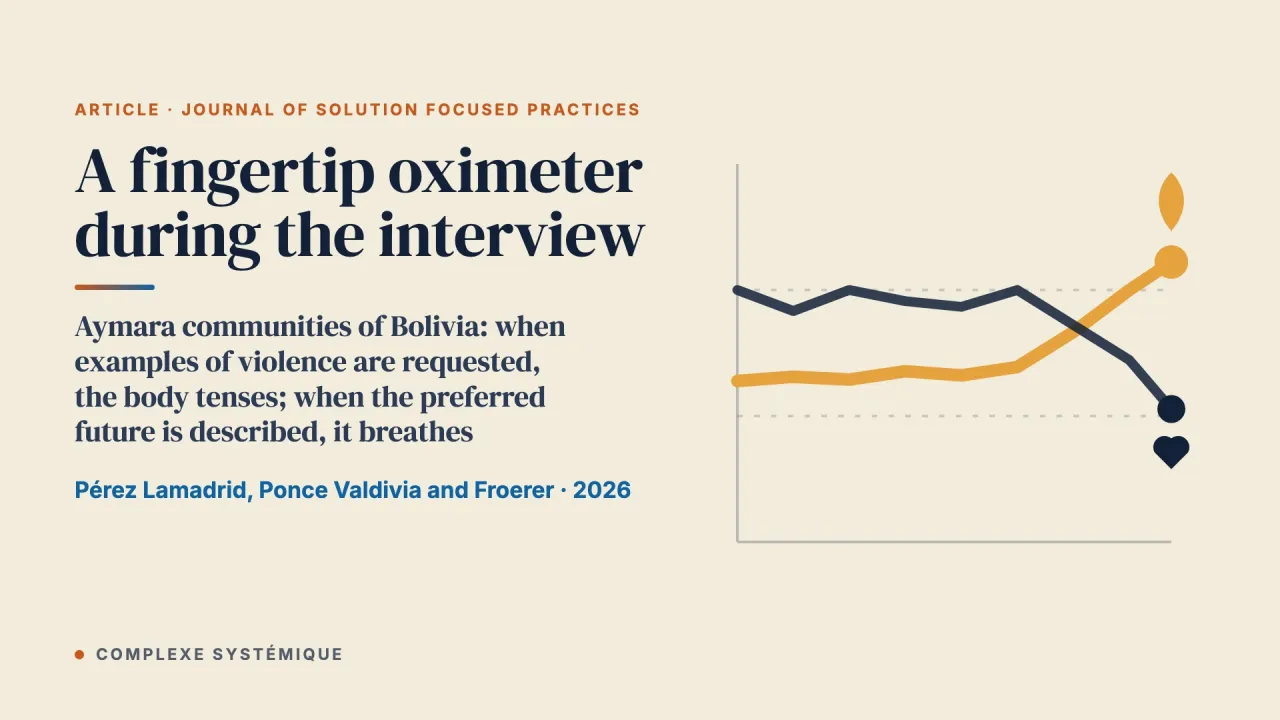
 Oxygenation and Heart Rate in Solution-Focused and Problem-Focused Interviews With Rural and Indigenous Aymara Communities (Viacha and Laja) Regarding Intersectional Violence
A fingertip oximeter on 19 Aymara people of the Altiplano: the problem-focused interview tenses when examples of violence are requested; the solution-focused one oxygenates and slows the heart.
Comments 0
Log in to join the discussion. Log in