Journal of Family Theory & Review · Family
Theorizing Family Rituals: A Family Systems Model
Why do shared meals, birthdays and holidays do families good? Lisbon psychologist Carla Crespo revisits 75 years of research and proposes a “spiral” systemic model: security and identity make rituals possible, and rituals in turn nourish family cohesion, the couple’s and parents’ sense of competence, and each member’s belonging.
This is a reformatted republication of Theorizing Family Rituals: A Family Systems Model, by Carla Crespo, published in Journal of Family Theory & Review (Wiley) (2026), doi: 10.1111/jftr.70032, under a CC BY 4.0 licence. Prepared by Complexe Systémique in September 2026: the authors’ text is unchanged; the layout has been adapted for reading online, which constitutes a modification of the work under the terms of the licence. This edition was made neither by the authors nor by the publisher, who are not responsible for its content or for any errors. The original version prevails.
Family rituals are not magic formulae that, simply being enacted, automatically yield positive outcomes for families and their members.
Carla Crespo
Abstract
Family rituals are universal and spontaneous events carried out by families worldwide. The meaning associated with family rituals can greatly benefit individuals and families. A robust body of research, coupled with ongoing theoretical developments, has paved the way for family rituals to become a well-established construct within family science. I revisit past theoretical core contributions and suggest a new, mid-range theoretical model of family rituals, grounded in family systems theory. This model identifies security and identity as building blocks for creating meaningful family rituals and as general processes through which the meaning of these events is associated with health and well-being outcomes at three different systemic levels. Family cohesion, perceived relational efficacy, and sense of belonging are conceptualized as three additional specific processes that connect the meaning of family rituals to improved outcomes for families, couples/parents, and individuals. In conclusion, I reflect upon the model's potential contributions for advancing further theory and research.
1 Introduction
Family rituals are at the heart of the human experience of being part of a family. Sitting down for family meals, gathering for birthdays and annual holidays, and being expected at major occasions that mark life cycle changes, such as weddings and funerals, are shared experiences for family members across cultures. While universal, family rituals are also idiosyncratic, as the way each family carries them out mirrors the unique interplay between its group identity and the broader cultural and social systems in which it is embedded. In short, family rituals are special events with symbolic meaning shared by the family as a whole (Fiese 2006). Meaningful rituals are considered an important resource for families in general, as well as protective factors for individual and family adaptation, providing stability during times of stress (Fiese et al. 2002).
The first comprehensive study on family rituals was published by Bossard and Boll (1950). Since then, family rituals as a field of study within family science has flourished. Theoretical landmarks in this specific field include Steve Wolin and Linda Bennett’s (Wolin and Bennett 1984) proposal of a typology of rituals, Evan Imber-Black, Janine Roberts, and Richard Whiting’s (Imber-Black et al. 1988) extensive work on the functions and features of both naturally occurring family rituals and therapeutic rituals, and Barbara Fiese's (2006) distinction between routines and rituals, as well as her conceptualization of the role of rituals in promoting family health. These authors also focused on the developmental course of rituals across the individual and family life cycles, noting how these events were shaped by the larger ecological context of the family. While early research on this topic was predominantly qualitative (e.g., via autobiographies, interviews, and clinical reports), the publication of a self-report measure of family ritual meaning, the Family Ritual Questionnaire (Fiese and Kline 1993), facilitated the expansion of studies using quantitative and mixed-methods approaches. To date, a substantial body of research supports the notion that meaningful family rituals are associated with key health and well-being outcomes for children, adolescents, adults, and families as a whole (Crespo et al. 2013; Fiese et al. 2002).
Recently, a renewed interest in family rituals was sparked by the Covid-19 pandemic. This major global event led to restrictions on social gatherings and people meeting in person. During this time, in many parts of the world, government regulations resulted in family rituals such as visiting grandparents for a weekly lunch, throwing a birthday party, or gathering extended family for Christmas or Hannukah no longer being able to take place (Crespo and Relvas 2024). The loss of family rituals was especially poignant for markers of life cycle transitions; the inability to be present or the experience of being alone during a loved one's funeral, or the impossibility of hosting a memorial, was perceived by some as a traumatic experience (e.g., Mondal 2024). However, as observed by Imber-Black (2020), “rituals bent but did not break during COVID-19” (p. 10). Old rituals were adapted to the new circumstances (e.g., family reunions and birthdays were reinvented online), and new rituals were created, many of them within the idiosyncratic realm of each family, such as the example of a Christmas Eve family pajama walk in the neighborhood described by Shelkey (2024). The common misconception that modern families have outgrown rituals, viewing them as vestiges of the past, was challenged. The survival of family rituals in the face of the adverse context of the pandemic was an indicator of both the creative resilience of families and their strong motivation to preserve these symbolic events.
The timely social context, combined with a mature yet heterogeneous field of study, calls for new endeavors in theorizing family rituals. There are four primary reasons supporting the need to revisit family rituals theory. Firstly, empirical research on family rituals, similar to other areas within family science, has not always been firmly grounded in theory. While research has consistently highlighted the benefits and essential conditions for developing meaningful family rituals, some of this work has been either atheoretical or insufficiently theoretical, suggesting a gap in detailed models that can, alongside foundational work, guide the conceptualization of new research in a deductive manner (Adamsons and Crossman 2022). Secondly, this growing body of research has produced new insights that have the potential to contribute inductively to the development of family ritual theory. Thirdly, there is a pragmatic argument: family science is inherently applied, and its theories must be relevant for informing interventions and policymaking for contemporary families. Daly (2003) poignantly noted that family theories “have drifted away from what families actually do” (p. 773). In an effort to elaborate pertinent theories that reflect everyday reality (Daly 2003), I argue that a focus on family rituals can help achieve such goals. Rituals are an everyday part of family life, easily identifiable by both children and adults in their narratives about family life and the emotional investment in these events, despite the fast-paced nature of contemporary life, attests to their relevance (Fiese 2006). Finally, family rituals concern the family as a group; that is, they are positioned systemically at the whole-family level. According to the system's property of totality, any change in the whole system will affect its parts, and vice versa. For family rituals, this means that these group interactions influence the adaptation of the couple and parental dyad, as well as individuals, while being simultaneously influenced by the functioning of subsystems and the individual characteristics of family members (Fiese et al. 2002). Although the intricate web of relationships within family systems has been acknowledged by previous scholars, no specific models currently address it in detail.
Drawing on family systems theory as the main theoretical compass and building on the foundational works of Imber-Black et al. (1988) and Fiese (2006) on family rituals, as well as a broad view of family rituals empirical research, I propose a mid-range theoretical approach to family rituals. I begin by examining the construct of family rituals, including its definition, typology, and key functions for individuals and families. Following this, I provide a detailed presentation of a model of family rituals.
2 Revisiting the Core Theory of Family Rituals
2.1 Definition
Rituals can be found in most human groups, ranging from wider society to dyadic relationships. Indeed, rituals are so vital to the maintenance of social connections that, wherever there is a human group, there is almost certainly a ritual. While the scientific study of rituals emerged within anthropology, initially focusing on collective rituals in social groups, it quickly became interdisciplinary and broadened in scope from the latter half of the 20th century (Fiese 2006). Today, research on rituals is vast, ranging from that which observes group processes associated with changes in larger social events, such as post-terrorism rituals in Oslo and France (Baele and Balzacq 2022), to studies examining the individual psychological processes involved in rituals (Hobson et al. 2018). Approaches to studying rituals can be distinguished by the audience (which group performs and shares a particular ritual or set of rituals?) and by the target level of analysis (who contributes to and is influenced by a ritual or set of rituals?). The focus of this article is situated systemically at the mid-level, specifically addressing the rituals in which families, as a diverse group, engage. In terms of the target level of analysis, it encompasses individuals, couples/parents, and the whole family, examining how family rituals influence these individuals and groups.
Family rituals can be briefly defined as special events with symbolic meaning shared by the family as a whole (Fiese 2006). The three key elements of this definition are why rituals are special, symbolic, and whole family related. Firstly, the special nature of family rituals refers to the idea that, like all rituals, those in which families engage are significant moments that offer a pause from the flow of ordinary life. Anticipation plays an important role: the time preceding rituals is one of preparation and planning, contributing to reduce anxiety and uncertainty. Several authors have noted a change in the subjective perception of time during rituals. Time, as a sequence of fleeting moments, is suspended and acquires meaning within the group narrative, allowing for stillness and lingering (Byung-Chul 2020); as Grimes (1982) aptly described, rituals are a “time between times” (p. 85). These events constitute time marks for the family, both according to the externally defined cultural calendar (e.g., Ramadan, Christmas) and the internal calendar specific to each family (e.g., birthdays of family members, reunion dates an extended family prepares every year, or weekend outings to a favorite location). The heightened significance of the ritual's time is made possible by the presence of symbols, units of meaning attached to objects or interactions.
Second, since its anthropological roots, the construct of rituals has included the symbol as both an essential and distinctive feature. Turner (1967) conceptualized the symbol as the smallest unit of rituals, while Myerhoff (1977) argued that the use of symbols is what differentiates rituals from mere habits or customs. The need for a code to fully understand and interpret what takes place in a family ritual mirrors the uniqueness of that group's identity: family members, as insiders, share access to the symbols and understand what they mean for the family. Also, symbols are useful for holding contradictions, making rituals privileged ways of marking transitions, such as life cycle changes, during which periods of ambivalence about relinquishing old roles and realities, and acquiring new ones, are expected.
Third, rituals involve all family members, yet the level of participation and the meanings assigned to them can differ (Roberts 1988) according to family members' developmental stage, gender, or generation. While a family ritual is enacted by the group, the role and lived experience of that event are unique for children, adolescents, and adults in the middle generation, particularly women, who are often regarded as the kinkeepers of the family and guardians of these events (Leach and Braithwaite 1996).
Beyond the three elements of the proposed definition (Fiese et al. 1993), another important feature of rituals is their dynamic nature. Although rituals are known for their ability to provide stability, they are never mere repetition. Rituals are symbolic acts that co-evolve alongside the development of individuals and families (Roberts 1988). It is the flexibility regarding rituals that ensures these events remain meaningful and beneficial. One way to understand how family rituals change and hold still is by recognizing their open and closed parts (Roberts 1988; van der Hart 1983). Open parts are those elements that can be changed without the ritual losing its symbolic meaning: these parts allow for fluidity and the necessary adaptation for the ritual to evolve. In contrast, closed parts are the elements that must remain unchanged; altering them would render the ritual hollow or empty, devoid of its symbolic meaning. The closed parts provide structure and the key elements that enable the continuity of meaning across time, and sometimes generations.
The perception of what constitutes open and closed parts varies from family to family, and sometimes, even within a family, individual perceptions may differ. For instance, while one family may celebrate Christmas in different family homes each year (open part), they may insist on maintaining a traditional dessert from an old recipe to preserve the sense of Christmas (closed part). In another family, everyone may agree that Christmas must be spent at the grandparents' house (closed part), yet they may be more flexible about which foods to include (open part). A story shared with me involved a family where, for each birthday, someone would smash a cake onto the celebrant's face, a practice known as “la mordida” in Mexico. Over time, as undesirable outcomes occurred, the family decided to discontinue this practice. However, when a young girl in the family turned 17 and no one else fulfilled the family tradition, she decided to do it to herself. For this adolescent, the symbolic act of smashing the cake was a closed part of the birthday ritual in her family she was not ready to relinquish. The balance between open and closed parts of rituals varies across families, reflecting the different ways families engage with ritualization. While some families opt to maintain a stable structure, favoring predictability (predominance of closed parts), other families may lean towards innovation and the integration of new meanings (predominance of open parts).
2.2 Typology
Family rituals cover a wide range of events in family life. A well-known typology of family rituals is that proposed by Wolin and Bennett (1984), encompassing three categories: family celebrations, family traditions, and patterned family interactions. Family celebrations include rituals that mark life cycle transitions, such as weddings, funerals, baptisms, and rituals associated with birth (e.g., Aqidah in the Muslim community and chhati among Hindu families), as well as bar mitzvahs, graduations and annual celebrations associated with religious (e.g., Christmas, Hanukkah, Easter, Ramadan, religious festivals) or secular holidays (e.g., New Year celebrations and national holidays). Family traditions are more specific to each family and may include summer vacations in a regular place or carried out in a distinctive way (for instance, family vacations characterized by adventure, cultural experiences, or fun), birthdays and anniversaries, and family reunions including special food, dance and music. Patterned interactions are the most frequently enacted rituals, such as mealtimes, bedtime moments with children, including specific elements such as a special story or song, and leisure activities during evenings or weekends, which are repeated and hold shared meaning for the family.
This typology implies a continuum: as one moves from family celebrations to traditions and then to patterned interactions, rituals become more frequent, less formal, less influenced by cultural norms, more idiosyncratic, and involve fewer individuals outside the family household. Wolin and Bennett (1984) noted that families vary in their commitment to rituals in general, and also with regard to different types of rituals, with some families investing more in family celebrations or traditions, while others prioritize patterned interactions. Although these authors placed the rituals associated with rites of passage and annual celebrations in the same category, rituals marking life cycle transitions are unique (Roberts 1988). During these transitions, second-order changes occur within the family system. These represent profound and enduring changes within the system itself, altering its underlying rules, belief structures, and patterns of interaction. This stands in contrast to first-order changes, which involve more superficial and temporary changes in behavior (Watzlawick et al. 1974). The rituals that mark life cycle changes play a particularly important role in managing the strong emotions and ambivalence that often characterize transition periods, during which individuals adjust to new roles and families prepare for a new stage. Both conceptually and for future research purposes, family life cycle rituals and annual family celebrations ought to be distinguished.
2.3 Rituals and Routines
A key conceptual distinction is the difference between rituals and routines (Fiese et al. 2002; Fiese 2006). In family settings such as mealtimes or annual celebrations, both ritual and routine elements are present. For example, while tasks like grocery shopping, meal preparation and cleaning are routine, the symbols (e.g., seating arrangements that reflect family relationships or the story behind an old Christmas tree decoration placed on top of the tree) and the shared meanings attached to these events belong to the domain of rituals. While both routines and rituals are vital, intertwined features of family life, they are distinct from one another. Fiese (2006) proposed that these constructs can be contrasted across the dimensions of communication, commitment and continuity.
Routines involve instrumental communication, characterized by direct language oriented for action and focused on the tasks at hand. Ritual communication, in contrast, is symbolic and conveys a message about who the family is as a group. Rituals involve multilayered and symbolic language, often using the analogic nonverbal code (Palazzoli et al. 1977), while routines abide by the digital code of communication. Unlike routines, where behaviors are causally linked to outcomes (e.g., food is prepared because people need to eat), rituals have been considered to present causal opaqueness, meaning that their constitutive elements are not clearly linked to outcomes (Hobson et al. 2018; Nielsen et al. 2018). Rituals can also be goal-demoted in the sense that an outsider may struggle to understand the reason or motivation behind the actions (Nielsen et al. 2018). Without their symbolic meaning, practices such as turning off the lights before bringing in the birthday cake or leaving food out on the table on Christmas Eve for deceased ancestors, a common practice in some regions of Portugal, may appear arbitrary, unnecessary, and even odd.
In terms of commitment, routines are momentary, with little attention given to their preparation or to reminiscing about them once they have been completed (Fiese 2006). In contrast, rituals involve an affective commitment that is longer lasting and extends beyond the duration of the ritual itself. This expansion in time is explained by the identification of the three stages of rituals, another legacy of the anthropological study of rituals that has crossed disciplines and remains relevant today. Briefly, the first stage involves the process of preparing for the ritual, the second refers to the actual event itself, and the third stage is the reflective integration that occurs afterwards, (as identified by van Gennep (1960), cited in Roberts 1988). These three stages initially described for rites of passage in the early 20th century, are now more readily observable in rituals that mark significant life cycle transitions. Not only are these rituals more noticeably prepared, but the experiences they provide may be replayed in memory long after the events have occurred. For instance, a wedding ritual can be remembered repeatedly through photographs, videos, and stories passed down to younger family members, especially during anniversaries. Similarly, the experience of a family member's funeral can be relived in future ritualized occasions of loss. However, all rituals, even the daily ones, involve, to a certain degree, anticipation and reminiscence (Wolin and Bennett 1984).
Routines and rituals can be differentiated in terms of their continuity. Routines are repeated over time in such a way that can be directly observable by outsiders (Fiese 2006). Rituals, on the other hand, involve repetition that is symbolic in nature and extends across generations, linking both ancestors and the unborn (Myerhoff 1984). Rituals facilitate the transmission of group identity by passing on values and ideas about the family and its relationship with the outside world (Wolin and Bennett 1984). Unlike routines, the symbols and meanings within each family are interpreted exclusively by the insiders, the family members. This explains why spending a holiday or even having a family meal with another family can make people feel like outsiders: while they may recognize what is taking place, there may be, for example, shared jokes, nervous laughter or specific seating arrangements that cannot be decoded by someone unfamiliar with the family's internal dynamics. Rituals are regarded as reliable signs of group membership, as those who know the rules and actions are easily distinguished from those who do not (Wen et al. 2020).
A superficial examination of rituals and routines may mistakenly conclude that rituals are important and beneficial for family and individual well-being, while routines are merely instrumental, monotonous tasks without relevance. However, research presents a more complex, less dichotomous picture of these dimensions of family life. Rituals but also routines have proven to be important promoters of individual and family adaptation (see Crespo et al. 2013 and Fiese et al. 2002 for reviews). Both routines and rituals may be either supportive or disruptive, according to how they are enacted within the family (Fiese 2006). In the particular case of rituals, for some families, these can be overt or covert conflict-laden occasions that bring about anxiety, sadness or anger in individual members. There are numerous lay references to rituals being experienced negatively, such as the holiday or Christmas “blues” or the awkwardness of some family meals. The scientific literature has also identified how family events can be occasions for exclusion, discrimination, and the exertion of power within family relationships (e.g., Oswald 2002; Roberts 1988). For instance, deciding who to invite to family events (do not invite your estranged aunt to your wedding), suggesting how one should behave in those events (Tom, bring your boyfriend but pretend you are just friends), and assigning specific roles and seating arrangements (you are still single, so you can sit with the children) can send powerful messages about who is in or out of the family and who is in control. The paradoxical communication created by ambiguous messages, such as the latter two, about expectations of attendance and behavior at family events can create double-binds, where a positive outcome is not possible: either individuals miss the event entirely or they attend and feel they cannot participate in a way that would be meaningful for them personally. Both positive and negative emotions can be heightened during these events and for some families or specific stages in a family's life cycle, ritual occasions can, under certain circumstances, become sources of pain. Family rituals are not magic formulae that, simply being enacted, automatically yield positive outcomes for families and their members. In order to be beneficial, rituals must be meaningful and adaptable to the evolving changes in a family's life cycle (Imber-Black 2020; Roberts 1988). The flexibility of families in constructing and revisiting their rituals ensures their continued relevance as new members join the family, as children grow, and as individuals shift their position within the family structure over time.
3 Family Systems' Spiral Model of Family Rituals
The family systems' spiral model of family rituals is the result of a theorizing process that incorporated both deductive and inductive approaches to understanding family rituals (Adamsons and Crossman 2022) to understanding family. Family systems theory provided the starting point for positioning family rituals within the family system and for deductively explaining how meaningful rituals influence outcomes and are shaped by dynamics in the family's different systemic levels (whole-family, couples and/or parents and individuals). Additionally, the system's properties (e.g., circularity) were used to explain the model's functioning. This broader theory was complemented by more specific theoretical contributions on family rituals, particularly those by Fiese et al. (2002), Fiese (2006), Imber-Black et al. (1988), and Imber-Black (2020). An overview of findings from empirical research on family rituals contributed inductively to inform and expand the theoretical assumptions. An additional inductive source included informal data gathered over a significant period of time researching family rituals, such as anecdotes from clinical practice, stories shared by students and colleagues about their own family rituals, and my own observations of these events in different cultural settings.
The definition of family rituals underlying this model is that family rituals are special family events that are meaningful because they convey a symbolic meaning shared by the family as a whole (Fiese 2006). Family activities, such as routines or other activities that do not hold this shared symbolic meaning are not considered family rituals. The family ritual meaning varies for individuals and families, with higher levels of meaning being linked to better outcomes (Fiese 2006). In the context of this model, family rituals are also conceptualized from a resource model standpoint (Imber-Black et al. 1988). Rituals are universal and spontaneous resources that families maintain, change and recreate across generations (Fiese 2006). Despite acknowledging that rituals can, under specific circumstances, be stressful occasions that exacerbate overt or covert conflict within family relationships, the main focus here is on family rituals as a source of family-based strength. Meaningful family rituals are viewed as beneficial natural resources that promote the health and well-being of both family systems and individual members.
The model depicted in Figure 1 begins by showing the building blocks, the necessary conditions for a family to develop meaningful rituals (Paths A and B). It then illustrates how family rituals are associated with outcomes at the family (Path C), couple and parental (Path D) and individual (Path E) levels. The core prediction of this model is that meaningful family rituals are linked to health and well-being outcomes at different levels within the family system. In Figure 1, these links are depicted in the right half of the model. Additionally, in a circular fashion, the characteristics and dynamics of different levels of the family system contribute to the development and maintenance of meaningful family rituals. The associations that posit rituals as outcomes are depicted by the dotted lines on the left-hand side. The model portrays a circular chain of influence that unfolds simultaneously and continuously over time. Therefore, I suggest the model is conceptualized as a spiral: the role of rituals in both predicting and being influenced by family features is revisited continuously as families maintain their identity while also changing as they move in time.
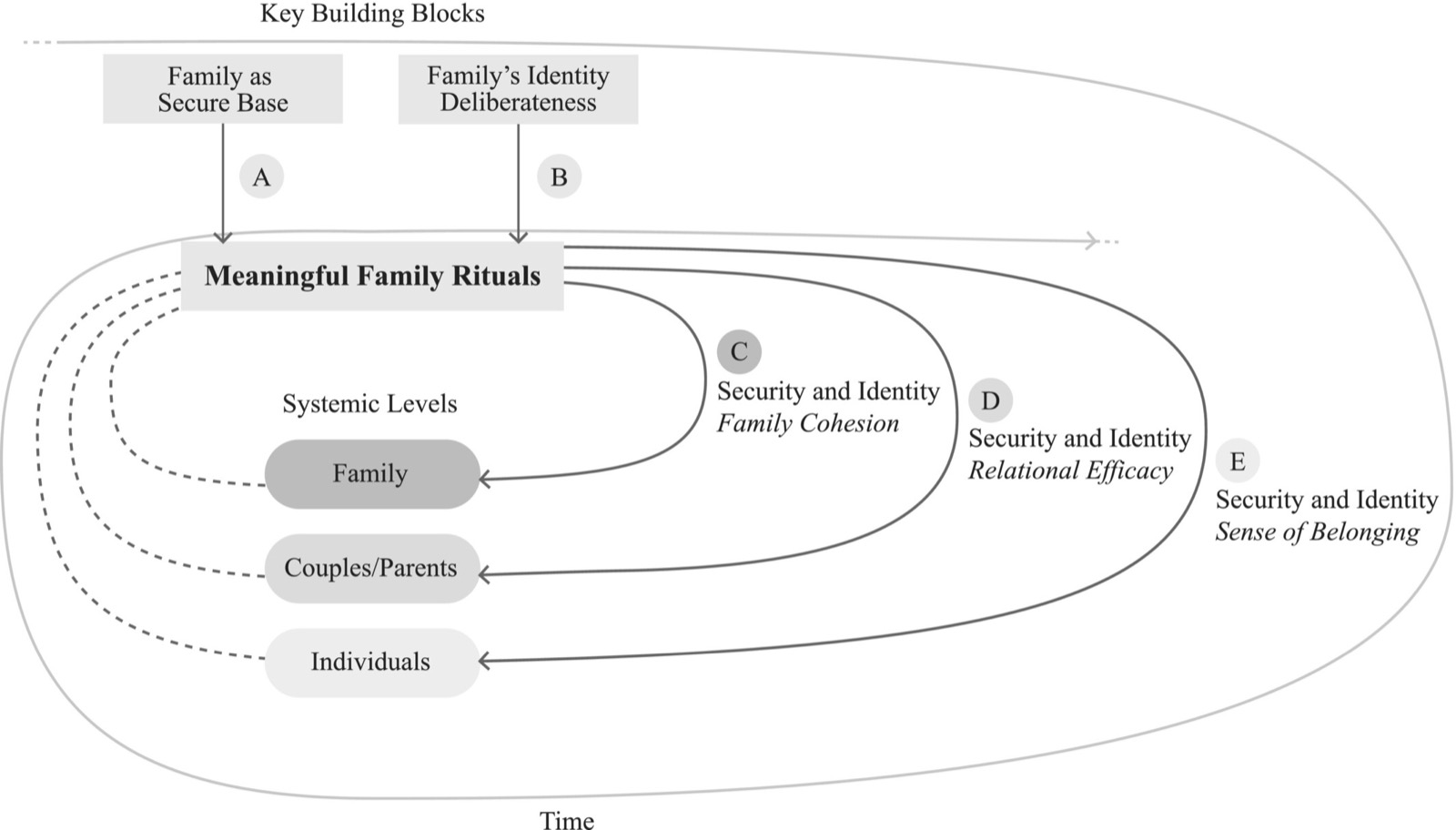
However, only the paths depicted on the right-hand side of the model, corresponding to the core prediction (i.e., rituals as antecedents of health and well-being), are presented in detail, for empirical and theoretical reasons. Most empirical research on rituals has analyzed family rituals as predictors of diverse outcomes for families, couples/parents and individuals. This approach aligns with the theory on rituals, which states that rituals serve important functions for individuals and groups. From a systemic point of view, rituals are situated at the broader family-system level; they are features that remain steady in family life and are less susceptible to change compared to certain relational variables (e.g., relationship satisfaction, parental burnout) and individual adaptation outcomes (e.g., anxiety and depression symptoms, or quality of life).
This model identifies security and identity as two main components that explain family rituals. Security can be broadly understood as a basic human need for stability, predictability and control over one's life. The literature on rituals has extensively highlighted how these events contribute to a general sense of security (e.g., Baele and Balzacq 2022; Myerhoff 1977; Wolin and Bennett 1984). Given that the explicit focus of this model is on family relationships, the conceptualization and examples provided are predominantly related to attachment security, characterized by positive internal working models of both self and others (Bowlby 1969; Mikulincer and Shaver 2016). With regard to identity, I embrace Scabini and Manzi's (2011) definition of family identity as “the patterns of those dimensions that differentiate the family from other identities and constitute its unique set of potentials and represent its true nature” (p. 569). Family identity can be examined at the group level (i.e., the identity of the family system), at the couple/parental level, as this subsystem has its own distinct identity, and at the individual level, meaning the component of identity that emerges from belonging to a particular family (Scabini and Manzi 2011).
In the model, security and identity are considered essential building blocks for the development of meaningful rituals (Paths A and B). Security and identity are also conceptualized as key general processes that explain how family rituals influence outcomes at the family (Path C), couple and/or parental (Path D), and individual (Path E) levels. I advance three key specific processes that contribute to explaining each of the Paths C, D, and E: cohesion, perceived relational efficacy and a sense of belonging, respectively.
3.1 Family as a Secure Base (Path A)
The family can be a secure base when “a network of care is made available for all family members of whatever age so that all family members feel secure enough to explore, in the knowledge that support is available if needed” (Byng-Hall 1995, Abstract). The idea that security in the family is vital for the development of family rituals is not new (Crespo 2012; Fiese 2006; Leon and Jacobvitz 2003). If families hold positive beliefs about relationships and trust in the outside world, they provide a solid foundation for family rituals (Fiese 2006). Taking the formation of a couple as the beginning of a new family, I suggest that at this stage relational security must already be present to provide a fertile context for the making of rituals in a freshly formed family. Relational security prominently refers to the elements of the couple, the architects of the family (Satir 1964) around whose relationship other family relationships are shaped. However, it also involves significant others in the extended family and their own web of relationships. By expanding the concept of attachment security from dyadic relationships to the family system, the whole family can be conceptualized as a source of security (Byng-Hall 1995). In a family that fosters security, there is not only an awareness that attachment relationships must be nurtured, but also an affirmation of a network of people who trust they will take care of each other when needed (Byng-Hall 1995). This contextual security within the family is a prerequisite for individual members to feel motivated to engage in family interactions that are not only time and resource-consuming but are also relationally dense, in the sense that they involve close proximity to other family members in situations that may evoke strong emotions (Roberts 1988). Additionally, some family rituals, particularly life cycle rituals involving loss, such as memorials and funerals, may be occasions when the attachment system is activated.
In a systemic fashion, according to the totality property (i.e., the whole is different from the sum of the parts), beyond the sum of the dyadic attachment relationships within the family, it is important that the whole family is both a secure base and a safe haven in which members can experience these emotionally charged situations together. This specific proposition has been tested only partially, as studies have mainly focused on linking individual attachment dimensions to meaningful family rituals. In one of the few prospective studies on predictors of family rituals, Leon and Jacobvitz (2003) suggested that the flexibility of thought and the ability to regulate strong emotions, which characterize secure adults, are important for carrying out meaningful and regular rituals. They found that insecure attachment in women prior to the birth of their first child was linked to higher routinization of rituals, interpreted by the authors as an indicator of rigidity; another finding was that couples in which one member was insecurely attached and the other securely attached reported a lower meaning of family rituals, which was hypothesized as a result of couples deemphasizing rituals to avoid conflict.
A link between the avoidant dimension of attachment security and lower meaning of family rituals was found cross-sectionally in women in married couples in the community (Crespo et al. 2008) and in the adverse context of couples whose children had cancer (Santos et al. 2016). Individuals with higher levels of attachment avoidance tend to have a less positive orientation towards interactions that imply togetherness and closeness, as well as a less favorable view of their partner and the relationship (Mikulincer and Shaver 2016), which can explain why they may be less motivated to invest in family rituals (Crespo et al. 2008). Further evidence of the importance of security within the family for the enactment of meaningful rituals stems from the descriptions of parents who had recently been homeless (Mayberry et al. 2014). These parents who, at the time of the study, were living with their children in temporary housing arrangements, including shelters and transitional housing programs, described the challenges they faced in trying to maintain routines and rituals under these circumstances. The institutional rules regarding food and meals, lack of privacy, surveillance, and a chaotic environment undermined parental authority, making it difficult for parents to preserve their routines and rituals with their children. Families in insecure contexts can struggle to offer security to their children (Berástegui and Pitillas 2024). I suggest that one way this chain of security is broken is through the disruption of structuring events of family life, such as family rituals. Security within the family, a prerequisite for meaningful rituals, is itself subject to change. It plays a vital role in the early establishment of rituals in family life and is revisited throughout the family's journey over time. Significant disruptions to a sense of security (for instance due to unexpected negative events, such as migration, financial hardship, or illness) may result in shifts in the meaning of rituals.
3.2 Family's Identity Deliberateness (Path B)
Family's identity deliberateness is the family's combined awareness of their identity as a group and engagement in purposeful actions to preserve it. Pioneers Bossard and Boll (1949) stated that “family pride makes for rituals, rituals make for family pride” (p. 468). When family members enjoy reminiscing about family stories and value the specific characteristics that define them as a group, they feel proud to belong to it and are highly motivated to participate in rituals that both reflect and reinforce such positive appraisals. Rituals often represent the face of the family, as they tend to reinvent common rituals and perform them in their own way (e.g., a bi-cultural family where children receive presents from Santa Claus both on the evening of the 24th and the morning of the 25th of December to honor both countries' Christmas traditions), and create specific rituals to mark their uniqueness (e.g., the grandmother's hot chocolate, a yearly winter reunion established by a family with a strong matriarch). Rituals convey a sense of “this is who we are” (Fiese 2006, 11), reaffirming family identity for both insiders and outsiders who join the family on ritual occasions.
I suggest that for meaningful family rituals to develop, families must have an awareness of their identity as a group and take deliberate actions to perpetuate this identity over time; namely they must be proactive and committed to preserving their family identity. The identity of the family as a group is forged across time, often spanning generations. Family therapists recognize this multigenerational influence, attesting to the importance of observing family functioning across at least three generations (Andolfi 2015). Families who honor the past in an affirming and generative manner are more likely to create meaningful rituals imbued with positive affect (Fiese 2006). As rituals store and convey identity (Wolin and Bennett 1984), they serve, in a feedback loop, as a powerful mechanism for families to maintain their identity and paradigm; that is, their unique ways of interacting with the outside world (Reiss 1982). If, conversely, the family history is recalled with negative affect or given little significance, families may develop rigid rituals that are detrimental or tend to neglect these events, leading to an under-ritualized family life (Roberts 1988). Although the latter is not necessarily detrimental to families, it is possible that those who do not gather for special religious or cultural events, or deliberately celebrate individual milestones (e.g., birthdays, graduations) may be foregoing the benefits that rituals are known to foster (Roberts 1988).
The links between family identity and meaningful rituals are not linear. As highlighted by Zentner and Renaud (2007), the formation of family identity involves three components: what the parents intend to transmit to the next generation, the extent to which children receive the intended parental messages, and individual elaboration, concerning how children accept and integrate the patterns from their family of origin. To illustrate the non-linear possibilities of association between family identity and meaningful rituals, I draw on the systemic properties of multifinality (similar starting conditions leading to different outcomes) and equifinality (different starting conditions leading to the same outcome). As regards multifinality, it is possible that siblings raised in a family that strongly emphasized its identity and had a high level of ritualization may have experienced this context differently: one sibling was highly involved in ritual occasions, took great satisfaction from these events, and intentionally chose to continue this tradition when forming a new family; the other sibling, feeling that rituals were rigidly observed and required considerable effort, often relying mainly on the women in the family, may have opted for fewer or less-structured rituals in their adult family life.
As for equifinality, it is possible that both an individual from a highly ritualized family and one from an under-ritualized family may choose to develop meaningful rituals in their adult life. This is the case of a woman I interviewed for a study (Crespo 2007), who, having witnessed the difficulties in relationships and the erosion of joyful moments in her family of origin, consciously decided early on to do differently in her future family, employing a great deal of effort and creativity into crafting family rituals with her husband and three children. These examples demonstrate that family identity, per se, does not guarantee the development of rituals. Instead, there must be a clear intention (whether fully or partially conscious) to continue that identity. Bennett et al. (1988) identified this as deliberateness in their study of children raised in families affected by alcoholism: in cases where families deliberately planned and carried out rituals, children were less likely to report behavioral or emotional problems. In families highly committed to rituals, these events are consciously planned and passed down to the next generation (Wolin and Bennett 1984).
Finally, just as identity without deliberateness is insufficient, deliberateness without a group identity may not result in meaningful rituals. An insightful reflection from Shelkey (2024) illuminates this point. Currently, influencers on social media, posting content on family life, often portray family rituals in an idealized way and suggest tips for achieving unrealistic standards for occasions such as birthdays, mealtimes, or Christmas. Interestingly, some of these messages imply that family rituals can be “family-proof”, such as a promising peaceful Christmas away from extended families or a birthday where everything is organized by paid professionals. While some of these ideas may be helpful to families, rituals must be owned by the family and must reflect the family's core and unique characteristics. Otherwise, ready-made “family ritual recipes” may lead to hollow rituals (van der Hart 1983), which, devoid of a shared unique meaning, cannot promote the benefits that rituals are known to bring to families.
3.3 Family Rituals to Family-Level Outcomes (Path C)
When family strengths are purposely built into the family system, they generate growth for the family unit as a whole (Sheridan et al. 2004). Meaningful rituals are considered one of such strengths, with the present model's path C addressing the processes through which these events promote benefits for families. While there is evidence indicating that interventions endorsing family rituals can increase family happiness (Waters 2020) and improve family communication, which indirectly enhances family health, happiness, and harmony (Ho et al. 2018), there is little insight into the mechanisms that explain these relationships. I begin by addressing the role of the general processes of security and identity before introducing family cohesion as a specific process that clarifies how engaging in meaningful rituals can improve family outcomes.
3.3.1 Security
Rituals have long been recognized as contributors to reducing both individual and collective anxiety (e.g., Hobson et al. 2018; Myerhoff 1977). Specifically, family rituals help ease the uncertainty and challenges encountered outside the family and reduce stress inherent to changes within the family (Fiese 2006; Wolin and Bennett 1984). Leisure activities, such as weekends, vacations and family gatherings, can serve as “safety valves.” (Wolin and Bennett 1984, 7), opportunities for family members to be at ease with each other without the pressures of work and everyday schedules. When the emotional environment of the family is positive and supporting, the time ascribed to family during these events fosters conversations where sensitive topics can be discussed, contributing to the assurance that the family is a safe place (Fiese 2006). In the case of rituals marking life cycle changes, these events also promote security by providing a predetermined formula to contain the discharge of affect (both positive and negative), thereby preserving family stability (Roberts 1988; Wolin and Bennett 1984). Family rituals are considered “an anchor for the family.” (Wolin and Bennett 1984, 8), grounding the group in the here and now, while simultaneously promoting a sense of continuity and constancy by linking the families' past, present and future. Over time, the systematic predictability of rituals allows families to build relational security. When family members generally hold positive expectations about their family, rituals provide a significant mechanism to confirm and reinforce these expectations, promoting a shared perception of the family as a secure, reliable context for belonging (Crespo 2012).
Studies of families of patients with chronic conditions offer particularly valuable insights into the role of family rituals, as health challenges can elicit anxiety among family members and pose a threat to the family as a secure base. A review found that families relied on rituals to achieve a sense of normalcy and provide emotional support amid adversity (Crespo et al. 2013). Engaging in rituals such as family meals, birthday celebrations, and Christmas festivities was considered a way of maintaining a sense of normalcy, by continuing to be just like any other family and as they were before the onset of a health condition affecting one of their members. In a specific study of families where one of the adults had cancer (Buchbinder et al. 2009), both old and new rituals were considered vital for mutual support (e.g., a canvas punching bag with the sentence I hate breast cancer written on it, used by children to express their feelings) and to mark significant milestones during the cancer journey (e.g., a woman who had completed half of her chemotherapy treatment had her family celebrate this milestone with half a cake). In sum, the observance of rituals over time imbues families with security by reinforcing their role as a secure base and safe haven: family members can be free to explore other areas of their lives knowing that there will always be special occasions to reconnect with each other and feel supported when needed.
3.3.2 Identity
One of the most effective ways for families to celebrate and perpetuate their unique features that define their identity and sense of family-ness is via rituals. These provide a means of clarifying roles, rules, and boundaries both within the family and in relation to the outside world, so that all members understand “this is the way our family is” (Wolin and Bennett 1984, 1). Whether it is a child's christening, an adolescent's bar mitzvah or quinceañera (the celebration of an adolescent girl's 15th birthday in Latin America), or a once-in-a-lifetime extended family reunion, families enact these moments in a particular way; this deliberate way of doing things conveys a message about family identity, and each time the ritual is performed, that identity is reinforced. For instance, a couple in their 70s described to me during a research interview (Crespo 2007) the celebration of their 50th wedding anniversary, which included a message they had prepared for their children and grandchildren, entitled there is so much in us that is worth eternalizing. This example reveals how the family's identity is showcased during rituals and how these events solidify commitment to that particular group of people (Watson-Jones and Legare 2016). In cases where rituals are interrupted due to sudden changes within (e.g., death, moving) or outside the family (e.g., war, migration) or skewed, that is, when one side or facet of the family is emphasized at the expense of others, family members may feel that their family identity is not being acknowledged or honored (Roberts 1988). Findings from interview-based studies with members of blended (Braithwaite et al. 1998) and single-parent families (Moriarty and Wagner 2004) have shown that rituals are important to the process of honoring both the old and new family structures and for facilitating cohesion and instilling family values, respectively.
3.3.3 Family Cohesion
Family identity is also expected to be strongly associated with group affiliation. According to social identity theory (Tajfel and Turner 1979), a strong group identity is linked to connectedness among group members. Being connected is essential for the family to function well as a group and to provide a supportive environment for its members. Thus, a more specific process explaining the relevance of family rituals is cohesion, the emotional bond that family members share (Olson et al. 1982). The emotional, cognitive, and behavioral exchanges promoted by rituals allow for the development of a sense of belonging among family members, forming the basis for a cohesive group (e.g., Baele and Balzacq 2022; Watson-Jones and Legare 2016). Additionally, the link between meaningful rituals and family cohesion can be explained by Kelley et al.'s (2002) theory, which posits that relationships are primarily based on interactions among people. The interactions that take place during rituals are frequent, meaningful, and usually extended over long periods, features that contribute to the increased interdependence and closeness of family members.
Research using the Family Ritual Questionnaire (Fiese and Kline 1993) has demonstrated that the meaning of family rituals is associated with family cohesion both longitudinally, that is, when parents reported higher levels of ritual meaning, both parents and adolescents experienced family cohesion 1 year later (Crespo et al. 2011), and cross-sectionally in children and adolescents with cancer and their parents (Santos et al. 2015), youth with asthma (Santos et al. 2012), and college students (e.g., Fiese and Kline 1993; Yang and Wang 2023). While studies so far have mainly tested how cohesion functions as a process (in the aforementioned cases, a mediator), explaining the relationship between the meaning of family rituals and family members' individual outcomes, it is plausible that this rationale operates similarly for family- level outcomes, given that cohesion is a key feature of family functioning. A word of caution is needed against linear cause–effect interpretations of how rituals function within families, particularly given that causality can be elusive, especially when analyzing variables at the whole-family level (Fiese 2006). As suggested by Fiese et al. (2002) and as found in one of the rare longitudinal studies on this topic, family ritual meaning and cohesion revealed bidirectional links in a sample of parents of adolescents (Crespo et al. 2011). This finding does not undermine the view that rituals promote cohesion and that cohesion is a key process in explaining their benefits for families; on the contrary, it contributes to a more nuanced understanding of family-level phenomena by integrating the conceptualization and testing of bidirectional temporal links between relevant variables.
3.4 Family Rituals to Couple and Parental-Level Outcomes (Path D)
The couple and/or the parents are at the center of family life. While in some families these subsystems are formed by the same individuals, in other families, there may be a couple without children or a parental team, that is, coparents, who are not in a romantic relationship. With regard to couple-level variables, family ritual meaning has been linked to marital satisfaction in parents of preschool children (Fiese et al. 1993) and to marital satisfaction and closeness in women, but not men, in a sample of couples across the life cycle (Crespo et al. 2008). Interestingly, another type of ritual, referred to as couple or relationship rituals, has been linked to higher relationship satisfaction (e.g., Pearson et al. 2010). Although the analysis of these rituals is beyond the scope of this work, it highlights the relevance of rituals within families for specific subsystems, such as couples, parent–child dyads or even siblings, in fostering relationships.
With regard to parental outcomes, when parents reported higher levels of family ritual meaning, they also reported lower levels of parental burnout in a community sample (Lisboa-Lima et al. 2025) and higher parental satisfaction and efficacy in a sample of families with children with epilepsy (Mendes et al. 2018). Dinnertime rituals have been found to be protective in working-class families, buffering the effects of parental stress on children's problems (mainly fathers' stress and daughters' internalizing symptoms; Yoon et al. 2015). From an adolescent perspective, when they reported greater participation in family rituals, they also perceived their parents to be more supportive of them (Li et al. 2024). Taken together, these findings support the assumption that meaningful family rituals contribute to better outcomes for couples and parents. I now propose how security and identity, in general, and perceived relational efficacy, specifically, may explain the importance of meaningful rituals for these two subsystems.
3.4.1 Security
Meaningful rituals are occasions that emphasize closeness and togetherness. If both partners in a relationship agree on how rituals should be developed and derive gratification from these events, their relationship is likely to flourish (Crespo 2012). One reason for this may be that positive views of themselves, their partners, and their relationships are reinforced each time a ritual occurs. When meaningful and positive, rituals can be considered experiences that sustain and foster attachment security. Although studies, to date, have primarily tested relationship attachment as a predictor of family ritual meaning (path A), it is plausible that, over time, rituals themselves also promote attachment security (Crespo 2012). A study assessing young adults' romantic attachment found that stronger family ritual meaning in the family of origin was related to lower levels of romantic attachment anxiety, even after controlling for their parents' attachment (Homer et al. 2007). These findings suggest that being raised within families with meaningful rituals may equip young people to develop more secure (less anxious) future couple relationships.
Furthermore, a study with dating couples found that engaging in each other's family rituals provided a template for a future ritual life with that partner and their family (Maniotes et al. 2020). The participation in these rituals and the way partners discussed and engaged with them had an echoing effect on the couple's relationship. On these occasions, certain relationship features were heightened and became diagnostic tools generating more or less certainty about the future of that partnership for dating couples (Maniotes et al. 2020). When partners are in tune with each other and both derive joy and meaning from family rituals, commitment to one another and to the relationship can be enhanced. Rituals can also serve as occasions for couples, especially young ones, to feel supported by both their families of origin and extended families. This support creates a favorable context for their own relationship to develop as, systemically, security fosters security (Berástegui and Pitillas 2024). Similarly, positive whole-family interactions during rituals can contribute to parents' ability to foster security for their children as they know they have the support of the broader family system. The implicit, and often explicit, reference to the family's history and ancestors during extended family gatherings (e.g., Christmas or life cycle ceremonies such as weddings and funerals) contributes to this sense of belonging to a group, affirming that the couple/parents do not stand alone. Another example of this can be found in the Indian birth ritual called chhati, a ceremony in which the baby is given a special, ritualized bath shortly after birth (Legare and Nielsen 2020). Performed among Hindu families, this ritual serves not only the function of welcoming babies into their families and communities but also of reducing parental anxiety and increasing feelings of control over the health of the child. Similarly, in some African regions, it is customary for the grandmother or an elderly woman in the family to carry out the baby's first bath, symbolizing that the newborn and the parents can rely on the support of the community. Patterned interactions such as mealtimes or bedtimes with children may be especially important for parents to experience a sense of family life, which may reduce insecurities regarding their parental role.
3.4.2 Identity
The identity of the couple (who we are as a couple) and the parental subsystems (who we are as parents) is shaped by whole-family ritual events. The way couples/parents interact during these events and the roles they assume are likely to influence how they appraise themselves as partners, parents and as a unit within the family. A couple in their 40s I interviewed for research (Crespo 2007) described how their engagement in family rituals differed from that of other family members. Unlike their siblings and in-laws, where women typically took on the bulk of the household chores needed for rituals, the man took charge of cooking for the extended family during birthdays and Christmas. Their contrasting approach to ritual responsibilities, often the subject of family jokes, defied the status quo of their generation regarding the gendered division of domestic labor, affirming them as a progressive, egalitarian couple, in which they took pride. A contrasting example in this study came from a newlywed couple where the wife was Catholic and the husband an atheist (Crespo 2007). During the celebrations of Easter at the wife's family home, the man grew increasingly uncomfortable with the specific religious rites observed by the family and refused to partake in some of them; the woman, deeply saddened by this, struggled to understand why her husband did not make an effort to engage with her family's traditions. This incident caused significant distress for the couple, who reported uncertainty about their identity as a couple and expressed concerns about what their relationship would be like once they had children. This anecdote illustrates Fiese and Tomcho's (2001) finding that wives' marital satisfaction was influenced by their husbands' participation in religious holiday rituals. Similar experiences can be found in other narratives of family gatherings where parents feel criticized or undermined in their parental role by other family members. In the aftermath of situations such as these, couples may feel disconnected from the family system and uncertain about their identity, both as a couple and as parents.
3.4.3 Relational Efficacy
In terms of the specific mechanism for this path, I suggest that perceived relational efficacy, that is, how competent individuals feel in their family roles, can clarify how meaningful family rituals promote better outcomes for parents and couples. Self-determination theory posits that competence, along with autonomy and relatedness, is a human need that, when fulfilled, allows for growth and development (Ryan and Deci 2017). The specific concept of relational efficacy was first advanced by Fiese (2006), who argued that rituals are associated with feelings of competence and self-efficacy. In line with Bandura's (1978) proposal, individuals build a strong sense of efficacy by engaging in mastery experiences, which provide evidence that they have what it takes to succeed in a specific area or role. This experience is the case for the parental role, with Spagnola and Fiese (2006) suggesting that family rituals can nurture better parenting. The underlying rationale is that the predictable structure offered by rituals guides behavior and ensures an emotional climate that is supportive of children's socioemotional, academic and linguistic development (Spagnola and Fiese 2007). When parents feel competent in carrying out and participating in family events, they may be better prepared for the tasks of supervising and helping children engage in healthy activities (Spagnola and Fiese 2007). The reliable and affective interactions that occur during ritual events create a supportive environment that facilitates parenting tasks. This proposition is supported by at least two empirical studies linking family ritual meaning to quality of life (Lisboa-Lima et al. 2025; Mendes et al. 2018) and lower psychological distress (Mendes et al. 2018) via reduced parental burnout and increased parental satisfaction and efficacy, respectively.
While perceived relational efficacy has been mainly conceptualized and tested for how people perceive themselves as competent parents, it is reasonable to expect this mechanism to apply to how couples perceive themselves as a capable and worthy team. Support for this idea comes from the contrasting stories of two couples. The first couple, who did not have children, described to me how they assumed a central role in the family by being available to support their parents, siblings, nephews, and nieces and by taking the lead in organizing family rituals (e.g., family gatherings, such as birthdays, and visiting one of the parents on the first anniversary of their stepmother's passing). This family kinkeeper role described in the literature and usually attributed to women in the middle generation (Leach and Braithwaite 1996) was, in this case, endorsed by the couple. The joint ability to support the family and take the lead in family rituals was perceived by them as one of the strengths of their relationship. In contrast, the second couple told me in a research interview (Crespo 2007) how hosting gatherings at home often resulted in mutual criticism and relationship conflict: the wife felt overwhelmed but refused the husband's assistance, citing his inability to cook properly or choose the appropriate dinnerware. As markers of how well we're doing as a team, family rituals can, thus, affirm or undermine couples' and co-parents' sense of competence, depending on how these occasions are experienced—as an achievement or a letdown.
3.5 Family Rituals to Individual Outcomes (Path E)
The bulk of research on the benefits of family rituals has focused on the links between the meaning of these events and individual health and well-being outcomes. The evidence is now well established, with studies finding, for instance, higher levels of ritual meaning associated with: children's better quality of life both in normative and pediatric health conditions (cancer, Santos et al. 2018; asthma, Santos et al. 2012), higher levels of hope in children with cancer (Santos et al. 2018), and lower levels of anxiety and emotional and behavioral problems in children with asthma (Markson and Fiese 2000; Santos et al. 2012). Evidence is also found in adolescents' higher levels of well-being (Crespo et al. 2011), meaning of life and friendship quality (Li et al. 2024), social connectedness and fewer depressive and anxiety symptoms (Malaquias et al. 2015); young adults' lower attachment anxiety (Homer et al. 2007), better quality of life (Fonseca et al. 2024), and adults' lower levels of anxiety (Fiese and Kline 1993), quality of life both in normative settings (Lisboa-Lima et al. 2025) and in adults who parented a child with a chronic health condition such as epilepsy (Mendes et al. 2018) or cancer (Santos et al. 2018). Research has identified both direct and indirect links between family ritual meaning and positive individual outcomes, with indirect links often operationalized through family or parental level variables. This reinforces the idea that the role of rituals for individuals is explained by these events' contribution to more cohesive and supportive families. The link between family rituals and individual health and well-being may be further understood through the model's focus on security and identity processes in general, and sense of belonging in particular.
3.5.1 Security
Children develop a sense of security through their connection and identification with those who care for them (McGoldrick et al. 2011). Family rituals are privileged occasions for family members to connect with one another, allowing children to experience what it means to belong to a particular family. A sense of security can be derived from these family interactions: if they are positive and meaningful, children can feel they belong to a context where people nurture and take care of each other, as evidenced by the links between family ritual meaning and lower levels of anxiety in children with asthma (Markson and Fiese 2000), and indirectly, through improved social connectedness, in adolescents in a community sample (Malaquias et al. 2015). While this sense of security is important for the development of children and adolescents in general, it may be especially important when they have a health condition and depend on family members, typically parents, to take on caregiving health-related tasks.
Whole-family events, such as celebrations and traditions, can help establish the family as a secure context; however it is in patterned interactions that parents assume a more central role. When parents cooperate as a team in carrying out meaningful family rituals, this too can serve as an experience of security for children. I suggest that family rituals may contribute to interparental positivity (i.e., positive relational interactions among parents), associated with children's short- and long-term growth and development (Don et al. 2024). Given that experiences of security during childhood influence relational security later in life, it is possible that the benefits of belonging to a family with a strong attachment to rituals can persist into adulthood. Although there are no longitudinal studies to my knowledge specifically addressing this hypothesis, a study by Homer (e.g., 2007) found that young adults who reported stronger ritual meaning in their family of origin also reported lower levels of attachment anxiety. Similarly, in a sample of undergraduate university students, Fiese and Kline (1993) found that those who reported stronger family ritual meaning also scored lower in general anxiety. Studies conducted in contexts of heightened adversity provide particularly valuable insights into how rituals foster security. For instance, in mothers of children with cancer, the link between financial burden and anxiety was buffered by family ritual meaning (Santos et al. 2016). This supports the long-standing idea that rituals can act as protective factors for individuals in times of stress.
3.5.2 Identity
There is a component of individual identity that comes from being part of a specific family group (Scabini and Manzi 2011). In cohesive families, there is an expectation that family members will accept each other's idiosyncrasies and celebrate each individual's uniqueness (Fiese 2006). Specific rituals that acknowledge individual milestones, such as birthdays, graduations or Mother's and Father's Day, can provide occasions for a person to feel celebrated by their family. These rituals can make individuals feel acknowledged as valued family members with unique characteristics. The family identity conveyed through rituals provides a mirror in which each family member can see themselves reflected, whether by identification or contrast (I love singing just like most of my family, or I am the one who dislikes singing in a family of singers).
Research findings suggest that rituals contribute to a child's early sense of self. A study by Klavir and Leiser (2002) found that many 4-year-old children believed that birthday parties actually caused growth. Rituals can also ease transitions related to a family member's identity, both for themselves and for the entire family. In a study describing therapeutic interventions with transgender, gender-diverse and non-binary young people, Keeley (2022) showed that the creation of new family rituals, such as a renaming ritual for the youth, alleviated anxiety and helped the family move forward in the process of the identity change experienced by their family member.
3.5.3 Sense of Belonging
One potential pathway to fulfilling the key human need for relatedness (Ryan and Deci 2017) is through the development of a sense of belonging to a group. An additional, specific way in which meaningful family rituals serve as important resources for individual growth and development is by fostering a sense of belonging within the family. Family rituals, from birth onward, signal to children that they are members of an in-group, first through observation and later through gradual increases in active participation as they develop the ability to do so (Erikson 1977). Rituals are known to promote affiliation with the group (e.g., Hobson et al. 2018). For instance, children between the ages of 4 and 11 who participated in a ritual showed greater in-group affiliation than those who engaged in group activities alone (Wen et al. 2016). Studies on youth in foster care contribute to substantiating the idea that rituals enhance a sense of belonging (Ie et al. 2022; Larsson et al. 2025). For instance, children in foster families or those whose custody had been transferred (Larsson et al. 2025) identified, holidays, such as Christmas and birthdays, in addition to everyday interactions, as occasions that influenced their sense of belonging. University students reported feeling the strongest sense of family belonging on special days that include ritual occasions, such as weddings, graduations, engagements, birthdays, and religious holidays (Aslantürk and Mavili 2020). Another study (Hanke et al. 2016) found that LGBT adults who reported higher ritual meaning in their family of origin also felt that both they and their partners were included in these ritual events. They exhibited a lower sense of obligation to participate in them; these positive appraisals were associated with relatedness to their family and flourishing, a proxy for social psychological prosperity. Meaningful rituals that involve family members, their chosen partners, and families promote a sense of connection that influences well-being. In sum, being part of a family that is accepting and supportive addresses the human need to belong and connect, making it a powerful resource for individuals.
3.6 Time
A key skill for families as they move through the various stages of the family life cycle is flexibility (McGoldrick et al. 2011). This principle also applies to family rituals, with foundational authors unanimously emphasizing the importance of a family's flexibility to adapt their rituals (Fiese 2006; Roberts 1988). Change is inevitable for families, whether due to life cycle events (births, deaths, and developmental milestones of family members, as well as additions and exits through unions, marriages, and divorces), or from unexpected changes such as a diagnosis of a chronic condition, unemployment, migration, or historical events like war or pandemics. These are considered second-order changes that require the family to change itself as a system; the ability to maintain meaningful family rituals becomes a valuable resource for families both during such transitions and in the long term. When confronted with these changes, families can opt to cease rituals that are no longer meaningful, adapt old rituals (keeping their key closed parts so as not to lose meaning) and create new rituals that address new needs or the emotional climate of the family. As Fiese (2006) noted “developmental transitions provide opportunities, as well as challenges to negotiate routines and create meaningful rituals that can enrich family life” (p. 62).
Developmental changes require that family members adopt new roles, both in general and within the context of ritual occasions. Children born into a particular family are typically included in their rituals from an early age. When children are assigned specific roles in family traditions and celebrations, they begin to build a sense of competence (Fiese 2006). Children increasingly have a say in the family's shared activities, making them key players in the creation and maintenance of family rituals. Children's roles may change significantly as they reach adolescence, when they can provide agency to rituals more intentionally. Adolescents, as future ritual makers (Erikson 1977), can be increasingly supported in taking a more active role in these family occasions, such as by cooking a special dish or having a say in the planning of their birthday celebrations; members of the older generation can pass the torch of the family kinkeeper to the middle generation, enabling them to continue contributing meaningfully to family occasions while ensuring the middle generation is prepared to lead and take on the load of organizing these potentially time- consuming events. In terms of unexpected changes, research on families coping with a child or parent's cancer provides a vivid picture of how families implement changes. Santos et al. (2018) reported how parents of children undergoing cancer treatment had to: skip attending family rituals that involved long-distance travel or large gatherings; adapt their birthday parties to minimize exposure to potential risks (children seeing their friends and family with banners and balloons through the window or downsizing the number of guests in a home party); and create new rituals, such as bedtime rituals, that increased children's security and reinforced that the family was watching over them.
4 Limitations and Implications for Research
As with any theoretical model, the family systems' spiral model of family rituals has limitations; by conceptualizing it as a mid-range model, I have focused on a specific piece of the phenomenon of rituals: the role of family rituals for outcomes in families, subsystems and individuals, leaving other aspects underdeveloped or unaddressed. First, a key limitation is the fact that this model does not explicitly conceptualize wider systems, such as the social and cultural context in which families are embedded. Rituals, especially traditions and celebrations, are heavily influenced by the surrounding culture, while simultaneously serving as important mechanisms for the transmission of cultural values to younger generations. Cross-cultural comparisons contrasting rituals across more collectivist and individualist contexts, as well as qualitative studies with migrant families, could enlighten understanding of how the relationship between family rituals and cultural background may influence family and individual outcomes. Macro-systemic factors, such as rising political polarization leading to violence, can affect how family members with divergent views interact during ritual gatherings.
Second, another factor not addressed in this model is the socioeconomic status (SES) of families. The literature indicates that, in certain circumstances, families may struggle to find time to organize and implement family events (Bossard and Boll 1949; Fiese 2006). Nonetheless, rituals have also been shown to serve as protective factors for the adjustment of mothers of children with cancer who face financial burdens (Santos et al. 2016) and families of emerging adults experiencing economic strain (Fonseca et al. 2024). A closer examination of families from diverse SES backgrounds and those experiencing economic stress is also important to expand the knowledge on the benefits of rituals.
Third, gender was also not explicitly addressed in this model. While most research has not tested gender differences, some studies have found that the direct effects of rituals were only evident for women (e.g., Crespo et al. 2008) or were stronger for women (e.g., Lisboa-Lima et al. 2025). Gender roles (e.g., women being socialized to pay more attention and time to nurturing relationships) can potentially explain these findings, but further research is needed to investigate how the intersectionality of culture, SES, and gender is experienced by women and men carrying out family rituals in the twenty-first century.
Fourth, the conceptualization of circular causality (as represented by the hypothesized spiral linking the left and right sides of the model) has its caveats. While it mirrors the systemic nature of relationships within the family system, it may lead to confusion when operationalizing the model. I suggest that, when using cross-sectional data, authors test the direction of effects as presented on the right-hand side of the model; whenever longitudinal research is possible, bidirectional effects between family rituals and other variables should be tested, given the complexity of the web of relationships of influence within the family system and the scarcity of longitudinal research on this topic.
Finally, the decision to depict family rituals as a resource within a strengths-based framework has limited the extent to which negative experiences are acknowledged. For some individuals and families, rituals may represent occasions of exclusion, loss, or the perpetuation of grief. Future developments of this model should address the flip side of rituals as strength, namely how ritual occasions may serve as vehicles for insecurity and feelings of not belonging. Despite its limitations, this model was designed to be open to revision and generative in nature, offering a foundation for future complementary theories on rituals, a universally relevant construct for families.
5 Conclusion
In 2002, Fiese and colleagues acknowledged the anniversary of 50 years of research on family rituals as a cause for celebration. Building on foundational theories, this article jubilantly marks its 75th anniversary, a milestone for this field of study since Bossard and Boll's (1950) study. I have revisited core aspects of family ritual theory and proposed the need for a timely reevaluation of this theoretical body. I then presented a mid-range model based on family systems theory, hypothesizing how meaningful family rituals are associated with outcomes at the family, couple/parental and individual levels. Security and identity were identified as key building blocks in the creation of meaningful family rituals, as well as processes through which ritual meaning links to outcomes. For each systemic level, I identified three specific processes that explain these links: cohesion, perceived relational efficacy, and sense of belonging. Although family rituals may not be the only, or the most parsimonious way of understanding family impacts on development (Fiese 2006), these universal natural events are unequivocally important for families today. Ultimately, family rituals hold substantial applied potential. The existing body of theoretical and empirical knowledge positions family rituals as an intervention resource. By supporting families in their rituals and designing and testing interventions to foster them, researchers and professionals who work with families can bridge the gap between family theories and their core finality of improving families' lives.
Complexe Systémique: key points
This paper gives rituals back their place as an ordinary family resource, beyond therapeutic prescription alone. Two ideas are directly useful in session. First, the distinction between the open and closed parts of a ritual: when a family goes through bereavement, migration, illness or repartnering, the task is neither to keep the ritual unchanged nor to drop it, but to identify what must remain for the meaning to hold. Second, circularity: rituals require security and an owned identity, and they produce them in return, which explains why a family under strain often stops gathering just when it would need it most. The critical reading comes from the text itself: the model favours strengths and leaves aside culture, social background and gender, whereas the burden of celebrations often falls on women and rituals can exclude (the partner who must be hidden, the aunt who is not invited) and trap people in double binds. Read alongside the article on health-giving rituals in human systems, and the article on migration, ambiguous loss and rituals.
Notes from the original
Acknowledgement. Open access publication funding provided by FCT (b-on).
Conflicts of interest. The author declares no conflicts of interest.
References
Adamsons, K., and K. A. Crossman. 2022. “Mid-Range Theories About Families: A Primer and Introduction to the Special Issue.” Journal of Family Theory & Review 14, no. 2: 111–122. https://doi.org/10.1111/jftr.12464.
Andolfi, M. 2015. Multigenerational Family Therapy. Routledge.
Aslantürk, H., and A. Mavili. 2020. “The Sense of Family Belonging in University Students From a Single Parent Family Compared With Those From a Two-Biological-Parent Family.” Current Psychology 39: 2026–2039. https://doi.org/10.1007/s12144-020-00725-0.
Baele, S. J., and T. Balzacq. 2022. “International Rituals: An Analytical Framework and Its Theoretical Repertoires.” Review of International Studies 48, no. 1: 1–23. https://doi.org/10.1017/S0260210521000401.
Bandura, A. 1978. “Self-Efficacy: Toward a Unifying Theory of Behavioral Change.” Advances in Behaviour Research and Therapy 1, no. 4: 139–161. https://doi.org/10.1016/0146-6402(78)90002-4.
Bennett, L. A., S. J. Wolin, and D. Reiss. 1988. “Deliberate Family Process: A Strategy for Protecting Children of Alcoholics.” British Journal of Addiction 83, no. 7: 821–829. https://doi.org/10.1111/j.1360-0443.1988.tb00517.x.
Berástegui, A., and C. Pitillas. 2024. “The Family Keyworker as a Critical Element for Attachment Resilience in the Face of Adversity.” Journal of Family Theory & Review 16, no. 1: 106–123. https://doi.org/10.1111/jftr.12537.
Bossard, J. H. S., and E. S. Boll. 1949. “Ritual in Family Living.” American Sociological Review 14: 463–469. https://doi.org/10.2307/2087208.
Bossard, J. H. S., and E. S. Boll. 1950. Ritual in Family Living. University of Pennsylvania Press.
Bowlby, J. 1969. Attachment and Loss: Vol. I. Attachment. Basic Books.
Braithwaite, D. O., L. A. Baxter, and A. M. Harper. 1998. “The Role of Rituals in the Management of the Dialectical Tension of ‘Old’ and ‘New’ in Blended Families.” Communication Studies 49, no. 2: 101–120. https://doi.org/10.1080/10510979809368523.
Buchbinder, M., J. Longhofer, and K. McCue. 2009. “Family Routines and Rituals When a Parent Has Cancer.” Families, Systems, & Health 27, no. 3: 213–227.
Byng-Hall, J. 1995. “Creating a Secure Family Base: Some Implications of Attachment Theory for Family Therapy.” Family Process 34, no. 1: 45–58. https://doi.org/10.1111/j.1545-5300.1995.00045.x.
Byung-Chul, H. 2020. The Disappearance of Rituals. Polity Press.
Crespo, C. 2007. “Rituais familiares e o casal: Paisagens inter-sistémicas [Family rituals and the couple: Inter-systemic landscapes].” Doctoral diss., University of Lisbon. http://hdl.handle.net/10451/42437.
Crespo, C. 2012. “Families as Contexts for Attachment: Reflections on Theory, Research, and the Role of Family Rituals.” Journal of Family Theory & Review 4, no. 4: 290–298. https://doi.org/10.1111/j.1756-2589.2012.00136.x.
Crespo, C., I. N. Davide, M. E. Costa, and G. J. O. Fletcher. 2008. “Family Rituals in Married Couples: Links With Attachment, Relationship Quality, and Closeness.” Personal Relationships 15, no. 2: 191–203. https://doi.org/10.1111/j.1475-6811.2008.00193.x.
Crespo, C., M. Kielpikowski, J. Pryor, and P. E. Jose. 2011. “Family Rituals in New Zealand Families: Links to Family Cohesion and Adolescents' Well-Being.” Journal of Family Psychology 25, no. 2: 184–193. https://doi.org/10.1037/a0023113.
Crespo, C., and A. P. Relvas. 2024. “Celebrating the “Good-Enough Families”: Family Challenges and Resilience During Global Adversity.” Journal of Family Theory & Review 16, no. 1: 7–16.
Crespo, C., S. Santos, M. C. Canavarro, M. Kielpikowski, J. Pryor, and T. Féres-Carneiro. 2013. “Family Routines and Rituals in the Context of Chronic Conditions: A Review.” International Journal of Psychology 48, no. 5: 729–746. https://doi.org/10.1080/00207594.2013.806811.
Daly, K. 2003. “Family Theory Versus the Theories Families Live by.” Journal of Marriage and Family 65, no. 4: 771–784. https://doi.org/10.1111/j.1741-3737.2003.00771.x.
Don, B. P., J. A. Simpson, B. L. Fredrickson, and S. B. Algoe. 2024. “Interparental Positivity Spillover Theory: How Parents' Positive Relational Interactions Influence Children.” Perspectives on Psychological Science 20, no. 4: 639–668. https://doi.org/10.1177/17456916231220626.
Erikson, E. 1977. Toys and Reasons–Stages in the Ritualization of Experience. Norton.
Fiese, B. H. 2006. Family Routines and Rituals. Yale University Press.
Fiese, B. H., K. A. Hooker, L. Kotary, and J. Schwagler. 1993. “Family Rituals in the Early Stages of Parenthood.” Journal of Marriage and Family 55, no. 3: 633–642. https://doi.org/10.2307/353344.
Fiese, B. H., and C. A. Kline. 1993. “Development of the Family Ritual Questionnaire: Initial Reliability and Validation Studies.” Journal of Family Psychology 6, no. 3: 290–299.
Fiese, B. H., and T. J. Tomcho. 2001. “Finding Meaning in Religious Practices: The Relation Between Religious Holiday Rituals and Marital Satisfaction.” Journal of Family Psychology 15, no. 4: 597–609. https://doi.org/10.1037/0893-3200.15.4.597.
Fiese, B. H., T. J. Tomcho, M. Douglas, K. Josephs, S. Poltrock, and T. Baker. 2002. “A Review of 50 Years of Research on Naturally Occurring Family Routines and Rituals: Cause for Celebration?” Journal of Family Psychology 16, no. 4: 381–390. https://doi.org/10.1037//0893-3200.16.4.381.
Fonseca, G., B. de Sousa, C. Crespo, and A. P. Relvas. 2024. “Economic Strain and Quality of Life Among Families With Emerging Adult Children: The Contributions of Family Rituals and Family Problem-Solving Communication.” Family Process 63, no. 3: 1319–1335. https://doi.org/10.1111/famp.12884.
Grimes, R. 1982. Beginnings in Ritual Studies. University Press of America.
Hanke, K., M. C. van Egmond, C. Crespo, and D. Boer. 2016. “Blessing or Burden? The Role of Appraisal for Family Rituals and Flourishing Among LGBT Adults.” Journal of Family Psychology 30, no. 5: 562–568. https://doi.org/10.1037/fam0000214.
Ho, H. C. Y., M. Mui, A. Wan, et al. 2018. “Family Meal Practices and Well-Being in Hong Kong: The Mediating Effect of Family Communication.” Journal of Family Issues 39, no. 16: 3835–3856. https://doi.org/10.1177/0192513X18800787.
Hobson, N. M., J. Schroeder, J. L. Risen, D. Xygalatas, and M. Inzlicht. 2018. “The Psychology of Rituals: An Integrative Review and Process-Based Framework.” Personality and Social Psychology Review 22, no. 3: 260–284. https://doi.org/10.1177/1088868317734944.
Homer, M. M., P. A. Freeman, R. B. Zabriskie, and D. L. Eggett. 2007. “Rituals and Relationships: Examining the Relationship Between Family of Origin Rituals and Young Adult Attachment.” Marriage & Family Review 42, no. 1: 5–28. https://doi.org/10.1300/J002v42n01_02.
Ie, J., M. Ursin, and M. Vicente-Mariño. 2022. “Foster Children's Views of Family: A Systematic Review and Qualitative Synthesis.” Children and Youth Services Review 132: 106337. https://doi.org/10.1016/j.childyouth.2021.106337.
E. Imber-Black, J. Roberts, and R. A. Whiting, eds. 1988. Rituals in Families and Family Therapy. Norton & Company.
Imber-Black, E. 2020. “Rituals in the Time of COVID-19: Imagination, Responsiveness, and the Human Spirit.” Family Process 59, no. 3: 912–921. https://doi.org/10.1111/famp.12581.
Keeley, S. 2022. “Integrative Family Therapy With Transgender, Gender Diverse, and Non-Binary (TGDNB) Young People.” Australian and New Zealand Journal of Family Therapy 43: 151–162. https://doi.org/10.1002/anzf.1480.
Kelley, H., E. Berscheid, A. Christensen, et al. 2002. Close Relationships. 2nd ed. Eliot Werner Publications.
Klavir, R., and D. Leiser. 2002. “When Astronomy, Biology and Culture Converge: Children's Conceptions About Birthday Parties.” Journal of Genetic Psychology 163, no. 2: 239–253.
Larsson, S., E. Punzi, and T. Wissö. 2025. “To Belong: Narratives About Family Belonging Among Children in Foster Families or Where Custody Has Been Transferred.” Child and Adolescent Social Work Journal 42: 619–633. https://doi.org/10.1007/s10560-024-00981-0.
Leach, M. S., and D. O. Braithwaite. 1996. “A Binding Tie: Supportive Communication of Family Kinkeepers.” Journal of Applied Communication Research 24, no. 3: 200–216. https://doi.org/10.1080/00909889609365451.
Legare, C. H., and M. Nielsen. 2020. “Ritual Explained: Interdisciplinary Answers to Tinbergen's Four Questions.” Philosophical Transactions of the Royal Society of London. Series B, Biological Sciences 375, no. 1805: 20190419. https://doi.org/10.1098/rstb.2019.0419.
Leon, K., and D. B. Jacobvitz. 2003. “Relationships Between Adult Attachment Representations and Family Ritual Quality: A Prospective, Longitudinal Study.” Family Process 42, no. 3: 419–432. https://doi.org/10.1111/j.1545-5300.2003.00419.x.
Li, X., Y. Du, H. Zhou, W. Xi, M. Wu, and Y. Hu. 2024. “Family Rituals and the Quality of Adolescents' Friendships: The Serial Mediating Role of Perceived Parental Support and the Meaning in Life.” Current Psychology 44: 17707–17717. https://doi.org/10.1007/s12144-024-06902-9.
Lisboa-Lima, M., T. M. Nguyen, I. Hasse, and C. Crespo. 2025. “Family Rituals and Quality of Life: The Mediating Role of Parental Burnout.” Journal of Marital and Family Therapy 51, no. 2: e70005. https://doi.org/10.1111/jmft.70005.
Malaquias, S., C. Crespo, and R. Francisco. 2015. “How Do Adolescents Benefit From Family Rituals? Links to Social Connectedness, Depression and Anxiety.” Journal of Child and Family Studies 24, no. 10: 3009–3017. https://doi.org/10.1007/s10826-014-0104-4.
Maniotes, C. R., B. G. Ogolsky, and J. L. Hardesty. 2020. “Destination Marriage? The Diagnostic Role of Rituals in Dating Relationships.” Journal of Social and Personal Relationships 37, no. 12: 3102–3122. https://doi.org/10.1177/0265407520952166.
Markson, S., and B. H. Fiese. 2000. “Family Rituals as a Protective Factor for Children With Asthma.” Journal of Pediatric Psychology 25, no. 7: 471–479. https://doi.org/10.1093/jpepsy/25.7.471.
Mayberry, L. S., M. Shinn, J. G. Benton, and J. Wise. 2014. “Families Experiencing Housing Instability: The Effects of Housing Programs on Family Routines and Rituals.” American Journal of Orthopsychiatry 84, no. 1: 95–109. https://doi.org/10.1037/h0098946.
M. McGoldrick, B. Carter, and N. Garcia-Preto, eds. 2011. The Expanded Family Life Cycle. Individual, Family, and Social Perspectives. 4th ed. Allyn & Bacon.
Mendes, T. P., C. A. Crespo, and J. K. Austin. 2018. “Family Rituals in Pediatric Epilepsy: Links to Parental Competence and Adaptation.” Journal of Family Psychology 32, no. 2: 165–174. https://doi.org/10.1037/fam0000359.
Mikulincer, M., and P. R. Shaver. 2016. Attachment in Adulthood: Structure, Dynamics, and Change. 2nd ed. Guilford Press.
Mondal, S. 2024. “Living in a Limbo: A Sociological Study of Missing Funerals, Death Rituals, and Complicated Grief in COVID-19.” Illness, Crisis & Loss 32, no. 2: 228–243. https://doi.org/10.1177/10541373221131760.
Moriarty, P. H., and L. D. Wagner. 2004. “Family Rituals That Provide Meaning for Single-Parent Families.” Journal of Family Nursing 10, no. 2: 190–210. https://doi.org/10.1177/1074840704263985.
Myerhoff, B. 1984. “Rites and Signs of Ripening: The Intertwining of Ritual, Time, and Growing Older.” In Age & Anthropological Theory, edited by D. I. Kertzer and J. Keith, 305–330. Cornell University Press.
Myerhoff, B. G. 1977. “We Don't Wrap Herring in a Printed Page: Fusion, Fictions and Continuity in Secular Ritual.” In Secular Ritual, edited by S. F. Moore and B. G. Myerhoff, 199–226. Van Gorcum.
Nielsen, M., K. Tomaselli, and R. Kapitány. 2018. “The Influence of Goal Demotion on Children's Reproduction of Ritual Behavior.” Evolution and Human Behavior 39, no. 3: 343–348. https://doi.org/10.1016/j.evolhumbehav.2018.02.006.
Olson, D. H., J. Portner, and R. Bell. 1982. Family Adaptability & Cohesion Evaluation Scales (FACES II), 55108. Buford Avenue.
Oswald, R. F. 2002. “Inclusion and Belonging in the Family Rituals of Gay and Lesbian People.” Journal of Family Psychology 16, no. 4: 428–436.
Palazzoli, M. S., L. Boscolo, G. F. Cecchin, and G. Prata. 1977. “Family Rituals as a Powerful Tool in Family Therapy.” Family Process 16: 445–453. https://doi.org/10.1111/j.1545-5300.1977.00445.x.
Pearson, J. C., J. T. Child, and A. F. Carmon. 2010. “Rituals in Committed Romantic Relationships: The Creation and Validation of an Instrument.” Communication Studies 61, no. 4: 464–483. https://doi.org/10.1080/10510974.2010.492339.
Reiss, D. 1982. “The Working Family: A Researcher's View of Health in the Household.” American Journal of Psychiatry 139, no. 11: 1412–1420. https://doi.org/10.1176/ajp.139.11.1412.
Roberts, J. 1988. “Setting the Frame: Definition, Functions, and Typologies of Rituals.” In Rituals in Families and Family Therapy, edited by E. Imber-Black, J. Roberts, and R. Whiting, 3–46. W. W. Norton & Company.
Ryan, R. M., and E. L. Deci. 2017. Self-Determination Theory: Basic Psychological Needs in Motivation, Development, and Wellness. Guilford Press.
Santos, S., C. Crespo, M. C. Canavarro, M. A. Alderfer, and A. E. Kazak. 2016. “Family Rituals, Financial Burden, and Mothers' Adjustment in Pediatric Cancer.” Journal of Family Psychology 30, no. 8: 1008–1013. https://doi.org/10.1037/fam0000246.
Santos, S., C. Crespo, M. C. Canavarro, and A. E. Kazak. 2015. “Family Rituals and Quality of Life in Children With Cancer and Their Parents: The Role of Family Cohesion and Hope.” Journal of Pediatric Psychology 40, no. 7: 664–671. https://doi.org/10.1093/jpepsy/jsv013.
Santos, S., C. Crespo, M. C. Canavarro, and A. E. Kazak. 2018. “Family Rituals When Children Have Cancer: A Qualitative Study.” Journal of Family Psychology 32, no. 5: 643–653. https://doi.org/10.1037/fam0000419.
Santos, S., C. Crespo, N. Silva, and M. C. Canavarro. 2012. “Quality of Life and Adjustment in Youths With Asthma: The Contributions of Family Rituals and the Family Environment.” Family Process 51, no. 4: 557–569. https://doi.org/10.1111/j.1545-5300.2012.01416.x.
Satir, V. 1964. Conjoint Family Therapy. Science and Behavior Books.
Scabini, E., and C. Manzi. 2011. “Family Processes and Identity.” In Handbook of Identity Theory and Research, edited by S. J. Schwartz, K. Luyckx, and V. L. Vignoles, 565–584. Springer Science + Business Media.
Shelkey, A. 2024. “A Path to Parental Self-Efficacy: a Workshop Incorporating Rituals and Routines as a Route Toward Confidence, Resiliency and Well-Being for Families.” Master's thesis, California State University. https://scholarworks.calstate.edu/concern/theses/ff365d11b.
Sheridan, S. M., E. D. Warnes, R. J. Cowan, A. V. Schemm, and B. L. Clarke. 2004. “Family-Centered Positive Psychology: Focusing on Strengths to Build Student Success.” Psychology in the Schools 41, no. 1: 7–17. https://doi.org/10.1002/pits.10134.
Spagnola, M., and B. H. Fiese. 2007. “Family Routines and Rituals: A Context for Development in the Lives of Young Children.” Infants & Young Children 20, no. 4: 284–299. https://doi.org/10.1097/01.IYC.0000290352.32170.5a.
Tajfel, H., and J. C. Turner. 1979. “An Integrative Theory of Inter-Group Conflict.” In The Social Psychology of Inter-Group Relations, edited by W. G. Austin and S. Worchel, 33–47. Brooks/Cole.
Turner, V. 1967. The Forest of Symbols: Aspects of Ndembu Ritual. Cornell University Press.
van der Hart, O. 1983. Rituals in Psychotherapy: Transition and Continuity. Irvington Publishers Inc.
van Gennep, A. 1960. The Rites of Passage. University of Chicago Press.
Waters, L. 2020. “Using Positive Psychology Interventions to Strengthen Family Happiness: A Family Systems Approach.” Journal of Positive Psychology 15, no. 5: 645–652. https://doi.org/10.1080/17439760.2020.1789704.
Watson-Jones, R. E., and C. H. Legare. 2016. “The Social Functions of Group Rituals.” Current Directions in Psychological Science 25, no. 1: 42–46. https://doi.org/10.1177/0963721415618486.
Watzlawick, P., J. H. Weakland, and R. Fisch. 1974. Change: Principles of Problem Formation and Problem Resolution. Norton & Company.
Wen, N. J., P. A. Herrmann, and C. H. Legare. 2016. “Ritual Increases Children's Affiliation With In-Group Members.” Evolution and Human Behavior 37, no. 1: 54–60. https://doi.org/10.1016/j.evolhumbehav.2015.08.002.
Wen, N. J., A. K. Willard, M. Caughy, and C. H. Legare. 2020. “Watch Me, Watch You: Ritual Participation Increases In-Group Displays and Out-Group Monitoring in Children.” Philosophical Transactions of the Royal Society of London. Series B, Biological sciences 375, no. 1805: 20190437. https://doi.org/10.1098/rstb.2019.0437.
Wolin, S. J., and L. A. Bennett. 1984. “Family Rituals.” Family Process 23, no. 3: 401–420. https://doi.org/10.1111/j.1545-5300.1984.00401.x.
Yang, Y., and C. Wang. 2023. “Research on the Effects of Family Rituals on Subjective Well-Being of Chinese College Students.” Current Psychology 42: 28549–28563. https://doi.org/10.1007/s12144-022-03858-6.
Yoon, Y., K. Newkirk, and M. Perry-Jenkins. 2015. “Parenting Stress, Dinnertime Rituals, and Child Well-Being in Working-Class Families.” Family Relations: An Interdisciplinary Journal of Applied Family Studies 64, no. 1: 93–107. https://doi.org/10.1111/fare.12107.
Zentner, M., and O. Renaud. 2007. “Origins of Adolescents' Ideal Self: An Intergenerational Perspective.” Journal of Personality and Social Psychology 92, no. 3: 557–574. https://doi.org/10.1037/0022-3514.92.3.557.
Reformatted republication of Theorizing Family Rituals: A Family Systems Model, by Carla Crespo, Journal of Family Theory & Review, vol. 18, no 1 (2026), doi: 10.1111/jftr.70032, under a CC BY 4.0 licence. Edition and layout: Complexe Systémique, September 2026 — the work has been modified under the terms of the licence. Neither the authors nor the publisher are responsible for this edition; the original version prevails.
This is the original article “Theorizing Family Rituals: A Family Systems Model”, published in Journal of Family Theory & Review (2026) under a CC BY 4.0 licence. Republished by Complexe Systémique: the author’s text is unchanged; only the presentation has been adapted for reading online, as set out at the head of this page.
Read the original articleHow to cite this article
Crespo, C. (2026). Theorizing Family Rituals: A Family Systems Model. Complexe Systémique. https://app.complexe-systemique.com/en_GB/articles/theorizing-family-rituals-a-family-systems-model (Original work published in 2025 in Journal of Family Theory & Review, 18(1), 62-76 (2026); republished in 2026 by Journal of Family Theory & Review, https://onlinelibrary.wiley.com/doi/full/10.1111/jftr.70032)
To go further
- Health-giving rituals in human systems: functions of the three types of ritual and their use in therapyThe three types of rituals.
- Migration, ambiguous loss and ritualsThe rituals of migration.
- The ritual that can change everything for a couple: the meaningful performative ritualRitual in the couple.
Related training courses
 Symposium
État des Lieux: a psychological approach to spaces
Replay of the “État des Lieux” conference (Paris, 16 October 2026): Ivy Daure, Maurizio Frisina, Viola Sallay and Gilbert Pregno on places as a clinical resource. In French.
 Short course
The power of rituals in couple therapy: a systemic intervention method
Online training: using ordinary, constitutive and performative rituals as a systemic intervention method in couple therapy. Delivered in French.
Related articles
 Scientific
Family group conference provision across the lifespan of child welfare intervention: A mixed-method realist-informed evaluation comparing three stages of welfare concern
Early help, child protection or children in care: among 155 UK families, experiences and outcomes of family group conferences vary very little by stage.
 Scientific
The AFFIRM Model for Navigating Challenges in Continuously-Interfaith and Divergent-Interfaith Marriages
Thirty happy interfaith couples describe how they navigate their religious differences: five processes, from respecting each other’s choices to religious intimacy, gathered in the AFFIRM model.
 Scientific
Parenting after critical illness: a biopsychosocial review of post-intensive care syndrome, family systems, and child outcomes
After post-intensive care syndrome, parenting falters, the co-parent is worn down and children help in silence. A biopsychosocial review proposes how to spot them.
 Scientific
Parenting concerns among patients with cancer: a qualitative meta-synthesis
Thirty-seven qualitative studies show how cancer shakes parental identity, mobilises family resources and reveals support needs that are still overlooked.