Journal of Solution-Focused Brief Therapy · Clinical practice
Solution-Focused Group Work in Prison
A Swedish prison, a ward for men sentenced for sexual offences who deny the facts, and an instruction from management: “do something”, in an open group, with a prison officer present. Britta Severin, social worker and family therapist, recounts the programme she invented in 2000, which she called “Sessions in Group” to make clear it was not therapy. Four inmates, half an hour each, the others listen. The miracle question, first blocked by “walls too thick”, then a man who answers “I wake up from a good morning kiss from my little daughter”. Another who puts himself at minus one on the scale and who, session after session, watches TV, studies, listens to tapes. A third who discovers he never hit his best friend. The officers, too, change the way they talk. A field text, without statistics, on what hope can do in the place least made for it.
This is the original article Solution-Focused Group Work in Prison, by Britta Severin, published in the Journal of Solution-Focused Brief Therapy (2014), now Journal of Solution Focused Practices, doi: 10.59874/001c.75122, under a CC BY 4.0 licence. Republished by Complexe Systémique: the author’s text is unchanged; only the presentation has been adapted for reading online. The abstract and a few lines of the first page, printed in a font with broken encoding in the PDF, were re-read on the rendered page. An earlier version of this paper was presented by the author at the European Brief Therapy Association Conference in Dublin, September 2001. Boxes labelled “Complexe Systémique” are ours, not the author’s.
Doing Solution-Focused work in prison, which is a very normative context, is a challenge. The request from the prison was distinct: to conduct a Solution-Focused group program, with inmates sentenced for sexual offences — “deniers” — in an open group. The miracle question, scaling, exceptions and tasks were useful in order to identify and take small steps while in prison, small steps that took the clients closer to their goals — which are always outside the prison walls.
I was asked to conduct a Solution-Focused group program in prison, in a ward for inmates sentenced for sexual offences against adults. The inmates were presented as “deniers” and they were sentenced to at least one year in prison. The conditions for the program were that it be an open group and, for my security, that a prison officer be present in every session, with different prison officers depending on their schedules. I was asked to conduct the program several times a week, but we agreed that once a week would suffice. I was not to do therapy, I was to conduct a Solution-Focused program — meaning, “do something”. Apart from that, I was free to form the program however I chose.
History and Design of Project
At the time I was asked to conduct the program, in 2000, there was not much literature about working in a Solution-Focused manner with groups, especially not in prison, nor with sexual offenders. Lindforss and Magnusson (1997) implemented a study in Sweden on Solution-Focused therapy in prison. It was a randomized controlled study. The prisoners had high recidivism rates and serious drug misuse. The study clearly showed reduced reoffending in the experimental group, who received SFBT. Lindforss and Magnusson estimated that the control group cost 2.7 million Swedish crowns more in prison costs than the experimental group during the follow-up year. But the study was based on individual therapy, not group work. The Plumas Project (Uken & Sebold, 1996), a Solution-Focused goal oriented domestic violence group program in California, USA, showed very good outcome. Individual interviewing was used in a group setting. The group met for one hour, eight sessions. I was struck by the simplicity. However it was not implemented in prison and not with an open group. I was also influenced by Jenkins’ profound belief that change is possible (Jenkins, 1990). Jenkins works with perpetrators of violence and sexual abuse and he is incredibly attentive to the slightest little sign of responsibility and that the client wants a change.
Designing the program I built on Steve de Shazer’s idea on doing things as easy as possible, the basic principles of Solution-Focused therapy (Berg, 1991; Berg and Miller, 1992; DeJong & Berg, 1997; de Shazer, 1988, 1991) plus my own ideas. I chose to interview each group participant separately, as in the Plumas Project, and to work on everybody’s personal goal. The program was named “Sessions in Group”, in order to clearly indicate it was not group therapy. I was used to doing Solution-Focused work with offenders (Berg & Dolan, 2001, pp. 75-78) and leaned on my experience from doing Solution-Focused work within the National Prison and Probation Service. I believed that the model can facilitate change for mandated clients (Uken et al., 1996), even clients in prison (Lindforss et al., 1997). Throughout the project I shared my ideas with colleagues, including Insoo Kim Berg. I continued to do whatever worked. What I did was pioneer work.
The project led to my co-presentation — on Insoo’s suggestion — with Adriana Uken from The Plumas Project on “Working Successfully with Mandated Clients” at the EBTA Conference in Cardiff in 2002.
An Official Program
As this was an official program, I needed a stated aim and I had to find one that the prison management, the inmates and I could accept. This was also a way of creating a framework for the program. I decided to say, “I come to this group to work with each one of you to diminish the risk of you ending up in prison again.” That is how I started the conversation with the group and I repeated it whenever there was a new participant.
Structure of Sessions
I chose to work with a group of four since this seemed to be a manageable number. It was also a request from the participants that there not to be too many members. I worked individually with each one of the participants, while the rest of the group and the prison officer were listening. Each interview took about half an hour per person. There was no specific topic for each session. I asked the same Solution-Focused questions as I ask clients in any setting. I used the miracle question, scaling, looked for exceptions and sometimes gave tasks. Since it was an open group new clients joined the program continuously. In each client’s first session I asked the miracle question. The second and the rest of the sessions, I asked “What has been better since last time we met?” I wrote on large papers that I stuck on the wall, so everybody could see them. At the end of the session, I made a short closing statement for each person. After the very first session, one of the clients said, “These small conversations are good. I get the feeling this is the beginning of something new.”
Being Able to Influence
Being in prison means there are so many things one cannot influence. To introduce the thought of being able to influence and make choices, I asked the clients how come they decided to join the program. One client, in prison for the first time, was very upset about being sentenced to two years in prison and also about being reported by his wife. He was worried about not being able to see his two children grow up. I asked him “How come you decided to join the program?” He said he had been thinking, and that he had come in order to discuss what would be the best for his children. Should he see them while in prison? How could he contact them? A couple of sessions later, he said he had now come to the conclusion that he needed to work on giving the children a positive picture of their mother — after all, they would go on living with her.
The Miracle Question and Scaling
It was crucial to connect the small acts of life inside prison to the client’s dreams — which always are on the other side of the prison walls. Using future-oriented questions and scales was most helpful. The clients told me about their dreams and wishes — and they were like the dreams of everybody else; having contact with their children again, seeing their children again, regaining the respect of their families, feeling better, having a job, getting an education etc. Those who had children had goals related to their children. My previous experience from using the miracle question in prison was that it was extremely difficult to get answers — it was like the prison walls were too thick! In the first session I used another future-oriented question. One of the clients said, “Oh, you mean, if a miracle happened?” After that I used the miracle question.
One client had spent most of his life in institutions. His answer to the miracle question was, “I wake up from a good morning kiss from my little daughter. I am there for my wife. I am there for my children. I am a father to my children.” He would also have a job and an income and there would be no drugs in his life. There had actually been a shorter period when he had a job and things worked pretty well. He said that making contact with his children again would be the first step. He had not seen them for over a year.
On a scale from 1 to 10, where 10 stood for when life was the way he wanted it to be, and 1 was when it was at it’s worst, he was at 7. A couple of weeks earlier he had been at a 2. I asked him what he had done to reach all the way to 7. He said that he had been thinking and that he had come to understand that there were things he could not influence and he had managed to let go of them. He had also thought that there were other things he could influence, and had started doing more of those things. He had called his lawyer and the social services to ask what would be the first step towards getting to see his children again. He had kept working on what he needed to do and finally he was at the point where he actually was permitted to call his children. Now he did not know what to say to them and he worried about their questions. He was afraid he would start talking about how dreadful it was for him being in prison, and he did not want them to hear that. So what he did, was to sit down and think about what would be the best for his children — and then he wrote himself a reminder, “Ask the children about their school, ask the children about their friends, ask the children what activities they are involved in.” This man, who saw himself as being extremely impulsive, had managed to sit down and make plans. He had called his children and had managed to do exactly what he had planned.
Small Steps
In order to get closer to our goals, we need to take small steps. One client felt extremely mistreated and had felt so for quite some time. He thought his sentence was unfair and he was busy writing to newspapers and appealing to the court to get a new trial. On a scale from 1 to 10, where 10 stood for when life was the way he wanted it to be, and 1 was when it was at it’s worst, he was at -1. After having acknowledged his difficulties, I asked him how he would know that he was just a little higher on the scale. He said that maybe, he would have been watching some TV. In the next session things were a little bit better. He told us that he had done other things besides pondering. He had watched sports on the TV, he had studied a little and he had started to socialize a bit more. In the following session he was at 4 on the same scale. He told us that he had five tapes about positive thinking in his cell, and that he had now listened to two of them. A couple of the clients asked if they could borrow his tapes.
Exceptions and Tasks
Searching for exceptions was of course essential. “Maybe this will give me an eye-opener”, one client said, when I asked him what would be a sign for him that it was worthwhile taking part in the program. He was not very cooperative in the first sessions but he kept coming. One day he said that he had had some “eye-openers”, that I had given him the opportunity of thinking in an alternative way by saying, “If you were to…”. He said that what really frightened him was that one day he would not be able to stop hitting when he was provoked and that he would eventually kill somebody. I asked him if he had ever felt provoked but did not hit the person. He looked at me and said, “In here or out there?” I said, “In here or out there.” “I never hit my best friend”, he said.
One of the other greoup members reminded him that he was provoked the other day by another inmate and that he had done nothing. I asked, “What did you do?” He said that he had walked away. I asked, “What made you walk away?” He said, “I was thinking ‘It’s not worth it, I have to behave’. I was thinking about my parents and that I have to behave in order to get a chance to be moved to a prison closer to my family, so they could come and visit me.” He said that it was an absolutely new way of thinking for him, that he was able to control himself. At the end of the session he was given a task. I said, “Between now and next time I would like you to notice, very carefully, occasions when you could have been provoked to hit someone but you did something else. I also want you to observe what you do instead.” At the next session he described more exceptions. And he added, that the prison was an excellent place for him to practice — there were lots of occasions when people provoked one another. And he kept on practicing thinking. After a while he said, that he had now practiced so many times that it had become a habit and that he did not get irritated any more. I asked what he did instead. He answered that he was busy making plans for his future. The prison officer attending that day said that he had noticed differences during the last few weeks. The client was much calmer in the ward, had spent more time in his cell and was no longer involved in arguments.
The Group Participants
The group turned out to be heterogeneous in many aspects. Since the prisons in general were overflowing, there were inmates in this ward who had been convicted for other crimes, for instance domestic violence and assault, and they also joined the group. Some of the clients were in prison for the first time in their lives, others had been sentenced 30-40 times, some had just arrived from custody, some had been in the ward for quite some time, some used drugs, some had a drinking problem, some were native Swedes, others not.
Building Collaboration with Clients
These men were incarcerated for what most people regard as despicable crimes. Their status is low even in prison. It was crucial to treat them with respect in order to build collaboration. One needs to set aside one’s personal biases and find out what is important to the client, see/address the person, not the problem. As in any other context it was important to meet the clients where they were. Some of them felt extremely insulted and mistreated. It was important to acknowledge them in their difficulties. Their goals were related to life outside prison, so I was curious about their lives, their families, their children, their interests, what country they were from etc. Throughout the sessions I gave them compliments whenever possible.
Building Collaboration with Staff
The prison administration was all along very supportive. Building collaboration with the prison officers was important. They referred the clients. Before starting the program, I met with the staff for half a day to introduce them to the Solution-Focused approach. Every time I came to the prison, I passed by the ward to get a chance to meet the staff on duty and say hello to everybody in an informal way. The staff discussed new referrals and the new inmates got to ask me about the program. As Lindforss and Magnusson (1997) describe, conducting a project in a prison has side effects, makes a difference for the staff. The prison officers told me that the program had influenced them. Attending the sessions had taught them how to talk to clients in a different way. They noted changes between sessions and discovered new sides of the clients. They also tried new things themselves. One prison officer had noticed that the inmates did a lot of thinking between sessions. He had also heard clients, in the ward, talk about their children, something he had not heard before. Another one had noted that one client, who had a very tough attitude in the ward, could also be sensitive and reflecting. One client who was really having a hard time, said in a session that for him the worst time of the day was after being locked up at night. The prison officer attending that session knocked at the cell-door of this inmate at night and they had a talk. One of the staff volunteered to interpret, even change his schedule, to enable one inmate to join the program.
Evaluation
The group program was an official program and I was supposed to report back to the management whether the program made any difference for the clients. I asked for an individual written evaluation on the fifth session and on the last session. On the fifth session evaluation there were four questions:
- “On a scale from 1 to 10, where 10 stands for “Sessions in Group” has been helpful and 1 is that it has been absolutely worthless. Where do you put yourself?
- What I have done myself that I am pleased with.
- What the facilitator has done that I am pleased with.
- Other reflections.
On the last session evaluation there were five questions:
- “On a scale from 1 to 10, where 10 stands for “Sessions in Group” has been helpful and 1 is that it has been absolutely worthless. Where do you put yourself?
- What I have done myself that I am pleased with.
- What the facilitator has done that I am pleased with.
- What I have brought with me from the sessions that will be useful for me in the future.
- Advantages of group sessions — instead of individual sessions.
The clients put themselves higher on the scale in the final session than in the fifth session. Many put themselves on 8, 9 and 10 in the final session. The clients wrote, for instance, “I have come to realize how important it is to talk to somebody when I get stuck and to think before I do things”, “I have decided to change my life”, “I’ve calmed down. I have learned to think before I act” and “I have learned how to control myself”.
Many of the clients wrote that the questions asked by the facilitator were helpful, for example, “The facilitator asked a lot of questions, questions that made me think”, “the questions made me think about things I have not thought of before”, “the many questions made me think — about the past, the present and the future”, “the questions made me think and I have realized there are alternative ways of reacting, these sessions have made me calmer”, and “the facilitator made me think, her questions made me think, that is the Socratic way”.
The clients also wrote, for instance, that the program had helped them understand that they could influence their lives, that talking about the future had been helpful and that their hopes for a better future had increased. They also wrote that it had been helpful to talk about their problems and that listening to other people’s problems and steps forward had given them new perspectives.
Benefits of Conducting the Program in a Group/Group Process
I must admit I initially rather would have seen the clients individually, not in a group and rather not in an open group. But that was what the prison administration had decided. I soon realized there were benefits in conducting the program in a group. The clients listened very carefully to what the other group participants said. They also listened to my questions and applied them to their own lives. Clients said they started thinking about their own scales and what had been better for them, when I asked other clients. The participants interacted with one another and they tried to help each other. One client asked, “Would you like to hear what I did in order to get closer to seeing my kids?” They also kept an eye out for the other clients’ exceptions and when the other clients made progress, for example one client said, “I noticed that you have been much calmer this week.” And they cared for one another. One client said to another that he was worried about him, because he was taking a lot of tranquillizers (prescribed by doctor) and said, “If you walk around like a sleep-walker, how shall you ever reach you goals?” The client came back the next session, more awake, saying he had cut down on his medication. Two of the other clients said that they too had cut down on their medication. The group participants wrote in the evaluation that listening to other participants’ problems and steps forward had given them new perspectives. Lee et al. (2003) also describe benefits of conducting their project in a group and of the interactive group process. Sharry (2001) addresses many aspects of group work in Solution-Focused Groupwork.
Working with sex offenders — “deniers” — in prison
The group of clients that joined the program is not considered to be highly motivated. The clients were sentenced for domestic violence, assault and sexual offences. Those who were sex offenders were in addition “deniers”. Some of those clients felt extremely offended and hurt, because nobody believed them. They pondered and pondered. In order to be able to build collaboration it was extremely important to acknowledge them in their difficulties! Solution-Focused conversations offer a respectful way too build collaboration without confronting. Macdonald (2007) states that several studies show that Solution-Focused therapy is effective for offenders and other hard-to-treat clients, maybe because it is collaborative.
Challenging Contexts
A prison is not the most hope-inspiring setting. It is very normative. There are lots of rules. Prison officers — and inmates — see many clients return after reoffending. The inmates have to make applications for almost everything. And they spend a lot of time waiting for the answers. Just to instil hope that change is possible is a challenge, both into inmates and prison officers. The program was offered to the inmates. The decision to join was up to them. One group participant said, “Joining the program was important to me. I think this is the first time since I came to prison my application was not rejected.”
The End of the Project
The program was conducted for 1½ years. 22 inmates were referred to the program. Three of them were inappropriate referrals. One thought I could help him to get a leave — which I could not; one thought I could have an influence on his transfer to another prison — which I could not; and one did not want to participate in a group. One client came twice and was then transferred to another prison. 18 inmates attended at least four times. The program ceased as The National Prison and Probation Administration had decided that this group of inmates was to be transferred to other prisons, where other programs waited. Also, I was asked to supervise two groups of prison officers and to work individually with clients sentenced for violence (Severin, 2008).
Complexe Systémique: what to take away
No figures, or almost none: eighteen men, a self-rating, a duration. What this text brings lies elsewhere, in the precision of its framing choices. A name, “Sessions in Group”, so that no one mistakes it for therapy. An aim you can state in front of management, inmates and yourself. Individual interviews in front of the others, which makes the group an audience and not a confrontation machine. And the stubborn refusal to work on the offence, even with those who deny it, in favour of what is always “on the other side of the prison walls”. Systemic readers will recognise the logic of context: it is the frame that makes the questions possible, and the officers who change are the sign that the system, not just the inmate, has been touched. Read with Blundo on supervision in child protection, another place of constraint, with Why work with sexual offenders, and with Perry, Alexander and Hemmington on hope under constraint.
References
Berg, I. K. (1991). Family Preservation: A Brief Therapy Workbook. London: BT Press.
Berg, I. K. & Miller, S. (1992). Working with the Problem Drinker: A Solution-Focused Approach. New York: W. W. Norton & Co.
Berg, I. K. & Dolan, Y. (2001). Tales of Solutions: A Collection of Hope-inspiring Stories. New York: W. W. Norton & Co.
DeJong, P. & Berg, I. K. (1997). Interviewing for Solutions. San Francisco, CA: Brooks/Cole.
de Shazer, S. (1988). Clues: Investigating Solutions in Brief Therapy. New York: W. W. Norton & Co.
de Shazer, S. (1991). Putting Difference to Work. New York: W. W. Norton & Co.
Jenkins, A. (1990). Invitations to Responsibility: The Therapeutic Engagement of Men who are Violent and Abusive. Adelaide, Australia: Dulwich Centre Publications.
Lee, M. Y., Sebold, J. & Uken, A. (2003). Solution-Focused Treatment of Domestic Violence Offenders. New York: Oxford University Press.
Lindforss, L. & Magnusson D. (1997). Solution-Focused therapy in prison. Contemporary Family Therapy, 19(1), 89–104.
Macdonald, A. (2007). Solution-Focused Therapy: Theory, Research & Practice. London: Sage.
Severin, B. (2008). Nu vet jag hur jag ska göra, inte bara hur jag inte ska göra: Lösningsfokuserat arbete med våldsbenägna klienter. (“Now I know how to do, not only how not to do: Solution-Focused work with clients with a history of violent behavior”). Socionomen, 8, 14-18. (a Swedish journal for social workers).
Sharry, J. (2001). Solution-Focused Groupwork. London: Sage.
Uken, A. & Sebold, J. (1996). The Plumas project: A Solution-Focused goal-directed domestic violence diversion program. Journal of Collaborative Therapies, 4, 10–17.
About the author
Britta Severin has vast experience doing Solution-Focused therapy within the correctional system with clients with a history of violence. For nine years, she worked in prison with inmates sentenced for violent crimes, individually and in groups, and for more than twenty years she worked as a probation officer, working both with probationers and parolees. Currently, she is employed as a therapist by the correctional care at an outpatient clinic for alcohol and drug abuse. Most of her clients are on probation or parole, often sentenced for violence. She has also been training and supervising for many years. Email: bseverin@bredband.net
Original article Solution-Focused Group Work in Prison, by Britta Severin, published in the Journal of Solution-Focused Brief Therapy, vol. 1, no. 1 (2014), article 3, pp. 1-10, doi: 10.59874/001c.75122, under a CC BY 4.0 licence. Republished by Complexe Systémique, September 2026, with the presentation adapted for online reading; the author’s text is unchanged.
This is the original article “Solution-Focused Group Work in Prison”, published in Journal of Solution-Focused Brief Therapy (2014) under a CC BY 4.0 licence. Republished by Complexe Systémique: the author’s text is unchanged; only the presentation has been adapted for reading online, as set out at the head of this page.
Read the original articleHow to cite this article
Severin, B. (2014). Solution-Focused Group Work in Prison. Complexe Systémique. https://app.complexe-systemique.com/en_GB/articles/solution-focused-group-work-in-prison (Original work published in 2014 in Journal of Solution-Focused Brief Therapy, vol. 1, n° 1 (2014), article 3, p. 1-10; republished in 2014 by Journal of Solution-Focused Brief Therapy, https://journalsfp.org/article/75122)
To go further
- Group Supervision in Child Protective Service: Utilising the Miracle QuestionAnother place of constraint, where the miracle question is asked of the professionals.
- Why work with sexual offenders?The underlying question, from the family therapy side.
- Putting the Hope Back In: Making the Case for Solution Focused Practice in AMHP InterventionsHope under constraint, in British mental health.
Related articles
 Article
 Relational Therapy in Post‐Incarceration Reentry: A Scoping Review
What does the literature say about relational therapy after prison? A review of 19 articles: decisive family bonds, almost no tested model, nothing on couples.
 Article
 What if the shortest path to change ran through a joyful detour?
Humour in therapy is not a gimmick but a clinical skill: it loosens the loops, reframes without wounding and reopens the field of possibilities. With its ethical safeguards and a concrete toolbox.
 Article
 Relearning couplehood after exile and violence
At the Maison d’Ella, Ivy Daure receives exiled women who have survived violence. Her work: relearning relationship so as not to form a couple by the same grammar again.
 Article
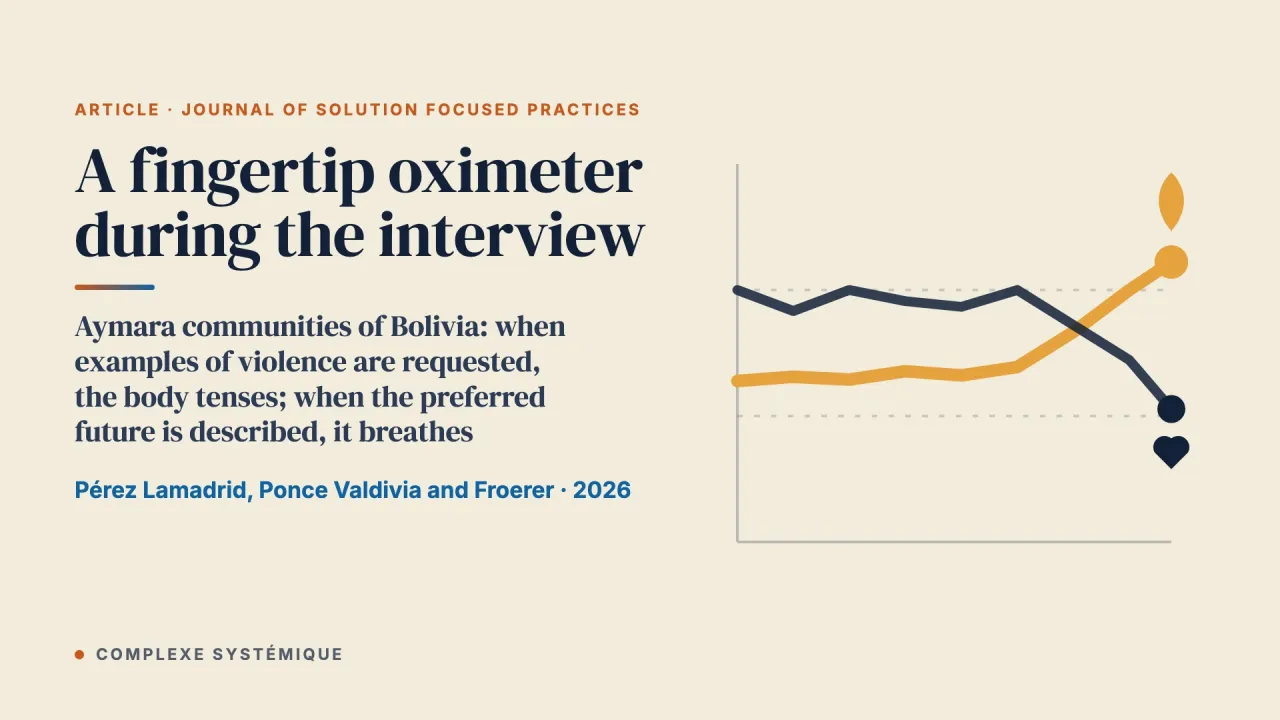
 Oxygenation and Heart Rate in Solution-Focused and Problem-Focused Interviews With Rural and Indigenous Aymara Communities (Viacha and Laja) Regarding Intersectional Violence
A fingertip oximeter on 19 Aymara people of the Altiplano: the problem-focused interview tenses when examples of violence are requested; the solution-focused one oxygenates and slows the heart.