Red Sistémica · Violence
Sowing violence in the minds of children
For twenty years, the children of Afghanistan learned to read, write and count from textbooks illustrated with bombs, mines and grenades, designed during the Cold War to turn them into future fighters. In this editorial written in the aftermath of September 11, 2001, Carlos E. Sluzki examines the perversity of any plan that inoculates violence into the minds of children, and the betrayal committed by those whose mission is to protect.
Editor’s note from Perspectivas Sistémicas
Translation of the editorial published in the American Journal of Orthopsychiatry (2002), whose author, Dr Sluzki, an internationally recognized master of systemic family therapy, is the journal’s editor-in-chief. Published in issue no. 73 (September–October 2002) of Perspectivas Sistémicas.
“The mere idea of having conceived and carried out a plan to prepare children as cannon fodder is staggering in its perversity.”
Carlos E. Sluzki
An arithmetic of war
One bomb, two mines, three rifles, four soldiers. “How many grenades will we have if we had two grenades and they bring us two more?” “Four.” “And if we throw one, how many do we have left?” “Three.” “Very good, little one!”
For twenty years, the children of Afghanistan have been learning the rudiments of reading, writing and arithmetic from textbooks abundantly illustrated with bombs, soldiers, machine guns, mines and grenades, whose text is interwoven with the rudiments of jihad and other militant Islamic teachings (43 of the 100 pages contain violent images or texts)… with the compliments of the United States Agency for International Development and the University of Nebraska at Omaha, hired to design and distribute this material.
Introduced and surreptitiously distributed in Afghanistan by the hundreds of thousands during the last period of the Cold War, with the aim of inoculating children with fanaticism and preparing them to become future guerrillas against the Soviet occupation, these textbooks constituted the main basis of Afghan primary education. The operation was, moreover, a success. Those children grew up, became young adults and took over the government of that almost ungovernable country (it is still not known whether they defeated the Soviet occupying forces or whether the latter simply left, having lost all fighting spirit in an unjust war while their own political system was collapsing); they transformed it into a fundamentalist Islamic state that banned any presence, education and professional or public activity of women, relegating them to the kitchen and to procreation, that closed all secular schools, banned all music and other “frivolities”, stoned adulterous women, destroyed with cannon fire thousand-year-old Buddhist monuments considered part of the heritage of humanity because they contravened its religious prohibition on representing human figures, and that governed with a justice administered by the omniscient decisions of the clergy. It is hardly surprising that these same textbooks continued to be used for primary education, within the framework of religious schools, the only ones permitted (except that, in accordance with the Islamic prescriptions in force, the silhouettes of the soldiers illustrating certain elementary arithmetic calculations were smeared over). And why not? They fitted perfectly with the official teaching. Indeed, the United Nations Children’s Fund, whose mission is to ensure “the survival, development and protection of children”, continued to distribute these books for several years. That agency still holds 500,000 copies, which it plans to destroy and replace with a textbook revised so as to retain an Islamic rhetoric but with more neutral images (oranges and melons instead of bullets and mines), in order to meet the educational needs of the four and a half million Afghan children of school age.
Whoever sows evil reaps evil
What a terrible example of “Whoever sows evil reaps evil”. The mere idea of having conceived and carried out a plan to prepare children as cannon fodder is staggering in its perversity – not that it had never been done before, in one of its many versions, from the Children’s Crusade (most of whose members ended up captured by Mediterranean pirates and sold as slaves) to the Hitler Youth (Hitlerjugend) of the Nazi period and the child soldiers of today, on the border between Sudan and Uganda or in Sierra Leone. Nor is it in any way surprising in the context of so many oppressive and abusive families that in turn produce oppressive and abusive children. But none of this diminishes the perversity of a plan, of any plan, that fosters the inoculation of violence into the minds of children.
With rare exceptions, we, professionals in the field of mental health, have a long history of activism to protect children from violence, maximize their potential, support families in order to increase their resilience and facilitate contexts that allow the growth of emotionally sound and socially competent children; and, above all, we have made a collective voice heard in favour of human rights and social justice. Explicitly designing, for political ends, the desensitization and indoctrination of children constitutes a betrayal – the betrayal that occurs whenever those charged with protecting individuals and social collectives from harm hurt us in one way or another, while mystifying their betrayal (“I am doing it for your own good”).
Key takeaway
For Sluzki, the perversity lies not only in the violence itself, but in the reversal of the protective function: when those whose mission is to protect children organize their desensitization and indoctrination, the betrayal always comes with a mystification – “I am doing it for your own good”. The same mechanism is found, on another scale, in oppressive families that produce oppressive children.
In the context of the horror of September 11 of last year, since which so many of us have searched, in vain, for a reassuring explanation in which the Good and the Bad would be clearly drawn, it is disheartening, though not surprising, to keep finding, in our own backyard, examples of the wisdom displayed by the famous North American philosopher Pogo1 when he declared in astonishment: “I have found the enemy! It is us!”
Note from the original
1. Central character of a famous comic strip.
This article is an English translation of “Sembrando violencia en la mente de los niños”, published by Red Sistémica (first published in Perspectivas Sistémicas, n° 73, septembre-octobre 2002 (éditorial de l’American Journal of Orthopsychiatry, 2002)). Translated and republished with the journal’s permission.
Read the original articleHow to cite this article
Sluzki, C. E. (2022). Sowing violence in the minds of children (Complexe Systémique, Trans.). Complexe Systémique. https://app.complexe-systemique.com/en_GB/articles/sowing-violence-in-the-minds-of-children (Original work published in 2002 in Perspectivas Sistémicas, n° 73, septembre-octobre 2002 (éditorial de l’American Journal of Orthopsychiatry, 2002); republished in 2022 by Red Sistémica, https://redsistemica.ar/2022/07/06/sembrando-violencia-en-la-mente-de-los-ninos/)
To go further
- Violence: understanding and interveningA systemic framework for reading violence, from the family to social contexts.
- Facing violence and indifference in non-therapeutic settings (part 1). Interview with Eduardo CárdenasWhen violence is social and political: the therapist outside the consulting room.
- What you need to know about resilience — Boris CyrulnikWhat allows wounded children to grow up despite the violence they have suffered.
Related training courses
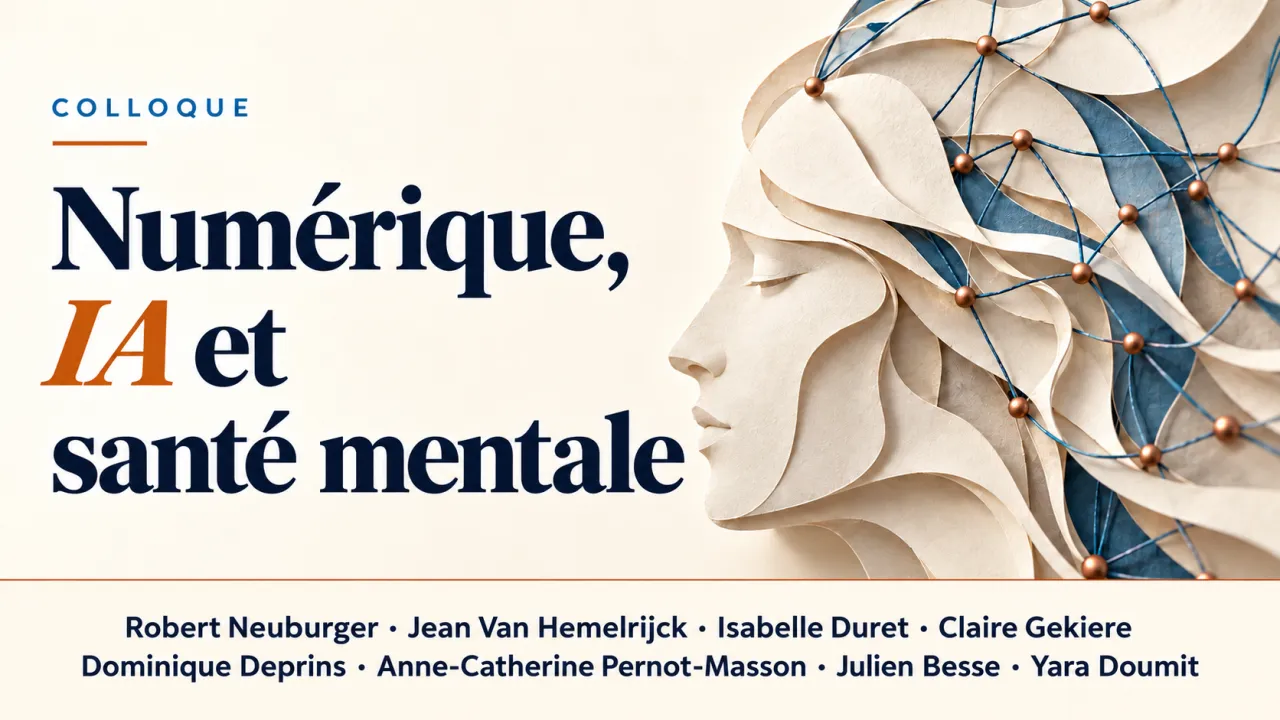 Symposium
Digital technology, AI and mental health
Conference in Lyon, 11 December 2026: digital technology, artificial intelligence and mental health. Six talks, replay for participants. In French.
 Short course
The suicidal crisis in adolescents and young adults
Training: assessing and supporting the suicidal crisis in adolescents and young adults. Clinical landmarks and systemic tools. In French.
Related articles
 Article
 Toxic, narcissistic, borderline: what therapy speak does to your relationships
Narcissistic, borderline, toxic: therapy speak has left the consulting room. Julien Besse shows how these labels close the debate and relieve us of our own part.
 Article
 Relearning couplehood after exile and violence
At the Maison d’Ella, Ivy Daure receives exiled women who have survived violence. Her work: relearning relationship so as not to form a couple by the same grammar again.
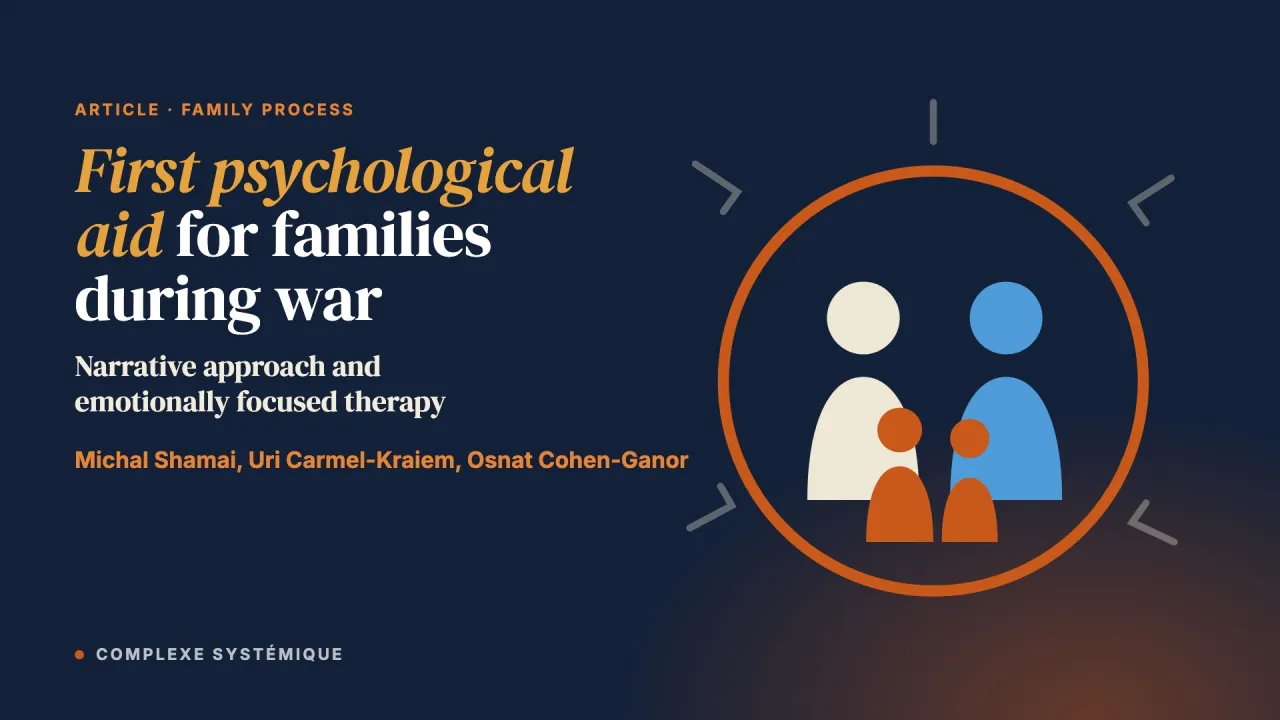 Article
 First Psychological Aid for Families During War: Integrating the Narrative Approach With Emotionally Focused Therapy (EFT)
Three or four meetings for families living under the threat of war: telling their story before a witness, then repairing the attachment cycle disrupted by fear.
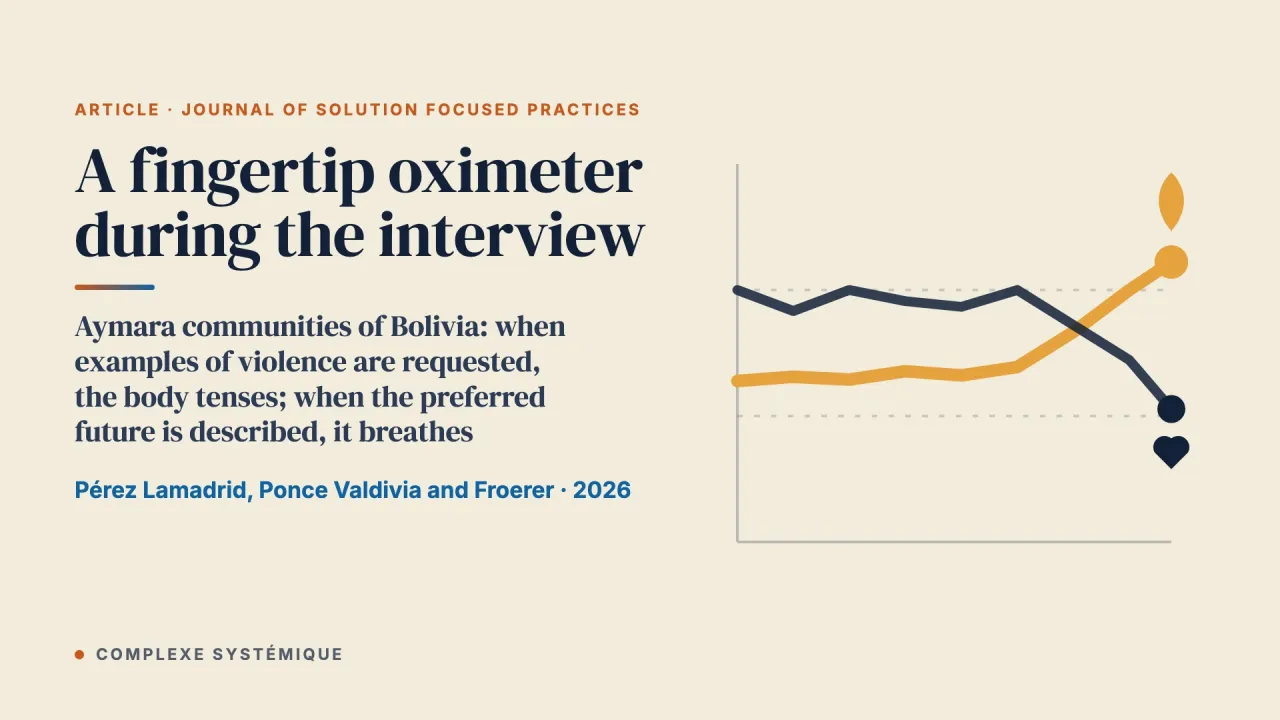 Article
 Oxygenation and Heart Rate in Solution-Focused and Problem-Focused Interviews With Rural and Indigenous Aymara Communities (Viacha and Laja) Regarding Intersectional Violence
A fingertip oximeter on 19 Aymara people of the Altiplano: the problem-focused interview tenses when examples of violence are requested; the solution-focused one oxygenates and slows the heart.
Comments 0
Log in to join the discussion. Log in