Journal of Solution Focused Practices · Debate
Reflections on Mark McKergow’s Paper, Version 3.0
Mark McKergow proposed calling the practice of the London BRIEF team ‘SFBT 2.0’ and the practice of the Brief Family Therapy Center in Milwaukee ‘SFBT 1.0’. Harry Korman refuses the numbering from the outset, since it already says which of the two is the better one. He lists the words the paper uses to qualify the older model, disputes the claim that the BRIEF model does not prompt the client to action, and then looks at the figures: the BRIEF studies changed their outcome measure between the fourth and the fifth, which makes any comparison between them meaningless, while the Milwaukee data point the other way – more sessions, better results.
This is the original article The 3.0 Version of “Reflections on Mark’s Paper SFBT 2.0 – The New Generation of SFBT Has Already Arrived”, by Harry Korman, published in Journal of Solution Focused Practices, vol. 3, no. 1 (2019), doi: 10.59874/001c.75084, under a CC BY 4.0 licence. Republished by Complexe Systémique: the author’s text is unchanged – wording, spelling and italics follow the printed article – and only the layout has been adapted for reading online, with the display title shortened and one section heading added where the original had none.
Complexe Systémique – a note on this page
The title carried by the atlas is a shortened form. The full title of the original is The 3.0 Version of “Reflections on Mark’s Paper SFBT 2.0 – The New Generation of SFBT Has Already Arrived”: Harry Korman quotes back the title of the paper he is answering and gives it a version number of his own, which the last of his endnotes explains.
The section headings are the author’s, with one exception: the opening section had none, and we added one for reading online. The italics and bold in ‘A couple of examples’ reproduce those of the printed article exactly. The author’s spelling and punctuation, including one elliptical run of questions in ‘Is it easier to learn the BRIEF model?’, are left as printed.
Language is powerful. The way we describe our world is how we live and take part in it.
Harry Korman
An unease I could not put my finger on
When I read Mark’s paper the first time, I thought that Mark had done a pretty decent job at pointing out some of the key differences between what I call the BRIEF-model1 and my more traditional way of doing and teaching SFBT. I felt a tiny bit of unease as I read the paper but couldn’t put my finger on why that was except for a couple of things where I did not agree with his descriptions of the BFTC2-model. I thought most of my unease was due to me just being and feeling old-fashioned.
Then the other day one of the people on our diploma training said, “Why do we need to learn SFBT 1.0 when SFBT 2.0 is already here?” I felt some more unease, so I re-read Marks paper again, and more carefully. Towards the end of the paper in the last paragraph Mark writes, “This is not to say that SFBT 1.0 is wrong, or bad, or outdated, or anything like that” (McKergow, 2016, p. 15). This phrase contradicts most of what came before it in the paper. Mark not only describes SFBT 2.0 in positive terms, it describes my way of doing Solution Focused Brief Therapy (the old way) in negatives.
Language is powerful. Some people even have the idea that meaning making happens in language. I think Mark is one of them. The way we describe our world is how we live and take part in it. So, I decided that in this comment on Mark’s paper I will not accept the names he proposes because the numbering system in itself denotes that one is better, more advanced, a major update, etc. Since I am not yet convinced, I will instead talk here about the BRIEF-model and the BFTC-model.
A couple of examples
Some of the words qualifying the BRIEF model (quotes from Marks’s paper in italics; my emphasis in bold):
- even simpler in form
- left behind many elements
- important evolution of existing practice
A couple of comparisons:
- losing hangovers from family therapy
- the end of the session has lost many of the trappings
- even more elegant than the previous versions.
- an even clearer commitment to offering power to the client,
A description of the BFTC-model around the utilization of the team and descriptions of the summary:
- The idea of others watching, hidden from view, seems not only costly but also rather creepy.
- compliments in a sustained barrage, as the prelude to selling some kind of intervention (McKergow, 2016).
I think my student’s question now makes sense. Who would want to do creepy things, sell interventions, use outdated elements, have hangovers3, be trapped by thinking about how to finish the session, be clumsy (instead of elegant) etc.4?
A short look on what I don’t agree with
Mark then compares the BFTC-model with the BRIEF-model where one is not “… trying to deliberately prompt the client to action” (McKergow, 2016, p. 11). Maybe this is a misunderstanding. I think that our much esteemed friends at BRIEF are saying that if you stop thinking about what to do at the end of the session you get more time and space to develop the preferred future in the future; the present and the past and new things will start happening in the session that you haven’t conceptualized and seen before. If they are actually saying (or thinking) that they are not deliberately trying to prompt the client to action, they are falling into the trap described by Weakland:
Weakland, as cited in Gilligan & Price (1993, p. 136–145)
Influence is inherent in all human interaction. We are bound to influence our clients, and they are bound to influence us. The only choice is between doing so without reflection, or even with attempted denial and doing so deliberately and responsibly.
My view on influence is that it happens in the negotiation of meaning that is continuously on-going in the therapeutic conversation. My contribution in the process lies in the choices I make when I echo, paraphrase, and build questions on only parts of what the client told me (De Jong, Bavelas, & Korman, 2013; Korman, Bavelas, & De Jong, 2013), and in the presuppositions of my questions (McGee, Del Vento, & Bavelas, 2005). Since most people don’t like to be told what to do, and since one of the reasons they have come to see me is that they don’t know what to do, it would be rather unproductive to ask them what they need to do. Instead, I ask them how they will notice when things get better, how they feel, what they think, how they behave, and how other people will behave differently. People can only answer these questions when they have imagined themselves noticing that things are better, and what actions would follow or precede. Pretending that this is not deliberately prompting the client to action is ignoring the power of language and the whole post-structural revision of SFBT that Mark refers to in his paper (de Shazer, 1992 p. 92; McKergow, 2016).
This is the largest beef I have with Mark’s paper. In more or less subtle ways, through his description of the BRIEF-model, he minimizes the effect of seemingly simple questions like: “So, after the miracle – what is the first thing you, or someone else, notices that you feel/do/think?” And pretends that this is not prompting the client into action.
Since the above is also a major part of Mark’s description pointing to the BRIEF-model being a major upgrade from the BFTC-model, this is also questionable by inference. But let’s suppose for the sake of the argument that the BRIEF-model represents a major shift.
Is the BRIEF model one step forward?
When I first heard Chris, Harvey, and Evan present the BRIEF-model at a conference some 15 years ago or so – I was enthusiastic. Steve de Shazer was walking out just in front of me, so I caught up with him, and asked him what he thought of this great simplification of his work, particularly considering his own fondness of simplicity. He grunted in response, so I pressed on. “Don’t you think it’s great that they have reduced the number of questions to only 2”; The questions being “What do you want? And what of that is already happening?”. He answered: “If it’s only a question of reducing the number of questions there is only one that is important.”
What’s better?
Steve de Shazer, as reported by Harry Korman
That caught my attention. Being a fervent admirer of Steve’s thinking I asked him what THE QUESTION was. He answered: “What’s better?” He then added that one problem that BRIEF’s description “makes it damned difficult to teach”. So – a question I have been asking myself since I listened to BRIEF presenting their model is:
Is it easier to learn the BRIEF model?
Mark didn’t say in his paper that the BRIEF-model is easier to learn. I think my student thinks it as easier though. And Steve suspected that it might be more difficult to learn SFBT with the BRIEF-model than with the BFTC-model. So, I decided to talk about it here as well.
If Solution Focused Brief Therapy is only, and I mean only, about creating a preferred future, and describing instances of that future, the answer would undoubtedly be: Yes! Obviously, the BFTC-model is more complex. If you use the model with the end of session message, including an experimental thing to do, something to observe, or just compliments requires that you create particular information in the session and it requires you to make a certain number of decisions. Is the miracle picture vague or concrete? If you were not able to construct a preferred future in the session, what is the form of the problem? The pieces of better something the client can do deliberately? problem? etc.? You need to categorize the information created in the session and you need to make decisions on how to proceed in order to construct a useful therapeutic reality.
Sometimes it’s more complicated and that’s where the BFTC-model may have some advantages (and may have some disadvantages). There are more pathways described, there are more options available. Among them, there is for instance, the possibility of finishing a “bad” session in a useful way with a summary that you have taken some time to reflect on. More importantly than the summary though, the BFTC-model opens up a variety of pathways in the session. If Scott Miller is right in that the best therapists are the ones with a wider register of available behaviors, then de Shazer may be right that the BRIEF-model makes it more difficult to learn the variety that one needs to fit with all kinds of people in therapy.
So, I personally believe that Steve’s comment about the BRIEF-model being more difficult to learn is that BRIEF-mapping makes it more difficult to learn the many different pathways of SBFT that I believe are useful to master.
Is the BRIEF-model better?
There are some strong arguments for the BRIEF-model. For instance, the elegant simplicity of its description and the fit with many of the basic assumptions extracted from the work at BFTC. The strongest argument though are the claims that it has the same results in fewer sessions and that because of the simplicity it might be easier to learn. I’m not sure that this is what the guys at BRIEF think, but it’s certainly what my student was thinking. And it also feels like the gist of Mark’s paper – despite him negating this.
Thinking about this, I re-read the paper where Shennan and Iveson (2011) present the development of the BRIEF-model and the research they did. I read with a critical eye, deliberately avoiding being solution focused.
In the paper (Shennan & Iveson, 2011), they describe the 5 studies that the team at BRIEF was involved in. Talking about the fifth study they have a headline: Study 5: Briefer and Still Effective?
Shennan & Iveson (2011)
The dip in outcomes (60% improved) of the fourth study compared to the previous studies spurred us on to put systems in place to enable more regular and systematic evaluations of our work. Because we wanted to check our practice as quickly as possible after the fourth study, the fifth was undertaken about a year later. On average, eighty-four percent of the clients reported that they had made progress towards their “best hopes” from the work, a year after its completion, with an average of 1.8 sessions per client. The questions asked in this study differed from those in the previous studies. The measure being about achievement of hopes rather than resolution of problems. This reflected the significant practice developments that had been set in motion by the earlier studies, and it is to these that we now turn.
It honors Shennan and Iveson (2011) that they put a question mark after the heading. Regardless of their motive for changing the measure it makes all comparisons between study 4 and study 5 nonsense and opens alternative interpretations. An unexpected finding of the fifth study was that the average number of sessions across the 25 clients was as low as 1.8.
This reminded me of a study on clients at BFTC on 168 clients made by Kiser (1988) and Kiser and Nunnaly (1990), referenced in de Shazer, Putting Difference to Work (1991; See Table 1). At follow-up, 80% of the clients reported either “Complete relief of the presenting problem” or “Clear and considerable improvement.”
About half of these clients had 4 sessions or more, and about half had 3 sessions or less. The researchers looked at if there was a difference in outcome correlated with length of therapy. In the group that had 4 sessions or more, 91% of the clients were better. In the group who had three sessions or less 69% were better. That is a big difference. Trying to be a brief therapist, I did not like that more therapy correlated with better results. The clients were also asked if things had improved in other areas then the problem that they had talked about. Again, there is a difference. There with more clients from the 4 sessions or more group meeting secondary goals.
BFTC – 3 sessions or less
51,8 % of the clients. Total % improved: 69%. Met secondary goal: 44%.
BFTC – 4 sessions or more
48,2% of the clients. Total % improved: 91%. Met secondary goal: 61%.
Table 1. Kiser (1988) and Kiser and Nunnaly (1990) cited in de Shazer (1991).
So, I took a look at De Jong and Hopwood (1996), and in their findings of the follow-up of 276 clients at BFTC from 1992–93 there is a tendency in the same direction: More sessions – better results.
Some years later, Scott Miller, who used to work at BFTC and who has been a strong advocate for practice-based evidence, told me that there are many studies that show that longer therapy is more effective than shorter. One of the key elements of his “Feedback Informed Treatment-model – FIT” is that we need to locate our unsuccessful cases early in therapy. Using the Session Rating Scale, we can find the cases at risk of dropping out in the first and second session. When we do, we can apologize for the bad fit we had with them and a lot of them will then return to a next session. Giving us the opportunity to perform better. Doing this improves outcome significantly.
Another thing that Scott talks about in his later, and now on-going work, is that the best therapists regardless of model seem to have a wider variety of behaviors at their disposal when things become difficult in a session.
Shennan and Iveson (2011) continue in their article:
Shennan & Iveson (2011, p. 295)
Our best guess about the reason for the reduction in the number of sessions is that it is related to our attempt to become non instrumental in our conversations with clients. Though overall our intention is to be successful therapists by helping clients move forward in their lives, client by client, the team endeavors to remain neutral about what the client does. Our hunch is that if clients are confronted in any way by our ideas concerning possible actions to take, then they will need to take time to consider these ideas. Conversely, the more we are able to keep out of their way, by simply inviting clients to describe future possibilities and whatever aspects of these possibilities are already in place, the more quickly they will be able to get on with whatever they choose to do.
It makes sense to see the reduction of the number of sessions as the result of something good happening in sessions at BRIEF, but only if the outcomes of their therapies are not worse. Due to the fact that they changed their outcome measure between study number 4 and 5 this cannot be claimed.
So, using my critical posture, here is another alternative. The BRIEF-model does not, in a significant number of cases, lead to the same kind of fit as the wider, older model that has more options on how to conduct the session and end it. Thus, the BRIEF-model might have more early dropouts and worse results (as they were in study number 4).
Conclusion
I agree with BRIEF that in lots of cases even having the idea that the client needs to do something doesn’t fit. If the therapist has the idea that the client needs to do something it will be visible in the presuppositions, in the selection process, and it will lead to a bad fit with that client. With other clients, for instance, someone who misheard what I asked with the best hopes/common project question; and to have heard me ask: “What can I do for you?” or “What needs to happen in this session for you to feel that it’s been useful?” and answers with: “I need you to give me some tools”. This answer will be taken into account in my BFTC-way of doing SFBT. It will be one of the threads of the conversation. And it might very well be a part in my summary, proposal of an experiment or what to pay attention to. I try to understand and work inside the client’s worldview even knowing that we are co-constructing it in the session. And I hope that it helps me develop/maintain the fit that I believe is crucial in developing a useful therapeutic reality with my clients.
Maybe, the BRIEF-model is the next generation of Solution Focused Brief Therapy or maybe it has taken too many important and useful things away from the BFTC-model and is a step backwards. I don’t know. I want to see more research on both process and effect to decide where I stand.
And maybe, maybe all of us brief therapist should do what Steve de Shazer did several times in his career. When the data doesn’t fit the theory, change the theory. Maybe we should at least ask ourselves if our old adage “briefer is better” is a useful way to think.
Author’s endnotes
1. What Mark calls SFBT 2.0, I call the BRIEF-model which is also in homage of the people who developed it.
2. What Marks calls SFBT 1.0 I call the BFTC-model.
3. I originally wrote: “If you want a hangover – use SFBT 1.0”. This is a classical rhetoric move. You use the words the other person used but you use it with another sense. I think it irritated me that Mark chose the word “hangover” because I use lots of stuff coming from Erikson (and thus the MRI).
4. The numbering system is interesting by what it implies. This is my third version on the reflections on Marks paper. Suppose I said: “This is not to say that versions 1 and 2 were wrong, or bad, or outdated, or anything like that.” Would you believe me?
Complexe Systémique – how the debate went on
This text is the centrepiece of a controversy that ran across several issues of the journal. Mark McKergow answered Harry Korman; Guy Shennan and the Solution-Focused Collective then joined the discussion, to which Korman, Peter De Jong and Sara Smock Jordan replied that they did not want to blur the boundaries. The BRIEF model Korman discusses here is set out by its own authors in Brief Therapy: Focused Description Development.
References
Bavelas, J. B., de Jong, P., Jordan, S. S., & Korman, H. (2014). The theoretical and research basis of co-constructing meaning in dialogue. Journal of Solution Focused Brief Therapy 1, 1–24.
De Jong, P. & Hopwood, L. E. (1996). Outcome research on treatment conducted at the Brief Family Therapy Center, 1992–1993. In S. D. Miller, M. A. Hubble, & B. L. Duncan (Eds.), Handbook of solution-focused brief therapy (pp. 272–298), San Francisco: Jossey-Bass Publishers.
De Jong, P., Bavelas, J. B., & Korman, H. (2013). An introduction to using microanalysis to observe co-construction in psychotherapy. Journal of Systemic Therapies, 32, 17–30. doi:10.1521/jsyt.2013.32.3.17
deShazer, S. (1991). Putting difference to work. New York: Norton.
deShazer, S., & Berg, I. K. (1992). Doing therapy: A poststructial revision. Journal of Marriage and Family Therapy, 18, 71–81.
Kiser, D. (1988). A follow-up study conducted at the Brief Family Therapy Center. Unpublished manuscript. Milwaukee, WI: Brief Family Therapy Center.
Kiser, D., & Nunnally, E. (1990). The relationship between treatment length and goal achievement in solution-focused therapy. Unpublished manuscript.
Korman, H., Bavelas, J. B., & De Jong, P. (2013). Microanalysis of formulations in solution-focused brief therapy, cognitive behavioral therapy, and motivational interviewing. Journal of Systemic Therapies, 32, 31–45. doi:10.1521/jsyt.2013.32.3.31
McGee, D. Del Vento, A., Bavelas, J. B. (2005). An interactional model of questions as therapeutic interventions. Journal of Marital and Family Therapy 31, 371–384.
Shennan, G., & Iveson, C. (2011). From solution to description: Practice and research in tandem. In C. Franklin, T. S. Trepper, E. E. McCollum, & W. J. Gingerich (Eds.), Solution-focused brief therapy: A handbook of evidence-based practice (pp. 281–298). Oxford: Oxford University Press.
Weakland, J. H. (1993). Conversation—But what kind? In S. G. Gilligan & R. Price (Eds.), Therapeutic conversations (pp. 136–145).
This is the original article “The 3.0 Version of “Reflections on Mark’s Paper SFBT 2.0 – The New Generation of SFBT Has Already Arrived””, published in Journal of Solution Focused Practices (2019) under a CC BY 4.0 licence. Republished by Complexe Systémique: the author’s text is unchanged; only the presentation has been adapted for reading online, as set out at the head of this page.
Read the original articleHow to cite this article
Korman, H. (2019). Reflections on Mark McKergow’s Paper, Version 3.0. Complexe Systémique. https://app.complexe-systemique.com/en_GB/articles/reflections-on-mark-mckergow-s-paper-version-3-0 (Original work published in 2019 in Journal of Solution Focused Practices, vol. 3, n° 1 (2019), p. 66-73; republished in 2019 by Journal of Solution Focused Practices, https://journalsfp.org/article/75084)
To go further
- SFBT 2.0: The Next Generation of Solution-Focused Brief Therapy Has Already ArrivedThe paper Korman is answering, and whose very numbering system he refuses.
- Response to Harry Korman’s Reflections on SFBT 2.0 PaperMark McKergow’s reply, published in the same issue of the journal.
- Steve de Shazer’s Theory DevelopmentWhat Korman means by ‘the BFTC model’: de Shazer’s work reread from end to end.
Related training courses
 Certifying course
Training in Systemic Therapy and Interventions – Cycle 1
Certifying training cycle in systemic therapy and interventions – year 1. Courses, supervision and practice, aligned with EFTA/SFTF. In French.
 Certifying course
Training in Systemic Therapy and Interventions – Cycle 2
Certifying training cycle in systemic therapy and interventions – year 2. Clinical complexity, supervision and practice. EFTA/SFTF aligned. In French.
 Certifying course
Training in Systemic Therapy and Interventions – Cycle 3
Certifying training cycle in systemic therapy and interventions – year 3. In-depth intervention, supervision and practice. EFTA/SFTF aligned. In French.
 Certifying course
Training in Systemic Therapy and Interventions – Cycle 4
Certifying training cycle in systemic therapy and interventions – year 4. Clinical integration, supervision and certification. EFTA/SFTF. In French.
Related articles
 Article
 The AFFIRM Model for Navigating Challenges in Continuously-Interfaith and Divergent-Interfaith Marriages
Thirty happy interfaith couples describe how they navigate their religious differences: five processes, from respecting each other’s choices to religious intimacy, gathered in the AFFIRM model.
 Article
 What if the shortest path to change ran through a joyful detour?
Humour in therapy is not a gimmick but a clinical skill: it loosens the loops, reframes without wounding and reopens the field of possibilities. With its ethical safeguards and a concrete toolbox.
 Article
 The therapy wars: who really has the right to treat?
Protected titles versus practitioners trained outside the university: a systemic reading of the “therapy wars”, and the real question of what minimum guarantees to demand.
 Article
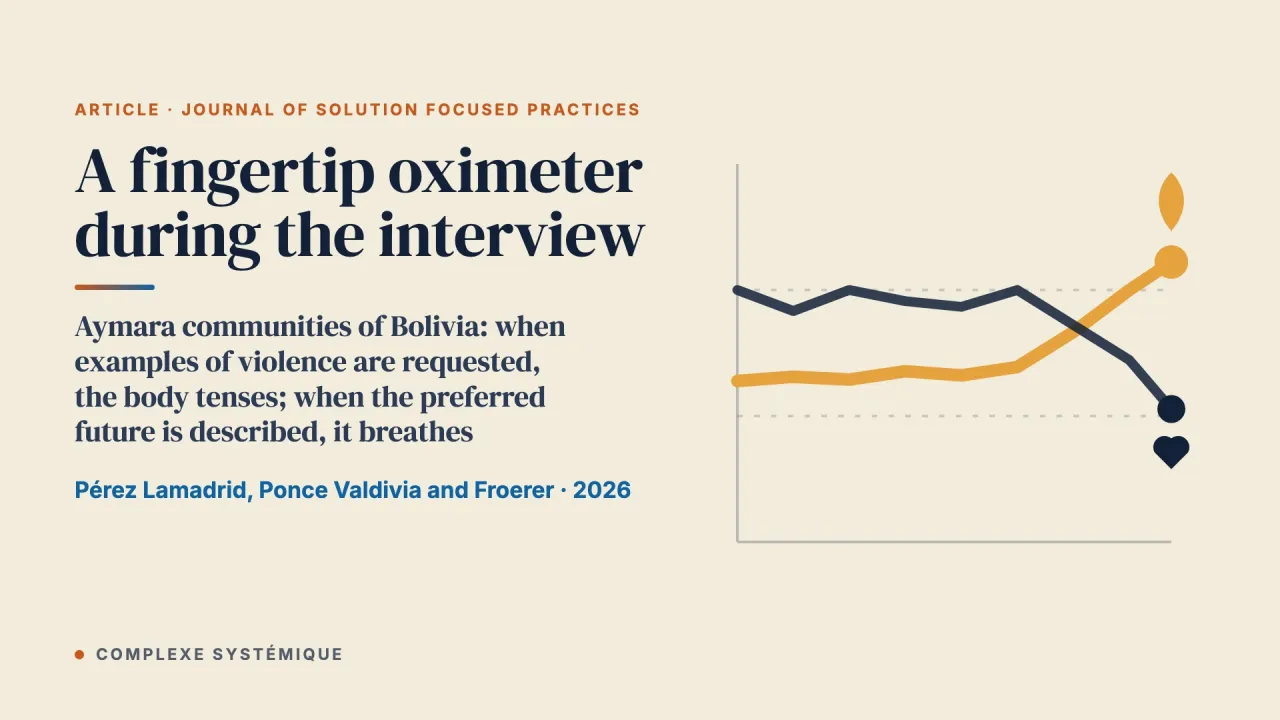
 Oxygenation and Heart Rate in Solution-Focused and Problem-Focused Interviews With Rural and Indigenous Aymara Communities (Viacha and Laja) Regarding Intersectional Violence
A fingertip oximeter on 19 Aymara people of the Altiplano: the problem-focused interview tenses when examples of violence are requested; the solution-focused one oxygenates and slows the heart.
Comments 0
Log in to join the discussion. Log in