Journal of Solution Focused Practices · Debate
Response to Harry Korman’s Reflections on SFBT 2.0 Paper
Harry Korman had replied point by point to the paper in which Mark McKergow proposed the name “SFBT 2.0” for solution-focused practice as it is done today. McKergow now answers him section by section: no, this second generation is not the sole invention of BRIEF; no, SFBT 1.0 is not “the BFTC model”, since Steve de Shazer and Insoo Kim Berg never stopped moving; yes, the difference can be seen on screen when an Insoo Kim Berg session and a Chris Iveson session are compared, with the counts to prove it. And yes, more research is needed — but the demand for research can also paralyse.
This is the original article Response to Harry Korman’s Reflections on SFBT 2.0 Paper, by Mark McKergow, published in Journal of Solution-Focused Brief Therapy (2019), doi: 10.59874/001c.75085, under a CC BY 4.0 licence. Republished by Complexe Systémique: the author’s text is unchanged; only the layout has been adapted and one section heading added at the start, where the original had none. All the other headings are the author’s own.
What I am proposing here is that with SFBT 2.0 the answer is basically “so the client can hear the answers”.
Mark McKergow
A wider trend than BRIEF
First of all, many thanks to Harry for giving such detailed attention to this paper. I am very honored that he thinks these developments are worth paying serious attention to. He raises some very interesting points.
At the outset, let me say that I don’t accept that what I have termed “SFBT 2.0” solely as the creation of BRIEF, although their work is clearly very important to it. I see this as much wider trend in the way SFBT is going and has been going for a decade or more. For example, I myself proposed a greater focus on ‘chunks’ of conversation all the way back in 2002. I have attempted to assemble the various changes and shifts into a coherent picture – which itself then reveals even more about new directions for our work. This also includes theoretical developments which are not the topic of the current SFBT 2.0 paper but are somewhat presaged in the Brief Therapy: Focused Description Development paper by Chris Iveson and me.
Although I can see the temptation to refer to what I have termed “SFBT 1.0” as the BFTC model, I don’t think that’s a wise move either. As Harry knows, Steve and Insoo’s work developed over their careers in ways that were not always well documented. Peter de Jong has said to me recently (and I am happy to agree with him) that Insoo’s late work might have been seen as something like “SFBT 1.6”. It’s useful to set up an idea of “SFBT 1.0” as a counter point but that doesn’t mean that most people are doing exactly that – in fact I think most SFBT practitioners I have seen are moving along this spectrum, albeit with different degrees of awareness and deliberation.
So, in this paper I am both attempting to point to shifts which are already happening, and also to show how a renewed and even more sharply honed set of practices might be emerging; which offers practitioners both clearer focus and a new connection to the question “how does it work”. The question “how does it work” could reposition SFBT in a clearer space for newcomers and the wider world. (Again, I accept that this element is not yet present in the paper under discussion.) Is that “better” as a clear conception of what we are seeking to do? Yes, I think so, hence the various comments about “leaving behind” elements of existing [the sentence breaks off here in the printed original — note by Complexe Systémique].
Deliberately prompting the client to action
Of course, I take the point of Harry’s reference to John Weakland about the all-pervading influence of communication. I am not seeking to pretend that our questions such as “so, after the miracle, what is the first thing you notice…” are not in the bigger picture intended to promote some kind of action in the client. I am making a rather narrow point – that these questions are not explicitly couched in “action” terms (“what will you do”) as in descriptive terms (“what will you notice”).
In the initial work from BFTC (for example in Clues), the discussion about a hypothetical miracle future was only deployed if suitable exceptions had not been found. The advantage of these exceptions was seen, at the time, as being that as they had already happened, they could be deconstructed in detail to examine what the clients had done already that had helped. Then, as the practice developed, the miracle question took a more central part and the work seemed (to me) to take on a hybrid quality of being partly about descriptions of the future and examinations of past exceptions. And all of this was at the service of an intervention design, to be done in a group and delivered at the end of the session.
Over the past 10-15 years, we have seen a shift away from deconstructing exceptions and building detailed interventions (in real-life action terms), and moving towards a much more creative and expressive way of working with clients. We want clients to feel encouraged to speak about themselves in the here-and-now and explore events in the future and past. Our goal is not to see what “really” happened but to connect with them in different ways. And of course, this is, in the end, about helping clients live their lives differently, in ways which give them less pain and more satisfaction. So, my point about prompting the client to action is about moving away from the blunt explorations of doing and towards the even more interactional and latent power of noticing.
Is SFBT 2.0 one step forward?
As I said above, I am seeing current practice as being at various points along an imaginary scale from SFBT 1.0 to SFBT 2.0. At the moment many people (including me) are doing something which allows for a mix of possibilities, and I get the sense from your document that you like the option to give tasks and get people to do things. I am reminded here, of the story Steve used to tell about the teenaged boy who came to therapy with his parents, watched what was going on for a while and then asked “So, are you asking these questions for you to get the answers, or for us to hear the answers?”. I think Steve’s response was a “hrmph” or something, because in the current practice it is ambiguous. It could well be both.
What I am proposing here is that with SFBT 2.0 the answer is basically “so the client can hear the answers”. The practitioner hears them too – and their role is to construct more questions to expand the description of the client. This is a different kind of endeavour from SFBT 1.0 where the practitioner is going to construct a task. I think / hope that in leaving that behind the practitioner is able to stay even better with the client in expanding their descriptions and their world, without having to worry about what to do with the information. That’s the proposal anyway, it clearly needs exploring and testing.
By the way, I don’t think that BRIEF has only two questions – in order to make sense of that, we need a whole raft of skills, sub-questions, and tactics. They are (as ever) being modest about their skills.
Distinguishing sessions of SFBT 1.0 and SFBT 2.0
You say that you’re not sure whether an observer could distinguish between sessions like this apart from the obvious lack of a break. It’s a very good question. Peter De Jong asked the same thing, so at his suggestion, we compared an Insoo session, (“Over The Hump”, chosen by him) and a Chris Iveson session, (“Mary and the cuddle”, chosen by me) by both looking at them to draw distinctions etc and then comparing notes. Of course, there are plenty of similarities – both sessions are clearly SFBT and not something else. However, there were also some clear distinctions.
In what seemed as a complicated session due to the amount of children in the room, Insoo didn’t get a “project” agreement with the clients but rather assumed it. She may have been justified in doing that because of the situation. Then Insoo asks the miracle question and has to do a lot of clarifying because the family misunderstood it (unfortunate, but not very significant in this discussion). She then gets some “headline” answers but doesn’t expand much on them. Insoo tended to get a headline (in response to the miracle question, or a scale) and then repeat it, whereas Chris tended to dive into more detail from whatever starting point – he uses the question “what difference would that make?” six times (Insoo 0), and variations on “what might you notice?” over 20 times (Insoo 0). I will add my marked-up copy of the complete Over The Hump transcript with my comparison notes to this reply when I send it. (This includes the opening and closing, which were not examined for microanalysis purposes.)
Peter De Jong concluded that these sessions show “very clear variations which could be very profitable to explore.” He also said that we were “reaffirming the spirit of SF” by looking directly at the work in action.
Varieties of Pathways
Yes, there are more possible pathways and options in SFBT 1.0. It’s not totally clear to me that it’s a useful thing – perhaps it means making decisions which takes one’s attention away from the client at hand. Perhaps there is enough variety within the options for SFBT 2.0 – we don’t know yet. What I do know is that I spent years recording open consultation sessions waiting for the perfect “difficult” one where the usual things didn’t work, resulting in doing something amazingly creative. And yes, I was frustrated that it never happened and the usual stuff (put together in a way which seemed to fit the situation) produced some useful ways forward. I think there are plenty of options in SFBT 2.0 – assuming a platform/project can be agreed, one can go to past, present or (more usually) future in various ways. The art gallery metaphor shows how what we’re after (a variety of different descriptions/pictures/scenes) can be approached in different ways.
Also, if there is not a fit between client and therapist, it may be better to move on more quickly to an alternative therapist or treatment.
Is SFBT 2.0 better?
Research – yes of course more is needed. As I say in the article, if we can name and define this as something to investigate, then investigation becomes likely. The research you mention about more sessions being better… it is of course, interesting and thought provoking. We could useful remember that most of the world is still not using a brief therapy mentality. I recently did a training for an agency here in Edinburgh where they give their clients 25 sessions routinely. (And guess what… the therapists report that there is a crisis around 20 sessions when the clients finally realizes they have to do something!) In this context, the difference between 4 and 5 sessions is less fundamental.
Changing our emphasis in SFBT from “as many sessions as needed and not one more than necessary” would be a very big step. I guess we might, in situations (such as those here in the UK where therapist resources are limited in the NHS) discuss the relative benefit of one more session to an existing client who is well on the way to recovery, and giving a new client a first session.
Yes of course we need more research. However, this can also act as a paralyser. I don’t think BFTC had a huge amount of weapons-grade research when they wrote Clues in 1988. They had some good ideas and some experience of them working, and look what that started. I also think there are some useful connections to come from SFBT 2.0 in terms of connection to things like enactive cognition, which is not included in the initial paper, but I hope to add soon from other work.
“Give me some tools”
You ask about the kind of situation where the client, in answering questions about their hopes, say “I need you to give me some tools…” We can easily respond to this not by accepting it at totally face value but rather asking “and what difference would it make, if you had some tools?” We might get towards somewhere where the client knew what kind of tools to go look for, or they might realise that there are other ways to handle the situation – we just don’t know. Of course, defining a common project or platform is key in all of this, in all manner of SFBT variants.
Thank you again Harry for taking all this trouble to respond to the paper. I am honoured and humbled that you felt it worth the time and energy. I hope this conversation will continue over many months and years to come – I value your experience, your knowledge, your commitment and your friendship.
Cheers,
Mark McKergow
Edinburgh, February 2018
Mark McKergow
Email: mark@sfwork.com
Original article Response to Harry Korman’s Reflections on SFBT 2.0 Paper, by Mark McKergow, published in Journal of Solution-Focused Brief Therapy, vol. 3, no. 1 (2019), doi: 10.59874/001c.75085, under a CC BY 4.0 licence. Republished by Complexe Systémique, September 2026: the author’s text is unchanged; only the layout has been adapted and one section heading added at the start, where the original had none.
This is the original article “Response to Harry Korman’s Reflections on SFBT 2.0 Paper”, published in Journal of Solution-Focused Brief Therapy (2019) under a CC BY 4.0 licence. Republished by Complexe Systémique: the author’s text is unchanged; only the presentation has been adapted for reading online, as set out at the head of this page.
Read the original articleHow to cite this article
McKergow, M. (2019). Response to Harry Korman’s Reflections on SFBT 2.0 Paper. Complexe Systémique. https://app.complexe-systemique.com/en_GB/articles/response-to-harry-korman-s-reflections-on-the-sfbt-2-0-paper (Original work published in 2019 in Journal of Solution-Focused Brief Therapy, vol. 3, n° 1; republished in 2019 by Journal of Solution Focused Practices, https://journalsfp.org/article/75085)
To go further
- SFBT 2.0: The Next Generation of Solution-Focused Brief Therapy Has Already ArrivedThe 2016 paper this whole debate turns on: the one Korman takes issue with and McKergow defends here.
- Reflections on Mark McKergow’s Paper, Version 3.0Harry Korman’s text, to which this reply is addressed, section by section.
- Brief Therapy: Focused Description DevelopmentThe paper written with Chris Iveson, where McKergow says the theoretical developments missing from SFBT 2.0 are foreshadowed.
Related articles
 Article
 The AFFIRM Model for Navigating Challenges in Continuously-Interfaith and Divergent-Interfaith Marriages
Thirty happy interfaith couples describe how they navigate their religious differences: five processes, from respecting each other’s choices to religious intimacy, gathered in the AFFIRM model.
 Article
 What if the shortest path to change ran through a joyful detour?
Humour in therapy is not a gimmick but a clinical skill: it loosens the loops, reframes without wounding and reopens the field of possibilities. With its ethical safeguards and a concrete toolbox.
 Article
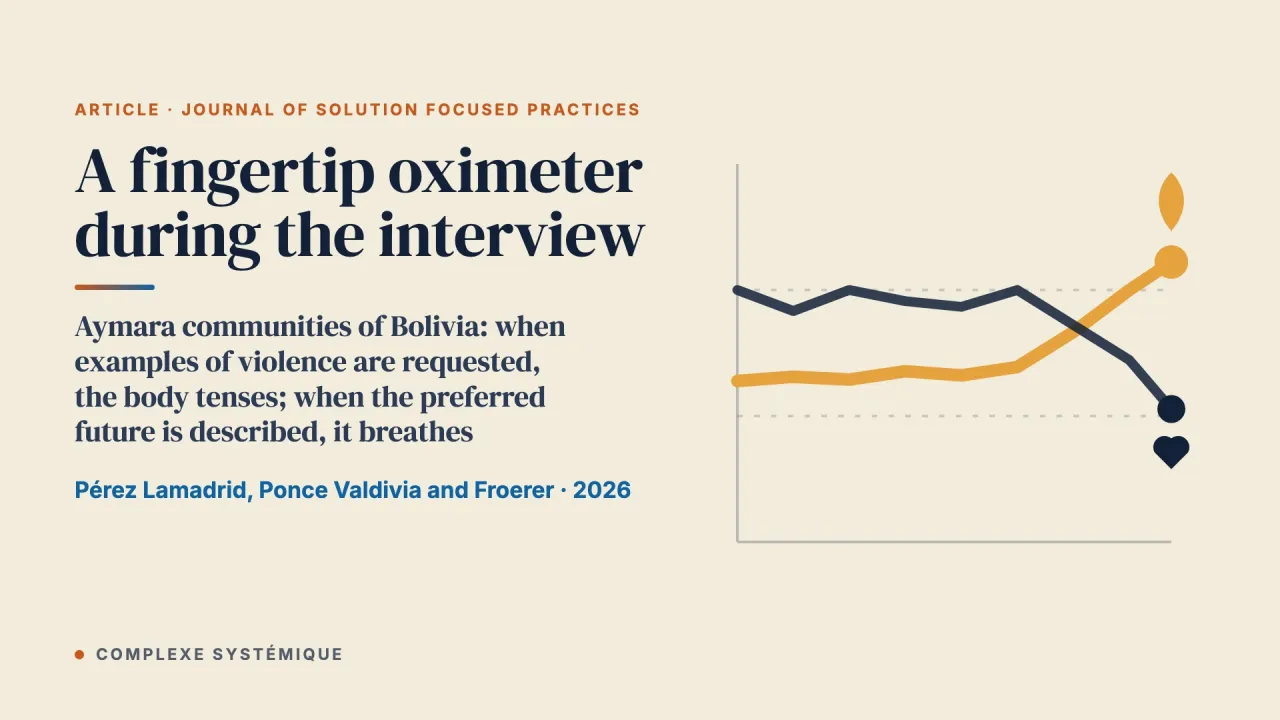
 Oxygenation and Heart Rate in Solution-Focused and Problem-Focused Interviews With Rural and Indigenous Aymara Communities (Viacha and Laja) Regarding Intersectional Violence
A fingertip oximeter on 19 Aymara people of the Altiplano: the problem-focused interview tenses when examples of violence are requested; the solution-focused one oxygenates and slows the heart.
 Article
 Anatomy of the Relational Reframe in Attachment‐Based Family Therapy
The first session of attachment-based family therapy, filmed in 47 families: what leads them to agree to work on relationships rather than on the adolescent.
Comments 0
Log in to join the discussion. Log in