AI-assisted translation
This version was translated from French by Complexe Systémique with the help of artificial intelligence. In case of doubt, the original version prevails.
Concept · Resonance
The concept of resonance in therapy
In the field of therapy and social intervention, the therapist’s emotions were long regarded as an obstacle to quality care. What if they turned out, in reality, to be powerful allies in our sessions?
From this perspective, we will explore the concept of resonance, theorised by Mony Elkaïm, which makes it possible to turn our emotions into precious tools for better grasping our clients’ experience and supporting the therapeutic process.
Resonance is a systemic, circular concept, which emphasises the function that one person’s experience serves for the members of the human system in which they take part.
According to Elkaïm, it is important to consider that, in a session, the therapist is an integral part of the observed system and cannot regard themselves as external to it. The role of their emotions then takes on a new importance: they can inform us about the world-construction of the people we accompany and contribute to improving their care.
1
Emotions as allies
The therapist’s emotions can be allies in sessions and in the therapeutic process, rather than a hindrance.
2
A therapist within the system
The concept of resonance, developed by Mony Elkaïm, regards the therapist as an integral part of the observed human system.
3
A clinical compass
Resonance offers a better understanding of patients’ world-constructions, so that care can be adjusted accordingly.
Resonance: emotions as allies
This concept was developed in the context of second-order cybernetics, when the observer was beginning to be seen as an integral part of the observed system. A therapist could no longer think of themselves as external to the family they were observing: they were now part of the therapeutic system. Resonance thus encourages practitioners to treat their emotions as relevant information about the client system, whether it is an individual, a family or a couple.
Instead of considering the therapist as an element outside the family, resonance allows us to see the practitioner as an actor integrated into that system. The emotions they feel can be linked to the interactions with the people they meet: these emotions provide information about their world-constructions and about the beliefs the system reinforces to protect its homeostasis.
For example, if a therapist feels rejecting, they may ask themselves to what extent the person in front of them is shaping that emotion in order to reinforce their own vision of a world in which they are constantly rejected.
Elkaïm’s example
A client expresses her frustration at the time the therapist took before starting the session. The question is then not only why this situation affects him personally, but also how this interaction reinforces the client’s construction of the world: perhaps feeling the therapist’s irritation confirms, for her, a vision of the world in which she is often neglected or rejected.
By accepting resonance as part of us, while not being reducible to us, our emotions can become a source of hypotheses about the world-constructions of the other members of the intervention system. They then turn into allies, rather than a brake on the therapeutic process.
Conclusion
Emotions can be powerful allies in our sessions. They help us better understand the people we meet and enrich the therapeutic process. The concept of resonance, theorised by Mony Elkaïm, asserts that our emotions are not solely linked to our own experience: they can also inform us about the world-constructions of the people we accompany.
The systemic, circular perspective of resonance highlights the importance of considering the therapist as an integral part of the observed system. The impact of emotions on the therapeutic encounter then becomes a source of hypotheses for better understanding the world-constructions of the people we meet.
In this spirit, emotions should not be perceived as vulnerabilities or obstacles to care, but as precious information about the stakes and challenges faced by the people we accompany. To explore this concept further, the full episode — in French — can be watched below.
How to cite this article
Besse, J. (2023, August 23). The concept of resonance in therapy. Complexe Systémique. https://app.complexe-systemique.com/en_GB/articles/the-concept-of-resonance-in-therapy
To go further
- Resonance in systemic therapy: the therapist's emotions as alliesThe first post devoted to resonance, to cross two perspectives on the therapist's emotions.
- Mony Elkaïm, a pioneer of the systemic approachThe portrait of Mony Elkaïm, theorist of resonance and pioneer of the systemic approach in Europe.
- The extraordinary power of empathyEmpathy, that precious ally of therapists, which can be worked on and refined in sessions.
Related training courses
 Symposium
État des Lieux: a psychological approach to spaces
Replay of the “État des Lieux” conference (Paris, 16 October 2026): Ivy Daure, Maurizio Frisina, Viola Sallay and Gilbert Pregno on places as a clinical resource. In French.
 Certifying course
Training in Systemic Therapy and Interventions – Cycle 1
Certifying training cycle in systemic therapy and interventions – year 1. Courses, supervision and practice, aligned with EFTA/SFTF. In French.
 Certifying course
Training in Systemic Therapy and Interventions – Cycle 2
Certifying training cycle in systemic therapy and interventions – year 2. Clinical complexity, supervision and practice. EFTA/SFTF aligned. In French.
 Certifying course
Training in Systemic Therapy and Interventions – Cycle 3
Certifying training cycle in systemic therapy and interventions – year 3. In-depth intervention, supervision and practice. EFTA/SFTF aligned. In French.
Related articles
 Blog
Blog Adult parentification: when being useful becomes a condition for being loved
Why is it sometimes so hard to hand over? Julien Besse explores parentification and parentalisation, acknowledgement and the place we take in our adult relationships.
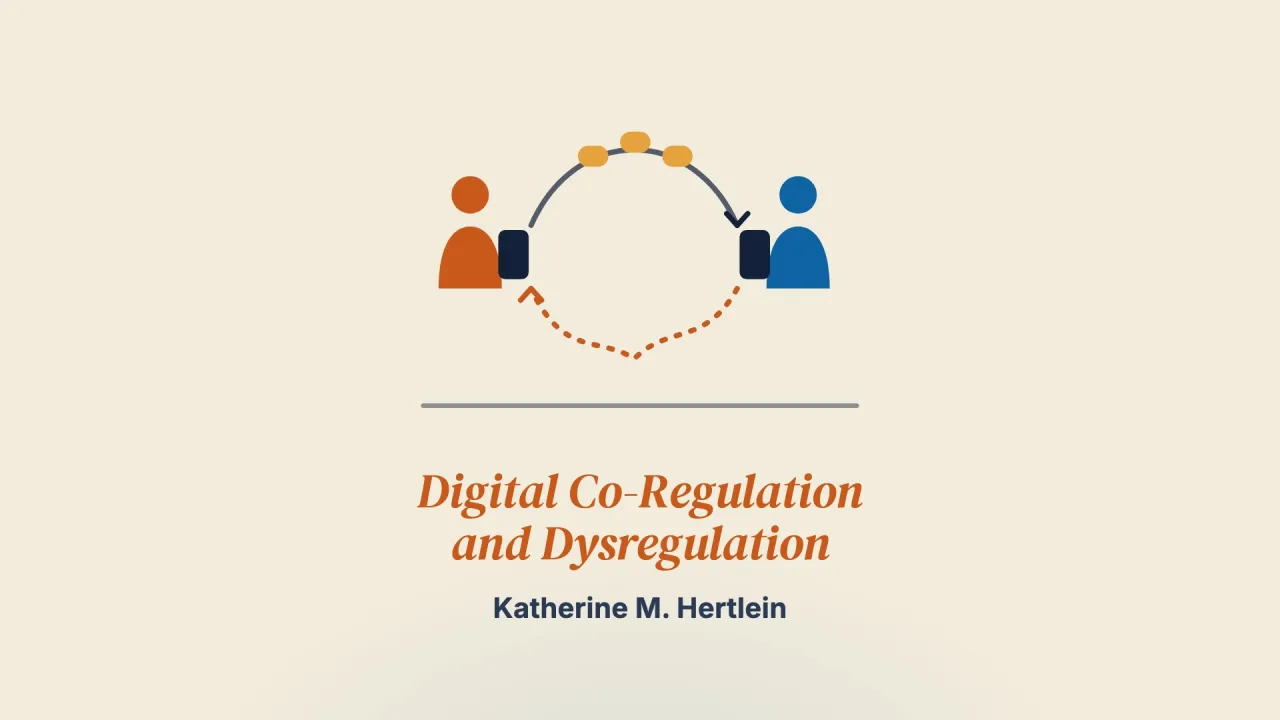 Scientific
 Digital Co-Regulation and Dysregulation in Romantic Relationships: A Systemic Model of Technology-Mediated Emotional Processes
Checking, chasing, blocking: 31 interviews show how the phone regulates or dysregulates a couple’s anxiety, with a systemic model of the loop.
 Scientific
 Internal Family Systems Therapy as Part of the ‘Family of Systemic Therapies’: A Critical Exploration of Systemic Practice in the Intra-Personal Domain
Does IFS belong to the family of systemic therapies? A critical exploration, grounded in a family court vignette, of systemic work with “parts”.
 Scientific
 Shaping the Therapist, Shaping the Field: A Narrative Review of the Person‐of‐the‐Therapist Training (POTT) Approach
Thirty sources, three periods: the history of Harry J. Aponte’s training, which turns the therapist’s wounds and “signature theme” into a clinical tool.
Comments 0
Log in to join the discussion. Log in