Family Process · Family therapy
A conversation analysis of therapist repeats in open dialogue network meetings
“She used to laugh more.” — “Ah, she used to laugh more.” Open Dialogue texts advise repeating the family’s words verbatim, so as to listen without interpreting. Ben Ong, Scott Barnes and Niels Buus identified 160 such repeats in fourteen hours of sessions filmed in Sydney and examined them through the lens of conversation analysis. A repeat can open up talk, but it can also close an exchange, ask for a simple repetition or steer away from a quarrel. And the choice of the word repeated is already the therapist’s decision.
This is a reformatted republication of A conversation analysis of therapist repeats in open dialogue network meetings, by Ben Ong, Scott Barnes and Niels Buus, published in Family Process (Wiley) (2024), doi: 10.1111/famp.12852, under a CC BY 4.0 licence. Prepared by Complexe Systémique in September 2026: the authors’ text is unchanged; the layout has been adapted for reading online, which constitutes a modification of the work under the terms of the licence. The eight session extracts are reproduced as images. This edition was made neither by the authors nor by the publisher, who are not responsible for its content or for any errors. The original version prevails.
While therapist authority can be mitigated by repeating clients’ words, when a therapist chooses to employ a repeat actively shapes the direction of the interaction.
Ben Ong, Scott Barnes and Niels Buus
Abstract
Writings on Open Dialogue approaches to working with families experiencing mental distress emphasize the importance of the therapist repeating the family's words back to them verbatim. Repeats are theorized to display the therapist's listening and to encourage elaboration without imposing the therapist's own interpretations or conclusions on the family. These recommendations have not been subjected to rigorous interactional investigation. In this study, we used conversation analysis to analyze 160 examples of therapists repeating the prior talk of the family from 14 h of video-recorded Open Dialogue sessions. We found that these repeats had similar functions to those previously described in conversation analysis research such as initiating repair, marking receipt, and requesting elaboration as well as examples of therapist repeats occurring in overlap with the talk of the client. Open Dialogue writings thus present an oversimplified account of how repeats are utilized in clinical Open Dialogue sessions. Consistent with dialogical writings, repeats can elicit elaboration with limited input from the therapist, however repeats reflect selectivity and function to direct and guide the conversation to some extent. So, while therapist authority can be mitigated by repeating clients' words, when a therapist chooses to employ a repeat actively shapes the direction of the interaction.
INTRODUCTION
Open Dialogue approaches to working with families have a number of principles emphasizing therapist responsiveness, continuity of the treatment team, and the promotion of dialogue (Haarakangas et al., 2007; Seikkula & Arnkil, 2006). Therapists adopt a dialogical stance characterized by collaboration and an openness towards the family's perspectives (Galbusera & Kyselo, 2018). Openness includes the promotion and appreciation for the voicing of multiple client and family perspectives without aiming for consensus or even change of health-influencing behavior (Buus et al., 2020; Galbusera & Kyselo, 2018). Instead the therapist adopts a position of tolerating uncertainty by withholding their ideas about diagnosis or formulation and encouraging the development of the family's own understandings (Haarakangas et al., 2007). Descriptions of Open Dialogue tend to focus on aspects of the therapist's mindset when working with families with little written on how therapists may specifically produce dialogical interactions in practice (Ong & Buus, 2021). One exception is the explicit recommendation that therapists repeat the prior talk of the family network in sessions.
A therapist's use of repeats in Open Dialogue theory is grounded in an intention to elicit elaboration and further dialogue around the unique understandings of each client while minimizing the influence of the therapist on the trajectory and content of the therapeutic conversation (Olson et al., 2014; Rober & Seltzer, 2010). To do this, therapists are advised to connect their words with those of the client and family by “incorporating the familiar language of the network members” (Seikkula & Trimble, 2005, p. 462) into their own responses and questions. This is said to display a “responsive listening”; listening without an agenda that allows clients to express important stories that they have not previously shared (Olson et al., 2014, p. 14).
In addition to incorporating the words of the clients, therapists are advised to actually repeat the clients' prior talk word-for-word to encourage further elaboration on a particular subject (Seikkula, 2011). In the extract below, Seikkula (2011, p. 190) provides two examples of a therapist (T1) repeating the words of a client (M).
“M: I have not been recognised.
Tl: You have not been recognised?
M: Throughout my life I've been excluded from the family. At last I want to get rid of this symbiotic mess.
Tl: You said that ‘Throughout my life I've been excluded from the family’. Then you said that ‘At last I want to get rid of this symbiotic mess’. It sounds like you are saying two things at the same time?
M: … yes … that's what I said … But so far I cannot say anything more about it.
Tl: … yeah.”
This extract provides two examples of how repeats can be utilized in Open Dialogue. There are verbatim repeats that, with minor additions, take up the whole of the therapist's turn. This is displayed in the therapist's first response “You have not been recognised?” which elicits elaboration by M about being excluded from the family. The therapist's next turn includes another verbatim repeat of the client's words however this repeat does not take up the entirety of the therapist's turn, instead it is incorporated into an extended response: “You said that ‘Throughout my life I've been excluded from the family’. Then you said that ‘At last I want to get rid of this symbiotic mess’. It sounds like you are saying two things at the same time?” This type of repeat is a quotative expression (Knol et al., 2020) that contains a turn-initial component “you said that…” that more clearly marks the beginning of the repeat, and a turn-ending component “It sounds like you are saying two things at the same time?” that more explicitly makes relevant an elaborated response.
In summary, Open Dialogue therapists are advised to design their responses to align, incorporate, and repeat aspects of the clients' talk. These responses are thought to allow clients the opportunity to hear their words repeated back to them, to reflect on them, and to encourage elaboration on issues that they may not have discussed previously. As noted in the examples presented above, these repeats can take a couple of different forms. They can include repeats of the client's words that occupy the whole of the therapist's turn or can function as quotes of the client's talk that is incorporated into a longer statement or question. While the dialogical literature has theorized the functions of therapist repeats of clients' prior talk, these functions have not been investigated empirically. It is therefore necessary to examine how repeats are utilized and responded to in actual therapeutic conversations to understand whether they actually fulfill the theorized functions and/or whether there are additional functional uses of therapist repeats.
Conversation analysis (CA) is research method that examines sequences of interaction to identify conversational practices and what social actions they serve (Goodwin & Heritage, 1990; Heritage, 1984b). CA has been used to investigate everyday conversational practices as well as institutional conversations such as psychotherapy (Peräkylä, 2012) and family therapy (Ong et al., 2020a, 2020b; Tseliou, 2013). For example, Muntigl and Horvath (2016) analyzed the opening of a structural family therapy session by Salvador Minuchin. They demonstrated how Minuchin sought to address a breach in the therapeutic alliance with a mother through claiming a similar “nervousness,” emphasizing her parenting authority and putting a positive frame on her parenting decisions. In Open Dialogue reflections, Schriver et al. (2022) demonstrated how therapists attempt to display empathy through describing their bodily reactions, imagining they are in the client's position, and claiming to be occupy a similar role category membership to clients. Through a focus on the micro details of conversation, CA can therefore provide a more thorough analysis of therapists' repeats from an interactional perspective, external to Open Dialogue theorizing.
Prior CA research has shown that repeats can serve a variety of functions depending on their sequential positions. Repeats of prior talk by another party inevitably occur in response to prior talk. Such next-turn repeats, if presented with rising final intonation, have a “questioning” character (Kim, 2002) and can initiate a repair on a problem of hearing or understanding by the recipient (Robinson & Kevoe-Feldman, 2010; Schegloff, 1996, 1997; Schegloff et al., 1977). They may also seek confirmation from the prior speaker, or display a speaker's stance towards the prior utterance, such as disagreement (Kim, 2002). Second position repeats with falling final intonation have different functions. They can provide confirmation and register receipt of the prior turn (Puchta et al., 2004; Schegloff, 1996, 1997), display agreement (Kim, 2002), or elicit expansion and additional information from the prior speaker (Brown, 1998; Kim, 2002; Knol et al., 2020). Repeats after a responsive turn (e.g., in third position) have different actions and can display a speaker's receipt or acknowledgement of a previous response (Schegloff, 1996, 1997). Third position, receipting repeats can result in no response and close a sequence resulting in responses of confirmation (Schegloff, 1997), or be treated by recipients as initiating repair on some trouble of hearing, speaking or understanding (Hayashi et al., 2013). Repeats thus have multiple functions and cannot be understood by reference to form or sequential position alone. Rather, a more comprehensive analysis needs to consider what actions a repeat implicates and how the repeat is responded to by the recipient.
In psychotherapy, Knol et al. (2020) described therapist repeats as mirroring the client's talk back to them. Similar to the recommendations of the Open Dialogue approach, they argue that unlike formulations (Antaki, 2008), repeats did not transform the talk of the client, thus avoiding therapist interpretations and reducing possible bias. Instead, mirroring repeats selected a salient phrase or quoted the prior talk of the client, which nominated prior topics for elaboration and functioned as more explicit requests for expansion. These mirroring repeats facilitated further explorations while also presenting the therapist as non-directive and impartial.
In this study, we focus specifically on therapist repeats of the prior talk of the family, which occupy the whole of the therapists' turns. These repeats are a clearly delineated practice and represent a more manageable sample for analysis. Using conversation analysis, we aim to examine the different functions of therapist repeats and to consider how these repeats impact on sequences of interactions in Open Dialogue meetings.
METHOD
Data and ethics
Data for this study included fourteen hours of video recorded Open Dialogue sessions from a youth mental health service in Western Sydney, NSW, Australia. Participants included therapists (n = 12), clients and the clients' networks, which included family members and other professional staff (n = 36). The majority of therapists (n = 10) had a minimum of 2-years of experience in Open Dialogue including foundation training and regular supervision. Seven of these therapists were participating in advanced training as Open Dialogue therapists or trainers. The remaining two therapists had an informal orientation to Open Dialogue from their more experienced peers. Open Dialogue sessions do not have a particular form of “intervention” per se but rather focus on the concerns presented by the family with the therapists aiming to maintain a mindset of openness to understanding the experiences of the family (Olson et al., 2014; Ong & Buus, 2021).
Potential therapist participants were approached by the first author with details about the study. Interested therapists then completed a consent form and identified potential clients and their networks for participation. The first author provided more detailed information to interested clients and their families. Participation in the study was voluntary and data collection only commenced after all participants provided written informed consent. The sessions were video recorded with three cameras placed at different points around the room to capture verbal and embodied aspects of their interactions. The study was approved by the Nepean Blue Mountains Local Health District ethics committee (reference number: HREC/17/NEPEAN/135) before data collection commenced. Identifying information in the presented extracts has been altered with the use of pseudonyms to ensure anonymity.
Analytic process
Video recorded data were transcribed using conversation analysis conventions (Hepburn & Bolden, 2017). We then focused on identifying all occurrences of therapist repeats of the talk of the clients that occupied the full turn of the therapist (with minor additions) and excluded therapist self-repeats. This was to capture the types of repeats discussed in Open Dialogue writings. Following the definitions used by Schegloff (1997) and Rossi (2020), we focused on full and partial lexical repeats and included repeats with changes to reference, deixis, intonation or prosody, and repeats that occurred within the next few turns following the first saying. While we began with a focus on a pre-defined conversational practice of repeats, we did not approach the data with a pre-determined view of the function of these repeats.
We identified 160 instances of therapists repeating the words of clients. Each example was analyzed line-by-line examining the preceding talk that occurred prior to the repeat, how the repeat itself was delivered (i.e., which word/s were selected and how they were prosodically voiced), and what response followed the repeat. Through this process, we analyzed the precipitating prior action/s that lead up to our target action of the repeat and how the repeat was responded to (Peräkylä, 2019). The function of each therapist repeat is understood through an analysis of how it was responded to by clients. In CA this is known as the next-turn proof where the action or function of a conversational practice is not contained within the intention or the attributes of the practice itself, but rather through how it is understood and responded to by the other participants in a conversation (Potter, 1996). Our analyses of repeats were compared and grouped according to the similar functions they served. Below, we present examples of the different types of repeats identified in the data; all extracts were analyzed by all the authors and the presented analysis reflects our combined analysis of the data.
RESULTS
We found that therapist repeats served a variety of interactional functions. We first present repeats that initiated repair and repeats that functioned as receipts. Second, we present repeats that nominated topics for elaboration, and explore how the equivocality of some repeats provide for a number of different responses. These types of repeats were congruent with Open Dialogue recommendations to repeat the words of the family to encourage elaboration. Third, we present repeats that occurred outside of transition relevance places (the places at which speaker change may occur), which did not disrupt the turn in progress. In the extracts that follow, the therapists' repeats are marked with bold italics and the first saying is marked in bold. Following family therapy conventions, participants are named according to their family role, for example, Grandmother, Father etc., and children are listed in order of age, for example, Child 1, Child 2, etc. In the analysis all non-therapist participants are referred to as “clients.”
Repeats as other-initiations of repair
In CA, repair refers to a set of practices for interrupting the progression of a conversation to deal with problems in speaking, hearing, or understanding (Hayashi et al., 2013; Schegloff et al., 1977). We found that one function of therapist repeats is the other-initiation of repair, or repair initiated by a party other than the speaker of the trouble source (Hayashi et al., 2013; Schegloff et al., 1977). In Extract 1, the therapist uses a repeat that results in a repair solution provided by the prior speaker, the Grandmother.
Extract1
S6.rpt3
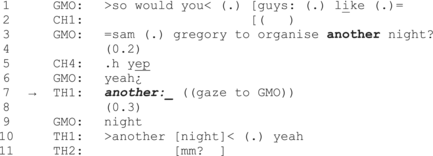
At line 1, the Grandmother asks the children if they would like their brother Gregory (who lives with a different relative) to visit them an extra night per week. The Grandmother initially says “Sam” (who is a different brother) and self-repairs her turn to “Gregory.” This is answered by Child 4 with “yep” (line 5) followed by confirmation from Grandmother with “yeah.” At line 7, Therapist 1 initiates repair with a repeat of “another” mirroring Grandmother's turn at line 3. This repeat includes a sound stretch on the last syllable of “another” with flat intonation and gaze to Grandmother thereby selecting her as the recipient. This repeat displays that Therapist 1 adequately received the first part of the turn and frames the trouble source of the repeat as occurring after “another” (Walker & Benjamin, 2017). Grandmother responds by completing the repeat of her original turn, began by Therapist 1, with “night.” Grandmother orients to Therapist 1's repeat as initiating a repair of hearing by providing a repair solution of “night.” The Grandmother did not orient to the repeat as initiating a repair of understanding otherwise she would provide an explanation of the meaning or an account of her prior talk. The repair solution is receipted by Therapist 1 with a repeat receipt of “another night” (discussed further below) and a confirming “yeah.”
As demonstrated in this example, therapist repeats that initiate a repair of hearing are followed by minimal responses by clients who only provide the part of their turn that was identified as unheard. Consequently, they function to maintain intersubjectivity or shared understanding (Albert & de Ruiter, 2018); however, they do not elicit expansion or elaboration in the way proposed by Open Dialogue writings.
In Extract 2, the therapist's repeat also other-initiates repair but, on this occasion, the repair indicates a problem of understanding rather than hearing. In these situations, there is some form of elaboration by the client in contrast to the minimal responses by clients in repairs of hearing. At the beginning of Extract 2, the Mother has described a fight between her daughter, the Client, and the Client's sister (Samantha) that resulted in the Client attending court.
Extract2
S5.rpt1
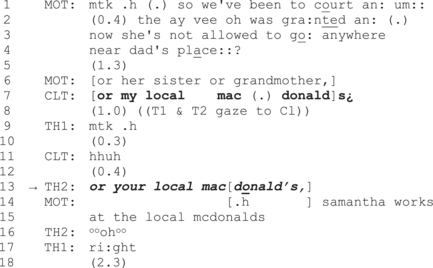
At lines 1–4, Mother describes the outcome of court being an AVO (Apprehended Violence Order), that the Client is not allowed near her Dad's place (where the incident occurred). At line 6, Mother adds that another condition of the AVO is that the Client is not allowed to be near her sister or grandmother. In overlap, the Client adds that she is also not allowed to go near the “local McDonald's” (line 7). This is followed by a silence at line 8 with Therapist 2 directing gaze towards the client. There is no forthcoming clarification from the Client and at line 13, Therapist 2 repeats “or your local McDonald's” with slightly rising intonation and gaze to the client. This is a full repeat of the Client's turn that rules out the therapist having a problem of hearing and instead indicates a problem understanding the whole of the turn (Robinson & Kevoe-Feldman, 2010). At line 14, Mother orients to this repeat as a repair initiation that requests an explanation by answering that the Client's sister Samantha works at the local McDonald's (as mentioned at line 6, the client is not allowed to be near her sister). The therapist was apparently not previously aware that Samantha works at the local McDonald's and this epistemic asymmetry (difference in knowledge) between the family and the therapist (as well as the full repeat ruling out a problem of hearing) is relevant in the Mother ascribing the therapist's repeat as an initiation of a repair of understanding (Robinson, 2013). At line 16, Therapist 2 responds with a change of state token “oh,” indicating that the Mother's answer was new information (Heritage, 1984a) and that the repeat at line 13 was indeed seeking a repair of understanding. The repeat of the client's words and the epistemic asymmetry is sufficient to successfully initiate a sequence of repair, although the trouble source was uttered by the Client, while the repair solution was provided by the Mother. In contrast to the minimal response from the client in Extract 1, this form of repair elicits elaboration and new information that the therapist was previously unaware of. While the Mother's response was new information for the therapist, it was factual information that did not elicit further discussion or dialogue between the family members.
Repeats as third position receipts
Therapists also used repeats to display their acknowledgement and receipt of prior talk and to close sequences (Schegloff, 2007). These examples usually occur in a sequence closing third position in a sequence consisting of a therapist question, family member response, and therapist repeat. In Extract 1 (above), Therapist 1's first repeat of “another” (line 7) initiates a repair sequence on a problem of hearing. After the repair solution is provided by the Grandmother at line 9, Therapist 1 repeats the whole turn “another night” (line 10) displaying their receipt of the repair solution.
In Extract 3, the Therapist asks the Client if she is in year nine of school (line 2). The Client answers with a disconfirming response, indicating that she is in year eight. This is receipted by Therapist with a repeat of “year eight.” There is then a silence before Therapist asks about a new topic (data not shown).
Extract3
S11.rpt1

This example demonstrates the use of the therapist's repeat in third position to signal receipt or acknowledgement of the family member's answer. These repeats display the therapists' adequate hearing of the family members' talk and do not lead to repair sequences, even though the repeat ends in slightly rising intonation (like in Extract 2). This may be explained by the sequential position of the repeat and the associated symmetrical distribution of knowledge. The therapist's original question implicates a downgraded epistemic stance. That is, by asking a question the therapist positions themselves as having less knowledge than the recipient who consequently has a stronger epistemic or “knowing” position relative to the therapist. After the recipient provides an answer, there is a more symmetrical distribution of knowledge (Heritage & Raymond, 2005). The therapist repeat that follows occurs in a sequential position after they have been “informed” displaying their receipt of this new information.
Repeats nominating topics and eliciting elaboration
Other therapist repeats functioned to nominate topics for further elaboration. In these environments, the therapist's repeat followed some form of assertion or telling by a family member, nominated a topic for further development, and initiated a sequence involving further elaboration from the prior speaker. In Extract 4, the therapist's repeat elicits elaborating responses from multiple members of the family. At the beginning of the extract, Child 4 has been describing differences in her sister (the client) since her sister has become mentally distressed.
Extract4
S4.rpt12
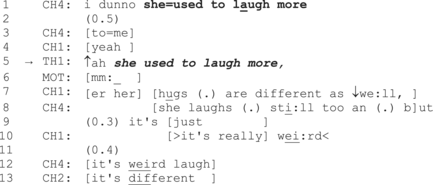
At line 1, Child 4 states that her sister (who is identified as the client) used to laugh more. After a silence, Child 4 adds an increment “to me,” emphasizing that her prior talk was her own observation. This occurs in overlap with her older sister (CH1; who is not the client) who agrees with “yeah.” At line 5, Therapist 1 begins with “ah,” a change-of-state token, which is suggestive of a receipt of new information or a new understanding by the therapist (Heritage, 1984a), and continues with a repeat of Child 4's “she used to laugh more”. This is met with responses from three people in rapid succession. Mother responds with stretched “mm” and flat intonation, but she does not say anything further. In overlap (line 7), Child 1 adds that the client's hugs are different as well. Child 4 responds in overlap with Child 1 adding that her sister still laughs (line 8). This clarifies her prior stance by suggesting that she used to laugh more in the past. After some silences in Child 4's turn (lines 8–9), Child 1 adds in overlap that the client's laugh is “really weird.” Child 4 agrees at line 12 with “it's a weird laugh.”
Therapist 1's repeat has a projective aspect that selects and topicalizes a part of Child 4's prior talk for further elaboration. The repeat is treated by the recipients as requiring a response, with responses from multiple family members including possible confirmation from the Mother, additional information from Child 1, and a clarifying statement from Child 4. The repeat thus nominated a topic for further discussion and prompted elaboration but did not specify a particular type or format of response promoting responsive flexibility (Enfield, 2017).
In Extract 5, the therapist's repeat occurs in third position with downward intonation, which is similar to third-position repeats displaying receipts. However, after a silence the prior speaker provides further details thus treating the repeat as a relevant environment for elaboration. Just prior to this extract, Child 2 has mentioned that he has a big thing to say, but at line 1, he declines to elaborate with “never mind.” The extract begins with the Stepfather asking Child 2 to speak more.
Extract5
S9.rpt4
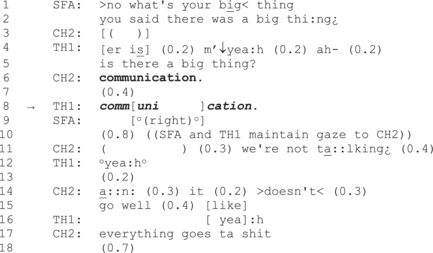
At lines 3 and 4, there is overlap between Child 2 and Therapist 1. Child 2's turn is inaudible and he abandons the turn. Therapist 1 hesitates briefly after the overlap and re-authors the Stepfather's prior question to “is there a big thing?” Similar to issues of epistemic primacy (Heritage & Raymond, 2005; Thompson et al., 2015), this re-authoring implicates the therapist's independent arrival at the question and deontic primacy and authority to direct the session. At line 6, Child 2 responds with “communication.” There is a silence before the therapist repeats “communication” with falling intonation at line 8 (similar to Extract 1, line 10). The Stepfather also provides a receipt of “right” in overlap with the talk of Therapist 1. Child 2 orients to the repeat as a relevant environment for elaboration by responding with further details that when the family are not talking “everything goes to shit” (lines 14–17). As displayed earlier, repeats in third position can display receipt of the prior information and close down further discussion on the topic (Schegloff, 2007). However, as demonstrated in Extract 5, third position repeats are potentially equivocal, and may close or extend a sequence of talk (Schegloff, 2007).
Extract 6 demonstrates how the equivocality of repeats may not lead to the expected response, with the therapist then following up with another statement that elicits elaboration. Extract 6 begins with the Client talking about his difficulties with eating and anxiety.
Extract6
S1.R1
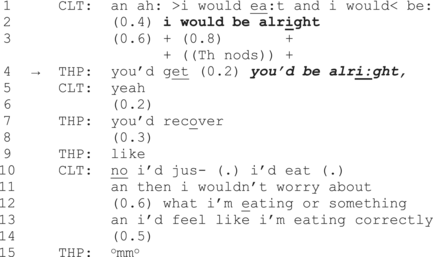
At line 1, the Client states that he would eat and then he would be alright. There is a long silence of 1.4 seconds (line 3), which includes nods from the Therapist. At line 4, the Therapist begins a turn with “you'd get” that projects a summary or formulation of the Client's prior turn. Instead, the Therapist self-repairs with “you'd be alright”, a repeat of the Client's words with slightly rising intonation. At line 5, the Client treats the Therapist's repeat as seeking confirmation (not elaboration) by responding with “yeah” and no further elaboration. This confirmation does not appear to be what the therapist is seeking because after a silence at line 6, the Therapist adds, “you'd recover,” which conveys a different description of the Client as being “alright.” Initially, there is no uptake by the Client and the Therapist starts another turn with “like” at line 9 projecting self-repair or clarification. The Therapist is interrupted by the Client at line 10, rejecting the Therapist's interpretation “you'd recover” by elaborating and saying that he would eat and then would not worry about what he was eating. The Therapist's initial repeat receives a “yeah” from the Client, suggesting that the client analyzed the Therapist's repeat as seeking confirmation. The Therapist, however, does not receipt the Client's confirmation and instead responds by revising their turn, thereby treating the Client's confirmation as inadequate. Here, then, we can see how the indeterminacy of some repeats may result in multiple attempts from the therapist to solicit elaborative talk from the client.
Repeats as receipts outside of transition relevance places
In the following extracts, we present instances of therapist repeats outside of transition relevance places. Transition relevance places are moments when speaker change is normatively implicated (but may or may not occur; Schegloff, 2007). Repeats that did not occur at (or following) transition relevance places resulted in overlap with the talk of a family member. These repeats occurred in two different environments and did not elicit an explicit response. In one environment, the therapist repeats a word in overlap with the current speaker. In the other environment, the therapist repeats a word from the turn of the prior speaker, in overlap with a new speaker. Extract 7 is an example of the therapist's repeat occurring in overlap with the talk of the current speaker outside a transition relevance place. This is followed by a silence with no response before the Mother self-selects with a response to the Client's prior turn. Just prior to the extract, the Mother has proposed that the Client finds it helpful speaking to her therapist and making “plans.” From line 1, the Client responds that nothing seems to come out of the plans.
Extract7
S5.rpt9
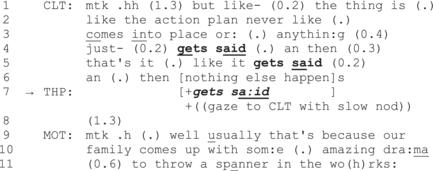
At lines 4–6 the Client states that the action plan just “gets said” and nothing happens as a result. At line 7, the Therapist repeats “get said” in overlap with the end of the Client's turn “nothing else happens” at a place where the Client's turn is not yet complete. The repeat is spoken at a clearly audible volume, with emphasis on “said,” gaze to the Client, and slow nods. This is followed by a silence of 1.3 s at line 8, before the Mother says that the family usually creates some sort of drama, as a reason for why the plans are not enacted. The Therapist's repeat occurs at a non-transition relevance place and is not responded to by any of the participants, nor does the Therapist reissue their repeat or revise their turn to pursue a response during the long silence at line 8. Instead, the Mother responds to the prior talk of the Client rather than the Therapist's repeat. The repeat is thus not treated as an initiation of repair nor a request for elaboration, but—along with the slow nods and lack of follow up from the Therapist—seems to function as a receipt of the Client's talk that does not normatively project a vocal response.
In Extract 8, the Therapist's repeat outside a transition relevance place occurs in overlap with the turn of the next speaker. But rather than receipt, as in the previous turn, the repeat serves the function of returning to the prior topic and avoiding a possible argument. The extract starts with the Mother saying that the Client did not participate in a school program when he was admitted to hospital, because “he didn't like the teachers there”.
Extract8
S10.rpt4
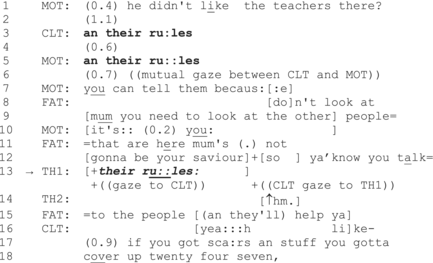
At line 3, the Client adds an increment to the Mother's turn that he did not like the school because of “their rules.” After a silence, the Mother directs the Client to speak (line 7). At line 8, the Father directs the Client to look at the therapists rather than his Mother and that his Mother is not going to be his savior, a reference to the Client not speaking for himself. The Therapist's repeat at line 13 of “their rules” with emphasis and sound stretch occurs in overlap with Father's talk and their gaze is directed to the Client. This repeat topicalizes the earlier talk about “their rules” and competes with the Father's turn (Schegloff, 2000). The Client is being addressed simultaneously by the Father telling him to speak to the therapists, and the Therapist inviting him to speak about the earlier topic of “their rules.” The Therapist's repeat also directs the Client away from responding to the Father's sanctioning and away from a possible argument. The repeat thus serves two functions, a request for elaboration, and avoidance of a conversational trajectory that may result in overt conflict.
DISCUSSION
In this study, therapists' repeats were found to serve a wide variety of interactional functions such as initiating repair, marking receipt, nominating a topic for further discussion, and directing the conversation away from an undesired area. Although these repeats are similar to those identified in everyday conversation, they are employed to accomplish situated institutional objectives relevant to an Open Dialogue approach. For example, through the use of repeats to initiate repair and to display receipt, therapists also demonstrate that they are closely attending to the talk of clients and incorporating that talk into their responses.
In a similar fashion, repeats were used to create sequential environments that encourage elaborative responses from clients without employing an action or practice that implements stronger constraints on responsive talk (e.g., an interrogative turn). These repeats function as a minimal prompt that extends the topic of talk and affords the recipient a wider variety of possible responses within a topical field determined by the therapist. These uses of repeats by therapists are closely aligned with the Open Dialogue literature where therapists are advised to incorporate and repeat the words of clients to encourage elaboration.
When repeats outside of a transition relevance place occur during the talk of the same speaker as the first saying, they generally do not receive a response or impact on the sequential trajectory of the turn. They therefore function as receipts of part of the ongoing turn that do not require a response. When repeats outside of a transition relevance place occurred during the talk of the next speaker, there was not the same consistency in function. In Extract 8, the repeat occurred in competition with another speaker and served dual functions of requesting elaboration on a therapeutically relevant topic and diverting the conversation away from a potential argument. Repeats outside of a transition relevance place generally do not interrupt the progression of the conversation and display the therapist's receipt, acknowledgement, and attention to the developing talk of the clients. In this sense, they are consistent with an Open Dialogue approach, however they generally do not lead to the elaboration that is proposed in writings on Open Dialogue repeats.
Previous CA research into Open Dialogue has found that therapists use different practices that generate similar outcomes. For example, Ong et al. (2021b) describe how therapists utilize the phrase “I'm wondering” to elicit stance positions from family members. These forms of turn design allow for a variety of responses from recipients and, to some extent, mitigate the authority of the therapist. These findings also align with the work of Knol et al. (2020) who describe how psychotherapists' mirroring repeats serve as requests for elaboration that avoid adding the therapist's interpretation.
Our results suggest that the proposed use of repeats in Open Dialogue practice provide an oversimplified view of how repeats are utilized in actual therapeutic conversations, because repeats serve a variety of functions that are not accounted for by current descriptions of dialogical practice. For example, therapists' repeats are not a neutral mirroring back of the family's words. Instead, repeats select and nominate particular parts of the prior talk for further development and thus reflect some professional decision-making by the therapist, which in turn guides the conversation in particular directions. This is similar to other therapist responses such as formulations, which provide a summary or “upshot” of the client's talk (Antaki, 2008; Antaki et al., 2005). Previous CA research has similarly demonstrated that Open Dialogue therapists select parts of prior talk, sometimes with interpretations, and exclude others to elicit stance positions from different participants (Ong et al., 2021b; Rossen et al., 2020; Schriver et al., 2019). So, while the use of repeats limits the therapists' responses to the actual words of the client, they still involve an exercising of authority through the selectivity and guiding of the conversation by the therapist.
IMPLICATIONS FOR PRACTICE
This study shows how theoretical descriptions of therapeutic practice need to be tested against actual conversational interactions to validate their proposed functions (Peräkylä & Vehviläinen, 2003). Open Dialogue emphasizes a collaborative approach that foregrounds the perspectives of the family over those of therapists. However, even within apparently desirable practices like repeats, some selectivity, directing of the session, and exercising of authority by the therapist is unavoidable. Current descriptions of Open Dialogue do not adequately address the authority of the therapist and the potential benefits of control of the session to enable the promotion of dialogue (Ong et al., 2021a, 2021b). The current theoretical descriptions of Open Dialogue mainly consist of aspirational ideals, while more practical and pragmatic accounts are relatively underdeveloped. For clinicians, this means that the theoretical ideals of Open Dialogue need to be tempered with the reality of therapist authority and power within therapeutic conversations. Regardless of their therapeutic approach, we recommend that clinicians remain mindful of the recommendations contained within theoretical models and to test these against their actual therapeutic experiences.
This research shows that a conversational practice like repeats, do not result in one type of outcome. Therefore, clinicians need to be mindful of the sequential position of their repeats. If therapists ask a direct factual question of clients, then a repeat of the client's answer can display the therapist's receipt of that information and close down the conversation. If a client has finished a turn at talk, then the therapist can use a repeat to prompt elaboration by the client on a particular topic while also providing flexibility in how a client may respond. That is, the repeat does not direct a client to provide a particular type nor focused response. Therefore, a repeat in this situation can extend talk on a nominated topic but may not be useful if a therapist is wanting the client to provide specific information. This equivocal function of repeats may also be helpful when the therapist wishes to select a particular speaker when there is competition for the conversational floor. Clinicians can therefore nominate both a topic and a speaker without explicitly closing a particular topic nor sanctioning an interrupting speaker. Repeats may therefore be helpful in directing the conversation while minimizing risks of breaching engagement with clients.
LIMITATIONS
A limitation of this study is that, while the participating therapists were experienced in the Open Dialogue approach, they were undertaking advanced training at the time that data was collected. These results may therefore represent a step in their process of applying a dialogical approach and a focus on following current prescriptive advice. This connects with a larger issue about what constitutes the essential practices of a dialogical approach and the current lack of an agreed and operationalized fidelity criteria. We therefore present these results as an indication of the real-world practices of therapists committed to a dialogical way of working. Further research could support whether these practices are also utilized by more experienced clinicians and if other functions of therapists' repeats are evident. As we were investigating the use of lexical repeats mentioned in the theoretical literature on Open Dialogue, we consequently focused on the verbal production of repeats with less attention to multimodal resources of the interaction. Multimodal CA research can contribute more detailed insights into communicative actions including embodied repeats (Mondada, 2018). This awaits future study.
The originators of Open Dialogue have encouraged the use of repeats, because they are thought to allow the client to hear and reflect on their own words (Haarakangas et al., 2007; Olson et al., 2014; Seikkula, 2011; Seikkula & Arnkil, 2006; Seikkula & Trimble, 2005). CA research focuses on the observable details of conversation and any inferences about the internal thought processes of conversational participants must be grounded in their displayed interactions. This study could not assess the extent to which repeats encouraged internal reflection by clients. We could demonstrate that certain repeats could elicit client elaboration and further details on their prior talk, but we could not show that this elaboration was connected to internal reflections or new insights. This question may be addressed in future CA research, possibly with the addition of other methods to investigate the internal thought processes of participants.
In examining the use of therapist repeats in actual therapeutic conversations, we have sought to demonstrate the various ways that repeats can be used both for theorized therapeutic purposes and for other conversational functions. A close description of the normative implications of conversational practices can provide therapists with an understanding of the repertoire of practices relevant for Open Dialogue, which they then can implement in context-sensitive ways. In doing this, we hope to contribute to a more nuanced understanding of the conversational work that is done in therapy, and to highlight the limitations of presumptions about the functions of different conversational practices without reference to empirical findings about their organization.
Complexe Systémique: key points
This article does what the Open Dialogue literature rarely does: it looks at what actually happens, line by line, when a therapist repeats a family’s words. The main lesson lies in the notion of “next-turn proof”: a repeat has no function in itself, only the one the response gives it. The same repeat can open up elaboration (“she used to laugh more” gets three children talking at once), close a factual question (“year eight”) or obtain nothing more than a “yeah”, as in Extract 6, where the therapist, unsatisfied, ends up offering their own wording, “you’d recover”, which the young man promptly corrects. Extract 8 is the most subtle: repeating “their rules” invites the adolescent to speak without contradicting the father who is lecturing him. The conclusion does not condemn the repeat, it de-idealises it: choosing a word is already directing, and it is better to know it. Limits: therapists in training, a mainly verbal analysis, nothing on the inner reflection repeats are supposed to prompt. Read alongside the same authors’ study of trainees, who learn to “hold ideas lightly”, and the case study on sharing reflections in a network meeting.
Notes from the original
Acknowledgments. Dr Ben Ong and Prof Niels Buus are generously supported by the Open Dialogue Centre, Sydney. Open access publishing facilitated by Monash University, as part of the Wiley - Monash University agreement via the Council of Australian University Librarians.
References
Albert, S., & de Ruiter, J. P. (2018). Repair: The interface between interaction and cognition. Topics in Cognitive Science, 10(2), 279–313. https://doi.org/10.1111/tops.12339
Antaki, C. (2008). Formulations in psychotherapy. In A. Peräkylä, C. Antaki, S. Vehviläinen, & I. Leudar (Eds.), Conversation analysis and psychotherapy (pp. 26–42). Cambridge University Press.
Antaki, C., Barnes, R., & Leudar, I. (2005). Diagnostic formulations in psychotherapy. Discourse Studies, 7(6), 627–647. https://doi.org/10.1177/1461445605055420
Brown, P. (1998). Conversational structure and language acquisition: The role of repetition in Tzeltal. Journal of Linguistic Anthropology, 8(2), 197–221. https://doi.org/10.1525/jlin.1998.8.2.197
Buus, N., Einboden, R., Gill, K., Mikes-Liu, K., & Ong, B. (2020). Påskønnende lytning [Appreciative listening]. In B. I. N. Askham, L. L. Berring, N. Buus, L. Hybholt, K. Stjernegaard, & E. S. Tønder (Eds.), Psykiatrisk sygepleje [Mental health nursing] ( 2nd ed., pp. 399–428). Blackwell Publishing—Munksgaard.
Enfield, N. J. (2017). Distribution of agency. In N. J. Enfield & P. Kockelman (Eds.), Distributed agency (pp. 9–14). Oxford University Press.
Galbusera, L., & Kyselo, M. (2018). The difference that makes the difference: A conceptual analysis of the open dialogue approach. Psychosis, 10(1), 47–54. https://doi.org/10.1080/17522439.2017.1397734
Goodwin, C., & Heritage, J. (1990). Conversation analysis. Annual Review of Anthropology, 19(1), 283–307. https://doi.org/10.1146/annurev.an.19.100190.001435
Haarakangas, K., Seikkula, J., Alakare, B., & Aaltonen, J. (2007). Open dialogue: An approach to psychotherapeutic treatment of psychosis in northern Finland. In H. Anderson & D. R. Gehart (Eds.), Collaborative therapy: Relationships and conversations that make a difference (pp. 221–233). Routledge.
Hayashi, M., Raymond, G., & Sidnell, J. (2013). Conversational repair and human understanding: An introduction. In G. Raymond, M. Hayashi, & J. Sidnell (Eds.), Conversational repair and human understanding (pp. 1–40). Cambridge University Press.
Hepburn, A., & Bolden, G. B. (2017). Transcribing for social research. Sage Publications.
Heritage, J. (1984a). A change-of-state token and aspects of its sequential placement. In J. M. Atkinson & J. Heritage (Eds.), Structures of social action: Studies in conversation analysis (pp. 299–345). Cambridge University Press.
Heritage, J. (1984b). Garfinkel and ethnomethodology. Wiley.
Heritage, J., & Raymond, G. (2005). The terms of agreement: Indexing epistemic authority and subordination in talk-in-interaction. Social Psychology Quarterly, 68(1), 15–38. https://doi.org/10.1177/019027250506800103
Kim, H. (2002). The form and function of next-turn repetition in English conversation. Language Research, 38(1), 51–81.
Knol, A. S. L., Huiskes, M., Koole, T., Meganck, R., Loeys, T., & Desmet, M. (2020). Reformulating and mirroring in psychotherapy: A conversation analytic perspective. Frontiers in Psychology, 11, 1–12. https://doi.org/10.3389/fpsyg.2020.00318
Mondada, L. (2018). Multiple temporalities of language and body in interaction: Challenges for transcribing multimodality. Research on Language and Social Interaction, 51(1), 85–106. https://doi.org/10.1080/08351813.2018.1413878
Muntigl, P., & Horvath, A. O. (2016). A conversation analytic study of building and repairing the alliance in family therapy. Journal of Family Therapy, 38(1), 102–119. https://doi.org/10.1111/1467-6427.12109
Olson, M., Seikkula, J., & Ziedonis, D. (2014). The key elements of dialogic practice in open dialogue. The University of Massachusetts Medical School. http://umassmed.edu/psychiatry/globalinitiatives/opendialogue/
Ong, B., Barnes, S., & Buus, N. (2020a). Conversation analysis and family therapy: A critical review of methodology. Family Process, 59(2), 460–476. https://doi.org/10.1111/famp.12431
Ong, B., Barnes, S., & Buus, N. (2020b). Conversation analysis and family therapy: A narrative review. Journal of Family Therapy, 42(2), 169–203. https://doi.org/10.1111/1467-6427.12269
Ong, B., Barnes, S., & Buus, N. (2021a). Downgrading deontic authority in open dialogue reflection proposals: A conversation analysis. Family Process, 60(4), 1217–1232. https://doi.org/10.1111/famp.12586
Ong, B., Barnes, S., & Buus, N. (2021b). Eliciting stance and mitigating therapist authority in open dialogue meetings. Journal of Marital and Family Therapy, 47(1), 120–135. https://doi.org/10.1111/jmft.12454
Ong, B., & Buus, N. (2021). What does it mean to work ‘dialogically’ in open dialogue and family therapy? A narrative review. Australian and New Zealand Journal of Family Therapy, 42(3), 246–260. https://doi.org/10.1002/anzf.1464
Peräkylä, A. (2012). Conversation analysis in psychotherapy. In J. Sidnell & T. Stivers (Eds.), The handbook of conversation analysis (pp. 551–574). Wiley Blackwell.
Peräkylä, A. (2019). Conversation analysis and psychotherapy: Identifying transformative sequences. Reseach on Language and Social Interaction, 52(3), 257–280.
Peräkylä, A., & Vehviläinen, S. (2003). Conversation analysis and the professional stocks of interactional knowledge. Discourse & Society, 14(6), 727–750. https://doi.org/10.1177/09579265030146003
Potter, J. (1996). Discourse analysis and constructionist approaches: Theoretical background. In J. T. E. Richardson (Ed.), Handbook of qualitative research methods for psychology and the social sciences (pp. 125–140). BPS Books.
Puchta, C., Potter, J., & Wolff, S. (2004). Repeat receipts: A device for generating visible data in market research focus groups. Qualitative Research, 4(3), 285–309. https://doi.org/10.1177/1468794104047231
Rober, P., & Seltzer, M. (2010). Avoiding colonizer positions in the therapy room: Some ideas about the challenges of dealing with the dialectic of misery and resources in families. Family Process, 49(1), 123–137.
Robinson, J. D. (2013). Epistemics, action formation, and other-initiation of repair: The case of partial questioning repeats. In G. Raymond, J. Sidnell, & M. Hayashi (Eds.), Conversational repair and human understanding (pp. 261–292). Cambridge University Press.
Robinson, J. D., & Kevoe-Feldman, H. (2010). Using full repeats to initiate repair on others' questions. Research on Language and Social Interaction, 43(3), 232–259. https://doi.org/10.1080/08351813.2010.497990
Rossen, C. B., Schriver, K. N., Tarber, C., Nordahl, D. V., Thygesen Rasmussen, G., Ong, B., & Buus, N. (2020). “Y, what do you think about what X just said?” conversation analysis of stance-eliciting questions in open dialogue network meetings. Journal of Marital and Family Therapy, 46(4), 719–731. https://doi.org/10.1111/jmft.12435
Rossi, G. (2020). Other-repetition in conversation across languages: Bringing prosody into pragmatic typology. Language in Society, 49(4), 495–520. https://doi.org/10.1017/S0047404520000251
Schegloff, E. A. (1996). Confirming allusions: Toward an empirical account of action. American Journal of Sociology, 102(1), 161–216. https://doi.org/10.1086/230911
Schegloff, E. A. (1997). Practices and actions: Boundary cases of other-initiated repair. Discourse Processes: Discourse Process after Two Decades, 23(3), 499–545. https://doi.org/10.1080/01638539709545001
Schegloff, E. A. (2000). Overlapping talk and the organization of turn-taking for conversation. Language in Society, 29(1), 1–63. https://doi.org/10.1017/S0047404500001019
Schegloff, E. A. (2007). Post-expansion. In Sequence Organization in Interaction: A primer in conversation analysis (pp. 115–168). Cambridge University Press.
Schegloff, E. A., Jefferson, G., & Sacks, H. (1977). The preference for self-correction in the organization of repair in conversation. Language, 53(2), 361–382. https://doi.org/10.2307/413107
Schriver, K. N., Buus, N., & Rossen, C. B. (2019). Reflective practices in open dialogue meetings: Reporting and inferential ‘my side tellings’. Journal of Pragmatics, 146, 19–31. https://doi.org/10.1016/j.pragma.2019.03.007
Schriver, K. N., Ong, B., Rossen, C. B., & Buus, N. (2022). Empathic ‘my side tellings’: Three therapist strategies that ‘argue understanding’ in open dialogue reflections. Journal of Pragmatics, 196, 44–53. https://doi.org/10.1016/j.pragma.2022.05.004
Seikkula, J. (2011). Becoming dialogical: Psychotherapy or a way of life? Australian and New Zealand Journal of Family Therapy, 32(3), 179–193.
Seikkula, J., & Arnkil, T. E. (2006). Dialogical meetings in social networks. Karnac.
Seikkula, J., & Trimble, D. (2005). Healing elements of therapeutic conversation: Dialogue as an embodiment of love. Family Process, 44(4), 461–475.
Thompson, S. A., Fox, B., & Couper-Kuhlen, E. (2015). Grammar in everyday talk: Building responsive actions. Cambridge University Press.
Tseliou, E. (2013). A critical methodological review of discourse and conversation analysis studies of family therapy. Family Process, 52(4), 653–672. https://doi.org/10.1111/famp.12043
Walker, T., & Benjamin, T. (2017). Phonetic and sequential differences of other-repetitions in repair initiation. Research on Language and Social Interaction, 50(4), 330–347. https://doi.org/10.1080/08351813.2017.1340717
Reformatted republication of A conversation analysis of therapist repeats in open dialogue network meetings, by Ben Ong, Scott Barnes and Niels Buus, Family Process, vol. 63 (2024), doi: 10.1111/famp.12852, under a CC BY 4.0 licence. Edition and layout: Complexe Systémique, September 2026 — the work has been modified under the terms of the licence (extracts reproduced as images). Neither the authors nor the publisher are responsible for this edition; the original version prevails.
This is the original article “A conversation analysis of therapist repeats in open dialogue network meetings”, published in Family Process (2024) under a CC BY 4.0 licence. Republished by Complexe Systémique: the author’s text is unchanged; only the presentation has been adapted for reading online, as set out at the head of this page.
Read the original articleHow to cite this article
Ong, B., Barnes, S., & Buus, N. (2024). A conversation analysis of therapist repeats in open dialogue network meetings. Complexe Systémique. https://app.complexe-systemique.com/en_GB/articles/a-conversation-analysis-of-therapist-repeats-in-open-dialogue-network-meetings (Original work published in 2024 in Family Process, 63(1) (2024); republished in 2024 by Family Process, https://onlinelibrary.wiley.com/doi/full/10.1111/famp.12852)
To go further
- Open dialogue trainees’ perspectives on learning processes and psychotherapeutic practice: A prospective focus group studyThe same authors, on the training side.
- Open Dialogue: A case study on the influence of sharing or withholding reflections during a network meetingAnother lens on the network meeting.
- Silence in therapy: a polysemic presenceWhat the silences between turns say.
Related training courses
 Webinar
Extramarital affairs: what does the therapist do when the couple explodes?
Free webinar: how to position yourself as a systemic therapist in the crisis of the extramarital affair. Revelation, secrecy, multipartiality.
 Short course
The suicidal crisis in adolescents and young adults
Training: assessing and supporting the suicidal crisis in adolescents and young adults. Clinical landmarks and systemic tools. In French.
Related articles
 Article
 The AFFIRM Model for Navigating Challenges in Continuously-Interfaith and Divergent-Interfaith Marriages
Thirty happy interfaith couples describe how they navigate their religious differences: five processes, from respecting each other’s choices to religious intimacy, gathered in the AFFIRM model.
 Article
 Toxic, narcissistic, borderline: what therapy speak does to your relationships
Narcissistic, borderline, toxic: therapy speak has left the consulting room. Julien Besse shows how these labels close the debate and relieve us of our own part.
 Article
 Are You Qualified, ChatGPT? Examining Clinical Skills and Competencies of ChatGPT in Delivering Systemic Interventions
A GPT trained in systemic interventions, blind-rated by twelve clinical supervisors: a rushed, dominating novice, whom the client nonetheless loved.
 Article
 Relational Therapy in Post‐Incarceration Reentry: A Scoping Review
What does the literature say about relational therapy after prison? A review of 19 articles: decisive family bonds, almost no tested model, nothing on couples.