Australian and New Zealand Journal of Family Therapy · Family therapy
A Critical, Relational Approach for Working with Suicide in Family Therapy
How can we support a family affected by suicidal ideation without forgetting what oppression does to people? Émilie Ellis proposes placing narrative therapy and dialectical behaviour therapy on a single spectrum, from skills coaching in times of crisis to rebuilding the preferred narrative. The journey of Morgan, a non-binary young adult, runs through the text.
This is a reformatted republication of A Critical, Relational Approach for Working with Suicide in Family Therapy, by Émilie Ellis, published in Australian and New Zealand Journal of Family Therapy (Wiley) (2022), doi: 10.1002/anzf.1477, under a CC BY 4.0 licence. Prepared by Complexe Systémique in September 2026: the authors’ text is unchanged; the layout has been adapted for reading online, which constitutes a modification of the work under the terms of the licence. Tables are presented as lists. This edition was made neither by the authors nor by the publisher, who are not responsible for its content or for any errors. The original version prevails.
Therefore, therapists should hold space for both the dominant narrative and exceptional moments.
Émilie Ellis
Abstract
Suicidality is a major global public health issue that couple and family therapists will inevitably encounter in their clinical work. While relational therapies for addressing suicidality are growing, few specifically outline ways to address the influence of systemic oppression on suicidality, reflecting the push to de-politicise suicide research. To address this issue, scholars have proposed integrating narrative approaches with evidence-based practices. This paper therefore delineates the integration of narrative therapy with dialectical behaviour therapy as a material discursive therapy. All main aspects of theory integration are described, including the epistemological framework, approach to the therapeutic relationship, and interventions. Finally, the change process is described using clinical case examples throughout to illustrate the ways in which these models can be integrated to produce a critical, relational approach for addressing suicidality in family therapy.
Key Points
- An integration of narrative therapy and dialectical behaviour therapy (DBT) is presented as a means of introducing a new approach to addressing suicidality for couple and family therapists.
- These models are integrated using feminist new materialism to harness the inherent connection between matter and discourse,
- DBT skills and narrative questions are both used to elicit change that is tangible and meaningful to the client.
- Key to integration is the use of DBT skills to enhance the meaning-making process inherent in narrative therapy.
Globally, suicide has been identified as a major public health issue (World Health Organisation [WHO], n.d). In Australia, rates of death by suicide have been consistently increasing over the last decade (Australian Institute of Health and Welfare [AIHW], 2020) and suicide is the leading cause of death in people 15–44 years old (Lifeline, n.d.). However, death by suicide is only a part of the problem; an even greater proportion of people engage in nonfatal suicide attempts or struggle with suicidal thoughts, such as considering or planning an attempt (AIHW, 2020). A 2007 national survey found that 2.1 million Australians reported they had seriously considered suicide in the last year (AIHW, 2020). It is therefore no surprise that almost all mental health professionals, including couple/marriage and family therapists (CFTs), encounter clients struggling with suicidality at some point in their career (Love, Frey, & Durtschi, 2020).
However, still very few CFT models are developed with high-risk clients in mind. Some studies have demonstrated that CFTs inconsistently implement best practices for addressing suicide (Love, Frey, & Durtschi, 2020). There exists a dominant discourse that relational models of therapy are not suitable for addressing suicidality (Levy, Koehler, & Hunt, 2019) despite evidence to the contrary (Frey & Hunt, 2018). Many of the existing relational approaches to addressing suicide require advanced training in a specific model or have been developed outside of the CFT field, which may contribute to CFTs' struggle to address suicidality. Considering the seriousness and pervasiveness of the issue, the CFT field needs more ways of addressing suicidality that align with the core models of our field and that allow for the integration of effective interventions.
To this end, the goal of this paper is to propose the integration of narrative therapy (White & Epston, 1990) and dialectical behaviour therapy (DBT; Linehan, 2015) as a means of developing a critical, relational approach for addressing suicidality in family therapy. These two models are particularly well suited for integration as DBT is an evidence-based treatment for suicide (DeCou, Comtois, & Landes, 2019) that combines cognitive behavioural therapy with mindfulness techniques (Linehan, 2015); while narrative therapy allows room for focusing on resilience and the deconstruction of systemic oppression. The model proposed in this paper helps CFTs to address suicide as an inevitable part of clinical practice, while also not limiting them to a ‘special occasions’ crisis intervention model, thereby eliminating abrupt switching between approaches when clients present with suicidality. In the following sections, a review of existing relational models for treating suicidality is presented, followed by a description of how DBT and narrative therapy can be effectively integrated.
Relational Approaches to Addressing Suicidality
Several relational approaches have been developed and shown effectiveness in addressing suicidality – defined as suicidal ideation and suicidal behaviour – among youth and adults. Attachment-based family therapy (Diamond, Diamond, & Levy, 2014) is a recognised evidence-based practice for reducing suicidality in adolescents and has also shown effectiveness in addressing suicidality in sexual and gender minority youth (Levy, Russon, & Diamond, 2016; Russon et al., 2021). Drawing on emotion-focused therapy, with its roots in attachment theory, the intervention is designed to strengthen parent–child attachment thereby increasing the young person's social support and reducing suicide risk (Diamond, Diamond, & Levy, 2014). Research has found family-focused interventions that improve communication (Richman, 2001), family psychoeducation (Miklowitz et al., 2020), and cognitive-behavioural family therapy (Esposito-Smythers et al., 2019; Weinstein et al., 2018; Wijana, Enebrink, Liljedahl, & Ghaderi, 2018) to be effective in reducing suicidal ideation in the identified struggling family member. A few CFT models have been adapted to address suicidality. For example, Romney, Hawkins, and Soloski (2020) describe an integration of structural family therapy and experiential family therapy as a means of addressing suicidal ideation and behaviours in a gender non-conforming adolescent. Additionally, Softas-Nall and Francis (1998) introduce a solution-focused approach to addressing suicidality.
However, many of the above models employ a depoliticised and psychocentric approach to suicidality, locating the Problem within the individual or relationship, without creating room to explore the influence of systemic oppression, which is a major critique of suicide treatment and research (White, Marsh, Kral, & Morris, 2015). To address this critique, scholars also recognise the ethical potential of integrating a narrative approach with empirically supported treatments. MacLeod (2019) describes how a narrative approach can be integrated with existing practices to create room in the therapeutic process to focus on resilience and address cultural and social influences on suicidality. Similarly, Larner (2009) integrates narrative therapy with individual cognitive therapy, outlining how he holds these two approaches in ethical relation to one another, which is in itself a systemic and ethical practice.
Scholars in critical suicide studies have also used narrative ideas to integrate a more ethical and systemic conceptualisation of suicidality (Ansloos, 2018; White & Morris, 2019). Focused on attending to suicide disparities, such as the fact that indigenous and sexual and gender minorities experience significantly higher rates of suicidality (AIHW, 2020; Lifeline, n.d.), critical suicide scholars centre systemic oppression and the need to reconceptualise suicidality itself (White, Marsh, Kral, & Morris, 2015). While developing a model for suicide prevention for use in clinical work may be in contrast with some of the core ideas of critical suicide studies, the work of these scholars has ethical implications for CFT, such as the imperative to address and deconstruct the influence of systemic oppression in suicidality, particularly when working with clients of marginalised identities. With their training in systemic and narrative approaches, CFTs are well positioned to integrate these critiques and approach our work with these clients differently.
Ethico-Onto-Epistemological Orientation
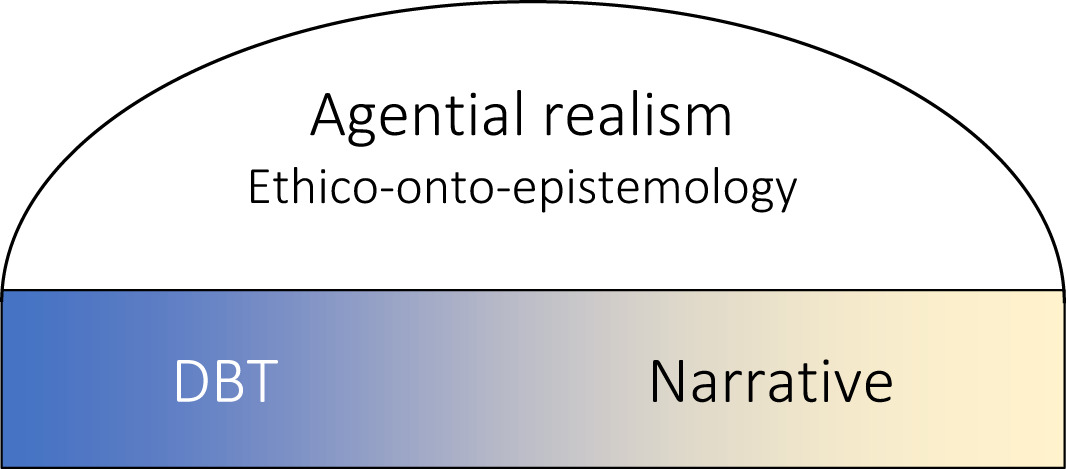
One perceived barrier to the integration of narrative therapy and DBT is that these models are situated in very different epistemological traditions. Informed by principles of behaviourism and valuing measurable change over intangible meaning-making, DBT is staunchly located within a neopositivist tradition (Linehan, 2015). Meanwhile, narrative therapy was born of Foucauldian, social constructionist epistemologies, and takes a discursive approach to change (Combs & Freedman, 2012). One approach to integrating these models is to situate them within a new epistemology, such as Barad's ethico-onto-epistemology, agential realism, which argues for the inseparability of matter and discourse (for further explanation, see Barad, 2007). As a feminist new materialist, Barad (2010) uses the idea of entanglements to describe how matter (nature) and discourse (culture) are related in a material-discursive process. As such, rather than the Foucauldian subject, it is these material-discursive processes that form the primary ontological unit (Barad, 2007).
This inherently systemic worldview provides a frame for understanding how materiality and discourse are both essential components of being and knowing in the world, and therefore has important implications for therapy. If people themselves are material-discursive processes in that they both produce and are produced by discourse, the historicity of which is embodied (Barad, 2007), then change must also be material-discursive.
A Material-Discursive Therapy
DBT and narrative therapy can be seen as being integrated on a spectrum (see Figure 1). This allows the therapist to change their approach seamlessly depending on the client's current level of risk without the need to implement a new model. For example, when a client is not at high risk of harming themselves and is regularly able to access their wise mind, therapy is focused on strengthening their preferred narrative. However, in times of crisis, the therapist can lean more about DBT, coaching the family on staying wise-minded and safe while embodying their preferred narrative.
Therapeutic Relationship
The ethico-onto-epistemological orientation has important implications for the therapeutic relationship. The therapist and clients are intra-acting phenomena (systems within systems) that co-constitute each other (systems producing systems). My materiality and discursiveness, such as my social location as a White, cisgender queer woman, are equally as influential on the process of therapy as my actions. While I cannot separate myself from the material-discursive processes that inform my subject position, I can be aware of the ethics involved in each of my intra-actions, attempting to take care to not engage in oppressive intra-actions and to repair when I do.
Additionally, the spectrum of integration influences the therapist's approach to the therapeutic relationship. While DBT tends to mandate therapists to be directive with clients (Linehan, 2015), narrative therapy necessarily takes a collaborative approach (Combs & Freedman, 2016). Therapists must therefore be intentional with how their approach to the therapeutic relationship shifts with the client's needs. In general, I default to a collaborative stance, which research has demonstrated is an essential part of effective therapy (Duncan, Miller, Wampold, & Hubble, 2010). However, there are also times when an entirely collaborative approach is not possible, such as when clients are unable to keep themselves and/or others safe. In these situations, therapists have a legal and ethical responsibility to be more directive, which could range from temporarily prioritising safety and crisis management skills over other goals for therapy to in/voluntary hospitalisation.
Finally, embedded within the material-discursive process of therapy, the therapeutic relationship has both discursive and material components. For example, empathy is an essential part of the therapeutic relationship (Duncan, Miller, Wampold, & Hubble, 2010), which therapists demonstrate discursively through communicating that they understand a client's moment-to-moment experience (Duncan, Miller, Wampold, & Hubble, 2010). However, we also experience a physiological and affective state of resonance that mirrors that of other people, which some have suggested could be a biological basis for empathy (Siegel, 2006). This research therefore demonstrates the inherent interconnectedness between therapist and client that is both material and discursive, which can in itself be healing.
Interventions
Material-discursive therapy (MDT) uses interventions from both narrative therapy (Freedman & Combs, 1996) and DBT (Linehan, 2015), such as narrative therapy questions, chain analyses, and skills coaching. The therapist may choose to use interventions based on the client's needs and the spectrum of integration (Table 2 below). The following sections will highlight how interventions are adapted for use in MDT with clients struggling against suicidal thoughts and urges.
Narrative questions
Narrative questions in MDT are mostly borrowed from narrative therapy, such as deconstruction questions, preference questions, and meaning questions (see Table 1). One difference is that they are used to discursively co-construct a state of becoming that is grounded in materiality. For example, in working with a client struggling with depression and experiencing suicidal thoughts, the therapist would integrate DBT's emphasis on vulnerability factors (Linehan, 2015). This would involve asking the client which physical states (i.e., hungry, tired) make them more vulnerable to Depression's influence. Depression is often experienced as louder and more persuasive when a client's basic needs are not met.
Table 1 — Questions in Material Discursive Therapya
- Deconstruction questionsa. When is the Problem's voice louder? When is the Problem quieter? How do systems of oppression make the voice of the Problem louder?
- Vulnerability questions. When are you most vulnerable to the influence of the Problem? What physical or emotional states make you more vulnerable to the Problem?
- Opening space questionsa. Are there times when the Problem's voice is quieter? Or is not present at all?
- Creating wise-minded unique outcomes. What can you do to defend yourself against the Problem?
- Preference questionsa. What did it mean to you that you were able to [sparkling moment]? What story were you embodying when you [sparkling moment]? How would you prefer your relationship to the Problem to be?
- Story development and meaning questionsa. How did you defend yourself against the influence of the Problem? What skills empowered you to take back agency in your relationship with the Problem? Who helped defend you or helped you defend yourself against the Problem?
a Adapted from questions in Freedman & Combs (1996).
Chain analysis
A key intervention in DBT is chain analysis (Linehan, 2015), wherein a client describes everything they experienced (i.e. Actions, Body sensations, Cognitions, Events, and Feelings) leading up to and immediately following a ‘problem behaviour’ (e.g., self-harm, suicide attempt). In narrative therapy, it is common to invite the client to tell a story about a time the Problem won. Chain analysis involves asking a client to do just that: to tell a detailed story that demonstrates the influence of the Problem on the client. The resulting process is a very ‘slowed-down’ and ‘zoomed-in’ approach to examining the client's experience of the dominant narrative. Individuals struggling with suicidal ideation often experience a long series of material and discursive events in very quick succession (Beaudoin, 2020), and chain analysis can facilitate better tracking of this chain of events while modelling mindfulness skills (Linehan, 2015). This intervention can also create opportunities for externalising conversations by mapping out the influence of the Problem on the chain of events. For example, the therapist can use chain analysis to map out the influence of systemic oppression on the client.
Finally, chain analysis is also useful for attending to sparkling moments, or moments that present an exception to the dominant narrative (Freedman & Combs, 1996). Here, it provides a means of inviting the client to tell a story about a time when the Problem was not present or was quieter. In this case, chain analyses can be used to build a rich, thick description of the sparkling moment and strengthen the preferred narrative by integrating the discursive experience (i.e., thoughts, story, meaning) with the embodied, material experience (i.e., body sensations, sensory input, behaviours) of the preferred narrative, and identify what tools, skills, or allies the client was able to access to help defend themselves against the suicidal thoughts or urges.
Developing a detailed counternarrative has been found to be helpful for marginalised clients struggling against suicidal urges (Mehl-Madrona & Mainguy, 2020). However, while some of the core reasons for integrating narrative with DBT is to allow room for resilience, overfocusing on strengths can invalidate the material experience of marginalised clients for whom suicide may present as a legitimate and reasonable option (Baril, 2020). Therefore, therapists should hold space for both the dominant narrative and exceptional moments.
Skills coaching
Skills coaching in MDT is different from DBT or narrative therapy both in terms of the skills that are coached and in the approach to ‘coaching.’ In DBT, clients attend skills coaching groups outside of individual therapy, where they learn in a highly structured and somewhat didactic format (Linehan, 2015). Conversely, the narrative therapist would not normally take a ‘coaching’ stance, as the focus is on recounting sparkling moments wherein the family lived out their preferred narrative (Freedman & Combs, 1996). In MDT, the approach to skills ‘coaching’ varies along the spectrum of integration (see Table 2). Clients in crisis may benefit from a DBT approach, using directive and/or didactic conversations about which skills to use when, or coaching that includes actively practicing skills together in session. However, when a family is outside of crisis, using questions to identify skills, tools, resources, and people the client already accesses (such as in the chain analysis) or providing resources with possible skills, tools, and people the client can access (i.e., worksheets, packets, safety plans) is more appropriate.
Table 2 — Interventions on the Integration Spectrum
Items are given in the order in which the original places them along the integration spectrum (see Figure 1).
- Interventions: Psychoeducation; MDT chain analysis; Narrative questions.
- Skills coaching: Directive and/or didactic conversations; Actively practicing skills together in session; Providing resources with possible skills, tools, and people; Questions that identify skills, tools, and people the client already accesses.
Process of Change in MDT
In practice, change occurs nonlinearly, cyclically, and dynamically. However, to better facilitate illustration of the process of change the following paragraphs describe a series of sequential ‘steps.’ To further assist in illustrating the process of change, de-identified case examples are included throughout in order to demonstrate the application of the approach with multiple clients. However, one particular example is highlighted: Morgan a Hispanic, non-binary, queer young adult, who used they/them/theirs pronouns. They had a history of childhood trauma and presented to therapy for help with depression and suicidal ideation following a break-up.
Step 1 – Externalising conversations
Immediately upon beginning therapy, the therapist will use externalising conversations to objectify and locate the Problem as outside the client system. Externalising conversations de-pathologises the process of therapy by creating the assumption that the client system does not have and is not the Problem (Dumaresque, Thornton, Glaser, & Lawrence, 2018). However, a wide range of problems, situations, and experiences can result in suicidal thoughts and behaviours. Therefore, it is important to work with the client or family to identify the Problem and how it influences the client to think about suicide or act on urges. By externalising the Problem, the therapist is able to track the influence of the Problem on familial relationships and to de-pathologise family members. Although externalising conversations occur at the beginning of therapy, they continue throughout the course of therapy (White & Epston, 1990), as families often identify other problems that may be working together to maintain the dominant narrative. For example, in working with Morgan, we talked about Depression as a separate entity, using questions such as, What does Depression have to say about that? in response to Morgan's story about their break-up.
Finally, externalised conversations can be used to examine the influence of systemic oppression on the client system (Dumaresque, Thornton, Glaser, & Lawrence, 2018). For example, Morgan was in crisis because their girlfriend, who identified as a transgender woman, had recently broken up with them as she had begun her medical transition and wanted to be free to explore relationships with others now that she was beginning to live in a body in which she finally felt comfortable. Depression told Morgan that they were unlovable, that they would be alone forever, and that they should die, which became their dominant narrative. Through externalising the Problems as Transphobia and Depression, Morgan was able to re-construct the situation as something that was neither their fault, nor the fault of their ex-girlfriend.
Finally, the therapist can use vulnerability questions to further externalise the Problem and identify vulnerability factors (Linehan, 2015). Vulnerability factors are physical or emotional states of being that make people more vulnerable to the effects of the externalised Problem or to the dominant narrative (see Table 1). For example, Morgan identified that they were more likely to be influenced by Transphobia and Depression when they had skipped meals during the day. Through using DBT skills to prioritise taking care of their physical body, they were able to better defend themselves against Transphobia's and Depression's influences.
Step 2 – Deconstructing the dominant narrative
The next step in the change process for MDT is to use deconstruction questions to determine the client system's dominant narrative and deconstruct it. Many scholars have documented and discussed narrative therapy's approach to deconstructing the dominant narrative; for a more in-depth exploration of using deconstruction questions in narrative therapy see authors such as White and Epston (1990) and Freedman and Combs (1996). Like narrative therapy, in MDT, deconstruction questions are used to identify the client system's dominant narrative and to identify its influences. Deconstruction questions are also used to deconstruct family dynamics and family legacies in relation to the dominant narrative.
In contrast to other models that include exploration of motivators for suicidality (Jobes, 2012), in MDT, deconstructing the dominant narrative will also always include politicising the dominant narrative (Dumaresque, Thornton, Glaser, & Lawrence, 2018), exploring again how the client's subject position makes them vulnerable to various systems of oppression, and how such systems might contribute to and maintain the dominant narrative (Freedman & Combs, 1996). For example, using deconstruction questions, Morgan identified that their dominant narrative was that they could not be loved. They were then able to identify how this narrative was influenced by experiences of childhood abuse as well as their experiences living as a non-binary person in a transphobic culture. Morgan also identified that they had inherited their dominant narrative from their family, who held the narrative that they were undeserving of love, and that systemic racism created the material and discursive conditions for this family legacy.
Finally, the therapist will map the influence of the Problem onto the client's dominant narrative and life experiences (White, 2007) using deconstruction questions in combination with the chain analysis. The therapist is then able to track how the Problem and the dominant narrative impact how the client thinks about themselves and their relationships with other people, as well as how it impacts their behaviour, their physical body, and their material environment. Using a chain analysis of a recent time when Depression had successfully persuaded Morgan to binge eat, they identified that Racism's material impact on Morgan was dissociation. For Morgan, there existed a dynamic relationship between the material and discursive effects of the Problem: the dominant discourse that they would never be loved led them to cope by seeking out experiences that were particularly triggering, such as binge eating, which further led them to dissociate. Through mapping the Problem with a chain analysis, we were able to track the influence of Racism, Depression, and Transphobia onto Morgan's experiences with dissociation.
Step 3 – Identifying wise-minded sparkling moments
Having identified the dominant narrative, the therapist then works with the client system to identify sparkling moments, or exceptions to the dominant narrative, such a time when the Problem was not present or was quieter (Freedman & Combs, 1996). For each sparkling moment, meaning questions are used to explore what it means to the client that they were able to defend themselves against the Problem. The therapist also uses opening space and vulnerability questions to help the client determine their state of mind during the sparkling moment (see Figure 2). In DBT, three states of mind are identified – wise mind, emotion mind, rational mind – wherein wise mind is understood as the mindful integration of emotion and rational mind (Linehan, 2015). Most often, sparkling moments are examples of the client system's wise mind. From here, the therapist may be able to use preference or meaning questions to help the client system identify their preferred narrative. This would involve asking the client system about how they would prefer their relationship with the Problem to be (Freedman & Combs, 1996).

For some clients, it is easier to access the preferred narrative by assigning meaning to their embodied experience (Beaudoin, 2020). These clients may need to bring mindful awareness to their body and discuss the difference in their embodied experience during a sparkling moment in order to identify their preferred narrative (Beaudoin, 2019). For example, one client who experienced suicidal ideation when she was fighting with her parents struggled greatly to identify a preferred narrative. She also occasionally purged and had survived childhood sexual abuse. Living in her body was normally difficult. Therefore, when she told the story of a meaningful hike, it stood out to her that she felt calm and comfortable in her body.
Through grounding the experience in their body, the client was able to access their preferred way of being and feeling, although they needed more help to strengthen the preferred narrative.
Step 4 – Identifying and strengthening the preferred narrative
Like Morgan, many clients struggle to imagine a life without the Problem, and therefore are unable to identify their preferred narrative. In traditional narrative therapy, clients build and strengthen their preferred narrative discursively through remembering their narrative (White, 2007). However, many families and clients struggling with suicidal ideation and behaviours have come to this place through hopelessness, and imagining a preferred way of being can feel impossible. To address this, the therapist can use both material and discursive ways to help the client system create sparkling moments. Other scholars have identified the ways in which mindfulness can facilitate the preferred self (Beaudoin, 2019), and in MDT, mindfulness skills are used towards this goal. The therapist integrates skills coaching and psychoeducation to help the client system learn and use skills to create more sparkling moments. This can result in material change, to which meaning can be ascribed, further strengthening the preferred narrative. The approach to skills coaching varies depending on client needs and the therapist's approach to therapy based on the spectrum on integration.
The therapist will first coach the client system on using mindfulness skills for accessing wise mind. This can range from practicing mindfulness with the family in session, to identifying mindfulness practices the client or family already accesses (e.g., yoga, meditation). Family therapies that involve mindfulness have been shown to be effective in treating traumatic stress (Swart & Apsche, 2014), which is commonly comorbid with suicidal ideation and behaviours (Ford & Gómez, 2015). Just in using mindfulness to access their wise mind, clients are embodying their preferred narrative.
Step 5 – Creating sparkling moments
However, some client systems will need even more direction, particularly when in crisis. If this is the case, the therapist can ‘coach’ the client to use other DBT skills as a means of providing them with more tools to defend themselves against the Problem. There are three other modules of DBT skills outside of the mindfulness skills: distress tolerance, emotion regulation, and interpersonal effectiveness. Each of these modules contains several individual skills for coping with and preventing suicidality, such as distractions, relational skills, and ideas for addressing vulnerability factors. Morgan participated in several different types of skills coaching. They were provided with resources on DBT skills explaining what they were and how to use them, and practiced skills in session. Finally, in producing a safety plan, Morgan identified people, tools, and resources that they already had access to and were helpful in supporting them defend themselves against Depression.
Following skills coaching, Morgan was able to access their wise mind and use skills focused on creating material change in the body (such as chewing ice to reduce body temperature and paced breathing exercises) when the Problem was loud. When asked, ‘What did it mean to you that you were able to defend yourself against Depression like this?,’ Morgan responded, ‘It shows that I have agency.’ Through ascribing meaning to this sparkling moment, the client was able to identify their preferred narrative, and they were able to experience both material change – they did not hurt themselves – and meaningful, discursive change – they have agency in their relationship with Depression.
When working with families in which a member is struggling with suicidal ideation or behaviours, the therapist will still use skills coaching, emphasising the ways in which family members can support each other in using skills to help defend each other against the influence of the Problem. From there, the therapist can guide them in exploring meaning and identify the preferred narrative they were embodying in those moments. For example, in my work with a family whose daughter was struggling with suicidal ideation out of fear that her friends and religious family would reject her upon coming out, our 'skills coaching' focused on facilitating conversations about their daughter's identity. Using DBT middle path skills (Linehan, 2015), the family was able to identify their preferred narrative: that they were a family who stuck together.
Finally, the therapist will work with the client system to continue to build and strengthen their preferred narrative (Freedman & Combs, 1996). This will include the use of narrative questions to pull together and build meaning out of sparkling moments. Narrative questions will include preference, story development, and meaning questions (Freedman & Combs, 1996), focusing on times when the family was in wise mind and embodying their preferred narrative.
Practice Recommendations
While it is outside the scope of this paper to provide an in-depth exploration of DBT or narrative therapy, the goal was to demonstrate how the two models can be integrated to address suicidality in family therapy. In practice, CFTs trained in either or both models may be most likely to find the above description of this integrated approach helpful, while others may need to seek out additional training in either model in order be able to ethically and practically apply the above concepts (see the DBT manual, Linehan, 2015; for narrative therapy, see White & Epston, 1990; Freedman & Combs, 1996). In particular, the above integrative approach may be particularly applicable to CFTs who are trained in narrative therapy and have completed some basic-level training in DBT. In fact, research has demonstrated that many therapists, including CFTs and other clinicians whose main theoretical orientation is in family systems approaches, are already using DBT skills in their practice (DiGiorgio, Glass, & Arnkoff, 2010). Therefore, this paper may serve as a reference for clinicians who have already found the above models effective in their practice and may provide an alternative roadmap for integration.
Conclusion
Informed by scholarship across several fields (i.e., feminist theory, critical suicide studies, family therapy), this paper describes the integration of DBT and narrative therapy as a means of developing a critical, relational approach to addressing suicide in CFT. These models are held together with the ethico-onto-epistemology of agential realism (Barad, 2007), making it another contribution to the small body of work in the family therapy literature that is incorporating new materialist and posthuman thinking (e.g., Kotzé, Crocket, & Waititi, 2016).
The spectrum of integration, the approach to the therapeutic relationship, and the non-linear process of therapy have been described, highlighting the ways in which material and discursive change are both necessary in the process therapy. When individuals, particularly those of marginalised identities, are provided with tools for material changes in combination with the opportunity to create meaning and reconstruct their dominant narratives, they can learn new ways to cope in a system that is working against their survival. Through dissolving the divide between evidence-based practices (matter) and postmodern approaches (discourse) we can develop a more ethical approach to addressing suicidality in CFT.
Complexe Systémique: key points
The interest of this text is that it refuses a false choice. On one side, dialectical behaviour therapy, effective and structured, which equips the person in crisis; on the other, narrative therapy, which externalises the problem and makes visible what racism, transphobia or family shame do to stories. By placing them on a spectrum rather than alternating between them, the author makes it possible to stay within a single framework when risk rises, and then to restore meaning to the changes achieved. Read systemically, the model shifts suicide from the individual to the contexts that make it thinkable, without denying the part played by the body, sleep or skipped meals. For clinical practice, the proposed questions (vulnerability, deconstruction, sparkling moments) can be used directly, and the warning is valuable: overemphasising resources can invalidate suffering rooted in oppression. Still, the approach has not been evaluated, and the few vignettes say nothing about failures. Read alongside the article on externalizing the problem, and the article on suicidal ideation in young people and family climate.
Notes from the original
Acknowledgement. The author gratefully acknowledges Dr. Elizabeth Wieling for her continued support throughout the development of this manuscript.
References
Ansloos, J. (2018). Rethinking Indigenous suicide. International Journal of Indigenous Health, 13(2), 8–28. [Record #576 is using a reference type undefined in this output style.]
Australian Institute of Health and Welfare (AIHW). (2020). Suicide & Self-Harm Monitoring Data. https://www.aihw.gov.au/suicide-self-harm-monitoring/data/suicide-self-harm-monitoring-data
Barad, K. (2007). Meeting the Universe Halfway: Quantum Physics and the Entanglement of Matter and Meaning. Durham, NC: Duke University Press.
Barad, K. (2010). Quantum entanglements and hauntological relations of inheritance: Dis/continuities, spacetime enfoldings, and justice-to-come. Derrida Today, 3(2), 240–268.
Baril, A. (2020). Suicidalité trans et modèles d'interprétation du suicide: Repenser le suicide à partir des voix des personnes suicidaires. Frontières, 31(2), 1–18. https://doi.org/10.7202/1070339ar
Beaudoin, M.-N. (2019). Intensifying the preferred self: Neurobiology, mindfulness and embodiment practices that make a difference. International Journal of Narrative Therapy & Community Work (3)., 94–103.
Beaudoin, M.-N. (2020). Affective double listening: 16 dimensions to facilitate the exploration of affect, emotions, and embodiment in narrative therapy. Journal of Systemic Therapies, 39(1), 1–18.
Combs, G., & Freedman, J. (2012). Narrative, poststructuralism, and social justice: Current practices in narrative therapy. The Counseling Psychologist, 40(7), 1033–1060.
Combs, G., & Freedman, J. (2016). Narrative therapy's relational understanding of identity. Family Process, 55(2), 211–224.
DeCou, C. R., Comtois, K. A., & Landes, S. J. (2019). Dialectical behavior therapy is effective for the treatment of suicidal behavior: A meta-analysis. Behavior Therapy, 50(1), 60–72.
Diamond, G. S., Diamond, G., & Levy, S. (2014). Attachment-based Family Therapy for Depressed Adolescents. Washington, DC: American Psychiatric Association.
DiGiorgio, K. E., Glass, C. R., & Arnkoff, D. B. (2010). Therapists' use of DBT: A survey study of clinical practice. Cognitive and Behavioral Practice, 17(2), 213–221.
Dumaresque, R., Thornton, T., Glaser, D., & Lawrence, A. (2018). Politicized narrative therapy: A reckoning and a call to action. Canadian Social Work Review/Revue Canadienne de Service Social, 35(1), 109–129.
Duncan, B. L., Miller, S. D., Wampold, B. E., & Hubble, M. A. (2010). The Heart & Soul of Change: Delivering What Works in Therapy. Washington, DC: American Psychological Association.
Esposito-Smythers, C., Wolff, J. C., Liu, R. T., Hunt, J. I., Adams, L., Kim, K., et al. (2019). Family-focused cognitive behavioral treatment for depressed adolescents in suicidal crisis with co-occurring risk factors: A randomized trial. Journal of Child Psychology & Psychiatry, 60(10), 1133–1141.
Ford, J. D., & Gómez, J. M. (2015). The relationship of psychological trauma and dissociative and posttraumatic stress disorders to nonsuicidal self-injury and suicidality: A review. Journal of Trauma & Dissociation, 16(3), 232–271.
Freedman, J., & Combs, G. (1996). Narrative Therapy: The Social Construction of Preferred Realities. New York, NY: W. W. Norton & Company.
Frey, L. M., & Hunt, Q. A. (2018). Treatment for suicidal thoughts and behavior: A review of family-based interventions. Journal of Marital and Family Therapy, 44(1), 107–124.
Jobes, D. A. (2012). The Collaborative Assessment and Management of Suicidality (CAMS): An evolving evidence-based clinical approach to suicidal risk. Suicide and Life-threatening Behavior, 42(6), 640–653.
Kotzé, E., Crocket, K., & Waititi, C. (2016). Meeting the Wharenui shapes teaching/learning therapy: Place pedagogy, new materialism, and Whakaaro Māori. Australian and New Zealand Journal of Family Therapy, 37(3), 317–326.
Larner, G. (2009). Integrating family therapy in adolescent depression: An ethical stance. Journal of Family Therapy, 31(3), 213–232. https://search.ebscohost.com/login.aspx?direct=true&AuthType=ip,shib&db=cin20&AN=105421164&site=eds-live&custid=uga1
Levy, R. L., Koehler, A. N., & Hunt, Q. A. (2019). A phenomenological investigation of therapists' experiences when working with suicide. Journal of Feminist Family Therapy, 31(4), 147–164.
Levy, S. A., Russon, J., & Diamond, G. M. (2016). Attachment-based family therapy for suicidal lesbian, gay, and bisexual adolescents: A case study. Australian and New Zealand Journal of Family Therapy, 37(2), 190-206.
Lifeline. (n.d.). Data and Statistics. https://www.lifeline.org.au/resources/data-and-statistics/
Linehan, M. (2015). DBT ® Skills Training Manual. New York, NY: Guilford Publications.
Love, H. A., Frey, L. M., & Durtschi, J. A. (2020). The practice of suicide assessment and management by marriage and family therapists. The American Journal of Family Therapy, 48(1), 16–35.
MacLeod, M. (2019). Using the narrative approach with adolescents at risk for suicide. Canadian Journal of Counselling and Psychotherapy, 53(1), 59–77. https://dev.journalhosting.ucalgary.ca/index.php/rcc/article/view/61213
Mehl-Madrona, L., & Mainguy, B. (2020). Narrative approaches to North American indigenous people who attempt suicide. The Permanente Journal, 24, 19.032. https://doi.org/10.7812/tpp/19.032
Miklowitz, D. J., Merranko, J. A., Weintraub, M. J., Walshaw, P. D., Singh, M. K., Chang, K. D., et al. (2020). Effects of family-focused therapy on suicidal ideation and behavior in youth at high risk for bipolar disorder. Journal of Affective Disorders, 275, 14–22.
Richman, J. (2001). Family therapy with elderly suicidal patients: Communication and crisis aspects. Omega: Journal of Death and Dying, 44(4), 361–370.
Romney, J. S., Hawkins, L. G., & Soloski, K. L. (2020). Gender conformity and suicide: A case study integrating structural family therapy and satir experiential therapy. Clinical Case Studies, 19(4), 282–300.
Russon, J., Smithee, L., Simpson, S., Levy, S., & Diamond, G. (2021). Demonstrating attachment-based family therapy for transgender and gender diverse youth with suicidal thoughts and behavior: a case study. Family Process, 1–11. https://doi.org/10.1111/famp.12677
Siegel, D. J. (2006). An interpersonal neurobiology approach to psychotherapy. Psychiatric Annals, 36(4), 248.
Softas-Nall, B. C., & Francis, P. C. (1998). A solution-focused approach to a family with a suicidal member. The Family Journal, 6(3), 227–230.
Swart, J., & Apsche, J. (2014). Mindfulness, mode deactivation, and family therapy: A winning combination for treating adolescents with complex trauma and behavioral problems. International Journal of Behavioral Consultation and Therapy, 9(2), 9.
Weinstein, S. M., Cruz, R. A., Isaia, A. R., Peters, A. T., & West, A. E. (2018). Child- and family-focused cognitive behavioral therapy for pediatric bipolar disorder: Applications for suicide prevention. Suicide & Life-Threatening Behavior, 48(6), 797–811.
White, J., Marsh, I., Kral, M. J., & Morris, J. (2015). Critical Suicidology: Transforming Suicide Research and Prevention for the 21st Century. Vancouver, BC: University of British Columbia Press.
White, J., & Morris, J. (2019). Re-thinking ethics and politics in suicide prevention: Bringing narrative ideas into dialogue with critical suicide studies. International Journal of Environmental Research and Public Health, 16(18), 3236.
White, M., & Epston, D. (1990). Narrative Means to Therapeutic Ends. New York, NY: W. W. Norton & Company.
White, M. K. (2007). Maps of Narrative Practice. New York, NY: W. W. Norton & Company.
Wijana, M. B., Enebrink, P., Liljedahl, S. I., & Ghaderi, A. (2018). Preliminary evaluation of an intensive integrated individual and family therapy model for self-harming adolescents. BMC Psychiatry, 18(1), 371.
World Health Organization. (n.d.). Violence and injury prevention: Self-directed violence. https://www.who.int/violence_injury_prevention/violence/suicide/en/
Reformatted republication of A Critical, Relational Approach for Working with Suicide in Family Therapy, by Émilie Ellis, Australian and New Zealand Journal of Family Therapy, vol. 43, no 1 (2022), doi: 10.1002/anzf.1477, under a CC BY 4.0 licence. Edition and layout: Complexe Systémique, September 2026 — the work has been modified under the terms of the licence (tables presented as lists). Neither the authors nor the publisher are responsible for this edition; the original version prevails.
This is the original article “A Critical, Relational Approach for Working with Suicide in Family Therapy”, published in Australian and New Zealand Journal of Family Therapy (2022) under a CC BY 4.0 licence. Republished by Complexe Systémique: the author’s text is unchanged; only the presentation has been adapted for reading online, as set out at the head of this page.
Read the original articleHow to cite this article
Ellis, É. (2022). A Critical, Relational Approach for Working with Suicide in Family Therapy. Complexe Systémique. https://app.complexe-systemique.com/en_GB/articles/a-critical-relational-approach-for-working-with-suicide-in-family-therapy (Original work published in 2022 in Australian and New Zealand Journal of Family Therapy, 43(1), 104-117 (2022); republished in 2022 by Australian and New Zealand Journal of Family Therapy, https://onlinelibrary.wiley.com/doi/full/10.1002/anzf.1477)
To go further
- Externalizing the problem in therapyExternalizing the problem.
- Suicidal ideation in young people and family social climateSuicidal ideation and family.
- Narrative therapiesNarrative therapies.
Related training courses
 Certifying course
Training in Systemic Therapy and Interventions – Cycle 1
Certifying training cycle in systemic therapy and interventions – year 1. Courses, supervision and practice, aligned with EFTA/SFTF. In French.
 Certifying course
Training in Systemic Therapy and Interventions – Cycle 2
Certifying training cycle in systemic therapy and interventions – year 2. Clinical complexity, supervision and practice. EFTA/SFTF aligned. In French.
 Certifying course
Training in Systemic Therapy and Interventions – Cycle 3
Certifying training cycle in systemic therapy and interventions – year 3. In-depth intervention, supervision and practice. EFTA/SFTF aligned. In French.
 Certifying course
Training in Systemic Therapy and Interventions – Cycle 4
Certifying training cycle in systemic therapy and interventions – year 4. Clinical integration, supervision and certification. EFTA/SFTF. In French.
Related articles
 Article
 Collaborative Polyphonic Writing as Therapeutic Practice: A Longitudinal Case Study
A patient and her therapist co-write her autobiography: the psychiatric diagnosis becomes one voice among others, coordinated by an “I as a writer”.
 Article
 Family Systems and Cultural Adaptation in Psychosocial Cancer Interventions for Latinx Families: A Critical Review
Nine family-based psychosocial cancer interventions under scrutiny: few measure the family as a system, and the culture of Latinx families is almost absent.
 Article
 Relational Therapy in Post‐Incarceration Reentry: A Scoping Review
What does the literature say about relational therapy after prison? A review of 19 articles: decisive family bonds, almost no tested model, nothing on couples.
 Article
 Multi‐Family Therapy in East and Southeast Asia—A Systematic Review and Meta‐Synthesis
17 studies in China, Hong Kong and Singapore: multi-family therapy mainly improves symptoms, but families describe a relational change that scales capture poorly.