Journal of Solution Focused Practices · Invited paper
A Personal View — Solution-Focused Therapy: The Research and the Literature. Where Do We Go From Here?
A Scottish psychiatrist and research coordinator of the European Brief Therapy Association since 1994, Alasdair Macdonald has kept the list of solution-focused outcome studies for twenty years. In 2013 he counts 128 of them, including 26 randomised trials, and takes stock at the Hertfordshire conference, after a detour through the history of mental care, from the maristans of Cairo to Pavlov’s mistranslated “conditional” reflexes. The real problem, he says, is no longer to prove but to read: a hundred studies a year are not in English, Google indexes neither Mandarin nor all of Spanish, and nobody can keep up any more. A 2014 text that announces, without knowing it, the scoping reviews of Kuminskaya and Pakrosnis.
This is a reformatted republication of A Personal View — Solution-Focused Therapy: The Research and the Literature. Where Do We Go From Here?, by Alasdair Macdonald, published in the Journal of Solution Focused Practices (2014), doi: 10.59874/001c.75127, under a CC BY 4.0 licence. Prepared by Complexe Systémique in September 2026: the text has been re-laid out, which constitutes a modification of the work under the terms of the licence. The first page of the archive PDF carries a font with broken encoding: it was transcribed from the image. This edition was made neither by the author nor by the publisher, who are not responsible for its content or for any errors. The original version prevails.
Abstract. After a brief reflection on the development of psychotherapy up to the present day, I summarise the current evidence base for Solution-Focused Brief Therapy (SFBT) and Solution-Focused approaches to organisational process (130 published outcome studies). Becoming familiar with the literature has changed over the last 50 years. It is no longer a matter of chatting to colleagues in your own field. New projects are published in many countries and languages. The database is now extensive and we need to develop strategies and systems which will enable us to keep pace with the expanding area of knowledge. How may this be done?
The treatment of mental disorder through history
The Moors developed maristans for the mentally ill: the earliest to be identified as primarily psychiatric was founded in Cairo in 872. Mediaeval laws in England allowed for mental disorder. Courts would rule on whether someone was ‘mute of malady’ or ‘mute of malice’. Relatives cared for those with maladies. If a mentally ill person had no relatives their estate fell to the King, which may have served to encourage community care by relatives. In Elizabethan England there were several slang terms for beggars who were feigning mental illness, suggesting that both real and feigned mental illness was recognised. In eighteenth century London, lunatics were confined * This paper was presented at the SFCT Research Conference, University Of Hertfordshire, 19-20 September 2013. http://www.asfct.org/events/research-conference-september-2013/. in Bedlam and similar institutions. The public would visit them for a fee and mock their afflictions.
The Russian scientist Pavlov began his work in the late nineteenth cen-tury. He demonstrated stimulus-response conditioning in dogs. This is usu-ally summarised thus: ringing a bell when food was presented led to saliva-tion when the bell was rung in the absence of food. However, Pavlov’s own writings are a model of scientific clarity and reveal more complex material. Writing in the Russian language he talked of ‘conditional’ reflexes, that is, reflexes which occurred in a certain context. In translation this became ‘con-ditioned’ reflexes, implying that the reflexes were induced or inserted by the experimenter. This moved the focus of interest towards control by the experi-menter and away from the innate abilities of the animal and from the context in which the reflexes were induced. This led behaviourism to be interpreted as a form of didactic process and less attention was given to the responses of the subject of the experiments.
Freud and his circle developed the concept of the mind as a dynamic organ in which thoughts and feelings were coloured by previous experiences. Many of their ideas are foreshadowed in the writings of Dickens and Henry James. Treatment by psychoanalysis would last about six months and might well be delivered to friends or family. At the same time, Binet in 1905 Paris was devel-oping the measurement of intelligence in school children by the use of tests. Freudian ideas came into use in the UK for use with cases of ‘shell shock’. Up to the First World War a medical degree was an essential preliminary to a psychoanalytic training. Rivers, working in Craiglockhart House in Edinburgh, wrote in The Lancet (1917) about his methods. Literary figures treated by Rivers (Siegfried Sassoon, Wilfred Owen) did much to spread the popularity of psychoanalytic ideas among artistic and creative people. Research into its effectiveness was only begun in the 1950s.
In the Second World War, there were not enough trained practitioners available for the number of psychological casualties. Hence group treatments were studied in detail. In any case, the Army expects everyone to do things in groups, so this encouraged such developments.
Post 1950, the medical insurance system in the USA agreed that psycholog-ical treatments for veterans would qualify for payments. There was an upsurge in spending and in facilities as a result. In the UK, mental health care was much improved by its inclusion in the NHS. Previous care by local authorities had been generally well-intentioned but fragmented and under-researched. In the 1960s, psychologists limited themselves to offering intelligence and personality tests only. By the 1970s, psychologists had begun to deliver behavioural therapies, with the addition later of other models of therapy. Psychodynamic therapies remained within psychiatry, although practised by many psychologists also. The first outcome studies in the psychothera-pies were published at this time. In the later 1970s, family therapy, systems theory and organisational work were the subject of rapid development. The Mental Research Institute in Palo Alto, California developed strategic therapy, looking at the client’s understanding and language instead of the therapist’s assumptions. This led to the development of SFBT in Milwaukee in the late 1980s.
From 1980–2010, there was a major expansion of counselling and psycho-therapy services in public and private sectors throughout the Western world. Psychiatry in the UK linked with cognitive-behavioural therapy, although psy-chodynamic therapists remained a mainstream profession. Psychiatry in the USA used psychodynamic ideas, with other therapies mainly carried out by psychologists.
The expansion of psychotherapy in the UK has been countered by the Improving Access to Psychological Therapies (IAPT) initiative from central government. This emphasises relatively untested brief CBT methods. Cur-rently an overall 30% success rate is demonstrated against a goal of 50%. This new programme has led to deskilling or privatisation of other therapists and services such as drug and alcohol programmes. Managers assume that all therapy will now be short-term or time-limited, mostly being carried out by relatively junior health workers. A similar programme in Sweden has visibly failed and been withdrawn in 2013. Lack of choice, inadequate training and a failure to grasp the multifarious nature of mental distress seem to have been among the difficulties encountered.
As psychotherapy research has advanced world-wide, we begin to recog-nise that common factors play a big part in outcome. Choice and control for the client, therapist allegiance, the client’s opinion of the therapeutic alliance and the client’s abilities all make a contribution.
Studies of outcome at the present date
When I became the research coordinator of the European Brief Therapy Association in 1994 there were eight outcome studies in two languages. This seemed manageable to me.
The second edition of my textbook (Macdonald, 2011) reviews the out-come research in Solution-Focused work up to 2010 so I will not repeat that here. Publication has greatly accelerated since then. In the last two years Google Scholar has identified over 1600 publications annually in many lan-guages. Franklin et al (2011) describes the current research scene. Currently we find 128 relevant studies: 2 meta-analyses; 26 randomised controlled trials showing benefit from Solution-Focused approaches with 13 showing benefit over existing treatments. Of 47 comparison studies, 38 favour SFBT. Effectiveness data are also available from some 5000 cases with a success rate exceeding 60%; requiring an average of 3–5 sessions of therapy time. Details of each publication may be found in the evaluation list on my website (www.solutionsdoc.co.uk).
There have been 19 important studies since 2010.
Systematic reviews
- Lovelock et al (2011). Australia: Evidence-based literature review. SFBT shows Level II effectiveness for depression, anxiety and sub-stance misuse.
- Bond et al (2013) UK: 38 studies included. Provides tentative support for the use of SFBT; particularly effective as an early intervention when presenting problems are not severe.
- Gingerich & Peterson (2013) USA: All available controlled outcome studies: 43 studies: 74% of the studies reported significant positive benefit from SFBT; 23% reported positive trends. 3 studies: SFBT used fewer sessions than alternative therapies. They conclude that SFBT is an effective treatment for a wide variety of behavioural and psycholog-ical outcomes; may be briefer and less costly.
Randomised controlled trials
There have been eight randomised controlled trials from five countries. Randomised controlled trials are the benchmark for studies of new drugs in medicine. They may not be the best form for trials of psychotherapy.
- Iran: Amiri et al (2013): useful improvement in nurse communication (71 subjects).
- Iran: Babollah et al (2011): behaviour improved in elementary and high school students (32 subjects).
- Iran: Javanmini et al (2013): depression in teenage girls improved (20 subjects).
- Iran: Saffarpoor et al (2013): adjustment in female college students (60 subjects).
- Australia: Grant (2012): Solution-Focused coaching more effective than problem focused coaching in several domains (225 coaches).
- Chile: Schade et al (2011): Solution-Focused family work effective in somatoform disorders (256 subjects).
- Netherlands: Vogelaar et al (2011): reduced fatigue and medical costs in Crohn’s disease (29 subjects).
A major study from Finland has just reached its final stages: Knekt et al (numerous publications up to 2013): 326 cases; 7 year follow-up. The main findings were as follows:
- A reduction in psychiatric symptoms and improvement in work ability and functional capacity in all treatment groups.
- The short-term therapies were more effective than long-term psycho-therapy during the first year, whereas the long-term therapy was more effective later.
- No differences were observed between long- and short-term therapies during the last 4 years of follow-up.
- Additional treatment was sought by 80% in short-term therapy groups and 60% in long-term therapy group.
- Psychoanalysis was the most effective at 5-year follow-up.
- Cost-efficiency analysis including social and unemployment costs showed that long-term therapy cost three times as much.
Comparison studies
There have been six comparison studies in four countries:
- USA: Antle et al (2012): 4559 cases; high levels of fidelity to Solution Based Casework Practice Model demonstrated significantly better out-comes in federal child safety.
- Bulgaria: Bostandzhiev and Bozhkova (2011): Mental health day centre; 96 patients, many diagnoses including schizophrenia. 65.8% improved when SFBT included vs 20% without.
- Lithuania: Cepukiene and Pakrosnis (2011): 92 adolescents in foster care. 31% of the treatment group showed significant behaviour change.
- Lithuania: Pakrosnis and Cepukiene (2011 and before) : 112 adoles-cents: Significant improvement in 77% in foster care; 67% in mental health care and 52% in rehabilitation group.
- Bulgaria: Panayotov et al (2011): compliance / adherence with medica-tion by patients suffering from schizophrenia. Fifty-one patients; treat-ment as usual then SFBT added. Own controls: compliance increased from 244 days to 827 days.
- Netherlands: Roeden et al (2012): 20 people with mild learning disa-bility. At six weeks follow-up improvements in psychological function-ing, social functioning, and maladaptive behaviour were statistically significant.
Naturalistic studies of practice
Four studies from three countries:
- USA: Bell et al (2011): Solution-Focused Guided Imagery as an Inter-vention for Golfers with the Yips. Four golfers; followed up for 12-14 weeks: effect maintained. The authors suggest that there may be useful effects on other task-specific focal hand dystonias such as musicians and tennis players. Note for management consultants: improving the Chief Executive’s golf is likely to be a good selling point.
- Belgium: Hendrick (2011): 30 alcohol users: significant improvement at 1 year: 11.93 units/day reduce to 7.76.
- Belgium: Opperman (2011): 30 alcohol users; 63.3% drinking less at 1 year and in better physical health.
- Netherlands: Roeden et al (2011): 10 with mild intellectual disabilities: improved on quality of life, less maladaptive behaviour and more goal attainment.
There are also 11 studies in Mandarin, Korean, Indonesian or Farsi which I have not read.
The story so far
In the 1960s, researchers knew each other and worked mostly within their own countries and languages. I remember a medical colleague who published a study without checking for other similar work. It turned out that he had duplicated other work. He was deeply embarrassed and was told he should not have published. Nowadays we believe nothing unless a study has been replicated, because many factors influence publication, including researcher allegiance and business consequences.
By the 1970s, studying a new topic often began with literature searches with the help of the university library. In the 1980s academics knew their field in detail. Searching would begin by consulting eminent authority. Then online searches became feasible. For a while, this made literature searches very easy and no university connection was needed. However, Google now finds massive numbers annually, sometimes costing $30 each for full access. Language groups: Google Scholar will find English, German and Korean. Others may be retrieved if Solution-Focused is mentioned in English e.g. in the abstract. Spanish articles are not all retrieved although it is the second most spoken language in the world. Political issues mean that Google is not widely available in mainland China and does not index articles in Man-darin or Cantonese. For researchers, English is still favoured for publications if you want to be an international star. However, publication in your local lan-guage is good for your CV and therefore for your job prospects.
It has been suggested that we use meta-analyses and reviews only. But this adds a filter between reader and researcher. And does not solve the language problem. Most meta-analyses rely on randomised trials: is this appropriate for therapy? We know that client choice and therapist allegiance are relevant to outcome. Also therapy is not blind, and needs to have some connection with how the client views the problem. What about those who have two ther-apies at once or in succession (not unknown) or therapeutic advice from well-meaning friends?
The National Institute for Health and Clinical Excellence (NICE) in the UK draws up guidelines regularly. However, these are usually based on diagnostic categories, which is not an effective way of tracing Solution-Focused publica-tions, since we pay little attention to diagnostic categories. Guideline commit-tees usually only include two clinicians, so ‘expert knowledge of the field’ is also limited.
In 2012, at least 100 research studies were not in English (including over 60 from Taiwan alone) and others in Farsi, Finnish, French, German, Man-darin, Korean and Turkish. So the evaluation list that I compile confirms the value of the model but is no longer sufficient in itself. How to retrieve these many other resources? How to read them all? I can read three languages and have colleagues who speak Dutch and Mandarin. But everyone is busy! The vocabulary of Google Translate is not equal to scientific papers. Now many queries come from new enthusiasts, some of whom do not seem to use search engines. So are we back to ‘colleagues’ knowledge’? How can we address this mounting database? We do need to know about each other’s dis-coveries. In 1970 one method was to find a paper on your topic, and then use the reference list at the end of the paper to find other relevant papers. Eventu-ally this process would start to return papers that you had already considered, so the search might be considered complete. Maybe we need to return to this personal style of searching, using Google and other search engines to look for the papers that we have already identified.
The attenders at the University of Hertfordshire SFCT conference were asked to discuss these questions in small groups: Suppose that research into SFBT in Korea has produced absolute proof that it is useful to the population with whom you work. Think or discuss in small groups for a few minutes: How will you clarify the effect of this finding? Can you read the original work? Who else in Korea has published on this topic?
A number of suggestions were generated: develop an international hub to collate research; use language students as translators; interview the first author of any paper by email; adopt a standard format for publications, including a structured abstract in English.
Psychoanalytic ideas were largely spread by the literary establishment. To spread knowledge of the Solution-Focused approach, suggestions included formalising and extending the use of social media; asking playwrights, TV drama and movie makers to include a brief reference to the topic; construct-ing a single sentence encapsulating the approach and including it in all possi-ble materials (a technique devised by Robert Townsend for the Avis car rental organisation (1970)).
Acknowledgements
Thanks to Trish Chilton for collating the ideas generated by the small groups.
About the author. Alasdair Macdonald has been a consultant psychiatrist in the United Kingdom for 30 years with experience in work with offenders and is a former Medical Director. He is a registered family therapist and supervisor who has written two textbooks and published original work about psychotherapy outcome and other interests and is Past President of the European Brief Therapy Asso-ciation. Alasdair is now a freelance SFBT trainer.
Complexe Systémique: key points
The text is valuable first as a document: in 2013, the man who has kept the list of evidence for twenty years announces that it is no longer enough, and states the problem that the scoping reviews of Kuminskaya and Pakrosnis will address ten years later: solution-focused research is first of all non-English, Taiwanese, Iranian, Turkish, and invisible to the tools. The historical detour is after-dinner conversation, but it holds a precise systemic lesson: the translation of “conditional” into “conditioned” moved the gaze from the context to the experimenter, and a whole psychology followed the word. Note also the author’s reservation about randomised trials as the yardstick of psychotherapy, and the Finnish study by Knekt, honestly reported although it favours psychoanalysis at five years. Read alongside the review of outcomes by Eads and Lee.
References
Amiri, H., Sharme, M. S., Zarchi, A. K., Bahari, F., & Binesh, A. (2013). Effectiveness of Solution-Focused Communication Training (SFCT) in nurses’ communication skills. Iranian Journal of Military Medicine, 14(4), 279-286.
Antle, B. F., Christensen, D. N., van Zyl, M. A., & Barbee, A. P. (2012). The impact of the Solution Based Casework Practice Model on Federal outcomes in public child welfare. Child Abuse and Neglect, 36(4), 342-353. https://doi.org/10.1016/j.chiabu.2011.10.009
Babollah, B., Khadijeh, A. S., Abolfazl, K., & Noorali, F. (2011). The effectiveness of solution-focused therapy on reducing behavioral problems of the elementary and high school students at Sari. Counseling Research And Development, 10(37), 7-24.
Bell, R., Skinner, C., & Halbrook, M. (2011). Solution-Focused guided imagery as an intervention for golfers with the yips. Journal of Imagery Research in Sport and Physical Activity, 6(1), 1-16.
Bond, C., Woods, K., Humphrey, N., Symes, W., & Green, L. (2013). The effectiveness of Solution-Focused Brief Therapy with children and families: A systematic and critical evaluation of the literature from 1990-2010. Journal of Child Psychology and Psychiatry, 54(7), 707-723. https://doi.org/10.1111/jcpp.12058
Bostandzhiev, Vl., & Bozhkova, E. (2011). A comparative study in a Mental Health Day Center 2002-2005. In A. J. Macdonald, Solution Focused Therapy: Theory, Research and Practice. Sage.
Cepukiene, V., & Pakrosnis, R. (2011). The outcome of Solution-Focused Brief Therapy among foster care adolescents: The changes of behavior and perceived somatic and cognitive difficulties. Children and Youth Services Review, 33(6), 791-797. https://doi.org/10.1016/j.childyouth.2010.11.027
Franklin, C., Trepper, T. S., Gingerich, W. J., & McCollum, E. E. (Eds.). (2011). Solution-Focused Brief Therapy: A Handbook of Evidence-Based Practice. Oxford University Press.
Gingerich, W. J., & Peterson, L. T. (2013). A systematic review of controlled outcome studies. Research on Social Work Practice, 23(3), 266-283.
Grant, A. M. (2012). Making positive change: A randomized study comparing Solution-Focused vs. problem-focused coaching questions. Journal of Systemic Therapies, 31(2), 21-35.
Hendrick, S., Isebaert, L., & Dolan, Y. (2011). Solution-Focused Brief Therapy in alcohol treatment. In C. Franklin, T. Trepper, W. J. Gingerich, & E. E. McCollum (Eds.), Solution-Focused Brief Therapy: A Handbook of Evidence-Based Practice. Oxford University Press.
Javanmini, L., Kimiaeel, S. A., & Abadi, B. A. G. H. (2013). The study of Solution-Focused group counseling in decreasing depression among teenage girls. International Journal of Psychological Studies, 5(1), 105-111. https://doi.org/10.5539/ijps.v5n1p105
Knekt, P., Lindfors, O., Virtala, E., Härkänen, T., Sares-Jäske, L., & Laaksonen, M. A. (2012). The effectiveness of short- and long-term psychotherapy during a 7-year follow-up. European Psychiatry, 27, Supplement 1.
Lovelock, H., Matthews, R., & Murphy, K. (2011). Evidence-based psychological interventions in the treatment of mental disorders: A literature review. Australian Psychological Association.
Macdonald, A. J. (2011). Solution-Focused Therapy: Theory, Research and Practice (2nd ed.). Sage.
Pakrosnis, R., & Cepukiene, V. (2011). Outcomes of Solution-Focused brief therapy for adolescents in foster care and health care settings. In C. Franklin, T. Trepper, W. J. Gingerich, & E. E. McCollum (Eds.), Solution-Focused Brief Therapy: A Handbook of Evidence-Based Practice. Oxford University Press.
Panayotov, P., Anichkina, A., & Strahilov, B. (2011). Solution-focused brief therapy and long-term medical treatment compliance / adherence with patients suffering from schizophrenia: a pilot naturalistic clinical observation. In C. Franklin, T. Trepper, W. J. Gingerich, & E. E. McCollum (Eds.), Solution-Focused Brief Therapy: A Handbook of Evidence-Based Practice. Oxford University Press.
Rivers, W. H. R. (1917). Freud’s psychology of the unconscious. Lancet, 189, 912-914.
Roeden, J. M., Maaskant, M. A., & Curfs, L. M. G. (2012). Process and effects of Solution-Focused Brief Therapy with People with Intellectual Disabilities; a Controlled Study. Journal of Intellectual Disability Research. https://doi.org/10.1111/jir.12038
Roeden, J. M., Maaskant, M. A., Bannink, F. P., & Curfs, L. M. G. (2011). Solution-Focused Brief Therapy with people with mild intellectual disabilities: A case series. Journal of Policy and Practice in Intellectual Disabilities, 8(4), 247-255. https://doi.org/10.1111/j.1741-1130.2011.00317.x
Saffarpoor, S., Farahbakhsh, K., Shafiabadi, A., & Pashasharifi, H. (2013). A comparison between the effectiveness of Solution-Focused Brief Therapy and the quadripartite model of social competence and a fusion model of these two methods on increasing social adjustment of female students residing in Tehran dormitories. Journal of Applied Social Psychology, 43(3), 562-569. https://doi.org/10.1111/j.1559-1816.2013.01036.x
Schade, N., Torres, P., & Beyebach, M. (2011). Cost-efficiency of a brief family intervention for somatoform patients in primary care. Families, Systems, & Health, 29(3), 197-205.
Townsend, R. (1970). Up the Organisation. Michael Joseph.
Vogelaar, L., van’t Spijker, A., Vogelaar, T., van Busschbach, J. J., Visser, M. S., Kuipers, E. J., & van der Woude, C. J. (2011). Solution-Focused therapy: A promising new tool in the management of fatigue in Crohn’s disease patients. Journal of Crohn’s and Colitis, 5(6), 585-591. https://doi.org/10.1016/j.crohns.2011.06.001
Reformatted republication of A Personal View — Solution-Focused Therapy: The Research and the Literature. Where Do We Go From Here?, by Alasdair Macdonald, published in the Journal of Solution Focused Practices, Journal of Solution-Focused Brief Therapy, vol. 1, no. 1 (2014), pp. 79-88, doi: 10.59874/001c.75127, under a CC BY 4.0 licence. Edition and layout: Complexe Systémique, September 2026 — the work has been modified under the terms of the licence. Neither the author nor the publisher are responsible for this edition; the original version prevails.
This is the original article “A Personal View — Solution-Focused Therapy: The Research and the Literature. Where Do We Go From Here?”, published in Journal of Solution-Focused Brief Therapy (2014) under a CC BY 4.0 licence. Republished by Complexe Systémique: the author’s text is unchanged; only the presentation has been adapted for reading online, as set out at the head of this page.
Read the original articleHow to cite this article
Macdonald, A. (2014). A Personal View — Solution-Focused Therapy: The Research and the Literature. Where Do We Go From Here?. Complexe Systémique. https://app.complexe-systemique.com/en_GB/articles/a-personal-view-solution-focused-therapy-the-research-and-the-literature-where-do-we-go-from-here (Original work published in 2014 in Journal of Solution-Focused Brief Therapy, vol. 1, n° 1 (2014), p. 79-88; republished in 2014 by Journal of Solution Focused Practices, https://journalsfp.org/article/75127)
To go further
- Research on the Solution-Focused Approach in 2022: A Scoping ReviewTen years later, the answer to the problem stated here.
- Solution Focused Therapy for Trauma Survivors: A Review of the Outcome LiteratureA review of outcomes, on one precise field.
- Steve de Shazer’s Theory DevelopmentThe model whose evidence is measured here.
Related articles
 Article
 The AFFIRM Model for Navigating Challenges in Continuously-Interfaith and Divergent-Interfaith Marriages
Thirty happy interfaith couples describe how they navigate their religious differences: five processes, from respecting each other’s choices to religious intimacy, gathered in the AFFIRM model.
 Article
 What if the shortest path to change ran through a joyful detour?
Humour in therapy is not a gimmick but a clinical skill: it loosens the loops, reframes without wounding and reopens the field of possibilities. With its ethical safeguards and a concrete toolbox.
 Article
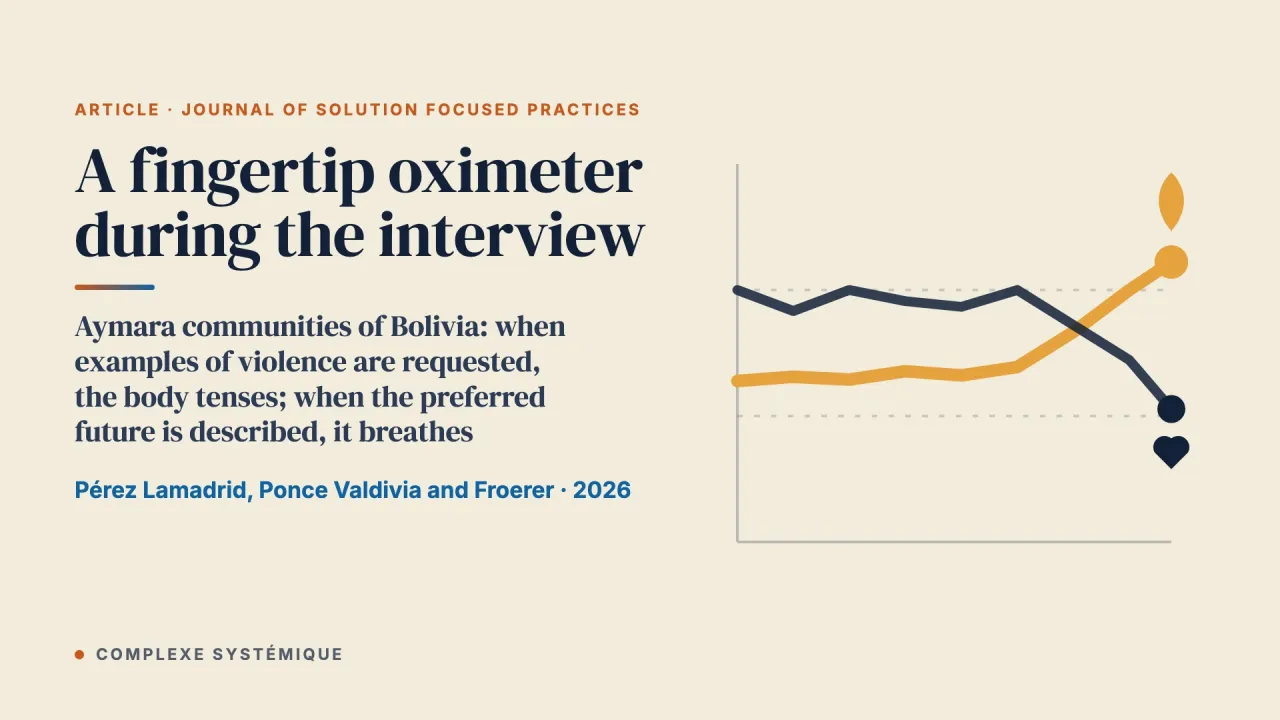
 Oxygenation and Heart Rate in Solution-Focused and Problem-Focused Interviews With Rural and Indigenous Aymara Communities (Viacha and Laja) Regarding Intersectional Violence
A fingertip oximeter on 19 Aymara people of the Altiplano: the problem-focused interview tenses when examples of violence are requested; the solution-focused one oxygenates and slows the heart.
 Article
 Anatomy of the Relational Reframe in Attachment‐Based Family Therapy
The first session of attachment-based family therapy, filmed in 47 families: what leads them to agree to work on relationships rather than on the adolescent.