Family Process · Family therapy
An ultra-brief systemic intervention to address child mental health symptomatology
A round table, a camera, tube socks and four instructions: one parent plays, then the other, then both, then the parents talk while the children manage on their own. Diane A. Philipp (SickKids, Toronto), Heather Prime (York University) and Joëlle Darwiche (University of Lausanne) turn the Lausanne Family Play into a three-session intervention, with a single video feedback session, to help the child by working on coparenting.
This is a reformatted republication of An ultra-brief systemic intervention to address child mental health symptomatology, by Diane A. Philipp, Heather Prime and Joëlle Darwiche, published in Family Process (Wiley) (2023), doi: 10.1111/famp.12875, under a CC BY 4.0 licence. Prepared by Complexe Systémique in September 2026: the authors’ text is unchanged; the layout has been adapted for reading online, which constitutes a modification of the work under the terms of the licence. This edition was made neither by the authors nor by the publisher, who are not responsible for its content or for any errors. The original version prevails.
Changes to the coparenting subsystem are expected to reverberate across the family system and lead to changes in child behavior.
Diane A. Philipp, Heather Prime and Joëlle Darwiche
Abstract
Drawing on decades of research in family systems, coparenting, and developmental science, we present a clinical approach to address unmet service needs in children's mental health. Specifically, we describe Lausanne Family Play – Brief Intervention (LFP-B) – a manualized family systems approach providing a caregiver-caregiver-child therapy (and sibling/s, when applicable). The LFP-B is ultra-brief, typically delivered in as few as three sessions (two assessment sessions followed by a video feedback session), with the aim of reducing children's mental health symptomatology by enhancing the coparenting relationship. We review literature on systemic family therapies and provide a rationale for including coparents and children in child mental health care. We then provide a rationale for using behavioral observations and video feedback in treatment, drawing on research in related family-based treatments (e.g., parent–child therapies). Finally, we provide an overview of the LFP-B manual and a case illustration.
Introduction
Given the current rise in children's mental health needs, evidence-based brief therapies hold great promise in providing efficient and effective service to families. Video feedback interventions are frequently used in parent-child therapies to promote positive parenting and child outcomes. However, video feedback in systemic family therapies involving both parents and siblings is not common. The current paper presents a description and case illustration of an ultra-brief systemic therapy called the Lausanne Family Play – Brief Intervention (LFP-B).
A Systemic Approach to Children's Mental Health
A systemic approach to children's mental health considers symptoms as arising from, being maintained by, and having influence on family relationships and patterns of interaction (Carr, 2019). Systemic therapies consider both a child's presenting complaint (e.g., anxiety, behavioral challenges) and systemic contributions to the problem (i.e., problematic patterns of family interaction) when formulating a treatment plan (Nichols & Tafuri, 2013). Systemic family therapies are effective for children and adolescents with externalizing and internalizing disorders, while also promoting family engagement and retainment in treatment (Retzlaff et al., 2013; von Sydow et al., 2013).
Despite the integral role of all family members in the development and/or maintenance of children's mental health symptoms, there continues to be an emphasis in research on parent–child and marital subsystems, with little representation in coparental and sibling subsystems (Perez-Brena et al., 2022). Fathers are frequently overlooked (Parent et al., 2017), and when they are included, interventions more commonly target parenting rather than coparenting (Fabiano & Caserta, 2018).
The coparental unit has a unique impact on child psychological well-being. For instance, a meta-analytic synthesis of longitudinal studies demonstrated that well-functioning coparenting is a significant predictor of change in child psychological adjustment, particularly in higher-risk samples (Teubert & Pinquart, 2010). Coparenting can be successfully improved through evidence-based interventions. However intervention studies that include coparenting couples frequently leave out the child from the intervention and/or do not assess child outcomes, and they are commonly focused on psychoeducation rather than coparenting interactions (Eira Nunes et al., 2020; Fabiano & Caserta, 2018). The LFP-B addresses these gaps by including all family members in a comprehensive play assessment, by emphasizing the central role of coparenting interactions to family life, and by centering child symptoms throughout assessment and video feedback.
Parent–Child Therapies and Video Feedback
Video feedback involving behavioral observation of family interactions can be used as the ‘port of entry’ into change in families, by focusing attention and facilitating discussion around problematic patterns of behavior (Fukkink, 2008; Stern, 2004). Though not commonly used in family therapies, play observation and video feedback are frequently central to parent–child therapies. For instance, the seminal behavioral observation work of Colwyn Trevarthen formed the basis of Video Interaction Guidance, which uses core concepts of intersubjectivity and sensitive parenting to enhance the parent–child relationship through video feedback (Kennedy et al., 2017). Sensitivity and attachment-based therapies for early childhood also frequently integrate behavioral observations and video feedback (Bakermans-Kranenburg et al., 2003). Other evidence-supported video feedback interventions for parents and their young children include Interaction Guidance (McDonough, 1995), the Marta Meo method (Aarts, 2000), Video Intervention to Promote Positive Parenting (Juffer et al., 2008), and the Video Interaction Project (Cates et al., 2018). The use of video feedback with families results in improved parent–child interactions and symptom reduction in children, among other benefits (Fukkink, 2008). Though there is increased use of video feedback in family therapies, including in systemic family therapies (Iles et al., 2017; Kemenoff et al., 1995; Olhaberry et al., 2017), it continues to be an understudied area. The LFP-B is a video feedback intervention that is derived from the longstanding family observational work of Fivaz-Depeursinge and Corboz-Warnery (1999).
A Call for Brief Systemic Therapies
Providing efficient and accessible systemic family therapies is needed, given unmet service needs in child mental health (Merikangas et al., 2011), which have intensified since the start of the COVID-19 pandemic (Harrison et al., 2022; Madigan et al., 2023). Brief therapies effectively treat a range of disorders from early childhood to late adolescence (Schleider & Weisz, 2017), with evidence that briefer therapies are as effective, or more effective, than lengthier ones (Bakermans-Kranenburg et al., 2003; Weisz et al., 2017). In a meta-analysis of 50 randomized controlled trials (n = 10,508 youth), youth with psychiatric problems benefited from just one intervention session, across problem severity, diagnostic status, and age (Schleider & Weisz, 2017). Caregiver- and family-focused behavioral interventions had a significant and positive effect on mental health symptomatology. These findings are enticing, as ultra-brief interventions have the potential to address multiple, intersecting systematic issues in child mental health care.
Lausanne Family Play Paradigms
Our proposed ultra-brief model has its origins in the Lausanne Trilogue Play and Lausanne Family Play Paradigms (LTP and LFP; Fivaz-Depeursinge & Corboz-Warnery, 1999), which are brief, semi-structured, observational assessment tools, developed to help bridge family systems theory and developmental science. These tools are used to examine within-family dynamics, to consider the contributions of each caregiver, their coparental relationship (the ways parents work together in their roles as caregivers), and the central role of the child or children within family interactions (McHale et al., 2018). The paradigms allow for the systematic observation of caregiver-caregiver-child interactions (LTP), and with siblings the term Lausanne Family Play (LFP) has traditionally been used.1 Interactions are video-recorded and subsequently rated on how the family cooperates to achieve the implicit goals of the task (Frascarolo et al., 2011).
The origins of these play tasks are in clinical assessment and research. They have been used to provide consultation through video feedback for a variety of family constellations and cultural contexts in both research and community settings (Fivaz-Depeursinge & Philipp, 2014; McHale et al., 2018). Furthermore, Olhaberry et al. (2017) used the LTP with video feedback intervention with 80 mother-infant-father triads, with promising results in coparental, parent–child, and triadic interaction quality. Finally, the LFP has been used to assess families with young children to determine which part of the family system to target in therapy (Philipp et al., 2018).
Although the LFP has been used extensively as a clinical assessment tool and, to a lesser extent, in the context of consultation and therapy, the current paper presents a novel use of the LFP as a manualized, ultra-brief systemic intervention to support children and their families. Specifically, the LFP-Brief Intervention (LFP-B) provides a caregiver-caregiver-child intervention (and sibling/s, when applicable). The LFP-B is delivered in as few as three sessions, with the goal of enhancing the coparenting relationship, the family system, and reducing children's mental health symptomatology. Next, we present a summarized version of the manual of the LFP-B (Philipp, 2023), including systemic underpinnings of the model.
Outline of the LFP-B
Setting
The focus of the current paper will be on the use of the LFP-B with 12 months to 10-year-olds, the most common demographic seen on our LFP-B clinical team. Our service is part of a child and youth mental health center in a vastly multicultural large urban setting (Statistics Canada, 2019). Families typically self-refer to the center and are triaged by the intake department using interviews as well as measures such as the Strengths and Difficulties Questionnaire (Goodman, 1997), or referred internally from other clinicians. Only families that meet “moderate” to “severe” criteria, as compared to “mild”, are referred on to treatment teams such as ours. This clientele is considered suitable for the intervention, given the evidence for use of systemic, brief, and family-based interventions for child clinical samples (Brendel & Maynard, 2014; Retzlaff et al., 2013; Schleider & Weisz, 2017; von Sydow et al., 2013). We do not see children or families in acute crisis.
Overview
The LFP-B has several defining characteristics (Frascarolo et al., 2011): it is observational rather than based on parent report and/or clinical interviewing, allowing for a unique entry point into the family's functioning; it is standardized in its setup and execution (e.g., seating, provision of instructions, use of standardized toys), which allows for between-family and within-family comparisons (e.g., change over time, response to intervention); it is triadic (or, in the case of siblings, multiperson), shedding light on the functioning of various subsystems and the whole family; and it is videorecorded, which is useful for catalyzing change in family patterns of interaction (Fukkink, 2008).
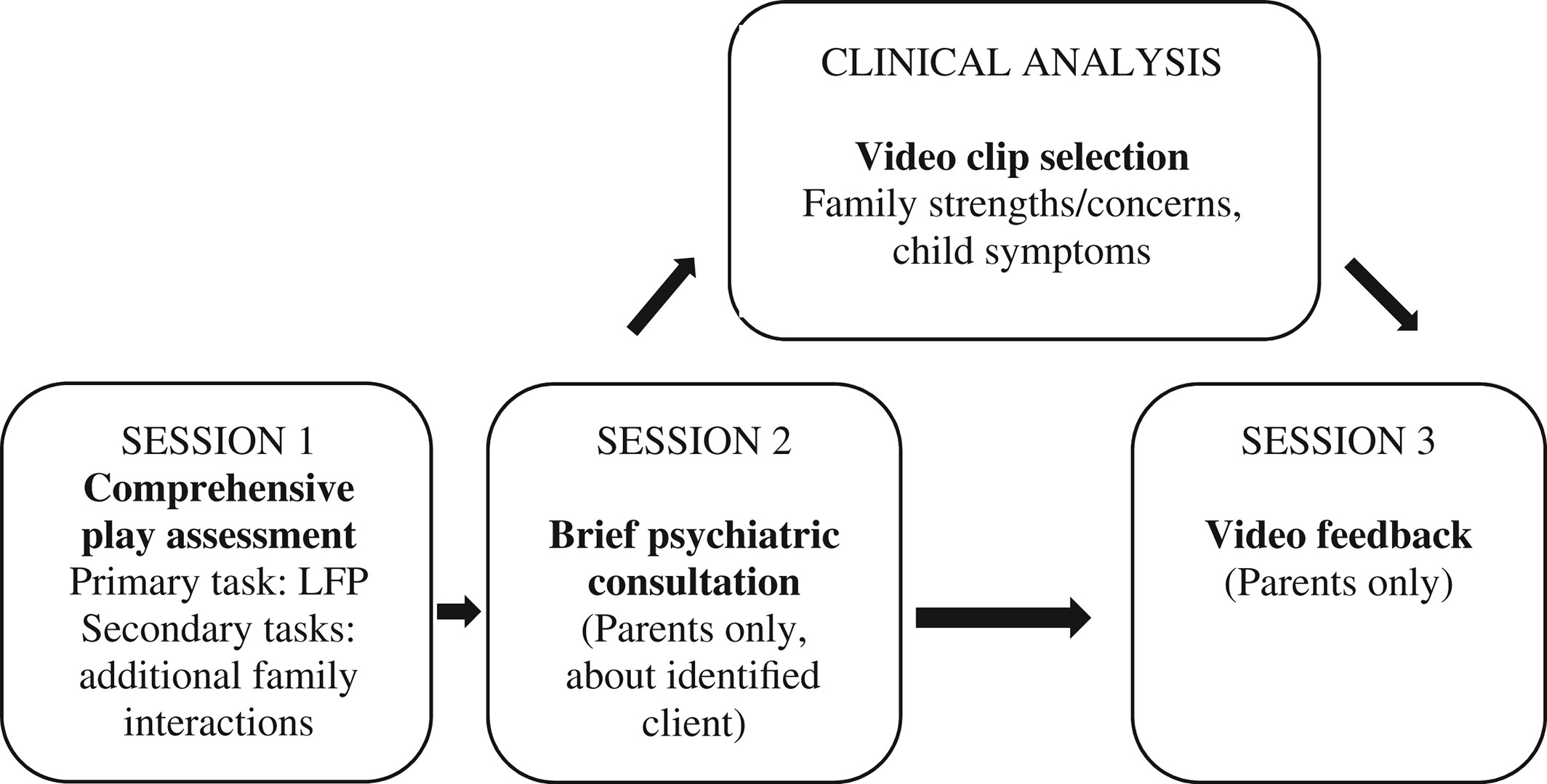
The LFP-B service is considered ultra-brief, as the entire service is typically completed within three sessions (Figure 1): a comprehensive play assessment that includes an LFP with both parents and child (Session 1), a brief child-focused psychiatric consultation with the parents (Session 2), and a single video feedback intervention session with the parents (Session 3). It is uncommon for families to require more than the standard single video feedback session, though we offer it on an as needed basis. We focus next on Sessions 1 and 3, and the Clinical Analysis, as these are unique to the LFP-B (whereas the brief psychiatric consultation can be completed in line with standard clinical practice).
Session 1. Comprehensive play assessment
The video-recorded comprehensive play assessment takes approximately 90 min. The primary task is a 10- to 12-min LFP, described next. There are also secondary tasks that we include in our comprehensive play assessment, not elaborated here for space purposes, including dyadic parent–child interactions (with each parent) and an additional whole family play task (a pretend picnic; Lausanne Picnic Task, Frascarolo & Favez, 2005). These tasks are analyzed in the same way as the LFP, using the core concepts described in the Clinical Analysis section below. They are also sometimes used to draw secondary themes related to parent–child, sibling, and whole-family dynamics. More information on each task is available in the unpublished manual available upon request.
Set-up for LFP
Family members are seated at a round table with a single camera filming the children face on. A large mirror is directly behind the child(ren) to capture the parents' faces. Standardized toys are used in the task: aggressive animals, toy phones, spoons/spatulas, and large tube socks. Families are provided instructions at the outset of the assessment to play in the following sequence: (i) one parent plays with the child(ren) while the other is simply present (Part 1); (ii) the parents reverse roles (Part 2); (iii) both parents play together with the child(ren) (Part 3); and (iv) the parents interact with one another, while the child(ren) manages(s) on their own, but remaining at the table (Part 4). Families are told the whole task is 10–12 min, and to signal the therapist when they complete the sequence.
Aside from the basic frame and overall timing, no further instructions are given regarding how to manage the task. How families move from one part to the next, how long they spend in each part, how each family member maintains their role in each part, and how they manage the task of playing together as a family, in all its configurations, are all part of the assessment process. For instance, the ability to follow instructions/rules is itself clinically meaningful; does the family perceive the instructions as rigid rules, guidelines, or something that can be disregarded? Notably, parents often forget, misunderstand, disregard, or dismiss part 4, when parents are to talk among themselves while the child(ren) manage(s) on their own. This is important for clinicians to note and explore with families during video feedback.
Different variations of the LFP are available for infants, older children and adolescents, as well as other family configurations (e.g., single-parent households and/or larger families). Most recently, we adapted the task to a virtual platform, as necessitated by the COVID-19 pandemic.
Debrief
A brief 5- to 10-min discussion with the clinician occurs directly after the LFP, allowing for three important processes: (i) provides a space for families to express any discomfort with the task (and for clinicians to normalize and validate their experiences); (ii) clarifies with families whether the interactions were representative of their daily lives; and (iii) sets the stage for how the parents will be tasked with reflecting on their family interactions during the subsequent video feedback session. For instance, we explore whether the child(ren) behaved in predictable and/or unexpected ways; we start to explore parental hypotheses for their children's behavior, and we begin to assess their flexibility in thinking about their child(ren). Clinicians may also start to move a “child problem” to a family frame. We also explicitly prepare families for the video feedback session, informing them that we will watch video of their family's strengths and challenges in the next session.
Clinical analysis
Following the comprehensive play assessment, video recordings are reviewed by clinicians to select appropriate clips for the video feedback session, keeping an eye out for strengths, areas of concern, and symptoms in the child. The process of video clip selection takes anywhere from 45 to 90 min, depending on whether it is conducted by an individual clinician or in a teaching/case conference format. The process is guided by key clinical and systemic principles. Below, we describe the themes of our analysis – coparenting (boundaries and patterns) and symptoms in the child, as well as the reciprocal nature of family interactions.
Coparenting
The coparenting relationship has been conceptualized as the central aspect of family life, where “positive coparenting alliances support not just the child, but also the parent and each parent-child relationship.” (McHale & Irace, 2011, pg. 25). Dimensions of coparenting relationships include supportiveness, child-rearing decisions, division-of-labor, and management of family interactions (Feinberg, 2002), which have been linked to child psychological adjustment (Teubert & Pinquart, 2010), and have successfully improved following coparenting interventions (Eira Nunes et al., 2020). The notion that coparenting interactions are “nested” in family interactions, including when addressing symptoms of children's mental health, is what drives the LFP assessment, analysis, and video feedback (Frascarolo et al., 2011). In analyzing the coparenting relationship, we typically consider the themes of boundaries and rule-governed patterns (Carr, 2015).
Boundaries
A core systemic principle, proposed by Minuchin (1974), is that the family is a system with boundaries, organized into subsystems (Carr, 2015). A close evaluation of family interactions can bring to light problems in the boundaries between parent and child subsystems. A cooperative coparenting unit is characterized by good communication and supportiveness in one another's parenting roles (rather than undermining). Described as cohesive coparenting, this united approach to coparenting is coordinated during family observations – it is warm, child-centered, and balanced in terms of parental involvement (Tissot et al., 2019). In the context of an LFP, we look for strengths such as an active parent clearly playing with the child(ren) and with the child(ren) reciprocally engaged. The active family members may look at the ‘simply present’ parent for social referencing or shared enjoyment, but mostly remain involved in active play. Notably, the ‘simply present’ parent supports the interaction by attending to it, without drawing attention to themselves or directing the play.
In contrast, when boundaries become blurred between the parenting and child subsystems, problems arise in the form of coalitions (Frascarolo et al., 2011). In a binding coalition, a child is bound to one parent and the other parent is excluded/ withdraws. In an LFP, this may show up as a child “bound” to an excluding parent, playing together during Part 3 (when both parents are supposed to be active with the child), without referencing, inviting in, or responding to cues from the ‘excluded’ parent.
A detouring coalition (also known as ‘scapegoating’) involves a child's (often problematic) behavior serving as a detour away from coparental tension or conflict. Here, the parents might only come together to discipline the child, and are otherwise uncoordinated in their communication and parenting. This detouring coalition may come up during Part 4, when parents are to be actively engaged with one another while their child manages independently. In response to current coparenting tension, the child may act out/misbehave or otherwise seek to diffuse the tension between coparents – thus blurring the boundary between parents and child that was the goal of Part 4. Such detouring can be child- or parent-initiated, and, as with many of the themes here, subtle in the context of clinical observation.
Finally, in a triangulation coalition, there is a competitive boundary violation, wherein parents vie for their child's allyship. Often best seen in Part 3 (both parents active with child), where the parents disregard one another's ideas, gestures, and cues, and persistently introduce new activities in the play (showing their lack of coordination). In this case, the child might divide their attention in a go-between fashion and ultimately withdraw from over-stimulation.
Patterns
Family interactions follow a rule-bound and recursive pattern, characterized by unstated, or covert, family roles, routines, and rituals (Carr, 2015). In the LFP-B, through the systematic observation of families (and video feedback), covert, unstated family rules, are made overt (Carr, 2015). This process helps parents to reflect on, address, and/or reverse rules to enhance family functioning.
The first transition of the LFP provides the initial opportunity to consider rule-bound roles and/or modes of communication. Here families must implicitly or explicitly decide (or do not decide at all) which parent will start as the ‘active parent’. The multiple transitions in an LFP provide further opportunities to observe these coparental negotiations; that is, if and how decisions (e.g., who goes first?) and/or needs and wishes (e.g., can I join the play now?) are communicated. Areas of concern may include allowing a child to decide, or parents turning to a child to mediate (e.g., “Who do you want to play with first?”), or a unilateral parent-led decision (e.g., one of the parents decides to initiate play with the child, without negotiation with their coparent). We note both verbal and nonverbal communication between coparents, from subtle gestures to loud intrusions, that may or may not be noticed by the coparent.
Rule-governed patterns of behavior frequently present themselves in Parts 1 and 2, when there is to be one active parent and the other is to be ‘simply present.’ The ease with which the simply present parent can remain attentive to and resonate with the play between their coparent and child(ren), without inserting themselves or disengaging completely, reflects their respect for family roles and the family alliance. In one case, we saw a mother in the ‘simply present’ role leaned in close to the father-child play, suggesting some difficulties with relinquishing the primary role in the family interaction. When it was her turn to be the active parent, the father appeared disengaged as the simply present parent, perhaps reflecting a role he is familiar with, as withdrawn or excluded. Again, though subtle, these are notable observations that can bring to light the covert dynamics related to family boundaries, coparental roles, and communication. These hypotheses are checked out with the parents during the video feedback session.
Symptom in the child
In our analysis of the LFP, we also consider how the child's presenting concerns show up in the family interactions. Indeed, as a child and youth mental health center, although families may have concerns about their family interactions and/or coparenting, caregivers are typically referred (or self-refer) due to concerns about their child's emotional, behavioral, and/or psychological adjustment. Carefully considering the presenting concern about the child, in relation to the systemic processes at play in the family, is part of a comprehensive assessment (Nichols & Tafuri, 2013). When possible, we identify the presenting symptoms in the child in the analysis of the LFP, no matter how subtle, to show caregivers that their concerns are being heard (during video feedback). Such validation is critical to the therapeutic alliance. This, in turn, allows them to explore different possibilities underlying the presenting behavior (including but not limited to the coparental and family dynamic at play).
We look for symptoms in the child such as: misbehaving, refusing to play with one of the parents, showing signs or symptoms such as emotion dysregulation, clinginess, refusal to participate, self-injurious behavior, and/or flight. For instance, if parents are reporting issues with impulse control, we would take greater notice of a child who speaks through the clinician's instructions or struggles to remain at the table. Such clips are used during video feedback with parents to explore whether this is reflective of their struggles with the child at home.
Circular hierarchies
Circular hierarchies reflect the reciprocal or transactional nature of family interactions. Here, the coparenting alliance and child's responses (including symptoms) mutually inform, and adjust in response to, one another (McHale et al., 2018). Acknowledging that a change in one person's behavior inevitably leads to a change in all family members takes blame out of the discussion, while simultaneously acknowledging family members' roles in the struggles (Carr, 2015). In our formulations, we consider both how family patterns came to be, and where they can go. For instance, consider a binding coalition observed in Part 3 of the LFP, when both parents are to be playing with the child, but instead a child seems to play almost exclusively with one parent. Clinicians are encouraged to look for both excluding behavior in the bound parent–child dyad, as well as withdrawing behavior in the excluded parent, so that a formulation of circular causality can be made. During video feedback with the caregivers, there are then multiple directions to think about change (e.g., how might the excluded coparent engage more and/or how might the bound coparent invite the excluded parent into the interaction)?
Session 3. Video feedback
The video feedback session is the heart of the LFP-B, used to “hold a mirror up to parents” (Fukkink, 2008, pg. 905), with a spotlight on the coparental unit that will serve as a catalyst of change for family interaction patterns. Children are not part of the video feedback session, but are informed that their parents will return to learn ways to help the family get along better. The clinician and caregivers review selected clips, allowing caregivers to experience their family relationships from a new vantage point (Frascarolo et al., 2011). In response to viewing each clip, caregivers are encouraged to reflect and make sense of the interactions, as well as explore potential avenues for change. Also relevant are the ways in which video feedback is used to elicit news of difference: “when two [or more] descriptions are given of the same events, then the difference in perspectives provides news of difference…” (Carr, 2015, pg. 23). Applied to the LFP-B, eliciting caregivers' unique perspectives about each video clip, in addition to insights provided by the clinician, introduces news of difference into family systems. Families can then reframe their challenges as family systems problems and, in turn, adapt.
Generally, clinicians share with families a clip of a strength, a presenting complaint in the child, and an area for change in the parents. Clinicians orient caregivers to the clip by describing what part of the assessment they are going to view, as well as whether they are intending to show a strength, a symptom in the child, or an area of concern. Clinicians may replay clips to parents, and/or focus the parents' attention to certain behaviors in one or more family members. Parents are encouraged to make sense of the material collaboratively with one another and with the clinician. The clinician's role is to validate emotions that arise, normalize experiences (when appropriate), and facilitate discussion. Clinicians are encouraged to allow parents to reflect on the video clip first; and only afterward share any further observations, psychoeducation, or hypotheses that might help catalyze change. The video feedback session serves to highlight what is going well and to shed light on the need for change in behavior. Together, the parents and clinician co-construct an understanding of the family's patterns of interaction, in relation to one another and their child, and highlight shared goals for change.
All good-enough families may find themselves in problematic patterns some of the time, and most struggling families will find themselves in good-enough patterns some of the time. When we assess families we are paying attention to the whole – are they on the whole having fun and doing a good-enough job, spending most of their time in a cohesive coparenting dynamic? Or, are they on the whole struggling?
Case Illustration
Rikki is a 9-year-old girl with a little brother, Theo, age 4. Her parents, Kim and Rashid, present with concerns about Rikki's behaviors at home and at school, including emotional outbursts with her parents and bullying directed toward Theo.2 Rikki's parents did not agree about how best to handle her behaviors.
This was a virtual family assessment, commonly used during the pandemic. As is typical for the LFP-B, this was the family's first point of contact with the clinical team, aside from scheduling. This family had three sessions, in total, the comprehensive play assessment, a mental health check in (i.e., brief diagnostic assessment of the child), and one video feedback session (Figure 1). The session began with an LFP (for a two-child family), followed by dyadic assessments with Rikki and each of her parents. It ended with the Lausanne Picnic Game.
At the video feedback session, the treating clinician showed two “strengths” clips of each parent's playfulness and ability to follow Rikki's lead in play. The therapist then moved on to introduce the clip illustrating the symptom in the child, a struggle between Kim and Rikki around tidying up the toys after one of the play tasks. The parents found the clip to resonate, and Rashid endorsed that he, too, can get into these kinds of power struggles with Rikki. The therapist also validated how the struggle we saw “might not be as intense as it can get sometimes.” The parents agreed that Rikki's behaviors frequently intensify, including hitting and kicking, sometimes resulting in minor injuries (e.g., bruises).
At this point the parents seemed settled into the session, the first three clips having solidified the therapeutic alliance. Now the task was to introduce some of the problematic communication between the parents.
T: In the next clips I want to focus on moments of transition, when you had to shift from one task to the next. These transition moments can be really informative about how the family communicates around decisions. I want to show you some of the tricky moments in those transitions so that we can think about them together.
(The therapist shows a clip of the parents debating how long the play should be – 12 minutes per part or 12 minutes all together. They eventually called the therapist back in to resolve the disagreement).
(Couple laughs watching)T: I notice you're laughing, so help me understand what you're noticing?
M: That I was right.
F (begrudgingly): OK, you were right.
T: I guess what I'm interested in is what are you noticing about how the two of you handled this?
M: I guess we have a lot of fights where we get stuck and then…?
F: Yeah, and we each wanna be right.
M: Yeah, we need to check who's right – like Google even.
T: So you kind of need to outsource?
Both: Yeah
(They then give more examples and how they might text a friend to weigh in).
The therapist used the observation of the parents calling her back in to resolve their debate as an example of a pattern in their communication style. She introduced the hypothesis about “outsourcing” early in the conversation, as there had been a clear pattern of this throughout the play assessment, as we will see in the next videoclip. While we did not see clear examples of Rikki mediating for the parents, we wondered if this were the case, given the dynamic we were seeing with the therapist. The therapist tested this hypothesis next.
T: And I'm wondering how these moments might impact the kids?
M (referring to image that therapist has left up on the teleconference): Rikki doesn't look too pleased. But I don't think not arguing is good for kids. I mean, what do you think?
T: Well I guess it's more how the arguments play out. You're right, arguments are bound to happen in front of kids and what's important is that the kids see that they are resolved. What I wonder about is whether Rikki gets drawn in as a mediator too?
F: She's sometimes a mediator. And she'll be like, “Guys stop arguing!”
M: There's been some arguments that have been really bad, and she's been in the middle.
(She gives an example when, during a conflict between Rashid and Kim, Rashid told Rikki, “We should leave”, and they packed their bags. Rashid told Kim, “You can't yell at me this way.” To this day, Rikki sometimes says, "Mommy if you yell, Daddy and I are going to pack our bags and leave.”)
This one observation of the parents calling the therapist back to resolve their debate has provided a window into some of the coalition dynamics in the family (i.e., a binding coalition between Rikki and Rashid that is ongoing). Furthermore, Rikki's role as mediator is a clear boundary violation – a detouring coalition with the child as “adult,” “therapist,” or “judge”.
F: Yeah, that was not good
M: Yeah, neither of us handled that well.
T: I wondered about that as well, how much Rikki gets involved in conflict with you? The parents go on to describe how they also resolve arguments in front of the kids.
The therapist reinforces this strength and provides some psychoeducation about the importance of resolving in front of the kids, just as she did earlier when normalizing that arguments are “bound to happen” in front of them. Psychoeducation is a part of the video feedback, albeit minor.
After wrapping up this discussion, the therapist orients the parents to another problematic coparenting sequence from the LFP, when Rashid was playing with the kids, and Kim was in the ‘simply present’ role.
(The clip shows Kim leaning onto the table)
M: Am I supposed to play too?
(Father does not respond – he has only been in Part 2 for 50 seconds)M (Loudly and looking at the camera): Dr. P, am I supposed to play too?
(Therapist does not answer)
(Mother goes ahead and joins the play)T (after watching the clip with the parents): One thing I wanted to ask you guys is – this was a decision moment – how did that decision-making go?
M: I made it.
T: Mmhm. And then what happened?
M: I guess Rashid was ok with it?
T: So you're noticing that you made the decision and Rashid sort of went along with it, but also you tried to outsource again to me?
(Parents nodding)T: Transitions are difficult in life in general, and why I'm showing these clips is that sometimes when there are decisions it gets challenging. Does that resonate with you two?
M: Maybe it would be helpful if Rashid were a little more assertive in these situations, cuz I'm super assertive.
T: Yeah, yet that seems unnatural sort of – for Rashid at the moment?
(Rashid nods)M: I'm the type of person that wants things to happen so if it needs to happen I'll just do it. Rashid's process is way slower than I'm comfortable with.
F (Chuckles): I like to think about it, plan it.
M: Yeah there's a difference.
T: So sometimes, when making decisions, if the pressure is all on you, Kim, that can be a lot, and for Rashid you're saying that you like to slow things down a bit?
The therapist is making explicit these differences in parenting styles as statements of fact, not blame. The goal here is to shift how they understand these differences as an opportunity for them to capitalize on this complementarity as a potential strength in their coparenting team. In other words, the therapist's perspective will hopefully bring new insight or “news of difference.”
T: In coparenting relationships there can be complementarity. Rashid may be more the planning guy. And Kim, you're more the take charge type.
F: Yeah, like every time we go to the park with the kids, I prepare the snacks and water.
T: So there's value in both Kim wanting to get out in a timely fashion, and there's value in Rashid having the foresight to pack snacks and water. And value in finding common ground where you're making decisions together and steering this ship as a team. Then there's this issue of outsourcing your conflict onto others, including the kids. So I'm wondering if these are some things you might want to consider? How you coparent is not the whole story of how Rikki came to be how she is, but changing how you coparent, and having the kids see you more as a team, is one piece of the puzzle in trying to help her.
Rashid and Kim seem quite receptive to the calls for change, which is in part due to an intentional structure of the model. It is important to begin the feedback session with videoclips of parents' strengths to build the alliance and highlight the things that families are doing well. Similarly, we showed the parents moments where Rikki was defiant, validating that we understood things can become more intense at home. These two things – the parents' strengths and validation about the symptoms in the child – allow us to then broach more challenging moments and ask the parents to consider changing. Nonetheless, some parents struggle to see their child or family's struggles in a new light. In this case, we may need to watch problematic clips more than once and be curious as to how they understand those moments. Alternatively, we may need to reconsider the strength of the therapeutic alliance and/or spend more time reinforcing good moments or validating challenges within the child. These approaches will support parents to think more flexibly about systemic problems in their family.
As part of the protocol for an ongoing research project, we have started to check in with families 1 month after the completion of the LFP-B. At this meeting, Rikki's parents showed a heightened awareness of the impact of their own behavior on Rikki. They spoke about some changes in their coparenting such as trying not to “outsource” decisions to Rikki. Indeed, they had started using the catch phrase, “this is a mommy and daddy decision.” The LFP-B model reflects a conceptualization of child symptoms as being maintained by systemic family problems (Carr, 2019). Rikki's parents' started to shift some patterns that were not working well for their family; our hope is that this change may translate to a reduction in Rikki's problem behaviors. Video feedback can be a powerful tool for shining a light on issues in family interaction patterns, to speed up the process of change. Our stance is always one of curiosity about change, leaving the door open for the parents to walk through it, but not insisting.
Concluding Remarks
Evidence linking coparental agreement and conflict to children's adjustment is robust (Ran et al., 2021; van Eldik et al., 2020). The described clinical service offers a brief, systemic family intervention targeting the coparental unit with the goal of addressing children's mental health symptoms. By drawing on decades of research on family observational methods, the LFP-B intervention is one approach to provide timely and accessible services to families, while considering all parts of the family system in relation to children's presenting concerns. However, without long-term follow-up data, we cannot be sure that our ultra-brief intervention leads to changes in coparenting and/or that such changes translate to a reduction in child symptomatology. We are currently evaluating the LFP-B in our clinical service using a single arm, pre-post design, where we are examining feasibility and pre-post changes in clinical outcomes to guide future evaluative studies. Findings will inform us about the relevance of the LFP-B for families and child outcomes, including long-term follow-up. We remind the reader that this is a systemic model of treatment and, as such, that changes to the coparenting subsystem are expected to reverberate across the family system and lead to changes in child behavior.
Complexe Systémique: key points
The article’s interest lies in turning an observational tool, Élisabeth Fivaz-Depeursinge’s Lausanne Trilogue Play, into an intervention in its own right, and in making it workable in an overstretched public service: three sessions, a single video feedback, parents watching themselves. For a systemic reader everything is familiar and well articulated: Minuchin’s boundaries and coalitions (binding, detouring, triangulation), implicit rules made visible, circular causality that removes blame, Bateson’s “news of difference”. Rikki’s case shows how fine the method is: a simple disagreement about how long to play, settled by calling the therapist back, opens onto the “outsourcing” of disagreements and a daughter enlisted as mediator. The structure of the session matters too: show strengths first, then validate the symptom, before tackling what needs to change. The limits are acknowledged: no efficacy data yet, a composite case, and an ongoing evaluation without a control group. Read alongside the structural approach explained simply, and the Finnish study on supporting coparenting.
Notes from the original
1 For simplicity, we refer primarily to the LFP throughout, which includes the LTP (single child) or the LFP (multiple children) play paradigms.
2 Names and identifying information have been altered for the purposes of this case presentation. Additionally, though the transcript is from one single feedback session, the case is a composite of clinical cases seen at the service to best illustrate the model and protect client details.
Funding information. Banting Research Foundation (Discovery Award #2021-1425), the Faculty of Health at York University, and the LaMarsh Centre for Child and Youth Research at York University, awarded to H. Prime, York University.
References
Aarts, M. (2000). Marte Meo basic manual. Aarts Productions.
Bakermans-Kranenburg, M. J., Van Ijzendoorn, M. H., & Juffer, F. (2003). Less is more: Meta-analyses of sensitivity and attachment interventions in early childhood. Psychological Bulletin, 129(2), 195–215. https://doi.org/10.1037/0033-2909.129.2.195
Brendel, K. E., & Maynard, B. R. (2014). Child–parent interventions for childhood anxiety disorders: A systematic review and meta-analysis. Research on Social Work Practice, 24(3), 287–295. https://doi.org/10.1177/1049731513503713
Carr, A. (2015). The evolution of systems theory. In G. R. Weeks (Eds.), Handbook of family therapy (pp. 153–213). Routledge.
Carr, A. (2019). Family therapy and systemic interventions for child-focused problems: The current evidence base. Journal of Family Therapy, 41(2), 153–213. https://doi.org/10.1111/1467-6427.12226
Cates, C. B., Weisleder, A., Johnson, S. B., Seery, A. M., Canfield, C. F., Huberman, H., Dreyer, B. P., & Mendelsohn, A. L. (2018). Enhancing parent talk, reading, and play in primary care: Sustained impacts of the video interaction project. The Journal of Pediatrics, 199, 49–56. https://doi.org/10.1016/j.jpeds.2018.03.002
Eira Nunes, C., de Roten, Y., El Ghaziri, N., Favez, N., & Darwiche, J. (2020). Co-parenting programs: A systematic review and meta-analysis. Family Relations, 70(3), 759–776. https://doi.org/10.1111/fare.12438
Fabiano, G. A., & Caserta, A. (2018). Future directions in father inclusion, engagement, retention, and positive outcomes in child and adolescent research. Journal of Clinical Child & Adolescent Psychology, 47(5), 847–862. https://doi.org/10.1080/15374416.2018.1485106
Feinberg, M. E. (2002). Coparenting and the transition to parenthood: A framework for prevention. Clinical Child and Family Psychology Review, 5(3), 173–195. https://doi.org/10.1023/A:1019695015110
Fivaz-Depeursinge, E., & Corboz-Warnery, A. (1999). The primary triangle: A developmental systems view of fathers, mothers, and infants. Basic Books.
Fivaz-Depeursinge, E., & Philipp, D. A. (2014). The baby and the couple: Understanding and treating young families. Routledge.
Frascarolo, F., & Favez, N. (2005). Une nouvelle situation pour évaluer le fonctionnnement familial: Le Jeu du Pique-Nique [A new tool for the assessment of the family: The Picnic Game]. Devenir, 17, 141–151. https://doi.org/10.3917/dev.052.0141
Frascarolo, F., Fivaz, E., & Favez, N. (2011). Coparenting in family–infant triads: The use of observation in systemic interventions. In J. P. McHale & K. M. Lindahl (Eds.), Coparenting: A conceptual and clinical examination of family systems (pp. 211–230). American Psychological Association. https://doi.org/10.1037/12328-010
Fukkink, R. G. (2008). Video feedback in widescreen: A meta-analysis of family programs. Clinical Psychology Review, 28(6), 904–916. https://doi.org/10.1016/j.cpr.2008.01.003
Goodman, R. (1997). The strengths and difficulties questionnaire: A research note. Journal of Child Psychology and Psychiatry, 38, 581–586.
Harrison, L., Carducci, B., Klein, J. D., & Bhutta, Z. A. (2022). Indirect effects of COVID-19 on child and adolescent mental health: An overview of systematic reviews. BMJ Global Health, 7(12), e010713.
Iles, J. E., Rosan, C., Wilkinson, E., & Ramchandani, P. G. (2017). Adapting and developing a video-feedback intervention for co-parents of infants at risk of externalising behaviour problems (VIPP-Co): A feasibility study. Clinical Child Psychology and Psychiatry, 22(3), 483–499. https://doi.org/10.1177/1359104517704025
Juffer, F., Bakermans-Kranenburg, M. J., & van Ijzendoorn, M. H. (2008). Methods of the video-feedback programs to promote positive parenting alone, with sensitive discipline, and with representational attachment discussions. In F. Juffer, M. J. Bakermans-Kranenburg, & M. H. IJzendoorn (Eds.), Promoting positive parenting. An attachment-based intervention (pp. 11–21). Psychology Press.
Kemenoff, S., Worchel, F., Prevatt, B., & Willson, V. (1995). The effects of video feedback in the context of Milan Systemic therapy. Journal of Family Psychology, 9(4), 446–450. https://doi.org/10.1037/0893-3200.9.4.446
Kennedy, H., Ball, K., & Barlow, J. (2017). How does video interaction guidance contribute to infant and parental mental health and well-being? Clinical Child Psychology and Psychiatry, 22(3), 500–517. https://doi.org/10.1177/1359104517704026
Lin, J. A., Hartman-Munick, S. M., Kells, M. R., Milliren, C. E., Slater, W. A., Woods, E. R., Forman, S. F., & Richmond, T. K. (2021). The impact of the COVID-19 pandemic on the number of adolescents/young adults seeking eating disorder-related care. Journal of Adolescent Health, 69(4), 660–663. https://doi.org/10.1016/j.jadohealth.2021.05.019
Madigan, S., Korczak, D., Vaillancourt, T., Racine, N., Hopkins, W., Pador, P., Hewitt, J., AlMousawi, B., McDonald, S., & Neville, R. (2023). Comparison of paediatric emergency department visits for attempted suicide, self-harm, and suicidal ideation before and during the COVID-19 pandemic: A systematic review and meta-analysis. The Lancet Psychiatry.
McDonough, S. C. (1995). Promoting positive early parent-infant relationships through interaction guidance. Child and Adolescent Psychiatric Clinics of North America, 4, 661–672. https://doi.org/10.1016/S1056-4993(18)30426-7
McHale, J. P., Favez, N., & Fivaz-Depeursinge, E. (2018). The Lausanne Trilogue Play paradigm: Breaking discoveries in family process and therapy. Journal of Child and Family Studies, 27(10), 3063–3072. https://doi.org/10.1007/s10826-018-1209-y
McHale, J. P., & Irace, K. (2011). Coparenting in diverse family systems. In J. P. McHale & K. M. Lindahl (Eds.), Coparenting: A conceptual and clinical examination of family systems (pp. 15–37). American Psychological Association. https://doi.org/10.1037/12328-000
Merikangas, K. R., He, J. P., Burstein, M., Swendsen, J., Avenevoli, S., Case, B., Georgiades, K., Heaton, L., Swanson, S., & Olfson, M. (2011). Service utilization for lifetime mental disorders in US adolescents: Results of the National Comorbidity Survey–Adolescent Supplement (NCS-A). Journal of the American Academy of Child & Adolescent Psychiatry, 50(1), 32–45. https://doi.org/10.1016/j.jaac.2010.10.006
Minuchin, S. (1974). Families and family therapy. Harvard University Press.
Nichols, M., & Tafuri, S. (2013). Techniques of structural family assessment: A qualitative analysis of how experts promote a systemic perspective. Family Process, 52(2), 207–215. https://doi.org/10.1111/famp.12025
Olhaberry, M., León, M. J., Escobar, M., Iribarren, D., Morales-reyes, I., & Álvarez, K. (2017). Video-feedback intervention to improve parental sensitivity and the quality of interactions in mother-father-infant triads. Mental Health in Family Medicine, 13, 532. https://doi.org/10.25149/1756-8358.1304029
Parent, J., Forehand, R., Pomerantz, H., Peisch, V., & Seehuus, M. (2017). Father participation in child psychopathology research. Journal of Abnormal Child Psychology, 45(7), 1259–1270.
Perez-Brena, N. J., Duncan, J. C., Bámaca, M. Y., & Perez, R. (2022). Progress and gaps: A systematic review of the family demographics and family subsystems represented in top family science journals 2008–2018. Journal of Family Theory & Review, 14(1), 59–78. https://doi.org/10.1111/jftr.12446
Philipp, D. A. (2023). Lausanne family play: Assessment and video feedback intervention for parenting and coparenting [Unpublished manuscript]. Department of Psychiatry, Temerty Faculty of Medicine, University of Toronto.
Philipp, D. A., Cordeiro, K., & Hayos, C. (2018). A case-series of reflective family play: Therapeutic process, feasibility, and referral characteristics. Journal of Child and Family Studies, 27(10), 3117–3131. https://doi.org/10.1007/s10826-018-1192-3
Racine, N., Cooke, J. L., Eirich, R., Korczak, D. J., McArthur, B., & Madigan, S. (2020). Child and adolescent mental illness during COVID-19: A rapid review. Psychiatry Research, 292, 113307. https://doi.org/10.1016/j.psychres.2020.113307
Ran, G., Niu, X., Zhang, Q., Li, S., Liu, J., Chen, X., & Wu, J. (2021). The association between interparental conflict and youth anxiety: A three-level meta-analysis. Journal of Youth and Adolescence, 50(4), 599–612. https://doi.org/10.1007/s10964-020-01388-7
Retzlaff, R., von Sydow, K., Beher, S., Haun, M. W., & Schweitzer, J. (2013). The efficacy of systemic therapy for internalizing and other disorders of childhood and adolescence: A systematic review of 38 randomized trials. Family Process, 52(4), 619–652. https://doi.org/10.1111/famp.12041
Schleider, J. L., & Weisz, J. R. (2017). Little treatments, promising effects? Meta-analysis of single-session interventions for youth psychiatric problems. Journal of the American Academy of Child & Adolescent Psychiatry, 56(2), 107–115. https://doi.org/10.1016/j.jaac.2016.11.007
Statistics Canada. (2019). Toronto – A data story on ethnocultural diversity and inclusion in Canada. https://www150.statcan.gc.ca/n1/pub/11-631-x/11-631-x2019002-eng.htm
Stern, D. N. (2004). The motherhood constellation: Therapeutic approaches to early relational problems. In A. J. Sameroff, S. C. McDonough, & K. L. Rosenblum (Eds.), Treating parent-infant relationship problems: Strategies for intervention (pp. 29–42). Guilford.
Teubert, D., & Pinquart, M. (2010). The association between coparenting and child adjustment: A meta-analysis. Parenting: Science and Practice, 10(4), 286–307. https://doi.org/10.1080/15295192.2010.492040
Tissot, H., Kuersten-Hogan, R., Frascarolo, F., Favez, N., & McHale, J. P. (2019). Parental perceptions of individual and dyadic adjustment as predictors of observed coparenting cohesion: A cross-national study. Family Process, 58(1), 129–145. https://doi.org/10.1111/famp.12359
van Eldik, W. M., de Haan, A. D., Parry, L. Q., Davies, P. T., Luijk, M. P., Arends, L. R., & Prinzie, P. (2020). The interparental relationship: Meta-analytic associations with children's maladjustment and responses to interparental conflict. Psychological Bulletin, 146(7), 553–594. https://doi.org/10.1037/bul0000233
von Sydow, K., Retzlaff, R., Beher, S., Haun, M. W., & Schweitzer, J. (2013). The efficacy of systemic therapy for childhood and adolescent externalizing disorders: A systematic review of 47 RCT. Family Process, 52(4), 576–618. https://doi.org/10.1111/famp.12047
Weisz, J. R., Kuppens, S., Ng, M. Y., Eckshtain, D., Ugueto, A. M., Vaughn-Coaxum, R., Jensen-Doss, A., Hawley, K. M., Krumholz Marchette, L. S., & Chu, B. C. (2017). What five decades of research tells us about the effects of youth psychological therapy: A multilevel meta-analysis and implications for science and practice. American Psychologist, 72(2), 79–117. https://doi.org/10.1037/a0040360
Reformatted republication of An ultra-brief systemic intervention to address child mental health symptomatology, by Diane A. Philipp, Heather Prime and Joëlle Darwiche, Family Process, vol. 62 (2023), doi: 10.1111/famp.12875, under a CC BY 4.0 licence. Edition and layout: Complexe Systémique, September 2026 — the work has been modified under the terms of the licence. Neither the authors nor the publisher are responsible for this edition; the original version prevails.
This is the original article “An ultra-brief systemic intervention to address child mental health symptomatology”, published in Family Process (2023) under a CC BY 4.0 licence. Republished by Complexe Systémique: the author’s text is unchanged; only the presentation has been adapted for reading online, as set out at the head of this page.
Read the original articleHow to cite this article
Philipp, D. A., Prime, H., et Darwiche, J. (2023). An ultra-brief systemic intervention to address child mental health symptomatology. Complexe Systémique. https://app.complexe-systemique.com/en_GB/articles/an-ultra-brief-systemic-intervention-to-address-child-mental-health-symptomatology (Original work published in 2023 in Family Process, 62(2) (2023); republished in 2023 by Family Process, https://onlinelibrary.wiley.com/doi/full/10.1111/famp.12875)
To go further
- The structural approach in systemic therapy explained simplyBoundaries and coalitions.
- Ways of Supporting Coparenting in Child and Family Services: Discourses of Involvement, Capacity Building and ReconciliationSupporting coparenting.
- What if our symptoms had a function?The symptom within the system.
Related training courses
 Certifying course
Training in Systemic Therapy and Interventions – Cycle 1
Certifying training cycle in systemic therapy and interventions – year 1. Courses, supervision and practice, aligned with EFTA/SFTF. In French.
 Certifying course
Training in Systemic Therapy and Interventions – Cycle 2
Certifying training cycle in systemic therapy and interventions – year 2. Clinical complexity, supervision and practice. EFTA/SFTF aligned. In French.
 Certifying course
Training in Systemic Therapy and Interventions – Cycle 3
Certifying training cycle in systemic therapy and interventions – year 3. In-depth intervention, supervision and practice. EFTA/SFTF aligned. In French.
 Certifying course
Training in Systemic Therapy and Interventions – Cycle 4
Certifying training cycle in systemic therapy and interventions – year 4. Clinical integration, supervision and certification. EFTA/SFTF. In French.
Related articles
 Article
 Silence in therapy: a polysemic presence
From Heidegger to Palo Alto, silence is not an absence but a message. Defensive, strategic, reflective or shared: its forms, its functions and its risks.
 Article
 Crisis: a catalyst of transformation in human systems
A crisis is not a malfunction to correct but an effort by the system not to founder. From the Denver Project to Falicov: a typology and what it asks of the practitioner.
 Article
 First Psychological Aid for Families During War: Integrating the Narrative Approach With Emotionally Focused Therapy (EFT)
Three or four meetings for families living under the threat of war: telling their story before a witness, then repairing the attachment cycle disrupted by fear.
 Article
 Homeostasis: what holds us together, and what holds us back
Homeostasis maintains a system’s internal balance. In families as in organisations, it protects the group while braking change. How to work with it rather than against it.