Family Relations · Family
Being a parent, but not: A grounded theory of home-based care
They are asked to love, to provide stability, to build attachment, yet never quite to become parents. Sixteen foster and kinship carers in Victoria, Australia, describe a role torn between home and institution. Kimberlea Cooper’s team derives a grounded theory built around one phrase: “being a parent, but not.”
This is a reformatted republication of Being a parent, but not: A grounded theory of home-based care, by Kimberlea Cooper, Christina Sadowski and Rob Townsend, published in Family Relations (Wiley) (2024), doi: 10.1111/fare.12969, under a CC BY 4.0 licence. Prepared by Complexe Systémique in September 2026: the authors’ text is unchanged; the layout has been adapted for reading online, which constitutes a modification of the work under the terms of the licence. This edition was made neither by the authors nor by the publisher, who are not responsible for its content or for any errors. The original version prevails.
It seems that regardless of whether carers conceptualize their role through primarily a professional or parental lens, carer roles do not fit neatly into either of these normative categories.
Kimberlea Cooper, Christina Sadowski and Rob Townsend
Abstract
Objective. This constructivist-grounded-theory study explored how foster and kinship carers conceptualize and experience their role.
Background. Internationally, amid growing emphasis on home-based care for children and young people living outside parental care, issues such as carer shortages, dissatisfied carers, and placement instability present significant challenges.
Method. Sixteen carers (seven foster carers and nine kinship carers) from a regional area in Victoria, Australia, participated in in-depth interviews following constructivist-grounded-theory protocols.
Results. Six categories reveal the central ways carers go about caring for children and young people and the main challenges they face in doing so. The core category of “being a parent, but not” demonstrates tensions that carers experience in trying to establish a sense of belonging and connectedness with a child, within the limits of the Victorian home-based care system.
Conclusion. Home-based carers view their role through a parental lens, but with various limitations that restrict their sense of being a parent.
Implications. The current research acknowledges the role tensions inherent within the Victorian home-based care system and emphasizes the importance of raising the status of foster and kinship carers to provide more recognition of the expertise they hold in the care of children and young people within this complex context.
Kinship and foster carers play a crucial role in the upbringing and development of children and young people who are living outside of the care of their parents. Due to the trend of deinstitutionalization, foster and kinship care programs worldwide are experiencing high levels of growth (Garcia Quiroga & Hamilton-Giachritsis, 2014). However, these home-based styles of alternative care currently face major challenges including carer shortages, overburdened and dissatisfied carers, and placement instability (D'Amato & Brownlee, 2022; McPherson et al., 2022; Rose et al., 2022). Home-based care programs rely upon foster and kinship carers to welcome children and young people into their homes. Therefore, it is crucial to draw upon the views and experiences of carers themselves to develop a strong research base to inform efforts to strengthen home-based care programs and ensure that carers feel supported to continue to sustain their roles.
Background—the shift to home-based care
Globally, there has been an increased and continual trend toward home-based care over institutional forms of alternate care for children away from their parents (Garcia Quiroga & Hamilton-Giachritsis, 2014), with notable shifts from group homes and institutions in countries such as the United States (Child Welfare Information Gateway, n.d.), and Australia (Musgrove & Michell, 2018). This shift toward home-based care options is occurring in all parts of the world, including those in which institutional care is still dominant (Garcia Quiroga & Hamilton-Giachritsis, 2014). It is the very nature of “the home” that differentiates home-based care from institutional models of alternative care, as a home is seen to provide a safe, stable, family environment, giving children the opportunity to build emotional connections with caregivers (Musgrove & Michell, 2018).
Attachment theory has been instrumental in influencing the growth of home-based care around the world (Hart et al., 2011; Smith et al., 2017). Attachment theory states that early relationships with caregivers are fundamental to children's development, and that these emotional connections are just as important for children's well-being as for their physical biological needs (Chinnery, 2016). Attachment relationships with caregivers enable children to feel safe and protected, and therefore give them a base from which to feel confident in exploring the world. This view is reflected in the United Nations Convention on the Rights of the Child, which states the main priority of alternative care should be an attachment relationship with at least one adult as well as the provision of nurture, stability, and a family life (United Nations Committee on the Rights of the Child, 2011, para. 72e).
The context in Victoria, Australia
In the state of Victoria, Australia, the current carer strategy of the state government positions home-based care as the state's preferred form of alternative care (Department of Health and Human Services [DHHS], 2019), which is realized in practice with 91% of children in Out-of-Home Care (OOHC) in Australia in 2021 living in home-based care arrangements (Australian Institute of Health and Welfare [AIHW], 2022). The state's policy vision for home-based care is that all children “live with carers who are supported to create a safe and nurturing home” (DHHS, 2019, p. 6) and “grow up in loving, caring and stable families” (DHHS, 2019, p. 9). This vision clearly reflects the rising recognition of the importance of relational bonds with caregivers in terms of children's development, reflecting the international trend toward home-based care and the emphasis on attachment relationships.
In Australia, Child Protection and OOHC are administered by state governments. In Victoria, the Victoria Child Protection Service oversees and manages OOHC but funds a range of nongovernmental welfare agencies throughout the state to deliver the programs (AIHW, 2022). The agencies are responsible for recruiting foster and kinship carers and providing them with training and support as well as providing case management for the children and young people in care. The agencies have contractual obligations to comply with specific legislation, standards, policies, and compliance measures and report back to Child Protection (AIHW, 2022).
Australia-wide, home-based care includes both foster and kinship care, which differs in the sense that the kinship carers have an existing familial or social relationship or connection to the child, whereas the foster carers do not. In Victoria, these two forms of home-based care operate as two separate programs that have different levels of access to support and resources, but from a policy perspective both foster and kinship care are combined and discussed collectively, such as in the state's current home-based care strategy (DHHS, 2019). Home-based carers take on the responsibility of the day-to-day care of children and young people as volunteers with some financial support in the form of allowances and reimbursements to cover costs (AIHW, 2022).
Sometimes, kinship and foster carers go on to become longer-term caregivers through permanent care or adoption when children are unable to return to their birth parents. Across Australia, permanent care is prioritized over adoption for children and young people who are unable to be reunified with their birth parents (Permanent Care and Adoptive [PCA] Families, 2021). Adoption is rare in Victoria, with only 17 children adopted in 2019–2020 across the state (PCA Families, 2021). Instead, permanency objectives in Victoria tend to be met via long-term foster care orders (where parental responsibility remains with the state) or permanent care orders. Permanent care orders transfer parental responsibility to the carer until the child turns 18 years of age, but differ from adoption in that there is no automatic change to a child's birth certificate or inheritance rights, and maintenance of contact with birth families is expected (PCA Families, 2021). [Correction added on December 29, 2023, after first online publication: Replaced “The main difference between permanent care and adoption is that parental responsibility for children in permanent care sits with the relevant government department and not with the carer themselves, as in adoption. However, adoption is rare in Victoria, with only 17 children adopted in 2019–2020 across the state (PCA Families, 2021)” with “A doption is rare in Victoria, with only 17 children adopted in 2019–2020 across the state (PCA Families, 2021). Instead, permanency objectives in Victoria tend to be met via long-term foster care orders (where parental responsibility remains with the state) or permanent care orders. Permanent care orders transfer parental responsibility to the carer until the child turns 18 years of age, but differ from adoption in that there is no automatic change to a child's birth certificate or inheritance rights, and maintenance of contact with birth families is expected (PCA Families, 2021).”.] Internationally, policy responses differ regarding situations when it is not possible for children to be reunited with their birth families. Australia, the Nordic countries, the Netherlands, and Spain prioritize long-term stable foster care, whereas the United States and United Kingdom prioritize adoption (Konijn et al., 2019). Thus, although home-based carers in countries that prioritize adoption may ultimately become adoptive parents, this outcome is highly unlikely in Victoria (PCA Families, 2021). In addition, Victorian policy documents clearly emphasize the use of the term “carer” as the preferred terminology, as opposed to the term “foster parent,” which is sometimes used in other jurisdictions (Kirton, 2022). Therefore, although policy directions in Victoria encourage home-based carers to form stable and loving bonds with children, they do not overtly encourage carers to consider themselves to be the parent of the children in their care in the long-term.
The complex role of home-based carers
The question of how home-based carers conceptualize their role has been a subject of research interest in various contexts due to the complexity that arises from carers straddling the public domain of social services and the private domain of family (Blythe et al., 2014; Pinto & Luke, 2022). Although historically the role of carers has been to fulfill the role of a substitute parent, over time, the role of carers has expanded to require greater professional skills to assist children and young people who experience challenging emotions and behaviors stemming from their experiences of complex trauma and/or maltreatment (Fergeus et al., 2017; Musgrove & Michell, 2018). Berrick and Skivenes (2012) used the term “Parenting Plus” to describe “the unique demands in parenting with the ‘foster’ component of their caregiving” (p. 1964). However, existing research findings regarding carer role perceptions are mixed: some carers primarily see themselves as fulfilling a parental role (Blythe et al., 2013; Borenstein, 2022; De Wilde et al., 2019; Riggs et al., 2009), others see themselves as primarily fulfilling a professional role (Hollett et al., 2022; Smyth & McHugh, 2006), and others see their roles as a hybrid of the two (Blythe et al., 2014; Farmer & Lippold, 2016) or report mixed results (Schofield et al., 2013). According to Sprecher et al. (2021), relationships between foster carers and young people are diverse and should not be oversimplified into categories such as “parent” or “professional.”
Current research
The purpose of this research was to draw upon the expertise of the people who have the most experience in implementing home-based care—namely, foster and kinship carers. The goal was to use their insights to inform strategies to strengthen home-based care programs and to address some of the challenges that home-based care is currently confronting, including carer shortages, placement instability, and pressure on kinship carers (D'Amato & Brownlee, 2022; McPherson et al., 2022; Rose et al., 2022).
Context and research questions
The Central Highlands Children and Youth Area Partnership (CHCYAP) brought together key child and family service agencies, service alliances, and government in the Central Highlands (a region in the west of the state of Victoria, Australia, with the regional city of Ballarat in its center) to create collaborative service innovations responding to challenges faced by children, young people, and families (Vulnerable Children Reform Unit, n.d.). As a part of the area partnership, Federation University established a research collaboration with participating stakeholders to achieve the shared objective of providing research evidence to underpin innovative local service developments. Stakeholders selected topic areas of relevance and pooled resources to provide funding and in-kind support for PhD research projects, including the current study. The research team in the current study consisted of the doctoral researcher, two academic supervisors, and two organization-based supervisors (program managers). Out of a desire to better understand home-based care in the local context and contribute to efforts to inform program development, the research team and various stakeholders collaboratively developed two broad research questions:
How do home-based carers understand and support the children and young people in their care?
What do home-based carers find supportive and challenging in caring for children and young people?
METHOD
The researchers used constructivist grounded theory to guide an iterative process of data collection and analysis, as informed by Charmaz (2014). Grounded theory was seen as a useful methodology for exploring everyday meanings, actions, and social processes from the perspectives of carers (Charmaz, 2014). The methodology was underpinned with symbolic interactionism (Blumer, 1969) to further explore the ways in which carer's conceptualizations of their role, and the surrounding context, frame the actions they utilize in caring for children and young people. In grounded theory, data collection and analysis occur simultaneously, as the emerging analysis and theory informs the direction of the data collection process (Charmaz, 2014). Therefore, the methods discussed here occurred as a part of an iterative approach.
Sampling and recruitment
In line with constructivist grounded theory (Charmaz, 2014), purposive sampling was initially used to find people who had everyday expertise in home-based care, namely, kinship and foster carers in the region. Once data collection commenced, theoretical sampling was then used to recruit carers with specific experience or characteristics to assist in developing the emerging theory (Charmaz, 2014). The research team chose to invite both foster and kinship carers to participate in the research due to a strong focus on both groups in policy directions regarding home-based care in Victoria.
Recruitment occurred via notices in carer newsletters, at carer support groups, and posters in the partner organization's carer's lounge. To address ethical risks related to coercion, undue influence to participate, and confidentiality due to carers' existing relationship with the partner organization, potential participants contacted the researcher directly to express interest in participating. In addition, the university researchers removed specific identifying details and pooled the data before any analysis discussions with organization-based researchers.
Participants
The participants in this research were 16 home-based carers in the Central Highlands region of Victoria associated with one community service organization. Six participants were foster carers, nine were kinship carers, and one was a foster respite carer. The participants' level of experience as home-based carers ranged from 1 year to 25 years. The ages of the children in the care of the participants included three infants (0–2 years old), two preschoolers (3–5), 10 primary school–aged children (6–12), and eight teenagers (13–18). The participants had commenced care of most of the children when they were infants or primary school–aged children, however two carers had taken on teenaged young people. Fourteen of the carers had White British ancestry and two of the carers had ancestry from continental Europe. Table 1 further describes the participant demographics.
Table 1 — Research participants and demographics.
- Pseudonym: Marie; Type of carer: Kinship; Prior relationship to child: Grandmother; Age range (years): 60–70; Gender: Female; Length of time as a carer (years): 5–10; Additional information about carer experience/status: Permanent
- Pseudonym: Sharon; Type of carer: Kinship; Prior relationship to child: Aunt; Age range (years): 40–50; Gender: Female; Length of time as a carer (years): 5–10; Additional information about carer experience/status: N/A
- Pseudonym: Lorraine; Type of carer: Kinship; Prior relationship to child: Grandmother; Age range (years): 60–70; Gender: Female; Length of time as a carer (years): 10–15; Additional information about carer experience/status: Permanent; commenced interstate
- Pseudonym: Elizabeth; Type of carer: Kinship; Prior relationship to child: Grandmother; Age range (years): 60–70; Gender: Female; Length of time as a carer (years): 0–5; Additional information about carer experience/status: Commenced interstate
- Pseudonym: Debbie; Type of carer: Kinship; Prior relationship to child: Grandmother; Age range (years): 50–60; Gender: Female; Length of time as a carer (years): 5–10; Additional information about carer experience/status: Permanent
- Pseudonym: Heather; Type of carer: Kinship; Prior relationship to child: Grandmother; Age range (years): 60–70; Gender: Female; Length of time as a carer (years): 10–15; Additional information about carer experience/status: Permanent
- Pseudonym: Denise; Type of carer: Kinship; Prior relationship to child: Grandmother; Age range (years): 50–60; Gender: Female; Length of time as a carer (years): 0–5; Additional information about carer experience/status: N/A
- Pseudonym: Les; Type of carer: Kinship; Prior relationship to child: Grandfather; Age range (years): 50–60; Gender: Male; Length of time as a carer (years): 0–5; Additional information about carer experience/status: N/A
- Pseudonym: Joan; Type of carer: Kinship; Prior relationship to child: Grandmother; Age range (years): 50–60; Gender: Female; Length of time as a carer (years): 0–5; Additional information about carer experience/status: Informal
- Pseudonym: Jane; Type of carer: Foster; Prior relationship to child: Nil; Age range (years): 60–70; Gender: Female; Length of time as a carer (years): 10–15; Additional information about carer experience/status: Multiple placements
- Pseudonym: Hugh; Type of carer: Foster; Prior relationship to child: Nil; Age range (years): 60–70; Gender: Male; Length of time as a carer (years): 10–15; Additional information about carer experience/status: Multiple placements
- Pseudonym: Alexandra; Type of carer: Foster; Prior relationship to child: Nil; Age range (years): 40–50; Gender: Female; Length of time as a carer (years): 5–10; Additional information about carer experience/status: Permanent
- Pseudonym: Evelyn; Type of carer: Foster; Prior relationship to child: Nil; Age range (years): 40–50; Gender: Female; Length of time as a carer (years): 20–25; Additional information about carer experience/status: Multiple placements
- Pseudonym: Steve; Type of carer: Foster; Prior relationship to child: Nil; Age range (years): 60–70; Gender: Male; Length of time as a carer (years): 35–40; Additional information about carer experience/status: Multiple placements
- Pseudonym: Nicole; Type of carer: Foster; Prior relationship to child: Nil; Age range (years): 50–60; Gender: Female; Length of time as a carer (years): 0–5; Additional information about carer experience/status: Wishes to become permanent
- Pseudonym: Gary; Type of carer: Foster; Prior relationship to child: Nil; Age range (years): 50–60; Gender: Male; Length of time as a carer (years): 5–10; Additional information about carer experience/status: Respite; multiple placements
Further information regarding the participants has the potential to identify them, due to the small community of carers in which in the research takes place. Therefore, we have balanced the information included to give the reader enough knowledge of the participants while prioritizing their confidentiality. All names in this article are pseudonyms.
Data collection
The data collection consisted of in-depth, face-to-face interviews with foster and kinship carers. The lead author used a general topic guide and asked various follow-up questions to have further discussions with participants based upon their topics of interest and the emerging theory (Charmaz, 2014). Some examples of questions asked by the researcher included (a) how do you describe your role as a carer?; (b) what are the main needs of the children/young people in your care?; (c) think of a recent example when you have responded to a challenging situation when caring for a child or young person (describe and elaborate upon); (d) what helps you the most to support to the children in your care?; and (e) what kind of barriers do you face in supporting the children in your care?
The lead author conducted 15 initial interviews with 16 carers (one interview was with a couple) and one follow-up interview with an early participant. All carers consented to voice recording of the interviews, which ranged from 52 minutes to 106 minutes in length, with mean length of 68 minutes. In total, there were 20 hours and 39 minutes of interview data. The lead author manually transcribed the data. The researchers ceased data collection when the research team determined that theoretical saturation had been met because additional data collection was not resulting in further development of the categories (Charmaz, 2014).
Data analysis
The data analysis consisted of iterative stages of coding, beginning with initial line-by-line coding of the interview transcripts, and then moving through subsequent stages of focused coding and theoretical integration, as described by Charmaz (2014). The lead author used words spoken by participants as the label for initial codes wherever possible to preserve the participant voice in the analysis (Charmaz, 2014). The researchers used a process of constant comparison, which involves comparing two pieces of information to assess their similarity or difference for the purposes of analyzing data (Charmaz, 2014) to make decisions about which codes or categories were similar enough to be grouped together, which are different and why, and to explain the relationships between them. The researchers used a combination of paper-based coding and code-mapping techniques (Saldaña, 2013) as well as the computer-based NVivo program (https://lumivero.com/products/nvivo/) to manage and sort the large number of codes generated during the analysis process. The lead author completed the initial coding process and the other members of the research team contributed to discussions regarding later stages of coding and theoretical integration.
The researchers wrote memos throughout each stage of the research process. Memo writing is an important way for the researcher to remain immersed in the data throughout grounded theory analysis (Lempert, 2007), reflect upon the researchers' own role in the research process, and provide an important audit trail of the analysis process (Charmaz, 2014). The lead author wrote memos to outline the analysis process and the development of each category, as well as shed light on her thoughts, assumptions, and reflections during the research process, which helped to provide reflexive insights into how the research team and context have shaped the resulting theory.
Initially, the research team had intended to analyze foster and kinship carers as two distinct groups. However, during the analysis, the research team decided to keep the data related to foster and kinship carers together. In the iterative grounded theory process, such decisions can be driven by the emerging analysis and the views of participants (Charmaz, 2014). Even though there were some specific circumstances related to each group, the underlying meanings, actions, and processes were shared between all participants. The use of symbolic interactionism (Blumer, 1969) assisted in exploring these underlying meanings and contributed to this understanding. Some of the additional considerations that were only relevant to kinship carers are reported separately in the Findings section.
Ethics, quality and rigor
Human Research Ethics Committee (HREC) approval was granted on August 3, 2017 (A17–103) and all protocols were followed as per the HREC approval and guidelines. The researcher obtained written and verbal consent from all potential research participants before commencing interviews.
The researchers drew upon the four criteria suggested by Charmaz (2014) to ensure quality and rigor: creditability, originality, resonance, and usefulness. Strategies used by the researchers to uphold these standards included writing detailed memos regarding rationale for the research process, using the words of participants in analysis and reporting, checking back with participants to ensure their intended meanings were captured, including a wide range of observations to support each category, and writing memos regarding the researcher's personal beliefs and assumptions.
FINDINGS
The findings demonstrate how kinship and foster carers in the Central Highlands region of Victoria, Australia, conceptualize and execute their role. The three themes related to the actions of carers will be discussed to show how carers went about caring for children and young people and what they saw as most important. These themes include “bringing kids into your circle,” “giving kids a normal life,” and “dealing with whatever kids bring with them.” Secondly, the three themes related to the experiences of carers will be discussed to show what they found supportive and challenging in their role. These themes include “feeling like you're ‘just’ a carer,” “pouring from an empty cup,” and “living in limbo.” Finally, the core category of “being a parent, but not” will be discussed to demonstrate the tensions and contradictions that carers in the Central Highlands experienced in trying care for children and young people within a complex context. The core category demonstrates how carers conceptualized their role through a parental lens, but with various limitations on their ability to fulfill this role. Figure 1 illustrates the major themes from the research and represents a model of how home-based carers understood and supported the children and young people in their care in the Central Highlands region.
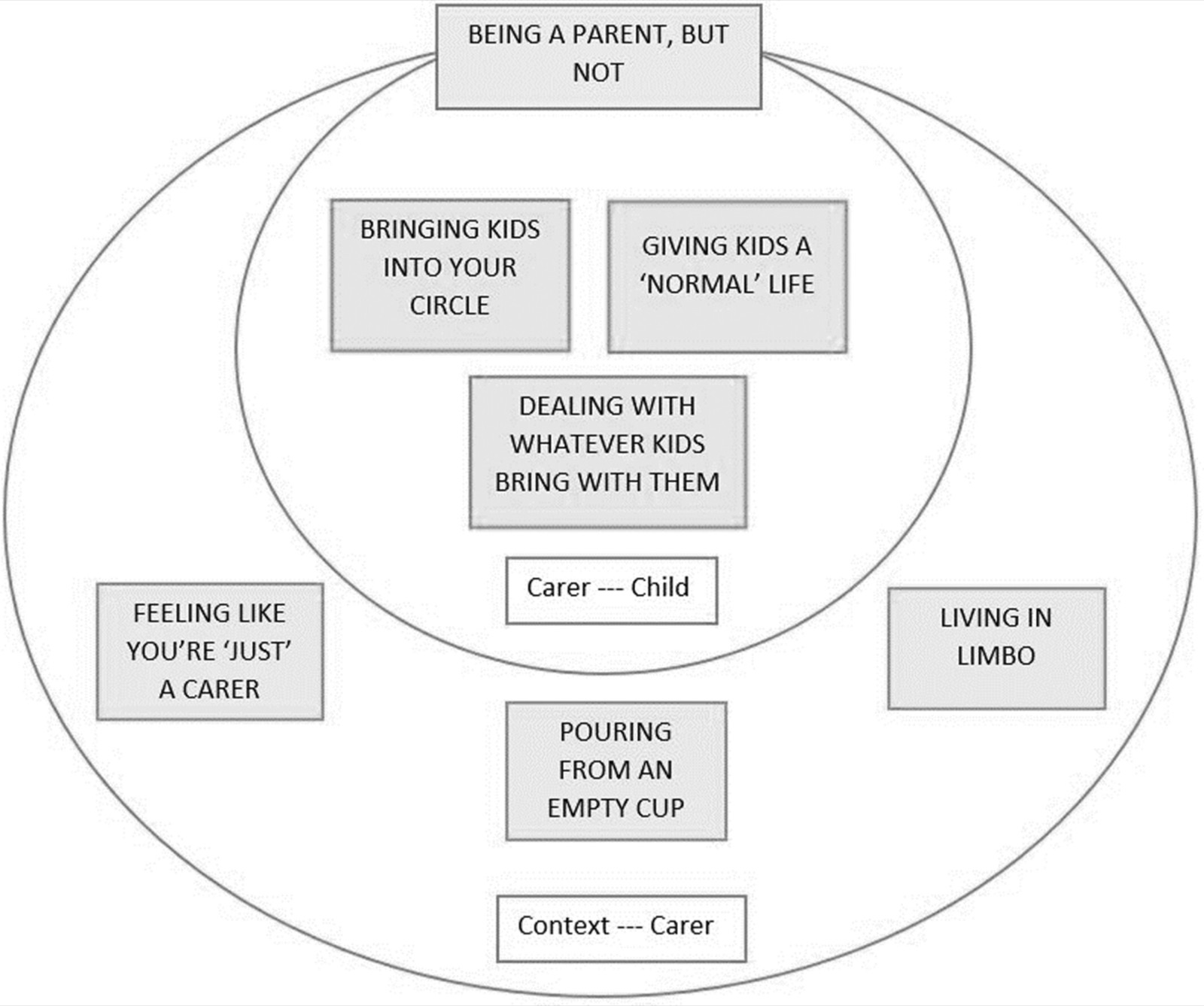
Carer support of children and young people
Foster and kinship carers cared for children and young people in three main ways. Although they all approached their day-to-day care of children differently to suit the needs and ages of the children in their care, they shared similar intentions in what they were trying to achieve. There were three main actions that carers felt were most important in how they approached their role on an everyday basis:
- bringing kids into your circle: establishing a sense of belonging and connectedness by forming a trusting relationship with a child
- giving kids a “normal” life: giving children everyday normality by meeting their basic needs and asisting them to prepare for their future lives
- dealing with whatever kids bring with them: assisting children with physical, emotional, behavioral, and/or psychological difficulties by gathering informationinfromation to understand what is going on for the child and finding strategies to effectively respond
Bringing kids into your circle
“Bringing kids into your circle” shows the importance that carers in the current research placed upon bonding with the children and young people who came into their care to build trust. Carers explained that bonding is a process that occurs over time, as they slowly build up a trusting relationship with one another and show the child that they will support them. In the longer term, carers said that they maintain this bond by being there for children to foster a sense of belonging, connectedness, love, and safety. All carers expressed their understanding of the past experiences of the children and young people in their care and acknowledged that they adjusted their approach to support children who had moved around multiple times or had not previously had supportive adults in their lives.
These quotes demonstrate the ways in which carers described the actions of bonding and being there for children, and the reasons why they saw it as important:
You've got to bring them into your circle. If you don't bring them into your circle, they are always going to stay outside of it, and they are not going to feel safe. They are not going to feel loved and wanted. (Debbie)
With love, the child gets a sense of belonging, um, sense of place, pride, um, “somebody loves me,” you know, “I am worth loving,” I must be doing something to make that so, but yes, um, that's there. And there are times when I felt that I've been the only one [to love Jack]. (Marie)
All carers in the current research explained that bonding and being there were important actions for them. However, carers explained that the way in which they went about building these connections with children depended on the child and their unique circumstances and interests, such as in the following example from Steve:
She's not very trusting at all and she's used to being let down so she expects that and she goes out of her way to push you away just to make sure you're gonna come back sort of thing … you've got to reach out and pull her in, because she'll sit back there and say, yeah this is what I'm used to, and you know, life hasn't really changed, I might get a feed on time, but you know, no one cares or no one loves me sort of thing … you've got to just gentle her through that so that she knows you care.
Giving kids a “normal” life.
“Giving kids a ‘normal’ life” demonstrates that carers in the current research believed that their fundamental goal is to give children as normal a life as possible. This involved assisting children with their day-to-day needs and ensuring that they had access to appropriate education, opportunities to socialize, and opportunities for leisure and fun. They saw themselves as playing an important role in assisting children to become independent and to plan for their future lives. These sentiments are demonstrated in the following quotes:
So you know, we try and give kids as normal a life, growing up here, a stay in our home, as what we can sort of give them. (Hugh).
I'm trying to prepare that child with whatever tools it's got, I am trying to add to those tools, so that by the time that child is independent, or if they've passed us they take with them another set of tools that can help them. Or, prepare them for life. And that's what I see parenting as. (Jane).
All carers explained that these everyday activities are not only important for meeting basic needs, but for giving children consistency, routine, and structure, revealing that although the specific tasks differ depending upon each child's age and circumstances, the intentions of carers in executing these tasks were consistent.
They have discipline here, they do have structure, they know what is expected of them, and through that, they've found safety and security. And I think kids do that when they have structure, they know what is expected of them, they know the boundaries. Um, they have a good, healthy routine, they eat well, they get sleep, you know. Then they, they have the chance to just thrive. (Alexandra)
Carers explained that they aim to prepare children for the future by first recognizing where individual children are at and working toward greater independence from there. This looked different for each child, depending on their age, ability, and areas of interest. For Jane, fostering adolescents meant that she focused upon building skills in financial literacy, saving money, decision-making, and working toward a particular skill or interest for future study or employment. For Marie, Steve, and Sharon, caring for children or young people with disabilities meant they focused on assisting them with their future goals such as living independently. For Evelyn, fostering babies in the short-term meant that she focused upon helping them to achieve developmental milestones and develop skills in language and play that will assist them when they leave her home.
Dealing with whatever kids bring with them
“Dealing with whatever kids bring with them” demonstrates that carers in the current research saw an important part of their role as assisting children and young people to cope with, or recover from, their own specific challenges. These challenges included physical, emotional, behavioral, and/or psychological difficulties that carers attribute to the children's past experiences. As Nicole described, “So some kids bring, like, um, trauma, mentally, and some kids are physical.” Fourteen out of the 16 carers reported that the children and young people in their care experienced challenging behaviors and emotions. Even though the challenges that individual children and carers experienced are all unique, carers explained a shared process in the journey of figuring out what is going on for the child and how to best support them. Carers explained that they proactively utilized professional support and attended training to assist them in figuring out how best to respond to each child.
Jane gave an example of this learning process. At the time of her first research interview, Jane said that she was unsure exactly what was going on for the child but wondered if she was autistic and was organizing professional assessments to investigate this further. By the time of her follow-up interview for this research (12 months later), Jane explained that she had new strategies that supported the child more effectively and a professional diagnosis of autism. Jane reflected upon her own learning through this process in the following explanation:
Looking back on it, I can see that I exacerbated things. Um, by going ok, this is poor behavior, I am going to come down on it, ooh, big blow up, ooh, well that was ugly [laughs]. So, now I'm a little further down the track. … So now I go about things in a very different way. I still want the same outcome, but I have learned now [more effective strategies to get there].
Some carers conceptualized their role in assisting children with challenging behaviors and emotions as a part of the role of any parent. However, some carers described this element of their role as going beyond their expectations of “ordinary” parenting. Steve stated that “[The children have] all got special needs. Most of them anyway, so it's a parent with extras really, yeah.” He explained that he saw this part of his role as beyond his view of normative parenting because he did not experience this when parenting his biological children, whereas other carers saw this as part of the role of parenting any child with special needs. However, many carers discussed the additional challenges that come with trying to fulfill this role as a home-based carer without full access to information about the child. Some carers described times when they did not know about specific behaviors or emotions that would have assisted them to provide more targeted and effective care to children and young people. For example, Marie explained that she missed “warning signs” regarding the child in her care because she did not know about his history of drug exposure in utero and that she felt blamed for not seeking professional help sooner. Marie stated that she feels as though “it is always my lack of knowledge … I've gotta keep searching … blindly.”
Carer experiences of supports and challenges
This section will explain the three main factors representing what foster and kinship carers found supportive and challenging in their caring role. Each of the categories occurs on a continuum, with one end explaining what supported carers in their role, and the opposite end explaining what challenged carers in their role. The three categories include the following:
- feeling like you're “just” a carer: the extent to which carers felt valued, heard, and recognized. This impacted upon the way carers communicated with professionals, participated in decision-making, and advocated for themselves and the child in their care.
- pouring from an empty cup: the extent to which carers felt supported in coping with the emotional stress of caring for children, which can impact upon their ability to care for children and young people day-to-day.
- living in limbo: the extent to which carers were informed about the length of a child's stay or their placement transition. This impacted upon carers' ability to prepare themselves and their family members to farewell or welcome a child, to prepare the child for a transition, and on the way in which they bond with a child.
Feeling like you're “just” a carer
“Feeling like you're ‘just’ a carer” represents foster and kinship carers' feelings of recognition. Carers in the current study varied on the extent to which they said that they felt that they are just a carer. Their feelings of recognition were associated with how they felt other people (primarily workers) perceived their unique contribution to the care of a child or young person. Carers who felt that their contribution was valued thought that workers viewed them as capable, trustworthy, and knowledgeable about the child or young person in their care. When carers were kept up to date with important information relating to the child and included in decision-making processes, carers said that they felt valued. Steve, for example, described how “they sat down with everyone and … we all agreed that that's what would happen. Yep. That's a much better way to do things.”
In contrast, carers who felt that they were just a carer described themselves as feeling like workers thought that they were “just a number” and that they were not of equal worth to professionals. Sharon exemplified this, sharing that “sometimes I feel like I am nothing, I am just Sienna's carer, and that's it. You know?”
When carers were not included, they felt that workers failed to recognize their contribution, nor saw them as worthy of meaningful contribution. Many carers reported a reluctance to advocate for themselves or for the children in their care to Child Protection out of concern that workers may be less likely to recommend that the child stay in their care in the longer term, and would judge them for doing so. In the following quote, Denise expressed how she felt that workers were judging her caring ability, and that she felt that her views were not valued or recognized:
Our caseworker at Child Protection, she was maybe 20, 21, um, only new to the job, um, telling me what to do, and yeah, how to do it, and how to look after kids, and I thought, you know, I've had enough of this. And in 12 months, she only came to our, did she come to our place? Yeah once … And yet, when I wanted to do something, oh no, we can't do it that way, we've got to do it this way. You can't argue the point because you won't win.
Whereas, when carers felt that workers trusted and valued them, they were more confident in discussing issues and raising concerns, as they did not feel that this would reflect poorly on their caring ability. This was the case for Hugh, who explained that he contacted a worker to inform them of an issue with a child lighting a fire in their home. The lead author asked Hugh if he felt any reluctance to report the issue, given that other carers had shared this concern in interviews. Hugh replied that he did not feel reluctant because “they feel confident in us, with whatever situation has occurred and they know full well that we'll handle them to the best of our ability.”
Pouring from an empty cup
“Pouring from an empty cup” represents the extent to which foster and kinship carers feel supported in their caring role. Carers varied on the extent to which they felt able to cope with the stress associated with their caring role, but all felt that their own well-being had an impact upon their care of children and/or young people.
Because sometimes you feel like you are pouring from an empty cup, but if you are feeling supported, and you are feeling appreciated, oh my god, the world of difference it makes. And that translates into the care, the quality of care that you provide to the kids. (Elizabeth)
Foster and kinship carers explained that they felt better able to cope when they had good relationships with workers, strong support networks from their family and friends, peer support from other carers, practical and financial support, and opportunities to have breaks. When carers reported feeling emotionally drained, they felt that they did not have access to sufficient support from within their own personal networks and did not feel that this support was forthcoming from their workers. For some carers, their feelings of emotional drain were serious enough that they considered giving up the care of children or young people because they did not feel that they could continue. This experience was reported by Debbie, a grandparent kinship carer, who was dealing with challenging family dynamics with little personal or professional support, and who was feeling worried about asking for assistance from workers because she felt that they may interpret this as a sign of inadequacy and would remove the children from her care. However, the strain continued and led Debbie to consider this option herself, as shown in the following quote:
So, it came to a point not that long ago, I think it was about June, June-July, where I was going through a very high emotional thing, and I was just about to give, relinquish the children after 8 years because of what was going on.
In this situation, Debbie ended up being able to access respite care through a disability health-care service, separate to the OOHC system, which gave her the space to regain her emotional energy and continue caring for her grandchildren.
Some carers reported feeling resentful at the type of involvement from workers in the OOHC system, in that they felt as though workers should be there to support them, but instead they felt that workers mainly scrutinized them. This is shown in the following quote from Steve:
The scrutiny I suppose, you're on your toes all the time … you know you'll get your bum kicked later if you do the wrong thing but that's something you wear …When I need somebody there is never any one here, when I don't need you, you're always annoying me!
Living in limbo
“Living in limbo” represents the extent to which carers feel that they have stability and predictability in their caring role. Carers in the Central Highlands explained that this feeling comes from not knowing what to expect in relation to the length of time the child would be in their care. Carers took on their role knowing that children may return to the care of their parents or move on to another placement, but carers explained that they did not feel like they were “kept in the loop” and therefore worried about children moving into and out of their care without notice. Carers explained that this feeling of living in limbo influenced the way in which they executed their caring role, particularly in relation to bonding with the child and assisting them to prepare for the future. When carers knew what to expect, they described feeling greater stability and predictability themselves, which they could pass onto children in their care. Carers expressed that they were conscious that transitions could be difficult times for everyone concerned, so they planned how to properly say goodbye and make the handover smooth.
When the child goes the kids get to write a letter or draw a picture to say goodbye to the child and then the child takes that book with them. And we always buy, like when the child is going we always go and buy a bear or a book or something, and the kids help me to choose that and they get to say goodbye. (Evelyn)
Whereas, when carers did not know what to expect, they felt a sense of uncertainty that arose from not knowing how long a child would be in their care. As Elizabeth explained in the following quote, frequently preparing to farewell a child impacted on her ability to make plans and to provide stability for the child in her care:
That's why I ended up being Toby's permanent carer. Like I said, he was only going to come for 3 months. Um, so, you get to the end of that 3 months, and the caseworker would say, alright we are going to permanent care panel next month, so you'd ration the nappies, you'd wash his clothes, you'd pack his bags. Um, and then, you wouldn't even get a phone call, you'd just get an email the night before saying oh, well, they couldn't find anyone appropriate, you are going to have him for another month. And this happened 3 or 4 times, right, and I just ended up thinking, you poor little bugger, you know, you're just getting bounced around um, my life is in limbo, his life is in limbo, I can't plan anything.
Conversely, carers described scenarios when children were abruptly moved on from their care without notice, explaining this led them to worry that they would not have time to prepare themselves, the children, and the rest of their family for such transitions. Carers gave examples of times when they only had a couple of hours' notice that a child would move on from their care and times when the authorities removed a child without an opportunity to say goodbye. Carers explained that this led them to worry in anticipation of potential abrupt endings, especially regarding the impacts on any children involved. In the following quote, Evelyn described a scenario where a child in her care was returned to the care of her birth mother without notice. Even though Evelyn was pleased that the child could be re-unified with her family, she worried about the unexpected nature of the transition and the impact of this upon the child, herself, and the other children in her care.
[The Department] rang and said that they had a place in a baby and mum's program in Melbourne and [child] was going down there and I was to pack her stuff and have her down there in an hour. So I said, alright, will she be back? Yep, she will surely be back, we will give it a week and we will see how we go. And then they rang me two hours later and said ah no, mum is coping really well, in 2 hours, mum is coping really well, we are going to send her home.
Being a parent, but not
“Being a parent, but not” encapsulates how carers understand and make sense of their role as home-based carers. Carers in the current study explained that they saw themselves as taking on the parenting of a child or young person through their day-to-day care, but that they could not fully be parents due to the tensions inherent in out-of-home care arrangements. As Joan described, “You know, when you're doing something for a child that's yours, but not yours.”
Carers explained that the everyday actions that they performed in caring for children meant that they were primarily parenting the child or young person. However, they saw their role as being different to the role of birth parents and acknowledged that this creates complexity within their parenting role. Joan described her role in relation to the granddaughter in her care as “playing the role of her mum when she has a mum.” Other carers shared this sentiment through explaining that they viewed their role as that of a parent, despite the child having existing birth parents. Jane explained that she interpreted her everyday acts of caregiving as constituting parenting, but that she differentiated this from the role of birth parents in a child's life.
But I make it very clear to the children, that while we are their parents, we are not their birth parents, you've only got one set of those, no one takes that role away, but while I am the one that is making your meals, cleaning your house, I'm your parent.
Carers who had the nonpermanent care of children, such as Jane, explained that they expected to transition out of their role as the child or young person's primary caregiver, and therefore they planned for this transition and understood from the beginning that they would not be the sole caregiver for the child or young person in the longer term. This limited their view of themselves as the parent of the child. Conversely, some carers in foster or kinship care arrangements did go on to become the permanent, or long-term, carers of children. These carers described their transition into a parental role differently to carers who set out to provide short-term care. A long-term or permanent caring relationship with a child or young person changed the expectations that carers had of their role and increased their sense of being a parent to the child.
I suppose it made us feel more like we were her parents. It was being verified for us and validated that she was probably going to stay and yeah, it's just now waiting. It can be quite a long process apparently. So it's sort of exciting but nerve wracking at the same time because she could still be taken away … The longer we have her the more she's ours and the more bonded we become and the more she slots into our family perfectly. And yeah, I consider her my child, my daughter. (Nicole)
Carers described a transitional process of “becoming a parent” that slowly emerged over time as their relationship with the child developed and their expectations of their role shifted. Some carers explained that once they saw permanent care as a possibility, they felt more like a parent due to the continued relationship they were likely to have with the child, as Nicole articulated in the previous quote. In addition, the length of time that carers had been caring for the child or young person contributed to their sense of “being a parent,” as this transition occurred gradually over time through shared experiences.
I don't see myself as Sienna's carer, I am Sienna's mum … I've had Sienna since she was 3 months, so I just class myself as her mum, because, I've been there through everything. (Sharon)
It does take time for the kinship caring role to come up to being the parenting role. When the children have been in your care for so long, you become their parent. You come up to that same level. (Debbie)
Additional considerations for kinship carers
In general, the experience of “being a parent, but not” and the process of becoming a parent were shared for both foster and kinship carers. However, kinship carers described some additional complexities due to their existing relationship with the child and their birth parent(s). Kinship carers described their transition into the role of a parent as also involving the loss of their original role, or as establishing a balance between both roles.
And when I was just her nanna we used to do really cool things together. You know it was totally different. I don't know. I was the cool nanna! So now I've sort of gotta, there's got to be boundaries and there's got to be rules and stuff that we didn't have to deal with before so it's a much more challenging role because I still want to be Nana, but I can't. (Joan)
Cause I don't look at it, I mean, I am their grandmother sure, but, in a different role, in a parenting role. And that's, that's not what grandparents should be doing, they should be spoiling their grandkids and, um, so that I miss. (Heather)
Kinship carers explained that the relationships between themselves and the birth parents of the children and young people in their care could be a source of tension. Some kinship carers explained that their transition into a parenting role and the relationship that they established with children and young people could be difficult to navigate within their wider families.
Yeah, I've been their parent for a number of years now. Um, the little one was even calling me mum. Until his mother heard him and then, really went off her face at him, and he was only a little baby, a little boy, it scared the hell out of me. But um, yeah, I've been their actual parent for a long time. (Debbie)
DISCUSSION
The concept of “being a parent, but not” raises important questions regarding the role expectations of home-based carers. This research suggests that home-based carers feel as though they are fulfilling the role of a child's parent, but with additional extras that exceed their expectations of normative parenting within a large bureaucratic system that creates additional complexities and barriers in their parenting role. Some of these tensions are inherent in the very nature of home-based care, in that carers are taking on the care of children who have existing families, histories, and complexities. However, some of these tensions come about through the ways in which home-based care systems are conceptualized and designed, which necessitates consideration of how home-based carers can be better supported to cope with the inevitable tensions of their role.
Home-based carers are operating in a context within which they are encouraged to form strong attachment relationships and provide safe and stable homelike environments for the children and young people in their care, in line with the rising recognition of the importance of relational bonds for children's development and the growth of home-based styles of alternative care (DHHS, 2019; Harlow, 2021; Smith et al., 2017). Carers in the research described here showed that their views align with this conceptualization of home-based care, in that they endeavored to create trusting relationships with children and create a normal, everyday family environment. However, carers found it challenging to fulfill this role when they were uncertain about how long the child would stay in their care, and when they worried that they would have to farewell children unexpectedly, due to systemic policies leading to high rates of placement instability (Riggs et al., 2009). Thus, carers experienced a quandary between the desire to make the child feel a part of their home and their family, and their fear of becoming too close in case the connection is unexpectedly severed. Wheeler (2022, p. 123) described this tension as an “emotional risk” that carers take when bonding with children, due to the grief that they anticipate experiencing if the relationship ends. This anticipation of a potential ending is one of the limitations to a parental self-identity described by carers in the current research.
The process of becoming a parent outlined in this research shows that carers described a transition from seeing themselves as acting as the child's parent, to seeing themselves as being the child's parent. Carers explained that they felt more like a parent when they cared for children for long periods of time, and when they expected to be able to continue their relationship with the child in the long term, particularly if they were planning on becoming a permanent carer. This finding is in line with research in the United States demonstrating that foster carers made a greater commitment to children in their care if they expected to continue the relationship in the longer term, such as by adopting the child (Leathers et al., 2019). Existing research demonstrates that long-term foster carers see themselves as parents (Blythe et al., 2013) and the current research adds to this by including both foster and kinship carers at various stages of long- and short-term care arrangements to elucidate the process of feeling more like a parent over time. It is noteworthy that the carers in the Victorian context still reported transitioning into a parental self-identity over time, even though they were unlikely to ever be recognized as a parent to the extent that an adoptive parent might.
One of the major frustrations reported by carers in the current research was their sense of feeling taken for granted and disrespected in their interactions with workers in the OOHC system. This aligns with existing research demonstrating that both kinship carers (McPherson et al., 2022; Rose et al., 2022; Zuchowski et al., 2019) and foster carers (D'Amato & Brownlee, 2022) feel excluded from decision-making and experience distress in their communication with agencies and government departments in various jurisdictions. It is not surprising that carers identified themselves as “being a parent, but not” when they experienced contradictory messages between the policy intent of home-based care (to provide stable, loving families) and their experiences of meso-level practices within OOHC (feeling unrecognized, unsupported, and uncertain). Carers wanted to be seen and valued as important people in children's lives, and to have their specific expertise recognized. The home-based care system relies upon foster and kinship carers to invest time, energy, and emotion in caring for children, and so it is crucial to value the specific contribution that carers make and support them to sustain their important role.
Efforts to advocate for home-based carers to access greater recognition and support contributed to the drive to professionalize home-based care in the United Kingdom as a means of addressing some of the challenges confronting this form of alternative care (Kirton, 2022). However, recent U.K. research with foster carers showed that even though they conceptualized their role through a professional lens, they felt that their professional status was still seen as inferior to the “real” professionals assisting children and carers in OOHC (Wheeler, 2022). This is similar to the feeling reported by carers in the current research of being “not quite” parents. It seems that regardless of whether carers conceptualize their role through primarily a professional or parental lens, carer roles do not fit neatly into either of these normative categories. Rather than trying to achieve greater recognition through promoting carers as either parents or professionals, it may be more useful to raise the status and visibility of carers by acknowledging the expertise of foster and kinship carers as unique role categories. This would enable carers to gain expert status in their own right, instead of them feeling like they are not quite parents and not quite professionals.
Limitations and future studies
The current research was a context-specific exploration of home-based care. Therefore, it is important to recognize the impact of systemic and cultural differences when interpreting its findings, as is recommended by Pinto and Luke (2022). The current research encourages us to center foster and kinship carers as experts when designing programs or enacting policy change. We recommend that future research positions foster and kinship carers as experts through the use of emancipatory research methodologies, such as action research (Kolenick, 2021). Bringing together carers with program managers, on-the-ground workers, and policymakers in context-specific environments may enable carers' voices to be centered and to create solutions that allow for better alignment of policy and practices to support carer experiences. Although the current research gave some suggestions as to some strategies that can assist to address challenges in home-based care programs, contextual differences mean that specific strategies need to be developed within the systemic and legislative conditions of each jurisdiction (Konijn et al., 2019).
In addition, it is important to recognize that carers are just one of the many important groups who need consideration in relation to home-based care. The children and young people themselves, birth parents, and various other stakeholders also need to be heard, and it is important to balance the needs and rights of all these people when looking toward making changes in home-based care systems. For example, recent Australian research demonstrates that both birth mothers and long-term foster female caregivers need to renegotiate their roles to support children in complex care arrangements (Collings & Wright, 2022). If the goal of home-based care is to provide family-like environments and stable connections with caregivers, then it is crucial for everyone involved with the process to be involved in research and policy reform.
A limitation of the current research is that none of the foster and kinship carers who participated in the research are Aboriginal or Torres Strait Islanders. Given that Aboriginal and Torres Strait Islander children enter out-of-home care in Australia at rates higher than non-Aboriginal and non–Torres Strait Islander children (AIHW, 2022) it is crucial to design research to proactively include First Nations peoples. First Nations and other cultural perspectives could provide great insight into this topic given the differences in kin systems and conceptions of family as compared with Western cultures, and therefore it is important to proactively involve the expertise of Aboriginal and Torres Strait Islander carers in future research.
Implications and conclusions
The current research may assist home-based care programs to address some of the challenges that this form of alternative care is currently experiencing, such as carer shortages, carer dissatisfaction, and placement instability (D'Amato & Brownlee, 2022). Rather than considering each specific challenge facing home-based care in isolation, the integrated grounded theory provides a framework for understanding how the actions and intentions of home-based carers, the context, and their role expectations all relate to one another. In other words, it demonstrates what foster and kinship carers do, why they do it, and what influences them to do so. This integrated perspective provides a framework for policymakers to use to scrutinize the role expectations placed upon carers and the ways home-based care systems support or constrain carers' abilities to meet them. In addition, the current research positions foster and kinship carers as experts in home-based care and provides a forum for their perspectives to be heard and shared.
Kinship and foster carers in the current research share their experiences of what they have found helpful and what they have found challenging in fulfilling their caring role, particularly from the perspective of the OOHC system that they operate within. The current study reveals that factors such as good relationships with workers, strong support networks, peer support from other carers, financial support, and opportunities to have breaks all made a difference to carers' experiences and to their ability to fulfill and sustain their roles. These suggestions provide insight into some of the ways in which home-based care programs can improve the experiences of foster and kinship carers, once adapted to suit contextual differences. However, these suggestions primarily focus upon micro-level (individual level) solutions that would assist carers to cope with the OOHC system as it currently stands.
The current research encourages us to go beyond the micro level in order to make connections between policy, practices, and carer experiences. By exploring the tensions and frustrations that carers experience due to the discrepancies between their own role expectations, practices at the program level, and policy directions, the necessity to make change at the meso (community and organization) and macro (system) levels becomes clear. If the intention of home-based care is to provide children and young people with the opportunity to “live with carers who are supported to create a safe and nurturing home” (DHHS, 2019, p. 6), then it is crucial to address the discrepancies that foster and kinship carers feel in their role by making systemic changes that enable carers to enact attachment principles in their daily care of children and reduce the mixed messages that carers report. The current research lends support for increasing the recognition of foster and kinship carers as experts in home-based care as a basis for enabling these systemic changes to take place.
Complexe Systémique: key points
The study aptly describes a third-party position: the carer holds the child’s daily life, but decisions, information and the future of the bond belong to the institution and, often, to the birth parents. Carers are expected to form a strong attachment while being denied the place and the time that would make it bearable, which looks very much like contradictory messages. For clinical practice, three points stand out: include the placement agency in the map of the system, rather than seeing only the foster family; acknowledge the anticipatory grief that holds back commitment; and, with grandparent carers, support the loss of the grandparent role and the conflicts with their own adult child. The scope remains limited: sixteen people attached to a single agency, mostly grandmothers, no Aboriginal participants, and neither the children nor the birth parents are heard. The account of the services is the carers’ account. Read alongside the article on invisible loyalties, and the article on institutional abuse in child protection.
Notes from the original
Acknowledgement. Open access publishing facilitated by Federation University Australia, as part of the Wiley - Federation University Australia agreement via the Council of Australian University Librarians.
References
Australian Institute of Health and Welfare. (2022). Child protection Australia 2020–21. https://www.aihw.gov.au/reports/child-protection/child-protection-australia-2020-21/
Berrick, J. D., & Skivenes, M. (2012). Dimensions of high quality foster care: Parenting Plus. Children and Youth Services Review, 34(9), 1956–1965. https://doi.org/10.1016/j.childyouth.2012.05.026
Blumer, H. (1969). Symbolic interactionism: Perspective and method. Prentice-Hall.
Blythe, S. L., Halcomb, E. J., Wilkes, L., & Jackson, D. (2013). Perceptions of long-term female foster-carers: I'm not a carer, I'm a mother. British Journal of Social Work, 43(6), 1056–1072. https://doi.org/10.1093/bjsw/bcs047
Blythe, S. L., Wilkes, L., & Halcomb, E. J. (2014). The foster carer's experience: An integrative review. Collegian, 21(1), 21–32. https://doi.org/10.1016/j.colegn.2012.12.001
Borenstein, J. (2022). Towards a conceptual and practice framework for statutory kinship care in Victoria [Unpublished doctoral dissertation]. La Trobe University.
Charmaz, K. (2014). Constructing grounded theory ( 2nd ed.). SAGE Publications.
Child Welfare Information Gateway. (n.d.). Foster care statistics 2019. U.S. Department of Health and Human Services, Administration for Children and Families, Children's Bureau. https://www.childwelfare.gov/topics/systemwide/statistics/foster-care/
Chinnery, S. (2016). Social work's fingerprint on the evolution of attachment theory: Some essential knowledge for care practice. Aotearoa New Zealand Social Work, 28(3), 79–90. https://doi.org/10.11157/anzswj-vol28iss3id216
Collings, S., & Wright, A. C. (2022). “You are mum and then they are mum”: Negotiating roles, relationships, and contact in out-of-home care. Family Relations, 71(3), 1211–1225. https://doi.org/10.1111/fare.12649
D'Amato, S., & Brownlee, K. (2022). Qualitative studies of foster carer experiences in providing Out of Home Care for children: A scoping review and narrative synthesis. The British Journal of Social Work, 52(6), 3078–3094. https://doi.org/10.1093/bjsw/bcab223
De Wilde, L., Devlieghere, J., Vandenbroeck, M., & Vanobbergen, B. (2019). Foster parents between voluntarism and professionalisation: Unpacking the backpack. Children and Youth Services Review, 98, 290–296. https://doi.org/10.1016/j.childyouth.2019.01.020
Department of Health and Human Services. (2019). Strong carers, stronger children: Supporting kinship, foster and permanent carers to achieve the best outcomes for children and young people in care. Victorian Government.
Farmer, E. M. Z., & Lippold, M. A. (2016). The need to do it all: Exploring the ways in which treatment foster parents enact their complex role. Children and Youth Services Review, 64, 91–99. https://doi.org/10.1016/j.childyouth.2016.03.005
Fergeus, J., Humphreys, C., Harvey, C., & Herrman, H. (2017). Assisting carers to respond to the mental health needs of children. Children Australia, 42(1), 30–37. https://doi.org/10.1017/cha.2017.1
Garcia Quiroga, M., & Hamilton-Giachritsis, C. (2014). “In the name of the children”: Public policies for children in out-of-home care in Chile. Historical review, present situation and future challenges. Children and Youth Services Review, 44, 422–430. https://doi.org/10.1016/j.childyouth.2014.07.009
Harlow, E. (2021). Attachment theory: Developments, debates and recent applications in social work, social care and education. Journal of Social Work Practice, 35(1), 79–91. https://doi.org/10.1080/02650533.2019.1700493
Hart, S. N., Lee, Y., & Wernham, M. (2011). A new age for child protection—General comment 13: Why it is important, how it was constructed, and what it intends? Child Abuse & Neglect, 35(12), 970–978. https://doi.org/10.1016/j.chiabu.2011.09.007
Hollett, M., Hassett, A., & Lumsden, V. (2022). Foster caring as ‘professional parenting’: A grounded theory of the relationships between parent and professional in long-term foster care. Adoption & Fostering, 46(4), 413–436. https://doi.org/10.1177/03085759221139490
Kirton, D. (2022). Exploring the anti-professional turn in English foster care: Implications for policy, practice and research. The British Journal of Social Work, 52(7), 4021–4039. https://doi.org/10.1093/bjsw/bcac039
Kolenick, P. (2021). Communicative space and the emancipatory interests of action research. Action Research, 19(2), 129–145. https://doi.org/10.1177/1476750317699461
Konijn, C., Admiraal, S., Baart, J., van Rooij, F., Stams, G. J., Colonnesi, C., Lindauer, R., & Assink, M. (2019). Foster care placement instability: A meta-analytic review. Children and Youth Services Review, 96, 483–499. https://doi.org/10.1016/j.childyouth.2018.12.002
Leathers, S. J., Spielfogel, J. E., Geiger, J., Barnett, J., & Vande Voort, B. L. (2019). Placement disruption in foster care: Children's behavior, foster parent support, and parenting experiences. Child Abuse & Neglect, 91, 147–159. https://doi.org/10.1016/j.chiabu.2019.03.012
Lempert, L. B. (2007). Asking questions of the data: Memo writing in the grounded theory tradition. In A. Bryant & K. Charmaz (Eds.), The SAGE handbook of grounded theory (pp. 245–264). SAGE.
McPherson, L., Gatwiri, K., Day, K., Parmenter, N., Mitchell, J., & Macnamara, N. (2022). “The most challenging aspect of this journey has been dealing with child protection”: Kinship carers' experiences in Australia. Children and Youth Services Review, 139, Article 106550. https://doi.org/10.1016/j.childyouth.2022.106550
Musgrove, N., & Michell, D. (2018). The slow evolution of foster care in Australia: Just like a family? Palgrave McMillan.
Permanent Care and Adoptive Families. (2021). Permanence and stability: The missing ingredients for Victoria's most vulnerable children. https://www.pcafamilies.org.au/advocacy/submissions-policy-resources#permanence-and-stability-the-missing-ingredients-for-victoria-s-most-vulnerable-children-2021
Pinto, V. S., & Luke, N. (2022). The role of foster carers in England and Portugal: Is it solely a parenting role? Children & Society, 36(2), 249–265. https://doi.org/10.1111/chso.12536
Riggs, D. W., Delfabbro, P., & Augoustinos, M. (2009). Negotiating foster-families: Identification and desire. The British Journal of Social Work, 39(5), 789–806. https://doi.org/10.1093/bjsw/bcm156
Rose, L., Taylor, E. P., Di Folco, S., Dupin, M., Mithen, H., & Wen, Z. (2022). Family dynamics in kinship care. Child & Family Social Work, 27(4), 635–645. https://doi.org/10.1111/cfs.12912
Saldaña, J. (2013). The coding manual for qualitative researchers ( 2nd ed.). SAGE.
Schofield, G., Beek, M., Ward, E., & Biggart, L. (2013). Professional foster carer and committed parent: Role conflict and role enrichment at the interface between work and family in long-term foster care. Child and Family Social Work, 18(1), 46–56. https://doi.org/10.1111/cfs.12034
Smith, M., Cameron, C., & Reimer, D. (2017). From attachment to recognition for children in care. The British Journal of Social Work, 47(6), 1606–1623. https://doi.org/10.1093/bjsw/bcx096
Smyth, C., & McHugh, M. (2006). Exploring the dimensions of professionalising fostering: Carers' perceptions of their fostering role. Children Australia, 31(1), 12–20. https://doi.org/10.1017/S1035077200010944
Sprecher, E., Tuitt, I., Hill, D., Midgley, N., & Sleed, M. (2021). No typical care story: How do care-experienced young people and foster carers understand fostering relationships? Adoption & Fostering, 45(3), 248–264. https://doi.org/10.1177/03085759211037156
United Nations Committee on the Rights of the Child. (2011). General comment 13: The right of the child to freedom from all forms of violence (CRC/C/GC/13). https://digitallibrary.un.org/record/711722?ln=en
Vulnerable Children Reform Unit. (n.d.). Children and Youth Area Partnerships overview. Department of Health and Human Services, Victorian Government.
Wheeler, P. (2022). Multiple modes of being: Exploring the complex role of a foster carer. [Unpublished doctoral dissertation]. University of Essex.
Zuchowski, I., Gair, S., Henderson, D., & Thorpe, R. (2019). Convenient yet neglected: The role of grandparent kinship carers. The British Journal of Social Work, 49(3), 615–632. https://doi.org/10.1093/bjsw/bcy085
Reformatted republication of Being a parent, but not: A grounded theory of home-based care, by Kimberlea Cooper, Christina Sadowski and Rob Townsend, Family Relations, vol. 73, no 3 (2024), doi: 10.1111/fare.12969, under a CC BY 4.0 licence. Edition and layout: Complexe Systémique, September 2026 — the work has been modified under the terms of the licence. Neither the authors nor the publisher are responsible for this edition; the original version prevails.
This is the original article “Being a parent, but not: A grounded theory of home-based care”, published in Family Relations (2024) under a CC BY 4.0 licence. Republished by Complexe Systémique: the author’s text is unchanged; only the presentation has been adapted for reading online, as set out at the head of this page.
Read the original articleHow to cite this article
Cooper, K., Sadowski, C., et Townsend, R. (2024). Being a parent, but not: A grounded theory of home-based care. Complexe Systémique. https://app.complexe-systemique.com/en_GB/articles/being-a-parent-but-not-a-grounded-theory-of-home-based-care (Original work published in 2023 in Family Relations, 73(3), 1880-1898 (2024); republished in 2024 by Family Relations, https://onlinelibrary.wiley.com/doi/full/10.1111/fare.12969)
To go further
- What are invisible loyalties?Invisible loyalties.
- Protection or institutional abuse? A crossroads in child protection policiesInstitutional abuse.
- Utiliser l’entretien d’exploration de l’attachement adulte (AEAI) pour rompre le cycle du trauma intergénérationnelAttachment in child protection.
Related articles
 Article
 Family group conference provision across the lifespan of child welfare intervention: A mixed-method realist-informed evaluation comparing three stages of welfare concern
Early help, child protection or children in care: among 155 UK families, experiences and outcomes of family group conferences vary very little by stage.
 Article
 Transitioning to the Business of a Session in Collaborative-Dialogic Meetings: A Conversation Analysis
How do Open Dialogue therapists move to the business of a session? The open question creates silences and family negotiation: a conversation analysis of ten sessions.
 Article
 “One Can Have All Sorts of Good Intentions but Sometimes in Everyday Life, It Turns Out Differently”: Change Agreements in Couples' Everyday Lives
Six Danish couples followed after an online couple program: their change agreements become guilt-inducing contracts, shared understanding or revealers of inequality.
 Article
 How can we BeST? meet the needs of adoptive families? Relevant findings from a major Randomised Controlled Trial of infants in foster care in the UK
The BeST? trial (488 infants in care in the UK) reread for adoption: holistic, ongoing assessment of children and a move to dual registration.