AI-assisted translation
This version was translated from Portuguese by Complexe Systémique with the help of artificial intelligence. In case of doubt, the original version prevails.
Revista Brasileira de Terapia Familiar · Sexual violence
Bonding, belonging and affectivity in the family relationships of adolescents who have sexually offended
What do family sculptures reveal about families in which an adolescent has committed intrafamilial sexual abuse? In a multifamily group at a public mental health service in Brazil’s Federal District, Mariana Miranda Borges and Liana Fortunato Costa analyse these sculptures, transposed into geometric figures: an adolescent hemmed in by relatives, a mother balancing between offender and victim, blurred boundaries. The article reads in them a doubt about one’s place in the family’s affections and a call for help addressed to the family.
Unofficial English translation. This article is a translation of Vínculo, pertencimento e afetividade nas relações familiares do adolescente ofensor sexual, by Mariana Miranda Borges and Liana Fortunato Costa, published in the Revista Brasileira de Terapia Familiar (ABRATEF), vol. 14, no. e1226 (2026), doi: 10.60114/rbtf.v14.164, under a CC BY 4.0 licence. Translated by Complexe Systémique in November 2026 with the help of artificial intelligence: the original Brazilian Portuguese text has been translated into English and reformatted, which constitutes a modification of the work under the terms of the licence. Paragraphs and headings are those of the journal; Table 1 is presented as a list; the figures reproduce the family sculptures as published by the journal, in geometric form; end-of-article statements are grouped in the notes. The quotation from Minuchin is given in the wording of the English original. The abstract is the authors’ own English version. This translation was made neither by the authors nor by the journal, who are not responsible for its content or for any errors. The original version prevails.
Perhaps the family is saying that it will not choose one or the other, but both: offender and victim.
Mariana Miranda Borges, Liana Fortunato Costa
Abstract
The purpose of the text is to contribute to the expansion of knowledge about the adolescent who committed an offense, mainly considering family relationships. The discussion on this context focuses on a resumption of the perspective of classical authors, national and international, in the study of the family. This is a qualitative investigation that used family sculpture as an assessment tool in a systemic reading of family relationships, considering belonging, bonding, and affectivity. Ten sculptures were made, photographed, and transformed using the PicsArt app. To make the publication viable, geometric figures were allocated to replace the people in the photos. The discussion expressed the movement of approximation and rupture between the mother and the teenager, causing a fragile bond and raising doubts about their place of affective importance. The feeling of belonging, which maintains the permanent connection with family members, is also dubious, determining behaviors that try to communicate the suffering of adolescents. This communication is still within family boundaries, as its intention is to ask for help. Family sculpture brings possibilities of understanding aspects of the systemic reading of the family. This is a recommended approach for professionals who care for these adolescents who have committed intrafamily sexual offenses.
Keywords: Sexual offender adolescent, Sexual abuse, Family.
Introduction
This text aims to present and discuss the affective bond and the sense of belonging present in the family relationships of adolescents who have committed a sexual offense. It seeks to revisit a systemic reading in the light of what the literature of family studies recommends when addressing the conflictual issues present in adolescence, given that the therapeutic care of adolescents should be conducted from a family perspective, that is, with the family (Andolfi, 2018; Andolfi & Mascellani, 2012; Fishman, 1989; Minuchin et al., 2008).
The theoretical foundation of this study is systemic thinking from the perspective of Esteves de Vasconcellos (2025), who proposes the emerging paradigm of contemporary science based on three assumptions: complexity, instability and intersubjectivity. The view of complexity widens the focus on the object with the intention of understanding it in context, so that understanding is not reduced to disconnected elements. Instability refutes the premise that the world is stable and its variables controllable; reality is assumed to be a process of becoming, of constant change. Intersubjectivity questions the possibility of knowing the world objectively; there is always an observer, embedded in a context, who observes and understands the object. The production of knowledge originates in a subjectivity (Esteves de Vasconcellos, 2025).
For Minuchin et al. (2008), the family is an open system in transformation, constituting a group of people connected by affective, emotional and mythical ties. Family members develop patterns of interaction and experience together various situations that justify and explain the interactional process, going beyond the question of blood ties and valuing the sense of belonging present in the relationship. The family has the external objectives of accommodating and transmitting a culture, and an internal one of protecting its members psychosocially, being the first social space a subject inhabits (Negreiros et al., 2021).
Among the family’s missions is the transmission of values, beliefs and culture, which develop through patterns of interaction. These patterns of interrelation make it possible to build a structure and a functionality. Family dynamics encompass aspects present in interactions and are perpetuated by the group’s own lived experience. These aspects are: rules, boundaries, communication, power, the sense of belonging, intimacy, affectivity, the expression of gender, roles, hierarchy, conflicts, individualization, cohesion. Observing these aspects provides knowledge of the transactional pattern (Minuchin, 1982; Minuchin & Fishman, 1990; Nichols & Schwartz, 2007; Passos, 2015).
In specific terms of organization, Minuchin (1982) regards the family as a system, “the invisible set of functional demands that organizes the ways in which family members interact” (Minuchin, 1982, p. 57). It is a system within other, larger systems, and it contains smaller systems, the subsystems. Interactions take place in these subsystems, which may be formed on the basis of shared characteristics, such as generation, sex, tasks or interests (Minuchin, 1982).
Minuchin and Fishman (1990) consider that there are three subsystems of singular significance in the family: the spousal, the parental and the sibling subsystem. The spousal subsystem refers to the dyad responsible for care, and its functions are complementarity and mutual accommodation. The spousal subsystem may also take the form of the parental subsystem when children are born, and must then extend its functions to their education and socialization, with the specific tasks of guiding, nurturing and directing. The sibling group is formed with the birth of further children, offering them a source of mutual support and a greater opportunity to experiment with the interactions present in social reality. In this context, siblings learn to establish a horizontal relationship among peers (Magalhães et al., 2017; Minuchin, 1982).
In working with adolescents, what matters is the construction of identity within the family, which is processed by two mechanisms acting simultaneously: the sense of belonging (bonding) and separation, which are interdependent. Belonging/bonding arises from the experience of a family group that communicates, physically, emotionally and symbolically, the union and affection among its members, and that enables the individual to identify as part of that bond (Minuchin, 1982). Intimacy is also part of the process of belonging; family members are available and close to one another. The need for separation is met through participation in different family subsystems, in various situations, and in extrafamilial groups, allowing individuals to learn how far their autonomy extends (Chagnon, 2017). Gender configuration and membership of a generation are constitutive elements in the interactions that establish the difference between sexes and ages, providing the movements of separation that lead to autonomy. Within the family, gender helps in learning the social roles to be performed in the groups people live with (Costa et al., 2020).
The profile of adolescents who commit sexual offenses is heterogeneous, but presents some common characteristics: deficits in social skills, values and beliefs marked by gender prejudice, physical and/or sexual victimization, lack of parental supervision combined with curiosity and an eagerness to experiment with sexuality. It is now known that adolescents who commit sexual offenses experience violence in the process of constructing their subjectivity, and can be considered poly-victims, because of the variety and persistence of that violence, which may be psychological, physical or economic, or take the form of neglect, abandonment or witnessing (Alexander et al., 2021; Tavares et al., 2021; Worling & Langton, 2017). As for the families of the adolescents who have been studied, a striking characteristic is limited family and social support, since these families’ main concern is material survival, especially in pandemic and post-pandemic times. These adolescents live in a family organization geared towards meeting basic needs, such as the distribution of domestic tasks and responsibilities among its members. In this context, the adolescent who has committed a sexual offense is the one responsible for looking after the house and the younger siblings while the parents are out all day, working (Pincolini & Hutz, 2014; Silva et al., 2021).
In short, the purpose of the text is to contribute to expanding knowledge about adolescents who have committed sexual offenses in contextual terms, that is, focusing on a national reality. The discussion revisits the perspective of classic authors, Brazilian and international, in the study of the family, with an emphasis on the meaning of the sexual offense as a communication to the family.
Method
Research context
This is a qualitative study conducted in a public outpatient mental health service for children and adolescents that treats adolescents who have sexually offended. Care is group-based: adolescents and their family members are received in interviews intended to gather psychosocial data and information on family relationships, life history, the victim and the context in which the violence occurred. The families then begin group treatment, consisting of five to seven sessions, in which the topics discussed are protection, sexuality, sexual violence, transgenerationality and dating plans. Sessions last three hours and take place every two weeks; most participating families are experiencing a situation of intrafamilial sexual violence. This group format corresponds to the multifamily group (Costa et al., 2015), which works from Fishman’s (1989) perspective that adolescents should be treated with their families. The information used for the discussion in this text concerns a group that began in the first half of 2017 and consisted of 10 families.
The participants are described in Table 1.
Table 1 — Information on the adolescents, family members and victims
- Adolescent 1: 16 years old, 8th grade (EF II); victim: M, 4; in the household: mother, aunt, three cousins (26, 19 years old); family income: 3 MW.
- Adolescent 2: 13 years old, 8th grade (EF II); victim: F, 4; in the household: mother, stepfather, two brothers, sister; family income: 7 MW.
- Adolescent 3: 14 years old, 9th grade (EF II); victim: F, 6; in the household: mother, stepfather, sister; family income: not reported.
- Adolescent 4: 13 years old, 8th grade (EF II); victims: M, 6; M, 5; M, 4; in the household: mother, adolescent; family income: not reported.
- Adolescent 5: 14 years old, 4th grade (EF I); victim: M, 11; in the household: mother, sister, brother; family income: not reported.
- Adolescent 6: 14 years old, 5th grade (EF I); victims: F, 10; M, 2; in the household: maternal great-aunt, two siblings; family income: 1 MW.
- Adolescent 7: 13 years old, 7th grade (EF II); victim: F, 3; in the household: father, mother; family income: 3 MW.
- Adolescent 8: 17 years old, 9th grade (EF II); victims: M, 7; M, 10; in the household: mother, stepfather, three brothers; family income: 2 MW.
- Adolescent 9: 16 years old, 1st year of secondary school (EM); victim: F, 11; in the household: mother, sister; family income: 1 MW.
- Adolescent 10: 16 years old, 8th grade (EF II); victim: M, 7; in the household: father, mother, maternal grandparents, maternal aunt, five siblings (20, 20, 18, 8, 7 years old); family income: less than 1 MW.
F: female; M: male; EF: ensino fundamental (primary and lower secondary education, stages I and II); EM: ensino médio (upper secondary education); MW: minimum wage(s). Source: the authors.
Instrument and procedures
The group was led by a multidisciplinary team of psychologists, social workers, and students and residents in psychology, nursing and medicine, with faculty members from a public university acting as supervisors. This text focuses on the first session, in which family sculpture was applied: a non-verbal technique that allows the symbolic representation of a system with little or no rationalization, resistance and/or labels (Andolfi, 1981). Choosing family sculpture makes it possible to visualize family interactions (Andolfi & Mascellani, 2012), describing the family organization, the roles taken on and the quality of each member’s bond with the others.
Ten adolescents and their family members attended this first session. Group treatment provides for an interactive warm-up in this first session, through the introduction of the families. Family sculpture is therefore applied for this purpose (Andolfi, 1981). The family sculpture technique was applied with the participation of the mother, the adolescent and the professional team, who could act as auxiliaries when it was necessary to include other family members who were not present at the session but were considered important. The mother was asked to build the representation of her family using the participants or objects present in the consulting room. At that moment, the representation of the family was photographed.
The adolescent was then invited to make changes to the arrangement of the family pose if he felt it was necessary, and a new photograph was taken. In accordance with the technique, the first photograph corresponds to the static moment of the family sculpture, and the changes made to the dynamic moment (Andolfi, 1981). It should be noted that family 5 did not agree to take part in the activity. There were thus 10 participants, but only nine were recorded. The photo files of the family sculptures were transferred to the PicsArt app, and the artistic oil effect was applied to blur the faces of the participants in order to protect their privacy. A letter was then added to identify each family member, together with the caption indicating the kinship relation.
The analysis of the information was based on the original photograph, with the aim of deepening the systemic reading of family relationships in the following aspects: family organization, roles taken on, and the quality of each member’s bond with the others. To this end, the literature drawn on is that of Andolfi (2018), Andolfi and Mascellani (2012), Chagnon (2017) and Minuchin et al. (2008).
Ethical considerations
The research project was submitted to Plataforma Brasil, receiving Certificate of Presentation for Ethical Appraisal (CAAE) number 66485717.0.0000.5540, and was approved on 9 May 2017, under opinion no. 2.054.880. Subsequently, the addition of documentary research was proposed, which was approved by amendment in February 2018.
Results
In this text, the family sculptures are presented as geometric figures, with the circle indicating the female gender and the square the male gender (Figs. 1–9). To make the aspects discussed easier to see, the figure representing the mother has been filled with diagonal lines; the adolescent’s figure with vertical lines; and the victim’s figure entirely blacked out. The other kinship figures are indicated in the caption. This adaptation of the photographs into figures was made because of the space available, replacing the members of each family while respecting the arrangement shown in the original photograph.
It should also be noted that all the ages given in this text are based on information provided by the institution. In some sculptures (Figs. 2, 3, 4, 6, 7a, 7b), the ages of some of the relatives in the figure are missing. These missing ages belong to people who are not part of the information in the adolescent’s institutional record, or who were not necessarily present when the sculpture was built. The adolescent’s choice of someone to include in the sculpture does not mean that this person was actually present at the session, but that this person is important in terms of affective bonding.
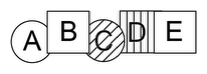
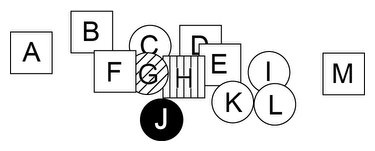
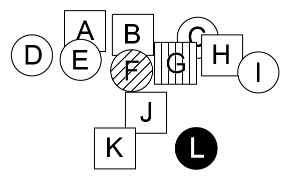
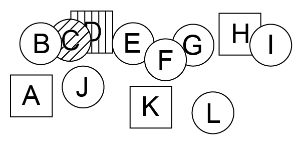
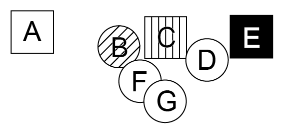
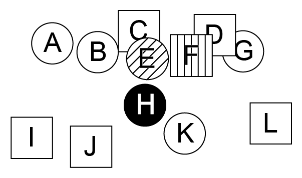
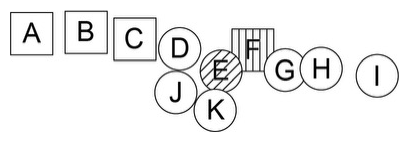
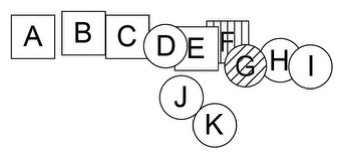

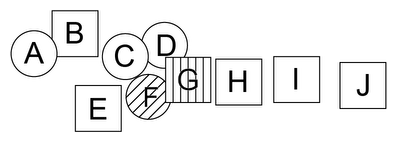
The figures show a crowded organization and enmeshed relationships, in Minuchin’s (1982) sense, owing to boundaries that are unclear and/or poorly maintained. In general, the function of a boundary is to delimit the subsystems in family interaction, or to delimit the family system in relation to wider social systems. Boundaries should be relational patterns that can be adjusted as the children and adolescents in the family develop.
The finding of enmeshment denotes a communication of concern for family unity. The disclosure of sexual abuse threatens family unity and affects the quality of boundary formation (Andolfi, 1981; Marra & Costa, 2018; Minuchin, 1982). The adolescent can be seen surrounded by several family members, mainly the mother, as well as by many women in the roles of grandmother, aunts and friends of the mother: a veritable family enclosure around the adolescent. The photographs of the families were built with several members of the nuclear and the extended family, which suggests that these people move a great deal between these two systems and have frequent contact with the adolescent.
In view of these considerations, a doubt arises, already expressed by Tavares et al. (2021), about the existence of an operational bond expressing parental supervision of the adolescent, given the many adults who come and go in the house. Parental supervision is a fundamental point in perceiving the presence of authority exercised over the adolescent who sexually offends within the family, ranging from an aspect of family relationships in general (Andolfi & Mascellani, 2012; Costa, 2020; Magalhães et al., 2015; Ponciano, 2015) to the specific matter of restoring the function of guiding and supervising the adolescent offender (Chagnon, 2017; Costa et al., 2020; Oliver, 2007; Silva et al., 2021). Conflict resolution in family relationships is managed by the presence of parental authority, which offers guidance, the experience of limits and a reduction of anxiety about the task that falls to each family member (Minuchin, 1982; Worling & Langton, 2017).
As for the victims, there were 11 in total, since in family 8 there were two victimizations, of male siblings. It is interesting to note that the victims were present in the photographs in five families and absent in five families. This observation means recognizing the existence of the victim (all the sexual abuse was intrafamilial), even at the cost of great discomfort, and a willingness to face a situation that brings shame and guilt and leads to isolation. The family sculpture also shows the contradictory position (and great suffering) of the mother on learning that one of her children has been assaulted (sexually abused) by another of her sons. This situation is expressed in the central position of the adolescent beside the mother and in the presence of the victim being held by the mother (Marra & Costa, 2018; Said & Costa, 2019; Santos & Dell’Aglio, 2010). The figures presented in the text visually show the mother balancing between the offender and the victim.
Discussion
Bonding and affectivity: I want to know what place I have in your life
Affect is a person’s readiness to maintain intimacy and closeness with another, making it possible to build a symbolic place in the relationship (Minuchin, 1982). The mechanism of affect is established through relationships of care, friendship and family idiosyncrasies. All the family members present in the photographs had a close relationship with the adolescent through kinship, neighbourhood or some kind of everyday contact.
These families live on the urban periphery, in large clusters of housing, where social organization involves intense cohabitation/proximity/intimacy with the victims (see family income in Table 1). Social inequality, together with increasingly precarious conditions of survival, means that several families live on the same plot of land, which in turn is divided into several houses, and childcare activities are carried out by everyone living in that territory (Said & Costa, 2018). Adolescents are often responsible for the domestic and personal care of the children who end up becoming their victims (Pincolini & Hutz, 2014; Said & Costa, 2019). This observation may help to better understand the sculptures, highlighting the large number of people present in each figure. At one time or another, any relative may take on responsibility, even temporarily, for the children and adolescents.
The care adolescents provide to children can be seen as a process of parentification, characteristic of the assumption of a parental role by another family member (Passos, 2015; Ponciano, 2015). Parentification places the adolescent at one vertex of an affective triangle whose other points are the mother and the victim; it also alters the organization and hierarchy of family relationships and may cause confusion in how roles are carried out within the family (Minuchin, 1982). This context is that of female-headed single-parent families, that is, mothers who work about 15 hours a day, with a triple workload, kept away from their children for the sake of survival, while aunts, grandmothers, great-aunts and the mothers’ friends take part in caring for the children and adolescents. In addition, children and adolescents end up moving between the spaces where the adults responsible for their care are.
The commitment of parentification is observed in abusive relationships between adolescents and children: it allows authority and power to be exercised over a child and facilitates contact with a possible victim without adult supervision (Marra & Costa, 2017; Oliver, 2007; Silva et al., 2021). In these circumstances, the affective relationship between the adolescent offender and the victim is strong and lasting, yet it contains an ambiguity, including contradictory aspects that range from dependence to anger and fear. These feelings produce confusion about the role played by the offender in the lives of these children and of the mothers, observations also made by Arpini et al. (2013) and Marra and Costa (2018).
Souza et al. (2014) point out that children find it difficult to name experiences of intrafamilial violence because of delegated authority, loyalty, affective bonds and family secrets. This difficulty is directly related to the roles the adolescent offender takes on in the family system, which interfere with the relationship between siblings. The distortion of roles and its consequences extend above all to the exercise of parenthood, representing an assessment of family failure and feelings of powerlessness and guilt, and intense suffering (Minuchin, 1982; Muniz & Féres-Carneiro, 2012).
In some figures, the victims are placed with the adolescents, or with the mother and, in these cases, with the whole family around them. We interpret the figure as communicating the protection of both victim and adolescent at once. Perhaps the family is saying that it will not choose one or the other, but both: offender and victim. Another aspect linked to this choice of both relates to whether or not the adolescent takes responsibility for the violent act. Of the 10 adolescents in the group, six acknowledged the sexual abuse as violence, and the other four denied it. Those who denied it did so by defining the sexual abuse as a game, and this position hinders a more critical stance on the part of the adults and helps to keep the family together (Seto et al., 2015; Silva et al., 2021).
Furthermore, when the adolescent offender was held accountable and separated from the victim, no emotional or behavioural changes were observed in their relationship. In five of the family sculptures, the victims were represented, even if they appeared disguised or minimized. The absence of victims from the sculptures does not necessarily mean that the family acknowledges the violence and/or holds the adolescent accountable. One has the impression that, now, at this point in the intervention, what happened makes no difference; what is past is past. What matters now is to look after the children and restore family unity, even though the sexual abuse amounted to a moment of exposure of the family organization previously in place. In the stressful struggle to ensure survival, adults take on work commitments that leave no room for parental supervision of adolescents, and intrafamilial sexual abuse may suggest that abandoning this fundamental parental function leads adolescents to call for help (Penso et al., 2012).
Belonging: Mommy, may I go?
The sense of belonging is one of the consequences of the construction of family identity, as is individuation, which results from the processes of differentiation and adaptation occurring in the family system (Minuchin, 1982; Penso et al., 2012). The perception of how important family relationships are to their members is linked to a sense of belonging shared by all (Minuchin, 1982). Several authors indicate that adolescents have doubts about their importance in the lives of their parents, of family members, or of the adults who take responsibility for their ongoing care (Andolfi & Mascellani, 2012; Costa, 2020; Minuchin, 1982; Oliver, 2007; Seto et al., 2015). It should be stressed that this questioning during adolescence is part of the process of identity construction, in which the emphasis shifts between autonomy/individualization and dependence/individuation (Said et al., 2016).
In the context of this research, the process of belonging and separating, lived with its joys and pains at this stage of development, involves the adolescents’ parents very intensely, especially the mothers, since many of them bear the household expenses alone. This situation may contribute to the adolescent’s isolation within the home, bringing about affective and emotional distance and accounting for angry behaviour on both sides, mother and son. The disturbance in the balance of this relationship peaks in the expression of anger, in the case of a son who sexually abused another of the mother’s children. Family members find it difficult to make connections between the quality of the relationship that previously existed between mother and son and the commission of the sexual violence. What is observed of this moment of contact in the mother/son dyad is ambiguity, and this may help explain why there are so many mediating figures for this dyad: maternal and paternal grandmothers, maternal and paternal aunts, sisters-in-law, mothers-in-law, the mother’s friends.
Another significant issue is marital separation, which brings in new partners, representing changes in the structure and dynamics of the family through the readjustment of each person’s roles, duties and obligations (Ponciano, 2015), and characterizing the theme of family reorganization. Beyond the strain caused by these changes, families that have experienced domestic violence feel greater insecurity about these reorganizations. The adolescents had doubts about whether this violence against their mothers would be repeated by the current partner — as expressed in the family sculpture of family 8, in which the stepfather is configured as trying to enter the family. The delicate question that arises at this point is whether or not to avoid the emergence of competition between the mother’s new partner and the adolescent. Tavares et al. (2021) point to a recurring change of the mother’s partners, who are brought into the home largely because of the need to ensure survival, that is, the need for a couple’s income that can cover expenses. Once again, the importance of considering the context of low-income families is emphasized (Pincolini & Hutz, 2014; Stoicov, 2021).
Gender is present in these conflicts through a certain social imposition of heteronormativity. Sexual violence between an adolescent offender and a male victim is a relationship of domination and oppression that allows belonging to male social groups, which reinforce this pattern of interaction in which sexual virility is expressed. At the same time, the child is initiated into a process of constructing masculinity. In this particular situation, the bond created by the sexual offense relates to masculinity (Worling & Curwen, 2012).
The photographs made up of so many relatives, especially female caregivers, reveal the support network mothers have in the tasks of raising and caring for their children. This involves journeys made, generally by the mothers, since both the adolescent and the child stay during the day with their grandmothers or other relatives, when only routine care is involved. In any case, there are also families living with severe violence. In these cases, mothers and children move around for different reasons, causing disruption of all kinds. There is yet another difference, which may be called the outsourcing of care, in which the closest relatives (the grandmothers) are responsible for care but are not recognized as having what the task requires, such as authority, hierarchy or adequate health (Tavares et al., 2021).
Finally, the reason for the subheading of this section, “Mommy, may I go?”, should be explained. This question comes from a Brazilian children’s game (Mamãe, posso ir?, akin to “Mother, may I?”) in which one child plays the mother and other children play her children. The children ask the mother whether they may move away from her, asking “Mommy, may I go?”, seeking to put more distance between themselves and the mother while still being assured of her protection and of an answer from her that speaks to their belonging in the family. This final section of the discussion is well illustrated by Costa (2020), where the author builds, in her research on adolescents who have committed sexual offenses, three cores of analysis, all focusing on the mother–son relationship.
Final considerations
This text sought to discuss one aspect of family interactions in families with adolescents who have committed intrafamilial sexual offenses, through family sculpture, based on academic research (Borges, 2018). In the sample discussed in this text, there was a frequent movement of rapprochement and rupture between the mother (mainly) and the adolescent, resulting in a fragile bond that leaves the adolescent in doubt about his place of affective importance: “I want to know what place I have in your life.”
The sense of belonging that maintains a permanent connection with family members also proves uncertain, determining behaviours that attempt to communicate the adolescents’ suffering.
This communication still shows itself at the family boundaries, since its intention is to ask: “Mommy, may I go?” Here, we take the liberty of borrowing a typical phrase from a children’s game in which the child tests how much they matter to the mother.
The text has limitations related to the choice of instrument, which makes it difficult to present in its original form; nonetheless, family sculpture allows a deep understanding of these aspects that make up a systemic reading of family interactions. It is a necessary and recommended approach for professionals who work with these adolescents who have committed intrafamilial sexual offenses.
Complexe Systémique: key points
This qualitative study turns family sculpture into a tool for a structural reading of families in which sexual abuse took place among siblings or close relatives. Its contribution lies in a shift of perspective: the offense is also read as a communication addressed to the family, in a context of poverty where parentification places adolescents in charge of children who will become their victims. The sculptures show enmeshed boundaries, a mother balancing between offender and victim, and families who choose “both” rather than one against the other. The reading calls for caution: the sculptures are described more than systematically analysed, the interpretation of what a present or absent victim “says” remains the team’s own, and the structural framework risks placing the failure of supervision on the mother alone, whereas the article mainly describes survival conditions that make such supervision impossible. For clinical practice, it highlights the value of a non-verbal tool for bringing the victim’s place in the system into view, and the need to work on the adolescent’s accountability without breaking the bond of belonging. Read alongside Isabel Boschi’s family therapy of the sexual offender, and the emotional experience of childhood parentification.
Notes from the original
Conflict of interest. Nothing to declare.
Authors’ contributions. Conceptualization: M.M. Borges and L.F. Costa. Methodology: M.M. Borges and L.F. Costa. Investigation: M.M. Borges and L.F. Costa. Data curation: M.M. Borges and L.F. Costa. Writing – review and editing: M.M. Borges and L.F. Costa. Visualization: M.M. Borges. Supervision: L.F. Costa. Project administration: L.F. Costa.
Data availability statement. The data are available in a data repository: https://repositorio.unb.br/handle/10482/34855
Funding. Not applicable.
Statement on the use of artificial intelligence tools. No AI tool was used.
Acknowledgements. We thank the Secretaria de Saúde do Distrito Federal (Federal District Health Department).
References
Alexander, A. A., McCallum, K. E., & Thompson, K. R. (2021). Poly-victimization among adolescents adjudicated for illegal sexual behavior: A latent class analysis. Journal of Aggression, Maltreatment & Trauma, 30(3), 347-367. https://doi.org/10.1080/10926771.2020.1774692
Andolfi, M. (1981). Terapia familiar. Vega.
Andolfi, M. (2018). A terapia familiar multigeracional: Instrumentos e recursos do terapeuta. Artesã.
Andolfi, M., & Mascellani, A. (2012). Historias de la adolescencia: Experiencias en terapia familiar. Gedisa.
Arpini, D. M., Witt, C. S., Savegnago, S. D. O., Lopes, M. D. C., & Siqueira, A. C. (2013). Violência sexual contra adolescentes: “Ninguém quer ajudar, só julgar”. Adolescência & Saúde, 10(Supl. 1), 27-33. Recuperado de http://www.adolescenciaesaude.com/detalhe_artigo.asp?id=392
Borges, M. M. (2018). Adolescência e ofensa sexual: [in]visibilidade dos vínculos familiares [dissertação de mestrado]. Instituto de Psicologia, Universidade de Brasília. Recuperado de https://repositorio.unb.br/handle/10482/34855
Chagnon, J. Y. (2017). Clínica e psicopatologia dos autores de agressão sexual. In D. M. Amparo, E. R. Lazzarinni, I. M. Silva, & L. Polejack (Eds.), Psicologia clínica e cultura contemporânea (vol. 3, pp. 305-330). Technopolitik. Recuperado de http://psicc.unb.br/images/livros/PsiClinCultContemp3v2rF.pdf
Costa, F. A. O. (2020). O adolescente que cometeu abuso sexual: Reflexões sobre a subjetividade. Dialética.
Costa, L. F., Penso, M. A., & Conceição, M. I. G. (Eds.) (2015). Manual de grupos multifamiliares. Central de Produções.
Costa, L. F., Setubal, C. B., Wolff, L. S., & Penso, M. A. (2020). Uma perspectiva sistêmica e de gênero na atenção ao adulto ofensor sexual. In J. S. N. F. Bucher-Maluschke & J. A. Alcântara (Eds.), Perspectiva sistêmica e práticas em psicologia: Temas e campos de atuação (pp. 225-243). CRV.
Esteves de Vasconcellos, M. J. (Ed.) (2025). Metodologia de atendimento sistêmico: Design de práticas colaborativas novo-paradigmáticas. Appris.
Fishman, H. C. (1989). Tratamiento de adolescentes con problemas: Un enfoque de terapia familiar. Paidós.
Magalhães, A. S., Féres-Carneiro, T., Machado, R. N., & Dantas, C. R. (2017). Modos de vinculação na família: a fratria em questão. In T. Féres-Carneiro (Ed.), Casal e família: Teoria, pesquisa e clínica (pp. 97-114). Prospectiva/PUC-Rio.
Magalhães, A. S., Féres-Carneiro, T., Machado, R. N., & Mello, R. (2015). Autoridade parental e violência familiar: O pai em questão. In T. Féres-Carneiro (Ed.), Família e casal: Parentalidade em diferentes contextos (pp. 25-38). Prospectiva/PUC-Rio.
Marra, M. M., & Costa, L. F. (2017). A família em contexto de abuso sexual: Significados e construções narrativas. In M. Grandesso (Ed.), Práticas colaborativas e dialógicas em distintos contextos e populações: Um diálogo entre teoria e prática (pp. 491-512). CRV.
Marra, M. M., & Costa, L. F. (2018). Entre a revelação e o atendimento: família e abuso sexual. Avances en Psicología Latinoamericana, 36(3), 459-475. https://doi.org/10.12804/revistas.urosario.edu.co/apl/a.3564
Minuchin, S. (1982). Famílias: funcionamento e tratamento. Artes Médicas.
Minuchin, S., & Fishman, C. (1990). Técnicas de terapia familiar. Artes Médicas.
Minuchin, S., Lee, W. Y., & Simon, G. M. (2008). Dominando a terapia familiar. Artmed.
Muniz, A. A. M., & Féres-Carneiro, T. (2012). Função fraterna: reflexões a partir do filme Príncipe das Marés. Psicologia em Revista, 18(1), 41-56. https://doi.org/10.5752/P.1678-9563.2012V18N1P41
Negreiros, A. C. P., Rocha, M. A. Q., & Silva, L. F. (2021). Sociedade e família: Um olhar histórico, social e estrutural acerca da família. Revista Episteme Transversalis, 12(1), 1-16. Recuperado de https://www.academia.edu/113427599/SOCIEDADE_E_FAM%C3%8DLIA_Um_Olhar_Hist%C3%B3rico_Social_e_Estrutural_acerca_da_Fam%C3%ADlia
Nichols, M. P., & Schwartz, R. C. (2007). Terapia familiar: Conceitos e métodos. Artmed.
Oliver, B. E. (2007). Three steps to reducing child molestation by adolescents. Child Abuse & Neglect, 31(7), 683-689. https://doi.org/10.1016/j.chiabu.2006.09.008
Passos, M. C. (2015). Vicissitudes do tempo na formação dos laços familiares. In T. Féres-Carneiro (Ed.), Família e casal: Parentalidade em diferentes contextos (pp. 11-23). Prospectiva/PUC-Rio.
Penso, M. A., Conceição, M. I. G., Costa, L. F., & Carreteiro, T. C. O. (2012). Jovens pedem socorro: O adolescente que praticou ato infracional e o adolescente que cometeu ofensa sexual. Líber.
Pincolini, A. M. F., & Hutz, C. S. (2014). Abusadores sexuais adultos e adolescentes no sul do Brasil: Pesquisa em denúncias e sentenças judiciais. Temas em Psicologia, 22(2), 301-311. https://doi.org/10.9788/TP2014.2-03
Ponciano, E. L. T. (2015). Autoridade parental em transformação: pais e filhos na adultez emergente. In T. Féres-Carneiro (Ed.), Família e casal: Parentalidade em diferentes contextos (pp. 73-92). Prospectiva/PUC-Rio.
Said, A. P., & Costa, L. F. (2019). Family dynamics of boys victims of sexual abuse. Paideia, 29, e2908. https://doi.org/10.1590/1982-4327e2908
Said, A. P., & Costa Junior, A. (2018). Polivitimização de meninos vitimizados sexualmente: uma análise documental a partir de fichas de notificação. Contextos Clínicos, 11(1), 26-36. https://doi.org/10.4013/ctc.2018.111.03
Said, A. P., Junqueira, E. L., & Costa, L. F. (2016). A passagem ao ato no abuso sexual intrafamiliar fraterno de menino. Revista Brasileira Adolescência e Conflitualidade, (14), 5-12. https://doi.org/10.17921/2176-5626.n14p5-12
Santos, S. S., & Dell’Aglio, D. D. (2010). Quando o silêncio é rompido: O processo de revelação e notificação de abuso sexual infantil. Psicologia & Sociedade, 22(2), 328-335. https://doi.org/10.1590/S0102-71822010000200013
Seto, M. C., Babchishin, K. M., Pullman, L. E., & McPhail, I. V. (2015). The puzzle of intrafamilial child sexual abuse: A meta-analysis comparing intrafamilial and extrafamilial offenders with child victims. Clinical Psychology Review, 39, 42-57. https://doi.org/10.1016/j.cpr.2015.04.001
Silva, A. C. G., Fernandez, L. M. M., Sousa, R. G. C., Pereira, V. M., Tavares, A. S., & Costa, L. F. (2021). Avaliação de reincidência de ofensa sexual cometida por adolescentes de 16-18 anos. Desidades, 9(31), 188-206. https://doi.org/10.54948/desidades.v0i31.41471
Souza, A. P. L., Lauda, B. V., & Koller, S. H. (2014). Opiniões e vivências de adolescentes acerca dos direitos ao respeito, à privacidade e à proteção contra a violência. Psicologia & Sociedade, 26(2), 397-409. https://doi.org/10.1590/S0102-71822014000200016
Stoicov, G. R. (2021). Conceito de família para atuação da psicologia no Sistema Único de Saúde. Revista Portal Saúde e Sociedade, 6(único), e02106043. https://doi.org/10.28998/rpss.e02106044
Tavares, A. S., Costa, L. F., & Moreira, D. L. (2021). Ofensa sexual cometida por adolescentes jovens/adultos. Aletheia, 54(2), 82-94. https://doi.org/10.29327/226091.54.2-8
Worling, J. R., & Curwen, M. A. (2012). Estimativa de risco de reincidência de agressão sexual em adolescentes. ERASOR (versão portuguesa). Universidade Trás-os-Montes e Alto Douro.
Worling, J. R., & Langton, C. M. (2017). Trends over time in clinical assessment practices with individuals who have sexually offended. In D. P. Boer (Ed.), The Wiley handbook on the theories, assessment, and treatment of sexual offending (pp. 573-606). Wiley Blackwell.
Unofficial English translation of Vínculo, pertencimento e afetividade nas relações familiares do adolescente ofensor sexual, by Mariana Miranda Borges and Liana Fortunato Costa, Revista Brasileira de Terapia Familiar, vol. 14, no. e1226 (2026), doi: 10.60114/rbtf.v14.164, under a CC BY 4.0 licence. Translation (with the help of artificial intelligence) and layout: Complexe Systémique, November 2026 — the work has been modified under the terms of the licence (table presented as a list). Neither the authors nor the journal are responsible for this translation; the original version prevails.
Unofficial English translation of “Vínculo, pertencimento e afetividade nas relações familiares do adolescente ofensor sexual”, published in Revista Brasileira de Terapia Familiar (2026) under a CC BY 4.0 licence. Made by Complexe Systémique with the help of artificial intelligence, it does not come from the authors or the journal, who are not responsible for its content; the original version prevails.
Read the original articleHow to cite this article
Borges, M. M., et Costa, L. F. (2026). Bonding, belonging and affectivity in the family relationships of adolescents who have sexually offended (Complexe Systémique, Trans.). Complexe Systémique. https://app.complexe-systemique.com/en_GB/articles/bonding-belonging-and-affectivity-in-the-family-relationships-of-adolescents (Original work published in 2026 in Revista Brasileira de Terapia Familiar, v. 14, n. e1226 (2026); republished in 2026 by Revista Brasileira de Terapia Familiar, https://revbrasterapiafamiliar.abratef.org.br/revista/article/view/164)
To go further
- Resilience in the family therapy of the sexual offenderPlacing the act in context, without excusing it.
- “Like stepping on glass”: A theoretical model to understand the emotional experience of childhood parentificationParentification experienced as relational trauma.
- Re-authoring marital partners’ stories. The aid of sculpting and the use of small objects as “co-therapists”Sculpture and small objects to show distance.
Related training courses
 Symposium
État des Lieux: a psychological approach to spaces
Replay of the “État des Lieux” conference (Paris, 16 October 2026): Ivy Daure, Maurizio Frisina, Viola Sallay and Gilbert Pregno on places as a clinical resource. In French.
 Short course
The suicidal crisis in adolescents and young adults
Training: assessing and supporting the suicidal crisis in adolescents and young adults. Clinical landmarks and systemic tools. In French.
 Short course
The new arenas of couple therapy: work, money, tasks and co-existence
Online training: working with conjugal tensions around work, money, mental load and household tasks. Systemic reading and tools. In French.
 Short course
The subtle art of humour in therapy: seriously funny
Online training: mobilising humour as a systemic intervention tool — reframing, stance, ethics. A lively day with Caline Fattal. In French.
Related articles
 Scientific
The Duogramma®: An innovative methodology for psychotherapy
A map of the couple relationships lived, desired or rejected since childhood: the Duogramma®, its graphic rules and its use in individual therapy.
 Scientific
Internal Family Systems Therapy as Part of the ‘Family of Systemic Therapies’: A Critical Exploration of Systemic Practice in the Intra-Personal Domain
Does IFS belong to the family of systemic therapies? A critical exploration, grounded in a family court vignette, of systemic work with “parts”.
 Scientific
Parenting after critical illness: a biopsychosocial review of post-intensive care syndrome, family systems, and child outcomes
After post-intensive care syndrome, parenting falters, the co-parent is worn down and children help in silence. A biopsychosocial review proposes how to spot them.
 Scientific
“Tired of Being Tired”: Intergenerational Trauma and Relational Bridging Among 1.5‐Generation East African Refugees
Sixteen Somali, Oromo and Ethiopian refugees who arrived as children describe their role as bridges between generations, between inherited silences and burdened resilience.
Comments 0
Log in to join the discussion. Log in