AI-assisted translation
This version was translated from Portuguese by Complexe Systémique with the help of artificial intelligence. In case of doubt, the original version prevails.
Revista Brasileira de Terapia Familiar · Clinical tools
The Duogramma®: An innovative methodology for psychotherapy
What if, instead of drawing one’s family, one drew one’s loves? Teresa Arcelloni and Gloria Ferrero, trainers and therapists in Milan, present the Duogramma®, a map of the couple relationships lived, desired or rejected since childhood, built in session with the therapist. Its narrative and social constructionist foundations, its graphic rules, when to propose it, and the case of Barbara.
Unofficial English translation. This article is a translation of O Duogramma®: Uma metodologia inovadora para a psicoterapia, by Teresa Arcelloni and Gloria Ferrero, published in the Revista Brasileira de Terapia Familiar (ABRATEF), vol. 14, no. e1326 (2026), doi: 10.60114/rbtf.v14.173, under a CC BY 4.0 licence. Translated by Complexe Systémique in November 2026 with the help of artificial intelligence: the original Brazilian Portuguese text has been translated into English and reformatted, which constitutes a modification of the work under the terms of the licence. Paragraphs and headings are those of the journal; the two figures, whose labels are in Italian in the original, are reproduced as they are, with translated captions; end-of-article statements are grouped in the notes. The abstract is the authors’ own English version. This translation was made neither by the authors nor by the journal, who are not responsible for its content or for any errors. The original version prevails.
While it is true that we do not choose whose children we are, we do choose whom we decide to form a couple with.
Teresa Arcelloni, Gloria Ferrero
Abstract
In this paper, we present the Duogramma®, a systemic-relational methodology developed by the authors. It consists of the narrative and graphic representation of couple relationships experienced, desired, or rejected from childhood to the present, with the aim of re-signifying these experiences and broadening future possibilities for choice. Compared with the genogram, the Duogramma® focuses specifically on couple relationships through the co-construction of a dynamic, dialogical map by therapist and patient. It helps deconstruct dominant narratives and bring to light the assumptions and biases underlying views of couple relationships. As a highly reflexive, inclusive, and non-heteronormative tool, the Duogramma® accommodates the complexity of contemporary affective trajectories. This paper describes its theoretical foundations, the rules governing its graphic representation, its criteria for application, and its transformative potential in clinical practice. Duogramma® is a registered European and international trademark.
Keywords: Duogramma, Individual therapy, Couple relationships, Systemic therapy.
Introduction
In the landscape of systemic-relational clinical practice and training, exploring the dynamics of couple relationships calls for a significant epistemological shift: moving beyond a view of isolated individuals in order to place the architecture of the bond at the centre. It is in this space of intersection that the Duogramma® shows its effectiveness. It is a tool born of experimentation in training and of clinical practice, designed to map dynamically, through narration and graphic representation, the couple stories, refusals and choices across a lifetime.
Our decision to develop this methodology responds to a precise training and clinical need: to give therapists a tool that is rigorous yet extremely flexible, capable of making the invisible visible. Whereas the genogram explores intergenerational family patterns vertically, the Duogramma® focuses on the horizontal axis of the couple system, over the course of the person’s life. It is an innovative methodology, originally developed for the training of psychotherapists and effectively applicable in both individual and couple psychotherapy. It is a new tool that does not merely take a snapshot of a sequence of events, but takes shape through a construction shared by patient and therapist. We chose the couple relationship as our preferred field of inquiry because we consider it a fundamental dimension of a person’s development, one that influences and defines choices and behaviours, self-image, and the way one reads the world and relationships.
For therapists, couple relationships are an area of clinical work in which personal premises and prejudices come strongly into play, and they therefore deserve in-depth reflection and training. The risk of superimposing one’s own view of what a couple is, of love, or of the rules for living together is very high and may lead professionals to adopt a judgemental or normative attitude towards their clients. In a world where the geometry of couple relationships is becoming ever more complex, fluid and constantly evolving, every professional must prepare as well as possible to ensure the greatest possible effectiveness in their therapies, by working on themselves and by having sound tools to support the work of care.
Situated within the landscape of contemporary systemic therapy, the Duogramma® represents a significant development of the complexity paradigm: at a historical moment in which couple configurations have become considerably diversified and fragmented, having this methodology at hand gives access to meanings, prejudices and rigid ideas, freeing us from the fixed narratives and descriptions that define who we are and how we should live, including in couple relationships.
In the Duogramma®, when we speak of the couple relationship, we are not referring to the couple formed by two physical persons, but to the idea of a couple relationship, in the sense that the relationship does not coincide with the two people who make it up, but with the bond itself, understood as a living, autonomous and organized structure. Following the thought of Gregory Bateson (1976), the relationship has logical primacy over the subjects who take part in it: it is a structure that connects, in which meanings, loyalties and implicit pacts reside in the intermediate space between the partners, to the point of conditioning individual behaviour and outliving their own contingent presence.
Presenting this methodology in the Brazilian clinical and academic context is of great value to us from a clinical, cultural and also affective point of view, because the Duogramma® has a long history linking it to Brazil, which has welcomed and appreciated it from the very beginning. Brazil has a rich systemic tradition; taking this tool across the ocean means maintaining a transcultural bridge of dialogue and exchange that we have been building with great commitment and satisfaction for many years.
The Duogramma®: Italian identity and Latin American resonances
The Duogramma® was born in Italy from the research, teaching and psychotherapeutic practice carried out by the authors over many years of professional collaboration, both in conducting hundreds of couple co-therapies and in training future psychotherapists at the Centro Milanese di Terapia della Famiglia. It was precisely in the context of training that this innovative tool came to life (Arcelloni & Ferrero, 2008), and it was later applied successfully in individual and couple therapy as well. The long experience we accumulated in training groups led us to devise a tool to help psychologists reflect on themselves and on their own way of being a therapist.
Our basic starting idea is that the experiences of couple life we go through over the course of our lives determine how we position ourselves in relation to our patients, particularly when working with issues concerning couple choices, how to live as a couple, how one should be a partner, and what is right or wrong in relational life. Accepting life choices, whatever they may be, without judgement is one of the main capacities that a therapist must develop and exercise. It is an ever-active process, to be monitored internally throughout one’s professional life; and the Duogramma® offers a great training opportunity in this respect, because experiencing it on oneself helps one focus on one’s own position, ideas and prejudices about couple life, love, and being a man or a woman in a relationship, making it possible to become more open and receptive to differences and always to maintain a respectful position towards the other. The core of the Duogramma® as used in the training of professionals is to provide skills for working on couple relationships, in both individual and couple therapy (Arcelloni & Rosas, 2024).
For many years we have been running structured Duogramma® training courses for therapists from different countries, in Italy and abroad, because we consider specific preparation for the use of this complex tool to be essential. The personal resonances that the tool activates in the professional can be powerful and can significantly influence how the methodology unfolds and how effective it is. Its use cannot be improvised; it requires continuous, reflective practice and experimentation, as well as supervision of the clinical cases in which it is used. For this reason, we decided to register it as a trademark, which ensures ethical use that is consistent with the theoretical and methodological premises on which we have founded it. The European and international trademark, which recognizes the authors as its creators, protects the tool from the inappropriate uses that have been made of it over the years in various countries and contexts, both clinical and educational.
In addition to Italy, Switzerland and Greece, we have taken the Duogramma® across the ocean, where it has met with great interest in Chile (Arcelloni & Ferrero, 2009), Brazil (Arcelloni & Ferrero, 2023), Mexico (Gómez Lamont & Bermúdez, 2023) and Paraguay.
The deep sensitivity of Latin American colleagues to the bodily, emotional and narrative dimension of relationships has made possible, over the years, an intense professional exchange that has enriched the development of our methodology. We are certain that this dialogue will continue in the future.
The Duogramma®: A resource for psychotherapy and training
We have been trainers and therapists for many years, and the question of how to approach couple relationships in individual therapy has always been a stimulating challenge for us, one that has led us, over many years of working together, to long reflections and discussions, through an exchange that has enriched our therapeutic practice and our conception of training. From this exchange, within the differences that distinguish us in terms of training, professional affiliation and personal style, the Duogramma® was born: a method consisting of the narration and graphic representation of the history of the couple relationships that have marked a person’s life, from childhood up to the present moment in which the account comes to life.
Used in therapy, it makes it possible to approach the history of couple relationships systematically, including those that were desired but not lived and those that were rejected, that is, those in which the person telling the story chose not to return the other’s interest. We decided to include unlived and rejected relationships as well because the Duogramma® is neither a chronological inventory of former partners nor an anamnestic investigation of the stories lived as a couple. It is, on the contrary, a dynamic map of relational meanings: a tool that does not answer the question who have you been with?, but explores how you formed bonds, what you desired and which premises guided your idea of the couple. Reducing the methodology to a sequence of encounters would mean losing its clinical scope and its transformative potential, which lie precisely in the deconstruction of dominant narratives about the affective bond.
The clinical aim of this tool is to foster a critical and reflexive rereading of relational experience, expanding awareness and allowing new meanings to be attributed to the choices made and to affective experiences. The theoretical assumption on which the Duogramma® is based recognizes that all couple experiences (lived, desired or rejected) contribute over time to shaping each individual’s convictions and prejudices about what a couple is. The premises we construct guide the personal definition of what constitutes a couple: roles and mutual expectations, explicit and implicit rules, boundaries with families of origin, the expression of sexuality, the management of financial resources and every other shared dimension of life as a couple. From this perspective, the Duogramma® helps to make explicit the prejudices and premises that, when rigidly internalized, risk becoming a source of dissatisfaction and suffering. We designed a tool that applies in three distinct fields: training, and individual and couple psychotherapy.
In training, the Duogramma® is a tool of primary importance in enabling therapists to develop greater awareness of their personal and conceptual position (Cecchin et al., 1994) on couple relationships and to acquire new clinical skills, which are not limited to the mere technical mastery of a tool, but lie in the capacity to manage the complexity of the therapeutic relationship as a co-constructed and interactive process. Therapeutic work requires the ability to connect theory and practice constantly, to read one’s own resonances and to modulate the intervention flexibly and ethically according to the specific needs of the patient and of the therapeutic relationship (Fruggeri, 2020). The dynamic map drawn by the Duogramma® enables clinicians who experience it on themselves to develop a non-normative, non-judgemental attitude towards others, strengthening their capacity to welcome openly the many life choices and the different relational models that patients bring to therapy. Using the Duogramma® continually prompts therapists to question their own interpretive frameworks, their prejudices and the emotional resonances linked to their own couple history.
In the training of psychotherapists, the value of the Duogramma® takes concrete form in activating a high level of reflexivity on one’s own professional conduct in clinical work and on the observer’s own premises (Schön, 1993). In individual psychotherapy, it sheds new light on the behaviours, interactional patterns and events in the patient’s relational history. Rereading present and past dynamics within a shared narrative frame makes it possible to free the subject’s story from rigid meanings, opening up new possibilities and developmental scenarios for the future. In therapy, in turn, the Duogramma® emerges in the interpersonal encounter between the therapist and the person to whom it is proposed, in a way that is expressed each time in a unique and unrepeatable form. It is neither a test nor a standardized exercise, nor an objective representation of reality: it is a tool of freedom, rigorously guided by precise methodological and graphic limits.
Finally, in couple psychotherapy, the use of the Duogramma® expresses its greatest theoretical and methodological complexity and introduces a significant innovation, redefining the very coordinates of the clinical setting. The operational singularity of this methodology in couple therapy lies in the fact that the narration and the graphic construction take place in joint sessions, in which both partners are present and each in turn tells, individually and independently, their own history of relationships. This challenges the idea that, if partners worked on their personal histories in the same therapeutic space and time, they might trigger irreparable and destructive conflicts, jealousies and fears capable of compromising the therapy and the very survival of the relationship. Evidence from clinical practice demonstrates the transformative effectiveness of this operational choice, thanks to the establishment of a safe context, a good therapeutic alliance and also the support of the graphic tool, which works as a genuine containing boundary, delimiting a protected symbolic and affective territory. The use of the Duogramma® in couple therapy is also valuable for its singular capacity to activate a dialectical exchange and to represent graphically the web of affective, emotional and sexual relationships (in their different forms of bonds lived, desired or rejected) in the presence of the other, making it possible to overcome the rigidity of an exclusively verbal register and to break free from the imposition of a single, homogenizing narrative.
In the Duogramma® there is room for all relationships, all choices, all the possibilities through which each person may decide and wish to live the experience of being a couple. Among the possible choices are also those relating to sexual orientation and to the expression of one’s gender identity (Liccione, 2023). The method recognizes and legitimizes the complexity of individual affective trajectories, offering an inclusive space for expressing and representing forms of relationship (Gómez Lamont & Bermúdez, 2023). Consensually non-monogamous and polyamorous relationships (Lomelí Aquino, 2025; Vassallo, 2022), stories of absolute fidelity or of unspoken betrayals, relationships with and without children, stories of sex or without desire, marked by violent interactions or by conflict, bonds born of convenience or of love. All experiences have a space in which to exist and emerge with equal dignity.
When we tried out the clinical application of the Duogramma® in psychotherapy, we started from the theoretical assumption that the narration of the history of couple relationships is not a chronological sequence of events, but a complex web of meanings dynamically renegotiated over time (Bruner, 1992). Each couple experience, whether lived, desired or rejected, bears within it the traces of previous relationships, the memory of past experiences and fantasies of what might have been, and at the same time anticipates what may happen, in a continuous recursive dialogue between past, present and future. Telling in the present what happened modifies the past and lights up the future with new possibilities. From a relational perspective, understanding the story of the person asking for help means exploring the ways in which events are given meaning, remembered and re-signified in the therapeutic context. This process takes place through a complex reading that does not seek objective truth or a chronological sequence of events, but aims to discover the meaning that the subject attributes to the events of their life.
In this scenario, the Duogramma® makes it possible to observe the system of affective relationships in its dynamic and complex nature, making visible the connections, continuities and discontinuities that run through the whole span of the individual’s life. Through the shared construction of the Duogramma®, the therapist guides the person along a path of narration and re-narration that is always unique and different, determined by the encounter in a specific context of time and space. The story comes to life in the here and now of the session: a precise time and a shared relational space that determine its emergence, making the narrative act unrepeatable and never identical to itself.
It is widely recognized that human beings structure their identity, interpret their experiences and communicate their reality through narrative forms: narrative is not a simple description of what happens, but the constitutive mode through which reality itself is created. Changing one’s self-narrative therefore amounts to changing the understanding of one’s own experience (Bruner, 1992), rereading one’s own behaviour and that of others, and attributing new emotional meanings. The clinical work carried out through the Duogramma® dismantles the dominant and unchanging stories that generate suffering, fostering the emergence of alternative stories that are richer in resources and in new explanatory possibilities (White & Epston, 1992). The Duogramma® shifts the focus from the search for a supposed objective truth to an understanding of the processes through which subjects attribute meaning to the couple experience over time, focusing not only on what happened but, above all, on how what happened is told (Boscolo & Bertrando, 1993).
In line with the social constructionist perspective (McNamee & Gergen, 1998), we consider that the story we tell about ourselves is never an individual product: it is, rather, the precipitate of conversations, discursive practices and meanings shared within the social and cultural matrix. The meaning of experience does not reside intrinsically in the individual, but is generated in relationship and in language (Gergen, 1994). Likewise, the description of problems takes shape within the linguistic system in which these lived difficulties come to life: it is in therapy, understood as an essentially conversational process, that problems and difficulties can be re-signified, transformed and rewritten (Anderson, 1997). Hence the idea that the therapist does not discover the patient’s real story, the truth, but participates, through their actions and their questions, in the construction of alternative narratives aimed at broadening choice, autonomy and self-understanding.
It is within this methodological horizon that the Duogramma® expresses its clinical effectiveness. It does not merely take a snapshot of all of a person’s couple relationships (lived, rejected or desired), but fosters a dialogical narration, shaped by the therapeutic conversation and by the significant relationships and cultural premises of the context to which patient and therapist belong. The emergence of new meanings and new ways of telling one’s life experience therefore takes place in the encounter between the culture and prejudices of the professional and those of the patient, stimulated by narration and systemic questioning (Cecchin et al., 1997). In the Duogramma®, what matters is the past as it is told and renegotiated in the present: the transformative scope of this tool lies in its capacity to generate new conversations around relational experiences of being a couple, through a change in the stories that people can tell themselves and others.
Beyond the genogram
In systemic clinical work, the investigation of the family of origin and the exploration of the bonds and vicissitudes of family history respond to the need to deconstruct the stereotyped and totalizing descriptions that individuals have developed over time. The use of the genogram in therapy (Danure & Borcsa, 2022) makes it possible to become aware of the influence of one’s own family on one’s personal history. The genogram is also a methodology widely used in the training of psychotherapists to reflect on their clinical positioning (Bowen, 1972; Byng-Hall, 1985; Liddle et al., 1988; Lieberman, 1979), as a fundamental tool for highlighting the professional’s position in the family game (Andolfi, 1995; Sorrentino, 1995) and for connecting their family premises with their professional practice (Cecchin, 1992, as cited in Formenti, 1995).
Beyond family history, we consider that each person’s experience of couple relationships, lived over the course of their existence, also contributes to determining the choices they make and the way they read their own life. The choice of a partner does not derive solely from family experience or from the couple models we know or grew up with; nor is it merely the result of a decision-making process based on similarity to or difference from the past. For every therapist, the experience of couple relationships that they bring into the therapy room is an integral part of the clinical process and manifests itself in the therapeutic interaction, along with characteristics such as age, gender, appearance, origin and personal style. These are implicit aspects, often unspoken, which are not the direct object of therapy but must be taken into account because of their inevitable part in the construction of the therapeutic context and of the helping relationship.
The name we chose for our methodology is a neologism, conceived by analogy with the genogram: the Duogramma®, like the genogram, directs attention to relationships, but it moves into the background the idea that blood ties are the only important ones in the therapist’s history, shifting the focus from blood relationships to the couple relationships of one’s own life. By the term Duogramma®, we mean the graphic representation and narration of an individual’s couple stories across the life span; it includes romantic relationships from early childhood, those of adolescence and adulthood, as well as bonds that were desired, fantasized and never realized, and those that were rejected. Duo because the couple is at the heart of this method’s reflection; gramma refers to the mark that each story leaves within us and that influences life choices and the ideas about relationships that accompany us over time.
Desired and imagined couple stories, the passions and crushes of childhood, are experiences of relationship and, even if they may lack the dramatic character of a family bereavement, a divorce or the sudden loss of a partner, from a systemic and relational perspective they carry weight and value of equal dignity. The memory of a rejection suffered at a very young age also conveys meanings and emotional resonances that contribute over time to the shaping of ideas and premises about the couple bond. These experiences will determine future affective choices and the construction of one’s identity as an individual and as a partner.
The Duogramma® is the subjective representation of a person’s couple vicissitudes; unlike the genogram, however, it focuses on the time span of the narrating subject’s life, following their development (Walsh, 1993), without considering the multigenerational axis, as the genogram does (McGoldrick & Gerson, 1985). The temporal sequence of the account does not require a rigid linear chronology, allowing the subject to follow the flow of memory, the associations and the sudden, unexpected recollections that the very act of narrating and the therapist’s questions bring up. The narrator can thus move through time, inserting new stories, going back or, on the contrary, leaping forward, organizing memories in whatever way they find meaningful. The therapist will also use these elements to invite reflection on choices and events, contributing to the construction of new views and new meanings. The temporal articulation of the process set in motion by the Duogramma® follows a recursive logic (Boscolo & Bertrando, 1993): the way the subject evokes and re-signifies their historical memory guides the decoding of the present and shapes anticipations of the future. In a constant feedback loop, the construction of new future scenarios acts back on the past, reconfiguring its memory and reorienting action in the present.
In terms of graphic representation, the Duogramma® differs significantly from the family-tree structure typical of the genogram: in the former, bonds are represented separately from one another, and the narrator can choose how to order their stories in time, even without following a chronological order along the past-present axis. Each bond is represented with the symbols normally used for the genogram: a circle for women and a square for men, joined by a solid line; each person may, of course, use the inclusive symbols that best express the gender identity and sexual orientation with which they prefer to represent themselves. No other symbols may be used, such as hearts, flowers or any other kind of object, animal, etc. For each relationship, the duration, the names of the people and their ages when the story began are indicated. The blank space of the sheet, in which the relational vicissitudes come to life, represents the relational space in which they take place, and each person may use it in whatever way they find meaningful. The therapist conducting the work, therefore, will give no instructions about where to draw, in what order, at what size, etc.
As an example, Fig. 1 shows the representation of Paolo’s Duogramma®.
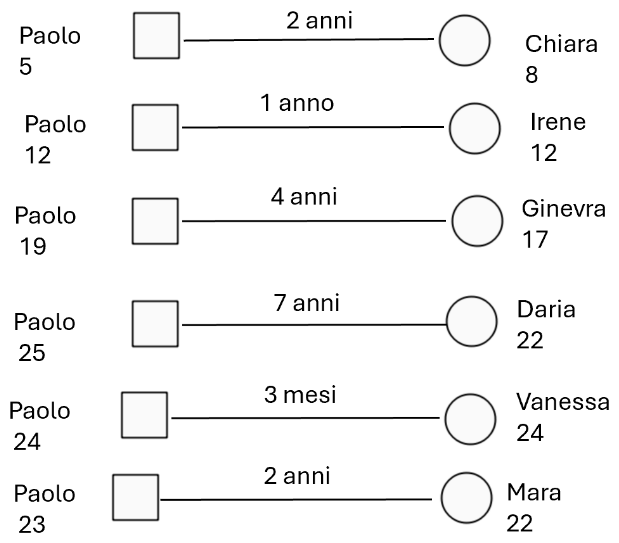
The graphic representation is another element to be considered in enriching the process of hypothesizing and re-signification. We do not, however, intend to make a symbolic interpretation of the drawing or of the spaces used; rather, we want to make sense of the choices made by the person presenting their Duogramma®. Asking oneself, for example, about the meaning of having indicated one partner first rather than another, or of having chosen to place one relationship at a distance from the others, can make it possible to recognize new values and meanings in these relationships. This is not a matter of the therapist’s interpretation or explanation: it will always be the narrator, prompted by the person conducting the work, who chooses what meaning to attribute to the graphic component.
The Duogramma® also differs from the genogram in another important respect: whereas the latter highlights blood ties, unions, lines of descent and the people who make up the family system to which each of us belongs by birth, the former confronts the individual with responsibility for their choices. While it is true that we do not choose whose children we are, we do choose whom we decide to form a couple with. The narration and graphic representation of romantic vicissitudes highlight, sometimes with striking transparency, the motivations and consequences of the decisions that determined the succession or absence of partners in our lives, the kind of person we wanted to have by our side, whom we left, whom we rejected and why we did not want them. The power of this methodology also lies in this capacity to shed light on individual responsibility and on the fact that one’s entire relational life is the outcome of individual choices that each person must face.
We consider both the Duogramma® and the genogram to be much more than two simple investigative techniques: they are two reflexive, highly complex methodologies designed to bring prejudices to the surface and to highlight roles and positions in relational systems. Couple situations in one case, family situations in the other. In conclusion, like the genogram, the Duogramma® does not aim to capture the objective reality of the couple system, but to analyse a narrative process in constant evolution. As an essentially interactive and dialogical tool, the Duogramma® generates ever-new narratives depending on the context, the developmental moment and the therapeutic relationship in which it is co-constructed.
The Duogramma® in individual therapy
Within this ethical and methodological framework, let us now see how a Duogramma® is carried out in practice in individual psychotherapy, where it presents itself as a structured method, characterized by a defined setting, dedicated time and a specific graphic representation. The whole process built up through this work is aimed at stimulating reflection on premises and prejudices, on role attributions and on the personal theories that shape the idea of love and of life as a couple.
Introducing the Duogramma® into the clinical process reflects a precise clinical choice, not a casual act on the therapist’s part: proposing it in session means inviting the patient to reread their own relational history from a new perspective, grounded in meticulous work that requires time, care and intense mutual collaboration. The success of the work and its effectiveness depend to a large extent on the therapist’s ability to judge the best clinical timing for using it, on their specific technical preparation in the method and on the solidity of the therapeutic bond. The Duogramma® is an integral part of the therapy; it only makes sense within the therapeutic process in which it takes shape, it is influenced by that process and, in turn, influences it. The reason for proposing it is related to the request for help that has been brought, to the themes of the therapy and to the prevailing emotional context.
It is important to specify that, although it focuses on couple bonds, this tool is not used only in situations where the person has difficulties in this area of life or in a specific relationship. Its strength also lies in its versatility: it proves very useful for widening the view of aspects of personal experience that sometimes seem inexplicable and unchangeable, opening up a broader perspective on the contexts in which events occur. The relational rereading of a symptom picture can also gain new impetus when it is observed as it exists, emerges, changes or disappears within one or more couple relationships over time. Difficulties such as anxiety, panic attacks and depressive periods can manifest themselves in different ways over the course of a life, and this evolution can also be addressed in connection with experiences of couple relationships. It may happen, in fact, that with a certain partner a problem never appears, whereas with others it does, or in different ways. Likewise, major differences in symptoms may emerge in periods when, for example, the person has no affective relationship, or would like one but cannot manage to make it happen. Connecting contexts and reading a symptom in terms of relational meanings, in its development over time, can offer the therapist new options and new interpretive keys and open the way to change.
Choosing the right moment to use the Duogramma® requires the assessment of several interconnected factors. First of all, temporal continuity must be considered: since its application often requires more than one meeting, it is advisable to avoid starting it close to summer breaks, business trips or interruptions in clinical activity, so as not to run the risk of leaving it unfinished. Likewise, it is essential to keep track of current events in the patient’s life: if the person is going through a moment of acute emotional urgency, devoting several sessions to the Duogramma® may be perceived as inappropriate or as a lack of attention to the needs they have expressed.
The time needed to construct a Duogramma® depends on the time the patient needs to tell all the stories they wish to tell; it is not set in advance and cannot be predicted: one therapy session may be enough, or three may be needed; it lasts as long as there are stories to tell and questions to ask. When planning to propose a Duogramma®, therapists are also called upon to reflect on their own emotional positioning, assessing their personal life moment and the inner resonances that the themes raised by the tool might activate, in order to ensure the competence and mastery required to manage the relationship.
The Duogramma® is never imposed; it is an open proposal that is assessed jointly, within the relationship. Once the meaning of the intervention the therapist intends to propose has been explained, it is essential to devote adequate space to exploring the patient’s doubts, fears and hesitations. Even in the face of immediate and enthusiastic acceptance, it is essential to explore the patient’s motivations and expectations in depth. Proposing a methodology is, in fact, a communicative act in itself: both acceptance and any refusal of the work offer important information for the therapy and for the therapeutic relationship, which should be brought back into the space of the conversation. The clinician’s aim is not to persuade the other to accept the proposal, but to create a shared context of meanings in which to work as well as possible. The therapist’s proposal should be read as metacommunication, which generates important feedback regardless of the outcome.
In the course of a clinical process, there is no absolutely right moment to propose a Duogramma®; we have deliberately not built a rigid protocol stating when it would be best to introduce it. This choice stems from the therapist’s sensitivity and emerges from the therapeutic context, in a way that is unique to each therapy. Each therapeutic relationship develops in its own particular and unpredictable way, making any overly rigid rule inapplicable. During the Duogramma® training we run, colleagues often ask whether it would be better to propose this tool at the beginning of the work or after a large number of meetings. Only the therapist, provided they are adequately trained, can assess the motivations, the meaning and the most appropriate moment for each specific context. The only fundamental recommendation we believe it is useful to emphasize in this regard is to avoid proposing it in the very early stages of the process: this is because the Duogramma® was not conceived as a tool for taking a history or as a simple getting-to-know-you interview, and using it in the first stages of therapy could lead the therapist to risk employing it in that way. On the contrary, reserving appropriate space for it when one already has sufficient knowledge of the person and their history makes it possible to propose it with deep meaning, ensuring its maximum effectiveness and fully developing its clinical potential.
When therapists propose the Duogramma®, they should do so with confidence and conviction, showing full readiness to clarify the person’s doubts and questions. Introducing such a complex methodology should never be a fallback in the face of an impasse, a lack of things to talk about or a simple practical expedient intended to revive the session or the therapy, but rather a conscious clinical choice.
Once the proposal has been made and it has been agreed to enter together into the account of the stories of couple relationships, the therapist carefully explains the details of the procedure, starting from the following instruction: “Tell me about your couple relationships, from when you were a child until today, including the ones you desired that did not happen, and the ones you turned down. Draw them on the sheet, one at a time, in whatever order you prefer”, and specifies that drawing and narrating proceed one relationship at a time. In structuring the work of graphic representation and narration, not all the relationships are drawn straight away; moving on to the next relationship will happen only after the narration of the previous one has been completed, when the therapist has no more questions to ask and the patient has nothing more to add. The therapist makes sure that the instruction has been clearly understood, repeating it several times if necessary; sets out the basic rules of graphic representation to be followed: the use of symbols, of the sheet and of space; the use of time and the phases of the process. The therapist hands over the sheet on which the stories will be represented, making sure to be able to follow the drawing closely as it develops.
The patient chooses the order in which to represent their story; the therapist listens and guides the account through questions, because questions are never neutral but define the semantic field of the answer (Canetti, 1981), and may implicitly suggest what should or should not be explored further, what is right or wrong.
The therapeutic aim is to generate transformations in narrative plots, making them more flexible and open to change (Sluzki, 1991). In this sense, questions introduce perturbations that open the way to discovery and to the new (Fruggeri, 2020). Each question conveys a precise intention (Tomm, 1988) and exercises power over the other’s narration, over the story the other will decide to silence or to tell.
The therapist encourages the narration by exploring events, emotions, details of the couple’s life, desires, fantasies and resources; addresses sexuality, conflict and relationships with families of origin and with partners; investigates financial matters and any other relevant aspect, guided by creativity and curiosity (Cecchin, 1987). Through questions, the therapist compares the stories over time, to bring out differences, similarities, recurring patterns, established habits or unthought-of novelties, all with the aim of opening new scenarios of meaning and changing the self-narrative.
In this process, not asking also has a profound impact: an omission may signal fear, shyness, disapproval or the wish to avoid complex subjects. For the patient, not being asked certain questions can also translate into feeling misunderstood, judged or regarded as fragile. Every choice, whether expressed or left unspoken, acquires a precise meaning in the therapeutic relationship, shaping the construction of a shared narrative, the fruit of the encounter between two people, between life stories and cultures.
Given the processual nature of the Duogramma®, it is essential to remember that it can only come to life in the encounter between patient and therapist: it is not possible to draw a sequence of relationships on a sheet at home and then talk about it in session. For this reason, if completing it requires more than one session, the sheet will stay with the therapist between one meeting and the next, and the narration will resume from the point where it was interrupted the previous time.
Once the narrative phase and the exploration of relational experiences have been completed, work with the Duogramma® continues with a fundamental space devoted to shared reflection, which focuses on analysing the ideas and prejudices that emerged in the account and that shape the view of the couple: from the meanings attributed to gender roles to ideas about ties with families of origin; the management of power and money; rules about fidelity, sexuality, parenthood and life plans. The therapist leads and stimulates this phase, highlighting recurrences, developmental leaps and differences over time, and offering the patient new lenses through which to reread the choices, renunciations and dynamics that have emerged. A diachronic view of the development of these ideas is crucial, within a narrative view of therapy, for deconstructing convictions and taboos, being able to see oneself with new eyes and activating resources for the future (White & Epston, 1992).
The process ends by giving the floor back to the patient who told the stories, for a meta-reflection on their own experience during the construction of the Duogramma®: the emotions it aroused, the new thoughts it set in motion and the expectations that were confirmed or disappointed. All these elements become precious clinical material to be brought back into circulation in the therapeutic setting as the clinical work continues.
Integrated into the process of individual therapy, the Duogramma® acts as a powerful tool for openness and reflexivity. The large amount of information that emerges continues to generate, even after the work has ended, possibilities for finding meaning far beyond the moment when the method is conducted. In clinical practice, this methodology is surprising in its capacity to bring to the surface entirely new experiences and relational knots, even with patients who have been in therapy for quite some time, precisely thanks to a rigorous methodological and graphic structure that defines a protected, non-judgemental and authentically relational listening frame.
About Barbara’s Duogramma®
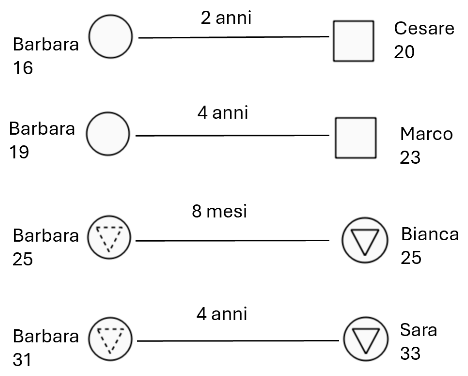
As an example, we present the representation of, and some reflections on, the Duogramma® of Barbara (a pseudonym), a young woman in individual therapy. The Duogramma® was proposed to her at an advanced stage of therapy, with the aim of exploring and rereading the difficulties she had raised in her relationship with Sara, also in the light of earlier stories. The proposal to do this work arose from the need to widen the view of certain attitudes she adopted in the relationship, which she herself perceived as repetitive with respect to previous bonds; at the same time, she recognized aspects of great novelty in her way of being in a couple, to which she could not give meaning. The therapist therefore judged that the Duogramma® could be the right tool for rereading the past of her relationships in the light of the present and, at the same time, for finding new ways of being in a couple today through reflection on the experiences already lived. Constructing and narrating the work took three therapy sessions; the drawing (reproduced here in digital format, but faithful to the original) highlights some interesting aspects of the use of the graphic rules, which formed part of the reflections presented and contributed to the formulation of hypotheses and new readings.
It is clear how, thanks to the possibility of using inclusive symbols, the narrator can choose how to define themselves over time, showing or not showing their sexual orientation and gender identity. This provides useful elements for reflection for the clinician, but also for the person themselves, who can observe, in black and white, the evolution of their way of being in a couple and give meaning to what appears on paper. In Barbara’s case, having represented herself differently in the drawing (first as a woman and later as a bisexual woman) brought to light a profound change with respect to the idea that a relationship should necessarily be heterosexual; this change in her personal outlook helped to highlight similarities and differences between the relationships before and after, making it possible for new meanings to emerge regarding the role she plays in the couple and to bring out the rules of the relationship that matter to her today.
Another aspect explored in this particular case, and one that the graphic representation (Fig. 2) made immediately evident, concerns the absence of relationships before the age of 16. The therapist explored this in depth, not to discover a reality different from the one shown by the drawing, but to understand the meaning of the choice that had been made. In the Duogramma®, it is in fact important to understand on the basis of which relational premise the person chooses what to say or leave out: everyone has the right to include in their Duogramma® the relationships they consider relevant; the person conducting the work must in no way judge or force this choice, but it is useful information for understanding what the person considers essential to define the idea of a couple, or what they think is relevant for talking or not talking about a relationship (its duration? How it ended? The signing of a contract? The presence of children?). Barbara chose to speak only of relationships in which there had been an explicit agreement about being together, about being a couple, about having something exclusive. Understanding this point, so important to her, opened up many reflections on her current relationship with Sara.
The graphic representation is therefore a powerful element of the Duogramma®, and for this reason it is essential for us that the rules defined by the method be respected. However, it certainly does not exhaust the complexity of this methodology, which is completed by a rich and fruitful phase of analysis and hypothesizing.
Conclusions
Introducing the Duogramma® into individual psychotherapy reflects the wish to equip clinical practice with a tool that is rigorous, inclusive and open to today’s ever more fluid and complex relational geometries. The Duogramma® offers an innovative lens on the individual’s affective vicissitudes, attributing equal dignity to all couple experiences: from childhood crushes to marital, and non-marital, bonds in adult life; from one-night relationships to stories that were only desired and those that were rejected; from non-monogamous to same-sex relationships. All stories find a place in the account and all have the right to exist as choices made by the person.
The transformative scope of this method lies in the conversational and dialogical process it activates in the here and now of the therapeutic encounter. Through an objective instruction, a specific graphic representation, a way of conducting the work that is attentive to the verbal and non-verbal aspects of language, and the professional’s theoretical positioning, the Duogramma® makes it possible to deconstruct the rigid premises, taboos and prejudices that the patient has internalized about gender roles, sexuality, power, money, fidelity and, more generally, the very idea of the couple bond.
Used in psychotherapy, supported by a solid therapeutic alliance and within a space free from judgement, the Duogramma® proves to be a resource of extraordinary effectiveness, making it possible to bring to the surface emotional knots and new experiences, and to generate new meanings, connections and possibilities for development. The Duogramma® sets in motion a reflexive process whose beneficial effect extends far beyond the moment when the technique is actually carried out, giving the patient back the freedom to rewrite their own story and to imagine future scenarios oriented towards greater well-being and change.
Complexe Systémique: key points
The Duogramma® transposes to the couple what the genogram does for the family, but along the horizontal axis of a single life, and with a strong idea: relationships that were desired, dreamed of or rejected weigh as much as those actually lived in shaping our premises about the couple. For systemic practice, its interest is twofold. In training, it is a tool for work on the person of the therapist, in the line of Cecchin’s “prejudices”: identifying one’s own ideas about fidelity, gender or money before they become norms imposed on clients. In session, a simple instruction and strict graphic rules (circles, squares, inclusive symbols, nothing else) create a frame that protects the narrative, and the question “what counts as a couple for you?” itself becomes clinical material. The limits are those of a presentation paper: no systematic evaluation, effectiveness vouched for by the authors’ own experience, and use governed by a registered trademark and specific training. Work in couple therapy, with each partner telling their story in front of the other, calls for particular attention to the safety of the frame. Read alongside the article on the genogram as a systemic tool, and the tribute to Gianfranco Cecchin and systemic prejudices.
Notes from the original
Conflict of interest. Nothing to declare.
Authors’ contributions. Substantial scientific and intellectual contributions to the study: Arcelloni, T.; Ferrero, G. Conception and design: Arcelloni, T.; Ferrero, G. Data analysis and interpretation: Arcelloni, T.; Ferrero, G. Final approval: Arcelloni, T.; Ferrero, G.
Data availability statement. Not applicable.
Funding. Not applicable.
Statement on the use of artificial intelligence tools. The artificial intelligence tools Gemini and ChatGPT were used to a limited extent to support grammatical revision of the text and the initial identification of relevant bibliographic references. All suggested sources were checked and critically analysed by the authors. The final content and the wording of the manuscript are the responsibility of the authors.
Acknowledgements. Sincere thanks to Ana Cristina Barros Fróes for her ever-warm support and her exceptional professional competence. Her careful reading, rigorous revision and contributions were fundamental to improving this article. We express our deep gratitude for the way she has always valued the Duogramma® and our work, offering invaluable technical and human support. Thanks to Daniela Bertoncello, who generously made her professional competence and her time available to us for reading and refining the text. Many thanks also to the translator Isa Carvalho for her precise, competent and reliable work. The collaboration of Ana Cristina and Daniela, as psychotherapists, offers an additional guarantee of appropriateness from the clinical point of view and in terms of systemic terminology. Finally, we thank all our Brazilian colleagues for the warm welcome they have given our Duogramma®.
References
Anderson, H. (1997). Conversation, language, and possibilities: a postmodern approach to psychotherapy. Basic Books.
Andolfi, M. (1995). La formazione come processo di crescita personale del terapeuta. Ecologia della Mente, 18(1), 15-28.
Arcelloni, T., & Ferrero, G. (2008). Il duogramma nella formazione sistemica. I terapeuti e le loro relazioni di coppia. Terapia Familiare, 87, 5-27.
Arcelloni, T., & Ferrero, G. (2009). El duograma en la formación sistémica. Los terapeutas y sus relaciones de pareja. Psicoperspectivas, 8(1), 195-230. https://doi.org/10.5027/psicoperspectivas-Vol8-Issue1-fulltext-76
Arcelloni, T., & Ferrero, G. (2023). O duograma – o terapeuta nos casais da sua vida. In D. D. Damo & L. Vinagre (Orgs.), O self do terapeuta: a cartografia dos tesouros escondidos no terapeuta (pp. 165-192). Artesã.
Arcelloni, T., & Rosas, H. R. (2024). Psicoterapia sistêmica de casal: mesmo enfoque, diferentes perspectivas clínicas. Artesã.
Bateson, G. (1976). Verso un’ecologia della mente (G. Longo, Trad.). Adelphi.
Boscolo, L., & Bertrando, P. (1993). I tempi del tempo: una prospettiva sistemica alla complessità clinica. Raffaello Cortina.
Bowen, M. (1972). On the differentiation of self. In J. L. Framo (Orgs.), Family therapy in clinical practice (pp. 111-173). Jason Aronson.
Bruner, J. (1992). La ricerca del significato (C. M. Galimberti, Trad.). Bollati Boringhieri.
Byng-Hall, J. (1985). The family script: a useful bridge between theory and practice. Journal of Family Therapy, 7(3), 301-305. https://doi.org/10.1111/j.1467-6427.1985.00688.x
Canetti, E. (1981). Massa e potere (F. Jesi, Trad.). Adelphi.
Cecchin, G. (1987). Hypothesizing, circularity, and neutrality revisited: an invitation to curiosity. Family Process, 26(4), 405-413. https://doi.org/10.1111/j.1545-5300.1987.00405.x
Cecchin, G., Lane, G., & Ray, W. A. (1994). From prejudice to theory: reflections on therapist’s stances. Systemic Practice and Action Research, 7(6), 667-675.
Cecchin, G., Lane, G., & Ray, W. A. (1997). Verità e pregiudizio: un’epistemologia per la clinica. Raffaello Cortina.
Danure, I., & Borcsa, M. (A cura di). (2022). Il genogramma nella pratica sistemica contemporanea. FrancoAngeli.
Formenti, L. (1995). Pianeti invisibili: formazione e ricerca sistemica. Raffaello Cortina.
Fruggeri, L. (2020). Politiche della quotidianità: relazioni e processi nei contesti familiari. Unicopli.
Gergen, K. J. (1994). Realities and relationships: soundings in social construction. Harvard University Press.
Gómez Lamont, M. F., & Bermúdez, J. M. (2023). La terapia familiar sistémica y el pensamiento de tercer orden. Editorial LEED.
Liccione, D. (2023). Identità e orientamenti sessuali: elementi di lavoro clinico affermativo. Bollati Boringhieri.
Liddle, H. A., Breunlin, D. C., & Schwartz, R. C. (Orgs.). (1988). Handbook of family therapy training and supervision. Guilford Press.
Lieberman, S. (1979). Transgenerational family therapy. Croom Helm.
Lomelí Aquino, E. (2025). Terapia sistémica relacional no monógama: parejas, triejas y polículas. Fundación Vivir en Armonía.
McGoldrick, M., & Gerson, R. (1985). Genograms in family assessment. W. W. Norton & Company.
McNamee, S., & Gergen, K. J. (A cura di). (1998). La terapia come costruzione sociale (M. Castiglioni, Trad.). FrancoAngeli.
Schön, D. A. (1993). Il professionista riflessivo: per una nuova epistemologia della pratica professionale (A. Barbanente, Trad.). Dedalo.
Sluzki, C. E. (1991). Trasformazioni narrative: processi di consulenza e terapia di famiglia. Terapia Familiare, 37, 5-18.
Sorrentino, A. M. (1995). Figli disabili. Raffaello Cortina.
Tomm, K. (1988). Interventive interviewing: part III. Intending to ask lineal, circular, strategic, or reflexive questions? Family Process, 27(1), 1-15. https://doi.org/10.1111/j.1545-5300.1988.00001.x
Vassallo, B. (2022). Per una rivoluzione degli affetti: pensiero monogamo e terrore poliamoroso. Edizioni Humus.
Walsh, F. (Org.). (1993). Normal family processes (2nd ed.). Guilford.
White, M., & Epston, D. (1992). Mezzi narrativi per fini terapeutici (M. A. Ferretti, Trad.). Astrolabio.
Unofficial English translation of O Duogramma®: Uma metodologia inovadora para a psicoterapia, by Teresa Arcelloni and Gloria Ferrero, Revista Brasileira de Terapia Familiar, vol. 14, no. e1326 (2026), doi: 10.60114/rbtf.v14.173, under a CC BY 4.0 licence. Translation (with the help of artificial intelligence) and layout: Complexe Systémique, November 2026 — the work has been modified under the terms of the licence (figure captions translated). Neither the authors nor the journal are responsible for this translation; the original version prevails.
Unofficial English translation of “O Duogramma®: Uma metodologia inovadora para a psicoterapia”, published in Revista Brasileira de Terapia Familiar (2026) under a CC BY 4.0 licence. Made by Complexe Systémique with the help of artificial intelligence, it does not come from the authors or the journal, who are not responsible for its content; the original version prevails.
Read the original articleHow to cite this article
Arcelloni, T., et Ferrero, G. (2026). The Duogramma®: An innovative methodology for psychotherapy (Complexe Systémique, Trans.). Complexe Systémique. https://app.complexe-systemique.com/en_GB/articles/the-duogramma-an-innovative-methodology-for-psychotherapy (Original work published in 2026 in Revista Brasileira de Terapia Familiar, v. 14, n. e1326 (2026); republished in 2026 by Revista Brasileira de Terapia Familiar, https://revbrasterapiafamiliar.abratef.org.br/revista/article/view/173)
To go further
- What you need to know about the genogram, a systemic toolThe basic tool for families.
- Tribute to the master Gianfranco Cecchin: systemic prejudicesQuestioning one’s own prejudices.
- Working with the person of the therapistWorking on oneself to care better.
Related training courses
 Short course
Extramarital affairs in couple therapy: from crisis to forgiveness
One-day online training with Julien Besse: reading the crisis triggered by an extramarital affair, positioning oneself as a couple therapist, rebuilding trust and working on forgiveness up to the repair ritual. Delivered in French.
 Symposium
État des Lieux: a psychological approach to spaces
Replay of the “État des Lieux” conference (Paris, 16 October 2026): Ivy Daure, Maurizio Frisina, Viola Sallay and Gilbert Pregno on places as a clinical resource. In French.
 Webinar
Extramarital affairs: what does the therapist do when the couple explodes?
Replay of the free webinar of 5 November 2026: how to position yourself as a systemic therapist in the crisis of the extramarital affair. Revelation, secrecy, multipartiality.
 Webinar
The three loves
Replay of the free webinar with Dr Robert Neuburger of 1 October 2026: the three loves, attachment and ways of loving. Held in French.
Related articles
 Blog
Challenging in therapy: What a patient taught me
A couples therapy session led me to reflect on confrontation, authenticity and resonance: how to address difficult behaviour without invalidating the person.
 Blog
Adult ADHD: when forgetting turns into a misunderstanding
Forgetting, compensating, tension in the couple: a systemic look at adult ADHD, to understand what is at stake and to look for more fitting forms of support.
 Scientific
Sickle Cell Disease and Young Couples: Understanding the Influence of Shared and Individual Meaning on Couples’ Experience of Illness
Nine young adult couples facing sickle cell disease: how each partner makes sense of the illness, and how the couple moves from caregiving to equality from one crisis to the next.
 Scientific
Decolonizing Supervision: A Critical Race and Queer Theory Framework for Marriage and Family Therapy
Supervision is not neutral: a framework drawing on Critical Race Theory and Queer Theory to name and share power in supervision, with a vignette.
Comments 0
Log in to join the discussion. Log in