Journal of Family Violence · Violence
Children who Cause Harm Are People Too: A Participatory Action Research Project To Understand Families help-seeking for child-to-parent Violence, and the (un)helpful Responses
What happens when a family asks for help because a child, overwhelmed by their impulses, harms their parents? In the north-east of England, Nikki Rutter’s team ran a participatory action research project with twelve parents and eight children. Requests begin early, as soon as sleep problems appear. The responses judge, pass families from one service to another and let the situation escalate, until foster care or youth justice.
This is a reformatted republication of Children who Cause Harm Are People Too: A Participatory Action Research Project To Understand Families help-seeking for child-to-parent Violence, and the (un)helpful Responses, by Nikki Rutter, Donna Garvey, Kelly Hetherington and Lihan Miao, published in Journal of Family Violence (Springer) (2025), doi: 10.1007/s10896-025-00952-8, under a CC BY 4.0 licence. Prepared by Complexe Systémique in September 2026: the authors’ text is unchanged; the layout has been adapted for reading online, which constitutes a modification of the work under the terms of the licence. Tables are presented as lists. This edition was made neither by the authors nor by the publisher, who are not responsible for its content or for any errors. The original version prevails.
Systems around the family should be responsive to parents’ help-seeking, supporting the parents so they can support their child.
Nikki Rutter, Donna Garvey, Kelly Hetherington and Lihan Miao
Abstract
Introduction. The purpose of this research was to work directly with children instigating child and adolescent to parent violence and abuse due to explosive and harmful impulsive, and parents experiencing such harms, to understand their help-seeking practices and experiences.
Methods. This work was a participatory action research project in which parents of children experiencing harm from their children, and children instigating these harms, were involved in separate semi-structured interviews and creative workshops. Children and parents analyzed their own workshop data, which was mapped onto critical incident chronologies and a socio-ecological map and the two analyzes were merged by the research assistant.
Results. Children want to feel a sense of belonging within their families but internalize the wider harmful narratives about themselves; children view parents as the most important people to help them navigate their harmful impulses. Parents also explained wider formal systems of support assumed parents should be expected to meet all support needs of their children. This was the case even when their children’s needs are significantly higher than children of the same chronological age due to trauma or neurodivergence.
Conclusions. Systems around the family should be responsive to parents’ help-seeking, supporting the parents so they can support their child. Parents and children demonstrated a variety of varied experiences from the same services, thus blanket approaches cannot be applied and should be led by an assessment of the whole family context including other children, wider family support, educational challenges
Keywords: Child or adolescent to parent violence and abuse, Socio-ecological model, Participatory action research, Critical incident chronologies, Filial harm
Introduction
‘The family’ is often considered a unit distinct from other social institutions. There are pervasive narratives that the nuclear family is ‘natural’ and should be upheld as a necessary entity, as though it were static, despite it being socially constructed and evolving (Bourdieu, 1996; Dermott & Fowler, 2020). However, parent-child relationships, the family, and the idea that ‘parents’ (i.e. those adults who have caring responsibility for a particular child) are expected to reproduce social norms and values, is complicated, as parents are rarely supported by wider social institutions, which have also been socially constructed to reproduce social norms (Dermott & Fowler, 2020). Thus, when individuals perform in a way which deviates from such norms, the family is often blamed; something must be wrong, they must be doing something wrong; narratives which can be interpreted as defining parents as ‘bad’. This narrative impacts mothers most significantly (O’Reilly, 2021). How the family reproduces social norms has been explored and interpreted utilizing several different theoretical frameworks including: social learning theory (Bandura, 1977); coercion theory (Patterson, 2016); choice theory (Glasser, 1999); attachment theory (Bowlby, 1969) and family systems theory (Bowen, 1966).
The complexity of family interactions has been raised in reviews of child and adolescent-to-parent violence and abuse (CAPVA) research, as issues such as intent, harm, and power relations are contentious and do not fit existing frameworks of family violence (Toole-Anstey et al., 2023). Family systems theory, in its simplest form, is a good example of the complexity of child-parent interactions. It recognizes that families are systems which constantly interact with the purpose of reducing anxiety to improve health (Bowen, 1966). As an interactive system, when one individual within the family is experiencing anxiety or distress, this impacts all members of the family who will attempt to promote family harmony (Bowen, 1966). These distressed behaviors can occur because a child or young person has experienced something negative, or overwhelmingly positive, and they are unable to regulate themselves and their emotions (Fonseca, 2021). Thus, cases of CAPVA may not require a criminological or criminal justice response, but rather there should be “consideration as to psychosocial factors, age, intent and needs of the family and child should form an essential part of decision making for interventions” (Toole-Anstey et al., 2023, p. 1161). However, the child, and the family system does not exist in isolation, and socio-ecological approaches appear to be the most popular in understanding protective factors and vulnerabilities in CAPVA research (Baker et al., 2025; Baker & Bonnick, 2021; Toole-Anstey et al., 2023).
Explosive and Harmful Impulses
As highlighted by Thorley and Coates (2017, p.4) CAPVA should be contextualized “to individual circumstance and recognise not all CAPVA is intentional. It is argued that current definitions are not fit for purpose when trying to support families living with [CAPVA]”. Indeed, much CAPVA research has highlighted that CAPVA is frequently non-intentional, but rather maladaptive ways children are attempting to meet their needs (Coogan, 2017; Thorley & Coates, 2017; Rutter, 2024). Indeed, most human behavior can be assessed as unconscious practices in which individuals respond without engaging in conscious (intentional) thinking (Bargh & Morsella, 2008). Thus, most behavior is non-intentional. When it comes to meeting one’s needs, reviews have found that unconscious goal direction is as successful as conscious goal directions (Bargh, 2013; Bargh & Morsella, 2008; Hassin & Sklar, 2014). For instance, many experienced drivers will find they arrive at their intended location without recalling how they got there; the task was unconscious but achieved the desired outcome (Bargh & Morsella, 2008).
Despite this, when it comes to causing harm within the family, when children are harming their parents through so-called CAPVA it is too frequently defined as “Any act of a child intended to cause verbal, physical, emotional or financial damage to gain power and control over a parent” (Cottrell, 2001: np, emphasis added). Nevertheless, very few actions within human behavior are able to meet the criteria of ‘intended’, and this is most true in children (Bargh & Morsella, 2008). Instead, most people learn about themselves, adapt their behavior, and develop a sense of identity through reflection of their unintended actions, rather than thinking them through beforehand (Bargh, 2013; Bargh & Morsella, 2008; Hassin & Sklar, 2014). A challenge in CAPVA research is that ‘instrumental’ and intentional forms of harm have been argued to be the only forms of CAPVA that should be considered in this form of research (Navas-Martínez & Cano-Lozano, 2022). Nevertheless, maladaptive attempts by children to meet their own needs has been identified in a systematic review as a key feature of CAPVA (Toole-Anstey et al., 2023). The same review critiqued studies which frame all forms of CAPVA as an intentional form of harm, stating this fails to recognise the complexity of family relationships, with children often experiencing shame and regret after incidents (Arias-Rivera et al., 2025). Explosive and harmful impulses have been named as the subsection of CAPVA which do not require intent from the child or young person (Rutter, 2024). Instead, harmful impulses relate to the maladaptive ways children and young people may attempt to meet their needs in harmful ways; thus, they are goal-directed behaviors which do not require conscious consideration or intent. As children and young people attempt to meet their own needs in maladaptive ways, their parents are harmed as an unintended consequence, rather than through intentional abuse (Rutter, 2024). For the remainder of this paper, the term ‘harmful impulses’ will be used to capture all forms of explosive and harmful impulses experienced by children and their parents, with the recognition that engaging in such harmful behavior is also harmful to children themselves and sits contrary to their developmental needs (Rutter, 2024).
Help-seeking
When families seek support and/or help for the harm caused by their child(ren), they often experience judgement and shame from the services they seek support from (Holt, 2023; McGinnis, 2024; Toole-Anstey et al., 2024; Williams et al., 2017). Furthermore, families are often told to contact the police when incidents of harm escalate, which create further barriers to help-seeking as parents are worried about the implications of criminalizing their child (Condry & Miles, 2014; Holt, 2023). Thus, when families seek support for the harm instigated by their child, these routes to support are often viewed as harmful and there are little to no opportunities for early intervention and support from formal support services (Mills et al., 2023; Rutter, 2025; Toole-Anstey et al., 2024). The aim of this paper is to outline the pathways to support parents and children attempted, underlining the potential for new, appropriate, and non-harmful pathways to support for parents and children living with children’s harmful impulses, based on the perspectives of families living with this harmful phenomenon. Previous research into responses to CAPVA has identified the barriers to accessing, or lack of, appropriate support pathways, with families keen to avoid police involvement (Condry & Miles, 2014; Holt & Lewis, 2021).
Methodology
This project was a participatory action research project (Kong et al., 2020), and an early component of what we expect will be a ten-year study. As a participatory action research project, those with lived experience of harmful impulses were involved with the design, data generation, analysis of the project, and write-up of this paper. Thus, this work enabled a deeper, more reflective understanding of the complexities of family relationships, as those with lived experience have been able to critically engage with both the process, and the write up of this research. However, the emotional challenges associated with engaging in research with direct lived experience of the topic should not be understated, and this was an ethical consideration throughout the work. This work was designed with an interpretivist perspective, whereby what is known is dependent upon interpretations based upon the perspectives and variable realities of mothers and their children. Epistemologically, this work is feminist, following matricentric politics that mothering is a particular practice, with mothers and children facing specific oppressions under patriarchy (O’Reilly, 2021).
Recruitment
Two collaborative partners with expertise in involvement work were involved in the recruitment of co-researchers and facilitation of the methods: Investing in Children and Walworth Primary School. Walworth Primary School identified 12 parents who met recruitment criteria (were experiencing harm due to the harmful impulses of their child(ren)). Further details are provided in Table 1. 12 parent co-researchers were recruited (11 mothers, 2 fathers), two of the mothers were related, as mother and daughter but both had school-aged children experiencing harmful impulses. All parent co-researchers were asked if they were happy to have themselves named in any outputs, including academic publications and presentations. For those who did not respond, or requested anonymity, they have been provided with pseudonyms, which were chosen by the principal investigator (PI), Nikki, parents highlighted their parenting role within workshops, and this was considered an important aspect of their relationships, so has been included in Table 1.
Table 1 Eight child co-researchers aged 8-to-15 were recruited, (four girls, four boys) by Investing in Children
- Name · Role · Pseudonym · Data
- Shannon · Birth- Grandmother · Yes · Interview and three workshops
- Beth · Birth-Mother · Yes · Interview and three workshops
- Emma · Birth-Mother · No · Interview and four workshops
- Donna · Birth-Mother · No · Interview and four workshops
- Kelly · Birth-Mother · No · Interview and four workshops
- Abigail · Foster-Mother · Yes · Interview and one workshop
- Gary · Birth-Father · Yes · Interview and two workshops
- Keira · Birth-Mother · Yes · Interview and two workshops
- Lewis · Adoptive father · Yes · Interview
- Kim · Special Guardian · Yes · Interview and two workshops
- Sandra · Birth mother · Yes · Interview and one workshop
- Cassie · Birth mother · Yes · Interview and two workshops
Table 2 All children were provided with pseudonyms for the work, which they chose for themselves (Table 2)
- Name · Age · Sex · Diagnoses
- Lee · 12 · Male · Family trauma
- Elliot · 8 · Male · Autism
- Aaron · 9 · Male · Autism and ADHD
- Callum · 13 · Male · Autism and ADHD
- Annie · 14 · Female · None
- Sasha · 15 · Female · ADHD
- Phillipa · 14 · Female · Anxiety
- Chelsea · 8 · Female · Developmental disorder
Methods
This work is a participatory action research project, based in the north-east of England and consisted of several phases to ensure the participatory principles were embedded throughout.
Phase one
The initial research team engage in one-to-one semi-structured interviews with parents and children. In some cases, this involved both Nikki and research assistant, Lihan. Support workers for children, or their parents, were also able to attend the interviews to support the child if it was believed the child would benefit from this support by the referrer. At the interview stage, children were all interviewed in-person alone (1 child), with a parent (5 children) or with a children’s safeguarding practitioner (2 children). Parents were interviewed via phone or Microsoft Teams and interviews each took between 20 and 40 min.
Semi-structured interviews were framed as consultation meetings whereby we received informed consent or assent from those interested in being involved in the research and engaged with questions we felt worked with our participatory action research approach. Interviews have been widely utilized as a participatory action research method, as it allows co-researchers to explain their lived experiences in their own words (MacDonald, 2012).
These interviews explored three main features:
- Why the individual wanted to participate in the interview and their relevant histories.
- What support or accessibility needs the individual may have in attending participatory workshops.
- A plan to design the workshops and things that should be included.
By having these particular questions, we were able to understand co-researchers’ particular experiences and challenges, whilst also collaborating with them from the outset on what they felt the project should look like. Interviews were recorded, with consent. These interviews established any additional support, guidance, or tools needed by the parents and children in their respective workshops later in phase two. Similar co-design consultation meetings have worked well in previous CAPVA research with practitioners and agencies alongside parents and children when attempting to identify appropriate family support mechanisms (Kehoe et al., 2020).
Phase two
Workshops with children were hosted at Investing in Children’s center, a familiar location to most of the children. Each session was recorded via a Dictaphone. A youth worker, Nikki and Lihan facilitated the sessions. Each session had a thematic focus, increasing in depth and complexity. When children were unable to attend a workshop, a follow-up interview was offered to ensure they were provided with an opportunity to explore their experiences with support. Each individual session was covering the same thematic focus of the group session with session one exploring emotions and feelings; session two who helps in the family; session three who helps beyond the family; and session four the analysis session. Creative, visual methods and approaches were utilized, including drawing, writing, and building, as they are associated with allowing individuals to express vulnerability (Bradbury-Jones & Taylor, 2015; Frith & Harcourt, 2007). Arts-based workshops, using visual methods, meant the research was guided by the creative needs of the participants, as arts-based methods are ideally suited to research into family violence, particularly for children (Leitch, 2009; Westmarland & Bows, 2018).
Workshops with parents were held at Walworth Primary School, which was a familiar location to parents, and a Dictaphone was used to record sessions. A peer support worker, Nikki and Lihan facilitated the sessions, and a feminist collaborative autoethnography was utilized. Feminist collaborative autoethnography is an integrated autobiographic approach, in which co-researchers are able to explore their sociocultural situational milieu experiences– in this case CAPVA - through an analysis of their collective understanding (Rutter et al., 2023; Chang et al., 2013; Dyer et al., 2022). This means parents were able to utilize the feminist collaborative autoethnography to identify shared experiences, challenges, barriers, successes and failures at different social levels. The following three workshop sessions continued the use of this method but was guided by and with parents to identify key people, organizations, and support networks. Lihan conducted initial analyses between workshop sessions, so children and parents could be provided with any relevant updates at the start of each workshop.
Ethical considerations
As a participatory action research project, this work was reviewed by Durham University Department of Sociology separately across the separate stages, as the project progressed, and feedback was generated by those involved in the work. The Department of Sociology ethical review panel provided ethical approval for the project, number 2481. Each of the workshops were planned to include regular breaks, and activities which highlighted positive experiences as well as barriers. Although that was not the focus of this project, it minimized the psychological and emotional risks to both researcher and co-researcher wellbeing. Through utilizing support from the collaborative partners, co-researchers had access to support from the parent support advisor (parents), or a youth worker (children). The high number of adults-to-children in the child co-researcher workshops meant they could have one-to-one support where required, and staff from the children’s safeguarding team were available to support child co-researchers when required at both the recruitment and data generation phase.
In some cases, parent and child co-researchers were recruited together. This was navigated on a case-by-case basis, with one child initially consenting to involvement and then withdrawing consent, with their parent continuing to work on the project, and another where parent and child co-researcher were involved at every stage of their respective work. In the latter case there were no concerns raised regarding any increasing risks due to involvement in the work and this was assessed continuously.
Analysis
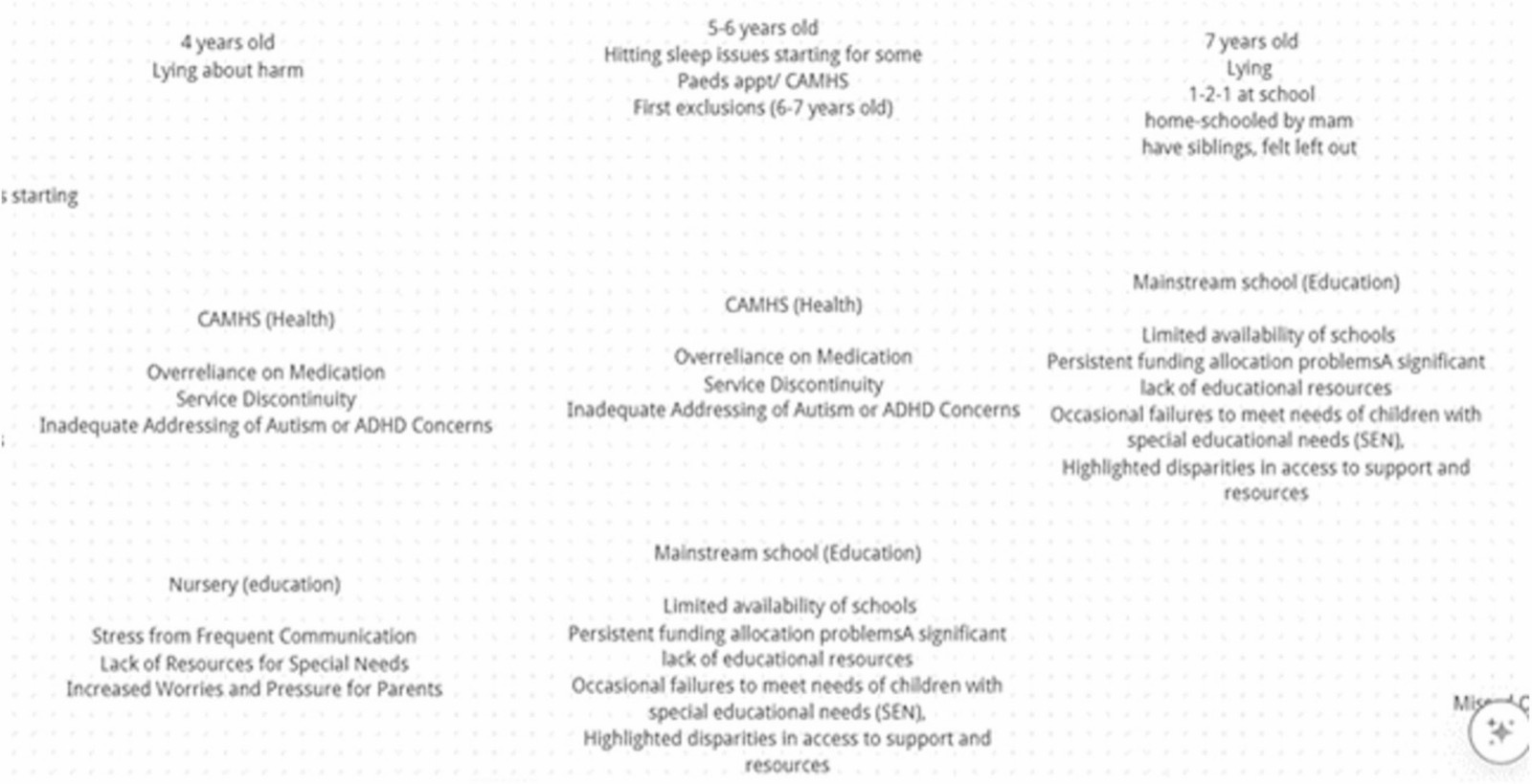
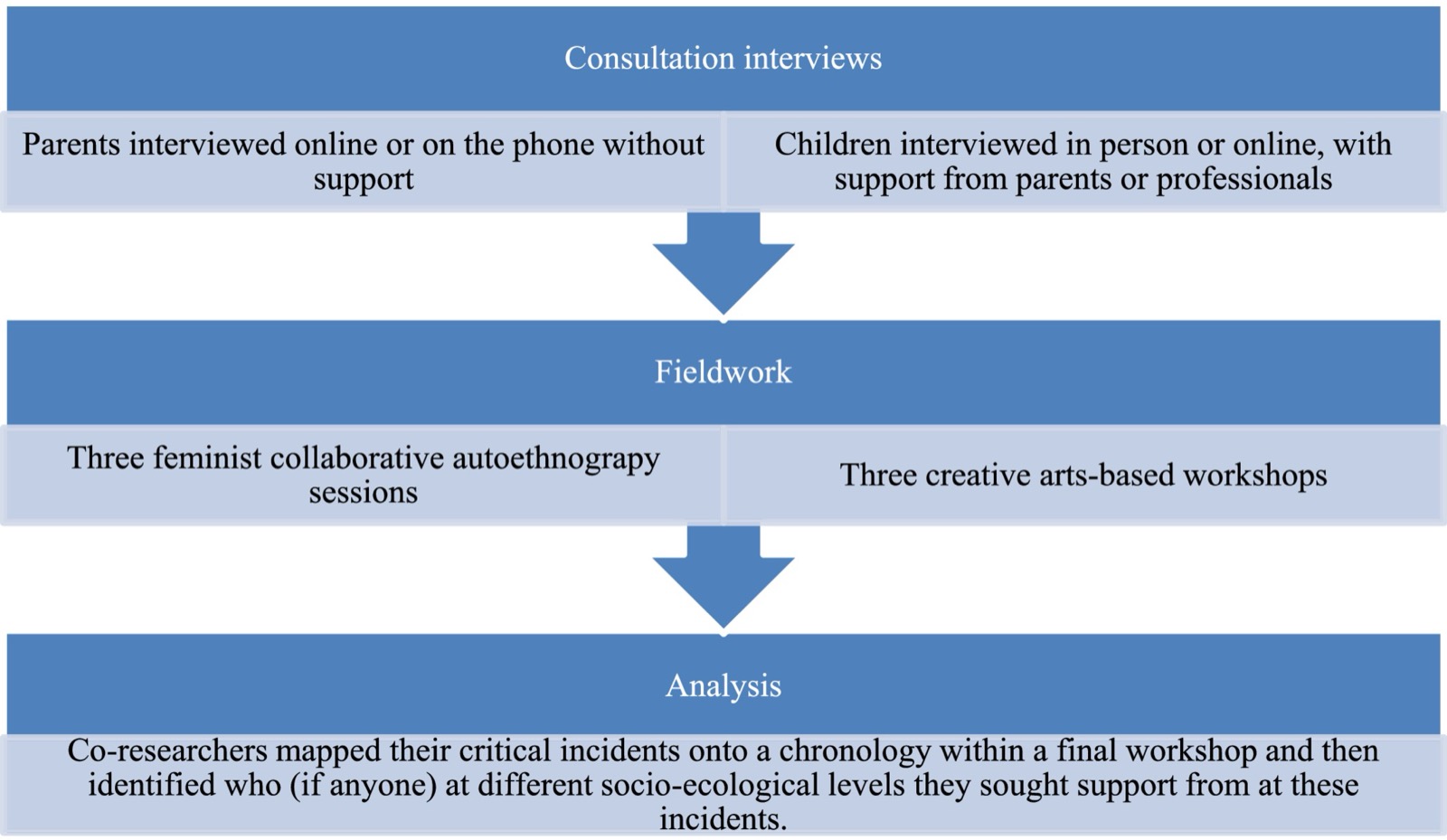
Analysis of the data was conducted within the final workshops, with and by children and parents, and then integrated by Lihan. As with many arts-based approaches, children and parents were able to analyze their work ‘in-action’ (Bradbury-Jones & Taylor, 2015). Through the respective workshops, parents and children analyzed the work mapping the child’s life story through ‘critical incidents’ where they had requested support. These critical incidents were then mapped onto a socio-ecological map, who they sought support from. The socio-ecological model is a systems theory which has been identified as a useful tool in recognizing both how individuals interact with their environment at different levels to create particular outcomes, and how these interactions could be understood to improve outcomes for the individual overall (Bronfenbrenner, 1977, 2000, 2013; Kilanowski, 2017). It is also frequently applied in CAPVA studies (Cottrell & Monk, 2004; Baker & Bonnick, 2021), and reviews of the CAPVA literature (Hong et al., 2012). Thus, the help-seeking practices of parents, and children, could be mapped onto different levels depending on the age of the child and the critical incident (Fig. 1). Figure 1 demonstrates how the different levels of the research processes interacted.
The final part of analysis exists within the write-up on this paper, where two of the four authors were co-researchers from the parent co-researcher component of this research, and they have engaged in reflective critique and analysis throughout the findings and discussion of this paper (Brookfield, 2017). This approach facilitated additional depth in the construction of this work.
Findings
The findings are presented across the socio-ecological levels (Bronfenbrenner, 1977, 2000, 2013), in line with the co-analysis. Of the four authors, two have lived experience of harmful impulses, and two do not. Reflective notes are made by those with lived experience throughout the findings. Family support at the micro-level was sought in all age groups, however health services were found to be the primary-focus of support seeking from birth-to-3; from 3-to-11 families sought support from health, and education; from 7-to-14 the community were also considered important; from 11 onwards safeguarding services became involved, and criminal justice from aged 14 onwards. Thus, there were specific services contacted through the process of help-seeking throughout childhood. When the needs of the child were not met, harm escalated until a statutory safeguarding or criminal justice response was enacted.
There was a distinction between children and adults in the way they interpreted their experiences, with children focusing more on the micro-level, speaking to their individual emotions and relationships, particularly their families, whereas parents focused more on systems, an example of this through a reflective note:
It is difficult to get the right support at the right time, but a lot of it is about communication and not knowing what is out there. If you are a parent that is new to support pathways and supporting your child’s mental health struggles, it can be hard to know where to go with it and who to talk to. Also, I feel sometimes the right professionals don’t always have the correct information, so you can end up going down the wrong path which can make stressful situations more difficult. (Donna, reflective note)
For the findings section of this paper, we compare the perspectives of parents, with the perspective of children.
Micro level
Family
The need for strong family support systems was emphasized as crucial in supporting children effectively by parents. This was much more difficult for lone parents. Having this support from the other parent could provide a pause or some respite, allowing one parent to regulate their emotions whilst the other stepped in to support the child, as explained by this co-researcher:
If I’m starting to get triggered by [my child’s] behavior, sometimes his dad can like, step in and be like, right, because sometimes this what I’m saying avoid triggering environments sometimes in my head I’m like right we are doing this and you are not going to spoil this [positive experience] that’s what I feel like sometimes you do just have to take a step back. (Kelly, workshop recording)
Interesting use of language from me ‘spoil’. This indicates several things: the challenge/conflict of meeting the whole needs of the family’s vs. the child’s individual needs; it shows the emotional impact on families i.e. this example suggests parent is taking behavior personally whereas a professional might be able to step back. (reflective note, Kelly)
There appears to be an emphasis on the expectations parents have when providing opportunities for their children. Using the word ‘spoil’, there is an assumption that there are certain opportunities and experiences that represent good childhoods and children should be grateful or experience joy when provided with such opportunities. Similarly, in the child workshops, a child talked about their ‘dad helping’ (Elliot, aged 8) as an option in a scenario presented to them, so children are aware of the ways parents can work together to navigate parenting challenges. It should however be noted, challenges can be compounded when there are multiple children who have very different needs to be met, or parents are navigating these issues alone.
When exploring the importance of family support systems, it was highlighted that children often exhibit different behaviors depending on which family member they are with. This highlights the need for tailored approaches to behavior management that consider these differing dynamics. Shannon illustrates this point:
I can take [my granddaughter] to the cinema, and we will go out for meals and stuff. And she’s totally different to what even if it means for our Beth, she can be a little witch, can be horrible. If it’s just me, and it’s the same with [my son], so she takes [my son/her brother] and I take [my granddaughter], you know what I mean. (Shannon, workshop recording)
Nevertheless, in these circumstances, both Shannon and her adult daughter, Beth, were experiencing harmful impulses from their children, therefore there was a shared understanding of the different strategies required to support such children. Family members who have not raised children with such needs may struggle to navigate the additional challenges. Beth was taking an additional caring responsibility by caring for her brother to support Shannon. This was generally a positive thing, however, in the children’s workshops there seemed to be a more negative attitude towards siblings generally:
I hate my sister so much with a passion, I could kick her downstairs actually her me. She gets me into so much trouble you know. She was brushing her teeth the other day right, and I walked in to get my toothbrush and she just shouted Mam! And then my mam comes upstairs and she’s like hit us, she just gets us in trouble for nowt, then she just sits there laughing at us (Annie, 14, workshop recording).
Parental intervention in this case appeared to be particularly imposing due to the age difference between the siblings (seven years), and the longevity of it “I didn’t really want her. Because my Mam never let me hold her [as a baby], because I used to say that I was going to drop her on her head to kill her” (Annie, 14, workshop recording). The conflict between Annie and her sibling created an additional concern, as the child co-researcher experienced harmful impulses. This does not negate her needs as an adolescence trying to navigate family relationships whilst also recognizing that any sibling was another person in the family home who can be negatively impacted by said harmful impulses.
In children’s workshops, most child co-researchers mentioned relying primarily on family members, such as parents and siblings, for support for their harmful impulses. Much more so than on external systems. For example, one child co-researcher explicitly stated, “My mam and my dad” (Aaron, 9, workshop note) are the first people they turn to when facing issues. Furthermore, they recognized that sometimes parents required additional support to support them “I put my granda [on the worksheet], like, he comes over if like, me and my dad are having more of an argument.” (Sasha, 15, workshop recording). Similarly, children identified those who could help form wider support systems to help their parents, particularly the parents of their own friends “because their children are the same age…they can talk about the problems together.” (Callum, 13, workshop recording). Children were acutely aware of the challenges faced by their parents in raising them, due to their harmful impulses, “your family is there. like if no one else like in the world will love you, your family will cause they have to” ((sic.) Aaron, 9, workshop recording), demonstrating the importance of family but also there is an undertone of self-doubt and negative self-talk here.
This makes me think about a meeting I had at work about how I could no longer work full time due to the caring needs of Elliot. I went to this meeting with a black eye following a particularly difficult morning. It just made me think about signposting for these kind of things and what a difference it could have made for my employers to have the confidence to support me. If my partner had hurt me, I might have been signposted to a number of well known charities or maybe even supported by colleagues, family and friends to leave, but of course I’ll never leave my child for so many reasons both practical and emotional as a mother - and therefore the support for mothers and carers so we can make sure our children feel confident that we will always be there, needs to be more robust. (Kelly, post-analysis reflective note)
Child co-researchers were aware of the support provided to them from within their family, particularly parents. However, for some child co-researchers, they did not live with their parents, thus their negative self-talk and reliance on friendship groups increased, as there were wider family problems (domestic abuse, poverty).
Meso level
Health
Health services were referred to by parents but not children as the most contacted service for support for children aged under seven. This may be linked directly to the ages of children, as parent chronologies indicated that nursing services (midwives, health visitors, school nurses) were important aged birth-to-three, and then General Practitioners (GPs) from aged three upwards. However, children did not report any support requirements until they were five.
Nursing
For a small number of parents, there were indicators of their child’s distress from birth. For instance, several parent co-researchers would report that their children had issues with sleep, but health visitors would dismiss their concerns despite their concerns being related to their children’s development:
This baby does not sleep, ‘yes but babies don’t sleep.’ No, I don’t think you understand, he never sleeps, that can’t be good for him. For his development (Kelly, workshop recording).
Despite concerns regarding children not hitting typical developmental milestones, with these being interpreted in some circumstances potentially related to wider contextual family circumstance, such as entering a refuge. However, there was a lack of professional curiosity in exploring these issues further. “Milk allergies”, “poor sleep”, “not hitting developmental milestones” (co-researcher workshop document) do build a picture for families recognizing that their children have atypical needs, but those they were seeking support from preferred the wait-and-see approach.
General Practitioners (GPs)
Many parent co-researchers expressed frustration with the difficulty of accessing specialized medical care for their children. This was often compounded by confusion regarding who has responsibility for supporting, assessing, diagnosing, and prescribing for children. For instance, within the UK, the model of primary health services, whereby all individuals have access to a GP who can refer onto specialist services caused confusion when it came to their children. For example, Gary described a disappointing pediatrician appointment, “the pediatrician, he turned around he says I’m only a general pediatrician I can’t authorize melatonin or prescribe or anything. Says she’ll have to go back to your GP” (workshop recording). This highlights a common barrier where even when families reach a specialist, they often do not receive the help they need, which also became frustrating for the GPs who wanted to help families but were not always clear in which specialist was required.
Child and Adolescent Mental Health Service (CAMHS)
A common concern among parent co-researchers was the abrupt discharge process and lack of follow-up after initial diagnosis or treatment. Shannon mentioned, “Then they discharge you, don’t they?” (workshop recording) pointing to a gap in continued support and monitoring, when she hoped for support for her child’s ongoing mental health needs. There was also confusion and inconsistency, as all parent co-researchers highlighted that their child(ren) required support for more than harmful impulses. They viewed the harmful impulses as a symptom of a wider mental health or developmental issue, or the atypical needs of the child were compounded by other issues, such as poor sleep. Ashley’s experience underscores this confusion, “I went to see if I can get melatonin for [my son] said they said we have to go through CAMHS for that” (workshop recording). Thus, Ashley then required a referral to the specialist mental health service, rather than initial support for healthy sleep support which could have been offered whilst she waited for the referral to be completed.
Children did not reference CAMHS, however there was evidence that their mental health was negatively impacted by their harmful impulses; regardless of whether poor mental health was the cause of the harmful impulses. There is potential for bidirectional escalation. Children recognized they experienced low mood and this often referred to poor expectations and harmful narratives around their harmful impulses, as to whether the low mood or mental health needs created the harmful impulses or vice versa is unclear and beyond the scope of this paper. However it was clear that there was an escalatory feature to more harmful impulses created more negative self-talk: “I get a bad feeling sometimes when we shout and have arguments. I’m just the reason we can’t be a happy family” (Callum, workshop recording)
Education
Parents and children all highlighted the importance of education systems in supporting the needs of children, particularly in relation to helping children to self-regulate within the school environment to prevent an explosive or harmful impulse. For parents, in particular, education was viewed as the system which has the most capacity in terms of identifying the needs of the child and potential pathways to support for the family:
Nurseries and schools should be the first point of contact as they see the children growing, see their struggles and if trained the right way can pick up more before things escalate to not only support the child but support the family to sometimes parents just want to be seen and heard. (Donna, post-analysis lived experience reflection)
My experience is that support such as Educational Health Care Plans (EHCPs1) and CAMHS intervention were initially declined due to age (initial requests were during pre-school); pushing the problem further along the road. (Kelly. Post-analysis lived experience reflections)
Nursery
Nurseries play a role in identifying children’s challenges, which can be pivotal for early intervention. Emma shared an incident that led to nursery staff finally acknowledging the impact of her son’s harmful impulses:
The only reason the nursery picked up on [my son] because he hit me in front of his nursery teacher, and I looked at her and she looked at him and said, I just seen you hit your Mam. (Emma, workshop recording)
Emma reported she had spoken to nursery about her son’s harmful impulses, however their lack of acknowledgement of this issue underscores how some professionals are not taking the concerns of parents seriously until their organisation is impacted by them, or they witness them:
It was like when the nursery teacher seen it, I broke down, because he’s gonna get me in trouble one day. People have seen what he’s like. (Emma, workshop recording)
This highlights the emotional toll on parents and the fear of judgment from others when the harmful impulses of their child are publicly observed. Furthermore, whilst staff were then able to share concerns with Emma, there was no pathway to further support or guidance to help her support her son.
Whilst parents sought support and guidance from nursery staff, in the hope their experience working with children would mean they were ideally situated to identify developmental differences, communication between nursery staff and parents was sometimes overwhelming and distressing. Kiera provided an example of communication from nursery, “I’ve never had an issue with nursery other than they were calling us every day” (workshop recording). This was an interesting reflection, as whilst daily phone calls could be considered a highly intrusive practice, Kiera minimized it, as it was comparatively non-harmful to their experiences with schooling later on. Nevertheless, Keira and Emma’s illustrate the duality of intrusive practices with validating acknowledgement.
Mainstream School
Both parents and children highlighted there was a bi-directional relationship between home and school which could escalate harmful impulses. Kelly discussed how schools often prioritize the impact of a child’s behavior on their peers over the needs of the child who experiences harmful impulses:
In mainstream schools, focusing on like, the behaviors of your child and how it impacts other children who are neurotypical or the other teachers and then that becomes like the parents’ problem. (Kelly, workshop recording)
Examples provided from both children and parents included children being put in isolation booths, being provided with desks away from their peers, being taught in separate rooms to their classmates. This approach marginalizes children with special needs, or who may be struggling within a classroom environment. This emphasizes compliance over accommodation, as evidenced from one workshop quote: “teachers don’t really, like they’re not really bothered, apart from if you’re good at school, they not really going to help, are they?” (Annie, 14, workshop recording). Children internalize some of these harmful practices, and some parents were aware of labels being applied to their child as highlighted by Beth:
[My daughter] got the blame for everything. Like the kids knew the child that she had problems, and they would wind her up and then they’d be naughty. And then they’d wind her and so she will get all the blame. (workshop recording)
As families frequently encounter negative labelling of children by teachers in mainstream schools, this contributed to a stigmatizing environment that often hindered the child’s progress and affected parental confidence. Ashley’s experience reflects this issue when she mentions the recurring feedback from teachers about her child: “But that’s all I used to get from [my son’s] old school is ‘he’s a bad lad, he’s a bad lad’ not, you know…” (workshop recording).
Many parents feel that teachers and school administrators lack understanding and are unsupportive when it comes to the specific needs of their child, thus they spend a significant amount of their time advocating for their child and working against the system. Shannon describes a particularly distressing incident that highlights this lack of empathy and understanding: “[my son] was just sat on the bench there you are nothing but a lazy disgusting little boy. You lazy you don’t do your work. You just sit there and stare blankly and you do nothing” (workshop recording). Such encounters not only affect the child’s self-esteem but also frustrate the efforts of parents advocating for better support.
How young people were impacted by harmful school environments was demonstrated through specific incidents and the broader implications of these on their education and family relationships. For instance, at the age of seven, one child co-researcher was expelled from school, a situation that elicited mixed emotions; he felt relief at not having to attend a setting where he was unhappy, yet he was also saddened by the expulsion itself. He was unclear as to why this even had occurred, stated “don’t know” (workshop note) when asked why he had been expelled from school. This event marked a significant turning point early in his education as the search for an appropriate, suitable school setting began for the family:
This can lead to parents being fully responsible for their children waiting for them to start suitable school provision. For us, it was a six-month wait. I think this study highlights the importance of regular and supportive contact with outside agencies, being off the radar made this more difficult and was very isolating for us both. We felt abandoned. (Kelly, post analysis reflection)
By age 12, another child recounted being expelled from school for his harmful impulses, despite having been given cards to allow him to leave a classroom when he was becoming distressed as a reasonable adjustment connected to his EHCP and related ADHD diagnosis. Despite attempting to use his cards, he was not permitted to leave and this led to a particularly explosive incident in which a teacher was harmed. This expulsion, not only disrupted his education but also led to strained relations with his mother, manifesting in frequent arguments that compounded the stress of his school experience and escalated to harmful impulses towards his parent. Reflecting on this incident he reported “what else could they do?” demonstrating that he felt deserving of punishment and had internalized the harmful narratives regarding his behavior, rather than recognising the strategies employed to support him to regulate (the cards) were rejected by the adult supporting him. This trend of increasing difficulties continued into the middle school years for some participants, with expulsions becoming a distressing yet common experience. These expulsions often raised questions about the adequacy of the schools’ strategies to manage and support students effectively, especially those who might require a more tailored approach due to underlying issues. It also demonstrates the impact of children out of school can have on the well-being of the whole family.
There is the connection between home and school and the impact that things that happen in one place can impact on the other:
Because if I have a bad night on home, and I have to go to school and I’ll take it out on my teacher will have now just go off and have to be in isolation for the rest of the day. Then the same thing will happen the next day. Then I’ll have two hours detention now I’ll sit there for two hours school. (Annie, workshop recording)
School and home are not independent of one another, as children are not built in a vacuum; things that happen at home can leak into school and vice versa. Having a mechanism which provides parents with a parent support advisor who they can relay information to about any circumstances at home, so school are aware when the child comes into school, was cited as a particularly useful tool by parents. Similarly, some child co-researchers were able to identify trusted adults they consider safe or approachable: “That teacher she was the best” (Sasha, 15, workshop recording).
Some child co-researchers were able to reflect on their negative experiences within the school environment by identifying that the family are their main support system, even when they doubt themselves, even when they knew they were harming their parents:
Like even if like no one else did, like even if school stopped trying with me. I know my mam always will. She will never like, ever give up on me. Even if I said or she said something, she’ll always be there for me (Annie, 14, workshop recording).
Despite difficult relationships with teaching staff, child co-researchers were aware of the importance of the school environment, despite finding the environment challenging: “because you have to go… or you’re not going to get your GCSEs and then you will not succeed at life.” (Callum, 13, workshop recording). When school was going well, child co-researchers considered this to be an indicator that they were achieving and doing well in life: “I’m happy cos’ school’s going good” (Callum, 13, workshop recording). Thus, school going well was linked to how they perceive themselves and their wellbeing. Contrary to this, child co-researchers were acutely aware of how their harmful impulses had resulted in them being labelled within the school context: “I think it’s because I have made a name for meself they are just going to think I’m involved” (sic.) (Annie, 14, workshop recording). Child co-researchers consistently reported the same concerns their parents had regarding how they were perceived, and this was leading them to perform in the way which was expected of them: “I was naughty, and then now, I can’t stop being naughty, like, I don’t know…” (Aaron, 9, workshop recording).
Specialist School Provision
Specialist school provision refers to schools which only support children who have been identified as having specific special educational needs in accordance with an EHCP. Children and their parents had a wide variety of experiences relating to school, but all children had experienced isolation, most had experienced exclusion, and some had experienced expulsion. At the time of writing, the children were based in mainstream schools (4 children), pupil referral units (2 children), or specialist school units (2 children) after an assessment concluded their needs could only be met within specialist provision, all parents and children highlighted their relationships within schools had a bi-directional impact on their harmful impulses. Despite specialist school provisions being considered the least desirable option by the UK Government, it was considered a positive turning point for all parents and children who were in contact with specialist provision: “parent blaming by schools. And then in our group we were saying that once the child came to [a specialist primary school for children with social, emotional and mental health needs] they start to feel understood” (Kelly, workshop recording). This indicates that such provisions provide a more empathetic, non-judgmental approach towards supporting children with such needs and their parents:
To me things should be more needs led rather than a diagnosis if they need the support, they should get it and that should be across every school not just specialist schools. It’s important for children’s education and emotional needs to be heard and noticed. (Donna, post-analysis reflective note).
Schools as specialist settings appeared to take a need-based focus over the deficit focus of mainstream settings, and this resulted in an entirely different experience of school communication. For instance, the frequency of mainstream schools and nurseries calling parents to report problems, resulted in strong physiological responses every time the phone rang: “They let you know if something’s happened like communication, me sometimes I used to hold it [my phone] and shake… um so like that was the old school there as well, but they only do it to communicate” (Emma, workshop recording). This level of communication, whereby schools are reporting general information, highlighting positive events, or inviting parents to school activities helped parents feel more connected and reassured about their child’s welfare. Thus, this more positive, and arguably collaborative, way of working can have a huge benefit to both parents and children, as they are both more regulated and calmer:
It just made made a positive spin like I’m happy to come to school. And then like happier that means he’s happier at home and he’s like engaged and more relaxed. So like, because he is happy at school, it has a huge knock on effect. (Kelly, workshop recording)
This illustrates how the right school environment can influence broader aspects of a child’s life, contributing to their overall well-being. With the specialist school experienced by the majority of the parent co-researchers, and some of the child co-researchers, it was clear that using a tailored approach to each child, whether that is meeting their affective needs through on site access to occupational therapy and CAMHS, working with the whole family and developing specific CAPVA interventions, or their relational needs through regular meetings with the child (not just about the child) to discuss behaviour and the opportunities they had to reduce their harmful impulses at home and at school in a safe environment.
Community support
The wider community provided a mixed level of support for families and meant different things for different co-researchers. For instance, one child co-researcher defined their community as “a place for a lot of people and places who are all connected” (Aaron, 9, workshop recording), whereas another demonstrated they viewed a community as supportive environment which has a role in meeting the relational needs of an individual: “a place where you feel safe make you feel like there’s people around you who care about you… people who make you feel confident” (Annie, 14, workshop note). Whilst these framing are positive, the role of the community and how they can provide support practically was unclear.
Parents reported police callouts when neighbors reported them due to the noise when children were displaying harmful impulses, concerned for the wellbeing of the family, which made them feel judged as they “never asked what was going on” (parent workshop note). However, neighbours could also be “understanding” or “offer advice” (parent workshop note). Similar to neighbors, private landlords would make complaints regarding “damage to property” whereby there would be a “lack of understanding” (parent co-research workshop note). Parents sometimes sent their children to youth clubs, but there were mixed responses regarding their inclusiveness; nevertheless, one parent highlighted positive experiences:
The youth group leaders, you can explain to them about your child what would it be convenient for them and for your child. That’s all I did and they were like yes. (Shannon, workshop recording)
For me there also seems to be a big gap in services which can make things difficult if you live in the wrong postcode and you can’t get the support. (Donna, post-analysis reflective note).
For parents, knowing that their children were safe and engaged in productive activities provided significant peace of mind. One element of this related to parents holding beliefs that community-based activities offered children the opportunity to learn essential life skills and gain confidence in their abilities.: “life skills and stuff like that they’ve learned their rights, they’ve learned cookery, they’ve learned to do charity things… it gives the child the life skills and it makes them think about what they want to do” (Shannon, workshop recording). Such activities not only teach practical skills but also encourage children to think about their future roles in society. However, how inclusive organisations are able to be varied widely:
Overall, I feel there is a lack of clubs and community activities that can support or ‘cope’ with the needs of an impulsive child– I’ve had to collect my youngest son from multiple failed activities over the years. There’s very little support for these children to engage but extracurricular clubs could be really beneficial way of teaching different coping skills during social activities. Thus, parents then hold beliefs that their child can not access extracurricular activities due to previous negative experiences. The internalized belief of parent then impacts on the opportunities for the child. (Kelly, post-analysis reflective note).
Child Safeguarding
Child safeguarding systems, and eventually the youth justice system, became involved with parents and their children from the age of 11, frequently due to the harmful impulses escalating over time for those children who were not able to have their needs met after help-seeking from the previous systems mentioned.
Family Support Workers
Families often feel judged and misunderstood by family support workers, which undermines the effectiveness of the support provided:
It was just the naughty step, and they didn’t have any other options have that like the naughty step except for now that we know that he’s got some like demand avoidance, like profile. (Kelly, workshop recording)
The example above, of a family worker providing strategies, points to a need for families to be provided with a range of behavioral strategies that are tailored to individual children’s needs, rather than assuming parents have not attempted a number of tools before seeking help, which all parents in this research had. The strategies suggested by family support workers, such as the “naughty step,” were often seen as ineffective or inappropriate for the children’s needs, particularly for those with specific behavioral profiles.
Instead of empowering parents, interactions with family support workers sometimes led to decreased parental confidence. This was particularly evident when parents were made to feel inadequate or blamed for their children’s behavior: “Make you feel inadequate suddenly that’s how I used to feel. I mean like it’s your fault, it’s not the child” ((sic.) Emma, workshop recording). This is a compounding experience, as parents have often sought support from multiple services before family workers became involved, all whilst parents are trying to support their children. Such experiences suggest a need for a more empathetic approach that reinforces parental competence rather than undermining it.
Social Workers
Social workers, and practitioners from wider child safeguarding systems, were experienced differently across both parent co-researcher and child co-researcher groups, with many of the parents highlighting they experienced judgement rather than support for understanding the harmful impulses of their child, which often led to parent-blaming practices, such as recommendations around improving parenting rather than a holistic assessment of whole family experiences “social workers were shit” (parent workshop note). The interaction with social workers or family workers was highlighted as a feature which negatively impacted parental confidence and family dynamics: “Make you feel inadequate suddenly that’s how I used to feel. I mean like it’s your fault, it’s not the child” (Shannon, workshop recording).
Communication between social workers and families was frequently described as poor, and there’s a notable lack of coordination with other services. Donna’s experience illustrates this communication gap: “there’s no communication between services, which means we’re not getting the help” (workshop recording). Improved communication and coordination among social services and the wider child welfare systems does have the potential to enhance the support offer provided to families. Unfortunately, the greatest amount of support was reported post-removal, when children had been placed in foster care due to the risk they posed to themselves and others within the home:
From a personal point of view there is so much support when a child is placed in foster care but when there is a child living at home there is lack of funding to suppose children and their families are living in the family home. Which then escalates and it gets harder and harder to ask for help or even know where the right support is (Donna, post-analysis reflective note).
As highlighted in a parent co-researcher workshop note “youth offenders helped my daughter a lot, but [it] wasn’t long enough for what she needed.” Thus, responding to the needs of children early and after a holistic assessment which takes into account traumatic histories which may require further intervention, could prevent escalation, prevent pathways into youth justice, and support children and their families more effectively. For the child co-researchers, one child highlighted a breakdown in trust when the boundaries of confidentiality were not made clear to her prior to her sharing experiences:
I put social workers and [early help] workers because I just think that, I don’t know they just don’t really make you feel listened to. Like whenever I fell out with me mam, we have, or I used to say to my Dad I don’t want to talk to them because it’s not like… they help mam not me, they just take things from me and tell mam and then… they made it seem like it was all safe. But then afterwards just didn’t… because they’d talk to her about it. (Annie, 14, workshop recording)
In contrast to the broader critiques of social worker interactions, there were instances where the support was positively impactful. One child co-researcher reported how social work intervention played a constructive role in his family dynamics: “[My social worker] was really good, she just helped my family by coming in and helping us… she was… she came in and got us to agree on rules and stick to them.” (Aaron, 14, workshop recording) This positive example underscores the potential for social workers to effectively utilize their powers to provide support and empower families when they provide empathetic and practical interventions tailored to the specific needs of the families they serve. As with all systems, transparency was an issue. One child co-researcher reporting that she thought her conversations with a social worker were confidential, but all her disclosures were shared with her mother, which increased family tension and resulted in escalating harmful impulses as the child co-researcher “didn’t know mam would get told everything” (Annie, 14, workshop recording).
Discussion
Judgement, stigma and shame have been widely acknowledged as occurring when families seek support and/or help for the harm caused by their child(ren), which prevents parents or those in a parenting role from seeking support when then were further incidents of harm (McGinnis, 2024; Williams et al., 2017). These feelings are compounded for single mothers in particular (Toole-Anstey et al., 2024). Thus, it should be acknowledged that if families are seeking support for such issues, it should be taken seriously by services, particularly as framing harmful impulses as an individual or family problem rather than a social problem makes practitioners complicit in ‘hiding’ forms of CAPVA (Rutter, 2022). Nevertheless, the parents and children in this research highlighted that they were seeking support throughout their lifespan, before harms escalated into CAPVA, and this highlights other research which demonstrates that when children and young people’s needs are not being met at the earlier stages, the harms escalate until a statutory safeguarding or criminal justice response was enacted (Rutter, 2022, 2024; Coogan, 2017). These issues have the potential to be missed as parents are frequently not referring to violence, but framing them as sleeping problems, developmental issues, behavioral problems (Coogan & Lauster, 2015).
Both children and parents referred to labelling as a significant issue in accessing support for harmful impulses, even at the early stages. Statements such as “made a name for meself (sic)” contradict recommendations for responding to children who engage in harmful impulses, whereby children should not be labelled as bad, but rather understood and approached whilst cognizant of their developmental age (Condry & Miles, 2021). Both the children within this research, and other research, experience intense shame at the harm they cause their parents, and this can be internalized by children so they are labelling themselves as ‘bad’ (Rutter, 2025); Arias-Rivera et al., 2025; Baker et al., 2025; Condry & Miles, 2021; Venables et al., 2025). Thus, children should not be labelled perpetrators of violence, or abusive, but recognized as part of a system in which their needs are not being met which leads to increasing harm (Coogan, 2017; Venables et al., 2025). Cases where labels may be useful, is where parents have found labels from diagnoses helpful when trying to understand why their children engage in harmful behaviors, such as violence (Rutter, 2025).
Parent co-researchers reported there was a lack of transparency regarding how services were organized, how they worked together, and what support was available to them, which further re-enforces the importance of peer support to empower parents to take control of their own experiences (McGinnis, 2024). Nevertheless, it is important to recognize that families should not be wholly responsible for navigating services to understand the needs of the family and prevent the escalation of harmful behaviors. Instead, existing systems can be designed to support families, such as the example provided in the specialist school setting where they were providing support session for children and parents where there was CAPVA, although this varies depending on region, the history of the child, the country and policy guidance available (Rutter, 2022).
Child co-researchers did not refer to healthcare practitioners, although this was a particular area of focus for parents. This may be due to children being too young to recall any healthcare appointments or assessments, as this was an area of help-seeking aged seven and under. Parents once again reported frequently that there was a lack of transparency regarding whom held responsibility for prescriptions, assessments and diagnoses meaning families were frequently moved through professionals with little to no accountability. These experiences are in direct contrast to the clear advice and guidance, which identifies that specialist practitioners (pediatricians, psychiatrists) should hold responsibility for these things over general practitioners (NHS, 2023). Furthermore, the National Institute for Health and Care Excellence highlight how “Good communication between healthcare professionals and autistic children and young people and their families and carers is essential” (NICE, 2023); This was relevant to the majority of co-researchers in this work, many of whom had autistic children or were autistic children, but there was more evidence of a lack of communication than evidence of good practice. Thus, there is clearly a disconnect between guidance and practise. This is particularly concerning as there is substantial evidence that when clinicians do not follow NICE guidelines, it can lead to poorer outcomes for children and young people (Fuller & Lewis, 2001), result in poorer spending and resource allocation processes (Alakeson et al., 2016), and ultimately lead to child fatalities (Dyer, 2018). This is particularly of concern when children experiencing harmful impulses frequently internalize harmful narratives regarding themselves, and therefore they are less likely or able to speak up when healthcare professionals are not treating them with dignity or there is the lack of transparency demonstrated in this work.
Children in this work spoke mostly about their micro-level relationships, including challenges with siblings; This work supports previous research, whereby sibling conflict is common, younger siblings are more likely to instigate the conflict, older siblings win more fights, and younger siblings are more likely to provoke parental intervention (McGuire et al., 2000). Although examples in this work, the conflict was particularly risky due to the large age differences between siblings. For children in particular, there appears to be a poor understanding of the limits and boundaries of confidentiality which leads to less help-seeking from children in particular (Radez et al., 2021). Children need clear communication which is embedded in relational practice when navigating sensitive topics, and this has been done well in some contexts rather than others (Bennion & Rutter, 2024).
Limitations
This research was completed with co-researchers based in the Northeast of England which is a particular context which may not be replicable in terms of experience across different regions or areas. Recruitment criteria meant all parent co-researchers recruited had children being education through specialist educational provision, thus specialist education was a key feature of their experience, and this is not the case in all similar research (Lawrence, 2019). Similarly, there was an element of homogeneity within both the parent and child co-researcher groups. However, neurodivergence is recognized as relatively common in CAPVA research, and is deserving of further exploration (Holt, 2023; Mills et al., 2023). As such, understanding the underlying needs of children and young people that lead to them attempting to meet their needs in maladaptive ways is an important element of CAPVA research whether it involves neurodivergent children or not (Rutter, 2024; Baker et al., 2025).
All children involved in the research were accessed through their relationships with relevant services (education, social care, collaborative partner), which provided a breadth of experiences, however the small sample sizes and difficulty many co-researchers from both groups had in attending every session means some voices are more evident than others across the data set.
Conclusion
Whilst the aim of this paper was to outline the potential for new, appropriate, and non-harmful pathways to support for parents and children living with the child’s harmful impulses, based on the perspectives of families living with this phenomenon, one of the most destructive experiences observed in this work, weres the narratives internalized by children and young people regarding their harmful impulses. Thus, even in the wider field CAPVA, it should be understood that children are harmed by their harmful impulses. In attempts to support children to navigate their challenges, parents take on the majority of supportive responsibility, which would otherwise be shared by the wider family and primary services in typically presenting children. Thus, the priority in supporting families where children experience explosive and harmful impulses should be providing support at an earlier stage (when families first ask for it) rather than allowing children to continue with their atypical needs not being met leading to escalation into social work intervention or youth justice.
Parents highlighted the importance of collaboration and support among family members, particularly in sharing and alternating roles when emotions are triggered. Sometimes, parents find it necessary to step back and allow the other parent to step in, handling the child’s behavior more calmly and avoiding conflicts that emotional responses could escalate. Additionally, parents recognize the importance of other family members (such as grandparents) and statutory support (such as social workers) in supporting them to support their child. On the other hand, children tended to view family as a network of emotional support, relying on parents and siblings when facing challenges. They express an expectation of unconditional support within the family, believing that family members will always accompany and understand them regardless of external circumstances. However, children were also aware of internal family conflicts, particularly competition and misunderstandings with siblings, which increased harmful impulses and the internalisation of harmful narratives about themselves.
Children also focused on the feeling of being labeled within the school environment, recognizing that they are often seen as “problem children” due to the way they presented within the school environment, which further affected their self-esteem and motivation for learning. A common theme in both parents’ and children’s perspectives is the failure of the school system to respond effectively to individual needs and to provide adequate support, leading to increased frustration both in and out of school. The experiences of both parents and children reveal that the school system lacks diverse strategies for supporting children with harmful impulses, which not only intensifies conflict between families and schools but also deepens the children’s sense of isolation and negative emotions within their education. By enhancing the school’s understanding of feedback from parents and students, particularly in adopting more flexible strategies for addressing the needs of such children, the school system could potentially better meet the needs of these families and reduce occurrences of marginalization.
Recommendations
Based on the findings above, we can analyze how to effectively support families experiencing harmful impulses from multiple social structure and system perspectives. The following discussion focuses on structural challenges, such as unequal resource distribution, weak policy implementation, insufficient support services, and communication breakdowns across social and educational systems, and offers corresponding optimization suggestions:
1. Resource Allocation and Policy Improvement
A significant issue within the current system is the unequal distribution of resources and weak policy implementation, which leaves many families feeling disheartened by their inability to access adequate support. This is especially true in the education, social services, and healthcare systems, where families with children who have special needs often face resource shortages. Recent austerity measures have further limited public resources, increasing the burden on low-income families, an issue which has been observed globally.
Recommendation: Policymakers should consider adjusting resource allocation priorities, particularly to provide more support to low-income families. This would not only alleviate the burdens on these families but also reduce the intergenerational transmission of social inequality.
2. Support and Labeling Issues Within the Education System
Within mainstream educational systems, many children do not receive adequate support and are often labeled as “problem children” due to their different behaviors. Such labeling not only affects their self-esteem and academic performance but also has a profound negative impact on their mental health and family well-being. The school system’s lack of effective individualized support strategies fails to truly address these children’s unique needs, highlighting systemic deficiencies in behavior management and special needs support within education.
Recommendation: Schools should adopt more personalized behavioral support measures instead of resorting to punitive approaches. Helping teachers and staff recognize and understand the emotional and behavioral characteristics of children with special needs would better support these students’ learning and growth.
3. Improving Empathy and Communication Within the Social Work System
Social workers and family support personnel often exhibit judgmental attitudes, making many families feel misunderstood or criticized. Parents report that social workers often offer one-size-fits-all advice that lacks adaptability to different behavioral needs. Additionally, insufficient communication within the social work system and between it and other support services prevents many families from receiving the comprehensive support they need, further increasing their sense of helplessness. This phenomenon highlights the need for improvement in social work training, communication, and service coordination.
Recommendation: The social work system should enhance staff training. Improving cross-departmental communication among social workers will ensure coordination and integration between different services, providing families with more comprehensive support.
4. Limitations and Gaps in the Healthcare and Mental Health System
Families frequently face long wait times, difficulties accessing professional support, and other issues within healthcare and mental health support systems. For child mental health support, parents often encounter inadequate or inappropriate treatment options, reflecting the system’s limited variety of treatment choices. Furthermore, the lack of systematic communication and follow-up support among healthcare providers results in a gap in continuity of care, especially within CAMHS.
Recommendation: Families should be provided with more diverse mental health support options, while the role of primary care doctors in the referral process should be strengthened to ensure children can access specialized support in a timely manner. Furthermore, the healthcare system should establish a structured follow-up and support mechanism to ensure that children’s and adolescents’ mental health needs receive continuous attention and care.
5. Integration of Family and Community Support Networks
Family and community networks are essential sources of support for many families. However, current community activities and support networks are under-resourced, particularly regarding supportive activities and clubs for children with impulsive behaviors. The lack of community activities exacerbates the sense of isolation among families and increases the risk of transferring emotional issues between school and home.
Recommendation: Government and social organizations should strengthen the integration of community resources by establishing more adaptive youth clubs and family support networks, especially by providing structured activities during holidays in an inclusive way. This would help alleviate the burden on families, enhance the development of children’s social skills, and strengthen the role of the community as an effective support system.
Complexe Systémique: key points
This research shifts the question of child-to-parent violence: less a power exercised over the parent than an impulse through which a child, often neurodivergent or affected by trauma, clumsily tries to meet their needs. A systemic reading finds much to work with here: impulses rise and fall depending on which parent is present, tensions between siblings, repeated calls from school, the exclusion that sends the child back home. Families ask for help early, but meet waiting lists, referrals elsewhere and suspicion about their parenting; the most substantial support often arrives only after a child is placed in care. Three leads for practice: hear the request even when it is framed as a sleep or behaviour problem, support parents so they can support the child, and work on the “bad child” label that children end up taking on. Caution remains: the sample is small, recruited around a specialist school, and two of the authors are also mothers with lived experience, which is both the strength and the limit of the design. The safety of parents, and of siblings, must still be assessed. Read alongside the article on child-to-parent violence as an emerging phenomenon, and the study on the invisibility of siblings in child-to-parent violence interventions.
Notes from the original
1 An EHCP is a legal document outlining the specific educational, health, and social care needs of a child if they have been identified as requiring specific educational support according to the Special Educational Needs Act 2021.
Acknowledgements. A huge thank you to the parents and children who acted as co-researchers in this work; Investing in Children (particularly Chris Affleck) and Walworth Primary School (particularly Suzanne Anderson) who acted as collaborative partners; Durham County Council CAPVA ambassadors for supporting the children to access the workshops; Vulnerability and Policing Futures Research Centre for their support and guidance.
Funding. This work was supported by Economic and Social Research Council [grant number ES/W002248/1]. For the purpose of open access, the author has applied a Creative Commons Attribution (CC BY) licence to any Author Accepted Manuscript version arising from this submission”.
Competing interests. None to disclose.
Ethical Approval. This work was approved by the Department of Sociology ethics committee at Durham University. Consent to publish the data was provided within the participant consent forms. Approval code: SOC-2023-05-22T11_37_57-fjtk59.
References
Alakeson, V., Boardman, J., Boland, B., Crimlisk, H., Harrison, C., Iliffe, S., & Patterson, J. (2016). Debating personal health budgets. BJPsych Bulletin, 40(1), 34–37. https://doi.org/10.1192/pb.bp.114.048827
Arias-Rivera, S., Lorence, B., & Maya, J. (2025). I lock myself in my room And cry in frustration: An Analysis of adolescent behaviors of child-to-parent violence. Frontiers in Psychiatry, 16(February), 1–16. https://doi.org/10.3389/fpsyt.2025.1524413
Baker, V., & Bonnick, H. (2021). Understanding CAPVA. A rapid literature review on child and adolescent to. Parent Violence and Abuse for the Domestic Abuse Commissioner’s Office.
Baker, V., Radford, L., Harbin, F., & Barter, C. (2025). Young people’s accounts of their violence and abuse towards parents: Causes, contexts, and motivations. Journal of Family Violence, 1–18. https://doi.org/10.1007/s10896-025-00870-9
Bandura, A. (1977). Social learning theory. Englewood Cliffs.
Bargh, J. A. (2013). Social psychology and the unconscious: The automaticity of higher mental processes. Psychology.
Bargh, J. A., & Morsella, E. (2008). The unconscious mind. Perspectives on Psychological Science, 3(1), 73–79. https://doi.org/10.1111/j.1745-6916.2008.00064.x
Bennion, H., & Rutter, N. (2024). The role of ‘friendship as method’ with child co-researchers in the primary school environment. Educational Action Research, 32(5), 867–883. https://doi.org/10.1080/09650792.2024.2310539
Bourdieu, P. (1996). On the family as a realized category. Theory Culture & Society, 13(3), 19–26. https://doi.org/10.1177/02632769601300300
Bowen, M. (1966). The use of family theory in clinical practice. Comprehensive Psychiatry, 7(5), 345–374. https://doi.org/10.1016/S0010-440X(66)80065-2
Bowlby, J. (1969). Attachment and loss (Vol. 79No.). Random House.
Bradbury-Jones, C., & Taylor, J. (2015). Engaging with children as co-researchers: Challenges, counter-challenges and solutions. International Journal of Social Research Methodology, 18(2), 161–173. https://doi.org/10.1080/13645579.2013.864589
Bronfenbrenner, U. (1977). Toward an experimental ecology of human development. American Psychologist, 32(7), 513. https://doi.org/10.1037/0003-066X.32.7.513
Bronfenbrenner, U. (2000). Ecological systems theory. American Psychological Association.
Bronfenbrenner, U. (2013). Ecology of the family as a context for human development: Research perspectives. Adolescents and their families, 1–20. https://doi.org/0012-1649/86/S00.75
Brookfield, S. D. (2017). Becoming a critically reflective teacher. John Wiley & Sons.ANONYMISED FOR PEER REVIEW.
Chang, H., Ngunjiri, F. W., & Hernandez, K. C. (2013). Collaborative autoethnography. Left Coast.
Condry, R., & Miles, C. (2014). Adolescent to parent violence: Framing and mapping a hidden problem. Criminology & Criminal Justice, 14(3), 257–275. https://doi.org/10.1177/1748895813500155
Condry, R., & Miles, C. (2021). Children who perpetrate family violence are still children: Understanding and responding to adolescent to parent violence. In J. Maher, K. Fitz-Gibbon, & H. Douglas (Eds.), Young people using family violence: International perspectives on research, responses and reforms. Springer Nature.
Coogan, D. (2017). Child to parent violence and abuse: Family interventions with Non violent resistance. Jessica Kingsley.
Coogan, D., & Lauster, E. (2015). Responding to child to parent violence. Programa Daphne [Daphne Programme].Final Report.
Cottrell, B. (2001). Parent abuse: The abuse of parents by their teenage children. The Family Violence Prevention Unit, Health Canada.
Cottrell, B., & Monk, P. (2004). Adolescent-to-parent abuse: A qualitative overview of common themes. Journal of Family Issues, 25(8), 1072–1095. https://doi.org/10.1177/0192513X0326133
Dermott, E., & Fowler, T. (2020). What is a family and why does it matter? Social Sciences, 9(5), 83. https://doi.org/10.3390/socsci9050083
Dyer, C. (2018). Psychiatrist who failed in care of teenager with epilepsy who died in bath is suspended for 12 months. BMJ: British Medical Journal, 360. https://doi.org/10.1136/bmj.k908
Dyer, J., Pickett, S., Davis, J., Hackett, K., Holmes, C., James, J., & Newhook, J. T. (2022). Collaborative autoethnography for feminist research. Rethinking feminist theories for social work practice (pp. 97–116). Springer International Publishing. https://doi.org/10.1007/978-3-030-94241-0_6
Fonseca, C. (2021). Emotional intensity in gifted students: Helping kids Cope with explosive feelings. Routledge.
Frith, H., & Harcourt, D. (2007). Using photographs to capture women’s experiences of chemotherapy: Reflecting on the method. Qualitative Health Research, 17(10), 1340–1350. https://doi.org/10.1177/1049732307308949
Fuller, J., & Lewis, D. (2001). Female genital mutilation. The British Journal of General Practice, 51(465), 330. PMID: 11458495.
Glasser, W. (1999). Choice theory: A new psychology of personal freedom. HarperPerennial.
Hassin, R. R., & Sklar, A. Y. (2014). The human unconscious. In Sherman, J. W., Gawronski, B., & Trope, Y. (Eds.). (2014). Dual-process theories of the social mind. Guilford Publications., 299.
Holt, A. (2023). I don’t know what is autism, what is normal teenage behaviour, and what is naughtiness’: Conceptualising child and adolescent to parent violence in the context of neurodevelopmental difference. Children & Society. https://doi.org/10.1111/chso.12809
Holt, A., & Lewis, S. (2021). Constituting child-to-parent violence: Lessons from England and Wales. The British Journal of Criminology, 61(3), 792–811. https://doi.org/10.1093/bjc/azaa088
Hong, J. S., Kral, M. J., Espelage, D. L., & Allen-Meares, P. (2012). The social ecology of adolescent-initiated parent abuse: A review of the literature. Child Psychiatry and Human Development, 43, 431–454. https://doi.org/10.1007/s10578-011-0273-y
Kehoe, M., Ott, N., & Hopkins, L. (2020). Responding to adolescent violence in the home–A community mental health approach. Australian and New Zealand Journal of Family Therapy, 41(4), 342–354. https://doi.org/10.1002/anzf.1432
Kilanowski, J. F. (2017). Breadth of the socio-ecological model. Journal of Agromedicine, 22(4), 295–297. https://doi.org/10.1080/1059924X.2017.1358971
Kong, S. T., Banks, S., Brandon, T., Chappell, S., Charnley, H., Hwang, S. K., & Ward, N. (2020). Extending voice and autonomy through participatory action research: Ethical and practical issues: Reflections on a workshop held at Durham University, November 2018. Ethics and Social Welfare, 14(2), 220–229.
Lawrence, C. (2019). Involving parents. in Beardon, L., Muir, L., Thompson, S., Thornally, H., McNichol, S., Howe, S.,… Tasker, J. (2019). Teacher education and autism: A research-based practical handbook. Jessica Kingsley Publishers., 86.
Leitch, R. (2009). Creatively researching children’s narratives through images and drawings. Doing visual research with children and young people (pp. 59–80). in Thomson, P. Doing Visual Research with Children and Young People.Routledge.
MacDonald, C. (2012). Understanding participatory action research: A qualitative research methodology option. The Canadian Journal of Action Research, 13(2), 34–50.
McGinnis, E. (2024). But where are the parents?? A narrative review of the literature on the experience of parents? When their child is in contact with the justice system. Child Care in Practice. https://doi.org/10.1080/13575279.2024.2400887
McGuire, S., Manke, B., Eftekhari, A., & Dunn, J. (2000). Children’s perceptions of sibling conflict during middle childhood: Issues and sibling (dis) similarity. Social Development, 9(2), 173–190. https://doi.org/10.1111/1467-9507.00118
Mills, T., Green, S., & O’Leary, N. (2023). Living in misery: Child to parent and grandparent violence and abuse. Temida, 26(2), 163–188. https://doi.org/10.2298/TEM2302163M
Navas-Martínez, M. J., & Cano-Lozano, M. C. (2022). Profile of the victimized aggressors in child-to-parent violence: Differences according to the type of victimization. International Journal of Clinical and Health Psychology. https://doi.org/10.1016/j.ijchp.2022.100302
NHS (2023). [Online] About Melatonin. https://www.nhs.uk/medicines/melatonin/about-melatonin/
NICE (2023). [Online] Autism spectrum disorder in under 19s: Support and management. Clinical guidance. https://www.nice.org.uk/guidance/cg170/chapter/Introduction
O’Reilly, A. (2021). Matricentric feminism: Theory, activism, practice. Demeter.
Patterson, G. R. (2016). Coercion theory: The study of change. The Oxford handbook of coercive relationship dynamics, 1, 7–22.
Radez, J., Reardon, T., Creswell, C., Lawrence, P. J., Evdoka-Burton, G., & Waite, P. (2021). Why do children and adolescents (not) seek and access professional help for their mental health problems? A systematic review of quantitative and qualitative studies. European Child & Adolescent Psychiatry, 30(2), 183–211. https://doi.org/10.1007/S00787-019-01469-4
Rutter, N. (2022). “It’s like living in a house with constant tremors, and every so often, there’s an earthquake” A glaserian grounded theory study into harm to parents, caused by the expl osive and controlling impulses of their pre-adolescent children (Doctoral dissertation, Durham University).
Rutter, N., Hasan, E., Pilson, A., & Yeo, E. (2023). “It’s the end of the PhD as we know it, and we feel fine… because everything is fucked anyway”: Utilizing feminist collaborative autoethnography to navigate global crises. International Journal of Qualitative Methods, 22, 16094069211019595. https://doi.org/10.1177/160940692110195
Rutter, N. (2024). Explosive and harmful impulses: A subset of child and adolescent-to-parent violence and abuse. Journal of interpersonal violence, 39(23–24), 4722–4747. https://doi.org/10.1177/08862605241244470
Rutter, N. (2025). Disability and Child Violence. In Macdonald, S. J., & Peacock, D. (Eds.). The Routledge Handbook of Disability, Crime, and Justice. Taylor & Francis.
Thorley, W., & Coates, J. (2017). Child on Parent Violence: Grappling with an Enigma. Academia Edu.
Toole-Anstey, C., Keevers, L., & Townsend, M. L. (2023). A systematic review of child to parent violence interventions. Trauma, Violence & Abuse, 24(2), 1157–1171. https://doi.org/10.1177/15248380211053618
Toole-Anstey, C., Townsend, M., & Keevers, L. (2024). I wasn’t gonna quit, but by hook or by crook I was gonna find a way through for the kids: A narrative inquiry, of mothers and practitioners, exploring the help-seeking of mothers’ experiencing child to parent violence. Journal of Family Violence, 39(4), 567–579.
Venables, J., Young, A., O’Leary, P., & Dragiewicz, M. (2025). Son-to-mother violence in the aftermath of domestic violence: Experiences of sons attending group violence prevention programs. Children and Youth Services Review, 169, 108063. https://doi.org/10.1016/j.childyouth.2024.108063
Westmarland, N., & Bows, H. (2018). Researching gender, violence and abuse: Theory, methods, action. Routledge.
Williams, M., Tuffin, K., & Niland, P. (2017). It’s like he just goes off, BOOM! Mothers and grandmothers make sense of child-to-parent violence. Child and Family Social Work, 22(2), 597–606. https://doi.org/10.1111/cfs.12273
Reformatted republication of Children who Cause Harm Are People Too: A Participatory Action Research Project To Understand Families help-seeking for child-to-parent Violence, and the (un)helpful Responses, by Nikki Rutter, Donna Garvey, Kelly Hetherington and Lihan Miao, Journal of Family Violence, advance online publication (2025), doi: 10.1007/s10896-025-00952-8, under a CC BY 4.0 licence. Edition and layout: Complexe Systémique, September 2026 — the work has been modified under the terms of the licence (tables presented as lists). Neither the authors nor the publisher are responsible for this edition; the original version prevails.
This is the original article “Children who Cause Harm Are People Too: A Participatory Action Research Project To Understand Families help-seeking for child-to-parent Violence, and the (un)helpful Responses”, published in Journal of Family Violence (2025) under a CC BY 4.0 licence. Republished by Complexe Systémique: the author’s text is unchanged; only the presentation has been adapted for reading online, as set out at the head of this page.
Read the original articleHow to cite this article
Rutter, N., Garvey, D., Hetherington, K., et Miao, L. (2025). Children who Cause Harm Are People Too: A Participatory Action Research Project To Understand Families help-seeking for child-to-parent Violence, and the (un)helpful Responses. Complexe Systémique. https://app.complexe-systemique.com/en_GB/articles/children-who-cause-harm-are-people-too-a-participatory-action-research-project (Original work published in 2025 in Journal of Family Violence, Online First (2025); republished in 2025 by Journal of Family Violence, https://link.springer.com/article/10.1007/s10896-025-00952-8)
To go further
- Child-to-parent violence: an emerging phenomenonAn emerging phenomenon.
- The Need for a Whole of Family Response: The Invisibility of Siblings in Adolescent-to-Parent Violence InterventionsInvisible siblings.
- Les violences filio-parentales ne se ressemblent pas toutes : une analyse centrée sur la personne à partir de la fonction de l’agressionDifferent forms of violence.
Related articles
 Scientific
Family group conference provision across the lifespan of child welfare intervention: A mixed-method realist-informed evaluation comparing three stages of welfare concern
Early help, child protection or children in care: among 155 UK families, experiences and outcomes of family group conferences vary very little by stage.
 Scientific
“One Can Have All Sorts of Good Intentions but Sometimes in Everyday Life, It Turns Out Differently”: Change Agreements in Couples' Everyday Lives
Six Danish couples followed after an online couple program: their change agreements become guilt-inducing contracts, shared understanding or revealers of inequality.
 Scientific
How can we BeST? meet the needs of adoptive families? Relevant findings from a major Randomised Controlled Trial of infants in foster care in the UK
The BeST? trial (488 infants in care in the UK) reread for adoption: holistic, ongoing assessment of children and a move to dual registration.
 Scientific
The Role of Parental Expressed Emotion and Loss-Specific Parental Responses in Children’s Loss-Related Outcomes Following Traumatic Loss: A Mixed-Methods Observational Study
After a road-traffic bereavement, parental criticism goes with the child's depression, positive appraisals of the loss with better well-being.