Systemic Practice and Action Research · Systemic practice
Climate Constellations: A Systemic Tool for Exploring Sustainability Transitions
What if family constellations were transposed to the climate crisis? Cathy Macharis facilitated seven constellations, from a university conference to an informal group, in which people stand in for the Earth, Industry or the Future Generation. Feedback describes heightened systems awareness and strong emotion; the data remain exploratory and self-reported.
This is a reformatted republication of Climate Constellations: A Systemic Tool for Exploring Sustainability Transitions, by Cathy Macharis, published in Systemic Practice and Action Research (Springer) (2025), doi: 10.1007/s11213-025-09722-5, under a CC BY 4.0 licence. Prepared by Complexe Systémique in September 2026: the authors’ text is unchanged; the layout has been adapted for reading online, which constitutes a modification of the work under the terms of the licence. This edition was made neither by the authors nor by the publisher, who are not responsible for its content or for any errors. The original version prevails.
It is not aimed to be the “truth” but it is a way to look differently to the dynamics of the system.
Cathy Macharis
Abstract
Climate Constellations adapt systemic constellation methods from family therapy to sustainability contexts, offering an experiential way to explore complex climate system dynamics. By engaging participants physically and emotionally in representing elements of socio-ecological systems, this approach can foster transformative learning and reveal hidden leverage points for change. We implemented Climate Constellations in several settings (a university sustainability course, professional workshops, a research team session, and an informal community group) to examine how this embodied systemic inquiry might shift participants’ perspectives. Qualitative observations and participant feedback consistently indicated heightened systems awareness, empathy, and personal engagement with climate issues. While careful facilitation is required, these case studies suggest Climate Constellations can be a powerful catalyst for reflection and learning in sustainability transitions.
Keywords: Climate constellations, Sustainability transitions, Systems thinking, Transformative learning, Experiential learning, Participatory methods, Climate change
Introduction
The climate crisis is fundamentally a systemic crisis, intricately woven into interconnected environmental, social, and economic systems. Addressing such a “wicked” problem requires moving beyond surface-level symptoms to examine underlying structures and mental models. Drawing on Meadows’ concept of leverage points (Meadows 2008), meaningful change is thought to arise from interventions that target deeper systemic causes rather than just treating immediate outcomes. Metaphors like the iceberg or the roots of a tree illustrate that beneath visible events lie patterns, structures, and worldviews sustaining the status quo (Davelaar 2021). At the deepest level, the worldviews and values people hold shape their actions toward the environment. Changing these deeply held beliefs is crucial for a sustainability transition.
In parallel, complexity science has illuminated how complex systems exhibit nonlinear behaviors, feedback loops, and emergent patterns that defy linear planning (Loorbach et al. 2016). Sustainability transition scholars argue that navigating such complexity calls for novel, participatory approaches that embrace uncertainty and multiple viewpoints. There is a growing emphasis on creating “transformative spaces” where stakeholders can collaboratively explore systemic interdependencies and experiment with new ideas for change (Pereira et al. 2020). In this context, engaging participants directly in systemic exploration – rather than treating them as passive recipients of information – can unlock hidden knowledge and spur deeper learning. Approaches grounded in participatory research and transformative learning theory align with this need: they treat learning and inquiry as a co-created, experiential process that can lead to shifts in mindset and culture.
Literature Review
One promising approach to probe beneath the surface of complex problems comes from the systemic constellation method, originally developed in family therapy. Family Constellations, pioneered by Hellinger in the 1980 s, involve participants (or “representatives”) enacting the roles of family members or elements in a family system and physically positioning themselves to represent relational dynamics (Hellinger 2001; Stam (2012);). This dynamic spatial representation can illuminate hidden family patterns, leading to insights and emotional resolution. Hellinger’s constellation work drew on diverse therapeutic traditions – including Moreno’s psychodrama, Satir’s family systems therapy, Ericksonian hypnotherapy, and phenomenology – combining them into a unique group process. The approach gained popularity in German-speaking countries, though it also drew criticism in the 1990 s due to overly dogmatic facilitation by some practitioners and a lack of scientific validation. Critics cautioned that without proper training, facilitators might inadvertently cause harm, given the intense emotions constellations can evoke. These concerns underscore the need for careful, ethical facilitation and aftercare, even when constellations are applied beyond therapeutic contexts.
Over time, the constellation method was extended beyond families to other social systems, most notably organizations. Organizational Constellations, introduced around 2000 by Weber and colleagues, transfer the guiding principles of family constellations to workplace contexts. In an organizational constellation, representatives stand in for parts of a business or institution (e.g. departments, roles, or even abstract entities like “Profit” or “Market”) to help uncover systemic blockages and inform change management. Weber (2003) and others found that additional principles – such as the right of membership, respect for hierarchy and leadership roles, recognition of contributions, and balance of give-and-take – needed to be considered to address organizational dynamics. Since the early 2000 s, organizational constellation work has been utilized in diverse forms of systemic consulting and management practice. For example, it has been applied to organizational culture diagnosis, team development, fostering innovation, and project management support (e.g. Thiecke and Van Leeuwen 2013; Bryan at all. 2006). Constellation-based leadership programs and consulting interventions have proliferated, aiming at applications from strategic planning to conflict resolution. In parallel, the method has only recently begun to appear in formal education and training settings, and corresponding academic studies are still few (Müller-Christ et al. 2015).
Numerous variants of systemic constellation practice have evolved, but all share a core feature: observing and analyzing the relationships between elements of a system in order to generate new insights or solutions. In every case, an internal “mental model” of the system is externalized through a spatial arrangement of representatives or symbols. The elements of a constellation might be represented by people or by objects (figurines, floor markers, etc.), but the goal is the same – to create an embodied map of the relationships, hierarchies, and communication patterns within the system. This allows both facilitators and participants to tap into implicit knowledge that might otherwise remain inaccessible. The constellation acts as a living “snapshot” of the system in which multi-dimensional information is conveyed at once. In this way, constellations provide an analog, holistic picture of deeply rooted structures and dynamics that often elude purely analytical inquiry. Importantly, the method engages participants on emotional and intuitive levels as well as cognitively, enabling what Kopp & Martinuzzi (2013) characterize as simultaneous affective and cognitive learning. This combination of embodied experience and reflection is thought to help people grasp complex issues more deeply than intellectual analysis alone.
One notable branch, the Systemic Structural Constellation (SSC) approach of Varga von Kibéd and Sparrer (2011), emphasizes representing abstract elements of a system (such as “the problem”, goals, or values) alongside concrete actors. SSC also introduced methodological innovations like “hidden” constellations (where representatives do not know whom or what they represent) to reduce bias, and it insists that the constellation process always be embedded in a larger dialogue or consulting process (including thorough briefing and debriefing). These adaptations aimed to increase the objectivity and integration of constellation insights, addressing some concerns from the therapeutic origins. In the English-speaking world, constellation work remained relatively uncommon for many years. However, conceptually similar systemic mapping techniques have been developed under different names. For instance, Social Network Analysis (SNA) provides a quantitative mapping of actors and their relationships as nodes and ties in a network (e.g. Freeman 2004), and Soft Systems Methodology (SSM) uses “rich pictures” to help stakeholders graphically depict a problematic situation as a first step in systems analysis (Georgiou 2015). Both SNA and SSM make implicit structures explicit (as constellations do initially), but they lack the embodied, experiential component and the live, interactive “scene” of a constellation. Unlike constellation work, these methods do not include the phenomenon of “representative perception,” where human representatives intuitively resonate with the system elements they stand in for. This illustrates the distinctive value of systemic constellations: they harness embodied intuition and group dynamics to yield insights into system behavior that might not emerge from surveys or diagrams alone.
Beyond anecdotal success in practice, there is growing (but still limited) research on the effectiveness of constellation methods. Ursula Franke’s early work (2003) provided a qualitative foundation, comparing the theoretical underpinnings of family constellations to other methods and analyzing a set of cases. Franke observed that constellation interventions seem especially effective because they engage the right hemisphere of the brain – processing metaphors, images, and spatial relationships – thereby communicating system dynamics on an intuitive, holistic level. This aligns with the idea that constellations speak in the language of symbols and emotions, complementing rational analysis. Empirical evidence is now beginning to support some benefits. For example, a randomized controlled trial by (Hunger et al. 2014) found that participants in family constellation workshops showed positive short- and long-term effects on their social relationships compared to a control group. (Konkolÿ Thege et al. 2021) conclude in their systematic review that the research point into the direction that family constellation therapy is an effective intervention with significant mental health benefits in the general population. They however warn that the quantity and overall quality of the evidence is low. In the domain of management education, Kopp & Martinuzzi, (2013) reported that using systemic constellations in a graduate sustainability leadership course enabled students to grasp complex, multi-stakeholder problems more holistically, integrating cognitive and emotional learning. Furthermore, Kopp and Huemann (2014) developed a “Project Impact Constellation” tool for project management, allowing project teams to map both human stakeholders and abstract elements (goals, impacts) in a constellation; this helped reveal how everything was interrelated in a project system, including power dynamics and system boundaries. Such adaptations demonstrate the versatility of constellation methods beyond therapy – they have been applied in consulting, community development, education, and even policy contexts to explore systemic issues.
That said, systematic study of constellation methods in organizational and societal contexts is still in its infancy. A recent review noted that while systemic constellations are increasingly used for team coaching, organizational development, and transformation processes, scientific evidence of their effectiveness remains scarce and of variable quality. Many reports are in German or appear as case descriptions and pilot studies. A recent systematic review by Scholtens et al., (2021) identified some promising outcomes of constellations applied in organizations (e.g. perceived improvements in team relationships and trust) but concluded that it is “too early to make firm conclusions” due to the small number and generally low quality of the studies. The authors emphasized that empirical research is lagging behind practice – the method’s perceived effectiveness is high among practitioners, yet its theoretical mechanisms and long-term impacts are not well-understood. This gap in the literature provides a strong rationale for exploring new applications like Climate Constellations and systematically documenting their effects.
Climate Constellations represent an attempt to extend systemic constellation work into the realm of environmental sustainability and climate action. Recently, Disterheft et al., (2021) have begun experimenting with constellation-based exercises for sustainability transitions, including virtual/online formats. These exploratory studies suggest that constellations can serve as a participatory research method to visualize sustainability problems and elicit “hidden” knowledge about system dynamics. Building on this foundation, our work positions Climate Constellations within the broader constellation framework: we adapt the method to focus on climate–society–ecosystem relationships as a way to engage people in systems thinking and transformative learning about sustainability challenges. In doing so, we heed both the potential and the cautions identified in prior research. On one hand, constellation methods offer a powerful means of revealing implicit patterns and shifting perspectives; on the other hand, they must be facilitated responsibly and studied rigorously to validate their transformative impact. In the following, we describe the Climate Constellations approach and several case studies of its application, before discussing insights, practical considerations, and the transformative potential of this novel method.
Climate Constellations: Approach and Cases
Climate Constellations are facilitated workshops in which participants physically enact elements of a climate-related system. The approach draws on established practices from family and organizational constellations, adapted to focus on sustainability issues. In a typical constellation session, a facilitator works with a group of participants to externalize a guiding question or problem statement by selecting individuals to represent key elements of the system in question. For example, elements in a climate constellation may include entities like “Earth,” “Climate,” “Humankind,” “Industry,” “Government,” or more specific stakeholders or concepts (e.g., “Fossil Fuels,” “Future Generation,” “Profit”). Representatives take their place in an open space, intuitively positioning themselves at varying distances or orientations relative to one another, thereby creating a living model of the system’s configuration.
It is important to clarify that to “enact” an element in constellation work does not mean performing a scripted role or impersonating a character. Rather, the representative stands in for that element and pays attention to any bodily sensations, emotions, or impulses that arise while in that position. This process leverages the phenomenon of “systemic resonance” or “representative perception.” Practitioners of constellation work hypothesize that representatives – being external to the actual system – can still intuitively resonate with the relational dynamics of the system they represent (Varga, von Kibéd & Sparrer, 2011). In practice, a representative might report feeling a sudden heaviness, warmth, urge to move, or other sensation, which can provide clues about the element’s state or needs within the system. While the science behind representative perception is not fully understood, it is treated as a pragmatic working hypothesis in constellation facilitation (often framed in terms of phenomenology and embodied cognition). The facilitator’s role is to guide the process: introducing initial elements, then possibly adding or repositioning elements based on the group’s input, and regularly inviting representatives to voice how they feel or what they sense from their position.
A Climate Constellation typically proceeds through several phases. First, the facilitator and group clarify the focus question or scenario to be constellated (for instance, “What unseen dynamics are at play in the climate crisis?” or “How do various economic actors interact around sustainability goals?”). Next, a subset of participants (or sometimes all participants, in a larger circle) are invited to be representatives for specific elements relevant to that question. The facilitator might appoint a few foundational elements (e.g., “Earth” or “Climate” to start the scenario) and then allow participants to suggest additional elements they feel are important. Representatives either choose or are assigned to these roles and move into the center of the space. The facilitator may place them initially or ask them to find a spot that “feels right” for their element. Once the constellation’s basic layout is established, the dynamic exploration begins: the facilitator prompts representatives to observe their feelings and spatial relations. Representatives can be asked one by one to describe how it feels to stand where they are (“What is coming up for you as Earth right now?”). They may also be invited to adjust their position if drawn to do so – for instance, moving closer to or further from another element if they feel a need. At times, new representatives (or objects serving as placeholders) may enter the constellation to represent additional factors (e.g. a “Disaster” or “Renewable Energy” element might be introduced if someone feels something important is missing). The facilitator monitors these interactions, occasionally posing questions (to the group or specific representatives) to clarify the relationships being revealed. Other ways of using constellations for climate and sustainability related situations are mentioned below.
Throughout the process, the facilitator remains attentive to the emotional safety of participants. Given that climate and sustainability issues can invoke strong feelings (grief, fear, guilt, etc.), it is vital to ensure a supportive environment. Our sessions began with a brief warm-up exercise in phenomenological awareness: participants paired up to practice “feeling into” simple relational changes (e.g., standing next to versus opposite each other). This was done to heighten participants’ sensitivity to bodily sensations and to normalize the act of noticing subtle feelings. Another way to create this body awareness can be a body scan or a meditation. We also established ground rules that participants could step out of their representative role at any moment if they felt uncomfortable, and that we would pause the exercise if needed. After the active constellation phase concluded (typically around 30 to 45 min for the main scenario), we conducted a structured debrief in multiple rounds. First, representatives were asked to step out of their roles and share their personal reflections on what they experienced. Next, observers (those not representing an element) were invited to describe what they noticed and how it impacted them. Finally, the group discussed the constellation in terms of the real-world system: What insights or questions did it raise about the climate crisis (or the specific issue at hand)? This debriefing structure was designed to help participants process emotions, make sense of the experience, and connect it back to concrete learnings or actions.
Creating a psychologically safe environment is essential to the Climate Constellation process. This does not imply the absence of emotional intensity or difficult topics — on the contrary, intense experiences often arise. However, it is vital that participants feel supported and grounded enough to access their intuitive perception. If participants are overly anxious or feel unsafe, their nervous system enters a survival state (fight-flight-freeze), which significantly limits their capacity to sense, reflect, and represent relational dynamics. Creating safety thus refers to providing a space where participants can relax their defenses, engage phenomenologically with their roles, and trust that their input is welcomed without judgment. Importantly, while participants often report strong emotions during constellations (e.g., grief, anger, helplessness), these are held within the understanding that they are representing elements of a system — not enacting their personal biography. This distinction allows them to explore even antagonistic or painful dynamics with clarity and care.
Workshop participants implicitly consented by voluntarily registering and actively participating in the sessions. Participants were explicitly informed that photographs taken during the workshops would only be used to summarize and visually illustrate workshop activities. To ensure full confidentiality, photographs have been converted into anonymized drawings in this manuscript, rendering individuals unrecognizable. This research was conducted in accordance with the ethical standards outlined in the Declaration of Helsinki.
Case Study Implementation: Different Types
We applied the Climate Constellation approach with different types of groups and variants of approaches to start with. In each case, the constellation method was similarly introduced and facilitated (as explained above), with adjustments for group size and focus. The first constellations were organized in the context of an academic course (Macharis, 2025). In this paper we aim to show the potential of climate constellations in workshops. All sessions were led by the same facilitator (the author of this paper) with experience and trained in systemic constellation facilitation.
- Case 1 (Professional Conference Workshop – Global Climate Constellation): a Climate Constellation workshop was proposed at an international sustainability education conference (8–10 September 2024). Approximately 25 attendees participated, including a mix of academics, practitioners, and students from various countries. The workshop was part of a conference session showcasing innovative methods for sustainability transitions. Given the diverse and transient group, we framed the constellation broadly around global climate and sustainability dynamics. Volunteers stepped into the core roles of “Earth,” “Climate,” “Humankind,” and “Industry,” which mirrored the foundational setup from the classroom cases. As the constellation unfolded, additional elements emerged from participant input – for example, someone took on “ocean”, “non human living species”, “extincted species” and another represented “Future Generation,” which ended up having a significant influence on the scenario.
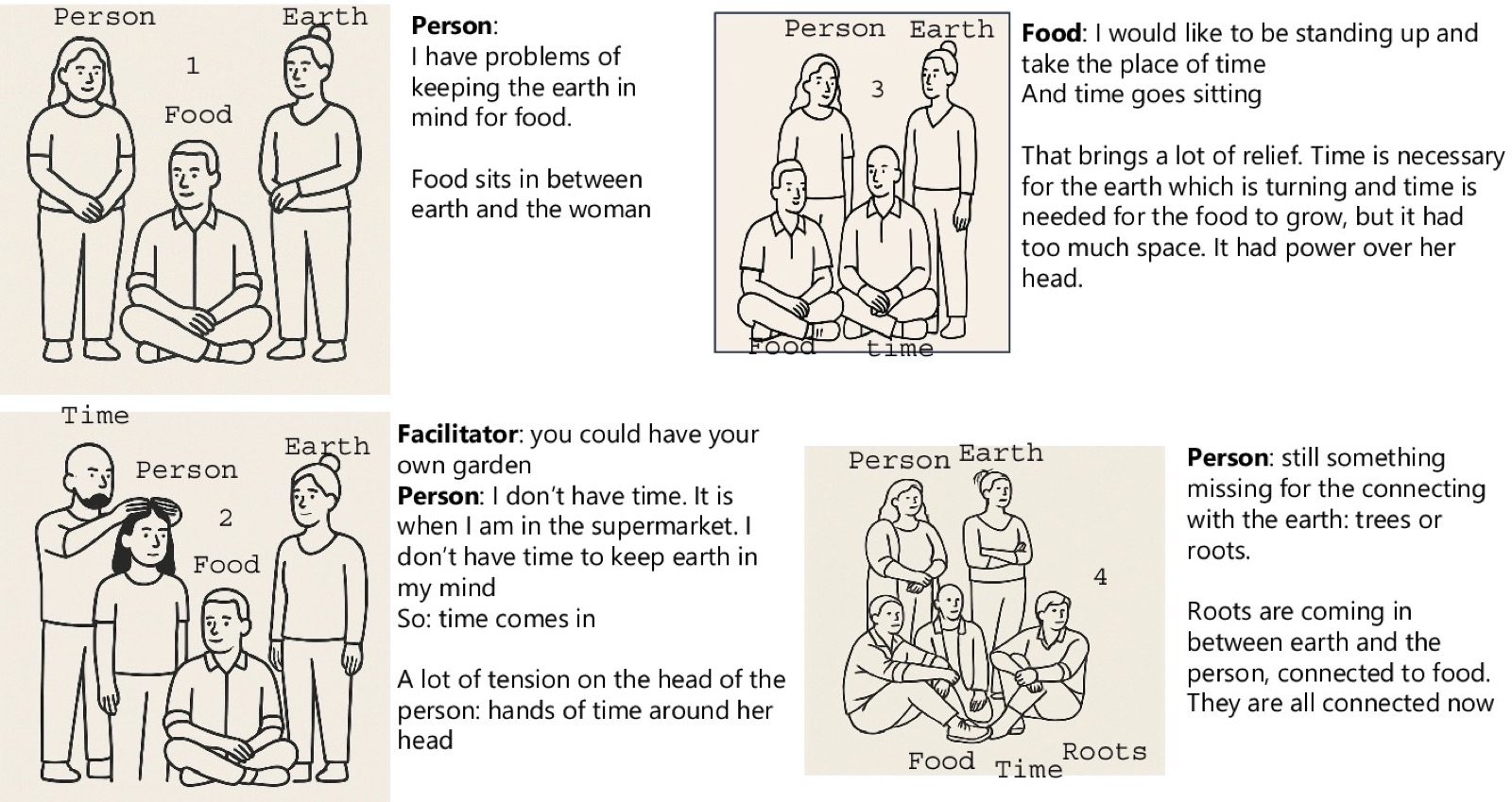
- Case 2 (Conference Workshop – Participant-Driven Constellation): At a conference event (8/3/2024) (a university education gathering), we experimented with a free-form constellation. Instead of starting with a predefined question, we invited participants to propose a sustainability-related question important to them. One participant volunteered a personal question regarding sustainable food systems (“What is my relationship to sustainable food?”). We then structured a constellation around that individual’s query, including elements like the person herself, earth, food and time. Time appeared to be a very crucial element. Time took a lot of space in her head, being all the time in a rush. That is why she could not take the time to go for healthy food. What came out was that time pressure had such an influence in her life that she could not take the time the time to buy and make healthy and sustainable food. All steps and words that were said are reported in a powerpoint, showing the position, the direction of the eyes and what has been said (Fig. 1).
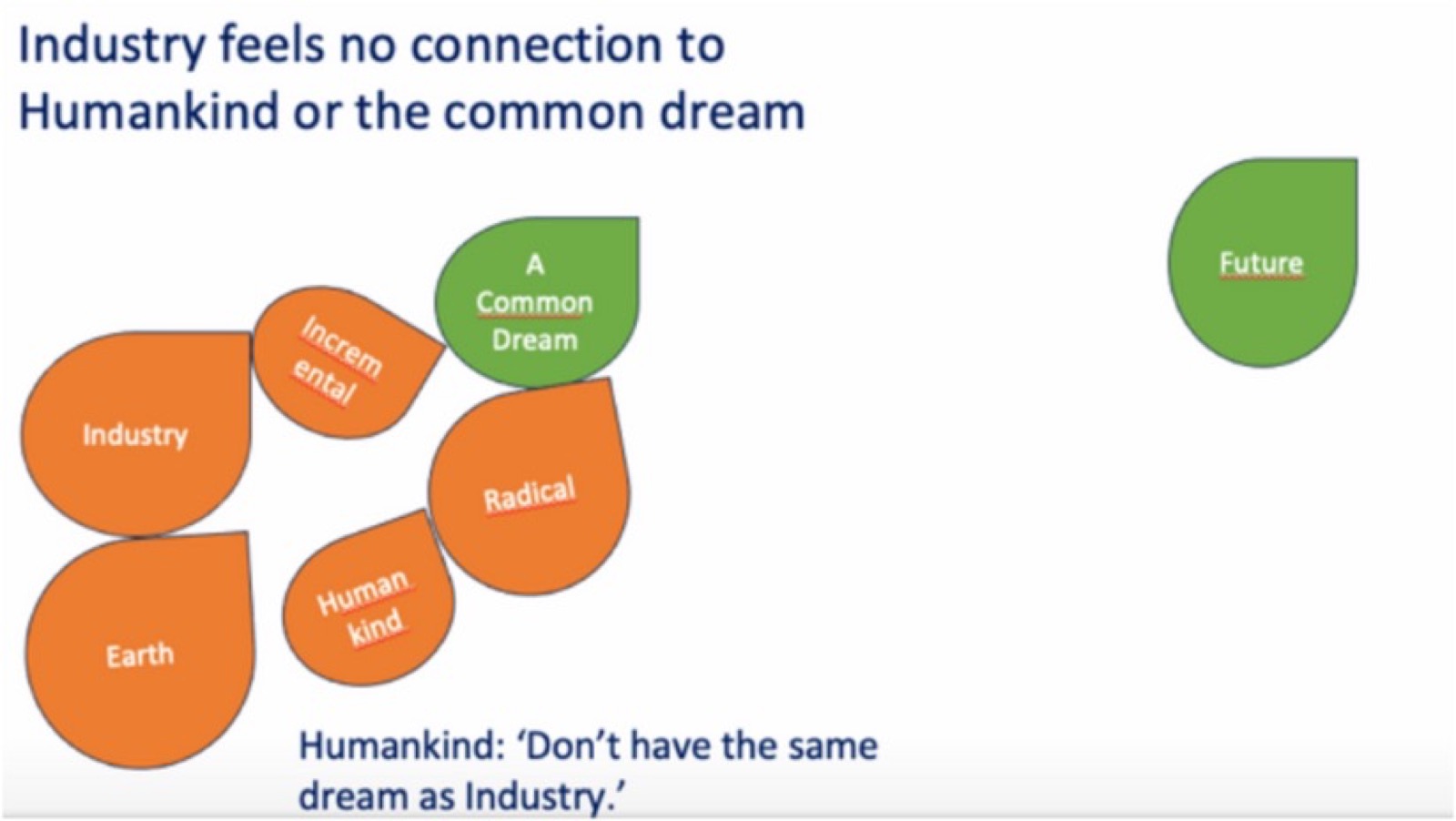
- Case 3 (Research Team Session – Transition Strategies Constellation): We organized a constellation with a university research group (15 researchers) working on sustainability transitions (29/4/2024). The goal was to reflect on tensions between pursuing “small steps” vs. “big leaps” in societal transitions – essentially, incremental change versus radical transformation. Elements in the constellation included “Incremental Actions,” “Radical Change,” “future,” “common dream,” among others, to represent different facets of the transition debate. This session allowed the researchers to step back from intellectual debate and feel the interplay between gradual and drastic change strategies. Notably, the constellation revealed that both approaches were closely interconnected and needed each other, a point that resonated with participants’ intellectual understanding but was experienced in a new way. All steps and words that were said are again reported in a powerpoint, showing the position, the direction of the eyes and what has been said (Fig. 2). For reasons of place, we include only one step of the process. Pictures have been deleted for privacy reasons.
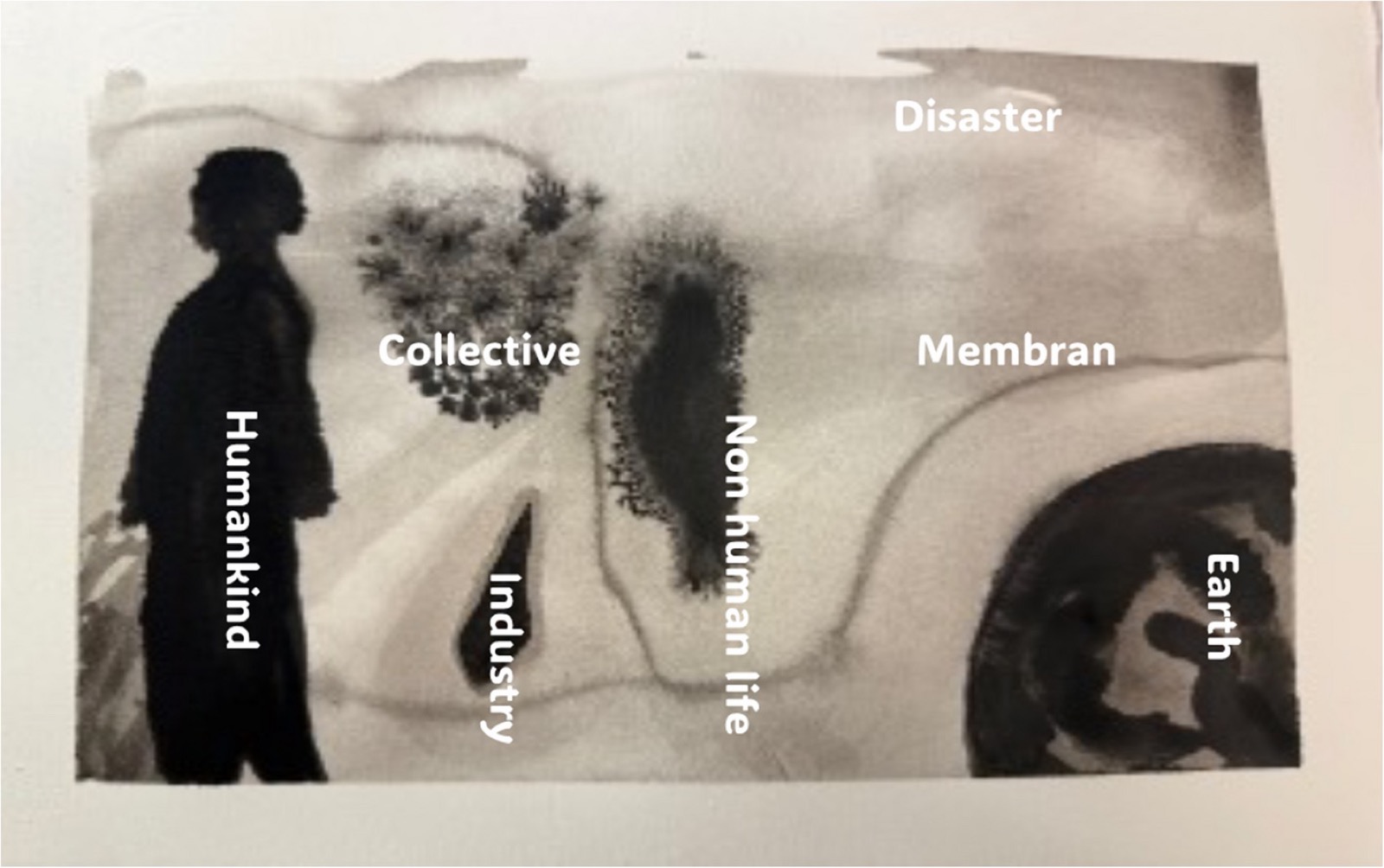
- Case 4 (Open Public Workshop Goodwave–Climate Constellation, 26/2/2025): We also held an open workshop for the general public in our city, which attracted about 24 participants (a mix of local citizens, NGO members, students, and professionals interested in sustainability). The constellation focused on the underlying dynamics of the climate crisis at a societal level. With minimal prior knowledge among participants, we introduced familiar core roles (Earth, Humankind, Climate, Industry) to initiate the constellation. As it progressed, the group introduced additional elements like “Collective Action” and “Natural Disasters.” This constellation vividly illustrated a disconnect: at one point, the representative for Earth lay down on the ground (reflecting distress), Humankind stood far from Earth, and Industry stated it “saw no problem” and wanted to continue business-as-usual, until a series of “disasters” forced the system to change. The presence of a “collective” actor – representing community– eventually shifted the dynamic. By the end, Humankind, Industry, and the Collective had moved closer together and acknowledged each other, which participants interpreted as a hopeful sign of potential real-world alignment. In order to keep anonymity but still have an overview of what happened a drawing brought the insights together (see Fig. 3).
- Case 5 (Climate constellation in an Informal Constellation Group, 16/2/2025): Finally, we facilitated multiple constellation sessions with a group of ten people who meet regularly to explore personal and societal development tools (self-named the Climate Constellation try outs). We tried different constellation scenarios related to climate and sustainability, ranging from global scale questions (“What don’t we see about climate change dynamics?”) with the four classical elements (earth, climate, humankind and industry). Here what came out was that the disconnection of humankind with the earth was crucial. Humankind had to grow up. And free themselves from industry.
- In Case 6 we used a double blind form, so the representatives and the observers did not know what was being represented. This approach is well fitted for people who are sceptical, as the cognitive (prejudiced) thinking will be deactivated. Person A got a letter in his/her pocket with (what we have to do), person B (what is the potential) and person C (what is taking us back?). What came out was that we have to slow down. But that if we are reaching out and do net get to grasp the potential, we start to feel weak. What is holding us back is fear and chaos.
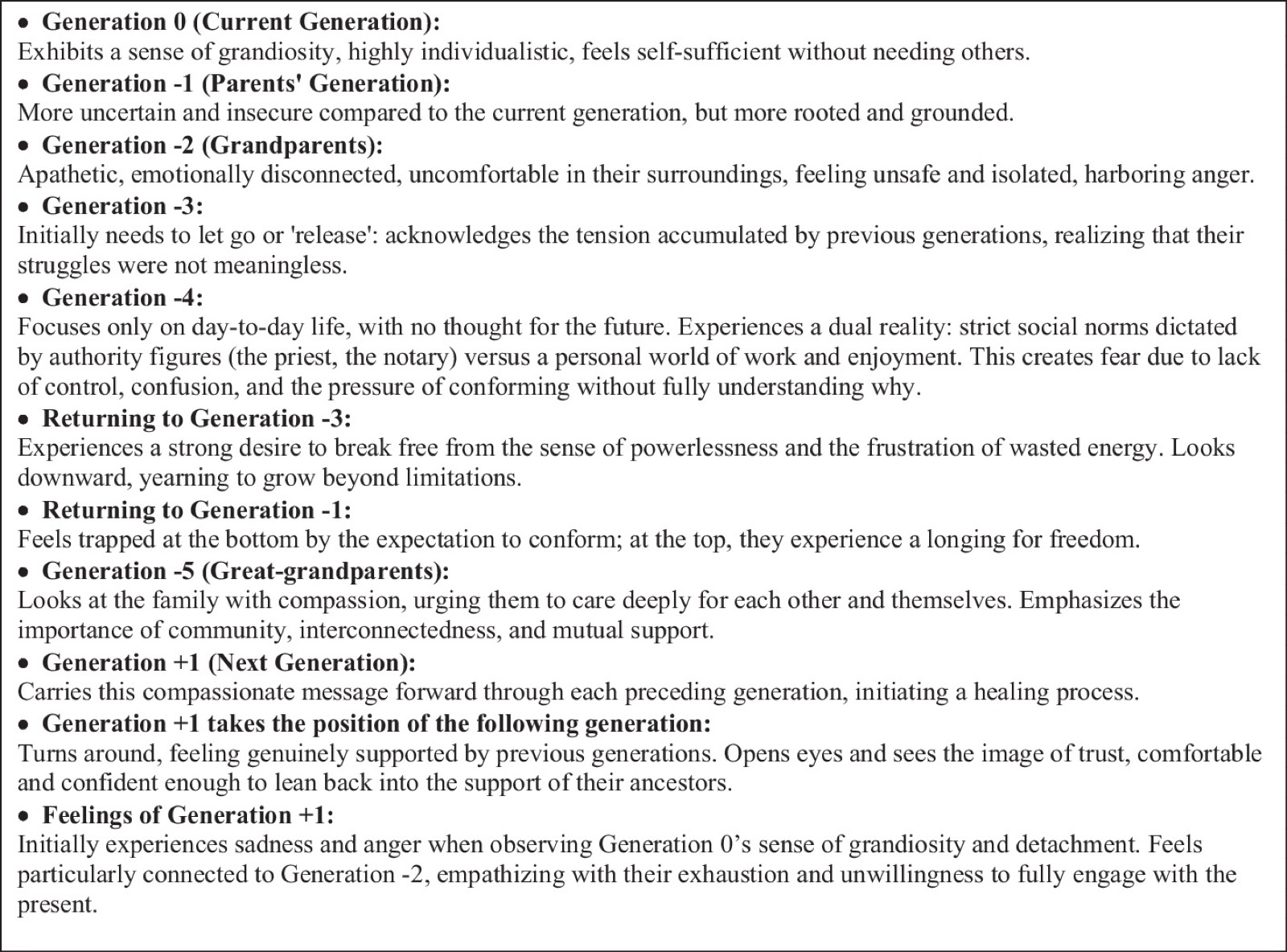
- Case 7 ancestor constellation: this last case constellated the different generations behind us and the future generations before us. It came with the question: what is it that we are not able to give a sustainable world to the next generation? Representants for the future generation, the current generation, the ancestors (parents, grandparents, and so 4 generations further and also the great mother were represented). We started with the letting every generation voice how it was to be standing there. Then with the next generation the facilitator took her to the great mother and asked for advice. This advice she brought to all the generations. Then she could take her place (Fig. 4).
For all cases above, data were collected through facilitator and assistant observations, post-workshop debrief discussions. Case 6 (double blinded) has been video recorded and there is a written feedback survey for case 4. The different steps in the constellations were captured with pictures and notes and brought together in a powerpoint after the session. These notes were checked with the representants. We gathered qualitative feedback either through informal written reflections or oral feedback at the end of the session. All individual responses were anonymized. These mixed data (narrative observations and participant feedback) form the basis of our qualitative analysis. Given the primarily exploratory nature of this study, our aim was to identify common themes and transformative effects reported by participants, rather than to measure outcomes with statistical rigor.
Summary of Participant Feedback, Experiences and Outcomes
Across the various cases, participants consistently reported that the Climate Constellation exercises were insightful and impactful. While each constellation had its unique storyline and elements, a number of common themes emerged from qualitative feedback:
- Heightened Systems Awareness: Participants often noted that the constellation helped them appreciate “the bigger picture” or see connections they hadn’t seen before. People mentioned realizing how different factors (environmental, economic, social) influence one another. Others echoed that seeing the system laid out in space allowed them to identify leverage points or hidden influences (like the role of collective action in case 4).
- Emotional Engagement and Empathy: A strong emotional resonance was a hallmark of the experience. Participants at the professional workshop said that the constellation “engaged the heart, not just the mind,” which opened up a different kind of dialogue afterward. Also the observers state that seeing the earth for example in all its sadness, also do something with them.
- Personal Connection and Reflection: Especially in the more personal constellations (like Case 3 sustainable food question or case 6), individuals found themselves reflecting on their own role in the system. This kind of personal mirroring suggests that constellation work can trigger self-reflection on one’s position and agency within a system. But even in the other constellations, personal elements are very much triggered by the constellation. For example, in the case 7 a person said afterwards that this community message came so intensively to her as she was deciding on a co-housing project.
- Catalyzing Dialogue: In all contexts, the constellations proved to be excellent conversation starters. After each session, we observed a noticeably richer group discussion. The shared experience of the constellation created a reference point – people would refer to moments from the exercise to make a point (“Remember how Disaster had to shove Industry before it reacted? That says something about…”) and this often led to deeper analysis. In the research team case, for instance, the constellation’s outcome (showing interdependence of small and big changes) gave the team a fresh way to talk about their strategic debates without it being just theoretical; it injected a common experiential metaphor into their discourse.
After case 4, a survey was conducted as part of the programs feedback system. 14 people filled in the survey. On the question if this session inspired them and on the question if they gained new insights, an average score of 3 on 4 was given. On the question how likely it would be that they give the gained knowledge to others, an average of 7 on 10 was given.
From the facilitator’s perspective, it is important to be conscious that as a facilitator you are also part of the system and that you have to be careful not to influence it with your own patterns. Creating a safe environment is key – setting norms of respect, ensuring opting-out in participation, and debriefing thoroughly.
In summary, the case studies of Climate Constellations demonstrated several practical outcomes: participants became more aware of systemic interconnections, experienced emotional engagement and empathy, and many underwent a shift (sometimes subtle, sometimes significant) in how they viewed climate change and their role in addressing it. No single constellation can solve a complex problem, of course, but by experiencing the system, participants often found new questions to ask or new resolve to act. The following discussion section will further interpret these findings, explore the methodological insights gained (including limitations and best practices), and situate the transformative potential of Climate Constellations in the context of sustainability transitions.
Discussion
According to Peter Senge (2004) and Hicks (2003), genuine change requires not only acknowledging reality but also nurturing creative visions of a different future. The Climate Constellation approach embodies this principle: participants first witness the current system by physically observing embodied representations of its elements and their interactions, and then they can begin to envision alternative arrangements by experimenting within the constellation scenario. In our cases, students and other participants moved from simply hearing about climate complexity to actively engaging with that complexity. This shift from passive reception of information to active, experiential learning appears to catalyze a deeper understanding. The case studies demonstrate how a systemic constellation exercise can act as a catalyst for transformative learning and insight. Altering an individual’s perception – literally changing how they see and feel about the relationships in a system – can precede and potentially trigger broader shifts in attitudes and behaviors. This concept resonates with theories of transformative learning: a constellation experience can serve as a kind of “disorienting dilemma” (Mezirow 1978) that challenges participants’ mental models. By confronting the complexity in an embodied way, participants often undergo a period of reflection (and sometimes confusion) as they reconcile the experience with their prior assumptions (Ison and Stowell 2000).
The outcomes we observed align well with prior accounts of systemic constellations in management and education. In Kopp and Martinuzzi’s (2013) work with business students, for example, the authors found that constellation exercises enabled “cognitive, emotional, and affective learning to occur simultaneously,” thereby helping future leaders grasp complexity better. Our participants feedback showed the same triple-learning effect: factual insights about the system, emotional connection to the issue, and even shifts in values or intentions (with some participants expressing greater commitment to collaboration or climate action after the exercise). These are precisely the kinds of deeper learning outcomes (systems thinking competence, empathy, and motivation for sustainability) that sustainability educators aim to cultivate (Sterling 2011; Shrivastava 2010). Likewise, organizational consultants have anecdotally reported that constellations can reveal blind spots in team dynamics or strategy (e.g., an unacknowledged conflict or an actor that isn’t being considered) and thereby improve decision-making. In several of the cases, we saw evidence of this “blind-spot illumination”: for instance, the community constellation highlighted the initially invisible role of collective action, and participants indeed left discussing how to better mobilize community efforts because they realized its importance in the “system” of solving climate issues. This suggests that Climate Constellations, as a form of applied systems thinking exercise, can generate actionable insights or at least strategic reflections. It bridges the gap between theoretical knowledge of systems and the lived experience of systems, which can make the knowledge more actionable. It brings new insights that can lead to new research avenues and creativity. It is not aimed to be the “truth” but it is a way to look differently to the dynamics of the system and be able to speak with another language, based on a visual representation.
Another important discussion point is the transformative potential of Climate Constellations in shaping mindsets. Transformative learning scholars argue that experiential, participatory approaches are needed to shift deeply held worldviews (O’Sullivan 2002; Taylor 2007). We did not formally track participants yet months after the workshops to see if their actions or choices changed. Having a facilitator who knows much about sustainability and its systemic roots, also helps to further discuss what was seen.
From a practical applications perspective, our cases illustrate that Climate Constellations are highly versatile. They were effective in a university classroom, in a professional conference setting, with a research team, with a public mixed group, and in an informal community. Each context required slight adjustments – for example, with professionals we had less time for basic theory and more focus on application, whereas with students we tied it into coursework and used it as a pedagogical tool. But fundamentally, the method’s participatory and immersive nature engaged people regardless of background. Practitioners considering this tool can adapt the framing to their needs: it could be used in corporate workshops to explore organizational sustainability challenges, in community meetings to foster dialogue between stakeholders, or in educational programs to enrich systems thinking training. An advantage of constellation work is that it does not require special technology or extensive resources – only a skilled facilitator and a willingness of participants to step into a novel experience. We also experimented with doing the constellations outside or within a room, and both options work. In terms of amount of people the cases went from 9 to 30 people. It is important to also give the observers an important task, being observing what is confirming their ideas and what is counterintuitive at first.
In terms of methodological insights gained from these case studies, several are worth highlighting for future practice and research:
- Facilitation Skills and Preparation: The importance of the facilitator’s skill cannot be overstated. A constellation leader must balance structure and emergence – knowing when to introduce a new element or intervention versus when to let the group’s intuition lead. In our cases, having a clear starting structure (with core elements) helped participants get oriented, but being open to unexpected additions (like “Disaster” or “Collective” appearing) made the constellations richer and more relevant. Additionally, preparing participants (through explanation or a short practice exercise) was valuable to get everyone into the right mindset.
- After care: Emotional safety was actively supported both during and after each constellation. While participants were informed they could withdraw at any time, the process also included debriefing to support collective reflection. In Case 4, a visual summary and follow-up message were sent to all participants, along with an open invitation for further contact. In case 3 and 5, participants were also encouraged to contribute to a shared session report. While no individual follow-up was requested, we believe these measures supported a sense of closure and integration. In future applications additional formal support structures (e.g., individual check-ins or referrals) may further strengthen ethical care.
- Limitations and Bias: We must acknowledge the limitations of our approach. The evidence of impact, while encouraging, is largely self-reported and qualitative. Participants might have been swayed by novelty or group enthusiasm (a kind of placebo or Hawthorne effect). Also, not everyone is equally comfortable with this format – a few participants (especially in the academic setting) remained reserved or skeptical, and their voices might be underrepresented in the feedback (e.g., those who felt it was “not their thing” might have opted out of surveys). In practice, facilitators should be mindful that some individuals (due to personality or culture) prefer more analytical approaches and might disengage internally even if participating externally. Blending constellation work with other methods, for example with soft system methodology, could help address different learning styles. Additionally, constellation outcomes can be subjective to interpret. Two people might witness the same session and draw different lessons. This isn’t necessarily a flaw – in fact, it can spur rich discussion – but it means that evaluating “the” result of a constellation is complex. Future research could introduce more systematic observation protocols to complement self-report data. This could be done with a before-survey, an after survey and a survey after 2 months.
In light of the above, we see Climate Constellations as a promising addition to the toolkit for sustainability transformation efforts. They create a temporary microcosm where people can experience systemic change processes and thereby potentially shift their mindsets. This embodies what some scholars call “transformative spaces” – safe arenas to experiment with new identities and interactions (Pereira et al. 2020). Our findings align with the notion that transformative learning is catalyzed when individuals engage their whole selves in the learning process (head, heart, and hands).
Although our sessions took place in relatively supportive environments (universities, professional workshops, community groups), the constellations themselves often surfaced complex and even confrontational systemic dynamics. Participants represented actors such as “Fossil Fuels” and “Extinct Species,” and experienced the tensions and asymmetries embedded in these roles. In another constellation (not included among the case studies reported here), an “Activist” was represented alongside “Parents,” revealing how the activist’s presence, while well-intentioned, evoked discomfort — with “Parents” expressing a wish to keep them at a distance from their children. This highlighted the subtle social boundaries and resistances climate actors can face. These moments do not offer simple answers but invite reflection on where influence or blockage resides within a system. In this way, Climate Constellations contribute to transformative learning by shifting worldviews and emotional understanding, while also resonating with the idea of triple-loop learning (Flood & Romm 2018), which invites us to question not only strategies or values, but the underlying power structures and framings that shape collective meaning-making. The constellations provide a space where such dynamics can be embodied, explored, and potentially reimagined. The facilitator plays a key role in being attuned to systemic power dynamics and ensuring they are represented within the constellation. When facilitators are sensitive to these layers, they can help surface otherwise overlooked actors or tensions — such as institutional constraints, cultural norms, or voices at the margins.
At the same time, we caution that Climate Constellations are not a panacea. They are one approach among many in addressing climate change education and engagement. For lasting impact, they should likely be part of a broader program or intervention. For example, a constellation workshop might be followed by action planning sessions, or integrated into an educational curriculum with reflection assignments and subsequent projects. The depth of insight gained in a constellation can be profound, but the breadth of reach is still limited (small groups, intensive session). Scaling this method to reach larger audiences remains a challenge – one could imagine adapted formats for bigger groups (with multiple constellations in parallel), but these remain to be tested.
In conclusion of this discussion, we assert that the experiential, systemic, and human-centric nature of Climate Constellations fills a critical gap in current approaches to sustainability transformation. By enabling a kind of “soft simulation” of complex problems that engages participants with their body, senses and emotions, it opens the door for deeper change that purely cognitive interventions might miss. Our case studies provide initial evidence that participants can indeed undergo meaningful shifts in perspective through this method. Future work, as discussed below, will need to solidify the empirical understanding of how and how much such shifts contribute to tangible sustainability outcomes.
Conclusion
As the urgency of addressing climate change and sustainability challenges grows, innovative systemic approaches to engage people are increasingly crucial. This study presented Climate Constellations as a promising and novel avenue for transformative learning and dialogue on climate issues – one that encompasses cognitive, emotional, and physical dimensions. Unlike conventional didactic methods, this embodied approach seeks to instigate not only intellectual understanding but also active engagement and a personal sense of commitment to sustainable practices. By encouraging participants to literally embody different components of a system, Climate Constellations facilitate a holistic understanding of sustainability problems, emphasizing that any viable solution must address the system’s root structures, not just its surface symptoms.
Our findings illustrate that Climate Constellation workshops can illuminate hidden dynamics, challenge entrenched mental models, and foster a collective commitment to action. Aligned with Meadows’ systems thinking framework and focused on deep leverage points for change, these constellation sessions provided a dynamic platform for participants to uncover leverage points and relationships that might otherwise be overlooked. In doing so, they highlighted the interconnected nature of the climate crisis and related sustainability issues, guiding participants toward recognizing effective intervention points.
The case examples in this paper, though exploratory, demonstrate the potential of Climate Constellations to transform perceptions. Participants across different contexts became more aware of the “bigger picture” and their own role within it – a key step toward empowerment and behavior change.
Future studies could track participants over time to see if and how their attitudes or actions evolve. It would also be valuable to quantify outcomes (e.g., systems thinking competencies, empathy scales) to complement the qualitative insights.
As a tool, Climate Constellations are still evolving. The practical knowledge from systemic constellation practitioners accumulated over decades provides a rich base to draw from, but translating it into academic and public engagement settings is an ongoing process. Nonetheless, the initial evidence presented here suggests that Climate Constellations can be a valuable addition to the repertoire of methods supporting sustainability transitions. They create a space where complex systems become tangible and personal. In that space, people can experiment with new ways of seeing and relating to the world, often discovering common ground and inspiration for action. By fostering such deep understanding and empathy, Climate Constellations help build the shared vision and will needed to navigate our world toward a more sustainable future.
Complexe Systémique: key points
The article speaks to systemic clinical practice in two ways. On the one hand, it shows that the constellation set-up, born in family therapy, can make tangible a system too vast to be thought of all at once, here the climate, and open a group dialogue from a shared experience. The precautions described (bodily warm-up, the right to step out of the role, debriefing in several rounds, attention to power relations, awareness that the facilitator is part of the system) carry over to any sculpting or spatial work. On the other hand, critical distance is needed: no evaluation protocol, self-reported feedback collected by the facilitator, implicit consent, and a “representative perception” posited as a working hypothesis without discussion of its foundations or of the controversies surrounding Hellinger’s constellations. These sessions are best read as tools for storying and collective reflection, not as access to the truth of the system, which the text itself acknowledges. Read alongside the interview with Bert Hellinger on constellations and the orders of love, and the article on family therapy and climate change.
Notes from the original
Acknowledgements. I would like to thank Igor Vervoort, Frank Van Oss and Ganiyat Temidayo Saliu for taking notes and pictures of the constellations.
Funding. No funding was received for conducting this study.
Ethics Approval. Formal ethics approval was not sought because the study due to the voluntary participation in the constellation exercise guarantueeing total anonomity and excluding the collection of sensitive data. Participants were given the choice to opt-out at any moment. The research was conducted in accordance with ethical standards outlined in the Declaration of Helsinki.
Human Ethics and Consent to Participate. Explicit consent was not initially obtained due to the informal and observational nature of this systemic practice research. All participant data has been fully anonymized to ensure confidentiality and minimize any potential risks.
Clinical Trial Number. Not applicable.
Competing interests. The authors declare no competing interests.
References
Bryan B, Goodman M, Schaveling J (2006) Systeemdenken:ontdekken van organisatiepatronen [Systems Thinking: Discovering Organizational Patterns]. Academic Press / SDU Uitgevers.
Davelaar D (2021) Transformation for sustainability: a deep leverage points approach. Sustain Sci 16(3):727–747. https://doi.org/10.1007/s11625-020-00872-0
Disterheft A, Pijetlovic D, Müller-Christ G (2021) On the road of discovery with systemic exploratory constellations: Potentials of online constellation exercises about sustainability transitions. Sustainability 13(9):5101. https://doi.org/10.3390/su13095101
Flood RL, Romm NRA (2018) A systemic approach to processes of power in learning organizations: Part I – literature, theory, and methodology of triple loop learning. Learn Organ 25(4):260–272. https://doi.org/10.1108/TLO-10-2017-0101
Franke U (2003) The River Never Looks Back: Historical and Practical Foundations of Bert Hellinger’s Family Constellations. Carl-Auer-Systeme, Heidelberg
Freeman LC (2004) The Development of Social Network Analysis: A Study in the Sociology of Science. Empirical Press, Vancouver, BC
Georgiou I (2015) Unravelling soft systems methodology. Int J Econ Business Res 9(4):415. https://doi.org/10.1504/IJEBR.2015.069680
Hellinger B (2001) Love’s Own Truths: Bonding and Balancing in Close Relationships. Phoenix, AZ: Zeig, Tucker & Theisen
Hicks D (2003) Lessons for the Future: The Missing Dimension in Education. Routledge, London
Hunger C, Bornhäuser A, Link L, Schweitzer J, Weinhold J (2014) Improving experience in personal social systems through family constellation seminars: Results of a randomized controlled trial. Fam Process 53(2):288–306. https://doi.org/10.1111/famp.12051
Ison R, Stowell F (2000) Systems Practice for Managing Complexity: Proceedings of the 1st International Conference. ISBN (manuscript)
Konkolÿ Thege B, Petroll C, Rivas C, Scholtens S (2021) The effectiveness of family constellation therapy in improving mental health: A systematic review. Fam Process 60(2):409–423. https://doi.org/10.1111/famp.12636
Kopp U, Huemann M (2014) Project impact constellations – a new tool to grasp the complexity of public sector projects. In: Dominici G (ed) Proceedings of the 3rd Business Systems Laboratory International Symposium: Advances in Business Management. Towards Systemic Approach. Perugia, Italy, pp. 245–248
Kopp U, Martinuzzi A (2013) Teaching sustainability leaders in systems thinking. Business Syst Rev 2(2):191–210
Loorbach D, Rotmans J, Kemp R (2016) Complexity and transition management. In: de Roo G, Hillier J, van Wezemael J (eds) Complexity and Planning: Systems, Assemblages and Simulations. Routledge, pp 177–198
Macharis (2025) Climate constellations: bridging cognitive, emotional, and physical engagement in climate education. Forthcoming in J Educ Sustain Dev
Meadows DH (2008) Thinking in Systems: A Primer. White River Junction, VT: Chelsea Green
Mezirow J (1978) Perspective transformation. Adult Educ 28(2):100–110
Müller-Christ G, Liebscher AK, Hußmann G (2015) Nachhaltigkeit lernen durch Systemaufstellungen. Zeitschrift Für Wirtschafts- und Unternehmensethik 16(1):29–51. https://doi.org/10.5771/1439-880X-2015-1-29
O’Sullivan E (2002) The project and vision of transformative education: Integral transformative learning. In: O’Sullivan E et al (eds) Expanding the Boundaries of Transformative Learning: Essays on Theory and Praxis. Palgrave, New York, pp 1–12
Pereira L, Frantzeskaki N, Hebinck A, Charli-Joseph L, Drimie S, Dyer M et al (2020) Transformative spaces in the making: Key lessons from nine cases in the Global South. Sustain Sci 15(1):161–178. https://doi.org/10.1007/s11625-019-00749-x
Scholtens S, Petroll C, Rivas C, Fleer J, KonkolÿThege B (2021) Systemic constellations applied in organisations: A systematic review. Gruppe Interaktion Organisation Zeitschrift Für Angewandte Organisationspsychologie (GIO) 52(3):537–550. https://doi.org/10.1007/s11612-021-00592-8
Senge P (2004) The Fifth Discipline: The Art and Practice of the Learning Organization, Rev. Doubleday, New York
Shrivastava P (2010) Pedagogy of passion for sustainability. Acad Manag Learn Ed 9(3):443–455. https://doi.org/10.5465/amle.9.3.zqr443
Stam J (2012) Systemic Coaching and Constellations. Triarchy Press, Axminster, UK
Sterling S (2011) Transformative learning and sustainability: Sketching the conceptual ground. Learn Teach Higher Ed 5(11):17–33
Taylor EW (2007) An update of transformative learning theory: A critical review of the empirical research (1999–2005). Int J Lifelong Educ 26(2):173–191. https://doi.org/10.1080/02601370701219475
Thiecke, Van Leeuwen (2013) Systemisch Transitiemanagement, Boom Uitgevers, Amsterdam
Varga von Kibéd M, Sparrer I (2011) Ganz im Gegenteil. Tetralemmaarbeit und andere Grundformen systemischer Strukturaufstellungen - für Querdenker und solche die es werden wollen, 7th ed. Heidelberg G: Carl-Auer-Systeme.
Weber G (2003) Het succes van Organisatieopstellingen. De methode van Bert Hellinger in de praktijk gebracht. Altamira-Becht, Haarlem
Reformatted republication of Climate Constellations: A Systemic Tool for Exploring Sustainability Transitions, by Cathy Macharis, Systemic Practice and Action Research, vol. 38, no 2 (2025), doi: 10.1007/s11213-025-09722-5, under a CC BY 4.0 licence. Edition and layout: Complexe Systémique, September 2026 — the work has been modified under the terms of the licence. Neither the authors nor the publisher are responsible for this edition; the original version prevails.
This is the original article “Climate Constellations: A Systemic Tool for Exploring Sustainability Transitions”, published in Systemic Practice and Action Research (2025) under a CC BY 4.0 licence. Republished by Complexe Systémique: the author’s text is unchanged; only the presentation has been adapted for reading online, as set out at the head of this page.
Read the original articleHow to cite this article
Macharis, C. (2025). Climate Constellations: A Systemic Tool for Exploring Sustainability Transitions. Complexe Systémique. https://app.complexe-systemique.com/en_GB/articles/climate-constellations-a-systemic-tool-for-exploring-sustainability-transitions (Original work published in 2025 in Systemic Practice and Action Research, 38(2), 13 (2025); republished in 2025 by Systemic Practice and Action Research, https://link.springer.com/article/10.1007/s11213-025-09722-5)
To go further
- Systemic psychotherapy of constellations and the orders of love. Interview with Bert HellingerConstellations according to Hellinger.
- Encourager les relations locales qui construisent la solidarité : penser systémiquement la thérapie familiale et le changement climatiqueFamily therapy and climate.
- Never underestimate the role of the body in therapy — Bernard FilleulThe role of the body in therapy.
Related training courses
 Symposium
État des Lieux: a psychological approach to spaces
Replay of the “État des Lieux” conference (Paris, 16 October 2026): Ivy Daure, Maurizio Frisina, Viola Sallay and Gilbert Pregno on places as a clinical resource. In French.
 Short course
The new arenas of couple therapy: work, money, tasks and co-existence
Online training: working with conjugal tensions around work, money, mental load and household tasks. Systemic reading and tools. In French.
 Short course
The subtle art of humour in therapy: seriously funny
Online training: mobilising humour as a systemic intervention tool — reframing, stance, ethics. A lively day with Caline Fattal. In French.
 Online course
Master the use of the Amour Monstre floating object in systemic therapy
Train with Ivy Daure, creator of the tool, in the Amour Monstre floating object: protocol, systemic questioning and filmed simulations. 8 hours of video, in French with English subtitles.
Related articles
 Scientific
Using Narrative Therapy for Couples to Address Discontinuity Narratives in Couples Living with Brain Injury
Ten sessions, trees of life, letters and an outsider witness: a structured narrative therapy helps three couples move beyond the story of a lost “before” after brain injury.
 Blog
When intuition comes before strategy. The first flash of meaning
From Bergson to von Foerster, intuition is not the enemy of rigour but its immediate side. How it works concretely in the clinical interview, and why it calls for a reflexive stance.
 Scientific
Epistemic Mobility in Complex Intervention: Rethinking Knowledge in Systemic Practice
Why does complex intervention stall despite expertise? A conceptual article proposes moving from epistemic inertia to epistemic mobility: changing one’s way of knowing.
 Blog
Thinking complexity: following the threads of the real without breaking them
Recursiveness, dialogic, hologrammatic: Edgar Morin’s three principles for thinking without mutilating, and what they change concretely in the stance of a practitioner working with human systems.