AI-assisted translation
This version was translated from Portuguese by Complexe Systémique with the help of artificial intelligence. In case of doubt, the original version prevails.
Revista Brasileira de Terapia Familiar · Narrative therapy
The Contributions of Narrative Therapy in the Care of Elderly Patients: A Clinical Case Study
Older people are a growing population, more exposed to depression, anxiety and bereavement. Drawing on their work with a patient at a university psychology training clinic in Porto Alegre, in the middle of the pandemic, Michele Klotz da Rosa and Débora Silva de Oliveira examine what White and Epston’s narrative therapy can offer at this point in the life cycle, and what it presupposes. A problem externalized as a “mongrel dog” opens up the deconstruction of stories of guilt and of care lived as an obligation.
Unofficial English translation. This article is a translation of As Contribuições da Terapia Narrativa no Atendimento de Pacientes Idosos: Um Estudo de Caso Clínico, by Michele Klotz da Rosa and Débora Silva de Oliveira, published in the Revista Brasileira de Terapia Familiar (ABRATEF), vol. 10, no. 1 (2021), doi: 10.60114/rbtf.v10i1.19, under a CC BY 4.0 licence. Translated by Complexe Systémique in November 2026 with the help of artificial intelligence: the original Brazilian Portuguese text has been translated into English and reformatted, which constitutes a modification of the work under the terms of the licence. Paragraphs and headings are those of the journal; the authors’ biographical notes, printed at the foot of the first page, are given in the presentation, and the notes on Michael White and David Epston are numbered 1 and 2; the genogram remains in Portuguese; the narrative concepts are given in White’s own English terms (re-authoring, unique outcomes, club of life, saying hullo again). The abstract is the authors’ own English version. This translation was made neither by the authors nor by the journal, who are not responsible for its content or for any errors. The original version prevails.
In the narrative model the family and the social network are seen as a resource and not as a deficit.
Michele Klotz da Rosa, Débora Silva de Oliveira
Abstract
The present article aims to present the possible contributions and limitations of Narrative Therapy in the care of elderly patients, a population group that has been growing in the last decades and which presents significant vulnerability to mental illnesses, in addition to a more frequent experience of losses and mourning. Based on a clinical case study with an elderly patient in attendance at a Psychology School Service, this study presents the problem-saturated stories brought by the patient, who arrives at therapy with depressive and anxious symptoms. The survey of the theoretical aspects that were articulated to the clinical case presented took place through a narrative review, which enabled the critical analysis of materials related to issues of the family life cycle, the aging process, the repercussions of aging on mental health and of the possible contributions (and limitations) of the Narrative Therapy developed by White and Epston in serving the elderly population. Additionally, were addressed interventions aimed at favoring the transformation of these narratives, as well as contributing to the process of mourning, one of the most presents aspects in families in the late stage of life. Externalizing the problem and introducing the patient to her problem-saturated stories, we tried to start deconstructing some of these problematic narratives, in order to go in search of the unique results, that is, the elements of her story that, being dissonant of the dominant speeches, had been ignored by her, sustaining her psychopathological symptoms.
Keywords: Narrative Therapy, anxiety, depression, mourning, elderly
Introduction
This article first set out to present statistical data on population ageing, on the prevalence of mental disorders among older people (emphasizing the likelihood that prevalence rates will worsen because of the pandemic) and on the frequent experience of losses and bereavements inherent in this phase of the life cycle. It then briefly presented the structure of the Narrative Therapy of Michael White1 and David Epston2, some of its main interventions and the possible limitations on its use.
According to the World Health Organization (WHO), the population’s life expectancy has risen significantly over the last 50 years. It is estimated that by 2050 the world’s older population will reach 1.25 billion people, 22% of the total population (Teixeira, 2017). By 2025, the WHO predicts that Brazil will have the sixth largest older population in the world (WHO, 2005). This growth in Brazil, and especially in the state of Rio Grande do Sul, is also reflected in the projections of the IBGE (2020), which estimates that by 2060 it will reach 25.49%, and 29% in Rio Grande do Sul.
Even if the ageing process is viewed from a more optimistic perspective in terms of vitality and physical and psychological functioning, adults over 65 are known to have been the group most susceptible to mental illness (Walsh, 1995). The main conditions include organic brain disease, depression and anxiety (Teixeira, 2017). Paranoid states and a risk of suicide may also be present. All of these conditions tend to stem precisely from the family’s difficulties in adapting to the transitions and tasks of this late stage of life (Walsh, 1995).
According to Walsh (1995), the family’s adaptation to the transitions and tasks of the late stage of life is directly related to the family patterns developed over the course of life to maintain the stability and integration of the family system. Even if some of these patterns were suitable for the family at a given moment, they may become dysfunctional as the life-cycle moment of each of its members changes. The main challenge for families at this stage is usually precisely the acceptance of changes in generational roles, above all for the middle generation, for whom the change in relational status with ageing parents is often even more challenging. Among the main tasks of this stage, which usually begins when the last child leaves home (the empty-nest moment), are: (i) the couple’s rediscovery of each other as a dyad; (ii) adjustments to retirement and to the loss of social roles held until then; (iii) the loss of friends and relatives; (iv) widowhood, with all the difficulty of reorganizing life for the surviving spouse; (v) the decline of physical vigour and the onset of health problems (sometimes imposing limits on habits and significant changes in routine); (vi) financial difficulties, changes in living arrangements and possible dependence on caregivers; and (vii) the arrival of new members in the family (through marriages, births and so on).
As we have seen, many adaptations are required, both of the older generation and of the younger generations, who, while experiencing the issues typical of their own individual and family life cycle, must deal with cross-generational interaction (Walsh, 1995). Other frequent experiences are situations involving loss and bereavement, which tend to intensify in pandemic contexts such as the present one, in which an increase in the incidence of mental disorders in general is also expected (WHO, 2009).
In this sense, we will reflect on the possible contributions (and limitations) of White and Epston’s (1990) Narrative Therapy for work with individuals in the late stage of life. We believe in the potential of this model for work with this phase of development, above all because of its more sophisticated capacity for introspection and reflection, which makes it possible to work on building a coherent narrative. In this work, the aim is to reinterpret the past, to select and give shape to old memories, and to reaffirm the importance of past events in the search for a sense of coherence in the present (Cárdenas & Del Valle, 2015; Erikson, 2000; Izquierdo, 2005; Martín, 2008; Ocampo & Londoño, 2007; Woodhead, Ivan, & Emery, 2013).
Other factors that strengthen the potential of the narrative model for work with older people are: (i) the fact that the intervention focuses on transforming the problematic narrative that usually underlies psychological problems; (ii) the high prevalence of depressive and anxious conditions, conditions in which Narrative Therapy has been used successfully (Batista et al., 2018); and (iii) the more frequent presence of bereavement and loss at this stage of the life cycle (Walsh, 1995).
It must be stressed, however, that the effectiveness of Narrative Therapy presupposes that the client’s narrative competences are preserved (which is not always the case with an older client) and that the life story is told under the influence of a dominant narrative. It also presupposes, for the deconstruction work carried out in Narrative Therapy to take place, that the life story makes sense and is built around a central theme that organizes experience, giving the narrative a structure. According to Batista et al. (2018), in life stories marked by the feeling that life has no meaning or has been wasted (meaningless stories), the aim is to increase the client’s sense of personal agency, and in chaotic (unstructured) stories, the work ends up focusing more on organizing the most relevant episodes of life.
White and Epston’s basic assumption is that the dilemmas people present are usually constructed through language and therefore do not reside within the individuals themselves. It is precisely through the stories that are told and retold in their relationships with other people, stories influenced by historical, social and cultural factors (the so-called dominant discourses), that individuals gradually give meaning to their experiences. In psychopathologies, it is precisely these attributed meanings that tend to be problematic (Morgan, 2007).
Through narrative practices, the aim is to explore stories that may never have been told about the problem or the lived experience. Stories that, because they are dissonant with the dominant discourse and the problem-saturated narrative, have been disregarded.
In this approach, the therapeutic process unfolds in three phases which, according to Batista et al. (2018), are neither bounded nor watertight, but move dynamically at every moment. They are:
- Deconstruction: strategies are used to question the individual’s “truths” that sustain the problem-saturated narrative.
- Reconstruction: the aim is to build alternative narratives, encompassing other ways of relating to the problem.
- Consolidation: the aim is precisely to consolidate the narrative of change in the individual’s daily life (Batista et al., 2018).
As regards the working strategies commonly used in the therapeutic process and used in this article, externalizing the problem and re-authoring will be presented. In addition, re-membering will be presented, a strategy found above all in work with situations of bereavement.
(i) Deconstructing the Problem-Saturated Narrative by Externalizing the Problem
According to Lomando and Sigaran (2018), externalizing the problem seeks to separate the person’s identity from the problem they bring. Instead of working with a “depressive patient” (that is, with the symptom / pathology turned into an adjective describing the person), the pathology (depression) is usually worked with as a noun, something external to the person that they need to deal with. This technique is carried out in four steps:
a) the person’s own definition of the problem: the moment when they name it, give it characteristics (such as size, shape, smell, colour, gender, appearance and so on), identify the trigger situations in which it appears, and observe the tactics, strategies, plans and words it usually uses;
b) mapping the effects of the problem: the moment when the person lists the consequences (feelings, impact on relationships, difficulties and so on) that the problem has in the various contexts of their life, as well as on their goals, dreams, values and future prospects, in short, on what really matters in their life;
c) evaluating the effects of the problem’s activity: the moment when the person is invited to take a position on the effects the problem has had on their life;
d) justifying the evaluation: the moment when the person reflects on how the problem draws them away from their values and principles.
In deconstructing the problematic narrative, details usually emerge such as the individual’s intentions to relate differently to the problem in the future, or behaviours, emotions or attitudes that defy the problem’s logic, what White and Epston called “unique outcomes”. These unique outcomes are precisely a means of making the process of re-authoring possible, encompassing the development of new meanings and new experiences that were initially disregarded under the influence of the dominant narrative (Batista et al., 2018).
(ii) Reconstruction and Re-authoring
In this phase, the aim is to foster the emergence of “unique outcomes”, their elaboration and the subsequent reflection on these aspects (initially dissonant with the dominant discourse and therefore disregarded) within an alternative narrative that is coherent for the individual. The main focus in this phase is the description of feelings, behaviours and actions, and of how the individual believes their unique outcomes are taken in by the people who are significant to them (Batista et al., 2018).
In other words, the starting assumption is that for every story told by the individual (in the case of pathologies and problem-saturated narratives), there are many others that have been silenced and that often contradict the dominant narrative told about the problem, about life experience or about the self. In therapeutic work, these untold stories (alternative stories) are usually investigated, since they never gained prominence. The aim is to link these experiences to others that also challenge the problem-saturated story, so that the alternative story gains greater relevance, becoming less vulnerable to being forgotten and more consistent (Vilela & Souza, 2020).
(iii) Consolidating the Alternative Narrative
The third phase of the therapeutic process aims to expand and validate the alternative narrative built in the previous phase, with a view to constructing an alternative identity for the individual. This is the moment when the alternative stories need to take concrete form in the outside world to reach their full transformative potential. According to Batista et al. (2018), the strategies usually used in this phase are: (i) naming the new narrative (contrasting it with the problem-saturated narrative); (ii) creating audiences for the new narrative (seeking social validation for the new narrative formulated in the re-authoring process); and (iii) encouraging reflection and anchoring change (which is usually done through letters documenting the therapeutic process and the new narratives).
(iv) Re-membering and Work with Grief
Re-membering is a concept introduced by Michael White on the basis of the ideas of the anthropologist Barbara Myerhoff. White builds a metaphor around what he called the “club of life”. Each individual has their own “club of life”, made up of people living or dead, characters, animals, in short, all those who contributed to making the individual who they are, including their beliefs and values. These members of the club are considered to influence, through their different actions and discourses, the individual’s ways of acting and living (White, 2005).
Through re-membering, the individual is invited to revisit and reorganize who the members of their club are, since the degree of importance and influence may differ, or even change over the years. The assumption behind the club-of-life metaphor is that the self is constructed in relationships and is therefore something dynamic.
In re-membering, the therapist works with questions aimed at identifying who the members of the “club of life” are and seeks to prompt reflection on a possible need to reorganize the group of members and/or their roles (White, 2005). This strategy proves very useful in working through grief, whether by reorganizing the roles or participants of the club, or by fostering the understanding that even people who have died can go on being important members of the “club of life” (Batista et al., 2018).
According to Carr and White (1998), the expression “re-membering” refers less to remembering the deceased and more to the idea of “becoming a member again” of the club. In this sense, they propose replacing the metaphor of “saying goodbye” (commonly used in contexts of grief) with the metaphor of “saying hullo again”. The proposal is to reincorporate the deceased into the life of the bereaved person, keeping alive the voice of those who have gone. They also argue that some negative reactions in the more traditional approaches to grief might be precisely a reflection of this need of bereaved people to remember their dead and incorporate them into their lives.
It is important to note that, unlike other systemic approaches that focus on promoting differentiation of the self from the family of origin (in order to avoid possible negative influences), in the narrative model the family and the social network are seen as a resource and not as a deficit. The aim is to help the individual find members of their network who have lived through similar experiences, encouraging these relationships as a source of social support and a resource for solving problems (Carr & White, 1998).
Drawing together the theoretical elements set out above, this article aims to reflect, on the basis of a clinical case study, on the possible contributions and limitations of Narrative Therapy in the care of older patients, a population group that has grown in recent decades and that presents significant vulnerability to mental illness, as well as a more frequent experience of loss and bereavement.
Method
This article, which is qualitative in nature, is a single clinical case study. Case studies are especially valuable in psychotherapy research insofar as they foster an understanding of the process of change, allowing a longitudinal and subjective analysis of the therapeutic encounter (Hilliard, 1993; Serralta, Nunes, & Eizirik, 2011).
To survey the theoretical aspects, a narrative review was first carried out by identifying and selecting books and scientific articles (preferably from the last five years) related to the themes addressed in the article. This method proved suitable insofar as the aim was a critical analysis of materials in order to reach conclusions of a more qualitative nature (Rother, 2007).
On the basis of the theoretical elements identified, we sought to link them to the aspects worked on in the clinical case, which consisted of individual systemic care for an older patient with the following family configuration:
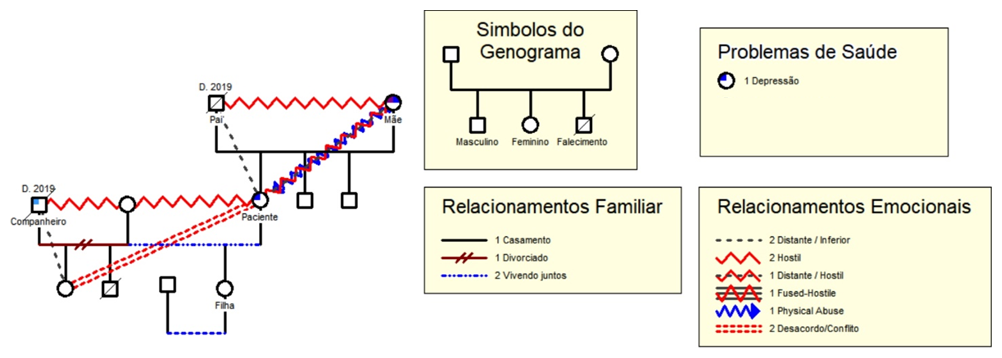
The sessions with the patient took place at a university psychology training clinic in the city of Porto Alegre and were conducted in co-therapy by the author of this article, between October and December 2020, without a reflecting team because of the health restrictions imposed by the pandemic.
Case Discussion
Laura (a fictitious name) lived with her partner (whom she had been caring for over several years because of a degenerative disease) in a remarried family configuration (Carter & McGoldrick, 1995) that lasted for decades, until his death, which occurred during the course of the sessions. The relationship with her partner was marked by hostility and by several marital infidelities. She described him as someone selfish (thinking only of his own needs). The couple’s daughter had just left her parents’ home, so the family was living through the “empty nest” moment.
Bereavement was present in Laura’s reflections in the sense that she was grieving for her father (who had died a few months earlier), for her daughter’s departure from home, for friendships with which she had lost touch, as well as (at first in anticipation) for her partner. According to Walsh (1995), some of the main changes of the late stage of life are the losses experienced with the empty nest (which usually marks the beginning of this stage), the death of relatives, health problems (in this case those of the patient’s partner, whom she cared for, and which ended up imposing limits on the family’s habits and significant changes in routine), and the subsequent adaptation to widowhood.
The main themes the patient brought concerned missing her father, her weariness at caring for her partner and the difficulties in her relationship with her daughter and the daughter’s partner, situations that, according to Walsh (1995), normally call for adaptations on the part of both the older and the younger members of the family. Also according to Walsh, the depressive state arising from this situation could stem, among other things, precisely from the difficulty of adapting to the transitions and tasks of this late stage of life.
On the other hand, at the same time as she was experiencing some of the losses typical of her moment in life, her daughter was also becoming independent and leaving her parents’ home, something that was also expected at her moment in the life cycle. This event, which was experienced as a crisis, reflects precisely the complexity of the cross-generational interaction described by Walsh (1995): a complexity bound up with each member dealing with the issues typical of their own individual and family life cycle while at the same time dealing with the issues typical of the individual and family life cycle of the other members.
After her partner’s death, feelings of sadness (at the loss), relief (because the burden had ended), anger (at the legal difficulties over the estate, which arose because they had never been officially married) and hope (of beginning a new stage of her life) were the main aspects worked on. It could be seen that the patient’s narrative competences were preserved and that her life stories were told under the influence of dominant discourses. These aspects, according to Batista et al. (2018), are essential to the effectiveness of Narrative Therapy, which does not prove suitable for work with patients whose narrative competences are impaired (as is sometimes the case in older patients), nor with chaotic or meaningless life narratives.
Another theme the patient brought was the desire to live a new life, a desire that, according to her, was constantly being “blocked” by circumstances beyond her control. She gave as an example the pandemic itself, which ended up jeopardizing her plans to enjoy life and reduced her social contact. In general, she resented not having been “successful” like other friends from her youth, suggesting a problem-saturated narrative to be deconstructed over the course of the therapeutic process.
According to White and Epston (1990), problematic narratives incorporate different interpretations of reality, which are directly influenced by the dominant discourses in the individual’s culture, giving their life a sense of coherence. In the previous narrative, one can note the influence of a dominant discourse about what it means to be successful, and a problem-saturated narrative that excludes the patient from the range of successful people. To deconstruct this narrative, a move not yet explored with the patient, White and Epston (1990) suggest exploring stories that may never have been told about the lived experience, stories that, because they are dissonant with the dominant discourse and with her problem-saturated narrative, have been disregarded by her.
Visibly depressed, Laura brought problem-saturated narratives over the course of the sessions that did indeed seem to sustain her depression. She said that as a child she had been “the rebel” of the house and the one “to blame” for everything that happened around her. Throughout her life, narratives in which she casts herself as the guilty one appear at many other moments. “Guilty” of destroying her partner’s first marriage (since she had had an extramarital relationship with him), “guilty” of having given up her profession to look after the house, her partner and her daughter, “guilty” of having “traumatized” her daughter by making her witness her moments of emotional dysregulation, “guilty” of having stayed by the side of a partner who cheated on her, and then of caring for him for so long, “guilty” of not looking after her sick mother in person, among other guilts.
These narratives, which describe her identity in pejorative terms, called precisely for the work of externalizing the problem described by Lomando and Sigaran (2018), in order to separate the patient’s identity from the problem she brought. This problem (always feeling she was the “guilty one”) had been built up over the course of her life, as she gave meaning to her experiences. This meaning turned out to be problematic, giving rise to a state of depression, as Morgan (2007) argues.
Possibly influencing the construction of these problematic narratives, dominant discourses can again be observed, such as: blaming the break-up of a couple on a third person who interferes in the relationship (disregarding the circular causality that usually leads to infidelity and break-up); feminist discourses that challenged women’s traditional role as caretakers “of the home” (when she blames herself for having given up her profession); and prescriptive psychological discourses about how to be a good mother and a good daughter, among others.
As for her family of origin, she tells her story with particular emphasis on relationships of care. Relationships that had more to do with an overwhelming obligation than with a genuine desire to care. Once again, problematic narratives sustained by dominant discourses. In the search for transgenerational aspects, the patient’s mother was identified as the sole caregiver of several children, always overburdened because her husband was away for work. As an adult, the patient tells of her mother’s illness, which brought severe limitations, leading her father (at first absent) to become his wife’s sole caregiver.
Once again, care is presented as an obligation, an inescapable burden socially assigned to the spouse, characterizing a problematic narrative influenced by a dominant discourse. Her mother, until then the sole and “overburdened caregiver” of the children, then becomes “the selfish one”, for needing care and “not letting her husband live his life”.
A narrative analogous to her father’s care for her mother appears in her own relationship of care with her late partner, who was also described as “selfish”, and which was likewise seen as an obligation that overburdened her. The obligation to care for her sick mother also emerged in the form of “guilt for not looking after her” in person. In this narrative, she recalls that when her grandparents fell ill, her mother looked after them herself until the end, without neglecting the house, her husband and her children. Here again one can observe a dominant discourse (White & Epston, 1990) that children must care for their parents, with a care that is personal and non-transferable.
Care also appears indirectly in other areas of her life, when she admits that she cannot say “no” to others. In this sense, it can be seen that in her narratives being cared for, and not personally caring for someone, are associated with being selfish, inducing feelings of guilt. Caring necessarily presupposes a burden and personal sacrifice, while self-care is understood as being selfish. This link between being cared for and being selfish appears even in the matter of self-care, which the patient had been systematically neglecting, intensifying her depression (Morgan, 2007).
Once the problem-saturated stories had been listed, we sought to present them to the patient so that she could consider and assess their meaning. According to her, it was the first time she had been able to realize that care actually had such a meaning in her personal history, and how closely it was tied to a sense of personal obligation and burden. The technique of externalizing the problem (White & Epston, 1990) was also used in order to deconstruct the patient’s problem-saturated narrative about her self. Starting from her account of feeling “all wrong”, inferior to other people and with a sensitivity far beyond the normal, she was asked to give this problem a name and a shape, projecting it mentally as if it were present in the session.
At this point, the first step of externalizing the problem began, the step that Lomando and Sigaran (2018) call the “person’s own definition of the problem”. The name and shape given were those of a “mongrel dog”, one that had suffered a great deal. She was asked what this dog would say if it could talk, and her answer was that it would say it felt “rejected, abandoned and ignored”. The patient was already bringing elements related to the second step of externalizing the problem, which involves mapping the effects of the problem (Lomando & Sigaran, 2018).
Asked next why the dog felt that way, the patient, visibly identified with the dog, began to recount (with emotion) episodes from her childhood in which she suffered physical violence at the hands of her mother. Talking about her mother, a subject the patient had avoided at all costs (because it was “something insignificant” in her story), came to be shared with emotion.
From these accounts, hypotheses were constructed that her mother’s severe punishment of her childhood “mistakes” (in fact small childhood slips or mishaps) may have contributed to her more perfectionist and worried adult functioning, as well as to her hypersensitivity. This functioning can be understood as adaptive in her history: after all, by becoming someone vigilant, sensitive to the slightest sign of disapproval and seeking to act as perfectly as possible, she was able to avoid the severe punishments for her “mistakes”.
As can be seen, at the time this article was written the work with Laura was still in the deconstruction phase, in which the externalization of the problem was being worked on, seeking to separate the patient’s identity from the problem she brought (Batista et al., 2018). Although Laura listed her bereavements fairly often in the sessions, when invited to talk about them she did not engage (making impossible the re-membering work proposed in some sessions) and said that depression had always been a constant in her life. She expressed a wish to understand, through therapy, why she was such a sensitive, worried and depressed person, a path that she was travelling together with the co-therapists.
From Laura’s therapeutic process, it can be seen that several problem-saturated narratives call for deconstruction: the narrative of guilt, that of care as an overwhelming (personal and non-transferable) obligation, and that of selfishness. Considering that the phases of Narrative Therapy are neither bounded nor watertight, but move dynamically so as to enhance and interconnect the changes achieved in each phase (Batista et al., 2018), the working hypotheses for future work with Laura involve helping her to identify, in her life story, examples of “unique outcomes”. That is, examples of experiences dissonant with the dominant discourses that influenced her problematic narratives, and which for this reason she ended up disregarding.
The next step in the therapeutic process will therefore be to link these outcomes to coherent alternative narratives, as White and Epston (1990) argue. These “unique outcomes” will be precisely the means of making her process of re-authoring possible, which will be consolidated through the expansion and validation of the alternative narratives constructed, culminating in the construction of an alternative identity (Batista et al., 2018).
Final Considerations
The aim of this article was to present the possible contributions and limitations of Narrative Therapy in the care of older patients on the basis of a clinical case. As has been shown, older people are a growing population group, calling for closer attention from psychology, since they present significant vulnerability to mental illness and a more frequent experience of loss and bereavement, especially in pandemic times.
In this context, it was possible to identify the potential of the narrative model for work with this population because of the more sophisticated capacity for introspection and reflection (usually present in more mature individuals). It was possible to work on building a coherent life narrative, starting from the deconstruction of the problem-saturated narratives that usually underlay the psychological problems.
It should be noted, however, as a limitation, that the effectiveness of Narrative Therapy presupposes that the client’s narrative competences are preserved (which is not always the case with an older individual) and that the life story is told under the influence of a dominant narrative (Batista et al., 2018).
The phases of the therapeutic process from the perspective of Narrative Therapy (deconstruction, reconstruction and consolidation) were briefly described, and some of the working strategies commonly used were presented, such as externalizing the problem, re-authoring and the work of re-membering, the latter used specifically in work with situations of bereavement.
In linking the theoretical elements to the clinical case, a number of problem-saturated narratives were presented, such as the narrative in which she saw herself as “rebellious” and “to blame” for everything that happened around her, the narrative of care as an obligation that personally overburdens the caregiver, and the narrative of the “mongrel dog”, “despised by everyone and a failure in life”.
So far, the therapeutic process has sought precisely to deconstruct these narratives so that, at a second stage, work can be done on bringing out alternative stories which, because they clash with the dominant discourse, end up being ignored over the course of a life. Given the insights it has produced, we believe that the narrative method has been successful so far. We acknowledge, however, that these results are still incipient and cannot be generalized, both because this is a single clinical case study and because the treatment is still under way.
Complexe Systémique: key points
The value of this case lies less in its results, which the authors themselves consider incipient, than in the way it brings two readings together. Walsh’s family life cycle places Laura’s losses (her father, her partner, her daughter leaving home) in a stage where each generation has to come to terms with the transitions of the others; White and Epston’s narrative therapy looks for the dominant discourses that give suffering its shape. The case shows clearly how one norm, care as a personal and non-transferable obligation, travels across three generations and turns any request for care into “selfishness”. Externalization, here a mongrel dog that says it feels rejected, opens access within a single session to childhood violence until then dismissed as insignificant. The limits are instructive too: the patient does not engage in re-membering, the method presupposes preserved narrative competences, and the case, followed for three months, is single and unfinished. Read alongside the article on externalizing the problem, and the narrative approach to group work with bereaved families.
Notes from the original
1 Michael Kingsley White was born in Australia in 1948 and died in the United States in 2008. A social work graduate of the University of South Australia in 1979, he worked as a psychiatric social worker at the Adelaide Children’s Hospital before beginning his work as a family therapist at the Dulwich Centre in the early 1980s. In 1990 he published, with David Epston, Narrative Means to Therapeutic Ends, regarded as the founding text of Narrative Therapy.
2 Born in Canada in 1944, David Epston began his studies at the University of British Columbia. After moving to New Zealand, he completed his bachelor’s degree in sociology and anthropology at the University of Auckland. From 1981 to 1987 he worked as a consultant family therapist at the Leslie Centre in Auckland. Since then he has been co-director of The Family Therapy Centre in Auckland.
References
Batista, J., Magalhães, C., Pinheiro, P., Ribeiro, A., Rosa, C., Silva, J., & Gonçalves, M. M. (2018) Terapia narrativa de re-autoria. In Leal, I. (Coord.). Psicoterapias. (1ª ed., pp. 185-202). Lisboa: Pactor.
Cárdenas, P., & Del valle, A. (2015). La vida hasta el último minuto aportes desde la psicoterapia sistémica con adultos mayores, tres estudios de caso. [Tese (Maestría em Psicología Clínica). Facultad de Psicología, Pontificia Universidad Javeriana]. Recuperado de https://repository.javeriana.edu.co/bitstream/handle/10554/19058/PerezCardenasAlejandraDelValle2015.pdf?sequence=1&isAllowed=n
Carr, A., & White, M. (1998). White's Narrative Therapy. Contemporary Family Therapy, 20(4): 485-503. https://doi.org/10.1023/A:1021680116584
Carter, B., & Mcgoldrick, M. (1995). As mudanças no ciclo de vida familiar: Uma estrutura para a terapia familiar. Porto Alegre: Artes Médicas.
Coutinho-Aerosa, S. V. (2012). Envelhecimento humano: Realidade familiar e convívio social de idosos do Rio Grande do Sul (Brasil) e da Catalunha (Espanha). Porto Alegre: Editora Universitária da PUCRS (Pontifícia Universidades Católica do Rio Grande do Sul), p. 51-64.
Erikson, E. (2000). El ciclo vital completado. Barcelona: Ediciones Paidós Ibérica, p. 77-83.
Hilliard, R. B. (1993). Single-case methodology in psychotherapy process and outcome research. Journal of Consulting and Clinical Psychology, 61(3): 373-380. https://doi.apa.org/doi/10.1037/0022-006X.61.3.373
IBGE – Instituto Brasileiro de Geografia e Estatística (2020). Projeções e estimativas da população do Brasil e das Unidades da Federação – 2020. Recuperado de https://www.ibge.gov.br/apps/populacao/projecao/
Izquierdo, A. (2005). Psicología del desarrollo de la edad adulta. Teorías y contextos. Revista Complutense de Educación, 16(2): 601 – 619. Recuperado de https://revistas.ucm.es/index.php/RCED/article/view/16845
Lomando, E., & Sigaran, C. (2018). TMS – Terapia dos Movimentos Sistêmicos (1ª ed., pp. 155-158). Porto Alegre: Arte em Livros.
Martín, J. (2008) Psicoterapia en la edad tardía. Clínica y Salud, 19(1): 101-120. Recuperado de https://www.researchgate.net/publication/262552153_Psicoterapia_en_la_edad_tardia
Morgan, A. (2007). O que é terapia narrativa? Uma introdução de fácil leitura. Porto Alegre: Centro de Estudos e Práticas Narrativas.
Ocampo, J., & Londoño, I. (2007). Ciclo Vital individual: Vejez. Rev. Asoc. Colomb. Gerontol. Geriatr., 21(3). Recuperado de https://www.acgg.org.co/pdf/pdf_revista_07/21-3.pdf
Organização mundial da saúde – OMS (2005). Envelhecimento Ativo: Uma política de saúde. Trad. Suzana Gontijo. Brasília: Organização Pan-Americana da Saúde. Recuperado de http://bvsms.saude.gov.br/bvs/publicacoes/envelhecimento_ativo.pdf
Organização mundial da saúde – OMS (2009), Organização Pan-Americana da SAÚDE, Unidade de saúde mental, de abuso de substâncias e reabilitação (THS/MH). Proteção da Saúde Mental em Situações de Epidemias, THS/MH/06/1 (pp. 1-7). Recuperado de https://www.paho.org/hq/dmdocuments/2009/Protecao-da-Saude-Mental-em-Situaciones-de-Epidemias--Portugues.pdf
Relvas, A., & Alarcão, M. (2001). Era uma vez quatro terapeutas e uma família – Narrativa de uma família. In M. Gonçalves, & O. Gonçalves (Coord.). A construção conversacional da mudança. Coimbra: Quarteto.
Rother, E. T. (2007). Revisão sistemática X revisão narrativa. Acta Paulista de Enfermagem, 20(2): v-vi. Recuperado de http://www.scielo.br/scielo.php?script=sci_arttext&pid=S0103-21002007000200001&lng=en&nrm=iso
Serralta, F. B., Nunes, M. L. T., & Eizirik, C. L. (2011). Considerações metodológicas sobre o estudo de caso na pesquisa em psicoterapia. Estudos de Psicologia, 28(4): 501-510. Recuperado de http://analytics.scielo.org/?journal=0103-166X&collection=scl
Teixeira, A. L., Diniz, B. S., & Malloy-Diniz, L. F. (2017). Psicogeriatria na prática clínica (pp. 43, 289-326). São Paulo: Pearson.
Vilela e Souza, L., Lion, C. M., Vidotto, L. T., & Moscheta M. S. (2020). Recursos da Terapia Narrativa de sessão única em tempos de pandemia e isolamento social. Revista Nova Perspectiva Sistêmica, 29(67): 7-22. Recuperado de https://www.revistanps.com.br/nps/article/view/571/442
Walsh, F. (1995). A família no estágio tardio da vida. In B. Carter, & M. McGoldrick. As mudanças no ciclo de vida familiar: Uma estrutura para a terapia familiar (2ª ed., pp. 269-287) (M, A. V. Veronese, Trad.). Porto Alegre: Artmed. (Trabalho original publicado em 1989)
White & Epston, D. (1990). Narrative means to therapeutic ends. New York: Norton.
White, M. (2005). Michael White Workshop Notes, 21 set 2005. Recuperado de https://dulwichcentre.com.au/michael-white-workshop-notes.pdf
Woodhead, E., Ivan, I., & Emery, E. (2013). Impact of Older Adults' Experience With Psychotherapy on Treatment Engagement. Clinical Gerontologist, 36(3): 260-273. Recuperado de https://www.researchgate.net/publication/271568038_Impact_of_Older_Adults%27_Experience_With_Psychotherapy_on_Treatment_Engagement
Unofficial English translation of As Contribuições da Terapia Narrativa no Atendimento de Pacientes Idosos: Um Estudo de Caso Clínico, by Michele Klotz da Rosa and Débora Silva de Oliveira, Revista Brasileira de Terapia Familiar, vol. 10, no. 1 (2021), doi: 10.60114/rbtf.v10i1.19, under a CC BY 4.0 licence. Translation (with the help of artificial intelligence) and layout: Complexe Systémique, November 2026 — the work has been modified under the terms of the licence. Neither the authors nor the journal are responsible for this translation; the original version prevails.
Unofficial English translation of “As Contribuições da Terapia Narrativa no Atendimento de Pacientes Idosos: Um Estudo de Caso Clínico”, published in Revista Brasileira de Terapia Familiar (2021) under a CC BY 4.0 licence. Made by Complexe Systémique with the help of artificial intelligence, it does not come from the authors or the journal, who are not responsible for its content; the original version prevails.
Read the original articleHow to cite this article
Rosa, M. K. da, et Oliveira, D. S. de (2021). The Contributions of Narrative Therapy in the Care of Elderly Patients: A Clinical Case Study (Complexe Systémique, Trans.). Complexe Systémique. https://app.complexe-systemique.com/en_GB/articles/contributions-of-narrative-therapy-in-the-care-of-elderly-patients-a-clinical-case-study (Original work published in 2021 in Revista Brasileira de Terapia Familiar, v. 10, n. 1 (2021); republished in 2021 by Revista Brasileira de Terapia Familiar, https://revbrasterapiafamiliar.abratef.org.br/revista/article/view/19)
To go further
- Externalizing the problem in therapySeparating the person from the problem.
- A Narrative Approach to Work With Groups of Bereaved Family MembersNarrative groups for bereaved families.
- How Older Adults and Their Families Perceive Family Talk about Aging-Related EOL Issues: A Dialectical AnalysisTalking about the end of life as a family.
Related training courses
 Online course
Master the art of narrative therapy: a unique journey with Charlie Crettenand
Immersive online course: discover the narrative approach with Charlie Crettenand. A unique audiovisual journey, lifetime access, exercises. In French, with English subtitles.
Related articles
 Blog
Why do we feel we are behind in our lives?
Checking how old Yalom was when he published his first book reassured me. But in which race? A systemic look at the feeling of being behind, and at what we can change together.
 Scientific
The Duogramma®: An innovative methodology for psychotherapy
A map of the couple relationships lived, desired or rejected since childhood: the Duogramma®, its graphic rules and its use in individual therapy.
 Scientific
Internal Family Systems Therapy as Part of the ‘Family of Systemic Therapies’: A Critical Exploration of Systemic Practice in the Intra-Personal Domain
Does IFS belong to the family of systemic therapies? A critical exploration, grounded in a family court vignette, of systemic work with “parts”.
 Scientific
The Role of Parental Expressed Emotion and Loss-Specific Parental Responses in Children’s Loss-Related Outcomes Following Traumatic Loss: A Mixed-Methods Observational Study
After a road-traffic bereavement, parental criticism goes with the child's depression, positive appraisals of the loss with better well-being.
Comments 0
Log in to join the discussion. Log in