AI-assisted translation
This version was translated from Spanish by Complexe Systémique with the help of artificial intelligence. In case of doubt, the original version prevails.
Red Sistémica · Interview
Conversations in Palo Alto. Interview with Steve de Shazer
In July 1994 the Mental Research Institute in Palo Alto, California, held its annual summer symposium, with a large Argentine turnout. Almost simultaneously, the seminar on brief family therapy led by Steve de Shazer was under way. This allowed us to open a dialogue with him, to be added to our “conversations” with the leading figures of family therapy (see Perspectivas Sistémicas no. 24, Dec.-Feb. 1992, “Brief therapies of Palo Alto: a conversation with D. Fisch, J. Weakland and P. Watzlawick”).
“Learning to listen to people and to take seriously what they say. If they say they have a big problem, even if you think it is a small one, you have to treat it as a big problem.”
Steve de Shazer
Editor’s note from Perspectivas Sistémicas
As a first posthumous tribute to the master of brief therapy who has just left us (25 June 1940 – 11 September 2005), one of the creators and initiators of solution-focused therapy (SFT), we are publishing this interview, conducted a few years ago. We mourn his loss, we send our greetings to those close to him, we shall always remember him, and he will live on in us through what he taught us about the small great “miracles” of his minimalist, effective and elegant interventions.
Steve de Shazer was co-founder and research associate of the Brief Family Therapy Center in Milwaukee. He wrote many articles and books, among which one must mention Keys to Solution in Brief Therapy (Gedisa), Patterns of Brief Family Therapy (Paidós) and one of my favourites, Words Were Originally Magic (Gedisa, 1994).
Claudio Des Champs
Buenos Aires, October 2005
Seven hundred cases a year, in Milwaukee
What are you working on at the moment?
Nothing very new: for seventeen years now I have been working at the Brief Family Therapy Center, at the Wisconsin Institute of Family Studies, in Milwaukee. I spend most of my time there teaching and working a great deal: I see seven hundred cases a year. So my world is very largely dominated by my clinical practice, and that practice addresses a particular population: almost all of my clients are poor people, without economic or social resources… To answer your question, what I mainly do is clinical work, and it is that work which creates in me the need to think and to develop the theoretical resources with which I then write my articles and my books.
Brief therapy: similarities and differences
You are here at the MRI on a visit; forgive me if my questions are very direct, or too blunt, but the differences between the model developed by the MRI and what emerges from your work do not always seem clear to me…
Hmmm… That poses problems of definition that are really too great for me… I would like to begin with what we have in common: I believe that the people who work here, and I myself, understand language as the source of our data. But that is also where a difference can be found: I think that the MRI clinical team believes more in the validity of the concept, it pays more attention to the search for an intention of the writer, or of the person speaking. I think they take the view that we can discover what that intention is, and that they then use it rather as if it were a report. For my part, I believe that language, what happens during the sessions, is something that evolves between the client and the therapist. The creation of emergent phenomena is very important to me: something close to what Keeney calls “moiré patterns” (see the note at the end of the article), different elements that come into relation with one another and produce an emergent result.
Let us see whether we understand you properly: for the MRI, intention would be a piece of data, and for you it is the outcome of something that occurs in the course of the interaction…
The data are the words themselves as they are used in the session, not something that would stand outside the therapeutic dialogue. That dialogue arises in, by and through the interaction. For example, the consultation brings a problem and what is sought is to give it the form of a solution. The therapist does not record what happens the way a videotape would: they build something like their own map of the solution and represent it to themselves in their own way, they build a map of their perception of the client’s interpretation. So there is one map, the client’s interpretation, and another map, the therapist’s. The space, the frame created by the differences between the one interpretation and the other, offers the possibility of designing the intervention.
The MRI, as de Shazer describes it
The intention of the speaker is a piece of data: it can be recovered, and what is said then counts rather like a report.
Steve de Shazer’s position
The data are the words themselves, as they are used in the session. Meaning does not lie outside the dialogue: it emerges in, by and through the interaction.
The impression I have sometimes gathered in Buenos Aires is that you use language with more emphasis on re-signifying what clients say, as though your model gave a larger place to a psychology, to subjective, cognitive processes that can be reframed (reframe).
No, we do not do reframing in that sense. It has to do with the way we understand the therapeutic dialogue. In the West we tend to interpret everything in a very linear fashion, because of the limits of our own language, which incidentally takes the place of reality very easily. It is true that, for a family to change, there has to be a change in its emotional or conceptual point of view on what concerns it, and the rules that organise its way of interacting also have to be modified. These are our different conceptual levels, questions which in practice present themselves together: it is the clinical dialogue and its context, and all of that only makes sense there. It is not someone, the therapist, who reframes or re-signifies. For instance, a family, a client or a couple set out their problem, their complaint; the therapeutic team will try to describe what it has heard in such a way that its reframed description serves as a guide, so that the intervention does not stray too far from the pattern of the description the family has given; and the family, in turn, must be perceived as cooperating with the task, as it has done all along. But what is said will also have to present a slightly different angle: a difference should be grasped by the family. Sometimes it is not the “new point of view” but the fact that “something else” is possible that fosters change…
You spoke of “the family understood as cooperating”… (cooperating).
Yes, it is a concept that interests me; we have been developing it as an idea for a long time. We take the view that the family displays before us a particular way of cooperating with the task of change, and that we have to describe that particularity in order to be able to cooperate with it in bringing a change about. When I was speaking a moment ago about reframing, I was saying that the team’s task was to arrive at a description that, more conceptually, I would now call isomorphic, homologous to the family’s own. What that isomorphism is to questions of meaning, cooperation is to questions of observable behaviour: to what we are going to say and do.
It is not the same thing to consider oneself part of the system and to seek to take part in it in a homologous way, as to be there “from outside” to correct errors in patterns of functioning. It is not the same thing to have to “choose” between “what belongs to the family” and “what belongs to me”, as to work with what is “ours” and escape explanations.
Key takeaway
Cooperating, for de Shazer, does not mean obtaining the family’s collaboration: it means recognising that the family is already displaying its own way of cooperating with change, and that the team’s task is to describe it. What isomorphism is to meaning, cooperation is to observable behaviour.
Clinical work and language
You are fundamentally a clinician; and yet your latest work moves towards fairly theoretical aspects of language, Wittgenstein appears in it a great deal… his theory of language… In short: what did you go looking for there, or what did you find there?
One probably has to take seriously what people say, what the people who consult us say. Not to try to explain, but to describe. That is the work: describing, because things cannot be explained… Creating with them the conditions in which change can come about.
You speak of language as a “game” that produces meanings…
Yes, that is it. Meaning emerges in a relational whole between people. The meaning of words depends, it emerges from the context; it is intimately bound up with the way people use words in each interaction. Wittgenstein was very important to me in confirming my approach and in finding new paths for my thinking.
In many places where clinical research is done, and even among many clinicians, one finds the idea of arriving at an integrated model: integrating into a metamodel various technical variants and related elements, even ones drawn from different epistemologies; a search for theoretical and technical integration for clinical psychology. Do you believe we are heading that way?
It is a waste of time. The most interesting differences between models are the ones we must preserve. It would be like wanting to erase national borders. The borders that exist between different epistemological models are sometimes as artificial as the ones that separate countries; but in knowledge, knowledge is born of differences.
Psychotherapy and commitment
Turning to another subject: you told us that you work with poor people. Is that something you chose? And if so, what for?
I find the cases more interesting. These people come with their problems, but those problems are surrounded by real-life problems: the context is richer… Others fail to see that these people possess an enormous amount of know-how that nobody knows about. Know-how, resources that nobody knows or acknowledges they possess, and that very often they are unaware of themselves…
Along those lines, how do you place yourself personally, as a health worker working with poor people? What is your commitment?
It is political.
Your answer surprises me: it has often been said that our models were formal, that they tended to formalise human relations and that they were not very committed politically.
The model is not, but our clients are…
We come from a country where political commitments in the face of social situations are sometimes very strong, where the therapist’s role becomes entangled with notions such as social control and power…
In my case, these are people who have no health insurance, nor any other form of state assistance. Whatever medical coverage scheme the government puts in place, it excludes a good percentage of users. What matters slips away through the cracks in the system.
What is the main virtue in a therapist, what should someone starting out aim at?
Learning to listen to people and to take seriously what they say. If they say they have a big problem, even if you think it is a small one, you have to treat it as a big problem. And if they say that it is not a big problem, or that it is a small one, or that there is no problem, we have to listen and take seriously what they tell us, because that is what they mean.
Editor’s note: the moiré effect
The “moiré effect” refers to a phenomenon common in the graphic arts: when two or more screens of different tone or texture are superimposed, a tone or texture emerges that is exactly none of those used, but that could not be obtained without the superimposition. Something similar occurs in the formation of rhythmic beats, by combining two sounds of different frequency, as when two high-pitched sounds produce low-frequency sounds. This phenomenon illustrates a principle: two patterns suitably combined can generate a different pattern. Bateson referred to it in Mind and Nature (chapter III). Watzlawick refers to a similar phenomenon under the name of “emergent quality”. De Shazer is pointing here to the enriching effects, in terms of information and possibilities, of combining sets of different descriptions of therapy.
This interview is an English translation of “Conversaciones en Palo Alto con Steve de Shazer”, published by Red Sistémica (first published in Perspectivas Sistémicas, n° 28, septembre-octobre 1993). Translated and republished with the journal’s permission.
Read the original articleHow to cite this article
Rodríguez Ceberio, M., & Wainstein, M. (2022). Conversations in Palo Alto. Interview with Steve de Shazer (Complexe Systémique, Trans.). Complexe Systémique. https://app.complexe-systemique.com/en_GB/articles/conversations-in-palo-alto-interview-with-steve-de-shazer (Original work published in 1993 in Perspectivas Sistémicas, n° 28, septembre-octobre 1993; republished in 2022 by Red Sistémica, https://redsistemica.ar/2022/06/23/conversaciones-en-palo-alto-con-steve-de-shazer/)
To go further
- The MRI (Mental Research Institute): the legacy of Don Jackson. Interview with Wendel RayThe Palo Alto institute whose differences from his own model de Shazer discusses here.
- Brief therapy. Theory of techniqueThe theoretical foundation of the field of which de Shazer was one of the masters.
- An integrative, solution-focused model for the development of individual and family resilienceThe solution-focused wager on the resources nobody sees, carried over to resilience.
Related training courses
 Certifying course
Training in Systemic Therapy and Interventions – Cycle 1
Certifying training cycle in systemic therapy and interventions – year 1. Courses, supervision and practice, aligned with EFTA/SFTF. In French.
 Certifying course
Training in Systemic Therapy and Interventions – Cycle 2
Certifying training cycle in systemic therapy and interventions – year 2. Clinical complexity, supervision and practice. EFTA/SFTF aligned. In French.
 Certifying course
Training in Systemic Therapy and Interventions – Cycle 3
Certifying training cycle in systemic therapy and interventions – year 3. In-depth intervention, supervision and practice. EFTA/SFTF aligned. In French.
 Certifying course
Training in Systemic Therapy and Interventions – Cycle 4
Certifying training cycle in systemic therapy and interventions – year 4. Clinical integration, supervision and certification. EFTA/SFTF. In French.
Related articles
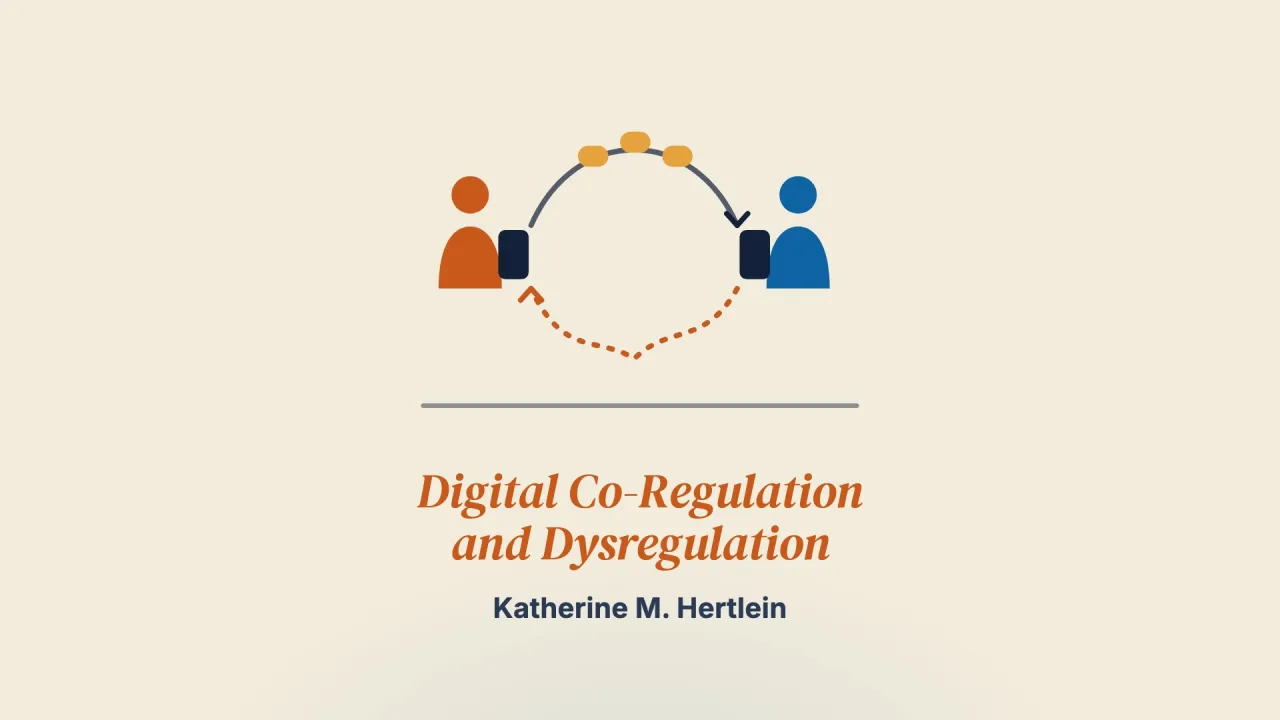 Scientific
 Digital Co-Regulation and Dysregulation in Romantic Relationships: A Systemic Model of Technology-Mediated Emotional Processes
Checking, chasing, blocking: 31 interviews show how the phone regulates or dysregulates a couple’s anxiety, with a systemic model of the loop.
 Scientific
 Internal Family Systems Therapy as Part of the ‘Family of Systemic Therapies’: A Critical Exploration of Systemic Practice in the Intra-Personal Domain
Does IFS belong to the family of systemic therapies? A critical exploration, grounded in a family court vignette, of systemic work with “parts”.
 Scientific
 The Role of Parental Expressed Emotion and Loss-Specific Parental Responses in Children’s Loss-Related Outcomes Following Traumatic Loss: A Mixed-Methods Observational Study
After a road-traffic bereavement, parental criticism goes with the child's depression, positive appraisals of the loss with better well-being.
 Blog
Blog Toxic, narcissistic, borderline: what therapy speak does to your relationships
Narcissistic, borderline, toxic: therapy speak has left the consulting room. Julien Besse shows how these labels close the debate and relieve us of our own part.
Comments 0
Log in to join the discussion. Log in