AI-assisted translation
This version was translated from Portuguese by Complexe Systémique with the help of artificial intelligence. In case of doubt, the original version prevails.
Revista Brasileira de Terapia Familiar · Family business
Corporate Kite: A Tool of Narrative Therapy Applied to Business Families
In Brazil, a family-owned cargo transport company after the death of its founder: no succession plan, an eldest son criticized on all sides, a mother ready to give it all up. Eduardo Ribeiro do Val carries David Denborough’s Kite of Life over into the business world. Mission, vision, values and the organizational chart become the parts of a kite that the family builds over twelve meetings, through externalization, re-authoring and a family document.
Unofficial English translation. This article is a translation of Pipa Corporativa: Uma Ferramenta da Terapia Narrativa Aplicada às Famílias Empresárias, by Eduardo Ribeiro do Val, published in the Revista Brasileira de Terapia Familiar (ABRATEF), vol. 8, no. 1 (2019), doi: 10.60114/rbtf.v8i1.46, under a CC BY 4.0 licence. Translated by Complexe Systémique in November 2026 with the help of artificial intelligence: the original Brazilian Portuguese text has been translated into English and reformatted, which constitutes a modification of the work under the terms of the licence. Paragraphs and headings are those of the journal; the original note on the title, printed at the foot of the first page, is given here (the work was first presented, in its original version, as a specialization dissertation for the course “Intervenção Sistêmica com Famílias” at CRESCENT, certified by the Faculdades Integradas de Vitória and supervised by Adriana Müller), and the author’s biographical note is included in the presentation; the five stages of the Kite of Life are presented as a numbered list; the second section numbered 3.1 in the journal becomes 3.2; the figure remains in Portuguese, with a translated caption; Denborough’s and Ncube’s methodologies are given their English names. The abstract is the author’s own English version. This translation was made neither by the authors nor by the journal, who are not responsible for its content or for any errors. The original version prevails.
No kite takes flight without wind.
Eduardo Ribeiro do Val
Abstract
This article presents the report of a research that uses as reference the Kite of Life methodology, developed by David Denborough (2008), adapted to the organizational environment and aims to strength, by the language, the interpersonal and intergenerational relations between the members of this business family. The research object of this study is a family cargo transportation company founded in 1990. After the death of its founder, the heirs took up positions in the company. The absence of succession planning led to conflicts such as: overwork, the emotional overload of the widow, and especially the lack of common purpose of that family within the corporation. These narratives became a history saturated with problems, and the adaptation of the Kite of Life methodology to the corporate environment helped this family overcome conflicts.
Keywords: Narrative therapy; Collective narrative practices; Corporate kite; People management; Family businesses.
1. Introduction
This work sets out to present the transposition of a collective narrative practice methodology to the organizational context, specifically the application of the Kite of Life in a family business. This initiative gave rise to the Corporate Kite (Pipa Corporativa), a methodology that will be discussed throughout the article.
Adapting the Kite of Life to the business environment can be an important tool since, as Ricca (2016) reports, according to data from the IBGE (Brazilian Institute of Geography and Statistics) and Sebrae (Brazilian Micro and Small Business Support Service), more than 90% of the companies set up in the country are family businesses, and they account for 65% of the country’s gross domestic product (GDP). These figures show how closely family and business are intertwined and point to the importance of a healthy and harmonious family and business environment so that both systems can function properly.
The family business has certain particularities that set it apart from others, for example the values and bonds between its members, which are usually stronger. For this reason, the roles of each member need to be clearly specified, and there needs to be a balance between family life and corporate life, so that the climate within the company and within the family is pleasant for everyone (Oliveira, 2006). In the family setting, each person holds a different position: parents, siblings, children, grandparents, each place with its own characteristics, such as hierarchy and authority. Emotional bonds are built through living together, and ethical, moral and cultural values are passed down from generation to generation.
It can also be observed that in the corporate environment there are individuals with their titles and responsibilities to fulfil, the hierarchy of the positions laid down, and interpersonal relationships. The similarities between the family and business environments are many; in the latter, however, there are targets, values, a mission, a vision, deadlines to be met, action plans, organizational charts and a division of tasks aimed at the success and effectiveness of the company in all its areas.
Data show that only 30% of family businesses survive into the second generation and only 5% pass to the third (Oliveira, 2006). It is important to stress that companies often survive in the market but do not remain in the hands of the founding family, being sold to large conglomerates or multinationals, as was the case, for example, with the Garoto chocolate factory, a Brazilian company headquartered in Vila Velha (Espírito Santo), which belonged to the Meyerfreund family and was sold to Nestlé S/A in 2002 (Kojikovski, 2017). This happens mainly because of conflicts between family members, which affect corporate governance and, as a consequence, the company’s succession planning. When the heirs’ dedication and commitment to the business differ from those of the founder, this ends up opening the way to, or giving signs of, a possibly short life for these companies (Oliveira, 2006).
Corporate governance deals with decision-making at the top management level and with the relationships between the main actors in business organizations (Silveira, 2010). It can be defined as the set of internal and external mechanisms aimed at ensuring that corporate decisions are made in a way that maximizes the long-term value of the business, thereby guaranteeing a financial return for all shareholders. Effective corporate governance encompasses transparent succession planning, greater competitiveness and an increase in the company’s market value, and it defines, as a priority, the direction the company will take in conducting its business. In family businesses, the main risks to effective corporate governance are succession planning and the transfer of power between generations. Added to these are the absence of meritocracy, the emergence of factions between branches of the family and the difficulty of separating family matters from business matters, which are usually very present.
Given that corporate governance sets out the direction and course of the company’s business, strategic planning aims to spell out the actions that must be carried out; in other words, it is the how by which the company will achieve the objectives set in its corporate governance. Strategic planning is a managerial process that makes it possible to develop and maintain an appropriate fit between a company’s objectives, skills and resources (Kotler, 2000). It also enables managers to think about the future of the business and the best way forward. The company therefore needs to be transparent in drawing up its vision of work [what we dream of], its mission [who we are and what we do] and its values [what we believe in].
Along the same lines, Lobato, Moysés, Torres and Alambert (2003) explain that a vision can be defined as a scenario, an intuition or a dream; it defines where the company wants to go and how it wants to be recognized in the future. The mission is the organization’s reason for being and expresses, in concrete terms, how the company intends to achieve its vision. Values, in turn, reflect what the company sees as most important for achieving its vision and mission, and they are the qualities the company seeks in its relationships with customers and with the market.
For a company to develop operationally and assign its various employees, there are positions, that is, the posts in which each person will carry out their duties, usually structured in an organizational chart. Chiavenato (2001, p. 251) explains that “... the organizational chart is a graphic that represents the formal structure of a company.” The purpose of this tool is to define the company’s hierarchy, setting out the spaces and boundaries of each individual in the corporate environment. In family businesses, the organizational chart is also an opportunity for the family to review whether its responsibilities match the competencies and autonomy of each member.
Providing conditions for developing competencies and skills becomes essential when the family is embedded in a business context. For the company to grow sustainably, taking advantage of the opportunities offered by the current economic scenario, each person, individually, needs to be clear about their goal and to develop the necessary aptitudes with clarity and relational responsibility. In this way, the family and the company will be able to establish themselves solidly, with healthy emotional relationships between their members.
According to the Italian sociologist Domenico De Masi (2001), the thesis of creative idleness aims to help people reflect consciously on the distribution of time, work, wealth and power, minimizing the sources of conflict between them and valuing each person’s real needs, looking for alternatives so that overwork does not cause the individual physical and emotional exhaustion and does not, as a consequence, produce relational difficulties with the family and with society.
For this, a sharper eye becomes vital, as does the construction of a methodology capable of working with the family in its relational and business context, so that the company always grows in harmony and with stronger family bonds.
The name given to collective interventions in different communities and contexts that draw on the theoretical assumptions of narrative therapy is collective narrative practices. Several methodologies have already been developed, in Brazil and abroad, and applied in different contexts, such as the Tree of Life (Ncube, 2006), the Team of Life (Denborough, 2008), the Kite of Life (Denborough, 2008) and the Rhythms of Life (Müller, 2012), among others that seek to help a wide range of people collectively.
The Kite of Life methodology was developed in Canada, in the St. James Town community, an immigrant neighbourhood on the outskirts of Toronto whose residents were experiencing intergenerational conflict. Most families there are of Asian descent, and the culture clash became more evident when the culture into which the grandchildren were born began to differ from the culture in which the grandparents had grown up.
According to narrative therapy (Müller, 2012), our lives are organized into narratives that we story by structuring experiences into sequences of events, linked in time and connected to certain people. In this approach, problems come into being in language, that is, through each person’s discourse, and they show up in the dominant stories that people build from their relationships and from the meaning they give to lived experience. When the account is saturated with problems, it becomes necessary to access the underlying stories in order to find new ways of telling the same story.
The person thus realizes that, beyond the dominant story, the one that has always been told, there are other possibilities, just as powerful, waiting to be accessed. These alternative versions reveal people, events and skills that were always present but were not mentioned in the problem-saturated narrative. Once told, these new versions of the same story bring out rich aspects that the person did not know or did not value, and so help to build a preferred version, that is, one that shows the person at their best, in their preferred identity (Müller, 2013).
Considering that people are experts in their own lives, when they begin to examine problems as situations separate from themselves, they make it possible to recognize the various skills that help them reduce the influence of those problems on their lives. This process involves deconstructing dominant truths and constructing new underlying stories. It is called re-authoring conversation, in which the person stops being a victim and becomes the author of their own story (Almeida & Müller, 2014).
Furthermore, as Professor Adriana Müller (2013) teaches, collective interventions based on the theoretical assumptions of Michael White and David Epston’s narrative therapy generally follow a few basic principles: (a) sharing in a group, since all people respond to life’s difficulties and this knowledge can, in some way, be passed on; (b) highlighting the double storyline of stories: the story of the problem coexists with the story of how the person responded to it. The emphasis given to one version or the other determines which will be the dominant story, that is, the problem-saturated one or the one that tells how the person managed to face the problem, what they drew on for strength, what skills they used, what their abilities and values were, who helped them, among other aspects; (c) thickening the preferred story, building broader and more richly described knowledge about oneself and one’s story; (d) linking individual experiences with collective situations; (e) helping the person contribute to the lives of others going through similar situations.
The author chose the Kite of Life methodology for the business environment, calling it the Corporate Kite, drawing on the theoretical assumptions of narrative therapy, because he considers it suitable and effective for work with families in business contexts. The author hopes that this methodology can create a harmonious, welcoming and inviting environment in which people see themselves as separate from the company’s problems and feel able to write a new story.
2. Theoretical framework
Narrative therapy is a postmodern practice that began in the 1970s with the work of Michael White in Australia and David Epston in New Zealand. Its main focus is the understanding of the linguistic context as the creator of reality, so that problems come into being in language (Grandesso, 2007). It is through discourse built by everyone, in co-authorship, that problem-saturated stories are revealed, and these, drawing on the main narrative told, are captured in the dominant stories. This therapeutic approach sees people’s discourse as constructing the reality they live and aims to give voice to the stories that reveal the person’s preferred identity (Müller, 2012).
To move beyond this problem-saturated narrative and access more interesting underlying alternative stories, one of the techniques proposed by White (2012) is the externalizing conversation, which aims to separate the person from the problem, locating the problem in its wider social context and treating it as an entity separate from the person.
Once the problem has been externalized, as described in the previous paragraph, another kind of conversation fosters the development of other, richer narratives. In this sense, the re-authoring conversation seeks to help the client see the connection between their actions and their principles, beliefs, skills and qualities. To this end, White (2012) proposes a conversation that links the landscape of action (all the person’s past, present and future actions) with the landscape of identity (the person’s qualities, competencies and skills, their values, dreams and principles), inviting people to keep developing and telling stories about their lives, including some unique events and experiences, that is, situations in which the problem is not present.
Notes on the stories told are transcribed into therapeutic documentation, in order to record the preferences, knowledge and commitments that became clear throughout the process. Like any document, this one is also available to all participants, so that people can consult it at any time. This document is the participants’ voice in the process, marking important commitments and celebrating great achievements.
2.1. The Kite of Life
The Kite of Life methodology is a collective narrative practice used by David Denborough in 1998, during a project in Canada with a community of refugees and immigrants facing intergenerational problems involving differences between grandparents, parents and grandchildren, in which conflictual situations sometimes arose that needed to be understood through mutual help between the younger and older generations (Denborough, 2008).
The Kite of Life methodology has 5 (five) stages:
- Drawing the kite. This consists of drawing the Kite of Life, taking into account skills/qualities, memories, music, cultural practices, values and dreams. In the centre of the kite, the person presents the central theme of their life at that moment.
- Methodology. This refers to the wind. It is a moment of externalization and reflection on the effects of the problem, which are also drawn on paper. The importance of this stage should be stressed, since no kite takes flight without wind.
- Our response to challenges. This is what can be done to deal with the challenging winds, the skills needed to face strong winds and life’s difficulties. This stage is represented by the hand that holds the kite string.
- Producing the documentation. This is the moment to bring all the kites together and look for common points. It seeks reflection on how people can help one another and contribute to each other’s lives.
- Definitional ceremony. At this stage, time is set aside for bringing the generations together, paying tribute and flying the kites.
3. Methodology: the Corporate Kite
This methodology was created for working with business families, with the aim of broadening the conversational space and seeking unity in diversity (Freire, 1992) in order to build relational harmony. It sought to create a welcoming and inviting environment so that people, shareholders and managers alike, could see themselves as separate from the company’s problems and feel able to rewrite their story, revealing each member’s preferred identity together with the family’s and the company’s values.
The original Kite of Life methodology uses a language that can be transposed to the corporate environment, allowing it to be understood by everyone and applied effectively to address the company’s needs. Concepts such as skills, qualities, values and dreams are present in the Kite of Life and are part of the business environment. In management, skills and qualities are called competencies; the dream is what a company calls its Vision; and the logo reveals the company’s preferred identity from the perspective of its founders.
The Corporate Kite methodology unfolds in 6 (six) stages: Introduction, Strategic Planning, Preferred Identity, Goal, Building the Kite and Family Document, which are presented below together with the specific objectives of each.
Stage 1: Introduction – Aims to get to know the family and to understand what problem its members are facing and for how long.
Stage 2: Strategic planning – Building a conversational space – with the aim of giving the family a voice on vision, mission and values – which will serve for reflection on individual and collective affinities and agreements, seeking unity in diversity, and which will be used to draw up the company’s strategic plan.
Stage 3: Preferred identity – Aims to reveal each family member’s skills, competencies and values, which will serve as the foundation for building the corporate identity/logo of the company.
Stage 4: Goal – The family builds a common objective on the basis of the account of the preferred identity and of the awareness of what each member will need to develop in order to achieve the goal and thus to create or update the company logo.
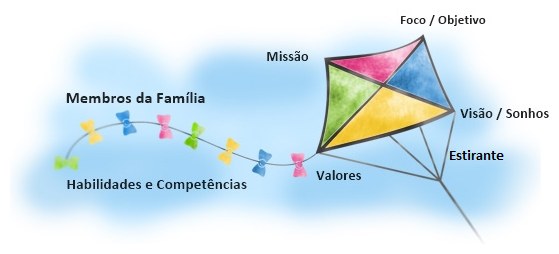
Stage 5: Building the kite – The information gathered is organized in the shape of a kite, as shown in Figure 1.
Stage 6: Family document – This is when the family draws up a document containing the aspects addressed over the course of the meetings, with the aim of guiding the family’s actions in strengthening the preferred story they have managed to build.
3.1. Tools for building the Corporate Kite
The logo – It has been there since the company was founded and may or may not be updated over time. Besides the company’s identity, it reflects the values, dreams and goals of whoever started the business. Asking about the logo is a strategic way of giving the founder a voice about their story and everything this company means. At the same time, when the successors in a family business look at their logo and hear the story told about it, they can make the intergenerational connections that will allow the values of the company and of the family members to be updated.
The bridle (estirante) – This is the structure of the Corporate Kite, and it has a double function: it is what allows the kite to take flight, but it can also be locked by the hands of whoever handles it, preventing and/or limiting flight. This scenario can also be reconstructed in the business context. Very often, what at one moment may be a company’s distinctive feature and competitive advantage may, at another, be a factor limiting its growth and development.
The wind – This is the determining factor that makes a kite take off and stay aloft, and it can be perceived in the family and in companies. For the family, the wind is what keeps it alive and united, with each member playing their role, carrying out their activities and developing their skills. For the company, the wind is the economic scenario in which it operates and how it will behave in the face of it. Strong winds and storms can and should be taken as opportunities for the family to review its principles and values and to seek unity and harmony, despite all the differences between its members. It is in the relationship between the kite and the wind that it will be able to take flight, whether the weather is stormy or calm. This dynamic will always be present in the family, whether inside or outside the company, and the methodology aims to offer family members resources for dealing with each wind that comes along, always seeking family unity and harmony.
The next step is to identify which family member will hold the kite. In the methodology, this person exercises authority by embodying the family’s and the company’s values, and must be recognized by everyone, by consensus, in order to support the family and the company.
Finally, the structuring of the Corporate Kite and the Family Definition Document serve to validate this process before the members of the family and of the company, making it possible to identify the aspects present in everyone’s lives and how the group can help one another to reach the common objective.
3.2. An idea to consider
This research was based on a case study of a family cargo transportation company founded in 1990 and with approximately 95 employees. The family presented here is made up of a mother (Amélia) and three adult children (one of them is called João, and he will be discussed in the procedures and analysis of results), all equal partners in a cargo transportation company. To keep the participants’ identities confidential, all the names given here are fictitious. The procedure consisted of fortnightly meetings between the four heirs, since one of them lives in a different state from the company’s headquarters, alternating with weekly visits to the company’s headquarters and individual sessions according to the needs that arose.
At the first meeting, we introduced ourselves and sought to understand the current situation of the family and of the company. The situation described had been fertile ground for interpersonal conflict, mainly involving João, the founder’s eldest son. Another aspect causing discomfort to part of the group was the fact that the youngest son had taken over the management of the company after the father’s death without any succession planning. These narratives had been drawing the managers’ focus away from the workplace and, as a result, the mother went so far as to propose that, if the conflicts between her children could not be resolved, she would give up the family business.
After an actual analysis of the situation of the company and of the family, an attempt was made to separate the two. The next step in the methodology was to explore the skills and competencies of each member of the group. In the organizational context, it is of the utmost importance that each person carries out their duties in line with their aptitudes.
Thus, at the second meeting, the family welcomed the option of structuring the organizational chart to help eliminate relational conflicts, developing it by listening to each family member about the activities they like, as well as those they do not identify with. At this point, the duties performed by each person were described, and the points in the process where conflicts were frequent within the company were identified.
At the third meeting, it was proposed that the family try to understand the issues raised by each member, so that the other’s needs could be known and taken in, with the aim of helping to build the organizational chart. Each member was invited to think about and name their aspirations, dreams, values and skills, so as to be able to align them with those of the company. At this stage, the question most explored was: what are your dreams, expectations and purposes for this company?
At the fourth meeting, caught up in the company’s critical routine, the group once again began to highlight the problems previously reported regarding João, such as failure to follow procedures and his rude way of relating to people, which led to staff being lost, among others.
At the fifth meeting, the group recounted a significant moment in the family’s history, when the father, already ill, bought a vehicle that had been the great dream purchase of his life and decided to take a car trip with his wife and children. The trip was a time of deep relaxation, with moments of leisure and dialogue among all the family members. This episode was seen by the whole group as a special occasion.
At the sixth meeting, the members mentioned how much the family’s history is based on work, a value passed on by the father and still upheld by the children today. However, the group realized that this value had changed the relationship between them, opening the door to conflict, criticism and disqualification and drawing them into a problem-saturated story. The group understood that it was time to revisit this version of the story and to undertake a re-authoring process in which the value of work would remain present but be blended with other values that are also important for the family’s current life: creative idleness, time with the family, sharing experiences of success, among others.
At the seventh meeting, the group reported that João, from the age of 16, had been the son delegated by the father to open new business fronts in other states. This strategy remains in place, and no one ever considered how João felt at not finding in the family the support he wanted; on the contrary, he was a frequent target of criticism.
At the following meeting, João spoke of the resonance between his story and his parents’ story and shared that he was going through a difficult period in his marriage, so that he needed to rethink his life. He proposed that the group settle the company’s organizational chart once and for all, so that he could clearly recognize his place and his responsibilities and, from there, plan his personal and professional life.
Questions were raised about the branch in another state and about the possibility of another brother taking it over, given that it is essential and strategic for expanding the company’s business, besides being very profitable. However, no one was willing to do so, which showed the group that João was the only member available and with the skills to take on such a responsibility. In this way, an environment was created in which everyone committed to helping him, and the group realized the importance of validating João’s assertive attitudes, giving him the support he needed to develop the competencies inherent to the position in question.
From then on, each member began to talk about the moments when they had seen João behave assertively or positively, such as meeting clients, visiting work sites, and monitoring and installing machinery at client companies. These are some of the activities he carries out with pleasure and that the group sees as a skill for managing these processes. These moments served as anchors for dissociating him from the problem.
With all these steps completed, the ninth meeting allowed each member of the family to write down their skills and competencies, with the aim of aligning their purposes and jointly building the company’s objectives, its mission, vision and values. In this way, it was possible to draw up the Strategic Plan and structure the organizational chart.
The following three meetings were used to coordinate the information using the metaphor of the Kite: who are the people involved in the process, what personal and family values do they want to see put into practice in the company’s routine, what mission and dreams are they seeking to achieve, what is the objective of this family unit, who is the person holding the bridle at this point in the company’s history, and how has the family been dealing with the winds that blow?
4. Analysis and discussion of results
To begin the analysis of the use of the Corporate Kite methodology in the organizational environment, it is worth mentioning first the difficulty of working on personal matters within a company. Unfortunately, most of the people who live in this atmosphere day to day become so caught up in the company’s critical routine (processes, targets, deadlines, results) that they fail to see the importance of building an assertive and broad conversational space to address the needs of these environments, family and business.
The methodology proved useful because it reached both areas while reducing the resistance this company’s executives had shown towards therapy, by using language that was accessible and close to the business context. The adaptations made to the Kite of Life for the corporate environment proved easy for the company to accept, apply and assimilate. This was possible because the narrative therapy approach enabled integration between the different areas, since it is concerned with helping people build narratives that reveal their best, their preferred identity.
In the specific case of this company, it was necessary to shift the focus away from the problem, anchoring the group in the set objective – the organizational chart. To this end, externalizing conversations were used in the first four meetings, with the aim of separating the people from the problem.
From the fifth meeting onwards, the technique used became the re-authoring conversation, with the aim of validating João’s assertive attitudes and leading the group to reflect on the value of work, blended with other values that are also important for family life: creative idleness, time with the family, sharing experiences of success.
In this company, it became clear that its members’ skill at being focused on work had become a limiting factor, since it caused the managers physical and emotional exhaustion owing to the lack of time for rest and leisure. There were also excessive demands within the group and discomfort among the heirs, since one of them did not want to live solely and exclusively for the company, and this was the focal issue of discussion between the brothers. The family realized that each of them, at one time or another, suffered the harmful effects of disqualification, sometimes as its authors, sometimes as its recipients. This pattern of criticism and imposition also limited the development of communication and expression skills, so that this family always circled around the problem. These issues were addressed up to the eighth meeting.
In the last four meetings, building on the improvement in the members’ ability to communicate and on the construction of the Corporate Kite, it was possible to talk about important points: the definition of the company’s vision, mission and values on the basis of this new arrangement, as well as each person’s preferred identity.
The group also considered the difficulty of finding moments to talk about matters other than work and came to understand that this process lends itself to reflection and makes it possible to share personal needs. In the same measure, integration, respect and the making of agreements with effects on both the family and the corporate environment become possible. This practice also supports corporate governance.
This becomes clear when the group, at the twelfth meeting, chooses the mother as the one who will hold the bridle of the Kite, taking on her role as the family matriarch, the father’s representative and guardian of the family’s values, keeping this family unit together around the same purpose at this time, and organizing christening parties, baby showers, birthday celebrations and Christmas, so that the children can be together, talking about a variety of subjects (sport, travel, cooking) and strengthening their emotional relationships.
Finally, the members drew up a document containing all the aspects highlighted during the collective process, giving concrete form to a new version of the life story of the family and of the company, built by everyone and duly agreed by each of its members. To do so, the group went back to the story of the car trip and realized the importance of the values the father had wanted to teach in the last months of his life, when he decided to go on a trip with the family. On that trip, the subject of the company was not present. They were moments of leisure and pleasure, in which the focus shifted to interpersonal relationships.
At that point, they realized that the company was the only point of connection and conversation between them, and they also understood that they needed to write a new family story. From this understanding, dinners, special dates and celebrations became opportunities to be together without company matters being discussed. This realization was so important for the group that it was one of the items addressed in the collective documentation.
The main aspects of this document were:
The importance of the father’s story, values and legacies: the patriarch’s skills that remain present in the company (focus, determination, perseverance), together with devoting time to leisure, to creative idleness. The family resolved to enjoy pleasant moments without the subject of the company being present.
Setting out hierarchy and boundaries within the company: the new organizational chart was built by consensus, respecting individual skills and preserving each person’s boundaries and space.
Seeking to validate the other: the collective agreement to value assertive attitudes, and respect for the differences and individuality of each member of the group.
The family’s commitment to holding gatherings that deepen family bonds: family lunches, christenings, baby showers, celebrations of special dates.
Management and action planning for the company: monthly meetings between the managers to review guidelines. The group resolved to deal with and discuss issues before they turned into a new problem, and these meetings would be held at the company and during business hours.
The therapeutic documentation was extremely important in helping this family remember the key points of the process, moving beyond the problem-saturated stories and building new narratives from the preferred story they told.
Final considerations
Using management principles together with the theoretical assumptions of narrative therapy was essential for working with this family in the business context. Dissociating the family from the problem broadened the group’s conversational space, and the focus shifted to each person’s skills and competencies and to how these could be put to better use both in the family and in the company.
Strategic planning (mission, vision and values) and human resources (organizational chart and people management with an emphasis on skills and competencies), together with the theoretical framework of narrative therapy (externalizing conversation, re-authoring and therapeutic documentation), with the aim of locating problems in their wider social context, identifying competencies and sharing skills, and the clarification of actions with a common purpose were opportunities that allowed the family to broaden the dialogue between its members, freeing themselves from problem-saturated stories and writing a new story.
These new narratives could be written and built together from the moment the Corporate Kite methodology brought different areas of knowledge together to work with this specific context, namely the corporate environment. In thinking about the organizational chart, the preferred identity was revealed; in building the strategic plan, a re-authoring took place in search of common values; and in learning to separate family and business spaces and to value the person in both – rather than the problem – there was the externalizing conversation.
Another relevant aspect for the group, after the Corporate Kite had been built, was each member’s personal satisfaction at being placed in the organizational chart in a position matching their individual skills and aptitudes. The company’s management and action planning were also revised through monthly meetings between the family members who manage it. Issues began to be discussed and addressed before they turned into a new problem-saturated story. These meetings were held at the company and during business hours.
The Corporate Kite methodology thus proved useful for opening a broad, interactive, constructive and collaborative dialogue between members of a family who work together in a family business, making corporate governance effective and contributing to the company’s growth in step with the strengthening of family bonds.
Complexe Systémique: key points
Drawn from a specialization dissertation, this text is less a demonstration than a proposed bridge. It translates collective narrative practices into the language of management (mission, vision, values, organizational chart), and this is probably what disarms the wariness of an executive team with little appetite for therapy. Several moves can be carried over: asking about the logo as a story of origins, treating the father’s car trip as an exception to the dominant story of work, freeing João from the label of the problem son by noticing what he does well. The limits are clear: a single case, no data collection described, outcomes reported by the practitioner himself, who combines family sessions, company visits and individual sessions without the contract or confidentiality being discussed. One may also ask whether the preferred identity slides into a corporate identity, and whether the role given to the mother, guardian of values and organizer of celebrations, reproduces a traditional place rather than questioning it. Read alongside the structural approach applied to companies, and the Tree of Life in a women’s group with fibromyalgia.
References
Almeida, B. B., & Müller, A. (2014). Jardim de flores: Uma experiência com grupos de famílias no contexto da socioeducação. Revista Nova Perspectiva Sistêmica, 23(49), 73-87.
Chiavenato, I. (2001). Introdução à teoria geral da administração (6ª ed.). São Paulo: Campus.
Demasi, D. (2019, julho). O ócio criativo. (2ª ed.). Rio de Janeiro: Editora Sextante.
Denborough, D. (2008). Collective narrative practice: Responding to individuals, groups and communities who have experienced trauma. Adelaide: Dulwich Centre.
Freire, P. (1992). Pedagogia da esperança: Um reencontro com a pedagogia do oprimido. São Paulo: Paz e Terra.
Grandesso, M. (2007). Narrativas: histórias, histórias e mais histórias. São Paulo: Casa do Psicólogo.
Kojikovski, G. (2017). Os quinze anos de vaivém entre Cade, Garoto e Nestlé. Revista Exame. Retirado em 17/08/2019 https://exame.abril.com.br/negocios/os-15-anos-de-vaivem-entre-cade-garoto-e-nestle/
Kotler, P. (2000). Administração de marketing: A edição do novo milênio. São Paulo: Prentice Hall.
Lobato, D. M., Moysés, J. F., Torres, M. C. S., & Alambert, R. (2011). Estratégia de empresas. Rio de Janeiro: FGV.
Müller, A. (2012). Troca de cartas no time da vida: Um bate-bola construtivo. Revista Nova Perspectiva Sistêmica, 21(42), 42-56.
Müller, A. (2013). Ritmos da vida: Ajudando crianças na superação da separação. Revista Nova Perspectiva Sistêmica, 22(45), 34-46.
Ncube, N. (2006). The Tree of Life Project: Using narrative ideas in work with vulnerable children in Southern Africa. International Journal of Narrative Therapy and Community Work, 1, 3-16.
Oliveira, D. P. R. (2006). Empresa familiar: Como fortalecer o empreendimento e otimizar o processo sucessório (2ª ed.). São Paulo: Atlas.
Ricca, D. (2016). 95% das empresas familiares são extintas no processo de sucessão à segunda ou terceira geração. Retirado em 17/08/2019 https://www.segs.com.br/seguros/14328-95-das-empresas-familiares-sao-extintas-no-processo-de-sucessao-a-segunda-ou-terceira-geracao.html
Silveira, A. (2010). Governança corporativa no Brasil e no mundo: Teoria e prática. Rio de Janeiro: Elsevier.
White, M. (2012). Mapas da prática narrativa. Porto Alegre: Pacartes.
Unofficial English translation of Pipa Corporativa: Uma Ferramenta da Terapia Narrativa Aplicada às Famílias Empresárias, by Eduardo Ribeiro do Val, Revista Brasileira de Terapia Familiar, vol. 8, no. 1 (2019), doi: 10.60114/rbtf.v8i1.46, under a CC BY 4.0 licence. Translation (with the help of artificial intelligence) and layout: Complexe Systémique, November 2026 — the work has been modified under the terms of the licence (figure in Portuguese, caption translated). Neither the authors nor the journal are responsible for this translation; the original version prevails.
Unofficial English translation of “Pipa Corporativa: Uma Ferramenta da Terapia Narrativa Aplicada às Famílias Empresárias”, published in Revista Brasileira de Terapia Familiar (2019) under a CC BY 4.0 licence. Made by Complexe Systémique with the help of artificial intelligence, it does not come from the authors or the journal, who are not responsible for its content; the original version prevails.
Read the original articleHow to cite this article
Val, E. R. do (2019). Corporate Kite: A Tool of Narrative Therapy Applied to Business Families (Complexe Systémique, Trans.). Complexe Systémique. https://app.complexe-systemique.com/en_GB/articles/corporate-kite-a-tool-of-narrative-therapy-applied-to-business-families (Original work published in 2019 in Revista Brasileira de Terapia Familiar, v. 8, n. 1 (2019); republished in 2019 by Revista Brasileira de Terapia Familiar, https://revbrasterapiafamiliar.abratef.org.br/revista/article/view/46)
To go further
- A systemic structural approach in companiesA company read through the structural approach.
- The Use of the Tree of Life in a Women's Group With FibromyalgiaAnother collective narrative practice in Brazil.
- Externalizing the problem in therapySeparating the person from the problem.
Related training courses
 Symposium
État des Lieux: a psychological approach to spaces
Replay of the “État des Lieux” conference (Paris, 16 October 2026): Ivy Daure, Maurizio Frisina, Viola Sallay and Gilbert Pregno on places as a clinical resource. In French.
 Short course
The new arenas of couple therapy: work, money, tasks and co-existence
Online training: working with conjugal tensions around work, money, mental load and household tasks. Systemic reading and tools. In French.
 Short course
The subtle art of humour in therapy: seriously funny
Online training: mobilising humour as a systemic intervention tool — reframing, stance, ethics. A lively day with Caline Fattal. In French.
 Online course
Master the use of the Amour Monstre floating object in systemic therapy
Train with Ivy Daure, creator of the tool, in the Amour Monstre floating object: protocol, systemic questioning and filmed simulations. 8 hours of video, in French with English subtitles.
Related articles
 Blog
Why do we feel we are behind in our lives?
Checking how old Yalom was when he published his first book reassured me. But in which race? A systemic look at the feeling of being behind, and at what we can change together.
 Scientific
The Duogramma®: An innovative methodology for psychotherapy
A map of the couple relationships lived, desired or rejected since childhood: the Duogramma®, its graphic rules and its use in individual therapy.
 Scientific
Collaborative Polyphonic Writing as Therapeutic Practice: A Longitudinal Case Study
A patient and her therapist co-write her autobiography: the psychiatric diagnosis becomes one voice among others, coordinated by an “I as a writer”.
 Scientific
“Tired of Being Tired”: Intergenerational Trauma and Relational Bridging Among 1.5‐Generation East African Refugees
Sixteen Somali, Oromo and Ethiopian refugees who arrived as children describe their role as bridges between generations, between inherited silences and burdened resilience.
Comments 0
Log in to join the discussion. Log in