The British Journal of Social Work · Social work
Digital Relationality, Rights, Resilience: Conceptualising a Digital Social Ecology for Children’s Birth Family Relationships When in Care or Adopted
Video calls, messaging apps, social media: since the pandemic, the bond between children in care or adopted and their birth family also runs through screens. Mandi MacDonald’s team, between Belfast and Sydney, refuses to call this contact “virtual” and rereads Bronfenbrenner to propose a digital social ecology built on three R’s: relationality, rights, resilience.
This is a reformatted republication of Digital Relationality, Rights, Resilience: Conceptualising a Digital Social Ecology for Children’s Birth Family Relationships When in Care or Adopted, by Mandi MacDonald, Amy Conley Wright, Amanda Taylor-Beswick, Kathryn Gillespie and Susan Collings, published in The British Journal of Social Work (Oxford University Press) (2023), doi: 10.1093/bjsw/bcac140, under a CC BY 4.0 licence. Prepared by Complexe Systémique in September 2026: the authors’ text is unchanged; the layout has been adapted for reading online, which constitutes a modification of the work under the terms of the licence. End-of-article statements are grouped in the notes. This edition was made neither by the authors nor by the publisher, who are not responsible for its content or for any errors. The original version prevails.
Whilst technology-mediated contact is characterised as ‘virtual’, the relationships it facilitates and emotions it generates are very real within children’s social ecology.
Mandi MacDonald, Amy Conley Wright, Amanda Taylor-Beswick, Kathryn Gillespie and Susan Collings
Abstract
The use of digital communication technology by children residing in out-of-home care or adopted from foster care has mainly been approached hesitantly and from a risk paradigm. The Covid-19 pandemic catalysed many digital and social work intersections, including practices used for birth family contact where in-person visits were supplemented or replaced with ‘virtual’ contact via digital devices. Whilst technology-mediated contact is characterised as ‘virtual’, the relationships it facilitates and emotions it generates are very real within children’s social ecology. Digital ubiquity in social life and the rapid pace of technological change presents significant ethical and practical tensions. To help social workers navigate this complexity of ‘contact-in-reality’ and facilitate safe, ethical use of digital communication technology for birth family contact, we connect an understanding of the dynamics of birth family contact with literature on children’s use of digital technology and ecological concepts of person-in-environment to offer a digital social ecology heuristic for social work practice. Three key aspects cut across all systems and levels, referred to here as the three Digital R’s: digital relationality; digital rights; and digital resilience. Future research is needed to understand how these dynamics play out.
Introduction
Prior to the Covid-19 pandemic, engagement by social workers with online technologies was under-developed, despite considerable evidence to support its relevance (e.g. LaMendola, 1987; Rafferty, 1997). Calls for the profession to address its digital skills gap had largely been ignored (Taylor, 2017; Zgoda and Shane, 2018) and an understanding of how technology intersects with the social and supports practice had been lacking (Susskind and Susskind, 2015). To mitigate the spread of Covid-19, governments in the UK and Australia, where the authors are located, and elsewhere imposed rules, such as physical distancing. The reduced opportunity for in-person interactions led to significant acceleration in technology-supported practice (Yadav and Yadav, 2022) including to replace or supplement in-person child safeguarding, care planning and reviews; however, it was birth family contact in foster care and adoption where its use flourished (Copson et al., 2022). This practice shift, reactive and circumstantial rather than proactive and visionary, increased technology acceptance but also surfaced challenges of navigating contemporary hyper-connectivity. Whilst social workers had largely approached the use of mobile phones and social media by children in care or adopted with hesitancy and from a risk paradigm (Hammond et al., 2018), the benefits of digital technologies for supporting relationships became more apparent and appreciated in the Covid-19 era, with the caveat that digital practices develop in safe and ethical ways (Neil et al., 2020; Barnett-Jones and Manning, 2021; Ciftci et al., 2022).
This article connects literature on children and young people’s use of digital communication technology with understanding of the dynamics of birth family contact in out-of-home care and adoption, informed by our prior research (MacDonald, 2018, 2021; Collings et al., 2022), to conceptualise the realities of digital contact as part of the child’s social ecology. Our aim is to offer social workers involved in planning, reviewing and supporting contact a conceptual framework to help navigate this new terrain by underscoring how the digital has transformed social ecology and focusing on three key issues that relate to contact: digital relationality; digital rights; and digital resilience.
Not just virtual: the digital as part of the social ecology
Digital technologies now infiltrate all aspects of an individual’s social ecology (Crawford and Schultz, 2019; Fuchs, 2021) such that it is practically impossible not to be part of the hyper-connected digital world, wherein every keystroke or swipe has consequences (Eubanks, 2017; Noble, 2018; Benjamin, 2019). The ubiquity of digital communication technology necessitates a rethink of some fundamental assumptions underpinning social work, to better reflect human social interaction in the contemporary socio-technical context, where people and technologies intersect and interact, and to consider the role of the digital in social ecological systems (Bronfenbrenner, 1979).
In social work, ecological thinking is often operationalised through the person-in-environment perspective. This paradigm originates from the work of Richmond (1922), who emphasised that practice must consider the milieu in which life is experienced. The person-in-environment perspective has been accepted as fundamental to the social work knowledge base, and informs ecological understandings of resilience (Ungar, 2011). To promote positive outcomes for care-experienced children and young people, there is a need to focus on the interconnection between their individual capacities and characteristics, their access to social resources and the way they interact with these resources in their social world (van Breda, 2018).
Reflecting on how the digital is reshaping the social ecology, the conceptualisation being proposed builds on the person-in-environment, offering ‘contact-in-reality’ as the lens through which to analyse and support connection, which has become necessarily technology-involved. The sociotechnical orientation highlights the bi-directionality of interactions between people and technologies recognising that these interactions are not always person-led, person-centred or mutually agreed. This extends on the concept of ‘digital dualism’ (Jurgenson, 2012, p. 83), which challenges the popular notion that online social worlds are somehow less real (Rettie, 2004), or that technology-mediated interactions are a simulacrum, as implied by the term ‘virtual’.
For children in care or adopted from care, the relational complexities and emotional significance of their birth family interactions should not be minimised (Neil et al., 2020; MacDonald, 2021; Collings et al., 2022). All contact arrangements, whether facilitated in-person or remotely, must be sensitive to how the potential legacy of trauma can be activated. Trauma involves emotional responses to threatening experiences; when children experience threat from an attachment figure, as occurs with child abuse and neglect, this can interfere with emotional regulation and cognitive processing (van der Kolk, 2003). Whilst technology-mediated contact has commonly been characterised as ‘virtual’, the emotions it generates are very real, as are the relationships it is intended to facilitate (Neil et al., 2020). The term ‘virtual’ has inhibited our understanding of the opportunities, challenges and subjective realities of interactions involving digital communication technology which are part of the social ecology of children and young people in out-of-home care or adopted, and this article considers what this ‘contact-in-reality’ conceptualisation means for birth family contact.
A digital social ecology for birth family contact
The social work role in relation to contact is often to mediate and negotiate interactions within and between the child’s various social systems. The ‘digital social ecology for birth family contact’, underpinned by ecological systems theory (Bronfenbrenner, 1979), frames digital technology as an integral part of, and bridge between, the various social systems, to help navigate the implications of technology for practice.
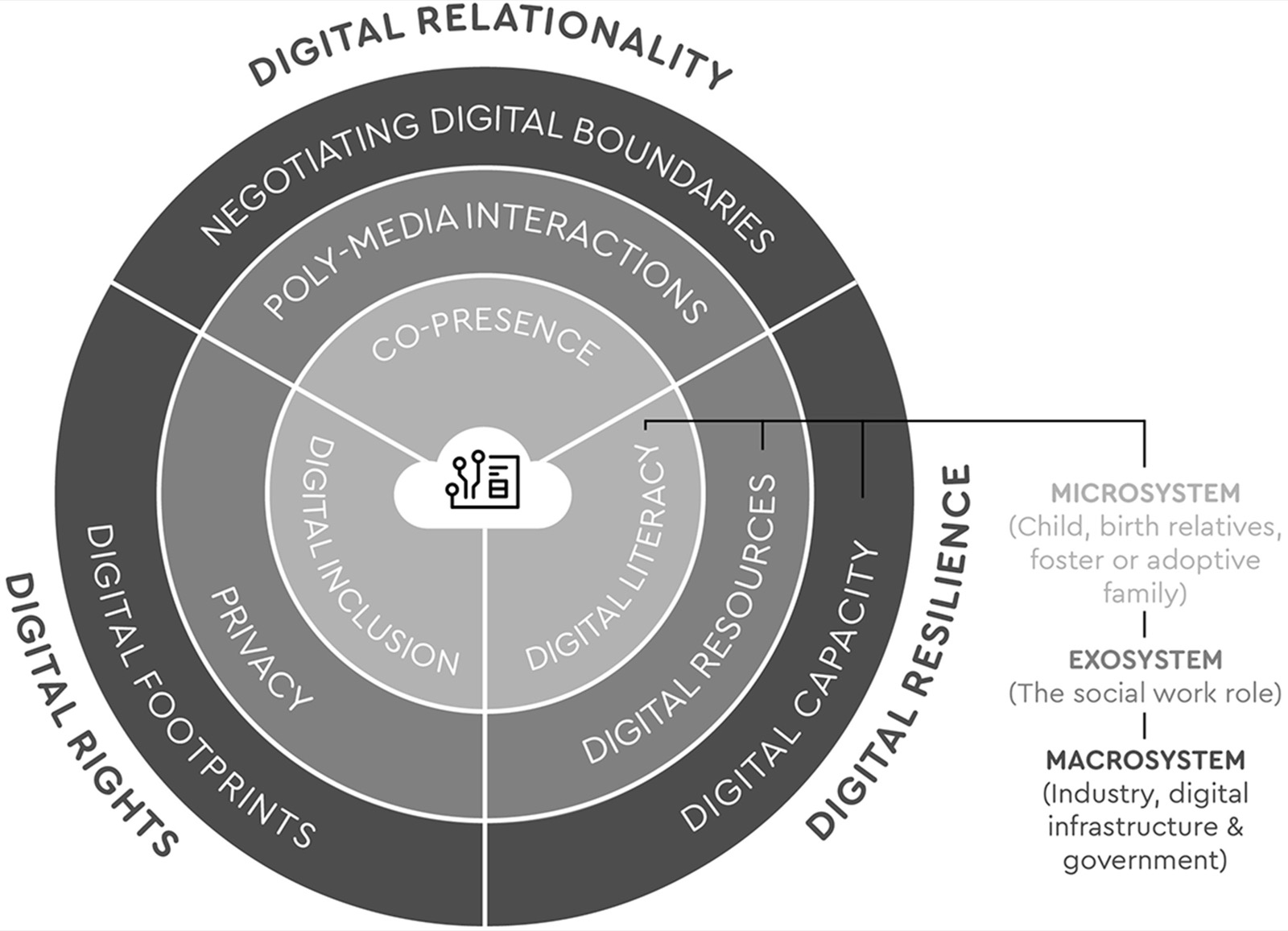
Considering the reality of contact today, it is apparent that communication technologies are a principal element of the mesosystem and a medium through which relationships can be enacted within and between birth and adoptive or foster family microsystems, and between the child and these dual microsystems of which they are a part. As such, technology has the potential to change and prescribe the nature of that communication, both by imposing technology-specific constraints and enabling new possibilities for interacting within and across systems. Technology-involved interactions are also an increasingly essential part of the macrosystem in terms of the communication infrastructure and the laws, governance practices, social policies and economic and educational resources that determine access to and use of this infrastructure (Crawford and Schultz, 2019). Social workers, as key elements in the exosystem, are themselves constrained and enabled in their role by the realities of how the digital operates at the macro- and microsystems levels.
This brief synopsis illustrates that birth family contact in the digital age is a complex system with multiple interlocking forces that profoundly shape relationships between children and their families. We, therefore, offer the digital social ecology for birth family contact (Figure 1) as a heuristic for social workers engaging with the proliferation and infusion of the digital in the specific practice context of birth family contact. To further assist with navigating this reality, the ecology focuses on three key aspects that cut across all systems and levels, namely, the three Digital R’s: digital relationality; rights and resilience.
Digital relationality
The purpose of contact is to facilitate sustained meaningful relationships between children and young people and their birth families. A question to ask about digital technology is whether it can facilitate the complex relational dynamics associated with contact. Many children and young people are adept at interacting and maintaining relationships via technology. Some studies indicate that digital mediums may facilitate personal disclosure or sensitive discussions (Vincent, 2015; Chan, 2016; Gibson and Trnka, 2020) as they reduce non-verbal inhibitors (Best et al., 2014) whilst others note a preference for in-person communication to discuss worries and resolve disagreements (Children’s Commissioner, 2018). Even in digital spaces, children and young people may prefer to exchange support with individuals they know offline, and with whom they have trust (Gibson and Trnka, 2020).
Co-presence—virtual proximity
Digital communication between relatives has become an almost compulsory family practice (Holmes and Wilding, 2019), so birth, adoptive and foster families, are not alone in seeking emotionally significant relationships via technology with individuals living elsewhere. Studies of transnational families highlight how digital communication technology allows geographically separated relatives to engage in family practices from a distance, even performing and delegating parental roles via smartphone (Waruwu, 2022). The types of direct interaction that occur in a shared physical space can also take place via communication technology, for example talking on video conferencing platforms enables people to be visibly co-present in the shared digital space. Even when not involved in direct synchronous communication, family members can achieve co-presence which involves a perception of mutual attention and emotional engagement (Campos-Castillo and Hitlin, 2013) and a sense of emotional closeness, togetherness and being there for one another despite physical separation (Urry, 2002; Baldassar et al., 2016).
Older children can exercise agency in these distant exchanges by initiating and administrating family groups, or using technology creatively to construct family narratives (Kędra, 2021). For refugee young people, creative use of technology allows imaginary co-presence through digitally edited images that symbolically represent what relationships could be like were circumstances different, signifying an imagined family experience that cannot be achieved but which, nonetheless, constructs a sense of family (Robertson et al., 2016).
Contact offers the potential for identity development by enabling children to understand their origins and we need to understand how this process is impacted by digital communication technology. For young people, social media can be a platform for social comparison (Hur and Gupta, 2013) and a tool for identity formation (Swist et al., 2015). Taking ‘selfies’, for example, gives children editorial control over the image (Phippen, 2017) and allows experimentation with self-representation and a chance to discover how others perceive them (Vincent, 2015).
Digital alteration of photographs can, however, negatively impact on children’s self-image (McCrory et al., 2020), and raises questions about their capacity to critically read and judge other people’s online self-representations. This is particularly pertinent for children who lack a stock of memories or life story details, against which to assess the authenticity of birth relatives’ online self-representations, potentially leaving them ill-equipped to make informed choices about the nature of their relationship.
The way that digitally mediated proximity is practiced must acknowledge that close relationships can entail positive and negative aspects (Holmes and Wilding, 2019), and that close engagement with birth relatives can be emotionally ambiguous or actively distressing (Boyle, 2017). Relationships conducted through technology are shaped by their unique social, emotional and cultural history (Baldassar et al., 2016); technology enables what already exists but is an inadequate vehicle for resolving relational difficulties (Madianou, 2016).
Polymedia interactions
Digital applications and devices offer various modes of communication, with different levels of proximity and ways of being co-present. Amongst the range of communication choices—or polymedia—video calls may offer the most intimate and immersive experience (Waruwu, 2022) as hearing and/or seeing one another can add depth of meaning (Shier, 2021). Alternatives to synchronous conversation include non-verbal mediums such as photo-sharing, typed chat or emoji exchange, allowing expression of information and emotion. Digital greetings cards and photo-sharing enable visual co-presence and casual sharing of experiences (Cabalquinto, 2020) that can facilitate close engagement in day-to-day life (Kędra, 2021). Compared to letters, these various modes of asynchronous communication can make it easier for children and birth relatives to share thoughts and feelings in a more contemporaneous way (Barnett-Jones and Manning, 2021).
Technology can offer children less intense and onerous ways of connecting with birth relatives when these relationships are complex or emotionally challenging (Simpson, 2020; Waruwu, 2022). The ephemeral nature of messaging features on some social media platforms (Quinn, 2019) offers a helpfully fleeting mode of staying in touch, and the ‘like’ function on social media posts offers a spontaneous and instantaneous means of connecting without the concentrated focus of in-person contact, alleviating the pressure for a lengthy reply (Shier, 2021). The multiple uses to which devices can be put may simultaneously help young people manage boredom or uncomfortable interactions (Vincent, 2015), making them a valuable asset during voice or video calls. The range of communication applications potentially gives them agency to control the pace, frequency and timing of interactions, and the ability to use the features of the platform to impose rules for acceptable communication (Kędra, 2021).
Remaining connected via technology, however, requires time and effort and can be emotionally exhausting (Kędra, 2021). It requires participants to exercise care and sensitivity for the emotional experience of the person with whom they are communicating (Alinejad, 2019). If children cannot stay focused on the interaction or lack technological competence, this can result in misunderstanding, stress or conflict, thus widening the emotional gap between individuals (Waruwu, 2022).
Negotiating digital boundaries
A key tenet of trauma-sensitive practice is that relational security with primary caregivers should be promoted, and unnecessary intrusion or strain on family life avoided (Purvis et al., 2015). The emotional realities of technology-mediated communication must be managed and the work of achieving meaningful co-presence balanced with boundary work. The overuse of digital technology in the home and disagreements over parental monitoring can lead to family conflict (UNICEF, 2017). Further concerns over the potential intrusion into family life for young people in or adopted from care, centre on the potential for them or their birth relatives to initiate new unmediated contact, with possible ramifications for placement stability (Children’s Commissioner, 2017), often without the knowledge or mediation of carers or adoptive parents. This can be destabilising or present safeguarding risks, especially in early adolescence, when young people’s digital skills might outstrip their emotional maturity.
Boundary management is not entirely at the discretion of the technology users, as the digital ecosystem has much to benefit from promoting connection. Digital applications are developed primarily by global commercial corporations (Fuchs, 2021). Many applications function to extend and increase the size of users’ social networks and are driven by algorithms that identify and suggest new connections (Crawford and Schultz, 2019), regardless of any safety or privacy concerns for the individuals, and operating largely beyond their control (Eubanks, 2017; Keddell, 2019).
Social media applications also operate to keep users engaged with existing networks, for example through constantly refreshed ‘news feeds’. These commercial features are not developed with the needs of care-experienced children and young people in mind. In the absence of bespoke technology, they and their families can only use these commercially driven products, the feature of which can lead to children being ‘always on’ (Simpson, 2020; Shier, 2021). This constant, pervasive, peripheral awareness of online friends and family in strong relationships can offer some emotional reassurance, but in weak relationships can lead to conflict and unwanted surveillance (Madianou, 2016).
Some technological features can, however, be used to facilitate clearer boundaries and control through use of privacy settings or muting functions (Greenhow et al., 2017; Simpson, 2020; Shier, 2021). Text messages, for example, allow the sender to limit the disclosure of personal information such as location or appearance, particularly when interactions risk being intensely emotional or confrontational (Waruwu, 2022). Young people can engage in dis-connective practices, without exiting from applications entirely (Zhao, 2019), choosing their mode and timing of connection and disconnection in order to maintain a balance of autonomy, privacy and proximity.
In summary, digital communication can be used to enable children to interact positively with their birth family members, contributing to relationship building and identity formation, when social workers encourage attention to the different opportunities presented by various media and technologies, to boundaries and to the emotional responses and safety of children and family members.
Digital rights
Overall, approaches to mediating children’s use of digital technology have focused on potential harms (Livingstone et al., 2017; Global Kids Online, 2019), but there is recent emphasis on rights. In March 2021, the United Nations Committee on the Rights of the Child provided guidance on children’s rights in relation to the digital environment (UNCRC, General Comment No. 25). This calls on governments to ensure that: parents are supported in understanding the digital world; digital services are accessible to all children; and digital design takes children’s needs into account. A rights-based approach challenges the dominance of a risk paradigm and highlights the importance of children’s equality of access to devices, applications, networks and guidance, viewing Internet access as their basic right (Berners-Lee and Leith, 2021) to be achieved ethically and safely.
Digital inclusion
Children and young people themselves consider digital technology as vital, aware of both its opportunities and risks (Third et al., 2017). Supporting the child’s emerging autonomy, therefore, means overcoming the socio-economic, geographic, educational, language and age-based barriers that can lead to digital inequities (UNICEF, 2017; Brosch, 2019), and equipping them with the skills to maintain their significant connections in a digital environment. Lacking access to technology, and/or the confidence to use it, can impinge on the rights of care-experienced young people (McGhee and Roesch-Marsh, 2020), including the right to stay in contact with their parents where this is consistent with their welfare (Article 9 UNCRC) (UN General Assembly, 1989). Digital disadvantage leaves some birth relatives lacking access to Internet-ready devices, effective WiFi or phone credit, inhibiting their meaningful engagement in contact (Copson et al., 2022). Promoting inclusion for family networks is likely to require resourcing and supporting children and adults alike.
Children’s digital inclusion must be viewed through the dual lenses of participation and well-being (McGhee and Roesch-Marsh, 2020). Children have a right to freedom of expression and access to information (Articles 13, 17 UNCRC), and to be kept safe in doing so. Parents and governments face a tension between balancing children’s right to both participate and be protected in the digital world, to maximise the benefits without exacerbating existing vulnerabilities or exposure to harm (Livingstone et al., 2017; Brosch, 2019). These rights can seem conflicting, for example, when children’s rights to know about their origins simultaneously creates potential for birth relatives to contact them unpredictably (Aroldi and Vittadini, 2017).
Adult support and guidance must be developmentally appropriate, recognising the child’s increasing capacity to make their own choices (Article 5 UNCRC), as excessive risk aversion may compromise the development of resilience and autonomy (Phippen, 2017). Draft UK legislation mandating companies to safeguard users online has been critiqued as potentially curbing freedom of speech. Lack of guidance, however, is a key challenge, with new technological developments outstripping regulations and their uptake by children outpacing that of their parents (Livingstone et al., 2018). Such tensions are highlighted by children’s ability to circumvent age restrictions on social media platforms, sometimes without their parents’ awareness, and their digital proficiency in hiding online activity. To enhance children’s rights in digital spaces, platforms should employ ‘age-appropriate’ design (Children’s Commissioner, 2018); however, the usual approach is ‘age-blind’ designs that do not verify user ages and are not tailored to differing skill levels (Brosch, 2019). This means informed critical judgement is required to ascertain the appropriateness of each application or platform for the individual. Social workers need to be technologically competent to promote inclusion of children, parents and carers through support and education (Taylor-Beswick, 2021), yet often it is young people who become the technology experts for the family (Copson et al., 2022).
Privacy
Key to young people’s sense of privacy is control over the online content posted about them and access to their own posts (Sen, 2016). Many parents feature children in their social media posts through the practice of ‘sharenting’, sometimes without children’s knowledge or consent (Steinberg, 2017), leading to feelings of upset, embarrassment and powerlessness (UNICEF, 2017; Bessant, 2018; Children’s Commissioner, 2018). There are safety implications if identifying information is included, whilst tagging and reposting afford information shared online a reach and durability of which parents may themselves not be aware (Bessant, 2018; NSPCC, 2021), and for children and young people represents a loss of control over their online narratives. Legal precedents emphasise parents’ role in exercising control over the minor child (Steinberg, 2017), as guardians of their children’s privacy (Bessant, 2018), leaving children with little recourse to challenge sharenting practices.
Contact visits can be an opportunity for birth parents to take or receive photographs of children, raising the possibility that they will subsequently post these on their social media accounts. Sharing children’s achievements in this way may increase a sense of connectedness for birth parents and, when used appropriately, may contribute to establishing a positive cohesive narrative (Bessant, 2018). However, the taking and posting of images is sometimes done surreptitiously or in breach of specific contact agreements, with concerns raised about the possible lack of privacy settings on birth relatives’ social media accounts, and the extent to which children’s images might be re-shared (MacDonald, 2021). All parents and carers should be aware of the potential impact of online sharing, and explicit agreements negotiated and reinforced. Assumptions that adults have a right to post images of children should be challenged (Phippen, 2017), whilst consultation with and consent from children about the use of their images and information should be encouraged (NSPCC, 2021).
Digital footprints
Digital technology can impact children’s right to privacy (Article 16 UNCRC) in various ways: physical privacy can be violated when the use of tracking or tagging reveal a child’s image or location; communication privacy can be violated when posts are accessed by unintended recipients; and information privacy can be violated when children’s personal data are collected or processed without their understanding or consent (UNICEF, 2018), sometimes for corporate gain. For some children who have been maltreated, safeguarding privacy is important for their safety and sense of security. Young people can be made aware of privacy settings and assisted to limit their contacts and be selective about their choice of platform and audiences (Vincent, 2015). However, all social media practices have a significant material dimension, producing digital traces which can be collated to create a profile of the individual, their digital footprints or shadow, which becomes difficult to control. European guidelines indicate that states must protect the right of children to privacy and data protection and ensure that relevant stakeholders, including parents or carers, do likewise (Council of Europe, 2018). This includes the ‘right to be forgotten’ (Bunn, 2019), a right largely unknown or rarely enacted in children’s services work, and about which parents, carers and young people require education. As attention to children’s data rights is relatively recent, further research and regulation is needed to understand and meet their needs for digital access and privacy (Livingstone et al., 2018).
There is general recognition of children and young people’s rights to participate in digital communication, yet this right must be balanced with their right to safety. Social workers can encourage carers and relatives to protect children and young people’s digital privacy and consult them before publicly sharing their images or personal information online.
Digital resilience
Developing resilience is an increasing area of focus of online well-being initiatives directed at children and young people (UK Council for Internet Safety, 2019). An ecological approach to resilience addresses the interplay between the individual’s capacities and characteristics and the circumstances of their social worlds (Ungar, 2011). Promoting children’s digital resilience, therefore, includes developing their critical ability and technical competency; informing constructive parenting practices; and improving the digital expertise of relevant professionals (Livingstone et al., 2017).
Digital literacy
Digital literacy requires specific skills to communicate and interpret meaning, particularly emotional content. Many children and young people have developed some online emotional literacy and risk awareness (Vincent, 2015; Livingstone et al., 2017; Gibson and Trnka, 2020), employing similar critical judgements as they would in offline relationships (Wang and Edwards, 2016). They have been found to make responsible use of devices and applications, with awareness of their own and others’ privacy and emotional safety needs (Gibson and Trnka, 2020) and to employ coping strategies after encountering online risk, such as telling a friend or parent, blocking contacts, modifying privacy settings or leaving the site. However, those vulnerable to offline risk are less likely to be resilient online (Livingstone et al., 2017).
Digital literacy is influenced by family support (Chaudron, 2015; Phippen, 2017), and is especially effective when it maximises children’s and young people’s expertise and recognises their strengths (Swist et al., 2015). Whilst adult influences can guide risk responses, young people must be afforded agency and space to develop strategies and resilience for themselves, through access to experiential learning (Swist et al., 2015; Wang and Edwards, 2016), as part of their development toward becoming digitally autonomous (Hammond et al., 2018). Whilst few educative initiatives have been evaluated (Livingstone et al., 2017), key learning features should address peer pressure, strategies to disconnect and understanding of digital algorithms, as well as helping children and young people to conceptualise the abstract realities of the digital world and develop critical thinking, particularly to differentiate between curated, or digitally altered images, and people’s real lives (Children’s Commissioner, 2018).
Digital resources
Parent and carer digital literacy, confidence and capacity to guide and encourage their children, are a crucial support (Chaudron, 2015) that may be undermined by significant knowledge gaps regarding digital technology and online privacy (Livingstone et al., 2018). With the rapid evolution of new digital technologies, parents and carers are not always aware of the range of children’s online activities and can find it easier to anticipate risks than identify benefits (Kumpulainen and Gillen, 2017). Passive parental restriction measures, such as imposing filters, do not necessarily eliminate the risk of online harm (Livingstone et al., 2017). Instead, active education and mediation strategies are encouraged. Restrictive parenting reduces risks, but also impedes opportunity, whereas supportive mediation and active negotiation can empower safer online engagement and encourage healthy protective behaviours and coping responses (Livingstone et al., 2018). Young people can express preferences for parental monitoring and can identify sound rationale for allowing parents to see their location, contacts and search history, but find it less acceptable for parents to control their device’s functions, for example, restricting the use of the camera (McNally et al., 2018). Parents and carers can access resources to educate themselves and prepare for conversations with children (Hur and Gupta, 2013) but professionals also have a key role as sources of information (Chaudron, 2015; Livingstone et al., 2017).
Supportive relationships, facilitated and strengthened through online networks, may be a crucial aspect of developing resilience for care-experienced children and young people (McGhee and Roesch-Marsh, 2020). However, the dominance of a risk paradigm can present an obstacle to this (Hammond et al., 2018) and training for social workers to develop their own digital competence (Taylor, 2017) and understand children’s digital needs is crucial.
Digital capacity
Digital competence is likely to follow similar developmental trajectories to other skills development, but there is limited evidence on young children’s use of communication technology. By age nine or ten years, children can perceive smartphone ownership to be essential to social life (Vincent, 2015). However, first encounters with digital devices often occur before the age of two years, commonly via a parent’s device (Chaudron, 2015), and young children are sometimes allowed to use a parent’s account, contradicting safety messages, and unintentionally exposing them to inappropriate content (Children’s Commissioner, 2018). Trial and error digital learning occurs in the home from an early age, largely through observation and replication of others’ practices, so skills may be more advanced than parents are aware of, and even with limited literacy, young children may use word auto-completion and voice and image recognition to communicate online (Chaudron, 2015; Kumpulainen and Gillen, 2017).
Children and young people with intellectual disability are considered to be more vulnerable to harm online where there are fewer boundaries or visual cues, making it harder to identify inappropriate behaviour and differentiate fantasy from reality (Livingstone et al., 2017). This can be especially challenging for those who have difficulty with social skills or a tendency to interpret even their offline social interactions literally. Chadwick et al. (2019) note that whilst some young people with intellectual disability have demonstrable capacity to manage online risks, and also evade restrictions, they can encounter increased parental monitoring, which may minimise risks, but also reduces benefits and weakens digital participation, potentially leading to unequal access and lower literacy.
General comment 25 should strengthen calls for the digital environment to be safe for all children by design and default, subject to similarly stringent safety monitoring as is applied to physical environments, such as playgrounds (see e.g. 5 Rights Foundation https://5rightsfoundation.com/). Until then, we must be mindful that digital technology is not designed with the capacities of children in mind, and even less so young or disabled children, or those who have experienced trauma
In the context of birth family contact, digital resilience means focusing on the child or young person’s digital literacy, the potential risks and safeguarding resources in their digital social ecology, and how they and their families are equipped to navigate these. Social workers can offer strategies for mediating risk whilst promoting active coping strategies and opportunities for young people to become digitally autonomous, as they gradually assume responsibilities for maintaining relationships with their birth families.
Conclusion
This article has explored how the proposed digital ecology heuristic for birth family contact (Figure 1) can guide social workers and other practitioners who support children in or adopted from care and their families, and structure a research agenda. It suggests that resilience-boosting efforts should be directed toward the individual child and their support networks, but that this must be matched by efforts to achieve safety and privacy by design in the development of digital technology and applications, and in the laws and policies that govern their use (Livingstone et al., 2017). Most social work practice is located at the exosystem level, and product design or global regulation of multi-national companies is beyond the scope of most social workers. However, they have an important role in promoting children’s digital relationality, rights and resilience as they impact on children’s closest relationships within microsystems.
Digital communication has significant potential to foster relationships between children adopted or in care and their birth families, but it is critical to stay mindful of the contact-in-reality aspect of their lived experience, and the emotionally real nature and potential impact of their digital interactions. Social workers should consider the additive function of online contact (Greenhow et al., 2017), but not view it as any less real than in-person visitation. Given the limited potential for relational difficulties or tensions to be resolved in a digital environment, trauma-sensitive practice requires investment in relationship building and mediation outside of and in support of all communications between children and their relatives (MacDonald, 2021; Collings et al., 2022).
Social workers should be champions of children’s participatory rights. They are required to practice to professional ethical codes that emphasise both privacy and self-determination (Reamer and Siegel, 2021), which in the digital world means training in and adhering to the cybersecurity protocols of their agency, modelling good practice in gaining informed consent for information-sharing, and maintaining up-to-date knowledge of relevant laws and industry guidelines. As corporate parents for children in care, social workers also have a responsibility to enhance their digital literacy and to be a supportive resource for parents and carers. This will require digitally literate social workers (Taylor, 2017) who are able to critically select technologies and online platforms whilst safeguarding children’s best interests.
Digital communication alters the social ecology of birth family contact, introducing new considerations around children’s digital relationships, rights and resilience. Some of the mediation undertaken by social workers can be undertaken by families and young people themselves, but this is likely to require assisted negotiation of the type of platform selected for contact, how and when it will be used, and what content will be shared. Improving social media and online privacy skills and knowledge for parents, carers, children and professionals offers potential for strengthening supportive online presence and alternative strategies for life story construction (Aroldi and Vittadini, 2017). Future research is needed to understand how these dynamics play out and how social workers facilitate the use of digital technology to keep children connected with birth family when they are physically separated.
Complexe Systémique: key points
The article puts the digital back where the child lives: not beside the bond, but within it. Rereading Bronfenbrenner here helps to see that the platform is not a mere channel between the birth family, the foster or adoptive family and the child, but an active third party, with its algorithms, contact suggestions and notifications, which bears on the boundaries of the system. For practice, one can retain the idea of negotiating digital contact as an explicit relational ritual: which medium, at what pace, what content, what place for photos and their posting, who mediates, and how the child can disconnect without breaking off. Caution is warranted, however: this is a conceptual paper, without data of its own, whose heuristic has not been tested; the voices of children and birth parents are absent, and there is a risk of shifting onto foster families a mediation that services do not fund. The legal framework is British and Australian. Read alongside the article on adoptive parents’ experiences of birth parent contact, and the article on parent–child relationships supported by digital technology.
Notes from the original
Funding. This work was supported by a British Academy / Leverhulme Small Research Grant SRG1920/101614.
Conflict of interest statement. None declared.
References
Alinejad D. (2019) ‘Careful co-presence: The transnational mediation of emotional intimacy’, Social Media + Society, 5(2), pp. 205630511985422–11. https://doi.org/10.1177/2056305119854222
Aroldi P., Vittadini N. (2017) ‘Children’s rights and social media: Issues and prospects for adoptive families in Italy’, New Media & Society, 19(5), pp. 741–49. https://doi.org/10.1177/1461444816686324
Baldassar L., Nedelcu M., Merla L., Wilding R. (2016) ‘ICT-based co-presence in transnational families and communities: Challenging the premise of face-to-face proximity in sustaining relationships’, Global Networks, 16(2), pp. 133–44.
Barnett-Jones B., Manning C. (2021) Modernising Post-adoption Contact: Findings from a Recent Consultation, London, Nuffield Family Justice Observatory.
Benjamin R. (2019) Race after Technology, Cambridge, Polity Press.
Berners-Lee T., Leith R. (2021) ‘To build a better world from the Covid crisis, we need a global push to connect the world’s young people’, World Wide Web Foundation, available online at: https://webfoundation.org/2021/03/web-birthday-32/ (accessed July 22, 2022).
Bessant C. (2018) ‘Sharenting: Balancing the conflicting rights of parents and children’, Communications Law, 23(1), pp. 7–24.
Best P., Manktelow R., Taylor B. J. (2014) ‘Online communication, social media and adolescent wellbeing: A systematic narrative review’, Children and Youth Services Review, 41, pp. 27–36. https://doi.org/10.1016/j.childyouth.2014.03.001
Boyle C. (2017) ‘What is the impact of birth family contact on children in adoption and long-term foster care?’ A systematic review’, Child & Family Social Work, 22(1), pp. 22–33.
Bronfenbrenner U. (1979) The Ecology of Human Development: Experiments in Nature and Design, Cambridge, Harvard University Press.
Brosch A. (2019) ‘Children’s rights in digital environment – Cultural and geographical contexts across Europe and Africa’, The New Educational Review, 56(2), pp. 215–29.
Bunn A. (2019) ‘Children and the “Right to be Forgotten”: What the right to erasure means for European children, and why Australian children should be afforded a similar right’, Media International Australia, 170(1), pp. 37–46. https://doi.org/10.1177/1329878X19848503
Cabalquinto E. C. (2020) ‘“They could picture me, or I could picture them”: “Displaying” family life beyond borders through mobile photography’, Information, Communication & Society, 23(11), pp. 1608–24. https://doi.org/10.1080/1369118X.2019.1602663
Campos-Castillo C., Hitlin S. (2013) ‘Copresence: Revisiting a building block for social interaction theories’, Sociological Theory, 31(2), pp. 168–92. https://doi.org/10.1177/0735275113489811
Chadwick D., Chapman M., Caton S. (2019) ‘Digital inclusion for people with an intellectual disability’, in Attrill-Smith A., Fullwood C., Keep M., Kuss D. (eds), The Oxford Handbook of Cyberpsychology, Oxford, Oxford University Press.
Chan C. (2016) ‘A scoping review of social media use in social work practice’, Journal of Evidence-Informed Social Work, 13(3), pp. 263–76. https://doi.org/10.1080/23761407.2015.1052908
Chaudron S. (2015) Young Children (0–8) and Digital Technology, Luxembourg, Publications Office of the European Union.
Children’s Commissioner (2017) Growing up Digital in Care: Submission to the DfE Fostering Stocktake 2017, London, Children’s Commissioner for England.
Children’s Commissioner (2018) Life in Likes: Children’s Commissioner Report into Social Media Use among 8–12 Year Olds, London, Children’s Commissioner for England.
Ciftci S., Collings S., Wright A. C. (2022) ‘Action research with caseworkers: Responding to and reflecting on the impacts of COVID-19 on birth family contact’, Child and Family Social Work. https://doi.org/10.1111/cfs.12935.
Collings S., Wright A. C., McLean L., Buratti S. (2022) ‘Trauma informed family contact practice for children in out-of-home care’, British Journal of Social Work, 52(4), pp. 1837–58. https://doi.org/10.1093/bjsw/bcab147
Copson R., Murphy A., Cook L., Neil E., Sorensen P. (2022) ‘Relationship-based practice and digital technology in Child and Family Social Work: Learning from practice during the COVID-19 pandemic’, Developmental Child Welfare, 4(1), pp. 3–17. https://doi.org/10.1177/25161032221079325
Council of Europe (2018) ‘Recommendation CM/Rec(2018)7 of the Committee of Ministers to member states on guidelines to respect, protect and fulfil the rights of the child in the digital environment’, available online at: https://search.coe.int/cm/Pages/result_details.aspx?ObjectId=09000016808b79f7 (accessed July 22, 2022)
Crawford K., Schultz J. (2019) ‘AI systems as state actors’, Columbia Law Review, 119(7), pp. 1941–72.
Eubanks V. (2017) Automating Inequality: How High-Tech Tools Police, Profile and Punish the Poor, New York, NY, St Martin’s Press.
Fuchs C. (2021) Social Media: A Critical Introduction, London, Sage.
Gibson K., Trnka S. (2020) ‘Young people’s priorities for support on social media: “It takes trust to talk about these issues”’, Computers in Human Behavior, 102, pp. 238–47. https://doi.org/10.1016/j.chb.2019.08.030
Global Kids Online (2019) Global Kids Online: Comparative Report, Florence, UNICEF Office of Research – Innocenti.
Greenhow S., Hackett S., Jones C., Meins E. (2017) ‘Adoptive family experiences of post‐adoption contact in an Internet era’, Child & Family Social Work, 22, pp. 44–52. https://doi.org/10.1111/cfs.v22.s1
Hammond S. P., Cooper N., Jordan P. (2018) ‘Social media, social capital and adolescents living in state care: A multi-perspective and multi-method qualitative study’, British Journal of Social Work, 48(7), pp. 2058–76. https://doi.org/10.1093/bjsw/bcx144
Holmes M., Wilding R. (2019) ‘Intimacies at a distance: An introduction’, Emotion, Space and Society, 32, p. 100590. https://doi.org/10.1016/j.emospa.2019.100590
Hur J., Gupta M. (2013) ‘Growing up in the web of social networking: Adolescent development and social media’, Adolescent Psychiatry, 3(3), pp. 233–44. https://doi.org/10.2174/2210676611303030004
Jurgenson N. (2012) ‘When atoms meet bits: Social media, the mobile web and augmented revolution’, Future Internet, 4(1), pp. 83–91. https://doi.org/10.3390/fi4010083
Keddell E. (2019) ‘Algorithmic justice in child protection: Statistical fairness, social justice and the implications for practice’, Social Sciences, 8(10), p. 281. https://doi.org/10.3390/socsci8100281
Kędra J. (2021) ‘Virtual proximity and transnational familyhood: A case study of the digital communication practices of Poles living in Finland’, Journal of Multilingual and Multicultural Development, 42(5), pp. 462–74. https://doi.org/10.1080/01434632.2020.1839084
Kumpulainen K., Gillen J. (2017) Young Children’s Digital Literacy Practices in the Home: A Review of the Literature, COST ACTION ISI1410 DigiLitEY, available online at: https://digiliteymethodscorner.files.wordpress.com/2018/10/wg1-kumpulainen_gillen_lit-review-2017.pdf (accessed July 22, 2022).
LaMendola W. (1987) ‘Teaching information technology to social workers’, Journal of Teaching in Social Work, 1(1), pp. 53–69. https://doi.org/10.1300/J067v01n01_05
Livingstone S., Davidson J., Bryce J., Batool S., Haughton C., Nandi A. (2017) ‘Children’s online activities, risks and safety: A literature review by the UKCCIS evidence group’, available online at: https://www.gov.uk/government/publications/childrens-online-activities-risks-and-safety-a-literature-review-by-the-ukccis-evidence-group (accessed July 22, 2022)
Livingstone S., Stoilova M., Nandagiri R. (2018) Children's Data and Privacy Online: growing up in a Digital Age: An Evidence Review, London, London School of Economics and Political Science.
MacDonald M. (2018) ‘Imagined and occasional co-presence in open adoption: How adoptive parents mediate birth connections’, in De Guzman M. R., Brown J., Edwards C. P. (eds), Parenting from Afar and the Reconfiguration of Family across Distance, New York, NY, Oxford University Press.
MacDonald M. (2021) ‘Supporting face-to-face birth family contact after adoption from care: Learning for trauma-sensitive practice’, British Journal of Social Work, 51(3), pp. 1060–79. https://doi.org/10.1093/bjsw/bcaa121
Madianou M. (2016) ‘Ambient co‐presence: Transnational family practices in polymedia environments’, Global Networks, 16(2), pp. 183–201.
McCrory A., Best P., Maddock A. (2020) ‘The relationship between highly visual social media and young people’s mental health: A scoping review’, Children and Youth Services Review, 115, p. 105053. https://doi.org/10.1016/j.childyouth.2020.105053
McGhee K., Roesch-Marsh A. (2020) Bridging the Digital Divide for Care Experienced Young People: If Not Now, When? Glasgow, CELCIS.
McNally B., Kumar P., Hordatt C., Mauriello M. L., Naik S., Norooz L., Shorter A., Golub E., Druin A. (2018) ‘Co-designing mobile online safety applications with children’, Proceedings of the 2018 CHI Conference on Human Factors in Computing Systems. Association for Computing Machinery, New York, NY, USA, Paper, 523.
Neil E., Copson R., Sorensen P. (2020) Contact During Lockdown: How are Children and their Birth Families Keeping in Touch? London, Nuffield Family Justice Observatory/University of East Anglia.
Noble S. (2018) Algorithms of Oppression, New York, NY, New York University Press. https://doi.org/10.2307/j.ctt1pwt9w5
NSPCC (2021) Photography and Sharing Images Guidance, London, NSPCC.
Phippen A. (2017) ‘Online technology and very young children: Stakeholder responsibilities and children’s rights’, International Journal of Birth and Parent Education, 5(1), pp. 29–32.
Purvis K. B., Razuri E. B., Howard A. R. H., Call C. D., DeLuna J. H., Hall J. S., Cross D. R. (2015) ‘Decrease in behavioral problems and trauma symptoms among at-risk adopted children following trauma-informed parent training intervention’, Journal of Child & Adolescent Trauma, 8(3), pp. 201–10. https://doi.org/10.1007/s40653-015-0055-y
Quinn S. (2019) ‘Positive aspects of social media’, in Attrill-Smith A., Fullwood C., Keep M., Kuss D. (eds), The Oxford Handbook of Cyberpsychology, Oxford, Oxford University Press.
Rafferty J. (1997) ‘Shifting paradigms of information technology in social work education and practice’, British Journal of Social Work, 27(6), pp. 959–69. https://doi.org/10.1093/oxfordjournals.bjsw.a011288
Reamer F. G., Siegel D. H. (2021) ‘Adoption ethics in a digital world: Challenges and best practices1’, Adoption Quarterly, 24(1), pp. 69–88. https://doi.org/10.1080/10926755.2020.1834040
Rettie R. (2004) ‘Using Goffman’s frameworks to explain presence and reality’, Presence 2004: Seventh Annual International Workshop, Valencia, ISPR.
Richmond M. (1922) What is Social Work? New York, NY, Russell Sage Foundation.
Robertson Z., Wilding R., Gifford S. (2016) ‘Mediating the family imaginary: Young people negotiating absence in transnational refugee families’, Global Networks, 16(2), pp. 219–36.
Sen R. (2016) ‘Not all that is solid melts into air? Care-experienced young people, friendship and relationships in the ‘digital age’, British Journal of Social Work, 46(4), pp. 1059–75. https://doi.org/10.1093/bjsw/bcu152
Simpson J. E. (2020) ‘Twenty-first century contact: The use of mobile communication devices and the internet by young people in care’, Adoption & Fostering, 44(1), pp. 6–19. https://doi.org/10.1177/0308575920906100
Shier A. M. (2021) ‘Negotiating reunion in intercountry adoption using social media and technology’, British Journal of Social Work, 51(2), pp. 408–26. https://doi.org/10.1093/bjsw/bcaa164
Steinberg S. B. (2017) ‘Sharenting: Children’s privacy in the age of social media’, Emory Law Journal, 66, pp. 839–84.
Susskind R. E., Susskind D. (2015) The Future of the Professions: How Technology Will Transform the Work of Human Experts, Oxford, Open University Press. https://doi.org/10.1093/oso/9780198713395.001.0001
Swist T., Collin P., McCormack J., Third A. (2015) Social Media and the Wellbeing of Children and Young People: A Literature Review, Western Australia, Commissioner for Children and Young People.
Taylor A. (2017) ‘Social work and digitalisation: Bridging the knowledge gaps’, Social Work Education, 36(8), pp. 869–79. https://doi.org/10.1080/02615479.2017.1361924
Taylor-Beswick A. (2021) ‘Social work, technologies, Covid 19’, in Turner D. (ed.), Social Work and Covid-19: Lessons for Education and Practice, St Albans, Critical Publishing.
Third A., Bellerose D., De Oliveira J. D., Lala G., Theakstone G. (2017) Young and Online: Children’s Perspectives on Life in the Digital Age. The State of the World’s Children 2017 Companion Report, Sydney: Western Sydney University.
Ungar M. (2011) The Social Ecology of Resilience: A Handbook of Theory and Practice, New York, NY, Springer Science and Business Media.
United Nations Committee on the Rights of the Child (UNCRC) (2021) General Comment No.25 on Children’s Rights in Relation to the Digital Environment, Geneva, United Nations.
UK Council for Internet Safety (2019) ‘Digital resilience framework’, available online at: https://assets.publishing.service.gov.uk/government/uploads/system/uploads/attachment_data/file/831217/UKCIS_Digital_Resilience_Framework.pdf (accessed July 22, 2022)
United Nations (1989) United Nations Convention on the Rights of the Child, Geneva, United Nations.
UN Committee on the Rights of the Child (2021) General Comment No.25 on Children’s Rights in Relation to the Digital Environment, Geneva, United Nations.
UNICEF (2017) The State of the World’s Children 2017: Children in a Digital World, New York, NY, UNICEF.
UNICEF (2018) Industry Toolkit. Children’s Online Privacy and Freedom of Expression, New York, NY, UNICEF.
Urry J. (2002) ‘Mobility and proximity’, Sociology, 36(2), pp. 255–74. https://doi.org/10.1177/0038038502036002002
van Breda A. D. (2018) ‘A critical review of resilience theory and its relevance for social work’, Social Work, 54(1), p. 18.
van der Kolk B. A. (2003) ‘The neurobiology of childhood trauma and abuse’, Child and Adolescent Psychiatric Clinics of North America, 12(2), pp. 293–317. https://doi.org/10.1016/S1056-4993(03)00003-8
Vincent J. (2015) Mobile Opportunities: Exploring Positive Mobile Opportunities for European Children, London, London School of Economics and Political Science.
Wang V., Edwards S. (2016) ‘Strangers are friends I haven’t met yet: A positive approach to young people’s use of social media’, Journal of Youth Studies, 19(9), pp. 1204–19. https://doi.org/10.1080/13676261.2016.1154933
Waruwu B. K. (2022) ‘Smartphone mothering and mediated family display: Transnational family practices in a polymedia environment among Indonesian mothers in Hong Kong’, Mobile Media & Communication, 10(1), pp. 97–114. https://doi.org/10.1177/2050157921998408
Yadav R., Yadav A. (2022) ‘The 6 A’s model of social worker associations and COVID-19: A preliminary insight’, Qualitative Social Work. https://doi.org/10.1177/14733250211068066.
Zhao X. (2019) ‘Disconnective intimacies through social media: Practices of transnational family among overseas Chinese students in Australia’, Media International Australia, 173(1), pp. 36–52. https://doi.org/10.1177/1329878X19837684
Zgoda K., Shane K. (2018) ‘Digital literacy in social work education: A case study incorporating technology and social media within the social work curriculum’, Journal of Nonprofit Education and Leadership, 8(1), pp. 32–41. https://doi.org/10.18666/JNEL-2018-V8-I1-8350
Reformatted republication of Digital Relationality, Rights, Resilience: Conceptualising a Digital Social Ecology for Children’s Birth Family Relationships When in Care or Adopted, by Mandi MacDonald, Amy Conley Wright, Amanda Taylor-Beswick, Kathryn Gillespie and Susan Collings, The British Journal of Social Work, vol. 53, no 1, p. 216-235 (2023), doi: 10.1093/bjsw/bcac140, under a CC BY 4.0 licence. Edition and layout: Complexe Systémique, September 2026 — the work has been modified under the terms of the licence. Neither the authors nor the publisher are responsible for this edition; the original version prevails.
This is the original article “Digital Relationality, Rights, Resilience: Conceptualising a Digital Social Ecology for Children’s Birth Family Relationships When in Care or Adopted”, published in The British Journal of Social Work (2023) under a CC BY 4.0 licence. Republished by Complexe Systémique: the author’s text is unchanged; only the presentation has been adapted for reading online, as set out at the head of this page.
Read the original articleHow to cite this article
MacDonald, M., Wright, A. C., Taylor-Beswick, A., Gillespie, K., et Collings, S. (2023). Digital Relationality, Rights, Resilience: Conceptualising a Digital Social Ecology for Children’s Birth Family Relationships When in Care or Adopted. Complexe Systémique. https://app.complexe-systemique.com/en_GB/articles/digital-relationality-rights-resilience-conceptualising-a-digital-social-ecology (Original work published in 2022 in The British Journal of Social Work, 53(1), 216-235 (2023); republished in 2023 by The British Journal of Social Work, https://academic.oup.com/bjsw/article/53/1/216/6651766)
To go further
- Le contact avec les parents de naissance vécu par les parents d’adoption dans les années qui suivent le placementBirth parent contact.
- Renforcer et soutenir les relations parent-enfant grâce aux technologies numériques : bénéfices et difficultésParent–child bonds and digital technology.
- Les archives numériques de groupe en foyer de l’enfance : une enquête sur la responsabilité de la mémoireDigital archives in residential care.
Related training courses
 Symposium
État des Lieux: a psychological approach to spaces
Replay of the “État des Lieux” conference (Paris, 16 October 2026): Ivy Daure, Maurizio Frisina, Viola Sallay and Gilbert Pregno on places as a clinical resource. In French.
Related articles
 Scientific
Sickle Cell Disease and Young Couples: Understanding the Influence of Shared and Individual Meaning on Couples’ Experience of Illness
Nine young adult couples facing sickle cell disease: how each partner makes sense of the illness, and how the couple moves from caregiving to equality from one crisis to the next.
 Scientific
Family group conference provision across the lifespan of child welfare intervention: A mixed-method realist-informed evaluation comparing three stages of welfare concern
Early help, child protection or children in care: among 155 UK families, experiences and outcomes of family group conferences vary very little by stage.
 Scientific
Digital Co-Regulation and Dysregulation in Romantic Relationships: A Systemic Model of Technology-Mediated Emotional Processes
Checking, chasing, blocking: 31 interviews show how the phone regulates or dysregulates a couple’s anxiety, with a systemic model of the loop.
 Scientific
How can we BeST? meet the needs of adoptive families? Relevant findings from a major Randomised Controlled Trial of infants in foster care in the UK
The BeST? trial (488 infants in care in the UK) reread for adoption: holistic, ongoing assessment of children and a move to dual registration.