Family Relations · Family
Dyadic resistance during parent–adolescent interactions: A state space grid analysis before and after high school
When parents and adolescents disagree, not everything lies in the intensity of the conflict: it unfolds as a series of micro-moves, justifying, deflecting, minimizing, shutting down. By filming 23 Canadian dyads before and after the move to high school, Daniel Ji’s team maps these moves and finds that the state to which exchanges return changes with the transition.
This is a reformatted republication of Dyadic resistance during parent–adolescent interactions: A state space grid analysis before and after high school, by Daniel Ji, Frances Cabahug and Sheila K. Marshall, published in Family Relations (Wiley) (2026), doi: 10.1111/fare.70137, under a CC BY 4.0 licence. Prepared by Complexe Systémique in September 2026: the authors’ text is unchanged; the layout has been adapted for reading online, which constitutes a modification of the work under the terms of the licence. The table is presented as a list. This edition was made neither by the authors nor by the publisher, who are not responsible for its content or for any errors. The original version prevails.
We make no claims about which side of the continuum should be promoted among parent–adolescent dyads, only that we observed variations of opening and closing “spaces” within the context of seeing resistance unfold in their interactions.
Daniel Ji, Frances Cabahug and Sheila K. Marshall
Abstract
Objective. This study examined micro-level resistance dynamics that occur during parent–adolescent interactions before and after the transition to high school.
Background. Although research on parent–adolescent disputes has emphasized global measures of frequency and intensity, less attention has been paid to the actions of resistance during parent–adolescent interactions. This study fills a gap in what is known about parent–adolescent resistance dynamics.
Methods. A state space grid approach informed by dynamic systems and family conflict theories was conducted on two videorecorded conversations in a sample of 26 Canadian parent–adolescent dyads. Flexibility, attractor, and intergrid distance analyses assessed intradyadic variability in how parents and adolescents resisted one another moment to moment.
Results. Attractor analysis revealed that the most probable state during resistance sequences shifted: Before high school it was the Parent Justifying–Adolescent Justifying cell, after it was the Parent Minimizing–Adolescent Rejecting cell. t-test results of intergrid distance scores showed a significant difference in the positioning of resistance sequences after high school.
Conclusion. Results offer evidence that dyadic resistance differs before and after significant family transitions like the move to high school.
Implications. Future research on dyadic resistance microprocesses could examine whether the proposed conceptual categories could be applied to dyads across multiple areas of difference to scrutinize its utility for a range of cultural and caregiver relationships.
Even though a significant body of research on adolescents has suggested that difficult interactions can contribute to negative outcomes for parents and adolescents (LoBraico et al., 2020; Thomas et al., 2019; Weymouth et al., 2016), resistance has been found to signal healthy and normal manifestations of adolescent growth (Parkin & Kuczynski, 2012; Van Petegem et al., 2015; Vansteenkiste et al., 2014). Parent–adolescent disputes usually concern the mundane hassles of daily life (Hill, 1988) and can involve complex behavioral dynamics as parents and adolescents express and navigate their differences together. Theoretical approaches to parent–adolescent conflict have varied in their traditions as well as their emphases on different aspects of conflict. Whereas psychoanalytic approaches to conflict have focused on individuation and pubertal maturation (Blos, 1962; Freud, 1958), family systems (LoBraico et al., 2020) and dynamic systems (Lougheed, 2019) theories attend to moment-to-moment emotional processes during conflicts between adolescents and parents. Despite numerous theoretical approaches to parent–adolescent conflict, measures of what happens when parents and adolescents disagree have not tapped into actions of resistance by partners involved in disputes. The focus of this article is on the actions related to resistance during parent–adolescent interactions.
Marshall et al.'s (2023) systematic review indicated that the use of conflict measures has unevenly attended to the frequency and intensity of negative affect during disagreements, warranting broader investigation of what actions are involved across parent–adolescent interactions. Researchers who study emotions during parent–adolescent conflicts have been part of a move away from global measures of frequency and intensity in favor of the observation and documentation of moment-to-moment processes. Dynamic systems theorists acknowledge that patterns of interaction can be identified as more or less variable (Branje, 2008). Although such approaches to studying parent–adolescent conflict have investigated emotional variability as a mechanism of change in the parent–adolescent relationship, other approaches to studying micro-level parent–adolescent interaction dynamics have focused on the actions involved when parents and adolescents disagree.
As argued by Saarni et al. (2006), applications of dynamic systems principles to emotional development are not specific to emotion but apply to any action-in-context. Their functionalist approach to emotion emphasizes the role that goal-directed actions play in self-expression. Key to their approach is the notion that communication of emotions as actions, rather than being considered as responses, can be investigated as how responses can serve to change or maintain person-environment relations. To our knowledge, no studies have attempted to capture resistance dynamics across time during parent–adolescent interactions, nor have any studies investigated whether resistance looks different before and after a significant family transition. This knowledge gap is addressed in the current study by mapping face-to-face resistance dynamics during interactions, and testing whether patterns of resistance are different before and after the transition to high school.
THEORETICAL CONSIDERATIONS
Like conflict, resistance in parent–adolescent interactions has a dynamic structure such that it is possible to document moment-to-moment processes in how dyads express and navigate differences together. Ji et al. (2025) observed that even though dyads engaged in resistance in unique ways, commonalities were identified in how parents and adolescents resisted one another face-to-face. The observation of patterns of expressed resistance during parent–adolescent interactions suggests that it may be possible to capture variability within and between dyads in the back-and-forth joint actions of resistance that parents and adolescents engage in together. If variability can be located along a continuum, it may then be possible to map resistance during parent–adolescent interactions.
Dynamic systems theory
Investigating the dynamics of parent–adolescent resistance requires the adoption of a conceptual framework that moves beyond global measures of individual behavior (Grumi et al., 2022; Zhang et al., 2022). The parent–child dyad has long been viewed as a system that cannot be reduced to its component parts (Maccoby, 1992). The dynamic system theory of human development (Thelen & Smith, 1994) views systems as open, nonlinear, multicausal, and multifinal, maintaining stability and coherence as they grow in organization and complexity (Smith & Thelen, 2003). Human development from a dynamic systems perspective is seen as the confluence of a range of available states within specific contextual opportunities (Thelen & Smith, 1994). Reciprocal patterns of interaction within a system are treated as a product of past interactions that emerge over development and constrain the ways people in relationships interact with each other (Fogel, 1993). From a dynamic systems perspective, a parent–child dyad can be viewed as a self-organizing system wherein there is back-and-forth influence between the actions of one individual and the actions of another (Granic, 2000).
Dynamic systems theories of human development have been used to study how moment-to-moment interactions unfold in the context of parent–infant relationships (Lewis et al., 1999). Researchers of child development sought to understand the dyadic mechanisms that facilitated the capacity for infants to grow in complexity while maintaining stability and identity (Sander, 2002). Development across time from a dynamic systems perspective can be seen as occurring on three related nested hierarchical scales. The micro-level scale consists of moment-to-moment, real-time interactions, the meso-level scale includes hourly or daily situational processes, and the macro-level scale comprises weekly or beyond processes (Granic, 2000). Family change processes on the micro- and meso-level are theorized to contribute to larger systemic changes at the macro level (Pennings & Hollenstein, 2020). Key to dynamic systems theories is the notion that ongoing coordination and regulation of contributing behaviors from both interacting partners is possible due to both constraints and degrees of freedom (Grumi et al., 2022). Dynamic systems theorists are particularly interested in transitions between states as indicative of the ability of a system to adapt to a multitude of contexts.
Dynamic flexibility refers to the moment-to-moment changes in a phenomenon of interest (usually emotion) within a given context (Hollenstein, 2015). For example, during a conflict, the ability to shift into and out of affective states is believed to reflect skillful, adaptive regulation (Hollenstein, 2015). It is proposed to occur through the interplay of positive and negative feedback processes within a system. Two approaches to demonstrating dynamic flexibility in research on affect have been to examine real-time inertia and analyze indices of dyadic affect. Inertia refers to the tendency to persist in certain states and may occur when a dyad is unable to move from a (usually negative) state to another state, which is why the concept is also sometimes referred to as rigidity. Indices of dyadic affect look at dispersion (how much space is covered in the state space), the number of transitions, and average event durations (the amount of time spent in one space). For example, if dyadic behaviors are widely spread around the state space grid (SSG) during a conflict situation, the dispersion is likely to be closer to one (maximum variability), and if the spread is limited and all the points are concentrated in one area, the dispersion will be closer to 0 (no variability; Pennings & Hollenstein, 2020). A system is believed to be flexible when there is a relatively greater propensity to transition into and out of states, whereas a system is rigid when there is a relatively lower tendency to make such shifts. Ideally, systems will be flexible with enough degrees of freedom to adapt to environmental demands or unexpected contingencies but capable of maintaining sufficient stability to withstand perturbations such that partners can know what to expect from each other. Based on the relative balance between degrees of freedom and constraints that are hypothesized by dynamic systems theories, observations are possible of the varying degrees of dynamic flexibility in systems like parent–child dyads.
Opportunities are abundant to move beyond using intensity and frequency measures of conflict to study the dynamic processes of resistance so that our understanding of what happens when partners disagree can be more nuanced. Expressions of agency are goal directed and dyad-specific and may involve dyads moving across a range of strategies or potentially becoming inert over the course of their interactions. Some expressions may be very brief (e.g., one or two words of disapproval or pushing to elicit approval or a phrase or expression that signals the desire to end further conversation on a topic) or very long (e.g., a lengthy pause or long explanation of one's expectations). Examining dynamic flexibility of resistance in the form of number of transitions as well as the average duration of events may allow for a closer and more detailed examination of what dyadic resistance looks like, taking a step beyond self-reported descriptions into documentation of observations. An important first step could be to look at the extent to which dyads span a range of dyadic patterns of behavior or become inert or stuck during their interactions and if they cover a range of behaviors, how often they move from one type of strategy to the next.
State space grid method
Lewis et al. (1999) developed the SSG method as a tool for quantitatively measuring and then visually mapping the structure of dynamic systems processes of parent–child interactions using multiple indexes of organization and flexibility at the dyadic level of analysis. States are the moment-to-moment actions that occur in real time between two individuals, and the complete range of all possible states that the dyad could occupy are referred to as the state space (which can be visualized on a two-dimensional grid; Hollenstein, 2013). Interaction patterns within such a system that are well established tend to be resistant to change (von Bertalanffy, 1968), and patterns that a system remains in for prolonged periods or repeatedly return to are referred to as “attractors” (Thelen & Smith, 2006). Attractors develop through repetition and are believed to be related to the quality of macro-level relationships (Pennings & Hollenstein, 2020). Previous studies have examined how mothers and children move across positive and negative emotional states (Granic & Lamey, 2002) as well as how parent–adolescent conflict dynamics relate to adolescent depression (Zhang et al., 2022). Granic and Lamey (2002) for example, applied a dynamic systems analysis to distinguish the parent–child interactions of externalizing children from children who had comorbid externalizing and internalizing problems. Their use of SSGs allowed them to show that even though both comorbid and externalizing dyads tended toward the permissive region of a state space before a perturbation, only comorbid dyads shifted to a mutually hostile region after a perturbation. Zhang et al. (2022) used the dynamic systems framework to examine the relationship between parent–adolescent conflict and depressive symptoms in adolescents. They measured duration entropy and visit entropy and indicators of intense parent–adolescent conflict to show that more conflict behaviors are associated with higher levels of depressive symptoms when the parent–adolescent conflict interaction pattern is more predictable during a conflict negotiation task (Zhang et al., 2022). Both studies illustrate the potential to examine dynamic and dyadic patterns of interaction and important outcomes of well-being in adolescence.
Family conflict theory
The basis for studying resistance in parent–adolescent interactions is drawn from family conflict theory (Sprey, 1979; J. White et al., 2019). Family conflict theory proposes that embedded in the structure of families is a perpetual tension between the joint opposing forces of “autonomy and jointness” (Sprey, 1979, p. 141) that must be managed to avoid escalating conflict to damaging levels (J. White et al., 2019) and achieve greater unity (Simmel, 1904). Family conflict theory highlights that interactions can be understood as two individuals engaging in a process of navigating autonomy and togetherness in ways that reflect a history of repeated and patterned behavior. Similarly, resistance can involve parents and adolescents expressing agency dynamically during interactions according to the ongoing and anticipated resistance coming from their partners (Ji et al., 2025). As such, parent–adolescent resistance is embedded in a relational context.
The present study
It is important to understand resistance processes in parent–adolescent interactions because the way that interactions unfold has been shown to contribute to the development and well-being of both parents and adolescents (Buehler, 2020; Silva et al., 2020; Weymouth et al., 2016). Hostile interactions have been found to contribute to negative outcomes for parents and adolescents alike (Arslan et al., 2024; Lobraico et al., 2020; Moed et al., 2015; Thomas et al., 2019), suggesting that parent–adolescent interactions characterized by difficulty could become patterned over time. Yet few studies have described what moment-to-moment resistance during such interactions looks like. Resistance has been studied as self-reported descriptions, not as moment-to-moment observations (Kuczynski et al., 2021; Parkin & Kuczynski, 2012). Resistance, however, is a dyadic and relational phenomenon that involves back-and-forth expressions of difference. Such patterns of behavior are therefore unique to each dyad but may not occur at the intensity of a full-blown conflict. Ji et al. (2025), for instance, identified a range of dyadic level microprocesses that partners use to slip, sidestep, or otherwise avoid discussion on sensitive topics that do not map easily onto how conflict has been conceptualized and operationalized. Such resistance patterns were unique to each dyad yet recurring often enough to pique our curiosity about how frequently dyads move from one way of resisting one another to the next, or how long dyads remain in one pattern.
Research that describes the movement of parent–adolescent resistance across time may add to our understanding of how expressing and navigating differences together contributes to the way the parent–adolescent relationship evolves during adolescence. Not only could the documentation of how parents and adolescents move from state-to-state reveal information about how partners construct meanings in resistance, but investigation of such movements could also facilitate understanding of how such constructions feed into expectations parents and adolescents have for each other over time. M. White (2009) argued that the conclusions partners make about each other during difficult interactions can shape the relationship over time and contribute to complications that can be difficult to overcome. The basis for observing across interactions is to bring attention to the co-construction of resistance patterns that parents and adolescents engage in when they resist one another. We propose that emphasizing resistance processes could have implications for researchers and practitioners (e.g., family counselors and social workers) who support families with adolescents to navigate transitions. If resistance processes can be identified, then professionals might also be taught to see them and guide family members to do likewise.
Drawing from dynamic systems and family conflict theories, we expected that parents and adolescents would resist one another in ways that reflect attempts to navigate the autonomy–togetherness tension. We therefore asked the following questions:
- When resistance sequences emerge in parent–adolescent conversations, are there attractors that dyads more frequently remain in? For example, across dyads, is justification more common than minimizing?
- Is there a difference in where attractor states tend to be located on a two-dimensional grid before and after the transition to high school?
We chose to study the transition to high school to observe attractors or recurring states because it is a major planned and anticipated family transition wherein young people and their parents are learning to balance new academic demands with family, leisure, and extracurricular activities (Marshall et al., 2014). This transition coincides with the developmental period of early adolescence wherein rapid transitions occur across multiple domains, which may result in misalignment in parents' and teens' expectations surrounding the legitimacy of parental authority and acceptable adolescent behavior (Jindal-Snape & Rienties, 2016; Smetana & Rote, 2019). Although mild disputes are normative in adolescence (Hill, 1988), early adolescence can be the stage when negative emotions and tensions increase (Meeus, 2019). Yet the consensus among researchers of adolescent development is that disagreements reflect a normative but transitory perturbation in the parent–adolescent relationship that transforms families from more hierarchical in early adolescence to more egalitarian and symmetrical across time (Branje, 2018; Meeus, 2016; Smetana & Rote, 2019).
As such, the period before and after the transition to high school may be an opportune time to study how parents and adolescents navigate their disputes together. Since researchers generally agree that tensions rise during early adolescence but diminish over time as the parent–adolescent relationship becomes more egalitarian, we expect that the attractor state before the transition to high school will be more discussion-oriented than after the transition. There may be an increased likelihood during the transition to high school of observing whether patterns of resistance are consistent across time. Data for this study consisted of conversations from a sample of parent–adolescent dyads from two Canadian urban centers that were transitioning to high school.
METHODS
Participants
Of the 28 parent–adolescent dyads who initially expressed interest in participating, 23 had data available at both time points (one dyad expressed interest but did not end up participating, one dyad dropped out before T1, and three dyads left before T2). Of the 23 dyads who remained in the study, seven of the adolescent participants were 12 years old, five were 13 years old, and 11 were 14 years old (M = 13). Fourteen youth identified as female, and nine identified as male. Four youth were born outside of Canada but had lived in Canada from anywhere between 1 and 11 years (M = 3). Three of the adolescents had been receiving academic support at school.
Even though most adolescents had contact with both parents, the researchers invited only one parent to participate because adding both would have added significantly to the complexity and cost of collecting and analyzing the data. Parent age ranged from 38 to 51 (M = 45 years) with most being mothers (n = 20). Eight parents were single, and one was a stepparent. Most parents were employed (n = 19). In terms of parents' educational background, three completed high school, five had a college diploma, 10 possessed an undergraduate degree, and four had completed graduate degrees (unknown for one parent). Most dyads (78.3% or 18) were of European decent, and none were Francophone; three were Asian (13%); and two reported other backgrounds (9%). Seven parents were born outside of Canada, and the number of years in Canada ranged from 1 to 25 (M = 11 years). Three dyads reported speaking languages other than, or in addition to, English at home (i.e., Cantonese, Mandarin, and Spanish).
Data collection procedure
A secondary analysis was conducted on data that were originally collected to examine the joint projects of parents and adolescents during the transition to high school using the Action-Project Method (Young et al., 2005). The decision to conduct a secondary analysis was based on low risk and burden to participants and cost efficiency (Doolan & Froelicher, 2009; Langkamp et al., 2021). The dataset being multi-informant provided perspectives of both the parent and adolescent (Bernard, 1982; De Los Reyes et al., 2019), and being multisource with video recall interviews provided clarification on how individuals made meaning of resistance (Welsh & Dixon, 2005). Furthermore, this dataset allowed for the observation of microprocesses that occur during moment-to-moment partner interactions occurring in real time (Gottman & Notarius, 2000). Collection of the initial data followed ethical review by Behavioral Research Ethics Boards in the two universities at which the two principal investigators were employed.
Data collected for the original study comprised a three-part conversation that took place in private research rooms at two Canadian university campuses. Part 1 consisted of an unstructured video-recorded introduction and warm-up interview. During this interview, two trained graduate students in social work, education, and family relations and human development explored the adolescents' use of leisure time and how they organized their activities. Parents were asked about their involvement in their children's high school and leisure activities. Both interviewers asked questions to both dyad members, but questions were open-ended to allow parents and adolescents to steer the conversation. Near the end of the warm-up, the interviewers asked the dyad to select a topic from the warm-up about which to converse without the interviewers present. Participants were instructed to talk about the topic and allow the conversation to evolve until it came to a natural end, at which time they were told to open the door and invite the interviewers back into the room. Part 2 of the interview was the videorecorded self-directed, self-generated conversation without the interviewers present that took place immediately following the warm-up interview.
Immediately after Part 2, each participant went to a separate room with one of the interviewers to view a video playback of the joint conversation (beginning at the point when the researchers had left the room). Interviewers asked participants in Part 3 (i.e., the video recall interview) to report on their thoughts and feelings during sections of the conversation at regular intervals. Audio recordings of the joint conversations and video recall interviews were transcribed verbatim professionally. Other components of communication in addition to the transcripts were noted and described (e.g., laughter, pauses, variations in inflections or vocal tone). Joint conversations that occurred before the transition to high school averaged 10:24 minutes in length, with video recall averaging 35:24 minutes for parents and 27:29 minutes for adolescents. The second conversation followed the same three-step format as the first and took place after families had settled into high school, 10 months after the first conversation. The joint conversations after the transition to high school averaged 09:46 minutes in length with video recall averaging 37:03 minutes for adolescents and 47:19 minutes for parents.
Plan of analysis
An SSG analysis guided by dynamic systems theory was conducted on data from the parent–adolescent conversations using Gridware 1.1 (Lamey et al., 2004). State space grid (SSG) analysis is useful for investigating the dynamic changes that occur throughout parent–adolescent interactions and allows for visualization of real-time interaction processes (Grumi et al., 2022; Hollenstein, 2013; Zhang et al., 2022). Given this study's focus of examining how parents and adolescents engage in resistance across time during their interactions, resistance sequences were selected as the unit of analysis. A resistance sequence is initiated by one partner as an expression of difference to another's perception, opinion, or attempt to control them. Sequences of resistance were identified using a combination of the first author's theoretical and empirical knowledge about resistance, in combination with information from parent and adolescent video recall interviews to confirm the speaker's intent to resist from the corresponding section of the transcript of the joint conversation. The entire exchange following an initial expression of difference was included for coding. The conclusion of a resistance sequence was determined to be the point at which no further back-and-forth occurred between parents and adolescents on the topic being discussed.
Coding
Once a unit of analysis was selected, all resistance sequences from conversations at both time points (T1 = before the high school transition, T2 = after the transition to high school) were coded for resistance for dyads for whom data were available (n = 26 at T1, and n = 23 at T2). A codebook of resistance strategies that was developed for a previous study by the first author (see Ji et al., 2025) was used by the second author to code all 23 conversations from T2 line by line (multiple codes could be applied to the same line). The codebook consisted of unique resistance strategies that describe a person's actions used to resist a partner during an interaction (i.e., expressions of agency in response to attempts to control, guide, or influence). Examples of resistance strategy codes included bottom-line statement (a statement of a minimally acceptable limit, requirement or expectation that is nonnegotiable), deferred response (“Um …,” “It really depends …,” or “Well, we'll see …”), mess with (a humorous statement, sometimes used playfully, to retaliate against or make light of a partner's statement, criticize their views or expectations, gloat, or suggest ulterior motives), and slip it in (revealing potentially important information in passing and with limited details). The codebook contained a list of the names, definitions, and verbatim examples of all 43 resistance strategies that was used for assigning codes to the examples of extracted resistance sequences by the second author. The second author is a social worker who has several years of experience observing families with children and received training to code for resistance by the first author. Resistance sequences identified from T1 were coded line by line by the first author. Thus, all resistance sequences at T2 were coded by the second author, and all resistance sequences at T1 were coded by the first author.
Interrater reliability
Given that the first author coded all conversations from T1 and the second author coded all conversations from T2, inter-rater reliability between coders was assessed by having the first author code a subsample of resistance sequences from three cases from T2 and the second author code a subsample of sequences from three cases from T1. Cases for the subsamples in both cases were selected randomly and coded line by line using the same resistance strategies codebook. After coding was completed, a category number from 1 to 6 was assigned to each line that best reflected the assigned codes as described earlier. All categorized lines for the three cases were then compared between coders using percent agreement. Interrater agreement was 0.87.
Creation of a resistance continuum
Once all sequences had been coded for both time points, the next step involved developing a conceptual framework of how dyads move within moments of resistance across time. Through ongoing team discussions, we were curious about whether an abstract concept like resistance could be gathered along a continuum. Our curiosity stemmed from our observations during review of the coded data with the conversation videos. We observed variability in the extent to which parents and adolescents facilitated or limited their partners' expressions of resistance when responding to one another. We also observed in many sequences a pattern of a dyad member either providing opportunities for the other to express their agency or finding ways to restrict such expressions from their partner. In checking these moments against their corresponding segments from the video recall transcripts, partners would do so for several reasons (e.g., facilitating autonomy, foregoing conflict to preserve the relationship, or avoid disrupting peace). Based on our observations as well as iterative team discussions, we drew from family conflict theory's joint pulls toward autonomy and connectedness (J. White et al., 2019) to collapse resistance codes into six distinct categories gathered along a continuum that we named “opening” and “closing” space.
The opening–closing space continuum was informed by prior theory and studies of resistance that frames the broaching or avoidance of sensitive topics as a range of strategies indicative of tact (Ji et al., 2025; Parkin & Kuczynski, 2012). In a previous qualitative study, Ji et al. (2025) found that partners were skillful in how they acted to produce or limit a conversational space to be able to discuss such topics, often engaging in a nudging match to push their partner's opinion one way or the other toward their own position or point of view. Prior research on parent–adolescent conflict measures have highlighted the importance of conflict measures to be sensitive enough to provide information regarding the variability of disagreement across both dyads and time (Collins & Laursen, 1992). Such measures have consistently yielded low rates of incidence (Smetana & Gaines, 1999) even though research indicates that low-level disputes are common in adolescence (Weymouth et al., 2016). Ji et al. (2025) observed differences in viewpoints occurring at least once in more than 85% of conversations, but differences did not necessarily become intense, in line with the extant literature on parent–adolescent conflict. Thus, we propose that parents and/or adolescents expanding or limiting the space to be able to converse about potentially contentious topics may provide a useful coding scheme for resistance that is sufficiently sensitive for investigating the variability of low-level disagreements across time and dyads.
We contend that opening and closing space also offers a useful framework for understanding the spectrum of the conversational space wherein parents and adolescents learn to navigate the autonomy–togetherness tension (J. White et al., 2019). Ji et al. (2025) proposed that tensions associated with objectives such as maintaining expectations or changing the other's mind were inherent to developed resistance patterns. Researchers of adolescents have long argued that a balance between interpersonal differentiation and integration is vital for healthy growth (Adams & Marshall, 1996; Grotevant & Cooper, 1985). Our suggestion in proposing an opening and closing spaces framework is to emphasize that the space in which low-level disagreements are negotiated in the back-and-forth of resistance may be where adolescents and parents are experimenting to reach such a balance. Table 1 presents these six categories as well as the specific codes within each category.
Table 1 — Dyadic resistance categories with definitions and individual codes.
Opening space
- 1. Inviting. Definition: An invitation to engage in discussion about a topic of importance as perceived by the expressor. Code names: Teasing or affectionate name-calling; Bracing or complimenting to re-raise a “big issue”; Encourage planning for more than one outcome; Pose hypothetical situation or scenario; Ask for details or quantification.
- 2. Justifying. Definition: Offering a reason or rationale in response to another's stated perception, opinion, or attempt to control. Code names: Under-agreeing; Correcting or disputing retort; Arguing; Comparing or avoiding comparison with others or past actions; Backtracking or explaining to defend; Changing strategies.
- 3. Directing, redirecting, or deflecting. Definition: An attempt to steer the conversation toward or away from a topic being discussed. Code names: Prompting to speak; Impelling; Asking for pause; Messing with; Reversing request; Trivializing importance or relevance to self; Self-deprecating or underachieving; Denying or deflecting; Deferring response; Slipping it in; Pleading; Whining; Complaining; Reacting physically.
- 4. Asserting position. Definition: Action directed toward the goal of affirming or maintaining a position. Code names: Capitulating or relenting; Attempting conclusion; Determination response; Abrupt topic change; Expressing a desire for or opposing a bid for independence; Protest or plan to take freedom.
- 5. Devaluing or minimizing. Definition: An expression of trivialization of the other's position. Code names: Doubting other's ability or strength; Exclaiming in disbelief or disapproval; Overruling or overtalking objections; Critical response or jab; Multiple successive questions; Laughing derisively; Restricting permission or offering a limited range of choices.
Closing space
- 6. Rejecting or shutting down. Definition: Response to indicate disengagement or non-negotiability. Code names: Resigning; Minimal responses; Physical hitting; Threatening; Scapegoating; Bottom-line statements.
Opening space refers to those actions under resistance directed toward expanding discussion on the topic about which a difference was initially expressed. Bids are made when opening space to elicit navigation of the expressed difference together, and categories as well as their respective codes relate to deeper engagement to reach resolution. Closing space refers to expressions of resistance that steer an interaction away from further discussion on the topic about which a difference was expressed. Attempts are made on the closing side of the continuum to defer, deflect, conclude, and at the extreme end disengage entirely from further discussion. Decisions about ordering strategies into the categories developed depended on the extent to which attempts are made to elicit additional engagement or prolonged back-and-forth from a partner. Those strategies that we felt were used with the intention of continuing to discuss a certain topic, eliciting a partner's thoughts, or encouraging a partner to reflect fell into the inviting or justifying side as the focus is on continuing to explore the topic together. Conversely, those strategies that we felt were used to discontinue further back-and-forth on a topic were those we deemed to fall on the closing-space side of the continuum. Strategies that leaned toward being more unilateral or less than willing to continue discussing a topic were categorized on the closing-space continuum. We interpreted those strategies as suggesting less willingness to continue to engage as those which indicated a closing of the space of resistance by either partner.
It is important to state explicitly that our intent in developing this continuum was not to engage in moralizing about opening space as positive or closing space as negative. We observed that both are entirely dependent on the family's interpretation and hinge on a multitude of factors like the topic being discussed, whether the topic had been discussed in the past, and even the mood of one or both participants at the time of the conversation. We make no claims about which side of the continuum should be promoted among parent–adolescent dyads, only that we observed variations of opening and closing “spaces” within the context of seeing resistance unfold in their interactions.
Table 1 shows how the categories of resistance collapsed from the codes were organized along the opening and closing space continuum.
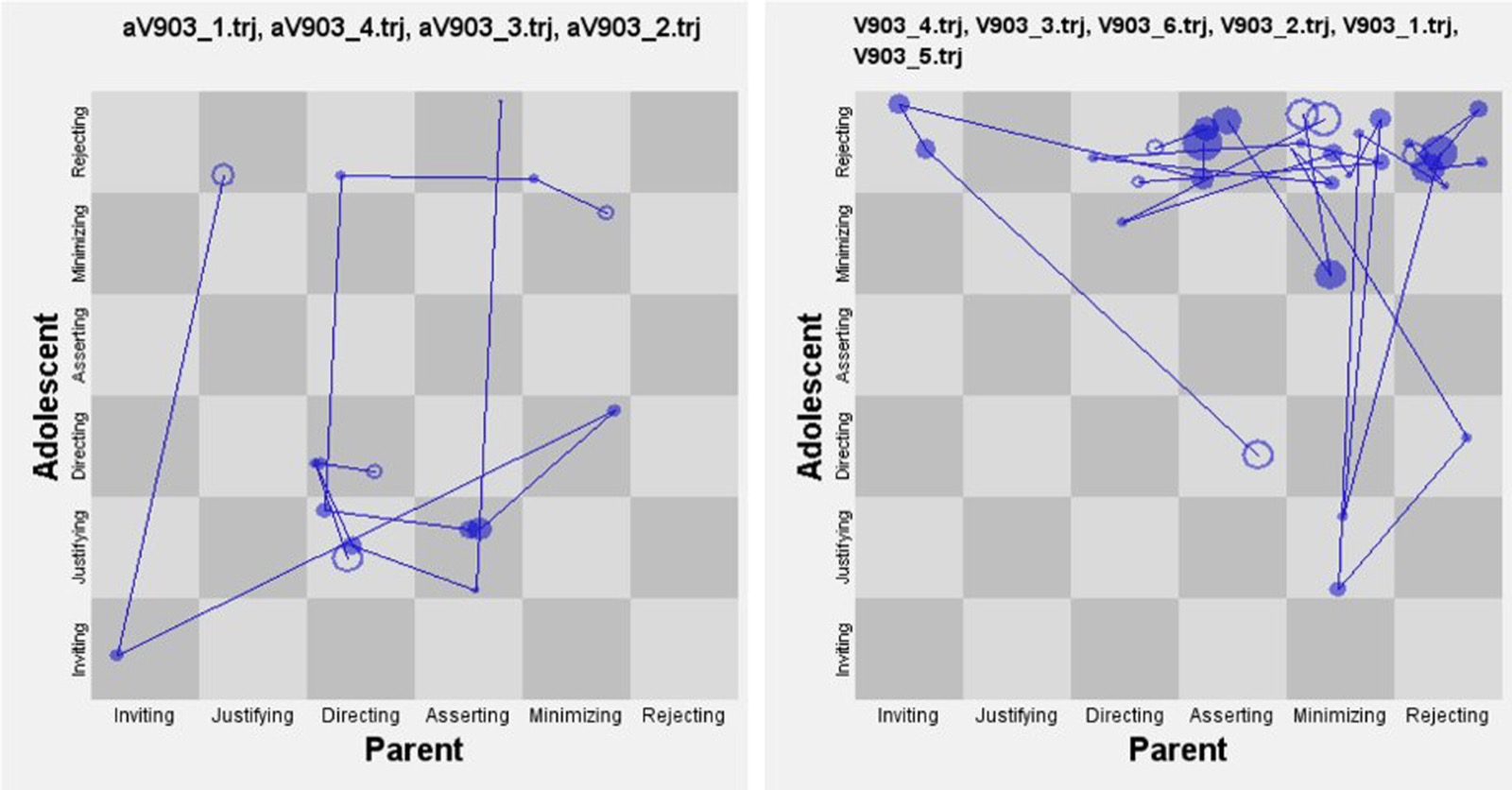
Organizing the codes into categories then locating the categories along a continuum facilitated capturing variability in dyadic resistance. Once we were able to capture variability in the concept, we began mapping resistance sequences onto a two-dimensional grid by locating each expression of resistance along temporal space. That is, the developed framework allowed mapping of coded resistance sequences onto the SSG to see how dyads navigated expressions of resistance together. We started by assigning a number from 1 to 6 to each code based on the category it was in (i.e., 1 = Inviting; 2 = Justifying; 3 = Directing, redirecting, or deflecting; 4 = Asserting position; 5 = Devaluing or minimizing; and 6 = Rejecting or shutting down). If a line was assigned more than one code, the category assigned was decided based on which category most codes for that line belonged to (e.g., if a line had two codes under the justifying category and one under the inviting category, the line was assigned a 2). Thus, coding of the newly created categories was based on the previous coding of resistance strategies, which were assigned using the codebook, which was also conducted line by line via conversational and gestural turn-taking, which are conceptually meaningful units because they are natural breaks as well as dynamic back-and-forth in the interaction between the dyad members. Ties in the same number of categories per line were resolved through team discussion.
Once each line was assigned to a category, that category was used to locate a point on the two-dimensional grid. This process continued until all of a dyad's resistance sequences were mapped onto the 6 × 6 resistance grid to allow for the visual depiction of how they moved about in their opportunities to express resistance with one another. These values were then entered into Gridware 1.1, which allows for the assessment of events in terms of both frequency and duration (Lamey et al., 2004). A decision was made by the research team based on discussion and observation of how resistance manifested in the conversations to use frequency over duration. This decision was informed by our observations that resistance can be very brief and transitory, sometimes difficult to notice without the aid of the video recall interviews. It is a decision that is also in line with observations of interactions between adult relationship partners by Gottman (1994) wherein expressions of contempt during interactions can be brief but of vital significance to relationship outcomes.
Dynamic flexibility
Flexibility refers to the extent to which a dyad can shift from one state to another (Granic et al., 2007). To examine whether the dyads differed in the flexibility of parent–adolescent resistance before and after the transition to high school, we looked at measures of dispersion and mean visits. Previous analyses (Granic et al., 2007; Granic & Lamey, 2002) looked at measures of dispersion, mean duration, and transitions to quantify flexibility in parent–child relationships. This study assesses dispersion and mean visits to reflect frequency counts but nonetheless Gridware controls for the overall duration of the trajectories in calculating the scores for dispersion and mean visits.
Dispersion is a measure of the sum of cells visited within a sequence but adjusted for the proportional duration in each cell (Hollenstein, 2013). Dispersion values range from 0 to 1, with 0 indicating that all states are located in a singular cell and 1 indicating maximum possible scatteredness. Higher dispersion scores indicate more flexibility. Mean visits refer to the count of transitions among cells on the SSG divided by the total duration of the trajectory. This propensity to transition from one cell to another reflects dynamic flexibility (Hollenstein, 2012). Higher scores for mean visits indicate greater flexibility.
Attractor analysis
To address the study's second question on coherence and stability of dyadic resistance, an attractor analysis was conducted on the conversations before and after the transition to high school. An attractor is a persistent and recurrent state that draws a system's trajectory toward it (Granic et al., 2007). In dynamic systems, it takes little energy to enter an attractor state and more energy to exit it (Hollenstein, 2013). Hence, an attractor state is one that is more probable than others. In this study, attractors are the cells or regions in the SSG that parent and adolescent dyads preferentially visited. Hollenstein (2013) described winnowing as an empirical, iterative process for identifying attractor cells wherein cells with the least duration or frequency are eliminated step by step. After every elimination, a criterion heterogeneity score is calculated, until the cell with the highest frequency remains in the end. Each iteration generates a heterogeneity proportion value or a value that is proportional to the initial iteration's heterogeneity. The heterogeneity proportion values of every iteration are then examined for scree or the largest drop. Lewis et al. (1999) defined a large drop as a reduction of 50% or more. If no large drops occur, Hollenstein (2013) suggested that the scree value can be taken as the last drop to 0 in the final iteration, and the singular cell that remains can be assigned as the attractor.
Intergrid distance
For our third research question regarding the frequency of patterns in parent–adolescent resistance interactions, we assessed the differences between the T1 and T2 grids with a simple Euclidian distance premise. Following intergrid distance analysis by Lewis et al. (2004), each cell's frequency count from T1 was subtracted from the same cell's frequency count in T2; differences were squared and summed to derive the distance scores for every dyad. We calculated the difference in values over the two periods for each grid cell, squared this amount, and summed values for all 36 cells. The square root of this sum provided the distance score between the two grids. We repeated this process to obtain an intergrid distance for each dyad, as well as for the entire sample.
RESULTS
Overall, there were 194 resistances sequences found in 18 of the 23 conversations that occurred in each timepoint; 105 resistance sequences were identified at T1 and 89 were identified at T2. The range in the number of resistance sequences within dyads' conversations was wider at T1 (range = 0–15, M = 4.57, SD = 4.19) than at T2 (range = 0–11, M = 3.87, SD = 3.32). The time at which first resistance sequences started differed for every dyad and also differed between T1 (range = 0–18:53 min, M = 2:02 min, SD = 4:35 min) and T2 (range = 0–1:55 min, M = 1:21 min, SD = 1:55 min).
Regarding flexibility, paired samples t tests were conducted to test differences in dispersion and mean visits between time points. No significant differences were found in dispersion scores t(22) = 0.07, p = .94 and mean visits t(22) = 0.02, p = .97 before and after the transition to high school. Using the winnowing method of identifying attractors, we observed no drops greater than 50% at either timepoint; the final single iteration identified different cells as attractors, however. Before the start of high school, the Parent Justifying–Adolescent Justifying cell remained in the final iteration. After the transition to high school, the Parent Minimizing–Adolescent Rejecting cell was identified as the attractor instead. A single-sample t test on the intergrid distance scores showed there was a significant difference in how the resistance sequences were positioned on the grid before and after the start of high school (M = 8.81, SD = 5.98); t(22) = 7.07, p < .001. Figure 1 shows an example of the difference in states for one dyad before and after the transition to high school.
DISCUSSION
This study's aim was to describe the moment-to-moment states of dyadic resistance that occur over parent–adolescent interactions both before and after the transition to high school. To this end, we tested whether the flexibility of parent–adolescent resistance—including dispersion, range, number of and transitions between behavioral states—varied before and after the transition. We also examined whether dyadic resistance coheres and stabilizes and whether the frequency patterns of resistance fluctuate between these two periods. There were no significant differences in scores for dispersion and mean visits, indicating no change in flexibility before and after the high school transition. However, attractor analysis indicated a shift in the most probable state in resistance sequences from the Parent Justifying–Adolescent Justifying cell before high school to the Parent Minimizing–Adolescent Rejecting cell after starting high school. Additionally, intergrid distance scores revealed a significant difference in the positioning of resistance sequences on the grid before and after the transition to high school. We previously observed that parents and adolescents engaged in resistance in distinct ways (Ji et al., 2025), but despite the unique manner that dyads engaged in resistance, we wanted to know whether it was possible to bring the concept along a continuum to answer our research questions. We began our journey to create a continuous variable for resistance by attempting to crystalize the abstract concept by querying (a) what creates variability in the construct and (b) whether such variability can be measured. Our attempts to locate resistance on a continuum led to us developing a tentative conceptual framework of opening and closing space. This opening and closing space conceptual framework is the product of repeated observations of the data as well as ongoing discussions by the research team. We then applied a methodology to the opening and closing space conceptual framework by using the SSG, which allowed us to systematically map out and visually represent dyadic resistance microprocesses. We chose an SSG for its usefulness in mapping out dyadic microprocesses.
This study adds to an existing body of evidence suggesting that resistance can be seen and treated as a dyadic concept. To date, no research has investigated resistance beyond the individual level of analysis. Resistance has been investigated using thematic analysis of individual responses and as such, this study is one of only two studies that have studied resistance at the dyadic level of analysis. In addition, our preliminary efforts suggest that it may be possible to conceptualize dyadic resistance as a continuous variable. No studies on resistance have moved beyond the development of themes at the individual level of analysis; therefore, conceptualizing dyadic resistance as a continuous variable is a novel contribution of this study. Our results suggest that our attempts to capture variability in resistance between parents and adolescents during their interactions and crystallize the variability along a continuum has been successful. The ability to gather variability in resistance along a continuum allowed us to successfully map resistance sequences across time in parent–adolescent interactions. This study represents a conceptual effort to shift resistance beyond dyadic behavior to a continuous variable.
This study contributes to past research on resistance by establishing that moment-to-moment resistance fluctuates along the opening and closing space framework and by demonstrating that these changes can be captured across time within a single conversation. In addition, we demonstrated that it is possible to capture key shifts in resistance 1 year apart before and after a significant family transition event. Even though there was no significant difference in flexibility, our results demonstrated a clear difference in attractors between the two time points. Our hypothesis based on consensus among researchers of adolescents that resistance will be more discussion-oriented before the transition to high school appears to have tentative support. Parents and adolescents used more justification and argument before high school as the literature suggests; the period after the transition was marked by Parent Minimizing and Adolescent Rejecting, however. Before starting high school, parents and adolescents were more likely to engage in justification as a resistance strategy. After transitioning to high school, parents were more likely to engage in minimization as a resistance strategy, while adolescents more often rejected their parents as their preferred resistance strategy. The test of intergrid distance revealed that pattern frequency in resistance was significantly different between T1 and T2. There are several possible explanations for the difference in how parent–adolescent dyads resist before and after the transition to high school. Given the multiple adaptations across multiple domains that occur just before entering high school (Jindal-Snape & Rienties, 2016), families with adolescents may need to reason together how young people will assume more responsibilities over their schoolwork, friendships, and extracurricular activities, necessitating negotiation. Parents and adolescents may provide arguments for their preferences, which may be reflected in the identification of justification as an attractor. Once the family has settled into high school however, there may be a reduced need to discuss changing expectations (unless further recalibration is needed). After the transition, parents and adolescents may have settled into ways of engaging together that they are less inclined to revisit. Previous research on resistance (Ji et al., 2025), for example, suggests that parents and adolescents are strategic in how they approach or avoid potentially sensitive or contentious topics to prevent disturbing the peace, which could help explain the tendency toward minimizing as a strategy. Parents who minimize and adolescents who reject may reflect a desire to maintain the status quo. We now turn to discussing the theoretical and practical implications of these findings on future research.
Limitations
Data analyzed for this study were anchored in a single event in time (i.e., before and after the transition to high school) and therefore cannot be considered truly longitudinal. Given the tether of data collection to a transition event, it was not possible to determine whether smaller scale examination of more time points would yield different resistance patterns. It is likely that more fine-grained patterns of resistance would be found over time considering the variability observed between dyads and shift in attractors between T1 and T2. The documentation of such patterns could lead to a more comprehensive understanding of how dyadic resistance evolves over adolescence. Finally, most of the parents in this sample were mothers, and as such, we do not know if resistance dynamics would look different if the data included more father–adolescent dyads or other caregiver–adolescent configurations.
Implications
Consistent with dynamic systems theory, parents and adolescents in our study experienced shifts in how they engaged in resistance between time points. Our observation of significant shifts in attractors in dyads before and after the transition to high school suggests that parents and adolescents adjust how they resist one another following major life events. Families often undergo important events during adolescence, some expected (e.g., graduating, friendship changes, exploring postsecondary and career options) and some unexpected (e.g., illness, dissolution, disasters). It may be useful to investigate further whether dyadic resistance looks different in families before and after various types of events, both anticipated and unanticipated. From there, patterns of shifts in attractors associated with specific types of events could be investigated and documented. By extension, it may be possible to identify the types of events that are likely to lead to attractor states (e.g., minimizing, rejecting) where families could benefit from supportive interventions.
Our findings indicated that some dyads navigated resistance by closing space after the transition to high school (Parent Minimizing–Adolescent Rejecting). The notion that some dyads may get “stuck” in a parent-minimizing–adolescent-rejecting state in a sample of nonclinical families has implications for practice. Families may benefit from being able to observe and think about their own attractor states. This could be done by having parents and adolescents observe playback or videorecording of a conversation together, followed by debriefing to identify and then reflect on their attractors. Engaging in observation and self-reflection may help families shift toward opening space and safely express resistance with the help of a practitioner. Tying back to family conflict and dynamic systems theories, it may be possible to move a family toward greater unity by helping them move through reflection to get away from their stuck points. Practice interventions that facilitate the safe expression of dyadic resistance may enhance the parent–adolescent relationship by helping dyads more effectively navigate the tension between autonomy and togetherness. We remain curious about whether it is possible to help families reconfigure how they engage in resistance using a SSG as an intervention (e.g., state space resistance therapy).
Our findings highlight the importance of looking for patterns of opening and closing spaces between parents and adolescents. Clinically, interventions to address parent–adolescent disputes have tended to target child noncompliance and parental control (Collins et al., 2000). Such one-sided interventions are usually informed by a behavioral view of socialization which sees influence in the parent–child relationship as unidirectional and deterministic from parent to child (Kuczynski & Hildebrandt, 1997). Few interventions have treated disputes between parents and adolescents as repeating attractor states of face-to-face resistance even though research has indicated that patterns of dyadic resistance are common during parent–adolescent interactions (Ji et al., 2025). Moment-to-moment processes during parent–adolescent interactions are linked to longer term adjustment in the parent–adolescent relationship (Lougheed, 2020). The opening and closing spaces of resistance framework offers a more nuanced approach to parent–adolescent disputes and may help practitioners identify patterns of resistance they can use to head off stalemates or attractors before disagreements escalate to a full-blown conflict. No studies to date have explored the concept of resistance to assist practitioners who help families address parent–adolescent disputes; the opening and closing spaces framework is a novel contribution to the resistance literature that may offer a promising way of rethinking and intervening in such situations.
Practitioners may also be able to apply the dynamics of opening and closing spaces to work among other types of dyads where resistance could be expected to occur. For example, the opening and closing of resistance framework may help romantic couples identify patterns along the continuum that they may be repeatedly returning to, encouraging the partners to reflect on that state, its appropriateness to each situation, and its potential implications for the long-term relationship. The opening and closing spaces continuum could also be useful for obtaining a deeper understanding of the dynamics occurring between an adolescent and their social worker. Rather than viewing interactions as noncompliance or matters of control, practitioners may benefit from attempting to find patterns of interactions that facilitate or hinder the ability to work together to address a youth's needs. The framework provided in this article emphasizes young peoples' agency and the joint actions of resistance in their interactions with others.
Conceptualizing this study within the extant literature on parent–adolescent conflict and resistance, we propose that the key contribution of this research is its focus on processes that can be examined through the continuum and the grid. This contribution represents a major advancement in moving beyond traditional conflict measures that have tended to focus only on intensity or frequency. Instead, we have offered a way to capture the subtle and everyday relationally coordinative processes that are involved when parents and adolescents resist one another.
Future directions
Prior research suggests that resistance may look different depending on the topic about which parents and teens have disputes (e.g., prudential vs. personal matters; Smetana & Rote, 2019). Mothers have been found to be more willing to compromise and negotiate when disputes pertained to personal choices (Nucci & Weber, 1995) and more likely to exercise authority and establish boundaries and limits when their children's actions contravened social conventions (Nucci & Smetana, 1996). Future studies following quasi-experimental designs could examine whether the ways parents and adolescents engage in resistance relate to the domain being discussed. Dyads could be assigned to a prudential or personal matter topic group, then potential attractor states could be identified and compared through analysis to determine differences in dyadic resistance based on topic area.
The dyadic resistance categories developed for this study may also have implications for future research. Researchers of parent–adolescent conflict have identified that disputes can take different shapes across ethnicities and cultures (Darling et al., 2005; Li & Warner, 2015; Phinney et al., 2005; Skinner et al., 2016). Future research could be conducted using the six categories from this study on a different dataset. In future research, we hope to scrutinize the utility of our conceptual framework across areas of difference in culture, ability, and types of caregiver relationships (e.g., foster parent and adolescent). Such studies may be useful in refining or adapting our proposed framework and increasing understanding of whether opening and closing space to express resistance is a useful way to think about the construct. Given our finding of attractors in this study, future research could describe using analyses of qualitative data the meanings that parents and adolescents assign to one another during resistance attractor states. Meanings could be described by analyzing follow-up interviews with parents and adolescents after a dispute where an attractor was identified. Analysis of interview data may reveal important information about the intentions, goals, and interpersonal history informing attractor states in resistance. For example, deeper understanding of why adolescents or parents engage in minimization or rejecting could help to aid in the development of categories along the opening and closing space continuum.
Conclusion
This study adds to what is known about dyadic resistance by describing the moment-to-moment microprocesses that occur over time during parent–adolescent interactions before and after the transition to high school. We developed a novel approach to mapping dyadic resistance onto a two-dimensional plane to facilitate SSG analysis. Even though our findings showed no difference between time points in flexibility, differences were found in attractor states and intergrid distance, offering preliminary evidence that types of dyadic resistance are different before and after significant family transitions such as the move to high school.
Complexe Systémique: key points
The article’s interest lies in its change of scale: instead of measuring how often and how intensely people argue, it follows the back-and-forth of turns and names states to which the dyad returns, which systemic practitioners will recognise as interactional redundancies. The “opening or closing space” continuum, presented without moral judgement, offers a simple vocabulary for a session: identifying with the family the moment when a parent minimizes and the young person shuts down, for instance by reviewing a filmed excerpt together. The results remain fragile: 23 dyads, mostly mothers, a different coder at each time point, which confounds the effect of time with that of the person coding, attractors identified without any clear drop during winnowing, and an intergrid distance tested against zero although it cannot be negative. The article also announces a third research question that was never posed. It reads as a methodological lead rather than a demonstration. Read alongside the article on morphostasis and morphogenesis, and the article on errors and dilemmas in working with adolescents.
References
Adams, G. R., & Marshall, S. K. (1996). A developmental social psychology of identity: Understanding the person-in-context. Journal of Adolescence, 19(5), 429–442. https://doi.org/10.1006/jado.1996.0041
Arslan, İ. B., Boele, S., Dietvorst, E., Lucassen, N., & Keijsers, L. (2024). Within-family associations of parent–adolescent relationship quality and adolescent affective well-being. Journal of Adolescence, 96(4), 803–819. https://doi.org/10.1002/jad.12299
Bernard, J. (1982). The future of marriage. Yale University Press.
Blos, P. (1962). On adolescence: A psychoanalytic interpretation. The Free Press.
Branje, S. (2018). Development of parent–adolescent relationships: Conflict interactions as a mechanism of change. Child Development Perspectives, 12(3), 171–176. https://doi.org/10.1111/cdep.12278
Buehler, C. (2020). Family processes and children's and adolescents' well-being. Journal of Marriage and Family, 82(1), 145–174. https://doi.org/10.1111/jomf.12637
Collins, W. A., & Laursen, B. (1992). Conflict and relationships during adolescence. In C. U. Shantz & W. W. Hartup (Eds.), Cambridge studies in social and emotional development. Conflict in child and adolescent development (pp. 216–241). Cambridge University Press
Collins, W. A., Maccoby, E. E., Steinberg, L., Hetherington, E. M., & Bornstein, M. H. (2000). Contemporary research on parenting: The case for nature and nurture. American Psychologist, 55(2), 218–232. https://doi.org/10.1037/0003-066x.55.2.218
Darling, N., Cumsille, P., & Peña-Alampay, L. (2005). Rules, legitimacy of parental authority, and obligation to obey in Chile, the Philippines, and the United States. New Directions for Child and Adolescent Development, 2005(108), 47–60. https://doi.org/10.1002/cd.127
De Los Reyes, A., Ohannessian, C. M., & Racz, S. J. (2019). Discrepancies between adolescent and parent reports about family relationships. Child Development Perspectives, 13(1), 53–58. https://doi.org/10.1111/cdep.12306
Doolan, D. M., & Froelicher, E. S. (2009). Using an existing data set to answer new research questions: A methodological review. Research and Theory for Nursing Practice, 23(3), 203–215. https://doi.org/10.1891/1541-6577.23.3.203
Fogel, A. (1993). Developing through relationships: Origins of communication, self, and culture. University of Chicago Press.
Freud, A. (1958). Adolescence. In A. Freud, H. Hartmann, & E. Kris (Eds.), Psychoanalytic study of the child (pp. 255–278). International Universities Press.
Gottman, J. M. (1994). What predicts divorce?: The relationship between marital processes and marital outcomes. Lawrence Erlbaum Associates, Inc.
Gottman, J. M., & Notarius, C. I. (2000). Decade review: Observing marital interaction. Journal of Marriage and Family, 62(4), 927–947. https://doi.org/10.1111/j.1741-3737.2000.00927.x
Granic, I. (2000). The self-organization of parent–child relations: Beyond bidirectional models. In M. D. Lewis & I. Granic (Eds.), Emotion, development, and self-organization: Dynamic systems approaches to emotional development (pp. 267–297). Cambridge University Press. https://doi.org/10.1017/CBO9780511527883
Granic, I., & Lamey, A. V. (2002). Combining dynamic systems and multivariate analyses to compare the mother–child interactions of externalizing subtypes. Journal of Abnormal Child Psychology, 30(3), 265–283. https://doi.org/10.1023/A:1015106913866
Granic, I., O'Hara, A., Pepler, D., & Lewis, M. D. (2007). A dynamic systems analysis of parent–child changes associated with successful “real-world” interventions for aggressive children. Journal of Abnormal Child Psychology, 35(5), 845–857. https://doi.org/10.1007/s10802-007-9133-4
Grotevant, H. D., & Cooper, C. R. (1985). Patterns of interaction in family relationships and the development of identity exploration in adolescence. Child Development, 56(2), 415–428. https://doi.org/10.2307/1129730.
Grumi, S., Pettenati, G., Manfredini, V., & Provenzi, L. (2022). Flexibility and organization in parent–child interaction through the lens of the dynamic system approach: A systematic review of state space grid studies. Infant Behavior and Development, 67, Article 101722. https://doi.org/10.1016/j.infbeh.2022.101722
Hill, J. P. (1988). Adapting to menarche: Familial control and conflict. Development during the transition to adolescence (pp. 43–77). Psychology Press. https://doi.org/10.4324/9780203771396-3
Hollenstein, T. (2012). Using state space grids for understanding processes of change and stability in adolescence. In S. Kunnen (Ed.), A dynamic systems approach to adolescent development (pp. 73–89). Routledge/Taylor Francis Group. https://doi.org/10.4324/9780203147641-8
Hollenstein, T. (2013). State space grids: Depicting dynamics across development. Springer. https://doi.org/10.1007/978-1-4614-5007-8
Hollenstein, T. (2015). This time, it's real: Affective flexibility, time scales, feedback loops, and the regulation of emotion. Emotion Review, 7(4), 308–315. https://doi.org/10.1177/1754073915590621
Ji, D., Marshall, S. K., & Charles, G. (2025). Dyadic resistance in parent–adolescent interactions during the transition to high school. Journal of Adolescence, 97(3), 758–777. https://doi.org/10.1002/jad.12451
Jindal-Snape, D., & Rienties, B. (2016). Understanding multiple and multi-dimensional transitions of international higher education students: Setting the scene. In D. Jindal-Snape & B. Rienties (Eds.), Multi-dimensional transitions of international students to higher education (pp. 1–17). Routledge/Taylor Francis Group. https://doi.org/10.4324/9781315680200-1
Kuczynski, L., Burke, T., & Song-Choi, P. (2021). Mothers' perspectives on resistance and defiance in middle childhood: Promoting autonomy and social skill. Social Sciences, 10(12), 469. https://doi.org/10.3390/socsci10120469
Kuczynski, L., & Hildebrandt, N. (1997). Models of conformity and resistance in socialization theory. In J. E. Grusec & L. Kuczynski (Eds.), Parenting and the internalization of values: A handbook of contemporary theory (pp. 227–256). John Wiley & Sons, Inc.
Lamey, A., Hollenstein, T., Lewis, M. D., & Granic, I. (2004). GridWare (Version 1.1) [Computer software]. http://statespacegrids.org
Langkamp, D. L., Barnes, A. J., & Zuckerman, K. E. (2021). Secondary analysis of existing data sets for developmental behavioral pediatrics. Journal of Developmental and Behavioral Pediatrics, 42(4), 322–330. https://doi.org/10.1097/DBP.0000000000000915
Lewis, M. D., Lamey, A. V., & Douglas, L. (1999). A new dynamic systems method for the analysis of early socioemotional development. Developmental Science, 2(4), 457–475. https://doi.org/10.1111/1467-7687.00090
Lewis, M. D., Zimmerman, S., Hollenstein, T., & Lamey, A. V. (2004). Reorganization in coping behavior at 1 1/2 years: Dynamic systems and normative change. Developmental Science, 7(1), 56–73. https://doi.org/10.1111/j.1467-7687.2004.00323.x
Li, Y., & Warner, L. A. (2015). Parent–adolescent conflict, family cohesion, and self-esteem among Hispanic adolescents in immigrant families: A comparative analysis. Family Relations, 64(5), 579–591. https://doi.org/10.1111/fare.12158
LoBraico, E. J., Brinberg, M., Ram, N., & Fosco, G. M. (2020). Exploring processes in day-to-day parent–adolescent conflict and angry mood: Evidence for circular causality. Family Process, 59(4), 1706–1721. https://doi.org/10.1111/famp.12506
Lougheed, J. P. (2019). Conflict dynamics and the transformations of the parent–adolescent relationship. In E. S. Kunnen, N. M. P. Ruiter, B. F. Jeronimus, & M. A. E. Gaag (Eds.), Psychosocial development in adolescence: Insights from the dynamic systems approach (pp. 69–82). Routledge/Taylor Francis Group.
Lougheed, J. P. (2020). Parent–adolescent dyads as temporal interpersonal emotion systems. Journal of Research on Adolescence, 30(1), 26–40. https://doi.org/10.1111/jora.12526
Maccoby, E. E. (1992). The role of parents in the socialization of children: An historical overview. Developmental Psychology, 28(6), 1006–1017. https://doi.org/10.1037/0012-1649.28.6.1006
Marshall, S. K., Tilton-Weaver, L., Shankar, S., & Johnston, A. (2023). Parent–adolescent conflict processes and their measurement: A systematic review. Journal of Family Theory & Review, 15(1), 118–132. https://doi.org/10.1111/jftr.12479
Marshall, S. K., Young, R. A., Wozniak, A., Lollis, S., Tilton-Weaver, L., Nelson, M., & Goessling, K. (2014). Parent–adolescent joint projects involving leisure time and activities during the transition to high school. Journal of Adolescence, 37(7), 1031–1042. https://doi.org/10.1016/j.adolescence.2014.07.015
Meeus, W. (2016). Adolescent psychosocial development: A review of longitudinal models and research. Developmental Psychology, 52(12), 1969–1993. https://doi.org/10.1037/dev0000243
Meeus, W. (2019). Adolescent development: Longitudinal research into the self, personal relationships, and psychopathology ( 1st ed.). Routledge. https://doi.org/10.4324/9780429465338
Moed, A., Gershoff, E. T., Eisenberg, N., Hofer, C., Losoya, S., Spinrad, T. L., & Liew, J. (2015). Parent–Adolescent conflict as sequences of reciprocal negative emotion: Links with conflict resolution and adolescents' behavior problems. Journal of Youth and Adolescence, 44(8), 1607–1622. https://doi.org/10.1007/s10964-014-0209-5
Nucci, L., & Smetana, J. G. (1996). Mothers' concepts of young children's areas of personal freedom. Child Development, 67(4), 1870–1886. https://doi.org/10.1111/j.1467-8624.1996.tb01833.x
Nucci, L., & Weber, E. K. (1995). Social interactions in the home and the development of young children's conceptions of the personal. Child Development, 66(5), 1438–1452. https://doi.org/10.1111/j.1467-8624.1995.tb00944.x
Parkin, C. M., & Kuczynski, L. (2012). Adolescent perspectives on rules and resistance within the parent–child relationship. Journal of Adolescent Research, 27(5), 632–658. https://doi.org/10.1177/0743558411435852
Pennings, H. J. M., & Hollenstein, T. (2020). Teacher–student interactions and teacher interpersonal styles: A state space grid analysis. The Journal of Experimental Education, 88(3), 382–406. https://doi.org/10.1080/00220973.2019.1578724
Phinney, J. S., Kim-Jo, T., Osorio, S., & Vilhjalmsdottir, P. (2005). Autonomy and relatedness in adolescent–parent disagreements: Ethnic and developmental factors. Journal of Adolescent Research, 20(1), 8–39. https://doi.org/10.1177/0743558404271237
Saarni, C., Campos, J. J., Camras, L. A., & Witherington, D. (2006). Emotional development: Action, communication, and understanding. In N. Eisenberg, W. Damon, & R. M. Lerner (Eds.). Handbook of child psychology: Social, emotional, and personality development (Vol. 3, 6th ed., pp. 226–299). John Wiley & Sons, Inc.
Sander, L. (2002). Thinking differently: Principles of process in living systems and the specificity of being known. Psychoanalytic Dialogues, 12(1), 11–42. https://doi.org/10.1080/10481881209348652
Silva, K., Ford, C. A., & Miller, V. A. (2020). Daily parent–teen conflict and parent and adolescent well-being: The moderating role of daily and person-level warmth. Journal of Youth and Adolescence, 49(8), 1601–1616. https://doi.org/10.1007/s10964-020-01251-9
Simmel, G. (1904). The sociology of conflict. The American Journal of Sociology, 9(4), 490–525. https://doi.org/10.1086/211234
Skinner, O. D., & McHale, S. M. (2016). Parent–adolescent conflict in African American families. Journal of Youth and Adolescence, 45(10), 2080–2093. https://doi.org/10.1007/s10964-016-0514-2
Smetana, J., & Gaines, C. (1999). Adolescent–parent conflict in middle-class African American families. Child Development, 70(6), 1447–1463. https://doi.org/10.1111/1467-8624.00105
Smetana, J. G., & Rote, W. M. (2019). Adolescent–parent relationships: Progress, processes, and prospects. Annual Review of Developmental Psychology, 1(1), 41–68. https://doi.org/10.1146/annurev-devpsych-121318-084903
Smith, L. B., & Thelen, E. (2003). Development as a dynamic system. Trends in Cognitive Sciences, 7(8), 343–348. https://doi.org/10.1016/S1364-6613(03)00156-6
Sprey, J. (1979), Conflict theory and the study of marriage and the family. In W. R. Burr, R. Hill, F. I. Nye, & I. Reiss (Eds.), Contemporary theories about the family (Vol. 2, pp. 130–159). Free Press.
Thelen, E., & Smith, L. B. (1994). A dynamic systems approach to the development of cognition and action. Bradford/MIT Press. https://doi.org/10.7551/mitpress/2524.001.0001
Thelen, E., & Smith, L. B. (2006). Dynamic systems theories. In R. M. Lerner (Ed.), Handbook of child psychology: Vol. 1. Theoretical models of human development ( 6th ed., pp. 258–312). John Wiley & Sons, Inc.
Thomas, S. A., Jain, A., Wilson, T., Deros, D. E., Jacobs, I., Dunn, E. J., Aldao, A., Stadnik, R., & De Los Reyes, A. (2019). Moderated mediation of the link between parent–adolescent conflict and adolescent risk-taking: The role of physiological regulation and hostile behavior in an experimentally controlled investigation. Journal of Psychopathology and Behavioral Assessment, 41(4), 699–715. https://doi.org/10.1007/s10862-019-09747-w
Van Petegem, S., Soenens, B., Vansteenkiste, M., & Beyers, W. (2015). Rebels with a cause? Adolescent defiance from the perspective of reactance theory and self-determination theory. Child Development, 86(3), 903–918. https://doi.org/10.1111/cdev.12355
Vansteenkiste, M., Soenens, B., Van Petegem, S., & Duriez, B. (2014). Longitudinal associations between adolescent perceived degree and style of parental prohibition and internalization and defiance. Developmental Psychology, 50(1), 229–236. https://doi.org/10.1037/a0032972
Von Bertalanffy, L. (1968). General systems theory. George Braziller.
Welsh, D. P. & Dickson, J. W. (2005). Video-recall procedures for examining subjective understanding in observational data. Journal of Family Psychology, 19(1), 62–71. https://doi.org/10.1037/0893-3200.19.1.62
Weymouth, B. B., Buehler, C., Zhou, N., & Henson, R. A. (2016). A meta-analysis of parent–adolescent conflict: Disagreement, hostility, and youth maladjustment. Journal of Family Theory & Review, 8(1), 95–112. https://doi.org/10.1111/jftr.12126
White, J., Martin, T., & Adamsons, K. (2019). The conflict and critical theories framework. Family theories: An introduction ( 5th ed., pp. 173–202). Sage Publications, Inc.
White, M. (2009). Narrative practice and conflict dissolution in couples therapy. Clinical Social Work Journal, 37(3), 200–213. https://doi.org/10.1007/s10615-009-0192-6
Young, R. A., Valach, L. & Domene, J. F. (2005). The action-project method in counseling psychology. Journal of Counseling Psychology, 52(2), 215–223. https://doi.org/10.1037/0022-0167.52.2.215
Zhang, J., Buchanan, G. J. R., Piehler, T. F., Gunlicks-Stoessel, M., & Bloomquist, M. L. (2022). The relationship between parent–adolescent conflict dynamics and adolescent depression. Journal of Child and Family Studies, 31(9), 2535–2544. https://doi.org/10.1007/s10826-022-02318-w
Reformatted republication of Dyadic resistance during parent–adolescent interactions: A state space grid analysis before and after high school, by Daniel Ji, Frances Cabahug and Sheila K. Marshall, Family Relations, vol. 75, no 2 (2026), doi: 10.1111/fare.70137, under a CC BY 4.0 licence. Edition and layout: Complexe Systémique, September 2026 — the work has been modified under the terms of the licence (table presented as a list). Neither the authors nor the publisher are responsible for this edition; the original version prevails.
This is the original article “Dyadic resistance during parent–adolescent interactions: A state space grid analysis before and after high school”, published in Family Relations (2026) under a CC BY 4.0 licence. Republished by Complexe Systémique: the author’s text is unchanged; only the presentation has been adapted for reading online, as set out at the head of this page.
Read the original articleHow to cite this article
Ji, D., Cabahug, F., et Marshall, S. K. (2026). Dyadic resistance during parent–adolescent interactions: A state space grid analysis before and after high school. Complexe Systémique. https://app.complexe-systemique.com/en_GB/articles/dyadic-resistance-during-parent-adolescent-interactions-before-and-after-high-school (Original work published in 2026 in Family Relations, 75(2), 901-920 (2026); republished in 2026 by Family Relations, https://onlinelibrary.wiley.com/doi/full/10.1111/fare.70137)
To go further
- Morphostasis and morphogenesis: navigating between stability and changeStability and change.
- Errors and dilemmas in working with adolescentsWorking with adolescents.
- Étudier la synchronie non verbale en thérapie de coupleMicroanalysis of interactions.
Related training courses
 Short course
The suicidal crisis in adolescents and young adults
Training: assessing and supporting the suicidal crisis in adolescents and young adults. Clinical landmarks and systemic tools. In French.
 Symposium
The Abnormal Normals and the Normal Abnormals
Conference replay: six clinicians explore normality — diagnoses, norms, adolescents, therapists. Immediate, lifetime access. Talks in French.
Related articles
 Scientific
Digital Co-Regulation and Dysregulation in Romantic Relationships: A Systemic Model of Technology-Mediated Emotional Processes
Checking, chasing, blocking: 31 interviews show how the phone regulates or dysregulates a couple’s anxiety, with a systemic model of the loop.
 Scientific
Transitioning to the Business of a Session in Collaborative-Dialogic Meetings: A Conversation Analysis
How do Open Dialogue therapists move to the business of a session? The open question creates silences and family negotiation: a conversation analysis of ten sessions.
 Scientific
“One Can Have All Sorts of Good Intentions but Sometimes in Everyday Life, It Turns Out Differently”: Change Agreements in Couples' Everyday Lives
Six Danish couples followed after an online couple program: their change agreements become guilt-inducing contracts, shared understanding or revealers of inequality.
 Scientific
How can we BeST? meet the needs of adoptive families? Relevant findings from a major Randomised Controlled Trial of infants in foster care in the UK
The BeST? trial (488 infants in care in the UK) reread for adoption: holistic, ongoing assessment of children and a move to dual registration.