Australian and New Zealand Journal of Family Therapy · Family therapy
Empire to Emancipation: Potential Decolonial Pathways in Family Therapy
The son of Caribbean parents from the Windrush Generation, raised to perform the perfect English family, Dwight Turner starts from his own history to question what psychotherapy and family therapy have inherited from empire. His work with Jaspreet, a South Asian woman caught in a hierarchical family-in-law, shows what a decolonial lens changes: not pushing for confrontation, and hearing caste, migration and Partition in a family’s story.
This is a reformatted republication of Empire to Emancipation: Potential Decolonial Pathways in Family Therapy, by Dwight Turner, published in Australian and New Zealand Journal of Family Therapy (Wiley) (2026), doi: 10.1002/anzf.70066, under a CC BY 4.0 licence. Prepared by Complexe Systémique in September 2026: the authors’ text is unchanged; the layout has been adapted for reading online, which constitutes a modification of the work under the terms of the licence. This edition was made neither by the authors nor by the publisher, who are not responsible for its content or for any errors. The original version prevails.
We are that which we are fighting against, so whilst we might tear down with one hand, we are also rebuilding with the other
Dwight Turner
Abstract
Family therapy, like any other theory within the helping professions, is as moulded by the systems of colonisation. This paper, which explores how this occurred, utilises client material to explore just how we might recognise, challenge and decolonise the ideas that have shaped our profession. Although presented through the lens of individual psychotherapy work, the author recognises that family therapy is well-positioned in this regard and encourages readers to use their undoubted talents to challenge the structures that inhibit us as we work with clients from other varying cultures.
Key Points
- The paper will assist practitioners in understanding the roots of how the world of counselling and psychotherapy has become colonised. Understanding this will then help practitioners to understand this impact upon their own practices.
- The paper will also signpost some of the ways and means for practitioners to decolonise their work with families.
- The paper will also encourage family therapists to look at their own internalised colonised structures, so the work of decolonisation becomes as much an internal one as an external one in the field of counselling and psychotherapy.
Colonisation works to decivilize the colonizer, to brutalise him in the true sense of the world, to degrade him, to awaken him to buried instincts, to covetousness, violence, race hatred, and moral relativism. Cesaire (2000)
1 Introduction
My parents arrived in the United Kingdom (UK) in the 1940s and 1950s for different reasons. They met in the early 1960s, and I was born towards the end of that decade, my brother following in the early 1970s. This very brief overview of my own family history is presented here because my parents were part of the colonial project. Their movement to the UK, in part because they were part of the Windrush Generation, was also in part because they had grown up within an ideal of empire (Williams 2020). My mother in particular held very narrow perspectives on just what it was to be a family: how we looked, how we acted, what we ate and the schools we went to. Within all of these, my upbringing was very much one of performance; you had to perform a certain type of family dynamic, you had to act in a certain type of way.
Were they to encounter a family therapist back then, my suspicion would be that because my mother and father were very good at playing and performing such an idea of what it was to be the perfect ‘White, English family’ that nobody would have raised an eyebrow. Yet, within my own family system, there were undoubted problems. Sticking with myself, my own experience of depression would have started when I was at around 14 years of age, having been sent to a very posh, middle-class school in Central London, where I did not fit in because I was marked out as an outsider. This meant that actually I ended up feeling incredibly lonely, bereft of friendships, connections and any sense of who I was.
In my subsequent therapy, which I started in my late 20s/early 30s, no mention is really made of just how the family system that I was raised within may have played a role in the difficulties I had in growing up. There was no real discussion of just how the family, and its colonised ways of being, were just as guilty of creating the difficulties that I, and other members of my family, would have had further on. This paper therefore looks at some of this and asks us, as therapists and yourselves as family therapists, to consider just how colonised our ideas are as to what it is to be a family therapist.
2 The Colonisation of Psychotherapy
From its earliest days, psychotherapy has strived to be accepted by an elite. Freud's efforts to have his powerful and forward-thinking ideas accepted by a medical establishment were perhaps one of the earliest examples of psychotherapy allowing itself to be colonised (Jacobs 2003). What I mean by that is that the medical establishment in its own way was already something that excluded, denigrated and marginalised other groups.
For example, drapetomania (Willoughby 2018) was a form of pseudoscience included within the medical model. Denoted as an illness that afflicted only Black people, the idea was that those who rebelled during slavery were mentally ill because they did not adhere to what was seen to be their natural position. Another example is the prevalence of the diagnosis of hysteria against women, a diagnosis rooted in undoubted sexism about the emotionality of one group when contrasted with another. When we start to explore these and other examples of how the medical model in its colonised state marginalises others, then we start to peel away and reveal the strands of a medicalised model, which denigrate those who are not part of this patriarchal, White supremacist environment.
Freud's efforts to have his ideas accepted for me do not mean that Freud was necessarily prejudiced. What they meant was that in order for early psychoanalysis to become established and to therefore find some sort of longevity, Freud signed a deal with the academic devil, so to speak. In doing so, what he also managed to do was to marginalise a number of his own peers, such as Carl Jung who, although not a perfect man in his own right, had ideas and perspectives that could have proved very useful for a medicalised model and may well have broadened out our understanding of psychoanalysis and other forms of therapy, post their coming together (Stevens 1990).
The colonisation of ideas is not just limited to medicalised models; it is something that happens in many different areas: When we think about who gets to define what is truth and knowledge, often in the modern era that is seen through a very Eurocentric lens. A real fact is that many cultures around the world had centres of study, libraries and so on, which highlighted the wealth of knowledge and experience within those societies; ideas that have been lost over generations have been historically erased from our consciousness. This then being replaced by a narrative, which denotes that actually knowledge in civilisation is a more modern construct brought to the rest of the world by those in the Global North. This says that there has been a problem in recognising that for certain countries in the Global North, the experience of encountering the cultural other, while nerve-wracking, also left them with a sense that their cultural identity was challenged by the mere presence of difference. This is something that is seen in the current discourse in the UK around immigration, and the movement of boats crossing the English Channel, a topic that has in its own way become a clarion call for the Far Right populist parties in British politics.
The presence of the other is a challenge to the reality of the subject. It challenges their identity and their truth. Yet, when we think about what truth is, we sort of have to recognise that truth is not just one aspect. Truth in its own way is quite phenomenological. The colonisation of truth suggests that there is only one total truth and in the colonial sort of framework that that truth comes from those within the Global North. This is how other ideas therefore become marginalised.
When we think about psychotherapy and we think about experiences of, say, dreams, one of the interesting aspects that, say, someone like Carl Jung did in exploring dreams and dreams work, although he later on published these ideas as if they were his own, was that he actually researched multiple cultures to look at their own experience of looking at dreams, understanding dreams, making sense of dreams and just basic dreaming (Stein 2005).
The fact that we have such a wealth of understanding of the dream landscape, an understanding that will never truly end because, to be honest, it is infinite, says here that there is no one simple truth. This is very different to other parts of counselling and psychotherapy. When we factor in how we understand attachment patterns, much of what we are taught is through a very Western Eurocentric lens. The idea that there is one form of secure attachment and that attachment is then built around the experience of a mother and possibly a father then marginalises ideas that sit outside this Westernised cultural ideal.
Because these ideas are formed out of an experience that a Westernised family has, say, two to four children and that they are a unit within themselves, anything to do with, say, the Afrocentric idea of the family being a wider unit, a wider experiential space whereby grandparents, aunties, uncles and even those closest to the family all play a role in raising said child, then we actually quite simplistically start to see that attachments are very multifaceted and will form in different ways so that if there is less of an attachment in one area then there is probably more of an attachment in another area.
The other aspect to look at within this sort of attachment pattern, as an example, is that when we consider attachment through a Westernised, mainly middle- to upper-class lens, then anyone who sits outside that lens, say, those working class or perhaps Celtic families that had a few more children than, say, the norm, which means that they are marked out as less than the other.
We see attachment, we see these patterns, through a simplistic binary lens, I will argue here, and there has always been a danger that we may well have seen much of the work that we do as therapists, and I will pass this one off to yourselves as family therapists, in a similar vein. Kakar (2012) speaks to this in some degree, recognising that within a South Asian context, different castes within their cultural system will have different ways of parenting their children, different attachment patterns and different family constructs.
When we move into the area where we consider family therapy and how this may itself have become colonised, what we have to factor in is the idea that many of its constructs are built from a Eurocentric perspective. To recognise this is not to bring shame on family therapy at all, but it is to actually recognise and explore that family therapy, in its own way, like any sort of social construct, will have within it systems of oppression.
For the purpose of this paper, and I am aware that I am doing this from a distance across the other side of the world, it is worth here exploring stories of the Stolen Generation (Moses and Atkinson 2006), a dark period in Australian history whereby Aboriginal and Torres Straits Island descendants were removed from their families and placed within White Australian families as a way of ‘civilising’ them and purportedly giving them a ‘better life’. The fact that many of those who were removed from their homes then suffered from later mental health issues says an awful lot about just how detrimental it was to the health, mental and physical, of these children because of such a myopic, coloniser idea of just what families should be. These incidents are not just limited to Australia and New Zealand, as similar stories abound from Ireland (Nolan 2017) and Canada (Sinclair 2021).
What this paper therefore aims to do is to explore how a more intersectional approach to family therapy, as well as therapy on the whole, can assist practitioners and the families they serve. Moving beyond the binary, recognising the importance of holding if not all of a person, then as much of them as intersectionally possible, allows us to see more of them and their position in their family more clearly.
To briefly say a little bit about intersectional theory though, this is a term coined by the likes of hooks, Crenshaw and Hill Collins, all of whom posit that we endure many different forms of marginalisation based on the varying intersecting identities we hold (Collins 2019; Crenshaw 1989; Hooks 2016). Yet, it is Lorde (1984) in particular who notes that we do not lead single-issue lives because we are not one single identity at any point.
The same could therefore be said of the complexity of identities that reside within a family unit, together with how they interact and jostle with each other for position and prominence. Yet, one of the beauties of family therapy therapists and the skills they have, I can argue, is that they already have to hand and through their training the ability to hold complexity of identity and meaning. In addition to this, it is therefore for family therapy to look at just how the ideas and structures and systems within which it is embedded may have led to or have led to the marginalisation of other groups and other families that therapists encounter.
3 Client Example
Jaspreet was a South Asian woman. She was in her mid-to-late 40s and had come to me, not because we were doing some family therapy work but because she wanted to understand her role in her family dynamic while doing some individual work with me. As I have stated in this paper, me not being a family therapist then left me feeling a little bit at a loss as to how to work with a client like this.
I explored this with Jaspreet, and she was perfectly fine with the fact that I was not a family therapist as such, for a number of reasons, including the fact that her seeking out therapy was something that went against her family, and particularly, cultural dynamics and rules.
To say a bit more about Jaspreet's background. She had two children from an arranged marriage with a man who was approximately 5 years older than herself. They had been married for 20 odd years, and when they married, she had moved from South Asia to the UK and immediately moved in with her husband's family. The issues that she had here in the UK began when she arrived, where she found herself having to serve her in-laws in particular, meaning that she was often the first one up in the mornings, preparing food throughout the day and looking after not just her husband and then her children but also her in-laws.
Jaspreet, though, endured not just the hateful messaging from her mother-in-law, who would often denigrate and put her down in front of her husband and the rest of the family, but also had to witness her mother-in-law abusing her father-in-law. To say a little bit more about her in-laws, there was a marked age difference between her mother-in-law and father-in-law, with the father-in-law being a lot older. There was also a caste difference between the pair of them, with her father-in-law being of a lower caste than her mother-in-law. Many of the experiences that she witnessed between the pair of them involved the mother-in-law putting down the father-in-law as being not enough of a man, and not having enough financial and cultural status to what she would have been used to.
Jaspreet had endured this, as I stated, for over 20 years and had come into therapy of her own volition. The crux point to this was that she had actually recently found herself a small part-time job in an office, where she worked 10 h per week. This was something that she had fought long and hard for with her husband and her in-laws, and which they had finally relented upon, giving her the chance to actually get out of the house and spend some time away from the family.
The issue that she ran into in the workplace was that she worked with a boss who she found treated her unfairly, based both around her racial difference and around the fact that her boss, who was also a woman but British and White, was often tricky to negotiate and work with. This led to Jaspreet occasionally finding herself at home, indoors, with anger and rage bubbling up within herself.
In our therapy work, we considered how much of what she had endured at home had become repressed within herself to the extent that, when she went out to work, this was projected onto her boss.
‘Culturally Normal’ ways of working with this material would have probably involved myself, as a Westernised therapist, asking the client what she would like to say to her boss, and/or to her mother-in-law, and encouraging her to find her voice and speak up for herself. This though would have run counter to a cultural narrative, which had become massively ingrained within her, that actually there was no space to have such a conversation, given the power dynamics and the hierarchy built within the family unit.
We also looked at how for Jaspreet there had been an occasion where she had tried to broach some of these topics within couples' work, where she had encouraged her partner to accompany her to a couples' therapist. However, they had only done one session. The reason for this was that the couples' therapist had tried to explain to them that often what couples do is they project so much of their unresolved issues onto their partner, and yet when Jaspreet explored this further in the therapy, what she realised was that actually because she had had an arranged marriage, the ideas of choice, selection and then projection did not apply in any way near the same way and that when the couples' therapist tried to argue that this might still be possible, but unconsciously so, Jaspreet found this immensely annoying and felt that she was not seen through the cultural lens within which it was embedded.
My particular work with Jaspreet involved giving space to her to explore and express some of the anger and frustrations that she felt not only within her home life but also within her working life, so that her working life was not destroyed by the unresolved issues that were impacting her at home. It felt important, therefore, for myself as a therapist, not to encourage Jaspreet to then take back and unveil, express and perhaps break the family system within which she was encased, but to allow her the space to use the therapy as a release valve. This release would have involved Jaspreet exploring what it was like for her to be raised within a patriarchal and cultural system which, although hundreds of years old, at times led to difficulties and experiences of oppression of some of the people within it, such as Jaspreet.
We did some work understanding issues of attachment through a cultural lens. Kakar's (Blamberger and Kakar 2018; Kakar 2012; Narayanan 2014) work in particular brought a cultural lens to psychoanalytic thinking, which Jaspreet and I found quite useful. In exploring it together, and what I mean by that is that I had to do some work around looking at this material as well as Jaspreet, what we found was we were able to build an understanding of the attachment-like patterns that circled around her, whilst also then adapting the therapy so that we were able to develop ways and means for which Jaspreet might exist and that she might develop and through which she might grow, should she wish to.
The second part to this is that in working with a client from a South Asian background, whilst I could have assumed that my knowledge was the truth and that I knew everything about South Asia, it was important for me to actually explore both with the client and away from the client, be it in supervision or even just through my own research and reading, what it might be like for a client such as Jaspreet to exist within her own unique cultural space.
Power differences, for example, were there. The idea that she was a client and I was a therapist is just one aspect of the power of the differential in this instance. There was also the fact that she was a woman who had been raised within a patriarchal environment and was left without a voice to a great extent, working with a man.
What there also was, was the exploration of South Asian versus Afro-Caribbean power imbalances. What I mean by this is that we need to take into consideration the fact that actually within a colonial framework, South Asians had more power than those from the Caribbean or from Africa, some of which has often led to massive fallouts between the communities post the end of colonialism, for example within Uganda and Zimbabwe.
My work with Jaspreet was therefore incredibly rich and nourishing, not just for Jaspreet. I found myself taking away a deeper, more nuanced understanding of myself and my own cultural legacy through working with such a rich and explorative client.
4 Decolonial Family Therapy
This is the beauty of decolonising not just therapy but family therapy. A decolonial approach to the work that we all do, be us working with individuals, with couples or with families, means that we engage with the whole intersectional identity of our clients or, if this is impossible, as much of that as we may encounter and/or embrace (Turner 2021).
The other part to this is, in working with this wider breadth of our clients through a decolonial sort of lens, what we are also doing is exploring and bringing to the surface more of our own intersectional identity as practitioners, be we individual therapists, family therapists or other types of therapists. The work that we do from within this decolonial sort of framework means that we explore in more depth and with more richness the worlds of ourself and the other. We move therefore beyond this binary notion of self and other and encounter many more others as we explore our own multiple others (Collins and Bilge 2016).
The other interesting part to the type of work that family therapists do is that in their ability to hold the complex and nuanced nature of the family structure, and of all the interactions that go on within that sort of familial space, should they be able to do so within a decolonial framework, then actually, for myself, I get to surmise that actually family therapists become the bridge between a colonised way of seeing identity within a family structure, and a more decolonial way of understanding social constructions of identity.
Family therapists, by their very nature, are used to holding complexity. Decolonial therapists also are challenged to do the same thing. We therefore have the chance here to walk the same pathway if we are able to do so. That is not to say that all family therapists are decolonial; I cannot argue that point, and maybe it is not even my place to do so, but what I can say is that in this sort of exploration, for example within this client example I have just given you, the willingness of myself, were it to be echoed by family therapists who have a good enough grounding within social constructions of identity as well as other aspects I have already explored in this paper, we are better positioned to embrace the richness and the more nuanced ways in which we interact within our structures.
Jaspreet's story had within it so many different layers. The individual layer of what it was to be a South Asian woman, together with the cultural layer of what it was to be a South Asian woman of a certain caste, who had been encouraged to find a husband, to what it was to be a South Asian woman who marries into a higher caste and moves to the UK, to then finally a South Asian woman who marries into a higher caste, who moves to the UK and has to understand her identity as a colonised woman.
There is, even in that last sentence, so, so much for us to explore and unpick and yet often, when we encounter otherness, we are afraid to explore these sorts of areas because we think of them as being too complex. Colonial thinking is reductionist in its simplicity, in its othering of the other, and even I probably am guilty of that in my exploration of the other in this paper. There is a danger that we lose so much of the richness of the other person because we want to see them in some sort of simplistic way that we believe we can hold.
In their papers, Stephen Frosh (2002) and Poland (2011) speak about some of the impossibilities of not othering the other and whilst I agree that actually we often use othering as a way of getting through life and the world, it is not that we are driven to never other the other; it is more that actually we are challenged to understand that that is what we are doing and in doing so change a behaviour and come back to the richness of the client encounter, the curiosity that goes with meeting somebody different to ourselves for the first, second, third and onward time.
Finally, I want to offer another way of looking at how family therapy might take therapy forward. Decolonial family therapy has to see the family structure as moulded not just by family and by culture but by the colonising structures that sit on the outside. One of the more touching stories that Jaspreet told me was of her father-in-law's experiences during Partition (Chaturvedi 2002). For those of you who do not understand what happened with Partition, at the end of British colonialism within India, in fact that whole area was divided up in many different ways, which led to the sudden movement of tens of millions of people, in this case between India and Pakistan and vice versa.
Understanding how we are all raised and formed within a colonised structure therefore gives us the chance to understand our identity fully and then the choice as to how we might want to step outside or individuate from it or find ways to exist still within it. What I mean by this is plenty of us can argue about stripping down capitalism, and the number of stories I have heard of people wanting to ‘burn it all down’ is astonishing. Whilst these stories make sense on one level, there is also a bit of nonsense embedded within them as well, in that you then in theory leave yourself without a system. Where I would also go with this theory is the idea that actually the system is not external to us, it is internal within us as well.
For Jaspreet, one of the things that she often talked about being most proud of was that she encouraged her own children to step outside some of the cultural norms that they had been raised within and find their own ways within the Western world. She did though also acknowledge that whilst there was a huge desire to do this, what there also was, was a problem in that it is very hard, and I agree with this, to exist to create something new while you are still within it. I recognised that she was trying to say to me, one of the things that I have learned in my own research, is we are the system. We are that which we are fighting against, so whilst we might tear down with one hand, we are also rebuilding with the other and it is less about us disrupting and changing the system as it is about us doing that while also recognising how we simultaneously reconstruct aspects of the system at the same time.
This does not mean that the system is not ripe for change, that it does not need to develop and alter itself in some way because ultimately these things have to change, have to move on, have to develop. What it means is that in order for these things to change, we work generation to generation, much like I admire Jaspreet for doing, as we look to disrupt, change and come up with different systems and ways of being that are better suited for a more modern, multicultural society.
5 Conclusion
I started off this paper with a confession and a coincidence. I would therefore like to end this paper in the same fashion, with a confession and a coincidence. The coincidence is that writing this paper has also led me to think about my own family, my own family unit's embeddedness within cultural and systemic structures. As stated, my parents are from the Caribbean. My father served in the Second World War and my mother was a part of the Windrush Generation, which we spent a lot of time as a culture valorising for taking that massive step to come to the UK in the late 1950s. What they both were though was colonised people who were born and raised in the time of the British Empire. Their views on their identities were that they were British, or more importantly, English. My father, in particular, spent a long time and worked incredibly hard, to speak like the King spoke back in those days, and both of my parents wanted me and my brother to attend prestigious schools in London.
This was the system, which I imbibed whilst I was growing up, this idea that one was less from the Caribbean than one was actually more English. It is also something that I was made acutely aware of whenever I travelled back to my mother's homeland of Trinidad where, although I was Black, I was not seen as a Trinidadian, but was often nicknamed ‘English’ because I spoke in a different way to a lot of my cousins when I visited them.
My own work over the years has inevitably involved me reconnecting with a more authentic sense of what it is to be Afro-Caribbean, African, Black or whichever term you choose to use, whichever term I choose to identify myself by. This ongoing exploration met and ran into the work that I managed to do with a client like Jaspreet, a work that reignited a passion within myself to keep on going. To keep on finding myself, to keep on looking at how I often have to adapt myself within one Eurocentric environment and yet how in doing so I find myself losing and therefore craving a more authentic sense of my own Black identity. My identities are therefore now less split than they may have been when I was growing up or when I was going through my training in my 30s and are more aligned with my own personal beliefs about who I am and the route forward that I want to follow, and also the direction that I encourage my daughter to follow as well. That is the coincidence.
The final confession is this: sometimes in writing papers like this, I find myself drawn to the topic area but not quite knowing what to say. This has been one of those occasions where in sitting down and actually researching and writing about where I want to go and how I want to be, I have really enjoyed the whole process of putting this together. There is a lightness, a spark, an intuitiveness that comes with an invitation and an exploration of a topic as rich as this one, through whichever lens it goes through, including one that involves working with and alongside family therapists and the pleasure that I feel in putting together this paper, irrespective of how it is received, is crafted from materials which suggest to me that this paper, this exploration, needed to happen.
My hope for any reader of this paper is that whatever you take from this, that it makes you adhere less to whatever I say as a form of truth, and instead that it encourages you to think about where you are with your own identities (plural) in these explorations. It does not matter if you are Celtic, European, White, Black, gay, lesbian, neurodiverse, older or younger, or any other form of identity; these will all have been formed in some sort of neurotypical, patriarchal, White supremacist, heteronormative, ageist environment and so on. Understand them, find them and work on them. That way you will find out who you are as well.
Complexe Systémique: key points
This text is not a study but an essay, written in the first person by a psychotherapist who does not practise family therapy, and that is what makes it interesting. It invites us to ask where our assumptions come from: an attachment theory designed for the Western nuclear family, a reading of projection that presupposes a chosen partner, an ideal of self-assertion that can break a person caught in a family hierarchy. The clinical choice is instructive: offering Jaspreet a space for release rather than encouraging her to blow up her system. The phrase ‘we are the system’ also echoes second-order cybernetics: the observer is part of what they would like to change. The limits are those of the genre: a single vignette, few concrete tools for families, and broad generalisations about the Global North or about Australia, approached from a distance, as the text acknowledges. Read alongside the article on an Afrocentric paradigm in family therapy, and the article on intersectionality in family therapy.
References
Blamberger, G., and S. Kakar. 2018. Imaginations of Death and the Beyond in India and Europe, 1–202. Springer. https://doi.org/10.1007/978-981-10-6707-5.
Cesaire, A. 2000. Discourse on Colonialism. Monthly Review Press.
Chaturvedi, S. 2002. “Process of Othering in the Case of India and Pakistan.” Tijdschrift voor Economische en Sociale Geografie 93, no. 2: 149–159. https://doi.org/10.1111/1467-9663.00191.
Collins, P. H. 2019. Intersectionality as Critical Social Theory. Duke University Press.
Collins, P. H., and S. Bilge. 2016. Intersectionality: Key Concepts. Polity Press.
Crenshaw, K. 1989. “Demarginalizing the Intersection of Race and Sex: A Black Feminist Critique of Antidiscrimination Doctrine, Feminist Theory and Antiracist Politics.” University of Chicago Legal Forum 1989: 139–167.
Frosh, S. 2002. “The Other.” American Imago 59, no. 4: 389–407. https://doi.org/10.1353/aim.2002.0025.
Hooks, B. 2016. “ Feminism Is for Everybody.” In Ideals and Ideologies: A Reader. Routledge. https://doi.org/10.4324/9781315625546.
Jacobs, M. 2003. Sigmund Freud – Key Figures in Counselling and Psychotherapy. 2nd ed. Sage Publications.
Kakar, S. 2012. The Inner World: A Psychoanalytic Study of Childhood and Society in India. 4th ed. OUP India.
Lorde, A. 1984. Sister Outsider. Crossing Press Limited.
Moses, A. D., and A. Atkinson. 2006. “Genocide and Settler Society: Frontier Violence and Stolen Indigenous Children in Australian History.” Reviews in History 6: 509.
Narayanan, A. 2014. “Ambivalent Subjects: Psychoanalysis, Women's Sexuality in India and the Writings of Sudhir Kakar.” Psychodynamic Practice 20, no. 3: 213–227. https://doi.org/10.1080/14753634.2014.916839.
Nolan, K. 2017. “The Irish Potato Famine.” DoChara: Insider Guide to Ireland, 10–17. https://www.dochara.com/the-irish/food-history/the-irish-potato-famine-1846-1850/.
Poland, W. S. 2011. “Regarding the Other.” American Imago 68, no. 2: 355–359. https://doi.org/10.1353/aim.2011.0016.
Sinclair, R. 2021. “The Indigenous Child Removal System in Canada: An Examination of Legal Decision-Making and Racial Bias.” First Peoples Child and Family Review 11, no. 2: 8–18. https://doi.org/10.7202/1082333ar.
Stein, M. 2005. “Individuation: Inner Work.” Journal of Jungian Theory and Practice 7, no. 2: 1–13.
Stevens, A. 1990. On Jung. Penguin Limited.
Turner, D. D. L. 2021. Intersections of Privilege and Otherness in Counselling and Psychotherapy. 1st ed. Routledge.
Williams, W. 2020. “Windrush Lessons Learned Review.”
Willoughby, C. D. E. 2018. “Running Away From Drapetomania: Samuel A. Cartwright Medicine, and Race in the Antebellum South.” Journal of Southern History 84, no. 3: 579–614. https://doi.org/10.1353/soh.2018.0164.
Reformatted republication of Empire to Emancipation: Potential Decolonial Pathways in Family Therapy, by Dwight Turner, Australian and New Zealand Journal of Family Therapy, vol. 47, no 1 (2026), doi: 10.1002/anzf.70066, under a CC BY 4.0 licence. Edition and layout: Complexe Systémique, September 2026 — the work has been modified under the terms of the licence. Neither the authors nor the publisher are responsible for this edition; the original version prevails.
This is the original article “Empire to Emancipation: Potential Decolonial Pathways in Family Therapy”, published in Australian and New Zealand Journal of Family Therapy (2026) under a CC BY 4.0 licence. Republished by Complexe Systémique: the author’s text is unchanged; only the presentation has been adapted for reading online, as set out at the head of this page.
Read the original articleHow to cite this article
Turner, D. (2026). Empire to Emancipation: Potential Decolonial Pathways in Family Therapy. Complexe Systémique. https://app.complexe-systemique.com/en_GB/articles/empire-to-emancipation-potential-decolonial-pathways-in-family-therapy (Original work published in 2026 in Australian and New Zealand Journal of Family Therapy, 47(1), e70066 (2026); republished in 2026 by Australian and New Zealand Journal of Family Therapy, https://onlinelibrary.wiley.com/doi/full/10.1002/anzf.70066)
To go further
- Cultural Threads: An Afrocentric Paradigm for Integrating Social Justice Principles in the Practice of Family Therapy in AfricaAn Afrocentric paradigm.
- The Premise of Intersectionality for Family Therapy Interventions With Asylum Seekers in the United StatesThinking intersectionality.
- Open Dialogue as a cultural practice - critical perspectives on power obstacles when teaching and enabling this approach in current psychiatryPower and culture.
Related training courses
 Symposium
État des Lieux: a psychological approach to spaces
Replay of the “État des Lieux” conference (Paris, 16 October 2026): Ivy Daure, Maurizio Frisina, Viola Sallay and Gilbert Pregno on places as a clinical resource. In French.
 Certifying course
Training in Systemic Therapy and Interventions – Cycle 1
Certifying training cycle in systemic therapy and interventions – year 1. Courses, supervision and practice, aligned with EFTA/SFTF. In French.
 Certifying course
Training in Systemic Therapy and Interventions – Cycle 2
Certifying training cycle in systemic therapy and interventions – year 2. Clinical complexity, supervision and practice. EFTA/SFTF aligned. In French.
 Certifying course
Training in Systemic Therapy and Interventions – Cycle 3
Certifying training cycle in systemic therapy and interventions – year 3. In-depth intervention, supervision and practice. EFTA/SFTF aligned. In French.
Related articles
 Blog
Challenging in therapy: What a patient taught me
A couples therapy session led me to reflect on confrontation, authenticity and resonance: how to address difficult behaviour without invalidating the person.
 Blog
Adult parentification: when being useful becomes a condition for being loved
Why is it sometimes so hard to hand over? Julien Besse explores parentification and parentalisation, acknowledgement and the place we take in our adult relationships.
 Scientific
Family group conference provision across the lifespan of child welfare intervention: A mixed-method realist-informed evaluation comparing three stages of welfare concern
Early help, child protection or children in care: among 155 UK families, experiences and outcomes of family group conferences vary very little by stage.
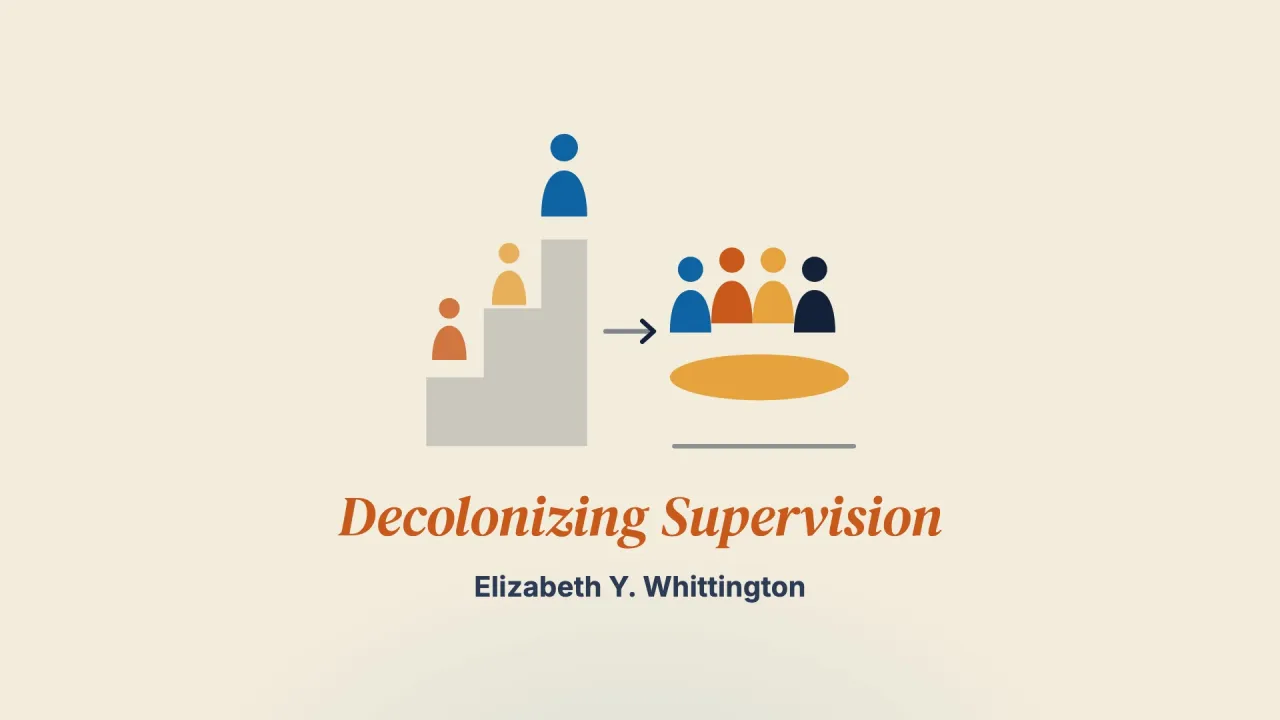 Scientific
Decolonizing Supervision: A Critical Race and Queer Theory Framework for Marriage and Family Therapy
Supervision is not neutral: a framework drawing on Critical Race Theory and Queer Theory to name and share power in supervision, with a vignette.