Contemporary Family Therapy · Family therapy
Examining the Role of Family Members in Perinatal Interventions Targeting Postpartum Depression: A Decade in Review
Is postpartum depression better treated when a partner, or a relative chosen by the mother, comes into the room? A University of Minnesota team screened twelve studies published over ten years, rating each intervention by its level of family inclusion. The verdict: even modest involvement helps, and the most family-inclusive programmes show the clearest effects. What remains are samples with little diversity and couple measures that cannot be compared.
This is a reformatted republication of Examining the Role of Family Members in Perinatal Interventions Targeting Postpartum Depression: A Decade in Review, by Ċante Nakanishi, Ana Mireya Diaz-Howard and Tai Mendenhall, published in Contemporary Family Therapy (Springer) (2026), doi: 10.1007/s10591-026-09791-1, under a CC BY 4.0 licence. Prepared by Complexe Systémique in September 2026: the authors’ text is unchanged; the layout has been adapted for reading online, which constitutes a modification of the work under the terms of the licence. Tables 1 and 2 are presented as lists. This edition was made neither by the authors nor by the publisher, who are not responsible for its content or for any errors. The original version prevails.
Any level of family inclusion is better than nothing.
Ċante Nakanishi, Ana Mireya Diaz-Howard and Tai Mendenhall
Abstract
Extant literature exploring postpartum depression (PPD) primarily focuses on individual risk factors, individual psychotherapy treatment, and psychotropic care. Recent work has started to recognize the importance of including partners and family members in maternal mental health care to improve outcomes. The authors critically examined 12 articles to understand the theoretical foundations, methodologies, and effects of varying levels of family involvement across said work. We applied a systemic lens to increase understanding of family interventions to improve PPD outcomes and applied a tiered model approach to expand on scholarship that translates family science research into these care practices. Results show strong support for family involvement in PPD interventions. Perinatal mental health impacts whole family systems, not just birth mothers, and leveraging social supports may positively impact postpartum outcomes. We conclude with suggestions for clinicians and researchers to further examine diverse experiences and explore nuances in family interventions for this population.
Keywords: Family, Family support, Family therapy, Postpartum depression, Systematic review
Maternal mental health conditions are some of the most prevalent complications for birth mothers during the perinatal period, which is defined as the time between when a woman becomes pregnant through up to one year after delivery (Howard & Khalifeh, 2020). Perinatal mental health conditions – which is an inclusive term to acknowledge parents’ mental health during this time – include mood-, anxiety-, psychosis-, and trauma-related disorders (Yeaton-Massey & Herrero, 2019). Postpartum depression (PPD) is the most prevalent of these conditions, affecting approximately one in eight new mothers (Bauman et al., 2020). Social factors contributing to mothers’ PPD include reduced social support, marital dissatisfaction, interpersonal violence, unemployment, and financial stress (Ghaedrahmati et al., 2017).
The perinatal period represents a substantial transition for individuals and families, and factors of influence span across individual, dyadic, relational, and intergenerational levels (Bost et al., 2002; Dun, 2010; Katz-Wise et al., 2010; Kluwer, 2010; Rauch-Anderegg et al., 2020). The couple’s relationship, for example, has been recognized to function as both a contributory and protective moderating factor for parents’ postpartum depressive symptoms (Çankaya & Dikmen, 2022; Kümpfel et al., 2025). Scholars suggest, too, that relationship dynamics that exist before the infant’s arrival become fortified, and subsequent changes in marital satisfaction can persist for years (Bogdan et al., 2022; Kluwer, 2010).
Few evidence-based interventions to prepare couples and families for the transition to parenthood exist. Early couple interventions (e.g., Becoming a Family Project; Cowan & Cowan, 1995) showed promising results wherein participating couples experienced fewer negative changes in role satisfaction compared to a control group. Shapiro and Gottman (2005) tested a prenatal couples’ workshop and found that the program had positive postpartum effects on depression, hostility, and marital quality, further highlighting the influence of the couple relationship on this period. More recently, practitioners and researchers have highlighted the importance of involving the entire family system in the treatment of PPD, beyond the couple relationship (Battle et al., 2023).
Although family-based interventions are still emerging, previous systematic reviews have attempted to address the question of their efficacy on maternal mental health more broadly and have demonstrated positive results. Cluxton-Keller and Bruce (2018), for example, found that family therapy reduced maternal depressive symptoms, but the effect size was moderated by intervention intensity (i.e., prevention or treatment) and level of family involvement. When integrated into pediatric care, parent interventions can improve parental mental health and parent-child interactions (Cluxton-Keller et al., 2015). A previous synthesis review by Noonan et al. (2021) examined studies of psychosocial interventions for PPD and anxiety published between 2010 and 2020 that included a partner or family member. They found nine interventions and concluded that there was a need to expand the study of intervention outcomes beyond the target parent, and to align respective studies’ outcomes to ease cross-study comparisons.
To expand on previous findings and examine the theoretical approaches, methodologies, and levels of family inclusion within extant literature, we centered the focus of our review on the following questions: (a) What are the strengths,limitations,and implications of current theoretical and methodological approaches used to study family interventions addressing maternal PPD?, and (b) How does the level of family inclusion impact postpartum depression outcomes? To address these questions, we synthesized the use of theories, research designs, and methods outlined in recent scholarship. To examine the levels of family involvement in literature, we applied a tiered model approach (Pratt & Sonney, 2020) that enables the translation of family science research into family-based interventions. We chose this model because it was designed to assess family involvement in care practices by operationalizing the inclusion of family members, ranging from low to high levels of inclusion.
Methods
Article Search Process
Initial database searches were conducted in October 2023, focusing on articles published between 2013 and 2023, using APA PsychINFO, PubMed, and Google Scholar (see Fig. 1). An additional search was conducted in December 2025 to ensure that all articles were captured. This decade in review allowed for an in-depth analysis of the current methodological approaches, empirical findings, and emerging trends of family interventions. Search terms across databases included variations of: [family therapy, couples therapy, psychotherapy, OR family intervention], AND [perinatal mood disorder, postpartum depression, peripartum depression, perinatal depression, OR mood disorder], AND [family, parents, caregivers, spouse, OR partner] AND [pregnancy, postpartum, perinatal, antenatal, OR peripartum] AND [primary care OR integrated care]. Twelve articles met inclusion criteria.
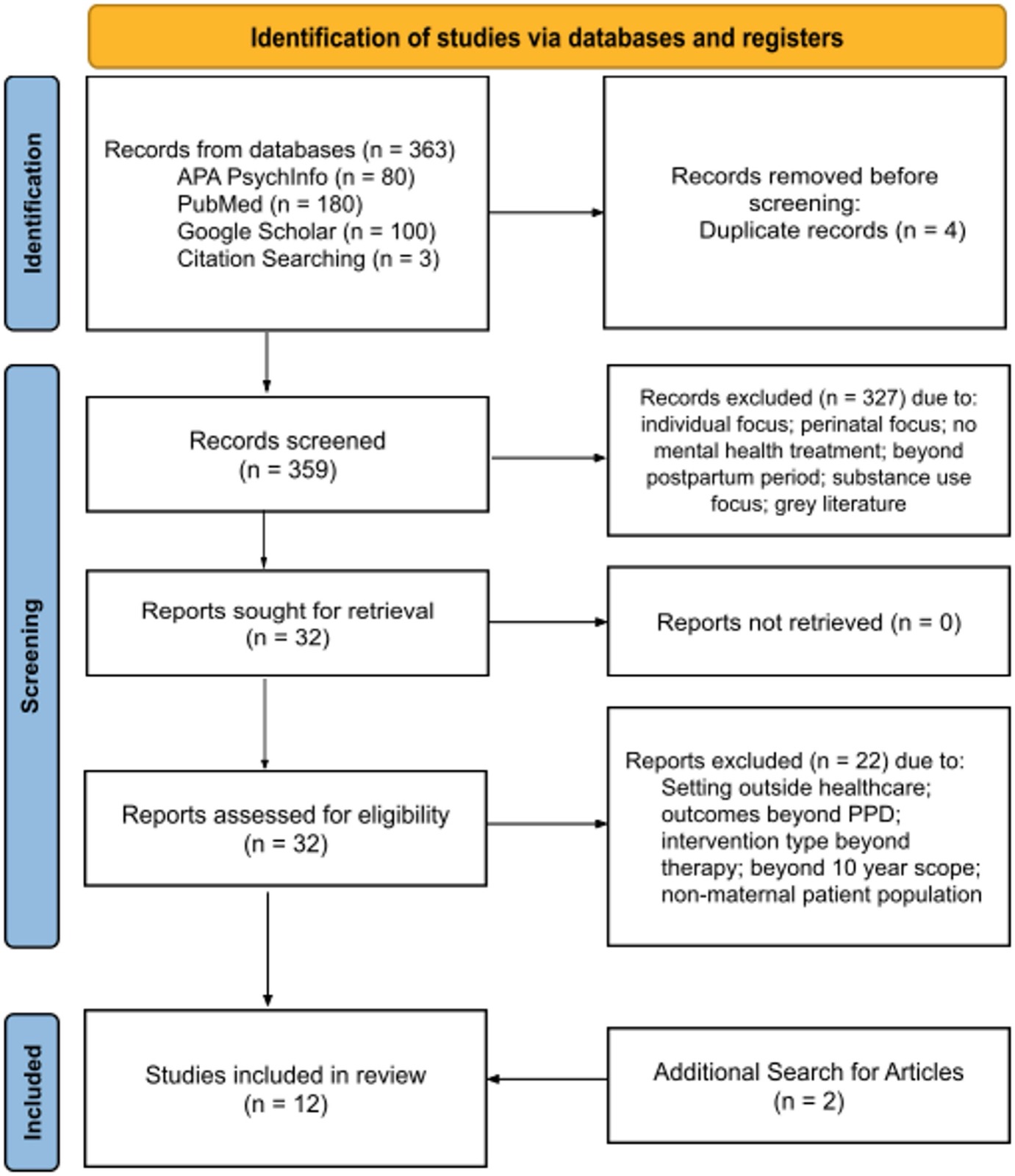
The first author conducted initial title screening, abstract screening, and data extraction. Theoretical frameworks, research questions, measures of individual and dyadic functioning, research methods, interventionist qualifications, and studies’ geographic location were systematically extracted and reviewed by all team members (see Table 1). Extracted information was used to identify themes, strengths, and limitations across the literature. Pratt and Sonney’s (2020) model was then applied to determine the level of family inclusion, which was reviewed and approved by all authors.
Table 1 — Overview of theory, research design, sampling, location, and interventionist credentials
- Battle et al. (2023). Theory and/or therapeutic framework: McMaster Model of Family Functioning. Research design: Quantitative (Single-arm Pilot). Sample size (n): 16 couples. Geographic location: United States. Interventionist: Masters- and doctoral-level therapists.
- Cluxton-Keller et al. (2018). Theory and/or therapeutic framework: Dialectic Behavioral Therapy and General Systems Theory. Research design: Quantitative (Quasi-experimental). Sample size (n): 13 families. Geographic location: United States. Interventionist: Licensed Marriage and Family Therapist (LMFT).
- Cluxton-Keller et al. (2023). Theory and/or therapeutic framework: Dialectic Behavioral Therapy and General Systems Theory. Research design: Quantitative (RCT). Sample size (n): 83 families. Geographic location: United States. Interventionist: Mental health professional.
- Cluxton-Keller and Olson (2023). Theory and/or therapeutic framework: Dialectic Behavioral Therapy. Research design: Quantitative (Effectiveness/ Implementation Hybrid). Sample size (n): 26 families. Geographic location: United States. Interventionist: Masters-level therapists.
- Dafei et al. (2021). Theory and/or therapeutic framework: Cognitive Behavioral Therapy. Research design: Quantitative (Quasi-experimental). Sample size (n): 40. Geographic location: Iran. Interventionist: Midwife; Clinical psychologist.
- Daley-McCoy et al. (2015). Theory and/or therapeutic framework: Unspecified. Research design: Quantitative (RCT). Sample size (n): 83. Geographic location: United Kingdom. Interventionist: Clinical psychologist trainee.
- Gambrel and Piercy (2015a). Theory and/or therapeutic framework: Interpersonal Neurobiology. Research design: Mixed Methods (RCT). Sample size (n): 66. Geographic location: United States. Interventionist: LMFT.
- Gambrel and Piercy (2015b). Theory and/or therapeutic framework: Interpersonal Neurobiology. Research design: Qualitative. Sample size (n): 66. Geographic location: United States. Interventionist: LMFT.
- Geller et al. (2018). Theory and/or therapeutic framework: Social Energy Exchange Theory for Postpartum Depression (SEED). Research design: Quantitative (Program Evaluation). Sample size (n): 47. Geographic location: United States. Interventionist: Clinical psychology doctoral students; Licensed therapists; Somatic practice facilitators.
- Giallo et al. (2022). Theory and/or therapeutic framework: Family Stress Theory and Emotional Security Theory. Research design: Mixed Methods (Program Evaluation). Sample size (n): 41 families. Geographic location: Australia. Interventionist: Counseling; Parent educators; Other allied health fields (i.e., psychology, social work).
- Kehl et al. (2020). Theory and/or therapeutic framework: Creative Music Therapy. Research design: Mixed Methods (Part of RCT). Sample size (n): 16 couples. Geographic location: Switzerland. Interventionist: Music therapist.
- Ngai et al. (2020). Theory and/or therapeutic framework: Cognitive Behavioral Therapy. Research design: Quantitative (3-arm RCT). Sample size (n): 388 couples. Geographic location: China. Interventionist: Midwife.
Inclusion/Exclusion Criteria
Articles were included if: (a) perinatal mothers and an identified support person also participated in services with them, which was labeled “family involvement” (e.g., spouse, co-parent, parent, caregiver, relative); (b) focus on mental health services during pregnancy, perinatal, and/or postpartum periods; (c) postpartum depression outcomes were addressed; (d) healthcare providers, primary care clinics, hospitals, antenatal clinics, or integrated care clinics were involved in conducting the intervention; (e) written in English; and (f) peer-reviewed. Articles were excluded if: (a) samples included only mothers individually; (b) examined perinatal health (e.g., medical procedures or physical conditions) without mental health service engagement; (c) focused solely on substance use treatment or online interventions without a facilitator; (d) sample focus outside of the perinatal/pregnancy/postpartum period; (e) not written in English; and (f) not peer-reviewed (e.g., book chapters, dissertations, grey literature).
Results
Theoretical Approaches
To fully grasp how the current literature understands the role of family when treating PPD, it is important to examine how theory lays the foundation for studies in this analysis. Of the 12 articles examined, five identified at least one theoretical framework; six of them identified at least one therapeutic framework; and one was unspecified (see Table 1). In this analysis, all frameworks were divided into three categories, including: sociocultural, integrated, and implied.
Sociocultural
Four studies identified multidimensional internal, external, and contextual factors that impact a mother’s mental health postpartum. For example, Geller et al. (2018) utilized social energy exchange theory for postpartum depression (SEED), which asserts that women with PPD aim to achieve balance between themselves and their sociocultural networks (Posmontier & Waite, 2011). Giallo et al. (2022) implemented an intervention derived from the family stress model and emotional security theory, highlighting how external factors (e.g., finances, parental conflict) impact family cohesion. These systemic theories challenge current frameworks of PPD (e.g., those that treat women in isolation) by highlighting the dynamic support and care for mothers and their social contexts.
Integrated
Gambrel et al. used interpersonal neurobiology (IPNB) in both their mixed-methods study (2015a) and qualitative study (2015b). IPNB is an interdisciplinary framework that conceptualizes well-being as a product of holistic integration of different parts of the brain to complete tasks and link with each other to create a state of flexibility, adaptability, coherence, energy, and stability (Siegel & Drulis, 2023).
Implied
Implied theoretical approaches include unspecified theories and therapeutic frameworks. For example, Daley-McCoy et al. (2015) argue that couples experience significant changes during the transition to parenthood stage of their family life cycle, aligning with life course theory, but they did not name how a specific theory applied to their work. Implied approaches also include studies that did not name a theory but identified a therapeutic framework guiding the work. Theories are often the foundation for therapeutic frameworks, albeit implicitly, whereas therapy itself is a practical application of a framework using a set of skills and interventions. Six studies identified three therapeutic frameworks (see Table 1), including: (a) cognitive behavioral therapy (CBT) to enhance cognitive restructuring and improve negative communication patterns, (b) dialectic behavioral therapy (DBT) to improve participating family members’ emotion regulation and interpersonal effectiveness, and (c) creative music therapy (CMT) to activate neonatal neural processes and promote bonding between infants and parents.
Methodology
Research Design
Three studies included in this review were mixed methods investigations; eight were quantitative; and one was qualitative (see Table 1). Of the 11 quantitative and mixed-methods studies, five were part of a randomized control trial (RCT), two were program evaluations, and one was an effectiveness/implementation hybrid. All articles identified trained (e.g., specific training to ensure intervention fidelity) and/or credentialed (e.g., licensed clinician) professional(s) leading the study interventions (see Table 1). Interventions were administered in a variety of settings, e.g., hospitals or hospital clinics (n = 4), videoconferences (n = 3), day treatment programs (n = 1), participants’ homes (n = 1), and unspecified (n = 3). Seven studies included a spouse/partner and five included family members chosen by the mother (see Table 2).
Table 2 — Overview of interventions, measures, and level of family inclusion
- Battle et al. (2023). Intervention; Time administered; Duration: Family Treatment for Postpartum Depression (FTP) with family member chosen by the mother; 1–7 months postpartum; 10–12 sessions. Level of family inclusion/Family member included: High/Patient and family member. Maternal and family outcome measures: Edinburgh Postnatal Depression Scale (EPDS); Modified Hamilton Rating Scale for Depression; Structured Clinical Interview for DSM-IV; Beck Depression Inventory (BDI); Family Assessment Device; Dyadic Adjustment Scale (DAS); Family Problem Ratings; Parenting Stress Index; Client Satisfaction Questionnaire (CSQ-8); FTP Questions.
- Cluxton-Keller et al. (2018). Intervention; Time administered; Duration: Video-delivered family therapy with family member chosen by the mother; Prenatal (first trimester)-18 months postpartum; 6 months. Level of family inclusion/Family member included: High/Patient and family member. Maternal and family outcome measures: Beck Depression Inventory - Second edition (BDI-II); EPDS; Protective Factors Survey-Family Functioning - Resiliency subscale; Emotion Regulation Questionnaire; Working Alliance Inventory-Short Form.
- Cluxton-Keller et al. (2023). Intervention; Time administered; Duration: Resilience Enhancement Skills Training (REST) with family member chosen by the mother; Prenatal-18 months postpartum; 10 sessions. Level of family inclusion/Family member included: High/Patient and family member. Maternal and family outcome measures: BDI-II; Family Environment Scale - Conflict (FES-C); Perceived Hostility Survey 18+ (PHS).
- Cluxton-Keller and Olson (2023). Intervention; Time administered; Duration: Family-Based Collaborative Care Model with family member chosen by the mother; Prenatal-3 months postpartum; 10 family sessions (REST) along with 1 provider training. Level of family inclusion/Family member included: High/Patient and family member. Maternal and family outcome measures: BDI-II; State-Trait Anxiety Inventory - State Anxiety scale (STAI-S); FES-C; PHS.
- Dafei et al. (2021). Intervention; Time administered; Duration: Cognitive behavioral group therapy with a spouse present; Prenatal (32–38 weeks pregnant); 8 weeks. Level of family inclusion/Family member included: Low/Patient and partner. Maternal and family outcome measures: Depression-Anxiety-Stress Scale 21 (DASS 21).
- Daley-McCoy et al. (2015). Intervention; Time administered; Duration: Transition to parenthood psychoeducation with married or cohabitating couples; Prenatal; 2-hour class. Level of family inclusion/Family member included: Moderate/Patient and partner. Maternal and family outcome measures: Couple Satisfaction Survey (Prepare-Enrich); Couple Communication Survey (Prepare-Enrich); EPDS.
- Gambrel and Piercy (2015a). Intervention; Time administered; Duration: Mindful Transition to Parenthood Program with couples; Prenatal (12–34 weeks pregnant); 4 weeks. Level of family inclusion/Family member included: High/Patient and partner. Maternal and family outcome measures: Couple Satisfaction Index (CSI); Five Facet Mindfulness Questionnaire; Interpersonal Reactivity Index; Self-Dyadic Perspective-Taking Scale (SDPTS); Other-Dyadic Perspective-Taking Scale (ODPTS); DASS-21; Positive and Negative Affect Schedule.
- Gambrel and Piercy (2015b). Intervention; Time administered; Duration: Mindful Transition to Parenthood Program with couples; Prenatal (12–34 weeks pregnant); 4 weeks. Level of family inclusion/Family member included: High/Patient and partner. Maternal and family outcome measures: None.
- Geller et al. (2018). Intervention; Time administered; Duration: Intensive outpatient mental health program with family member chosen by the mother; Prenatal-13 months postpartum; 13 weeks (Mean program time). Level of family inclusion/Family member included: Moderate/Patient and partner. Maternal and family outcome measures: EPDS; City Birth Trauma Scale (City BiTS); Barkin Index of Maternal Functioning; Parental Stress Scale; Perceived Stress Scale; Difficulties in Emotion Regulation Scale (DERS); Dyadic Adjustment Scale-Revised (RDAS); CSQ-8.
- Giallo et al. (2022). Intervention; Time administered; Duration: Family Foundations with both partners; Prenatal-12 months postpartum; 10 sessions. Level of family inclusion/Family member included: High/Patient and partner. Maternal and family outcome measures: DASS-21; Quality of Co-parental Interaction Scale -Interparental Conflict subscale; Coparenting Relationship Scale - Child Exposure to Conflict subscale; Coparenting Relationship Scale; Child Rearing Questionnaire - Parental Warmth Subscale; Early Childhood Longitudinal Study of Children (Parenting Hostility); Family Foundations Satisfaction Survey.
- Kehl et al. (2020). Intervention; Time administered; Duration: Creative Music Therapy with mothers and fathers; 2 weeks postpartum; 2-3x/week until discharge from NICU. Level of family inclusion/Family member included: Low/Patient and partner. Maternal and family outcome measures: State-Trait Anxiety Inventory - German version (STAI-t); State-Trait Anxiety Inventory – State Anxiety Short Version German (STAI-SKD); EPDS; Parental Stressor Scale - Neonative Intensive Care Unit (PSS-NICU); Pictorial Representation of Attachment (PRAM).
- Ngai et al. (2020). Intervention; Time administered; Duration: Cognitive Behavioral Group Intervention with mothers and fathers; Prenatal; 3-hour session and 2 postpartum follow-ups via telephone. Level of family inclusion/Family member included: Low/Patient and partner. Maternal and family outcome measures: EPDS.
Samples
All 12 articles used unspecified sampling methods but identified a set of inclusion criteria, suggesting purposive sampling methods. Participants were recruited from regional hospitals (n = 5), primary care clinics (n = 2), family health or home visitor services (n = 3), and other referral sources (e.g., birthing centers, prenatal classes, local businesses; n = 2). All studies conducted in the U.S. (n = 7) identified participants’ race in the results. Only one U.S. study reported a non-white majority sample. Studies conducted in China (n = 1), Iran (n = 1), Australia (n = 1), Switzerland (n = 1), and the United Kingdom (n = 1) did not report race as a primary identifier, but two reported participants’ nationalities or birth country. Ten studies reported the demographics of both the mother and her support person, which was an important contextual element given that this body of literature examined the role of a said support person. Only two studies reported same-sex and/or queer couples within their sample. In six studies, most mothers had a bachelor’s degree or higher, and one study reported that over 70% of their sample attended some college (Geller et al., 2018). Three studies reported that most of their sample had less than a college degree. Five studies reported that a majority of their participants were employed.
Measures
Measures (n = 41; see Table 2) assessed participants’ interpersonal functioning and PPD severity in various ways, ranging from maternal mental health and well-being (n = 13) to dyadic/family functioning and communication (n = 20), aspects of parenthood (n = 4), and intervention satisfaction (n = 4). The quantitative and mixed-methods studies demonstrated clear rationales for the self-report measures they utilized.
Postpartum Mental Health and Maternal Functioning. Maternal functioning was assessed with 13 different measures. The Edinburgh Postpartum Depression Scale (EPDS) was the most employed instrument across studies (n = 6). Investigators utilized EPDS to (a) screen for the presence of depressive symptoms and (b) assess maternal functioning, distress, and/or severity of depressive symptoms as a primary outcome. Two used the EPDS to assess depressive symptoms for both partners (Daley-McCoy et al., 2015; Kehl et al., 2020).
The second most common instrument used to measure maternal well-being was the Depression, Anxiety, and Stress Scale (DASS-21; n = 3). In two studies, the DASS-21 was administered to both mothers and fathers. Three studies used the Beck Depression Inventory – Second Edition (BDI-II); one study used the original BDI; and three used versions or subscales of the State Trait Anxiety Inventory (STAI). Other measures were only used once across the literature to assess maternal health and well-being (see Table 2).
Dyadic or Family Functioning. All reviewed articles used different instruments (n = 20) to assess relationship quality and/or communication. However, many of the instruments assessed similar constructs (e.g., communication, relationship satisfaction, conflict resolution). Some measures were applicable to family relationships, not just partnerships (e.g., Perceived Hostility Scale); some assessed co-parenting (e.g., Coparenting Relationship Scale); and some assessed couples’ relationships (e.g., Dyadic Adjustment Scale). Although it appears to be an individual measure, Gambrel and Piercy (2015a) used the Five Facet Mindfulness Questionnaire to measure participants’ mindfulness, which they argue positively affects intrapersonal attunement, dyadic interactions, and overall interpersonal functioning.
Parenting and Parenthood. Three studies assessed different aspects of parenting using four instruments. For example, Geller et al. (2018) used the Parental Stress Scale (PSS) to explore parents’ perceptions about positive and negative aspects of their parenting role. Others examined physical and social stressors, assessed parental warmth, and parental hostility (see Table 2).
Intervention Satisfaction. Four studies used self-report surveys to measure participants’ satisfaction with intervention(s) received. Two studies used two different versions of the Client Satisfaction Questionnaire (CSQ) assessed intervention acceptability and program satisfaction. Two other articles used a separate survey designed by the researchers to assess aspects (i.e., content, logistics) of their interventions (see Table 2).
Analyses
Quantitative Analyses
The mixed methods and quantitative studies included in this review used several different analyses to compare interventions’ effects. Descriptive statistics, specifically mean and standard deviations, were computed at baseline and post-intervention across 11 studies. Five studies used non-parametric analyses (e.g., Wilconxon signed-rank test, Mann-Whitney U-test) to account for small sample sizes, nonindependence, and violations of the normality assumption. Other analyses included paired t-tests to assess participant changes from across multiple time points, independent t-tests and repeated measures tests, Hedge’s g, and generalized linear mixed models to determine main intervention effects for both control and intervention groups.
Mixed Methods and Qualitative Analyses
To examine qualitative interviews, the three mixed methods studies used thematic analysis coded by multiple researchers. Gambrel and Piercy (2015a) used qualitative data to “expand and explain quantitative results” (p. 8). Giallo et al. (2022) and Kehl et al. (2020) utilized post-intervention qualitative interviews to identify intervention satisfaction, improvements, and outcomes.
The sole qualitative study, by Gambrel and Piercy (2015b), provided a detailed account of a grounded theory process to highlight the experiences of participants in a mindfulness intervention. The researchers used an iterative process with three stages of coding: open, axial, and whole text analysis (Strauss & Corbin, 1998). They reviewed codes to reach consensus and took additional steps to assure rigor and trustworthiness (e.g., recruited additional coders, implemented clear documentation methods, peer/team consultation, member checking).
Findings
This body of literature demonstrates that a family-involved approach to addressing postpartum depression is beneficial for both mothers and partners. Maternal rates of depressive symptoms are statistically significantly reduced when her partner engages in family-focused interventions (Battle et al., 2023; Cluxton-Keller & Bruce, 2018; Cluxton-Keller & Olson, 2023; Cluxton-Keller et al., 2023; Dafei et al., 2021; Geller et al., 2018; Ngai et al., 2020). Evidence showed that maternal rates of anxiety, negative paternal affect, and psychological distress also decreased, while overall rates of interpersonal functioning (e.g., communication, conflict resolution, co-parenting support) improved (Cluxton-Keller and Olson 2023; Daley-McCoy et al. 2015; Gambrel and Piercy 2015a). Daley-McCoy et al. (2015) found that postpartum couples experienced decreases in relationship satisfaction, but those who participated in interventions exhibited less decline in relationship satisfaction than control groups. Men who participated in mindfulness interventions reported improved relationship satisfaction post-intervention (Gambrel and Piercy 2015a). Inclusion of a family member, not just the coparent, demonstrated reduced conflict with the participating mother over time (Cluxton-Keller & Olson, 2023).
Levels of Family Inclusion
We applied Pratt and Sonney’s (2020) model to this literature to examine the extent that families were included to address PPD. We found that there were high (n = 7), moderate (n = 2), and low (n = 3) levels of family inclusion (see Table 2). Even low levels of family inclusion demonstrated positive effects on maternal PPD. Dafei et al. (2021) argued that the simple presence of a spouse in treatment improves maternal outcomes due to their partner’s level of increased knowledge and involvement in the pregnancy. Studies with high levels of family inclusion demonstrated strong results with statistically significant reductions in depressive symptoms (e.g., Cluxton-Keller & Olson, 2023; Cluxton-Keller et al., 2018, 2023) and medium to large effect sizes of their outcome measures (Battle et al. 2023; Gambrel and Piercy 2015a; Giallo et al. 2022), supporting the idea that perinatal mental health impacts whole families. These studies reportedly improved interpersonal functioning for participants by improving communication between partners, increasing quality time spent with one another, and reducing conflict. The varying levels of family inclusion highlight an ongoing shift in health care towards more family-centered approaches (Lamson et al., 2022).
Discussion
There are many assumptions about postpartum depression (PPD) in extant literature, alongside best practices about how to address it. Geller et al. (2018) highlighted internal and external factors, as well as micro- and macro-processes, that contribute to postpartum experiences. This systemic perspective promotes maternal well-being while recognizing the important roles and impact(s) of social networks. However, at the same time that partners and other family members often want to be involved in perinatal care, they may experience ambivalence and barriers in doing so. More structural support is needed to ensure that women, particularly those at high risk, are supported during this critical time (Hoang et al., 2022; Taylor et al., 2018).
In the review presented here, we examined guiding frameworks, methodologies, and levels of family involvement in interventions centered on these important foci. We considered the validity, reliability, timing, operationalization, and cultural sensitivity of instruments employed by researchers, and examined whether the constructs that they intended to assess were appropriate for their targeted populations. A strength across the studies is that many used the Edinburgh Postpartum Depression Scale (EPDS) as a baseline and post-intervention measure to determine changes in depressive symptom severity. Presently, the EPDS is the most accepted and valid measure to assess symptoms and severity for perinatal groups (Cox et al., 1987; Kendall-Tackett, 2024). Since its initial development, it has been validated for both pregnancy and postpartum timeframes in eight different languages, as well as for fathers (Kozinsky & Dudas, 2015; Levis et al., 2020; Matthey et al., 2001).
Caution is still indicated, though. In a review of validation studies, Kozinszky and Dudas (2015) found that the EPDS may generate a considerable number of false positives, and that it also may miss positive cases of PPD. These mixed findings may be a result of providers using the EPDS to diagnose PPD, rather than for its intended screening use (Kendall-Tackett, 2024). Researchers have examined, too, the validation of the EPDS with diverse populations and suggested alternative cut-offs and item adaptations to account for cultural nuances of depressive symptoms (Chan et al., 2021; Salehi et al., 2023; Levis et al., 2020). For example, Moyer et al. (2023) created a trauma-informed EPDS instrument to incorporate more colloquial language for U.S. populations. While no standardized tool is perfect, the EPDS is a convenient screening tool to assess for depressive symptoms in both mothers and partners during the perinatal period – but it is important for researchers and providers to be aware of its limitations.
In contrast to the widely used Edinburgh Postpartum Depression Scale (EPDS), there was minimal overlap when assessing interpersonal and/or dyadic functioning across this set of articles. No two studies used the same instrument to assess the relationship between mothers and their support person. This lack of consistency across dyadic measures makes it difficult to compare studies’ results. Some authors did not fully explain their rationale for choosing the instruments that they administered. For example, while the Dyadic Adjustment Scale is widely used to assess marital satisfaction, it may not accurately measure the components affecting new parents or their relationship with one another (Bogdan et al., 2022). It would benefit the literature for authors to rationalize their use of instruments and identify how those tools capture desired constructs of relationship functioning, particularly with dyadic data wherein interdependence is a necessary consideration. Some dyadic functioning measures were only administered to the participating mothers, which limited the analysis of relationship-level variables. Emerging literature would benefit from a standardization of instruments to measure dyadic functioning during the perinatal period.
The family-focused interventions within this set of literature appeared to be a strength, but they may be difficult to implement across healthcare sites. Many of the interventions consisted of psychoeducation therapy sessions or skills groups in various formats (e.g., in-person, concurrent telehealth). For example, Geller et al. (2018) implemented an ideal model of intensive support services for mothers in the perinatal period with moderate levels of family inclusion. Their intervention(s) demonstrated positive results for maternal functioning, parental stress, emotion regulation, and dyadic adjustment. However, such an intensive model may be difficult to advance due to funding, reimbursement rates, clinical training, and institutional support (or lack thereof). More accessible approaches for providers and patients, with more modest levels of family inclusion (e.g., a two-hour psychoeducational workshop; Daley-McCoy et al., 2015), have still shown promising results in the alleviation of PPD and couple distress during the perinatal period.
Limitations
It is important to note the following limitations of the review presented here. Homogeneity across many of the samples suggests that this review primarily captures the experiences of a particular population (i.e., this literature skewed toward white, higher educated samples). Whether that is representative of others’ experiences with PPD is difficult to say. There were also a wide variety of methodologies, foci, and measures across the literature. For example, some studies focused on psychoeducation (e.g., Dafei et al., 2021; Ngai et al., 2020) with a partner present and others were focused on family support and interpersonal dynamics (e.g., Battle et al., 2023; Giallo et al., 2022). While this variety across studies offers considerable perspective, it is challenging to make broad comparisons. It is apparent, however, that any level of family inclusion is better than nothing.
Future Directions
Given the well-established mental- and physical- health disparities for Black, Indigenous, People of Color (BIPOC) mothers, this literature could also benefit from the application of an intersectional or culturally specific framework (Hoang et al., 2022). According to Hill et al. (2022), for example, Black and AI/AN mothers experience higher rates of maternal mortality compared to non-Hispanic White mothers in the U.S., who can be better understood vis-a-vis the intersection of social and economic factors (e.g., gender, race, socioeconomic status, environment) shaping health outcomes. Further, an inclusive framework (e.g., social determinants of health) would allow for the integration of extended family into care by recognizing family diversity and the importance of kinship ties in communities of color (Bernardes, 1999; Gerstel, 2011; Herman & Newland, 2022). By applying an intersectional framework to this literature, researchers can increase diverse family participation and address systemic inequalities that contribute to maternal health disparities.
All but one study examined in this review included self-report measures. Battle et al. (2023) used a clinician-rated instrument (i.e., Modified Hamilton Rating Scale for Depression) to assess participants’ symptoms. In this population, there is an opportunity to utilize other approaches (e.g., observational, archival, physiological) to measure aspects of the perinatal period (Leary, 2016). Relying primarily on self-report measures does not fully capture the complexity of interpersonal dynamics in dyadic research. By addressing issues of validity for diverse populations, interdependence of data, and standardization of dyadic measures, future studies can enhance rigor and relevance of dyadic research within the perinatal population.
While this literature demonstrated the importance of partner-involvement, future studies can examine levels of family inclusion (Pratt & Sonney, 2020) to provide more nuanced evaluations of how family involvement impacts perinatal health. Examining the role of extended support for mothers (e.g., relatives, friends, peers) could reveal critical information about improving maternal mental health. Additionally, longitudinal studies to determine long-term outcomes of perinatal interventions could provide valuable insight into the effectiveness of early interventions and whether families are better equipped to navigate future parenting challenges.
Clinical Implications
The limited literature on evidence-based therapeutic interventions within the context(s) of the perinatal period indicates a need – and an opportunity – to clinically address the mental health of pregnant parents and expanding families. It is critical for couple and family therapists (CFTs) to be aware of how family interventions influence perinatal mental health outcomes. The perinatal period is a vital time to engage families because it is a period marked by heightened changes in identity, relationship dynamics, levels of stress, and role adjustments. CFTs have a unique skillset to engage families and implement interventions while maintaining high levels of family involvement. During this time, CFTs can utilize their systemic training to effectively incorporate biological and/or chosen family into treatment to support new parents and their infants. Leveraging additional support(s) for mothers can improve both individual and interpersonal outcomes, as results from this review imply. Insight into the perinatal period and how it affects interpersonal dynamics allows for greater systemic improvement with the potential for positive long-term effects on family well-being.
Conclusion
This review synthesized the theoretical and methodological strengths and limitations of 12 articles examining how family involvement impacts postpartum depression (PPD). Findings show that engaging a family member in treatment to support perinatal adjustment can improve PPD and interpersonal functioning. Future research should incorporate diverse samples into their designs to increase understandings about the nuanced experiences of PPD for families. Additionally, longitudinal studies should be conducted during the perinatal period to demonstrate the effects on maternal and infant/child health outcomes, family cohesion, and interpersonal functioning over time. Couple and family therapists are uniquely situated to engage families at this critical time, and using an inclusive framework will allow for greater integration of essential supports.
Complexe Systémique: key points
This review confirms what systemic practice suspects: postpartum depression is not only a mother’s matter but a moment when the whole system reorganises, and the couple can make things worse as well as protect. Its most useful contribution is the grid of inclusion levels: from a partner simply being present in session to a therapy that actively works on relationships, each step seems to bring a benefit, and the most family-inclusive programmes show the clearest effects. A practical rule follows: inviting someone close, chosen by the mother, even for a single information session, is already better than nothing. Caution is still needed. Twelve heterogeneous studies, samples that are mostly white and highly educated, no couple measure shared by any two studies, and an EPDS sometimes used to diagnose when it is meant for screening. For couple and family therapists, the stakes are also institutional: getting the perinatal period recognised as a time for family work, not just individual follow-up. Read alongside the review on the relatives of people with depression, and the article on the couple between partnership and parenthood.
Notes from the original
Competing interests. The authors declare no competing interests.
References
Battle, C. L., Cardemil, E. V., Rossi, R., O’Hara, M. W., & Miller, I. W. (2023). Family treatment for postpartum depression: Acceptability, feasibility, and preliminary clinical outcomes. Archives of Women’s Mental Health, 26(1), 127–134. https://doi.org/10.1007/s00737-022-01282-0
Bauman, B. L., Ko, J. Y., Cox, S., D’Angelo, D. V., Warner, L., Folger, S., Tevendale, H. D., Coy, K. C., Harrison, L., & Barfield, W. D. (2020). Vital signs: Postpartum depressive symptoms and provider discussions about perinatal depression—United States, 2018. Morbidity and Mortality Weekly Report, 69(19), 575–581. https://doi.org/10.15585/mmwr.mm6919a2
Bernardes, J. (1999). We must not define the family! Marriage & Family Review, 28(3–4), 21–41. https://doi.org/10.1300/J002v28n03_03
Bogdan, I., Turliuc, M. N., & Candel, O. S. (2022). Transition to parenthood and marital satisfaction: A meta-analysis. Frontiers in Psychology, 13, 901362. https://doi.org/10.3389/fpsyg.2022.901362
Bost, K. K., Cox, M. J., Burchinal, M. R., & Payne, C. (2002). Structural and supportive changes in couples’ family and friendship networks across the transition to parenthood. Journal of Marriage and Family, 64(2), 517–531. https://doi.org/10.1111/j.1741-3737.2002.00517.x
Çankaya, S., & Dikmen, H. A. (2022). The effects of family function, relationship satisfaction, and dyadic adjustment on postpartum depression. Perspectives in Psychiatric Care, 58, 2460–2470. https://doi.org/10.1111/ppc.13081
Chan, A. W., Reid, C., Skeffington, P., & Marriott, R. (2021). A systematic review of EPDS cultural suitability with Indigenous mothers: A global perspective. Archives of Women’s Mental Health, 24, 353–365. https://doi.org/10.1007/s00737-020-01084-2
Cluxton-Keller, F., & Bruce, M. L. (2018). Clinical effectiveness of family therapeutic interventions in the prevention and treatment of perinatal depression: A systematic review and meta-analysis. PLOS ONE, 13(6), e0198730. https://doi.org/10.1371/journal.pone.0198730
Cluxton-Keller, F., & Olson, A. (2023). A family-based collaborative care model for treatment of depressive and anxiety symptoms in perinatal women: Results from a pilot study. JMIR Pediatrics and Parenting, 6, e45616. https://doi.org/10.2196/45616
Cluxton-Keller, F., Riley, A. W., Noazin, S., & Umoren, M. V. (2015). Clinical effectiveness of family therapeutic interventions embedded in general pediatric primary care settings for parental mental health: A systematic review and meta-analysis. Clinical Child and Family Psychology Review, 18, 395–412. https://doi.org/10.1007/s10567-015-0190-x
Cluxton-Keller, F., Williams, M., Buteau, J., Donnelly, C. L., Stolte, P., Monroe-Cassel, M., & Bruce, M. L. (2018). Video-delivered family therapy for home visited young mothers with perinatal depressive symptoms: Quasi-experimental implementation-effectiveness hybrid trial. JMIR Mental Health, 5(4), e11513. https://doi.org/10.2196/11513
Cluxton-Keller, F., Hegel, M. T., Donnelly, C. L., & Bruce, M. L. (2023). Video-delivered family therapy for perinatal women with depressive symptoms and family conflict: Feasibility, acceptability, safety, and tolerability results from a pilot randomized trial. JMIR Formative Research, 7, e51824. https://doi.org/10.2196/51824
Cowan, C. P., & Cowan, P. A. (1995). Interventions to Ease the Transition to Parenthood: Why They Are Needed and What They Can Do. Family Relations, 44(4), 412–423. https://doi.org/10.2307/584997
Cox, J. L., Holden, J. M., & Sagovsky, R. (1987). Detection of postnatal depression: Development of the 10-item Edinburgh Postnatal Depression Scale. British Journal of Psychiatry, 150(6), 782–786. https://doi.org/10.1192/bjp.150.6.782
Dafei, M., Mojahed, S., Dastjerdi, G., Dehghani, A., & Ardakani, T. S. (2021). The effect of cognitive-behavioral counseling of pregnant women with the presence of a spouse on stress, anxiety, and postpartum depression. Journal of Education and Health Promotion, 10., Article 131. https://doi.org/10.4103/jehp.jehp_926_20
Daley-McCoy, C., Rogers, M., & Slade, P. (2015). Enhancing relationship functioning during the transition to parenthood: A cluster-randomised controlled trial. Archives of Women’s Mental Health, 18(5), 681–692. https://doi.org/10.1007/s00737-015-0510-7
Dun, T. (2010). Turning points in parent-grandparent relationships during the start of a new generation. Journal of Family Communication, 10(3), 194–210. https://doi.org/10.1080/15267431.2010.489218
Gambrel, L. E., & Piercy, F. P. (2015a). Mindfulness-based relationship education for couples expecting their first child-part 1: A randomized mixed-methods program evaluation. Journal of Marital and Family Therapy, 41(1), 5–24. https://doi.org/10.1111/jmft.12066
Gambrel, L. E., & Piercy, F. P. (2015b). Mindfulness-based relationship education for couples expecting their first child-part 2: Phenomenological findings. Journal of Marital and Family Therapy, 41(1), 25–41. https://doi.org/10.1111/jmft.12065
Geller, P. A., Posmontier, B., Horowitz, J. A., Bonacquisti, A., & Chiarello, L. A. (2018). Introducing mother baby connections: A model of intensive perinatal mental health outpatient programming. Journal of Behavioral Medicine, 41(5), 600–613. https://doi.org/10.1007/s10865-018-9974-z
Gerstel, N. (2011). Rethinking families and community: The color, class, and centrality of extended kin ties. Sociological Forum, 26(1), 1–20. https://doi.org/10.1111/j.1573-7861.2010.01222.x
Ghaedrahmati, M., Kazemi, A., Kheirabadi, G., Ebrahimi, A., & Bahrami, M. (2017). Postpartum depression risk factors: A narrative review. Journal of Education and Health Promotion, 6, 60. https://doi.org/10.4103/jehp.jehp_9_16
Giallo, R., Seymour, M., Skinner, L., Fogarty, A., Field, K., Mead, J., Rimington, H., Galea, K., Talevski, T., Ruthven, C., Brown, S., & Feinberg, M. (2022). Evaluation of home-based family foundations targeting perinatal mental health and couple conflict in Australia. Family Relations, 71(3), 1036–1057. https://doi.org/10.1111/fare.12647
Herman, R., & Newland, R. (2022). It takes a village: Broadening coparent support to enhance perinatal mental health. The Brown University Child and Adolescent Behavior Letter, 38(3), 1–6. https://doi.org/10.1002/cbl.30611
Hoang, T. M. H., Hsieh, W. J., Lee, B. A., Lukacena, K. M., & Tabb, K. M. (2022). Navigating pregnancy and the healthcare system during COVID-19: A qualitative study with perinatal women of color. International Journal of Environmental Research and Public Health, 19(20), 13698. https://doi.org/10.3390/ijerph192013698
Howard, L. M., & Khalifeh, H. (2020). Perinatal mental health: A review of progress and challenges. World Psychiatry, 19(3), 313–327. https://doi.org/10.1002/wps.20769
Katz-Wise, S. L., Priess, H. A., & Hyde, J. S. (2010). Gender-role attitudes and behavior across the transition to parenthood. Developmental Psychology, 46(1), 18–28. https://doi.org/10.1037/a0017820
Kehl, S. M., Marca-Ghaemmaghami, L., Haller, P., Pichler-Stachl, M., Bucher, E., Bassler, H. U., D., & Haslbeck, F. B. (2020). Creative music therapy with premature infants and their parents: A mixed-method pilot study on parents’ anxiety, stress and depressive symptoms and parent-infant attachment. International Journal of Environmental Research and Public Health, 18(1). https://doi.org/10.3390/ijerph18010265. Article 265.
Kendall-Tackett, K. A. (2024). Screening for perinatal depression: Barriers, guidelines, and measurement scales. Journal of Clinical Medicine, 13(21), 6511. https://doi.org/10.3390/jcm13216511
Kluwer, E. S. (2010). From partnership to parenthood: A review of marital change across the transition to parenthood. Journal of Family Theory & Review, 2(2), 105–125. https://doi.org/10.1111/j.1756-2589.2010.00045.x
Kozinszky, Z., & Dudas, R. B. (2015). Validation studies of the Edinburgh Postnatal Depression Scale for the antenatal period. Journal of Affective Disorders, 176, 95–105. https://doi.org/10.1016/j.jad.2015.01.044
Kümpfel, J., Weise, V., Mack, J. T., & Garthus-Niegel, S. (2025). Parental relationship satisfaction, symptoms of depression and anger/hostility, and the moderating role of perceived social support—A prospective cohort study in the light of the COVID-19 pandemic. Frontiers in Psychology, 16, 1470241. https://doi.org/10.3389/fpsyg.2025.1470241
Lamson, A. L., Hodgson, J. L., Pratt, K. J., Mendenhall, T. J., Wong, A. G., Sesemann, E. M., Brown, B. J., Taylor, E. S., Williams-Reade, J. M., Blocker, D. J., Caspari, H., Zubatsky, J., M., & Martin, M. P. (2022). Couple and family interventions for high mortality health conditions: A strategic review (2010–2019). Journal of Marital and Family Therapy, 48(1), 307–345. https://doi.org/10.1111/jmft.12564
Leary, M. R. (2016). Introduction to behavioral research methods (7th ed.). Pearson.
Levis, B., Negeri, Z., Sun, Y., Benedetti, A., & Thombs, B. D. (2020). Accuracy of the Edinburgh Postnatal Depression Scale (EPDS) for screening to detect major depression among pregnant and postpartum women: Systematic review and meta-analysis of individual participant data. British Medical Journal, 371, m4022. https://doi.org/10.1136/bmj.m4022
Matthey, S., Barnett, B., Kavanagh, D. J., & Howie, P. (2001). Validation of the Edinburgh Postnatal Depression Scale for men, and comparison of item endorsement with their partners. Journal of Affective Disorders, 64(2–3), 175–184. https://doi.org/10.1016/s0165-0327(00)00236-6
Moyer, S. W., Kinser, P. A., Nunziatio, J. D., Holmes, C. M., & Salisbury, A. L. (2023). Development of the EPDS-US: An updated perinatal mental health screening tool using a respectful care and trauma-informed approach. Journal of Women’s Health, 32(10), 1080–1085. https://doi.org/10.1089/jwh.2023.0141
Ngai, F. W., Wong, P. C., Chung, K. F., Chau, P. H., & Hui, P. W. (2020). Effect of couple-based cognitive behavioural intervention on prevention of postnatal depression: Multisite randomised controlled trial. British Journal of Obstetrics and Gynaecology, 127(4), 500–507. https://doi.org/10.1111/1471-0528.15862
Noonan, M., Jomeen, J., & Doody, O. (2021). A review of the involvement of partners and family members in psychosocial interventions for supporting women at risk of or experiencing perinatal depression and anxiety. International Journal Environmental Research and Public Health, 18(10), 5396. https://doi.org/10.3390/ijerph18105396
Posmontier, B., & Waite, R. (2011). Social energy exchange theory for postpartum depression. Journal of Transcultural Nursing, 22(1), 15–21. https://doi.org/10.1177/1043659610387156
Pratt, K. J., & Sonney, J. T. (2020). Family science and family-based research in integrated and health care contexts: Future considerations for Families, Systems, & Health [Editorial]. Families Systems & Health, 38(1), 1–5. https://doi.org/10.1037/fsh0000477
Rauch-Anderegg, V., Kuhn, R., Milek, A., Halford, W. K., & Bodenmann, G. (2020). Relationship behaviors across the transition to parenthood. Journal of Family Issues, 41(4), 483–506. https://doi.org/10.1177/0192513X19878864
Salehi, A., Zhang, M., Kithulegoda, N., Vigod, S., & Ivers, N. (2023). Validation of the culturally adapted Edinburgh postpartum depression scale among East Asian, Southeast Asian and South Asian populations: A scoping review. International Journal of Mental Health Nursing, 32(6), 1616–1635. https://doi.org/10.1111/inm.13202
Shapiro, A. F., & Gottman, J. M. (2005). Effects on marriage of a psycho-communicative-educational intervention with couples undergoing the transition to parenthood, evaluation at 1-year post intervention. Journal of Family Communication, 5(1), 1–24. https://doi.org/10.1207/s15327698jfc0501_1
Siegel, D. J., & Drulis, C. (2023). An interpersonal neurobiology perspective on the mind and mental health: Personal, public, and planetary well-being. Annals of General Psychiatry, 22(1). https://doi.org/10.1186/s12991-023-00434-5
Strauss, A., & Corbin, J. (1998). Basics of qualitative research: Techniques and procedures for developing grounded theory. SAGE.
Taylor, B., Billings, J., Morant, N., & Johnson, S. (2018). How do women’s partners view perinatal mental health services? A qualitative meta-synthesis. Clinical Psychology & Psychotherapy, 25(1), 112–129. https://doi.org/10.1002/cpp.2133
Yeaton-Massey, A., & Herrero, T. (2019). Recognizing maternal mental health disorders: Beyond postpartum depression. Current Opinion in Obstetrics and Gynecology, 31(2), 116–119. https://doi.org/10.1097/GCO.0000000000000524
Reformatted republication of Examining the Role of Family Members in Perinatal Interventions Targeting Postpartum Depression: A Decade in Review, by Ċante Nakanishi, Ana Mireya Diaz-Howard and Tai Mendenhall, Contemporary Family Therapy, advance online publication (2026), doi: 10.1007/s10591-026-09791-1, under a CC BY 4.0 licence. Edition and layout: Complexe Systémique, September 2026 — the work has been modified under the terms of the licence (tables presented as lists). Neither the authors nor the publisher are responsible for this edition; the original version prevails.
This is the original article “Examining the Role of Family Members in Perinatal Interventions Targeting Postpartum Depression: A Decade in Review”, published in Contemporary Family Therapy (2026) under a CC BY 4.0 licence. Republished by Complexe Systémique: the author’s text is unchanged; only the presentation has been adapted for reading online, as set out at the head of this page.
Read the original articleHow to cite this article
Nakanishi, Ċ., Diaz-Howard, A. M., et Mendenhall, T. (2026). Examining the Role of Family Members in Perinatal Interventions Targeting Postpartum Depression: A Decade in Review. Complexe Systémique. https://app.complexe-systemique.com/en_GB/articles/examining-the-role-of-family-members-in-perinatal-interventions (Original work published in 2026 in Contemporary Family Therapy, OnlineFirst (2026); republished in 2026 by Contemporary Family Therapy, https://link.springer.com/article/10.1007/s10591-026-09791-1)
To go further
- The relatives of people with depression: A systematic review and methodological critique of qualitative studiesRelatives facing depression.
- The couple, at the crossroads of conjugality and parentalityPartnership and parenthood.
- Ways of Supporting Coparenting in Child and Family Services: Discourses of Involvement, Capacity Building and ReconciliationSupporting coparenting.
Related training courses
 Webinar
Extramarital affairs: what does the therapist do when the couple explodes?
Free webinar: how to position yourself as a systemic therapist in the crisis of the extramarital affair. Revelation, secrecy, multipartiality.
 Webinar
The three loves
Free live webinar with Dr Robert Neuburger, 1 October 2026, 6 pm (Paris): the three loves, attachment and ways of loving. Held in French.
 Short course
The new arenas of couple therapy: work, money, tasks and co-existence
Online training: working with conjugal tensions around work, money, mental load and household tasks. Systemic reading and tools. In French.
 Short course
The power of rituals in couple therapy: a systemic intervention method
Online training: using ordinary, constitutive and performative rituals as a systemic intervention method in couple therapy. Delivered in French.
Related articles
 Article
 The AFFIRM Model for Navigating Challenges in Continuously-Interfaith and Divergent-Interfaith Marriages
Thirty happy interfaith couples describe how they navigate their religious differences: five processes, from respecting each other’s choices to religious intimacy, gathered in the AFFIRM model.
 Article
 ‘My Penis is Probably Too Small’: A Collaborative Autoethnographic Study
Two researchers use autoethnography to explore what their partners’ sexual pasts do to their relationships: insufficiency, intrusive images, shame, ambivalence.
 Article
 Toxic, narcissistic, borderline: what therapy speak does to your relationships
Narcissistic, borderline, toxic: therapy speak has left the consulting room. Julien Besse shows how these labels close the debate and relieve us of our own part.
 Article
 Are You Qualified, ChatGPT? Examining Clinical Skills and Competencies of ChatGPT in Delivering Systemic Interventions
A GPT trained in systemic interventions, blind-rated by twelve clinical supervisors: a rushed, dominating novice, whom the client nonetheless loved.