AI-assisted translation
This version was translated from Portuguese by Complexe Systémique with the help of artificial intelligence. In case of doubt, the original version prevails.
Revista Brasileira de Terapia Familiar · Primary care
Family Relationships, Family Care and Supporting Tools
How can the family be brought into primary health care? Paula Antonelli Penteado and Katia Maria Edmundo trace the history of the family and that of the Brazilian health system, from the SUS to the Family Health Strategy as it was set up in Rio de Janeiro, then present the family approach tools available to health teams: PRACTICE, FIRO, the family APGAR, the ecomap and, above all, the genogram.
Unofficial English translation. This article is a translation of Relações familiares, saúde da família e ferramentas de apoio, by Paula Antonelli Penteado and Katia Maria Edmundo, published in the Revista Brasileira de Terapia Familiar (ABRATEF), vol. 12, no. e0824 (2024), doi: 10.60114/rbtf.v12i1.142, under a CC BY 4.0 licence. Translated by Complexe Systémique in November 2026 with the help of artificial intelligence: the original Brazilian Portuguese text has been translated into English and reformatted, which constitutes a modification of the work under the terms of the licence. Paragraphs and headings are those of the journal; Table 1 is presented as a list; end-of-article statements are grouped in the notes; a few typographical errors have been corrected silently. The abstract is the authors’ own English version. This translation was made neither by the authors nor by the journal, who are not responsible for its content or for any errors. The original version prevails.
Family-centered care regards the maintenance and health of the individual within their family context as vital because, systemically, the family is the main shaper of the beliefs and rules of behavior directly linked to health.
Paula Antonelli Penteado, Katia Maria Edmundo
Abstract
The article deals with family configurations, their formation in the social context and the importance of understanding this system for maintaining health. It is structured based on the concept of family and its history, family functions, primary care, family health, family approach tools and the genogram, contextualized by the formation and installation of primary care in the city of Rio de Janeiro (RJ), Brazil.
Keywords: History, Family relationships, Primary attention, Family health, Genogram.
“The family is not born ready-made. It is built little by little and it is the best laboratory of love. At home, between parents and children, one can learn to love, to have respect, faith, solidarity, companionship and other feelings” (Luís Fernando Verissimo).
Family
The history of humanity’s social development shows the various phases of transformation and maturation of the social body, and the construction and adaptation of habits and customs grounded in family and social relationships. Understanding the social and family context provides significant input for designing schemes of social health support and assistance.
For Ariès (1981), the word família (family) derives from the Latin famulus and means domestic slave. The term was coined in Rome to designate a new social group that emerged among the local tribes when its members were introduced to agriculture and became legalized slaves. The prevailing family structure at the time was patriarchal, with a wide range of people under the authority of the same head. In medieval times, ties were formed through marriage, creating paternal and maternal families. In Western culture, a family was, and still is, defined specifically as a group of people of the same blood, or legally united by marriage or adoption. The family can thus constitute an institution governed by a series of rules of filiation and alliance.
At the beginning of modern times, again according to Ariès (1981), concern with education began to be taken into account. A real struggle by religious partisans against the disorder of medieval society set off a social mobilization that brought out the moral side of religion and recognized the importance of education. A new phase was beginning: that of the school. The free school became a controlled college, and the religious orders, founded by Jesuits or Oratorians, became orders devoted to teaching essentially reserved for children and young people, and no longer for adults. The new form of education gradually transformed society. The family ceased to be an institution of private law serving to transmit property and names, and took on a moral and spiritual function and a role of caring for children and young people in both the physical and the emotional sense. Having a child began to inspire new feelings, one of which may be called the modern sentiment of the family.
Bowen (1991, p. 33) describes the family as “a combination of emotional and relational systems. The term ‘emotional’ refers to the way in which one expresses oneself. The latter comprises communication, interaction and other modes of relationship.” Carter and McGoldrick (1995) stress that external influences can pass through individuals and families by way of a stream of stressful events. The family member, as an individual, is the product of genetic inheritance and of the experiences of a lifetime, and can be characterized by their aptitudes and shortcomings.
The family encompasses an entire emotional system of four generations and is not limited to the nuclear family itself. These are emotional subsystems, always responding to past and present relationships and precipitating future ones. People cannot change the fact that they are connected to the web of family ties across several generations.
To deepen our understanding of the family, we need to circumscribe the concept covered by the term family and observe it in its social context. Ribeiro et al. (1995) stress that in Brazil the value family holds an important place in all social strata, but with different meanings in each of them. For the elite, lineage and patrimony are the foundation; the middle strata rely on a modernity expressed in the nuclear family; and for the working classes, domestic activities and networks of mutual aid mark the concept of family.
Wright and Leahey (2002) point out that the functioning of each member of the family group shapes the way its members interact, and that any significant change affecting a member individually may be reflected in the family group.
The family is categorized as a basic institution, as Carvalho and Almeida (2003) define it, and its structure is made up of cultural and historical kinship relations. According to the analysis of the many family configurations carried out in the social sciences, the family is the center of protection and socialization of its members, ensuring the transmission of its inner culture as well as the connection between the individual and society.
From the perspective of Alves et al. (2010), the harmonious institution that appears in the social imaginary of the family, as a place intended to welcome its members and meet their needs, is far removed from the type that prevails today. The social institution has a fixed structure with defined social roles, balancing rights, duties, powers and dependencies.
According to Chapadeiro et al. (2011), families are permeable to the external environment and undergo vertical influences, through systems, or horizontal ones, through life cycles.
For Penteado (2012), the changes taking place in the family context, however interesting the forms of expression of the individual within the group and of the group itself may seem, mark new aspects, or different formats and updates, of experiences already lived by past generations. Leônidas and Santos (2015) stress that the family is a unit of interaction formed by subsystems characterized by psychological, physical and biological aspects, which make up the larger group called the family.
All this complexity of family relationships can be used to understand the treatment of illness and the maintenance of health, and to support them. Working with families enriches the understanding of the individual, since families are regarded as a group forming a single body, with its own specific features and functions. Yet these family models, given the multiplicity of patterns found in the family context today, do not represent the diversity of the family in Brazil.
Family ties and configurations are essential for understanding the individual’s role in the family. Adjustment to the current social context is equally relevant in reading the family, since not only does the family cycle change, the social and cultural environment changes as well. What we used to regard as normal no longer fits, and, together with the speed and quantity of information, the parameters have become more fluid, making the norms for life cycles relative.
For Penteado (2020), the human being is formed by the union of individual, family, hereditary and sociocultural factors, and intrafamily transmission occurs through the relationship between these hereditary factors and the mechanisms of transmission, which blend biological inheritances with the relational patterns of family interaction. These patterns stem from the history of the members and from the narrative of one and the same family, whose sociocultural values are socially shared and mark the way of life of the family members, playing a decisive part in interaction and social presentation.
The family’s challenge lies in reorganizing and seeking stability in order to reach the new stages of the life cycle. When something comes apart and the family context cannot get back on its feet by itself, outside participation is needed. In seeking new ways out, the family comes across various possibilities of support, and family approach tools belong to this context.
Primary care and family health
Work with families takes the form of occasional and varied interventions over an indefinite period (Talbot, 1985). Gomes (1994) reports that the importance of working with the family lies in understanding the model this family has built, including its habits, beliefs and values. For Franco et al. (1999), there are special situations in patient-centered relationships, within the patient’s family context, that enable health professionals to build important bonds with service users. These situations can be very rich and should be explored: for instance, the moment of registration, information about the family life cycle, the family’s behavior in critical situations and the illnesses present in the family context.
According to Wagner et al. (1999), work with families is divided into stages, beginning with the connection between the professional and the family. The next stage is an objective assessment of the issue, of the group’s functioning and of the way the family operates. Communication between professionals and the family must be clear, so that essential information about care and better habits can be exchanged.
McDonald et al. (2012), through a concept of their own, identify the service user as co-responsible for building and maintaining their own care-related actions. They also recognize that care coordination is the articulation between sectors, services provided and health care actions, and that it means different things to the various participants, but does not depend on the region where it is applied, as long as it is linked to the provision of the service.
The establishment and formation of the Unified Health System (SUS) were shaped by the national and international political and economic contexts up to its current form. Giovanella et al. (2018) discuss the assumptions and strategies related to the proposal of universal health coverage and the different conceptions of universality, in order to situate the experiences of countries that combine private and social insurance yet do not match the strength of universal public health systems.
Rodrigues (2014) addresses the context in which the health reform was conceived and the SUS was built during Brazil’s political transition from military rule to democracy, and lists the political challenges to consolidating the system. Paim (2019) discusses health systems and sectoral reforms, market-oriented trends and obstacles to the development of the SUS. All these authors place the birth and establishment of the SUS in context, taking into account the political and economic changes in the process of setting up the system adopted in Brazil.
The organization of knowledge building and the implementation of practices and formulation of policies in the health sector resulted from many intertwined factors. The provision of public services alternated over the course of history. According to Aguilera Campos et al. (2016), the permanent network of health posts and health centers in Brazil was set up before the field of primary health care (PHC) was constituted.
A great deal of effort was put into health development, but sufficient results in meeting the population’s needs were still far off. According to these authors, when the city of Rio de Janeiro became the capital of the state of Rio de Janeiro in 1974, the Municipal Health Department was re-established, keeping its principles and functions. Between 1979 and 1985, the implementation of a broad health services policy inspired by the Alma-Ata Conference began. The Integrated Health Actions of 1984 prompted municipal governments to take back their role as providers of health services. Services were created under the names of auxiliary primary health care units and municipal primary medical care units.
This expansion of the basic network served to highlight the importance of outpatient care. The decentralization of SUS management between 1988 and 1999 emphasized health promotion and disease prevention (Aguilera Campos et al., 2016).
The central proposal was the creation of the Family Health Program (PSF) in 1993, initially aimed at the most vulnerable populations. Little by little, through successful experiences, municipal uptake and popular support grew. The PSF began to receive dedicated funding, which facilitated its expansion, and the model came to be known as the Family Health Strategy (ESF), broadening the scope of public health action.
According to Pinto and Giovanella (2018), since 1994 the organization of PHC in Brazil has taken as its care model the ESF, previously called the PSF, designed to be patients’ first point of contact with the health system.
To achieve an integrated and effective result, comprehensive care is indispensable, since it meets the health needs of the system’s users. Fragmented care is one of the culprits behind poor quality of care, high costs, duplicated information and diagnostic procedures, and conflicting use of therapeutic plans and medicines, among other things (Nolte & McKee, 2008). To ensure productive care coordination, actions must be organized, such as setting shared goals for the health system across all three levels, primary, secondary and tertiary; adapting payment schemes and resource allocation; selecting communication tools between professionals; building a common culture and leadership for the teams; and strengthening PHC as the foundation of the system (Nolte & McKee, 2008).
Family health and family approach tools
In social terms, one can observe a set of important changes in society, which no longer accepts certain authoritarian or fixed patterns once the limits of individually established rights are exceeded. These social changes also represent changes in family roles and strategies. Conceptions and assessments of behavior are changing, resulting in a diversification of family structures and roles and valuing the family group as a protector of individuals, detached from the traditional concept of family. Family transmissions likewise draw on the surroundings, such as support networks, thus broadening the source of information and protection. These networks include relatives outside the nuclear family, the neighborhood and public authorities, and the education, social assistance and health systems, including the ESF, which represents an arm of public action (Brasil, [n.d.]).
Understanding of the family’s importance in the treatment of the individual has gained prominence, and the ESF amounts to a reorientation of the care model of multiprofessional teams in health units. Family health teams in the ESF are made up of professionals from different fields, forming multiprofessional teams, with the aim of reorganizing basic care in the country in line with SUS guidelines. They are responsible for three to four thousand people, respecting equity criteria and taking into account the families’ degree of vulnerability. The teams are made up of general practitioners or family health specialists, family and community physicians, nurses, nursing technicians, community health workers, dentists and oral health technicians (Brasil, [n.d.]).
According to Hemfelt et al. (1989), it is essential for health professionals to know the social aspect of the community to which the family under their care belongs, in order to adjust the possibilities of support to the existing social context, since this social spectrum to be mastered includes the community’s history; local social organization and movements; community leaders and representatives; available public services; schools; churches; leisure spaces; risk areas; among others. Command of this information helps in understanding the family’s context, giving the professional tools to grasp the singularities of the process.
With the family at the core of the ESF, for Cecagno et al. (2004), the family is read through multiple definitions and concepts and is also seen from different perspectives, which makes work with the family group complex, as it requires dedication, attention, skill and flexibility to establish a bond. Because of these issues, knowledge of social problems becomes essential.
Fonseca (2005) stresses the need to delve into the question of what a family is in order to place this group at the center of intervention. The process of intervening with the family group calls for more refined strategies, drawing on contextual information about the group in its territory as well as on direct communication from those directly involved in the intervention with the specific population. The author states that, from a spatial perspective, kinship networks go beyond blood ties, making family groups broader and more complex. Family approach tools are effective and support work with families, because they make it possible to visualize family dynamics, intrafamily relationships and dysfunctional patterns, allowing interventions that are relevant and appropriate to the moment. Knowing the family is important for assessment, for diagnostic decision-making and for possible interventions connected to the reality of that social group.
One of the features of the ESF, according to Borges et al. (2015), is its strong presence in the community, always taking into account close work with the family and the social, economic and political relations that run through the history of the primary care user. The genogram, the focus of this paper, is one of the instruments that contribute to understanding the concrete and current family context, allowing greater access to and knowledge of relevant information about families, so that ESF health teams can provide quality follow-up and possible interventions in the care process.
According to Chapadeiro et al. (2011), the literature points to several family approach tools used in work with families in PHC, such as the Problem, Roles and Structures, Affect, Communication, Time in Life, Illnesses in Family Coping with Stress, Environment or Ecology (PRACTICE), the Fundamental Interpersonal Relations Orientation (FIRO), the family APGAR, network maps or ecomaps, and the genogram.
According to Lacerda et al. (2017), the PRACTICE tool assists in family assessment and possible interventions. The translation of the name PRACTICE is: problem; roles and structure; affect; communication; time in the life cycle; illness in the family; coping with stress; and environment, as shown in Table 1.
Table 1 — The acronym of the name of the PRACTICE tool
- P – Problem: presenting problem.
- R – Role and structure: roles and structure.
- A – Affect: affect.
- C – Communication: communication.
- T – Time in life: time in the life cycle.
- I – Illness in family: illness in the family, past and present.
- C – Coping with stress: coping with stress.
- E – Environment or ecology: environment or ecology.
In the original, a two-column table: the English terms and their Portuguese translation.
In the context of the family approach, the tools used, such as PRACTICE, make it possible to discuss the issues raised and possible solutions for family members to adapt to the situations they are experiencing (M. C. Silva et al., 2011).
Its use includes a family interview, aimed at gathering information for possible interventions, including behavioral, medical and relational data. For Fernandes and Curra (2006), PRACTICE is used in more complicated cases, to guide the assessment of family functioning. It aims at solving problems by showing the various facets from which the presenting issues arise.
FIRO, or Fundamental Interpersonal Relations Orientation, is used to assess the feelings of the members of the family group and to observe the family’s everyday relationships and relational experiences. It covers understanding everyday interactions, assessing changes in the family life cycle, marital changes, the onset and establishment of illnesses, serious conditions and members with terminal illnesses. Family relationships are presented along the dimensions of intimacy, control and inclusion, which can be seen as relations of affection, power and communication (Chapadeiro et al., 2011).
According to M. J. Silva et al. (2014), the APGAR instrument was developed to estimate the level of functionality of a family, regardless of the life-cycle stage of its members. By means of questionnaires, it can detect dysfunctions in family systems and reorganize the balance among members. The name APGAR comes from adaptation (adaptation), which covers the family resources available for assistance; partnership (partnership), which refers to reciprocity in family communication and problem solving; growth (growth), relating to the ease of role change and the family’s emotional development; affection (affection), which corresponds to emotional interactions and intimacy within the family group; and resolve (resolve), linked to the family’s determination, decision-making and problem-solving capacity. It is used in clinical practice in the ESF because it is a tool that facilitates the observation and analysis of family groups.
The genogram provides a graphic representation of the family, with its members, relationship patterns and illnesses, and can be expanded to include data of interest to the family and to the professional who applies it, allowing reflection on family issues and on ways of coping with possible problems (Chapadeiro et al., 2011).
For Mendes (2012), the use of family approach tools in team work, such as the genogram, can help these professionals perceive the needs, pains, anxieties, demands and strengths of families.
In line with this perspective, M. C. Silva et al. (2011) explain that health professionals, in the object of their care, understand the value of the family in building care, even though their practice is more focused on the individual.
As Sarti (2010) stresses, the lack of focus on the family and on family approach tools, in the health care model and in the day-to-day decisions of the ESF, together with the lack of a notion of community, opens up a harmful gap that makes health actions centered on the family and its context impossible. Welcoming the family and its context, and using family approach tools as central to the formulation of actions, to tackling illness and to health care, is the foundation of care in PHC.
Athayde and Gil (2005) state that, in the process of building a bond between family members and health professionals, the genogram plays an important part, because its construction relies on the family’s participation, which makes it a support instrument for ESF professionals.
For Mello et al. (2005), the genogram broadens the understanding of the family group, resulting in a wider range of forms of intervention. In this way, the professionals of family health teams are able to grasp the relational patterns produced over generations, which strongly influence the health-illness process.
According to Machado et al. (2005), the actions for disease prevention and health promotion formulated by health team professionals rest on elements derived from the genogram exercise. The family has the opportunity to see its own members as belonging to a larger group, which takes part in the production and maintenance of illness as well as in the promotion of health.
Support networks are relationships that connect groups, people and institutions to a subject. For Camilo et al. (2021), these networks are fundamental for containing and protecting the individual, since interpersonal relationships are essential to that individual’s survival and act directly on their well-being and psycho-emotional aspects. Support networks are decisive for subjects exposed to confrontations and difficult situations, with the positive outcome of reducing suffering and providing a foundation for facing problems. It is worth stressing how important it is for health professionals to be the first able to detect vulnerable families in need of support.
Network maps, or ecomaps, are the graphic representation of the family members together with all the social systems surrounding that family group. They represent the family’s social network, a drawing complementary to the genogram, covering the structure and relational composition of the family and its interaction with its surroundings. They include all of the family’s supports, such as the Church, communities, neighbors and family support. Families with weaker connections among their members and with the community are those most in need of attention from family health teams (Chapadeiro et al., 2011).
The use of family approach tools such as the genogram in PHC provides support and containment for consultations, facilitating the relationship of both the team and the individual professional with the health system user.
Stories, ways of relating past experiences, are the source of information for reading how the family group functions, which in turn provides the special elements that take the quality of ESF care to a higher level of attention and care (Santos et al., 2016).
For Viegas (2019), the functions of PHC are geared to solving the health problems of the specific population of each territory, under the coordination of multiprofessional health teams.
Santos et al. (2016) report that the quality of care for health system users depends on the dynamics of understanding the family structure and its context. It is in this specific place that the most relevant information for understanding how the family was formed is to be found, carrying the whole history that can tell who the members of that group are.
Tools for approaching family systems, such as the genogram, serve to understand the varied interactions present in the relationships among the members of a nuclear family.
Genogram
The term familiogram is better known in the medical field because it is used in various disciplines, including genetics, to identify hereditary problems. It is considered an indispensable instrument in family clinical practice. Other terms, such as family tree, genogram and genealogical tree, are also used in psychology, social work and family therapy to name the familiogram (Mejía Gómez et al., 1990).
The choice of the term genogram in this article reflects the authors’ background in psychology and family therapy, fields in which the term genogram is more widespread than familiogram, although both refer to the same thing.
The family genogram, as explained, also known as the familiogram, is a form of graphic representation of the family that is widely used in PHC. It can be regarded as a tool that helps the family express its issues and demands, since the physical, social and emotional functioning of the members of the family group is interconnected (Wendt & Crepaldi, 2008).
In this tool, one observes the graphic map of the family, together with its patterns and history, according to McGoldrick and Gerson (1995). For Nichols and Schwartz (2009), the main functions of this instrument are to organize family data and to track relational movements during the assessment process.
Used as a way of encouraging the family’s engagement in treatment, according to McGoldrick and Gerson (1995), the genogram brings out the participants’ difficulties and possibilities, highlights relational patterns and identifies the extended family, and can help clarify the issue for which the family is seeking treatment. It graphically represents the pattern and structure of the various forms of family relationships.
Identifying the family structure and the pattern in the relationship is the basic feature of the genogram, which points out the pathologies and frictions in the family as a whole, and maps and broadens knowledge about the family (Santos et al., 2016).
McGoldrick and Shibusawa (2012) note that the genogram is a structure for understanding the relational shape of the family in a simple and direct way.
For Santos et al. (2016), an individual’s illness affects the family context, hence the importance of gathering data in the patient’s treatment. The tool gives access to specific information about the connections within the nuclear family and the environment in which the family lives, with particularities that would probably not have been reached in any other way.
Athayde and Gil (2005) stress that family members’ participation in building the genogram helps create the bond between health professionals and the family, strengthening the relationship and making it possible to work with the family as users of the health system. This participation in building the family drawing allows health teams to gain deeper knowledge of the patterns and relationships produced in the course of transmission across the generations, which mark the family’s health-illness process.
Consequently, this information facilitates the targeting of actions and measures, as well as the identification of risks for designing prevention and support programs for families (Athayde & Gil, 2005). Machado et al. (2005) stress that seeing family members as integrated into the family context as a larger organism is only possible through work with the genogram.
Using the genogram in basic health care makes it possible to observe and identify the needs of the moment and to enable relevant interventions, which may strengthen that family group where it is vulnerable (Borges et al., 2015).
Below are some examples of genograms by way of illustration, showing the legends and symbols used in drawing a genogram (Fig. 1); next, an example of a genogram mapping illnesses (Fig. 2); and finally, an example of a family drawing (Fig. 3).
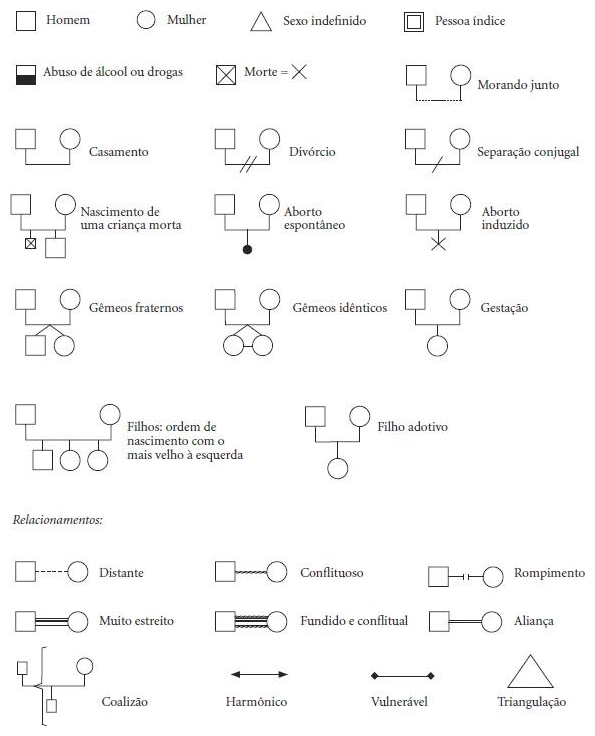
Family-centered care regards the maintenance and health of the individual within their family context as vital because, systemically, the family is the main shaper of the beliefs and rules of behavior directly linked to health.
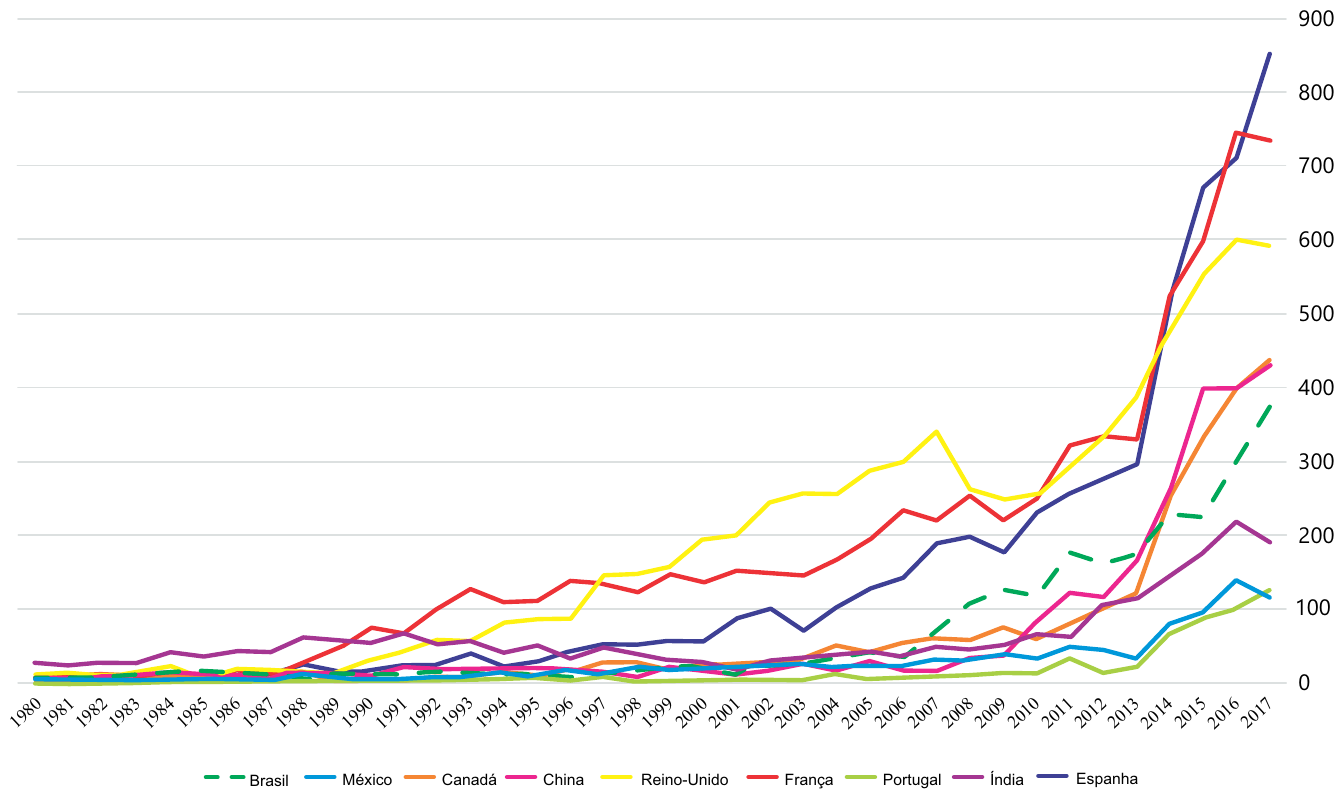
For Macinko and Mendonça (2018), there is a growing number of studies published, nationally and internationally, on the expansion of the ESF. As Fig. 4 shows, scientific publications increased significantly in 2007 and 2008, including in Brazil.
The development of this article, which stems from the author’s master’s dissertation, was driven by the need for studies on working with the genogram in public health, as noted by Borges et al. (2015). In the scientific literature there is a gap between the aim of filling the void in studies on the genogram and its contributions as a tool in basic health care. The literature review also revealed gaps in studies on the practical application, barriers and potential of the genogram tool in health professionals’ day-to-day work.
Final considerations
This article made it possible to recognize the many facets of the construction of family relationships, the aspects related to health and the social factors that interfere with family health, together with their potential and importance for understanding, designing and applying health measures for family health as a whole.
The article dealt with family configurations and their formation in the social context, and with the importance of understanding this system for maintaining health. It was built on the concept of family and its history, family functions, primary care, family health, family approach tools and the genogram, set in the context of the formation and establishment of PHC in the city of Rio de Janeiro, describing and emphasizing the importance of family support tools for gathering information and helping to maintain the health of the family as a whole, and illustrating the need for and the advantages of using the tools discussed.
The family’s challenge lies in this reorganization and in the search for stability in order to reach the new stages of the life cycle. When something comes apart and the family context cannot get back on its feet by itself, outside participation is needed. In seeking new ways out, the family comes across various possibilities of support.
Complexe Systémique: key points
This review article, which grew out of a master’s dissertation, has the merit of linking two worlds that rarely talk to each other: systemic family therapy and Brazilian primary health care, where each Family Health Strategy team follows several thousand people. It reminds us that tools born in family clinical work, the genogram and the ecomap first among them, can become ordinary instruments of community care, provided they are built with the family rather than filled in about it. That is where their clinical value lies: the genogram is not merely a record of medical history and risks, but a conversation that creates a bond and lets the family see itself as a whole that takes part in illness as well as in health. One may regret the lack of an explicit review method and of a clinical example, a presentation of PRACTICE, FIRO and APGAR that remains descriptive, and a question barely touched on: how to train teams and find time for this work in busy consultations. Read alongside our introduction to the genogram, and the study of vulnerable family meetings in general practice.
Notes from the original
Conflict of interest. Nothing to declare.
Authors’ contributions. Substantive scientific and intellectual contributions to the study: P.A. Penteado, K.M. Edmundo; conception and design: P.A. Penteado; data analysis and interpretation: P.A. Penteado, K.M. Edmundo; writing of the article: P.A. Penteado; critical revision: P.A. Penteado, K.M. Edmundo; final approval: P.A. Penteado.
Data availability statement. Not applicable.
Funding. Not applicable.
Acknowledgements. Not applicable.
References
Aguilera Campos, C. E., Cohn, A., & Brandão, A. L. (2016). Trajetória histórica da organização sanitária da cidade do Rio de Janeiro: 1916-2015. Cem anos de inovações e conquistas. Ciência & Saúde Coletiva, 21(5), 1351-1364. https://doi.org/10.1590/1413-81232015215.00242016
Alves, J. E. D., Cavenaghi, S. M., & Barros, L. F. W. (2010). A família DINC no Brasil: algumas características sociodemográficas. IBGE; Escola Nacional de Ciências Estatísticas.
Ariès, P. (1981). História social da criança e da família (v. 2). LTC.
Athayde, E., & Gil, C. R. R. (2005). Possibilidades do uso do genograma no trabalho cotidiano dos médicos das equipes de saúde da família de Londrina. Revista Espaço para a Saúde, 6(2), 13-22.
Borges, C. D., Costa, M. M., & Faria, J. G. (2015). Genograma e atenção básica à saúde: em busca da integralidade. Revista Psicologia e Saúde, 7(2), 133-141.
Bowen, M. (1991). De la familia al individuo: la diferenciación del sí mismo en el sistema familiar. Paidós.
Brasil. Ministério da Saúde. Secretaria de Atenção Primária à Saúde. Estratégia Saúde da Família. Recuperado de https://aps.saude.gov.br/ape/esf
Camilo, L. A., Couto, L. L., Barreto, A. C. M., Santana dos Santos, A. C., Regazzi, I. C. R., & Pinto, L. F. (2021). Family violence against children: approach to nursing through genogram and ecomapa. Revista de Pesquisa Cuidado é Fundamental Online, 13, 1554-1560. https://doi.org/10.9789/2175-5361.rpcfo.v13.10443
Carter, B., & McGoldrick, M. (1995). As mudanças no ciclo de vida familiar: uma estrutura para a terapia familiar (2ª ed.). Artmed.
Carvalho, I. M. M., & Almeida, P. H. (2003). Família e proteção social. São Paulo em Perspectiva, 17(2), 109-122. https://doi.org/10.1590/S0102-88392003000200012
Cecagno, S., Souza, M. D., & Rosa Jardim, V. M. (2004). Compreendendo o contexto familiar no processo saúde-doença. Acta Scientiarum. Health Sciences, 26(1), 107-112. https://doi.org/10.4025/actascihealthsci.v26i1.1622
Chapadeiro, C. A., Andrade, H., & Araújo, M. (2011). A família como foco da atenção primária à saúde. Nescon/UFMG.
Fernandes, C., & Curra, L. (2006). Ferramentas de abordagem familiar. Artmed/Panamericana.
Fonseca, C. (2005). Concepções de família e práticas de intervenção: uma contribuição antropológica. Saúde e Sociedade, 14(2), 50-59. https://doi.org/10.1590/S0104-12902005000200006
Franco, T. B., Bueno, W. S., & Merhy, E. E. (1999). O acolhimento e os processos de trabalho em saúde: o caso de Betim, Minas Gerais, Brasil. Cadernos de Saúde Pública, 15(2), 345-353. https://doi.org/10.1590/S0102-311X1999000200019
Giovanella, L., Mendoza-Ruiz, A., Pilar, A. C. A., Rosa, M. C., Martins, G. B., Santos, I. S., Silva, D. B., Vieira, J. M. L., Castro, V. C. G., Silva, P. O., & Machado, C. V. (2018). Sistema universal de saúde e cobertura universal: desvendando pressupostos e estratégias. Ciência & Saúde Coletiva, 23(6), 1763-1776. https://doi.org/10.1590/1413-81232018236.05562018
Git Mind (2022). Doenças. Git Mind. Recuperado de https://gitmind.com/app/flowchart/v176rrz6af
Gomes, H. S. (1994). Educação para família: uma proposta de trabalho preventivo. Journal of Human Growth and Development, 4(1).
Hemfelt, R., Minirth, F., & Meier, P. (1989). O amor é uma escolha: recuperação para relacionamentos codependentes. Grandalfo.
Lacerda, M. K. S., Pereira, A. C. A., Pereira, M. M., Teixeira, R. D. L. O. D., Veloso, D. C. M. D., & Pimenta, D. R. (2017). Ferramentas de abordagem familiar: estudo de uma família cadastrada em uma equipe de estratégia saúde da família em Montes Claros, Minas Gerais, Brasil. Revista de Iniciação Científica da Universidade Vale do Rio Verde, 7(1), 25-34.
Leônidas, C., & Santos, M. A. (2015). Family relations in eating disorders: the Genogram as instrument of assessment. Ciência & Saúde Coletiva, 20(5), 1435-1447. https://doi.org/10.1590/1413-81232015205.07802014
Machado, H. B., Soprano, A. T. B., Machado, C., Lustosa, A. C. P., Lima, M. H., & Mota, A. C. G. (2005). Identificação de riscos na família a partir do genograma. Família, Saúde e Desenvolvimento, 7(2), 149-157. https://doi.org/10.5380/fsd.v7i2.8042
Macinko, J., & Mendonça, C. S. (2018). Estratégia Saúde da Família, um forte modelo de atenção primária à saúde que traz resultados. Saúde em Debate, 42(spe1), 18-37. https://doi.org/10.1590/0103-11042018s102
McDonald, K., Schultz, E., Albin, L., Piñeda, N., Lonhart, J., & Sundaram, V. (2012). Care coordination measures atlas. Agency for Healthcare Research and Quality.
McGoldrick, M., & Gerson, R. (1995). Genetogramas e o ciclo de vida familiar (M. A. V. Veronese, Trad.). In Carter, B. & McGoldrick, M. (Eds.), As mudanças no ciclo de vida familiar: uma estrutura para a terapia familiar (2. Ed.). Artes Médicas.
McGoldrick, M., & Shibusawa, T. (2012). The family life cycle. In Walsh, F. (Ed.), Normal family processes: growing diversity and complexity (pp. 375-398). Froma Walsh.
Mejía Gómez, D., Molina, J., Soto, M. I., & Ruiz Puiana, C. E. (1990). Salut familiar sistema de educación continua. Asociación Colombiana de Facultades de Medicina.
Mello, D. F., Viera, C. S., Simpionato, É., BiasolI-Alves, Z. M. M., & Nascimento, L. C. (2005). Genograma e ecomapa: possibilidades de utilização na estratégia de saúde da família. Revista Brasileira de Crescimento e Desenvolvimento Humano, 15(1), 79-89.
Mendes, E. V. (2012). O cuidado das condições crônicas na atenção primária à saúde: o imperativo da consolidação da estratégia da saúde da família. Organização Pan-Americana da Saúde, Organização Mundial da Saúde, Conselho Nacional de Secretários de Saúde.
Multicultural Family Institute (2022). Kahlo Genogram. Multicultural Family Institute. Recuperado de https://multiculturalfamily.org/product/kahlo-genogram-downloadable-pdf/
Nichols, M. P., & Schwartz, R. C. (2009). Terapia familiar: conceitos e métodos. Artmed.
Nolte, E., & McKee, M. (2008). Integration and chronic care: a review. In Nolte, E. (Ed.), Caring for people with chronic conditions: a health system perspective (pp. 64-91). Open University Press.
Paim, J. S. (2019). Os sistemas universais de saúde e o futuro do Sistema Único de Saúde (SUS). Saúde em Debate, 43(n. esp.), 15-28. https://doi.org/10.1590/0103-11042019S502
Penteado, P. A. (2012). Construção social da maternidade. Revista Brasileira de Terapia Familiar, 4(1), p. 23-34. https://doi.org/10.60114/rbtf.v4i1.66
Penteado, P. A. (2020). Transtornos alimentares: transmissão geracional, obesidade e família. In Damião, D. B., & Moreira, R. C. (2020). Psicologia: um olhar na família (pp. 138-147). Científica Digital. https://doi.org/10.37885/200500245
Pinto, L. F., & Giovanella, L. (2018). Do Programa à Estratégia Saúde da Família: expansão do acesso e redução das internações por condições sensíveis à atenção básica (ICSAB). Ciência & Saúde Coletiva, 23(6), 1903-1914. https://doi.org/10.1590/1413-81232018236.05592018
Ribeiro, I., Ribeiro, A. C. T., & Duarte, L. F. D. (1995). Família em processos contemporâneos: inovações culturais na sociedade brasileira (Vol. 10). Edições Loyola.
Rodrigues, P. H. A. (2014). Desafios políticos para a consolidação do Sistema Único de Saúde: uma abordagem histórica. História, Ciências, Saúde-Manguinhos, 21(1), 37-60. https://doi.org/10.1590/S0104-59702014000100003
Santos, J. A., Cunha, N. D., Brito, S. M. S., & Brasil, C. H. G. (2016). Ferramenta de abordagem familiar na atenção básica: um relato de caso. Journal of Health Science Institute, 34(4), 249-252.
Sarti, C. (2010). O lugar da família no Programa de Saúde da Família. In Bomfim, L. A. (Ed.), Família contemporânea e saúde: significados, práticas e políticas públicas (pp. 91-103). Fiocruz.
Silva, M. C. L. S. R., Silva, L., & Bousso, R. S. (2011). A abordagem à família na Estratégia Saúde da Família: uma revisão integrativa da literatura. Revista da Escola de Enfermagem da USP, 45(5), 1250-1255. https://doi.org/10.1590/S0080-62342011000500031
Silva, M. J., Victor, J. F., Mota, F. R. N., Soares, E. S., Leite, B. M. B., & Oliveira, E. T. (2014). Análise das propriedades psicométricas do APGAR de família com idosos do nordeste brasileiro. Escola Anna Nery, 18(3), 527-532. https://doi.org/10.5935/1414-8145.20140075
Talbot, Y. (1985). Assessing the single-parent family. Canadian Family Physician. Recuperado de https://www.academia.edu/62228321/Assessing_The_Single_Parent_Family
Viegas, A. B. (2019). Possibilidades de uso de ferramentas de abordagem familiar na construção da SAE na APS: o genograma funcional (Dissertação de Mestrado, Universidade de São Paulo, São Paulo).
Wagner, A. B. P., Wagner, H. L., Talbot, Y., Oliveira, E., Czeczko, N. G., Ribas, C. A., Moysés, S. J., & Ribas Filho, J. M. (1999). Trabalhando com famílias em saúde da família. Revista Médica do Paraná, 57(1/2), 40-46.
Wendt, N. C., & Crepaldi, M. A. (2008). A utilização do genograma como instrumento de coleta de dados na pesquisa qualitativa. Psicologia: Reflexão e Crítica, 21(2), 302-310. https://doi.org/10.1590/S0102-79722008000200016
Wright, L. M., & Leahey, M. (2002). Enfermeiras e famílias: guia para avaliação e intervenção na família (v. 2). Roca.
Unofficial English translation of Relações familiares, saúde da família e ferramentas de apoio, by Paula Antonelli Penteado and Katia Maria Edmundo, Revista Brasileira de Terapia Familiar, vol. 12, no. e0824 (2024), doi: 10.60114/rbtf.v12i1.142, under a CC BY 4.0 licence. Translation (with the help of artificial intelligence) and layout: Complexe Systémique, November 2026 — the work has been modified under the terms of the licence. Neither the authors nor the journal are responsible for this translation; the original version prevails.
Unofficial English translation of “Relações familiares, saúde da família e ferramentas de apoio”, published in Revista Brasileira de Terapia Familiar (2024) under a CC BY 4.0 licence. Made by Complexe Systémique with the help of artificial intelligence, it does not come from the authors or the journal, who are not responsible for its content; the original version prevails.
Read the original articleHow to cite this article
Penteado, P. A., et Edmundo, K. M. (2024). Family Relationships, Family Care and Supporting Tools (Complexe Systémique, Trans.). Complexe Systémique. https://app.complexe-systemique.com/en_GB/articles/family-relationships-family-care-and-supporting-tools (Original work published in 2024 in Revista Brasileira de Terapia Familiar, v. 12, n. e0824 (2024); republished in 2024 by Revista Brasileira de Terapia Familiar, https://revbrasterapiafamiliar.abratef.org.br/revista/article/view/142)
To go further
- What you need to know about the genogram, a systemic toolThe basics of the genogram, from reading to use.
- The Use of Child-Centered Ecomaps to Describe Engagement, Teamwork, Conflict and Child Focus in Coparenting Networks: The International Coparenting Collaborative ApproachThe ecomap, drawn from the child’s point of view.
- Vulnerable Family Meetings: A Way of Promoting Team Working in GPs’ Everyday Responses to Child Maltreatment?When general practice meets around families.
Related training courses
 Symposium
État des Lieux: a psychological approach to spaces
Replay of the “État des Lieux” conference (Paris, 16 October 2026): Ivy Daure, Maurizio Frisina, Viola Sallay and Gilbert Pregno on places as a clinical resource. In French.
 Short course
The new arenas of couple therapy: work, money, tasks and co-existence
Online training: working with conjugal tensions around work, money, mental load and household tasks. Systemic reading and tools. In French.
 Short course
The subtle art of humour in therapy: seriously funny
Online training: mobilising humour as a systemic intervention tool — reframing, stance, ethics. A lively day with Caline Fattal. In French.
 Online course
Master the use of the Amour Monstre floating object in systemic therapy
Train with Ivy Daure, creator of the tool, in the Amour Monstre floating object: protocol, systemic questioning and filmed simulations. 8 hours of video, in French with English subtitles.
Related articles
 Scientific
The Duogramma®: An innovative methodology for psychotherapy
A map of the couple relationships lived, desired or rejected since childhood: the Duogramma®, its graphic rules and its use in individual therapy.
 Scientific
Family group conference provision across the lifespan of child welfare intervention: A mixed-method realist-informed evaluation comparing three stages of welfare concern
Early help, child protection or children in care: among 155 UK families, experiences and outcomes of family group conferences vary very little by stage.
 Scientific
Implementing Family Group Decision-Making within statutory child protection social work in Scotland: Challenges and opportunities
Family group decision-making offered automatically in Scottish child protection: families find a voice, social workers doubt the plans, and everyone wants it offered earlier.
 Scientific
Parenting after critical illness: a biopsychosocial review of post-intensive care syndrome, family systems, and child outcomes
After post-intensive care syndrome, parenting falters, the co-parent is worn down and children help in silence. A biopsychosocial review proposes how to spot them.
Comments 0
Log in to join the discussion. Log in