Family Relations · Family
“I Want to Make Sure I'm Doing What It Takes”: Parental Role Changes Following Separation
How is one’s place as a parent redefined in the months after separation? Drawing on 17 interviews conducted in Pennsylvania, Raymond E. Petren’s team proposes a grounded theory in three stages: revisiting former roles, dealing with uncertainty and loss of control, then adjusting, or remaining stuck. Custody weighs as much as gender.
This is a reformatted republication of “I Want to Make Sure I'm Doing What It Takes”: Parental Role Changes Following Separation, by Raymond E. Petren, Melissa A. LaBuda and Mike Anthony, published in Family Relations (Wiley) (2026), doi: 10.1111/fare.70250, under a CC BY 4.0 licence. Prepared by Complexe Systémique in September 2026: the authors’ text is unchanged; the layout has been adapted for reading online, which constitutes a modification of the work under the terms of the licence. The table is presented as a list. This edition was made neither by the authors nor by the publisher, who are not responsible for its content or for any errors. The original version prevails.
Parents may reduce initial uncertainty and regain some control simply through practical behavioral responses which may only later shape their perceived roles and developing identities.
Raymond E. Petren, Melissa A. LaBuda and Mike Anthony
Abstract
Objective. The objective of this study is to understand how parents adjust their roles during the transition to separation.
Background. Parental separation is a transition involving several structural, economic, personal, and interpersonal changes that require adjustments in parental roles.
Method. This study used qualitative interviews and a grounded theory approach to examine parents' perceptions of their role changes shortly following separation (N = 17).
Results. The process of adjusting parental roles involved (re)considering pre-separation role perceptions and responsibilities; navigating uncertainty and control; and adjusting parental roles (or feeling stuck and losing hope). Parents' experiences and role adjustments varied by parent gender, relational circumstances, and structural conditions.
Conclusion. Findings suggest that circumstances surrounding separation force parents to make behavioral and psychological changes to re-conceptualize their roles which, when successful, can lead to a sense of satisfaction and well-being.
Implications. Divorce educators and practitioners should consider supporting parental role adjustment to foster post-separation adjustment.
1 Introduction
Separation and divorce are transitions in which changes in household composition, economic circumstances, and family relationships require parents to play new roles in families (Emery 2012). The establishment of new parental roles has implications for parent well-being, parenting behaviors, child adjustment, and family functioning following separation and divorce, and adjusting to new roles is a concern for parents during this time (Ferraro et al. 2016; Nelson 2006; Troilo and Coleman 2013). As responsibilities and relationships change substantially early in the process of separation and divorce (Ferraro et al. 2016; Markham and Coleman 2012), many adjustment problems of both parents and children occur shortly following the dissolution of parental relationships (Amato 2010), and the establishment of new parental roles shortly following separation may be particularly important.
Transitions such as parental separation are times of conflict and disequilibrium that require adjustments in parental roles, resulting in a “qualitative reorganization of both inner life and external behavior” (Cowan 1991, 5). The establishment of new parental roles can be challenging as the responsibility to attend to the changing needs of children in this context is accompanied by the need to resolve practical and emotional issues surrounding the dissolution of the romantic relationship, the reconfiguration of coparental relationships, new custody and child support agreements, shifting residential circumstances, financial challenges, and on-going legal issues (Ashbourne et al. 2013; Emery 2012; Jamison et al. 2014). Despite these challenges, such transitions also provide opportunities for parents to make both internal (e.g., sense of self, roles and relationships) and external (parenting and coparenting behaviors) adjustments that can result in adaptations and more integrated levels of equilibrium that ultimately benefit both parents and children (Cowan 1991; Palkovitz and Palm 2009).
Although not focused on parents' perceptions of their roles, per se, Van Gasse and Mortelmans (2020) found that the transition to single parenthood among Belgian parents involves six phases, beginning with an initial lack of contentment and decline in the relationship with the former partner and culminating in a period of contentment, reorganization, and acceptance as a fully functioning single parent family is established. Between these initial and final periods, parents negotiated phases of: driving toward transition; a hazy period of heightened uncertainty as they attempted to grapple with the breakdown of household organization during the transition; a period of temporary reorganization during which emotional turbulence subsided; family re-organization began to take shape; and a period of sustainable reorganization during which work and family responsibilities were balanced and sustainable family routines were developed. Whereas this recent study used retrospective reports to provide some insight into how parents approach family reorganization, it did not focus intently on how parents view their roles and identities during the transition to parental separation and divorce.
Most previous studies focusing on parental roles and identities after separation and divorce have included parents who had been separated from previously unmarried partners for years (see Troilo and Coleman 2012, 2013 as exceptions focusing on fathers), and few studies focus on parents' perceptions of their roles during the transition to separation. However, early changes in parenting roles following separation can set the trajectory for more permanent parenting arrangements, as they may affect parents' choices and legal decisions related to family relationships and boundaries, custody, and visitation. Also, many divorce education programs are implemented shortly following separation, and qualitative research is needed to help parents understand and anticipate challenges and sources of resilience as they re-construct their roles during this formative period. To our knowledge, no research has explored the process of parental role adjustment following separation and divorce. Therefore, the purpose of the current study is to develop a theory of the process of parental role changes following separation.
2 The Re-Construction of Parental Roles in Separation
Research on experiences of separated and divorced parents provides a useful backdrop since changes in parental roles early in the process of separation likely portend later adjustment. Previous research has typically focused on parents based on parents' gender and custody or resident status (e.g., resident mothers, nonresident fathers), as these categories represent different sets of social expectations and practical constraints for parents (Arditti 1995). We note that experiences of recently separated parents cannot be so distinctly categorized as living arrangements, custody, and visitation agreements are varied and often in flux. Noting the limitations of these labels, we arranged this literature review by parents' resident status to reflect the language and conceptualizations of parenting provided by authors of previous research and to discuss general circumstances of post-separation parenting.
2.1 Resident Mothers
Although shared custody agreements are increasingly prevalent, mothers are still most commonly primary resident parents following separation and divorce (Meyer et al. 2022). Resident mothers often view themselves as having primary responsibility for children (Ganong et al. 2015; Nelson 2006). Many report feeling overwhelmed by financial limitations and time constraints, and they describe difficulty balancing demands of work and parenting (Arditti and Madden-Derdich 1995; Hodgson et al. 2001). Feelings of guilt can result when these challenges limit quality time or result in negative parenting due to fatigue (Arditti and Madden-Derdich 1995; Son and Bauer 2010). Additionally, some experience feelings of guilt and loss associated with the loss of the two-parent family ideal and its implications for children (Arditti and Madden-Derdich 1995; Nelson 2006). Despite these challenges, parenting in the absence of a conflictual partner can reduce tension in the home, enabling more satisfying relationships with children (Arditti and Madden-Derdich 1995; Nixon et al. 2012). Early research shows that some custodial mothers describe unexpected changes in self-concept related to personal growth (Arditti and Madden-Derdich 1995) and increased satisfaction related to independence, life control, and competence, although some mothers describe little change in self-concept (Baum et al. 2005).
Resident mothers often consider themselves managers of family relationships (Ganong et al. 2015; Nelson 2006). In some cases, single mothers recruit kin (fathers, new partners, extended family members) to help with childrearing and financial support (Nelson 2006; Roy and Burton 2007). Accepting help often includes a balance of seeking help while maintaining self-sufficiency, preserving a “good mother” identity, and taking some advice while remaining “mother-in-charge” who knows what is best for their children (Nelson 2005, 2006).
Several factors may affect mothers' gatekeeping behaviors which encourage or discourage father involvement. Mothers report restricting father involvement when they view interparental communication as conflictual, report fathers as controlling or abusive, perceive fathers as incompetent or unimportant, have concerns about child safety in the father's presence, view custody arrangements as burdensome or chaotic, or receive inadequate child support (Ferraro et al. 2016; Nixon and Hadfield 2018; Sano et al. 2008; Trinder 2008). However, many mothers negotiate a complex balance between the merits of father involvement and risks posed to children by the father (Nixon and Hadfield 2018; Trinder 2008). Some mothers who experience conflict with fathers or perceive them as ambivalent about involvement engage in passive gate tending, leaving fathers and children to negotiate their own relationships (Trinder 2008).
2.2 Resident Fathers
To the extent that parenting duties and the division of household labor are gendered among heterosexual couples, becoming a single resident father may include taking new roles that were once taken by former partners. Single fatherhood is viewed as a social position in which men are often expected to take on traditional mothering roles in the care of children while upholding cultural standards as traditional men (Hook and Chalasani 2008). Single resident fathers are generally more involved with children than are other fathers, but gender tempers the extent to which they take roles traditionally occupied by mothers (see Coles 2015 for a review).
Some resident fathers describe reluctance or unreadiness to take primary responsibility when they assume childcare duties as a result of mothers' personal challenges that limit their ability to care for children (Cohen et al. 2014; Hamer and Marchioro 2002; Waller 2009). As with resident mothers, resident fathers describe difficulties with work-family balance and role strain while assuming sole responsibility for child care (Hamer and Marchioro 2002; Greif and DeMaris 1990). When faced with these challenges, low-income and unmarried custodial fathers report relying on their own kin (e.g., mothers, siblings, aunts) or new partners for help with child care and practical advice (Coles 2001; Hamer and Marchioro 2002; Waller 2009).
Little research has focused on the transition to resident fatherhood. In one study of unmarried parents, Waller (2009) found that some initially nonresident fathers who ultimately took on primary parenting responsibilities often re-defined their obligations, at first focusing on financial provision but shifting to more caregiving duties over time. These fathers were motivated to change employment and develop new parenting skills—a process involving “learning on the job” to accommodate the demands of primary parenting.
2.3 Nonresident Fathers
Previous qualitative research has focused mostly on the nature and extent of father involvement with the view that contextual circumstances, relationships, perceptions, and motivations shape the roles of nonresident fathers. Following separation and divorce, many nonresident fathers no longer have less access to children “at will” (Pasley and Braver 2004), and new roles are developed in the absence of daily interaction (Frieman 2003). Fathers report a number of threats to the frequency and quality of their involvement, including unfavorable custody arrangements, geographic distance, time and financial limitations, coparental conflict and maternal gatekeeping, the autonomy of adolescent children, difficult emotional adjustments, personal issues such as substance abuse, and life changes such as new jobs and partners (Dudley 1991; Hallman et al. 2007; Jenkins 2009; Troilo and Coleman 2012, 2013).
Nonresident fathers often view a lack of control over their involvement and perceive limited influence in child-related decisions. Many nonresident fathers perceive that mothers have control over visitation (Bloomer et al. 2002), even when legal custody agreements stipulate otherwise (Jenkins 2009). Child support is another source of contention. Although most fathers value the provider role as a hallmark of responsible fathering (Edin and Nelson 2013; Troilo and Coleman 2012), some fathers express resentment over being viewed solely as providers (Bloomer et al. 2002; Hallman et al. 2007; Olmstead et al. 2009).
Many nonresident fathers experience loss related to the desire for more child interaction, distress when visitation concludes, resentment over perceived loss of authority and influence, and feelings that they are outsiders in the family (Catlett and McKenry 2004; Hallman et al. 2007; Jenkins 2009; Kielty 2006). Failure to resolve these feelings often results in conflict or disengagement with ex-partners (Arendell 1992; Baum 2004). Some fathers justify disengagement as a strategy to avoid conflict or distance themselves when loss becomes overwhelming and regaining control appears impossible (Arendell 1992). However, some fathers develop new strategies by engaging in traditionally feminine behaviors, emphasizing child nurturance and cooperative coparenting to maintain involvement (Arendell 1992).
2.4 Nonresident Mothers
As nonresident mothers typically lose the context in which traditional maternal caregiving roles can be enacted (Babcock 1998; Kielty 2005), they often struggle to live up to the ideology of intense motherhood which can result in feelings of guilt, shame, and grief (Arditti and Madden-Derdich 1993; Kielty 2005; Kruk 2010). Some nonresident mothers attempt to fulfill “good mother” ideals whereas others vacillate between accommodating these expectations and rejecting them amid the limitations of noncustodial motherhood (Bemiller 2010). As with nonresident fathers, many nonresident mothers describe a lack of satisfaction with custody arrangements, perceive themselves as outsiders in the lives of the children, and report missing day-to-day interactions (Arditti and Madden-Derdich 1993; Babcock 1998).
Mothers who voluntarily forego custody tend to focus on the child's need to have a stable environment, and they perceive the fathers' residence as the context for such stability (Kielty 2005). However, a substantial proportion of noncustodial mothers involuntarily lose custody through litigation (Herrerías 2008). These mothers often report fathers' custody claims are selfish in nature and are not in the best interests of children (Kielty 2006). When children choose to live with their fathers, mothers often perceive that they are marginalized or feel that fathers have inordinate influence (Arditti and Madden-Derdich 1993; Kielty 2005). In other cases, mothers may leave to escape an abusive partner (Arditti and Madden-Derdich 1993; Herrerías 1995, 2008), and some report fathers' gatekeeping behaviors and intimidation contribute to continued feelings of disempowerment (Kielty 2005). Overall, mothers who involuntarily lose custody often focus on the perceived need of children to have ongoing maternal care and limitations placed on them to provide such care (Kielty 2005).
2.5 Shared Custody
A growing number of parents share custody after separation and divorce (Meyer et al. 2022). However, de facto shared physical custody arrangements vary as shared custody is generally defined as both parents having at least 25%–30% of the overnight parenting time (Amato et al. 2009), and most custody decisions stipulate that children have more time with mothers than with their fathers (Grall 2020; Meyer et al. 2022). When parents do share custody, there are implications for parents' roles related to both coparenting and parenting.
Shared custody provides special challenges as more communication is often required to coordinate parenting across households which can make coparenting difficult, particularly when coparental relationships are contentious (Markham and Coleman 2012). Parents attempt to work together while maintaining boundaries between households through a variety of communication methods and strategies (Markham et al. 2017), often using cognitive (e.g., focusing on the children), affective (e.g., regulating emotional responses to the other parent) and behavioral strategies (e.g., implementing flexibility with time and addressing money issues with the former partner) to maintain positive coparenting relationships (Jamison et al. 2014).
Gendered perceptions shape both pre-separation parenting experiences and post-separation expectations. For many mothers, sharing custody with fathers may run counter to intensive mothering ideals that suggest mothers are primarily responsible for child care and well-being (Markham and Coleman 2020). Markham and Coleman (2020) found that mothers with shared custody found ways to support the mother identity despite having to share custody. To reduce concerns about their inability to physically “be there” for their children, mothers focused on perceptions that the children should have a relationship with both parents, emphasized the quality of their relationship with the children, and engaged with the child when they were in the father's care (Markham and Coleman 2020). Some mothers still struggled when the perceived need to be there for their children outweighed the perception that children should have a relationship with both parents, resulting in continued negative feelings about their ability to meet the standards of their mother identities (Markham and Coleman 2020).
On the other hand, fathers who had not been too involved with primary parenting responsibilities prior to separation are likely to experience more challenges and role adjustments associated with assuming new primary caregiving tasks when the children are in their care (Ashbourne et al. 2013). Such challenges may be exacerbated by the lack of cultural scripts to define engaged fatherhood (Collett et al. 2015). Yet, some fathers may view taking new roles as an opportunity to enhance their relationships with their children and derive a greater sense of satisfaction from parenting (Palkovitz and Palm 2009).
3 Parental Roles and Identities Following Separation and Divorce
Roles of both mothers and fathers are understood to be socially constructed and informed by personal, interpersonal, cultural, and gendered expectations (Weaver and Coleman 2010; Marsiglio and Cohan 2000). During separation, parents re-construct their roles in the context of the changing family, often prior to the establishment of legal agreements (in cases where legal agreements are eventually established) and in the absence of clear social guidelines for parenting after separation (Arditti 1995). Also, boundary ambiguity (uncertainty about who is in the family) and role ambiguity (uncertainty about expectations for a role) are common in separation (Markham and Coleman 2020; Sarkisian 2006; Weaver and Coleman 2005), simultaneously making parenting roles unclear and providing opportunities for parents to play new roles.
An additional sensitizing lens, identity theory, posits that individuals hold positions or statuses in society (e.g., mother, father), and identities represent self-meanings for role expectations (Pasley et al. 2014; Stryker and Burke 2000). Identities are often reflected in the individual's behaviors (Pasley et al. 2014; Stryker and Burke 2000), and commitment to parental identities may be shaped by structural and economic circumstances (Adamsons and Pasley 2013) or expectations of important others (e.g., former spouse, children, new partners, family members) who provide more or less support for a parental identity (Pasley et al. 2014). Additionally, cultural expectations, typically imbued with gendered notions regarding the roles of mothers and fathers, affect role perceptions and behaviors (e.g., Bemiller 2010; Hallman et al. 2007).
Burke (1991a, 1991b) suggested a process model of identity verification whereby individuals seek to verify the identities they hold (e.g., parental identity) through social feedback (e.g., from children, former partners, kin, peers). Affirmative feedback verifies that the individual is enacting behaviors that align with their internal standard for the identity. Social feedback that the identity is not enacted as expected signals the need for adjustments to realign behaviors with the identity. In cases where behavioral change appears too difficult to align with identity expectations, the individual may adjust their internal standard (the internalized meaning of the identity) to reduce the discrepancy, or the identity may become less salient if verification challenges appear insurmountable (Burke 1991a, 1991b). Ultimately, the parent may forego the parental identity altogether and choose to invest in other identities (e.g., worker, partner in a new relationship) if verification is chronically challenged.
4 The Current Study
As separation and divorce result in changing relationships, circumstances, and tasks for parents, it is a natural time for parents to reconsider their responsibilities, roles, and identities (Petren and Ferraro 2024). Previous research has focused on how parents negotiate practical and emotional challenges to reorganize the family (Van Gasse and Mortelmans 2020) and seek to maintain and enact their parental identities (Markham and Coleman 2020; Troilo and Coleman 2013) following separation. Little research has focused on the processes whereby parents' roles change shortly following separation. The current study uses grounded theory methodology to describe parents' perceptions of role changes following separation and factors that foster or restrict role changes that support parental adjustment and positive family functioning. Specifically, we address the following research questions:
RQ1.How do parents perceive parental role changes following separation?
RQ2.What factors foster or restrict parental role changes following separation?
5 Method
Qualitative grounded theory methodology (Charmaz 2006; Corbin and Strauss 1990) was used to conduct an investigation of parental role changes following separation. Separated parents were recruited from a mandated parenting education class for parents seeking custody in a Northeastern state in the United States. Consistent with grounded theory methodology, data collection, analysis, and recruitment were concurrent (Corbin and Strauss 1990). Parents were recruited until theoretical saturation was reached, and no new information emerged from the data (Corbin and Strauss 1990). Data were transcribed and analyzed by the three authors and two undergraduate research assistants, using open, axial, and theoretical coding (Charmaz 2006). The first two authors participated at all stages of the coding process. The third author and the two undergraduate research assistants participated in transcribing the data and the open coding process in consecutive, non-overlapping periods during data collection. During the open coding phase, data were coded line-by-line (Charmaz 2006). Research team members met to discuss each open code, working through disagreements until a consensus was reached for each code. The first two authors engaged in axial coding to make connections between categories and subcategories (Corbin and Strauss 1990). For example, we explored connections among pre-separation role expectations, emerging child needs that required parents to re-think their roles, and opportunities to play new roles. Then, during selective coding, the first two authors arranged categories around core categories (Corbin and Strauss 1990). In continuation of the previous example, (re)considering parental roles and responsibilities was developed as a core category. Throughout the analytic process, the constant comparative method was used to compare codes within and across cases and challenge researchers' assumptions against the data (Corbin and Strauss 1990). Consistent with grounded theory methodology, a theory was inductively developed to describe the process of parental role change following divorce and the re-negotiation of parental roles among recently separated and divorced parents.
Each participant was interviewed once. Semi-structured interviews lasted approximately 60–90 min and were conducted in a place of the participant's choosing (participant's home, University office, coffee shop). Interview questions focused on: parents' perceptions of their roles both before and after separation; the personal, interpersonal, and structural factors that affected changes in their roles; and their perceptions of how role changes affect individual (parent and child) and family functioning. To further explore developing themes, new interview questions were generated as interviews progressed. New questions focused on participants' experiences of uncertainty, the impact of changes in physical space on parental roles, and the influence of (impending) legal negotiations on parents' roles. Each participant was given a $15 Target gift card and was entered in a drawing to win an Apple iPad.
Several steps were taken to ensure qualitative validity. The use of a semi-structured interview protocol enhances trustworthiness of the data by ensuring that all participants had a similar interview experience (Macnee 2004). To further assure trustworthiness, all interview transcripts were reviewed by the researchers for any obvious errors. Credibility was enhanced through the use of memos and the establishment of an audit trail to document decisions and provide consistency throughout the process (Creswell and Miller 2000). Bias was reduced by the use of multiple researchers with varied backgrounds (age, gender, SES, family experiences) to conduct analyses and challenge each other's unique perspectives (Strauss and Corbin 1990). The constant comparative method also reduces bias as this method requires that researchers continuously compare their thoughts against the data (Corbin and Strauss 1990). Pseudonyms are used to protect participant identities. All research was conducted in compliance with the Institutional Review Board at Pennsylvania State University.
The sample includes 17 participants (9 mothers, 8 fathers). Most participants were recently separated (mdn = 7 months). At the time of the interview, 13 of 17 participants had been separated within 12 months, 2 had been separated within 1–3 years, and 2 had been separated for 5–9 years. Participants were mostly White (14 White, 1 Asian, 2 African American), diverse in education level (29.4% high school, 23.5% some college, 11.8% technical degree, 11.8% bachelor's degree, 23.5% graduate degree), employed (88.2%), and middle-income (mdn = $40,000–$49,999). The average participant age was 39 years old (SD = 8.45), the average number of children per participant was 1.94 (SD = 1.02), and the average age of the youngest child was 6.58 (SD = 5.03) (Table 1).
Table 1 — Demographic information.
- Participant: Dan; Age: 43; Number of children: 3; Youngest child age: 9; # Overnights/month: 3; Time since separation: 3 months; Annual household income: ≥ $75,000
- Participant: Morty; Age: 35; Number of children: 3; Youngest child age: 7; # Overnights/month: 30; Time since separation: 12 months; Annual household income: $40,000–$49,999
- Participant: Ariela; Age: 53; Number of children: 4; Youngest child age: 13; # Overnights/month: 30; Time since separation: 0 monthsa; Annual household income: $50,000–$74,999
- Participant: Jack; Age: 49; Number of children: 2; Youngest child age: 15; # Overnights/month: 0; Time since separation: 17 months; Annual household income: $50,000–$74,999
- Participant: Jampa; Age: 39; Number of children: 2; Youngest child age: 3; # Overnights/month: 0; Time since separation: 8 months; Annual household income: $30,000–$39,999
- Participant: Roland; Age: 35; Number of children: 1; Youngest child age: 8; # Overnights/month: 10; Time since separation: 5 months; Annual household income: $40,000–$49,999
- Participant: Lee; Age: 30; Number of children: 2; Youngest child age: 5; # Overnights/month: 8; Time since separation: 1 month; Annual household income: $30,000–$39,999
- Participant: Rick; Age: 28; Number of children: 1; Youngest child age: 6; # Overnights/month: 30; Time since separation: 68 months; Annual household income: $40,000–$49,999
- Participant: Rachel; Age: 31; Number of children: 1; Youngest child age: 6 months; # Overnights/month: 30; Time since separation: 7 months; Annual household income: $20,000–$29,999
- Participant: Lenore; Age: 49; Number of children: 2; Youngest child age: 16; # Overnights/month: 30; Time since separation: 2 months; Annual household income: $30,000–$39,999
- Participant: Erica; Age: 37; Number of children: 2; Youngest child age: 4; # Overnights/month: 30; Time since separation: 2 months; Annual household income: $40,000–$49,999
- Participant: Kelly; Age: 52; Number of children: 2; Youngest child age: 12; # Overnights/month: 30; Time since separation: 12 months; Annual household income: ≥ $75,000
- Participant: Robin; Age: 29; Number of children: 4; Youngest child age: 3; # Overnights/month: 30; Time since separation: 32 months; Annual household income: $0–$9999
- Participant: Jen; Age: 47; Number of children: 1; Youngest child age: 10; # Overnights/month: 27; Time since separation: 109 months; Annual household income: $20,000–$29,999
- Participant: Kaitlin; Age: 31; Number of children: 1; Youngest child age: 2; # Overnights/month: 30; Time since separation: 7 months; Annual household income: ≥ $75,000
- Participant: Jessica; Age: 43; Number of children: 1; Youngest child age: 4; # Overnights/month: 30; Time since separation: 4 months; Annual household income: $0–$9999
- Participant: John; Age: 43; Number of children: 1; Youngest child age: 4; # Overnights/month: 30; Time since separation: 4 months; Annual household income: $0–$9999
a Still lived with former partner at the time of the interview.
6 Results
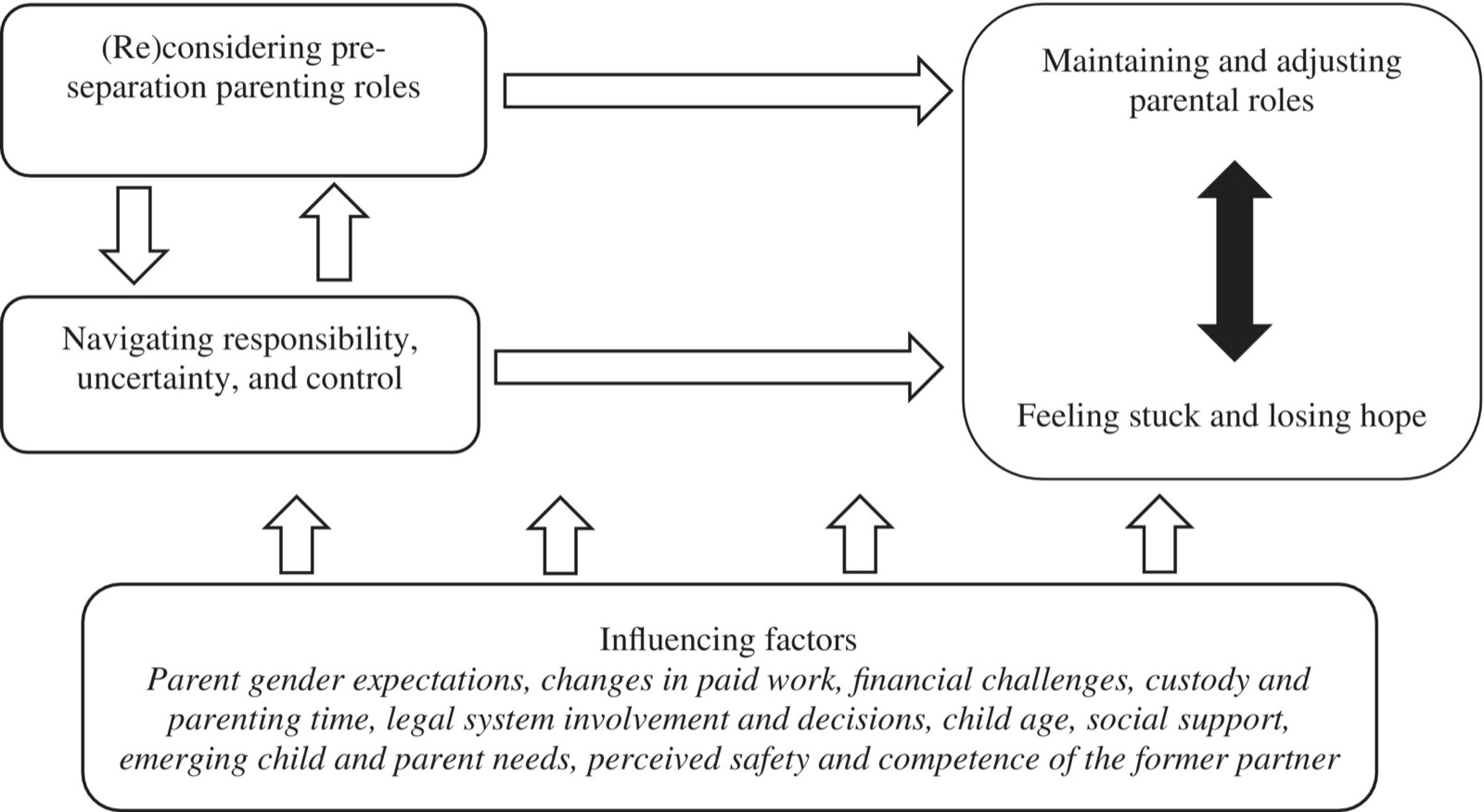
Figure 1 depicts the theoretical model which was derived inductively during the course of analysis. Upon the transition to separation, parents began to (re)considering pre-separation roles and responsibilities that had previously helped to define their sense of self as parents while they navigated perceptions of responsibility, uncertainty, and control in the context of separation. This process led to varying levels of parental role adjustment on a continuum from maintaining and adjusting parental roles to feeling stuck and losing hope. Although the overarching process was generally the same for most parents, there was variation in the experience of the process and outcomes by parent gender, structural conditions, and relational circumstances.
6.1 (Re)considering Pre-Separation Roles and Responsibilities
Most parents described pre-separation roles that are consistent with traditional gender roles. Mothers often described themselves as having shouldered the primary responsibility for hands-on childcare, planning, and emotional nurturance when they lived with former partners. The perception that they were “always the primary parent” provided them with a sense of confidence that they were the ones who knew best what the children needed and provided a sense that they knew who they were as parents. Robin described: “Even throughout the marriage I was basically a single mom. You know, I had to do bath time, I had to cook, I had to clean, I had to take care of them … basically nothing really has changed.”
Conversely, the majority of fathers described themselves as having focused on financial provision prior to separation while describing former partners as primarily responsible for child care and household labor. Roland described the division of household labor: “I'm the one that was working, so she's the one that was taking care of them.” A common refrain among these fathers was that they had been “going through the motions” in matters related to hands-on parenting. Some fathers sensed that they missed opportunities to build better bonds with the children. Morty describes, “I was working a lot of hours, coming home, and pretty much zoning out and not really giving the kids enough time.” Some fathers described additional traditional fathering roles related to leisure (“just have fun with them, go fishing and do whatever,” Dan), mentoring (“to show them the little things in life that they are going to run into,” Jack), teaching (“helping my daughter at home with her homework and, uh, giving her extra educational things,” Jampa), and discipline (“teaching them the roles of consequences,” Morty).
Two fathers were the exception to the pattern of traditional roles, recalling having been more involved with caregiving and household tasks prior to separation. Rick, whose former partner experienced mental health challenges that limited her ability to provide child care described, “I worked. You know, then I would come home, and then right into dad mode because he was still a baby, I would feed him, I would change him, I would rock him to sleep.”
6.2 Navigating Uncertainty and Control in the Context of Separation
Pre-separation roles provided parents with an initial template that helped to define their sense of self as parents and included perceived responsibilities they often hoped to carry forward. However, changing structural and relational conditions introduced feelings of uncertainty, and often a lack of control, as parents faced challenges in meeting former responsibilities and as new responsibilities emerged. Uncertainty relates to new conditions in the context of separation that make the future vague or unsettled and cast doubt as to the roles parents might play. Control is related to responsibility and uncertainty in that parents considered the agency they had over enacting preferred roles and meeting perceived responsibilities. Parents experienced uncertainty and (a lack of) control in a number of different ways, as described below.
6.2.1 Doing It on My Own
Despite describing a sense of competence related to having been “primary parents,” many mothers noted new, and sometimes challenging, responsibilities that introduced uncertainty about their ability to do so much on their own. Several mothers described heightened financial responsibilities. Jen explained, “The struggles are bigger because now you have the bills coming in. You're alone with the bills.” Having to take on new roles as providers and an adjustment to being “working mom” often meant a perceived conflict with caregiving roles they had played in the past. Jessica described: “I'm leaving my 4-year-old is like ‘I don't want you to go. I miss you.’ And it's hard. I have to tell him ‘Mommy has to go work,’ you know?”
All mothers in the study sample had sole physical custody of their children (N overnights/month ≥ 27 for all mothers). Fathers who were new to being primary parents also described having to take care of all of the children's needs. John, the father of a 4-year-old boy who had shared parenting responsibilities with his former partner, described the all-encompassing work of parenting “I'm with him the majority of the time if I'm not working you know. I'm with him, he goes everywhere I go…” For John, a substantial source of uncertainty related to balancing work and the child's needs as he describes, “scrambling all around trying to see you know, whether it be uh, trying to find daycares for him or scheduling doctor's appointments, or um, you know trying to find someone to take care of him.”
Feeling the sole responsibility for the child without the other parent heightened uncertainty for mothers like Jen, who was unsure whether she was making the right decisions on her own: “It's all on you yeah. Decisions, and you know like this right now in his life, this is his (child's) path and I have to make those right decisions.” Especially for mothers like Jen, who had young, dependent children, the pressure to make the right decisions in the absence of the other parent was particularly strong.
Some mothers also perceived a responsibility to play roles of both mother and father. Erica explained: “I don't want to be dad because only dad can be dad, but at the same time I recognize that … I have to be dad too.” Erica's perspective highlights gendered perceptions related to parenting. Many parents perceived that both mothers and fathers make unique and essential contributions. When fathers were not very involved, mothers felt the responsibility to fulfill these roles, but also experienced uncertainty as to whether they, as women, are equipped to do so. Unlike mothers, fathers who had primary or sole custody of the children typically did not speak of playing roles of both mother and father. They often simply described the tasks that needed to be done.
6.2.2 Preserving a Sense of Family
Many parents with primary or sole physical custody also viewed the preservation of a sense of family as an important responsibility. Erica described: “I want [the children] to have that sense of family … make sure it's not dying with our marriage.” Mothers typically expressed a desire to foster the fathers' involvement with the children. For Rachel, the mother of an infant, this was particularly important. Since her son was so young, she felt highly responsible for the father-child relationship stating, “I don't want him [child] to miss his father for however long.” Despite the desire to preserve father involvement, some mothers expressed uncertainty about how and to what extent to do so when they viewed fathers as unstable or unsafe for children. Erica, whose former spouse struggles with substance abuse issues, described: “I ride this fine line between protecting my kids and making sure they have their dad involved.” Similarly, John, whose former partner struggled with mental health issues had a similar perspective: “I want to have that relationship, but I also, you know, have that worry with his mother. Will she harm him? You know, will anything happen with him and it's just constant regarding that.” John, whose stepdaughters went to live with his in-laws also described his sense of responsibility for fostering his son's relationship with his stepsisters: “I personally, I feel that they should know who they are and know who their siblings are.”
Some parents of adolescent children felt less responsibility for preserving a sense of family, given the adolescents' autonomy, especially when they experienced tension in the relationship with former partners. For example, Kelly explained how she made sure the children had access to their father, but stayed out of the relationship: “I felt it is my responsibility to make sure they have access to a relationship with him and then he can take it from there.” Unlike resident parents, nonresident fathers described less focus on preserving a sense of family through the maintenance of relationships between children and others. Some emphasized preserving a sense of family by maintaining their own relationships with children which they often perceived to be under threat due to the lack of time and opportunities to be with their children. Lee described: “I grew up without a father, so I can't imagine (not) being there for my children.” Later he continued: “Every child deserves both parents.” As with many of the resident parents in the study, Lee espouses the belief that children need and deserve relationships with both parents, regardless of the nature of the interparental relationship.
6.2.3 Navigating Changes in Parenting Time and Opportunities
Just as mothers typically sought to continue their roles as primary caregivers and nurturers of children, fathers often sought to continue playing the roles they had prior to the separation. However, fathers who had partial or no custody of their children often faced uncertainty as to how they would continue playing parental roles they once played while having fewer organic opportunities for engagement. Jack lamented: “You don't see them day to day now; you don't see them when they wake up. You are not ironing their clothes for them and everything. You are just like, ‘Crap, I miss that.’” For fathers like Jack, the age of the children was also a factor that impacted how they viewed their parenting roles. In addition to challenges related to parenting time, Jack knows that his adolescent children's increased autonomy means that, “I just can't force them to be with me I've got to ask them.”
In addition to continuing to provide financially, fathers perceived the responsibility to continue contributing in other ways. Jampa, an immigrant father who was the primary parent involved with the children's education prior to separation, explained, “I have to educate my children, so they will have the better life … I was providing all the support they need.” For Jampa, concerns about meeting responsibilities were heightened when barriers such as geographic distance and a protection from abuse (PFA) order drastically limited contact. Jampa described his concerns: “I don't know how my children will develop their social skills, social, social/cultural … respect. She's (former partner is) not very social.”
New structural and relational contexts often meant the elimination of complimentary roles, with mothers or other family members taking roles that fathers once had occupied. Jack, who had been the disciplinarian (his former partner played the role of “supporter”) prior to separation, was unsure what role he should play now, especially in his former partner's presence: “The authoritative role is the one I struggle with a lot. What to say? What to do? When am I allowed to?” Jack's understanding of his roles was further challenged as his former partner's extended family began assuming some of the roles that he had once taken. He described how his former father-in-law bought a suit for his son, which made him feel displaced as a father and a provider: “You know, being the dad you want to take your son go buy a suit and everything like that, and I just told her (former partner) and she said, ‘I understand and I am sorry.’”
6.2.4 Lacking Control in Times of Uncertainty
For both mothers and fathers, the sense of lacking control was especially salient in the initial stages of separation, although their perceptions of control varied, partially due to custody, legal system involvement, and their perceptions of themselves as parents related to the roles they have played in the children's lives.
For many fathers who did not have custody of the children, living apart resulted in a sense that they lacked over contact, information, and decisions related to the children. These fathers often perceived mothers as limiting their control. Roland recalls when his former partner tried to deny him time with his child, shortly after she left him for another man: “I get a letter in the mail that says, ‘you cannot see your child’ and stuff, so that put me in a different situation again on top of what has happened.” For Roland, the letter was accompanied by additional legal actions that resulted in the loss of his car which was essential to his earnings as a ride service provider. He wondered why his former partner would take action against him. His sense of control was further diminished by the feeling that someone was encouraging his former partner to take these actions against him. He described, “I'm like ‘what's going on?’ It was a guy or her mom or somebody that was telling her you need to do this? You need to get a lawyer? I'm like, now I'm getting hit by lawyers, I'm getting hit by her, my car is gone, everything.”
Another father, Lee, perceived his lack of control as a result of former partner's unwillingness to communicate: “She moved on, I moved on but at the same time she still feels that we should still have that same level of communication with me pertaining to the kids.” When asked what he wishes his former partner communicated more about, he continued:
Everything. Literally last night, no Wednesday night, she just texted me close to 10 o'clock, ‘Kids didn't have school today.’ Obviously, this is something that you (former partner) knew. I'm busy with my work schedule and you've got your things going on; this is something you could have brought up ahead of time.
For Lee, who had only been separated for 1 month at the time of the interview, the initial adjustment to parenting apart was characterized by a lack of communication that limited his knowledge of the children's lives and diminished his sense of control.
For many mothers, lacking control looked different. As a result of the changing conditions and shifting child needs and parenting responsibilities and perhaps due to their perceptions of themselves as having been “primary parents,” some mothers perceived a need for control. As Jessica stated, “I don't want to say ‘control,’ but I want to be the deciding factor. You know what I mean?” However, they also experienced uncertainty about how to parent amid the adjustment to this new context. Many of these mothers were worried about, “Making the right choices?” (Erica). The uncertainty and perceived lack of control made mothers like Kelly question whether they could get back to parenting like they once did: “I've seen myself act in ways that I'm like ‘holy cow’ … I want to be able to get past that and get back to who I was as a mom when I didn't have all that stress.”
6.2.5 Suddenly Becoming the Primary Parent
Three fathers gained primary custody of one or more of their children following separation, becoming primary caregivers and nurturers after having played mostly traditional fathering roles before separation. This resulted in a sudden and shocking sense of primary responsibility for all child needs which was accompanied by an initial sense of uncertainty and lack of control. Morty recalls, “You now realize you are the parent, not a parent (italics added for emphasis).” He added, “I need to make the doctor's appointments. I need to make sure that their insurance cards are good and I got their schoolwork signed … (make sure) they have stuff for lunch.” In addition to taking care of practical childcare needs, these fathers described new roles related to building nurturing, supportive relationships to care for children's emotional needs, as described by Morty: “(If) something is bothering them that I haven't figured out, we need to sit down and discuss what's going on, why things are happening … whether it's me, or school, or what's going on.” For fathers like Morty, the rapid and drastic change in parental responsibilities raised concerns about the ability to meet the immediate and urgent needs of children that differed from perceptions of mothers who experienced similar levels of responsibility for the child's care but had been primary caregivers prior to separation.
6.3 Adjusting Parental Roles (or Feeling Stuck and Losing Hope)
Faced with changing perceptions of responsibility, uncertainty, and control related to perceived roles and emerging child needs in the context of separation, parents responded by making practical, relational, and psychological adjustments. However, a subset of parents struggled to adjust and felt stuck, losing hope in their ability to continue parenting roles.
6.3.1 Adjusting Parental Roles
Considering responsibility, uncertainty, and control (or a lack of control) during separation, many parents made practical adjustments to the roles they played as parents in response to both child needs and relational needs of themselves and other family members.
6.3.1.1 Taking on New Roles
Some role adjustments occurred when parents took new roles that their former partner had once taken. Kaitlin described squeezing in play time with her young child—a role the child's father once played—amid all of the tasks she typically performed: “Now, let's play too. I … I try to get as much fun in as we can on top of trying to get, you know, dinner done and do all of that, too.” Adjustments to new financial circumstances and work situations were also described as some mothers struggled to make ends meet. Lenore described: “I have had to, you know, on my limited income and the income I receive from my daughter, and now spousal support, I make it work for all of us.” In both of these cases, mothers' adjustments often related to doing more with less time, instrumental support, and financial resources.
Whereas mothers typically viewed new roles as playmates and providers as additional tasks to be squeezed in or adjustments to “make it work,” many fathers took on new roles with a sense of discovery and satisfaction. Roland described how having full responsibility for his 9-year-old son during visitation led to a new opportunity: “I said ‘you see how we put water in and it take about 20 minutes before the water is full and now you got to sit in it, and you got to sit in it for about 10-20 minutes.’” In this case, Roland noted an emerging developmental need (autonomy in bathing) and found an opportunity to make a new contribution that typically would have been taken by the child's mother who had been the primary caregiver.
The initial change was most sudden and sharp for fathers who assumed primary care of their children for the first time during separation which required an immediate response to new responsibilities and child needs. Despite experiencing “… instant fear of ‘What do I do now?’” (Morty), these fathers had to respond immediately by taking care of the day-to-day childcare needs. Dan, whose daughter chose to live with him, proudly described how he took on small new tasks: “At night I make sure they're (clothing) all washed and hung up. I get everything ready, and I never did that before … I'm able to do the laundry, I figured out how to do the laundry.”
Playing new roles and becoming more complete parents helped these fathers to push past the initial shock of having primary responsibility and restored a sense of self as a parent that was accompanied by an increased sense of certainty, control, and satisfaction in parenting. Dan explained: “You ‘go through the motions’ [as a pre-separation father]. Now … it's more exciting.” Although parenting was still challenging, these parents were invigorated and motivated to continue growing into their new roles. Morty described: “I want to do what it takes, not only in ways I have been before, but in new ways, too.”
6.3.1.2 Making Adjustments to Maintain Relationships
In addition to taking on new practical roles related to child needs, parents engaged in new roles to maintain relationships with both children and former partners in response to their uncertainty about preserving a sense of family (for resident parents) and experiencing reductions in parenting time and opportunities (typically for nonresident fathers). For nonresident fathers, making adjustments to maintain family relationships was a primary focus, given that they now have less automatic daily contact with children and the future of their relationships with children was less certain. Some fathers described employing new relational strategies with both children and former partners that helped them adapt to the new structural and interpersonal conditions during separation. Jack strategized to connect with his 16 year-old daughter by taking her to a concert about an hour away, “I get to drive [daughter] down. I don't care if I have to sit in the [concert venue] parking lot for 4 hours to hang out and talk with her.” He further described his strategy to have her drive when they go places, so she could engage in conversation without the distraction of her phone: “Now what I will do is if I come over [I say] ‘Why don't you drive and I get to be with her and she can't be on her phone as we are driving around and texting people.’” Implementing these strategies helps Jack to negotiate two conditions (residential limitations and adolescent autonomy) to ensure quality time with his child in a way that he had not done before. In this new context, parenting could not be automatic; fathers had to be intentional about how they approached their tenuous relationships with their children.
Fathers also facilitated positive coparenting to preserve their roles in the family, especially when children lived primarily with their mothers. Roland mentored his son to be respectful of his mother: “I tell him that ‘you need to respect your mom, you cannot talk to your mom the way it is!’”. This positive triangulation ultimately facilitated greater cooperation with his former partner who later came to him for help with parenting challenges. As a response, Roland sought to be more supportive, encouraging the mother to, “‘… let him (child) come stay with me for like 2 weeks so you can heal and everything after your surgery. When you're ready let me know and I will go and drop him off.’” Adjustments in parenting strategies and coparental support help to alleviate fathers' uncertainty about their roles in the family and provide a sense of control as they began to see themselves as effective agents in negotiating family relationships.
Whereas fathers often appeared to be motivated to preserve their own relationships with children, mothers' motivation was typically derived from their sense of responsibility to foster their former partners' involvement with the child(ren). Torn between the perceived responsibility to preserve a sense of family and the risks of father involvement, mothers like Erica enlisted confederates to ensure child safety. She explained, “I want to confirm that he's (father) not intoxicated when the kids are dropped off, so either his brother or his sister-in-law are there for exchange of custody. They confirm to me that he's not drunk or high.”
For some mothers, success as coparents and family managers ultimately meant constructing a new vision for the family and negotiating the role of former partners as part of that vision. At times, this involved taking control to orchestrate family interactions to reduce uncertainty and gain control, especially in difficult situations. Erica explains assertively confronting her former partner following a breakdown that her son had:
I went to my ex and said “Listen, we need to talk. Do you want to be involved in their lives yes or no?” and he's like “yes” and you know he's going on and I said “Just stop, I just need facts like you want to be involved in their lives. Let's make this work.”
Regaining a sense of control over family life helped mothers cope. As Kelly stated, “It might be a hard transition, but I feel like there's a lot more hope … Maybe that's because I'm in more control over it.”
Whereas most mothers who were recently separated described efforts to foster father involvement, despite the challenges they perceived in doing so, two mothers who had been separated for a longer period of time eventually gave up when fathers appeared to be minimally invested. Robin who had been separated for 32 months recalled initial attempts to keep the father involved, but eventually gave up due to his apparent lack of interest: “I tried, I've, I pretty much given up on the calling factor unless it was something very important.” Similarly, Jen, who had been separated for over 9 years stated: “… (father) doesn't call to see how he's doing and I pretty much stopped communicating because I'm like, ‘Why bother anymore?’” Given the many responsibilities faced by single mothers, keeping fathers engaged may become burdensome, especially when fathers appear not to be doing the work.
6.3.1.3 Developing and Re-Negotiating Worker Identities
An additional area of post-separation adjustment related to the development of and changes in parents' worker identities in the changing context of separation. Although many stay-at-home mothers expressed uncertainty and reluctance to get back into paid work due to sacrifices in availability for children, some described developing a worker identity that ultimately led to a new and more satisfying sense of self. Kate, who was initially reluctant to go back to work, eventually began to develop a new sense of self as a worker: “I'm forming different kinds of relationships … When I'm at home I can be mom but when I'm at work I can be me. You know what I mean? So, it's kind of like my break.” For Kate, going back to work provided a chance to be herself with other adults outside of parenting which provided both respite from parenting and a new, expanded sense of self.
Similarly, Kelly, who had given up her career to support her husband's career and stay at home with the children, described some ambivalence about planning to go back to work after she and her adolescent children move to a new town: “I worry once we move that I won't be … that they're going to need more emotional support.” However, she also described excitement about going back to work, “I'm very excited to be going back to work um … I, I, it's actually a new field, a new specialty for me so that's exciting. Um … just to be able to interact with intelligent adults again.” For Kelly, the opportunity to develop expertise in a new field and the potential for new social relationships provided new and exciting avenues for identity development.
Perhaps because they were typically breadwinners prior to separation, fathers described taking on new work identities less often than did mothers. However, some fathers described shifting priorities away from work to be more available for children. Jack, a nonresident father, describes this change:
Before I said (to the mother), “Nah, I am working. I can't do that. You have to. Now, I am going out of my way. I will change a whole work schedule around for the day just to go get them from the dentist appointment at 11:30.”
Similarly, Lee, who changed jobs to better accommodate parenting time, reflected on himself as a worker and a parent: “I know what kind of parent I am. And I give my all that the kids are taken care of … You know, money is not everything and time, you can't get back.”
Lee and Jack both highlight the role of time as a practical limitation that affects the negotiation of parental and work identities. Given the importance of the parental identity and the lack of time to enact the parental identity through involvement, paid work is viewed as less salient, or at least more flexible than it had been in the past.
6.3.2 Accepting Social Support
Whereas both mothers and fathers often described benefitting from social support to aid in their abilities to carry out parental roles, they tended to discuss their willingness to receive social support differently. As many mothers considered new roles and responsibilities in light of their identities as primary parents, they often expressed ambivalence about the types of support they were willing to receive. Some reported the importance of having instrumental support as they were overwhelmed by new responsibilities. For many, having family close or moving in with family helped to provide relief. Rachel described “My mother and I live together … if I need to run to the store she is more than happy to watch (child) … it's nice to have that.”
Whereas mothers like Rachel described having support as they navigated changing parenting roles, Lenore, who had only been separated for 2 months, lamented the lack of support from her friends prior to separation “I am actually doing better. I needed you before.” Lenore admits that as a private person it was hard for her to ask for help. “I never really asked for help or complained.” For mothers like Lenore, asking for help may run counter to intensive mothering expectations. Whereas some mothers were glad to have instrumental and emotional support, many eschewed advice from others. Kate described her response to her mother's advice, balancing social grace with the refusal to take advice: “I make the decisions, and this is how I'm going to do it. Thank you for your input but this is the way I'm going to do it.” Similarly, Erica described her reactions to well-intended advice from others: “They all have their opinions … and I'm like ‘yeah (sarcastically), no this is not your life.’”
In contrast to most mothers, who typically expressed reluctance to receive advice, fathers who were new to primary parenting often accepted feedback from others to guide them and alleviate some of the worry associated with taking on new parenting roles. Dan explained: “I like getting advice from my friends and family you know. I am very open … people I love and are near to me pretty much give me good information and try to help me.”
6.3.3 Feeling Stuck and Losing Hope
Although most parents described adapting to new roles, a few parents reported feeling stuck and losing hope about how to conceptualize their roles after separation. These parents found themselves in situations where they perceived their former partners to have a high level of control and negative influence on their relationships with children which left them feeling a lack of control and heightened uncertainty about the future of their relationships with the children.
Jampa, whose former partner moved to another state and filed a PFA order against him, worried about his inability to contribute to his children: “(Former partner has) the PFA against me so I cannot talk to her. And she has the children too under the PFA and I can … cannot call them but they call me.” He continued: “The thing is it is different when I was with my children … and now I remain idle.” Lacking the interaction with his children, Jampa could neither enact old parenting roles nor could he envision how to develop new roles.
In another case, Ariel, who continued to live with her former partner and children in the months following the dissolution of the romantic relationship, perceived that her partner triangulated the children against her: “So now that I'm looking back at that it kind of makes sense that he's (former partner is) able to influence him (son) to be against me because he's been able to influence him in every other way, so I don't know …” Exasperated, Ariel described how this triangulation and lack of control kept her from considering how to adapt: “I feel like I'm pushed out. I feel I have no, … I feel like they, if, if I disappeared they wouldn't care.” Feeling hopeless, Ariel wondered if she could be a parent at all, stating “I can't be a mom now.”
In these situations, parents felt as though they were stuck with no ability to adapt to circumstances which were perceived to place impossible barriers between them and their children. Only time would tell whether their circumstances would change or whether they would eventually find a way to adapt and re-conceptualize their roles as parents.
7 Discussion
The purpose of this study was to develop a theory of the process of parental roles change following parental separation, using identity theory and Burke's (1991a, 1991b) identity verification process as sensitizing frameworks. Semi-structured interviews of 17 mostly recently separated or divorced parents revealed three primary themes that begin to illuminate how parental roles change as they navigate the context of parental separation: (re)considering pre-separation parental roles and responsibilities; navigating uncertainty and control in the context of separation; and adjusting parent roles (or feeling stuck and losing hope). Based on the process discovered in the current study, we offer the following theoretical propositions: P1.Parents' perceptions of pre-separation parental roles provide an initial template for considering how they will parent after separation. Initial post-separation parental roles are partially informed by the parent's sense of responsibility for aspects of child care and wellbeing they were responsible for prior to separation. P2.In the context of parental separation, experiences of uncertainty and (lack of) control occur amid emergent child and family needs, changing family relationships, and constraints to playing parenting roles held prior to separation.
- The intensity of uncertainty and (lack of) control varies by familiarity with emergent child and family needs and the perceived ability to meet parental role demands in the context of separation.
P3.Custody and gendered experiences are primary factors that shape parents' perceptions of responsibilities for child wellbeing and parental role adjustments.
- Parents with primary custody experience a greater sense of responsibility for child wellbeing and preserving family relationships than noncustodial parents.
- Custodial parents who were not primary parents prior to separation (typically fathers) experience the greatest initial role adjustments due to heightened levels of uncertainty and lack of control amid immediate child needs.
- Noncustodial parents experience greater concern for their own relationships with the children than do other parents.
P4.As they face varying perceptions of responsibilities for child wellbeing, uncertainty, and control amid emergent needs and constraints in the context of separation, parents experience varying levels of dissonance between their pre-separation parenting roles and post-separation child and family needs which results in changing perceptions of parental role demands.
- When demands are urgent and numerous, requiring immediate responses, parents initially prioritize behavioral responses (not role reflections) which ultimately shape changing role perceptions.
P5.Parents' abilities to adjust roles in response to emergent child and family needs depend on constraints and opportunities to implement new roles.
P6.Parents who successfully adjust parent roles following separation experience reductions in uncertainty, greater perceived control, and heightened satisfaction in parenting. Parents who are unable to make successful adjustments experience continued or worsening uncertainty, perceived lack of control, and decrements in satisfaction related to parenting.
Parents in this study initially transitioned to post-separation parenting having formed mostly gender-traditional identities and associated roles that inform who they also may be as separated parents. However, changes in family structure, relationships, and child needs in the context of separation forced parents to consider whether roles they had played in the past would still work. Family transitions such as parental separation are often imbued with a sense of boundary and role ambiguity (Markham and Coleman 2020; Weaver and Coleman 2005) which results in uncertainty about family roles. Not yet knowing how to adjust early in the transition, parents in the current study initially fell back on the roles and responsibilities they are accustomed to until they understood the practical constraints and needs in the new context of parental separation which happens quickly, especially for parents who had primary responsibility for the child. From an identity perspective, the inability to verify the existing parental identity through social feedback results in anxiety—manifest as uncertainty and a lack of control in the current study—that signals the need to adjust role behaviors associated with the identity (Burke 1991b).
The emergence of new and changing parental relationships and responsibilities resulted in heightened uncertainty and varying levels of perceived control that further indicated a need for parents to adjust as changing family relationships, living arrangements, and resources don't enable them to enact identities as they had in the past. Van Gasse and Mortelmans (2020) reported a similar sense of uncertainty and lack of control as parents worked through a “hazy period” during which emotional turbulence from the separation was still high and family organization and routines had not been established in the single parent family. In these changing conditions, parents appear to realize that the pre-separation scripts they relied on would no longer work to meet the needs of children, themselves, or others. As adjustments were urgently needed to meet the emergent needs of children or maintain functional family relationships, parents in the current study often worked through a process of revising their roles (and internalized parental identity expectations) to meet emergent needs.
Although the general process of adjusting roles and responsibilities amid uncertainty and varying levels of control was common to both mothers and fathers, there was some variation in the experience by gender. Identity theory posits that identities and roles are imbued with social meanings which are informed by gendered scripts (Burke 2006; Stryker 1987), and opposite-sex parents often co-construct complementary roles (Burke and Cast 1997; Lévesque et al. 2020). Faced with the conditions of separation, some previous parental roles are constrained while other roles are gained as parents attempt to do it all without the complementary input from their former partner. Both role constraints and role gains result in feelings of uncertainty and lack of control, and mothers and fathers both described having to do things in separation that the other parent had done when they lived together; however, their experience generally differed.
Although mothers typically expressed confidence in their abilities to take care of all of the child's needs as they often described themselves as “always primary parents,” they also experienced uncertainty about whether they could do all of the things they had done as primary caregivers in the past while also taking roles previously covered by fathers (e.g., playmate, provider) and generally lacking support in parenting that was once provided by fathers. These findings are consistent with previous research showing that mothers often experience role overload following parental separation (Markham and Coleman 2020).
In contrast, for many fathers, the lack of experience as caregivers and nurturers of children resulted in challenges as they attempted to maintain relationships with children outside of the shared home where opportunities for interaction were once abundant (Pasley and Braver 2004). Whereas many of the fathers in the current study might have considered themselves good fathers while focusing mostly on financial provision prior to separation, they had neither experience nor a clear script to guide them as they attempted to stay involved after separation. Only through trial, error, and some feedback from others did fathers who were able to stay involved begin to find their way which ultimately resulted in a heightened sense of satisfaction in parenting.
In addition to parent gender, custody status was a prominent factor that shaped parents' experiences of role adjustments following separation. Although mothers may be socialized to be primary parents due to cultural ideologies emphasizing intensive motherhood (Hays 1996) and fathers may lack social scripts for primary parenting (Collett et al. 2015), findings from the current study suggest the importance of custody status as both mothers and fathers who had primary custody of the children saw themselves as the person with primary responsibility for child care and wellbeing. Whereas fathers typically did not view themselves as primary parents prior to separation in the current study, those who assumed custody quickly came to understand that they were suddenly primary parents with a concomitant increase in responsibilities and role demands. These findings suggest that while parent gender may be important to parents' initial conceptualizations of their identities and roles following separation, the practical realities of custody arrangements are likely to be a driving factor in role adjustments as they face emergent practical demands during separation.
The need for urgent behavioral responses was especially the case for fathers who suddenly became primary parents after separation. Whereas Waller (2009) described a gradual transition from an emphasis on the provider role to caregiving roles for unmarried fathers who assumed primary custody of the child, fathers in the current study emphasized having to immediately re-consider what to do, even if they did not have time to consider who they were. Following a brief initial period of substantial uncertainty, these fathers' had no choice but to rapidly engage in caregiving and emotionally nurturing behaviors to meet the immediate practical and emotional needs of children rather than following a previously developed internal identity standard or set of meanings for role behaviors. This finding suggests that, in the absence of a clearly defined script (identity standard) and faced with emerging and immediate needs of children and others, parents may reduce initial uncertainty and regain some control simply through practical behavioral responses which may only later shape their perceived roles and developing identities. It may be that the ability to change behaviors to match existing internalized identity standards (Burke 1991a) is a luxury that is only afforded when a degree of stability, certainty, or control over the individual's circumstances is established or once social meanings for a role identity are more clearly defined. Future research should examine how identity adjustment and verification processes vary during times of transition or uncertainty, especially when expectations for an identity (e.g., parental identity) change across social contexts (e.g., parental separation).
Whereas fathers who assumed primary parenting responsibility may have experienced the most urgent and rapid role adjustments, most parents adjusted their roles to meet the demands of post-separation parenting. Similar to those in previous research (Van Gasse and Mortelmans 2020), parents in the current study often described a sense of relief (especially for primary resident parents) or satisfaction when they successfully re-conceptualized their roles and found a new homeostasis in parenting and family organization. Parents reported varying levels of adaptation in their roles as they navigated perceptions of previous roles and responsibilities and new levels of uncertainty and control in the context of separation and divorce. Those who described ultimately feeling successful or satisfied as parents noted making adjustments in the roles they held prior to separation or taking new roles altogether. However, for some other parents, the perception of untenable circumstances and constraints left them with a sense that they could not adjust and ultimately may no longer fulfill parental roles. For these parents, feeling stuck and losing hope may have implications for their well-being and continued involvement.
While anxiety related to identity verification is a motivator for parents to change behaviors to better align with internalized identity standards (Burke 1991b), the continued inability to enact behaviors that align with identity standards may result in decrements in well-being (Burke and Stets 2009). Parents in the current study who perceived little or no agency in enacting parental roles and identities described anguish that distinguished them from others who ultimately found ways to adapt. Whereas many parents experience divorce as temporary crisis whose effects subside in the years following separation and divorce, others experience chronic strain that continues to linger (Amato 2010). The inability to enact parental roles and identities may be one overlooked mechanism that accounts for variation in parent well-being following separation. Longitudinal research is needed to examine whether identity processes are associated with parent well-being above and beyond practical challenges associated with this transitional period.
Challenges to parental role adjustments also have implications for maintaining parent involvement. When facing the continued inability to enact an identity, individuals may ultimately forego the identity altogether (Burke 1991a). Particularly for fathers, the lack of experience in caregiving and nurturing and the unclear expectations for fathers' parenting, which are heightened during the transition to separation, may be reasons they develop feelings of resentment and hopelessness that result in disengagement from parenting (Catlett and McKenry 2004; Hallman et al. 2007; Jenkins 2009; Kielty 2006). In the face of overwhelming obstacles, some fathers may ultimately give up on the parental identity and the behaviors that accompany it, or they may invest in new relationships and children as a way to maintain the identity (Edin and Nelson 2013). Mothers may be even more distressed when they face insurmountable challenges to adjusting parental roles as intensive mothering ideals are particularly strong social expectations (Bemiller 2010).
In the current study, parents who were feeling stuck and losing hope described coparental processes such as child triangulation and parental gatekeeping as primary obstacles. Future research should examine the mechanisms through which pre-divorce parenting role perceptions and parents' adaptability in developing new roles are associated with continued parent–child relationships and well-being among both mothers and fathers. As former partners may provide both practical barriers to role enactment and a source of social feedback (reflected appraisals) that informs parents' role identity perceptions (Petren and Ferraro 2024), the effects of coparental processes on parental role adjustment may be a useful area for future exploration.
7.1 Limitations
The current study provides a unique examination of the process of reconceptualizing parental roles following separation and divorce. However, there are some limitations that should be noted for future research. First, single interviews were used. Although a strength of the study is that most parents were interviewed close to the transition to separation, future research could benefit from following parents over time to understand how role and identity perceptions shift over the months and years following separation. Second, although the sample was somewhat diverse in terms of socioeconomic status, future research should include more racial and ethnic diversity as culture affects perceptions of parenting roles. Also, research examining role re-construction for LGBT+ families is needed as these processes likely differ due to variations in gender perceptions in these families. Finally, whereas the current study included both fathers and mothers with different structural and relationship circumstances, future research could benefit by exploring nuanced experiences of parents who were underrepresented here (e.g., resident fathers and nonresident mothers).
8 Implications and Conclusion
Adjusting parental roles is an important task for parenting after separation and divorce, not only to meet children's needs, but to enhance parental well-being. When salient identities are not verified, individuals experience anxiety, and chronic identity disruption is associated with poor mental health outcomes (Burke and Stets 2009) which are likely to trickle down to their parenting and family relationships. However, our findings suggest that parents who successfully adjust roles and develop a new sense of self as parents can reach greater levels of satisfaction and fulfillment in parenting, even as they contend with the challenges of separation.
Clinicians and divorce educators alike might consider role adjustments and identity work as worthy avenues to pursue as they help parents adjust after separation. A useful first step might be to help parents consider who they were as parents prior to the separation and determine what roles they can keep or modify, given their circumstances. Then, parents can be encouraged to explore new ways in which they can re-define themselves, based on the needs of children, themselves, and others amid the opportunities and constraints they face.
Although every case differs, practitioners might consider common challenges to the process of re-constructing parental roles following separation among groups of parents, based on gender and structural context. For example, some resident fathers may need intensive support early on as they take on many new roles all at once. For resident mothers, practitioners might consider helping to ease the burden of role overload by encouraging them to seek social support. Mothers might also be encouraged to consider a new and realistic family ideal that reasonably encourages father-child relationships while not taking too much responsibility for the father's involvement. Education and interventions could also be implemented help nonresident fathers and mothers. A central task might be to help these parents develop new roles that enhance relationships with children and former partners despite the structural challenges. Special attention might be paid to gendered perceptions related to parenting ideals which, if not met, may be a source of disappointment that ultimately dissuades parental engagement. Encouraging adaptability and flexibility in role perceptions and development can help when parents feel stuck and hopeless.
Finally, although not a direct focus of the current study, findings hold some implications for the changing, yet still ambiguous, cultural role expectations for fathers. Despite changes in expectations for the “new nurturant father” who is more engaged in care and emotional work, the provider role is still primary for many fathers (Edin and Nelson 2013), and behavioral role expectations for fathers as hands-on parents remain unclear (Collett et al. 2015). Given that divorce is more likely when parents have an unequal division of household labor (Bellani and Esping-Andersen 2020), the need to consider parental roles that transcend traditional gendered parenting is likely common after separation and divorce. The unequal division of household labor and caregiving among separated mothers and fathers may also be one reason that child custody arrangements still favor mothers, despite recent increases in shared custody (Meyer et al. 2022). Practitioners and policy makers might focus on the implications of ambiguous, and sometimes inflexible, role expectations for fathers which could help with parental role adjustments following separation.
Complexe Systémique: key points
The study captures, as close as possible to the break-up, how mothers and fathers redefine their place as parents. Its most useful proposition for clinical practice is that action often precedes identity: fathers who suddenly become the primary parent first do what is needed, and only later ask who they have become. From a systemic point of view, the text also shows that custody matters as much as gender, that the couple’s complementary roles come apart along with the couple, and that the extended family or the former partner may occupy, or even take over, the places left vacant. Among parents who describe themselves as stuck, the obstacles described are coparenting processes, triangulation of the child or gatekeeping, which invites work with the parental system rather than with the distressed person alone. The limits are those of a small US sample, mostly White and heterosexual, recruited from a mandatory class, with a single interview per parent; the six-proposition model remains to be tested. Read alongside the article on children’s fundamental needs when parents separate, and the article on a multi-family program after divorce.
Notes from the original
Funding. The authors have nothing to report.
References
Adamsons, K., and K. Pasley. 2013. “Refining Identity Theory to Better Account for Relationships and Context: Applications to Fathering.” Journal of Family Theory & Review 5: 159–175.
Amato, P. R. 2010. “Research on Divorce: Continuing Trends and New Developments.” Journal of Marriage and Family 72: 650–666.
Amato, P. R., C. E. Meyers, and R. E. Emery. 2009. “Changes in Nonresident Father-Childcontact From 1976 to 2002.” Family Relations 58: 41–53.
Arditti, J. A. 1995. “Noncustodial Parents: Emergent Issues of Diversity and Process. Single Parent Families: Diversity, Myths and Realities.” Marriage & Family Review 20: 283–304.
Arditti, J. A., and D. Madden-Derdich. 1995. “No Regrets: Custodial Mothers' Accounts of the Difficulties and Benefits of Divorce.” Contemporary Family Therapy 17: 229–248.
Arditti, J. A., and D. A. Madden-Derdich. 1993. “Noncustodial Mothers: Developing Strategies of Support.” Family Relations 42: 305–314.
Arendell, T. 1992. “After Divorce: Investigations Into Father Absence.” Gender & Society 6: 562–586.
Ashbourne, L. M., D. L. Whitehead, and L. Hawkins. 2013. “Orienting Services to Separated/Divorced Fathers: A Conceptual Framework.” Family Court Review 51: 666–680.
Babcock, G. M. 1998. “Stigma, Identity Dissonance, and the Nonresidential Mother.” Journal of Divorce & Remarriage 28: 139–156.
Baum, N. 2004. “Coping With ‘Absence-Presence’: Noncustodial Fathers' Parenting Behaviors.” American Journal of Orthopsychiatry 74: 316–324.
Baum, N., G. Rahav, and D. Sharon. 2005. “Changes in the Self-Concepts of Divorced Women.” Journal of Divorce & Remarriage 43: 47–67.
Bellani, D., and G. Esping-Andersen. 2020. “Gendered Time Allocation and Divorce: A Longitudinal Analysis of German and American Couples.” Family Relations 69, no. 1: 207–226.
Bemiller, M. 2010. “Mothering From a Distance.” Journal of Divorce & Remarriage 51: 169–184.
Bloomer, S. R., T. A. Sipe, and D. E. Ruedt. 2002. “Child Support Payment and Child Visitation: Perspectives From Nonresident Fathers and Resident Mothers.” Journal of Sociology and Social Welfare 29: 77–91.
Burke, P. J. 1991a. “ Attitudes, Behavior, and the Self.” In The Self-Society Dynamic: Cognition, Emotion, and Action, edited by J. A. Howard and P. L. Callero, 189–208. Cambridge University Press.
Burke, P. J. 1991b. “Identity Processes and Social Stress.” American Sociological Review 56, no. 6: 836–849.
Burke, P. J. 2006. “Identity Change.” Social Psychology Quarterly 69, no. 1: 81–96.
Burke, P. J., and A. D. Cast. 1997. “Stability and Change in the Gender Identities of Newly Married Couples.” Social Psychology Quarterly 60: 277–290.
Burke, P. J., and J. E. Stets. 2009. Identity Theory. Oxford University Press.
Catlett, B. S., and P. C. McKenry. 2004. “Class-Based Masculinities: Divorce, Fatherhood, and the Hegemonic Ideal.” Fathering: A Journal of Theory, Research, and Practice About Men as Fathers 2: 165–190.
Charmaz, K. 2006. Constructing Grounded Theory. Sage Publications, Inc.
Cohen, O., R. Finzi-Dottan, and G. Tangir-Dotan. 2014. “The Fatherhood Experience of Divorced Custodial Fathers in Israel: The Experience of Custodial Fathers.” Family Relations 63: 639–653.
Coles, R. L. 2001. “The Parenting Roles and Goals of Single Black Full-Time Fathers.” Western Journal of Black Studies 25: 101–116.
Coles, R. L. 2015. “Single-Father Families: A Review of the Literature.” Journal of Family Theory & Review 7: 144–166.
Collett, J. L., K. Vercel, and O. Boykin. 2015. “Using Identity Processes to Understand Persistent Inequality in Parenting.” Social Psychology Quarterly 78, no. 4: 345–364 |.
Corbin, J. M., and A. Strauss. 1990. “Grounded Theory Research: Procedures, Canons, and Evaluative Criteria.” Qualitative Sociology 13: 3–21.
Cowan, P. A. 1991. “ Individual and Family Life Transitions: A Proposal for a New Definition.” In Family Transitions, edited by P. A. Cowan and M. Hetherington, 3–30. Lawrence Erlbaum Associates.
Creswell, J. W., and D. L. Miller. 2000. “Determining Validity in Qualitative Inquiry.” Theory Into Practice 39: 124–130.
Dudley, J. R. 1991. “Increasing Our Understanding of Divorced Fathers Who Have Infrequent Contact With Their Children.” Family Relations 40: 279–285.
Edin, K., and T. J. Nelson. 2013. Doing the Best I Can: Fatherhood in the Inner City. University of California Press.
Emery, R. E. 2012. Renegotiating Family Relationships: Divorce, Child Custody, and Mediation. Guilford.
Ferraro, A. J., T. R. Davis, R. E. Petren, and K. Pasley. 2016. “Post-Divorce Parenting: A Study of Recently Divorced Mothers and Fathers.” Journal of Divorce & Remarriage 57: 485–503.
Frieman, B. B. 2003. “Helping Professionals Understand the Challenges Faced by Noncustodial Parents.” Journal of Divorce & Remarriage 39: 167–173.
Ganong, L., M. Coleman, T. Jamison, and R. Feistman. 2015. “Divorced Mothers' Coparental Boundary Maintenance After Parents Repartner.” Journal of Family Psychology 29: 221–231.
Grall, T. 2020. “ Custodial Mothers and Fathers and Their Child Support: 2017.” In Current Population Reports, P60-269. U.S. Census Bureau.
Greif, G. L., and A. DeMaris. 1990. “Single Fathers With Custody.” Families in Society 71, no. 5: 259–266.
Hallman, M., A. Dienhart, and J. Beaton. 2007. “A Qualitative Analysis of Fathers' Experiences of Parental Time After Separation and Divorce.” Fathering 5: 4–24.
Hamer, J., and K. Marchioro. 2002. “Becoming Custodial Dads: Exploring Parenting Among Low-Income and Working-Class African American Fathers.” Journal of Marriage and Family 64: 116–129.
Hays, S. 1996. The Cultural Contradictions of Motherhood. Yale University Press.
Herrerías, C. 1995. “Noncustodial Mothers Following Divorce.” Marriage & Family Review 20: 233–255.
Herrerías, C. 2008. “Inequities Faced by Noncustodial Mothers.” Journal of Interdisciplinary Feminist Thought 3: 3–29.
Hodgson, J., A. Dienhart, and K. Daly. 2001. “Time Juggling: Single Mothers' Experience of Time-Press Following Divorce.” Journal of Divorce & Remarriage 35: 1–28.
Hook, J. L., and S. Chalasani. 2008. “Gendered Expectations? Reconsidering Single Fathers' Child-Care Time.” Journal of Marriage and Family 70: 978–990.
Jamison, T. B., M. Coleman, L. H. Ganong, and R. E. Feistman. 2014. “Transitioning to Postdivorce Family Life: A Grounded Theory Investigation of Resilience in Coparenting.” Family Relations 63: 411–423.
Jenkins, J. M. 2009. “Nonresident Fathers' Leisure With Their Children.” Leisure Sciences 31: 255–271.
Kielty, S. 2005. “Mothers Are Non-Resident Parents Too: A Consideration of Mother's Perspectives on Non-Residential Parenthood.” Journal of Social Welfare and Family Law 27: 1–16.
Kielty, S. 2006. “Similarities and Differences in the Experiences of Non-Resident Mothers and Non-Resident Fathers.” International Journal of Law, Policy and the Family 20: 74–94.
Kruk, E. 2010. “Collateral Damage: The Lived Experiences of Divorced Mothers Without Custody.” Journal of Divorce & Remarriage 51: 526–543.
Lévesque, S., V. Bisson, L. Charton, and M. Fernet. 2020. “Parenting and Relational Well-Being During the Transition to Parenthood: Challenges for First-Time Parents.” Journal of Child and Family Studies 29, no. 7: 1938–1956.
Macnee, C. L. 2004. Understanding Nursing Research. Reading and Using Research in Practice. Lippincott Williams & Wilkins.
Markham, M. S., and M. Coleman. 2012. “The Good, the Bad, and the Ugly: Divorced Mothers' Experiences With Coparenting.” Family Relations 61: 586–600.
Markham, M. S., and M. Coleman. 2020. “‘Part-Time Parent’: Mothering in the Context of Shared Physical Custody.” Family Relations 69, no. 5: 1128–1142.
Markham, M. S., J. L. Hartenstein, Y. T. Mitchell, and G. Aljayyousi-Khalil. 2017. “Communication Among Parents Who Share Physical Custody After Divorce or Separation.” Journal of Family Issues 38, no. 10: 1414–1442. https://doi.org/10.1177/0192513x15616848.
Marsiglio, W., and M. Cohan. 2000. “Contextualizing Father Involvement and Paternal Influence: Sociological and Qualitative Themes.” Marriage & Family Review 29: 75–95.
Meyer, D. R., M. J. Carlson, and M. M. U. Alam. 2022. “Increases in Shared Custody After Divorce in the United States.” Demographic Research 46, no. 38: 1137–1162.
Nelson, M. K. 2005. The Social Economy of Single Motherhood: Raising Children in Middle America. Routlege.
Nelson, M. K. 2006. “Single Mothers ‘Do’ Family.” Journal of Marriage and Family 68: 781–795.
Nixon, E., S. Greene, and D. M. Hogan. 2012. “Negotiating Relationships in Single-Mother Households: Perspectives of Children and Mothers.” Family Relations 61: 142–156.
Nixon, E., and K. Hadfield. 2018. “Construction of Single Mothers' Roles as Gatekeepers Between Children and Nonresident Fathers.” Journal of Family Issues 39, no. 14: 3732–3752.
Olmstead, S. B., T. G. Futris, and K. Pasley. 2009. “An Exploration of Married and Divorced, Nonresident Men's Perceptions and Organization of Their Father Role Identity.” Fathering 7: 249–268.
Palkovitz, R., and G. Palm. 2009. “Transitions Within Fathering.” Fathering 7: 3–22.
Pasley, K., and S. L. Braver. 2004. “ Measuring Father Involvement in Divorced, Nonresident Fathers.” In Conceptualizing and Measuring Father Involvement, edited by R. D. Day and M. E. Lamb, 217–240. Erlbaum.
Pasley, K., R. E. Petren, and J. N. Fish. 2014. “Use of Identity Theory to Inform Fathering Scholarship.” Journal of Family Theory & Review 6: 298–318.
Petren, R. E., and A. J. Ferraro. 2024. “Fathers' Status and Role Identities and Involvement Shortly After Divorce.” Family Relations 73, no. 2: 1401–1422.
Roy, K., and L. Burton. 2007. “Mothering Through Recruitment: Kinscription of Nonresidential Fathers and Father Figures in Low-Income Families.” Family Relations 56: 24–39.
Sano, Y., L. N. Richards, and A. M. Zvonkovic. 2008. “Are Mothers Really “Gatekeepers” of Children?” Journal of Family Issues 29, no. 12: 1701–1723. https://doi.org/10.1177/0192513x08321543.
Sarkisian, N. 2006. “‘Doing Family Ambivalence’: Nuclear and Extended Families in Single Mothers' Lives.” Journal of Marriage and Family 68: 804–811.
Son, S., and J. W. Bauer. 2010. “Employed Rural, Low-Income, Single Mothers' Family and Work Overtime.” Journal of Family and Economic Issues 31: 107–120.
Strauss, A., and J. M. Corbin. 1990. Basics of Qualitative Research: Grounded Theory Procedures and Techniques. Sage Publications, Inc.
Stryker, S. 1987. “ Identity Theory: Developments and Extensions.” In Self and Identity: Psychosocial Perspectives, edited by K. Yardley and T. Honess, 89–103. John Wiley & Sons.
Stryker, S., and P. J. Burke. 2000. “The Past, Present, and Future of an Identity Theory.” Social Psychology Quarterly 63: 284–297.
Trinder, L. 2008. “Maternal Gate Closing and Gate Opening in Postdivorce Families.” Journal of Family Issues 29: 1298–1324.
Troilo, J., and M. Coleman. 2012. “Full-Time, Part-Time Full-Time, and Part-Time Fathers: Father Identities Following Divorce.” Family Relations 61: 601–614.
Troilo, J., and M. Coleman. 2013. ““I Don't Know How Much More I Can Take”: How Divorced Nonresidential Fathers Manage Barriers to Involvement.” Fathering 11: 159–178.
Van Gasse, D., and D. Mortelmans. 2020. “Reorganizing the Single-Parent Family System: Exploring the Process Perspective on Divorce.” Family Relations 69, no. 5: 1100–1112.
Waller, M. R. 2009. “Family Man in the Other America: New Opportunities, Motivations, and Supports for Paternal Caregiving.” Annals of the American Academy of Political and Social Science 624: 156–176.
Weaver, S. E., and M. Coleman. 2005. “A Mothering but Not a Mother Role: A Grounded Theory Study of the Nonresidential Stepmother Role.” Journal of Social and Personal Relationships 22: 477–497.
Weaver, S. E., and M. Coleman. 2010. “Caught in the Middle: Mothers in Stepfamilies.” Journal of Social and Personal Relationships 27: 305–326.
Reformatted republication of “I Want to Make Sure I'm Doing What It Takes”: Parental Role Changes Following Separation, by Raymond E. Petren, Melissa A. LaBuda and Mike Anthony, Family Relations, advance online publication (2026), doi: 10.1111/fare.70250, under a CC BY 4.0 licence. Edition and layout: Complexe Systémique, September 2026 — the work has been modified under the terms of the licence (table presented as a list). Neither the authors nor the publisher are responsible for this edition; the original version prevails.
This is the original article ““I Want to Make Sure I'm Doing What It Takes”: Parental Role Changes Following Separation”, published in Family Relations (2026) under a CC BY 4.0 licence. Republished by Complexe Systémique: the author’s text is unchanged; only the presentation has been adapted for reading online, as set out at the head of this page.
Read the original articleHow to cite this article
Petren, R. E., LaBuda, M. A., et Anthony, M. (2026). “I Want to Make Sure I'm Doing What It Takes”: Parental Role Changes Following Separation. Complexe Systémique. https://app.complexe-systemique.com/en_GB/articles/i-want-to-make-sure-i-m-doing-what-it-takes-parental-role-changes-following-separation (Original work published in 2026 in Family Relations, e70250 (2026); republished in 2026 by Family Relations, https://onlinelibrary.wiley.com/doi/full/10.1111/fare.70250)
To go further
- The 7 fundamental needs of children when parents separateChildren’s needs.
- L’éducation parentale au-delà de l’apprentissage : un programme multifamilial après le divorceA multi-family program.
- Ways of Supporting Coparenting in Child and Family Services: Discourses of Involvement, Capacity Building and ReconciliationSupporting coparenting.
Related articles
 Article
 The AFFIRM Model for Navigating Challenges in Continuously-Interfaith and Divergent-Interfaith Marriages
Thirty happy interfaith couples describe how they navigate their religious differences: five processes, from respecting each other’s choices to religious intimacy, gathered in the AFFIRM model.
 Article
 “Tired of Being Tired”: Intergenerational Trauma and Relational Bridging Among 1.5‐Generation East African Refugees
Sixteen Somali, Oromo and Ethiopian refugees who arrived as children describe their role as bridges between generations, between inherited silences and burdened resilience.
 Article
 Relational Therapy in Post‐Incarceration Reentry: A Scoping Review
What does the literature say about relational therapy after prison? A review of 19 articles: decisive family bonds, almost no tested model, nothing on couples.
 Article
 Redefining Grandparenting in Autism: A Qualitative Study of Emotional Experience and Role of Grandparents
Ten grandparents of autistic children describe grief, anger and hope, and a reinvented role: scaffolding, supporting their child, training, asking for help.