Journal of Marital and Family Therapy · Family therapy
Impact of repeating somatic cues on the depth of experiencing for withdrawers and pursuers in emotionally focused couple therapy
“I see tears in your eyes”: in emotionally focused couple therapy, does naming what the body shows help deepen emotional experience? A Finnish-Canadian team coded thirteen demonstration sessions led by EFT trainers. Repeating the somatic cue deepens the withdrawer’s experience, but lowers the pursuer’s, perhaps for their own good.
This is a reformatted republication of Impact of repeating somatic cues on the depth of experiencing for withdrawers and pursuers in emotionally focused couple therapy, by Sari Kailanko, Stephanie A. Wiebe, Giorgio A. Tasca and Aarno A. Laitila, published in Journal of Marital and Family Therapy (Wiley) (2022), doi: 10.1111/jmft.12544, under a CC BY 4.0 licence. Prepared by Complexe Systémique in September 2026: the authors’ text is unchanged; the layout has been adapted for reading online, which constitutes a modification of the work under the terms of the licence. Tables are presented as lists; the appendix (multilevel modelling equations) is not reproduced. This edition was made neither by the authors nor by the publisher, who are not responsible for its content or for any errors. The original version prevails.
Repeating or referencing to the same somatic emotional cue, even six or more times may be a way of engaging withdrawing partners in a couple.
Sari Kailanko, Stephanie A. Wiebe, Giorgio A. Tasca and Aarno A. Laitila
Abstract
Emotionally Focused Couple Therapy, an experiential modality, views emotion central to therapeutic change. In this exploratory study, we examined therapists' repetition of somatically focused interventions (therapist verbalizing somatic cues, such as facial expressions) and their impact on clients' emotional experiencing in-session. We also assessed difference for withdrawing versus pursuing partners. The sample included 13 EFT therapists who worked with one couple each for a single session. From transcripts we coded therapists' repetition of somatically focused interventions and clients' depth of experiencing pre-and post-intervention. Multilevel modeling demonstrated that a higher number of repetitions of somatically focused interventions predicted greater increase in depth of experiencing, unlike length of time spent repeating interventions. Somatically focused interventions resulted in greater increase in depth of experiencing for withdrawing as compared to pursuing partners. The results of this exploratory study suggest that such interventions may be a specific technique of EFT therapists that enhances emotional experiencing especially among withdrawing partners.
According to Gendlin (1961), emotional experiencing is an important variable in therapeutic change. In his definition, emotional experiencing has two characteristics: it occurs in the immediate present and it is felt, rather than thought, known, or verbalized. Further, Gendlin (1964) and Madison (2014) proposed that the body and bodily experiences are the doorway to a felt sense of self and emotions that underlie words, concepts, and thinking. Therefore, somatic experience is important to understanding one's emotions and for therapeutic change. Gendlin (1969) proposed that a person is in bodily interaction with others and with the environment, so how humans live and react is in part a somatic process that occurs in different situations. In couples' interactions, for example, when one partner yells at or hurts the other partner, the recipient may “feel” it in their gut. In other words, humans often have somatic experiences of emotionally charged events. Therefore, it is important to study emotional experiencing in couples, and it may be particularly important to understand somatic experiences and their manifestations in couples therapy.
A recent meta-analysis indicated that greater client experiencing, measured with the Experiencing Scale (EXP; Klein et al., 1969), was a significant predictor of symptom improvements in psychotherapy (Pascual-Leone & Yeryomenko, 2017). Emotionally Focused Couple Therapy (EFT; Johnson, 2004, 2020) research has focused on the process of change and predictors of outcome in addition to demonstrating the treatment's efficacy and effectiveness. Several studies of EFT demonstrated that the depth of emotional experiencing is a predictor of successful outcomes, such as relationship satisfaction (Wiebe, & Johnson, 2016). In one of the early EFT studies, Johnson and Greenberg (1988) found that couples with successful outcomes had greater depth of emotional experiencing in their in-session responses. Couples made the most progress during therapy sessions in which partners had deeper emotional experiencing (McRae et al., 2014). Further, those couples who were able to maintain a deeper level emotional engagement in the session were most likely to sustain it in the long term, hence improving their relationship satisfaction (Wiebe et al., 2017). EFT process research on withdrawers and pursuers has focused recently on two key change events, withdrawer re-engagement (Lee et al., 2017) and pursuer softening (Burgess Moser et al., 2018; Bradley & Furrow, 2004). These events require that therapists must engage the individual partner in greater depth of experiencing (Dalgleish et al., 2015; Bradley & Furrow, 2004, 2007). In current study, the individual partners' emotional experiencing in a couple in terms of depth of experiencing is measured and rated by coders using the experiencing scale.
Interventions that facilitate deepening of experience
Deepening of experience can be seen as a two-fold concept. Deepening is an in-session change from secondary to primary emotional experiences, and deepening is also a process that involves a focus on somatic experience and creating new meaning (Gendlin, 1969). In EFT practice, accessing and deepening of individual partners' emotions are in focus, and then the use of new emotional experiences to restructure interactions between couple (Johnson, 2004, 2009, 2020). The practice of EFT interventions, as articulated by Johnson (2004, 2020), includes empathic attunement, validation, empathic conjectures, evocative questions and responses, addressing deactivating and hyperactivating strategies, heightening, reframing, and enactments. The interventions especially targeting at deepening of emotions are heightening, evocative questions and responses (Johnson, 2004, 2020). In heightening, referring to a somatic reaction is one option for the therapists out of the five elements of experience (Johnson, 2019).
One means of achieving heightened emotional experiences in couples is for therapists to identify and comment on the somatic cues of emotions during the session (Kailanko et al., 2020).
Affective experiences are observable in somatic emotional cues that the therapist can track and verbalize. These cues that occur in the here-and-now of the session may provide therapists and couples a door to individual partners' inner experience (Kailanko et al., 2020). In a recent study of EFT for couples, somatically focused interventions (i.e., therapists verbalizing individual partners' somatic emotional reactions, movement, or posture) were significantly associated with partners' greater depth of experiencing in a couple therapy session (Kailanko et al., 2020). Kailanko and colleagues (2020) also found an immediate increase in individual partners' depth of experiencing after each somatically focused intervention by the therapist. These results serve as the foundation for this article that focuses on what actions therapists could take to support emotional deepening. More specifically, we study two independent variables of somatically focused interventions, the effects of therapists' repeating and spending time on the repetition of intervention for the individual partner during a couple therapy session.
Repeating of interventions
Repetition by therapists has been emphasized as useful in heightening affect in EFT literature (Johnson, 2019, 2020) that may lead to dissolving of emotional suppression (Johnson, 2019) and deepening the key emotions (Johnson, 2009). The reasoning arises from attachment theory that is in the core of EFT for couples, because repetition may address emotion inhibition of individuals using attachment avoidance strategies. Therefore, repetition in heightening affect is advised to EFT therapists, however it has not been studied earlier within the framework of EFT for couples. A recent study by Wiebe et al. (2017) suggested that EFT therapists should focus on the deactivating strategies of avoidantly attached partners in order to achieve better relationship outcomes, therefore, repetition might be one option to reconnect client to their emotional experience. As Greenman and Johnson (2013) suggested, it is important to study what clinicians do at the specific points of EFT that impact and heighten emotional experiences in couples.
Spending time on the repetition of interventions
Devoting more time to repetitions may be important variable in deepening the clients' emotional experience. A study of the relationship between the length of time spent expressing highly aroused emotion and therapeutic outcome concluded that moderate amounts of heightened emotional arousal improved therapeutic outcomes (Carryer & Greenberg, 2010). That is, the goal for an EFT therapist is not to overwhelm the individual partner with dysregulating emotion, but rather to facilitate experiencing with an optimal level of arousal (Brubacher, & Wiebe, 2019); Elliott et al., 2004. Further, more time may be needed for the more withdrawing partner gradually to increase their emotional experience (Lee et al., 2017; Rheem, 2011). Lee and colleagues noted that therapists used a sequence of several interventions for the withdrawing partner first to heighten their core affect, then share the core affect with their partner through guided enactment, and finally followed by either continuing to heighten the affect or seeking their partners' support to foster new emotional experience. Hence, both Lee and Rheem noted in their studies that instead of linear progression as was assumed, the therapists needed to heighten affect several times with the more withdrawing partner in a couple. During the process the most often utilized interventions included heightening (35%), evocative questions and responses (20%), validation (12%), and restructuring interactions (8%). These represented 75% of therapist behaviors coded as EFT interventions (Lee et al., 2017). In contrast to their study, we study the impact of time spent on deepening of emotion and include differences between withdrawing and pursuing partners in a couple.
Deepening of experiencing for withdrawing partners
One of the models that underlie EFT for couples is attachment theory. According to attachment theory, human infants engage in behaviors that draw attachment figures near and enhance the potential for security (Bowlby, 1988). Repeated interactions with caregivers result in infants developing internal working models of attachment. These become non-conscious strategies of affect regulation stored in procedural memory (Schore, 1994, 2011; Schore & Schore, 2008) that an individual may utilize in relational interactions (Ogden & Fisher, 2015), and especially during moments in which the experience threat. Attachment-related somatic responses and movements develop during the first year of an infant's life. Withdrawal and immobilization can be functional responses to impossible or dangerous situations in which the experience of vulnerability might be overwhelming (Porges, 2011), such as finding oneself dependent on an unpredictable attachment figure. Avoidant strategies for dealing with negative emotion include the use of suppression and downregulation of affective experiences (Hofmann et al., 2009). These attachment strategies tend to be relatively stable across the lifespan (Pinquart et al., 2013).
Similarly, in EFT theory individual partners who are referred to as withdrawers tend to react by avoiding, silencing, shutting down, or defending themselves (Johnson, 2004, 2020). This withdrawing behavior may be viewed as deactivating attachment needs that is commonly found in individuals with greater attachment avoidance (Johnson & Whiffen, 1999). Therefore, deepening of emotional experience for withdrawing partners in couples therapy may be challenging. Rheem (2011) found that withdrawing partners attempted to exit their primary core affect, hence they needed support from therapists to be able to reconnect to deeper level of emotional experiencing. Additionally, Wiebe et al. (2017) suggested that EFT therapists should be attuned to de-activating strategies for both partners throughout the session. Yet, it is more likely that it is the withdrawing partner who tends toward greater use of de-activating strategies in the relationship.
Deepening of experiencing for pursuing partners
In the EFT model, pursuing partners are often seen as equivalent to someone with anxious attachment. Anxiously attached clients' autonomic nervous system activation is usually high (Schore & Schore, 2014). For these individuals anger and hypervigilance are easily triggered by the expectations of rejection in relationships. Anxiously attached partners may view such responses as functional and protective (Porges, 2011). However, this hyperactivation of the attachment system presents affect regulation challenges as these individuals become easily and intensely upset, emotionally aroused, fearful, and angry (Buss & Plomin, 1986). In close adult relationships, anxiously attached partners tend to worry about their partner's emotional and physical availability. Releasing or distancing from their partner is difficult due to fears of rejection and relationship loss.
At times, pursuers tend blame, demand, or yell at their partners in an attempt to seek proximity and connection. In the mind of the pursuer, even a negative response is better than no response. According to Burgess Moser et al. (2018), pursuers' blaming behavior may be a way of coping with the hyperactivated attachment needs associated with attachment anxiety. Therefore, in EFT therapy sessions, pursuers appear more emotional, and react with more intensity (Johnson & Whiffen, 1999).
The present study
The present study is an exploratory study with a small sample that aims to gain preliminary understanding of the actions that a therapist can take in session to support emotional experiencing for the client, with a focus on somatically focused interventions. We tested whether therapists' repetition of somatically focused interventions and spending time on the repetition of intervention could be a means by which therapists assist individual partners to increase the depth of individual partners' experiencing. Somatically focused intervention refers to EFT therapists who identify, verbalize, and repeat the verbalization of individual partners' somatic emotional cues. In addition, we examined if therapists' repeating of somatically focused interventions has a differential impact on emotional experiencing of pursuing versus withdrawing partners.
The hypotheses of the study were the following:
Hypothesis 1a.More repetitions of somatically focused interventions by therapists will predict greater increases in depth of experiencing by individual partners over the course of the session.
Hypothesis 1b.Longer lengths of time a therapist spends repeating the same somatically focused intervention will predict greater increases in depth of experiencing in individual partners over the course of the session.
Hypothesis 2a.More repetitions of somatically focused interventions by therapists will predict greater depth of experiencing for withdrawing partners as compared to pursuing partners.
Hypothesis 2b.Longer lengths of time a therapist spends repeating the same somatically focused intervention will predict greater depth of experiencing for withdrawing partners as compared to pursuing partners.
METHOD
Participants
The present study included 13 different EFT therapists from around the world who had more than ten years of clinical experience in the area of couple therapy. The therapists were trainers and supervisors certified by the International Centre for Excellence in Emotionally Focused Therapy (ICEEFT). The 13 EFT therapists worked with one couple each.
Individual partners (N = 26) were adult members of 13 heterosexual couples. The sessions were one-time EFT demonstration meetings that took place between 2011 to 2016. Each study therapist and couple met on one occasion at an Externship or Core Skills training demonstration for therapists. The sessions were transcribed and available for online training for therapists to conduct EFT for couples. The transcriptions were eligible for this study if they were anonymized, available in English, the EFT therapists identified withdrawers and pursuers, and therapists used a somatic emotional cue intervention (defined below) at least once during the session.
The researchers did not use nor analyze the couple's personal data in this study as the couples were anonymous. Therefore, there is no specific information about the individuals or the couple, such as demographics and level of relationship satisfaction.
Measures
The experiencing scale
The Experiencing Scale (EXP; Klein et al., 1969) is a 7-point observer rating scale that is applied to therapy transcripts to indicate an individual's inner experiences throughout the therapy. The stages in the Experiencing Scale are clearly defined. The client's experiences move from level 1 of impersonal narrative to level 2 of intellectual account of thoughts and opinions, and then to level 3 of behavioral description possibly including limited referencing to feelings. Deeper experiencing begins at level 4 with the speaker sharing his own personal, internal perspective or feelings. The level 5 is an exploration of the speaker's feelings, then posing and exploring a problem about himself in the terms of feelings. Further, deepening at level 6 includes the speaker's feelings and inner insights about himself that are elaborated and communicated here-and-now. At level 7, the individuals are able to focus on and connect with inner experiences (Klein et al., 1969). In this study, the EXP was used as a continuous variable in the analyses. The descriptions of level 4 and above as deeper experience are for clinical information about the scale. The research on key EFT change events has pointed towards a need for experiencing levels 4 to 6 for a change to take place (Lee et al., 2017; Rheem, 2011).
The individual partners were given two different scores regarding their experience within a coded segment: a mode score indicating the score most frequently attained, and a peak score indicating the highest score attained. Past research found that the EXP shows high validity as well as high inter-rater reliability, with coefficients ranging from .76 to .91 (Klein et al., 1969). For this study, inter-rater reliability was assessed by using the intra class correlation coefficient (ICC) between the two raters. The ICC was 0.94 for identifying the coding segments and 0.76 for the EXP ratings, thus indicating excellent to good reliability. In current study, experiencing scale scores coded at various time points (6 min pre and post each therapist emotional cue intervention) was the dependent variable in the models.
Procedure
One EFT session per trainer therapist and couple was available for transcription and coding. The trainer therapists had defined pursuers and withdrawers of their session in the transcribed session document. As the study was focused on individual partners' depth of experiencing prior to and following the therapist's somatically focused intervention, each partner's depths of experiencing was coded repeatedly throughout the therapy session. The somatically focused intervention was defined as any instance in which a therapist identified and commented on an individual partner's somatic response or cue. A somatic cue was defined as individual partner's non-verbal reaction, posture, or movement that is representative of emotion. Both coders reviewed the whole session in order to identify all key moments during which the therapist referred to an individual partner's somatic emotional cues. The codings were compared against each other, and in case of difference in codings, the potential key moment was reviewed together and agreed upon. To identify these moments, the following criteria was used: (1) a somatic emotional cue was expressed by the individual partner in the therapy session and the EFT therapist recognized it; (2) the therapist commented on the somatic cue by stating for example “I see tears in your eyes,” or “you look sad as you are talking about it”; (3) the individual partner's somatic emotional cue was identifiable in the transcribed text; and (4) the therapist repeatedly used and referenced the somatic emotional cue. We coded the somatic cue data into categories such as tears, eyes, face, head, voice, hands, body. These identified moments were used as a starting point for dividing the transcript into segments to be coded. Segments that were defined as 6 min before and 6 min after these identified moments were coded. For each 6-min segment all talk turns were coded with the experiencing scale resulting a peak and mode value for that section. The chosen 6-min coding time is in line with the Experiencing Scale guidelines by Klein et al., (1969) where the recommended time for coding varied between five to eight minutes. Each session had several of these identified segments that were coded, thus resulting the longitudinal nature of the experiencing scale data within each session. Additionally, in order to test hypothesis, we coded the frequency with which the same intervention was uttered by the therapist, and we also coded the amount of time in minutes during which the same intervention occurred.
Two psychology graduate students were trained to identify the key moments and to code partner responses pre- and post- emotional cue interventions using the experiencing scale (EXP; Klein et al., 1969). The coders received fourteen hours of training to identify the somatic emotional cues and to use the EXP scale. The training was based on the Experiencing Scale training manual and DVDs developed by Klein et al., (1969). The EXP coding of 6-minute transcript sections was done in random order, one segment at a time. Raters in this study used the Experiencing Decision-Tree (Jaouich et al., 2006) which provides an easy visual reference to facilitate rater accuracy and speed. The decision tree was developed and validated to improve scoring efficiency, to maintain high levels of inter-rater reliability, and to help sustain rater interest during the process.
As personal data of couples were not available, the General Data Protection Regulation personal data protection was not required. Further, the couple data used is aggregated and anonymous thus protecting their privacy.
Illustration
To demonstrate the somatically focused interventions, we provide a vignette taken from the transcripts of a therapists' emotional cue intervention with a withdrawer male partner of a couple. In the example, the therapist verbalized a somatic emotional cue related to pain noted in the withdrawer's eyes. As indicated, the therapist's intervention was defined as noticing and verbalizing some individual partner somatic emotional cue, somatic reaction, or posture that takes place in the moment. The partners' talk turns were coded before and after the therapists' intervention, which appears in italics. The repetition of interventions and time spent on them are also noted.
Therapist:: When I look into your eyes, when you talk about this, and I see you kind of struggling with it right now…it looks very painful.
Withdrawer:: Yeah…
Therapist:: Yeah…Deep inside…Yeah…I see it in your eyes, but do you ever let yourself feel that pain?
Withdrawer:: Occasionally, it's hard for me to do that - you know.
In the therapist's first mention of withdrawer's somatic emotional cue, such as “When I look into your eyes, I see you…,” the withdrawer gives very short answers, such as “yeah.” However, the withdrawing partner does not deny it, so the therapist stays there repeating the somatic emotional cue in the moment. The pace of the therapist's talk turn is slow, providing time with pauses while talking to the withdrawing partner.
Therapist:: What's happening right now as we talk about the pain?
Withdrawer:: Oh, I'm just kind of like holding composure. I feel like I'm taking half breaths.
The therapist keeps repeating the cue. Although the withdrawer is opening slowly, he is in contact with his internal experience, aware of his holding of composure which is his coping strategy, and describing somatic reactions, such as “taking only half breaths.”
Therapist:: Yeah, yeah. I'm seeing that. So, that pain is there?… I see the pain in your eyes. (Hmmm-hmm). It is very understandable and to feel the pain that you're somehow letting her down…and disappointing her…and she obviously matters so much to you.
Withdrawer:: Right. I'm just kind of,…I'm still having trouble, you know, getting in touch with the pain part of it, you know, because I'm just…I'm feeling like I don't want to break down. I got to…I still have to be able to function, you know, play my part as…dad and, you know, and I've always just looked at sadness like that as a weakness, too, you know. I don't know. It's just the way I was raised with, you know— to be sad, you know, it's like, “Oh, you got to stay positive, you know, look at the bright side of things.”
Finally, when the therapist stays patiently repeating the somatic emotional cue, the withdrawer starts to express what is happening on the inside, and slowly he opens up to exploring deeper insights about his own experience.
Plan of analysis
The number of key events that were identified and coded per EFT therapist and couple within the session ranged from a minimum of two to a maximum of seven. The average number of key events across the therapists was four. Multilevel Modelling (MLM; Singer & Willett, 2003) was used to analyze the data. This method was chosen because it is well suited for longitudinal data and is flexible in accounting for data occurring at varying time points, as is the case in the present study. Time at which the coding occurred was modelled at Level 1 of the MLM, and individual partners of a couple (N = 26) were modelled at Level 2. In MLM, more complex models are built from simpler models. First, we estimated a base (intercepts-only) model containing only the dependent variable and intercepts. Next, we estimated a simple linear model including the linear time parameter representing the sequence of coding time-points throughout the session (unconditional linear growth model). Following this, in order to assess Hypothesis 1, a linear model was run with a level 1 growth parameter indicating the time during the session when the coding occurred as well as a level 1 parameter representing intervention repetitions (Hypothesis 1a) or length of time spent repeating the intervention (Hypothesis 1b). To assess Hypothesis 2, a dichotomous variable was created to represent withdrawn partners (coded as 0) versus pursuing partners (coded as 1) and this variable was added to the model at level 2 to predict intercepts and slopes. If effect of the dichotomous variable on repetitions predicting EXP scores was significant, we followed up with testing simple slopes pursuers and withdrawers in separate linear models. Again, models were also estimated to represent the number of repetitions (Hypothesis 2a) and length of time spent repeating the intervention (Hypothesis 2b). Each of these models were estimated separately with respect to the impact of predictors on the peak and mode experiencing scores as dependent variables. See the Appendix for the multilevel modelling equations.
RESULTS
Baseline results
The therapists engaged in somatically focused interventions that focused on somatic emotional cues 53 times across all couples. Therapists repeated the somatically focused interventions for 28 of the 53 interventions (52.8% of interventions were repeated) (Table 1). Of the verbalized somatic cues, 82% focused on head area such as tears, eyes, face, voice such as sigh, and head (Table 1). Tears was the most verbalized somatic emotional cue for pursuers (39%), while eyes were the most verbalized cue for withdrawers (27%). In terms of the gender, the frequency of the somatic emotional cues verbalized by the therapist occurred almost equally relative to the males and the females in the couples, with 25 for the males (47%) and 28 for the females (53%). The mean number of interventions, the length of time in minutes spent on somatic interventions for withdrawers and pursuers, and the detail EXP data for withdrawers, pursuers and total after repeated and non-repeated somatically focused interventions are presented in Table 2.
Table 1 — Number and percent of therapist somatically-focused interventions across all withdrawers, pursuers, and the total
- Total. Withdrawers: n 30, % 57; Pursuers: n 23, % 43; Total: n 53, % 100.
- Tears. Withdrawers: n 6, % 20; Pursuers: n 9, % 39; Total: n 15, % 28.
- Eyes. Withdrawers: n 8, % 27; Pursuers: n 2, % 9; Total: n 10, % 19.
- Face. Withdrawers: n 7, % 23; Pursuers: n 6, % 26; Total: n 13, % 25.
- Head. Withdrawers: n 3, % 10; Pursuers: n 0, % 0; Total: n 3, % 6.
- Sigh. Withdrawers: n 1, % 3; Pursuers: n 1, % 4; Total: n 2, % 4.
- Body. Withdrawers: n 4, % 14; Pursuers: n 1, % 4; Total: n 5, % 9.
- Hands. Withdrawers: n 1, % 3; Pursuers: n 4, % 18; Total: n 5, % 9.
N = 26 partners (13 withdrawers and 13 pursuers) in 13 couples. Therapist n = 13.
Table 2 — Mean (M) and standard deviation (SD) of depth of experiencing scale (EXP) scores for withdrawers, pursuers and total
- Number of repetitions per client. Withdrawers: M 5.88, SD 4.79; Pursuers: M 2.83, SD 1.52; Total: M 4.57, SD 4.05.
- Repetitions per client, in min. Withdrawers: M 6.69, SD 5.43; Pursuers: M 4.17, SD 3.66; Total: M 5.61, SD 4.92.
- Repeated somatically-focused interventions — EXP peak, pre-intervention. Withdrawers: M 3.44, SD 0.96; Pursuers: M 3.25, SD 1.06; Total: M 3.36, SD 0.99.
- Repeated — EXP peak, post-intervention. Withdrawers: M 4.31, SD 1.01; Pursuers: M 4.08, SD 1.24; Total: M 4.21, SD 1.1.
- Repeated — EXP mode, pre-intervention. Withdrawers: M 3.06, SD 1.12; Pursuers: M 2.67, SD 0.89; Total: M 2.89, SD 1.03.
- Repeated — EXP mode, post-intervention. Withdrawers: M 4.06, SD 1.12; Pursuers: M 3.67, SD 1.07; Total: M 3.89, SD 1.1.
- Somatically-focused Interventions without repetition — EXP peak, pre-intervention. Withdrawers: M 3.00, SD 0.68; Pursuers: M 3.00, SD 0.77; Total: M 3.00, SD 0.71.
- Without repetition — EXP peak, post-intervention. Withdrawers: M 3.64, SD 1.08; Pursuers: M 4.55, SD 0.93; Total: M 4.04, SD 1.1.
- Without repetition — EXP mode, pre-intervention. Withdrawers: M 2.07, SD 0.27; Pursuers: M 2.45, SD 0.82; Total: M 2.24, SD 0.6.
- Without repetition — EXP mode, post-intervention. Withdrawers: M 3.07, SD 1.21; Pursuers: M 4.00, SD 1.00; Total: M 3.48, SD 1.19.
“Pre- and post-interventions” refer to therapists' somatically-focused interventions. N = 26 partners (13 withdrawers and 13 pursuers) in 13 couples. Therapist n = 13. Number of somatically-focused interventions 53 (28 repeated interventions and 25 without repetition).
Multilevel modelling
Experiencing scale
As an initial step, we estimated an unconditional linear growth model for changes in EXP scores (peak and mode) across all coded timepoints within sessions. These results were previously reported by Kailanko et al., (2020) and serve as the foundation for the analyses of focus in this study. This model demonstrated significant linear increases in EXP scores across timepoints (peak: β10 = 0.13, t (22) = 2.27, p = .033; mode: β10 = 0.15, t (22) = 3.12, p = .005).
Repetitions of somatically focused interventions (Hypothesis 1)
Consistent with Hypothesis 1a, results indicated that a greater number of therapist repeated somatically focused interventions was associated with greater increases in client EXP scores (peak: β20 = 0.05, t (22) = 2.27, p = .033; mode: β20 = 0.07, t (22) = 3.23, p = .004).
However, contrary to Hypothesis 1b, therapists spending a longer amount of time repeating somatically focused interventions was not associated with greater increases in EXP scores (peak: β20 = 0.03, t (22) = 1.26, p = .22; mode: β20 = 0.04, t (22) = 1.64, p = .12).
Pursuer-Withdrawer effects (Hypothesis 2).
Repetition of interventions (Hypothesis 2a)
Results indicated a significant effect for pursuer/withdrawer classification by the intervention repetitions for both peak: β21 = 0.32, t (21) = 4.59, p < .001 and mode: β21 = 0.35, t (21) = 7.12, p < .001. We followed up on the significant effect in line with our hypothesis by reporting the effects for withdrawers and pursuers separately.
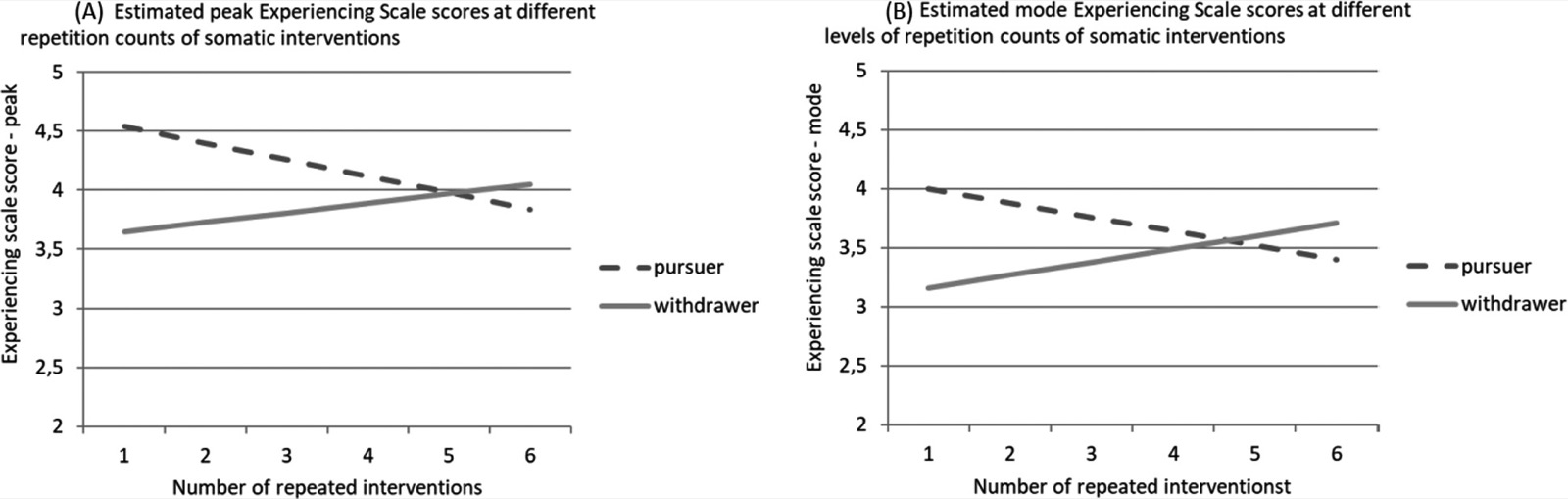
In support of Hypothesis 2a, results indicated that for withdrawing partners there was a positive association between therapists repeating somatically focused interventions and EXP scores, such that a higher number of repetitions was associated with greater EXP scores (peak: β20 = 0.09, t (21) = 4.17, p < .001; mode: β20 = 0.12, t (21) = 5.05, p < .001). In contrast, for pursuing partners higher therapist repetitions of somatically focused interventions were associated with lower EXP scores (peak: β20 = −0.23, t (21) = −3.51, p = .002; mode: β20 = −0.23, t (21) = −5.36, p < .001). Figure 1 graphs the effects of pursuer or withdrawer status on the association between repeated somatically focused intervention and EXP scores.
Length of intervention repetitions (Hypothesis 2b)
Results indicated a significant effect for pursuer/withdrawer classification by the length of time that the intervention was repeated for both EXP peak, β21 = 0.17, t (21) = 3.84, p < .001, and EXP mode, β21 = 0.19, t (21) = 5.86, p < .001. We followed up on the significant effect to test our a-priori hypothesis by reporting the effects for withdrawers and pursuers separately.
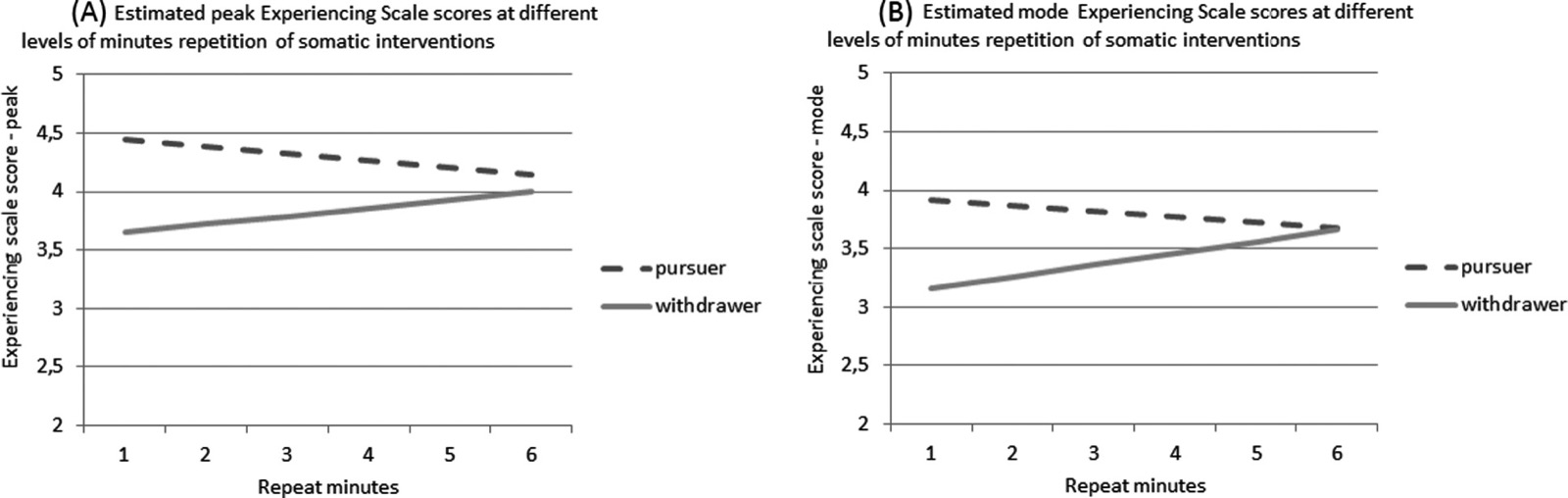
For withdrawn partners there was a positive association between length of time that the somatically focused interventions were repeated and EXP scores. Longer length of time that the interventions were repeated was associated with greater EXP scores (peak: β20 = 0.08, t (21) = 4.19, p < .001; mode: β20 = 0.10, t (21) = 3.86, p < .001). In contrast, for pursuing partners longer length of time that the somatically focused interventions were repeated was associated with significantly lower EXP scores (peak: β20 = −0.09, t (21) = −2.21, p = .04; mode: β20 = −0.09, t (21) = −4.75, p < .001). Figure 2 graphs the effects of pursuer or withdrawer status on the association between length of time somatically focused intervention repeated and EXP scores.
DISCUSSION
The goal of this research was to explore whether therapists' repetition of somatically focused interventions and spending time on the repetition of intervention could be a means by which therapists assist individual partners to increase the depth of individual partners' experiencing. The findings of this exploratory study supported Hypothesis 1a that a higher number of repeated somatically focused intervention by therapists predicted greater depth of experiencing in partners during an EFT session. However, Hypothesis 1b was not supported. The number of minutes in the session that therapists spent in repeating somatically focused interventions was not significantly related to depth of experiencing in partners during the session.
The second hypothesis was also supported. The impact of somatically focused intervention repetitions on depth of experiencing differed between withdrawers and pursuers. Specifically, more repetitions of somatically focused intervention by therapists (Hypothesis 2a), and greater length of time spent by therapists on these interventions (Hypothesis 2b) predicted a significant increase in depth of experiencing for withdrawing partners, and a significant decline in depth of experiencing for pursuing partners. The impact of therapists' somatically focused interventions was first researched by Kailanko et al., (2020) who found immediate increases in level of experiencing among partners in EFT following a therapist's somatically focused intervention. The present study deepens our understanding of the impact of therapists' somatically focused interventions in EFT. The findings point to the possibility that repeated somatically focused interventions have different effects on the depth of experiencing of withdrawers and of pursuers in a couple.
Depth of experiencing for withdrawers compared with pursuers
Not only did repeated somatically focused interventions by therapists result in greater depth of experiencing in withdrawers, but we also found that withdrawers' average peak score after repeated interventions exceeded the level on the EXP that indicates a shift from being purely descriptive of feelings to a deeper expression of inner experience. This is an important shift for withdrawers who, like those with avoidant attachments, tend to downplay internal emotional experiences and focus on the external. The depth of experiencing after EFT therapists' repeated somatically focused interventions found in this study were at the same level as those reported in the best sessions of previous studies (Wiebe et al., 2017; Bradley & Furrow, 2004; Johnson & Greenberg, 1988). These previous studies found that greater depth of experiencing in the best sessions was predictive of positive response to treatment.
In this study withdrawers gained greater depth of experiencing when therapists repeated the somatically focused interventions. This is in line with earlier research by Lee et al., (2017) who showed that working with more withdrawing partners requires therapist to heighten affect several times to achieve greater depth of experiencing for clients. Avoidantly attached partners, who likely make up most of those who are withdrawers in a couple, tend to have deactivating autonomic nervous systems concurrent with self-regulated arousal and affect (Ogden et al., 2006). The results of this study suggest that repeated somatically focused interventions mitigate the deactivation of avoidant partners.
A decline in emotional experiencing among pursuers with greater therapist repetition and time spent on somatically focused interventions was found in this study. Anxiously attached partners usually have higher autonomic nervous system activation as they tend to worry about relationship loss. It is often challenging for them to stay at the optimal level in the window of tolerance (Ogden & Fisher, 2015). In this study, pursuers' emotional reactions seemed to be immediately alive. However, therapist repetitions of pursuers' somatic cues and of their emotion may have prompted the pursuer to reduce their emotional experience to a more optimal level for therapeutic work. Burgess Moser et al. (2017) noted that pursuers may get overwhelmed with anxiety in their experience, but we found that pursuers' level of experience reduced over time with repeated somatically focused interventions by therapists.
There are some limitations worth noting in the present study. First, the participant couples' demographics, their therapy and relationship history, and presenting problems were not known to researchers. Hence it is not possible to evaluate the degree to which one can generalize these findings to a population. Second, the sample size was relatively limited likely reduced power of some statistical tests and so it is not clear how reliable the findings are without replication. Therefore, we consider the present study to be an exploratory one, offering preliminary results to help pave the way for future research, which may aim to replicate and deepen our findings. Nevertheless, there were some methodological strengths in the present study. The EFT sessions included in the study were from experienced EFT trainers, thus possibly representing how EFT should be practiced ideally. The therapy sessions were reviewed and coded from the beginning to the end, thus providing more depth and comprehensiveness to the findings about what occurs across an entire EFT session. This is a novel study of repeated somatically focused interventions by EFT therapists which may inform future and larger studies in order to establish the reliability of the findings and the conditions under which somatically focused interventions might work.
For the future research, it might be useful to get corroborative evidence to the experiencing scale to measure each partner's inner emotional experiences. As the withdrawers tend to limit their emotional expression, their emotional experience may be hard to gauge from the outside. Hence, it might be interesting assess their autonomic nervous system reactions measured with physical measurements, such as heart rate or skin conductance. Further, it would be useful to learn more about EFT trainers' and therapists' thoughts and views behind their use of somatically focused interventions, specifically when working with withdrawers and pursuers. A qualitative study of EFT therapist interviews may shed light on the decision-making processes related to engaging in somatically focused interventions.
Clinical implications
The findings of the present study provide several implications related to clinical practice and training for EFT therapists. First, therapists' somatically focused interventions may provide access to and a way of deepening partners' inner experience. The findings support the key theoretical concept of affect assembly and deepening that takes place in EFT sessions (Brubacher, & Wiebe, 2019; Johnson, 2004, 2020). Second, the findings suggest a way for therapists to keep emotions alive during an EFT session through repetition of somatically focused interventions. This is especially helpful for withdrawing partners that tend to cope with stressful situations by deactivating arousal and affect. Repeating or referencing to the same somatic emotional cue, even six or more times may be a way of engaging withdrawing partners in a couple. Based on this study findings, we suggest that training of EFT therapists pay particular attention to identifying, naming, and focusing on the somatic cues among couples.
A third implication of this study is that it suggests therapists may have to work differently regarding repetition of somatically focused intervention with withdrawers. While it may be challenging for the withdrawer to activate their emotions, therapists' repetition of somatically focused intervention may be helpful. The effect of repetition may be the opposite for pursuers who are more alive to their emotions. Repetitions of emotional cues by therapists may result in a decrease of emotional experiencing for pursuers. From a clinical point of view this could be seen as beneficial in helping pursuers to become more reflectively focused of their own experience thus keeping their emotions from overwhelming them. Staying with and talking about the emotion with the therapist may bring to the pursuer a sense of structure and understanding of the feelings.
CONCLUSIONS
The present study is the first exploratory study that aims to gain preliminary understanding of the actions that a therapist can take in session to support emotional experiencing for the client, with a focus on somatically focused interventions in Emotionally Focused Couple Therapy. This research suggests that therapists' repetition of somatically focused interventions could be a means by which therapists assist individual partners to increase the depth of experiencing. A higher number of repetitions of somatically focused interventions by therapists was associated with a greater increase in depth of experiencing for clients, especially for withdrawing as compared to pursuing partners. The results of this study suggest that such interventions may be a specific technique of EFT therapists that enhances emotional experiencing especially among withdrawing partners.
Complexe Systémique: key points
The study puts figures on a gesture many clinicians make without thinking: naming what the body shows, then coming back to it. Its systemic interest lies in an asymmetric result. The same intervention does not have the same effect depending on the place occupied in the pursue-withdraw cycle: it deepens the withdrawer’s experience and lowers the pursuer’s. The intervention thus acts on a relational position more than on an individual, and one can read in it a way of slowing one partner down and waking the other up, and so of defusing the circularity. Caution is nonetheless needed: thirteen single sessions, filmed for training and led by leading EFT figures, with anonymous heterosexual couples; a correlational design; and a favourable reading of the pursuers’ decline that remains a hypothesis. The positions themselves were assigned by the therapists. Read alongside the microanalytic study of empathic conjectures in emotionally focused couple therapy, and the article on the role of the body in therapy.
References
Bowlby, J. (1988). A secure base. Basic Books.
Bradley, B., & Furrow, J. L. (2004). Toward a mini-theory of the blamer softening event: Tracking the moment-by-moment process. Journal of Marital and Family Therapy, 30(2), 233–246. https://doi.org/10.1111/j.1752-0606.2004.tb01236.x
Bradley, B., & Furrow, J. J. (2007). Inside blamer softening: Maps and missteps. Journal of Systemic Therapies, 26(4), 25–43. https://doi.org/10.1521/jsyt.2007.26.4.25
Brubacher, L. L., & Wiebe, S. A. (2019). Process-research to practice in emotionally focused couple therapy: A map for reflective practice. Journal of Family Psychotherapy, 30(4), 292–313. https://doi.org/10.1080/08975353.2019.1679608
Burgess Moser, M., Johnson, S. M., Dalgleish, T. L., Wiebe, S. A., & Tasca, G. A. (2018). The impact of blamer-softening on romantic attachment in emotionally focused couples therapy. Journal of Marital and Family Therapy, 44(4), 640–654.
Buss, A. H., & Plomin, R. (1986). The EAS approach to temperament (67–80). In R. Plomin & J. Dunn (Eds.), The study of temperament (pp. 66–80). Psychology Press.
Carryer, J. R., & Greenberg, L. S. (2010). Optimal levels of emotional arousal in experiential therapy of depression. Journal of Consulting and Clinical Psychology, 78(2), 190–199. https://doi.org/10.1037/a0018401
Dalgleish, T. L., Johnson, S. M., Burgess Moser, M., Wiebe, S. A., & Tasca, G. A. (2015). Predicting key change events in emotionally focused couple therapy. Journal of Marital and Family Therapy, 41(3), 260–275. https://doi.org/10.1111/jmft.12101
Elliott, R., Watson, J. C., Goldman, R. N., & Greenberg, L. S. (2004). Learning emotion- focused therapy: The process experiential approach to change. American Psychological Association.
Gendlin, E. T. (1961). Experiencing: A variable in the process of therapeutic change. American Journal of Psychotherapy, 15(2), 233–245. https://doi.org/10.1176/appi.psychotherapy.1961.15.2.233
Gendlin, E. T. (1964). A theory of personality change. In P. Worchel & D. Byrne (Eds.), Personality change (pp. 100–148). John Wiley & Sons.
Gendlin, E. T. (1969). Focusing. Psychotherapy: Theory, Research and Practice, 6(1), 4–15. https://doi.org/10.1037/h0088716
Greenman, P. S., & Johnson, S. M. (2013). Process research on emotionally focused therapy (EFT) for couples: Linking theory to practice. Family Process, 52(1), 46–61. https://doi.org/10.1111/famp.12015
Hofmann, S. G., Heering, S., Sawyer, A. T., & Asnaani, A. (2009). How to handle anxiety: The effects of reappraisal, acceptance, and suppression strategies on anxious arousal. Behaviour Research and Therapy, 47(5), 389–394. https://doi.org/10.1016/j.brat.2009.02.010
Jaouich, A., Rogan, K., Fitzpatrick, M., Desbois, A. C., & Janzen, J. (2006). Experiencing decision tree: Modifications to the experiencing. McGill University.
Johnson, S. M. (2004). The practice of emotionally focused couples therapy ( 2nd ed). Brunner-Routledge.
Johnson, S. M. (2009). Attachment theory and emotionally focused therapy for individuals and couples, perfect partners. In J. H. Obegi & E. Berant (Eds.), The attachment theory and research in clinical work with adults (pp. 410–433). The Guilford Press.
Johnson, S. M. (2019). Attachment: An essential guide for science-based practice. In S. M. Johnson (Ed.), Attachment theory in practice: Emotionally focused therapy (EFT) with individuals, couples, and families (pp. 1–23). Guildford Publications.
Johnson, S. M. (2020). The practice of emotionally focused couple therapy: Creating connection ( 3rd ed). Routledge.
Johnson, S. M., & Greenberg, L. S. (1988). Relating process to outcome in marital therapy. Journal of Marital and Family Therapy, 14(2), 175–183. https://doi.org/10.1111/j.1752-0606.1988.tb00733.x
Johnson, S. M., & Whiffen, V. E. (1999). Made to measure: Adapting emotionally focused couple therapy to partners' attachment styles. Clinical Psychology: Science and Practice, 6(4), 366–381. https://doi.org/10.1093/clipsy.6.4.366
Kailanko, S., Wiebe, S. A., Tasca, G. A., & Laitila, A. A. (2020). The impact of therapists’ somatically-focusedsomatically-focused interventions on the depth of clients’ experiencing in emotionally focused couple therapy [Unpublished manuscript].
Klein, M. H., Mathieu, P. L., Gendlin, E. T., & Kiesler, D. J. (1969). The experiencing scale. A research and training manual (Vol. I). Wisconsin Psychiatric Institute.
Lee, N. A., Spengler, P. M., Mitchell, A. M., Spengler, E. S., & Spiker, D. A. (2017). Facilitating withdrawer re-engagement in emotionally focused couple therapy: A modified task analysis. Couple and Family Psychology: Research and Practice, 6(3), 205–225. https://doi.org/10.1037/cfp0000084
Madison, G. (2014). Palpable existentialism: A focusing-oriented therapy. Psychotherapy in Australia, 20(2), 26–33.
McRae, T. R., Dalgleish, T. L., Johnson, S. M., Burgess-Moser, M., & Killian, K. D. (2014). Emotion regulation and key change events in emotionally focused couple therapy. Journal of Couple & Relationship Therapy, 13(1), 1–24. https://doi.org/10.1080/15332691.2013.836046
Ogden, P., & Fisher, J. (2015). Sensorimotor psychotherapy: Interventions for trauma and attachment. W.W. Norton & Company, Inc.
Ogden, P., Minton, K., & Pain, C. (2006). Trauma and the body: A sensorimotor approach to psychotherapy. W.W. Norton & Company, Inc.
Pascual-Leone, A., & Yeryomenko, N. (2017). The client “experiencing” scale as a predictor of treatment outcomes: A meta-analysis on psychotherapy process. Psychotherapy Research, 27(6), 653–665. https://doi.org/10.1080/10503307.2016.1152409
Pinquart, M., Feußner, C., & Ahnert, L. (2013). Meta-analytic evidence for stability in attachments from infancy to early adulthood. Attachment & Human Development, 15(2), 189–218. https://doi.org/10.1080/14616734.2013.746257
Porges, S. W. (2011). The polyvagal theory: Neurophysiological foundations of emotions, attachment, communication, and self-regulation. Norton.
Rheem, K. D. (2011). Analyzing the withdrawer re-engagement change event in emotionally focused couple therapy: A preliminary task analysis. Argosy University.
Schore, A. N. (1994). Affect regulation and the origin of the self: The neurobiology of emotional development. Erlbaum.
Schore, A. N. (2011). The right brain implicit self lies at the core of psychoanalysis. Psychoanalytic Dialogues, 21(1), 75–100. https://doi.org/10.1080/10481885.2011.545329
Schore, J. R., & Schore, A. N. (2008). Modern attachment theory: The central role of affect regulation in development and treatment. Clinical Social Work Journal, 36(1), 9–20. https://doi.org/10.1007/s10615-007-0111-7
Schore, J. R., & Schore, A. N. (2014). Regulation theory and affect regulation psychotherapy: A clinical primer. Smith College Studies in Social Work, 84(2–3), 178–195. https://doi.org/10.1080/00377317.2014.923719
Singer, J. D., & Willett, J. B. (2003). Applied longitudinal data analysis: Modeling change and event occurrence. Oxford University Press.
Wiebe, S. A., & Johnson, S. M. (2016). A review of the research in emotionally focused therapy for couples. Family Process, 55(3), 390–407. https://doi.org/10.1111/famp.12229
Wiebe, S. A., Johnson, S. M., Burgess Moser, M., Dalgleish, T. L., & Tasca, G. A. (2017). Predicting follow-up outcomes in emotionally focused couple therapy: The role of change in trust, relationship-specific attachment, and emotional engagement. Journal of Marital and Family Therapy, 43(2), 213–226. https://doi.org/10.1111/jmft.12199
Reformatted republication of Impact of repeating somatic cues on the depth of experiencing for withdrawers and pursuers in emotionally focused couple therapy, by Sari Kailanko, Stephanie A. Wiebe, Giorgio A. Tasca and Aarno A. Laitila, Journal of Marital and Family Therapy, vol. 48, no 3 (2022), doi: 10.1111/jmft.12544, under a CC BY 4.0 licence. Edition and layout: Complexe Systémique, September 2026 — the work has been modified under the terms of the licence (tables presented as lists). Neither the authors nor the publisher are responsible for this edition; the original version prevails.
This is the original article “Impact of repeating somatic cues on the depth of experiencing for withdrawers and pursuers in emotionally focused couple therapy”, published in Journal of Marital and Family Therapy (2022) under a CC BY 4.0 licence. Republished by Complexe Systémique: the author’s text is unchanged; only the presentation has been adapted for reading online, as set out at the head of this page.
Read the original articleHow to cite this article
Kailanko, S., Wiebe, S. A., Tasca, G. A., et Laitila, A. A. (2022). Impact of repeating somatic cues on the depth of experiencing for withdrawers and pursuers in emotionally focused couple therapy. Complexe Systémique. https://app.complexe-systemique.com/en_GB/articles/impact-of-repeating-somatic-cues-on-the-depth-of-experiencing-for-withdrawers-and-pursuers (Original work published in 2021 in Journal of Marital and Family Therapy, 48(3), 693-708 (2022); republished in 2022 by Journal of Marital and Family Therapy, https://onlinelibrary.wiley.com/doi/full/10.1111/jmft.12544)
To go further
- Empathic Conjectures in Emotionally Focused Couple Therapy (EFCT): A Process Microanalytic StudyEmpathic conjectures.
- Never underestimate the role of the body in therapy — Bernard FilleulThe role of the body.
- Studying Nonverbal Synchrony in Couple Therapy—Observing Implicit Posture and Movement SynchronyNonverbal synchrony.
Related training courses
 Webinar
Extramarital affairs: what does the therapist do when the couple explodes?
Free webinar: how to position yourself as a systemic therapist in the crisis of the extramarital affair. Revelation, secrecy, multipartiality.
 Short course
The suicidal crisis in adolescents and young adults
Training: assessing and supporting the suicidal crisis in adolescents and young adults. Clinical landmarks and systemic tools. In French.
 Certifying course
Training in Systemic Therapy and Interventions – Cycle 1
Certifying training cycle in systemic therapy and interventions – year 1. Courses, supervision and practice, aligned with EFTA/SFTF. In French.
 Certifying course
Training in Systemic Therapy and Interventions – Cycle 2
Certifying training cycle in systemic therapy and interventions – year 2. Clinical complexity, supervision and practice. EFTA/SFTF aligned. In French.
Related articles
 Article
 The AFFIRM Model for Navigating Challenges in Continuously-Interfaith and Divergent-Interfaith Marriages
Thirty happy interfaith couples describe how they navigate their religious differences: five processes, from respecting each other’s choices to religious intimacy, gathered in the AFFIRM model.
 Article
 Toxic, narcissistic, borderline: what therapy speak does to your relationships
Narcissistic, borderline, toxic: therapy speak has left the consulting room. Julien Besse shows how these labels close the debate and relieve us of our own part.
 Article
 Are You Qualified, ChatGPT? Examining Clinical Skills and Competencies of ChatGPT in Delivering Systemic Interventions
A GPT trained in systemic interventions, blind-rated by twelve clinical supervisors: a rushed, dominating novice, whom the client nonetheless loved.
 Article
 Relational Therapy in Post‐Incarceration Reentry: A Scoping Review
What does the literature say about relational therapy after prison? A review of 19 articles: decisive family bonds, almost no tested model, nothing on couples.