Journal of Addictive Diseases · Family
Nested family support: the axial role of support workers for families in which a parent is in treatment for substance misuse
Who supports the people who support families affected by a parent’s addiction? In Leeds, Netalie Shloim and Anna Madill’s team interviewed eleven staff members of a British service grounded in a whole family approach. The result is a three-circle model: the person in treatment, their family, and the organisation that holds the support workers, each level holding thanks to the one around it.
This is a reformatted republication of Nested family support: the axial role of support workers for families in which a parent is in treatment for substance misuse, by Netalie Shloim, Mark Crowe, Lisa Simpson, Sarah Fordham, Anne-Marie Watkinson and Anna Madill, published in Journal of Addictive Diseases (Taylor & Francis) (2026), doi: 10.1080/10550887.2025.2490874, under a CC BY 4.0 licence. Prepared by Complexe Systémique in September 2026: the authors’ text is unchanged; the layout has been adapted for reading online, which constitutes a modification of the work under the terms of the licence. The table is presented as a list; the declarations are grouped in the notes. This edition was made neither by the authors nor by the publisher, who are not responsible for its content or for any errors. The original version prevails.
Supporting the support worker is vital to the successful operation at all three levels of the system, i.e., the service user, their family, and the service providing organization.
Netalie Shloim, Mark Crowe, Lisa Simpson, Sarah Fordham, Anne-Marie Watkinson and Anna Madill
Abstract
The UK National Health Service (NHS) defines addiction as loss of control over harmful behavior. Addiction is commonly linked to drugs and alcohol with varied community-based treatment services available in England. This study presents an organizational case study of a community-based organization in the North of England commissioned by the NHS through the local authority to support people with complex health and social needs and addresses the research question: What is the experience of support workers for families in which a parent is in treatment for substance misuse? Eleven support workers whose work is guided by a Whole Family Approach took part in semi-structured interviews which were analyzed qualitatively using thematic analysis. This resulted in a model of Nested Family Support which captures how the service user is supported by their family with the help of the support worker who is, in turn, supported by their organization. This model illuminates how outer levels of nested support need to be effective for inner levels to work and the axial role of support workers in this system. The main application of the model is identifying parallels between the support employees need from their organizational to deliver effective recovery interventions and the ways in which they are trained to support their clients in terms of the need for trusting relationships and tailored support.
Keywords: Addiction; recovery; Substance misuse treatment; Organizational support
The UK National Health Service defines addiction as “not having control over doing, taking or using something to the point where it could be harmful” (para 1).1 Although addiction can relate to many different aspects of life, it is most commonly associated with drugs, alcohol, smoking and gambling. In England and Wales, access to, and the structure of, treatment and withdrawal services vary with little consistency among community-based programmes.2 Addiction community services play a pivotal role in addressing substance abuse. Comprehensive programs offer a range of interventions, from counseling to medication-assisted treatments. The National Institute for Health and Care Excellence (NICE) guidelines emphasize a person-centered approach, promoting collaboration between service users and providers. Noteworthy initiatives include the Public Health England’s support for harm reduction strategies. Challenges persist, such as resource constraints and stigma, necessitating ongoing research and policy efforts for effective addiction community services.2
The present article offers an organizational case study of the experience of family support workers employed by a community-based organization in the North of England who work with families in which a parent is in treatment for substance misuse.
Data from 2020 to 2021 indicate that 275,896 adults were in contact with drug and alcohol services in the UK, with the number of adults entering treatment at 130,490.3 The largest group (51%) sought help with problematic use of opioids, the next largest group (28%) with alcohol. Moreover, in 2021, the national body who conduct Child in Need assessments in England and Wales, report that one in six recorded a parent with alcohol problems and a similar proportion with drug misuse.3,4
In families dealing with substance use issues, life can revolve around the needs of the substance use disorder with associate problems undermining stability and inflaming discord5 and, when this is a parent, dependent children can be the most affected.6 Adverse childhood experiences such as parental offending and addiction is associated with lifelong disadvantage.7 This includes risks factors for an intergenerational cycle of addiction perpetuated through ineffective parenting. It is therefore important to consider the family system when seeking to treat and to mitigate the impact of substance abuse.8 This includes taking into account family structure given that, for example, the needs of a nuclear unit of couple and dependent children will differ from that of a large extended family related by blood and marriage. Moreover, there are many nontraditional arrangements such as single parent, same-sex parented, and blended families which bring their own challenges.
Alongside different family structures, the family members can have different orientations toward recovery. The two main perspectives of their family members’ recovery are as an act of self-change and as a relational process.9 Moreover, family members can have multiple, and sometimes conflicting roles, in relation to the person or people misusing substances which can increase tension. For example, Tsantefski et al.10 note that often the mother has the role of holding responsibility for family functioning but she may not have the authority to mitigate the destructive behavior of relatives or to seek treatment when suffering herself from substance misuse. Such contrasting understandings and complex roles can lead to poor communication among family members which is a risk factor in addiction relapse.11
On the other hand, support from family, friends, and the community can buffer those in recovery against environmental stress and help maintain their sobriety.12 For example, Amey and Scott13 Family Centered Practice promotes an approach “based on empathy, respect, genuineness and optimism” (p. 2) in which the relationship between the support worker and the family is deemed the most important factor. It has four elements: the family as the center of attention; maximizing family choice; focusing on strengths not deficits; and cultural sensitivity. This is support by research into counseling and psychotherapy which reliably reports that the relationship between client and therapist is one of the most important factors in positive outcome (e.g.,14).
Research on the experience of support workers for families dealing with addiction highlights the challenges associated with such a role. Support workers play a crucial role in assisting families affected by addiction, offering emotional support, guidance, and practical assistance. Smith et al.15 identify the emotional toll on support workers as they navigate the unique dynamics of families affected addiction. The research highlights the need for tailored training and ongoing supervision to address the specific challenges faced by support workers.16 A more recent study by Smith et al.15 emphasizes the importance of recognizing and mitigating burnout among support workers to ensure sustained effectiveness in their roles. Therefore, understanding the experiences of support workers is crucial for enhancing organizational effectiveness and developing interventions to promote the well-being of both the families affected by addiction and the professionals assisting them.
The substance use treatment partnership studied in this article is based in the North of England, in one of the cities in Yorkshire and the Humber, and brings together a number of independent, multi-purpose community partners commissioned by the local authority and NHS to support people with complex health and social needs. The partners provide other services in the community alongside their components of treatment service delivery. In turn they are part of a wider network of health and care organizations (including public sector providers) delivering associated services to people with complex health and social needs as well as those in substance treatment and recovery. It provides one of the largest substance treatment services in the country, a specialist component of which is support for the family of parents with drug and alcohol use problems. This Family Plus Service is modeled on whole family approaches17 and seeks to build resilience via protective factors and/or to mitigate the adversity of risk factors in relation the impact on partners and children. Central to this is engaging families quickly on the emergence of problems to provide the best opportunity of positive outcomes and avoidance of statutory interventions. The Family Plus Service is consistent with the report of McCartan et al.18 that family-focused approaches can lead to improved outcomes and their recommendation that this should be provided in a consistent manner across mental health, addictions, and children’s services.
The Family Plus Service is predominately outreach and meets with families in the home, community venues, and schools. It takes referrals form Recovery Co-ordinators from across the substance treatment service with the important caveat that the service excludes families on a Child Protection Plan who are, as a result, supported by the City Council Children’s Services teams. The Family Plus Service consists of a support worker in each of the three wider treatment delivery hubs who are supported by a Lead Practitioner. There is also a Young People’s Worker and an Emotional Health and Well-Being Worker who focus exclusively on the children of families in the service. The Family Plus Service works closely specialists across the organization including Midwives, Health Visitors, and Early Help Hubs as well as other family intervention services in the local area.
The Family Plus Team has an ongoing caseload capacity of around 60 families with each support worker allocated 10–15 families. The role involves taking a highly family-centered approach, providing intensive case support and care planning, and ensuring children are safeguarded. Training is delivered through Practice Development Groups which includes Trauma Informed Practice, Hidden Harm, Multi-Agency Risk Assessment Conference (MARAC) Protection, and Working With The Family In Mind. In the absence of national occupational standards or professional accreditation for this area of work, direction and support are provided through Peer Supervision sessions, regular one-to-one supervision by line managers, and Reflective Practice Groups.
In summary, this article presents an organizational case study of a community-based organization in the North of England commissioned by the NHS through the local authority to support people with complex health and social needs. This article reports a thematic analysis19 of online semi-structured interviews with eleven support workers whose work is guided by a Whole Family Approach. Support workers come through a range of training as nursing and midwifery, social work and youth work. Some hold previous degrees, likely in unrelated subjects. We address the research question: What is the experience of support workers for families in which a parent is in treatment for substance misuse?
Method
This research obtained approval from the organization in which the research was conducted. Initially conceived to inform service development, hence for the purposes of publication, Retrospective Chair Scrutiny was sought and approved from the School of Healthcare Ethics Committee, University of Leeds, HREC 23-011 dated 20th June 2024. A condition of approval is that direct quotes from participants can be used only where specific consent has been provided. This was gained retrospectively from three of the 11 participants, in part because many had left the organization.
Recruitment and participants
Staff were invited to take part in a research interview who had worked for the organization for at least 1 year (range 1–27 years) and provided support for families in which a parent is in treatment for substance misuse. The study was introduced at team meetings by the organization Research and Development Co-Ordinator at which attendees had the opportunity to ask questions. Prospective participants were also approached directly by emailing them a research information sheet. Of a total pool of 20 suitable staff, ten women and one man took part in the study (Table 1).
Table 1 — Description of participants
Role, participant number, service (yrs), interviewer, interview (mins).
- P1. Specialist Lead; 13 yrs; interviewer 1; 54 min.
- P2. Lead Practitioner; 9 yrs; interviewer 1; 35 min.
- P3b. Family Support Worker; 5 yrs; interviewer 1; 39 min.
- P4. Emotional Health & Wellbeing Worker; 5 yrs; interviewer 2; 44 min.
- P5b. Family Support Worker; 9 yrs; interviewer 2; 36 min.
- P6. BRICa Worker; 1 yrs; interviewer 2; 42 min.
- P7. Recovery Worker; 10 yrs; interviewer 3 (male); 62 min.
- P8. Lead Practitioner; 1 yrs; interviewer 3 (male); 58 min.
- P9. Midwife Families with Addictions; 15 yrs; interviewer 4; 34 min.
- P10. Midwife Families with Addictions; 7 yrs; interviewer 4; 40 min.
- P11b. Midwife Families with Addictions; 20 yrs; interviewer 4; 29 min.
Note a: Building Research in Communities; Note b: Consent to quote directly.
Data generation
Semi-structured interviews were conducted by four postgraduate students (one male) completing a Master of Arts in Counseling and Psychotherapy at the University of Leeds (Table 1). All were provided training by the first author. The four postgraduates, the first author, and representatives from the case study organization (i.e., Research & Development Co-ordinator, Research Assistant, and a Lead Practitioner from the Family Plus Team) together developed an interview schedule which would generate information relevant to the research question: What is the experience of support workers for families in which a parent is in treatment for substance misuse?
To begin, participants were asked to describe their role and why they had applied for this job. They were then asked about how service users appear to view them, what they saw as the impact of their role, and about their case load in general. Question then moved on to inquire about the support they provide service users, the issues with which service users frequently need help, and what they through might happen if their role did not exist. They were then asked about working within a multidisciplinary team and to describe how they co-ordinate with other people and services to undertake their work. Finally, participants were asked about maintaining boundaries, burnout, and self-care. Specific examples of questions include: If you can think of an image which will best describe your role, what would it be?; Why have you applied for this position and what did you think it would involve?; and How does your previous experience impact on your current work? Interviews were conducted and recorded with consent online and lasted between 29 and 62 min (Table 1). The Microsoft Teams automatic transcription was checked for accuracy and correct where necessary by the interviewer.
Data analysis
Data was analyzed using thematic analysis as outlined by Braun and Clarke.19 The aim was to achieve a rich description of the data set through identifying patterns of experience and meaning across the interviews which addressed the research question: What is the experience of support workers for families in which a parent is in treatment for substance misuse? Following Braun and Clarke,19 the analysis took an inductive, rather than theoretical approach, in which themes were developed ‘bottom up’ from the data while allowing for a level of researcher interpretation. The four postgraduates were provided with training in thematic analysis by the first author and analysis of the data set was conducted by a group of researchers as outlined below.
First, the postgraduates familiarized themselves with the data by reading the transcripts several times, each allocated 40% of the total data set. Second, they then began annotating their allocated transcripts highlighting possible patterns of experience and meaning responding to the research question, working toward capturing these patterns in concise phrases representing nascent theme labels. Throughout this process, the four postgraduates met as a group with the first author to discuss the process of analysis and their observations with a view to honing-in on agreed patterns. Four early potential themes were identified at this stage: (i) supporting clients; ii) risk of supporting clients in the home environment; (iii) supporting staff; and (iv) the vital nature of organizational support.
Third, the larger research team consisting of four students for counseling and psychotherapy, a lecturer and expert in the field of addictions and a lead researcher in the organization reviewed these suggested themes within the context of the full data set. At this stage, it was agreed to integrate the third and fourth themes under the label ‘support workers feel supported by the organization’ and to divide the first theme into two sub-themes: (a) treating services users as individuals; and (b) bring the whole family together. A draft analysis was then written with supporting quotes from the interviews. Finally, the last author reviewed the draft analysis and identified in it a further conceptual level of analysis supporting a model of Nested Family Support. This involved a moderate reorganization of material in the draft analysis and refinement of theme labels. This revision was reviewed and agreed by the first and second authors.
Results
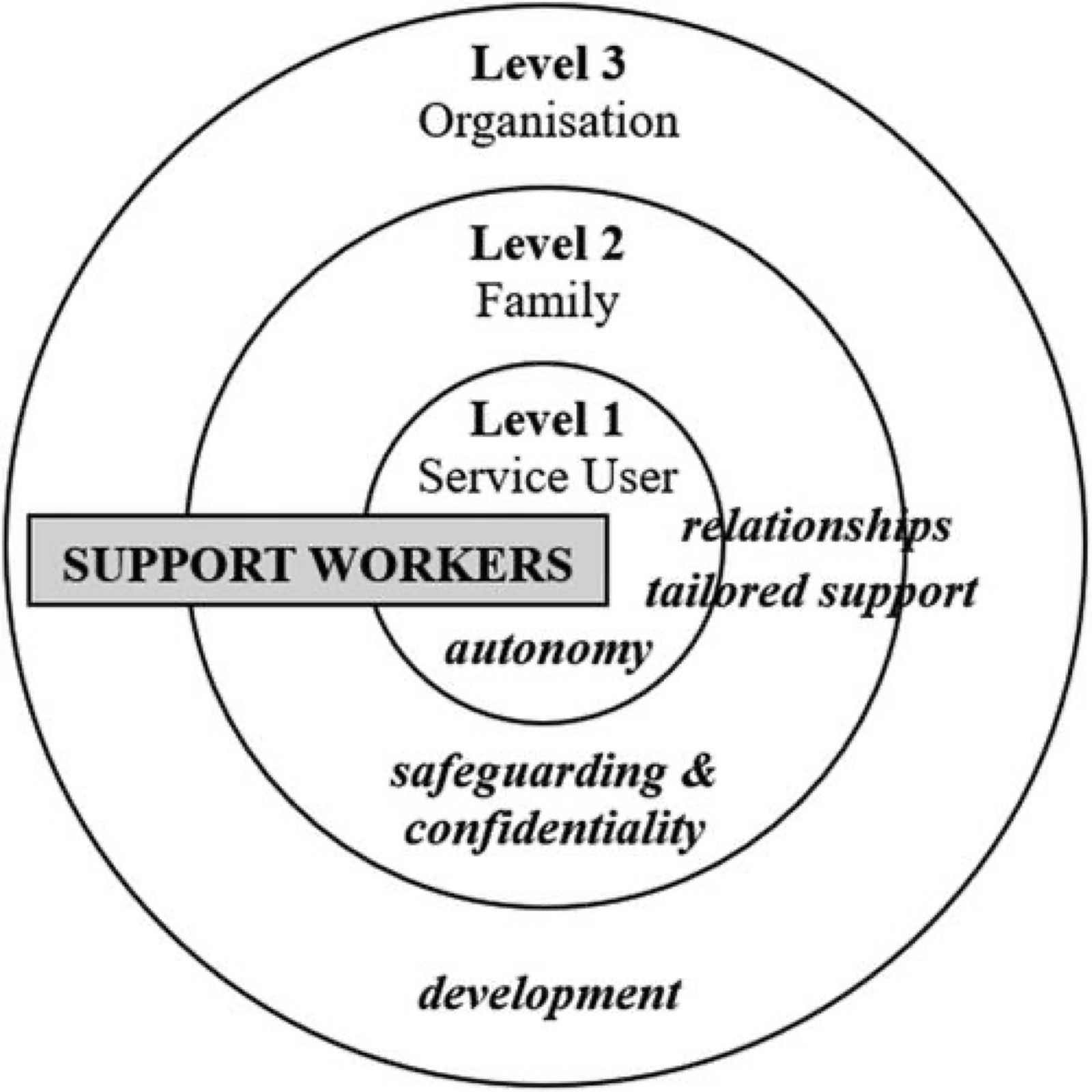
Our findings are brought together in a model of Nested Family Support (Figure 1). Each level of the Nested Family Support model will now be presented with illustrative direct quotes from participants P3, P5, and P11, and for ethical reasons, paraphrased quotes from the other participants.
Level 1: Supporting the service user
Participants emphasized three key aspects involved in Supporting the Service User: (i) building a trusting relationship; (ii) providing tailored support; and (iii) supporting the service user’s autonomy.
Building a trusting relationship in the context of a service user suffering substance addiction is multifaceted as explained by a Midwife (P10). She described how this entailed working with the service user’s individual needs, avoiding their triggers, and trying to work in a way that the environment does not feel overwhelming. In particular, this Midwife highlighted how building a trusting relationship requires understanding how to provide a safe space in which to work together and that this is facilitated by a trauma-informed approach. Specifically, she draws attention to the importance of working within the service user’s capacity. Interestingly, she suggests a possible mechanism facilitating progress, i.e., being very focused on their individual needs.
Indeed, the importance of providing tailored support was highlighted by many participants. Tailored support acknowledges that each service user’s circumstances are different and that this requires focusing on what works for the individual rather than applying a one-size-fits-all approach. In this regard, a Family Support Worker (P5) offers a rich analogy of her experience of tailored support which provides insight into another possible mechanism facilitating progress: i.e., supporting the service users’ autonomy. She says: “The image I would have is like a child who I’m helping riding a bike with stabilizers on a rocky road and I’m the stabilizers. They’re pedaling, they’re saying how fast they want to go. They’re choosing the direction and I’m just there to keep them steady and keep them on the right track that they want to be down.” In this statement, a key aspect of the support worker’s role is presented as the provision of stability and boundaries with the aim of promoting the service user’s self-determination with regard to the timing and focus of their recovery. This analogy also captures the collaborative nature of the work and, again, the importance of building a trusting relationship with the service user.
Finally, in terms of Level 1 Supporting the Service User, a Family Support Worker (P3) expands on the importance of supporting the service user’s autonomy saying: “As a team I think our biggest strength is we never do for clients and families. We never do it for them but we will help them and support them to find the light. We don’t always take them to the end of the tunnel but maybe that next two or three steps to get a bit lighter.”
Level 2: Supporting the family
Participants emphasized three key aspects involved in Supporting the Family: (i) rebuilding family relationships; (ii) providing tailored support; and (iii) safeguarding and confidentiality. The first two are similar to what has been identified with regard to Supporting the Service User.
Substance abuse can have a profound impact, not only on the person with the addiction, but on the whole family. While support workers can provide information and interventions, this is necessarily limited in scope and time and the participants viewed it as essential that families discover and develop their own assets to keep moving forward. Specifically, participants focused on the need to rebuild family relationships in which there is trust and good communication. A BRIC Worker (P6) explained that an aspect of the word was about bringing everyone together, particularly in the context of addiction which can lead to relationship breakdowns and damaged trust. Rebuilding family relationships takes time and sometimes the support worker needs to teach, and model for the first time, what a positive interaction looks like.
Facilitating such radical change requires that the support worker understands the family dynamic and provides tailored support. A Midwife (P11) expands: “we talk about like family mapping and what network of support they have and things like that and understanding the relationships and role models that they might have had.” Importantly, participants reported that key to providing tailored support was to work in the service user’s home environment. This offered an opportunity to develop a relationship with family members, insight into how they interact, and understanding of their support systems.
Working in the service user’s home, also was a way into providing tailor supported for relatives. For example, a Lead Practitioner (P8) described how this was about having individual conversations with many different family members, including children. In fact, many participants explained how working in the home environment facilitated the ability to notice even subtle changes, support needs around housing, finance, and education, and opportunities to signpost to local service. However, working in the service user’s home is not without risks and a Specialist Lead (P1) provide an example of having to deal with someone who was, not only drinking heavily, but who could be aggressive.
The final key aspect involved in Level 2 Supporting the Family are the challenges of safeguarding and confidentiality. These challenges are interwoven with the foci just expounded of rebuilding family relationships and providing tailored support through working in the service user’s home environment. The safeguarding of children in families where there is substance misuse is paramount and participants were aware of the need to be alert to risk. For example, a Lead Practitioner (P2) explained that seeing the different family members in their home environment could allow staff to understand better their relationships and to identify safeguarding risks such as potential neglect and financial issues if, for example, there is little food in the house.
Another challenge identified by support workers in relation to working in the home environment was about confidentiality. Although the service user and their relatives may feel relaxed in their own home, the setting might not provide a space in which individuals can speak with the support worker without fear of being overheard. This overlaps with safeguarding concerns as a BRIC Worker (P6) explained that having private space to allowed children to speak for themselves can be hard but essential to hear about their experiences in confidence.
Level 3: Organizational support for support workers
The final level of our model of Nested Family Support consists of the way in which the organization provides support for the support workers which allows them to provide the necessary support to the service user and their family. In this overarching level of nested support, the idea of ‘family’ is metaphorical rather than literal. Participants emphasized three key aspects involved in Organizational Support for Support Workers: (i) providing trusting relationships; (ii) providing tailored support; and (iii) supporting the support worker’s development. All three echo what has been identified with regard to Level 1 Supporting the Service User.
Participants could experience their work as stressful and highlighted the need for trusting relationships with their colleagues in order to receive the emotional and practical support to work effectively with service users and their family. An Emotional Health & Wellbeing Worker (P4) describes this in terms of knowing that her team members are ‘always there’ for her.
As well as providing trusting relationships, participants described how an important aspect of care was the way in which the organization provided them also tailored support. For example, in her role as a Lead Practitioner, P8 described the way in which she provided tailored support to her team through one-to-one supervision, peer support, and team meetings. A Midwife (P10) added how they also have clinical supervision through a weekly multidisciplinary team meeting.
Finally, Level 3 Organizational Support for Support Workers involved supporting the support worker’s development. In this regard, many participants described how they had benefited from opportunities for training to allow them to build their skills. For example, a Midwife (P9) said she had been encouraged to get involved in further education, training, and research and well as learning on the job. Midwife P10 concurred saying how ongoing training was provided about four times a year alongside an away day as well as mandatory training on issues such as safeguarding and specific tailoroing training opportunities on concerns such as physical and mental health.
Discussion
We present an organizational case study of the experience of family support workers employed by a community-based organization in the North of England, addressing the research question: What is the experience of support workers for families in which a parent is in treatment for substance misuse? Our findings were brought together in a model of Nested Family Support. This captures the way in which the service user is supported by their family with the help of the support worker who is, in turn, supported by their organization. The idea of ‘family’ therefore morphs through the nested levels from literal, i.e., the family unit, to metaphorical. i.e., the employing organization. This model illuminates how outer levels of nested support need to be effective for inner levels to work and the axial role that support workers fulfill in this system. We now discuss each level of the model with respect to the existing literature, Notably, relationships and tailored support are pertinent across all three levels (Figure 1). The particular quality of the relationship and tailored support required at each level will be discussed in the relevant section, while the main reflection on tailored support across levels will be considered toward the end.
Level 1 - Supporting the Service User - consists of (i) building a trusting relationship; (ii) providing tailored support; and (iii) supporting the service user’s autonomy. All three aspects are supported by a systematic review on SUD and service use by McLellan et al.20 According to the review, service users who trust their providers are more likely to adhere to treatment recommendations and report better overall satisfaction with their care. Individualized treatment plans tailored to the specific needs of the service user were reported to support engagement and recovery outcomes (see also 21) Moreover, personalized approaches, which included developing trust and fostering autonomy, lead to higher engagement and retention in treatment programs.
Considering trust in more detail, people suffering substance addiction often have histories of trauma, hence creating a safe and supportive environment is essential to their recovery journey.22 Trust forms the foundation upon which effective therapeutic alliances are built, enabling individuals to feel secure and understood, thus enhancing their willingness to engage in treatment and recovery efforts.23 More specifically, the Substance Abuse and Mental Health Services Administration (SAMHSA 2014) notes that trauma-informed care, which integrates trust and safety, supports engagement and successful treatment outcomes for people with substance use disorders.
Our participant support workers also stressed the need to support client autonomy. This is highlighted as an important aspect of trauma-informed care by Harris and Fallot24 in terms of client empowerment and choice alongside safety, trustworthiness, and collaboration. Knight25 develops this theme, arguing that developing autonomy and empowerment is important in helping clients recover, particularly in the context of SUD.
Level 2 - Supporting the Family – consists of (i) rebuilding family relationships; (ii) providing tailored support; and (iii) safeguarding and confidentiality. A meta-analysis by Copello, Templeton, and Powell (2009) notes that family interventions reduce substance use and improve psychosocial outcomes. This is supported in a comprehensive study by the National Treatment Agency for Substance Misuse (2016)26 which found that family involvement in treatment significantly improved outcomes for individuals with substance use disorders, including higher rates of treatment completion and reduced relapse rates. These findings are supported by the Family-Involved Recovery Support Services Study (SAMHSA, 2014)27 which suggested that interventions, such as the Community Reinforcement and Family Training program, not only enhanced treatment outcomes but also improved the overall well-being of both the individuals in recovery and their family members. Families themselves benefited from strong support networks, Smith et al.15 finding that well-networked families maintained higher rates of treatment retention and lower relapse rates. Accounting for the benefits of family interventions in addiction recovery, a study of family dynamics by Lander et al.28 concluded that positive family involvement enhances motivation and commitment to recovery. Interestingly, Orford et al.29 note that lack of family support significantly hinders addiction recovery positing that this, at least in part, is due to related stress and social isolation.
Our participant support workers often met with services users and their family at their own home which meant navigating challenges with respect to safeguarding and confidentiality. Our findings are with agreement with Reamer30 who looked at ethical complexities related to privacy and confidentiality in nontraditional settings, including clients’ homes. Reamer stresses the importance of maintaining professional boundaries and protecting client information in environments that might not have the same privacy safeguards as clinical or office settings.
Level 3 - Organizational Support for Support Workers - consists of (i) providing trusting relationships; (ii) providing tailored support; and (iii) supporting the support worker’s development. Interestingly, our findings suggest that support workers make parallels between the way they support their service users (Level 1) and how they want to be supported by their organization (Level 3). Like their clients, support workers benefit from being able to trust their colleagues and having their individual support needs recognized and addressed. However, while support workers identified the bolstering their client’s autonomy as a primary aim, their own needs are to be supported to develop in their organizational role.
Trusting relationships can be developed through good supervision and peer support processes, in turn, supporting the support worker’s development via continuous training and professional development to provide the skills necessary to address the evolving challenges in addiction recovery. For example, Simpson et al.31 notes that organizations with higher levels of staff support tend to have better treatment outcomes suggesting this is because they can provide comprehensive care that addresses a broad range of issues faced by service users. Interestingly, McLellan et al.20 argue that while organizational support is essential, there are significant disparities in how different organizations implement their support systems and allocate resources which then can effect service user outcome. Moreover, Scott et al.32 explore the importance of integrating care across different services, emphasizing the need to include medical, psychological, and social support services. In general, organizational culture plays a significant role in the effectiveness of addiction interventions, the best promoting continuous learning, supervisor support, and collaboration between employees.33 Such an environment makes it more likely that evidence-based practices are adopted and sustained and that staff feel encouraged to learn new skills and integrate these into their daily work. Moreover, Aarons et al. note that organizations with a positive culture tend to have lower levels of resistance to change among staff.
Finally, we return to our observation that, not only are relationships important across all three levels of our model (Figure 1), as discussed above, so too is the idea of tailored support. In relation to Level 1: Supporting the Service User, we highlighted research, such of that of McLellan et al.20 that provides evidence of the benefit of individualized treatment plans in the context of substance addiction. Moreover, it is likely that family-based interventions, such as the Community Reinforcement and Family Training program mentioned with regard to Level 2: Supporting the Family, benefit from adjustment to context. For example, Krisher and McCrady34 suggest that when family support is customized, it helps foster a supportive and stable home environment conducive to recovery. Evidence is provide in a review by Liddle and Hogue35 who note that, when customized to the adolescent’s and family’s specific needs, family therapy can be effective in sustaining long-term recovery and reducing relapse.
Our study suggests that fine tuning is also relevant to Level 3: Organizational Support for Support Workers. In order to understand this important thread, we might draw on Vygotsky’s36 theory of how tailored support enhances child development and learning. In particular, the concept of scaffolding illustrated by the metaphor of stabilizers on a bike may be helpful. Just as stabilizers are gradually adjusted as a child gains confidence in riding a bike, support for people in recover, their families, and organizational support for their support worker, may be most efficacious if personalized and adaptive, evolving alongside the individual’s progress and current challenges. Laudet37 concurs that offering tailored support acknowledges that each individual’s journey through addiction and recovery is unique, requiring personalized interventions that address specific needs and circumstances. Our study suggests that this is true also of involved families and support workers.
We now consider the strengths and limitations of this research. First, we have presented a case study meaning that findings may be specific to this organization. We have, however, made links to existing research which suggests at some transferability of findings to similar contexts.38 Second, our participant sample size is relatively small, although commensurate with qualitative research of this kind.19 Moreover, we have provided details, such as total potential participant pool and participant role, that situates our sample for interpretative transparency.38 Finally, the study involved multiple researchers, some of whom are relative novices, which may have introduced inconsistencies in data collection and analysis. To mitigate this, interviewers had close supervision and employed an identical semi-structured interview schedule and their early analytical insights were developed by a team of expert researchers which included representation from the host organization.
We have presented a case study of a community-based organization in the North of England which serves people with complex health and social needs and offer a model of Nested Family Support which addresses from the perspective of the support workers themselves the research question: What is the experience of support workers for families in which a parent is in treatment for substance misuse? We suggest the main applications of this model are in relation to identifying the axial role of support workers in this system. That is, supporting the support worker is vital to the successful operation at all three levels of the system, i.e., the service user, their family, and the service providing organization. More specifically, support workers identified parallels with the ways in which they are trained to support their clients in terms of the need for trusting relationships and tailored support. More research is needed to test the applicability of our model across diverse organizations and to identify best practice in providing support workers the organizational support they need to deliver successful recovery programs.
Complexe Systémique: key points
This short qualitative article has the merit of shifting the gaze: in an addiction service that works with the whole family, it looks first not at the person in treatment but at those who accompany the household, often at home, between child safeguarding and confidentiality that is hard to guarantee. The proposed model follows a very systemic logic: the service user is supported by their family, the family by the support worker, and the support worker by their organisation, each circle holding only if the outer one holds. The same ingredients recur at every level, trusting relationships and tailored support, like an isomorphism between what is offered to families and what one needs oneself. For teams, it is a concrete argument for supervision and reflective practice groups. The limits are clear: eleven interviews in a single organisation, only three people quoted directly, and a discussion that sometimes relies on literature cited at second hand. Read alongside the article on a family-based intervention for substance-using parents, and the article on how professionals support concerned significant others.
Notes from the original
Copyright statement. For the purpose of open access, the author has applied a Creative Commons Attribution (CC BY) license to any Author Accepted Manuscript version arising from this submission.
Acknowledgements. We would like to thank everyone who took part in this study for their valuable insights and Calum McCready of the University of Leeds for undertaking some of the research interviews and contributing to the early analysis.
Disclosure statement. No potential conflict of interest was reported by the author(s).
References
National Health Service 2021. Addiction: what is it? NHS. https://www.nhs.uk/live-well/healthy-body/addiction-what-is-it/.
National Institute for Health and Care Excellence (NICE). 2021. Integrated health and social care for people experiencing homelessness. NICE guideline [NG214] https://www.nice.org.uk/guidance/ng214.
Gov.uk. 2021. National statistics, adult substance misuse treatment statistics 2020 to 2021: report. Retrieved from https://www.gov.uk/government/statistics/substance-misuse-treatment-for-adults-statistics-2020-to-2021/adult-substance-misuse-treatment-statistics-2020-to-2021-report.
Local Government Association. Must know: treatment and recovery for people with drug or alcohol problems. https://www.local.gov.uk/publications/must-know-treatment-and-recovery-people-drug-or-alcohol-problems.
Barnard M. 2007. Drug Addiction and Families, Barnard Marina, London, Jessica Kingsley Publishers, 2007, pp. 175, ISBN 13: 978 1 84310 403 2, £19.99, $34.95, The British Journal of Social Work, Volume 37, Issue 8, December 2007, Pages 1435–1436, 10.1093/bjsw/bcm132
Cameron D, 2002. Mapping the Social Consequences of Alcohol Consumption: Edited by Harald Klingemanna and Gerhard Gmel. WHO Regional Office for Europe/Kluwer Academic, Dordrecht. 2001, 170pp. hardback, £44.06. ISBN: 0-79236-740-5., Alcohol and Alcoholism, Volume 37, Issue 1, January 2002, Pages 103–104, 10.1093/alcalc/37.1.103-b
Craig JM, Piquero AR, Farrington DP, Ttofi MM. A little early risk goes a long bad way: adverse childhood experiences and life-course offending in the Cambridge study. J Criminal Justice. 2017;53:34–45. doi:10.1016/j.jcrimjus.2017.09.005.
Sparks SN, Tisch R. A family-centered program to break the cycle of addiction. Famil Soc. 2018;99(2):100–9. doi:10.1177/1044389418767841.
Waller S, Reupert A, Ward B, McCormick F, Kidd S. Family-focused recovery: perspectives from individuals with a mental illness. Int J Ment Health Nurs. 2019;28(1):247–55. doi:10.1111/inm.12528.
Tsantefski M, Briggs L, Griffiths J, Tidyman A. An open trial of equine-assisted therapy for children exposed to problematic parental substance use. Health Soc Care Community. 2017;25(3):1247–56. doi:10.1111/hsc.12427.
Din Mohammadi M, Amini K, Yazdan Khan M. Survey of social and environmental factors related to the relapse of addiction in volunteer addicted individual in welfare organization of Zanjan. J Adv Med Biomed Res. 2007;15:85–94.
Atadokht A, Hajloo N, Karimi M, Narimani M. The role of family expressed emotion and perceived social support in predicting addiction relapse. Int J High Risk Behav Addict. 2015;4(1):e21250. doi:10.5812/ijhrba.21250.
Arney F, Scott D. 2010. Working with vulnerable families: a partnership approach. Fiona Arney, Dorothy Scott Cambridge University Press.
Asay TR, Lambert MJ. 1999. The empirical case of the common factors in psychotherapy: quantitative findings. In M. A. Hubble, B. L. Duncan, & S. D. Miller (Eds.), The heart and soul of change: What works in therapy (pp. 23–55). Washington, DC: American Psychological Association. doi:10.1037/11132-001.
Smith R, Taylor S, Bilek E. Computational mechanisms of addiction: recent evidence and its relevance to addiction medicine. Curr Addict Rep. 2021;2021:1–11.
Doe J, Johnson M, Smith P. Training needs of support workers in addiction family support: a qualitative analysis. J Addict Educat Counsel. 2019;35(4):421–35.
Thoburn J. Troubled families’,’troublesome families’ and the trouble with Payment by Results. Famil Relationships Societies. 2013;2(3):471–5. doi:10.1332/204674313X13805512389852.
McCartan C, Davidson G, Donaghy M, Grant A, Bunting L, Devaney J, Duffy J. Are we starting to ‘think family’? evidence from a case file audit of parents and children supported by mental health, addictions and children’s services. Child Abuse Review. 2022;31(3):e2738. doi:10.1002/car.2738.
Braun V, Clarke V. Using thematic analysis in psychology. Qualitat Res Psychol. 2006;3(2):77–101. doi:10.1191/1478088706qp063oa.
McLellan AT. Substance use disorders and service use: a systematic review. J Substance Abuse Treatment. 2014;47(5):345–55.
McLellan AT, Kushner H, Metzger D, Peters R, Smith I, Grissom G, Pettinati H, Argeriou M. The fifth edition of the Addiction Severity Index. J Subst Abuse Treat. 1992;9(3):199–213. doi:10.1016/0740-5472(92)90062-s.
Sweeney MM, Rass O, DiClemente C, Schacht RL, Vo HT, Fishman MJ, Leoutsakos J-MS, Mintzer MZ, Johnson MW. Working memory training for adolescents with cannabis use disorders: a randomized controlled trial. J Child Adolesc Subst Abuse. 2018;27(4):211–26. doi:10.1080/1067828X.2018.1451793.
Miller WR, Rollnick S. 2023. Motivational interviewing: helping people change (4th ed.)(Applications of Motivational Interviewing) Hardcover.
Harris M, Fallot RD. Designing trauma-informed addictions services. New Dir Ment Health Serv. 2001;2001(89):57–73. doi:10.1002/yd.23320018907.
Knight C. Trauma-informed social work practice: practice considerations and challenges. Clin Soc Work J. 2015;43(1):25–37. doi:10.1007/s10615-014-0481-6.
Abuse, S., & Administration, M. H. S. 2016. 2015 National survey on drug use and health.
Abuse, S., & Administration, M. H. S. 2014. National survey on drug use and health.
Lander L, Howsare J, Byrne M. The impact of substance use disorders on families and children: from theory to practice. Soc Work Public Health. 2013;28(3-4):194–205. doi:10.1080/19371918.2013.759005.
Orford J, Copello A, Velleman R, Templeton L. Family members affected by a close relative’s addiction: the stress-strain-coping-support model. Drugs: Educat Prevent Policy. 2010;17(sup1):36–43. doi:10.3109/09687637.2010.514801.
Reamer FG. Evolving ethical standards in the digital age: challenges for social work and client privacy and confidentiality. Soc Work. 2018;63(4):379–81.
Simpson DD, Joe GW, Broome KM. A national 5-year follow-up of treatment outcomes for cocaine dependence. Arch Gen Psychiatry. 2002;59(6):538–44. doi:10.1001/archpsyc.59.6.538.
Scott CK, Dennis ML, Laudet A, Funk RR, Simeone RS. Surviving drug addiction: the effect of treatment and abstinence on mortality. Am J Public Health. 2011;101(4):737–44. doi:10.2105/AJPH.2010.197038.
Aarons GA, Fettes DL, Flores LE, Sommerfeld DH. Evidence-based practice implementation and staff emotional exhaustion in children’s services. Behav Res Ther. 2009;47(11):954–60. doi:10.1016/j.brat.2009.07.006.
Krisher TL, McCrady BS. The role of family involvement in the treatment of alcohol use disorders. Addict Sci Clin Pract. 2014;9(1):27–36.
Liddle HA, Hogue A. Family-based treatments for adolescent substance abuse: a review of the evidence. J Substance Abuse Treatment. 2004;27(1):69–78.
Vygotsky LS. 1978. Mind in society: the development of higher psychological processes. (M. Cole, V. John-Steiner, S. Scribner, & E. Souberman, Eds.). Harvard University Press. 10.2307/j.ctvjf9vz4
Laudet AB. The case for considering quality of life in addiction research and clinical practice. Addict Sci Clin Pract. 2011;6(1):44–55.
Elliott R, Fischer CT, Rennie DL. Evolving guidelines for publication of qualitative research studies in psychology and related fields. Br J Clin Psychol. 1999;38(3):215–29. doi:10.1348/014466599162782.
Reformatted republication of Nested family support: the axial role of support workers for families in which a parent is in treatment for substance misuse, by Netalie Shloim, Mark Crowe, Lisa Simpson, Sarah Fordham, Anne-Marie Watkinson and Anna Madill, Journal of Addictive Diseases, vol. 44, no 2, p. 206-216 (2026), doi: 10.1080/10550887.2025.2490874, under a CC BY 4.0 licence. Edition and layout: Complexe Systémique, September 2026 — the work has been modified under the terms of the licence (table presented as a list). Neither the authors nor the publisher are responsible for this edition; the original version prevails.
This is the original article “Nested family support: the axial role of support workers for families in which a parent is in treatment for substance misuse”, published in Journal of Addictive Diseases (2026) under a CC BY 4.0 licence. Republished by Complexe Systémique: the author’s text is unchanged; only the presentation has been adapted for reading online, as set out at the head of this page.
Read the original articleHow to cite this article
Shloim, N., Crowe, M., Simpson, L., Fordham, S., Watkinson, A.-M., et Madill, A. (2026). Nested family support: the axial role of support workers for families in which a parent is in treatment for substance misuse. Complexe Systémique. https://app.complexe-systemique.com/en_GB/articles/nested-family-support-the-axial-role-of-support-workers-for-families-in-which-a-parent (Original work published in 2025 in Journal of Addictive Diseases, 44(2), 206-216 (2026); republished in 2026 by Journal of Addictive Diseases, https://www.tandfonline.com/doi/full/10.1080/10550887.2025.2490874)
To go further
- Une intervention familiale pour les parents qui consomment des substances : vécu et utilisation des ressourcesA family-based intervention.
- « Mon conseil, c’est de ne pas le laisser entrer » : comment la compréhension professionnelle des problèmes d’alcool et de drogues façonne le soutien aux prochesSupporting significant others.
- Les facteurs qui peuvent faciliter ou freiner une approche centrée sur la famille dans le traitement des parents ayant un trouble psychiqueThe family-focused approach.
Related training courses
 Symposium
État des Lieux: a psychological approach to spaces
Replay of the “État des Lieux” conference (Paris, 16 October 2026): Ivy Daure, Maurizio Frisina, Viola Sallay and Gilbert Pregno on places as a clinical resource. In French.
Related articles
 Scientific
Family group conference provision across the lifespan of child welfare intervention: A mixed-method realist-informed evaluation comparing three stages of welfare concern
Early help, child protection or children in care: among 155 UK families, experiences and outcomes of family group conferences vary very little by stage.
 Scientific
“One Can Have All Sorts of Good Intentions but Sometimes in Everyday Life, It Turns Out Differently”: Change Agreements in Couples' Everyday Lives
Six Danish couples followed after an online couple program: their change agreements become guilt-inducing contracts, shared understanding or revealers of inequality.
 Scientific
How can we BeST? meet the needs of adoptive families? Relevant findings from a major Randomised Controlled Trial of infants in foster care in the UK
The BeST? trial (488 infants in care in the UK) reread for adoption: holistic, ongoing assessment of children and a move to dual registration.
 Scientific
The Role of Parental Expressed Emotion and Loss-Specific Parental Responses in Children’s Loss-Related Outcomes Following Traumatic Loss: A Mixed-Methods Observational Study
After a road-traffic bereavement, parental criticism goes with the child's depression, positive appraisals of the loss with better well-being.