Family Relations · Family
Not all child-to-parent violence is the same: A person-based analysis using the function of aggression
Not all violence by children against their parents looks the same. Drawing on 252 Australian caregivers, almost all mothers, Travis Harries’s team distinguishes two profiles according to the function of the violence: when it is proactive, the family hierarchy has been reversed; when it is mainly affective, the parent keeps control and the violence looks more like an overflow of anxiety.
This is a reformatted republication of Not all child-to-parent violence is the same: A person-based analysis using the function of aggression, by Travis Harries, Ashlee Curtis, David Skvarc, Michelle Benstead, Arlene Walker and Richelle Mayshak, published in Family Relations (Wiley) (2024), doi: 10.1111/fare.12991, under a CC BY 4.0 licence. Prepared by Complexe Systémique in September 2026: the authors’ text is unchanged; the layout has been adapted for reading online, which constitutes a modification of the work under the terms of the licence. Tables are presented as lists; the online supporting information is not reproduced. This edition was made neither by the authors nor by the publisher, who are not responsible for its content or for any errors. The original version prevails.
Different types of dyads experiencing CPV may have unique intervention needs.
Travis Harries, Ashlee Curtis, David Skvarc, Michelle Benstead, Arlene Walker and Richelle Mayshak
Abstract
Objective. To explore a typology of dyads experiencing child-to-parent violence (CPV) using the function of CPV (i.e., its motivation).
Background. CPV may be motivated by reactive (i.e., retaliatory), proactive (i.e., instrumental), or affective (i.e., primarily emotional) functions, which may co-occur intraindividually; however, their co-occurrence pattern is not fully understood.
Method. This study included 252 participants aged 27 to 78 years (M = 45.92, SD = 8.33; 96% female) who were caregivers of a young person aged 5 to 24 years (M = 13.18, SD = 4.86) and completed an online survey measuring the form and function of CPV and a range of child, parent, and dyadic factors. The majority of dyads were mother–child.
Results. Latent profile analysis revealed two distinct types of dyads: High-proactive dyads reported severe, highly reactive and proactive CPV compared with low-proactive dyads in which proactive CPV was rare and reactive CPV was uncommon. Rates of affective CPV were similar across types. Analysis of variance demonstrated that high- and low-proactive dyads significantly differed across intervention-relevant parent, child, and dyadic factors.
Conclusion. High-proactive dyads exhibited role reversal and spousification (i.e., parental conflict spill-over) in which caregivers were helpless, frightened, and frightening, and the young person possessed domineering traits. Low-proactive dyads were characterized by a comparatively in-control caregiver who exhibited intrusiveness and higher supervision and a young person who was comparatively less domineering.
Implications. Different types of dyads experiencing CPV may have unique intervention needs.
Child-to-parent violence (CPV) is a form of family violence directed toward a caregiver by a young person under their care that can occur for a variety of reasons or motivations related to three functions: proactive, reactive, and affective CPV (Harries et al., 2023). Proactive CPV is domineering, planned, and instrumental; reactive CPV is retaliatory against perceived or actual intrusions from the parent; and affective CPV is a behavioral response displaced from internal fear or frustration (also referred to as reactive aggression from internal frustration in general aggression literature; Blair, 2013; Smeets et al., 2017). The presence of proactive CPV may be the most prognostically useful indicator of these functions. Proactive CPV is associated with high callous–unemotional traits (Harries et al., 2023), which are a specifier for treatment resistance (Hawes et al., 2014; Kimonis et al., 2019), as well as a greater severity of abusive CPV (Harries et al., 2023). Thus, knowledge surrounding the function of aggression has significant clinical utility for case conceptualization and intervention delivery (Cano-Lozano et al., 2021a; Curtis et al., 2022). However, the patterns by which these functions co-occur intraindividually, and their associated risk factors are currently not understood.
The area of CPV lacks cohesive theoretical development. As such, the following discussion provides a framework within which the different functions of CPV may manifest, grounded in attachment theory, dynamic systems theory (Granic & Patterson, 2006), and dyadic power theory (Dunbar, 2004).
CPV AS A POWER CONTEST FOR CONTROL
CPV may occur within a parent–child power contest (Bugental & Happaney, 2000). The young person is in a persistent struggle for control against the parent (Calvete et al., 2014), who may become increasingly withdrawn (Routt & Anderson, 2011) as their attempts to retain control waiver (Eckstein, 2004; Selwyn & Meakings, 2016). Indeed, as specified in dyadic power theory, power dynamics underpin all types of relationships (Dunbar, 2004), and all individuals attempt to control others (Dumas et al., 1995) based on their relative power within the dyad. Control attempts become more likely when both individuals have equality of power, and each may be met with counter-control attempts, resulting in a contest for power. However, relative to others, individuals with very low power may withdraw from such power interactions altogether (Dunbar & Mejia, 2013).
The perceived power of an individual, and thus their likelihood to attempt control (Dunbar & Johnson, 2015), is influenced by their available power resources (Kuczynski, 2012). Certain personality traits may increase the perceived or actual power of the young person and facilitate proactive CPV. Callous unemotional traits are associated with attitudes of dominance over authority figures (Tampke et al., 2021) and may provide the motivation, as well as the means and empowerment to do so. Specifically, young people with high callous–unemotional traits display insensitivity to punishment (Chen et al., 2021), which would reduce the relative power of the parent who may be using discipline to maintain control. Callous unemotional traits and narcissistic traits frequently co-occur (Van Geel et al., 2017), and together they can provide the young person with significant perceived power in the dyad and increase the likelihood of conflict (Lee-Rowland et al., 2017). High levels of narcissism in the child may direct the dyad away from collective goals and toward the pursuit of self-interest, increasing the frequency of power interactions.
A requisite for dominance is submission (Dunbar, 2004), and thus proactive aggressions are favored against passive targets (Hubbard et al., 2001). Parents possess inherent authority within the parent–child dyad (Baumrind, 1968; Dunbar, 2004) and are atypical targets for proactive aggressions. Despite this, it is evident that within some families, parents become disempowered. Such disempowerment may surmount through relational processes of boundary dissolution (Kerig, 2005) which augment secure parent–child attachment. For example, a young person may be spousified by the caregiver, elevating them to hold the power of a partner and involving them in marital/ex-marital conflict and hostile treatment (Kerig, 2005). In a potentially related process closely aligned with attachment theory (Engelhardt, 2012), caregivers may become vulnerable to a reversal of parent–child roles in the dyad through disconnected caregiving (Out et al., 2009). Here, a disorganized attachment may form, and the parent may present as variably frightened and frightening (Hesse & Main, 2000; Main & Hesse, 1990), creating an unpredictable environment which the young person is motivated to control, in some cases by relying on the punitive and hostile treatment of the parent analogous of proactive CPV (i.e., punitive role reversal; Lecompte & Moss, 2014; Moss et al., 2004). In such cases, the parent may feel helpless in caregiving (Lecompte & Moss, 2014).
However, parents also possess the means to assert power within the dyad; in some cases, the parent–child power contest may be substantially in their favor. This may encourage a predominantly reactive function of CPV. For instance, boundary dissolution can also disempower the young person. Parents can be highly intrusive, making frequent control attempts that impose on the young person's autonomy (Kerig, 2005). Similarly, a parent's natural authority allows them to assert control through discipline (Dunbar, 2004).
THE FUNCTION OF CPV WITHIN COERCIVE PATTERNS OF PARENT–CHILD INTERACTION
The outcomes of this ongoing contest for power may canalize into observable patterns of interaction between the parent and the young person, which maintain the status quo. Although coercion theory (Patterson et al., 1984) is commonly applied to CPV, such an account is oversimplified when considering the function of CPV. The implication of the model is that all CPV becomes learned over time, and thus all CPV naturally becomes proactive. In an extension of coercion theory, known as dynamic systems theory, Granic and Patterson (2006) specified that interacting risk factors gradually produce stable interaction patterns (attractors). Dynamic systems and the attractors they form contain inputs from both the young person and parent, which may move the dyad toward certain attractors, some of which are more conducive to maintaining proactive aggressions, whereas others represent interactions where reactive CPV may be more plausible. Two coercive attractors are specified within dynamic systems theory: a permissive–hostile attractor and a mutually hostile attractor.
The permissive–hostile attractor describes a state in which a young person uses aggression, and a parent responds by withdrawing (Granic & Patterson, 2006). These interactions may result from disconnected caregiving, which has resulted in punitive role reversal or spousification. Both processes bolster the relative power of the young person and facilitate proactive control attempts that may encourage parental permissiveness, much like victims of bullying (Salmivalli & Peets, 2009). These permissive–hostile interactions may reinforce further proactive CPV as the young person is afforded more autonomy, and there is little consequence for, or interruption of, coercive behavior (Pang et al., 2013).
The mutually hostile attractor could accommodate and maintain both reactive and proactive CPV. In primarily child-driven hostilities, instances of proactive CPV could trigger a parent's counter-attempt at control, which is then met with reactive CPV as a balanced struggle for power ensues (Bugental & Happaney, 2000; Dunbar, 2004). However, the mutually hostile attractor could also be absent of proactive CPV and instead be parent initiated or driven. Stressed or disempowered parents may use more power-assertive control tactics (a correlate of CPV; Ibabe & Bentler, 2016) to repair their power in the dyad (Steeger & Gondoli, 2013). Here, the parent may demonstrate substantial power and control, directing hostility toward a disempowered young person who is retaliating against this, particularly when the young person has traits of irritability.
NEED FOR PERSON-CENTRED INVESTIGATION
The functions of aggression are highly interrelated (Harries et al., 2023) and seem to co-occur within individuals (e.g., Brugman et al., 2017; Euler et al., 2017), as well as within interactions (Dodge, 1991; Walters, 2005). This overlap makes it statistically difficult to model the unique correlates for each function of CPV (Pang et al., 2013). Further, identifying correlates at a variable level will likely not translate into clinical presentations. It is, instead, necessary to explore the CPV functions at an individual level. Person-centered analyses cluster individuals to produce population subgroups with commonality across a combination of variables (e.g., latent class analysis; McCutcheon, 1987) and maximize the clinical utility of findings (Lanza & Rhoades, 2013). Studies using inductive clustering approaches indicate substantial crossover between functions; almost all aggressive young people act reactively, whereas a minority will use both proactive and reactive aggression (Smeets et al., 2017).
Nascent modeling has considered the differences in the function of CPV between classes of young people. Navas-Martínez and Cano-Lozano (2022) identified that generalists (i.e., young people who used both CPV and aggressed toward peers) were significantly more maladjusted than specialists (i.e., young people who used only CPV and did not aggress toward other targets). Generalists also displayed more proactive and reactive aggression. Although this study is important and useful, the function of aggression was not the pivot point of profiling and was only demonstrated to correlate with generalist aggression. Indeed, to date, no typology or classification systems have centered on the function of CPV because few appropriate measures have existed until recently (Harries et al., 2023).
The current study aimed to explore a typology of dyads experiencing CPV based on the function of CPV. We first hypothesized that person-centered analysis would produce profiles characterized by high levels of concurrent proactive, reactive, and affective CPV, and others characterized by low levels of proactive CPV and high levels of reactive or affective CPV. Next, we compared these types of dyads and nonabusive control dyads on a range of parent, child, and dyadic factors. We hypothesized that a high-proactive type of dyad would correlate with greater caregiver withdrawal and domineering traits in the young person (e.g., callous–unemotional traits and narcissism) than the low-proactive type of dyad and the control group. Finally, we hypothesized that a low-proactive type of dyad would correlate with greater caregiver control and involvement and lower domineering traits in the young person than the high-proactive type of dyad and the control group. An additional aim of the study was to confirm the factor structure of the Child-to-Parent Violence Functions Scale (CPV-F; as per Harries et al., 2023).
METHOD
Participants
The participants were 252 caregivers aged between 27 and 78 years (M = 45.92 years, SD = 8.33) who were caregivers of a young person aged between 5 and 24 years (M = 13.18 years, SD = 4.86). Caregivers were primarily female (96%), and the young people they reported on were mostly male (60%). The vast majority of participants were a biological parent of the young person (86%), and 7% were a step, foster, or adoptive parent. Just under half (48%) were married, 18% were separated, 14% were divorced, 2% were widowed, and 18% were never married. Participants were recruited online through advertisements that described research on parent–child conflict.
Materials
Demographics
Participants provided gender and age information for both themselves and the target child. Participants also indicated if the young person had a mental health diagnosis.
The Abusive Behaviour by Children—Indices
The Abusive Behaviour by Children—Indices (ABC-I; Simmons et al., 2019) is a measure of CPV with empirically derived cutoff scores to distinguish abuse from violence. This measure contains nine items measuring three subscales: Physical Aggression, Verbal Aggression, and Coercive Behavior. Participants respond to items using a 6-point rating scale ranging from 0 (never) to 6 (daily). A sum score of greater than or equal to 16 indicated abuse within the past 12 months. The values on the scale were weighted differently per item based on severity to distinguish abuse from violence. For example, verbal aggression (when considered in isolation) must be reported daily to constitute abuse, whereas physical aggression need only be reported once in the past 12 months. Reliability was not calculated as constructs are formative.
The Child-to-Parent Violence Functions Scale
The CPV-F (Harries et al., 2023) is a measure of the function of aggression specific to the parent–child relationship. Before item reduction, 23 items measured the observable differences between proactive and reactive aggressions (Kempes et al., 2005), centered on four facets apparent during the act of violence: affect, timing, provocation, and purpose. Participants respond to items on a 5-point Likert scale ranging from 0 (never) to 4 (almost always). Following item reduction, 18 items remained across three factors: reactive (α = .83), affective (α = .68), and proactive (α = .93).
Revised Conflict Tactics Scale
Four items were taken from the Revised Conflict Tactics Scale (Straus et al., 1996) and used to measure psychological and physical violence against siblings and peers. Items measured the frequency of violence on a 6-point Likert scale ranging from 0 (never) to 5 (daily) and were repeated for both peers and siblings. Reliability of the scale in the current study was excellent for peer (α = .91) and sibling (α = .92) violence.
The Inventory of Callous Unemotional Traits
The Inventory of Callous Unemotional Traits (ICU) is widely used in screening for callous–unemotional traits (Frick, 2004). The ICU is a 22-item questionnaire that targets three factors underpinning the callous–unemotional construct: callous, uncaring, and unemotional. Participants respond to each item on a 4-point Likert scale ranging from 0 (not at all true) to 3 (definitely true). The ICU demonstrates good criterion validity in adolescent samples, and good convergent validity in older children (Gao & Zhang, 2016). The full scale demonstrated excellent reliability in the current study (α = .92).
Multisource Assessment of Personality Pathology (Narcissistic Personality Disorder Subscale)
The Narcissistic Personality Disorder Subscale of the Multisource Assessment of Personality Pathology (Oltmanns & Turkheimer, 2006) consists of 103 items, including 79 items based on 10 personality disorders recognized in the fourth edition of the Diagnostic and Statistical Manual of Mental Disorders as well as 24 items based on other personality traits. The current study used only the 10 items related to narcissistic personality disorder, measured on a 4-point Likert scale ranging from never to always. Reliability of the scale in the current study was excellent (α = .89).
Affective Reactivity Index
The Affective Reactivity Index (ARI; Stringaris et al., 2012) measures affective reactivity (i.e., anger) across seven items measured on a 3-point Likert scale ranging from not true to certainly true. The ARI has adequate validity and reliability (Stringaris et al., 2012), which was excellent in the current study (α = .93).
Dimensions of Discipline Inventory
The Dimensions of Discipline Inventory (DDI; Straus & Fauchier, 2007) is a comprehensive measure of parental discipline tactics. Discipline use is measured across 26 items, rated on a 10-point Likert scale measuring the frequency of use for each discipline tactic (e.g., deprivation of privileges, diversion, monitoring). The DDI was used to create a number of indicators. First was disciplinary effort, which reflects the raw frequency of all disciplinary strategies. The proportion of disciplinary effort that was power-assertive was also calculated, as well as the proportion that was inductive. These were calculated by dividing the sum of the relevant scale by the total disciplinary sum and dividing by 100 to generate a percentage proportion of power-assertive or inductive discipline as per the DDI manual (Straus & Fauchier, 2007). This method controlled for differences in the frequency of discipline. Items measuring the consistency of discipline, ignoring of misbehavior, and disciplinary monitoring were also summed and included in the current study. The full scale possessed excellent reliability (α = .92).
Alabama Parenting Questionnaire (Monitoring subscale)
The Alabama Parenting Questionnaire (Essau et al., 2006) is a measure of parenting behaviors consisting of 42 items across five dimensions of parenting, measured on a 5-point Likert scale ranging from never to almost always. Only the monitoring/supervision subscale (six items) was used (α = .86).
Parenting Styles and Dimensions Questionnaire
The Parenting Styles and Dimensions Questionnaire is a measure of parenting style consisting of 11 subscales (Olivari et al., 2013). The full questionnaire contains 62 items measured on a 5-point Likert scale ranging from never to almost always or always. Only items from the Warmth & Involvement subscale were used in the current study (α = .83).
Parent–Child Boundaries Scale
The Parent–Child Boundaries Scale (Kerig, 2005; Rowa et al., 2001) is a 35-item parent-report scale designed to measure boundary dissolution within the parent–child relationship. The intrusiveness and spousification subscales were used, with items measured on a 5-point Likert scale ranging from never to almost always. The spousification subscale possessed great reliability in the current study (α = .84); however, the reliability of the intrusiveness subscale was low (α = .58).
Caregiver Helplessness Questionnaire
The Caregiver Helplessness Questionnaire (CHQ; Huth-Bocks et al., 2016) measures disorganized caregiving behavior and consists of 26 items rated on a 5-point Likert scale ranging from 1 (not characteristic at all) to 5 (very characteristic). The CHQ includes three subscales: mother–child frightened (six items), mother—helpless (six items), and child—caregiving (seven items; not used in the current study). One item was removed from the mother—frightened subscale (“my child hits, kicks, or bites me”) due to multicollinearity with the measurement of CPV (modeled as dependent). The mother and child frightened subscales were separated to align with conceptualizations of disconnected caregiving. In the current study, reliability was excellent (α = .91).
Depression, Anxiety, Stress Scale (Stress subscale)
The Depression, Anxiety, Stress Scale (Henry & Crawford, 2005) measures depressive, anxiety, and stress symptomology. The current study used only the Stress subscale (nonspecific arousal; α = .87), which includes seven statements measured on a 4-point Likert scale (0 = Did not apply to me at all, 3 = Applied to me very much or most of the time).
Procedure
Ethics approval for the study was attained from Deakin University Human Research Ethics Committee (ID: 2020–227). Potential participants accessed an online survey hosted on Qualtrics between June 2021 and March 2022. The survey took approximately 25 minutes to complete. Those who completed the survey could enter a draw to win a gift voucher. Data were analyzed using SPSS version 26 (IBM Corp., 2019b), SPSS AMOS version 28 (IBM Corp., 2019a), and RStudio (RStudio Team, 2020). For the confirmatory factor analysis and latent profile analysis, only participants who met the criteria for abuse on the ABC-I were included (n = 195).
RESULTS
Confirmatory factor analysis
To build on the validation of the CPV-F, we conducted a confirmatory factor analysis. The original model proposed by Harries et al. (2023) was tested and refined for improved fit within the current sample. The functions of aggression are well known to be interrelated (Harries et al., 2023), so the modifications made primarily related to trimming items with large cross-loading and accounting for high interitem covariances. Items P10 (“After being violent or aggressive toward me, the young person appears sorry for doing it”), A2 (“The young person is quick to become very angry”), A1 (“I can predict when the young person is likely to respond with violence or aggression”), R3 (“The young person is defensive”), and P1 (“They are demanding”) were removed from the model. A moderate violation of multivariate normality was detected (CR = 7.75; Yuan et al., 2005). As such, we ran the model using Bollen–Stine (1992) bootstrapping (200 samples). On the basis of these results, we concluded that the model remained an acceptable fit (p = .060) and interpreted the bias-corrected regression weights; all pathways remained significant (p < .05).
Overall, the updated model retained the theoretical distinction between functions and was a significantly better fit for the data (see Supplemental Table 1). However, the affective factor was now best described as anxiety based CPV, rather than internal frustration more generally. The final scale and factor structure used within the current study is provided in Supplemental Figure 1.
Classification of latent profiles
We conducted latent profile analysis to explore the presence of subgroups within the sample based on the function and severity of CPV. A comparison between one-, two-, three-, and four-class models is presented in Supplemental Table 2. Although the three-class solution was the best fit for the data, models with nonnormally distributed predictors (such as the abuse severity and proactive CPV variables in the current study) are susceptible to better fit from more complex solutions (Morgan et al., 2016). Further, profile counts smaller than the minimum inclusion point above a two-profile solution (additional profiles were n < 25; Lubke & Neale, 2006). All models produced a qualitatively similar solution characterized by increasing severity of abuse, alongside increasing proactive and reactive CPV, as well as acceptable accuracy of class allocation (all models had entropy values greater than .80; Clark & Muthén, 2009). As such, we selected the more parsimonious two-profile model (Akaike information criterion = 1,906.21, sample-size adjusted Bayesian information criterion = 1,926.21, entropy = 0.82).
The results of profile classification indicated that 60% of participants experiencing CPV were classified as profile one (n = 118), and 40% were classified as profile two (n = 77). The descriptive statistics for each variable that contributes to the two profiles are presented in Figure 1. Profile 1 (low proactive) was characterized by low levels of abuse and comparatively lower proactive aggression as a proportion of total CPV, compared with Profile 2 (high proactive), where proactive CPV was a considerable proportion of total CPV (Figure 1). Control dyads (no abuse) consisted of participants who did not meet the criteria for experiencing abuse and therefore were not considered in the latent profile analysis. Some still reported very infrequent verbal or coercive CPV (n = 24), whereas others reported no CPV.
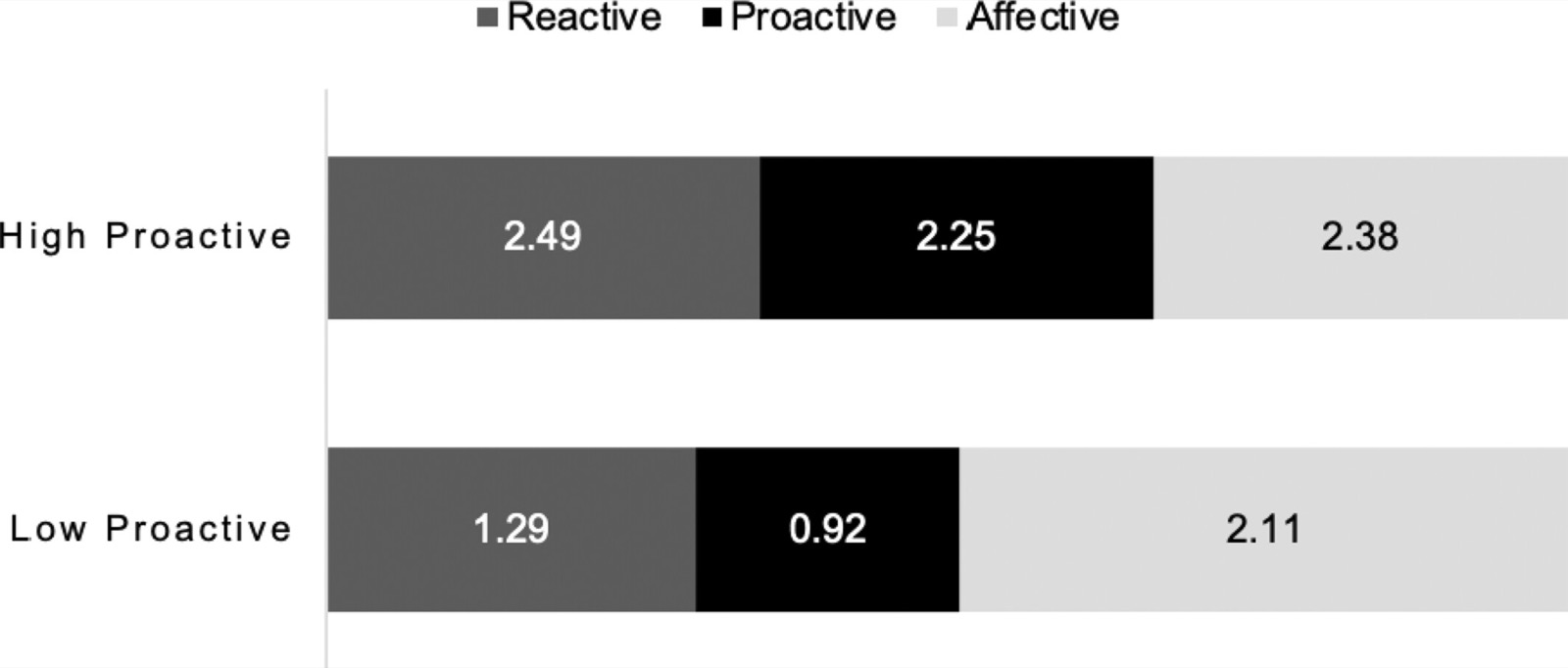
The demographic and CPV information for each type of dyad is presented in Table 1. There were no significant differences between types on young person age, F = 1.29(2,251), p = .276, or gender (χ2 = 0.16, p = .922). However, both the high- and low-proactive types had larger proportions of young people diagnosed with mental health issues compared with no-abuse dyads (χ2 = 27.89, p < .001).
Table 1 — Descriptive comparison between latent profiles and control group
- Group sizes: no abuse, n = 57; abuse, low proactive, n = 118; abuse, high proactive, n = 77.
- Age (years), M (SD). No abuse: 14.09 (5.24); low proactive: 12.96 (4.94); high proactive: 12.84 (4.41).
- Age of onset (years), M (SD). No abuse: 9.91 (4.86); low proactive: 8.66 (4.92); high proactive: 7.78 (4.51).
- Gender (male), n (%). No abuse: 36 (63%); low proactive: 83 (60%); high proactive: 32 (62%).
- Socioeconomic disadvantage (percentile)a, M (SD). No abuse: 45.35 (26.56); low proactive: 47.96 (25.54); high proactive: 42.96 (26.72).
- Child psychopathology (yes), n (%). No abuse: 13 (23%)b,c; low proactive: 70 (49%)b; high proactive: 34 (64%)c.
- Anxiety disorder, n (%). No abuse: 5 (8%)b,c; low proactive: 36 (31%)b; high proactive: 22 (29%)c.
- Depressive disorder, n (%). No abuse: 4 (7%); low proactive: 18 (15%); high proactive: 7 (9%).
- Trauma, n (%). No abuse: 2 (4%); low proactive: 9 (8%); high proactive: 7 (9%).
- ASD, n (%). No abuse: 3 (5%)c; low proactive: 10 (9%)d; high proactive: 15 (20%)c,d.
- ADHD, n (%). No abuse: 5 (9%)c; low proactive: 19 (16%); high proactive: 21 (27%)c.
- ASD + ADHD, n (%). No abuse: 2 (4%); low proactive: 6 (5%); high proactive: 7 (9%).
- CPV form — physical, M (SD). No abuse: 0 (0); low proactive: 38.08 (36.89); high proactive: 151.27 (126.27).
- CPV form — verbal, M (SD). No abuse: 1.19 (1.84); low proactive: 8.91 (6.25); high proactive: 22.29 (8.30).
- CPV form — coercive, M (SD). No abuse: 0.77 (2.32); low proactive: 39.39 (31.09); high proactive: 176.42 (89.60).
- CPV form — total, M (SD). No abuse: 1.96 (3.67); low proactive: 81.11 (51.13); high proactive: 349.97 (199.92).
- CPV function — reactive, M (SD). No abuse: —; low proactive: 1.29 (0.63); high proactive: 2.49 (0.59).
- CPV function — proactive, M (SD). No abuse: —; low proactive: 0.92 (0.57); high proactive: 2.25 (0.74).
- CPV function — affective, M (SD). No abuse: —; low proactive: 2.11 (0.90); high proactive: 2.38 (0.83).
Note. No significance testing for CPV form or function was conducted as these variables contributed to the latent profile model. ADHD = attention-deficit/hyperactivity disorder; ASD = autism spectrum disorder; CPV = child-to-parent violence; Trauma = diagnosis of posttraumatic stress disorder or dissociative disorder. a Higher percentiles indicate greater socioeconomic disadvantage relative to Australian population. b Significant pairwise difference between no-abuse and low-proactive groups. c Significant pairwise difference between no-abuse and high-proactive groups. d Significant pairwise difference between low-proactive and high-proactive groups.
Analysis of group differences
We conducted a series of analysis of variance tests to explore differences between latent profiles and the control group. Outliers were removed from models only if they were highly influential. A Welch correction was used to correct variance heterogeneity between groups when necessary. We observed the most significant between-group differences in the young person's personality traits and the caregiver's helplessness. The results of all group comparisons are presented in Table 2.
Table 2 — Differences between latent profiles and control group
- CU traits. No abuse: 21.51 (8.95)a,b; low proactive: 26.94 (10.82)a,c; high proactive: 39.17 (11.02)b,c; F(2, 140.79) = 52.50d, p < .001, ηp2 = .30.
- Affective reactivity. No abuse: 1.94 (2.36)a,b; low proactive: 5.34 (3.38)a,c; high proactive: 10.97 (2.78)b,c; F(2, 145.34) = 199.13d, p < .001, ηp2 = .57.
- Narcissism. No abuse: 2.39 (2.49)a,b; low proactive: 4.29 (3.63)a,c; high proactive: 10.59 (6.83)b,c; F(2, 132.47) = 44.13d, p < .001, ηp2 = .34.
- Sibling aggression. No abuse: 3.63 (3.92)a,b; low proactive: 9.33 (5.14)a,c; high proactive: 13.79 (5.79)b,c; F(2, 185) = 44.21, p < .001, ηp2 = .33.
- Peer aggression. No abuse: 0.98 (1.83)a,b; low proactive: 2.97 (3.53)a,c; high proactive: 6.14 (5.60)b,c; F(2, 145.86) = 33.68d, p < .001, ηp2 = .19.
- Parental helplessness. No abuse: 4.07 (3.67)a,b; low proactive: 9.59 (5.17)a,c; high proactive: 17.09 (5.79)b,c; F(2, 133.53) = 113.63d, p < .001, ηp2 = .48.
- Parent frightened. No abuse: 0.31 (0.63)a,b; low proactive: 1.29 (1.33)a,c; high proactive: 3.08 (1.58)b,c; F(2, 132.89) = 90.12d, p < .001, ηp2 = .40.
- Child frightened. No abuse: 1.05 (1.41)a,b; low proactive: 2.29 (1.60)a,c; high proactive: 3.71 (1.73)b,c; F(2, 221) = 42.16, p < .001, ηp2 = .29.
- Spousification. No abuse: 6.45 (4.19)b; low proactive: 7.81 (4.35)c; high proactive: 9.99 (4.88)b,c; F(2, 224) = 9.87, p < .001, ηp2 = .08.
- Intrusiveness. No abuse: 7.32 (2.47)a,b; low proactive: 8.52 (2.67)a; high proactive: 9.06 (2.94)b; F(2, 227) = 5.79, p = .004, ηp2 = .05.
- Disciplinary effort. No abuse: 25.35 (23.30)a,b; low proactive: 51.42 (24.85)a,c; high proactive: 70.78 (32.82)b,c; F(2, 100.87) = 35.24d, p < .001, ηp2 = .29.
- Power assertion/Punitiveness. No abuse: 18.15 (17.64)a,b; low proactive: 29.94 (15.23)a; high proactive: 29.52 (15.43)b; F(2, 186) = 6.94, p = .001, ηp2 = .07.
- Inductive discipline. No abuse: 31.96 (8.57)b; low proactive: 29.45 (6.61); high proactive: 27.43 (6.19)b; F(2, 184) = 4.97, p = .008, ηp2 = .05.
- Ignore misbehavior. No abuse: 4.46 (5.43)b; low proactive: 5.34 (5.16); high proactive: 6.55 (4.75)b; F(2, 191) = 2.17, p = .117, ηp2 = .02.
- Disciplinary consistency. No abuse: 8.29 (2.81); low proactive: 8.97 (1.83); high proactive: 9.10 (2.22); F(2, 100.23) = 1.47d, p = .235, ηp2 = .02.
- Disciplinary monitoring. No abuse: 2.35 (3.49)a,b; low proactive: 3.99 (4.16)a,c; high proactive: 6.16 (5.18)b,c; F(2, 116.20) = 10.63d, p < .001, ηp2 = .10.
- Poor parental monitoring. No abuse: 5.40 (5.01); low proactive: 3.86 (4.03)c; high proactive: 6.28 (6.51)c; F(2, 98.25) = 4.15d, p = .019, ηp2 = .04.
- Parental warmth/involvement. No abuse: 17.88 (3.20)b; low proactive: 16.91 (2.67); high proactive: 16.28 (2.89)b; F(2, 203) = 4.14, p = .017, ηp2 = .04.
- Parental stress. No abuse: 4.60 (3.23)a,b; low proactive: 6.73 (3.10)a,c; high proactive: 9.36 (4.36)b,c; F(2, 103.80) = 20.79d, p < .001, ηp2 = .20.
Note. CU = callous–unemotional. a Significant pairwise difference between no-abuse and low-proactive groups. b Significant pairwise difference between no-abuse and high-proactive groups. c Significant pairwise difference between low-proactive and high-proactive groups. d Welch statistic.
DISCUSSION
The current study sought to investigate a typology of dyads experiencing abusive CPV based on the function of CPV, as well as explore the parent, child, and dyadic correlates of these types. We found two types of dyads primarily characterized by high or low rates of proactive CPV. In high-proactive dyads, not only was the rate of proactive CPV substantially greater than in low-proactive dyads, these dyads were also experiencing substantially more violence; thus, the within-group proportion is more meaningful than raw frequencies. Indeed, there was a balanced and more frequent use of all three functions in the high-proactive type compared to the low-proactive type (see Figure 1). The low proactive type demonstrated fewer CPV behaviors and used far fewer proactive aggressions as a proportion of all functions (the average response to proactive items was “rarely”). Instead, the function of CPV in these dyads was primarily affective and partially reactive.
Both types of dyads reported using all three functions to some degree; we did not find a purely reactive (or affective) type. All dyads were experiencing significant and ongoing abuse, not isolated incidents of minor aggression. It may be that a purely reactive type does exist, but only in a subabuse population—general aggression models find pure reactive aggression in lower severity groups (Brugman et al., 2017). In an exploratory analysis, we investigated this possibility with participants who reported CPV but did not meet the criteria for abuse in our sample (n = 24). These subabuse dyads reported primarily affective CPV (M = 1.42) and a very low frequency of reactive (M = 0.56) and proactive CPV (M = 0.22). On the basis of these trends, it is more likely that a purely affective rather than purely reactive type could emerge here. Purely reactive CPV could instead be found in extreme cases of child abuse, where the motivation for using CPV is a survival response (Ibabe, 2019; Loeber & Hay, 1997).
Typology correlates
High proactive dyads
We hypothesized that dyads experiencing high proactive CPV would be characterized by a withdrawn parent and an empowered young person. We found some evidence to support this prediction. First, caregivers in high-proactive dyads reported being the most helpless, frightened, and frightening compared with caregivers in both no-abuse and low-proactive dyads. Considering the young person's substantial use of proactive CPV, this suggests that some form of punitive role reversal has occurred in these dyads. Consistent with a role-reversal perspective, we also observed that young people in these dyads had significantly more autonomy (i.e., they were less monitored) than low-proactive dyads and were more spousified. Further, young people in high-proactive dyads exhibited personality characteristics conducive to dominance in interpersonal relationships; they were substantially more callous–unemotional and more narcissistic than their peers, which would encourage the pursuit of self-interest (creating the conditions for a power contest) and also provide the means to achieve this through powerful coercion.
High-proactive dyads exhibited greater spousification than low proactive and no-abuse dyads. Low-proactive dyads were not significantly different from no-abuse dyads, indicating that spousification may be unique to high-proactive dyads. There is scant literature on hostile spousification to consult (the concept is more often mentioned rather than explored); however, this process may influence CPV. First, it may elevate the young person in the power hierarchy to that of an equivalent (Linde-Krieger & Yates, 2021). A spousified young person is, from the perspective of the parent, comparable to an adult partner, and their behaviors are viewed as such. This may implicate them in conflict that is beyond the boundaries of the parent–child relationship, spilling over from the marital or ex-marital subsystem (Kerig et al., 1993). This aligns with prior CPV research identifying high rates of partner conflict in families experiencing CPV (Izaguirre & Calvete, 2017). Currently, the prevailing explanation for the impact of IPV on CPV is grounded in social learning theory, whereby the young person may witness and replicate the violent behaviors of the parent or parents (Tew & Nixon, 2010). This study adds that such an account may not be complete and that intimate partner conflict may also impact CPV in high-proactive dyads through caregiver representations of the young person, which are conflated with that of an intimate partner and the similar hostile treatment this may attract.
While demonstrating low power and withdrawal, parents in the high-proactive dyads were far from prototypically permissive. They reported significantly more frequent attempts at discipline, and their disciplinary repertoire included more power-assertive and fewer inductive techniques compared with nonabused caregivers. They were also more intrusive than no-abuse caregivers. Although they were also more vigilant of misbehavior, they ignored these transgressions at a higher rate. This may be because the young person was frequently misbehaving, and the parent was forced to “pick battles” but also remain alert as misbehavior could create an opportunity for conflict. Alternatively, it may be that the parent often perceives the young person as powerful, which promotes withdrawal in many circumstances and power repair in others (Steeger & Gondoli, 2013). In both cases, the dyad could enter a permissive–hostile attractor state.
There are several reasons frequent discipline attempts in a high-proactive dyad may be problematic. Foremost, young people in these dyads were highly irritable (based on ARI scores) and, therefore, very likely to respond aggressively to control attempts, particularly coercive ones, and enter a mutually hostile attractor state. This could be why these young people also demonstrated greater reactive CPV. Parents in high-proactive dyads were also the most stressed in the sample. Stressed parents who administer harsh discipline are more likely to experience CPV than those who use harsh discipline and are not stressed (Cano-Lozano et al., 2021b). Finally, these strategies are unlikely to be successful, given that callous–unemotional traits are associated with insensitivity to punishment (Chen et al., 2021; Hawes & Dadds, 2005). Such a process may perpetuate helplessness in the parenting role and parental burnout, a risk factor for violent and neglectful behavior (Hansotte et al., 2021), adding additional risk to an already mutually hostile dyad. This was not explicitly measured in the current study; however, such bidirectional violence is common in families afflicted by CPV (Gallego et al., 2019) and may reasonably stem from circumstances within high-proactive dyads.
Rates of affective CPV (i.e., anxiety-based CPV) were substantial in high-proactive dyads. In DST (Granic & Patterson, 2006), comorbid anxiety and aggression are hypothesized to relate to switches between permissive and hostile parenting, although this has not since been tested; this study provides preliminary evidence in support of this hypothesis. The frightening component of disconnected caregiving in high-proactive dyads may generate anxiety observable during CPV interactions that is intimately related to resolving such fear through control. If so, it would be reasonable that affective CPV would reduce as the young person gains more control within the dyad. Perhaps, as proactive CPV develops when control in the relationship is established, the anxiety that drives affective CPV is reduced. In this study, proactive CPV was negatively correlated with affective CPV and this correlation was seen only in high-proactive dyads (r = −.29). At a variable level, affective CPV was more strongly associated with frightening rather than frightened caregiving, and less strongly associated with caregiver helplessness and parent stress compared with proactive CPV (Supplemental Table 1). This suggests that affective CPV may be more prominent earlier in the punitive role-reversal process before proactive CPV becomes highly frequent and severe violence exacerbates helpless and frightened caregiving. Overall, in high-proactive dyads, affective CPV may occur as an artifact of establishing control over a frightening and unpredictable parent, which may also be related to prior trauma experiences (Nowakowski-Sims & Rowe, 2017). Thus, the “function” of affective CPV may be related to relief from anxiety but in the context of broader motivations of control and the development of proactive CPV.
Young people in high-proactive dyads were also aggressive toward peers and siblings at significantly higher rates than those in the low-proactive and no-abuse dyads. Although this aligns with the characterization of a generalist (Navas-Martínez & Cano-Lozano, 2022), we did not find a type aligned with a specialist. It may be that specialists are subabusive (e.g., not physically violent and infrequently verbally aggressive); affective CPV is primary in this population and at a variable level, and it was not correlated with either sibling or peer aggression.
Low-proactive dyads
We hypothesized that dyads in which the young person uses less or no proactive CPV might be ones in which the young person, rather than the parent, demonstrates disempowerment. Caregivers in low-proactive dyads were more in control and perhaps even overcontrolling. Like high-proactive dyads, they used more frequent assertive disciplinary attempts to control the young person than nonabused caregivers and were similarly intrusive. However, these caregivers demonstrated more successful supervision of the young person compared with the high-proactive type; young people in these dyads were less unsupervised and, therefore, less autonomous. These caregivers also responded to misbehavior at the same frequency as nonabused caregivers. Overall, this reflects a strong hierarchy favoring the parent that may be maintained through intrusiveness and power assertion (Kerig, 2005). Despite this seemingly punitive control, caregivers in the low-proactive dyads were just as warm and involved as nonabused caregivers and retained a similar use of positive discipline strategies. This may be because they were less stressed and less helpless in their caregiving role (compared with high-proactive dyads); stressed and overwhelmed (i.e., disempowered) parents tend to favor harsh discipline (Guajardo et al., 2009; Steeger & Gondoli, 2013). Overall, these caregivers appeared more in control than those in high-proactive dyads and thus have likely retained more of the inherent authority of their role.
Despite demonstrating more control compared with the high-proactive type, the caregivers' intrusive and sometimes power-assertive actions in low-proactive dyads provide an opportunity for reactive CPV and a mutually hostile attractor to form. Young people in low-proactive dyads were more callous–unemotional, narcissistic, and irritable than those in no-abuse dyads, but to a far lesser extent than in high-proactive dyads. Thus, although not nearly as maladjusted, they were still unlikely to become fully withdrawn in response to a more inductive, warmer, yet intrusive and power-assertive parent. The young person may sometimes be making counter-attempts for control against the parent. However, based on the low frequency of proactive CPV in these dyads, these attempts may not be successful, and they may rarely initiate such interactions.
Although reactive CPV was observed in these dyads, it remained relatively uncommon compared to the frequency of affective CPV. Where there is an absence of concurrent proactive CPV, affective CPV may capture the result of tension building up; the lack of proactive CPV suggests aggressive responses are not prioritized. A second, untested hypothesis within dynamic systems theory was that prolonged, real-time anxiety may reduce cognitive control and “overflow” into aggression (Granic, 2014). Controlling behaviors such as intrusiveness can generate anxiety and irritability in the young person (Kashdan et al., 2004; Silverman et al., 2021), which may burden the young person's emotion regulation capacity. Intrusive behaviors may also lead to anxiety by limiting the young person's perceptions of control (Nanda et al., 2012). Recent qualitative work by Rutter (2021) aligns with this conceptualization, describing a process surrounding an overwhelmed young person whose violence is unintended, nondirected, and anxiety based.
It should be noted that the disconnected behaviors that may facilitate role-reversal were not absent from low-proactive dyads. Helpless, frightened, and frightening caregiving were all significantly higher than in control dyads, albeit to a far lesser extent than high-proactive dyads. These dyads may still be at risk of role-reversal and the learning of substantial CPV. However, these behaviors were only slightly elevated in low-proactive dyads, so the risk is likely small; there may be a dose–response relationship between maladaptive parenting behaviors and disorganized attachment (Green & Goldwyn, 2002).
Limitations
Several perturbations are relevant to CPV (e.g., transition to adolescence). The current study is a cross-section of what is likely fluid and evolving patterns of interaction between the parent and the young person. The age range of youth in the current study was broad (5–24 years) and therefore aligned with current conceptualizations of CPV that focus on the relationship as a defining quality rather than arbitrary age restrictions (Pereira et al., 2017; Simmons et al., 2018). However, the nature of the parent–child relationship changes over time (e.g., the relative power of the young person and expectations of autonomy; Stewart & Zaenglein-Senger, 1982; Youniss, 1982). Thus, it could be that high-proactive dyads are captured at two time points in an escalating process of CPV, one when the parent has learned helplessness and one when the parent is attempting to regain control. To explore this, dyads could be followed longitudinally from childhood to adolescence, although the population is small, so this approach would require significant resourcing. Future studies could instead consider the young person's age as a moderator of risk factors within typologies.
Another limitation was the over-representation of female caregivers and the single caregiver report. Male caregivers are particularly difficult to recruit for family research. Harries et al. (2023) explained that fathers might experience a primarily reactive function of CPV rather than controlling proactive aggressions. Alongside the parent-report methodology, the undersampling of male caregivers may have inflated the amount of proactive CPV reported in the current study and reduced our ability to detect reactive aggression in the population. Relying on caregiver report likely biased the reporting on the characteristics of the young person; owing to deterioration in the relationship, the caregiver may have overreported negative aspects of the young person's personality and behaviors. We only had the perspective of a single caregiver within each family system. Parents in dual-parent family systems can take on different roles in caregiving (McKinney & Renk, 2007; Yaffe, 2020) and may have different perspectives on the experience of CPV. Corroborating reports by collecting data from multiple caregivers in the same family system, or the reports of the young person themselves would help to confirm the results of the current study.
Finally, we did not collect data on race or ethnicity, which can play a significant role in shaping cultural norms, values, and behaviors within families. For example, there are cultural differences in expected family structure and parenting between countries and cultures (Dunbar & Adams, 2017) that may have an impact on the relationship between parenting strategy and youth adjustment. Cultural normativeness can moderate the link between parenting behaviors and youth maladjustment (Lansford et al., 2018), and ideal parenting strategies may vary based on whether the culture is individualistic or collectivistic, as well as hierarchical or egalitarian (Garcia & Gracia, 2009; Singelis et al., 1995).
Implications
The typology of high- and low-proactive CPV has utility for intervention planning. Foremost, this typology provides evidence against the use of manualized intervention for CPV that adopts a “one-size-fits-all” approach. Although there is a substantial array of unique intervention considerations for high- and low-proactive dyads, the following recommendations highlight potential core aspects of treatment and should be considered within the complexity of family and dyadic systems. For example, violence within a relationship occurs alongside myriad secondary issues, including guilt, shame, trauma, and emotional distance (Junco-Guerrero et al., 2021; Scharf & Goldner, 2018; Williams et al., 2017). There is also a need to consider safety planning and immediate management of the problematic behavior.
Within high-proactive dyads, CPV may be an inappropriate means to achieve control over an unpredictable and frightening environmental characteristic of disorganized attachment (Moss et al., 2004). As such, our primary recommendations for intervention center on encouraging and developing sensitivity in caregiving. Establishing organization and consistency in the responsiveness of caregiving may be essential. Changing an environment of disconnected caregiving, disorganized attachment, and role reversal appears complex, but this does not necessitate complex intervention. Although longer interventions may have better outcomes (Wright et al., 2017), more simplistic attachment modules seem to fare best (Bakermans-Kranenburg et al., 2003). Targeting parental sensitivity (understanding the young person's needs and responding appropriately; Mesman & Emmen, 2016) produces the most consistent benefits in preventing and reducing disorganized attachment (Bakermans-Kranenburg et al., 2005; Wright et al., 2017). Increases in sensitivity aim to reduce frightened, frightening, and helpless caregiving responses to the needs of the young person and disrupt patterns of parental withdrawal (Yarger et al., 2020).
Although this recommendation is derived from parent–infant or parent–child intervention evaluations, there is evidence that the parent behaviors related to disorganized attachment remain stable over time and represent an ongoing treatment target (Madigan et al., 2011). Notwithstanding, very early intervention may be ideal within high-proactive dyads. The average age of onset of CPV in this study was young—age 7 to 8 years in high-proactive dyads. This is likely why such a diversity of ages is represented in the sample and highlights an important finding: CPV can be detected well before adolescence and is a risk to the relationship across early development to emerging adulthood. Future research should consider this and limit the restriction of samples to adolescence, where the etiological contributors to the emergence of CPV may be somewhat distal.
The development of sensitive parenting skills aims to build a healthier attachment; however, the young person presents significant obstacles here too. Parenting a young person with callous–unemotional and narcissistic traits may inevitably become a power struggle, where a helpless, stressed, and disconnected parent may use power-assertive disciplinary strategies to retain power. However, these strategies are likely ineffective, whereby young people with callous–unemotional traits are less responsive to such discipline and are instead conditioned primarily by reward (Chen et al., 2021; Hawes & Dadds, 2005). There is an opportunity within this to introduce strategies that are attachment focused, such as sensitive discipline, which is an essential component of sensitive parenting skills into later development (Juffer et al., 2017). Sensitive discipline focuses on positive reinforcement, empathy, inductive discipline, and distraction (Juffer et al., 2017). The CPV intervention implications for high callous–unemotional traits are reviewed by Curtis et al. (2022) and include targeted efforts to increase warmth in the dyad and encourage the use of rewards. It is also noteworthy that the timing of intervention is important for young people with callous–unemotional traits. Younger children have greater potential for reductions in callous–unemotional traits (and consequently severe aggression) than those later in development (Masi et al., 2013). This reinforces the need to intervene during childhood, particularly with high-proactive dyads.
The function of CPV in low-proactive dyads was significantly less diverse, where affective CPV was most prominent. These dyads also attract lower risk (i.e., the CPV they experience was less severe/frequent) and thus warrant lighter intervention (Bonta & Andrews, 2007). Affective CPV was closely related to affective reactivity, a component of which is persistent negative mood (Stringaris et al., 2012). It may be that this reduces the flexibility of the young person to switch between emotions and hinders the ability of the dyad to exit from coercive interactions (Granic, 2008; Granic et al., 2007), leading to prolonged hostility. Working to increase capacity to exit from coercive attractors quickly may allow for reorganization into more adaptive states. Therefore, intervention focused on regulating and processing anxious states may reduce CPV in low-proactive dyads.
Negative mood, frustration, and irritability (i.e., affective reactivity) in the young person may also interact with parental intrusiveness to further increase the likelihood of reactive CPV. Intrusiveness is a part of the constellation of disrupted parenting behaviors for which parental sensitivity training may also be appropriate (Out et al., 2009; Yarger et al., 2016). Parental sensitivity training specific to intrusiveness may focus on the individualization between parent and young person and autonomy-supportive strategies. Intervention could also seek to support parents with the determinants of intrusive behaviors, such as low self-esteem and perfectionism (Scharf & Goldner, 2018). Caregivers in low-proactive dyads were only slightly more intrusive than no-abuse dyads. If intrusiveness causally impacts CPV, this indicates that only small changes to parenting behavior may be necessary. This aligns with the lower risk these dyads attract and is prognostically positive.
Conclusion
The function of CPV appears to be a valid way to delineate and infer dyad types due to its relationship with parent–child power dynamics. The current study identified two unique types of dyads experiencing CPV: high-proactive and low-proactive dyads. Young people who use CPV which includes a substantial proactive component, possess personality traits that afford them power in the relationship and their caregivers presented as variably withdrawn and hostile. On the other hand, in dyads where CPV is predominantly affective, and rarely proactive and reactive, the caregiver may retain power and control through power assertive and intrusive means. Future research should consider the function of CPV as a moderator of intervention response and work to replicate the typology described within this study in larger and more diverse samples.
Complexe Systémique: key points
The study’s interest lies in looking at child-to-parent violence not as a single block but through its function in the relationship. Two configurations emerge. In the first, the hierarchy has been reversed: an exhausted, frightened caregiver who alternates between withdrawal and attempts to regain control, a young person who dominates, and often spousification, in which the child inherits the couple’s conflicts. In the second, the parent keeps control, sometimes intrusively, and the violence looks more like an overflow of anxiety. For systemic practice the reading is familiar (generational boundaries, triangulation, coercive loops described as attractors), and it invites clinicians to tailor intervention rather than apply a single programme: restoring sensitive, predictable caregiving in the first case, working on anxiety regulation and intrusiveness in the second. The limits are clear: an Australian sample recruited online, almost only mothers, the parent’s view alone, a cross-sectional design and low reliability for intrusiveness. Read alongside the article on an ecological understanding of child-to-parent violence, and the article on parentification.
Notes from the original
Acknowledgement. Open access publishing facilitated by Deakin University, as part of the Wiley - Deakin University agreement via the Council of Australian University Librarians.
References
Bakermans-Kranenburg, M. J., Van Ijzendoorn, M. H., & Juffer, F. (2003). Less is more: Meta-analyses of sensitivity and attachment interventions in early childhood. Psychological bulletin, 129(2), 195–215.
Bakermans-Kranenburg, M. J., Van Ijzendoorn, M. H., & Juffer, F. (2005). Disorganized infant attachment and preventive interventions: A review and meta-analysis. Infant Mental Health Journal, 26(3), 191–216. https://doi.org/10.1002/imhj.20046
Baumrind, D. (1968). Authoritarian vs. authoritative parental control. Adolescence, 3(11), 255–272. https://www.proquest.com/openview/1ab065f19552b3ec2e969b6f7044ce32/1?pq-origsite=gscholar&cbl=1819054
Blair, R. J. (2013). The neurobiology of psychopathic traits in youths. Nature Reviews Neuroscience, 14(11), 786–799. https://doi.org/10.1038/nrn3577
Bollen, K. A., & Stine, R. A. (1992). Bootstrapping goodness-of-fit measures in structural equation models. Sociological Methods & Research, 21(2), 205–229. https://doi.org/10.1177/0049124192021002004
Bonta, J., & Andrews, D. A. (2007). Risk–need–responsivity model for offender assessment and rehabilitation. Rehabilitation, 6(1), 1–22. https://www.securitepublique.gc.ca/cnt/rsrcs/pblctns/rsk-nd-rspnsvty/rsk-nd-rspnsvty-eng.pdf
Brugman, S., Cornet, L. J. M., Smeijers, D., Smeets, K., Oostermeijer, S., Buitelaar, J. K., Verkes, R.-J., Lobbestael, J., De Kogel, C. H., & Jansen, L. M. C. (2017). Examining the reactive proactive questionnaire in adults in forensic and non-forensic settings: A variable- and person-based approach. Aggressive Behavior, 43(2), 155–162. https://doi.org/10.1002/ab.21671
Bugental, D. B., & Happaney, K. (2000). Parent–child interaction as a power contest. Journal of Applied Developmental Psychology, 21(3), 267–282. https://doi.org/10.1016/S0193-3973(99)00038-6
Calvete, E., Orue, I., Bertino, L., Gonzalez, Z., Montes, Y., Padilla, P., & Pereira, R. (2014). Child-to-parent violence in adolescents: The perspectives of the parents, children, and professionals in a sample of Spanish focus group participants. Journal of Family Violence, 29(3), 343–352. https://doi.org/10.1007/s10896-014-9578-5
Cano-Lozano, C., León, S. P., & Contreras, L. (2021a). Child-to-parent violence: Examining the frequency and reasons in Spanish youth. Family Relations, 70(4), 1132–1149. https://doi.org/10.1111/fare.12567
Cano-Lozano, C., León, S. P., & Contreras, L. (2021b). Relationship between punitive discipline and child-to-parent violence: The moderating role of the context and implementation of parenting practices. International Journal of Environmental Research and Public Health, 19(1), Article 182. https://doi.org/10.3390/ijerph19010182
Chen, F. R., Raine, A., & Gao, Y. (2021). Reduced electrodermal fear conditioning and child callous–unemotional traits. Research on Child and Adolescent Psychopathology, 49(4), 459–469. https://doi.org/10.1007/s10802-020-00727-3
Clark, S. L., & Muthén, B. (2009). Relating latent class analysis results to variables not included in the analysis [Unpublished manuscript]. https://www.statmodel.com/download/relatinglca.pdf
Curtis, A., Harries, T., Moulds, L., & Miller, P. (2022). Addressing child-to-parent violence: Developmental and intervention considerations. Journal of Family Studies, 28(1), 382–399. https://doi.org/10.1080/13229400.2019.1682643
Dodge, K. A. (1991). The structure and function of reactive and proactive aggression. In D. J. Pepler & K. H. Rubin (Eds.), The development and treatment of childhood aggression. (pp. 201–218). Lawrence Erlbaum Associates.
Dumas, J. E., LaFreniere, P. J., & Serketich, W. J. (1995). “Balance of power”: A transactional analysis of control in mother–child dyads involving socially competent, aggressive, and anxious children. Journal of Abnormal Psychology, 104(1), 104–113. https://doi.org/10.1037/0021-843X.104.1.104
Dunbar, N. E. (2004). Theory in progress: Dyadic power theory: Constructing a communication-based theory of relational power. Journal of Family Communication, 4(3–4), 235–248. https://doi.org/10.1080/15267431.2004.9670133
Dunbar, N. E., & Adams, A. (2017). Dominance and power in family communication. Sage Publications. https://doi.org/10.4135/9781452204420
Dunbar, N. E., & Johnson, A. J. (2015). A test of dyadic power theory: Control attempts recalled from interpersonal interactions with romantic partners, family members, and friends. Journal of Argumentation in Context, 4(1), 42–62. https://doi.org/10.1075/jaic.4.1.03dun
Dunbar, N. E., & Mejia, R. (2013). A qualitative analysis of power-based entrainment and interactional synchrony in couples. Personal Relationships, 20(3), 391–405. https://doi.org/10.1111/j.1475-6811.2012.01414.x
Eckstein, N. J. (2004). Emergent issues in families experiencing adolescent-to-parent abuse. Western Journal of Communication, 68(4), 365–388. https://doi.org/10.1080/10570310409374809
Engelhardt, J. A. (2012). The developmental implications of parentification: Effects on childhood attachment. Graduate Student Journal of Psychology, 14, 45–52.
Euler, F., Steinlin, C., & Stadler, C. (2017). Distinct profiles of reactive and proactive aggression in adolescents: Associations with cognitive and affective empathy. Child and Adolescent Psychiatry and Mental Health, 11, Article 1. https://doi.org/10.1186/s13034-016-0141-4
Frick, P. J. (2004). The Inventory of Callous–Unemotional Traits [Database record]. APA PsycTests. https://doi.org/10.1037/t62639-000
Gallego, R., Novo, M., Fariña, F., & Arce, R. (2019). Child-to-parent violence and parent-to-child violence: A meta-analytic review. The European Journal of Psychology Applied to Legal Context, 11(2), 51–59. https://doi.org/10.5093/ejpalc2019a4
Gao, Y., & Zhang, W. (2016). Confirmatory factor analyses of self- and parent-report inventory of callous-unemotional traits in 8- to 10-year-olds. Journal of Psychopathology and Behavioral Assessment, 38(3), 331–340. https://doi.org/10.1007/s10862-015-9527-5
Garcia, F., & Gracia, E. (2009). Is always authoritative the optimum parenting style? Evidence from Spanish families. Adolescence, 44(173), 101–131. https://pubmed.ncbi.nlm.nih.gov/19435170/
Granic, I. (2008). A dynamic systems approach to understanding family and peer relationships: Implications for effective interventions with aggressive youth. In Human development in the twenty-first century: Visionary ideas from systems scientists. (pp. 216–224). Cambridge University Press.
Granic, I. (2014). The role of anxiety in the development, maintenance, and treatment of childhood aggression. Development and Psychopathology, 26(4, Pt. 2), 1515–1530. https://doi.org/10.1017/s0954579414001175
Granic, I., O'Hara, A., Pepler, D., & Lewis, M. D. (2007). A dynamic systems analysis of parent–child changes associated with successful “real-world” interventions for aggressive children. Journal of Abnormal Child Psychology, 35(5), 845–857. https://doi.org/10.1007/s10802-007-9133-4
Granic, I., & Patterson, G. R. (2006). Toward a comprehensive model of antisocial development: A dynamic systems approach. Psychological Review, 113(1), 101–131. https://doi.org/10.1037/0033-295x.113.1.101
Green, J., & Goldwyn, R. (2002). Annotation: Attachment disorganisation and psychopathology: New findings in attachment research and their potential implications for developmental psychopathology in childhood. Journal of Child Psychology and Psychiatry, 43(7), 835–846. https://doi.org/10.1111/1469-7610.00102
Guajardo, N. R., Snyder, G., & Petersen, R. (2009). Relationships among parenting practices, parental stress, child behaviour, and children's social-cognitive development. Infant and Child Development, 18(1), 37–60. https://doi.org/10.1002/icd.578
Hansotte, L., Nguyen, N., Roskam, I., Stinglhamber, F., & Mikolajczak, M. (2021). Are all burned out parents neglectful and violent? A latent profile analysis. Journal of Child and Family Studies, 30(1), 158–168. https://doi.org/10.1007/s10826-020-01850-x
Harries, T., Curtis, A., Skvarc, D., Walker, A., & Mayshak, R. (2023). The Child-to-Parent Violence Functions Scale (CPV-F): Development and validation. Journal of Family Violence, 38(7), 1287–1301. https://doi.org/10.1007/s10896-022-00425-2
Hawes, D. J., & Dadds, M. R. (2005). The treatment of conduct problems in children with callous–unemotional traits. J Consult Clin Psychol, 73(4), 737–741. https://doi.org/10.1037/0022-006x.73.4.737
Hawes, D. J., Price, M. J., & Dadds, M. R. (2014). Callous-unemotional traits and the treatment of conduct problems in childhood and adolescence: A comprehensive review. Clinical Child and Family Psychology Review, 17(3), 248–267. https://doi.org/10.1007/s10567-014-0167-1
Henry, J. D., & Crawford, J. R. (2005). The short-form version of the Depression, Anxiety, Stress Scales (DASS-21): Construct validity and normative data in a large non-clinical sample. British Journal of Clinical Psychology, 44(2), 227–239. https://doi.org/10.1348/014466505x29657
Hesse, E., & Main, M. (2000). Disorganized infant, child, and adult attachment: Collapse in behavioral and attentional strategies. Journal of the American Psychoanalytic Association, 48(4), 1097–1127. https://doi.org/10.1177/00030651000480041101
Hubbard, J. A., Dodge, K. A., Cillessen, A. H. N., Coie, J. D., & Schwartz, D. (2001). The dyadic nature of social information processing in boys' reactive and proactive aggression. Journal of Personality and Social Psychology, 80(2), 268–280. https://doi.org/10.1037/0022-3514.80.2.268
Huth-Bocks, A. C., Guyon-Harris, K., Calvert, M., Scott, S., & Ahlfs-Dunn, S. (2016). The caregiving helplessness questionnaire: Evidence for validity and utility with mothers of infants. Infant Mental Health Journal, 37(3), 208–221. https://doi.org/10.1002/imhj.21559
Ibabe, I. (2019). Adolescent-to-parent violence and family environment: The perceptions of same reality? International Journal of Environmental Research and Public Health, 16(12), 2215. https://doi.org/10.3390/ijerph16122215
Ibabe, I., & Bentler, P. (2016). The contribution of family relationships to child-to-parent violence. Journal of Family Violence, 31(2), 259–269. https://doi.org/10.1007/s10896-015-9764-0
IBM Corp. (2019a). IBM SPSS Amos statistics for Windows, version 28.0.
IBM Corp. (2019b). IBM SPSS Amos statistics for Windows, version 26.0.
Izaguirre, A., & Calvete, E. (2017). Exposure to family violence as a predictor of dating violence and child-to-parent aggression in Spanish adolescents. Youth & Society, 49(3), 393–412. https://doi.org/10.1177/0044118X16632138
Juffer, F., Struis, E., Werner, C., & Bakermans-Kranenburg, M. J. (2017). Effective preventive interventions to support parents of young children: Illustrations from the Video-Feedback Intervention to Promote Positive Parenting and Sensitive Discipline (VIPP-SD). Journal of Prevention & Intervention in the Community, 45(3), 202–214. https://doi.org/10.1080/10852352.2016.1198128
Junco-Guerrero, M., Ruiz-Fernández, A., & Cantón-Cortés, D. (2021). Family environment and child-to-parent violence: The role of emotional insecurity. Journal of Interpersonal Violence, 37(15–16), NP13581–NP13602. https://doi.org/10.1177/08862605211006370
Kashdan, T. B., Jacob, R. G., Pelham, W. E., Lang, A. R., Hoza, B., Blumenthal, J. D., & Gnagy, E. M. (2004). Depression and anxiety in parents of children with adhd and varying levels of oppositional defiant behaviors: Modeling relationships with family functioning. Journal of clinical child and adolescent psychology, 33(1), 169–181. https://doi.org/10.1207/s15374424jccp3301_16
Kempes, M., Matthys, W., De Vries, H., & Van Engeland, H. (2005). Reactive and proactive aggression in children A review of theory, findings and the relevance for child and adolescent psychiatry. European child & adolescent psychiatry, 14(1), 11–19. https://doi.org/10.1007/s00787-005-0432-4
Kerig, P. K. (2005). Revisiting the construct of boundary dissolution: A multidimensional perspective. Journal of Emotional Abuse, 5(2–3), 5–42. https://doi.org/10.1300/J135v05n02_02
Kerig, P. K., Cowan, P. A., & Cowan, C. P. (1993). Marital quality and gender differences in parent-child interaction. Developmental Psychology, 29(6), 931–939. https://doi.org/10.1037/0012-1649.29.6.931
Kimonis, E. R., Fleming, G., Briggs, N., Brouwer-French, L., Frick, P. J., Hawes, D. J., Bagner, D. M., Thomas, R., & Dadds, M. R. (2019). Parent–child interaction therapy adapted for preschoolers with callous–unemotional traits: An open trial pilot study. Journal of Clinical Child & Adolescent Psychology, 48(Suppl. 1), S347–S361. https://doi.org/10.1080/15374416.2018.1479966
Kuczynski, L. (2012). Beyond bidirectionality: Bilateral conceptual frameworks for understanding dynamics in parent-child relations. In L. Kuczynski (Ed.), Handbook of dynamics in parent–child relations (pp. 3–24). Sage Publications. https://doi.org/10.4135/9781452229645
Lansford, J. E., Godwin, J., Al-Hassan, S. M., Bacchini, D., Bornstein, M. H., Chang, L., Chen, B.-B., Deater-Deckard, K., Di Giunta, L., Dodge, K. A., Malone, P. S., Oburu, P., Pastorelli, C., Skinner, A. T., Sorbring, E., Steinberg, L., Tapanya, S., Alampay, L. P., Uribe Tirado, L. M., & Zelli, A. (2018). Longitudinal associations between parenting and youth adjustment in twelve cultural groups: Cultural normativeness of parenting as a moderator. Developmental Psychology, 54(2), 362–377. https://doi.org/10.1037/dev0000416
Lanza, S. T., & Rhoades, B. L. (2013). Latent class analysis: An alternative perspective on subgroup analysis in prevention and treatment. Prevention Science, 14(2), 157–168. https://doi.org/10.1007/s11121-011-0201-1
Lecompte, V., & Moss, E. (2014). Disorganized and controlling patterns of attachment, role reversal, and caregiving helplessness: Links to adolescents' externalizing problems. American Journal of Orthopsychiatry, 84(5), 581–589. https://doi.org/10.1037/ort0000017
Lee-Rowland, L. M., Barry, C. T., Gillen, C. T. A., & Hansen, L. K. (2017). How do different dimensions of adolescent narcissism impact the relation between callous–unemotional traits and self-reported aggression? Aggressive Behavior, 43(1), 14–25. https://doi.org/10.1002/ab.21658
Linde-Krieger, L. B., & Yates, T. M. (2021). A structural equation model of the etiology and developmental consequences of parent–child role confusion. Journal of Applied Developmental Psychology, 72, Article 101216. https://doi.org/10.1016/j.appdev.2020.101216
Loeber, R., & Hay, D. (1997). Key issues in the development of aggression and violence from childhood to early adulthood. Annual Review of Psychology, 48(1), 371–410. https://doi.org/10.1146/annurev.psych.48.1.371
Lubke, G., & Neale, M. C. (2006). Distinguishing between latent classes and continuous factors: Resolution by maximum likelihood? Multivariate Behavioral Research, 41(4), 499–532. https://doi.org/10.1207/s15327906mbr4104_4
Madigan, S., Voci, S., & Benoit, D. (2011). Stability of atypical caregiver behaviors over six years and associations with disorganized infant-caregiver attachment. Attachment & Human Development, 13(3), 237–252. https://doi.org/10.1080/14616734.2011.562410
Main, M., & Hesse, E. (1990). Parents' unresolved traumatic experiences are related to infant disorganized attachment status: Is frightened and/or frightening parental behavior the linking mechanism? In Attachment in the preschool years: Theory, research, and intervention (pp. 161–182). The University of Chicago Press.
Masi, G., Muratori, P., Manfredi, A., Lenzi, F., Polidori, L., Ruglioni, L., Muratori, F., & Milone, A. (2013). Response to treatments in youth with disruptive behavior disorders. Comprehensive Psychiatry, 54(7), 1009–1015. https://doi.org/10.1016/j.comppsych.2013.04.007
McCutcheon, A. L. (1987). Latent class analysis (Vol. 64). Sage Publications.
McKinney, C., & Renk, K. (2007). Differential parenting between mothers and fathers: Implications for late adolescents. Journal of Family Issues, 29(6), 806–827. https://doi.org/10.1177/0192513X07311222
Mesman, J., & Emmen, R. A. (2016). Mary Ainsworth's legacy: A systematic review of observational instruments measuring parental sensitivity. Maternal Sensitivity, 15(5–6), 43–64. https://doi.org/10.1080/14616734.2013.820900
Morgan, G. B., Hodge, K. J., & Baggett, A. R. (2016). Latent profile analysis with nonnormal mixtures: A Monte Carlo examination of model selection using fit indices. Computational Statistics & Data Analysis, 93, 146–161. https://doi.org/10.1016/j.csda.2015.02.019
Moss, E., Cyr, C., & Dubois-Comtois, K. (2004). Attachment at early school age and developmental risk: Examining family contexts and behavior problems of controlling-caregiving, controlling-punitive, and behaviorally disorganized children. Developmental Psychology, 40(4), 519–532. https://doi.org/10.1037/0012-1649.40.4.519
Nanda, M. M., Kotchick, B. A., & Grover, R. L. (2012). Parental psychological control and childhood anxiety: The mediating role of perceived lack of control. Journal of Child and Family Studies, 21(4), 637–645. https://doi.org/10.1007/s10826-011-9516-6
Navas-Martínez, M. J., & Cano-Lozano, M. C. (2022). Differential profile of specialist aggressor versus generalist aggressor in child-to-parent violence. International Journal of Environmental Research and Public Health, 19(9), 5720. https://doi.org/10.3390/ijerph19095720
Nowakowski-Sims, E., & Rowe, A. (2017). The relationship between childhood adversity, attachment, and internalizing behaviors in a diversion program for child-to-mother violence. Child Abuse and Neglect, 72, 266–275. https://doi.org/10.1016/j.chiabu.2017.08.015
Olivari, M. G., Tagliabue, S., & Confalonieri, E. (2013). Parenting style and dimensions questionnaire: A review of reliability and validity. Marriage & Family Review, 49(6), 465–490. https://doi.org/10.1080/01494929.2013.770812
Oltmanns, T. F., & Turkheimer, E. (2006). Perceptions of self and others regarding pathological personality traits. In R. F. Krueger & J. L. Tackett (Eds.), Personality and psychopathology (pp. 71–111). The Guilford Press.
Out, D., Bakermans-Kranenburg, M. J., & Van IJzendoorn, M. H. (2009). The role of disconnected and extremely insensitive parenting in the development of disorganized attachment: Validation of a new measure. Attachment & Human Development, 11(5), 419–443. https://doi.org/10.1080/14616730903132289
Pang, J. S., Ang, R. P., Kom, D. M., Tan, S. H., & Chiang, A. Q. (2013). Patterns of reactive and proactive aggression in young adolescents in singapore. Social Development, 22(4), 794–812. https://doi.org/10.1111/sode.12024
Patterson, G. R., Dishion, T. J., & Bank, L. (1984). Family interaction: A process model of deviancy training. Aggressive Behavior, 10(3), 253–267. https://doi.org/10.1002/1098-2337
Pereira, R., Loinaz, I., del Hoyo-Bilbao, J., Arrospide, J., Bertino, L., Calvo, A., & Gutiérrez, M. (2017). Proposal for a definition of filio-parental violence: Consensus of the Spanish Society for the Study of Filio–Parental Violence (SEVIFIP). Papeles del Psicólogo, 38(3), 216–223. https://doi.org/10.23923/pap.psicol2017.2839
Routt, G., & Anderson, L. (2011). Adolescent violence towards parents. Journal of Aggression, Maltreatment & Trauma, 20(1), 1–19. https://doi.org/10.1080/10926771.2011.537595
R Studio Team. (2020). Rstudio: Integrated development for R.
Rowa, K., Kerig, P. K., & Geller, J. (2001). The family and anorexia nervosa: Examining parent-child boundary problems. European Eating Disorders Review, 9, 97–114. https://doi.org/10.1002/erv.383
Rutter, N. (2021). “I'm meant to be his comfort blanket, not a punching bag”—ethnomimesis as an exploration of maternal child to parent violence in pre-adolescents. Qualitative Social Work, 20(5), 1317–1338. https://doi.org/10.1177/1473325020940774
Salmivalli, C., & Peets, K. (2009). Bullies, victims, and bully–victim relationships in middle childhood and early adolescence. In K. H. Rubin, W. M. Bukowski, & B. Laursen (Eds.), Handbook of peer interactions, relationships, and groups (pp. 322–340). The Guilford Press.
Scharf, M., & Goldner, L. (2018). “If you really love me, you will do/be …”: Parental psychological control and its implications for children's adjustment. Developmental Review, 49, 16–30. https://doi.org/10.1016/j.dr.2018.07.002
Selwyn, J., & Meakings, S. (2016). Adolescent-to-parent violence in adoptive families. British Journal of Social Work, 46(5), 1224–1240. https://doi.org/10.1093/bjsw/bcv072
Silverman, W. K., Marin, C. E., Rey, Y., Jaccard, J., & Pettit, J. W. (2021). Directional effects of parent and child anxiety 1 year following treatment of child anxiety, and the mediational role of parent psychological control. Depression and Anxiety, 38(12), 1289–1297. https://doi.org/10.1002/da.23210
Simmons, M., McEwan, T., Purcell, R., & Huynh, M. (2019). The Abusive Behaviour by Children—Indices (ABC-I): A measure to discriminate between normative and abusive child behaviour. Journal of Family Violence, 34(7), 663–676. https://doi.org/10.1007/s10896-019-00071-1
Simmons, M., McEwan, T., Purcell, R., & Ogloff, J. (2018). Sixty years of child-to-parent abuse research: What we know and where to go. Aggression and Violent Behavior, 38, 31–52. https://doi.org/10.1016/j.avb.2017.11.001
Singelis, T. M., Triandis, H. C., Bhawuk, D. P. S., & Gelfand, M. J. (1995). Horizontal and vertical dimensions of individualism and collectivism: A theoretical and measurement refinement. Cross-Cultural Research, 29(3), 240–275. https://doi.org/10.1177/106939719502900302
Smeets, K. C., Oostermeijer, S., Lappenschaar, M., Cohn, M., van der Meer, J. M. J., Popma, A., Jansen, L. M. C., Rommelse, N. N. J., Scheepers, F. E., & Buitelaar, J. K. (2017). Are proactive and reactive aggression meaningful distinctions in adolescents? A variable- and person-based approach. Journal of Abnormal Child Psychology, 45(1), 1–14. https://doi.org/10.1007/s10802-016-0149-5
Steeger, C. M., & Gondoli, D. M. (2013). Mother–adolescent conflict as a mediator between adolescent problem behaviors and maternal psychological control. Developmental Psychology, 49(4), 804–814. https://doi.org/10.1037/a0028599
Stewart, C. S., & Zaenglein-Senger, M. M. (1982). The parent–adolescent power contest. Social Casework, 63(8), 457–464. https://doi.org/10.1177/104438948206300802
Straus, M., & Fauchier, A. (2007). Manual for the Dimensions of Discipline Inventory (DDI). Family Research Laboratory, University of New Hampshire.
Straus, M., Hamby, S. L., Boney-McCoy, S. U. E., & Sugarman, D. B. (1996). The Revised Conflict Tactics Scales: Development and preliminary psychometric data. Journal of Family Issues, 17(3), 283–316. https://doi.org/10.1177/019251396017003001
Stringaris, A., Goodman, R., Ferdinando, S., Razdan, V., Muhrer, E., Leibenluft, E., & Brotman, M. A. (2012). The affective reactivity index: A concise irritability scale for clinical and research settings. Journal of Child Psychology Psychiatry, 53(11), 1109–1117. https://doi.org/10.1111/j.1469-7610.2012.02561.x
Tampke, E. C., Fite, P. J., Griffith, R. L., Pederson, C. A., & Abel, M. (2021). Further evaluation of the link between perceived containment and proactive and reactive functions of aggression among detained youth. Journal of Aggression, Maltreatment & Trauma, 30(4), 509–527. https://doi.org/10.1080/10926771.2020.1774694
Tew, J., & Nixon, J. (2010). Parent abuse: Opening up a discussion of a complex instance of family power relations. Social Policy and Society, 9(4), 579–589. https://doi.org/10.1017/S1474746410000291
Van Geel, M., Toprak, F., Goemans, A., Zwaanswijk, W., & Vedder, P. (2017). Are youth psychopathic traits related to bullying? Meta-analyses on callous–unemotional traits, narcissism, and impulsivity. Child Psychiatry and Human Development, 48(5), 768–777. https://doi.org/10.1007/s10578-016-0701-0
Walters, G. D. (2005). Proactive and reactive aggression: A lifestyle view. In J. P. Morgan (Ed.), Psychology of aggression (pp. 29–43). Nova Science Publishers.
Williams, M., Tuffin, K., & Niland, P. (2017). “It's like he just goes off, boom!”: Mothers and grandmothers make sense of child-to-parent violence. Child & Family Social Work, 22(2), 597–606. https://doi.org/10.1111/cfs.12273
Wright, B., Hackney, L., Hughes, E., Barry, M., Glaser, D., Prior, V., Allgar, V., Marshall, D., Barrow, J., Kirby, N., Garside, M., Kaushal, P., Perry, A., & McMillan, D. (2017). Decreasing rates of disorganised attachment in infants and young children, who are at risk of developing, or who already have disorganised attachment. A systematic review and meta-analysis of early parenting interventions. PLoS One, 12(7), Article e0180858. https://doi.org/10.1371/journal.pone.0180858
Yaffe, Y. (2020). Systematic review of the differences between mothers and fathers in parenting styles and practices. Current Psychology. https://doi.org/10.1007/s12144-020-01014-6
Yarger, H. A., Bronfman, E., Carlson, E., & Dozier, M. (2020). Intervening with attachment and biobehavioral catch-up to decrease disrupted parenting behavior and attachment disorganization: The role of parental withdrawal. Development and Psychopathology, 32(3), 1139–1148. https://doi.org/10.1017/s0954579419000786
Yarger, H. A., Hoye, J. R., & Dozier, M. (2016). Trajectories of change in attachment and biobehavioral catch-up among high-risk mothers: A randomized clinical trial. Infant Mental Health Journal, 37(5), 525–536. https://doi.org/10.1002/imhj.21585
Youniss, J. (1982). Parents and peers in social development: A Sullivan–Piaget perspective. University of Chicago Press.
Yuan, K.-H., Bentler, P. M., & Zhang, W. (2005). The effect of skewness and kurtosis on mean and covariance structure analysis. Sociological Methods & Research, 34(2), 240–258. https://doi.org/10.1177/0049124105280200
Reformatted republication of Not all child-to-parent violence is the same: A person-based analysis using the function of aggression, by Travis Harries, Ashlee Curtis, David Skvarc, Michelle Benstead, Arlene Walker and Richelle Mayshak, Family Relations, vol. 73, no 3 (2024), doi: 10.1111/fare.12991, under a CC BY 4.0 licence. Edition and layout: Complexe Systémique, September 2026 — the work has been modified under the terms of the licence (tables presented as lists). Neither the authors nor the publisher are responsible for this edition; the original version prevails.
This is the original article “Not all child‐to‐parent violence is the same: A person‐based analysis using the function of aggression”, published in Family Relations (2024) under a CC BY 4.0 licence. Republished by Complexe Systémique: the author’s text is unchanged; only the presentation has been adapted for reading online, as set out at the head of this page.
Read the original articleHow to cite this article
Harries, T., Curtis, A., Skvarc, D., Benstead, M., Walker, A., et Mayshak, R. (2024). Not all child-to-parent violence is the same: A person-based analysis using the function of aggression. Complexe Systémique. https://app.complexe-systemique.com/en_GB/articles/not-all-child-to-parent-violence-is-the-same (Original work published in 2024 in Family Relations, 73(3), 1968-1988 (2024); republished in 2024 by Family Relations, https://onlinelibrary.wiley.com/doi/full/10.1111/fare.12991)
To go further
- An ecological understanding of child-to-parent violenceAn ecological reading.
- Parentification: when to worry and what to doParentification.
- Child-to-parent violence: an emerging phenomenonAn emerging phenomenon.
Related training courses
 Short course
The suicidal crisis in adolescents and young adults
Training: assessing and supporting the suicidal crisis in adolescents and young adults. Clinical landmarks and systemic tools. In French.
 Symposium
The Abnormal Normals and the Normal Abnormals
Conference replay: six clinicians explore normality — diagnoses, norms, adolescents, therapists. Immediate, lifetime access. Talks in French.
Related articles
 Scientific
Transitioning to the Business of a Session in Collaborative-Dialogic Meetings: A Conversation Analysis
How do Open Dialogue therapists move to the business of a session? The open question creates silences and family negotiation: a conversation analysis of ten sessions.
 Scientific
“One Can Have All Sorts of Good Intentions but Sometimes in Everyday Life, It Turns Out Differently”: Change Agreements in Couples' Everyday Lives
Six Danish couples followed after an online couple program: their change agreements become guilt-inducing contracts, shared understanding or revealers of inequality.
 Scientific
How can we BeST? meet the needs of adoptive families? Relevant findings from a major Randomised Controlled Trial of infants in foster care in the UK
The BeST? trial (488 infants in care in the UK) reread for adoption: holistic, ongoing assessment of children and a move to dual registration.
 Scientific
Internal Family Systems Therapy as Part of the ‘Family of Systemic Therapies’: A Critical Exploration of Systemic Practice in the Intra-Personal Domain
Does IFS belong to the family of systemic therapies? A critical exploration, grounded in a family court vignette, of systemic work with “parts”.