Red Sistémica · Couples
Of love and one of the many forms of divorce: a brief history of the Rodríguez marriage
Standing before the judge, Mr Rodríguez cannot say why he wants a divorce; in the end he invokes the tube of toothpaste his wife squeezes in the middle. In this short clinical fiction, published in the very first issue of Perspectivas Sistémicas, Jorge Daniel Moreno shows how a couple who love each other deeply can come apart, not through any disaster, but by the accumulation of tiny daily destructions — and precisely because of the rules the two spouses had given themselves in order to love each other well.
Author’s note
None of the characters in this story is drawn from real life.
“Love is an ideal thing, marriage a real thing, and the confusion of the ideal with the real never goes unpunished.”
Goethe
The tube of toothpaste
Mr Rodríguez was uneasy as he entered the judge’s chambers; timidly, he sat down in an old brown leather armchair and answered the judge’s question in the affirmative. He was absolutely certain of his decision: he wanted a separation. But when the judge asked his second question and wanted to know why, Mr Rodríguez seemed to falter, and then, visibly embarrassed and rather pale, he replied that it was because his wife had a habit of squeezing the tube of toothpaste in the middle. The judge, who had heard many similar answers before, accepted what Mr Rodríguez had just said and granted the divorce.
Once in the café on the corner, Mr Rodríguez asked himself once more why, and the absence of any clear answer helped, among other things, to feed the depression in which he lived for close to a year. Mrs Rodríguez, who had gone into the judge’s chambers before him, had answered the question with heavy sobs. Both of them, nevertheless, felt relieved by the divorce decree.
Hard as it may be to believe, a marriage is capable of surviving the most terrible disasters, but not a process of small daily destructions, impossible to retrace from a café table on the corner by the courthouse. For Mr Rodríguez knew it well: his wife had been carelessly squeezing the toothpaste tube since their wedding night, despite the smiling request he had made that she should not. Just as he, for his part, had never changed his habit of leaving his shoes at the foot of the bed, even though his wife was forever tripping over them.
And Mrs Rodríguez went on making the maté with sweetener, and Mr Rodríguez went on smoking in bed. And although Mr Rodríguez had swapped maté for tea, his wife remained attached to her sweetener, and they no longer had anything in common in the afternoon, after work, because Mr Rodríguez had never liked tea.
So many nights spent sleeping back to back because of that last cigarette of the day, almost the only one he really savoured; and then the anger, on finding that magma of toothpaste again:
“Always the same, always the same. When are you going to understand that it’s disgusting?” “Always complaining about trifles; as for me, last night I nearly killed myself over those wretched shoes of yours.”
And after the shouting, the slammed door. Mrs Rodríguez left alone in front of the breakfast she had laid out: waiting at first for her husband to come back and ask her forgiveness, then eating alone, then making her breakfast at ten in the morning, while her husband had his at the bar at eight and came home in a foul mood after a wretched day at work, with a great desire to have dinner and go to sleep, and found no dinner because Mrs Rodríguez, cross with him, had spent the day out shopping.
Agreements, and nothing but agreements
One might perhaps speak of immaturity; someone might also think of a lack of affection. But what is so distressing in this story is that Mr and Mrs Rodríguez loved each other deeply, and that they were nevertheless unable to prevent ruin upon ruin and rout upon rout from deepening the confusion. And it is precisely because they loved each other, and loved each other so much, that Mr Rodríguez did not dare impose his habit of quietly smoking his last cigarette of the day the way God commands (or commanded him, at any rate), lying on the bed, relaxing after love, letting the ash fall into a large bronze ashtray, the kind of ashtray he liked; and that Mrs Rodríguez did not dare either to push her husband’s shoes under the bed with her foot, so that on waking he would have to crouch down and look for them.
The fact is that Mr and Mrs Rodríguez had promised each other never to impose anything on one another: everything was to be obtained through agreements, clear and clean-cut agreements. And since it had never occurred to them that one might agree to disagree, and since neither could impose anything on the other, he preferred to smoke when he thought she was asleep, to hide his cigarette ends in the bedside table, or, overcome by the torpor of sleep, to decorate the bedspread with a sort of Brussels lace. And it never crossed his wife’s mind to buy a toothpaste for her own personal use — for the sensitivity of her gums, let us say — and to massacre it as she pleased.
Without impositions and by agreement, that is how he came to prefer his sugar to the maté, and how she went on stumbling over her husband’s shoes. Both chose the spontaneous, easy, clear… and false solution.
Mr and Mrs Rodríguez clung to their own convictions about how one ought to behave in marriage and about the laws that must always be respected: never impose a point of view on the other, never lie, always look for reasoned, adult agreements. And these laws and these beliefs, always respected on account of the very affection they felt for each other, meant that between quarrels and truces they passed from anger to resentment, from the toothpaste and a ruined bedspread to no longer greeting each other in the morning, then to no longer speaking to each other at dinner, and, having done everything they could and everything they had to, to wanting to separate and feeling relieved by the judge’s sentence, without knowing why.
This article is an English translation of “Acerca del amor y una de las tantas formas de divorcio: Breve historia del matrimonio Rodríguez”, published by Red Sistémica (first published in Perspectivas Sistémicas, n° 1, 1988). Translated and republished with the journal’s permission.
Read the original articleHow to cite this article
Moreno, J. D. (2022). Of love and one of the many forms of divorce: a brief history of the Rodríguez marriage (Complexe Systémique, Trans.). Complexe Systémique. https://app.complexe-systemique.com/en_GB/articles/of-love-and-one-of-the-many-forms-of-divorce-a-brief-history-of-the-rodriguez-marriage (Original work published in 1988 in Perspectivas Sistémicas, n° 1, 1988; republished in 2022 by Red Sistémica, https://redsistemica.ar/2022/06/20/acerca-del-amor-y-una-de-las-tantas-formas-de-divorcio-breve-historia-del-matrimonio-rodriguez/)
To go further
- The instability of the conjugal bondWhat wears a couple down day after day, examined this time from the standpoint of the theory of the bond.
- Living as a couple, or the art of harmonising differencesThe other side of the Rodríguez story: negotiating small differences without turning them into laws.
- The use of metaphor in a consultation with a couple facing divorceWhen the separation is already there, narrative and image as tools of consultation.
Related training courses
 Webinar
Extramarital affairs: what does the therapist do when the couple explodes?
Free webinar: how to position yourself as a systemic therapist in the crisis of the extramarital affair. Revelation, secrecy, multipartiality.
 Webinar
The three loves
Free live webinar with Dr Robert Neuburger, 1 October 2026, 6 pm (Paris): the three loves, attachment and ways of loving. Held in French.
 Short course
The new arenas of couple therapy: work, money, tasks and co-existence
Online training: working with conjugal tensions around work, money, mental load and household tasks. Systemic reading and tools. In French.
 Short course
The power of rituals in couple therapy: a systemic intervention method
Online training: using ordinary, constitutive and performative rituals as a systemic intervention method in couple therapy. Delivered in French.
Related articles
 Article
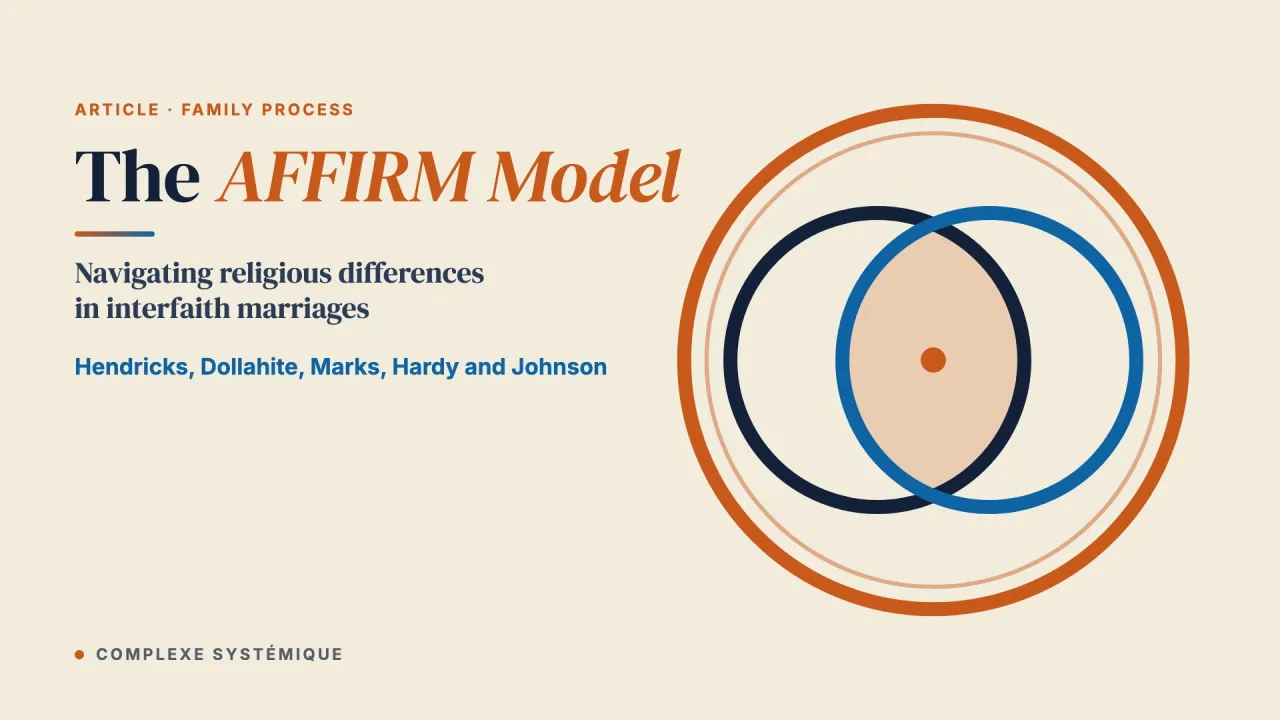
 The AFFIRM Model for Navigating Challenges in Continuously-Interfaith and Divergent-Interfaith Marriages
Thirty happy interfaith couples describe how they navigate their religious differences: five processes, from respecting each other’s choices to religious intimacy, gathered in the AFFIRM model.
 Article
 Toxic, narcissistic, borderline: what therapy speak does to your relationships
Narcissistic, borderline, toxic: therapy speak has left the consulting room. Julien Besse shows how these labels close the debate and relieve us of our own part.
 Article
 Silence in therapy: a polysemic presence
From Heidegger to Palo Alto, silence is not an absence but a message. Defensive, strategic, reflective or shared: its forms, its functions and its risks.
 Article
 Rebuilding trust after infidelity: the 5 behaviours that repair
Infidelity does not doom a couple, but surviving it owes nothing to chance. Five behaviours that restore trust after a betrayal, from a couple therapist’s practice.
Comments 0
Log in to join the discussion. Log in