AI-assisted translation
This version was translated from Italian by Complexe Systémique with the help of artificial intelligence. In case of doubt, the original version prevails.
Connessioni · Body and trauma
Rebuilding the body, re-narrating the Self: a systemic approach to theatre therapy in the treatment of trauma
How can theatre help to rework a trauma that has found no words? Erica Napoli, Donatella De Colle and Andrea Mosconi propose a “systemic theatre therapy” that brings together Salvo Pitruzzella’s dramatherapy, Grotowski’s Poor Theatre and Mosconi’s conversational model. The body becomes the gateway to implicit memories, and the group, through three phases of stage work, a place in which to re-narrate one’s own story.
Unofficial English translation. This article is a translation of Ri-costruire il corpo, ri-narrare il Sé: un approccio sistemico alla teatroterapia nel trattamento del trauma, by Erica Napoli, Donatella De Colle and Andrea Mosconi, published in Connessioni (Centro Milanese di Terapia della Famiglia), “Contributi” section (2026), under a CC BY 4.0 licence. Translated by Complexe Systémique in November 2026 with the help of artificial intelligence: the original Italian text has been translated into English and reformatted, which constitutes a modification of the work under the terms of the licence. The journal text has no subheadings; the two tables are presented as lists, with their titles placed at the top; the figures remain in Italian, with translated captions; quotations are translated from the Italian; titles of works are given as the article cites them, except Bateson’s Mind and Nature, given under its original English title; a few typographical errors have been silently corrected. This translation was made neither by the authors nor by the journal, who are not responsible for its content or for any errors. The original version prevails.
Caring for the body also means caring for the mind.
Erica Napoli, Donatella De Colle, Andrea Mosconi
In psychotherapy and theatre therapy, the work aims to reactivate a person’s expressive and creative potential, which is often compromised by traumatic experiences. Trauma can generate states of inner blockage that hinder access to one’s emotional resources and impair the person’s expressive and symbolic capacities. Therapeutic approaches based on art and on the body seek to overcome these blockages, facilitating emotional regulation and fostering new forms of narration and expression. Every gesture, word or stage movement thus becomes a channel of intersubjective connection, in which healing takes place not only at the individual level but also at the relational level.
Within this framework, the body becomes a fundamental point of access: biography is also embodied (van der Kolk, 2014). Body psychotherapies show how developmental traumas translate into tension, closed postures and altered breathing (Rispoli, 1998). These memories are not always accessible to consciousness, yet they influence how we perceive ourselves and others. Bowlby (1952) observes that posture develops in the earliest interactions, shaping the construction of a bodily Self and affect regulation. Affect regulation depends on early relational patterns which, when dysfunctional, impair access to the emotional world (Bromberg, 2006). Proprioception and interoception are essential for recognizing one’s own internal states and attuning to others (Damasio, 1994), but developmental traumas impair these functions. The traumatized body reacts even to minimal stimuli with intense physiological responses that are not always mediated by consciousness. Effective trauma treatment therefore necessarily requires an approach that attends to the mind-body pair. Caring for the body also means caring for the mind: only by reintegrating somatic and relational experience is it possible to defuse the state of chronic alert and restore continuity to the Self.
Traumatic experience can profoundly impair a person’s ability to access their own creative processes, interfering with the imaginative function and reducing the cognitive and emotional flexibility needed to face the complexity of life. The absence of an imaginative dimension does not only limit access to artistic production; it also compromises the possibility of developing new relational and interpretive modes, reducing the potential for mutual transformation between individual and world (Pitruzzella, 2004). During traumatic flashbacks, the brain mainly activates the right hemisphere, linked to emotions and sensory perceptions, while activity decreases in the left hemisphere, which is responsible for language (van der Kolk, 2014). This makes trauma difficult to put into words, and it often remains stored in implicit form. Art therapy, through non-verbal languages such as form, colour, rhythm and movement, facilitates access to these unnarratable contents and encourages a reflection centred on lived experience rather than on logic. As Laub and Lee (2003) point out, gesture and image can become privileged tools for giving shape and meaning to traumatic experience. In keeping with second-order cybernetics, the therapist is not a neutral observer but takes an active part in co-constructing reality with the patient, through interaction with the artwork and with the creative process itself. The art therapist thus becomes a co-constructor of meaning, a bridge between the inner and the outer world. As Bateson (1984, p. 398) emphasizes, “between us and things as they are there is always a creative filter”: every perception and representation is already interpretation, and within this interpretive space art offers a privileged place for subjectivity and transformation to emerge. Malchiodi (2009, p. 146) observes that “artistic expression can help when trauma is so severe that words are lacking to communicate feelings”. From this perspective, art therapy does not focus on the final product but on the creative process as a sensory, bodily and relational experience that allows the person to access, integrate and transform traumatic experiences through new emotional and cognitive connections.
Following on from the expressive therapeutic languages, theatre therapy represents a development that integrates body, stage and relationship into clinical practice. Psychoanalysis approached the theme of theatricalization through symbolic dynamics such as transference and countertransference, interpreted as unconscious representations of past experiences (Racker, 1968). Freud (1914) describes acting out as a form of dramatization within the therapeutic relationship. Authors such as Bion (1961) showed that symbolic scenarios of conflict also emerge in therapy groups. This is the context of J. L. Moreno’s psychodrama (1946), which values stage action as a therapeutic tool for exploring and reworking emotional experiences, with the therapist guiding the process as a director (Blatner, 2000). Van der Kolk (2014) emphasizes how movement and bodily expression can reactivate and transform implicit traumatic memories.
The aim of this work is to outline a pathway of “Systemic Theatre Therapy”, in which the integration of systemic-relational psychotherapy, Dramatherapy and some principles of Jerzy Grotowski’s “Poor Theatre” (1970) becomes a tool for exploring and enhancing the body as a vehicle of communication and relational transformation. Through stage action and the symbolic dimension of theatre, the group becomes a space for exploration, mirroring and transformation, in which the expressive and performative dimension intertwines with the therapeutic one. In this context, body-based and relational work fosters processes of awareness, resonance and change, both personal and interpersonal, promoting meaningful transformation within each participant’s relational system. For Grotowski, the actor undertakes a process of radical emotional and physical exposure, which can serve as a model for a therapeutic expression centred on corporeality and authenticity. From this perspective, significant resonances emerge between Poor Theatre and systemic-relational psychotherapy: two approaches that pay close attention to relational process, change and transformation. In Poor Theatre, Grotowski emphasizes the circularity between actor and spectator, both of whom are transformed by the interaction, a concept reflected in psychotherapy, where the dynamics between therapist and patient are mutually influential. In both fields, change is a co-constructed process involving the whole system: in the theatrical approach, actors and audience contribute together to the transformation, while in systemic therapy each member of the system, whether family or relational, makes their own contribution to reworking and change. Poor Theatre also promotes experimentation and the deconstruction of conventional models, just as systemic-relational psychotherapy seeks to break rigid relational patterns, fostering new ways of interacting. In both contexts, flexibility and adaptation are crucial: just as theatre adapts to the audience’s reactions, systemic therapy responds dynamically to the patient’s emerging needs.
In the theoretical model of Dramatherapy developed by Salvatore Pitruzzella (2014), which contributes to defining the pathway of “Systemic Theatre Therapy” proposed in this paper, human experience is organized around four fundamental nuclei of aggregation: body, relationships, knowledge and narratives. These elements are not separate compartments but interdependent areas that co-construct one another in a continuous systemic and intersubjective process. Specifically:
- the Body, as a unitary organism, participates fully in rational and emotional decisions. Corporeality, although individual, is built in contact with that of others. In theatre, “the actor’s body is not only the vehicle through which a character takes shape, but also their very organism, a testimony to their history and to their reaching out towards the other”;
- Relationships are the network of meaningful bonds through which identity is defined. Every authentic encounter generates mutual transformation. On stage, the actor constantly explores the relationship between “the other in me” and “the other than me”, distinguishing what engages through similarity or through difference;
- Knowledge concerns what each individual knows about the world, acquired in the social context. Such knowledge forms an internal map of reality. Theatre makes it possible to compare one’s own knowledge with that of the group, making room for “new forms of communication, which help to create new and dynamic knowledge” (Pitruzzella, 2014), often fostering flexibility and curiosity;
- Narratives are the way in which knowledge is structured into stories that give meaning to experience. Pitruzzella and Errico (2012) emphasize that “what matters is to be aware that these are stories, that we can choose to tell them as we wish, also allowing ourselves the possibility of transforming them”. The theatrical space allows these narratives to be rewritten through alternative, non-judgemental languages.
From this perspective, roles are the behavioural models we take on and perform in relation to the world and to others. They can be experienced as masks or as intentional constructions, sometimes rigid, sometimes flexible, used to express or to cover parts of ourselves. They are deeply intersubjective constructions, modelled on the other, and every role needs its counter-role in order to exist and to express itself fully in the relationship.
In their systematization of the Systemic Quadrilateral, Mosconi et al. (2013; 2014) offer a perspective centred on communicative and relational processes that makes it possible to integrate different therapeutic views and to develop a more articulated understanding of the Self and of the issues bound up with its construction. The Quadrilateral is a useful operational tool, since it allows information about the problem to be organized on four distinct and coherent logical levels that describe human interactions: Narration, Person, Communication, Relationships. This structure allows an integrated reading of models of mind and methodologies, highlighting the complementarity of the approaches: psychoanalytic (ego and defences), cognitivist (internal working models) and systemic (relational identity). Their complementarity in the process of identity construction becomes easier to understand if we use the scale between form and process proposed by Bateson in Mind and Nature (1979), which we present in Figure 1.
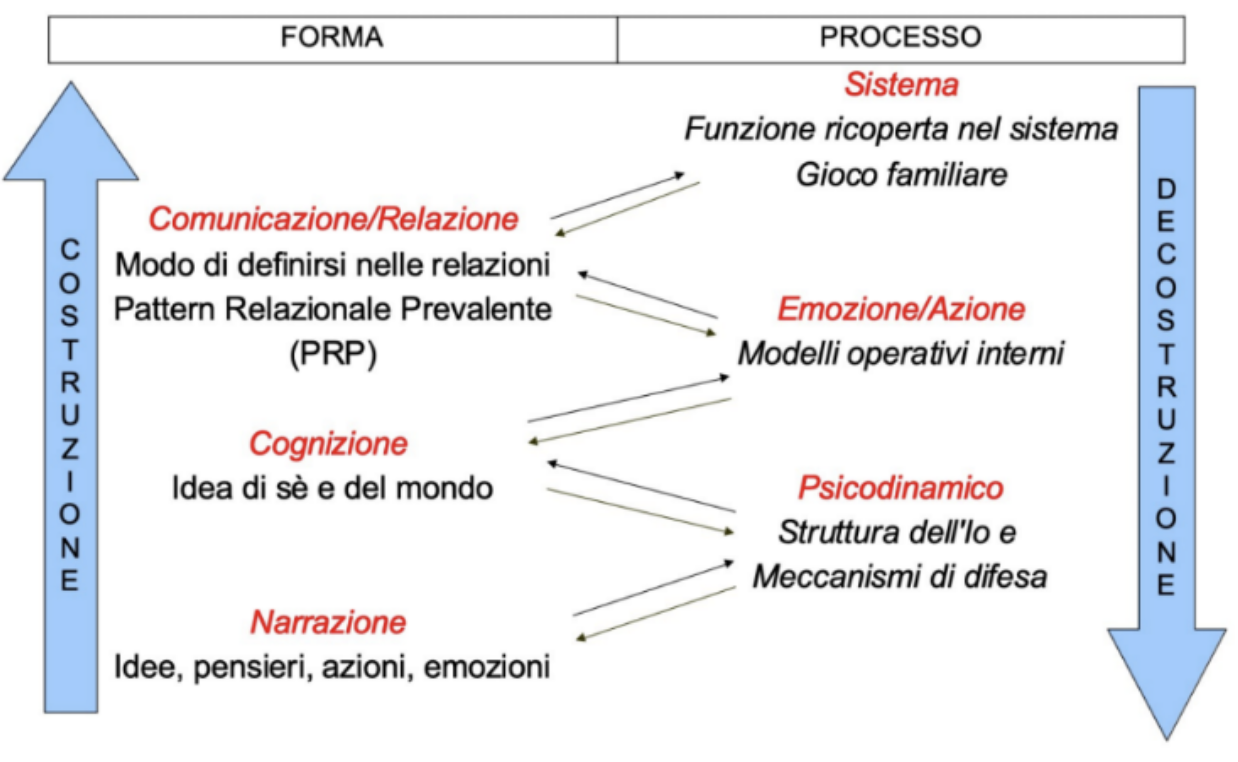
In this sense, we present an integration of the levels of construction of the Self (Mosconi et al., 2013; Mosconi, 2014) and the nuclei of aggregation, which places the role of the body at the centre, as shown graphically in Figure 2 below:
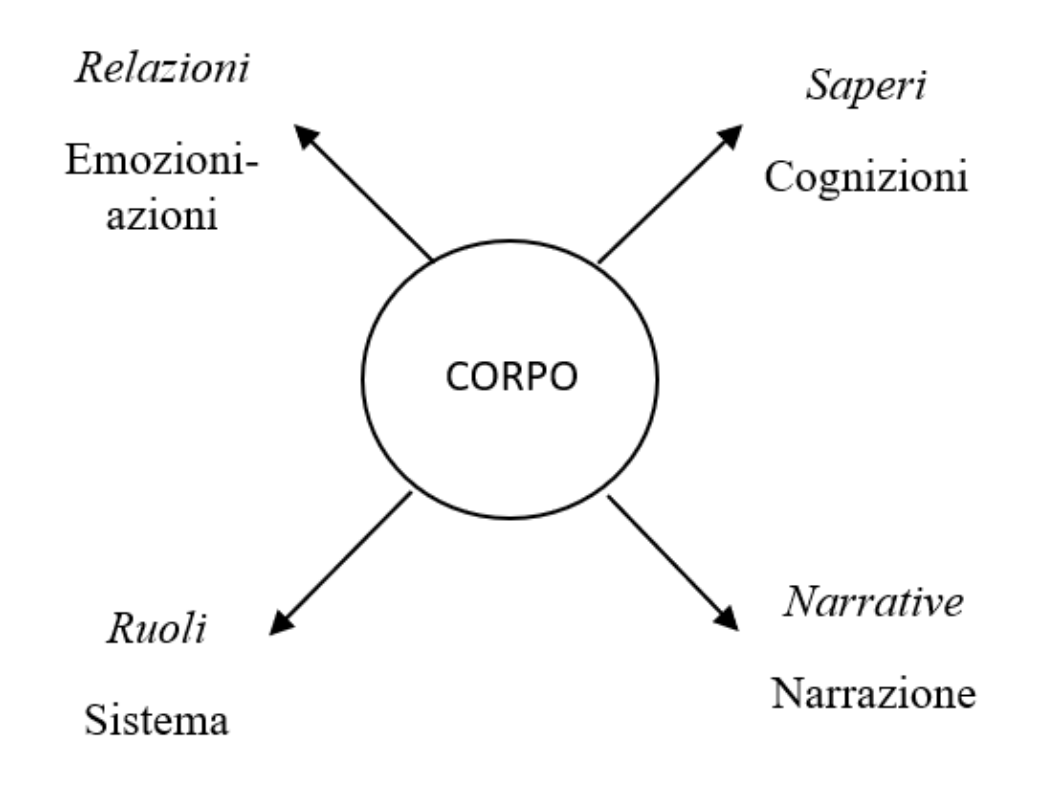
The integration between these levels takes place within an intersubjective process in which the body acts as mediator and container of transformative experiences. The nuclei of identity form and change over time, in a relational dynamic in which identity is not a stable entity but rather “a snapshot of the state of the system at a given moment, which we tend to extend into the temporal dimension” (Pitruzzella, 2014, p. 69).
From a systemic point of view, all the elements influence one another in a continuous movement of feedback and calibration. As Bateson (1988) states, feedback allows the system to adapt to new events, while calibration allows an overall reorganization in response to change. Theatrical action makes these processes visible and workable, staging, on both the inner and the outer plane, the dynamics between body, relationships, knowledge and narratives.
By integrating these principles, theatre therapy applies psychotherapeutic reflexivity, using conversational and expressive techniques to promote deep change, particularly in the treatment of trauma, where the group and the therapist work together to rebuild a sense of belonging and to foster reworking in a safe and transformative context.
Building on these theoretical affinities, it is possible to outline a theatre therapy pathway structured in progressive phases, integrating Salvo Pitruzzella’s dramatherapy (2014), Jerzy Grotowski’s Poor Theatre approach (1970) and the fundamental principles of systemic conversation (Mosconi, 1992, 1993; Mosconi et al., 1996; Mosconi & Trotta, 2022). Theatre therapy work is generally organized in three phases (Moreno, 1946): pre-expressive (warm-up), expressive (dramatization) and post-expressive (sharing). This methodological structure is a shared framework in the field of theatre therapy, as it fosters the person’s exploration, expression and emotional processing through the creative and relational process of theatre.
In this paper, these phases are reinterpreted in the light of the integration of the models indicated above, with an emphasis on the processual and transformative character of the theatrical experience. We describe the phases below.
- The pre-expressive phase, corresponding to the Foundation Phase of the dramatherapy process, is centred on the body and the voice as primary instruments of awareness and of contact with the Self. In this phase there is no predefined representational content: participants freely explore personal associations, memories and needs, in a protected context that stimulates unusual forms of mentalization and deep bodily listening. The facilitator takes a participatory, non-directive position, facilitating the process of individual discovery rather than steering it towards predetermined goals. The intent is not the display of specific emotions but the removal of the obstacles that limit spontaneity and authentic response. As Grotowski (1970) emphasizes, theatrical work involves a “negative” process aimed at identifying and dissolving the resistances that prevent access to the “total act”, capable of engaging all of the individual’s psychophysical resources. This phase fosters the activation of creativity, the strengthening of personal resources and openness to new possibilities of learning and relating.
- The expressive phase, corresponding to the Creation Phase of the dramatherapy process, is the natural evolution of the pathway. It focuses on building the character and on dramatization, which emerge progressively through psychophysical, symbolic and emotional exploration. The character is not conceived as a predefined entity but as a dynamic structure that takes shape in the dialogue between the imaginative dimension, subjective experiences and the relationship. The therapist plays an active role, guiding each participant in discovering individual modes of expression and suggesting new paths to explore, according to each person’s needs and capacities. The group setting, founded on mutual listening and acceptance, is a space of narrative co-construction, in which improvisation and shared creation take on transformative value.
- The post-expressive phase, corresponding to the Sharing Phase of the dramatherapy process, is the closing moment, in which the contents that have emerged are recapitulated and space opens up for reflection and sharing. It is the moment after the staging, in which the group returns to the domain of words, to the construction of meaning after having passed through action. It is the moment in which members discuss the meaning of what came up in the first two phases and rework what has emerged, valuing the individuality of each person within the collective.
In the light of the theoretical premises set out above, this paper offers a reflection on the possible dialogue between theatre therapy and the systemic-relational approach, highlighting their points of contact and clinical potential. The Systemic-Relational model, as proposed by Mosconi (1992, 1993; Mosconi et al., 1996; Mosconi & Trotta, 2022), offers a clear and articulated structure of the therapeutic process, divided into phases and precise goals, which guide the intervention and facilitate the reworking of subjective experiences. We present it again in Table 1.
Table 1 — Phases of the Therapeutic Process (Mosconi & Trotta, 2022)
- 1) CONTACT phase. Goal A, connection with the client(s). Actions: welcoming and listening; therapeutic relationship and rapport; identifying the client’s “key words” and typical gestures; observing the level of suffering.
- 2) Phase of WIDENING THE FIELD OF PERCEPTION AND INFERENCE, DECONSOLIDATION OF MEMORIES and BUILDING AREAS OF CONSENSUS. Goals B, C and D. Actions: use of the Relational Record. B) Deconstruction of the problem. Actions and sub-goals: contextualization, historicization, pragmatic effects, typical situations, in-depth observation of the client, ego-syntonia or ego-dystonia. C) Wider contextualization. Actions and sub-goals: previous events, premises, myths. Sub-themes: three-generational history, characters and relationships, their hypotheses, non-verbal behaviour. Use of the Systemic Quadrilateral to build a plausible Systemic Hypothesis. D) Inclusion of elements not seen by the client(s). Actions and sub-goals: activating the reflexive position. Sub-themes: symmetrical relationships, unresolved conflicts, incongruities, alliances and coalitions, disqualifications or disconfirmations present in the system.
- 3) Phase of REDEFINING THE PROBLEM, or of RESTRUCTURING and RECONSOLIDATION OF MEMORIES. Goal E, new hypothesis or description of the facts. Actions and sub-goals: redefining the client’s premises; a description that can be shared but is founded on incompatible premises; making the difference; closing the session.
By integrating this approach with the expressive and symbolic techniques of theatre, the ways of accessing implicit memories and relational dynamics are widened, creating a transformative space that unites body, emotions and narrative. Below we present a systematization of the theatre therapy process in a systemic key, following the three phases and five goals described above:
- CONTACT phase, Goal A) Connection with the patient(s): this corresponds to the pre-expressive phase of the pathway. As in the psychotherapeutic process, the focus is on developing trust and on affect regulation. Participants are invited to express the motivations that brought them to the group, through symbolic activities that facilitate access to personal experiences (e.g. stage objects representing “weights” and “levers”). The therapist carefully observes the level of activation, verbal and non-verbal language and the quality of the interaction, ensuring that relational boundaries are respected. The fundamental goal is to keep people within their window of tolerance; this fosters the creation of a sense of trust, a fundamental prerequisite for receptive learning.
- Phase 2 of WIDENING THE FIELD OF PERCEPTION AND INFERENCE AND BUILDING AREAS OF CONSENSUS, Goal B) Deconstruction of the problem: in this pre-expressive phase, participants are invited to explore bodily and vocal modes of expression with no performative purpose, with the aim of widening relational and narrative possibilities within the group.
From a neurobiological point of view, body and voice are privileged channels for accessing implicit and autobiographical memories, involving fundamental brain structures such as the hippocampus and the limbic cortex. The hippocampus, in particular, acts as a synthesizer of experience; recalling a memory opens it to the possibility of re-encoding, that is, of transformation and integration. This is a crucial step, because traumatic events and prolonged stress can impair this integrative function through excessive cortisol production. However, the group context and the modes of expression typical of theatre create a corrective space in which implicit memory can connect to new narratives, thus fostering the reworking and transformation of experience. A practical example is the gesture echo exercise: each participant proposes a movement or a sound that the group mirrors in chorus, generating resonance and amplification. This mirroring makes it possible to recognize oneself through the other, widening the emotional window of tolerance and promoting awareness and affective modulation. A second moment of the exercise follows: the transformation of the gesture. Each participant adds a personal element to the other’s gesture, generating a creative co-construction. This transformation marks the first exposure to difference and opens up new expressive possibilities, breaking the rigidity of habitual relational scripts. The variety of contributions reflects the multiplicity of stories present in the group, promoting a first step towards differentiation and openness to new narratives. - Phase 2 – Goal C) Wider contextualization: this phase coincides with the expressive moment of the theatrical pathway; starting from the contents that have emerged and the narratives brought by participants, a process of deconstruction and decoding of the Coordinated System of Narratives (CSN) is supported, that is, an integrated set of thoughts, words, actions and emotions which, in their structure, bear witness to the work of coordination carried out over time within significant relationships and which continues to operate in the present moment of interaction (Mosconi, 2014). To support this movement towards a widening of the perceptual and narrative field, each participant is invited to make their own coat of arms (Caillé, 2005). The coats of arms are placed at the centre of the circle, and the mottoes (lessons learned that are of little use in the present) are staged by the participant through a gesture, a sound or a short theatrical improvisation. In this representational phase, the participant is invited to take up the stage object chosen at the beginning of the pathway and to connect it again: what was first perceived as an obstacle takes on meaning within a wider frame, linking up with relational dynamics, belongings and myths. Next, the other members of the group are invited to recognize themselves in an element of another person’s coat of arms and to represent it, offering a bodily and emotional mirroring that enriches and relaunches the original meaning. This act introduces a moment of resonance and differentiation: through similarities, it becomes possible to experience oneself as different from the other, since each person has developed different strategies for differentiating.
- Phase 2 – Goal D) Inclusion of unseen elements: this phase opens with a shared reflection on the previous expressive activities, in particular the representations that emerged in the coat-of-arms work and in the symbolic exchanges of the group. The therapist invites participants to tune in to the stories that resonated most, asking questions that activate the reflexive position with respect to their own story. Through this movement, the group comes into contact with the implicit premises and myths that structure individual narratives. At this point, the therapist helps participants to identify, starting from that significant scene or narrative, the most relevant problem it brings to the fore, fostering a first level of shared redefinition. From here, a work of theatrical improvisation begins: the group is invited to imagine and stage, through dramatic co-creation, different possible ways of handling that situation, with particular attention to communicative exchanges, to the subjective position and to the relational dynamics activated. The goal is not to find “the right solution” but to widen the field of possibilities, questioning rigid scripts and univocal stories. This process allows the participant to see and feel their own relational script mirrored, transformed, multiplied. The group’s responses, divergent and sometimes unexpected, function as perturbative interventions, fostering a gap between inner narrative and outer representation and generating a shift in meaning. The group thus becomes a protected context of “relational recapitulation” (Yalom, 2022), in which roles and responses different from the habitual ones can be explored, questioning the rigidity of one’s own relational functioning. In this space it is possible to experience the inclusion of unseen elements, and to recognize and deconstruct symmetrical or complementary dynamics, alliances, disqualifications, positions and roles that often operate below the level of awareness. Thanks to the therapist’s guidance and the containing frame of the setting, limbic activations remain modulable and manageable, and theatrical language makes it possible to transform intense experiences into representable material, supporting the widening of the window of tolerance. In this phase, the theatrical metaphor continues to act as a bridge between the Self that acts and the Self that experiences, facilitating a transformation of the initial premises and initiating a movement of integration that makes possible the shared redefinition of the problem on broader, more complex narrative foundations that are more useful to the participant’s current life cycle.
- Phase 3 – REDEFINING THE PROBLEM or RESTRUCTURING and RECONSOLIDATION OF MEMORIES, Goal E) New hypothesis or description of the facts: in this post-expressive phase, space is given to reworking what has been experienced and represented during the pathway. Within the group, an opportunity arises for recalling and re-narrating past experiences (see Goal C) in a protected and shared context. During theatrical work, relational patterns learned in the primary contexts of life are reactivated (consciously and implicitly), and every member of the group (including the therapist) may find themselves unwittingly taking on roles that belonged to that original “scene”. However, the distinctive feature of the therapeutic group and of theatrical language lies in the possibility of experimenting with new configurations and roles, exploring alternative perspectives. By way of example, in this final phase a closing activity can be proposed that symbolically recalls the pathway completed: each person is asked to reflect on the object identified at the beginning (Goals A and C) and to compare it with their present state, to see whether that image still matches how they feel or whether it has changed. Then the group forms a circle and, one at a time, each participant enters the space at the centre of the circle to stage a brief moment in which they can replace, complete or modify the initial object, so as to represent the change or transformation experienced during the pathway. This gesture, simple yet charged with meaning, makes inner change concrete, showing whether the starting premises have shifted from a rigid and exclusionary view (“either… or”) to a broader one, open to possibilities and capable of creating greater freedom (“both… and”). In this way, personal and collective recognition of the pathway completed and of the new perspective acquired is fostered. The single, crystallized narrative can thus open up to multiple meanings, recognizing that every experience can be read from different points of view, depending on the relationships and the context present. This process fosters a gradual re-narration, recall and reactivation of past experiences (Tirelli, Mosconi, & Gonzo, 2016). Within the new relationships established in the group, relational patterns learned in primary contexts tend to be reactivated. However, the collective dimension and theatrical language offer the possibility of exploring alternative ways of being in relationship and of attributing new meanings to experiences. The original configuration can thus be recognized as belonging to the past, while the group becomes a safe training ground in which to co-construct different narratives that are more useful at that moment of the life cycle and in the context in which the person lives.
Theatrical work facilitates the transformation of traumatic experience from a fragmented, unprocessable experience into a coherent and flexible narrative, reactivating the dialogue between the limbic system (seat of implicit and emotional memories) and the prefrontal cortex (responsible for regulation, reflection and the attribution of meaning). Through the symbolic and bodily language of theatre, emotional memories become representable and therefore processable. In this process the group plays a central role: it offers affective containment that keeps activation within the window of tolerance, and at the same time it exposes to difference, making new perspectives and narrative possibilities accessible. Integration therefore takes place not only at the individual level but also at the relational and systemic levels, thanks to a context that supports and multiplies meaning.
To return to Pitruzzella’s theorizations (2014): the creative process activated in theatre therapy mobilizes skills that are often latent in everyday life but fundamental for restructuring subjective and relational experience. Among the key functions activated are:
– imagination, not only as the capacity to generate worlds that are alternatives to perceived reality, but above all as a resource for breaking down and rebuilding one’s own narrative. This fosters a redefinition of the traumatized identity;
– inner listening: the capacity to get in touch with one’s own emotional and sensory world, often dissociated in traumatized people;
– spontaneity, which allows immediate and authentic expressive responses, countering the rigidities and defences typical of traumatic structures;
– productivity, as an orientation towards transformative action and the co-construction of new meanings in a shared relational context.
Theatre therapy fosters inner listening through attunement to oneself and to one’s own emotional world, allowing spontaneity to be rediscovered through body work and improvisation. It stimulates imagination through the construction of roles, characters and scenes, and supports the capacity to plan, expressed in building and sharing the performance. As in the conversational systemic process, theatre therapy sessions are fertile ground for the deconsolidation of traumatic or rigid memories, fostering their regeneration through bodily, symbolic and relational experience. The elements to be transformed come directly from the person: each person brings their own body, knowledge, relationships, roles, stories, myths and possibilities. Identity is set in motion, traversed and reworked on stage.
The climate of acceptance and attunement created in the group is essential: there is no need to make the themes explicit in an analytical or verbal way, as often happens in dialogic therapy. In theatre therapy, contents emerge implicitly: parts of the Self become living material for dramatic construction, and creative stimuli arise from play, mirroring and relationship. The stage makes it possible to explore other ways of perceiving the world, to play different roles, to see oneself from new points of view, thus fostering the reconsolidation of transformed memories. In this way, theatre therapy not only offers a creative space but also becomes an effective clinical device for reintegrating dissociated memories and facilitating the narrative reorganization of the Self. As in the conversational systemic process, theatre therapy sessions become a ground for the deconsolidation of memories. Each person brings the richness of their own body, knowledge, relationships, roles and narratives. Each brings what they are, what they have been and what they could become.
In Phase 1, Goal A of the therapeutic process, each individual offers their initial representations of the Self. These find space and acceptance in the group. They may be representations that are not always faithful, or even misleading, but they represent the creative adaptation possible at that moment of the individual’s history. The different parts of the Self become sources to draw on in building the dramatic act, while the creative elements, which correspond to the widening phases, emerge through various kinds of mirroring and co-construction. This allows the discovery of new ways of perceiving the world, of expressing oneself, of playing with one’s own roles and of developing new points of view on one’s own narratives. The group, conceived as a clinical device and as a complex relational system, is not only a space for mirroring but a genuine transformative field. Interactions among members generate dynamics of emotional resonance, affective co-regulation and decentring of point of view, which foster the rereading and reworking of their narratives and identities. From this perspective, the group takes on the characteristics of a “plural mind” (Kaës, 2007) or of an extended relational mind (Siegel, 2012): an inter-psychic system in which the boundaries between Self and other become more porous, allowing new meanings, alliances and co-constructed processes of transformation to emerge. It is precisely within the network of connections that group thinking is activated, capable of supporting change and opening up new developmental trajectories. This transformative dimension of the group finds its natural development in the phase of restructuring and redefining the problem (Goal E). The relational and symbolic dynamics activated in the theatrical process prepare the ground for the possibility of re-narrating experiences, exploring new meanings and experimenting with roles other than those learned in the past and of little use in the present. The group thus becomes both the container and the catalyst of this transformation, offering a space in which earlier narratives can be deconstructed and reorganized in the light of a new relational plot. The link between these therapeutic phases is shown in the passage from the implicit expression of bodily and relational memories to the explicit possibility of redefining one’s own story, supported by a group space that makes change visible and livable. Table 2 summarizes the parallel between the PTS/CSPSP processes and Systemic Theatre Therapy.
Table 2 — Comparison between the PTS/CSPSP model (Mosconi & Trotta, 2022) and the proposal of Systemic Theatre Therapy developed in this paper
- Phase 1. Systemic Therapeutic Process (PTS): CONTACT phase. Systemic Theatre Therapy (TTS): PRE-EXPRESSIVE phase.
- Goal A. PTS, connection with the client(s). Actions: welcoming and listening; therapeutic relationship and rapport; defining the problem; observing the level of suffering (N.B. ego-syntonia, ego-dystonia, dissociation). TTS, connection with the participants. Actions/activities: building a safe and containing relational setting; defining the problem; activating the narrative level through non-verbal symbolization, observing the possibilities of expression (movement/voice), monitoring access to narration and the tolerability of the experiences evoked.
- Phase 2. PTS: phase of WIDENING THE FIELD OF PERCEPTION AND INFERENCE, DECONSOLIDATION OF MEMORIES and BUILDING AREAS OF CONSENSUS; Goals B, C and D; actions: use of the Relational Record. TTS: same phase, EXPRESSIVE PHASE; Goals B, C and D; actions: use of the group as an amplifier of the perceptual field.
- Goal B. PTS, deconstruction of the problem. Actions and sub-goals: history, typical situations, pragmatic effects, effects of attempted solutions, Self/problem relationship (distance from the relational hypothesis). TTS, initial widening. Actions and sub-goals: free exploration of voice and spontaneous movement; activating the body as a channel of access to implicit memories and non-verbal narratives; mirroring and co-creation; facilitating a first reflection on emerging communicative sequences and relational patterns.
- Goal C. PTS, wider contextualization. Actions and sub-goals: three-generational history, characters and relationships, events preceding the problem, premises, myths, identification of relational sequences connected to the problem, their hypotheses, non-verbal behaviour; use of the Systemic Quadrilateral to build a plausible Systemic Hypothesis. TTS, wider contextualization. Supporting the process of deconstructing personal and family narratives, integrating them into a broader relational frame; awareness of myths, roles and belongings; facilitating mutual resonance and intersubjective differentiation within the group; use of experiential techniques (coat of arms).
- Goal D. PTS, inclusion of elements not seen by the client(s). Actions and sub-goals: highlighting unseen situations in the family game (symmetry, unresolved conflicts, previous events, pragmatic effects), recalling emotions, choice of symptom, activating the reflexive position. TTS, inclusion of unseen elements. Activating reflexive capacity through the exploration of narrative and relational elements not previously seen; contact with new meanings; a multiplicity of points of view that questions rigid premises; the group as a protected space for working through and transforming stories and relational patterns.
- Phase 3. PTS: phase of REDEFINING THE PROBLEM or of RESTRUCTURING AND RECONSOLIDATION OF MEMORIES. TTS: same phase, POST-EXPRESSIVE phase.
- Goal E. PTS, new hypothesis or description of the facts. Actions and sub-goals: redefining the client’s premises; a description that can be shared but is founded on incompatible premises; making a difference; closing the session. TTS, narrative reformulation and representation of change. A plausible and contrasting description; fostering re-narration and personal transformation through new attributions of meanings and roles; consolidating change in a more flexible and integrated narrative; closing.
The declared fiction of the theatrical “as if” leaves people freer to experience new sensations, often otherwise inaccessible to those who have lived through trauma. For many people, in fact, closeness and affection can be frightening, activating deep memories linked to vulnerability and pain (van der Kolk, 2014; Siegel, 2012). In theatrical play, the explicit metacommunicative frame makes it possible to explore such experiences without being entirely caught up in them, creating a protected yet deeply transformative space. In this “safe” distance it is possible to pass through complex emotions and to try out new relational forms, such as living complementary or more symmetrical relationships, in a context that supports experimentation without threat.
In the context of theatre as a therapeutic process, we can recall Bateson’s concept of play as mimesis, in which imitation is not confused with reality but consciously represents its difference. “If this is play”, as Bateson (1996) states, then one is not fighting but not-fighting: a separation is thus created between the imitative action and the original model. It is precisely this distance that makes second-order learning (deutero-learning) possible: experiences are not only lived but also observed, transformed and reworked. Through the language of the body and of the stage, the person can rewrite their own story, inhabit new meanings and experiment with alternative forms of Self and of being in the world.
Complexe Systémique: key points
The article has the merit of giving body, quite literally, to an intuition often left at the level of theory: a trauma that has found no words can be worked through gesture, the stage and the gaze of the group. Its strength lies in translating Mosconi’s therapeutic process, contact, widening, redefinition, step by step into precise exercises: the echo and then the transformation of a gesture, the coat of arms whose motto is acted out, the opening object replaced or modified at the end. The theatrical “as if” recovers its Batesonian function as a metacommunicative frame, which makes it possible to approach closeness and affection without threat. The neurobiological supports (hippocampus, cortisol, hemispheres) are put forward as self-evident and call for more caution, and there is no clinical vignette or data on the groups conducted: the proposal remains a model to be tested. For practice, the text is a reminder that the therapist is also caught up in the roles of the original “scene”, and that the window of tolerance must be held before widening. Read alongside Bernard Filleul’s case for the body in therapy, and the presentation of the family coat of arms.
References
Anderson, H.; Goolishian, H. (1992), The client is the expert: A not-knowing approach to therapy , in McNamee, S. & Gergen, K. J. (eds.), Therapy as Social Construction, pp. 25-39, London, Sage.
Bateson, G. (1972), Steps to an Ecology of Mind, San Francisco, Chandler Publishing Company.
Bateson, G. (1979), Mind and nature: A necessary unity, New York, Dutton.
Bateson, G. (1996), Questo è un gioco. Perché non si può mai dire a qualcuno “gioca!”, Milano, Raffaello Cortina Editore.
Bion, W. R. (1961), Experiences in Groups, London, Tavistock Publications.
Blatner, A. (2000), Foundations of Psychodrama: History, Theory and Practice, New York, Springer.
Bowlby, J. (1999), Attaccamento e Perdita, Torino, Bollati Boringhieri.
Bowlby, J.; Robertson, J.; Rosenbluth, D. (1952), “A Two-Year-Old Goes to the Hospital”, The Psychoanalytic Study of the Child, 7(1), 82-94.
Bromberg, P. M. (2006), “The Shadow of the Tsunami: A Psychodynamic Perspective on the Tsunami and Its Aftermath”, The Journal of the American Psychoanalytic Association, 54(2), 367-393.
Caillé, P.; Rey, Y. (2005), Gli oggetti fluttuanti. Metodi di interviste sistemiche, Roma, Armando Editore.
Damasio, A. R. (1994), Descartes’ Error: Emotion, Reason, and the Human Brain, New York, G. P Putnam’s Sons.
Freud, S. (1914), Erinnern, Wiederholen und Durcharbeiten, Wien, Internationaler Psychoanalytischer Verlag.
Giannantonio, M. (2013), Trauma, attaccamento e sessualità, Psicoterapia integrata-corporea e bodywork per le ferite invisibili, Milano, Mimesis.
Grotowski, J. (1970), Per un teatro povero (prefazione di P. Brook; trad. M. O. Marotti), Roma, Bulzoni.
Kaës, R. (2007), Un singolare plurale. Quali aspetti dell’approccio psicoanalitico de i gruppi riguardano gli psicoanalisti?, Torino, Borla.
Laub, D.; Lee, N. C. (2003), “Thanatos and massive psychic trauma: The impact of the death instinct on knowing, remembering, and forgetting”, Journal of American Psychoanalytic Association, 51(2), 433-464.
Malchiodi, C. A. (2009), Arteterapia. L’arte che cura, Firenze, Gruppo Editoriale Giunti.
McNamee, S.; Gergen, K. J. (eds.) (1992), Therapy as Social Construction, London, Sage.
Moreno, J. L. (1946), Psychodrama, Volume 1, New York, Beacon House.
Mosconi, A. (1992), “Livelli e strategie della conservazione terapeutica: Alcune considerazioni generali”, Psichiatria Generale e dell’Età Evolutiva, 1, 183-197.
Mosconi, A. (1993), “Alcuni spunti per un dibattito sui livelli e le strategie della conversazione terapeutica”, Psicobiettivo, 2, 53-60.
Mosconi, A. (2014), Identità ed Identità Sistemica, in Mosconi, A.; Pezzolo, M.; Racerro, G. (a cura di), Identità Sistemiche, p. 86, UltimaBooks.
Mosconi, A. (2022), “Un modello generale per la comprensione e l’integrazione dei Processi di Cambiamento in Psicoterapia: 10 concetti ed 8 conclusioni”, Relazione presentata al CSAPR di Prato, 1 gennaio 2022.
Mosconi, A.; Castellani, A.; De Maria, L.; Gonzo, M.; Sorgato, R.; Tirelli, M.; Tomas, M.; Zago, E. (1996), “Come costruisci la tua conversazione terapeutica? Breve glossario degli interventi in terapia sistemica e alcune considerazioni sulla possibilità di utilizzo”, Terapia Familiare, 50, 25-41.
Mosconi, A.; Tirelli, M.; Neglia, V. (2013), “Il Quadrilatero Sistemico: Una Storia Per Narrare Altre Storie: Il caso di una supervisione sistemica in un Day Hospital Territoriale”, Terapia Familiare, 101, 67-92.
Mosconi, A.; Trotta, B. (2022), Manualizing the therapeutic process in systemic therapy from the construction of the hypothesis to the assessment of change, in Mariotti, M.; Saba, G.; Stratton, P. (Eds.), Handbook of systemic approaches to psychotherapy manuals, pp. 101–122), Berlin, Springer.
Mosconi, A.; Trotta, B. (2025), I vantaggi della manualizzazione nella integrazione delle narrazioni terapeutiche: un protocollo di integrazione tra Terapia Sistemica ed Emdr, in Mariotti, M.; Loriedo, C.; Saba, G.; Sluzki, C.; Stratton, P. (eds), Evidenze e creatività in psicoterapia sistemica e relazionale, pp. 546-613, Milano, Franco Angeli.
Pitruzzella, S. (2014), La drammaterapia nella formazione e nella cura, Milano, Franco Angeli.
Pitruzzella, S. (2015), Creatività e apprendimento: Teorie e pratiche, Milano, Franco Angeli.
Pitruzzella, S.; Errico, G. (2012), Manuale di narrazione creativa. Con 50 schede e un giocherello per inventare storie ed esplorare l’immaginario fiabesco, Milano, Franco Angeli.
Racker, H. (1968), Transference and Countertransference, London, Hogarth Press.
Rispoli, L. (1998), La psicoterapia corporea e il suo sviluppo funzionale, in Cionini, L. (Ed.), Psicoterapie: Modelli a confronto, Roma, Carocci.
Selvini Palazzoli, M.; Boscolo, L.; Cecchin, G.; Prata, G. (1980), “Hypothesizing – circularity – neutrality. Three guidelines for the conductor of the session”, Family Process, 19, 73-85.
Shapiro, F. (2019), EMDR. Il manuale. Principi fondamentali, protocolli e procedure. Nuova edizione, Milano, Raffaello Cortina Editore.
Siegel, D. J. (1999), The developing mind: How relationships and the brain interact to shape who we are, New York, Guilford Press.
Siegel, D. J. (2010), Mindsight: The New Science of Personal Transformation, New York, Bantam Books.
Tirelli, M.; Mosconi, A.; Gonzo, M. (2016), Manuale di Psicoterapia Sistemica di Gruppo, Milano, Franco Angeli.
Van der Kolk, B. A. (2014), The body keeps the score: Brain, mind, and body in the healing of trauma, New York, NY, Viking.
Watzlawick, P.; Beavin, J. H.; Jackson, D. D. (1967), Pragmatics of human communication, New York, W. W. Norton; Company.
Wynne, L. (1984), “The epigenesis of relational systems: A model for understanding family development”, Family Process, 23, 297-318.
Yalom, I. D.; Leszcz, M. (2022), Teoria e pratica della psicoterapia di gruppo, Torino, Bollati Boringhieri.
Unofficial English translation of Ri-costruire il corpo, ri-narrare il Sé: un approccio sistemico alla teatroterapia nel trattamento del trauma, by Erica Napoli, Donatella De Colle and Andrea Mosconi, Connessioni, “Contributi” section (2026), under a CC BY 4.0 licence. Translation (with the help of artificial intelligence) and layout: Complexe Systémique, November 2026 — the work has been modified under the terms of the licence (tables presented as lists, figure captions translated). Neither the authors nor the journal are responsible for this translation; the original version prevails.
Unofficial English translation of “Ri-costruire il corpo, ri-narrare il Sé: un approccio sistemico alla teatroterapia nel trattamento del trauma”, published in Connessioni (2026) under a CC BY 4.0 licence. Made by Complexe Systémique with the help of artificial intelligence, it does not come from the authors or the journal, who are not responsible for its content; the original version prevails.
Read the original articleHow to cite this article
Napoli, E., De Colle, D., et Mosconi, A. (2026). Rebuilding the body, re-narrating the Self: a systemic approach to theatre therapy in the treatment of trauma (Complexe Systémique, Trans.). Complexe Systémique. https://app.complexe-systemique.com/en_GB/articles/rebuilding-the-body-re-narrating-the-self-a-systemic-approach-to-theatre-therapy (Original work published in 2026 in Connessioni, sezione «Contributi» (2026); republished in 2026 by Connessioni, https://connessioni.cmtf.it/ri-costruire-il-corpo-ri-narrare-il-se-un-approccio-sistemico-alla-teatroterapia-nel-trattamento-del-trauma/)
To go further
- Never underestimate the role of the body in therapy — Bernard FilleulThe body as a resource in therapy.
- Floating objects in systemic therapy: the family coat of armsThe coat of arms, a floating object.
- Therapy without talking: possible?Sculpting, beyond words.
Related articles
 Scientific
The Role of Parental Expressed Emotion and Loss-Specific Parental Responses in Children’s Loss-Related Outcomes Following Traumatic Loss: A Mixed-Methods Observational Study
After a road-traffic bereavement, parental criticism goes with the child's depression, positive appraisals of the loss with better well-being.
 Scientific
How Venezuelan mothers and their young children use storytelling to process immigration journeys
Seven Venezuelan mothers tell their young children about crossing the Darién: shared memories or superhero tales, six ways of facing fear together.
 Scientific
Collaborative Polyphonic Writing as Therapeutic Practice: A Longitudinal Case Study
A patient and her therapist co-write her autobiography: the psychiatric diagnosis becomes one voice among others, coordinated by an “I as a writer”.
 Scientific
Parenting after critical illness: a biopsychosocial review of post-intensive care syndrome, family systems, and child outcomes
After post-intensive care syndrome, parenting falters, the co-parent is worn down and children help in silence. A biopsychosocial review proposes how to spot them.
Comments 0
Log in to join the discussion. Log in