Family Relations · Family
Self‐Differentiation and Mentalization in Couple Adjustment: An Actor–Partner Mediation Model
Does being able to remain oneself within the bond help one think about the other’s mind, and does the couple fare better for it? With 158 couples in Turkey, Buket Ünver shows that self-differentiation goes hand in hand with mentalization, which in turn accompanies better dyadic adjustment, even in the other partner.
This is a reformatted republication of Self‐Differentiation and Mentalization in Couple Adjustment: An Actor–Partner Mediation Model, by Buket Ünver, published in Family Relations (Wiley) (2026), doi: 10.1111/fare.70273, under a CC BY 4.0 licence. Prepared by Complexe Systémique in September 2026: the authors’ text is unchanged; the layout has been adapted for reading online, which constitutes a modification of the work under the terms of the licence. Tables are presented as lists; the online supporting information is not reproduced. This edition was made neither by the authors nor by the publisher, who are not responsible for its content or for any errors. The original version prevails.
Self-differentiation is not the absence of closeness but the capacity to remain emotionally connected without excessive fusion.
Buket Ünver
Abstract
Objective. To examine whether mentalization mediates the association between self-differentiation and dyadic adjustment in couples using a dyadic model.
Background. Self-differentiation (balancing intimacy and autonomy) and mentalization (understanding one's own and others' mental states) are both linked to relationship functioning, yet their combined contribution to couple adjustment has rarely been tested at the dyadic level.
Method. One hundred fifty-eight heterosexual couples from Turkey completed self-report measures of self-differentiation, mentalization, and dyadic adjustment. An actor–partner interdependence mediation model (APIMeM) was estimated to examine actor and partner pathways simultaneously.
Results. Higher self-differentiation was associated with greater mentalization for both women and men, and greater mentalization was associated with better dyadic adjustment. Modest but significant partner effects indicated that one partner's mentalization was positively associated with the other partner's dyadic adjustment. Cross-partner associations between self-differentiation and the partner's mentalization were not significant.
Conclusion. Self-differentiation was indirectly linked to dyadic adjustment primarily through partners' own mentalization, alongside modest between-partner associations of mentalization with adjustment.
Implications. Couple interventions that support both differentiation processes and mentalizing may strengthen dyadic adjustment by targeting individual and relational regulatory processes.
1 Introduction
Marriage is most vulnerable to divorce in the early years. Within the first 5 years, about 13% of first marriages end in divorce (Mayol-García et al. 2021), and this figure rises to 35%–55% by the tenth year (Abdel-Sater 2022; Diler and Diler 2022), with significant racial and ethnic differences (Bulanda and Brown 2007; Mayol-García et al. 2021). A similar trend is also observed in Turkey; according to data from the Turkish Statistical Institute (TÜİK 2025) 33.7% of divorces in 2024 occurred within the first 5 years of marriage and 21.3% between the sixth and tenth year, indicating that 55% of divorces occurred within the first 10 years of marriage. It is therefore not surprising that, in recent years, there has been a marked global increase in the number of married individuals seeking psychotherapy. More than 30% reportedly seek professional support due to relationship problems, and couple psychotherapy has been steadily growing (Fischer et al. 2018). In Turkey as well, awareness of seeking psychological support has increased, and help-seeking for couple therapy has become more visible (Gürmen 2025).
There is therefore a need for professional psychological support for couples, particularly in the early years of marriage, that adopts systemic approaches to address both individual psychological factors and dyadic processes to better understand and treat relational difficulties (Young and Seedall 2024). Among such difficulties, marital conflict poses a significant threat to relational health (Frye-Cox et al. 2021). It manifests with a range of symptoms, from minor daily disagreements to severe verbal and physical arguments, often stemming from differing values, motivations, goals, and priorities (Singh et al. 2023). Although marital conflict is widely recognized as an inevitable aspect of long-term romantic relationships, which often arises in parallel to intimacy and love (Dong et al. 2022), the ability to manage it effectively is a central determinant of both relationship satisfaction and the success of couple therapy interventions (Wusirige et al. 2025).
Marital conflicts can lead to multiple negative psychological consequences, including reduced couple adjustment (Özgüç and Tanrıverdi 2018). Couple adjustment, defined as the condition in which partners experience consistent satisfaction, happiness, and contentment, involves mutual accommodation to individual preferences and acknowledgment of each partner's unique features (Jiménez-Picón et al. 2021). Effective couple adjustment, usually characterized by frequent agreement, shared leisure activities, mutual consultation on life and financial decisions, and satisfaction with their sexual relationship, significantly contributes to sustaining the marriage (Demirci et al. 2022). It is influenced by partners' personality traits, cultural context, and psychological factors (Costa and Mosmann 2021) and is closely associated with their abilities to cope with lifestyle differences, maintain emotional closeness, and handle conflict in functional ways (Rived-Ocaña et al. 2025; Silverio et al. 2025). However, the importance attributed to marriage and family is not distributed uniformly across cultures. In Turkey, marriage and family gain meaning within a social context in which intergenerational connectedness and close relational networks are salient; at the same time, this context is also characterized by patterns in which psychological autonomy and relatedness can be jointly organized (Kagitcibasi 2005, 2017). Kagitcibasi's Model of Family Change emphasizes that increasing psychological autonomy alongside socioeconomic development does not necessarily entail a weakening of close family ties; rather, these processes may unfold concurrently (Kagitcibasi 2002). Consistent with this perspective, the Balanced Integration–Differentiation framework likewise indicates that individuation and relatedness are distinct yet co-occurring orientations, particularly in more urban and higher-SES groups (İmamoğlu and Karakitapoğlu-Aygün 2004). Comparative research across Mediterranean societies (including Turkey) suggests that self-direction and self-expression can co-exist with commitment to close relationships and ingroup ties, indicating cultural patterns in which autonomy and relatedness may be lived together in Turkey (Uskul et al. 2004, 2023). Recent work on family meanings in Turkey also emphasizes that interdependence and independence may co-exist within the same cultural context and that practices of interdependence can vary substantially across social groups (Erdem et al. 2022). Taken together, close relationships and family ties in Turkey may be experienced within patterns that, for some groups, are more embedded in intergenerational connectedness and extended-family relations, whereas for other groups, psychological autonomy and individuation are more salient (İmamoğlu and Karakitapoğlu-Aygün 2004). This heterogeneity may vary with urbanization, socioeconomic status, and generation (Kagitcibasi 2005; İmamoğlu and Karakitapoğlu-Aygün 2004). When these cultural patterns are taken into account, couple adjustment and relational functioning may be shaped not only by intradyadic processes but also by the broader family-system context intertwined with intergenerational and extended-family ties (Ataca 2009).
Empirical findings suggest that adult relational functioning is shaped not only by individual psychological traits but also by emotional patterns formed through early family interactions and experiences (Kim and Woo 2025). Individuals from more functional family environments typically display greater emotional flexibility, better interpersonal regulatory capacities, and more harmonious romantic relationships (Rived-Ocaña et al. 2025). To comprehensively understand relational conflict and the process underlying couple adjustment, it is therefore necessary to develop integrative theoretical models that incorporate these early-emerging intrapsychic structures.
A critical determinant of these intrapsychic structures is self-differentiation, which refers to the capacity to maintain a coherent sense of self while remaining emotionally connected in close relationships (Bowen 1978). Highly differentiated individuals effectively set healthy interpersonal boundaries and manage their own emotions and thoughts, whereas those with low differentiation are more prone to experience heightened emotional reactivity, anxiety, and relational disengagement (Kim and Woo 2025; Skowron and Friedlander 1998). In couple relationships, these difficulties in managing closeness and distance often manifest as heightened and recurring conflict rather than flexible, collaborative negotiation with the partner (Mozas-Alonso et al. 2022). Given that differentiation encompasses both intrapsychic awareness and interpersonal boundaries, it provides a central lens for understanding how individuals regulate intimacy and autonomy in close relationships (Rived-Ocaña et al. 2025).
Bowen-based research conceptualizes self-differentiation as a universal developmental task across the life cycle; across cultures, individuals must learn to balance the need for independence with the need to form emotional bonds with meaningful others (Calatrava et al. 2022; Kerr and Bowen 1988; Manzi et al. 2006). However, the literature also suggests that not all dimensions of differentiation operate independently of culture. For instance, while the I-position dimension—reflecting an internal stance—has been shown to relate similarly to psychological adjustment and relationship functioning across different countries, the fusion with others dimension has been found, particularly in collectivistic contexts, to be experienced as a desirable indicator of in-group loyalty and harmony (Erdem and Safi 2018; Işık and Bulduk 2015; Kim et al. 2014; Lam and Chan-So 2015; Lampis et al. 2019). Taken together, these findings suggest that self-differentiation is, on the one hand, a theoretically meaningful construct with cross-cultural relevance, while on the other hand, its interpersonal dimensions may be shaped by societal norms regarding autonomy and connectedness.
In Turkey, close relationships are often embedded in intergenerational connectedness and broader family involvement, while autonomy may be negotiated alongside relational obligations within kin networks (Kagitcibasi 2005; Uskul et al. 2004). Although the family structure in Turkey has shifted toward a more nuclear structure, it often continues to function as a holistic unit that preserves strong intergenerational and extended-family ties (Ataca 2009; Bölükbaşı 2024); individuals' social identities are often defined through family, kinship, and close relational networks (Kagitcibasi 2005; Kagitcibasi and Ataca 2005, 2015). Such a relational ecology may heighten the salience of negotiating autonomy and connectedness, making self-differentiation and mentalization particularly relevant for understanding couple adjustment in Turkey. In such contexts, self-differentiation is not the absence of closeness but the capacity to remain emotionally connected without excessive fusion, while maintaining a coherent sense of self (Bowen 1978). Accordingly, higher levels of self-differentiation have been associated with stronger mentalization/reflective functioning, suggesting that differentiation may provide a foundation for mentalizing capacities in close relationships (Kim and Woo 2025; Todosijević and Kojić 2022).
Mentalization is another psychological capacity increasingly recognized for its role in couple adjustment (Borelli et al. 2021; Froidevaux et al. 2025). It refers to the ability to understand and interpret one's own and others' behaviors as expressions of mental states such as intentions, desires, and beliefs (Fonagy and Luyten 2009). Rather than a unitary skill, mentalization is a multidimensional capacity that involves noticing internal states, reflecting on them, and flexibly holding one's own and the partner's mind in mind, including in situations of high emotional arousal or ambiguity (Bateman and Fonagy 2016; Luyten and Fonagy 2015). This capacity facilitates empathic responsiveness and emotional regulation in the context of close relationships, where partners are repeatedly required to interpret and re-interpret each other's behavior (Schwarzer et al. 2021). Individuals with high levels of mentalization more effectively grasp the psychological underpinnings of their partners' behaviors, respond less defensively to perceived slights or misunderstandings, and are better able to repair ruptures after conflict, which result in more satisfying and less conflictual relationships (Borelli et al. 2020). Moreover, mentalization has been shown to affect both personal and partner relationship satisfaction (Aspiras et al. 2025; Silverio et al. 2025), underscoring its importance as a shared regulatory resource and genuinely dyadic process within intimate relationships. However, most of this work has been conducted in Western contexts, and it remains unclear whether mentalization plays a similar regulatory role in Turkey, a context often characterized by psychological interdependence (autonomous relatedness), where autonomy and relatedness may co-exist (İmamoğlu and Karakitapoğlu-Aygün 2004; Kagitcibasi 2005). Both self-differentiation and mentalization originate in early parent–child interactions and represent intrapsychic regulatory systems that underpin functionality in adult romantic relationships (Finzi-Dottan 2023; Wagner-Skacel et al. 2022). Recent research has demonstrated a meaningful association between these capacities, with self-differentiation linked to greater mentalization, which in turn was associated with greater couple satisfaction (Kim and Woo 2025). Studies involving female samples indicate that self-differentiation positively predicts mentalization (Todosijević and Kojić 2022), reinforcing this developmental pathway. However, despite growing recognition of mentalization as a dyadic regulatory process, evidence on mentalization as a mediating mechanism between self-differentiation and couple adjustment remains limited and is confined to individual-level analyses (Kim and Woo 2025), leaving open important questions about whether and how the self-differentiation–mentalization linkage operates at the couple level, particularly in Turkey, where autonomy may be negotiated alongside relational obligations within salient intergenerational and kinship ties (Erdem et al. 2022; Kagitcibasi 2005).
Given the inherent interdependence within romantic relationships, it is crucial to examine how both individuals' psychological capacities simultaneously contribute to relationship satisfaction (Cook and Kenny 2005; Ledermann et al. 2011). The ability to anticipate a partner's mental states and respond accordingly becomes a plausible relational pathway within the dyadic system (Aspiras et al. 2025; Fonagy and Luyten 2009). From this perspective, mentalization can be conceptualized not only as an intrapsychic capacity for regulating one's own affective states, but also as a dyadic regulatory process that shapes the partner's relational experience and may mediate the association between self-differentiation and couple adjustment.
Most models of dyadic adjustment and conflict developed to date are based largely on Western/WEIRD samples and have typically examined self-differentiation or mentalization separately, most often at the individual level (Peleg 2008; Williamson et al. 2022). More recent work has begun to operationalize mentalization in couple contexts (e.g., Borelli et al. 2020), yet integration with self-differentiation in dyadic models remains limited. Although this body of work indicates that both capacities are linked to relational functioning, to our knowledge, dyadic models that simultaneously consider self-differentiation and mentalization and incorporate partners' reciprocal influences have not been examined in family-oriented, collectivistic cultural contexts such as Turkey. While some studies have investigated the association between self-differentiation and dyadic adjustment within the APIM framework (Lampis et al. 2019; Rizkalla and Rahav 2016), mentalization has not been included in these models as a distinct regulatory process. Accordingly, by integrating self-differentiation and mentalization within the same dyadic model, the present study aims to enrich the dyadic adjustment literature by providing evidence from Turkey's cultural context. To address these theoretical gaps, the present study applies the actor–partner interdependence mediation model (APIMeM; Ledermann et al. 2011) to investigate how self-differentiation and mentalization contribute to couple adjustment at both individual and dyadic levels. This analytical framework enables simultaneous examination of actor effects (the influence of an individual's variables on their own outcomes) and partner effects (the influence of the partner's variables on the individual's outcomes), thereby capturing relational-level transmission mechanisms. Given the dyadic nature of mentalization, exploring both actor and partner pathways is critical for explanatory precision.
Dyadic adjustment/satisfaction in romantic relationships is shaped not only by partners' psychological capacities but also by the developmental timing and structural context in which the relationship unfolds (e.g., age, relationship duration, parenthood/number of children, and socioeconomic resources; Bogdan et al. 2022; Falconier and Jackson 2020). Systematic review and meta-analytic evidence further suggest that trajectories of relationship satisfaction/adjustment across the lifespan can be sensitive to both age and relationship duration (Bühler et al. 2021). Family life-cycle transitions—particularly the transition to parenthood—have also been linked to systematic shifts and fluctuations in dyadic adjustment/satisfaction (Bogdan et al. 2022). Finally, socioeconomic conditions and financial stress are consistently associated with the emotional climate of couple relationships and conflict processes (Falconier and Jackson 2020). Accordingly, research on dyadic adjustment is recommended to consider such contextual indicators alongside psychological processes.
Specifically, this study aimed to examine whether (a) self-differentiation indirectly affects couple adjustment through mentalization, and (b) mentalization contributes to relationship functioning via partner effects among heterosexual couples. This approach offers a novel contribution by elucidating the interrelated roles of self-differentiation and mentalization within romantic relationships. Thus, the present study aims to offer a more refined account of how the reciprocal interplay between self-differentiation and mentalization is configured within the context of romantic relationships, and how it operates at the dyadic level in a Turkish sample.
2 Methods
2.1 Procedures
Ethical approval for this study was obtained by the author from Işık University (approval No. 2024/03) and all procedures were performed in accordance with relevant ethical standards. The inclusion criteria specified that participants must be at least 18 years of age and currently in a romantic relationship while cohabiting with their partner (i.e., living in the same household at the time of data collection). The study focused on heterosexual couples; most couples were married, which allowed us to test a relatively homogeneous dyadic model. Accordingly, same-sex couples and couples in consensual non-monogamous relationships were not included. The data were collected using snowball and convenience sampling methods and the entire data collection process was conducted using Google Forms. The survey was shared via social media networks, and all participants provided informed consent. To ensure independent responding at the dyadic level, separate survey links were used for each member of the couple. After contacting the first partner, and with their permission, the other partner's contact information was obtained, and the survey link was sent directly to the second partner separately. Participants were explicitly instructed to complete the survey independently, not to fill it out together in the same setting, and not to discuss their responses with their partner while completing the questionnaires. Simultaneous completion was not required; participants completed the survey individually at a time convenient for them. Nevertheless, due to online data collection, it could not be fully verified that partners completed the survey under entirely independent conditions. Each couple generated an anonymized participant code to enable matching. The code consisted of the participant's own name initial, a fruit name jointly chosen by the couple, and the first initial of their partner's name. This instruction was provided to couples both verbally and in written form before completing the survey. Partner responses were then manually matched based on these codes; non-matching or incomplete entries were excluded and analyses were conducted on fully matched complete dyads only.
2.2 Participants
The study sample consisted of 158 heterosexual couples, of whom 93.7% were married and 6.3% were engaged or in a dating relationship and cohabiting with their partner (i.e., living in the same household) at the time of data collection. The mean age of women participants was 38.44 years (SD = 9.62; age range: 20–65), while the mean age of the men participants was 41.35 years (SD = 10.69; age range: 23–67). Overall, 64.2% of participants reported having at least one child. On average, couples had been in a relationship for 164.1 months (SD = 125.4; duration range: 1–516 months). 59.5% of women and 60.1% of men had completed university. In terms of socio-economic status, 49.4% of the participants fell within the middle range. Table 1 details the sample characteristics separately for women and men.
Table 1 — Sociodemographic characteristics of the women–men dyads (N = 158 pairs)
- Age (years). Women: 38.44 ± 9.62; men: 41.35 ± 10.69; p = 0.012.
- Relationship duration (months). Women: 164.44 ± 125.12; men: 163.87 ± 126.21; p = 0.968.
- Education level (p = 0.983) — Primary school. Women: 10 (6.3); men: 9 (5.7).
- Education level (p = 0.983) — Lower secondary school. Women: 7 (4.4); men: 9 (5.7).
- Education level (p = 0.983) — High school. Women: 20 (12.7); men: 20 (12.7).
- Education level (p = 0.983) — University. Women: 94 (59.5); men: 95 (60.1).
- Education level (p = 0.983) — Master's degree. Women: 25 (15.8); men: 22 (13.9).
- Education level (p = 0.983) — Doctorate (PhD) degree. Women: 2 (1.3); men: 3 (1.9).
- Socio-economic status (p = 0.084) — Very low. Women: 2 (1.3); men: 1 (0.6).
- Socio-economic status (p = 0.084) — Low. Women: 5 (3.2); men: 7 (4.4).
- Socio-economic status (p = 0.084) — Lower-middle. Women: 28 (17.7); men: 12 (7.6).
- Socio-economic status (p = 0.084) — Middle. Women: 77 (48.7); men: 79 (50.0).
- Socio-economic status (p = 0.084) — Upper-middle. Women: 42 (26.6); men: 50 (31.6).
- Socio-economic status (p = 0.084) — High. Women: 4 (2.5); men: 9 (5.7).
- Employment status (p < 0.001) — Employed. Women: 98 (62.0); men: 144 (91.1).
- Employment status (p < 0.001) — Unemployed. Women: 60 (38.0); men: 14 (8.9).
- Marital status (p = 1.00) — Dating. Women: 6 (3.8); men: 6 (3.8).
- Marital status (p = 1.00) — Engaged. Women: 4 (2.5); men: 4 (2.5).
- Marital status (p = 1.00) — Married. Women: 148 (93.7); men: 148 (93.7).
- Children status (p = 1.00) — Has children. Women: 102 (64.6); men: 101 (63.9).
- Children status (p = 1.00) — Does not have children. Women: 56 (35.4); men: 57 (36.1).
Note: Continuous variables are shown as M ± SD and were compared with paired Wilcoxon signed-rank tests; categorical variables are shown as n (%) and were compared with χ2 or McNemar tests as appropriate. a Two-tailed p-values.
2.3 Measures
2.3.1 Sociodemographic Data Form
This form was created ad hoc to gather self-report information about the participants' age, gender, education level, socioeconomic status, relationship status, relationship duration, having children, and employment status.
2.3.2 Differentiation of Self Inventory Short Form (DSI-SF)
The Differentiation of Self Inventory–Short Form (DSI-SF; Drake et al. 2015) is a 20-item self-report measure developed as a brief version of the original 46-item Differentiation of Self Inventory–Revised (DSI-R). We used the Turkish adaptation of the DSI-SF (Sarıkaya et al. 2018), which retains the same 20 items and the original four-subscale structure: Emotional Reactivity, Emotional Cutoff, I-Position, and Fusion with Others. Each item is rated on a 6-point Likert scale ranging from 1 (not at all true of me) to 6 (very true of me). A sample item is: “I'm often uncomfortable when people get too close to me.” The Cronbach's alpha coefficient for the entire scale in the adaptation study was 0.82 (Sarıkaya et al. 2018). In the present sample, internal consistency was α = 0.83.
2.3.3 Mentalization Scale—Short Form (MentS-11)
The MentS-11 is an 11-item brief form of the original Mentalization Scale (MentS; 28 items; Dimitrijević et al. 2018) and retains the same three-domain structure (self-related mentalization, other-related mentalization, and motivation to mentalizing). In Turkish, the long form includes 25 items; the MentS-11 was developed as a shorter form for use in the present study (Ünver 2026). Each item is rated on a 5-point Likert-type scale ranging from 1 (completely false) to 5 (completely true). A sample item is: “To understand someone's behavior, we need to know her/his thoughts, wishes, and feelings.” The internal consistency of the entire scale in the adaptation study was McDonald's omega total = 0.91 (Ünver 2026). In the present sample, internal consistency was α = 0.74.
2.3.4 Revised Form of the Dyadic Adjustment Scale (RDAS)
The Revised Dyadic Adjustment Scale (RDAS; Busby et al. 1995) is a 14-item revised version of the 31-item Dyadic Adjustment Scale (DAS; Spanier 1976) and assesses dyadic adjustment. The Turkish psychometric study (Bayraktaroğlu and Çakıcı 2017) retained the same 14 items and supported a three-factor structure (satisfaction, consensus, and conflict). Each item is rated on a 5-point Likert-type scale ranging from 1 (never) to 5 (most of the time). A sample item is: “How often do you calmly discuss something?” In the Turkish psychometric study, the Cronbach's alpha coefficient for the total scale in the adaptation study was 0.88 (Bayraktaroğlu and Çakıcı 2017). In the present sample, internal consistency was α = 0.85.
2.4 Statistical Analysis
Analyses were conducted in R version 4.5.1 (R Foundation for Statistical Computing). Study variables were summarized and women–men differences were tested with paired Wilcoxon signed-rank tests for continuous measures and McNemar (or Bowker, if > 2 levels) tests for categorical measures. Spearman correlations were calculated separately for women and men, and Fisher r-to-z statistics were used to assess whether the two sets of correlations differed. Prior to analysis, variables were screened for non-normality and potential influential cases using standard graphical and descriptive checks. Candidate sociodemographic covariates (age, relationship duration, education, monthly income/SES, and number of children) were examined in preliminary analyses using Spearman correlations computed separately for women and men; to maintain model parsimony given the sample size, age and relationship duration were retained as a priori covariates in the primary APIMeM.
An actor–partner interdependence mediation model (APIMeM) was estimated in lavaan to test whether each partner's mentalization carries the effect of his/her self-differentiation onto dyadic adjustment. Men and women were treated as different partner types. Accordingly, a distinguishable-dyads APIMeM was fitted (gender as the distinguishing variable). Actor and partner paths were initially freely estimated for women and men; equality constraints across gender were subsequently evaluated. Each partner's age (grand-mean centered) was added to both steps of the mediation with one common slope for the IV → Mediator link (gA) and another for the Mediator → Outcome link (gM). The couple's relationship duration, also centred, entered both steps with slopes dA and dM. Model parameters were estimated using maximum likelihood and 5000 non-parametric bootstrap samples to obtain 95% confidence intervals. Prior to analysis, responses were checked for completeness and couple matching; only fully matched complete dyads were retained. Because the online survey required responses to all items, there were no missing data on the variables included in the APIMeM (316 individuals from 158 dyads). Model fit was considered acceptable when χ2/df < 2, CFI and TLI ≥ 0.90, RMSEA ≤ 0.06, and SRMR < 0.08 (Stefana et al. 2025). Statistical significance was evaluated using two-sided p values at the .05 level. Nonparametric bootstrap confidence intervals based on 5,000 samples were also reported. No subgroup or moderation analyses were run, so results refer to all 158 complete men-women dyads. Subsequently, a Monte-Carlo power check was run. The standardized estimates from the fitted model (plus the two residual partner covariances) were treated as the population values. We generated 1000 new datasets of 158 couples with simulateData(), refit the same APIMeM each time, and recorded how often each key actor, partner, and indirect path reached p < 0.05; power was defined as the proportion of replications meeting this criterion.
3 Results
3.1 Characteristics of the Dyads
A total of 158 heterosexual couples were included in the analysis. Women had a mean age of M = 38.44 years (SD = 9.62; age range: 20–65), whereas men averaged M = 41.35 years (SD = 10.69; age range: 23–67); the 2.90-year difference was statistically significant (p = 0.012). Couples had been together for an average of 13.6 years (SD = 10.4; duration range: 0.08–43 years). 59.5% of women and 60.1% of men had completed university. Socio-economic status clustered in the middle band (49% of women, 50% of men). Employment showed the clearest gender disparity: 62% of women versus 91% of men were in paid employment (p < 0.001). Most couples were married (93.7%), and overall, 64.2% of participants reported having at least one child. Dyad-level cross-tabulations indicated no significant discrepancies between women's and men's reports of marital status and having children (Bowker and McNemar tests, respectively, both p = 1.00). Table 1 presents detailed sociodemographic information.
3.1.1 Mean Scores, Standard Deviations, and Differences Between Women and Men
The mean DSI-SF score (self-differentiation) for women was lower than that of their male partner (18.73 ± 3.60 vs. 20.95 ± 3.33, respectively; p < 0.001). By contrast, women scored higher on MentS (mentalization) than men (41.71 ± 5.84 vs. 39.56 ± 6.19, respectively; p = 0.002). Partners did not differ on perceived dyadic adjustment (women = 52.86 ± 8.22; men = 53.34 ± 7.72; p = 0.622).
3.1.2 Correlation Coefficients of Study Variables
Among women, higher self-differentiation was small to moderately associated with better mentalization (ρ = 0.30) but not to adjustment; mentalization was also small to moderately associated with dyadic adjustment (ρ = 0.33). Among men, self-differentiation correlated with both mentalization (ρ = 0.24) and adjustment (ρ = 0.20), while mentalization was again small to moderately associated with adjustment (ρ = 0.32). Fisher's r-to-z tests indicated that none of these women–men correlations differed significantly from one another (all p > 0.50). Zero-order (unadjusted) within-person Spearman correlations are reported in Table S1. Cross-partner zero-order Spearman correlations are reported in Table S2 (e.g., partners' dyadic adjustment: ρ = 0.72, p < 0.01).
3.2 APIMeM of Self-Differentiation → Mentalization → Dyadic Adjustment in Couples
In this study, the model fit index values were χ2(18) = 27.85, p = 0.064, CFI = 0.94, TLI = 0.90, RMSEA = 0.06, 90% CI [0.00, 0.10], and SRMR = 0.04, which indicate a good fit with the data.
3.2.1 Direct Effects (Differentiation → Mentalization)
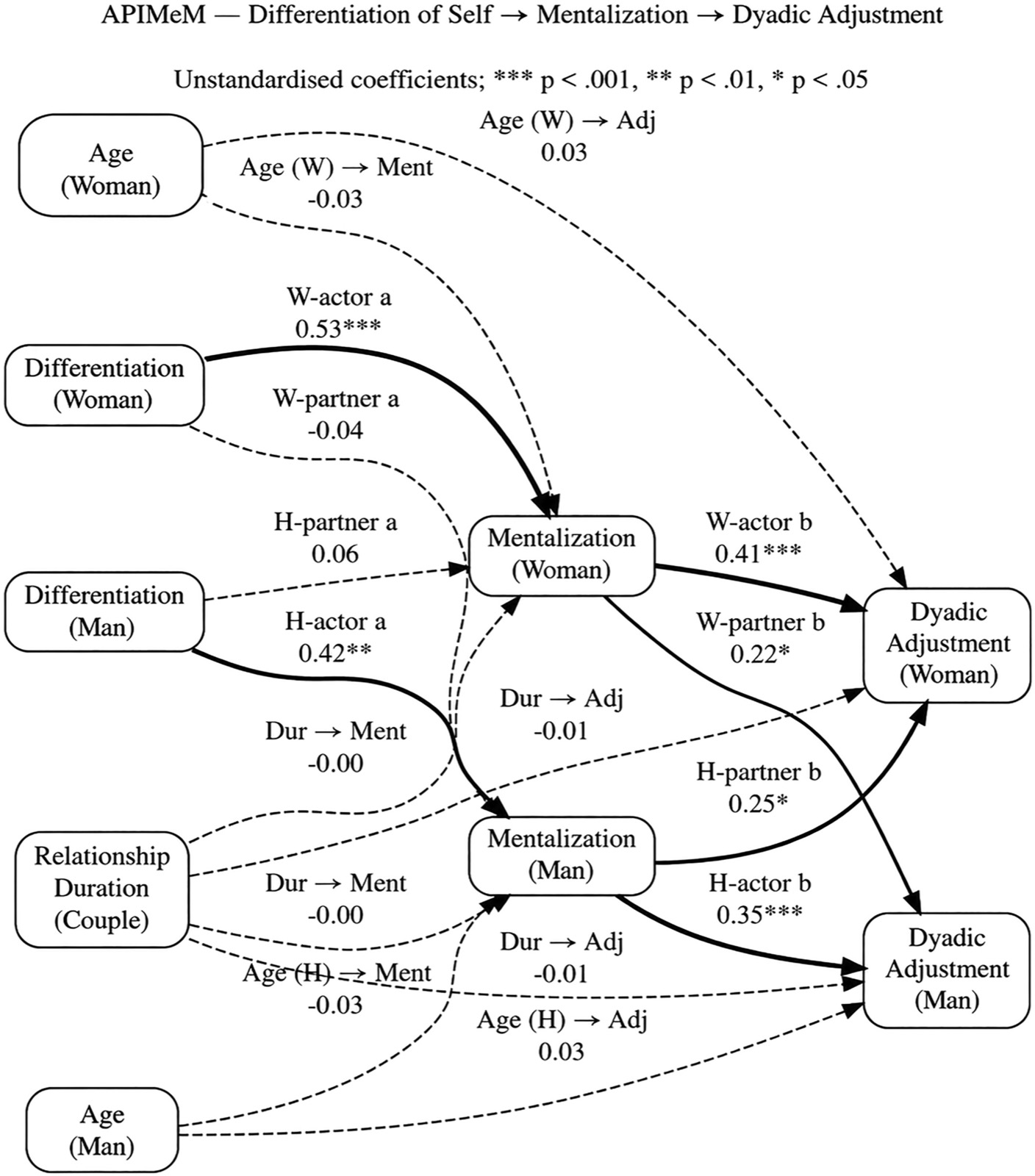
Women's self-differentiation predicted their own mentalization (women-actor a-path: b = 0.53, SE = 0.13, p < 0.001), and men showed a smaller but still significant counterpart (men-actor a-path: b = 0.42, SE = 0.15, p = 0.006). Cross-partner predictors—men → women (men-partner a-path) and women → men (women-partner a-path)—were nonsignificant (ps ≥ 0.63).
3.2.2 Direct Effects (Mentalization → Dyadic Adjustment)
Mentalization, in turn, predicted dyadic adjustment for both partners (women-actor b-path: b = 0.41, p < 0.001; men-actor b-path: b = 0.35, p = 0.001). The two cross-partner b-paths were smaller but significant (women → men: b = 0.22, p = 0.037; men → women: b = 0.25, p = 0.017). Full coefficients appear in Table 2 and the structural diagram (Figure 1).
Table 2 — Standardized regression paths (bootstrapped SEs, 5000 draws)
- Woman DSI-SF → Woman Mentalization. β = 0.324; SE = 0.077; 95% CI [0.16, 0.48]; z = 4.16; p < 0.001.
- Man DSI-SF → Woman Mentalization. β = 0.037; SE = 0.078; 95% CI [−0.12, 0.18]; z = 0.48; p = 0.630.
- Man DSI-SF → Man Mentalization. β = 0.225; SE = 0.082; 95% CI [0.07, 0.39]; z = 2.74; p = 0.006.
- Woman DSI-SF → Man Mentalization. β = −0.024; SE = 0.082; 95% CI [−0.23, 0.18]; z = −0.29; p = 0.769.
- Woman Mentalization → Woman Adjustment. β = 0.296; SE = 0.081; 95% CI [0.10, 0.45]; z = 3.65; p < 0.001.
- Man Mentalization → Woman Adjustment. β = 0.189; SE = 0.079; 95% CI [0.03, 0.34]; z = 2.39; p = 0.017.
- Man Mentalization → Man Adjustment. β = 0.278; SE = 0.081; 95% CI [0.11, 0.44]; z = 3.42; p = 0.001.
- Woman Mentalization → Man Adjustment. β = 0.168; SE = 0.081; 95% CI [0.01, 0.33]; z = 2.08; p = 0.037.
- Age → Mentalization (both partners). β = −0.057; SE = 0.063; 95% CI [−0.16, 0.09]; z = −0.52; p = 0.600.
- Age → Adjustment (both partners). β = 0.034; SE = 0.081; 95% CI [−0.15, 0.17]; z = 0.33; p = 0.743.
- Relationship duration → Mentalization. β = −0.060; SE = 0.107; 95% CI [−0.13, 0.01]; z = −0.56; p = 0.575.
- Relationship duration → Adjustment. β = −0.156; SE = 0.119; 95% CI [−0.24, 0.01]; z = −1.31; p = 0.190.
Note: DSI-SF = self-differentiation. β values are completely standardized (Std.all).
3.2.3 Indirect (Mediated) Effects
The women-actor indirect effect (differentiation → mentalization → adjustment) was significant, b = 0.22, SE = 0.08, p = 0.005, whereas the smaller men-actor indirect effect was marginal, b = 0.15, p = 0.053. All partner-mediated indirect effects were nonsignificant (see Table 3).
Table 3 — Indirect (mediated) effects (standardized) coefficients
- Woman actor (DSI-SF1 → Ment1 → Adj1). β = 0.096; SE = 0.034; 95% CI [0.03, 0.19]; z = 2.80; p = 0.005.
- Man → Woman (partner). β = 0.011; SE = 0.025; 95% CI [−0.08, 0.16]; z = 0.45; p = 0.652.
- Woman → Man (partner). β = 0.043; SE = 0.027; 95% CI [−0.01, 0.11]; z = 1.61; p = 0.107.
- Cross-partner (M DSI-SF → M Ment → W Adj). β = −0.005; SE = 0.018; 95% CI [−0.09, 0.07]; z = −0.27; p = 0.786.
- Man actor (DSI-SF2 → Ment2 → Adj2). β = 0.062; SE = 0.032; 95% CI [0.01, 0.12]; z = 1.93; p = 0.053.
- Woman → Man (partner). β = −0.007; SE = 0.025; 95% CI [−0.12, 0.09]; z = −0.28; p = 0.777.
- Man → Woman (partner). β = 0.054; SE = 0.028; 95% CI [0.00, 0.12]; z = 1.90; p = 0.057.
- Cross-partner (W DSI-SF → W Ment → M Adj). β = 0.006; SE = 0.015; 95% CI [−0.04, 0.11]; z = 0.40; p = 0.692.
3.2.4 Covariates
Neither age nor relationship duration related to mentalization or dyadic adjustment (ps ≥ 0.19).
3.2.5 Equality Test
Constraining women and men paths to equality did not degrade fit, Δχ2(4) = 1.64, p = 0.80.
3.2.6 Monte-Carlo Power
A 1000-replication simulation (N = 158 dyads each) showed excellent power (> 0.95) for both actor a-paths, both actor b-paths, and the women-actor indirect, moderate power (0.59–0.70) for the two partner b-paths and the men-actor indirect, but very low power (< 0.10) for the partner a-paths.
4 Discussion
This study advances the literature by examining mentalization as a mediator between self-differentiation and dyadic adjustment at the couple level, thus clarifying the psychological processes underlying relational functioning. Our findings indicate that self-differentiation and mentalization were linked to dyadic adjustment primarily through within-person pathways, as both actor paths—from self-differentiation to mentalization and from mentalization to dyadic adjustment—were significant for women and men. In other words, individuals with greater differentiation are more capable of emotional regulation and interpersonal boundary-setting, which in turn are associated with stronger mentalization and better relationship quality (Priest 2019; Salehi et al. 2021; Todosijević and Kojić 2022; Williamson and Lavner 2020). Notably, the study also found modest but significant partner effects, suggesting that one partner's mentalization is positively associated with the other partner's dyadic adjustment. However, no significant cross-partner effects were observed from self-differentiation to the partner's mentalization, which may reflect the primarily intrapersonal character of self-differentiation (i.e., being less directly shaped by the partner's characteristics). Collectively, these findings suggest that while the main pathways are intrapersonal, mentalization may also serve as a relational resource within couples.
Although the actor indirect effect reached conventional significance for women and was marginal for men, our study did not directly examine gender moderation, warranting cautious interpretation of gender-based differences. Nevertheless, prior evidence of generally higher mentalization among women (Greenberg et al. 2023) aligns with this pattern. Beyond mean-level differences, the present pattern may also be understood in light of gendered relational roles: women are often more consistently positioned as the primary “relationship managers” (Reich-Stiebert et al. 2023; Umberson et al. 2020). Accordingly, individual differences in women's mentalizing may be more closely linked with perceived dyadic adjustment. This interpretation is also consistent with gendered emotion work and relational maintenance accounts suggesting that women are more centrally engaged in monitoring and sustaining the relational climate, which may make individual differences in women's mentalizing more tightly coupled with perceived dyadic adjustment (Smoliak et al. 2023; Umberson et al. 2020; Wang and Umberson 2022).
In the Turkish context, this linkage may be further amplified by gendered expectations surrounding emotional expression and relational labor; traditional role scripts may render men's emotional expression less socially sanctioned, while positioning women as more active in articulating emotions (Kara and Ümmet 2021) and in sustaining the relational climate through emotion work and relational maintenance (Horne and Johnson 2019). More specifically, widely shared norms in Turkey often place women as key stewards of domestic life and relational harmony—an expectation that may be reflected in women's higher responsibility load and a more self-sacrificial stance in family life (Şendil and Korkut 2008; Yüksel and Dağ 2015). Within this frame, the salience of the women's actor indirect effect is consistent with the possibility that women's self-related capacities (e.g., differentiation) are more likely to covary with how they mentalize and evaluate couple functioning, whereas parallel indirect pathways for men may be more contingent on gender ideology and role arrangements within the couple (Greenstein 1995; Mickelson et al. 2006). Future research should explore these differences more rigorously. Specifically, studies should model gender role attitudes and gender ideology for both partners and test whether emotion work/relational maintenance processes operate as moderators or parallel mediators, particularly in family-oriented cultural contexts.
The small but significant partner effects of mentalization on dyadic adjustment are notable and support theoretical models that conceptualize mentalization as both an individual regulatory capacity and a functional process within the couple system (Fonagy and Luyten 2009). One partner's level of mentalization was positively associated with the other partner's dyadic adjustment, consistent with the mutual regulatory and co-constructive nature of romantic relationships. These partner associations were observed in both directions and are consistent with recent evidence on the benefits of mentalization in both parenting and couple contexts (Aspiras et al. 2025; Ensink et al. 2023; Silverio et al. 2025). Importantly, this interpretation converges with dyadic evidence indicating that interpersonal (extrinsic) emotion regulation efforts within couples are meaningfully linked with dyadic adjustment (Kinkead et al. 2023). Relatedly, research on emotion work in marital dyads indicates that the ongoing monitoring and management of the relational climate carries measurable psychological and relational consequences, underscoring that these “between-partners” regulatory processes are consequential rather than incidental (Umberson et al. 2020). Taken together, the observed partner effects can be framed as reflecting everyday co-regulatory transactions within couples (e.g., responsiveness and relational maintenance), through which mentalizing is associated with how partners experience dyadic adjustment.
In contrast, the nonsignificant partner effects from self-differentiation to the other's mentalization likely reflect the stable, intrapsychic origins of differentiation, which originates in early attachment experiences and is less susceptible to external influence (Bowen 1978; Kim and Woo 2025). Empirical work also indicates that dyadic functioning covaries strongly with more proximal interactional channels, particularly communication quality, emotional expressiveness, and coping-related exchanges under daily stress rather than with direct cross-partner transmission of trait-like self-capacities (Kinkead et al. 2023; Laslo-Roth and George-Levi 2022; Schwenck et al. 2022). For example, dyadic communication and coping processes have been shown to predict long-term relationship satisfaction trajectories by shaping how partners navigate stress and conflict jointly (Roth et al. 2025). Daily diary evidence further reveals that fluctuations in daily stress and interactional dynamics significantly covary with same-day relationship satisfaction for both partners (Birthelmer et al. 2025). Moreover, systematic evidence underscores that effective dyadic coping and communication support both individual and relational outcomes in intimate partnerships (Landolt et al. 2023). Finally, family systems and cultural accounts note that autonomy–connection dynamics (e.g., fusion with others) can carry different meanings in collectivistic contexts such as Turkey, which supports interpreting cross-partner links as contingent on how couples negotiate autonomy, emotional expression, and role expectations within their relational ecology (i.e., during conflict episodes or family-boundary negotiations; Kagitcibasi 2005; Lampis et al. 2019).
Overall, our findings are consistent with the view that self-differentiation was associated with dyadic adjustment indirectly through individuals' mentalization capacities at both the individual and couple levels. The empirical demonstration of both actor and partner effects of mentalization underscores the salience of mentalization as a relational process within the couple system. These results align with developmental models highlighting the transformation of early relational experiences into adult internal regulatory mechanisms and interpersonal competencies (Barthel et al. 2018; Girme et al. 2021).
4.1 Clinical Implications
These findings have several clinical implications for couple therapy. First, assessing self-differentiation levels can inform case formulation, as lower differentiation is associated with heightened emotional reactivity, anxiety, and relational disengagement (Kim and Woo 2025). Interventions aimed at enhancing regulatory skills may be particularly beneficial for individuals with lower levels of differentiation. Second, the identified role of mentalization in dyadic adjustment through both actor and partner effects highlights the value of integrating mentalization-based interventions (e.g., MBT for couples) into couples and family therapy. Such approaches can enhance individuals' awareness of both their own and their partners' mental states (Fonagy et al. 2019), fostering more balanced and sustainable emotional closeness. Given the modest partner association observed in this study, couples therapy should incorporate both individual insight and mutual mentalizing skills. Third, tailoring interventions to both partners' psychological capacities may optimize therapeutic outcomes. Evidence-based assessment of differentiation and mentalization can therefore guide both case formulation and intervention planning. Given the non-clinical, heterosexual sample, these clinical implications should be applied cautiously to clinical populations and more diverse couple configurations.
4.2 Limitations
The findings of this study should be interpreted in light of some limitations. First, the cross-sectional design precludes causal inferences; thus, the observed effects should be interpreted as associations and indirect links rather than directional mechanisms. Longitudinal and experimental studies are needed to examine the unfolding of these mechanisms over time and to test whether changes in mentalization covary with within-couple changes in adjustment under naturally occurring stress. Second, the exclusive focus on heterosexual, mostly married, cohabiting, non-clinical couples limits generalizability to other relationship forms, including sexual minorities and high-conflict couples. Future research should explicitly extend this model to same-sex couples, clinical/high-conflict samples, and couples with different living arrangements, and test whether the measurement and structural paths are invariant across couple types and gender-role arrangements. Third, because data were collected online, partners were instructed to complete the questionnaires independently (i.e., without discussing items or completing them together). However, absolute verification of independent responding was not possible; therefore, a residual risk of response contamination (and shared-method inflation) cannot be ruled out. Future studies should implement stronger procedural checks (e.g., individualized links, completion time-stamps, attention checks, or brief verification items) to better ensure independence. Fourth, self-report measures may introduce biases such as social desirability or response tendencies. In addition, the Turkish short-form mentalization measure (MentS-11) has only recently been validated; therefore, replication with additional samples and/or multimethod assessments of mentalization is warranted. Future studies should incorporate partner reports, structured observational paradigms (e.g., conflict/problem-solving discussions coded for responsiveness, escalation/repair, and reflective functioning/mentalizing markers) or clinician ratings to ensure data triangulation and thus enhance validity. Finally, unmeasured individual and contextual factors, such as gender roles, attachment styles, or cultural values, may also influence couple dynamics. Given existing evidence for their role in shaping relational dynamics (Sbarra and Whisman 2022), these moderators should be considered in future research. More concretely, future studies could model gender ideology/role attitudes and relational maintenance (emotion work) as moderators or parallel mediators and examine whether partner links emerge more clearly in role-relevant contexts (e.g., conflict episodes) rather than as global trait-level associations. Future studies with larger samples may also test the robustness of the pattern after adjusting for additional sociodemographic factors (e.g., education, SES, number of children) and exploring potential non-linear or stage-of-relationship effects.
5 Conclusion
By exploring the couple-level mechanisms linking self-differentiation and mentalization to dyadic adjustment, this study helps clarify how internal regulatory systems are associated with relational dynamics. The findings suggest that self-awareness and emotional boundary management are linked to dyadic adjustment through mentalization, which can be conceptualized as operating as both an individual and a dyadic process. Overall, these results support systemic perspectives in couple therapy by showing that partners' psychological resources are associated not only with their own relationship evaluations but also with their partner's reported dyadic adjustment.
Complexe Systémique: key points
The study gives empirical support to an intuition shared by Bowen and by mentalization approaches: being able to remain oneself within the bond supports the capacity to think about the other’s mind, which in turn accompanies better couple adjustment. The most systemic finding is the partner effect: one partner’s mentalization goes hand in hand with the other’s adjustment, whereas differentiation does not “pass” directly from one partner to the other. For clinical practice, this argues for cultivating curiosity about the other’s experience in session, without giving up on supporting each partner’s differentiation. The gendered reading offered (women as “relationship managers”) sheds light on the load of emotion work, at the risk of naturalising it. Caution is warranted: cross-sectional design, self-report measures, a non-clinical sample of mostly married and university-educated heterosexual couples, modest effects, a marginal indirect effect for men, and a shortened mentalization scale that has only just been validated. Read alongside the article on dependence and independence in couples, and the article on dyadic analyses of alliance and marital satisfaction.
Notes from the original
Acknowledgments. The author gratefully acknowledges Işık University for its support.
Funding. This research was funded by Işık University Scientific Research Projects Coordination Unit (Project No. 23B105).
Disclosure. The author has nothing to report.
Ethics statement. This study was conducted in accordance with ethical standards. Informed consent was obtained from all participants, and the study protocol was approved by the Işık University Ethics Review Board (Approval No. 2024/03, April 16, 2024).
Conflicts of interest. The author declares no conflicts of interest.
References
Abdel-Sater, R. 2022. “Marriage Dissolution in the United States: A Survival Analysis Approach.” Journal of Divorce & Remarriage 63, no. 4: 235–261. https://doi.org/10.1080/10502556.2022.2042788.
Aspiras, O., J. O'Gara, and J. Radunzel. 2025. “Actor–Partner Parenting and Co-Parenting Practices and Youth Resilience During the COVID-19 Pandemic.” Family Process 64, no. 2: e70033. https://doi.org/10.1111/famp.70033.
Ataca, B. 2009. “ Turkish Family Structure and Functioning.” In Perspectives on Human Development, Family, and Culture, edited by S. Bekman and A. Aksu-Koç, 108–125. Cambridge University Press. https://doi.org/10.1017/CBO9780511720437.010.
Barthel, A. L., A. Hay, S. N. Doan, and S. G. Hofmann. 2018. “Interpersonal Emotion Regulation: A Review of Social and Developmental Components.” Behaviour Change 35, no. 4: 203–216. https://doi.org/10.1017/bec.2018.19.
Bateman, A., and P. Fonagy. 2016. Mentalization-Based Treatment for Personality Disorders: A Practical Guide. Oxford University Press. https://doi.org/10.1093/med:psych/9780199680375.001.0001.
Bayraktaroğlu, H. T., and E. T. Çakıcı. 2017. “Psychometric Properties of Revised Form Dyadic Adjustment Scale in a Sample From North Cyprus.” International Journal of Educational Science 19, no. 2–3: 113–119. https://doi.org/10.1080/09751122.2017.1393954.
Birthelmer, S., E. Zambrano Garza, T. Pauly, et al. 2025. “Daily Stress-Influence Dynamics Predict Relationship Satisfaction in Post-Stroke Couples.” Frontiers in Psychology 16: 1659945. https://doi.org/10.3389/fpsyg.2025.1659945.
Bogdan, I., M. N. Turliuc, and O. S. Candel. 2022. “Transition to Parenthood and Marital Satisfaction: A Meta-Analysis.” Frontiers in Psychology 13: 901362. https://doi.org/10.3389/fpsyg.2022.901362.
Bölükbaşı, A. 2024. “Social Consequences of Demographic Transformation in Turkey.” Uluslararası Anadolu Sosyal Bilimler Dergisi 8, no. 4: 1041–1058. https://doi.org/10.47525/ulasbid.1572932.
Borelli, J. L., K. Ensink, M. L. Gillespie, et al. 2021. “Mothers' Self-Focused Reflective Functioning Interacts With Childhood Experiences of Rejection to Predict Current Romantic Relationship Quality and Parenting Behavior.” Family Process 60, no. 3: 920–934. https://doi.org/10.1111/famp.12603.
Borelli, J. L., A. Slade, C. Pettit, and D. Shai. 2020. “I “Get” You, Babe: Reflective Functioning in Partners Transitioning to Parenthood.” Journal of Social and Personal Relationships 37, no. 6: 1785–1805. https://doi.org/10.1177/0265407520905641.
Bowen, M. 1978. Family Therapy in Clinical Practice. Jason Aronson.
Bühler, J. L., S. Krauss, and U. Orth. 2021. “Development of Relationship Satisfaction Across the Life Span: A Systematic Review and Meta-Analysis.” Psychological Bulletin 147, no. 10: 1012–1053. https://doi.org/10.1037/bul0000342.
Bulanda, J. R., and S. L. Brown. 2007. “Race-Ethnic Differences in Marital Quality and Divorce.” Social Science Research 36, no. 3: 945–967. https://doi.org/10.1016/j.ssresearch.2006.04.001.
Busby, D. M., C. Christensen, D. R. Crane, and J. H. Larson. 1995. “A Revision of the Dyadic Adjustment Scale for Use With Distressed and Nondistressed Couples: Construct Hierarchy and Multidimensional Scales.” Journal of Marital and Family Therapy 21, no. 3: 289–308. https://doi.org/10.1111/j.1752-0606.1995.tb00163.x.
Calatrava, M., M. V. Martins, M. Schweer-Collins, C. Duch-Ceballos, and M. Rodríguez-González. 2022. “Differentiation of Self: A Scoping Review of Bowen Family Systems Theory's Core Construct.” Clinical Psychology Review 91: 102101. https://doi.org/10.1016/j.cpr.2021.102101.
Cook, W. L., and D. A. Kenny. 2005. “The Actor–Partner Interdependence Model: A Model of Bidirectional Effects in Developmental Studies.” International Journal of Behavioral Development 29, no. 2: 101–109. https://doi.org/10.1080/01650250444000405.
Costa, C. B., and C. P. Mosmann. 2021. “Personality Traits and Marital Adjustment: Interaction Between Intra and Interpersonal Aspects.” Paidéia (Ribeirão Preto) 31: e3107. https://doi.org/10.1590/1982-4327e3107.
Demirci, A. D., R. Aydın, Ö. Korukcu, and K. Kabukcuoğlu. 2022. “Is Marital Adjustment a Way to Increase Women's Identification With the Motherhood Role During Pregnancy?” Health Care for Women International 43, no. 6: 568–582. https://doi.org/10.1080/07399332.2020.1867859.
Diler, Z., and S. Diler. 2022. “Türkiye'de Boşanma Olgusunun Zamansal Değişimi (2001-2021).” International Journal of Social and Humanities Sciences Research 9, no. 89: 2166–2178. https://doi.org/10.26450/jshsr.3305.
Dimitrijević, A., N. Hanak, A. Altaras Dimitrijević, and Z. Jolić Marjanović. 2018. “The Mentalization Scale (MentS): A Self-Report Measure for the Assessment of Mentalizing Capacity.” Journal of Personality Assessment 100, no. 3: 268–280. https://doi.org/10.1080/00223891.2017.1310730.
Dong, S., Q. Dong, H. Chen, and S. Yang. 2022. “Mother's Parenting Stress and Marital Satisfaction During the Parenting Period: Examining the Role of Depression, Solitude, and Time Alone.” Frontiers in Psychology 13: 847419. https://doi.org/10.3389/fpsyg.2022.847419.
Drake, J. R., N. L. Murdock, J. M. Marszalek, and C. E. Barber. 2015. “Differentiation of Self-Inventory-Short Form: Development and Preliminary Validation.” Contemporary Family Therapy: An International Journal 37, no. 2: 101–112. https://doi.org/10.1007/s10591-015-9329-7.
Ensink, K., M. Bégin, G. Martin-Gagnon, et al. 2023. “Post-Traumatic Stress in the Context of Childhood Maltreatment: Pathways From Attachment Through Mentalizing During the Transition to Parenthood.” Frontiers in Psychology 14: 919736. https://doi.org/10.3389/fpsyg.2023.919736.
Erdem, G., M. Adli-Isleyen, N. Baltalarlı, and E. Kılıç. 2022. “Low-Income Turkish Mothers' Conceptions and Experiences of Family Life.” Frontiers in Psychology 12: 756278. https://doi.org/10.3389/fpsyg.2021.756278.
Erdem, G., and O. Safi. 2018. “A Cultural Lens Approach to Bowen Family Systems Theory: Contributions of Family Change Theory.” Journal of Family Theory & Review 10, no. 2: 469–483. https://doi.org/10.1111/jftr.12258.
Falconier, M. K., and J. B. Jackson. 2020. “Economic Strain and Couple Relationship Functioning: A Meta-Analysis.” International Journal of Stress Management 27, no. 4: 311–325. https://doi.org/10.1037/str0000157.
Finzi-Dottan, R. 2023. “The Role of Fear of Intimacy as Mediator Between Self-Differentiation and Marital Relationship Satisfaction: A Dyadic Model.” Family Journal 31, no. 3: 392–398. https://doi.org/10.1177/10664807231163254.
Fischer, M. S., V. Bhatia, J. L. Baddeley, R. Al-Jabari, and J. Libet. 2018. “Couple Therapy With Veterans: Early Improvements and Predictors of Early Dropout.” Family Process 57, no. 2: 525–538. https://doi.org/10.1111/famp.12308.
Fonagy, P., E. Allison, and C. Campbell. 2019. “ Mentalizing, Resilience, and Epistemic Trust.” In Handbook of Mentalizing in Mental Health Practice, edited by A. W. Bateman and P. Fonagy, 2nd ed., 63–77. American Psychiatric Association Publishing.
Fonagy, P., and P. Luyten. 2009. “A Developmental, Mentalization-Based Approach to the Understanding and Treatment of Borderline Personality Disorder.” Development and Psychopathology 21, no. 4: 1355–1381. https://doi.org/10.1017/S0954579409990198.
Froidevaux, N. M., S. Millwood, H. K. Hecht, et al. 2025. “Attachment Insecurity and Partner Reflective Functioning in the Context of Long-Distance Interracial Romantic Relationships.” Personal Relationships 32, no. 1: e70004. https://doi.org/10.1111/pere.70004.
Frye-Cox, N., L. Ganong, T. Jensen, and M. Coleman. 2021. “Marital Conflict and Health: The Moderating Roles of Emotion Regulation and Marriage Order.” Journal of Divorce & Remarriage 62, no. 6: 450–474. https://doi.org/10.1080/10502556.2021.1925853.
Girme, Y. U., R. E. Jones, C. Fleck, J. A. Simpson, and N. C. Overall. 2021. “Infants' Attachment Insecurity Predicts Attachment-Relevant Emotion Regulation Strategies in Adulthood.” Emotion 21, no. 2: 260–272. https://doi.org/10.1037/emo0000721.
Greenberg, D. M., V. Warrier, A. Abu-Akel, et al. 2023. “Sex and Age Differences in “Theory of Mind” Across 57 Countries Using the English Version of the “Reading the Mind in the Eyes” Test.” Proceedings of the National Academy of Sciences of the United States of America 120, no. 1: e2022385119. https://doi.org/10.1073/pnas.2022385119.
Greenstein, T. N. 1995. “Gender Ideology, Marital Disruption, and the Employment of Married Women.” Journal of Marriage and Family 57, no. 1: 31–42. https://doi.org/10.2307/353814.
Gürmen, M. S. 2025. “Who Seeks Couple and Family Therapy in Turkey? A Descriptive Analysis From the MFT-PRN.” Contemporary Family Therapy 48: 25–34. https://doi.org/10.1007/s10591-025-09772-w.
Horne, R. M., and M. D. Johnson. 2019. “A Labor of Love? Emotion Work in Intimate Relationships.” Journal of Social and Personal Relationships 36, no. 4: 1190–1209. https://doi.org/10.1177/0265407518756779.
İmamoğlu, E. O., and Z. Karakitapoğlu-Aygün. 2004. “Self-Construals and Values in Different Cultural and Socioeconomic Contexts.” Genetic, Social, and General Psychology Monographs 130, no. 4: 277–306. https://doi.org/10.3200/MONO.130.4.277-306.
Işık, E., and S. Bulduk. 2015. “Psychometric Properties of the Differentiation of Self Inventory-Revised in Turkish Adults.” Journal of Marital and Family Therapy 41, no. 1: 102–112. https://doi.org/10.1111/jmft.12022.
Jiménez-Picón, N., M. Romero-Martín, L. Ramirez-Baena, J. C. Palomo-Lara, and J. Gómez-Salgado. 2021. “Systematic Review of the Relationship Between Couple Dyadic Adjustment and Family Health.” Children 8, no. 6: 491. https://doi.org/10.3390/children8060491.
Kagitcibasi, C. 2002. “A Model of Family Change in Cultural Context.” Online Readings in Psychology and Culture 6, no. 3. https://doi.org/10.9707/2307-0919.1059.
Kagitcibasi, C. 2005. “Autonomy and Relatedness in Cultural Context: Implications for Self and Family.” Journal of Cross-Cultural Psychology 36, no. 4: 403–422. https://doi.org/10.1177/0022022105275959.
Kagitcibasi, C. 2017. Family, Self, and Human Development Across Cultures: Theory and Applications. Routledge.
Kagitcibasi, C., and B. Ataca. 2005. “Value of Children and Family Change: A Three-Decade Portrait From Turkey.” Applied Psychology. An International Review 54, no. 3: 317–337. https://doi.org/10.1111/j.1464-0597.2005.00213.x.
Kagitcibasi, C., and B. Ataca. 2015. “Value of Children, Family Change, and Implications for the Care of the Elderly.” Cross-Cultural Research 49, no. 4: 374–392. https://doi.org/10.1177/1069397115598139.
Kara, A., and D. Ümmet. 2021. “Evli Kadınlarda Evlilik Uyumu Ve Iletişim Becerileri Arasındaki Ilişkinin Incelenmesi.” Academic Platform Journal of Education and Change 4, no. 2: 233–244.
Kerr, M. E., and M. Bowen. 1988. Family Evaluation: An Approach Based on Bowen Theory. Norton & Co.
Kim, H., A. M. Prouty, D. B. Smith, M. Ko, J. L. Wetchler, and J.-E. Oh. 2014. “Differentiation of Self and Its Relationship With Family Functioning in South Koreans.” American Journal of Family Therapy 42, no. 3: 257–265. https://doi.org/10.1080/01926187.2013.838928.
Kim, S., and S. Woo. 2025. “Indirect Effects of Self-Differentiation and Mentalization on Family of Origin Health and Marital Satisfaction Among Korean Adults.” Journal of Marital and Family Therapy 51, no. 1: e12756. https://doi.org/10.1111/jmft.12756.
Kinkead, A., C. Salas, and C. P. Ewert. 2023. “Couples' Extrinsic Emotion Regulation and Dyadic Adjustment: An Actor-Partner Interdependence Model Analysis.” Current Psychology 42: 31619–31633. https://doi.org/10.1007/s12144-022-04188-3.
Lam, C. M., and P. C. Y. Chan-So. 2015. “Validation of the Chinese Version of Differentiation of Self Inventory (C-DSI).” Journal of Marital and Family Therapy 41, no. 1: 86–101. https://doi.org/10.1111/jmft.12031.
Lampis, J., S. Cataudella, M. Agus, A. Busonera, and E. A. Skowron. 2019. “Differentiation of Self and Dyadic Adjustment in Couple Relationships: A Dyadic Analysis Using the Actor-Partner Interdependence Model.” Family Process 58, no. 3: 698–715. https://doi.org/10.1111/famp.12370.
Landolt, S. A., K. Weitkamp, M. Roth, N. M. Sisson, and G. Bodenmann. 2023. “Dyadic Coping and Mental Health in Couples: A Systematic Review.” Clinical Psychology Review 106: 102344. https://doi.org/10.1016/j.cpr.2023.102344.
Laslo-Roth, R., and S. George-Levi. 2022. “Hopeful Woman, Happy Couple: A Dyadic Model of Hope, Partner Support, and Relationship Satisfaction.” Journal of Happiness Studies 23: 2201–2216. https://doi.org/10.1007/s10902-021-00494-y.
Ledermann, T., S. Macho, and D. A. Kenny. 2011. “Assessing Mediation in Dyadic Data Using the Actor–Partner Interdependence Model.” Structural Equation Modeling 18, no. 4: 595–612. https://doi.org/10.1080/10705511.2011.607099.
Luyten, P., and P. Fonagy. 2015. “The Neurobiology of Mentalizing.” Personality Disorders, Theory, Research, and Treatment 6, no. 4: 366–379. https://doi.org/10.1037/per0000117.
Manzi, C., V. L. Vignoles, C. Regalia, and E. Scabini. 2006. “Cohesion and Enmeshment Revisited: Differentiation, Identity, and Well-Being in Two European Cultures.” Journal of Marriage and Family 68, no. 3: 673–689. https://doi.org/10.1111/j.1741-3737.2006.00282.x.
Mayol-García, Y., B. Gurrentz, and R. M. Kreider. 2021. Number, Timing, and Duration of Marriages and Divorces: 2016 (Current Population Reports, P70–167). U.S. Census Bureau. https://www.census.gov/library/publications/2021/demo/p70-167.html.
Mickelson, K. D., S. T. Claffey, and S. L. Williams. 2006. “The Moderating Role of Gender and Gender Role Attitudes on the Link Between Spousal Support and Marital Quality.” Sex Roles 55, no. 1–2: 73–82. https://doi.org/10.1007/s11199-006-9061-8.
Mozas-Alonso, M., J. Oliver, and A. Berastegui. 2022. “Differentiation of Self and Its Relationship With Marital Satisfaction and Parenting Styles in a Spanish Sample of Adolescents' Parents.” PLoS One 17, no. 3: e0265436. https://doi.org/10.1371/journal.pone.0265436.
Özgüç, S., and D. Tanrıverdi. 2018. “Relations Between Depression Level and Conflict Resolution Styles, Marital Adjustments of Patients With Major Depression and Their Spouses.” Archives of Psychiatric Nursing 32, no. 3: 337–342. https://doi.org/10.1016/j.apnu.2017.11.022.
Peleg, O. 2008. “The Relation Between Differentiation of Self and Marital Satisfaction: What Can Be Learned From Married People Over the Course of Life?” American Journal of Family Therapy 36, no. 5: 388–401. https://doi.org/10.1080/01926180701804634.
Priest, J. B. 2019. “Examining Differentiation of Self as a Mediator in the Biobehavioral Family Model.” Journal of Marital and Family Therapy 45, no. 1: 161–175. https://doi.org/10.1111/jmft.12301.
Reich-Stiebert, N., L. Froehlich, and J. B. Voltmer. 2023. “Gendered Mental Labor: A Systematic Literature Review on the Cognitive Dimension of Unpaid Work Within the Household and Childcare.” Sex Roles 88: 475–494. https://doi.org/10.1007/s11199-023-01362-0.
Rived-Ocaña, M., M. Calatrava, and M. Rodríguez-González. 2025. “Relational Ethics and Differentiation of Self: An Empirical Study of the Key Constructs of Contextual Theory and Bowen Family Systems Theory.” Family Process 64, no. 1: e70005. https://doi.org/10.1111/famp.70005.
Rizkalla, N., and G. Rahav. 2016. “Differentiation of the Self, Couples' Intimacy, and Marital Satisfaction: A Similar Model for Palestinian and Jewish Married Couples in Israel.” International Journal of the Jurisprudence of the Family 7: 1–32.
Roth, M., F. W. Nussbeck, S. A. Landolt, et al. 2025. “Dyadic Coping and Communication as Predictors of 10-Year Relationship Satisfaction Subgroup Trajectories in Stable Romantic Couples.” Behavioral Sciences 15, no. 10: 1361. https://doi.org/10.3390/bs15101361.
Salehi, H., S. Hoseinian, and S. M. Yazdi. 2021. “The Relationship Between Successful Marriage and Self-Differentiation: The Mediating Role of Cognitive Emotion Regulation.” Journal of Woman and Family Studies 9, no. 4: 63–78.
Sarıkaya, Y., M. Boyacı, T. İlhan, and A. Aldemir. 2018. “Adaptation of the Differentiation of Self Inventory-Short Form (DSI-SF) to Turkish: Validity and Reliability Study.” Bartın University Journal of Faculty of Education 7, no. 2: 365–380. https://doi.org/10.14686/buefad.364196.
Sbarra, D. A., and M. A. Whisman. 2022. “Divorce, Health, and Socioeconomic Status: An Agenda for Psychological Science.” Current Opinion in Psychology 43: 75–78. https://doi.org/10.1016/j.copsyc.2021.06.007.
Schwarzer, N. H., T. Nolte, P. Fonagy, and S. Gingelmaier. 2021. “Mentalizing and Emotion Regulation: Evidence From a Nonclinical Sample.” International Forum of Psychoanalysis 30, no. 1: 34–45. https://doi.org/10.1080/0803706X.2021.1873418.
Schwenck, G. C., S. J. Dawson, D. B. Allsop, and N. O. Rosen. 2022. “Daily Dyadic Coping: Associations With Postpartum Sexual Desire and Sexual and Relationship Satisfaction.” Journal of Social and Personal Relationships 39, no. 12: 3706–3727. https://doi.org/10.1177/02654075221107393.
Şendil, G., and Y. Korkut. 2008. “Evli Çiftlerdeki Çift Uyumu Ve Evlilik Çatışmasının Demografik Özellikler Açısından Incelenmesi.” Psikoloji Çalışmaları 28: 15–34.
Silverio, N., R. Gao, A. I. Skeen, et al. 2025. “The Dyadic Influence of Relationship Hope on Family Functioning.” Family Process 64, no. 2: e70036. https://doi.org/10.1111/famp.70036.
Singh, Y., V. Gupta, and A. K. Srivastava. 2023. “Marital Conflict, Health, and Well-Being Among Couples.” International Journal of Indian Psychology 11, no. 1: 1098–1110.
Skowron, E. A., and M. L. Friedlander. 1998. “The Differentiation of Self Inventory: Development and Initial Validation.” Journal of Counseling Psychology 45, no. 3: 235–246. https://doi.org/10.1037/0022-0167.45.3.235.
Smoliak, O., K. Al-Ali, A. LeCouteur, et al. 2023. “The Third Shift: Addressing Emotion Work in Couple Therapy.” Family Process 62, no. 3: 1006–1023. https://doi.org/10.1111/famp.12906.
Spanier, G. B. 1976. “Measuring Dyadic Adjustment: New Scales for Assessing the Quality of Marriage and Similar Dyads.” Journal of Marriage and the Family 38, no. 1: 15–28. https://doi.org/10.2307/350547.
Stefana, A., S. Damiani, U. Granziol, et al. 2025. “Psychological, Psychiatric, and Behavioral Sciences Measurement Scales: Best Practice Guidelines for Their Development and Validation.” Frontiers in Psychology 15: 1494261. https://doi.org/10.3389/fpsyg.2024.1494261.
Todosijević, M., and D. Kojić. 2022. “Differentiation of Self as a Predictor of Capacity for Mentalization.” ГОДИШЊАК ЗА ПСИХОЛОГИЈУ 19: 65–79. https://doi.org/10.46630/gpsi.19.2022.04.
Türkiye İstatistik Kurumu. 2025, February 24. “Evlenme ve boşanma istatistikleri, 2024”. https://data.tuik.gov.tr/Bulten/Index?p=Evlenme-ve-Bo%C5%9Fanma-%C4%B0statistikleri-2024-54194&dil=1.
Umberson, D., M. B. Thomeer, A. M. Pollitt, and S. E. Mernitz. 2020. “The Psychological Toll of Emotion Work in Same-Sex and Different-Sex Marital Dyads.” Journal of Marriage and Family 82, no. 4: 1141–1158. https://doi.org/10.1111/jomf.12686.
Uskul, A. K., M. Hynie, and R. N. Lalonde. 2004. “Interdependence as a Mediator Between Culture and Interpersonal Closeness for Euro-Canadians and Turks.” Journal of Cross-Cultural Psychology 35, no. 2: 174–191. https://doi.org/10.1177/0022022103262243.
Uskul, A. K., A. Kirchner-Häusler, V. L. Vignoles, et al. 2023. “Neither Eastern Nor Western: Patterns of Independence and Interdependence in Mediterranean Societies.” Journal of Personality and Social Psychology 125, no. 3: 471–495. https://doi.org/10.1037/pspa0000342.
Ünver, B. 2026. “Development and Validation of a Short Form of the Mentalization Scale (MentS-11): An Evidence-based Measure for Turkish adults.” Cognitive Processing Advance online publication. https://doi.org/10.1007/s10339-026-01335-7.
Wagner-Skacel, J., D. Riedl, H. Kampling, and A. Lampe. 2022. “Mentalization and Dissociation After Adverse Childhood Experiences.” Scientific Reports 12, no. 1: 6809. https://doi.org/10.1038/s41598-022-10787-8.
Wang, Y., and D. Umberson. 2022. “Dyadic Coping and Marital Quality in Same-Sex and Different-Sex Marriages.” Journal of Social and Personal Relationships 40, no. 3: 996–1017. https://doi.org/10.1177/02654075221123096.
Williamson, H. C., J. X. Bornstein, V. Cantu, O. Ciftci, K. A. Farnish, and M. T. Schouweiler. 2022. “How Diverse Are the Samples Used to Study Intimate Relationships? A Systematic Review.” Journal of Social and Personal Relationships 39, no. 4: 1087–1109. https://doi.org/10.1177/02654075211053849.
Williamson, H. C., and J. A. Lavner. 2020. “Trajectories of Marital Satisfaction in Diverse Newlywed Couples.” Social Psychological and Personality Science 11, no. 5: 597–604. https://doi.org/10.1177/1948550619865056.
Wusirige, X. Liang, and Z. Wang. 2025. “The Association Between Marital Satisfaction and Perceived Coparenting in Infancy: A Longitudinal Dyadic Approach.” Family Process 64, no. 1: e13082. https://doi.org/10.1111/famp.13082.
Young, B., and R. B. Seedall. 2024. “Power Dynamics in Couple Relationships: A Review and Applications for Systemic Family Therapists.” Family Process 63, no. 4: 1703–1720. https://doi.org/10.1111/famp.13008.
Yüksel, Ö., and İ. Dağ. 2015. “Kadınlarda Evlilik Uyumu Ve Psikolojik Belirtiler Arasındaki Ilişki: Stresle Baş Etme Biçimleri Ve Toplumsal Cinsiyet Rolü Tutumlarının Aracı Rolleri.” Türk Psikiyatri Dergisi 26, no. 3: 181–188.
Reformatted republication of Self‐Differentiation and Mentalization in Couple Adjustment: An Actor–Partner Mediation Model, by Buket Ünver, Family Relations, advance online publication (2026), doi: 10.1111/fare.70273, under a CC BY 4.0 licence. Edition and layout: Complexe Systémique, September 2026 — the work has been modified under the terms of the licence (tables presented as lists). Neither the authors nor the publisher are responsible for this edition; the original version prevails.
This is the original article “Self‐Differentiation and Mentalization in Couple Adjustment: An Actor–Partner Mediation Model”, published in Family Relations (2026) under a CC BY 4.0 licence. Republished by Complexe Systémique: the author’s text is unchanged; only the presentation has been adapted for reading online, as set out at the head of this page.
Read the original articleHow to cite this article
Ünver, B. (2026). Self‐Differentiation and Mentalization in Couple Adjustment: An Actor–Partner Mediation Model. Complexe Systémique. https://app.complexe-systemique.com/en_GB/articles/self-differentiation-and-mentalization-in-couple-adjustment (Original work published in 2026 in Family Relations, Early View, e70273 (2026); republished in 2026 by Family Relations, https://onlinelibrary.wiley.com/doi/full/10.1111/fare.70273)
To go further
- Dependence / independence in couples: a metaphorDependence and independence.
- Traiter ensemble, changer ensemble : les analyses dyadiques pour comprendre la réciprocité entre alliances et satisfaction conjugale au fil du tempsDyadic analyses.
- Couple therapy in the 2020s: Current status and emerging developmentsCouple therapy today.
Related training courses
 Webinar
Extramarital affairs: what does the therapist do when the couple explodes?
Free webinar: how to position yourself as a systemic therapist in the crisis of the extramarital affair. Revelation, secrecy, multipartiality.
 Webinar
The three loves
Free live webinar with Dr Robert Neuburger, 1 October 2026, 6 pm (Paris): the three loves, attachment and ways of loving. Held in French.
 Certifying course
Training in Systemic Therapy and Interventions – Cycle 1
Certifying training cycle in systemic therapy and interventions – year 1. Courses, supervision and practice, aligned with EFTA/SFTF. In French.
 Certifying course
Training in Systemic Therapy and Interventions – Cycle 2
Certifying training cycle in systemic therapy and interventions – year 2. Clinical complexity, supervision and practice. EFTA/SFTF aligned. In French.
Related articles
 Article
 The AFFIRM Model for Navigating Challenges in Continuously-Interfaith and Divergent-Interfaith Marriages
Thirty happy interfaith couples describe how they navigate their religious differences: five processes, from respecting each other’s choices to religious intimacy, gathered in the AFFIRM model.
 Article
 ‘My Penis is Probably Too Small’: A Collaborative Autoethnographic Study
Two researchers use autoethnography to explore what their partners’ sexual pasts do to their relationships: insufficiency, intrusive images, shame, ambivalence.
 Article
 Toxic, narcissistic, borderline: what therapy speak does to your relationships
Narcissistic, borderline, toxic: therapy speak has left the consulting room. Julien Besse shows how these labels close the debate and relieve us of our own part.
 Article
 Are You Qualified, ChatGPT? Examining Clinical Skills and Competencies of ChatGPT in Delivering Systemic Interventions
A GPT trained in systemic interventions, blind-rated by twelve clinical supervisors: a rushed, dominating novice, whom the client nonetheless loved.