Journal of Family Therapy · Family therapy
Sibling stories of parental mental distress
What do adult siblings who grew up with a mother in mental distress take away from it? A British team interviewed four sibling pairs together, using a narrative inquiry approach. Two plots emerge: ‘the story of us’, made of eldest-child roles, parentification and leaving home, and ‘we are who we are because of what happened’. The sibling bond appears as a protective resource, yet one that assigned roles can also weaken.
This is a reformatted republication of Sibling stories of parental mental distress, by Wendy O’Neill, Pieter W. Nel, Nic Horley and Lizette Nolte, published in Journal of Family Therapy (Wiley) (2024), doi: 10.1111/1467-6427.12452, under a CC BY 4.0 licence. Prepared by Complexe Systémique in September 2026: the authors’ text is unchanged; the layout has been adapted for reading online, which constitutes a modification of the work under the terms of the licence. Table 1 is presented as a list. This edition was made neither by the authors nor by the publisher, who are not responsible for its content or for any errors. The original version prevails.
Moving from a position of silence to shared meaning-making, by adopting a family-based approach, can promote resilience in children.
Wendy O’Neill, Pieter W. Nel, Nic Horley and Lizette Nolte
Abstract
This paper reports on the results of a study exploring sibling stories of parental mental distress and the societal discourses that may have contributed to the adult siblings' sense-making. Four sibling pairs were purposively recruited and interviewed, using a narrative inquiry approach. Two main plots were constructed through analysis of the participants' narratives: ‘The story of us’ and ‘We are who we are because of what happened’. Results highlighted that the identity construction of each sibling and the collective identities of the sibling pairs are influenced by the parental mental health context. The findings also suggest a change in the siblings' meaning-making from childhood to adulthood. These findings are considered along with the implications for systemic practice and research.
Practitioner points
- All family members are affected by parental mental distress, and practitioners should adopt family-inclusive practice and attend to the wellbeing of children of parents attending adult mental health services.
- Sibling relationships are often under-utilised by systemic practitioners – they should be aware of the potentially protective role of the sibling relationship and consider working alongside the sibling group to co-construct a coherent meaning of parental mental distress.
- Systemic practitioners working with the children of parents experiencing mental distress should consider roles and responsibilities when considering the different needs of siblings, for example, in relation to parentification or access to information.
- Practitioners working alongside those who grew up within the context of parental mental distress should adopt a ‘both–and’ position, making space for conversations about both challenges and strengths as well as gains and losses.
- Practitioners working in adult mental health services should develop the skills and confidence to work in a family-inclusive way where those who use the service are parents.
- Practitioners can join those who experienced parental mental distress in their commitment to challenge stigmatising discourses about mental health concerns.
INTRODUCTION
Parents' experiences of psychological distress impacts everyone in the family (Lagdon et al., 2021), including the children (Dam & Hall, 2016). The paper presents a narrative inquiry (NI) of how adult siblings co-construct the experience of having a parent with experiences of mental distress (PEMD). The study sought to explore whether siblings can act as a resource and protective factor for the risks associated with PEMD and to consider the role and importance of family-based interventions for these families. For the purposes of this study, PEMD was an assigned label by participants which was understood through parental diagnostic labels such as anxiety, depression or bipolar disorder and which had a significant negative impact on family life at least once during the siblings' lives. The importance of adopting a whole-family approach has repeatedly been highlighted (e.g. Lagdon et al., 2021; Social Care Institute for Excellence, 2011); however, this recommendation is not consistently implemented and access to systemic whole-family interventions is often not available.
Families affected by PEMD are deemed to be some of the most vulnerable in society and are at an increased risk of poverty, social isolation, exclusion and marital discord (Reupert & Maybery, 2007). Research indicates that children living with PEMD are at a greater risk of developing psychological distress, attachment and relationship difficulties, behavioural problems and poor academic attainment (Foster, 2010; Gajos & Beaver, 2017; Mennen et al., 2015; Reupert & Maybery, 2007), and the impact of the PEMD will be influenced by the frequency and period that it occurs across the child's development (Office for Health Improvement & Disparities, 2022). It has been reported that two-thirds of these children experience psychosocial or mental distress in adulthood (Foster, 2010; Rutter & Quinton, 1984).
Given this high risk, it is important to understand what contributes to and protects against difficulties, to mitigate the risks and support social and emotional wellbeing for children with experience of PEMD. While some research has focused on the direct causal impact of, for example, genetic factors (and their interaction with environmental factors, as highlighted above) (see e.g. Manning & Gregoire, 2006), it is now widely accepted that it is not the nature of the diagnosis of the parent per se that impacts children or that the impact is linear or one-directional but rather that risk is determined by the complex social, relational and interactional aspects often associated with mental health concerns (see e.g. Reupert et al., 2013; Rutter & Quinton, 1984; Van Parys & Rober, 2012). Family communication and meaning-making has particularly been highlighted in the literature, with children's meaning-making of PEMD shown as one significant factor that mediates the impact of PEMD on children (e.g. Focht & Beardslee, 1996; Scherer et al., 1996). Furthermore, family relationships and roles (e.g. ‘parentification’ and caring responsibilities) have been shown to be significant (e.g. Rose & Cohen, 2010). Thus, moving from a position of silence to shared meaning-making, by adopting a family-based approach, can promote resilience in children and positive interactions within the family and support the need for systemic practices.
The sibling relationship is one such relationship that has been identified as being important within the literature (Feinberg et al., 2012; Reupert & Maybery, 2007). Sibling relationships fluctuate in intensity over the developmental life course and can at times be the most emotionally salient relationship in a child's development (Waldinger et al., 2007). A developmental model describing the sibling relationship indicates that siblings in different phases of the family life cycle may be closer and more supportive of each other (Goetting, 1986). For example, adolescents report lower levels of friendship, intimacy and affection with their siblings compared with children and pre-adolescents (Buhrmester & Furman, 1990), and the frequency of shared activities decreases with age (Raffaelli & Larson, 1987; Widmer, 1999). Structural changes to the relationship have also been shown to change during middle childhood and adolescence (Buhrmester, 1992; Guan & Fuligni, 2016). As siblings transition from adolescence into adulthood, they have a choice in maintaining their relationship and those relationships can become more like friendships (Whiteman et al., 2011). Studies have highlighted factors such as contact, help and support, and feelings of closeness and security as indicators of adult sibling attachment, which are in turn related to psychological wellbeing and physical health in old age (Cicirelli, 1992, 1995; Stormshak et al., 1996).
Furthermore, siblings have the potential to provide both practical and emotional support to each other in difficult circumstances (Widmer & Weiss, 2000), which has been shown to be a protective factor for young children. The support offered by siblings can moderate the negative effects of stressful life events and protect from internalising problems (Gass et al., 2007; Jenkins & Smith, 1990). In a study with children living with PEMD, many participants assumed protective and/or caring roles for siblings, often taking on the parental role (Aldridge & Becker, 2003).
Sibling relationships can also have adverse effects on an individual's wellbeing, for example, siblings can engage in frequent conflict and occasional violence (Stormshak et al., 1996; Waldinger et al., 2007). Poor relationships between siblings in childhood is a risk factor for experiences of depression in adulthood irrespective of the quality of parenting, and studies have shown that conflict between siblings during middle childhood can be associated with greater experiences of anxiety and depression in adolescence (Waldinger et al., 2007). Consequently, sibling relationships can fluctuate in closeness, time spent together, connection and support; these relationships can be a context for meaning-making and shared experiences, but also challenge and distress (Cicirelli, 1995; Griffiths & Sin, 2013) and can therefore be seen as key in identity formation, self-esteem and wellbeing (Cicirelli, 1995; McHale et al., 2013). Given the importance of the family context and developmental life course of the sibling relationship, the current study sought to explore the sibling relationship over time in the context of PEMD.
STUDY AIMS AND RESEARCH QUESTION
The principal aim of the research was to explore how siblings co-construct meaning from their experiences of PEMD, and the research question was framed in a deliberately open way to support exploration and curiosity.
How do siblings living with a parent experiencing mental distress construct the meaning of their relationship and the experience of PEMD?
Additionally, the study explored how siblings story their lives and experiences over time, to understand the stories that may contribute to a positive or negative sibling relationship and what prohibits and facilitates conversation about PEMD among these siblings in the context of wider societal discourses.
METHOD
A qualitative NI approach was employed to gather and make sense of the contextual, subjective experience of participants, including the potential change over time (Wertz, 2014). In line with qualitative methodology, the study took place in the field without clearly defined hypotheses and involved the recruitment of a small number of participants (Kidd, 2002). Adopting the NI approach, the stories constructed within personal and social relationships were investigated, focusing on the different and opposing, silenced or privileged meanings that individuals attribute to experiences, and in consideration of the local and broader sociocultural contexts (Andrews et al., 2008).
Participants
Purposeful sampling was used to recruit a small number of participants from across the United Kingdom, with a varied sample in relation to age, gender and experience of distress. Participation was invited where siblings had a parent identifying as having lived experience of mental distress, were both over 18 years of age and were fluent in English. Four sibling pairs were recruited to participate, including three female sibling pairs and one male and female sibling pair (Table 1). Although a small sample size, Wells (2011) purports that smaller sample sizes are suitable for narrative studies because of the rich depth of information that narrative research generates and that the attempt is not to generalise the findings to all siblings with experience of PEMD.
Table 1 — Participant demographics.
- Pair 1. Lana, 28; Shelby, 28. Parent identified as having MD: Mother. Diagnostic label: Bipolar disorder.
- Pair 2. Anna, 30; Karen, 26. Parent identified as having MD: Mother. Diagnostic label: Bipolar disorder, depression, borderline personality disorder.
- Pair 3. Aaron, 30; Hannah, 25. Parent identified as having MD: Mother. Diagnostic label: Bipolar disorder.
- Pair 4. Jane, 56; Denise, 54. Parent identified as having MD: Mother. Diagnostic label: No formal diagnosis received.
All the parents had been in contact with mental health services, and three of the parents had spent time on a mental health ward. All participants were from a white British cultural background, and any identifying information has been anonymised.
Ethical considerations
Participants were fully informed as to the purpose of the study, and consent was obtained prior to the interviews commencing. Check-ins and breaks were offered to minimise any distress, and participants were provided information on mental health support services at the end of the interviews.
Procedure
Paired depth interviewing, whereby two people are interviewed together to collect information about how they perceive the same event (Arksey, 1996), was carried out with each sibling pair. The questions for the semi-structured interview were framed by attending to the three narrative commonplaces of sociality, temporality and place (Clandinin et al., 2007). There was a particular emphasis on temporality as the authors were interested in any change in the stories over time. The schedule was refined through expert-by-experience consultation and focused on the construction of the siblings' early experiences and how their experiences and meaning-making changed over time. The interviews lasted between 1 h and 25 min and 2 h and 10 min, and a guided conversational approach was adopted to optimise the co-construction of the narratives.
Data analysis
All interviews were recorded and analysed using a multidimensional narrative analytical approach (Coffey & Atkinson, 1996). The process of analysis (Figure 1) was informed by the narrative approaches of Clandinin (2006), Riessman (2008) and Bamberg (2011).
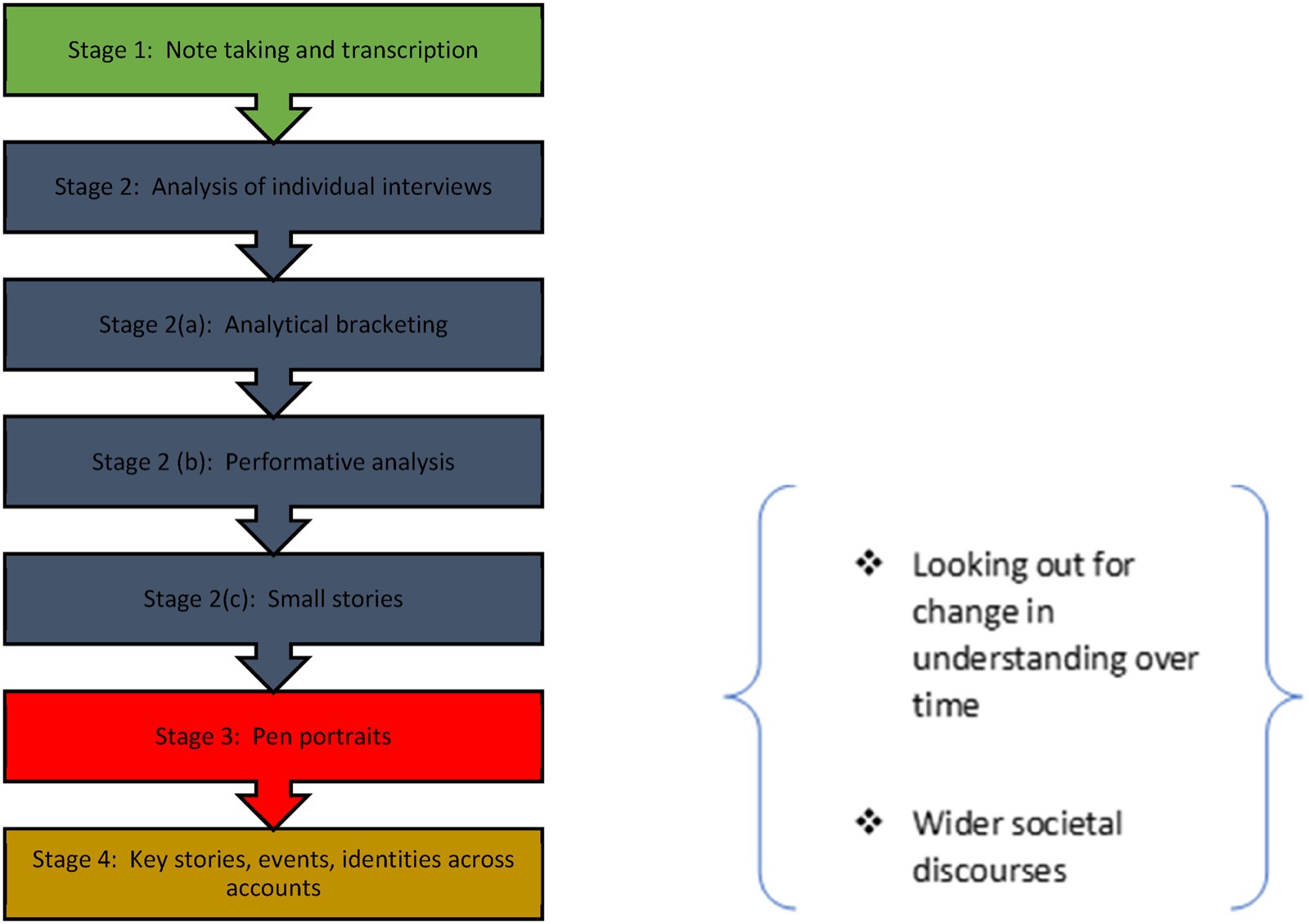
Initial impressions of the interviews and figures of speech that were important were recorded. Narrative accounts were initially analysed employing analytical bracketing and then by analysing the themes, structure and performative aspects of the transcripts (Riessman, 2008). Attention was also paid to how meaning-making changed over time (Clandinin et al., 2007) and the wider societal discourses (Wells, 2011). To improve the quality and credibility of the research, a number of credibility checks were carried out, including data being reviewed independently and compared between the research team and within peer supervision. Finally, analysis of the data was reviewed and compared.
Pen portraits were completed for each narrative and prominent ‘storylines’ identified, particularly those that spoke to the relational identities of the siblings and the events that they privileged about their experiences. Once all four transcripts had been analysed individually, they were then considered collectively, identifying any areas of similarity or difference between or across the narratives. To ensure quality of the analysis, the data were reviewed and compared between the authors.
RESULTS
Two main plots emerged (Figure 2) from the analysis of the participants' narratives: (1) ‘The story of us’ and (2) ‘We are who we are because of what happened’. There was an emphasis on the emergence of key storylines in relation to sibling relationships and identities in the context of PEMD and the emotional experience of the storylines. Additionally, all of the interpretations of the storylines and identity construction were considered within the local and broader context in which the stories were co-constructed.
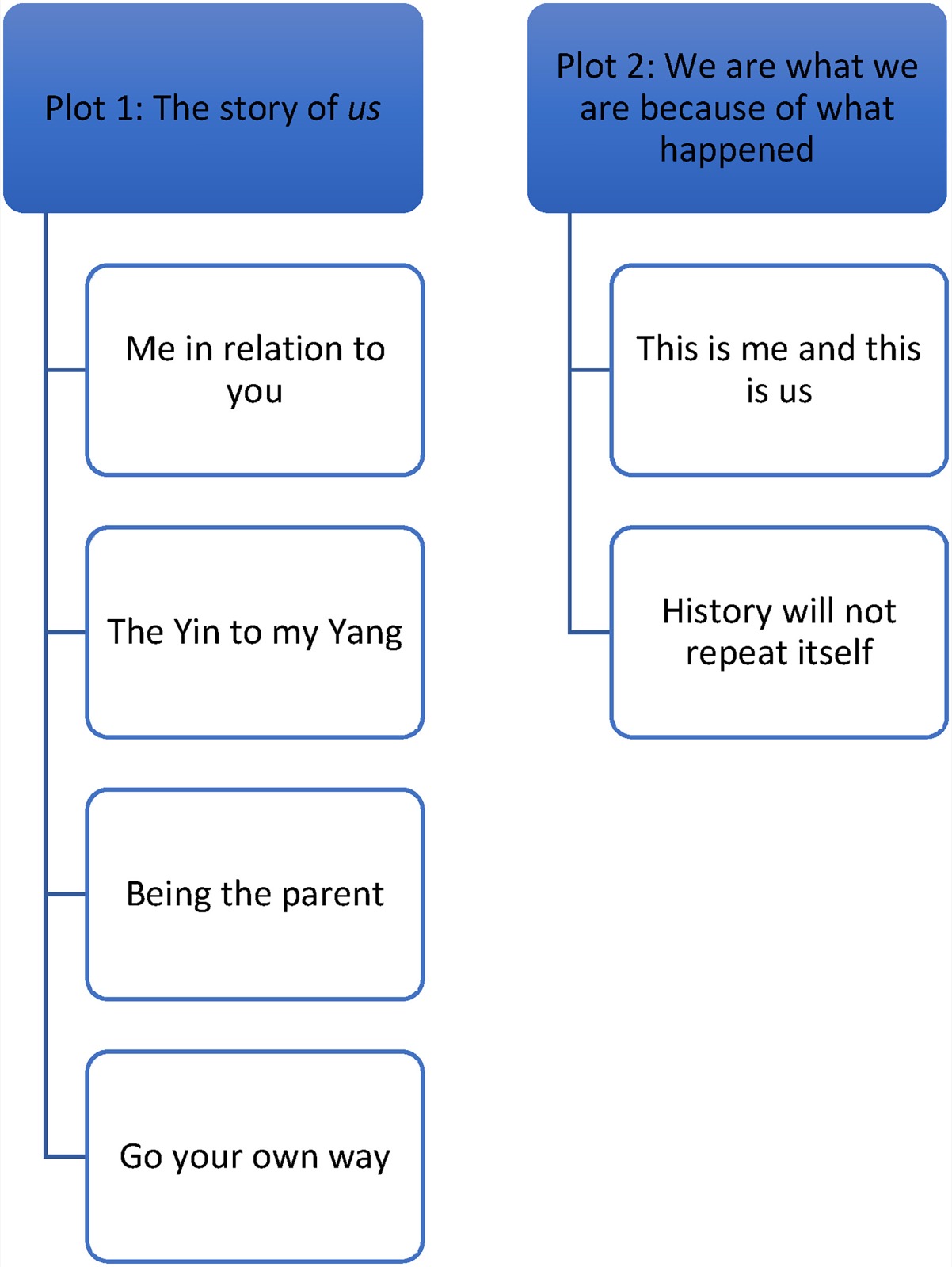
Plot 1: The story of us
The first plot reflected the co-constructed story of the siblings as they grew up in the context of PEMD and the wider societal discourses of mental distress at the time of childhood and later in adulthood. Despite the shared sibling experiences, participants also wanted to speak about the differences in their individual stories, reflecting some of the individuality in themes, and to tell their side of the story to the other sibling. Four subplots were identified as part of the plot.
Me in relation to you
Stories of identity formation in relation to the other sibling were clearly spoken about. The co-construction of identities appeared to be in response to the PEMD, in relation to the sibling and also formed outside of this experience. The recognition of each person's identity was framed in familiar societal discourses. For example, Anna clearly positioned herself as the older sibling, the one who takes the role of ‘big sister’, with Karen's consensus, and there is a tacit agreement that certain characteristics come with being a ‘big sister’. This role had been maintained throughout their relationship.
Anna: Yeah, I'm still big sister aren't I, and I still organised things because I know you don't want to and stuff.
Karen: I think you keep a role, maternal role, still a little bit like not take over, as in I push you towards the leader role a lot to take charge, make decisions.
Hannah acknowledged how important it had been to have an ‘older brother’ who helped them cope with some challenging and upsetting experiences.
Hannah: You don't… you probably didn't realise what you… I don't know, you were just very very supportive.
Aaron: hmm
Hannah: Very very very good older brother, role model.
It was important for Anna and Aaron to be perceived as older siblings, validating the sacrifices and responsibilities that they had taken on, and to be portrayed positively, which contrasted with the reality of their situation growing up. These roles were performed during the interviews, and their relationships were distinguished by how responsibility was devolved during childhood. This in turn appeared to be maintained over time in the sibling relationships.
In the counter narrative to the older sibling identity, it was apparent that the other sibling took a different role and meaning-making within their story. Karen, Hannah and Jane seemed less certain of their understanding of their parent's distress.
Jane: [pause] and I couldn't – I didn't understand and I was absolutely frightened, it… it filled me with fear [pause].
While Jane, chronologically, was the older sister, Denise and Jane had agreed that Denise adopted the older sibling role within the context of their relationship and family system.
Denise: Em and sometimes, although I'm the younger sister there's been situations where I've had to, em, be the responsible- err.. [be the].
Jane: [Very much so]
Denise: I've had to, err take charge of [situations]
This may have been a result of their age at the time and a lack of understanding of what was happening at home when they were younger, or protection by their older sibling. The siblings may have adopted a more distant role to minimise competition and to preserve relationships, and therefore their understanding was less clear. The need for the siblings to create a family hierarchy and structure based on socio-cultural discourses around family roles was in contrast to the chaos narratives told by the siblings in relation to PEMD.
The Yin to my Yang
The siblings discussed the ebb and flow of their relationships, reflecting on times of closeness and distance, being similar and different, and feeling curious about their relationships in comparison with other sibling relationships. Denise and Jane reflected on this.
Denise: "[Some], some people don't make- aren't as involved with their sisters and brothers as much, so you will have relationships where they're extremely close and that's always been or you might have brothers and sisters that maybe see each other twice a year or something or, or who are not as involved in everything… everything
Jane: [We're very]
Denise: [Is slightly] different, I don't know if it is different from other people because of how we've been brought up, I don't know
Jane: Mmm
Denise: This sort of, what's the word, I want- don't want to say enmeshed, what's that word?
Jane: No it is, it's for me wanting to be, it's wanting to be involved with Denise's [life]…”
The subplot also acknowledged the changing way in which the siblings related to each other as they got older or as different life events took place. Three of the sibling pairs told a story of how close they were as children. Aaron and Hannah discussed their close relationship and how they felt they belonged to a sibling club with a secret language and code when they wanted to talk to each other about their mother becoming unwell.
Hannah: We would just give each other a look, and be like, okay she might go off in a bit.
They recalled this shared experience through corroboration and joint construction of sentences, speaking over each other and replaying the excitement of the secrecy they may have experienced as children and a sense of pride that they were able to do this.
Aaron: I think we became quite clever at sending messages to each other.
Lana and Shelby also described feeling like they were closer and more similar than other twins and siblings because of their experience of living with their mother and feeling merged together when they were children.
Lana: …and then there needs to be this little like tight unit looking after mum. It just means you got to be practical about it, it's how we figured it out.
With regard to the changes in the sibling relationships, Jane and Denise discussed the changing nature of their relationship from childhood to adulthood. Jane talked about when Denise was born and reflected that Denise was ‘my world’. There was some uncertainty as to whether their relationship was like other sibling relationships, given their experiences of PEMD and how they related to each other as children and now as adults. The participants spoke about what facilitated close relationships, reflecting that good communication skills, trust, forgiveness, respect, having each other for support and helping each other cope during difficult times with their parents contributed to their close relationships. The idea that the siblings were sharing the experiences helped them form alliances appearing to serve as a protective factor.
Hannah: No, because if anything happened like we'd be there in a heartbeat to help support. So, I think in a way it's just… it's made us more alert with each other. Very protective.
The story of difference was evident throughout the accounts. Three of the four sibling pairs spoke about their experiences of PEMD being different from each other. While situations may have happened to them both, how they responded and the role in relation to each other and their parents affected the meaning-making of the experience.
Denise: As in we've seen the same, we've heard the same, but the way that we've dealt with it is very different and, they're different stories because I can't remember, I've cut myself off from certain things and I can't remember some things, and maybe I don't want to remember some things.
The reasons provided were the role the sibling adopted, either willingly or through necessity, or a sibling not being around for a particular event. For example, Aaron and Hannah described having a different sibling experience because of Aaron's role, which was shaped by their mother's mental distress. Hannah reflected that, because of Aaron's age and position in the family when their mother had her first ‘episode’, she was able to be more childlike and freer whereas Aaron had to be more responsible.
Anna and Karen acknowledged that they also had a different account of their experience, reflecting that they still do not really see each other's perspectives, although demonstrating they had been able to overcome this difference and form a close sibling and friendship bond. Karen and Aaron also felt that the differences were related to different personality styles, and Aaron also proposed that the structure and dynamics of the family made things different for each of them.
Aaron: I think just generally the family dynamic like older brother, middle sister, younger sister. Em I suppose I was… I had more closer than an adult relationship with Dad.
Being the parent
The siblings spoke about not having a ‘normal’ family life or childhood. The use of the word ‘normal’ in the four accounts highlighted their sense of feeling different from others and the isolative effects of their experiences, informed by normative societal discourses.
Jane: But it's only when you grow up and become an adolescent or you mix more, that you realise…
In particular, the siblings talked about not having a childhood and having to grow up sooner than they may have wanted to. There were contradicting narratives of having to be a responsible young person, adopting a parental role, and the recognition that they were unable to be children at home. Additionally, each sibling pair talked about providing practical or emotional support to their siblings and parents, talking to mental health professionals and being advocates and advisors for their parents. For Anna and Karen, the parentified role adopted by Anna created conflict in their relationship when they were younger, as Anna positioned herself as a parent for Karen.
Anna: I was in charge basically, Matt (older brother) had gone to America, I was, had to parent you – Dad worked all the time. So, I was basically your mum.
While Aaron clearly positioned himself as the ‘leader’ and ‘responsible’ sibling who advised his father and was a confidante to his mother, this did not appear to elicit any conflict with Hannah, who readily praised Aaron for the role he took in supporting the family. Hannah reflected that she too had taken on a parentified role when Aaron left. However, she looked for guidance from Aaron when this occurred.
So when you went off to University, that was when I think I had to step up and then I still felt myself… though I still I still found myself on the phone being like Aaron, what do I do?
Aaron welcomed this as he felt guilty that he was unable to be there for the family after he moved out. Lana and Shelby talked about providing care to their mother and developing a sense of competence.
Shelby: …growing up with mom as well like so we were always like very close and I think we definitely, I definitely feel like I took on this which is like I'm fine and I can look after her she definitely gave us a lot of reinforcement, like you two are so good.
This dependence by their mother and their position as her protection placed a lot of responsibility on them. This responsibility felt like a burden for some and stopped the children becoming independent and engaging in adolescent experiences, as they were conscious of not causing any distress to their parent.
Shelby: It would have been really dramatic, really horrible, so there's like that weight of like consequence of like your mum's feelings that I think definitely kept us in check, but it's quite a frustrating thing.
While this was a consequence of parentification, there were other implications from adopting the parental position. For example, Shelby reported that she felt emotionally mature as a child; however, both siblings did not feel that they had the social maturity to cope with the outside world as they got older due to their lack of freedom in childhood. Similarly, for Anna and Karen, Anna acting as Karen's parent caused tension and confusion for Karen, and resentment for Anna for having this role.
Despite adopting an adult role at times, Anna, Karen, Jane and Denise also spoke about having no control over what happened to them as children. Jane had often gone to the pub when she was younger to buy alcohol for her mother; however, this is in stark contrast to feeling like she had no control over the situation, describing feeling ‘traumatised’, ‘frightened’ and ‘scared’.
This parental identity, performed in the context of the interview, was important in demonstrating a sense of pride in their resilience, competence and ability to adopt a mature role when they were younger. However, this was accompanied by the siblings not feeling they had control of their situation because they were children, capturing the tension between sensed responsibility and agency for children of PEMD and also the struggle and loss for these older siblings alongside their sense of pride.
Go your own way
Sibling relationships change over time as life events occur. This was evident in all the accounts as the siblings negotiated the transition of living with each other to living apart. The changing nature of the sibling relationship as they navigated this separation was identified as a subplot. Where the older siblings left the family home first to go to university or to remove themselves from the experience of PEMD, the change in context and separation appeared to create some ruptures and feelings of guilt.
Denise: You feel like you abandoned me.
Anna and Karen's story was interspersed with times of togetherness and times when they were apart, creating occasional conflict and closeness as they negotiated their new roles and living situations. Karen felt that spending time together when she visited Anna at university was the first time that they had ever spent time together where they were able to sit down and talk and find things out about each other.
Karen: You had to spend time with me, and I don't think we'd had that, so actually when we sat down, we were like oh, we actually have a lot in common.
Anna: I guess there's a freedom that you get from being outside of the family home… that you got to see me with all my mates living independently and being who I was.
In this respect, Anna reflected that removing themselves from the context at home and creating a new way of relating to each other when they had found some independence moved the relationship from a sibling relationship to a friendship. The stories of being together and separating and then telling their story together within the context of the interview conveyed the importance of their sibling relationship.
Lana and Shelby also talked about moving out of home for the first time and living independently from each other, describing it as a very difficult time for them and their relationship. Shelby spoke about the challenge of then living together again and the realisation that they had changed.
Shelby: …like so it's sort of like, we're really happy to come back together and still am massively, but it's just different and we have got to get re-used to it.
Aaron and Hannah talked about Aaron leaving home and the challenge this posed as they adopted new roles outside and within the family, respectively. For instance, Aaron spoke about finding it hard to settle into a new life, reflecting that he experienced anxiety, and felt guilty for not being at home to help his siblings and family. Aaron appeared to find it difficult to cope with the change in his role as ‘man of the house’ to a student.
Aaron: So I would phone for a catch-up maybe twice, three times a week or you'd phone me, so we just make sure I was fully aware here.
They talked about their relationship now and with their sister Clare and felt that they have an unusual relationship in how much they keep in contact and enjoy spending time together. Jane and Denise also spoke about the time they spent apart. Jane reported that she would spend nights away at the age of 14 as a way of coping. In contrast, Denise remained at home until her late twenties. Denise talked about how she understood Jane's decision to distance herself from the family; however, Jane felt guilty for leaving Denise at home, which Jane conveyed in the interview, expressing her disdain should Denise have done this to her.
Plot 2: We are who we are because of what happened
This plot described who the siblings had become in adulthood, how they had developed a good understanding of their relationship and how it had been shaped by the context in which they grew up. The narrators also spoke about not wanting to become like their parent, and the measures and resources they have drawn on to ensure that mental distress was not a significant presence in their lives. Two subplots were identified.
This is me and this is us
Each sibling had developed an identity, both personal and professional, in adulthood, borne out of their experiences.
Jane: …well I…, cos I only adhere to discipline, I need discipline; if I don't have discipline, I, I, I need that discipline in my life, and I obviously did as a child,
Five of the eight participants had entered or were entering professions where helping the public was at the forefront. The experiences they had as children, caring for and supporting their parents, had shaped who they were. The impact of living with PEMD had transposed from their personal to their professional identity and the language used reflected this dualism. The stories of competence and achievement countered the socio-cultural narrative of children of PEMD as being some of the most vulnerable and at risk.
The siblings also demonstrated beliefs about who they were as individuals in adulthood, emphasising who they were in the present and introducing other characters to their stories such as boyfriends, husbands and peer groups to portray the transformation in their life stories, supporting the resilience of the siblings in overcoming adverse life experiences. The introduction of these ‘new’ characters and events, such as going on holidays and getting married, showed alignment with the wider societal views of ‘normal’ development, and showed the influence of these societal norms on the siblings. Nevertheless, the siblings privileged their relationship with each other as adults.
Shelby: I think it's made us closer…than other twins than probably most other siblings.
Aaron and Hannah also talked about how communication and having a shared experience enabled the close relationship that they now enjoy as adults.
Aaron: I feel like we had the kind of this understanding and respect for each other that helped foster a much closer relationship and we could communicate better, understand each other a bit better, and I could probably wind you up of little bit easier. [Yeah] we, we have quite unique relationship and a really quite a healthy one…
Anna and Karen reiterated the idea that their shared experience of what had happened to them and being parented by a parent with lived experience of mental distress had fostered a sense of closeness in their relationship that would not have existed without this experience. Some of the siblings felt protective of their sibling even in adulthood and felt the need to look out for them. Humour was an important component, and being able to share a joke and laugh about difficult times was evident in the relationship during the interviews through moments of humour and laughter.
History will not repeat itself
The narrators were conscious of the idea that mental distress ‘runs in families’ with the potential for them to experience their own distress. There was a determination about not repeating the experiences they had with regard to their own mental distress.
Anna: I've just always thought that it's so inevitable that we were going to be mentally unwell, I've always just thought that was written in… in our genetics and I was absolutely not gonna let that happen.
The siblings told stories of not wanting to experience the distress experienced by their parent, and this had made them more vigilant about their own wellbeing entering adulthood.
Shelby: …we know what it would look like if either one of us started being like that. Those were essentials that I can… and there was a feeling of like I'll be able to see it in myself if I start getting ill just so surrounded by it.
The siblings appeared to want to let each other know that they would support each other and that it was permissible for each of them to have difficulties of their own.
Anna: I feel like we can support each other in that way because we can see the little nuances in our behaviour, our own kind of mental health difficulties.
A lot of the language used by the participants in talking about the prevention of psychological distress reflected current societal discourses around mental health and medication, which had helped the participants look after themselves and prioritise their own wellbeing. In this regard, some of the siblings talked about speaking to their friends more openly about their mental wellbeing and drawing on the resources available to them, such as counselling services within educational settings. The siblings appeared to position themselves as advocates for less negative attitudes around distress within their personal contexts, and the reframing of their position also seemed to contribute to their wellbeing.
DISCUSSION
Participants in this study co-constructed their sibling relationships as ‘very close’, and their sibling identities in relation to each other, as well as individual identities, as powerfully shaped by being children of PEMD. The closeness described appeared to contribute to wellbeing and resilience, affirming a shared sibling identity and closeness which continued into adulthood. There was a compelling narrative of having survived and thrived despite challenging and stressful life situations in relation to PEMD. This story seems particularly important to tell as it contradicts the dominant discourse of children with PEMD being particularly vulnerable and at risk (e.g. Goodman et al., 2011; HM Government, 2018), and it supports the perspective that other determinants exacerbate risk and vulnerability for children of PEMD, other than the mental distress in itself (Rutter & Quinton, 1984). It also points towards the protective potential of close sibling relationships in families of PEMD. The sibling pairs in this study had appeared to cope relatively robustly with the stressors associated with PEMD. Not only were they able to draw on their own resources, they were also able to support and/or be supported by their sibling.
The siblings reported how sibling relationships were affected by PEMD at a number of levels, as individuals recounted the positions, roles and responsibilities they took in the family as was needed in response to PEMD. For the siblings, the traditional structure of the family subsystems had been disrupted, with some siblings adopting a parentified position (Byng-Hall, 2008; Minuchin, 1974). These siblings tended to also perform this role during the interview, portraying a sense of ‘precocious competence’ (Aldridge & Becker, 1999, p. 9) when retelling the additional responsibilities they took on as children. It appeared that when one sibling took an affirmative position of action, the other sibling took a position that balanced this, maintaining a sense of homeostasis and potentially mirroring the parental system (Crittenden & Dallos, 2009). Some siblings acknowledged that their sibling relationship had been less cohesive at times, and framed the relationship as tumultuous, because of the positions they took in relation to the experiences of the family and the PEMD. Therefore, when one sibling adopted a parentified role, the role had the potential to create conflict for the sibling pair. Despite these ruptures occurring around roles and transitions, for participants in the current study the sibling relationship appeared to survive, thrive and be protective over time. This powerfully highlights the enduring impact PEMD can have for family relationships. Thus, it is important to consider how the responsibilities and parentification that for some come with living with PEMD can interfere with or disrupt the possible support siblings might gain from one another.
In the current study, the parentified child tended to be the older sibling. It has been reported that older siblings may feel responsible for taking on a parental role or suppressing negative feelings when there are crises in the family (Van Parys & Rober, 2012), which was also characterised in some of the stories in this study. Furthermore, the role appeared to have endured into adulthood and to become an important part of older siblings' identities. Despite this, some siblings reported the fear, uncertainty and trauma they felt at times during childhood. Some of the narrators talked about being ‘enmeshed’ with the parent experiencing distress and their sibling, which created conflict within the individual and in the relationship with the sibling and parent.
Times of transition appeared particularly significant in the sibling relationship, in particular when the older sibling was ready to leave home. This study showed how roles can be taken over by other siblings over time, for example, a younger child taking over a carer role as the other sibling leaves home (Byng-Hall, 2008). The change in the hierarchical power structure within the family potentially had negative implications for the sibling relationships. Siblings reported the challenge of separating from each other or remaining at home, adopting new identities depending on the context with varying consequences for the sibling relationship at that time point.
In terms of making sense of PEMD, most of the siblings shared an understanding that, although each sibling had lived through similar events, their individual experiences, and therefore their meaning-making, had been different from each other. This was reflected in, and appeared to be influenced by, the positioning of the individuals and role that each person adopted within the family system. The research identified that the absence of conversations about the stress at home resulted in a lack of understanding about what was going on, which appeared to exacerbate the feelings of worry and confusion for the siblings. Younger siblings in particular described a less clear understanding of PEMD. Research has consistently shown that a lack of communication in families about PEMD (Gammage & Nolte, 2020), and the accompanying potential for confusion, worry and self-blame for children (Mordoch, 2010), can have a significant negative impact on children's wellbeing. Existing literature points towards the protective impact of a clear and coherent understanding of PEMD (Beardslee et al., 2003). Therefore, this finding is significant in raising awareness of how a child's position and role within the family can influence developing such an understanding.
Finally, in relation to coping strategies, the sibling pairs appeared to cope with PEMD quite differently from each other. All siblings felt that they had no control over the situation growing up with PEMD. The strategies adopted by siblings varied from taking a parental role offering care and protection the other sibling, and creating some distance (e.g. staying away from the family home) to help cope with the stress. Later in adolescence and adulthood, there was an acknowledgement that developing a friendship with the sibling had helped maintain the closeness of the relationships and supported coping. Having coping strategies and a positive relationship in adulthood with a sibling appeared to have helped the siblings make sense of their experiences.
Clinical implications
There are clear implications for practitioners working with children from families living with PEMD. This study adds to the awareness of the potential impact of PEMD for all in the family, including the children. PEMD remains not consistently inquired about by helping professionals (Polkki et al., 2004), and this study highlights again the necessity of exploring parental wellbeing and drawing on family systemic practices when meeting with families. Including this information as part of the assessment acknowledges that PEMD may contribute to a child's experiences of emotional difficulties, and models transparency for the family when discussing PEMD. Additionally, it highlights again that it is crucial that clinicians in adult services become more open and curious about the impact mental distress has on parenting and acknowledge the effect on children (Cleaver et al., 2011).
Furthermore, the focus on siblings highlights the necessity for family-focused and family-inclusive services. In particular, it highlights important areas for family work within the context of PEMD. Firstly, acknowledging and, where appropriate, facilitating the potential for the support siblings can offer one another seems important (Abbey & Dallos, 2004; Rosenberg, 1980). However, this potential can be disrupted by the roles and responsibilities ascribed to siblings within the family. Therefore, opening up conversations about such roles and the implications for individuals and for relationships in the family might be particularly helpful (Byng-Hall, 2008), and considering making time to see siblings without the rest of the family could harness strengths and further support that sibling relationship (Bank & Kahn, 1975; Lewis, 1986). Furthermore, while it is known that children's meaning-making in relation to PEMD is significant in relation to coping and wellbeing (Mordoch, 2010), the current study highlights how a child's role and responsibility in the family can have an impact on developing such understanding. This highlights for practitioners how some siblings might require more support than others to develop a coherent understanding of PEMD.
CONCLUSION
This study has once again shown the impact on the wider family of PEMD, and the reality that for children these impacts extend into adulthood. The research highlighted the potential significance of sibling relationships in families with PEMD. This was a study with a small sample size of participants from a white British cultural background, and it is plausible that a particular subset of siblings put themselves forward to participate. The four sibling pairs participating in the study reported positive and supportive experiences, and the narratives of those with more troubled sibling relationships, sibling pairs of brothers, and siblings from diverse ethnic backgrounds are not present in this study. While these limitations are acknowledged, and there is no intention to generalise the findings, some important implications for systemic practice are highlighted. Sibling roles and responsibilities, such as parentification, and points of transitions, such as leaving home, were identified as having potentially important implications for individuals as well as for sibling relationships. Family conversation (or the absence thereof) and individual and collective meaning-making were highlighted as significant in coping and wellbeing. These aspects have potentially important implications and deserve further research and clinical attention, including research that considers the ways culture influence sibling roles, relationships and meaning-making, as well as how sibling experiences and roles in the context of PEMD impact their own parenting in adulthood.
Complexe Systémique: key points
A small study with a large blind spot: adult services often treat a parent without seeing the siblings who organise themselves around that parent. These stories show siblings working as a subsystem in their own right, with its own hierarchy, secret codes and homeostasis: when one takes the parent’s place, the other steps back, and the balance is replayed even in the interview. Three pointers for clinical work. First, parentification is not only a burden: it is also a source of pride and identity, better acknowledged than denounced. Second, transitions (leaving for university, moving out) reshuffle roles and stir up guilt in whoever leaves. Third, family silence about the illness weighs most on the youngest: seeing the siblings alone, without the parents, can open a space to co-construct a coherent story. A limit to keep in mind: four volunteer pairs, white, British, and all fairly close-knit. Read alongside the article on parentification, and the article on the sibling bond.
Notes from the original
Conflict of interest statement. All authors declare that they have no conflicts of interest.
References
Abbey, C. & Dallos, R. (2004) The experience of the impact of divorce on sibling relationships: a qualitative study. Clinical Child Psychology and Psychiatry, 9, 241–259.
Aldridge, J. & Becker, S. (1999) Children as carers: the impact of parental illness and disability on children's caring roles. Journal of Family Therapy, 21, 303–320.
Aldridge, J. & Becker, S. (2003) Five: towards a systemic approach: ways forward and conclusions. In: Children caring for parents with mental illness. Bristol: Policy Press.
Andrews, M., Squire, C. & Tamboukou, M. (2008) Doing narrative research. London: Sage Publications.
Arksey, H. (1996) Collecting data through joint interviews. Social Research Update, Winter( 15).
Bamberg, M. (2011) Who am I? Narration and its contribution to self and identity. Theory & Psychology, 21(1), 3–24.
Bank, S. & Kahn, M.D. (1975) Sisterhood-brotherhood is powerful: sibling sub-systems and family therapy. Family Process, 14, 311–337. Available from: https://doi.org/10.1111/j.1545-5300.1975.00311.x
Beardslee, W.R., Gladstone, T.R., Wright, E.J. & Cooper, A.B. (2003) A family-based approach to the prevention of depressive symptoms in children at risk: evidence of parental and child change. Pediatrics, 112, 119–131.
Buhrmester, D. (1992) The developmental courses of sibling and peer relationships. In: F. Boer & J. Dunn (Eds.) Children's sibling relationships: developmental and clinical issues. Hillsdale, NJ: Lawrence Erlbaum Associates, Inc, pp. 19–40.
Buhrmester, D. & Furman, W. (1990) Perceptions of sibling relationships during middle childhood and adolescence. Child Development, 61(5), 1387–1398.
Byng-Hall, J. (2008) The crucial roles of attachment in family therapy. Journal of Family Therapy, 30(2), 129–146.
Cicirelli, V.G. (1992) Sage library of social research, Vol. 186. Family caregiving: autonomous and paternalistic decision making. Thousand Oaks, CA: Sage.
Cicirelli, V.G. (1995) Sibling relationships across the life span. Boston, MA: Springer US.
Clandinin, D.J. (2006) Handbook of narrative inquiry: mapping a methodology. Thousand Oaks, CA: Sage Publications Inc.
Clandinin, D.J., Pushin, D. & Orr, A.M. (2007) Navigating sites for narrative inquiry. Journal of Teacher Education, 58, 21–35.
Cleaver, H., Unell, I. & Aldgate, J. (2011) Children's needs – parenting capacity. Child abuse: parental mental illness, learning disability, substance misuse, and domestic violence, 2nd edition. London: The Stationary Office.
Coffey, A. & Atkinson, P. (1996) Making sense of qualitative data: complementary research strategies. Thousand Oaks, CA: Sage Publications, Inc.
Crittenden, P.M. & Dallos, R. (2009) All in the family: integrating attachment and family systems theories. Clinical Child Psychology and Psychiatry, 14(3), 389–409. Available from: https://doi.org/10.1177/1359104509104048
Dam, K. & Hall, E.O. (2016) Navigating in an unpredictable daily life: a metasynthesis on children's experiences living with a parent with severe mental illness. Scandinavian Journal of Caring Sciences, 30(3), 442–457.
Feinberg, M.E., Solmeyer, A.R. & McHale, S.M. (2012) The third rail of family systems: sibling relationships, mental and behavioral health, and preventive intervention in childhood and adolescence. Clinical Child & Family Psychological Review, 15(1), 43–57.
Focht, L. & Beardslee, W.R. (1996) Speech after long silence: the use of narrative therapy in a preventive intervention for children of parents with affective disorder. Family Process, 35, 407–422.
Foster, K. (2010) You'd think this roller coaster was never going to stop': experiences of adult children of parents with serious mental illness. Journal of Clinical Nursing, 19(21–22), 3143–3151.
Gajos, J.M. & Beaver, K.M. (2017) Maternal depression and risk for antisocial behaviour in children. Child and Family Social Work, 22, 349–363.
Gammage, R.J. & Nolte, L. (2020) Understanding and communication about an adult's mental health problem by their adult relatives: a systematic review. Journal of Psychiatric and Mental Health Nursing, 27, 763–788.
Gass, K., Jenkins, J. & Dunn, J. (2007) Are sibling relationships protective? A longitudinal study. Journal of Child Psychology & Psychiatry, 48(2), 167–175.
Goetting, A. (1986) The developmental tasks of siblings over the life cycle. Journal of Marital and Family Therapy, 47, 703–714.
Goodman, S.H., Rouse, M.H., Connell, A.M., Broth, M.R., Hall, C.M. & Heyward, D. (2011) Maternal depression and child psychopathology: a meta-analytic review. Clinical Child and Family Psychology Review, 14(1), 1–27.
Griffiths, C. & Sin, J. (2013) Rethinking siblings and mental illness. The Psychologist, 11(26), 808–811.
Guan, S.S.A. & Fuligni, A.J. (2016) Changes in parent, sibling, and peer support during the transition to young adulthood. Journal of Research on Adolescence, 26(2), 286–299.
HM Government. (2018) Working together to safeguard children: a guide to inter-agency working to safeguard and promote the welfare of children. London: HM Government.
Jenkins, J.M. & Smith, M.A. (1990) Factors protecting children living in disharmonious homes: maternal reports. Journal of the American Academy of Child & Adolescent Psychiatry, 29(1), 60–69.
Kidd, S.A. (2002) The role of qualitative research in psychological journals. Psychological Methods, 7(1), 126–138.
Lagdon, S., Grant, A., Davidson, G., Devaney, J., Donaghy, M., Duffy, J. et al. (2021) Families with parental mental health problems: a systematic narrative review of family-focused practice. Child Abuse Review, 30, 400–421. Available from: https://doi.org/10.1002/car.2706
Lewis, K.G. (1986) Sibling therapy with multiproblem families. Journal of Marital and Family Therapy, 12, 291–300. Available from: https://doi.org/10.1111/j.1752-0606.1986.tb00655.x
Manning, C. & Gregoire, A. (2006) Effects of parental mental illness on children. Psychiatry, 5(1), 10–12.
McHale, S.M., Updegraff, K.A. & Whiteman, S.D. (2013) Sibling relationships. In: Handbook of marriage and the family, 3rd edition. New York, NY: Springer US, pp. 329–351.
Mennen, F.E., Pohle, C., Monro, W.L., Duan, L., Finello, K.M., Ambrose, S. et al. (2015) The effect of maternal depression on young children's progress in treatment. Journal of Child and Family Studies, 24(7), 2088–2098.
Minuchin, S. (1974) Families & family therapy. Cambridge, MA: Harvard University Press.
Mordoch, E. (2010) How children understand parental mental illness. “You don't get life insurance. What's life insurance?”. Journal of the Canadian Academy of Child and Adolescent Psychiatry, 19(1), 19–25.
Office for Health Improvement & Disparities. (2022) Methodology and supporting information: children living with parents in emotional distress, March 2022 update. Available from: https://www.gov.uk/government/statistics/children-living-with-parents-emotional-distress-march-2022-update/methodology-and-supporting-information-children-living-with-parents-in-emotional-distress-march-2022-update
Polkki, P., Ervast, S.A. & Huppoonen, M. (2004) Coping and resilience of children of a mentally ill parent. Society of Work Health Care, 39, 151–163.
Raffaelli, M. & Larson, R.W. (1987) Sibling interactions in late childhood and early adolescence. In: Paper presented at the biennial meeting of the Society for Research in Child Development, Baltimore.
Reupert, A. & Maybery, D. (2007) Families affected by parental mental illness: a multiperspective account of issues and interventions. American Journal of Orthopsychiatry, 77(3), 362–369.
Reupert, A.E., Maybery, D.J. & Kowalenko, N.M. (2013) Children whose parents have a mental illness: prevalence, need and treatment. The Medical Journal of Australia, 199(Supplement 3), S7–S9. Available from: https://doi.org/10.5694/mja11.11200
Riessman, C.K. (2008) Narrative methods for the human sciences. Thousand Oaks, CA: Sage Publications.
Rose, H.D. & Cohen, K. (2010) The experiences of young carers: a meta-synthesis of qualitative findings. Journal of Youth Studies, 13(4), 473–487.
Rosenberg, E.B. (1980) Therapy with siblings in reorganizing families. International Journal of Family Therapy, 2, 139–150. Available from: https://doi.org/10.1007/BF00927383
Rutter, M. & Quinton, D. (1984) Parental psychiatric disorders: effects on children. Psychological Medicine, 14, 853–880.
Scherer, D., Melloh, T., Buyck, D., Anderson, C. & Foster, A. (1996) Relation between children's perceptions of maternal mental illness and children's psychological adjustment. Journal of Clinical Child Psychology, 25(2), 156–169.
Social Care Institute for Excellence. (2011) Think child, think parent, think family. London: SCIE.
Stormshak, E.A., Bellanti, C.J. & Bierman, K.L. (1996) The quality of sibling relationships and the development of social competence and behavioral control in aggressive children. Developmental Psychology, 32(1), 79–89.
Van Parys, H. & Rober, P. (2012) Trying to comfort the parent: a qualitative study of children dealing with parental depression. Journal of Marital and Family Therapy, 39, 330–345.
Waldinger, R., Vaillant, G.E. & Orav, E.J. (2007) Childhood sibling relationships as a predictor of major depression in adulthood: a 30-year prospective study. American Journal of Psychiatry, 164(6), 949–954.
Wells, K. (2011) Narrative inquiry. Oxford: Oxford University Press.
Wertz, F.J. (2014) Qualitive inquiry in the history of psychology. Qualitative Psychology, 1(1), 4–16.
Whiteman, S.D., McHale, S.M. & Soli, A. (2011) Theoretical perspectives on sibling relationships. Journal of Family Theory & Review, 3(2), 124–139.
Widmer, E.D. (1999) Family contexts as cognitive networks: a structural approach of family relationships. Personal Relationships, 6(4), 487–503.
Widmer, E.D. & Weiss, C.C. (2000) Do older siblings make a difference? The effects of elder sibling support and older sibling adjustment on the adjustment of socially disadvantaged adolescents. Journal of Research on Adolescence, 10, 1–27.
Reformatted republication of Sibling stories of parental mental distress, by Wendy O’Neill, Pieter W. Nel, Nic Horley and Lizette Nolte, Journal of Family Therapy, vol. 46, no 2 (2024), doi: 10.1111/1467-6427.12452, under a CC BY 4.0 licence. Edition and layout: Complexe Systémique, September 2026 — the work has been modified under the terms of the licence (table presented as a list). Neither the authors nor the publisher are responsible for this edition; the original version prevails.
This is the original article “Sibling stories of parental mental distress”, published in Journal of Family Therapy (2024) under a CC BY 4.0 licence. Republished by Complexe Systémique: the author’s text is unchanged; only the presentation has been adapted for reading online, as set out at the head of this page.
Read the original articleHow to cite this article
O'Neill, W., Nel, P. W., Horley, N., et Nolte, L. (2024). Sibling stories of parental mental distress. Complexe Systémique. https://app.complexe-systemique.com/en_GB/articles/sibling-stories-of-parental-mental-distress (Original work published in 2024 in Journal of Family Therapy, 46(2), 121-139 (2024); republished in 2024 by Journal of Family Therapy, https://onlinelibrary.wiley.com/doi/full/10.1111/1467-6427.12452)
To go further
- Parentification: when to worry and what to doRecognising parentification.
- Brothers and sisters: the invisible bond that shapes our livesUnderstanding the sibling bond.
- Exploring the triadic parent–child–sibling relationship: How do mothers’ view of their children impact sibling relationships?The parent–child–sibling triad.
Related training courses
 Symposium
Digital technology, AI and mental health
Conference in Lyon, 11 December 2026: digital technology, artificial intelligence and mental health. Six talks, replay for participants. In French.
 Short course
The suicidal crisis in adolescents and young adults
Training: assessing and supporting the suicidal crisis in adolescents and young adults. Clinical landmarks and systemic tools. In French.
 Online course
Master the art of narrative therapy: a unique journey with Charlie Crettenand
Immersive online course: discover the narrative approach with Charlie Crettenand. A unique audiovisual journey, lifetime access, exercises. In French.
Related articles
 Article
 “Tired of Being Tired”: Intergenerational Trauma and Relational Bridging Among 1.5‐Generation East African Refugees
Sixteen Somali, Oromo and Ethiopian refugees who arrived as children describe their role as bridges between generations, between inherited silences and burdened resilience.
 Article
 Toxic, narcissistic, borderline: what therapy speak does to your relationships
Narcissistic, borderline, toxic: therapy speak has left the consulting room. Julien Besse shows how these labels close the debate and relieve us of our own part.
 Article
 Silent Witnesses, Protective Bonds: Sibling Memories and Shielding Behaviors in Households Affected by Intimate Partner Violence
Fourteen sibling pairs recount how they protected one another during violence between their parents: a “sibling shield”, divergent memories, a long silence.
 Article
 Redefining Grandparenting in Autism: A Qualitative Study of Emotional Experience and Role of Grandparents
Ten grandparents of autistic children describe grief, anger and hope, and a reinvented role: scaffolding, supporting their child, training, asking for help.