Systemic Practice and Action Research · Systemic practice
Systems Thinking in Practice (STiP): A Praxeology for Our Times
Peter Checkland taught a whole generation of systems specialists to start from situations rather than systems. Yet his soft systems methodology left the person who practises it in the shadows. Ray Ison and Kevin Collins, who have taught systems at the Open University for decades, revisit this legacy and propose leaving the “hard” versus “soft” dualism behind to put praxis, and the person who acts, back at the centre.
This is a reformatted republication of Systems Thinking in Practice (STiP): A Praxeology for Our Times, by Ray Ison and Kevin Collins, published in Systemic Practice and Action Research (Springer) (2026), doi: 10.1007/s11213-026-09775-0, under a CC BY 4.0 licence. Prepared by Complexe Systémique in September 2026: the authors’ text is unchanged; the layout has been adapted for reading online, which constitutes a modification of the work under the terms of the licence. This edition was made neither by the authors nor by the publisher, who are not responsible for its content or for any errors. The original version prevails.
With the emphasis on the person instead of the method, there is an urgent need to develop an ethical pedagogy for STiP.
Ray Ison and Kevin Collins
Abstract
Peter Checkland’s groundbreaking work on soft systems has been central to reframing understanding of human activity systems and emphasising the role of people in decision making. But in the success of soft systems methodology, the practitioner and their praxis have received less attention. In this paper we explore some early influences on Checkland which led to the welcome shift of systemicity to the process of inquiry into the world and also the framing choices resulting in a trap of hard-soft dualism. Informed by our own teaching and research experiences, we offer some critical reflections on the ‘soft-approach’ based on the Open University’s 55-year relationship with Checkland and his influence on the systems teaching and research praxis developed at the OU. In seeking to address some of the limitations of SSM (soft systems methodology), we outline how systems teaching at the OU by reframing hard and soft into a duality affords new ways of conceptualising praxis and a renewed focus on the practitioner. In recognising that all practice is embodied and situated, we account for the emergence of Systems Thinking in Practice (STiP) as a systemic model of praxis. Extending this into notions of co-inquiry as an adaptive ‘soft approach’, we briefly explore aspects of the application of STiP-informed social learning approaches to socially owned sustainability issues. As calls for systems approaches increase, the paper concludes with a call for more overt scholarship of praxis beyond a primary focus on methodology if we are to secure systemic improvement and betterment in situations of concern.
Keywords: Checkland, Soft systems, SSM, Duality, Praxis, Systems thinking in practice
Introduction
The framing-choices made in a recent editorial for a special edition of this journal (see https://link.springer.com/collections/ceeijiigee) drew attention to the distinction between the theory and the methods of ‘soft systems.’ Soft systems theory, it was claimed, raised philosophical questions about the notion of ‘system’, teleology, and what constitutes a valid ‘system of interest’ (Stowell 2025). Within a decade of Peter Checkland beginning his 30+ year action research endeavours at the University of Lancaster in 1969, a plethora of new terms were created and released to the world e.g., soft/hard systems; soft/hard systems approach; soft systems analysis; soft systems methodology (SSM). A timeline of developments and some contributors are outlined in Table 1. This Table is provided for critique, and a settling of the narrative around the legacy of Checkland’s work following his death in May 2026. Despite regular definitive accounts of what came to be called SSM by Checkland and colleagues, considerable confusion and ambiguity remains amongst theorists and practitioners. This confusion irked Checkland right up to the time of his withdrawal from academic life. In addition, the significant contribution of the Open University (OU) Systems Group created in 1971 is frequently overlooked in accounts of the ongoing evolution of the ‘soft’ lineage in the period 1977-26.
Table 1 — Summary timeline of some key concepts and shifts on the pathway to STiP (systems thinking in practice)
- 1955. Geoffrey Vickers publishes ‘Cybernetics and the Management of Men’ in The Manager.
- 1965. Vickers’ ‘The Art of Judgement’ Chapman & Hall, London, published. Vickers becomes a key influence on Checkland’s work and is championed by OU Systems Group (e.g. the OU holds Vickers’ archive)
- 1969. Checkland takes up the Chair of Systems at the University of Lancaster in the postgraduate Department of Systems Engineering (later Systems then Systems and Information Management); Checkland attends week-long event in UK run by C West Churchman; influenced by his work; a key link to American pragmatism.
- 1971. C West Churchman’s book published: The Design of Inquiring Systems: Basic Concepts of Systems and Organization. Basic Books, New York, 1971
- 1977. Naughton, J.J. The Checkland Methodology – a Reader’s Guide, Open University Systems Group (Written for Systems Summer School)
- 1979. Naughton, J.J. (1979): The Checkland Methodology – a Reader’s Guide, Second Edition, Open University Systems Group
- 1980–1984. Mingers uses “interpretivist” in early systems-methodology critique e.g. Mingers (1980)
- 1981. Naughton coins “soft systems” as a parallel, more practice-oriented label
- 1982. Jackson’s (1982) paper frames Churchman/Ackoff/Checkland’s work under the interpretivist/soft systems banner; this can be seen as a precursor to the ‘critical systems approach’ developed at Hull.
- 1984. Naughton, J.J. (1984a, 1984b): Soft Systems Analysis – an introductory guide, Open University Press written for new OU course ‘Complexity. Management & Change. Applying a Systems Approach’ (T301). Naughton creates an audio tape based on interview with Checkland for T301 called: Soft Systems Analysis The Open Systems Group at the OU publishes ‘The Vickers Papers’ (Harper & Row, London).
- Late 1980–1990’s. Interpretivism and SSM as terms spread into IS discipline; becomes one pole of the “paradigm wars” (positivism vs. interpretivism) 1984 - System of Systems Methodologies: Jackson and Keys (1984) proposed a “meta-methodology” to evaluate which systems tools best fit different, complex problem contexts. 1991 - Consolidation: Jackson and Flood synthesized these evolving ideas into Critical Systems Thinking (Flood and Jackson 1991)
- 1998. Checkland and Holwell (1998) publish their book which explicates what became known as the FMA framework for doing action research (in the context of IS) – see also Jackson (2025)
- 1999 onward. Retrospective histories (e.g. Checkland’s 30-year retrospective Checkland 2000b) seemingly consolidates “interpretivist” as the standard epistemological gloss for the whole soft/SSM tradition
- 2002. Checkland presents his paper to the OU Systems Society: Checkland (2002) ‘The role of the practitioner in a soft systems study’, Makes clear to a new audience that doing SSM is an enactment of Churchman’s process of inquiry.
- 2000 +. Refinement via Maturana/second-order cybernetics (Ison 2008; Armson 2011; Paucar-Caceres and Jerardino-Wiesenborn 2020), authenticity criteria (Stowell), and epistemological/ontological distinctions within interpretivism itself. SSM-inspired action research approach informs OU-based social learning research and systemic inquiry in social-environmental contexts e.g. water catchments.
- 2008 +. A new Masters programme in Systems Thinking in Practice at the OU committed to a practice/praxis perspective, decentering the established mainstream focus on methodologies and the conservation of conceptual dualisms rather than enacting dualities.
Concern with ’soft systems’ questions and concepts emerged concurrently within the long relationship between Peter Checkland and the Open University (OU) Systems Group (Ison 2026; Maiteny and Ison 2000).1 The OU-Checkland relationship began with a visit to Lancaster in the early 1970 s by two of the first appointed Systems academics at the OU (John Beishon and Geoff Peters). Checkland later claimed (Checkland to Ison, pers comm 1994) that ‘it was the teaching of SSM at the OU that put SSM on the map.’ Checkland (1994) also said: ‘I like to think we influenced the OU in making ST (systems thinking)relevanttoreal situations.’ Checkland’s relationship with Systems academics at the OU remained close throughout his career – he served as external examiner, engaged in critical reading of course material, lectured at summer schools, undertook some small consultancies and served on several Chair appointment panels. In 1980 he spent a 3-month sabbatical at the OU and was awarded an Honorary Doctorate by the OU in 1996. This close relationship did not preclude OU academics critically engaging with and adapting, Checkland’s work. John Naughton, for example, was the first to write a set of constitutive rules for the doing of SSM (Naughton 1977, 1981).
Whilst OU course developers were influenced by the work of Checkland and his colleagues throughout the 1970s it was not until 1984 that the ‘soft systems approach’ was introduced to OU students as one of three systems approaches (along with the Hard Systems Approach and the Failures Approach) in a new course ‘Complexity, Management and Change: Applying a Systems Approach’ (T301). Since that time Checkland’s work has informed in some way all OU systems courses (now called modules) as well as being used in internal consultancies or action research framed as systemic co-inquiries (see Naughton 1981; Armson 2011). In teaching this represents a significant commitment: a module at the OU is the product of a major R&D effort by a multidisciplinary team that might take up to three years to develop and might cost up to £1 million (see Ison 2026).
Despite a significant literature we will contend that there remains some confusion about what exactly constitutes ‘an approach’, a methodology and a praxis/praxeology of systems (i.e. systems practice). To these ‘system inquiry or co-inquiry’ as a mode of praxis could be added. Checkland’s 30-year retrospective of SSM (Checkland, 2000a, 2000b) together with his later overview in ‘Learning for Action’ (Checkland and Poulter 2006), his autobiographical retrospective (Checkland 2011) and biographical reviews of his career (Jackson 2000) offer readers a detailed and insightful account of the origin of ‘soft systems’ and SSM. Whilst we do not claim or wish to offer a similar detailed account of the ‘soft approach’ or SSM since then, we do offer critical reflections drawing on our own experiences during the last 25 years of using soft-systems-informed Systems Thinking in Practice (STiP) approaches in our situated praxis (including research praxis).
This paper is concerned with the influences between Checkland’s work, the systems teaching and research praxis developed at the Open University (OU) and the emergence of STiP as a reframing of systems praxis that assimilates much of what became framed as ‘a soft approach’. Within this framing SSM is also an exemplar, the primary exemplar, of a soft approach, but not exclusively so. The STiP approach displaces methodology, and methodology choice as central elements of praxis in favour of placing the systems thinking practitioner (STP) as central to their own practice i.e., a reframing of STiP as a praxeology (a concern with the “science’ of practical human action) for the enactment of soft and hard approaches but abandoning the unhelpful dualism these terms have become (Box 1).
Box 1 Praxis and praxeology
Derived from the Greek, praxis means “deed, action, or practice”. It is the process by which a theory or idea is enacted, embodied, or realized through willed action and over time becomes a practical social activity. Praxis requires a situated, embodied practitioner.
Praxeology is the branch of knowledge, or knowing (aka praxis), that deals with practical activity and human conduct (sometimes referred to as the science of efficient action, though in our work we refer to the conduct of effective, purposeful action) (based on Brown (1993).
Our paper is written as a reflexive account based on the experiences of the authors with ‘soft approaches’ including the creation of STiP. Our first serious engagements with SSM came in 1985-8 for Ison at Hawkesbury Agricultural College (Packham et al. 1988) and jointly in 2001-4 (Collins et al. 2007). Before that, Ison had primarily engaged with SSM as an educator at Hawkesbury where Checkland’s scholarship, SSM and other ‘soft approaches’ were very influential (Bawden et al. 2025; Bawden and Ison 1992; Macadam and Packham 1989). Our reflections cover two major themes:
- (i)
OU-originated reframings of the doing of SSM as a ‘soft approach’, moves away from the soft-hard dualism and the emergence of STiP as a meta framing for systems praxis, especially systems co-inquiry; - (ii)
learnings and collaborations based on our individual and joint engagements with Checkland, SSM (hereafter sensu Checkland) and our own use and elaborations of STiP based on adaptations of soft-approaches particularly in multi-stakeholder contexts typical of social problems that effect human-biosphere relations such as river catchments.
In Part 2 we raise some framing issues associated with this paper and in others’ use and interpretation of ‘soft systems.’ In Part 3 we juxtapose SSM (sensu Checkland) with adaptations made to SSM (as an exemplar of a soft approach) within the OU Systems Group i.e., the emergence of STiP. Our paper offers an interpretive accounting and re-framing of the history of soft approaches from our perspective and draws on materials and experiences generated via the relationship Checkland had with the OU.1 Part 4 offers a brief commentary on situating STiP enactment as part of a process, and institutional form for systems (co)inquiry and systems governing and as an antidote to the hegemony of ‘projectification’. Drawing on our own research and scholarship Part 5 briefly sets out how we sought to use the legacy of SSM within our STiP praxis to effect systemic change for sustainability. Concluding reflections are in Part 6.
Some Framing Choices
The framing offered in the guidance for the special issue (referred to above) claimed that Checkland’s work highlighted the inescapable role of subjectivity in shaping the way that we perceive the world (see also Jackson 1982). This is a framing choice we seek to resist because, as posed, subjectivity has to be understood as a dualism, a self-negating pair with ‘objectivity’ the other member. The trap that arises when dualism is chosen/utilised rather than a duality is a weakness of contemporary scholarship, including cybersystemic scholarship (Box 2). As we will outline, the terms ‘hard’ and soft’ have also become an unhelpful dualism rather than a duality, a holistic totality (Ison 2024). We argue the need to abandon in teaching and practice use of the hard/soft dualism that may have made sense in the early 1970 s, but which has for some time lost its utility in academic and practical terms (Ison 2008, 2010).
Box 2. Distinguishing between dualism and duality
Dualism describes antagonistic or negating opposites: mind/matter, objective/subjective, Brexit/Remain. Two concepts form a dualism when they belong to the same logical level and are perceived as opposites. The logic behind this dialectic is negation. Negation takes a proposition p to another proposition not-p. Not-p is interpreted intuitively as being true when p is false, and false when p is true. It fuels pugilistic media interviews and adversarial politics. Modern duels are fought with dualisms of ideas and words rather than pistols. In research a classic dualism is the pair subjective/objective which in its use has carried many unhelpful entailments and ignores recent developments in the biology of cognition.
Dualistic thinking is a product of the prevailing objectivist Cartesian world view, with its orthodox logic, under which we are still brought up. In science, it was not until it was recognized that phenomena we observe in ‘nature’ are not independent of our acts of observing them. The wave/particle paradox of quantum mechanics was resolved by appreciating that their observed behaviours are complementary and constitute a duality rather than a dualism. Taken together they do not negate each other but create a unity, or a whole. The same can be said for the pair predator/prey in ecology and, we will argue, the pair hard/soft reframed as systematic/systemic in STiP.
Choices that unknowingly or knowingly draw on dualisms rather than dualities undermine systems thinking in practice as a holistic, relational praxis (Ison and Straw 2018; Ison 2024).
What is undoubtedly important are the framings Checkland offered to: (i) begin one’s practice with situations, not systems and (ii) see situations as if (they are) ‘human activity systems’ and (iii) to place persons at the centre of organizational ‘problem solving’ and decision making. Despite these key insights much of the discourse generated is about SSM, the methodology rather than as an exemplar of a ‘soft approach’, operating with a central leitmotif of a practitioner with a history, a tradition of understanding, engaging in purposeful human action to improve complex, real-world situations.
In seeking a critical accounting of the forms of praxis that Checkland’s work can inspire, it is possible to claim that the turn from taking ‘a soft approach’ to ‘doing SSM’ has had a reductive effect – a turn from an ethos of situated praxis into the systematic application of a methodology (and all too often of a method). There is also the issue of the domains of praxis in which the ‘soft approach’ and/or SSM has, and will, be applied. In an answer to the question: ‘where do you think the [soft] approach will go in the future?’ (Naughton 1984a), Checkland replied:
‘.virtually all of our experience…derives from situations which are problematical situations within organisations whereas of course many of the most important problems that face us aren’t organisational problems, they are the kind of problems which are owned by society and we don’t yet know how to use the methodology for problems of that kind……I would like to see some work done on how to press this approach into problems of that kind….’.
This reflection by Checkland sets initial starting conditions which frame much of our joint career based at the OU. In many ways the shift seen as desirable by Checkland has not arrived, or only partially. Checkland (2008) was able to write (to Ison, pers comm) that ‘I recently examined a PhD in the School of Chemical Engineering at Manchester University …it used SSM to develop a framework for seeking sustainable development….I’m glad to see discipline boundaries crumbling’. Unfortunately, these boundaries have not crumbled fast enough, and as outlined in Klein et al. (2025), the expansion of systems thinking and approaches into a growing number of domains has not carried with it a concomitant deepening of Systems (hereafter cybersystemic) research and scholarship per se i.e., a research praxis grounded in action research, situation improvement as well as tested conceptual and methodological innovation as pursued by Checkland and colleagues at Lancaster but with an added concern for the development of a systems thinking practitioner’s embodied and situated praxis. It is also timely to return to the critique initiated by Jackson (1982) regarding the efficacy of various systems approaches and their enactment in effecting meaningful change.
In the next section we offer our interpretive account of the ‘soft approach’ and SSM together with some further reframing.
An Interpretative Accounting of SSM as A ‘Soft Approach’
Stowell (2024; 2025) traces out much of the SSM history (from his perspective). He thus provides an opportunity for SSM scholars to triangulate on the interpretations and claims we make.
Checkland’s Initial Starting Conditions With His ‘Action Research Project’
In any systemic engagement with a situation, it makes sense to consider initial starting conditions. Checkland’s professorship in Systems began in 1969. His appointment to the postgraduate Department of Systems Engineering followed a career in chemistry at the University of Oxford and then at ICI. At Lancaster he entered a milieu mainly staffed by colleagues shaped by two academic lineages: systems engineering and systems analysis such as that developed by the RAND corporation (Levien 1997; see also Checkland 1993 pp. 14–15; Ison 2026).
In 1972 Checkland made the case for a shift away from the then mainstream, hard systems tradition (as he labelled it in his writing), with its focus on goal seeking, the language of problems and solutions and assumptions that systems existed in the world and could be engineered (Checkland 1972, 1985). Instead, he proposed a new ‘soft systems’ tradition oriented to learning that assumed that the world was filled with problematical situations that could be explored using systems models as epistemological devices for knowing, learning and changing. Checkland’s ‘approach talked the language of issues and accommodations, or in other words, incorporated within it, a systemic theory of change, rather than employing the dominant linear, systematic, change model, then (and still) pervasive (Checkland 1985).
Checkland’s response to the failings of an ‘engineering-oriented’, ‘hard’ approach to effect improvement in management situations prompted his commitment to developing SSM (Checkland 1972). Checkland (1981) had by the time of his first book realised (and articulated) that the then prevailing RAND, Operations Research (OR), mainstream management science and systems engineering approaches had to that point been unaffected by theoretical development of systems thinking, instead being ‘systematic rather than systemic’ (p.95).
Checkland (1981; 1993) does not elucidate why he chose to use and perpetuate the hard/soft terms in his work. Naughton (1984a p.6) in his introductory guide to soft systems analysis, written for OU students says:2
- ‘‘hard systems analysis’ [means] applied work in designed technical systems or research on problems for which goals can be specified, performance monitored and implementation achieved… systems engineering [etc]’.
- ‘‘soft systems analysis’ …is an approach which favours an organizational-learning approach over the problem-solving approach of ‘hard’ systems analysis …‘Soft’ analysis thus moves from finding out about a complex problem-setting involving people to taking action which will effect tangible improvement in the situation’.
He goes on to say (p.7):
- ‘The adjectives ‘hard’ and soft’ do not mean ‘difficult’ and ‘easy’ respectively but are ways of describing two approaches to systems analysis.’ (our emphasis)3
From this account by Naughton the following framing failures were unknowingly incorporated within the early writings about SSM:
- It was the approach that was either hard or soft, not the system – this subsequently fed the trap of reification of a system as real (i.e. ontologies) and the focus on praxis (an approach; a form of analysis or inquiry) was lost to most (Ison 2026);
- Despite his disclaimer about not being difficult or easy the subsequent actions of most OU students (located in a Faculty of Technology) reinforced a worldview that because hard involved quantification it must be more rigorous. This contributed to the unhelpful soft/hard dualism (see below).
Other influences shaped the trajectory of his action research project but sometimes these were not as apparent as perhaps they should have been.
Churchman Influences
The influence C West Churchman, the systems scientist, had on Checkland is apparent from his first book (Checkland 1981) but some of the influences were subjugated in the early part of his career. Although not revealed till after his retirement in 1997, Checkland spent a week prior to taking up his post at Lancaster in an event designed and run by Churchman, author of ‘The Design of Inquiring Systems’ (1971) (pers. comm to Ison 2005). Later in an autobiographical review (Checkland 2011 p.500) he says:
'In 1969…there occurred one of the most important weeks of my life. I discovered that our colleagues in the Operational Research Department had persuaded an American, C. West Churchman to give a one-week course called ‘The Systems Approach’… The most important idea I brought away from that week …tuned out to be of crucial importance in my own work, was that of Weltanschauung (or world view).'
Churchman was the first to use in print the term ‘wicked problem’ (Churchman 1967), a concept subsequently attributed to Rittel and Webber (1973). However, Checkland did not choose to use (or articulate) a ‘wicked framing’ in his writings until, it seems, his autobiographical reflection (Checkland 2011):
'When I later came across Rittel and Webber’s phrase ‘wicked problems’ (1973) I found it an excellent description of what managers continuously struggle with ….So my high-level research question could be stated as something like: ‘Can systems ideas inform a more holistic approach to tackling wicked problem situations?'
The terms ‘wicked’ or ‘tame problems’ do not appear in the glossary or index of his first and second book despite his 2011 account. Like Checkland, our own research careers can be seen as similarly pursing this research question but within largely different domains i.e., in the context of the ‘super-wicked problem’ (Levin et al. 2012; Feather 2023) of human -‘nature’ relations (Collins and Ison 2009).4 Ison et al. (2014) provide a critical account of what Rittel and Webber did when they coined the terms ‘wicked’ and ‘tame’ problems and explore why an effective praxis for addressing ‘wicked problem’ situations has never been institutionalised thus meaning that much public policy continues to fail (see also APSC 2007; Ison and Straw 2020). It is not clear why this remains the case, though we suggest a human and cultural preference for solutions, by default, invokes and requires a problem – perhaps the ultimate dualism that has shaped lives, societies and economies in recent centuries.
It can be argued that the reductive effects of focusing on method/methodology (M) rather than praxis, which is practitioner rather than M-focused, within the broader systems community and in relation to the ‘soft approach’ has held back institutionalising inquiry-based approaches to engaging with wicked problem situations. This is an area for further scholarship and institutional innovation. Churchman had significant influence on several systems scholars who took up his ‘inquiring systems’ or ‘inquiry systems’ approach (Francois 1997; van Gigch 1986; Leddington 1992; Mitroff and Linstone 1993) but as with SSM per se these have not been institutionalised into contemporary governing praxis (Ison and Straw 2020).
In his first book ‘Systems Thinking, Systems Practice’ Checkland (1981) cites Churchman extensively and makes the claim (p.19) that:
‘[SSM] can be seen to be an operationalization of Churchman’s philosophical analysis of enquiry systems,or a means of formally orchestrating what Vickers terms ‘appreciative systems’.
Over 20 years later at an OU event Checkland (2002) expanded upon his 1981 claim that enacting SSM was also the enactment of a ‘systemic inquiry’ (sensu Churchman). Figure 1 was prepared and delivered by Checkland at that OU meeting (see Ison 2010). It needs to be understood as a high-level activity model that summarises what Checkland considered as necessary for the enactment of SSM as an inquiry/learning and action research process. But it might equally be understood as a meta-level activity model for designing and enacting a ‘soft approach’. Whilst the model drew mainly on Checkland’s SSM practice it could equally be applied at a meta-level to the enactment of STiP (see below) including any one of the various methodologies that make up the ’systems field’ (Reynolds and Holwell 2020). We thus make the same claims for STiP as ‘soft-SSM’.
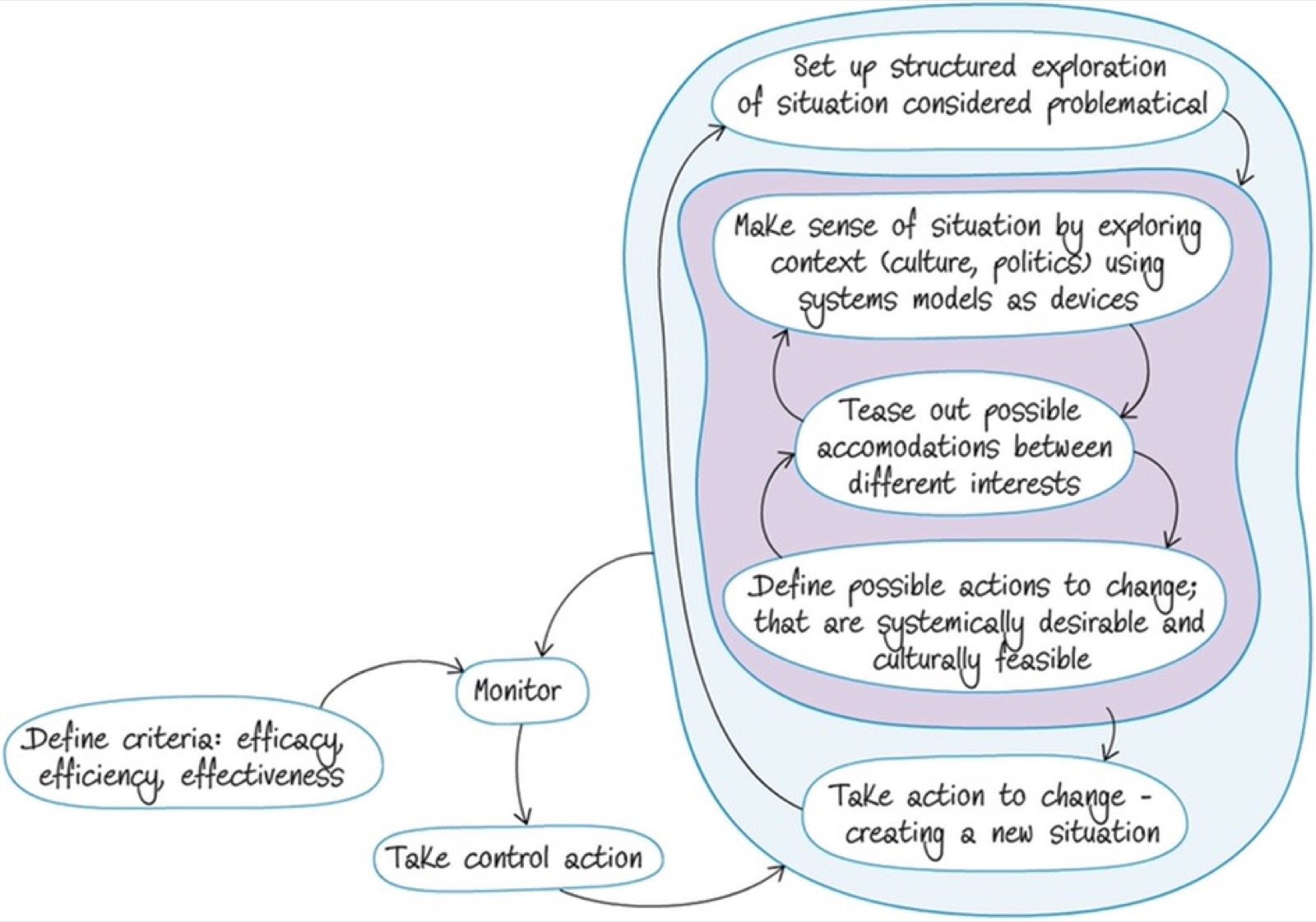
As Ison (2010/17) outlines, inquiry-based practice has been a concern within different systems practice lineages for many years (Helme 2002). Blackmore (2009) traces some of the antecedents in the systems field to current practices associated with ‘inquiries’, identifying three primary lineages:
- What Schön (1995) called ‘Deweyan Inquiry’ (1933) i.e. thought is intertwined with action and inquiry begins with ‘problem situations’.
- Inquiry based on Vickers’ idea of appreciative systems (Checkland 1994; Vickers 1965, 1970).
- Churchman’s (1971) inquiring systems, particularly in the sense of recognising that there are many possible worldviews and perspectives.
Checkland’s subsequent articulation of the use of SSM as a systemic inquiry (2002) can be understood as an ‘ideal type’. Checkland conceptualises the enactment of SSM as an action-oriented approach which finishes when those involved agree to finish. The intention of enactment is to produce a change. It is not about introducing or creating ‘a system’ but producing changes in situations that are systemically desirable and culturally feasible. Importantly what is systemically desirable is the product of systems thinking associated with formulating system-of-interest activity models that act as epistemological devices so as to better ‘know’ what might be systemically desirable. What is culturally feasible depends on the praxis – who learns and knows in the inquiry process i.e., systemic learning or social learning can shift what is culturally feasible in a situation of concern.
In our own work change is mainly manifest as changes in understandings, practices and social relations amongst those involved (including power relations), changes in process or changes in structures (including institutions), i.e., social learning (Ison et al. 2007; Collins et al. 2009). The products of SSM enacted as a systems inquiry (or co-inquiry) does not, once mastered, demand the systematic enactment of method because one is no longer enacting SSM per se.
Checkland (2011) makes the important claim (p. 510):
‘We found that instead of thinking that we were addressing ‘systems’ in the world which needed to be improved,we found – because of multiple worldviews – that we were addressing ‘situations’ in the world,ones which were seen as problematical …. we also found that we were building an inquiry process which,in use,needed to be treated as,and constructed as ‘a system’: in fact a learning system’.
In 1995-6 Checkland was the recipient of a Senior Fellowship to undertake research that braided developments in SSM with that of ‘appreciative systems’ as developed by Sir Geofrey Vickers; it is unfortunate that the work done on this project was never finished and published.
The Hard-Soft Dualism
In the 1990 s systems educators at the OU became concerned about the limitations of the hard-soft dualism that Checkland had created and which was central to the third level course (T301). Students (almost all mature age) frequently fell into a trap created by having to meet a designed-in pedagogic need to choose and use one of the three approaches in a situation: a hard, soft or failures approach. Over time the student view became that hard approaches were rigorous (and often quantitative) whereas soft approaches were fluffy, messy and subjective. This was of course a misreading of the approaches and said more about the dominant experiences and worldview of the students than anything else. From an educational perspective, the hard/soft dualism became increasingly unhelpful and attracted external critique as well.
Checkland, unlike many other systems scholars, shifted the attribution of systemicity from existing in the world to the process of inquiry into the world (Checkland PB 2000a, 2000b); Fig. 2). We have followed in this tradition within our own work on the design and enactment of learning systems (Collins and Ison 2010; Ison et al. 2021).
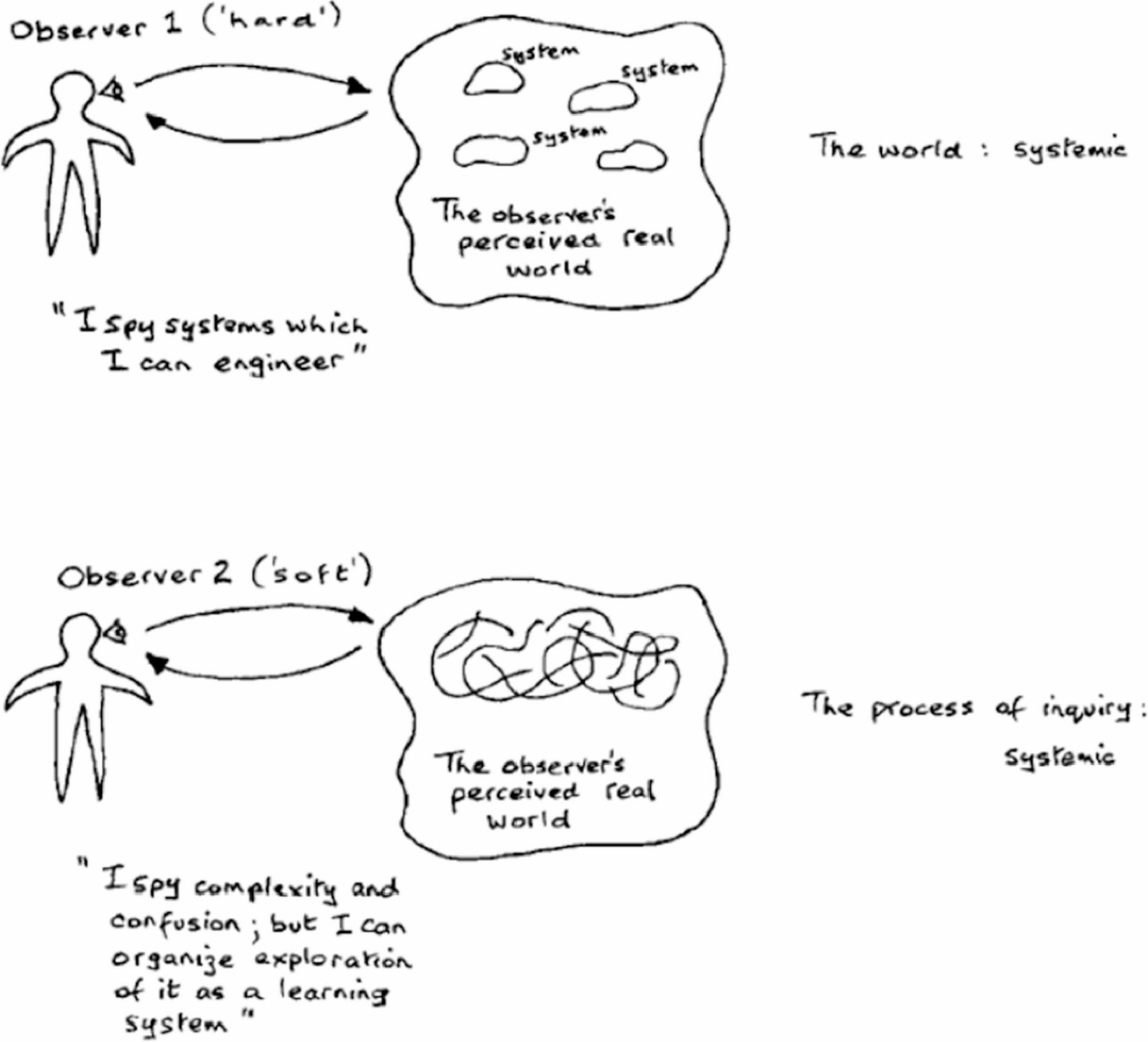
Despite the clarity of his perspective as shown in Fig. 2, Checkland failed to effect a broad shift in epistemological responsibility that each practitioner must make when they use the concept system i.e. as to where they locate systemicity.
Subsequently when developing new courses, Ison (2008; 2010) reformulated the hard and soft approaches as the systematic and the systemic coupled as a duality: two approaches that together comprise a whole (Fig. 3). Given that Checkland (1999) had already used the distinctions ‘systemic’ and ‘systematic’ (Fig. 2) it is possible to claim that when formulated as a duality, the unhelpful features of the hard/soft dualism could be avoided – and a systems approach could be claimed to comprise both being systemic and systematic, i.e., holistic. The logic evoked by Fig. 3 is that in practice both systemic and systematic thinking/practice have a place and practitioners need to know why, how, and when to choose to move between them based on awareness of the practical and epistemological entailments of these choices (Ison 2024).
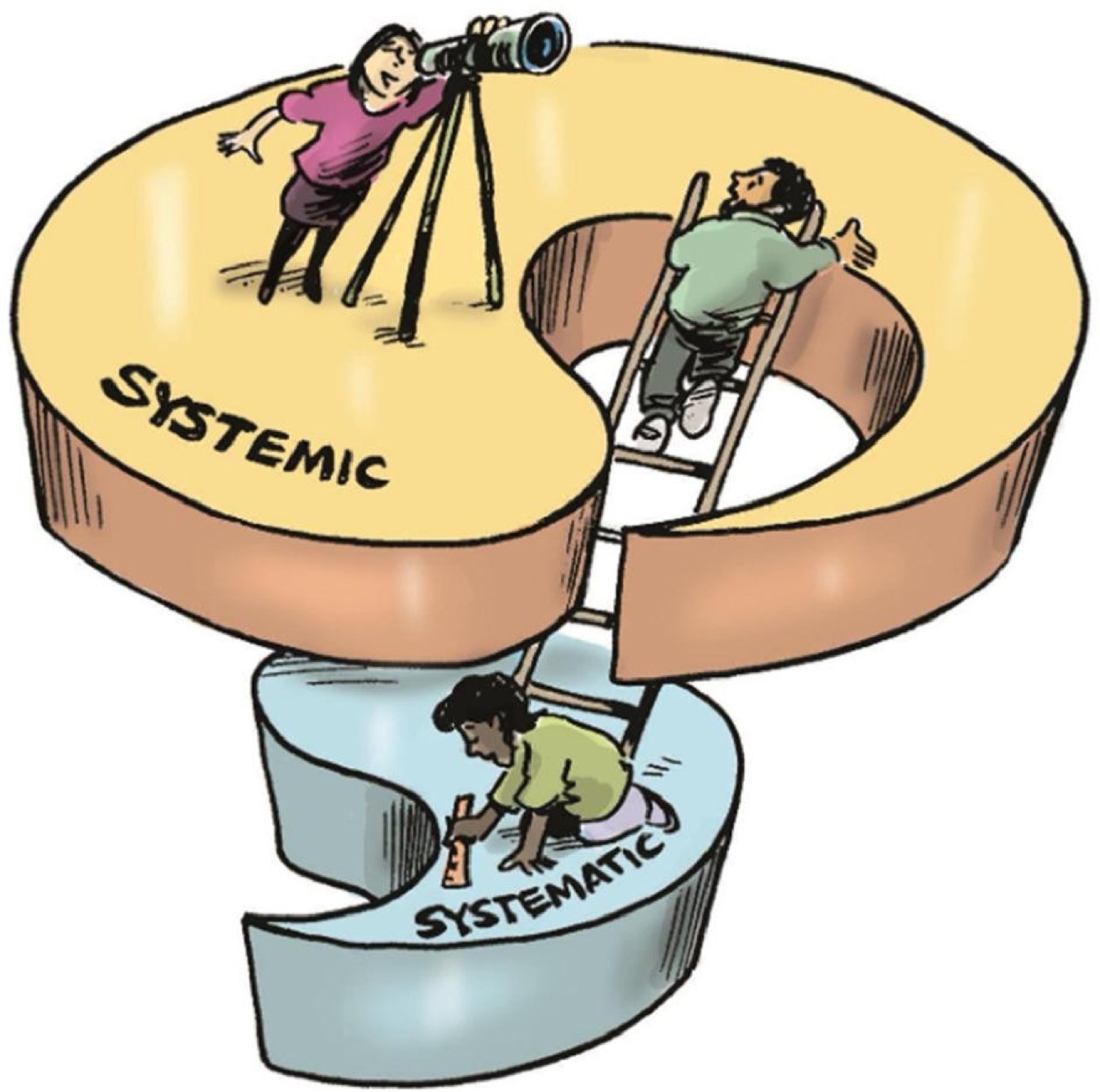
The move to a systemic/systematic duality is theoretically more coherent and in praxis terms makes more sense in terms of the later claims made (but not named) by Checkland (2011) that the hard systems thinker, or the soft systems thinker (i.e., practitioners) are central to the practice of hard and soft (p. 510):
The two outlooks mark a paradigm shift,but we should note that the ‘soft’ outlook does not throw away all the excellent ‘hard’ systems thinking done in the 1950 s and 1960s. When it comes to ‘action to improve’ in the use of SSM,the chosen action might well be to design and implement a system to do something using the ‘hard’ approach.
Avoiding Goal-Setting - Practicing ‘Soft Systems’
Many managers, policy makers, researchers, aided and abetted by ‘projectification’, commonly formulate goal statements. Goal statements were, and remain, a common practice e.g. the UN’s Sustainable Development Goals (SDGs; Reynolds et al. 2017). This widespread practice presents a meta-level framing issue of concern as elucidated by Checkland (1985) i.e., how to deal with the historical implications arising from espoused ‘goal-seeking behaviour’ which opens an organisation to the potential trap of pursuing goals non-reflexively in the mistaken belief that the organisation exists and functions in a world of stationarity (Milly et al. 2008; Ison et al. 2025) except in the very tamest of ‘tame situations’ (in the Rittel and Webber sense (1973).
By 1981, with the intellectual and practical work underpinning SSM established, its adoption (with refinements) began in the teaching program of the OU. Naughton (1984a) developed innovations in understanding and practice of SSM, including a set of constitutive rules to enable students to know when and whether they were doing SSM. These served a pedagogic purpose but may have contributed to an entrenchment of the view (held by Checkland) that methodology was the pursuit of the logic of method, rather than arising in the reflections of a situated and embodied practitioner based on their enactment of the logic (or adaptation) of method (Ison 2010). In contrast, Checkland said (2000a, 2000b) that ‘I’m happy to ‘objectify’ a methodology as a set of principles written out on paper’. But going on he says:
'Of course, words on paper can’t force a user to do any particular thing….But what happens whenever a user consciously ‘uses SSM’ is that they construct what to do in this particular situation with these people with this particular history, culture, politics etc. That produces their method. If they wish to claim to be ‘using SSM’, they have to be able to mount an argument that ‘what we did embodies the principles of the methodology which is SSM in the following way.'
What Checkland (2000a, 2000b) describes is in fact the essence of a praxeology that is more akin to choreographing a performance or chorographing a landscape (Russell and Ison 2005) or a practitioner who is a form of dramaturge, a designer and creator of effective performances (Ison et al. 2023). It is this understanding that is a key element of STiP.
We would claim that Checkland is in fact more concerned with praxis than he acknowledges. Most (if not all) of his diagrams contain a human figure; they thus potentially contain an observer/practitioner, though this ‘person’ is rarely specified as a subject of inquiry. His later descriptions of methodology, e.g. doing SSM, is action that arises through reflection in and on situated practice makes methodology more than the pursuit of the logic of method (Ison 2017). This involves an expansion of what Argyris and Schon (1978) referred to as reflection in and on practice (though we would say praxis).
The question thus arises as to the boundaries between taking a ‘soft approach’ and ‘doing/using SSM’ as well as whether the espoused ‘rules’ for each are purposefully followed or adapted. In our own experience we would claim that when learning a ‘soft-approach’- praxis it pays to begin by doing SSM in full, to begin to build an SSM/soft approach repertoire into one’s tradition of understanding out of which we each think and act (Ison 2005). Checkland acknowledged that with his close colleagues, and in his own practice, SSM enactment, following experience, became more flexible and adaptive to context. So where might the praxis boundaries be, and do they matter?
In the introductory guide to the soft approach within the OU module (T301) Naughton (1984a) made the following claims about the ‘soft approach’ all of which, despite the reference to problems, have stood the test of time and circumstance:
- i.
‘problems’ do not have an existence independent of the human beings involved in them; - ii.
people have different appreciations of situations because they see them in genuinely different ways; - iii.
if it is accepted that ‘problems’ are intellectual constructs which are determined by the perceptions of concerned actors, then it is necessary to accept that what might constitute ‘solutions’ are also intellectual constructs; - iv.
practitioners are compelled to scrutinize the whole concept of what constitutes a ‘problem,’ for which Naughton (1984 a, b) drawing on the work of Russ Ackoff (1974) used the term ‘messes’ and claimed the role of the analyst (practitioner) was ‘mess management’; - v.
improvements in messes are most likely to be brought about through the sharing of perceptions and through persuasion and debate; - vi.
the idea that an analyst can be divorced from the analysis has to be abandoned i.e., all practitioners are part of the practice situation.
In our STiP practice of being systemic and systematic (Fig. 3) Naughton’s framing holds for starting out systemically, but with awareness and capacity for shifting epistemological commitments from ‘is’ to ‘as if’. The systematic need not be ignored when required as long as practical movement between them is done with requisite awareness, capability, and thus responsibility. Following Maturana (1988) we see this form of practice as a pathway of responsibility in STiP.
Naughton’s six-point perspective has, however, been difficult to institutionalise. It could be claimed that Naughton (ibid.) and others hung onto practices (and associated verbs) that encouraged deeply held assumptions about systems being real (i.e., ontologies) through the use of language e.g. doing an analysis of a system; system analysis; mapping the system and so on which continue to the present and, unfortunately, persist in shaping goal seeking behaviours.
Nonetheless, Checkland’s primary contribution has been to see systems (which he once tried to rename as ‘holons’ - see Checkland 1988) as epistemological devices for understanding, knowing, changing situations in ways that realise outcomes that are systemically desirable, culturally feasible and ethically defensible (Figs. 1 and 2).
Epistemological Conflict
Importantly it was the process of creating and participating in a learning system that was central to the shift built into SSM use by Checkland et al. SSM as a learning system began with an engagement with a situation which was then explored in a process of formulating systems-of-interest (using activity modelling based on verbs) as devices to aid learning and change i.e., start with a situation not a ‘system’. He sought the creation of ‘aha moments’ (see Ison 2021) for those carrying out an SSM study so that they might realise that they could:
- (i)
take responsibility for the way they thought, and. - (ii)
change the way they thought.
Unfortunately, the now dominant understanding of ‘systems’ being in the real-world (Fig. 2) has meant the concept ‘system’ has gone feral i.e., there is widespread, non-reflexive use of the noun form (Ison 2016). The understanding and responsibility needed for commissioning, designing, and enacting a systemic process of inquiry i.e., designing and enacting a learning system, remains in short supply.
Checkland’s very significant contribution to the cyber-systemic field remains under- appreciated, a situation he railed against in the latter parts of his career. His experience exemplifies the difficulty for practitioners, particularly research practitioners, acknowledging or realising and taking responsibility for their epistemological commitments. This failing, knowingly or not, constrains the emergence of an ethics of practice across the cyber-systemic field (Cook and Brown 1999; Ison 2007). Reflecting on this phenomenon Checkland said (pers. comm. to Ison 2011):
'My last-ever meeting with Russ Ackoff came about by chance when we were both at the BBC in London on the same day, when the Open University were recording interviews [for] systems courses. I made another attempt to convince Russ that it was a huge mistake to think that our projects involved intervening in systems in the real world. I argued that these human situations were not at all systemic. “Oh we know that” said Russ. “That’s why in ‘interactive planning’ we see what we would have to do to redesign them into being systems”. Alas, the call came for Russ to be interviewed, and I had not time to again make the argument that in the human world different conflicting worldviews are always present – and are a source of creativity; thus making human situations into systems is not something you would ever want to do. In human affairs – always changing – it is always appropriate to hang onto uncertainty, to fight the war against certainty. To lose that war would hand the future to authoritarians, not something which Russ Ackoff or West Churchman would ever have wished to do.4'
In a further communication Checkland (2016) says:
Russ [Ackoff] was system-oriented to the core. He and West Churchman made a huge mistake in the first ever textbook on OR, when they declare that the intervention is into a system. Russ and West never budged from this mistake (which is common in the literature).
It is unlikely that even the most experienced SSM practitioners are prepared to totally forgo the use of an SSM based inquiry process to realise designs for systems-of-interest that could ‘become’ operational; this is an issue worthy of greater conversation and reflection as the current ‘systemic design’ turn grows in popularity.
When consulted about the renaming of the Systems Group at the OU Checkland favoured the label ‘applied systems thinking’ over that of ‘applied systems’ (rejecting yet again the idea of systems being ontologies). He thus exerted his influence once again when the name ASTiP (the applied systems thinking in practice group) was chosen.
Practitioners and Praxis
Diagramming has been a central feature of OU systems education and our own practice in particular (Collins 2025). Figure 2 is an exemplar of Checkland’s propensity for diagramming. Whilst Checkland was not active in the American Society of Cybernetics, the primary legacy-holders of second-order cybernetics, the fact that in Fig. 2 he has called his two persons ‘observers’ suggests he was familiar with the challenge first laid down by Margaret Mead that every observation required an observer (and every control system required a controller). To which one could add: every system requires a formulator. Despite this apparent awareness, and even including the LUMAS model (see Checkland 2000a, 2000b), Checkland paid relatively little attention to the SSM practitioner per se, although SSM came to include methodological elements for undertaking a SSM study (a more common term than ‘inquiry’). He also published extensively in co-authored publications with SSM practitioners (e.g. Checkland and Scholes 1990).
Nonetheless, the user of SSM, the practitioner, was not conceptualised per se as an integral element within his system of interest. It might be said that Checkland in his own practice strongly retained the demeanour of an academic consultant engaged in the conduct of a ‘study’ when doing his own SSM-work. In his 1984 recording he says:
‘I don’t believe that the methodology itself has a rationalist view of the world in the sense of believing the world to be a version of a rationalist machine of some kind. I believe that what the methodology does embody is the rational articulation of a process of enquiry which does not itself take as given that the world is a rational machine’ (Naughton and Checkland 1984).
Seen through the lens of a theory of technology (if SSM is understood as a social technology – see Ison 2010) Checkland’s perspective was too simplistic. He saw SSM as neutral in terms of power:
‘[the methodology] is neutral in the same way that a knife is neutral’ (1984 p.33).
This is the same argument made by members of the gun lobby. It is for this reason, many critics of SSM make the claim that SSM does not address power effectively (see Reynolds and Holwell 2020). However, these critics also risk falling into the same trap of failing to see that any choice of technology (interpreted broadly) such as language, concept, method or methodology creates a practice dynamic that is relational or systemic (see below). Of course, astute practitioners of SSM bring considerations of power to any SSM analysis they undertake in setting up a study. For example, addressing the question of who an ‘owner’ might be taken to be in any inquiry involving the creation of a root definition of a system of interest using the CATWOE mnemonic, is also an invitation to consider the dynamics of power in the notional system-of-interest. In our own work, we have, since 2002, used the activity model of systemic inquiry in Fig. 1 to inform our use and adaptation of SSM within STiP practice that primarily focuses on the design of learning/inquiry systems. Although the observer/practitioner is not made visibly explicit in Fig. 1 we understand that in practice, a STP (systems thinking practitioner) will be able to move between systemic and systematic praxis (as in Figs. 2 and 3) in the contextual design, enactment and reworking of a given learning -system-of-interest (see Ison et al. 2021).
The question of who is (and is not) doing the designing, exploring, accommodating, defining, monitoring and so on in the activities depicted in Fig. 1 is for us an open, but key ethical and methodological question to be explored in each context through systemic design or co-design. We thus return to the development and enactment of STiP in which the practitioner is central to all practice.
Placing Practitioners as Central to Their Own Practice
In the 1980 s and 90 s systems groups and practitioners across the UK were preoccupied with methodologies (M); what Reynolds called a methodology fetish (Reynolds 2024). Via curriculum and praxis development the OU group has pioneered a shift from an M-focus to a practitioner focus in STiP. By doing this we have successfully navigated learners away from an initial starting condition which was either (i) overly concerned with the situation external to themselves (sometimes called ‘reality’, ‘the problem’, or inappropriately ‘the system’) or (ii) with prioritising the selection of methods or sometimes multimethodologies. It has been eye-opening for OU systems academics and associate lecturers to experience how hard it is for some students (and many professionals we have engaged with) to make themselves central to their own practice.
Checkland did however devote research and scholarship to the doing, the practice, of action research (AR) (see Checkland and Scholes 1990; Checkland 1991; Checkland and Holwell 1998; Jackson 2025). The result was what they called the FMA model (Framework, Method, Area of application) as a conceptual account for action research practice as a central part of the practice of enacting SSM. Even so, in this model the central role of the practitioner in enacting STiP remained subjugated and M-focused until an OU-based refocusing on the STP (systems thinking practitioner) was formulated within a systemic model of praxis in the OU postgraduate program (Fig. 4 – see Ison 2010; 2020a; Reynolds 2024).
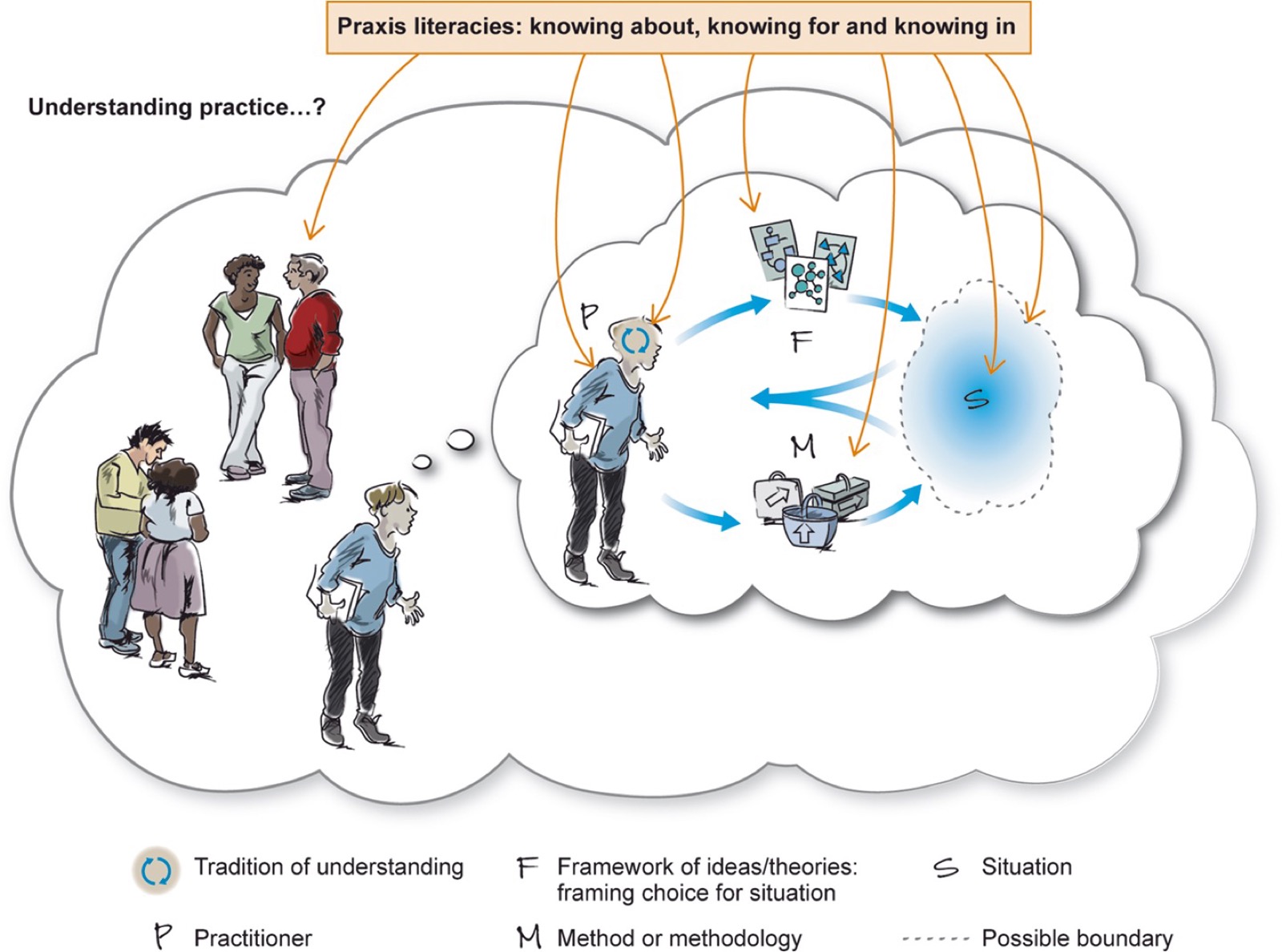
The practice model in Fig. 4 is conceptualised on the understanding that all practice is embodied and situated and that practice cannot happen without the central actor(s) including the practitioner(s) i.e., all practice happens physically in S. The exception is that a practitioner can conceptually abstract themselves, i.e. step out of their situatedness (as Fig. 4 depicts), and reflect on:
- i.
how practice as a situated performance can be understood conceptually (and practically) in terms of the systemic (feedback and feedforward) dynamics between a practitioner (P) with a history, a tradition of understanding out of which they think and act, a framework of ideas (F) which one knowingly, or unknowingly uses to frame, or engage with a situation (S) of concern and choice of methodology, method, tools and techniques (M); - ii.
how practice enactment can be likened to juggling four central elements of one’s praxis – one’s Being, how we Engage in situations (especially framing, deframing and reframing practices), how our practice/praxis is Contextualised to a situation or situations and how practice is Managed as an overall situated performance i.e., a practitioner is the key choreographer of a practice performance that is effective, or not within situations where institutional arrangements may, or may not be conducive to STiP (see Ison 2017/2010).
Over the last 25 years, we have used SSM concepts and approaches including this practice model (and earlier versions) in a variety of research projects, related events, symposia and our teaching in supported open learning modules and face-to-face, experiential short courses. We do not have space to review them here. However, compared to the ‘problem situations’ prevalent in the private sector organisational world (where much of Checkland’s work was conducted), our work has been focussed on socially owned sustainability issues, sitting at the interface of the social and biophysical worlds.
In summary, our own work innovates and extends that of Checkland in the following aspects:5
- (i)
reframing tools, techniques, methods, projects, studies etc. as institutions (norms, rules of the human game in the institutional economics sense) or social technologies (see Postman 1993; Idhe (1990) that mediate situated practice; ‘institutions’ are significant because of their ‘matrix-like’ stranglehold on what we do and feel we cannot do; - (ii)
understanding practice in systemic terms through the PFMS heuristic (Fig. 4) requiring a practitioner to.recognise that practice is always situated, embodied and undertaken in and through language (understood broadly), and is usually done with others;
‘bring forth’, from past experience, a theory or framing choice that was suited to the circumstances (e.g., about power or any other conceptual concern) which shapes how they engaged with their practice, or.
make a purposeful choice of a theoretical framework or situational framing choice (e.g. in relation to power if that were relevant).
become aware of their own systemic sensibilities, the extent of their systems literacy and, in developing their ‘signature praxis’ (Hoverstadt 2022), take responsibility for their STiP capabilities i.e., effective, situated-enactment of knowing (and when reified, knowledge), skills and behaviours arising from cyber-systemic lineages. - (iii)
the design and co-design of systemic/systematic (co)inquiry multi-stakeholder processes, understood in their enactment, as a learning system (Ison et al. 2021); - (iv)
avoiding the trap generated by practice that relies only on, or reverts exclusively to, the mainstream linear (systematic) model of knowledge production and adoption; - (v)
appreciating that a practitioner is central to the practice situation and can be understood as a key choreographer of a practice performance that is effective, or not; - (vi)
recognising the need for developing an ethical pedagogy for STiP through enabling an expansion of their praxis to encompass ‘taking a design turn’ – being able to act purposefully to improve the situations of doing their own praxis (often in the face of workplace indifference or hostility following their study and increased enthusiasm for STiP).
Addressing the Sustainability Conundrum
That much public policy work fails or is ineffective in the face of ‘wicked problems’ (APSC 2007; Head 2022), returns us to the systemic framing of Özbekhan et al. (1970) where we understand sustainability as a manifestation of ‘the global problematique’ that has created the ‘predicament of mankind’ (sic). The sustainability conundrum, however defined, has all the features of situations that have been described as wicked, super wicked, messes, occupying the high ground of technical rationality, part of the polycrisis (Rittel and Webber 1973; Levin et al. 2012; Ackoff 1974; Schön 1995; Klein et al. 2023).
In such situations the dispositions of power and the initial starting conditions whether by contract, commission or project can be very different. We also recognise the concerns over the ethics of relations between governments and multinational management consultancies or the impact of state capture of governments by large multinationals (Ison and Straw 2020).
Seeking to open discussions and learning about (re)framing practices relating to sustainability, the challenge for the STP is often to get the necessary people ‘into the room’ or into the inquiry. The key question always is ‘who participates in the learning that can be transformative so as to realise emergent outcomes that can be described/experienced by all involved as ‘systemically desirable’ and ‘culturally feasible’?’
Our own reflexive praxis, as designers, facilitators, researchers and teachers using STiP have been focused on attempts to address the ‘systemic failings’ that characterise much of the sustainability-action agenda and its failure to effect widespread meaningful change (Khayame et al. 2026). Our purposeful action has been to seek improvements in ‘sustainability situations’ in the UK and internationally. We frame our concerns about sustainability in terms of the on-going qualities of the relational dynamic between human social systems and the biophysical world (including non-human species). Any other framing, we claim, is not systemic, i.e. it is non-relational and falls into the isolated or absolute trap of thinking, such as the ‘Earth has to be saved’. Yet another dualism.
In addressing sustainability situations, our methodological commitment has been to create emergent understandings about the sustainability situation by formulating inquiry pathways. As noted by Stowell, (2024), Churchman and Checkland’s ideas offered a new approach to inquiry in social situations where the prime purpose of a soft systems inquiry is to engender a learning cycle rather than seek an optimal solution as is the common outcome from a technique driven approach. We follow Churchman’s (1971) invitation that reflective learning in the literal sense is: ‘the thinking about thinking, doubting about doubting, learning about learning, and (hopefully) knowing about knowing’ (p. 17). Hence, a pathway is not a pre-chosen method or methodology, but a design and enactment that unfolds as a means to transform the knowing of an inquirer or inquirers: an inquiry pathway is laid down in the doing, where the challenge is to be as reflexively rigorous as possible in execution (Oliver 2005). The adaptive practice of SSM within a STiP framing can be understood as a process of design and enactment seeking to transform situations through social learning i.e., the design of a learning system capable of effecting transformation (Collins et al. 2009; Ison 2025).
Central to our joint work as authors and scholars are understandings and practices that were formulated in the EU Framework 5 project Social Learning for Integrated Water Management (SLIM). A key heuristic on situation transformation through social learning generated in that research is shown in Fig. 5 (Collins and Ison 2009). Like SSM, this heuristic, when enacted, is designed for use by practitioners seeking to transform wicked situations (or situations framed as messes), such as integrated river catchment managing and many other sustainability situations.
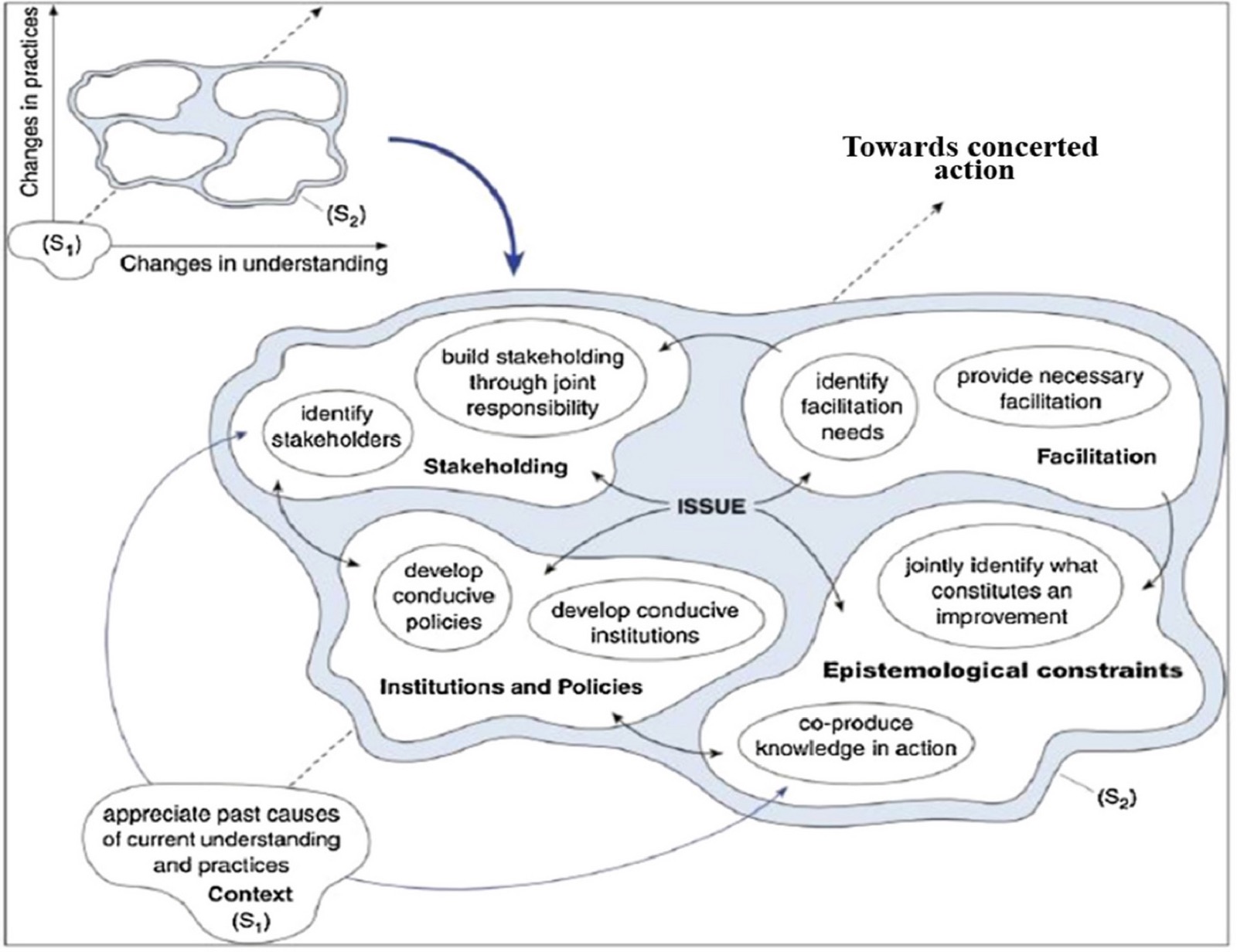
In Fig. 5, in the upper left, the transformation of a situation (S1 to S2) requires concomitant changes in understanding and practices. The main diagram shows the five key elements and associated activities (e.g., Context; Stakeholding; etc.) needed in the learning processes to enable concerted action and the transformation process. These ‘variables’ were established by empirical case-study research across Europe (Steyaert and Jiggins 2007).
The different elements and their associated exemplar activities in the heuristic have allowed us, as STPs cognisant of our commitments depicted in Fig. 4, to (i) design inquiries using SSM and other methods and techniques and (ii) map any critical incidents to their relevant part(s) in order to understand their possible consequences and implications for situation transformation. For example, does using SSM or any related modified version allow for exploration of the starting conditions? Did a critical incident prevent engagement with the framing power of epistemologies and therefore lead to a failure to jointly identify what constitutes an improvement or co-produce knowledge in action? It is in the describing, analysing and evaluating the combination and interaction of these elements as understood by those involved in the learning process that give rise to the explanatory power of the heuristic to reframe situations and their underlying human-environmental relational dynamics.
Concluding Reflections
Checkland’s groundbreaking work on SSM set in motion a new understanding of where systemicity can be found, and thus how the concept system can be used and abused. His work highlighted to varying degrees what it means to be a systems thinking practitioner engaging with confusion and complexity.
In our experience, SSM-style engagement with ‘sustainability issues’ that demonstrate a good understanding of Checkland’s work is still relatively rare. It is a field requiring on-going research and innovation including into methodological approaches to reflexive STP (e.g., Colvin et al. 2014; Bunch 2003; Presley and Meade 2002). Despite a widening use of systems methods/methodologies too little attention is given, it seems, to an accompanying scholarship of praxis that offers potential to enhance praxeological understandings, and thus overall effectiveness in securing systemic improvement and betterment (for example see Müller et al. 2023). With the emphasis on the person instead of the method, there is an urgent need to develop an ethical pedagogy for STiP.
In this vein, we advocate future research that draws on the substantial body of SSM-related scholarship that critically considers and reports on what they as authors and practitioners, do when they claim they are doing:
- (i)
‘soft systems’; - (ii)
soft-systems methodology (SSM) sensu Checkland; - (iii)
STiP – enacting systemic and systematic practice as a duality; - (iv)
systems (co)inquiry, or. - (v)
a design for, and enactment of, a learning system to develop ‘soft-systems’ or STiP literacy, capabilities and epistemological responsibility.
The articulation and reflection on praxis is not simply of academic interest, but an invitation for reframing of the varying interpretations of ‘soft systems’ as systems thinking in practice involving being clear about Checkland’s central claims and extending his scholarship to place the STP as central to our desires for an effective praxeology that can make ethical-differences-that-make-a-difference in our human created Anthropocene-world (Khayame et al. 2026).
Complexe Systémique: key points
This text comes from a world other than family therapy, that of management, engineering and the environment, but it touches a sensitive point in systemic clinical practice: the temptation to believe that systems exist “out there” and that a good method is enough to fix them. With Checkland, Ison and Collins recall that systemicity lies in the way we inquire, not in things, and that every method is enacted by someone, with a history, in a situation. The PFMS model (practitioner, framework, method, situation) can be used in supervision to question one’s own practice: where I think from, which framework I apply, when I move from the systemic to the systematic. The distinction between dualism and duality also sheds light on many clinical debates. One may regret an argument that is at times allusive, strongly centred on the history of the Open University, with few concrete examples. Read alongside the article on first- and second-order cybernetics, and the interview with Humberto Maturana on the ethics of systemic thinking.
Notes from the original
1 Ison first visited Checkland at Lancaster in 1990 (having met him earlier at Hawkesbury Agricultural College – see Bawden et al. 2025) and participated in a project report-back session with students studying the SSM-focused MSc. In 1993 Checkland was on the appointment panel for the new Chair of Systems at the OU, an appointment which Ison took up in early 1994. This paper draws on an extensive personal correspondence between Checkland and Ison as well as reflections on many conversations and shared experiences.
2 Peter Checkland was a critical reader on this course so would have had to approve what was written by Naughton.
3 Checkland in his glossary (1993) sees both hard and soft problems as ‘real-world problems’ and soft as problems which cannot be formulated as a search for an efficient means of achieving a defined end – a problem in which ends, goals, purposes are themselves problematic.
4 In courses developed at the OU Naughton opted to use Russ Ackoff’s (1974) distinctions between messes and difficulties as key concepts in Systems education. In contrast academics from the Design Department (in the same Faculty) taught the distinctions wicked and tame.
5 Time and space do not allow in depth accounting for, and description of, the work on which these claims are based. For interested readers an extensive array of published journal papers, chapters and books have been produced and can be sourced from the OU’s Open Research On-line repository – see https://oro.open.ac.uk/ (Accessed 28th November 2025).
Acknowledgements. We acknowledge a long-term friendship with Peter Checkland (PBC) which has been both personal and institutional i.e., with the UK Open University (OU). PBC was a consistent supporter of the OU Systems group and held the OU mission in high regard. We are grateful to our OU colleagues and wider members of the STiP (Systems Thinking in Practice) group. We received funding from a wide range of funding organisations which supported the work that informs this paper including: EU 5th Framework; EU Horizon; EU Horizon 2020; Environment Agency of England & Wales, DWELP Victoria; Monash University Sustainability Institute. Most importantly, we gratefully acknowledge all the many people and organisations who have contributed their time and thoughts during our research. All errors and omissions remain the responsibility of the authors.
Competing interests. The authors declare no competing interests.
References
Ackoff R (1974) Redesigning the future: a systems approach to societal problems. John Wiley & Sons, New York
APSC (Australian Public Service Commission) (2007) Tackling wicked problems. a public policy perspective. ASPC, Canberra
Argyris C, Schon D (1978) Organizational learning: A theory of action perspective. Addison-Wesley, Reading, MA
Armson R (2011) Growing Wings on the Way. Systems Thinking for Messy Situations. Triarchy Press, Axminster
Bawden RJ, Ison RL (1992) The purpose of field-crop ecosystems: social and economic aspects. In: Pearson CJ (ed) Field-Crop Ecosystems. Elsevier, Amsterdam, pp 11–35
Bawden R, Packham R, Macadam R (2025) Soft systems thinking, soft systems practice and the evolution of systemic development. Syst Pract Action Res. https://doi.org/10.1007/s11213-025-09744-z
Blackmore C (2009) Learning systems and communities of practice for environmental decision making. PhD Thesis, The Open University
Brown L (1993) The new shorter oxford english dictionary. Clarendon, Oxford
Bunch M (2003) Soft systems methodology and the ecosystem approach: a system study of the Cooum River and environs in Chennai, India. Environ Manage 31:0182–0197
Checkland P (1972) Towards a systems based methodology for real-world problem solving. J Syst Eng 3(2):87–116
Checkland PB (1981/1993) Systems thinking, systems practice. Wiley, Chichester
Checkland PB (1985) From optimizing to learning: a development of systems thinking for the 1990s. J Oper Res Soc 36(9):757–767
Checkland PB (1988) The case for holon. Guest Editorial Sys Prac Action Res 1:235–238
Checkland PB (1991) From framework through experience to learning: the essential nature of action research. In: Nissan HE, Klein HK, Hirschheim RA (eds) Information Systems Research: Contemporary Approaches and Emergent Traditions. North-Holland, Amsterdam, pp 1–7
Checkland PB (1994) Systems theory and management thinking, In Blunden, M & Dando, M, eds American Behavioural Scientist Special Issue 38:75–91
Checkland (1999) Systems thinking, systems practice, 2nd edn. John Wiley & Sons Ltd., Chichester, UK
Checkland PB (2000a) Systems thinking, systems practice, a thirty-year retrospective. Syst Res Behav Sci 17:S11–S58
Checkland PB (2000b) T306 Block 4 Part 4, Correspondence from Checkland to Ison re new OU Module, 26th January 200
Checkland PB (2002) The role of the practitioner in a soft systems study’, notes of a talk given to OuSyS and UKSS, Saturday 8th December 2001, in Quarterly Newsletter of the Open University Systems Society (OUSyS), Open University: Milton Keynes, No. 27, March 2002, pp. S5–S11
Checkland PB (2008) Checkland to Ison, personal correspondence
Checkland PB (2011) Learning your way to ‘action to improve’ - the development of soft systems thinking and soft systems methodology. Int J Gen Syst 46:487–512
Checkland PB (2016) Letter to Ison, 16th February 2016
Checkland PB, Holwell S (1998) Systems, Information and Information Systems. John Wiley, Chichester
Checkland PB, Poulter (2006) Learning for action. Wiley, Chichester
Checkland PB, Scholes J (1990) Soft Systems Methodology in Action. Wiley, Chichester
Churchman CW (1967) Wicked problems. Guest editorial. Manage Sci 14(4):141–142
Churchman C, West (1971) The design of inquiring systems. Basic Concepts of Systems and Organizations. Basic Books, New York
Collins KB (2025) Systems diagramming. Some experiences of inviting people to draw. SysPrac2025 SCiO, The Open University & IFSR, Milton Keynes, UK https://www.youtube.com/watch?v=tbzSj1Ac3NM. Accessed 11 Dec 2025
Collins KB, Ison RL (2009) Jumping off Arnstein’s ladder: social learning as a new policy paradigm for climate change adaptation. Environ Policy Gov 19(6):358–373
Collins KB, Ison RL (2010) Trusting emergence: Some experiences of learning about integrated catchment science with the Environment Agency of England and Wales. Water Resour Manage 24(4):669–688
Collins K, Blackmore C, Morris RM, Watson D (2007) A systemic approach to managing multiple perspectives and stakeholding in water catchments: some findings from three UK case studies. Environ Sci Policy 10(8):564–574
Collins KB, Colvin J, Ison RL (2009) Building ‘learning catchments’ for integrated catchment managing: designing learning systems and networks based on experiences in the UK, South Africa and Australia. Water Sci Technol 59(4):687–693
Colvin J, Blackmore C, Chimbuya S, Collins KB, Dent M, Goss J, Ison RL, Roggero PP, Seddaiu G (2014) In search of systemic innovation for sustainable development: a design praxis emerging from a decade of social learning inquiry. Res Policy 43:760–771
Cook SDN, Brown JS (1999) Bridging epistemologies: the generative dance between organizational knowledge and organizational knowing. Organ Sci 10(4):381–400. https://doi.org/10.1287/orsc.10.4.381
Dewey J (1933) How we think: a restatement of the relation of reflective thinking to the educative process. D.C. Heath & Co Publishers, Boston, MA
Francois C (ed) (1997) International encyclopeddia of systems and cybernetics, KG Sauer, Munchen
Feather P (2023) Super wicked problem – or, the crisis formerly known as climate. Available at https://climatecultures.net/cultural-change/super-wicked-problem/. Accessed 7 Feb 2025
Flood R, Jackson MC (1991) Creative Problem Solving: Total Systems Intervention. Wiley, Chichester
Head B (2022) Wicked problems in public policy. understanding and responding to complex challenges. Palgrave Macmillan
Helme M (2002) Appreciating metaphor for participatory practice: constructivist inquiries in a children and young people’s justice organisation. PhD Thesis, The Open University
Hoverstadt P (2022) The grammar of systems. from order to chaos and back. SCiO, UK
Ihde D (1990) Technology and the lifeworld: from garden to earth. University of Indiana Press
Ison RL (2005) Traditions of understanding: language, dialogue and experience. In: Keen M, Brown VA, Dyball R (eds) Social Learning in Environmental Management. Towards a Sustainable Future. Earthscan, London, pp 22–40
Ison RL (2007) Epistemological awareness – a systemic inquiry. ASC (American Society for Cybernetics) Column. Cybernetics Hum Knowing 11:197–200
Ison RL (2008) Systems thinking and practice for action research. In: Reason P, Bradbury H (eds) The Sage Handbook of Action Research Participative Inquiry and Practice, 2nd edn. Sage Publications, London, pp 139–158
Ison RL (2010) Systems practice: how to act in a climate-change world. Springer, London and The Open University
Ison RL (2016) Governing in the Anthropocene: what future systems thinking in practice? Syst Res Behav Sci 33(5):595–613
Ison RL (2017) Systems practice: how to act. in situations of uncertainty and complexity in a climate-change world. 2nd Edition Springer, London and The Open University
Ison RL (2020a) Toward cyber-systemic thinking in practice, In Chapman, Jocelyn (Ed.) For the Love of Cybernetics. Personal Narratives by Cyberneticians. Routledge: New York 118p. ISBN 9780367861018
Ison RL (2020b) Managing change with STiP (Systems Thinking in Practice) TB873 Module, STiP Program. The Open University
Ison RL (2024) Exploring the conceptual and practical affordances of duality and dualism. In: Reyes A, Perko I (eds) Addressing challenges of an uncertain world: A CyberSystemic approach. Ediciones Unibagué, Ibagué, Colombia, pp 335–364
Ison RL (2026) Professionalising the cybersystemic practitioner: Five decades of STiP education at the Open University (1971–2025). Systems Research & Behavioral Science. (in press)
Ison RL (2021) In search of Aha moments’ Fifty years of systemic co-designing for transformative learning with STiP. STiP@50 Celebrations, OpenLearn. https://www.open.edu/openlearn/society-politics-law/stip50-celebrations. Accessed 10 Dec 2025
Ison RL, Straw E (2018) Duality, dualism, duelling and Brexit. Open Democracy, March 1st. https://www.opendemocracy.net/can-europe-make-it/ed-straw-ray-ison/duality-dualism-duelling-and-brexit
Ison RL, Straw E (2020) The hidden power of systems thinking – governance in a climate emergency. Routledge, Abingdon
Ison RL, Röling N, Watson D (2007) Challenges to science and society in the sustainable management and use of water: investigating the role of social learning. Environ Sci Policy 10(6):499–511
Ison RL, Collins KB, Wallis P (2014) Institutionalising social learning: Towards systemic and adaptive governance. Environ Sci Policy 53(B):105–117
Ison RL, Collins KB, Iaquinto BL (2021) Designing an inquiry-based learning system: innovating in research praxis to transform science-policy-practice relations for sustainable development. Syst Res Behav Sci 38(5):610–624
Ison RL, Rubenstein N, Shelton MR, Wallis PJ (2023) Dramaturgies for re-imagining Murray-Darling Basin governing. Australas J Water Resour 27:346–359. https://doi.org/10.1080/13241583.2023.2171846
Ison R, Buckle P, Nguyen N, Preiser R, Vandenbroeck P, Klein L (2025) Reimagining systems thinking as cybersystemic researching: An invitation to a cyber-systemic co-inquiry. 32(5):1391–1403. https://doi.org/10.1002/sres.3189
Jackson MC (1982) The nature of soft systems thinking: the work of Churchman, Ackoff and Checkland. J Appl Syst Anal 9:17–29
Jackson MC (2000) Checkland, Peter Bernard (1930±) Systems research and behavioral science 17:S3–S10
Jackson MC (2025) The development of soft systems methodology through the lens of the FMA framework. Syst Pract Action Res. https://doi.org/10.1007/s11213-025-09743-0
Jackson M, Keys P (1984) Towards a system of systems methodologies. J Oper Res Soc 35:473–486
Khayame HA, Kevin B, Collins RL, Ison (2026) How may the ‘Anthropocene’ enable and constrain cybersystemic governance? The ‘Anthropocene problématique.’ Systemic Practice and Action Research. https://doi.org/10.1007/s11213-026-09764-3
Klein L, Buckle P, Nguyen N, Preiser R, Ison R (2023) Navigating the polycrisis—governing for transformation: the 2024 agenda for the systems community. Syst Res Behav Sci 40:973–977
Klein L, Ison RL, Buckle P, Nguyan N, Preiser R, Vandenbroeck P (2025) Recognising and realising the field of systems research in itself and for itself: The 2026 agenda for the cybersystemic community, Systems Research and Behavioral Science (published)
Leddington P (1992) Relevance, formality and process: toward a theory of soft systems practice. Syst Res 9(4)
Levien R (1997) RAND, IIASA, and the Conduct of Systems Analysis. Proceedings of the Dibner Institute Symposium on the Systems Approach
Levin K, Cashore B, Bernstein S, Auld G (2012) Overcoming the tragedy of super wicked problems: constraining our future selves to ameliorate global climate change. Policy Sci. https://doi.org/10.1007/s11077-012-9151-0
Macadam RD, Packham RG (1989) A case study in the use of soft systems methodology: restructuring an academic organisation to facilitate the education of systems agriculturalists. Agric Syst 30(4):351–367
Maiteny PT, Ison RL (2000) Appreciating systems: critical reflections on the changing nature of systems as a discipline in a systems learning society. Syst Pract Action Res 16(4):559–586
Maturana H (1988) Reality: The search for objectivity or the quest for a compelling argument. Ir J Psychol 9:25–82
Milly PCD, Betancourt J, Falkenmark M, Hirsch RM, Kundzewicz ZW, Lettenmaier DP, Stouffer RJ (2008) Stationarity is dead: whither water management? Science 319:573–574. https://doi.org/10.1126/science.1151915
Mingers J (1980) Towards an appropriate social theory for applied systems thinking: critical theory and soft systems methodology. J Appl Syst Anal 7:41–50
Mitroff I, Linstone H (1993) The unbounded mind. Oxford University Press, New York
Müller M, Nirmalarajan LY, Wisti P, Uggerhøj L (2023) Co-production between researchers, service users, and practitioners in practice research – barriers and possibilities. Asia Pac J Soc Work Dev. https://doi.org/10.1080/02185385.2023.2233490
Naughton J (1977) The Checkland Methodology: A Reader’s Guide, 2nd edn. Open University Systems Group, Milton Keynes
Naughton J (1981) Theory and practice in systems. J Appl Syst Anal 8, University of Lancaster, Lancaster UK
Naughton J (1984a) Soft Systems Analysis: An Introductory Guide. Block IV The Soft Systems Approach. Complexity Management and Change: Applying a Systems Approach. The Open University, Milton Keynes
Naughton J (1984b) Soft Systems Analysis: Workbook, Block IV The Soft Systems Approach. Complexity Management and Change: Applying a Systems Approach. The Open University, Milton Keynes
Naughton J, Checkland PB (1984) Audio-cassette 3: soft systems analysis, T301 complexity, management and change. transcript, The Open University, Milton Keynes
Özbekhan H, Jantsch E, Christakis A (1970) The predicament of mankind: a quest for structured responses to growing world-wide complexities and uncertainties. (Club of Rome) [Proposal]
Packham RG, Ison RL, Roberts RJ (1988) Soft-systems methodology for action research: The role of a college farm in an agricultural education institution. Agricultural Adm Ext 30:109–127
Paucar-Caceres A, Jerardino-Wiesenborn B (2020) A bridge for two views: Checkland’s soft systems methodology and Maturana’s ontology of the observer. J Oper Res Soc 71:660–672
Postman N (1993) Technopoly: the surrender of culture to technology. Vintage Books, USA
Presley A, Meade L (2002) The role of soft systems methodology in planning for sustainable production, greener management international 37, Foresighting for Development (Spring 2002). Taylor & Francis, Ltd., pp 101–110
Reynolds M (2024) Systems thinking principles for making change. Systems 12(10):437. https://doi.org/10.3390/systems12100437
Reynolds M, Blackmore C, Ison R, Shah R, Wedlock E (2017) The role of systems thinking in the practice of implementing sustainable development goals. In: Leal Filho W (ed) Handbook of Sustainability Science and Research. Springer, London, pp 677–698. https://doi.org/10.1007/978-3-319-63007-6_42World Sustainability Series
Reynolds and Holwell (2020) Introducing systems approaches. Reynolds and Holwell, eds Systems Approaches to Making Change: A practical Guide. Open University and Springer, pp 1–24
Rittel HWJ, Webber MM (1973) Dilemmas in a general theory of planning. Policy Sci 4(2):155–169
Russell DB, Ison RL (2005) The researcher of human systems is both choreographer and chorographer. Syst Res Behav Sci 22:131–138
Schön DA (1995) The new scholarship requires a new epistemology. Change 27(6):27–34
Steyaert P, Jiggins J (2007) Governance of complex environmental situations through social learning: a synthesis of SLIM’s lessons for research. policy Pract Environ Sci Policy 10(6):575–586
Stowell F (2025) Soft systems practice and its misconceptions, Systemic Practice and Action Research 38(37)
Stowell Frank (2024) The art of soft systems inquiry: Retracing the footsteps of Churchman and Checkland, Systemic Practice and Action Research. Open access Sept. 2024
van Gigch J (1986) Applying the metasystem paradign to improve our knowledge about knowledge. In: de Zeeuw G (ed) Knowledge (Dis)appearance. Systeem Groep Nederland. Delft University
Vickers G (1965) The art of judgment: a study of policy making. SAGE Publication
Vickers G (1970) Value systems and social process. Penguin Books, London
Reformatted republication of Systems Thinking in Practice (STiP): A Praxeology for Our Times, by Ray Ison and Kevin Collins, Systemic Practice and Action Research, vol. 39, no 3 (2026), doi: 10.1007/s11213-026-09775-0, under a CC BY 4.0 licence. Edition and layout: Complexe Systémique, September 2026 — the work has been modified under the terms of the licence. Neither the authors nor the publisher are responsible for this edition; the original version prevails.
This is the original article “Systems Thinking in Practice (STiP): A Praxeology for Our Times”, published in Systemic Practice and Action Research (2026) under a CC BY 4.0 licence. Republished by Complexe Systémique: the author’s text is unchanged; only the presentation has been adapted for reading online, as set out at the head of this page.
Read the original articleHow to cite this article
Ison, R., et Collins, K. (2026). Systems Thinking in Practice (STiP): A Praxeology for Our Times. Complexe Systémique. https://app.complexe-systemique.com/en_GB/articles/systems-thinking-in-practice-stip-a-praxeology-for-our-times (Original work published in 2026 in Systemic Practice and Action Research, 39(3), 27 (2026); republished in 2026 by Systemic Practice and Action Research, https://link.springer.com/article/10.1007/s11213-026-09775-0)
To go further
- First- and second-order cybernetics: from puppeteer to dancerThe observer is part of the system.
- Ecology of ideas. The ethics of systemic thinking (part 1). Interview with Humberto MaturanaEthics according to Maturana.
- Thinking complexity: following the threads of the real without breaking themThinking complexity.
Related training courses
 Certifying course
Training in Systemic Therapy and Interventions – Cycle 1
Certifying training cycle in systemic therapy and interventions – year 1. Courses, supervision and practice, aligned with EFTA/SFTF. In French.
 Certifying course
Training in Systemic Therapy and Interventions – Cycle 2
Certifying training cycle in systemic therapy and interventions – year 2. Clinical complexity, supervision and practice. EFTA/SFTF aligned. In French.
 Certifying course
Training in Systemic Therapy and Interventions – Cycle 3
Certifying training cycle in systemic therapy and interventions – year 3. In-depth intervention, supervision and practice. EFTA/SFTF aligned. In French.
 Certifying course
Training in Systemic Therapy and Interventions – Cycle 4
Certifying training cycle in systemic therapy and interventions – year 4. Clinical integration, supervision and certification. EFTA/SFTF. In French.
Related articles
 Article
 When intuition comes before strategy. The first flash of meaning
From Bergson to von Foerster, intuition is not the enemy of rigour but its immediate side. How it works concretely in the clinical interview, and why it calls for a reflexive stance.
 Article
 Changing… but at which level?
First order, second order, paradigmatic revolution: three logical levels of change, and why intensifying old recipes stops working once the context has shifted.
 Article
 Crisis: a catalyst of transformation in human systems
A crisis is not a malfunction to correct but an effort by the system not to founder. From the Denver Project to Falicov: a typology and what it asks of the practitioner.
 Article
 Epistemic Mobility in Complex Intervention: Rethinking Knowledge in Systemic Practice
Why does complex intervention stall despite expertise? A conceptual article proposes moving from epistemic inertia to epistemic mobility: changing one’s way of knowing.