AI-assisted translation
This version was translated from Spanish by Complexe Systémique with the help of artificial intelligence. In case of doubt, the original version prevails.
Red Sistémica · Psychotherapy
The importance of being able to express oneself. The story and its narrative in the therapeutic relationship
According to Gregory Bateson, the relationship between human beings rests on a shared story. In a living relationship, however, the story of the relationship evolves continually over time and is also told in many different ways. If the narrative becomes stereotyped, it is because it has lost contact with the subconscious substratum of the story: the relationship is thereby gravely threatened. This article underlines the importance of certain analogical methods that recover the trace of the original story at the sensory, preverbal level, thus allowing the narrative and the relationship, if it is still possible, to come back to life.
Keywords: relationship – narrative – cognitive absolutes – analogical methods – co-evolution
“No doubt what we caress and hold in our arms is what we have found; but what we discover in it is what we ourselves have built.”
Cees Nooteboom, Philip en de anderen
To exist before the other is to be able to tell one’s own story
Our starting point will be that no relationship exists or sustains itself except through the construction of a narrative. To belong to a family is to take part, through discourse as much as through behaviour, in the narrative that this family elaborates about itself. To form a couple is to build, in complicity with another person, the narrative of a couple. This state of affairs holds equally for the relationship we maintain with ourselves. In order to exist as individuals who carry past experiences and future projects, we continually tell ourselves to ourselves in words. It is telling that Jean-Paul Sartre should have chosen precisely The Words as the title of his autobiography (Sartre, 1994).
It is hardly a novel claim to point out that what we usually take to be a faithful description, both of ourselves and of the relationship we maintain with those around us, is nothing other than the construction of a narrative or of a set of narratives.
Bateson expressed this point of view throughout his work, and above all in the book entitled Mind and Nature. From the opening pages he notes: “I would consider an individual A relevant to an individual B if A and B are both parts or components of the same ‘story’” (Bateson, 1979).
In the same text, Bateson adds that this narrative, or these narratives, although they are merely the fruit of our mind, seem to us so obvious and so irrefutable that they escape our conscious attention as such.
The constant verification of this proposition in clinical work has led me to designate these narratives, at once so contingent and so necessary, by the name of “relational absolutes” in several publications. They are absolute in that they explain and condition a relationship all at once, but also because they largely escape our conscious attention and our critical reflection. They are our truth, for we know no other (Caillé, 1995, 1999, 2001; Caillé & Rey, 1998).
In order to become aware of the necessity and the power of this relational absolute, which we might regard as more “supraconscious” than unconscious, we shall meditate…
Notes from the original
An expanded version of a lecture given at the study day “Must we always put it into words?”, organised by the Institut d’études systémiques in Paris on 5 October 2001.
Dr Caillé is a psychiatrist, trainer and systemic therapist.
Editor’s note
The extract published by Red Sistémica breaks off here: the meditation announced, the account of the analogical methods and the remainder of the article are to be found in the complete text published in Perspectivas Sistémicas no. 90.
This article is an English translation of “La importancia de poder expresarse. La historia y el relato de la historia en la relación terapéutica”, published by Red Sistémica (first published in Perspectivas Sistémicas, n° 90). Translated and republished with the journal’s permission.
Read the original articleHow to cite this article
Caillé, P. (2022). The importance of being able to express oneself. The story and its narrative in the therapeutic relationship (Complexe Systémique, Trans.). Complexe Systémique. https://app.complexe-systemique.com/en_GB/articles/the-importance-of-being-able-to-express-oneself-the-story-and-its-narrative-in-the-therapeutic-relationship (Original work published in 2022 in Perspectivas Sistémicas, n° 90; republished in 2022 by Red Sistémica, https://redsistemica.ar/2022/08/01/la-importancia-de-poder-expresarse-la-historia-y-el-relato-de-la-historia-en-la-relacion-terapeutica/)
To go further
- The narrative mind. Towards a post-rationalist conception of personal identityIdentity held together by the account one gives of it: another road to the same idea.
- The new interventions. New narrative methods in family therapyWhat clinical work becomes when one works on the narrative a family makes of itself.
- Recovered words, recovered worldsWhen words come back: the link between recovered language and a relationship brought back to life.
Related training courses
 Online course
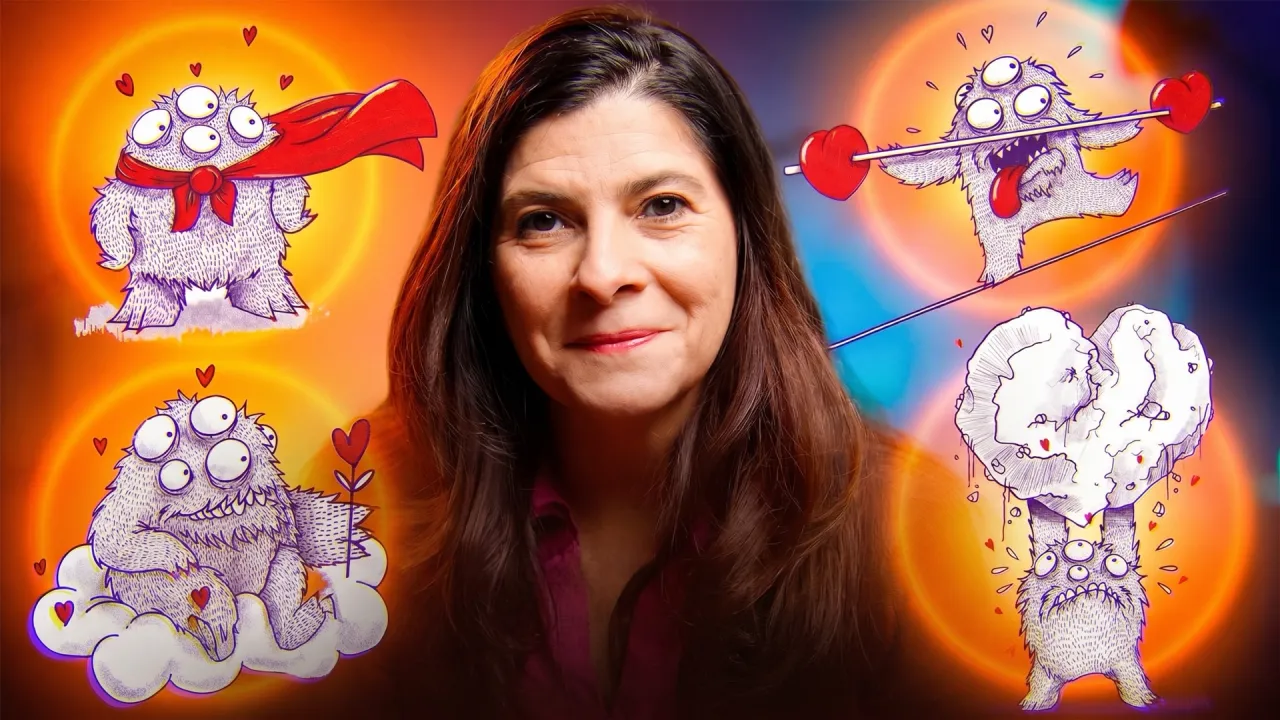
Master the use of the Amour Monstre floating object in systemic therapy
Train with Ivy Daure, creator of the tool, in the Amour Monstre floating object: protocol, systemic questioning and filmed simulations. 8 hours of video, in French with English subtitles.
 Online course
Master the art of narrative therapy: a unique journey with Charlie Crettenand
Immersive online course: discover the narrative approach with Charlie Crettenand. A unique audiovisual journey, lifetime access, exercises. In French, with English subtitles.
Related articles
 Scientific
The AFFIRM Model for Navigating Challenges in Continuously-Interfaith and Divergent-Interfaith Marriages
Thirty happy interfaith couples describe how they navigate their religious differences: five processes, from respecting each other’s choices to religious intimacy, gathered in the AFFIRM model.
 Scientific
Collaborative Polyphonic Writing as Therapeutic Practice: A Longitudinal Case Study
A patient and her therapist co-write her autobiography: the psychiatric diagnosis becomes one voice among others, coordinated by an “I as a writer”.
 Scientific
Integrating social identity theory and family systems theory to explain how sociocultural norms become family life
How “what people will say” becomes a household rule: social identity theory and Bowen’s theory brought together and tested against Mauritian families.
 Scientific
“I Want to Make Sure I'm Doing What It Takes”: Parental Role Changes Following Separation
Seventeen mothers and fathers describe how they redefine their parental role right after separation: revisiting the past, facing uncertainty, adjusting or feeling stuck.
Comments 0
Log in to join the discussion. Log in