AI-assisted translation
This version was translated from Portuguese by Complexe Systémique with the help of artificial intelligence. In case of doubt, the original version prevails.
Revista Brasileira de Terapia Familiar · Adoption
Therapy with the Adoptive Family
Abandoned at birth, Maria was handed over at three months to her paternal uncle’s wife, who registered her as her own daughter. Cynthia Ladvocat, a psychoanalyst and family therapist, recounts her work with the child from six to eight years old, and again at sixteen. The genogram of the “adoptive triad,” in which the biological family has its place, prepares an encounter with the origins that the adoption within the family made inevitable.
Unofficial English translation. This article is a translation of A Terapia da Família Adotiva, by Cynthia Ladvocat, published in the Revista Brasileira de Terapia Familiar (ABRATEF), vol. 2, no. 1 (2010), doi: 10.60114/rbtf.v2i1.117, under a CC BY 4.0 licence. Translated by Complexe Systémique in November 2026 with the help of artificial intelligence: the original Brazilian Portuguese text has been translated into English and reformatted, which constitutes a modification of the work under the terms of the licence. The text was established from the journal’s PDF (scanned copy); paragraphs and headings are those of the journal; the author’s biographical note, printed as a footnote on the first page, is included in the presentation; a few obvious typographical errors have been corrected silently. The abstract is the author’s own English version. This translation was made neither by the authors nor by the journal, who are not responsible for its content or for any errors. The original version prevails.
Blood ties are replaced by affective ties. It is through culture and language that relationships become structuring.
Cynthia Ladvocat
Abstract
In adoption, one of the great myths points to the psychic representation of parental images, both biological and adoptives. The author presents a case in which a child client who had therapy from six to eight years old returns to therapy in her adolescent years. The work with the Genogram explores her biological analysis, including the abandonment of her biological mother, the adoption process, the revelation, her contact with her origin and motherhood in her adult life.
Keywords: adoption; origen family; genogram; parental images
Introduction
The author has pursued her study and practice in the field of adoption since her first clinical case, seen during her internship in the final year of her undergraduate degree, in 1976. During her psychoanalytic training she had the opportunity to meet Paulina Kernberg, who introduced her to the concept of the adoptive triad, fundamental to work in adoption. Work with an adopted child must take the adoptive status into account, and therefore the child’s history from the standpoint of both the adoptive and the biological systems. In her master’s thesis, the author stresses the inclusion of the child’s biography in the genogram, for effective work on the myths and difficulties surrounding the child’s origins that interfere with the adoptive bond.
Freud did not address the topic of adoption in his work. However, in Family Romances (1909) he mentioned children’s fantasies about adoption. He observed that children develop a critical sense about their parents and begin to compare them with other parents. And this feeling of rejection can lead a child to imagine being adopted. Adoption in this sense was seen as a filiation of lesser value, illegitimate and with fewer rights in the family. In this text Freud raised an extremely important question, which was brought up to date by Winnicott and Kernberg: no longer as the child’s fantasy of being adopted, but in the fact that the child really is adopted and therefore fantasizes the family romance of the two pairs of parents, the adoptive and the biological.
Motivations for adoption
The parents’ motivations must be analyzed for the adoption process to go well. The desire for a child through adoption may result from the impossibility of conceiving a biological child. According to Dolto (1998), in the face of biological infertility, the symbolic fertility of adoption becomes important. Parents need to work through their mourning for the child in order to seek an adoptive child, which sometimes brings much disquiet to the family, especially if the child stands in the place of a lost biological child (Hamad, 2002). Many difficulties may arise, particularly in the face of the hopes and threats surrounding the search for, and the encounter with, the child’s biological origins.
The biological parental imago
For children, the existence of a mother and a father who abandoned them is a fact that is hard to understand. They live alongside other children whose reality is different and who were not abandoned. Children often try to hide, or even to deny, the adoption. For Kernberg (1985), the reference to biological origin takes us back to limbo, an empty space between the baby’s contact with the biological mother and the moment the baby finds the adoptive mother’s arms. Blood ties are replaced by affective ties. It is through culture and language that relationships become structuring. For Dolto (1998), we cannot consider an individual’s worth to be tied to their biology; yet the biological parental imago is part of the child’s biography. Winnicott (1997) emphasizes that the biological parents are truly unknown and unreachable. There is always a mystery, a mixture of fantasy and reality, as well as emotions that cannot be lived out with the biological parents and that cannot be left behind.
Disclosure and secrecy
Adoption always involves a share of secrets. Even after disclosure, information may be missing about the origins, about the reason for the abandonment and even about the reasons for the adoption. For Kernberg (1985), adopted children are affected by the secrets of adoption, but much more harmed by the secret feelings about adoption. Children need information coming from a trustworthy person in their lives. What is left unsaid, the gaps in their personal history, interfere with the child’s development; children are able to discover that they were deceived by someone they trust, which is far more traumatic than what they discovered (Winnicott). According to Dolto (1988), it is very common for adoptive parents to have difficulty dealing with the child’s history and to keep the secret about the child’s origins. As if, in this way, the child, who knows nothing, could become a biological daughter of the adoptive parents’ fantasy.
When therapy is indicated
In the author’s experience, parents may interpret any of the child’s behavior as a reaction to the adoption. However, whether or not a problem is related to the adoption, it should always be placed in the context of the adoptive status. Some parents become anxious about the story of the biological origins. According to Hamad (2002), the parents’ anxiety often prevents the child from voicing doubts and longings, as if the child could not live a child’s life. And when children cannot bear the knowledge of their adoption, their problem is not merely illegitimacy but the sum of all their difficulties (Winnicott, 1997).
In the author’s experience, therapy for the child and the parents is always preventive, so that the theme of adoption can be worked through at the different moments of the life cycle. Parents worry about the child’s difficulties, and the main complaint often concerns difficulties at school, which may be related to a curiosity blocked by the myths and secrets inherent in adoption. There is indeed a family structure that includes two pairs of parents, which can compromise learning and social relationships. The therapist must take into account the phenomenon of ambiguity in the adopted child, the devaluation or idealization of the two pairs of parents. For Kernberg (1985), it is important to include in the adoption story the adoptive triad, with the history of the biological system, the history of the adoptive system, and the nuclear system of the adoptee. Therapeutic work on the myths of adoption, on real or fantasized data and on the origins, with the parents as well as with the child, is therefore fundamental (Ladvocat, 2002).
Clinical case
The mother requested help because of the difficulties of her six-year-old daughter, who was having problems at school. The family considered the possibility that the child was developing problems because she had been abandoned, neglected and exposed to health risks before being adopted at three months of age. The case presented deserves attention for its particular features; it was seen in two phases, at six years old and in adolescence, and it stands out for certain particular features: because adoption within the family makes it easier for the biological family to find out where the child is; because of the family’s willingness to return years later; and because of the preventive work on a possible encounter with the biological family.
Life history before the adoption
The biological father was married and had two daughters; he was having an extramarital relationship, and the woman became pregnant with Maria. He wanted a son and would only acknowledge paternity of a boy. The father’s brother was married, and his wife wished to adopt a child. In view of this pregnancy outside marriage, it was agreed that the brother and his wife would adopt the baby if it was a girl. However, the sister-in-law became pregnant and gave up on the adoption. Months later Maria was born; she was not registered, was rejected by her biological mother, lacked basic care and survived thanks to the help of neighbors. Months later the sister-in-law had a miscarriage, separated from her husband and asked for the girl to be handed over. The father told the biological mother that he would take Maria to be adopted (Ladvocat, 1989).
Life history after the adoption
The father brought Maria, then three months old, to his sister-in-law, who chose an informal adoption and registered her as her legitimate daughter, with no declared paternity. Maria was welcomed with affection and protection into her new family, then made up of the mother, grandmother and godmother. Relatives warned the adoptive mother about the risks of adopting her niece. The three women competed over caring for the baby and related to one another as if they were “three mothers.” The mother told her daughter that she had been born from the heart, that her tummy mother could not keep her, and that her father lived far away. What worried her most was the risk of an encounter with the biological family, with the possibility that the mother and father might seek contact and that Maria might go back to live with her father’s family. In fact, given that this was an adoption within the family, such an encounter was foreseeable and should be analyzed and prepared for in therapy.
The therapeutic process at age six
The first phase of the therapeutic process took place with Maria from six to eight years old, with individual sessions and sessions with the family. The girl was a source of concern because, besides being unable to learn, she was very quiet, did not cry, and had herpes outbreaks, fainting spells and loss of appetite. The mother reported that the adoption itself had been well assimilated. The three women looked after Maria, quarreled and competed for her love. According to them, the fact that Maria had been rejected for three months and had suffered many deprivations justified the extreme care and the efforts to satisfy all her wishes. When the problem with learning to read and write appeared, the three women agreed that the time had come to seek specialized help.
In family therapy, the girl was the center of the discussions. It was not clear who had authority over her. The mother, the grandmother and the godmother projected all their personal needs onto the girl. The grandmother devoted her life to her granddaughter; the godmother had no children and indulged her goddaughter’s every whim. The adoptive mother, after separating from her husband, saw in her daughter the meaning of her life.
After the difficulties had been surveyed, the genogram was introduced as a new therapeutic resource. The family tree came to include both systems, the adoptive and the biological. The information about the family of origin, the names of the biological father, mother, sisters and grandparents, was included in Maria’s pre-adoptive biography, despite efforts to keep these data at a distance. The drawing of the adoptive triad made all the systems involved visible. The three women voiced their concerns about the possibility that the father’s or the mother’s family might want to take the child back. The therapy had to take this possibility into account.
Therapeutic work with the family was carried out in parallel with individual work with Maria. The girl showed fear of staying in the therapy room and of being abandoned by her family. The godmother would take her in her arms to protect her from every threat. At first the therapist represented a danger to the family, because of her interest in addressing the difficulties related to the adoption. The child’s despair aroused in the therapist, in the countertransference, the need to be a “good mother/therapist.” The girl projected the rejection by her biological mother and her death anxieties into her play and her drawings, with a woman throwing dolls out of the window. Maria played out a scenario with plots about a dispute between two queens over a kingdom, in a story full of suspense. She fantasized a family romance about her adoptive mother: that she had separated from her husband because she had lost her baby, and that if she became pregnant again, she would throw her adopted daughter out of the window. The two queens represent the biological imago and the adoptive imago. Sometimes she would say that her tummy mother did not like playing with dolls, and that was why she threw them away.
In the genogram, Maria used the colored pens in the space reserved for the adoptive family, filling in the spaces of the biological family in pink. This work helped the girl to integrate her biological and adoptive bonds, and helped Maria understand her complicated family configuration. The drawing of the adoptive family, which linked mother and daughter, was covered with blue hearts. The girl would say that her real mother was the one she had lived with since she was three months old. Maria began to feel more integrated into her family, without fear of being dropped or thrown out of the window (Ladvocat, 1989).
As the joint sessions progressed, the mother, the grandmother, the godmother and Maria herself had all become familiar with the genogram. Her biography from the pregnancy onward could gradually be revealed. There was no information about the biological mother apart from her name. The girl enjoyed her drawn story, about the family of origin, about her biological father’s family, about her sisters’ names and ages. What the three women feared was Maria’s reaction to the objective facts. To the family’s relief, what interested her most was the information about her sisters.
The grandmother and the godmother were surprised when the adoptive mother expressed the wish to take her daughter to meet her father’s family. The mother was willing to face her fears about contact with the origins. Maria then calmly met her father, her sisters and her grandparents. On their return from the holidays, the sessions focused on this meeting, a topic previously so feared and avoided. With new information about the father’s family, it was possible to fill in the gaps in the genogram. The therapy of the adoptive family progressed very well. Maria no longer had difficulties at school, began to speak about the adoption naturally, and to call her adoptive mother “Mom.” The grandmother and godmother began to cooperate in Maria’s upbringing. The adoptive mother took on her motherhood and her role of authority. The therapeutic work could be interrupted, with the commitment that it would be resumed in adolescence for an assessment.
The therapeutic process at age 16
When they returned eight years later, the adoptive mother said that she was worried about her daughter’s future: the girl was very difficult, did not want to study and did not accept limits. The adoption issue, according to the mother, had been well resolved. A consultation was arranged with Maria, who talked about her life, her school, her friends and her boyfriends. The genogram, the stories and the drawings were taken up again. Maria expressed surprise at her own sensitivity as a child, with the colored lines of the genogram and the drawings that drew attention to the biological and the adoptive bond. The blue hearts represented the relationship between her and her adoptive mother, while the pink line linked her to her biological mother. In this new phase of her treatment it was possible to revisit the reasons for the blue and the pink, which represent the masculine and the feminine respectively. As a child, Maria would have unconsciously perceived that what had marked her rejection was the fact of being a girl (pink). And that what had justified the adoption was the fact of not being a boy (blue). The young woman found this matter of the colors very interesting; given its complexity, it had not been mentioned in the first phase of her treatment.
Maria wanted to tell everything new she had learned about her father’s family, about her grandparents and her sisters. She said that she regularly traveled to her father’s town during her holidays and stayed at her grandparents’ house. Maria had a relationship with her father’s family but knew nothing about her biological mother. Her father was still married, had another extramarital relationship and sons. For her fifteenth birthday, her father gave her a new birth certificate as a present, with the acknowledgment of paternity, which made her very happy. She had a calm relationship with her two sisters. She identified strongly with the elder one, who was the same age as her biological mother. On the whole, she felt good in this family, showed affection for her father and saw that he was making an effort to get closer to the daughter he had once rejected.
Maria wanted to build a new genogram with the new data about her family configuration. There were still blank spaces, voids and mysteries in her life. She made up stories about her biological mother to fill the gaps in her genogram. She imagined why her mother had agreed to the adoption. She said she felt no resentment and did not wish to meet her. She reaffirmed that she was proud to be her adoptive mother’s daughter.
A year later, on returning from her holidays in the town where her father’s family lived, Maria reported that her biological mother had approached her and introduced herself. The two talked for a few hours. Maria was able to satisfy her curiosity and get answers to her questions. Her biological mother gave her a photograph with a dedication. Maria talked about her mother calmly and said that she had met her only because the approach had come from her. She showed the therapist the portrait, which revealed the resemblance between the two of them. With the biological mother’s story in hand, new facts came to complete the fantasized ones.
In family therapy, Maria said that she had not particularly wanted this meeting, that nothing had changed in her life and that she had felt nothing special. She understood that her biological mother must feel remorse and that it must have been a relief for her to have explained herself. Maria acknowledged that her adoptive mother was her real mother. These revelations confirmed to the adoptive mother that her daughter would never abandon her. It was emphasized that the therapeutic work had helped this feared moment to go well.
In the last month of the second phase of therapy, Maria turned to the genogram again to complete the course of her biography. The young woman projected that in the future she would like to have children, but only girls. This was understood as a way of repairing her history, since she had been rejected precisely for being a girl. She appeared calmer, had access to her biological mother, had been acknowledged by her father, spent time with her father’s family and had no conflicts with her adoptive family. By mutual agreement, it was decided to end the treatment. Her mother was pleased with her daughter’s maturity. Maria said goodbye, saying that one day she would adopt a child.
Some years later, the adoptive mother got in touch to say that Maria was 19, still lived with the family, had become pregnant by her boyfriend and had just had her baby. She said that her daughter was happy about the birth of a baby girl and was proving to be a good mother. Once again, she expressed her thanks for all the therapeutic work since Maria was six years old.
Conclusion
The genogram of the adopted child identifies the adoptive triad, with the history of the biological family and of the adoptive family. In the clinical work presented, Maria’s adoptive status was analyzed at the different phases of her life. Therapy using the genogram helped Maria to understand the confusing facts about her history. Curiosity about the secrets of adoption and about her origins was the main theme worked on in individual therapy and in family therapy. In adolescence, the young woman showed even more curiosity about her biological family. Since this was an adoption within the family, the encounter with the biological family was inevitable. The blank spaces about her origins could be worked through and filled in fantasy. And this helped the young woman to react calmly to the inevitable encounter with her origins, with her father and then with her biological mother, a scene so feared by the mother, grandmother and godmother, and one that did no harm to the adoptive bond. The therapeutic work therefore made a rapprochement with her father’s family possible. It turned an adopted child into a truly adoptive daughter. Years later, Maria was able to relive the bond of motherhood, but in a healthy way, in her capacity to take good care of her baby.
Complexe Systémique: key points
This case is valuable above all for its length: following the same child at six and at sixteen, and then hearing about her motherhood, shows what becomes of work on origins over the life cycle. The genogram serves as a shared stage: the biological and adoptive systems are drawn together, and secrecy stops organizing the family. A systemic reading will also note the triangle formed by the mother, the grandmother and the godmother, the “three mothers” whose rivalry left the child without a clear hierarchy; the therapy restores the adoptive mother’s authority as much as it works through the adoption. Some caution is in order regarding the unconscious interpretations (the pink and the blue), presented as certainties, the silence surrounding the informal adoption by direct registration, which is legally fragile, and the rather normative final judgment on a motherhood at nineteen. Read alongside Steve Jobs’ genogram, between biological and adoptive parents, and the study of adoptive identity rebuilt through artifacts.
References
Dolto, Françoise, (1998). O destino das crianças. São Paulo: Martins Fontes.
Freud, Sigmund (1909). Romances familiares – Obras completas. Rio de Janeiro: Imago.
Hamad, Nazir (2002). A criança adotiva e suas famílias. Rio de Janeiro: Companhia de Freud.
Kernberg, Paulina (1985). Child analysis with a severely disturbed adopted child. International Journal of Psychoanalytic Psychotherapy, 11.
Ladvocat, Cynthia (2002). Mitos e segredos sobre a origem da criança na família adotiva. Rio de Janeiro: Booklink.
Ladvocat, Cynthia (1996). Vicissitudes no manejo da transferência com crianças adotadas. Boletim Científico da Sociedade Psicanalítica do Rio de Janeiro, XVII,(2).
Ladvocat, Cynthia (1989). A rainha que não podia reinar – dificuldades no atendimento de uma criança adotada. Congresso Interno, Sociedade Psicanalítica do Rio de Janeiro.
Winnicott, Donald (1997). Adoção. In Ray Sheperd; Jennifer Johns & H. Robinson, Pensando sobre Crianças. Porto Alegre: Artmed.
Unofficial English translation of A Terapia da Família Adotiva, by Cynthia Ladvocat, Revista Brasileira de Terapia Familiar, vol. 2, no. 1 (2010), doi: 10.60114/rbtf.v2i1.117, under a CC BY 4.0 licence. Translation (with the help of artificial intelligence) and layout: Complexe Systémique, November 2026 — the work has been modified under the terms of the licence. Neither the authors nor the journal are responsible for this translation; the original version prevails.
Unofficial English translation of “A Terapia da Família Adotiva”, published in Revista Brasileira de Terapia Familiar (2010) under a CC BY 4.0 licence. Made by Complexe Systémique with the help of artificial intelligence, it does not come from the authors or the journal, who are not responsible for its content; the original version prevails.
Read the original articleHow to cite this article
Ladvocat, C. (2010). Therapy with the Adoptive Family (Complexe Systémique, Trans.). Complexe Systémique. https://app.complexe-systemique.com/en_GB/articles/therapy-with-the-adoptive-family (Original work published in 2010 in Revista Brasileira de Terapia Familiar, v. 2, n. 1 (2010); republished in 2010 by Revista Brasileira de Terapia Familiar, https://revbrasterapiafamiliar.abratef.org.br/revista/article/view/117)
To go further
- Becoming adopted: Rebuilding adoptive identity through artifactsObjects that tell the story of adoption.
- What does Steve Jobs' genogram reveal?Biological and adoptive parents on the genogram.
- Adoptive parents' experiences of birth parent contact in the years after placementWhen contact with the birth family fades.
Related training courses
 Short course
The suicidal crisis in adolescents and young adults
Training: assessing and supporting the suicidal crisis in adolescents and young adults. Clinical landmarks and systemic tools. In French.
 Symposium
The Abnormal Normals and the Normal Abnormals
Conference replay: six clinicians explore normality — diagnoses, norms, adolescents, therapists. Immediate, lifetime access. Talks in French.
Related articles
 Blog
Why do we feel we are behind in our lives?
Checking how old Yalom was when he published his first book reassured me. But in which race? A systemic look at the feeling of being behind, and at what we can change together.
 Scientific
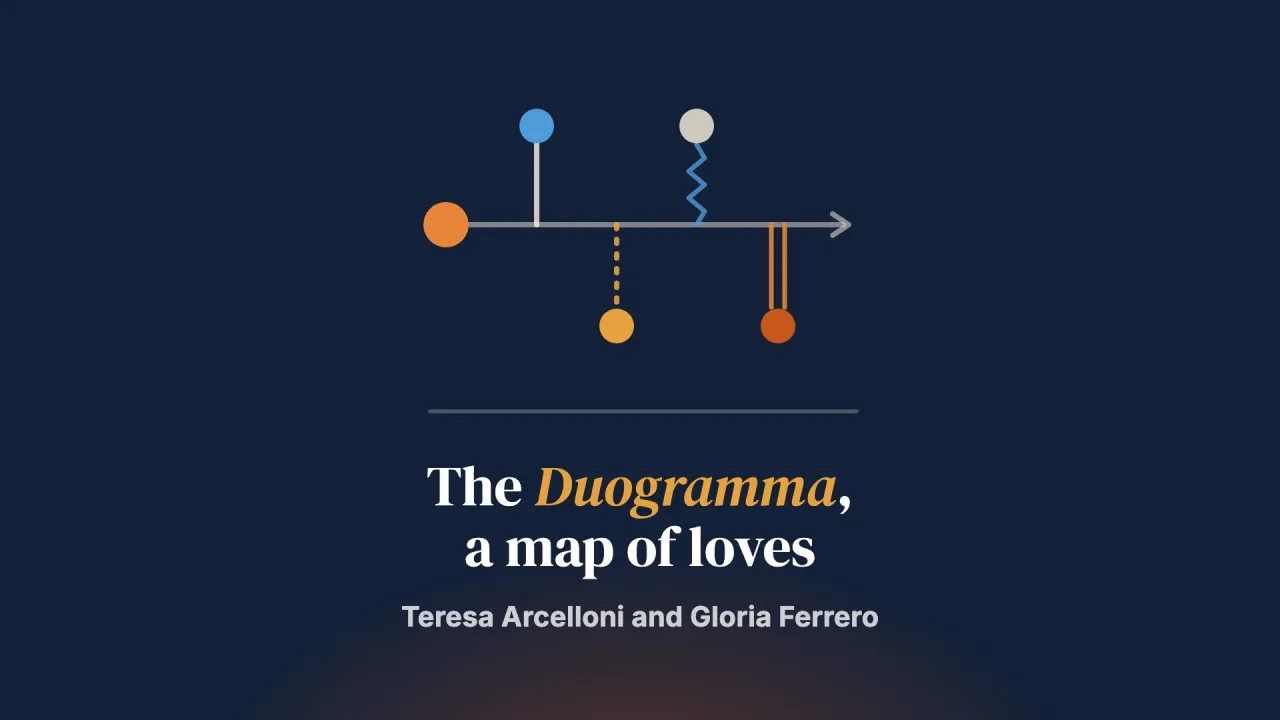
The Duogramma®: An innovative methodology for psychotherapy
A map of the couple relationships lived, desired or rejected since childhood: the Duogramma®, its graphic rules and its use in individual therapy.
 Blog
Capp® groups give parents a place to think together
How does a reflective parenting group work? Jalila Kormachi and Yara Doumit describe how parents revisit a difficult moment and choose what to try next.
 Scientific
“One Can Have All Sorts of Good Intentions but Sometimes in Everyday Life, It Turns Out Differently”: Change Agreements in Couples' Everyday Lives
Six Danish couples followed after an online couple program: their change agreements become guilt-inducing contracts, shared understanding or revealers of inequality.
Comments 0
Log in to join the discussion. Log in