Journal of Marital and Family Therapy · Family therapy
Training therapists in emotionally focused therapy: A longitudinal and cross-sectional analysis
What does the official training pathway in emotionally focused therapy produce, step by step? In Budapest, the team of Réka Koren and Scott R. Woolley followed trainees from the Externship through the two Core Skills blocks, with six measurement points. Knowledge leaps as early as the Externship; competency, by contrast, is built mainly during Core Skills. And between trainings, without supervision, gains fall back.
This is a reformatted republication of Training therapists in emotionally focused therapy: A longitudinal and cross-sectional analysis, by Réka Koren, Scott R. Woolley, Ildikó Danis and Szabolcs Török, published in Journal of Marital and Family Therapy (Wiley) (2022), doi: 10.1111/jmft.12495, under a CC BY 4.0 licence. Prepared by Complexe Systémique in September 2026: the authors’ text is unchanged; the layout has been adapted for reading online, which constitutes a modification of the work under the terms of the licence. Tables are presented as lists; figures are reproduced as published. This edition was made neither by the authors nor by the publisher, who are not responsible for its content or for any errors. The original version prevails.
In the end, to help people, therapists must be able to competently use the model, not just know about the model.
Réka Koren, Scott R. Woolley, Ildikó Danis and Szabolcs Török
Abstract
Using cross-sectional and longitudinal data, our study looks at the effectiveness of the Emotionally Focused Therapy (EFT) Externship and Core Skills trainings. It is the first study to evaluate EFT Core Skills trainings and the first to evaluate change longitudinally throughout the standardized EFT training program. We used the Hungarian EFT Knowledge and Competency Scale (Hungarian EFT-KACS) to examine self-perceived knowledge, competency, and alliance over three 4-day training blocks (Externship, Core Skills Modules 1&2, Core Skills Modules 3&4). Results indicate that each training block significantly increased self-perceived knowledge, competency, and alliance. During the Externship, participants’ knowledge increased the most and remained at this level after each training block. Competency showed a more modest but significant increase during the Externship. However, by the end of the Core Skills training, competency showed a significant increase compared to post-Externship results, demonstrating the unique role of Core Skills training in developing competency in EFT.
INTRODUCTION
Emotionally Focused Therapy (EFT) is a systemic, experiential-humanistic model (Johnson, 2020), that builds on attachment theory (Bowlby, 1969, 1979). This short-term approach provides highly effective, lasting results for couple distress and appears to be the most effective therapeutic method of couple therapy available (Beasley & Ager, 2019).
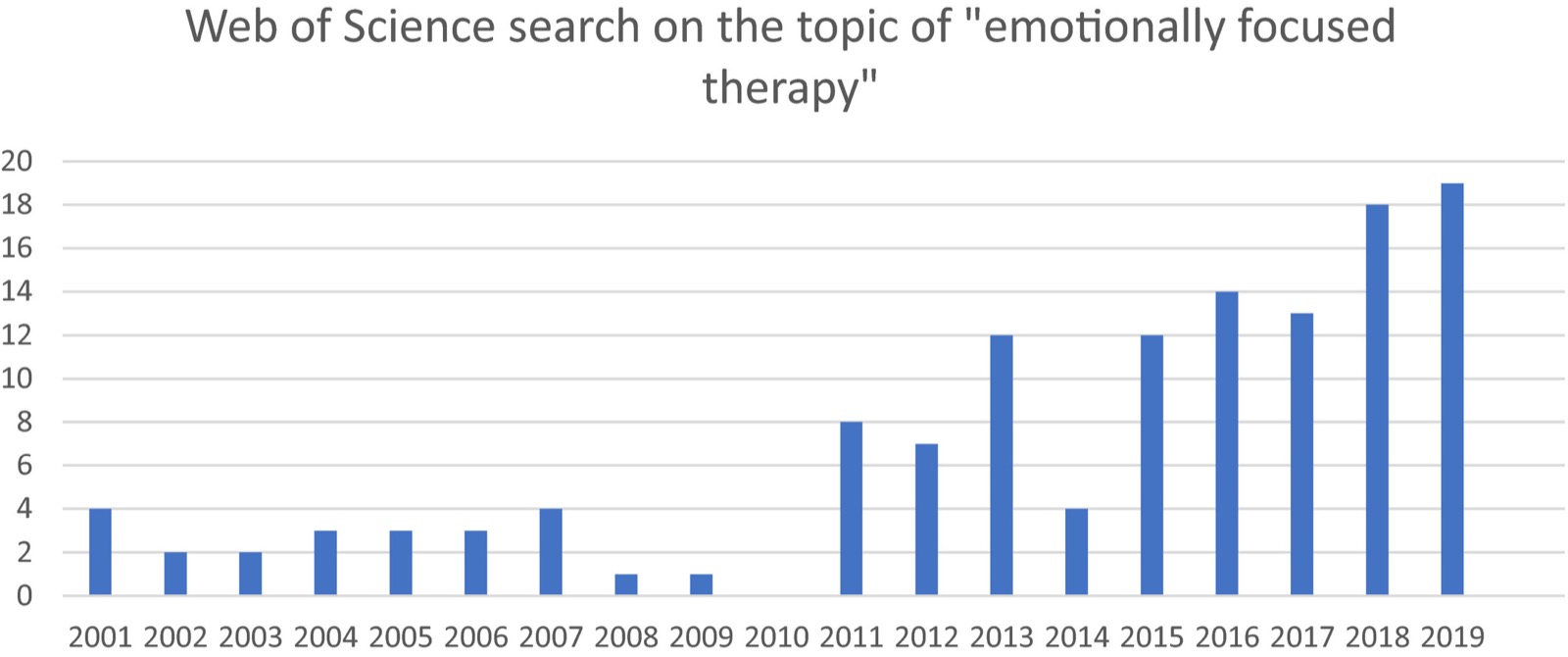
EFT is increasingly becoming the focus of attention and research. Since Johnson and Greenberg’s early development of the model in the 1980s (Johnson & Greenberg, 1985a, 1985b), the model has primarily been developed, implemented, and disseminated throughout the world by Johnson and colleagues (Brubacher, 2017; Furrow et al., 2019; Johnson, 2020; Johnson et al., 2005). Research on EFT has increased a great deal over the last two decades. For example, a Web of Science search indicated that there was an average of 3.2 scientific articles per year with “emotionally focused therapy” as a topic from 2001 to 2005 and 15.2 scientific articles per year from 2015 to 20191 (see Figure 1).
However, research is still limited on the process of learning EFT (Bell et al., 2017; Denton et al., 2012; Rodriguez-Gonzalez et al., 2019; Sandberg et al., 2013, 2015, 2019; Wittenborn, 2012), and there are only a few studies focusing on the effectiveness of the formal, ICEEFT (International Center for Excellence in Emotionally Focused Therapy) endorsed, EFT training program (Koren et al., 2020; Montagno et al., 2011; Rodriguez-Gonzalez et al., 2019). These studies have only focused on the effectiveness of the beginning training module, the EFT Externship.
There is no published research on the effectiveness of the advanced training, which is called Core Skills, even though it is an integral part of the EFT certification training process. To help fill this research gap, this longitudinal study evaluated the effectiveness of the entire formal training process from the beginning of the Externship to the completion of the Core Skills training. This study was performed with participants in trainings held in Budapest, Hungary, and is a follow-up to the published research on the effectiveness of EFT Externship training through translation in Hungary (Koren et al., 2020). It also adds to the dissemination and implementation research in EFT and follows Rogers’s (2003) diffusion of innovations model (see also Koren et al., 2020).
Emotionally focused couple therapy: An empirically validated, structured approach
EFT is a structured, short-term approach that aims to modify distressed couples’ destructive emotional responses and interaction patterns using the power of emotion (Johnson, 2020). The model provides a road map to therapists for treating clients. EFT has three stages and nine steps, which guide the therapy.
In Stage I, through the first four steps of EFT, therapists work to create an alliance with their clients, they do both individual and relational assessment, they identify negative cycles that drive distress, they access attachment-related emotions, and they reframe distress in terms of the underlying attachment-related emotions and negative cycles (Johnson, 2020). Through this process, the therapist helps the couple deescalate, which prepares them for the deeper work of Stage II.
Stage II of EFT (Steps 5–7) involves the restructuring of couple interactions to create secure attachment bonds (Johnson, 2020). The main therapeutic objectives of this stage are withdrawer re-engagement and pursuer softening to create corrective emotional bonding experiences. By the end of successful Stage II work, previously withdrawn clients are more open to expressing their emotions and needs, and previously pursuing partners are softer and more open to asking for their needs to be met in a vulnerable, safe manner. Both partners experience a much safer, stronger bond with each other and are more effective in responding to their partner’s needs.
The focus of the last stage (Stage III, Steps 8–9) is consolidating and integrating the changes. If needed, there can also be a focus on supporting the couple in finding new solutions to old relationship problems that may still exist (Johnson, 2020).
EFT interventions
An EFT therapist is a process consultant (Wiebe & Johnson, 2016), and uses a variety of interventions such as emotional reflection, focused validation, empathic conjecture, evocative questions, and heightening interventions such as repeating, using images, speaking simply, slowly, in a soft voice, and using the clients’ words (RISSSC). Therapists use a process called the TANGO, in which they work with the present process, deepen and assemble emotional experiences, get partners to turn and share (enactment), process the enactment, and then reflect and validate the experience of the enactment (Johnson, 2019).
EFT training structure
The first formal step to become a certified EFT therapist is to attend a 4-day (28 h) EFT Externship training held by an ICEEFT certified EFT trainer. In this training participants learn about attachment theory, the process of EFT, relationship distress, the steps and stages of EFT, EFT interventions, cycle de-escalation, withdrawer reengagement, pursuer softening, becoming an EFT therapist, and attachment injury repair. Participants learn through lectures, videos of sessions, live therapy demonstrations, and by experiential exercises such as role-plays (see www.iceeft.com).
After completing an Externship, the next step is to attend a Core Skills Training. This training is a 48-h training, generally divided into four 2-day workshops held by an ICEEFT certified EFT trainer. These workshops are held for up to 12 participants (or up to 16 when the trainer is assisted by a certified EFT supervisor). They involve a mix of lecture, demonstration, role plays, and other exercises focused on learning how to effectively use basic EFT skills. Participants are required to do case presentations with video demonstrations of their own work. In Hungary, these workshops have been held in two 4-day blocks, as the trainers have had to travel from abroad. This is common in areas of the world that do not have a local ICEEFT trainer.
The final requirements to become a certified EFT therapist involve getting at least 8 h of supervision from an ICEEFT certified EFT supervisor. Applicants must then submit two videos of them doing EFT with a couple, one from Stage I, and one from Stage II, along with a case writeup. The videos and case writeup are reviewed and must be accepted by ICEEFT (Figure 2).

Purpose and hypotheses
Previous research (Koren et al., 2020; Montagno et al., 2011; Rodriguez-Gonzalez et al., 2019) has indicated that the EFT Externship training is associated with improvements in participants’ self-perceived EFT-related knowledge and competency. It also is related to increases in the therapist-perceived alliance between therapist and clients. However, these studies did not research the effectiveness of the Core Skills training, which is an essential part of the EFT training process. The Core Skills training builds on the Externship but has a stronger emphasis on developing essential skills in the application of the model. Therefore, the entire standardized training protocol has never been evaluated. Consequently, the purpose of this study was to evaluate the effectiveness of the complete standardized EFT training protocol from the Externship through the completion of Core Skills. We hypothesized that:
- There will be increases in self-reported knowledge, competency, and alliance during each training block (Externship, Core Skills 1, and Core Skills 2).
- There will be differences in the degree of change between self-reported knowledge, competency, and alliance during each training block (Externship, Core Skills 1, and Core Skills 2).
- Core Skills training will raise self-reported EFT knowledge, competency, and alliance higher than the level of knowledge, competency, and alliance at the end of the Externship training.
METHODS
Procedure
Our study used data collected from two Hungarian EFT Externships held in October 2016 and March 2018, and three Core Skills trainings that were held in two 4-day blocks between October 2017 and March 2019. Consequently, there were three training blocks: the 4-day Externship, the 4-day Core Skills training Modules 1 & 2, and the 4-day Core Skills training Modules 3 & 4. Participants completed paper and pencil surveys at the beginning and end of every training block to measure the effectiveness of the EFT Externship and Core Skills trainings. We had 6 measuring points altogether: pre-Externship, post-Externship, pre-Core Skills Modules 1 & 2, post-Core Skills Modules 1 & 2 (Core Skills Block 1), pre-Core Skills Modules 3 & 4, and post-Core Skills Modules 3 & 4 (Core Skills Block 2). The study was approved by the Regional, Institutional Scientific and Research Ethics Board at Semmelweis University in Hungary (No.: SE RKEB 80/2018).
Measuring EFT and EFT training outcomes
To measure fidelity to the EFT model, Denton and colleagues developed the Emotionally Focused Therapy Therapist Fidelity Scale (EFT-TFS), a measuring tool, that evaluates therapists’ application of the EFT model in session (Denton et al., 2009). Raters evaluate how faithful a therapist is to the EFT framework by assessing their work in terms of adherence to and competency within the EFT model. The scale contains skills that are essential to EFT practice (Sandberg et al., 2015).
To have a self-report measuring tool for learning EFT, Levenson and Svatovic (2009) used Denton and colleagues’ observational scale (2009) and created the EFT Knowledge and Competency Scale (EFT-KACS). In their instrument, each item is followed by two 7-point Likert scales, one for assessing knowledge of and one for assessing competency in an EFT-related skill. Since this scale is self-report, it lends itself to large studies.
Montagno et al. (2011) were the first to use the EFT-KACS in their research, where they measured the short- and long-term effects of EFT training. Rodriguez-Gonzalez et al. (2019) replicated their study on a Spanish-speaking sample and found similar results. Koren et al. (2020) used a Hungarian translation of the EFT-KACS (Koren & Török, 2016), which was approved by the developers and found to be reliable and have factor validity in a Hungarian sample (Koren et al., 2020). All three studies found that self-perceived EFT-related knowledge and competency significantly increased after completing the EFT Externship training and remained significantly higher than pretest several months after completing the training. Alliance appeared as the third factor in all three research studies, and also showed improvement after the training. However, there are no studies on Core Skills, even though it is a critical next step in the training process. Additionally, no one has evaluated the overall training program from pre-Externship to post-Core Skills.
In our study, we used the Hungarian EFT Knowledge and Competency Scale – Self Report version (EFT-KACS) (Koren & Török, 2016) to longitudinally measure the participating professionals’ self-perceived knowledge of and competency in EFT. When calculating the scale scores, the average item scores of each person were computed. The Hungarian EFT-KACS was translated into Hungarian through back-translation in 2016 and was approved by the scale developers. The psychometric properties of the Hungarian version of the scale were strong and showed similar features to the original scale (Koren et al., 2020). Furthermore, our research included demographic characteristics, such as age, gender, relationship status, education, profession, and other professional background characteristics.
Participants
The participants in our study were people who attended one of the two EFT Externship trainings held in Budapest, Hungary, and also completed one of the three Core Skills trainings held in Budapest. The two Externships were performed through translation (Koren et al., 2020), and two of the Core Skills trainings were also performed through translation. The other Core Skills was performed in English, which was not the first language of the participants, however, they were fluent in it. The criteria for attending the Externship training was to either have obtained a degree in a relevant domain of a mental health-related profession (e.g., psychology, social work, counseling, couple and family therapy, etc.) or currently be in a training program. For entering the Core Skills training, participants had to be family therapists or at a stage in their training program where they could practice couple therapy under appropriate supervision. As part of the survey, participants received an informed consent at the beginning of each training block (Externship and Core Skills blocks 1 and 2) and were asked to complete the questionnaire before and after each training. At the first measuring point, participants filled out a short socio-demographic questionnaire. At each measuring point, participants put their ID code on the questionnaire to match the questionnaires of each person for the longitudinal analyses. Table 1 shows the number and general demographic characteristics of the participants in our study in the three training blocks (Externship: N = 244, Core Skills block 1: N = 23, Core Skills block 2: N = 33) and in the longitudinal subsample (N = 19). The longitudinal sample was small because there were only 19 participants who took the survey at all 6 measuring points. Although the drop off in the sample size of the Core Skills may seem large, it is important to note that the total number of therapists who completed the Core Skills training in Hungary was only 36. This means our sample was over 50 percent of the total. One Core Skills block 1 training did not do the posttest, which is why Core Skills block 1 sample is smaller than Core Skills block 2. There were only a few missing data, and we handled them by averaging the scores of the participant.
Table 1 — Demographic characteristics in the four subsamples at each training block
Externship (N = 244); Core Skills 1 (N = 23); Core Skills 2 (N = 33); longitudinal subsample (N = 19). Age: M ± SD; other rows: frequency (valid %).
- Age. 43.6 ± 9.8; 42.9 ± 10.5; 45.4 ± 10.3; 42.2 ± 11.3.
- Gender: male. 43 (17.7%); 5 (21.7%); 8 (24.2%); 5 (26.3%).
- Gender: female. 200 (82.3%); 18 (78.3%); 25 (75.8%); 14 (73.7%).
- Relationship status: single. 24 (9.8%); 1 (4.8%); 2 (6.7%); 1 (5.3%).
- Relationship status: partnered. 142 (58.2%); 15 (71.4%); 23 (76.7%); 14 (73.7%).
- Relationship status: married. 71 (29.1%); 5 (23.8%); 5 (16.7%); 4 (1.1%).
- Relationship status: divorced. 1 (2.9%); 0 (0%); 0 (0%); 0 (0%).
- Education: student. 7 (2.9%); 0 (0%); 1 (3.3%); 0 (0%).
- Education: BA/BSc. 33 (13.5%); 0 (0%); 1 (3.3%); 0 (0%).
- Education: MA/MSc. 187 (76.6%); 16 (76.2%); 23 (76.7%); 14 (73.7%).
- Education: PhD. 17 (7.0%); 5 (23.8%); 5 (16.7%); 5 (26.3%).
- Profession: psychologist. 80 (33.5%); 7 (35.0%); 8 (27.6%); 6 (33.3%).
- Profession: clinical psychologist/psychotherapist/psychiatrist. 56 (18.9%); 7 (35.0%); 13 (44.8%); 7 (38.9%).
- Profession: other helping professional. 84 (38.8%); 5 (25.0%); 6 (20.7%); 4 (22.2%).
- Profession: other. 19 (8.7%); 1 (5.0%); 2 (6.9%); 1 (5.6%).
- Qualification in family therapy: qualified. 72 (30.4%); 8 (38.1%); 11 (36.7%); 8 (42.1%).
- Qualification in family therapy: not qualified. 165 (69.6%); 13 (61.9%); 19 (63.3%); 11 (57.9%).
- Studying family therapy at the moment: yes. 130 (56.3%); 10 (47.6%); 16 (53.3%); 9 (47.4%).
- Studying family therapy at the moment: no. 101 (43.7%); 11 (52.4%); 14 (46.7%); 10 (52.6%).
As Table 1 shows, the majority of participants in our samples were middle-aged and female. Most of the respondents were partnered or married at the time of the training and had at least a master’s degree. Most of them were psychologists, approximately one-third of the samples were qualified couple and family therapists, and half of the samples were receiving family therapy training. None were in ongoing supervision with an EFT supervisor because there was not a Hungarian ICEEFT certified supervisor living in Hungary during this period.
RESULTS
Preliminary analyses
For each training block, the internal consistency of the EFT-KACS scales (Knowledge, Competency, Alliance) was examined using Cronbach’s alpha scores. In all the blocks the Cronbach’s alpha scores were between.83 and.96 for all three scales, indicating strong reliability.
The distributions of the scales were analyzed according to normality with One-Sample Kolmogorov–Smirnov Test. Almost all scales had normal distributions, so parametric tests were chosen for further analyses. Pearson correlation coefficients (Table 2) showed systematic significant relationships between the scales pre and post for each training block. For Knowledge and Competency, the strengths of the correlations were r = .4–.5, while for Alliance, they were r = .6–.7.
Table 2 — Intercorrelations of the Hungarian EFT-KACS scales between pre & post for each phase
- Knowledge. Externship (N = 244): 0.41**; Core Skills 1 (N = 23): 0.61**; Core Skills 2 (N = 33): 0.55**.
- Competency. Externship: 0.52**; Core Skills 1: 0.50*; Core Skills 2: 0.43*.
- Alliance. Externship: 0.61**; Core Skills 1: 0.74**; Core Skills 2: 0.68**.
* p < .05. ** p < .01.
Main analyses
Hypothesis 1.There will be increases in self-reported knowledge, competency, and alliance during each training block (Externship, Core Skills 1, and Core Skills 2).
Table 3 shows the means and standard deviations for each measuring point and each scale. Paired sample t-tests were conducted in each block for all three scales. Table 3 shows the mean differences between pre and post measures. The differences were all significant. If we handle the three phases as cross-sectional2 measuring points with different sample sizes, the results show the Externship training had the greatest level of positive change in Knowledge and Competency (Mean difference between pre and post were 1.66 and 1.09, respectively). In the case of Core Skills 1, these differences were 0.85 and 0.93, while for Core Skills 2 they were 0.68 and 0.74, respectively. The mean differences between the pre and post measures of Alliance were between 0.31 and 0.46. Consequently, hypothesis 1 was supported.
Table 3 — Mean differences between pre and post measures of the Hungarian EFT-KACS scales in the three blocks of the study
Original table rearranged as lists: pre and post means with N and SD, then paired differences (lower and upper bounds of the 95% confidence interval).
- Block 1: Externship — Knowledge. Pre: M = 3.42 (N = 244; SD 1.2); post: M = 5.09 (N = 244; SD 1.0). Paired differences: mean −1.66; SD 1.21; SE mean 0.08; 95% CI −1.81 to −1.51; t = −21.42; df = 243; Sig. .000.
- Block 1: Externship — Competency. Pre: M = 3.37 (N = 242; SD 1.2); post: M = 4.46 (N = 242; SD 1.0). Paired differences: mean −1.09; SD 1.12; SE mean 0.07; 95% CI −1.23 to −0.95; t = −15.16; df = 241; Sig. .000.
- Block 1: Externship — Alliance. Pre: M = 5.04 (N = 244; SD 1.2); post: M = 5.44 (N = 244; SD 1.0). Paired differences: mean −0.40; SD 0.96; SE mean 0.06; 95% CI −0.52 to −0.28; t = −6.52; df = 243; Sig. .000.
- Block 2: Core Skills 1 — Knowledge. Pre: M = 4.67 (N = 23; SD 0.8); post: M = 5.51 (N = 23; SD 0.9). Paired differences: mean −0.85; SD 0.75; SE mean 0.16; 95% CI −1.17 to −0.52; t = −5.39; df = 22; Sig. .000.
- Block 2: Core Skills 1 — Competency. Pre: M = 3.91 (N = 23; SD 1.0); post: M = 4.84 (N = 23; SD 0.8). Paired differences: mean −0.93; SD 0.93; SE mean 0.19; 95% CI −1.33 to −0.53; t = −4.78; df = 22; Sig. .000.
- Block 2: Core Skills 1 — Alliance. Pre: M = 5.28 (N = 23; SD 0.9); post: M = 5.74 (N = 23; SD 0.8). Paired differences: mean −0.46; SD 0.60; SE mean 0.13; 95% CI −0.72 to −0.20; t = −3.64; df = 22; Sig. .001.
- Block 3: Core Skills 2 — Knowledge. Pre: M = 5.01 (N = 33; SD 0.9); post: M = 5.68 (N = 33; SD 0.8). Paired differences: mean −0.68; SD 0.82; SE mean 0.14; 95% CI −0.97 to −0.39; t = −4.78; df = 32; Sig. .000.
- Block 3: Core Skills 2 — Competency. Pre: M = 4.31 (N = 33; SD 0.8); post: M = 5.05 (N = 33; SD 0.6). Paired differences: mean −0.74; SD 0.79; SE mean 0.14; 95% CI −1.02 to −0.46; t = −5.40; df = 32; Sig. .000.
- Block 3: Core Skills 2 — Alliance. Pre: M = 5.53 (N = 33; SD 0.7); post: M = 5.84 (N = 33; SD 0.7). Paired differences: mean −0.31; SD 0.57; SE mean 0.10; 95% CI −0.51 to −0.10; t = −3.06; df = 32; Sig. .004.
Hypothesis 2.There will be differences in the degree of change between self-reported knowledge, competency, and alliance during each training block (Externship, Core Skills 1, and Core Skills 2).
Repeated measures ANOVAs were conducted to test the differences between the pre and post measures in each block. Table 4 shows that we found significant time and scale main effects and time by scale interactional effects in all the blocks of the training process. This means three trends: (a) every time the posttest measures were significantly higher than pretest measures for every scale; (b) in all the blocks Alliance had the highest and Competency had the lowest grand mean, and Knowledge was always between the two; (c) finally, we found an important interactional effect, that during the Externship, Knowledge showed the greatest change in means, followed by Competency and then Alliance. At the two 4-day Core Skills trainings, the increase of changes in the means of Knowledge and Competency scales was nearly the same. There were smaller changes in Alliance in each training. Consequently, hypothesis 2 was supported (Figure 3–5).
Table 4 — Main and interactional effects of time and scales in the three blocks of the EFT training process
- Block 1: Externship — TIME main effect. F = 317.02; df = 1; error df = 241; Sig. .000; partial eta² = 0.568. Mean: Pre<Post.
- Block 1: Externship — SCALES main effect. F = 292.94; df = 2; error df = 240; Sig. .000; partial eta² = 0.709. Mean: Competency<Knowledge<Alliance.
- Block 1: Externship — TIME by SCALES interactional effect. F = 132.22; df = 2; error df = 240; Sig. .000; partial eta² = 0.524. Rate of change: Alliance<Competency<Knowledge.
- Block 2: Core Skills 1 — TIME main effect. F = 28.65; df = 1; error df = 22; Sig. .000; partial eta² = 0.566. Mean: Pre<Post.
- Block 2: Core Skills 1 — SCALES main effect. F = 45.44; df = 2; error df = 21; Sig. .000; partial eta² = 0.812. Mean: Competency<Knowledge<Alliance.
- Block 2: Core Skills 1 — TIME by SCALES interactional effect. F = 5.09; df = 2; error df = 21; Sig. .016; partial eta² = 0.326. Rate of change: Alliance<Competency & Knowledge.
- Block 3: Core Skills 2 — TIME main effect. F = 29.65; df = 1; error df = 32; Sig. .000; partial eta² = 0.481. Mean: Pre<Post.
- Block 3: Core Skills 2 — SCALES main effect. F = 82.70; df = 2; error df = 31; Sig. .000; partial eta² = 0.842. Mean: Competency<Knowledge<Alliance.
- Block 3: Core Skills 2 — TIME by SCALES interactional effect. F = 7.22; df = 2; error df = 31; Sig. .003; partial eta² = 0.318. Rate of change: Alliance<Competency & Knowledge.
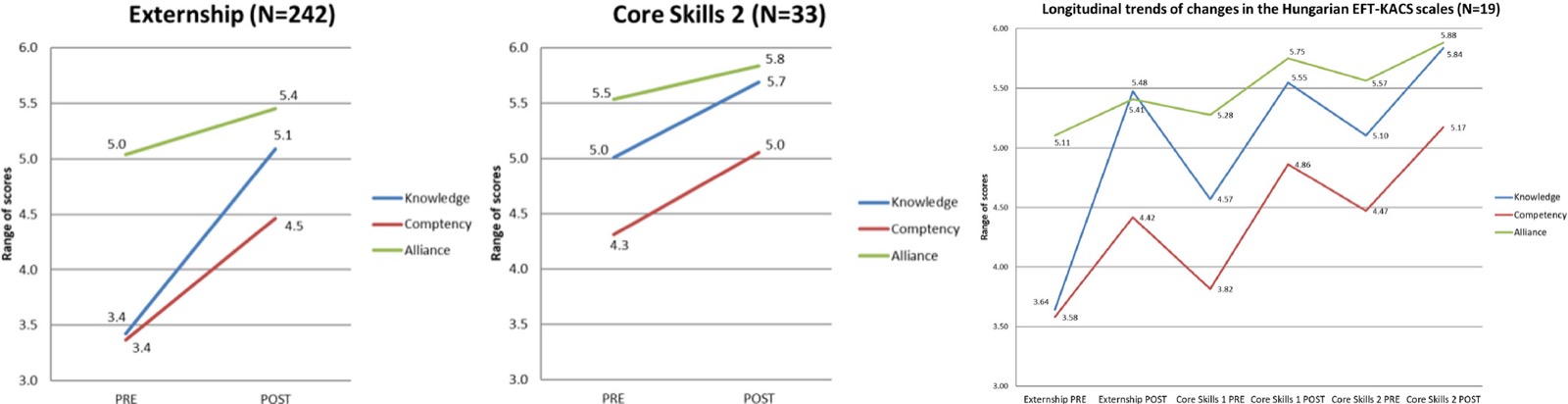
Hypothesis 3.Core Skills training will raise self-reported EFT knowledge, competency, and alliance higher than the level of knowledge, competency, and alliance at the end of the Externship training.
A subsample of 19 participants responded at all 6 measuring points. Figure 6 shows the longitudinal trends of changes in self-perceived Knowledge, Competency, and Alliance. Since the sample size is low, to measure the time by scales interactional effects we cannot use the statistically most appropriate 6-point repeated measures ANOVA for all the scales. Therefore, we conducted these analyses separately, longitudinally within the scales and across each measuring point between the scales.
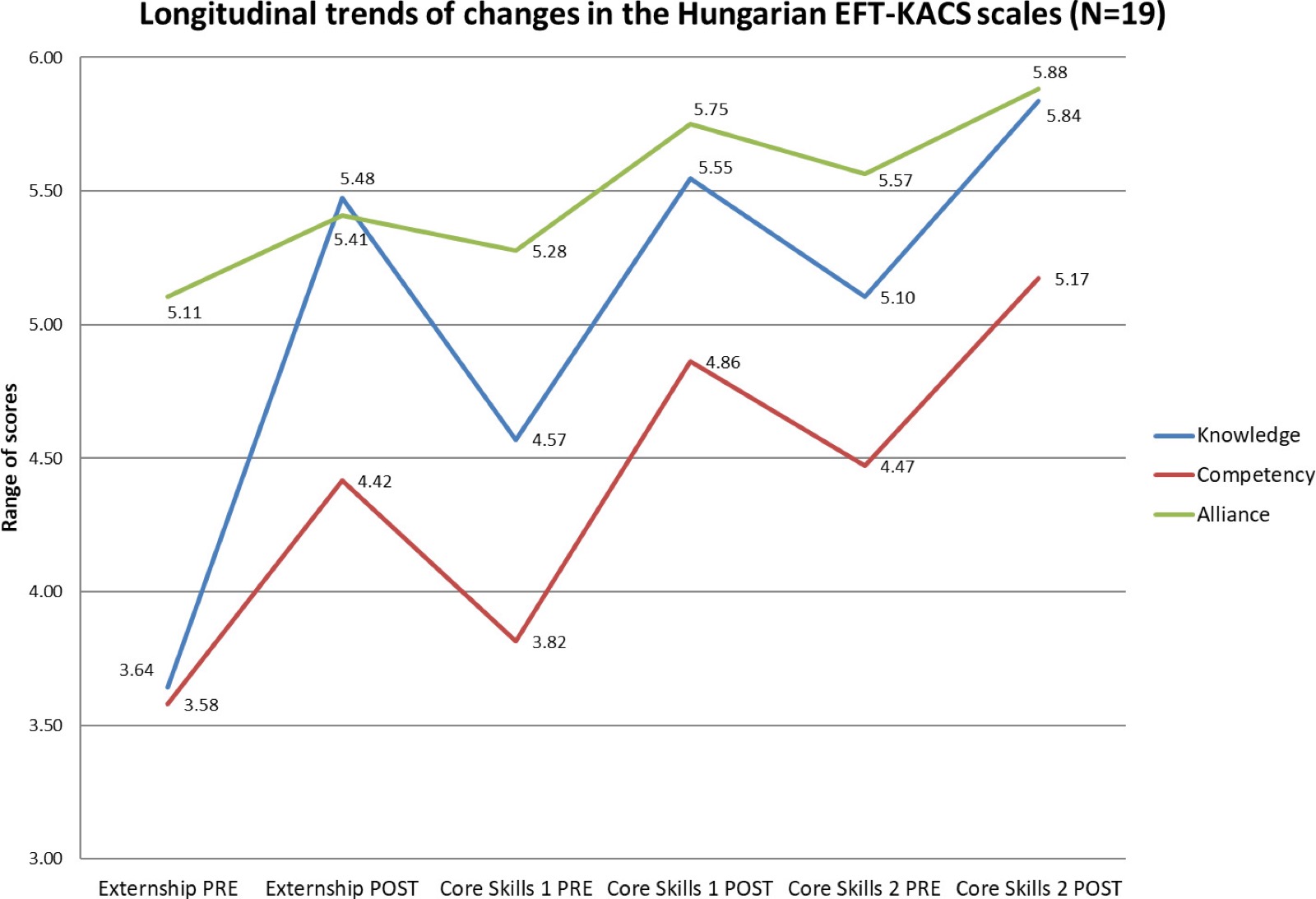
Table 5 and Figure 6 show the longitudinal trends of changes through the whole training process (6 points: Externship pre & post, Core Skills 1 pre & post, Core Skills 2 pre & post). All three scales showed the same pattern: there were significant increases between pre and post measures during each training block, followed by decreases between each training block. For Knowledge, the posttest measures after each Core Skills (M = 5.55 and M = 5.84) were not significantly higher than post-Externship scores (M = 5.48). For Competency, the pattern was similar, but the rates of change were different. There was a significant increase between post-Externship Competency (M = 4.42) and post-Core Skills 2 Competency (M = 5.17). During the Externship, the total increase was 0.84, while for the complete Core Skills (from pre-Core Skills block 1 to post-Core Skills block 2) the increase was 1.35. Therefore, the increase in Competency during Core Skills was greater than the increase during the Externship. Changes in Alliance were smaller but followed similar patterns in and between the training points. However, post-Externship Alliance was not significantly different than either of the post-Core Skills Alliance scores.
Table 5 — Longitudinal trends of changes in Knowledge, Competency, and Alliance through the whole training process
- Knowledge. F = 10.987; df = 5; error df = 14; Sig. .000; partial eta² = 0.797. Time trends: 1<2>3<4>5<6, 3<6, and 2=4=6, 2=5.
- Competency. F = 5.558; df = 5; error df = 14; Sig. .005; partial eta² = 0.665. Time trends: 1<2>3<4>5<6, 2<6, 3<6, and 1=3, 2=4, 2=5, 4=6.
- Alliance. F = 3.859; df = 5; error df = 14; Sig. .021; partial eta² = 0.580. Time trends: 1<2=3<4=5<6, 3<6, and 2=4=6, 1=3=5.
* 1 = Externship pretest; 2 = Externship post-test; 3 = Core Skills 1 pretest; 4 = Core Skills 1 post-test; 5 = Core Skills 2 pretest; 6 = Core Skills 2 post-test.
Paired sample t-tests were conducted to test the significance of mean differences between the Hungarian EFT-KACS scales at each measuring point. Table 6 shows that except for the Externship pretest Knowledge and Competency, and the Externship, Core Skills 1 and Core Skills 2 posttest Knowledge and Alliance, every other difference between scale means were significant. Alliance scores were generally higher than Knowledge scores (except Externship and Core Skills 2 posttest), and Knowledge scores were generally higher than Competency scores (except Externship pretest).
Table 6 — Mean differences between the Hungarian EFT-KACS scales at each measuring points
Original table rearranged as lists: paired differences (mean, SD, SE mean, 95% confidence interval), t, df, Sig.
- Externship PRE. Knowledge - Competency: mean 0.06; SD 0.54; SE mean 0.12; 95% CI −0.19 to 0.32; t = 0.52; df = 18; Sig. .608. Knowledge - Alliance: mean −1.46; SD 1.04; SE mean 0.24; 95% CI −1.96 to −0.96; t = −6.11; df = 18; Sig. .000. Competency - Alliance: mean −1.53; SD 1.02; SE mean 0.23; 95% CI −2.02 to −1.04; t = −6.53; df = 18; Sig. .000.
- Externship POST. Knowledge - Competency: mean 1.06; SD 0.76; SE mean 0.18; 95% CI 0.69 to 1.43; t = 6.05; df = 18; Sig. .000. Knowledge - Alliance: mean 0.07; SD 0.64; SE mean 0.15; 95% CI −0.24 to 0.38; t = 0.46; df = 18; Sig. .652. Competency - Alliance: mean −0.99; SD 0.66; SE mean 0.15; 95% CI −1.31 to −0.67; t = −6.52; df = 18; Sig. .000.
- Core Skills 1 PRE. Knowledge - Competency: mean 0.75; SD 0.92; SE mean 0.21; 95% CI 0.31 to 1.20; t = 3.59; df = 18; Sig. .002. Knowledge - Alliance: mean −0.71; SD 0.52; SE mean 0.12; 95% CI −0.96 to −0.46; t = −5.92; df = 18; Sig. .000. Competency - Alliance: mean −1.46; SD 0.80; SE mean 0.18; 95% CI −1.85 to −1.07; t = −7.93; df = 18; Sig. .000.
- Core Skills 1 POST. Knowledge - Competency: mean 0.68; SD 0.55; SE mean 0.13; 95% CI 0.42 to 0.95; t = 5.45; df = 18; Sig. .000. Knowledge - Alliance: mean −0.20; SD 0.57; SE mean 0.13; 95% CI −0.48 to 0.07; t = −1.55; df = 18; Sig. .139. Competency - Alliance: mean −0.89; SD 0.63; SE mean 0.14; 95% CI −1.19 to −0.58; t = −6.16; df = 18; Sig. .000.
- Core Skills 2 PRE. Knowledge - Competency: mean 0.63; SD 0.87; SE mean 0.20; 95% CI 0.21 to 1.05; t = 3.15; df = 18; Sig. .005. Knowledge - Alliance: mean −0.46; SD 0.83; SE mean 0.19; 95% CI −0.86 to −0.06; t = −2.43; df = 18; Sig. .026. Competency - Alliance: mean −1.09; SD 0.66; SE mean 0.15; 95% CI −1.41 to −0.77; t = −7.20; df = 18; Sig. .000.
- Core Skills 2 POST. Knowledge - Competency: mean 0.66; SD 0.69; SE mean 0.16; 95% CI 0.33 to 1.00; t = 4.19; df = 18; Sig. .001. Knowledge - Alliance: mean −0.04; SD 0.53; SE mean 0.12; 95% CI −0.30 to 0.21; t = −0.37; df = 18; Sig. .716. Competency - Alliance: mean −0.71; SD 0.53; SE mean 0.12; 95% CI −0.96 to −0.45; t = −5.80; df = 18; Sig. .000.
Hypothesis 3 was partially supported. Competency was significantly higher at the end of the Core Skills than it was at the end of the Externship. However, Knowledge and Alliance were not significantly higher.
DISCUSSION
This study is the first to evaluate any aspect of the EFT Core Skills training program. Our research builds on the existing Externship training effectiveness studies (Koren et al., 2020; Montagno et al., 2011; Rodriguez-Gonzalez et al., 2019) and measures the longitudinal effects of EFT trainings from the beginning of the Externship through the completion of the Core Skills trainings. We had a number of important findings that have implications for future training and research in EFT.
First, we found significant increases between pre and posttests for all three scales during each of the training blocks. In other words, every training block resulted in increases in knowledge, competency, and alliance. Our findings regarding the effectiveness of the Externship are consistent with previous research on EFT Externships (Koren et al., 2020; Montagno et al., 2011; Rodriguez-Gonzalez et al., 2019). However, this is the first research to demonstrate that Core Skills significantly increased knowledge, competency, and alliance. In fact, even attending one 4-day module of the Core Skills training was associated with a significant increase in knowledge, competency, and alliance. This demonstrates that the Core Skills is an effective and useful aspect of EFT training.
Second, participation in Core Skills was associated with a significantly higher increase in competency than participating in the Externship. This makes sense in part because the Core Skills has a strong focus on developing competency and makes extensive use of role-plays, case presentations, and individualized feedback. In the end, to help people, therapists must be able to competently use the model, not just know about the model. Therefore, participants who complete the Externship can have confidence that Core Skills training will increase their EFT competency compared to their competency at the end of the Externship. This is important given Sandberg et al. (2013) found that clinicians had difficulty learning and practicing EFT, particularly knowing how to understand and work with emotion.
Third, in line with existing Externship outcome studies (Koren et al., 2020; Montagno et al., 2011; Rodriguez-Gonzalez et al., 2019), we found that the Externship training was associated with greater increases in knowledge than competency. This is consistent with the Externship training pedagogy which focuses more on increasing knowledge through lectures, videos, and live demonstrations, than on developing competency. Although the Core Skills training reviews knowledge gained in the Externship, the main focus of Core Skills is on the application of that knowledge through developing competency in EFT skills. In the Core Skills trainings, knowledge and competency, although starting at different points, increased at about the same rate. Additionally, we found that although knowledge increased significantly in each training block, it did not increase significantly between the end of the Externship and the end of Core Skills. Consequently, it appears the Core Skills trainings are effective at refreshing the foundational knowledge gained in the Externship, and most importantly at increasing competency in the use of the model.
Fourth, there were significant declines in knowledge and competency after both the Externship and Core Skills training block 1. This is partially consistent with the Montagno et al. (2011) Externship study, which found significant declines in knowedge at follow-up (although competency did not decline significantly). In our study, the declines in competency may have occurred in part because there was not a certified EFT supervisor in Hungary during this time and therefore participants likely did not have supervision in the model after the Externship. We know they did not have Core Skills at the time of testing. Moreover, some of the participants in the Montagno et al. study may have had supervision and additional advanced EFT trainings such as Core Skills before their follow-up data were collected.
Fifth, Alliance was high before the Externship and increased modestly, but significantly, during each of the training blocks. This suggests that Alliance, as measured by the KACS, is a general skill (Buchholz & Abramowitz, 2020) and is not EFT specific. Additionally, unlike Knowledge and Competency, Alliance did not decline significantly between the trainings. Consequently, it appears that EFT training does improve the important general therapy skill of Alliance and that those improvements are maintained over time.
Implications for EFT training
The results of this study provide evidence that the EFT Externship and Core Skills trainings are effective in increasing EFT related knowledge, competency, and alliance. However, competency improves much slower than knowledge, particularly in the Externship. Consequently, it may be important to strengthen competency building aspects of the Externship, such as doing more experiential exercises focusing on the application of the model. Given that competency is lower than knowledge even through Core Skills, it is very important that Core Skills maintains and perhaps even increases its emphasis on competency development.
There were significant declines in both perceived knowledge and competency between trainings. Therefore, it may be valuable for EFT trainers and leaders to organize and encourage activities such as EFT peer consultation groups, case presentations, supervision, viewing training films, and doing specific readings.
Finally, our research indicates that Core Skills trainings are essential in maintaining self-reported EFT knowledge and improving self-reported EFT competency. Consequently, to master EFT skills, Externship participants should be strongly encouraged to continue their development in the model by doing the Core Skills trainings.
Strengths and limitations
Our study is the first to evaluate the effectiveness of the EFT Core Skills training, and the first to evaluate the effectiveness of the complete formal EFT training sequence from the Externship through the completion of Core Skills. The study has large sample sizes for most of the cross-sectional analysis (up to N = 244) compared to other research. Additionally, we analyzed completed data from 19 participants across 6 data collection points from before the Externship to the end of the Core Skills trainings. The data were collected at trainings held in Budapest, Hungary, thus adding to the dissemination and implementation research on EFT. There were no EFT supervisors in Hungary during this time, which means that our findings were not impacted by EFT supervision between the trainings.
Our study also has several limitations. The sample size for the longitudinal analysis was only 19, which weakened statistical power. Had we had a larger sample we may have been able to detect significant differences between each of the posttraining blocks for all three scales. We used a self-report instrument, so the results are a subjective evaluation of participants’ self-perceived knowledge, competency, and alliance. We also had no control group. The trainings were performed in Hungary, and most were performed in Hungarian through translation which means that the results may not generalize to people in other countries or people being trained in their native language. However, previous research indicates that EFT training can be performed successfully through translation (Koren et al., 2020).
Finally, the Core Skills trainings in Hungary were performed in two 4-day blocks, which is often the case in areas where there is not a local EFT trainer. However, in areas where there are local EFT trainers, the Core Skills training is typically performed with four 2-day modules. Consequently, these results may not generalize to areas where Core Skills is performed with four 2-day modules.
Suggestions for future research
Future research should verify our results with a larger sample and with a sample that includes people from multiple countries and locations. Additionally, it would be helpful to have a control group and use objective as well as subjective measures. Although the results of Externships performed through translation are consistent with Externships performed in English with English speaking therapists (Koren et al., 2020), and performed in Spanish with Spanish speaking therapists (Rodriguez-Gonzalez et al., 2019) it could be valuable to ensure that the Core Skills results performed through translation are consistent with Core Skills training performed in the language of the participants. Additionally, it would be valuable to study whether doing the Core Skills training in two 4-day modules, or four 2-day modules makes a difference in its effectiveness.
Future research could also evaluate how the experience levels of the participants would impact the effectiveness of the Core Skills training. It would be valuable to follow people through the completed certification and evaluate the impact of supervision and the impact of identifying and submitting videos and case writeups of therapists’ own work.
Finally, Alliance, as measured by the EFT-KACS, appears to be a general (couple) therapy skill and not specific to EFT. Consequently, the Alliance questions could be dropped from the EFT-KACS when it is used to measure EFT-specific skills.
Conclusion
Our findings demonstrate that the EFT training program from the Externship through the Core Skills trainings is effective in increasing EFT knowledge, EFT competency, and alliance. Furthermore, most of the participants’ knowledge was gained during the Externship and refreshed during Core Skills, while most of their competency was gained during Core Skills. Consequently, the Core Skills training is essential to train competent EFT therapists.
Complexe Systémique: key points
The study puts figures on an experience familiar to anyone in training: understanding a model is not enough to know how to use it. After the Externship, knowledge of emotionally focused therapy leaps, but perceived competency lags behind; it catches up during Core Skills, with role-plays, case presentations and feedback on one’s own videos. Two lessons reach beyond EFT. First, gains fall back between trainings when nothing sustains them: in Hungary, in the absence of certified supervision, peer consultation and supervision appear as the framework of learning, not an extra. Second, alliance, high from the start and stable, looks more like a general therapist skill than a model-specific one. The limitations are clear: self-report only, no control group, 19 people followed from start to finish, trainings largely delivered through interpretation. What the study measures is confidence in one’s skills, not the quality of sessions. Read alongside the study on adding video feedback to EFT supervision, and the article on the cultural adaptation of EFT and its training in Uganda.
Notes from the original
Endnotes. 1 Data downloaded from webofknowledge.com on 08.07.2020. 2 We analyzed the pre-post changes within each training block separately (with different sample sizes) which makes the analysis cross-sectional.
References
Beasley, C. C., & Ager, R. (2019). Emotionally Focused Couples Therapy: A systematic review of its effectiveness over the past 19 years. Journal of Evidence-Based Social Work, 16(2), 144–159. https://doi.org/10.1080/23761407.2018.1563013
Bell, C. A., Denton, W. H., Martin, G., Coffey, A. D., Hanks, C. O., Cornwell, C. S., & Priest, J. B. (2017). Learning Emotionally Focused Couple Therapy: Four clinicians' perspectives. Journal of Couple & Relationship Therapy-Innovations in Clinical and Educational Interventions, 17(1), 61–78. https://doi.org/10.1080/15332691.2017.1310638
Bowlby, J. (1969). Attachment and loss: Volume 1: Attachment. Basic Books.
Bowlby, J. (1979). The Bowlby-Ainsworth Attachment Theory. Behavioral and Brain Sciences, 2(4), 637–638.
Brubacher, L. L. (2017). Stepping into Emotionally Focused Couple Therapy. Routledge.
Buchholz, J. L., & Abramowitz, J. S. (2020). The therapeutic alliance in exposure therapy for anxiety-related disorders: A critical review. Journal of Anxiety Disorders, 70, 102194. https://doi.org/10.1016/j.janxdis.2020.102194
Denton, W. H., Johnson, S., & Burleson, B. (2009). Emotion-Focused Therapy - Therapist Fidelity Scale (EFT-TFS): Conceptual development and content validity. Journal of Couple and Relationship Therapy, 8, 226–246. https://doi.org/10.1080/15332690903048820
Denton, W. H., Wittenborn, A. K., & Golden, R. N. (2012). Augmenting antidepressant medication treatment of depressed women with emotionally focused therapy for couples: a randomized pilot study. Journal of Marital and Family Therapy, 38(Suppl 1), 23–38. https://doi.org/10.1111/j.1752-0606.2012.00291.x
Furrow, J. L., Palmer, G., Johnson, S. M., Faller, G., & Palmer-Olsen, L. (2019). Emotionally Focused Family Therapy. Routledge.
Johnson, S. M. (2019). Attachment Theory in Practice. Emotionally Focused Therapy (EFT) with Individuals, Couples, and Families. The Guilford Press.
Johnson, S. M. (2020). The Practice of Emotionally Focused Couple Therapy ( 3rd ed.). Routledge.
Johnson, S. M., Bradley, B., Furrow, J., Lee, A., Palmer, G., Tilley, D., & Woolley, S. R. (2005). Becoming an EFT therapist: The workbook. Brunner-Routledge.
Johnson, S. M., & Greenberg, L. S. (1985a). Differential-Effects of Experiential and Problem-Solving Interventions in Resolving Marital Conflict. Journal of Consulting and Clinical Psychology, 53(2), 175–184. https://doi.org/10.1037//0022-006x.53.2.175
Johnson, S. M., & Greenberg, L. S. (1985b). Emotionally Focused Couples Therapy - An Outcome Study. Journal of Marital and Family Therapy, 11(3), 313–317. https://doi.org/10.1111/j.1752-0606.1985.tb00624.x
Koren, R., & Török, S. (2016). The Hungarian EFT Knowledge and Competency Scale (Hungarian EFT-KACS). https://www.eft-parterapia.hu/wp-content/uploads/2020/05/Magyar-EFT-KACS.pdf
Koren, R., Woolley, S. R., Danis, I., & Török, S. (2020). Measuring the Effectiveness of the Emotionally Focused Therapy Externship Training in Hungary done through Translation. Journal of Marital and Family Therapy, 1–17. https://doi.org/10.1111/jmft.12443
Levenson, H., & Svatovic, M. (2009). The EFT knowledge and competency scale: Construction and psychometric properties. Unpublished Manuscript.
Montagno, M., Svatovic, M., & Levenson, H. (2011). Short-term and long-term effects of training in emotionally focused couple therapy: professional and personal aspects. Journal of Marital and Family Therapy, 37(4), 380–392. https://doi.org/10.1111/j.1752-0606.2011.00250.x
Rodriguez-Gonzalez, M., Schweer-Collins, M., Greenman, P. S., Lafontaine, M. F., Fatas, M. D., & Sandberg, J. G. (2019). Short-term and long-term effects of training in EFT: A multinational study in Spanish-speaking countries. Journal of Marital and Family Therapy, 46(2), 304–320. https://doi.org/10.1111/jmft.12416
Rogers, E. M. (2003). Diffusion of Innovations ( 5th ed.). Free Press.
Sandberg, J. G., Brown, A. P., Schade, L. C., Novak, J. R., Denton, W. H., & Holt-Lunstad, J. (2015). Measuring Fidelity in Emotionally Focused Couples Therapy (EFT): A Pilot Test of the EFT Therapist Fidelity Scale. American Journal of Family Therapy, 43(3), 251–268. https://doi.org/10.1080/01926187.2015.1034637
Sandberg, J. G., Knestel, A., & Cluff Schade, L. (2013). From Head to Heart: A Report on Clinicians’ Perceptions of the Impact of Learning Emotionally Focused Couple Therapy on Their Personal and Professional Lives. Journal of Couple and Relationship Therapy, 12, 38–57. https://doi.org/10.1080/15332691.2013.750076
Sandberg, J. G., Rodrıguez-Gonzalez, M., Pereyra, S., Lybbert, R., Perez, L., & Willis, K. (2019). The experience of learning EFT in Spanish-speaking countries: A multi-national replication study. Journal of Marital and Family Therapy, 46(2), 256–271. https://doi.org/10.1111/jmft.12383
Wiebe, S. A., & Johnson, S. M. (2016). A Review of the Research in Emotionally Focused Therapy for Couples. Family Process, 55(3), 390–407. https://doi.org/10.1111/famp.12229
Wittenborn, A. K. (2012). Exploring the influence of the attachment organizations of novice therapists on their delivery of emotionally focused therapy for couples. Journal of Marital and Family Therapy, 38(Suppl 1), 50–62. https://doi.org/10.1111/j.1752-0606.2012.00290.x
Reformatted republication of Training therapists in emotionally focused therapy: A longitudinal and cross-sectional analysis, by Réka Koren, Scott R. Woolley, Ildikó Danis and Szabolcs Török, Journal of Marital and Family Therapy, vol. 48, no 3 (2022), doi: 10.1111/jmft.12495, under a CC BY 4.0 licence. Edition and layout: Complexe Systémique, September 2026 — the work has been modified under the terms of the licence (tables presented as lists). Neither the authors nor the publisher are responsible for this edition; the original version prevails.
This is the original article “Training therapists in emotionally focused therapy: A longitudinal and cross-sectional analysis”, published in Journal of Marital and Family Therapy (2022) under a CC BY 4.0 licence. Republished by Complexe Systémique: the author’s text is unchanged; only the presentation has been adapted for reading online, as set out at the head of this page.
Read the original articleHow to cite this article
Koren, R., Woolley, S. R., Danis, I., et Török, S. (2022). Training therapists in emotionally focused therapy: A longitudinal and cross-sectional analysis. Complexe Systémique. https://app.complexe-systemique.com/en_GB/articles/training-therapists-in-emotionally-focused-therapy-a-longitudinal-and-cross-sectional (Original work published in 2021 in Journal of Marital and Family Therapy, 48(3), 709-725 (2022); republished in 2022 by Journal of Marital and Family Therapy, https://onlinelibrary.wiley.com/doi/full/10.1111/jmft.12495)
To go further
- Effects of adding video feedback to emotionally focused therapy supervision: A concurrent multiple‐baseline across subjects designSupervising with video.
- Culturally Informed Adaptation of Emotionally Focused Couple Therapy and Training for a Ugandan PopulationTraining in EFT in Uganda.
- Empathic Conjectures in Emotionally Focused Couple Therapy (EFCT): A Process Microanalytic StudyEmpathic conjectures.
Related training courses
 Symposium
État des Lieux: a psychological approach to spaces
Replay of the “État des Lieux” conference (Paris, 16 October 2026): Ivy Daure, Maurizio Frisina, Viola Sallay and Gilbert Pregno on places as a clinical resource. In French.
 Certifying course
Training in Systemic Therapy and Interventions – Cycle 1
Certifying training cycle in systemic therapy and interventions – year 1. Courses, supervision and practice, aligned with EFTA/SFTF. In French.
 Certifying course
Training in Systemic Therapy and Interventions – Cycle 2
Certifying training cycle in systemic therapy and interventions – year 2. Clinical complexity, supervision and practice. EFTA/SFTF aligned. In French.
 Certifying course
Training in Systemic Therapy and Interventions – Cycle 3
Certifying training cycle in systemic therapy and interventions – year 3. In-depth intervention, supervision and practice. EFTA/SFTF aligned. In French.
Related articles
 Blog
Challenging in therapy: What a patient taught me
A couples therapy session led me to reflect on confrontation, authenticity and resonance: how to address difficult behaviour without invalidating the person.
 Scientific
Decolonizing Supervision: A Critical Race and Queer Theory Framework for Marriage and Family Therapy
Supervision is not neutral: a framework drawing on Critical Race Theory and Queer Theory to name and share power in supervision, with a vignette.
 Scientific
Digital Co-Regulation and Dysregulation in Romantic Relationships: A Systemic Model of Technology-Mediated Emotional Processes
Checking, chasing, blocking: 31 interviews show how the phone regulates or dysregulates a couple’s anxiety, with a systemic model of the loop.
 Scientific
“One Can Have All Sorts of Good Intentions but Sometimes in Everyday Life, It Turns Out Differently”: Change Agreements in Couples' Everyday Lives
Six Danish couples followed after an online couple program: their change agreements become guilt-inducing contracts, shared understanding or revealers of inequality.